




Abstract
Following the nationwide implementation of the Village Funds, the government attempted to accelerate rural economic growth through rural enterprises (Badan Usaha Milik Desa/BUMDes). This study aimed to analyze how social capital affects village-owned enterprise management to accelerate rural economy. This study was conducted in 2018 and applied a qualitative approach and case study design with a content analysis method derived from interviews, observations, and legal documents. The analysis shows that stakeholders’ development visions to initiate the establishment are critical to determining the management and cooperation of rural enterprises, especially regarding the common direction of development. This study’s results show that, presently, rural enterprises have a low impact on rural economic growth. This study also argues for policy implications by highlighting the importance of social capital and village local assets to determine BUMDes development in Indonesia. Specifically, local policies should also aim to enhance community participation and improve BUMDes’ human capital on management and marketing.
Introduction
Despite urban-bias policies, the government has attempted rural development through various programs without satisfactory results. Economic institutional systems and mechanisms in rural areas do not work effectively; rather, they have caused further dependence on government assistance, thus limiting the spirit of independence (Zulkarnaen, 2016). The government initiated a more balanced development in the Indonesia Medium-term Development Plan (RPJMN) 2015 to 2019 by introducing the national program “building Indonesia from the rural area by strengthening regions and villages within the framework of the Unitary State of the Republic of Indonesia.” This is implemented by issuing Village Law, which allows villages as the development arena through government policies, development funds, and community empowerment.
The implementation of the Village Funds is expected to stimulate and drive the economic wheels in rural areas by establishing Village Owned-Enterprises (Badan Usaha Milik Desa/BUMDes). The Law No. 6 of 2014 concerning villages states that BUMDes was among the four priorities for using Village Funds directed by the Ministry of Villages for Disadvantaged Areas and Transmigration in 2017.
Cianjur Regency is among the districts with a low average index of developing villages (IDM) and also among the districts with the most disadvantaged villages in West Java Province. Unexpectedly, the Regency continued to have a higher poverty rate after the implementation of the Village Funds, with the Gini ratio index increasing from 0.28 in 2016 to 0.36 in 2017 (West Java BPS data, 2017). However, the number of BUMDes increased from 52 in 2016 to 126 in 2017. Using two case studies, Sukanagalih and Sindangjaya Villages were among the villages with BUMDes after the Village Funds was implemented. Although both villages are located in the northern area of Cianjur Regency and near various tourist sites, BUMDes were formed with different approaches. While BUMDes was initiated by the community in Sukanagalih village, the village government initiated it in Sindangjaya village. Thus, it is important to examine the differences in social capital and establishment history in influencing the economic performance of BUMDes.
The rural diversification literature provides a starting point for examining how rural development could be implemented. The term “rural diversification” refers to the economic development of non-agricultural activities or livelihoods as a transformation toward a new structure of rural economy. The transformation may be like a growing output, productivity, or shifts in economic structure defined by both internal (such as entrepreneurship, location, skills, capital, and market) and external factors (such as government policies, target sectors, and investment criteria) and the dynamic relationship between these factors (Kelly & Ilbery, 1995; Rijanta, 2006; Start, 2001). Furthermore, the transformation and economic structure question the implications for rural societies, traditional life, and the impact on well-being.
Although the literature highlights the trade-offs between increased growth and more equitable opportunity, as to what extent the rural economy should develop, labor markets should be regulated, and how rural micro-enterprises should be expanded (Start, 2001), the literature lacks discussion on how internal and external factors may influence the rural economy. Thus, we consider the social capital theory that has been widely studied to examine its impact on rural enterprise and economy. Particularly, studies on how social capital influences rural enterprise performance range from examining the impact of social capital on the welfare and resilience of rural communities (Ali & Yousuf, 2019; Lang & Fink, 2019; Roxas & Azmat, 2014) to the study of the impact of the social enterprise on community welfare (Morrison & Ramsey, 2019; Pratono & Sutanti, 2016; Steiner & Atterton, 2015; Steiner & Teasdale, 2019), and the study of the role of social enterprise in encouraging community empowerment (Haugh & Talwar, 2016).
However, how social capital in each village contributes to the economic performance of BUMDes remains unexplored. This study aims to analyze how social capital affects village-owned enterprise management to accelerate rural economy. The study hypothesizes that the differences between the history of BUMDes and the social conditions of the community affect the performance of the BUMDes. This study contributes to the discussion on social capital in rural enterprise generally and in rural enterprise particularly. Specifically, in-depth interviews were conducted to address the following questions: What are the impacts of different historical establishments? How does social capital determine the economic performance of rural enterprises?
The structure of this study is as follows: the next section discusses the literature review on the social capital and economic performance of rural enterprise. This is followed by the research methodology. Section 4 discusses the results of the qualitative analysis, followed by the conclusion.
Literature Review
Here, the study revisited broad literature related to social rural enterprises, social capital, and the implementation of BUMDes in Indonesia.
Social Rural Enterprises and Village-Owned Enterprises
The current literature, dominantly from the global north, recognizes the social rural enterprise as an institution that combines the social enterprise and the rural company. Here, social rural enterprises offer a comprehensive approach to overcoming rural problems, where they are supported by the culture and customs of local communities. Thus, rural enterprises could adapt to changes from outside where the aspect of the local communities is contained, such as social structure, social capital, and cultural values (Steiner & Teasdale, 2019).
Many studies have been conducted concerning how the process of establishing social rural enterprises vary between countries. For example, in Sweden, the establishment of social rural enterprises is dominated by local initiatives and is accepted by the community; in the United Kingdom (UK), it is dominated by government regulations so that many social rural enterprises can be opposed by the local community (Richter, 2019); and in China, social rural enterprises (or Township and Village Enterprises [TEVs] are established by government regulations [Zhao & Wong, 2002]).
However, simultaneously, social rural enterprises also face challenges such as a limited number of competent workers in the business and capacities to impact economic development. Several studies have analyzed the impact of social rural enterprises on agricultural economic growth (Zhao & Wong, 2002), community resilience (Steiner & Atterton, 2015), and rural innovation encouragement (Richter, 2019). Also, some studies have shown the importance of rural enterprise on economic development through improving management and accountability (Susilo & Purnamasari, 2016) and providing new opportunities to increase community income (Lenu et al., 2015). However, there is a lack of literature that explicitly depicts channels of social enterprise in generating economic value for the village.
Rural Diversification, Social Capital, and Economic Performance
This study employs the concept of rural diversification that emphasizes a comprehensive approach to rural change by considering the interaction between internal and external factors. Internal factors include motivating factors (studies show that businesses aim beyond money-making and profit maximization in rural areas [Chell et al., 1991]), personal characteristics (levels of skill, training, and experience), and entrepreneurship characteristics (tend to be small-medium in size, considering planning procedures, and also lack of investor experience). Previous studies have also highlighted that the nature of rural enterprise determines the level of training and experience required. For instance, farm families do not commonly require additional skills other than prior domestic experience, while high-tech engineering firms require specific expertise (Kelly & Ilbery, 1995).
Also, external factors may include international trade policies, national industrial sectorial development targets, the increasing importance of industrial and financial capital to support small businesses as their limited economic of scale for operation, and lack of a proven track-record in business. Also, there is a need to hire consultants who provide information advice on grant-application jargon and planning application formats (Kelly & Ilbery, 1995). To conduct their work, entrepreneurs or champions as individual diversifiers are commonly controlled by the state-sponsored bodies in developing the rural enterprise; hence, they should work together with external bodies such as state-agricultural and industrial agencies, financial, and information institutions, and the national planning system. Therefore, rural diversification can only be implemented by examining the policies and attitudes of various public and private agencies to target certain interest groups in determining the adoption level (and non-adoption) of rural diversification in a rural area (Kelly & Ilbery, 1995).
The rural diversification approach further suggests an interactive environment where a two-way relationship occurs when external policies and investment targets are responded to by entrepreneurs (through involvement, cooperation, and utilization) as feedback for the government and external policymakers to adapt its sectoral target or policy accordingly. This interactive relationship has provided a framework for rural diversification to be operationalized.
Furthermore, to understand how the above factors are operationalized to examine rural enterprise performance, it is necessary to discuss social capital. First, it is insufficient to simply discuss capital, as known in economic theory (Bourdieu, 1986); however, it is also important to know the forms of transactions that are considered in economic theory as non-economic (or social) transactions because they cannot directly maximize material profits. Second, social capital is defined as the whole of actual and potential resources associated with the ownership of a stable institutional relation based on mutual recognition. Thus, the amount of social capital owned by a member of a group depends on the extent to which the quantity and quality of the relations can be created and how much economic, cultural, and social capital volume is owned by those in their relationship network (Bourdieu, 1986).
Social capital is a conceptual means of understanding the theoretical orientation of social action by linking components from sociological and economic perspectives (Coleman, 1988). Social capital can be seen as a framework that covers aspects of social structure and facilitates people to do something within this framework. Consequently, social capital fosters rural entrepreneurship through various channels, such as empowering social networks (Prayitno et al., 2020), training and skill improvement programs (Roxas & Azmat, 2014), and women’s empowerment (Haugh & Talwar, 2016; Saadi et al., 2016).
There are at least three main elements that became the pillars of social capital. The first is obligations and expectations arising from the sense of trust in the social environment. This mutual trust in a social network reinforces norms regarding the need to help one another achieve one vision as a convergence of perception. Second, mutual trust smoothens the information flow in the social structure to encourage the development of activities in the community. This confirms Putnam (1993), who argued that social networks allow coordination and communication, which foster mutual trust among fellow community members. Thus, collaboration in this network encourages continuous cooperation. Third, the norms of reciprocity are learned by the community through local culture or persistent instruction. Consequently, the community stated that these norms must be obeyed with clear and effective sanctions. Thus, norms of reciprocity are only produced through participation, as trust and networks are fostered among community members.
As mentioned above, social capital also acts as the social organization features as trusts, networks, and norms that facilitate coordination and cooperation for mutual benefits (Putnam, 1993). Social capital, akin to norms and linked networks, is a precondition and prerequisite necessary for good and effective governance. Also, social capital can also bridge the gap between groups with different ideologies and strengthen agreements on the importance of community empowerment.
Rural Enterprises in Indonesia: An Analytical Framework
In Indonesia, social rural enterprise is regulated by Village Funds Law No. 6/2014 and established as Village-Owned Enterprises (Badan Usaha Milik Desa/BUMDes). The law defines BUMDes as a business entity where the entire or most of their capital is owned by the village through direct participation from the separated property of the village for the management of assets, services, and other businesses for the maximum welfare of the village community. The law also states that BUMDes is established to increase Village Own-Source Revenue (Pendapatan Asli Desa/PAD). As an economic institution in the village, BUMDes should be distinctive from conventional economic institutions so that the existence and performance of BUMDes can significantly improve the village’s welfare. However, as regulations determine priority of Village Funds expenditure for each year, many villages focus to establish and set-up BUMDes, thus the impact on BUMDes may only be studied in the following years (Iskandar & Aritenang, 2020). For instance, these regulations are Ministry of Village Development of Disadvantage Region and Transmigration Regulation No. 5/2015 and No. 19/2017 on Priorities for the Use of Village Funds in 2015 and 2017, respectively.
The Ministry of Villages, Disadvantaged Regions, and Transmigration Regulation No. 4/2015 stipulates that the planning of BUMDes development can be conducted from above (Top-Down) and from below (Bottom-Up). The top-down planning refers to BUMDes that is established with instructions from the government or village officials. However, the bottom-up planning describes that BUMDes is established by the initiative of the local community that accounts for and accommodates local needs and aspirations.
Like social rural enterprises, BUMDes acts as a pillar of economic activity in the village that functions as a socio-economic institution. The social rural enterprises can be described as businesses that primarily focus on social roles where the gained economic benefits are used to achieve the social role (Chell, 2007). As a social institution, BUMDes accommodate public interest through its contribution to providing social services. Also, as an economic institution, BUMDes seek profits by offering local resources (goods and services) to the market (see Figure 1).

The social and economic role of BUMDes.
Hence, two important issues in the development of BUMDes are (i) the relationship between the management of BUMDes and the village government, and (ii) the professional aspects of the management of BUMDes (Susilo & Purnamasari, 2016). First, it is important to acknowledge that BUMDes and the village government are closely related because the village government supervises BUMDes activities. In making decisions, BUMDes uses village stakeholder discussion (musyawarah) as a discussion mechanism, and the village government acts as the main stakeholder in the discussion process. BUMDes and village governments are challenged with maintaining a balanced relationship where the dominance of one group over the other groups should be avoided.
Second, as BUMDes has two potentially conflicting functions simultaneously, the manager of the organization must have agility in accommodating the conflicting alignments, as argued by Duncan (1976). Therefore, the management of BUMDes must be more open to simultaneously developing social and professional management patterns. The management of BUMDes must be performed using cooperative, participatory, emancipatory, transparent, accountable, and sustainable principles with member-based and self-help mechanisms that are run professionally and independently (Ferdianto, 2016). Through self-help and member-based mechanisms, the BUMDes also embodies the participation of the village community whole so that it does not create a business model hegemony by only certain groups at the village level.
Thus, BUMDes as a social and economic institution depends heavily on local social capitals that arrange norms and rules that govern the relationship between the management of BUMDes and village officials, the trust between the management of BUMDes and village officials, and networks owned by the management of BUMDes and village officials. By focusing on lagging regions, this study contributes to the understanding of how social capital determines economic performance in rural enterprise. In lagging regions, technical knowledge and economic capital are limited (Farmer et al., 2008; Steiner & Atterton, 2015; Steiner & Teasdale, 2019). The study captures variations in trust, networks, and norms in villages that determine how social capital determines economic performance in rural enterprises.
Research Methods
This study considers the role of social capital in the economic performance of rural enterprises. Therefore, social capital determines the establishment process of BUMDes through coordination and collaboration between the village community or government. Consequently, this affects the economic performance of BUMDes to accelerate the village economy and increase local community participation.
Research Design
As this study examines how social capital determines the economic performance of BUMDes, it employs a qualitative method. This method was chosen to provide insight into ways BUMDes could benefit from social capital to increase their economic performance. Furthermore, by employing a multiple case study approach, the study could verify potentially contrasting results and reflect them on the theoretical framework (Yin, 2013).
This study uses qualitative analysis for several reasons. First, we have limited data on village enterprises because only two case studies and relatively young village enterprise were examined. The law on village enterprises was issued in 2015, and in the case studies, village enterprises were established in less than 3 years of the survey we conducted in 2018. Second, the lack of data accuracy and different periods of available data suggest that the study could not simply compare quantitative economic performance between the case studies. These limitations hinder quantitative analyses, such as descriptive statistics and regression. We prefer to analyze qualitatively by understanding social capital and economic performance’s role in developing village enterprises, following previous studies that examine the impact of social capital on economic performance, such as Fahmi (2019) and Rutten and Boekema (2007).
The operationalization of social capital and economic performance indicators are derived from Government Regulation No. 43/2014 on Implementation Regulations of Law 6/2014 on Village Development, Government Regulation No. 11/2021 on Village Enterprises, and Regulation Ministry of Village, Lagging Regions, and Transmigration No. 4/2015. First, village enterprises rely on social capital through emphasis on local endowments for business development, business cooperation plans between villages, and/or with third parties and create market opportunities and networks. Second, the importance of economic performance on village enterprise by improving economic activities, generating economic profit, and accelerating village community income and owned-source revenue economic growth in the village. Particularly, the following table depicts the operationalization of social capital and economic performance (Table 1).
Economic Indicators of BUMDes Performance.

Data Collection and Analysis
In this study, Cianjur Regency was chosen because it is an area with underdeveloped villages in West Java Province. From 354 villages, two research locations were selected based on the following criteria: (i) BUMDes that were formed only after the existence of Village Funds law; (ii) Having various business units, (iii) Located within the same development area (North Cianjur, Central Cianjur, or South Cianjur); and (iv) Two different establishment histories, one initiated by the village apparatus and another by the community.
Primary data were collected through a semi-structured format, where interview questions develop along with the interview process. Using the purposive sampling method, the selected informants were directly involved in the management of BUMDes in the two villages as case studies. These data were gathered from previous studies, official documents, archives, regulations, and interview transcripts.
The interviews were conducted in June to August 2018 to confirm social capital, networking behaviors at different levels, and economic performance. In Sukanagalih village, four key informants were interviewed: village secretary, chairman, daily manager of BUMDes Berkah Utama Mandiri, and a village Bank Employee. In Sindangjaya village, three interviews were held with the Head of Village, Chairman of BUMDes Sugihjaya, and Youth Organization of Sindangjaya Village. The selection of interviewees was based on a purposive sampling principle with the following criteria: (i) representative of the village governments; (ii) representative of BUMDes; (iii) representative of an institution that has work together with the BUMDes. In selecting key informants, a desk study was first conducted to identify some potential interviewees, including the government and BUMDes representatives. Whilst interviews with the representative of institutions that have worked with BUMDes were based on recommendations from previous key informants (snowballing).
The analytical method used in this research is qualitative content analysis, which studies social phenomena by considering written documents, sorting out relevant data, and clarifying information obtained from different sources, including field observations and interviews (Babbie, 2007). The recorded interviews were transcribed and further analyzed by data reduction, data display, and conclusion drawing (Miles et al., 2013). In data reduction, the transcripts were coded and classified into social capital and economic performance categories derived from the theoretical framework presented in the previous section. In the data display, the relevant data were collected and presented to compare and contrast the results of the two cases. The conclusions were drawn by extracting important features through validity checking and examining similarities and differences between the case studies.
Analysis
This section examines the establishment process and social capital that influence the economic performance of BUMDes.
The Establishment Process of BUMDes
Here, we examined the establishment process of BUMDes to understand the social capital in each village (Table 2).
BUMDes Establishment Comparison of Two Case Studies.

First, BUMDes Sukanagalih comes from local community initiatives, based on the initiative of AH, who is the director and founder of that BUMDes. Overall, he founded the BUMDes by himself, including compiling the establishment concept, presenting to the village officials, and drafted Village Regulations and Memorandum and Article of Association (Anggaran Dasar-Anggaran Rumah Tangga/AD/ART). After the BUMDes was officially established through village regulations in 2015 and Memorandum and Article of Association in 2016, the village government was not convinced to provide capital investment to BUMDes. The interview suggested that this was due to unclear regulations on how to use the Village Funds from the central government. The lack of understanding and interest also shown with the election of BUMDes’ management members was without village government consultation. Therefore, in the initial stages, the capital for the development of BUMDes came from AH’s own money along with other BUMDes administrators.
“When I saw the opportunity to establish a BUMDes, I asked the village officials to understand what BUMDes was, but they did not really know as well. Therefore, I looked for the information about this BUMDes on my own” (Presentation of Director of BUMDes Sukanagalih, 9 May 2018).
In a different process, BUMDes Sugihjaya was established in the interest of village officials, and the local community were also involved. The BUMDes establishment was also supported by Village Law No. 3/2018 on BUMDes Sugihjaya establishment. The result of the village initiatives is the creation of the BUMDes business unit, the chairman, and the village regulations regarding the establishment of BUMDes. To establish and develop the BUMDes, Sindangjaya Village also collaborated with consultants from the West Java Community Entrepreneurship Incubation Centre (Pusat Inkubasi Kewirausahaan Masyarakat/PIKUM). At the beginning of the establishment in 2016, no capital was provided. However, in 2018, BUMDes Sugihjaya received a capital investment of 200 million IDR from the village government and was given assets in the form of a building (Graha BUMDes) located in front of the village office. The provided capital was determined by the village officials who had been communicated and consulted with the community. Regarding staff recruitment, BUMDes Sugihjaya chose its employees through the recruitment process.
Analysis of the Role of Social Capital in Managing BUMDes Berkah Utama Mandiri, Sukanagalih
The first indicator is a common perception among village officials, the management of BUMDes, and the local vision to brand Sukanagalih Village as a tourism village. Sukanagalih Village is located between two existing tourism locations in Cianjur: the Nusantara Flower Garden (Taman Bunga Nusantara) and the City of Flower (Kota Bunga). However, despite there is a consensus on the main policy, the director of BUMDes stated that he did not get any recommendations regarding the development of BUMDes.
“. . . I should have been given direction by the head of the village. In other villages, it is the head of the village who has taken the initiative . . . We do not get any direction. We also have to wait. It is why I have said many times since last year that if this village wants to be recognised, we must think about what this village wants to be recognised as. Previously, people knew Sukanagalih Village as the city of flower or the village of widows. But, today, since the existence of the village of irrigation, it is not like that anymore. People know Sukanagalih Village because of this. Therefore, if the village has a vision and it connects to BUMDes, it will be easy. But, here, it is unclear. We do not know what to do” . . . (Interview with the Director of BUMDes Sukanagalih, 9 May 2018).
Social norms of reward were further showcased with the establishment process when AH drew up a Village Regulation about BUMDes and immediately asked village officials to sign the document without going through village musyawarah. Mr. AH decided not to present the idea of developing BUMDes in the village meeting because of several things, including (i) the process taken would be longer, (ii) the struggle between citizens, and (iii) concepts and regulations that he had been prepared would be potentially replaced if someone else is to be appointed as BUMDes chairman.
“This [BUMDes] would not establish if the musyawarah was set. . .I really do not like it if the draft must first be shown to the public. I spoke on the forum in the second year. At that time, I also reported what had been done in BUMDes. If in the beginning, I had to present this in the village musyawarah, this would not be established. I am also not sure that I would be the chairman of this BUMDes because they [who involved in the village musyawarah] would have interest in becoming the chairman. . .Because of this, for the beginning of the establishment of this BUMDes, it will be better to apply the authoritarian management.” (Interview with Director of BUMDes Sukanagalih, 9 May 2018).
Another example of norms is the direct appointment of AH as the director of BUMDes, and he can freely appoint anyone who as administrators of BUMDes. Although the official meeting report and attendance list that present the process of musyawarah were found, AH explained that the meeting report and list of attendees were only to fulfil administrative requirements.
“I appointed myself and my men. I said in the second-year meeting that I apologised for everything I did because this [BUMDes] did not make a profit, so I appointed myself. They [official meeting report and attendance list] are only for the administrative mechanism. If we applied the musyawarah mechanism, this [BUMDes] would not be established. I am sure.” (Interview with Director of BUMDes Sukanagalih, 9 May 2018).
Thus, since the establishment of BUMDes, the village government has fully given the development process to the management of BUMDes. There was no specific development direction from the village officials because, from the beginning, there was no intention from the village government to establish a business unit at that time.
“Previously, from the village government’s side, we had no plans for establishing business. If BUMDes wanted to create a business unit, we would have invited them to make so. It is because we are involved in the government field, not in the economic field. Meanwhile, they [the administrator of BUMDes] had indeed been involved in the business field. Therefore, we let it [BUMDes] go according to plan. However, we still monitor its development.” (Interview with Secretary of Sukanagalih Village, 9 May 2018) “Yes, this BUMDes should have been initiated by the village government. I should have been given instruction by the head of village. For other villages, the head of the village was the one who took the initiative.” (Interview with Director of BUMDes Sukanagalih, 9 May 2018)
The next variable is the values of community customs or habits in joint decision making. The decision-making process, including village finance, is conducted through musyawarah in accordance with community needs and development priorities. This was attended by community representatives, village officials, and the village consultative board. This can be seen in the process of determining the development of the BUMDes Berkah Utama Mandiri business unit.
Overall, there are several business units that are approved, such as tourism villages, rental services, confection services, general trade and marketing, financial services units, and banking transactions. From these various business units, the tourism village is the main option to be developed. The selection of this business unit focuses on the field of tourism, which is considered a driving force for other business units, and it can increase the potential of small and medium enterprises (Usaha Kecil Menengah/UKM) which also relates to the development of tourism villages, for example, tent rental services for tourists and confection services to provide gathering uniforms. Other potentials of Sukanagalih villages are traditional foods, such as opaque, gemblong, and krupuk RO.
While trust was seen at the initial allocation of Village Funds, the village government did not want to provide capital for BUMDes because they were unfamiliar with the rules regarding the new Village Funds regulations. In the 2015 to 2016 period, AH, with other management members of BUMDes, spent their money developing the village business unit of BUMDes. However, they slowly gained trust, and this was reflected from the capital investment transferred by the village government gradually yearly. In 2017, the investment was 120,000,000 IDR, where 75,000,000 IDR was from the village government and the rest was from local community participation. In 2018, the provided investment was 150,000,000 IDR, after considering that the business units run by BUMDes in 6 months had already made a profit (Document of Accountability Report of BUMDes Sukanagalih in 2017).
Furthermore, there was no protest or rejection by the community regarding the transfer fund, as BUMDes has shown tangible performance. At the beginning of the development of BUMDes, it was difficult to find people who wanted to be involved because the majority of the community expected to receive a salary.
The social form of the information channel was seen with the networks in Sukanagalih Village, which were observed by the horizontal network (a network between village organizations) and a vertical network (a network between villages and organizations outside the village). First, in the internal network in the development of BUMDes Sukanagalih, several actors are involved, including the village officials and village consultative board who are involved in compiling the village regulations about BUMDes and those who are involved in the organizational structure as supervisors of BUMDes (Memorandum and Article of Association of BUMDes Sukanagalih). Other local organizations are the Empowerment and Family Welfare (Pemberdayaan dan Kesejahteraan Keluarga/PKK), the Integrated Service Centre (Pos Pelayanan Terpadu/Posyandu), and the Islamic Study Group (Kelompok Pengajian), where they handle food consumption provision for tourists who visit Sukanagalih Village. Whilst the art group has been involved as performers for tourism visits and Youth Organization (Karang Taruna) trained in public speaking for game masters, facilitators, and tour guides (Document of Accountability Report of BUMDes Sukanagalih).
Second, the networks between villages and organizations outside the village, such as using social media to raise news or topics about the Village of Irrigation to increase tourism promotion for Sukanagalih Village. While collaboration with the regency government was seen after the training conducted by the DPMD of Cianjur in 2016, the director of BUMDes began coordinating with the Head of Economic Development and continued with the appointment of Sukanagalih BUMDes to represent Cianjur Regency in the BUMDes Exhibition and a competition in Kuala Lumpur, where it made Sukanagalih Village more known so that it increases public trust for BUMDes and easier to obtain capital assistance. The BUMDes receive a proposal for the Ministry of Villages, Disadvantaged Regions, and Transmigration to obtain 500 million IDR for funds for developing tourism village. Moreover, the Regency government also plans to provide a 400 million IDR for the next revised local budget.
Economic performances
Generally, the economic performance of BUMDes Berkah Utama Mandiri is still very limited. The management of BUMDes admitted that the village government has not demanded revenue for Village Original Income from the BUMDes. After running for 2 years, BUMDes is still investing assets in purchasing machinery, tents, the construction of the gazebo, and other capital goods. Profits gained from the business unit that is already running are re-invested in developing tourism infrastructure. However, this BUMDes has succeeded in increasing its assets with a budget value of 125 million IDR, and growing business units of BUMDes has indicated benefits from the product sold and services offered. Until the end of December 2017, the net profit obtained from the business units of BUMDes Sukanagalih had reached 15,257,600 IDR (Accountability Report of BUMDes Sukanagalih in 2017).
Business activities of BUMDes Berkah Utama Mandiri have successfully developed some local community businesses. All tour package activities managed by BUMDes involved local community participation, such as food shops for tourists’ consumption. Furthermore, BUMDes also established an online business unit that helps improve community businesses regarding packaging and flavor innovations. These efforts are considered successful because the presence of BUMDes has been felt by the local community.
“Actually, the local community provides many products. Therefore, BUMDes makes innovation to increase it even more. We provide good packaging and then sell them online. Usually, when we sold them on the roadside, they are only worth 5 thousand IDR. However, when the packaging is good, they are worth 15 thousand IDR. It does not only increase community productivity but also help the local community to expand their marketing.” (Interview with Management of BUMDes Sukanagalih, 9 May 2018).
Furthermore, the success of BUMDes Sukanagalih in developing business units, especially tourism villages, has encouraged the trust of village officials and the village consultative board to invest the village capital in BUMDes. The number of BUMDes in the village capital increased to 150 million IDR. Village officials have also helped to socialize it to the public that this BUMDes is to increase the village income, and then the village income also increases after the establishment of BUMDes (Document of Village Budget and Revenue of Sukanagalih Village in 2018).
BUMDes’ impact remains low on management members’ welfare, with a lack of increase in income. The Accountability Report of BUMDes reveals that the overall salary for 10 employees in 2017 were only 8 million IDR. The BUMDes’ current focus on tourism infrastructure construction investment causes the BUMDes struggle to provide appropriate salaries for their management members. To increase the income of the management members of BUMDes and also local community involvement, the director of BUMDes sometimes uses his personal money following a lack of specific salary allocation in the BUMDes’ financial plan.
Analysis of the Role of Social Capital in Managing BUMDes Sugihjaya and Sindangjaya
Since the establishment of BUMDes, there has been a common vision between the function of BUMDes and the development plan of Sindangjaya Village, with the main aim of generating and increasing village revenue so that the village could be more independent. The vision of the head of the village on the development of Sindangjaya Village is to be known for its achievements and innovation so that the programs and business units will aim to improve the local economy and as a new source of village finance.
“Actually, I think the steps taken by the head of the village were good. He did so in order not to take the wrong step because most of the BUMDes has been running business units that have already been run. All they should do is provide funds and then regulate how to share the profit. However, our head of village wanted to start the BUMDes from its beginning. Thus, the establishment is from bottom-up not top-down. We changed our mindset.” (Interview with Chairman of BUMDes Sindangjaya, 8 August 2018)
For financial services, the BUMDes prioritize establishing a cooperative so that the local community may avoid borrowing from loan sharks and start borrowing from village banks. The secretary of the village explained that this was the case because the interest rate of loan sharks was very high, and considering that, generally, the local community borrows for only non-productive loans, such as daily necessities. Sindangjaya Village people are mainly farmers, meaning that they have indefinite income following the crop harvest cycle, thus causing them prone to borrow monies from loan sharks. This problem became difficult because the interest rate given by these loan sharks was exorbitant, and this made it difficult for the local community to pay. Therefore, BUMDes established a village bank that serves as a community savings and loan.
There is also a need for a set of regulations to regulate the rights, obligations of each member, and profit-sharing schemes in business developed by the BUMDes. This direction from the head of the village is to ensure that the development of BUMDes does not harm local community businesses; hence, businesses that can be developed in Sukanagalih Village must be community-owned businesses or businesses that are developed together with all the village people. Therefore, among the BUMDes’ business units that will be developed is a modern retail business that will be managed by BUMDes. Again, this reveals that the determinant of business units developed should be based on problems that occur in the local community and should also seek to increase village potential.
Trust is reflected with collective interest in village community participation for every decision-making process relating BUMDes, such as meetings to determine the business units to be developed, to appoint the chairman and the management members of BUMDes, and to determine the capital participation from the village to BUMDes. Although there is assistance from the PIKUM consultants, the process of community empowerment through village consultations continues.
These decision-making processes were performed together with village participation attended by community leaders, including representatives of religious leaders and heads of the sub-division village. Determining the business units to be run by BUMDes is conducted through discussions among the community, village officials, and consultants. The report shows that the main potential of Sindangjaya Village is vegetables, so among the business units to be developed is a vegetable tofu factory and its innovative derivative products, which have been supported by the local community because it attempts to overcome community problems and contribute to Sindangjaya Village revenue.
The village community was involved in electing the chairman of BUMDes, where it was conducted by open recruitment, and then the three top candidates were chosen. The election of the chairman of BUMDes was attended by representatives of the local community, village officials, and the village consultative board. In choosing the chairman of BUMDes, the candidates should have the same economic development vision as the village government. The above suggests that a common vision is created between the development of BUMDes and the village.
Finally, networks are critical for developing BUMDes. The first is the internal networks, which comprise village officials, village consultative boards, youth organizations, and also PIKUM consultants that assist the village government. The business units currently being developed are the village bank and tofu factory. The socialization of the village bank is often conducted by the head of the neighborhood to his community to join the village bank and is no longer affected by loan sharks. On the other hand, the marketing of tofu products is often helped by women from the integrated service center as tofu sales agents, while the youth organization members were trained as tour guides to support tourism development.
Village officials also cooperate with villages in Southern Cianjur to jointly sell local products and often submit proposals to regency or province governments for developing BUMDes business units. Among the successful efforts is that there will be funding assistance for developing tourism sites, which will be included in the long-term plan of BUMDes Sugihjaya and capital assistance from the Cianjur government.
Openness to collaboration is also seen with the immediate acceptance for assistance on BUMDes establishment offered by PIKUM. After seeing that the success of villages outside Cianjur improved the local community economy and increased village revenue through BUMDes, the head of Sindangjaya Village perceived that BUMDes aligned with the government’s development aims.
The consultant was already there before I became the chairman of BUMDes. I think the steps taken by the head of the village were good. He did so in order not to take the wrong step because most of the BUMDes has been running business units that have already been run. All they should do is provide funds and then regulate how to share the profit. However, our head of the village wanted to start the BUMDes from its beginning. Thus, the establishment is from bottom-up not top-down. We changed our mindset. . . . (Interview with Chairman of BUMDes Sindangjaya, 9 August 2018)
Second, there are also external networks that collaborate in marketing with Wiraniaga Indonesia consultants that help to promote the tofu products from Sindangjaya Village with a profit-sharing scheme. Because the raw material for tofu production, namely soybean, is not produced locally, the village cooperates with the Agriculture Office of Cianjur. Also, external cooperation is important to obtain additional funding sources other than the village budget. The chairman of BUMDes explained that the head of the village encouraged BUMDes to make innovations so that they could be widely known by other stakeholders, which may induce further financial assistance. Adding to the communication ability of the head of Sindangjaya Village with the regency government, Sindangjaya Village is also known for several achievements in Cianjur. It facilitates BUMDes in obtaining funding for infrastructure development. For instance, this village won both Kampung Kuba in the Cianjur and in the Cianjur Agropolitan Area, and the best village in West Java in 1999.
Economic Performance
The economic performances of BUMDes that can be observed are as follows. First, BUMDes Sugihjaya has not generated additional income for the village because the business unit has only operated for 5 months. However, according to the business calculation plan compiled with the PIKUM consultant, by the end of 2018, BUMDes Sindangjaya, through the tofu factory business, is expected to contribute revenue to the village budget by producing six jerry cans of tofu daily. However, due to access to the factory that was closed by road construction, it is expected that the business unit will stop production for a while.
Second, as BUMDes’ business units are expected not to compete with local businesses, BUMDes Sindangjaya developed two strategies: short-term and medium-term business units. For the short-term business units developed in 2018, only two business units were developed by the BUMDes, namely tofu factory and the village bank. Presently, the economic improvement of the local community through the establishment of the tofu factory is yet unseen due to its low production size, and it was stopped due to road improvements. For the medium-term business units, an Agropolitan education farm will be developed on agropolitan land in Sindangjaya Village. BUMDes Sugihjaya also plans to collaborate with other BUMDes(s) in the Southern Cianjur regency to promote existing vegetable products and exchange fisheries products. This collaboration is conducted to overcome the existing problems of loan sharks and is supported by Wiraniaga Indonesia as a consultant for market and value-added improvement of local community products.
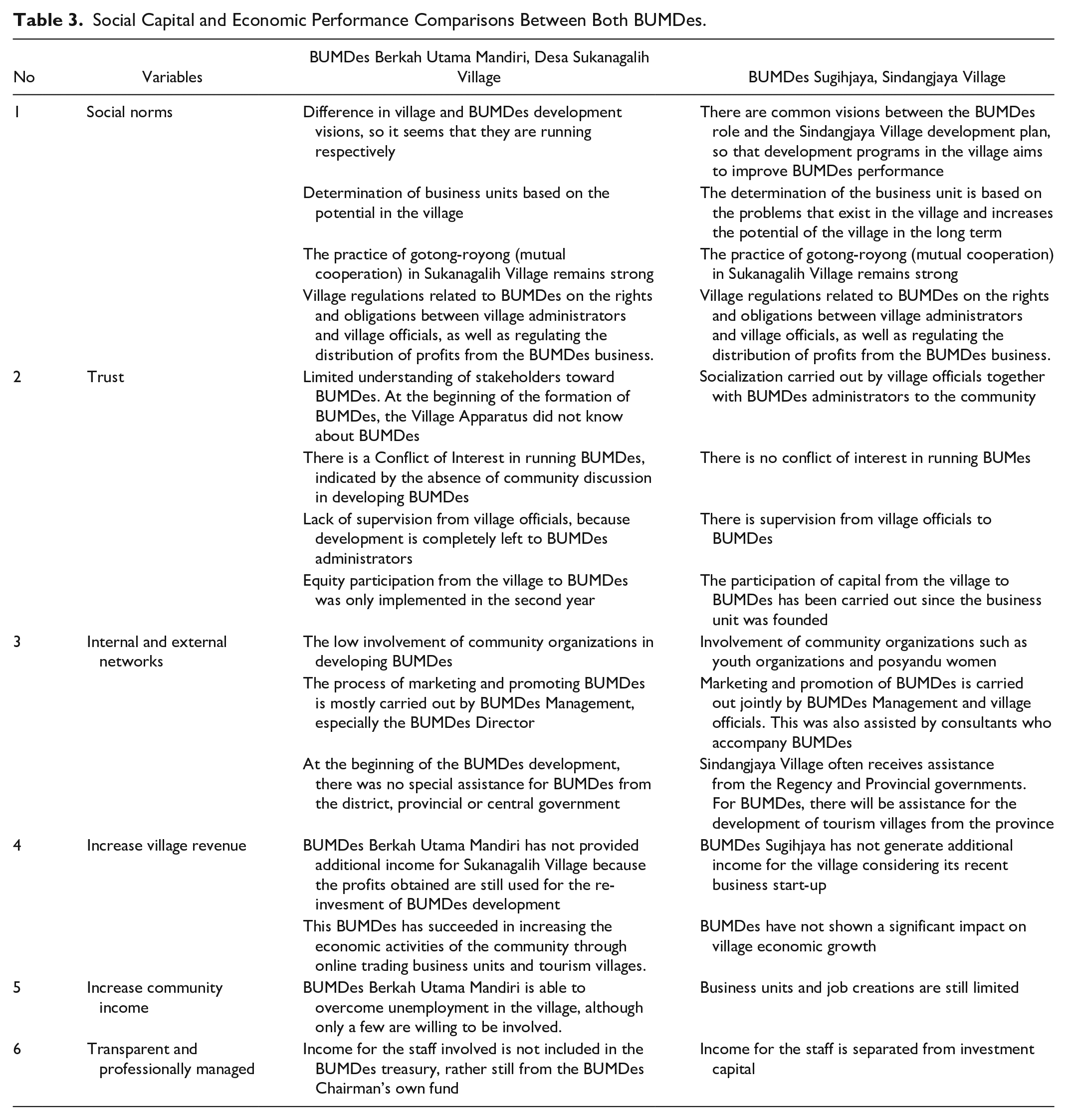
Third, despite the aim of BUMDes to increase the community’s economic income is far from achievement, the increase in income in the community can be directly seen by the people working at BUMDes. As part of the BUMDes capital investment of 200 million IDR, there are operational costs for employees for 6 months. Although the employee’s salary has not yet reached the employees’ minimum salary of Cianjur, it has provided employees with a steady income. The following table summarizes the social capital and economic performance of both BUMDes (Table 3).
Social Capital and Economic Performance Comparisons Between Both BUMDes.
Discussion and Conclusions
The government expects that BUMDes’ establishment will be a driving force in accelerating the financial independence of the village. However, in contrast to urban areas, rural communities still have strong local social capital that may offset how policies determine BUMDes development and induce performance variation between villages.
The results indicate two important findings on the role of social capital that influences the economic performance of BUMDes: first, the importance of BUMDes’ management relationship with the village government and the community, and second, the professional capacities of the BUMDes management. The BUMDes Sukanagalih is more driven by BUMDes Management, while village official’s role as supervisors and low involvement of community organizations due to limited understanding of stakeholders toward BUMDes. The management fully controls business development, including marketing and promotion to BUMDes Administrators. Contrarily, the BUMDes Management and Village Officials in Sindangjaya Village have a good relationship in developing business units with their share values and goals for the village’s economic development. Particularly, there was supervision from village officials and Regency governments. Furthermore, there was also assistance in the development of tourism villages from the province. Whilst, the involvement of community organizations, such as Karang Taruna and posyandu women, has strongly supported BUMDes activities.
Second, these social relationships induce the management capacities of BUMDes. Despite the above differences, both BUMDes’ economic performance is considered potentially to generate income for the community and accelerate village economic growth. In Sukanagalih Village, BUMDes’ performance was determined by the openness to cooperation and togetherness within the BUMDes management. Administrators themselves indeed aim to establish a management that is willing to develop the village, and the BUMDes is not their main income. As the BUMDes Sukanagalih budget is still supported by the BUMDes director’s own funding, there was a lack of professionalism and working hours regulations for employees. However, the promising result of expanding the existing business units in the first year attracted the government to participate in funding and community participation in the following year. Whilst Sindangjaya Village developed because of the strong relationship between BUMDes administrators and Village Officials, and these two parties can attract community participation to be involved in the BUMDes business unit. For instance, the cooperation allows BUMDes to develop multi-commodities and trade-based business units for BUMDes capital turnover. Furthermore, BUMDes Sindangjaya is more professional in nature to BUMDes administrators by providing decent salaries and demanding that daily employees at Village Banks and the Tofu Factory follow the working hours set to pursue profit targets from BUMDes.
The results suggest inconclusive findings regarding how social capital and establishment history determine BUMDes’ management and economic performance. BUMDes Sukanagalih was established by the local community and managed by the BUMDes independently; thus, it is surprising how this BUMDes was less able to attract community participation at the beginning of its establishment. The BUMDes struggle to gain trust and community participation in determining BUMDes business units. The case study was contrary to the findings of Yeni (2016) and Athsil (2017), which found that BUMDes was established based on community initiatives to increase the participation of the local community in its development. Furthermore, the findings also suggest the importance of BUMDes manager requirements to be agile in accommodating conflicts (Duncan, 1976).
Sindangjaya BUMDes was also established through the initiative of rural officials who attracted community participation following numerous socializations from the head of the village. This shows a good relationship between the management of BUMDes and village officials in developing business units. The leadership factor also potentially encouraged trust and community participation to drive the village economy. Village community’s initiative to establish the BUMDes was also crucial to gain trust from the community. This insight agrees with the findings in China on how social rural enterprises (or Township and Village Enterprises [TEVs]) were successfully established by government regulations (Zhao & Wong, 2002). Contrary with this finding, in the UK the government regulations established many social rural enterprises that were opposed by the local community (Richter, 2019).
The results suggest the theory that social capital offers a comprehensive approach to overcoming rural problems where they are supported by the culture and customs of local communities, such as social structure, social capital, and cultural values (Steiner & Teasdale, 2019). Our study finds that social capital determines BUMDes’ economic performance and development variation once trust is established to create networks; therefore, we argue that norms are important but insufficient to generate networks. It is only through trust that government funding and community awareness of the importance of BUMDes as an economic growth engine can be realized, confirming that reciprocity cultivated among BUMDes stakeholders are built upon interaction and cooperation (Boix & Posner, 1996).
This study contributes to the literature by showing that it is only in its full form that social capital is adequate to determine enterprises performance. The knowledge needed to identify unique products, marketing, leadership, and competent human resources is crucial for rural diversification. Thus, this study suggests the importance of embedding social capital to operationalize the rural diversification approach. It is important that village development policy programs to acknowledge and consider social capital in rural enterprise as it provides both internal framework (e.g., norms, trust, and network that determine the openness for skill training, acceptance of new information), and feedback to external factors (willingness to accept training from government programs, acceptance as a sector target, and to absorb investment).
Although this study highlights the importance of trust through knowledge and awareness, it is beyond the scope of this study to examine how to raise these issues among stakeholders. However, the research findings may indicate that to attract community’s awareness, marketing and promoting rural enterprises should be conducted collaboratively by the management and village officials. To some extent, assistance by consultants and the regency government would also be beneficial in gaining the community’s attention on rural enterprises. Therefore, future studies should consider how to disseminate information on the importance of rural enterprises in generating community income and a village’s economic growth. Broadly, the study could be conducted across provinces to capture the impact of culture and policy differences.
Footnotes
Acknowledgements
The author would like to thank team members of the research group for the data collection and discussions; Santi Sopandi, Tessa Talitha, Alvaryan Maulana, and Dr. Hastu Prabatmodjo.
Declaration of Conflicting Interests
The author declared no potential conflicts of interest with respect to the research, authorship, and/or publication of this article.
Funding
The author disclosed receipt of the following financial support for the research, authorship, and/or publication of this article: This research was fully funded by the P3MI Research Funding Program in Institut Technology Bandung (ITB) in 2018.
