



Abstract
In light of the gap in the national identity research, this study proposes, constructs, and examines the path to national identity by using a mixed-method approach. Study 1 collected 502 questionnaires from Chinese tourists, and Study 2 conducted semi-structured interviews with 15 tourists. The findings confirm that cultural and creative tourism contributes to the construction of tourists’ national identity. Tourists’ long-term implicit cultural memory and short-term explicit cultural learning are the double guarantees for forming tourists’ cultural identity. Importantly, tourists’ cultural identity plays a critical mediating role in promoting national identity. Moreover, the interactive effect of cultural experience and creative performance accelerates the construction process of tourists’ national identity. This study consolidates the sociopolitical significance of cultural and creative tourism for national identity through a rare mixed method and identifies the specific role of the cultural factors affecting national identity, thereby providing great theoretical contributions and practical value.
Keywords
Introduction
The nationalist debate is heating up, especially in the context of the globalization process rapidly eroding different identities; thus, the issue of how to find and maintain unique identities is becoming crucial (Zhang, Fong, et al., 2019). Nations represent groups of the same unique culture, showing that cultural characteristics are the only criterion of national affiliation (Kymlicka, 2001). Similarly, China is composed of many ethnic minorities and shows a pattern of “pluralistic integration.” Under the background of multiethnic coexistence and social mobility, the original social construction and identity in China have been impacted (Sun, 2020). With the rapid development of transportation and information technology, many countries face issues of cultural identity and national identity influenced by social mobility. However, as a critical social flow, tourism has significantly increased the cultural interaction among ethnic minorities and created new possibilities for the development of cultural and national identity. Cultural activities are seen as effective tools for national unity in tourism and hospitality studies, which affects the construction of tourists’ national identity (Weaver et al., 2017). Some studies have recognized the cultural and heritage appeal of destinations as a powerful medium for national identity (Butler et al., 2014). However, the construction of national identity ignores the rise of cultural and creative tourism; therefore, it is difficult to clarify and grasp the shaping and promotion of national identity under the current new trend of tourism development.
Cultural and creative tourism is the product of the high integration of culture and tourism in China. Unlike traditional cultural tourism, cultural and creative tourism is a new type of tourism experience. It focuses on local original culture and takes creative thinking as a means to supply tourists with interactive learning and cultural understanding through the protective development of traditional culture (Zhang, Li, et al., 2019; Richards, 2000). With the wide dissemination of innovative and creative thought and the guidance of relevant national policies in the past 10 years, cultural and creative tourism has become a new trend in the development of tourism in China, and a variety of cultural and creative tourism formats have been formed around products, facilities, landscapes, activities, and communities (Pan & Zhang, 2019). Furthermore, cultural and creative tourism promotes the innovation of technology, management, and systems in the tourism industry. It creates opportunities for innovation in China’s overall tourism market. It has also become an indispensable part of Chinese cultural exchange that helps realize people’s “cultural consciousness” (Pan & Zhang, 2019).
The current research has asserted that cultural and creative tourism plays a significant role in cultural communication and perception (Zhang, Li, et al., 2019). The creative elements introduced in the development of cultural and creative tourism provide an excellent method for the mining, representation, and revitalization of national culture, thus strengthening tourists’ perception and understanding of culture (Jovicic, 2016). Specifically, creativity provides an innovative and designed mode of expression that can realize an extensive and in-depth dissemination of culture through the innovation of tourism products. Culture is characterized by uniqueness, complexity, and diversity. Creative forms present culture in a way that is easy for tourists to accept, further promoting tourists’ cultural reception (Zhang, Li, et al., 2019). Therefore, creativity plays a crucial role in improving the image of traditional culture and generates a multiplier effect (Liu, 2020), thereby becoming a special topic and an effective carrier through which tourists can receive subtle national education. However, current studies related to national identity primarily focus on the relationship between heritage sites and individual local identity (Zhang et al., 2018), post-colonial destination identity (Zhang, Fong, et al., 2019), the alienation of immigrant tourists’ national identity (Grajzl et al., 2018), and so on, and they ignore the promotion value of creative elements to tourists’ cultural experience under the background of dynamic tourism development. In view of the significant potential role of culture in the promotion of national identity and the fact that creative patterns of expression can vastly advance cultural dissemination, our study urgently addresses an unresolved new issue: Can cultural and creative tourism in the new era universally enhance the national identity of mass tourists?
Culture is regarded as an essential manifestation of national identity because it originates from a common history and is shaped by cultural channels (Werf et al., 2020). More importantly, cultural identity is conducive to an individual’s identification with and consolidation of national identity (Pratt, 2005), and cultural reproduction and activation are the core elements of the sustainable development of cultural and creative tourism. Therefore, the construction of identity may not ignore the role of media in culture, especially the specific guiding role of cultural factors. Previous research has reinforced the impact of individual experience and familiarity with culture on identity (Jensen et al., 2011). Therefore, cultural and creative tourism provides an innovative atmosphere and unique field for tourists’ cultural experience, and interaction can also promote tourists’ cultural identity. Creativity represents a novel means of cultural expression that caters to the market, contributing to tourists’ understanding of common culture from shallow to deep (Zhang, Li, et al., 2019), and strengthening tourists’ cultural experiences and perceptions. Although previous studies have highlighted the political role of purely sightseeing cultural tourism, such as visits to heritage sites, museums, and war sites, on tourist identity (Gieling & Ong, 2016; Packer et al., 2019), they have ignored the excellent function of creative elements in the value of tourists’ cultural experience in the context of the dynamic development of tourism. Therefore, this study re-examines how cultural and creative elements improve the cultural and national identity of tourists.
In the unconventional environment of tourism, the formation of tourists’ national identity requires a long-term, deep-rooted, cultural, psychological foundation, and short-term cultural learning behaviors. Some scholars have emphasized that individual cultural identities begin as a basic form in childhood (Kranz & Goedderz, 2020) and are then consolidated through constant exposure to the common historical and cultural heritage of the nation, thus reflecting that internal identity depends on the perception of self-culture (He & Wang, 2015). Especially in the field of cultural and creative tourism, creativity means packaging static and esoteric historical culture into an external form that is easy for the public to understand. Interactive experience awakens hidden cultural genes in tourists’ memories (Zhang, Fong, et al., 2019). As a consequence, the relevant memories of tourists in the cultural context are reproduced and consolidated, and the deepening of cultural memory leads to the positive cultural belonging of tourists. Moreover, the core purpose of cultural creative experiences is to provide opportunities for tourists to integrate and learn cultural knowledge (Huang & Liu, 2018), thus promoting the process of changing the common culture of tourists from one of shallow understanding to one of deep understanding (Zhang, Li, et al., 2019). Importantly, the formation of cultural identity is based on the experience, perception, and understanding of culture (Kranz & Goedderz, 2020). Cultural and creative tourism clearly provides such an opportunity. Under the guidance and awakening of cultural memory and cultural learning, tourists may experience culture and form a certain level of psychology identity (Ye & Ng, 2019). As a rational conjecture, it is reasonable to believe that cultural creative experiences provide important experiences through which tourists awaken long-term cultural memories and short-term cultural learning behaviors, thereby strengthening the positive impact process from cultural attitudes to national identity.
Although previous references have emphasized the role of culture in promoting national identity and discussed this relationship in the context of the tourism research (Werf et al., 2020; He & Wang, 2015), related research lacks in-depth empirical analysis of the theoretical path (Liu, 2020). Therefore, this study constructs an integrated mediation-moderation model (Figure 1.) and introduces qualitative interviews to test a theoretical path. It aims to achieve the following research goals: (a) confirm the internal relationship between cultural factors and national identity in cultural and creative tourism, (b) explore whether the formation of national identity is jointly influenced by long-term cultural memory awakening and short-term cultural learning, and (c) identify whether creative performance plays a catalytic role in the development of tourists’ national identity. This study systematically determines the direct guiding effect of cultural and creative tourism on national identity through empirical analysis, clarifies the specific path of how cultural elements promote national identity and responds to various discussions and conjectures about the relationship between culture factors and national identity in previous studies. In addition, this research highlights the socio-political role of cultural and creative tourism in enhancing and enlightening the national identity of mass tourists and provides a new cultural and creative perspective on how to promote the formation of national identity and national rejuvenation and maintain national identity.

Conceptual model.
Theoretical Background and Hypotheses
Social Identity Theory
Social identity is derived from the established concept of group identity (Tolman, 1943), referring to a person’s sense of belonging to a group. This cognition comes from the process of having a common group spiritual identity or from seeing oneself as a member of the same category. Bond and Falk (2013) assert that there is a connection between individuals’ core identity attributes and their visits to specific sites. Tourism can be considered a means to establish, maintain, and reshape identity, while the tourism experience, to some extent, is conducive to the consolidation of individual national identity. This theory provides a theoretical basis for research on the development of tourists’ national identity in the cultural and creative tourism field.
Social identity theory points out that through a process of social comparison, a group of people similar in self-attitude, memory, behavior, and emotion are labeled as an internal group and form their unique group identity, which is the same as a nation (Stets & Burke, 2000; Hornsey, 2008). Furthermore, social category-specific stimuli can play a prominent role in the cognitive evaluation process that activates a social identity. Under the context of cultural and creative tourism, creative performance, cultural activities, and other external stimuli can stimulate and consolidate the tourist process from cultural cognition to cultural identity, which will realize national identity. This is consistent with the core perspective of social identity theory. Specifically, when tourists feel the symbolic significance of a particular culture, the significance itself represents part of the identity of the group from the same cultural background, indicating the clear boundaries of the specific group (Gieling & Ong, 2016). Therefore, cultural background reflects the basis of a national specific identity, and cultural activities, as social stimuli, have an important impact on the formation of tourists’ national identity. It can be seen that cultural experience advocates that individuals establish a national identity through understanding culture (White & Frew, 2011). In this context, cultural and creative tourism can provide multiple cultural experiences for tourists’ identity recognition through creative means.
In the context of cultural and creative tourism, culture is the fundamental value and core content for its development while the creative mode is the carrier of culture. It can promote tourists’ in-depth interpretation of culture by constructing innovative forms of expression (Liu, 2020). Tourism destinations can shape a field of local culture (e.g., cultural blocks, traditional festivals). When tourists immerse themselves in this special environmental structure, their individual identities are susceptible to influence (Stets & Burke, 2000; Yang et al., 2020). On the one hand, cultural symbols conveyed by tourist destinations show both insiders and outsiders their unique identity (Quinn, 2003), which contributes to awakening the cultural symbols and cultural elements hidden in the tourists’ memories and in turn may deepen their cultural memories. Creative performance provides an unforgettable tourism experience to tourists through novel tourism products and services, thus deepening their cultural memory (Liu, 2020). Furthermore, cultural and creative tourism destinations use cultural activities to stimulate tourists’ implicit cultural feelings and, in this way, promote the ability of tourists to define themselves. On the other hand, in social identity theory, the concept that individual identity is a process of continuous understanding and social learning also points to the goal of cultural and creative tourism with tourists’ cultural learning and understanding as the core (Plakhotnik, 2020; Richards, 2000). It is undeniable that the learning process plays an important role in shaping individual identity (Checkel, 2001). Cultural and creative tourism provides a wide range of cultural learning atmospheres to strengthen the depth and breadth of tourists’ cultural understanding, fill cultural gaps, and consolidate cultural identity and national identity. Therefore, the core view of social identity theory supports the idea that tourists’ national identity stemming from the perspective of cultural and creative tourism is mainly affected by comprehensive cultural factors such as cultural memory (memory), cultural learning (behavior), and cultural identity (attitude).
Hypotheses Development
Memory is a mental process in which people recall activities, behaviors, and experiences. Cultural memory shows that past cultures were aggregated spatially through images, texts, cultural relics, historic sites, and so on, and then reshaped in the collective consciousness of the public (Assmann, 2011). The current cultural tourism experience has provided the possibility for the creation of individual memory and even promoted the formation of cultural memory (Withers, 2005). In cultural and creative tourism, static cultural resources are activated through creative performance. The interactions between tourists and destinations are promoted in the creative atmosphere to achieve a deep cultural experience (Yin, 2014). Furthermore, the multicultural experience provided by cultural and creative tourism can awaken the deep cultural memories of tourists (Assmann & Czaplicka, 1995). More importantly, the depth of cultural memory is regarded as an essential part of high-level cultural identity (Sahdra & Ross, 2007). Gieling and Ong (2016) emphasize that stimulus activities in specific social categories play a prominent role in activating high-level cognition and identification processes. In fact, the essence of cultural and creative tourism is to create unforgettable and vivid cultural tourism experiences for tourists through innovative and cultural performance (Li, 2000). In particular, cultural symbols and representations during cultural experience create opportunities for the reproduction and shaping of tourists’ cultural memories (Kim, 2010). As a result, tourists undergoing cultural experiences can store culturally associated surface impressions and deep understandings in the form of memories (Lehto et al., 2004), thereby generating a high level of cultural identity consistent with their self-association. Therefore, this study makes the following assumptions:
Cultural learning is the core of the cultural and creative tourism experience (Blapp & Mitas, 2018) proposed by McKercher and Du Cros (2002), which advocates that tourists’ cultural learning can enhance their sense of identity with the destination. Cultural and creative tourism converts culture into tourism products with positive value with innovative forms, which provides tourists with special cultural experience. United Nations Educational, Scientific and Cultural Organization (UNESCO) Creative Cities Network emphasizes that tourists can learn local traditional arts and symbolic culture with local characteristics in a cultural creative experience. In this process, cultural learning behaviors are helpful for tourists to fill in the cognitive gaps regarding static history and culture and develop a sense of identity that traces back to the source. In fact, some researchers of social identity theory argue about the stability and mobility of individuals’ acquired identities (Abrams & Hogg, 2004), as they believe that the identity of individuals is not fixed. Ditlmann et al.’s (2011) research confirms that the national identity change of immigrants stems from the alienation of identity in different cultural backgrounds. In this way, it is important to maintain cultural learning in the same cultural context. Cultural and creative tourism provides a common cultural condition for tourists, and their understanding of national culture is strengthened under the stimulation of a cultural atmosphere. With the deep contact and learning made possible by culture, the cultural immersion level of individuals in the destination is increased, and tourists will gradually tend to form a cultural identity (Kranz & Goedderz, 2020; Ye & Ng, 2019). Therefore, the following assumptions are made in this study.
Cultural belonging is a critical factor in shaping individual identity (Pratt, 2005). Jameson (2007) asserts that cultural identity is an internal state that depends on self-perception and becomes the key to individual identity. In essence, cultural identity represents a form of collective identity that binds people together based on a common historical and cultural heritage and reflects the idea that the positive attitude of individuals toward cultural identity plays a critical role in guiding national identity (He & Wang, 2015). Although individual cultural cognition and cultural backgrounds are complex and diverse, local tourists’ cultural backgrounds and destination cultures often share common aspects. As a result, cultural identity is more likely to come from cultures that have been understood or recognized. Importantly, national identity is regarded as the expression of a collective identity, and its common beliefs and values are influenced to a certain extent by the same culture.
Cultural and intercultural psychologists prove that external stimuli influence a series of individual psychological processes by emphasizing the power of cultural identity. Through the mediating role of cultural identity, the individual’s mental state or perception of identity will change. In the context of cultural and creative tourism, individual cultural learning behaviors and cultural memory awakening are likely to help enhance the sense of identifying with local culture, thereby affecting ethnic identity. Cultural and creative tourism is characterized by interaction and participation in cultural excavation and activation, which can transform a scenic-spot-led sightseeing experience into a tourist-led participation learning experience (Zhang, Li, et al., 2019). Through cultural learning behavior, tourists’ cognition of culture changes from a surface level to a deep level. Therefore, cultural and creative tourism creates opportunities for tourists’ cultural identity through cultural memory awakening and cultural learning. Some studies have also highlighted the significant role of cultural and creative tourism in safeguarding identity and culture as well as the educational significance of national identity (Durie, 2015). Many thinkers believe that national identity is regarded as the true carrier of culture or national spirit. When members realize that they share common self-descriptive characteristics and cultural traditions, then national identity will be expressed (Ditlmann et al., 2011). When culturally related external stimuli are imposed on tourists, their understanding of culture and the connection with their identity become closer. Therefore, this study assumes that implicit cultural memory consolidation and explicit cultural learning can promote tourists’ cultural identity and their national identity.
Cultural and creative tourism highlights the important role of creative and innovative forms in the psychology and behavior toward the tourists’ experience. Creative performance is described as the ability to generate new ideas, new behaviors, new concepts, new designs, and new service procedures and renew old ideas into new and unique ideas (Wang & Netemeyer, 2004). Creative expression as a means of processing, packaging, and transforming formats using authentic cultural elements (Divisekera & Nguyen, 2018) is often used to attract tourists’ attention (Hjalager, 2002). Specifically, creativity can change an original cultural presentation (such as cultural and creative products, festival activities, and literary performances), showing an invisible and static culture in a tangible and dynamic way, which helps tourists obtain deep cultural exposure during the cultural experience (Zhang et al., 2019). As opposed to types of sightseeing such as visiting museums and historical sites, creative elements can make the obscure content in culture easier to understand, and such elements can convey and produce cultural connotations in innovative forms that are easy for tourists to accept and connect with (Sternberg, 2012). Therefore, creative forms accelerate the process of transforming cultural elements and symbols into tourists’ flashback memories (Kim, 2010), and the role of these forms in activating and deepening the cultural memory of tourists is becoming increasingly apparent. In addition, cultural and creative tourism destinations often draw tourists through diversified creative projects. A creative atmosphere that is favorable to tourists is conducive to the immersive experience, which arouses tourists’ desire to actively learn and constructs a new relationship between tourists and the destination culture. Therefore, this study asserts that a high-level creative performance can better stimulate tourists’ cultural learning behaviors and strengthen their cultural memories.
Methodology
Research Design
National identity is a relatively complex research issue, especially from a cultural perspective, from which to gain insight into the process of enhancing national identity in the context of cultural and creative tourism. Thus, this study adopted a mixed-method design that combines qualitative and quantitative data collection and analysis procedures to help highlight the reliability of the results (Creswell, 2003). Based on previous suggestions (Zhang et al., 2021), in Study 1, which was a quantitative study, we initially conducted a survey to investigate and examine the six hypotheses proposed and then confirmed them through qualitative research by conducting semistructured interviews in Study 2.
Quantitative Study
Samples and data collection
This research used Chinese cultural and creative blocks as the survey sites, which consisted of the first batch of such blocks announced by China, including the Wudianshi Traditional Blocks, Huangshan Old Street, Hubu Alley, South Street of Pingyao County, and so forth. The selection of samples was mainly based on the following. First, cultural and creative tourism is a new trend of tourism development in China (Zhang, Li, et al., 2019). Taking the Chinese cultural and creative block as the research sample allowed us to explore the construction of national identity in cultural and creative tourism. Second, as the microcosm of the local characteristic culture, the history and culture of these cultural and creative tourism destinations is characterized by integrity, richness, and uniqueness. Moreover, these destinations have developed a variety of creative tourism products and characteristic activities and skilfully combined culture and creativity. Finally, the survey sites are mainly distributed in the seven geographic regions of China, and basically cover the main areas in spatial distribution, ensuring typicality and rationality (Zhang, Fong, et al., 2019). Regarding the field survey phase, first, we invited four professors and experts with rich research experience in tourism management to translate the original scales, and a back-translation method was adopted to ensure the accuracy of the translation (Brislin, 1970). Second, five research assistants checked the questionnaire items and modified the questionable or unclear items to ensure content validity. Third, the quantitative research data were collected by field interception surveys using a non-probabilistic convenience sample technique (Assiouras et al., 2019), which was able to investigate the actual feelings of tourists for the first time. Fourth, in the course of the survey, we made it clear that the questionnaires were completed anonymously, and we answered all questions asked by the respondents. Fifth, data were collected eight times from October to December 2019. A total of 600 questionnaires were distributed to tourists who completed them according to their destination experience. A total of 563 questionnaires were recovered, and 502 valid questionnaires retained, showing an 89.17% effective rate. Table 1 details the demographic characteristics of the respondents in this study.
Background of Research Sample.

Measurements
The core variables in this study included cultural experience, creative performance, cultural memory, cultural learning, cultural identity, and national identity. All variables of the conceptual measurement model were selected from mature scales, and a 7-point Likert-type scale was adopted, in which 1 indicated total disagreement and 7 indicated total agreement. Specifically, for cultural experience, four items from scales from Jang and Ha (2015) were used to explore tourists’ cultural experience with the cultural and creative destinations. Furthermore, each item was corrected according to the Chinese context of the study. For creative performance, referring to the scale studied by Darvishmotevali et al. (2018), this study adopted 5 items for measurement. For cultural memory, from the study of Chen and Rahman (2018), a 7-item scale was used to measure the memory level of tourists regarding culture. For cultural learning, four items adopted by Hung et al. (2019) were used to measure the learning behavior of tourists. In addition, we assessed cultural identity using 4 items measured by Cleveland et al. (2016). Finally, the national identity measurement was adapted from Zhang, Fong, et al. (2019) and contained 5 items.
Statistical analysis
The results in Table 2 show that the coefficients of all variables were greater than .849, satisfying the threshold of 0.70 (Bland & Altman, 1997). Moreover, the standardized factor loadings of all observation variables were between .730 and .929, and the t-test values were all significant at the level of .001, indicating that the questionnaire samples reached good reliability. Furthermore, the convergent validity was examined by the average variance extracted (AVE) and composite reliability (CR) of latent variables. According to the criteria (Chen & Tsai, 2007), the CR value of each variable was greater than .848, and the AVE value was greater than .583 in this study, indicating that the sample had good convergent validity. In addition, Table 3 shows that the AVE square root of each latent variable was greater than the correlation coefficient, confirming the discriminant validity between each construct (Hosany & Gilbert, 2010).
Descriptive Statistics and Confirmatory Factor Analysis.
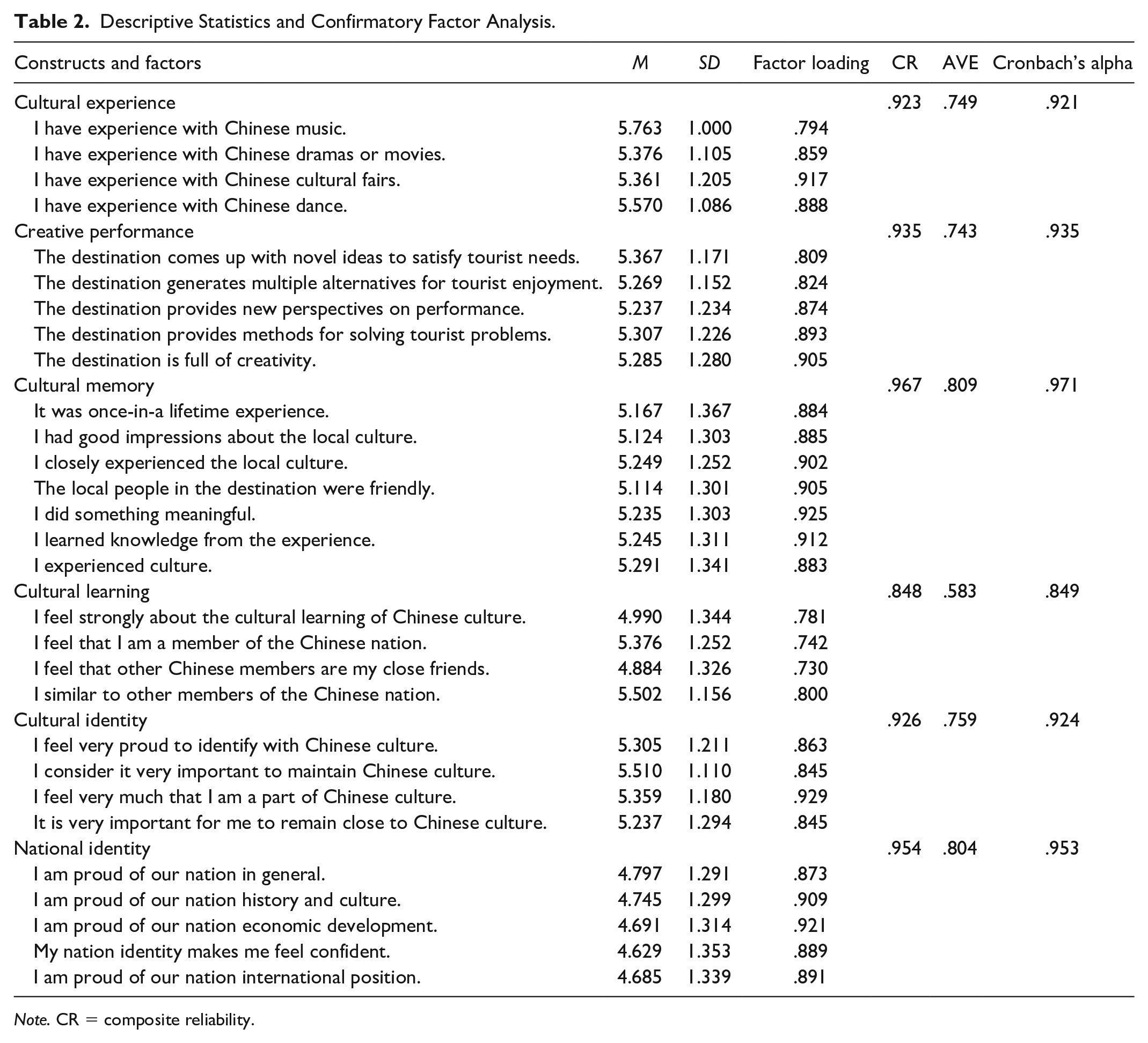
Note. CR = composite reliability.
Means, Standard Deviations, Correlations and Discriminant Validity.

Note. The square root of AVE are shown in bold on the diagonal.
***p < .001.
Table 3 summarizes the mean value, standard deviation (SD), and correlation coefficient of each structure, as well as other statistics. According to the suggestions of Podsakoff et al. (2003), some measurement variables may be highly correlated, and collinearity issues need to be examined. Therefore, this study separated the independent and dependent variables in the questionnaire, and the variance inflation factor (VIF) was introduced to check the collinearity level (Johnson et al., 2011). Consequently, all VIF values were less than 1.98, indicating that collinearity was not a critical consideration in the hypothesis model.
We took the following steps to control the common method bias problem in the process of data acquisition. First, in the design of the scale, we selected the mature scale that has been tested in previous authoritative journals and modified the content of the scale to make it applicable to our study context. Second, the data collection period was from November to December 2019, and the questionnaire was sent out a total of 8 times, which avoided measurement at the same time. Third, in the process of investigation, all questionnaires were completed anonymously, and we clarified that there was no criterion of right or wrong in the questionnaire to ensure the reliability of the data results as much as possible. In order to further confirm whether there is a problem of common method bias, this study used the SPSS 21.0 Satorra-Bentler scaled chi-square variance test to examine common method deviation. The factor model results were compared with the Harman single factor test of the proposed measurement model (Chang et al., 2010). The results showed that 6 structures were extracted, and the first factor accounted for only 46.791% (<50%). Furthermore, when the common method bias was introduced into the structural equation model as a latent variable, the comparison models revealed that the model parameters were not significantly improved (Kolar & Čater, 2018). Therefore, the common method bias issue does not affect the current research.
To check the validity of the construction more accurately, this study applied confirmatory factor analysis (CFA) (Jacobsen et al., 2019). Furthermore, in structural equation testing using AMOS20.0 software, some fitness indexes were used to judge the model fit. The results illustrated that the standardized coefficient loading in the proposed model had higher values for each factor, and the proposed six-factor model indicated good model fit (χ2 = 1,497.705, p < .001; χ2/df=3.840; CFI = .938; IFI = .938; TLI = .931; NFI = .918; AGFI = .803; RFI = .908, and RMSEA = .075).
Qualitative Study
Data collection and procedure
This study used semi-structured interviews to collect data for the qualitative research in Study 2. The specific process was as follows: (a) The interviewees had to be tourists who have experienced cultural and creative tourism. Furthermore, the researcher used a combination of intercept sampling and snowball sampling to select 19 tourists for interviews. 15 tourists accepted the invitation by telephone interview, and one of them accepted the invitation but interrupted the interview halfway through. However, considering that the interviewee basically completed the answers to the interview questions, the data were still included in the result analysis. (b) According to the suggestions of a previous study (Pham et al., 2019), we followed 3 procedures: warm-up, development and closing. What must be clarified is that before the interview, the researcher clearly stated our research purpose and the interviewees’ anonymity. (c) During the telephone interview, a recording was made with the consent of the interviewees. The interviews with interviewees who did not agree to be recorded were recorded in the form of notes. (d) After the interview, the recording was translated into text and proofread repeatedly to form a formal text. We carefully analyzed the data of each interview and adopted a member inspection process to reduce bias and improve the research credibility and quality (Baxter & Jack, 2008). When theoretical saturation was reached, the data collection was terminated (Dayour et al., 2019). The respondents were 9 women and 6 men aged between 18 and 52.
Results
Quantitative Results
The structural equation model (SEM) method was adopted to examine the mediating and moderating effects. The SEM method can test the relationship between multiple independent variables or multiple dependent variables simultaneously and avoid inaccurate standard error estimates or assessment bias due to non-independent observations (Lowry & Gaskin, 2014). Moreover, the bootstrapping method (20,000 resamples) was applied to generate standard errors and t-statistics to assess the significance of the parameters. Meanwhile, the Monte Carlo method obtained a 95% confidence interval with bias correction, which could cope with the deviation of the normal distribution hypothesis (Zhang, Li, et al., 2019). Figure 2 demonstrates that all the direct impact paths were significant and that the global model fit measure was good in the hypothesis model (χ2 = 1,042.652, p < .001; χ2/df = 3.862; CFI = .942; IFI = .942; TLI = .935; NFI = .923; GFI = .859; AGFI = .830; RFI = .914, and RMSEA =.076).

Research model results.
Mediator analysis
Hypothesis 1 proposed that tourists’ cultural experience affected their cultural identity through the mediating role of cultural memory. The standardized path coefficient of cultural experience on cultural memory was significant (β = .663; p < .001), and cultural memory significantly affected cultural identity (β = .403; p < .001). Meanwhile, the average indirect influence of cultural experience on cultural identity through cultural memory was statistically significant (β = .226; p < .001). Thus, Hypothesis 1 was supported.
Hypothesis 2 explored whether the positive impact of tourists’ cultural experience on their cultural identity would be generated through cultural learning. Cultural experience had a significant positive effect on cultural learning (β = .717; p < .001), and cultural learning significantly affected cultural identity (β = .281; p < .001). Consistent with this assumption, cultural learning played a mediating role in the positive influence of cultural experience on cultural identity (β = .300; p < .001), thus supporting Hypothesis 2.
Hypothesis 3 and Hypothesis 4 predicted the mediating effect of cultural identity. Cultural identity had a positive direct impact on national identity (β = .565; p < .001), and cultural memory could significantly influence national identity through the indirect effect of cultural identity (β = .288; p < .001), which confirmed Hypothesis 3. In addition, cultural identity played a significant mediating role in the positive influence of cultural learning on cultural identity (β = .159; p < .001). Therefore, Hypothesis 4 was supported.
According to Zhao et al. (2010), the indirect effect is significant if neither of the 95% confidence intervals include zero. Table 4 showed that there was no zero between the minimum and maximum in the double-tailed confidence interval test of bootstrapping. Hence, the mediation effect was fully supported for Hypothesis 1 through Hypothesis 4.
The Results of Mediating Effect.

Note. CI = confidence interval.
***p < .001.
Moderator analysis
Hypothesis 5 and Hypothesis 6 predicted the moderating role of creative performance. The results in Table 5 show that the cross-multiplying terms of the independent variable and moderator variable (cultural experience×creative performance) had a significant positive impact on cultural memory (β = .455; p < .001). Furthermore, the simple slope diagram of interaction drawn in Figure 3 illustrates that with a higher level of creative performance at cultural and creative tourism destinations, the cultural experience of tourists could strengthen their cultural memory. Thus, Hypothesis 5 was supported.
The Results of Moderating Effect.

***p < .001.

Interaction of cultural experience and creative performance on cultural memory.
The results of Hypothesis 6 revealed that the interactive term of creative performance and cultural experience (creative performance × cultural experience) had a positive association with cultural learning (β = .574; p < .001). Figure 4 confirms that when cultural and creative tourism destinations show a higher degree of creativity, it is easier to enhance the cultural learning level of tourists after the cultural experience. Therefore, Hypothesis 6 was supported.

Interaction of cultural experience and creative performance on cultural learning.
Quantitative Results
The formation of individual national identity is a long-term process. However, tourism is a special activity that occurs in an unusual environment (Zhang, 2019). The cultural experience in the context of cultural and creative tourism provides a special cultural perception scenario that can strengthen tourists’ understanding and recognition of national culture. For example, some respondents noted the following: I’m usually busy at work, and I don’t have a specific time to experience the culture. But when travelling, all the local cultural buildings, operas, or those traditional spirits are concentrated together. I think it is easy to be influenced by culture in that particular destination. (R7)
When I went to the museum before, all I could hear was tourism interpretation, but in cultural and creative tourism destinations, it’s easier to get close to some less understood cultures. (R2)
Cultural and creative tourism destinations are different from traditional cultural tourism destinations. They include more innovative elements, which include cultural and creative games, activities, products, and ceremonies (Zhang, Li, et al., 2019). This type of innovative experience generates cultural activation and reconstruction on the basis of the original culture, which greatly awakens the cultural memory of tourists:
The architecture here is very much like what my grandmother told me about when I was a child. When I actually saw it, I was very familiar with it, as if it confirmed a memory of the past. (R12)
When I saw the ancestral hall, for example, those plaques, rosters and some family instructions—I can understand and identify some concepts of “morality” and “home” in our national culture. (R9)
Cultural and creative tourism provides a subtle cultural learning scene. Through a variety of cultural experiences in a specific field, it is possible to enhance empathy for the local cultural spirit. In addition to actual experiences and activities, such experience cause tourists to feel the long history and profoundness of their national culture, which creates a strong attraction and sense of identity:
Although reading or browsing the web, I can learn about some local cultures, cultural and creative tourism allows me to learn cultural content in a relaxed and pleasant atmosphere. (R3)
I tried the process of how to make tea and incense and found that there are a lot of things that need attention in several processes, and I also felt the wisdom of the ancients and the long history of Chinese culture. (R2)
I used to think that Nanyin was a folk song, but in fact it is an intangible cultural heritage, known as the “living fossil in the history of Chinese music.” It’s really amazing. I feel that Chinese culture is vast and profound. (R10)
Culture is the unique intangible heritage and spiritual inheritance of a nation. Werf et al. (2020) assert that the national identity of citizens often contains cultural elements. This special characteristic may be manifested in national character, thoughts, feelings, art, and science. All these forms are part of the history of a nation and are realized through national culture (Tevzadze, 1994). Therefore, in the process of cultural and creative tourism, tourists can personally understand the history and development of national culture through cultural experience and learning. It can even enhance their cognition of national unique identity through the process of creative experience and thereby improve their connection and emotion toward national identity:
It’s hard to describe this feeling. The Chinese nation has a long history, inventions, art, and culture. It makes me feel proud to be Chinese. (R6)
I am very excited when it comes to learning those things, and the culture passed down from generation to generation makes me feel that our nation is very unique. (R15)
I feel that these cultural or spiritual ideas, such as “harmony,” “home” and “filial piety,” cannot be seen in other countries. It is really a philosophy that the Chinese nation has always followed. (R1)
Conclusion and Discussion
Study 1 and Study 2 respond to the growing need to understand and promote national identity. Specifically, this study systematically constructs and tests the formation path of tourists’ national identity in the context of cultural and creative tourism, which is the first step to exploring the cultural characteristics and specific cultural factors in the tourism field and the construction of national identity.
First, quantitative research and qualitative research have addressed the issue that cultural and creative tourism has a significant impact on enhancing tourists’ national identity by providing empirical evidence for the current literature on the close relationship between tourism and national identity. Previous studies have indicated that countries around the world attract tourists with their unique historical and cultural heritage and reveal the identity and significance of their tourists through the history of their past events (Best & Kellner, 1991; Gieling & Ong, 2016; Light, 2007). However, the current research results highlight that cultural and creative tourism can create a special field for tourists’ identity by providing a unique cultural experience and achieving the function of cultural soft outputs in a manner that portrays relaxed entertainment. Cultural experience creates a process of tourists focusing on historical tracing and cultural elements in an unconventional environment, thus becoming the leading influencing factor for tourists to generate positive emotions and a sense of common cultural belonging. This conclusion confirms that cultural creative tourism is a good means to achieve tourists’ national identity and is the key role of cultural experience.
Second, the research results reveal the specific development path of the influence of specific cultural elements on tourists’ national identity, which suggests the significant mediating roles of cultural memory, cultural learning, and cultural identity. Although previous research has highlighted the close connection between tourism, culture, and national identity, this discussion is still conceptual and lacks empirical verification (Gieling & Ong, 2016; Hitchcock, 1998; Werf et al., 2020). However, this research not only systematically constructs a theoretical model of national identity but also confirms the specific role of cultural factors in the process of improving national identity. On the one hand, cultural memory, as a psychological factor accumulated by tourists over a long period of time, can be stimulated and consolidated in the process of tourists’ cultural experience, confirming the core point of memory fade according to trace decay theory and strengthening the important role of cultural experience in mitigating cultural memory decline. On the other hand, cultural learning is a short-term behavior of tourists in the context of cultural and creative tourism, once again confirming the impact of learning behavior on the promotion of national identity (Packer et al., 2019) and highlighting that cultural learning beyond the inherent cultural memory can further consolidate identity.
Third, creativity is seen as a key moderator of strengthening tourists’ national identity process. Creative factors with a strong affinity can turn static culture into dynamic culture, which reduces the individual’s sense of distance to culture and becomes an excellent means of the output of cultural connotation. Consistent with the conclusion by Gieling and Ong (2016), cultural experience is a crucial aspect of national identity. However, the difference is that the results prove that in the context of new tourism reform, traditional cultural experiences alone are not enough to satisfy the needs of tourists (Zhang, Li, et al., 2019). The interaction between creative performance and cultural experience is more conducive to strengthening tourists’ national identity. In short, the construction of national identity in the tourism field is a soft process that depends on society and culture (Zhang, Fong, et al., 2019). As an important means of cultural output, creative performance greatly enhances tourists’ sense of identity and sense of belonging in the process of cultural experience.
Theoretical Implication
This study provides a theoretical and empirical basis for the study of tourists’ national identity in the new era and demonstrates a great research contribution. First, the current research solidifies the important position of cultural and creative tourism in constructing tourists’ national identity, thereby identifying the leading role of tourists’ cultural experience and the catalytic role of creative performance in this process. Although Palmer (2005), Park (2010), and Soper (2007) have outlined the relevant theoretical discussions of countries using culture as a tool to promote national identity, faced with rapid changes in tourism and new development trends, the issue of how to improve tourists’ national identity has not been given sufficient theoretical support or systematic empirical tests. The current results not only confirm the important influence of cultural and creative tourism as a form of cultural production on the shaping of individual national identity (Soper, 2007) but also indicate that only the combined effect of cultural experience and creative elements can accelerate the process of tourists’ national identity. This study considers the social education value of new types of tourism beyond those of experience and entertainment, highlighting the view that the positive psychology generated by the cultural and creative experience of tourists will rise to the level of national emotional belonging. The conclusion confirms the auxiliary function and soft means of cultural and creative tourism in national education, and it is given political significance on the role of universally guiding ethnic identity, which provides a new cultural and creative perspective and ideas on how to further enhance national identity.
Second, the current study reconstructs and verifies the specific path of tourists’ national identity and confirms that the formation of national identity is awakened by long-term recessive cultural memory and short-term explicit cultural learning. Although previous studies have suggested that there is a close relationship between cultural factors and individual national identity (Butler et al., 2014), this relationship has only remained theoretical. Rare empirical studies (i.e., Zhang, Fong, et al., 2019) have examined the relationship between national identity and tourist behavior in cultural festivals, but in turn, there is still a lack of exploration on whether and how cultural experience can promote tourists’ national identity (Zhang et al., 2018). This study subdivides the specific role of cultural factors; that is, the short-term and long-term cultural stimulation and accumulation of tourists are the key links for the formation and promotion of national identity. These findings are encouraging, as research shows that implicit cultural memories are easily activated in special areas of cultural and creative tourism, while explicit cultural learning can effectively acquire cultural information and deepen cultural understanding. In short, cultural psychological processes and behavioral processes are a double guarantee for generating a high level of national identity for tourists. This conclusion contributes to the central role of cultural factors in the construction of national identity and empirically distinguishes the specific roles of cultural experience, cultural memory, and cultural learning in promoting tourists’ national identity in cultural factors.
Third, the current research results further highlight the close relationship between tourists’ cultural identity and national identity, reflecting the tendency of cultural identity to directly lead to the result of national identity. The study corroborates Triandafyllidou’s (1998) earlier discussion of national identity through an empirical sample analysis that shows that the essence of national identity stems from irrational and psychological belonging to common historical memories and public culture (Werf et al., 2020). In particular, cultural identity in the tourism field focuses more on the positive psychological results of perception and experience. Empirical evidence shows that the cultural identity of tourists can directly guide them to adopt a more emotional attitude toward national identity. The evidence further confirms that in the context of cultural and creative tourism, the positive cultural attitude of the individual level of tourists directly creates the value of national identity at the socio-political level, thereby reflecting the key role of cultural identity. In fact, the direct orientation of cultural identity to national identity proves the direct and deep connection between culture and national identity, which contributes to the theoretical significance for clarifying the development of national identity.
Managerial Implications
The survey results confirm that it is of great theoretical significance to enhance the national identity of domestic tourists through cultural and creative tourism, which highlights the national strategic significance and the social and political value of cultural and creative tourism development under the new normal. However, the formation of national identity is a long process (Zhang et al., 2018). First, the issues of how to maximize the national identity of tourists in the short-term tourism arena should illuminate the pivotal role of creative means in the process of soft cultural output. The use of creative elements needs to be strengthened in cultural display content, such as historical and cultural skills, traditional customs, and cultural stories. In addition, it is undeniable that national identity is based on common psychology and emotions. Therefore, the process of cultural soft output is more critical (Ditlmann et al., 2011). Creative cultural performances still need to grasp the market preferences of tourists and make use of technology, film, television, games, and other acceptable ways to create cultural products. Moreover, the experience effect of cultural brands under the influence of the situation causes tourists to have cultural contact motivation and thus promotes cultural understanding and identification through cultural experience.
Second, cultural collective memory elements should be created because they are a hidden representation of cultural emotions. Therefore, it is necessary to activate and consolidate the positive effect of tourists’ long-term cultural memory on national belonging. The destination of tourism should emphasize the distinctive characteristics and repetitive display of national identity symbols in cultural elements, whether in experience activities or logo design (Marschall, 2012). In this way, the cultural marketing theme design highlights some distinctive cultural elements or cultural imprints as much as possible to consolidate the potential cultural identity of tourists and arouse pride in national culture (Wang & Lin, 2009). In particular, the cultural elements of cultural products need be consistent and unique to establish a distinct cultural image (He & Wang, 2015). In addition, holding cultural festivals is a good way to achieve identity recognition and consolidation (Zhang, Fong, et al., 2019). Linking cultural symbols and collective memory elements to national identity in entertaining celebrations and using festivals to celebrate traditional festivals and cultural anniversaries can achieve the effect of enhancing national identity in a gentle way.
Third, a guiding role for cultural learning environments should be strengthened. Cultural and creative tourism destinations encourage tourists to participate in cultural learning through multi-participation interactive activities (Richards, 2000), which is more conducive to transforming the passive cultural absorption of tourists in traditional tourism into active cultural involvement and understanding. Cultural learning can reinforce shared cultural backgrounds and stimulate a sense of identity (Huang & Liu, 2018), which requires tourism destination managers to incorporate educational activities, such as situational presentation and performance, into the cultural dissemination process. Simultaneously, it is valuable to identify key attributes of Chinese culture or design unique cultural products because doing so will affect tourists’ judgment of cultural image by encouraging tourists’ interest in learning and increasing their cultural awareness (Fangxuan & Ryan, 2018). In terms of cultural learning content, it is necessary to focus on the understanding and emotional belonging of excellent traditional culture, including the inherent connection between personal development and culture, such as family feelings and filial piety. Only deeper emotional resonance can motivate tourists to rise from the level of cultural identity to the level of national identity.
Limitations and Future Research
The main contribution of this study is to answer the research question of whether cultural and creative tourism can enhance tourists’ national identity and clarify the role of cultural factors in the construction of national identity. Therefore, the current survey sample only includes domestic tourists. Future research will explore whether tourists of different nationalities differ in their national identity and construction pathways (Zhang, Fong, et al., 2019) and promote the stability of the results of this study through a sample of foreign tourists (Huang & Liu, 2018). Second, our study examined the national construction path under the background of cultural and creative tourism. However, different types of cultural and creative tourism are found in different types of tourism products, innovation forms, and cultural output. Moreover, there may be differences in the process of national identity among cultural tourism, creative tourism, cultural and creative tourism and other types of tourism. More research is needed to explore whether these differences have an impact on the construction of national identity. Finally, this study proves that long-term cultural psychology and short-term cultural behavior are pivotal factors that jointly promote national identity, and the current findings are obtained through micro-level visitor surveys. Future research can further subdivide the specific elements of cultural psychology and cultural behavior through experimental methods to comprehensively identify the core focus of cultural and creative tourism on the improvement of national identity. In addition, a longitudinal design can be introduced instead of a cross-sectional study in future research to explore the changes in national identity in different stages of samples (Wakefield et al., 2011). In this way, the dynamic relationship between national identity and culture can be more extensively identified.
Footnotes
Declaration of Conflicting Interests
The author(s) declared no potential conflicts of interest with respect to the research, authorship, and/or publication of this article.
Funding
The author(s) disclosed receipt of the following financial support for the research, authorship, and/or publication of this article: This work was supported by All-China Federation of Returned Overseas Chinese (grant number 19BZQK234).
