




Abstract
This article is an empirical reflection on interdisciplinary research. Surveying theories of performance and performativity, it proposes performance as a heuristic tool to breach and bridge the divide between Literature and Culture. The scriptocentricism of academia that reiterates the imperialist ideals and ideas of knowledge, history, and culture itself often ignores or dismisses the lived and embodied “texts” of culture. Performance paradigm can help shift this skewed status quo of “the word.” The appeal of performance studies lies in its attempt to elevate the body to the same status as the word, tracing performatives of identity, culture, history, myth, and more and offering a holistic critique of culture through this kaleidoscope. As a product of qualitative research in contemporary Hindu Nationalism, this article advocates the performance paradigm as an effective tool in the study of ethnic nationalism as an embodied and a discursive cultural phenomenon.
Introduction
The article records my experiences with transdisciplinary research in an attempt to transcend disciplinary boundaries and create a space of adisciplinary creative imagination, a space where discourses and practices of sociocultural and political phenomenon can be explored and dissected. The phenomenon central to my research is Hindu Nationalism, the dominant ethnocultural nationalism in contemporary India. The fundamental ideological proposition of Hindu Nationalism is the substitution of an inclusive republic of “fuzzy communities” 1 (Kaviraj, 2010), and fuzzier culture, with a dogmatic imagination of India as a Hindu Nation. This imagination is premised on a common language, a common culture, and a common ancestry that constitute Hindutva (Hinduness). This discourse of homogeneity has persisted, despite vehement challenges, and has pervaded the national, social, and cultural spectrums through the last century. This article attempts to explore this imagination of nation and national character, the apparatuses, methodologies of meaning and affect, and the cultural politics of the organizations of the Hindu Right that have sustained and empowered their rhetoric of exclusivity for more than 90 years. Interpellated in English literary and criticism traditions, my first academic exposure to Hindu Nationalism in/as a text was Mahesh Dattani’s play Final Solutions. Produced in response to the 1991 riots, in the aftermath of Babri Masjid demolition, what struck me most was Dattani’s treatment of the inside/outside, or the domestic/public sphere meticulously reimagining the banality of bigotry. Dattani illustrates that communal riots are the exceptional manifestations of quotidian xenophobic and chauvinist sentiments. The play illustrated that if the uneducated and conservative Aruna takes the glasses Javed and Bobby used, pressed delicately between “her thumb and index fingers, on the side which have not been touched by their lips,” and sets them aside, her modern-liberal husband handles them milk in the same glasses. He eventually commits a Freudian slip—“your life is based on violence, your faith is . . .” (Dattani, 2000), as he comes to a staggering halt at the realization of his own bigotry. Through his upper caste middle-class characters—Daksha-Hardika, Smitha, and Ramnik—Dattani explored the banal chauvinism that pervades everyday spaces. The banality of ethnic resentment and hatred that Final Solutions reproduced remains unexplored in the vast literature on Hindu Nationalism that is largely etic and top-down. Experiences of this Othering are available in infinite, ubiquitous acts made invisible by their normalized repetition. For example, the partition and subsequent communal riots—Hindu-Muslim, Hindu-Sikh—has result into an enclavization and a ghettoization of Muslims. These enclaves are colloquially called “mini-Pakistan” (Kirmani, 2008), a common pejorative that insinuates an incongruity and alienness of Muslim community in India. The popularity of this discourse ensures an atemporal access for the organizations of the Hindu Right to conveniently collate masses into polarizing grand narratives of self/other, identity/belonging, and victim/perpetrator. Such narratives form the core of Rashtriya Swayamsevak Sangh’s (RSS) informal pedagogy practiced in its daily congregations, Shakhas. These Shakhas are the crucibles of Hindu Nationalism, where its foundational ideologies manifest on the bodies of acolytes and veterans and discourse assumes an animated embodied form. More than a million volunteers undergo a standardized psychosomatic indoctrination into the ideology of Hindutva. Their indoctrination employs a two-pronged psychosomatic strategy of “character building”—ludic rituals and games—and “intellectual” sermons that deploy its narratives and discourses. It exports its informal pedagogy of character building across India into multiple domains (student politics, farmer and labor politics, tribal areas, etc.) in an attempt to engineer an overarching Hindu identity that substitutes or subsumes all other identities. A curriculum of lectures, games, play, and ritual is employed to produce a lived, palpable, and visceral re-imagination of nation and national belonging.
Simulating a Hindu Nation
From Field Note: September 10, 2016
After a series of interviews, an RSS office-bearer agreed to allow me to join and observe a Shakha. He insisted that I do not interfere in the proceedings: A group of young children have assembled in the public—school playground. Most of them still have their school uniform shirts on; some are in loose khaki shorts, the Sangh’s uniform . . . The gana pramukh (group leader) called them to order and . . . in a synchronized martial parade, the children assemble into formations of rows in age-groups. This is followed by a choreographed three-step Dhwaj Pranam, i.e., Flag Salute . . .—bringing their right hands to their heart, bowing their head and returning to the alert position. . . . Following a Suryanamaskar (Sun Salutation in Yoga), the instructor explains to the children they would be playing Niyudh Siddh (Martial arts), Kashmir Kiska (Whose Kashmir) and Kadi (Chain). . . . The Swayamsewaks (volunteers) stand in two rows and as the instructor/leader shouts “Niyudh Siddh” they hop into a wide legged stance and start throwing punches in the air. The training concludes in less than ten minutes after all stances, angles, actions and directions for dodging, defence and offense are covered. After a brief interlude . . . the group is divided into two groups, according to age group. The young Swayamsewaks in each group form a circle and one of them stands at its center, the pretend-Kashmir. The game begins as the instructor shouts “Kashmir Kiska” (Whose Kashmir?). The Swayamsewaks respond with a unanimous chant “Kashmir hamara hai” (Kashmir is ours) and try to push and replace the one at the center. Tumbling and collapsing over each other the huddle emanates youthful energy, playfulness and excitement. If someone cannot hold the center for more than a few seconds, the instructor provokes and taunts him until he jumps back into the huddle with the zeal to reclaim Kashmir. With abrupt and intermittent chants of “Bharat Mata ki jai” (Hail! Mother India) the young boys reform and resume their contest for Kashmir.
These volunteers are the foot soldiers of Hindu Nationalism. They are the emblematic and embodied products of RSS’s ideological training who also serve as ambassadors of the organization. The Shakha is the crucible where their identities and subjectivities are brewed by a process of “character building.” The Shakha is the method and the Swayamsevak is the message of Hindu Nationalism—Hindu men with disciplined body and a singular mind bound to each other in a tactile and tactical bond of ethno-kinship. They spend all their lives in similar immersive training to sacrifice everything in the name of the Saffron flag and all that it represents. The khaki shorts, an abbreviation of the Sangh’s full uniform, and the saffron flag are crucial to a Swayamsevak’s identity. The routine assembly and play-training is a functional simulation of the Sangh’s structure and their role in it. The RSS is the largest voluntary organization in the world whose ideology has been subjected to extensive scrutiny. However, the quotidian psychosomatic practices that have sustained and popularized the ideology remain considerably unexplored.
Leveraging Repertoires of Lived Culture
Criticism of Hindu Nationalism has, over the years, centered around its textual sources and has often received criticism for the same. The most scalding critique, perhaps, comes from Raymond Williams (1960) who almost reprimands the “arrogance” and “delusion” of literate elites. Often, if and when, extra-literary elements seep through the disciplinary walls of textual criticism; they do so to legitimize, validate, and fortify the hegemony of the text and textual interpretation. Jonathan Culler expressed his concerns with the “hegemony of New Criticism.” He suggests, In a sense, whatever critical affiliations we may proclaim, we are all New Critics now, in that it would require a strenuous consciousness of effort to escape notions of the autonomy of the literary work, the importance of demonstrating its unity, and the requirement of “close reading.” (Culler, 1976)
The textual is undisputedly an archive of social norms, cultural politics, and power relations of class, caste, and gender, but when we consider the conditions of its production, distribution, and reception, its status as a holistic authority on an “immediate living experience” (Williams, 2010) becomes problematic. Culture is an assemblage of narratives, discourse, ideology, and symbols that are empirically constructed, communicated, and perpetuated by the body. Textual archives constitute just one cultural artifact, and a hermeneutics of culture remains incomplete if the written word is prioritized, or often, given authority, over lived embodied experiences.
The fixation with the script is a remnant of colonial ontology. In the colonial exercise of knowledge production, indigenous knowledge was judged against European enlightenment ideals of knowledge, archive, disciplinarity, and Scriptocentricism and deemed inconsequential. 2 In his critique of “scriptural economy,” Michel de Certeau states that for occidental cultures, “Progress is scriptural . . . the ‘oral’ does not contribute to progress . . . here to work is to write, or here only what is written is understood” (de Certeau & Mayol, 1998). Wilhelm Haldfass (1988) proclaims that up to the 1800, no theoretical or philosophical treatise existed in India. Hegel (1837/2001) declared that both philosophy and history could not exist in India because Indians had not “arrived at that period of development . . . [to] possess self-consciousness.” J. S. Mill, E. J. Rapson, and A. A. Macdonell, British historians, settled that India had no historical sense because it was not chronicled and archived like the European histories of Herodotus and Livy (Macdonell, 1971; Mill, 1826; Rapson, 1922). It preceded Mill’s arbitrary periodization of Indian History into Hindu, Muslim, and British periods, which attributed both Indian history and historiography to the British pioneers.
This determinist authority of the text has also been inherited and has prevailed in post-independence imagination of nation and nationness in post-colonial India even as they challenged the European perceptions of “no historical sense.” The texts studied and promoted at this liminal stage of colonialism and decolonization were patently in Sanskrit, the language of upper caste Hindu elites and, sometimes, Buddhists. These texts formed the canon of early epistemology of India. F. Schlegel’s “On the Language and Wisdom of the Indians” based on his Sanskrit scholarship, Paris Schlegel and William Jones’ translation of the Ramayana, The Laws of Manu, and Bhagavad Gita and Kalidasa’s Shakuntala (in German and English, respectively) reinforced this canon of Indian literature and culture as more Sanskrit texts were added to it. The political and cultural elites, who led the movement for national self-determination, from Bankim Chandra Chatterjee in Krishna Charitra, Gandhi in his idealization of Ramrajya, to Jawaharlal Nehru in Discovery of India, all seek historical and cultural legitimacy through this canon. The inherited faith in written archives becomes much more problematic in the project of nation building. The search of a civilizational essence and national pride excavates these texts that are tainted with casteist and cultural elitism and belong to a period when selective communities had access to knowledge and power and catered to one another to produce a discourse of mutual validation. Hindu Nationalist ideologues also borrowed these orientalist perspectives on India, most importantly, Mill’s tripartite periodization of history. It validated their claims that Indian/Hindu civilization was homogeneous and fully evolved before the foreigners invaded the territory and perverted its culture (Golwalkar, 1966; Savarkar, 1923/1969, Savarkar, 1971). The Hindu period is evoked as the Golden Age of national history, a period of “renascent Hinduism” invulnerable to historical change when Hindu rulers ruled the land, Sanatan Dharma flourished, and Vedic-Sanskritic Hindutva was the dominant way of life (Prakash, 1990; Thapar, 1968).
While writing as archiving was the privilege of the affluent, precolonial popular cultures were largely performative, oral, and visual. “Not everyone comes to ‘culture’ through writing” (Taylor, 2003), instead they constitute culture through repertoires—rituals, dastangois, folk songs, folk tales, moving theater, puppetry, Ram Lilas, and so on. Social and cultural performances facilitated the transmission of cultural meanings, collective memories, socio-symbolic order. While the absence of textuality allowed and sustained vernacular subcultures, the production and emphasis on text has in effect imperialized and subsumed these subcultures allowing homogenizing ideologies of the cultural elites to flourish. “Subjugated knowledges have been erased because they are illegible, they exist by and large as active bodies of meaning outside of book eluding the forces of inscription that would make them legible and thereby legitimate” (Conquergood, 2002).
Academic and intellectual criticism of Hindu Nationalism remains limited within its textual foundations and scriptural trails analyzing the treatise, manifestos, and speeches produced by its founding fathers. Chetan Bhatt (2001), John Zavos (2000/2009), Jose Kuruvachira (2006), Christophe Jaffrelot (2007), and Jyotirmaya Sharma (2015) have produced genealogies of the movement through emerging nationalist discourses in early 20th century. Perspectives on contemporary developments remain archival and top-down with very few exceptions. Thomas Blom Hansen and Jaffrelot’s fieldwork in Maharashtra, Delhi, and Madhya Pradesh have also been with the intent of producing a macro-analysis prioritizing the political operations of organizations over its constituent individuals (Hansen, 1999; Jaffrelot, 1996/1999). There was a perceptible shift toward the spectacle and embodied aspects of the ideology with Shubh Mathur’s (2008) seminal ethnographic account based on her fieldwork with RSS and Bharatiya Janata Party (BJP) campaigners in Rajasthan. John Zavos (2004) identified “performative politics” within Shiv Sena, a regional Hindu nationalist political party of Maharashtra, but these perspectives have not been explored further. Kalyani Devaki Menon pioneered an ethnographic bottom-up account of the Hindutva women organizations’ strategies of recruitment. Bottom-up perspectives and on-ground academic engagement with processes, practices, and experiences of Hindu Nationalism are few and eclipsed by top-down political analysis. The changing scope of the “textual attitude” has certainly permeated these works to include “not only what is written but what is voiced, what is expressed, what is invented, in whatever form” (Marcus & Sollors, 2009). However, each attempt at interdisciplinary/transdisciplinary or adisciplinary epistemology gets enveloped in residual and emergent dogmas of disciplinarity. 3
Researching ethnocultural nationalism in India, I discovered the “antagonistic nation states” that departmental disciplines can be, vehemently enforcing conservative disciplinary boundaries (Appadurai, 1996). The decision to include cultural and theatrical, quotidian and thespian, performances of Hindu Nationalism in India has been heavily contested. At the crossroads of the body and the word, my research is an exercise employing and advocating, theoretically, an integrative approach, “a typology of discourse and a theory of the relations (both mimetic and non-mimetic) between literature and the other modes of discourse” (Culler, 1976). I propose that the disciplinary divide or the “genre trouble” can be breached and bridged through a performance paradigm that negotiates between different products of a cultural continuum.
Why Performance?
RSS, the flag-bearer of 21st-century Hindu Nationalism in India, originated in an akhada, an open air gymnasium. It prioritizes a praxis of physical culture imbibed with its narrative of collective suffering at the hands of a foreign ruler aimed at rekindling their glorious past and reviving Hindu racial pride (Rashtriya Swayamsewak Sangh, 2008). Its repertoire includes, but is not limited to, physical training, baton and weapons training, martial arts, wrestling, games and invented rituals, and traditions of quasi-religious allegiance to symbols of the Hindu Nation. Ideology and doctrines are embedded on the body of the volunteers through physical training and embodied rituals of belonging and excluding.
Performance theory furnishes a theoretical apparatus to comparatively examine the multiple lived and embodied, constitutive, and critical configurations of such phenomenon. The first and fundamental proposition of performance theory is that “a theatrical dimension underlines all human activity. Therefore, any event, action, or behaviour can be studied
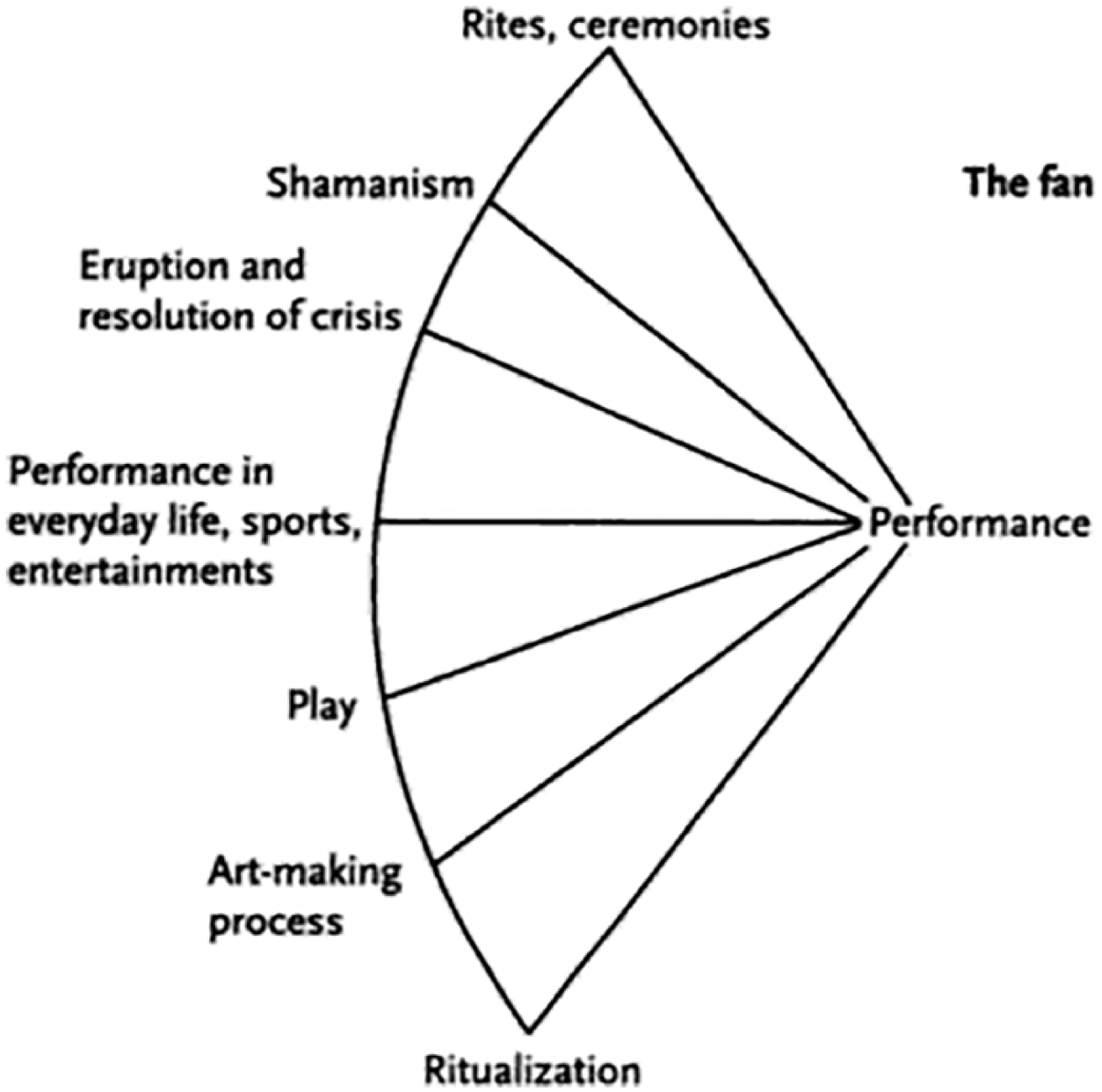
Schechner’s fan model of performance (Schechner, 2004, p. xvi).

Schechner’s Web illustration of performance (Schechner, 2004, p. xvi).
Performance, therefore, opens a theoretical terrain where one can access diverse genres and disciplines and engage with “the archives and the repertoires” of culture even-handedly to produce nuanced interpretations of culture. It “textualizes” the quotidian, through the body. The body is the site where ideology is embedded; where discourse operates; where power manifests in gestures, gait, and gaze; and where multiple identities (of sexuality, gender, class, caste, age, race, ethnicity, nation, community) are done. Deconstructing grand narratives of communication that consider language—verbal and written—as the only medium of communication, performance recognizes the myriad devices of communication that the beings—human as well as nonhumans—have produced. Devices that express not only messages or emotions but also identities, ideologies, beliefs, tradition, and culture through a semiotics that goes much beyond the philological. Borrowing from a wide range of discipline—from ethnology, anthropology, ethology, linguistics, psychology, and more—it attempts to analyze meanings that are deeply encoded and communicated through a pervasive, and yet, obscured medium.
The dynamism of culture is best embodied in its actors. To quote a platitude, culture(s) are “ways of living” and they are lived through the body. This relationship is crucial, as it involves both choreography and contingency. What is performed is compliant with sociocultural norms of being, and it is scripted by collective cultural memory and the individual’s interpellation into respective ideological traditions. Also, a “performance’s only life is in the present” (Phelan, 1993). It is contingent in the sense that it can never be “saved, recorded, documented, or otherwise participate in the representation of representations” (Phelan, 1993). “Performance’s being,” Phelan suggests, “becomes itself through disappearance.” Diana Taylor (2003) improves the definition by proposing that performance is not just that which disappears but also that which persists “through nonarchival systems of transfer . . . the repertoire.” Cultural meanings are communicated through embodied practices that are most certainly governed by cultural politics similar to literary and historical archiving, that is, survival of the fittest, but they are accessible to larger participants and audiences that contribute to them, conscious or oblivious, of their agency within them.
Performativity/Discursive Performativity and the Making of a Subject
These constitutive acts, or “bits of behavior,” the fundamental units of performance, have been theorized as performatives, and performativity has been theorized as “the-thing-done,” the “what-has-to-be-done” that has already-been-done so many times under the disciplinary threat of culture that it is, deceptively, simply “the-thing-done” (Diamond, 1996). The concept originated in the works of J. L. Austin, who etymologically evolved the term as an adjective form of “perform.” He proposed that utterances—first person, present tense, indicative mood, active voice—do what they express. Austin (1975) concluded that these utterances and whether they are constative or performative depend on their context. Derrida added that meaning is dependent on repetition of discursive norms, so a performative makes sense in a particular context only because its meaning has been reified through citation, and Butler explores how human beings who produce these discursive norms are themselves constituted by them. Performativity therefore, to commit an undesirable reductionism, is the citational cultural norm that discursively constitutes subjects. Therefore, abstractions of identity, morality, culture, and ideology become visceral and are naturalized through citations and repetitions. Butler quotes Simone de Beauvoir, “one is not born, but rather becomes a woman,” as she advances to trace the production of identities of gender and sexuality as “stylized repetitions of acts.” In the act of declaring “it is a girl,” the doctor/nurse embeds the heteronormative history of girlness on the baby and creates it a subject of the discourse of sex and, in a metalepsis, gender and sexuality—an identity that would be enforced and governed by the norms of embodied practices that would “ensure certain girling” and that would need to be cited by it “in order to qualify and remain a subject” (Butler, 1993). The illocutionary act makes sense only in a cultural context.
Discursive performativity, writes Butler, . . . appears to produce that which it names, to enact its own referent, to name and to do, to name and to make. Paradoxically, however, this productive capacity of discourse is derivative, a form of cultural iterability or rearticulation, a practice of resignification, not creation ex nihilo. Generally speaking, a performative functions to produce that which it declares. As a discursive practice (performative “acts” must be repeated to become efficacious), performatives constitute a locus of discursive production. No “act” apart from a regularized and sanctioned practice can wield the power to produce that which it declares. Indeed, a performative act apart from a reiterated and, hence, sanctioned set of conventions can appear only as a vain effort to produce effects that it cannot possibly produce. (Butler, 1993; emphasis original)
Discursive performativity therefore produces meaning and constructs social reality through a programmed reproduction of cultural codes. Any performative act to successfully affect its audience has to be located in the cultural system of signification of normativity, hierarchy, and power and has to reiterate those codes to acquire any validation from the subjects of that system. Coupled with Althusser’s theory of ideology, 5 discursive performativity can be said to reproduce the conditions of production. These perspectives of subject, subjection, subjectivation, and ideology constitute the semioticity of performance that manifests in embodied everyday practices and gets embedded in legible as well as illegible discourse. 6 A performance paradigm can help shift the skewed status quo of “the word.” The appeal of performance studies lies in its approach of elevating the body to the same status as the word; tracing performatives of identity, culture, history, myth, and more; and offering a holistic critique of culture through this kaleidoscope.
The RSS fosters a discursive environment—replete with visual, aural, and somatic cues—where nationalism or national belonging is a contest of races that “Hindus” have been losing. Narratives of invading Muslim tyrants, Muslim and Christian encroachment of not only land but also culture and ways of living are woven into ludic activities, creating insecure subjects that self-identify as victims. The RSS prescribes indigenous tag and chase games such as Main Shivaji (I am Shivaji) that are modified as per to these narratives. Games adopt narratives of Hindu/Self and Muslim/Other aggressor and superimpose them on the players. For instance, Main Shivaji, a tag game, capitalizes on the legend of Shivaji and his skirmishes with Mughal forces. The chaser takes the role of Aurangzeb, a 17th-century Muslim ruler. He is the oppressor, metonymic of violent Islam and Islamic violence against helpless Hindus. Other participants shout “Main Shivaji” and intervene the chase one after the other. The chaser has to chase the interceptor, reproducing the historical struggle between Aurangzeb and Shivaji. On being tagged the roles reverse, the game goes on. The chaser signifies foreign forces and the interceptors bellowing “main Shivaji” sacrifice themselves to save the runner and enact ludic adaptations of Shivaji’s guerilla tactic and his bravery.
Play in shakha is always a simulation of rigor, revenge, and reclamation. Insisting on machismo and force as essentials of Hindu pride and weapons of war over dharma and adding paramilitary combat training to this cauldron of paranoia and insecurity gives birth to a volatile and militant fringe. Fringe or, otherwise, ideological violence is a crucial expression of Hindutva’s cultural power that manifests routinely in performative acts of ethnic belonging. The routine and rituals of the Sangh qualify as “cultural performance.” They “possess a limited time span, a beginning and an end, an organized program of activity, a set of performers, an audience and a place” (Milton Singer quoted in Madison, 2011, p. 154). Victor Turner allegorizes such cultural performances to a hall of mirror that not only reflects individual and collective “distortions,” but actively constitutes who or what we are (Turner, 1982a, p. 263). The exhibitionist and spectatorial nature of these performances provokes a reflexive correctional portrayal of the self, “for no one likes to see himself as ugly, ungainly or dwarfish” (Turner, 1982b, p. 104). Hindutva substitutes “distortions”—attributes perceived as impractical, weak, or effeminate—incompatible with the norms and ideals of culture, society, and nationality with ameliorative utilitarian attributes—strength, discipline, and machismo. An RSS volunteer worships and idolizes the Hindu warrior kings and abstemious Vedic scholars totemized in the saffron flag. He prays to an antinomous deification of the Motherland—fair, opulent, and assertive, who mounts a lion but requires blood sacrifices to survive—and pledges to self-sacrifice. Perceptions of comradeship and solidarity are cemented in sweat, if not blood, through close tactile contact—touch, pushes, shoves, and huddles—of the bodies of his companions engaged into routine instructional strategic serious play. Reiteration of these ideals and inferences produced and drawn from these acts manifests somatically in quotidian spaces. They spill beyond the shakhas and the playgrounds, into streets, campuses, living rooms and, lately, into virtual spaces.
Performance assumes the attribute of a ligand, between multiple genres and disciplines, and a heuristic tool with immense possibilities. An interrogation of “the crossroads of culture and society” should indulge the narrative as well as the performative. It is crucial in understanding the intricate ways culture operates in creating constitutive subjects, Fixing of Identity (Meyer & Geschiere, 1999), Construction of the Other (Said, 1979), and the Invention of a Tradition (Hobsbawm & Ranger, 1983).
Stephen Totosy in his paper, “From Comparative Literature Today to Comparative Cultural Studies,” wrote, The discipline of comparative cultural studies would implicitly and explicitly disrupt the established hierarchy of cultural products and production similar to the disruption cultural studies itself has performed. Among others, the suggestion is to pluralize and parallelize the study of culture without hierarchization. (Tötösy de Zepetnek, 1999)
I postulate the paradigm of performance, in response to Totosy’s call “to pluralize and parallelize the study of culture.” The body and the word that appear as a crossroads in critical traditions are in fact a helix that run along parallel shaping, producing and reproducing culture and society.
Reflections From Fieldwork: The Case of Hindu Nationalism
Dwight Conquergood and Norman Denzin suggest that while doing Performance Ethnography, that is, performance-based ethnography, the researcher and the researched are co-performers (Conquergood, 1991; Denzin, 2003). The hierarchy between the researcher and the researched ruptures creating new avenues that can be explored reflexively and affectively. In my own study of performances of Hindu Nationalism in India, where I attempt a comparative study of the embodied, enacted, and spectatorial world of the Hindu Right and theatrical configurations of Hindu Nationalism, I discovered nuances that could only be experienced in-flesh. The struggle to study a group averse to academic scrutiny, the days of meetings and interviews required to establish a workable relationship and secure access, the series of formal interviews, routine observation, and casual conversation yield raw immanent information that literature alone could not have offered. Although everyday life is always already performative, the everyday life of romantic fascist organizations is ever more so. The Nazis had their parades, the Fascists their radio shows, the Ku Klux Klan (KKK) has their cross-burnings, and the Islamic State (IS) has its beheading. The RSS has its shakha (branches), shivir (camps), and shastra puja (arms worship). The reiterations and citations/(re)citations of identity are militantly pervasive. The members of the RSS are also vehemently against literary, academic, or intellectual activity as it is perceived as passive counterproductive armchair pontification. They lack sufficient oeuvre, which is limited to early doctrines, commentaries, behavior manuals, and training instructions. Key office-bearers would insist that instead of reading about the Sangh, I should “experience” the Sangh. And so I did.
The Sangh’s behavior manuals recommend how Hindu houses should look like; how should Hindu men, women, and children look like; and what symbols and iconography should be prominently displayed not only on the animate bodies but also on the inanimate, for example, houses, vehicles, and other possessions. The ritualist daily shakha, the dhwaj pranam (flag salute), and the daily prayer to Hindu Rashtra (Hindu Nation) produce ideologically militant subjects. The Sangh performs most of its rituals in public spaces, but the crucial political and ideological decisions are taken behind closed doors by a select few. To fit into this paradox of public-yet-clandestine group, small performatives, which would otherwise be invisible, create huge difference. For instance, a goatee, a visual identifier of being non-Hindu, would always distract the interviewee and create a bubble of aversion from other members as well. But a mustache to go with the goatee would burst that bubble and created a space where candid conversation was possible. The same proved true for other culturally identifiable accessories—sacred threads on wrist, tilak on forehead, and kurtas—and actions “Namaste” instead of the Western interaction ritual “hello.” The presentation of self affected a nonverbal assurance. It allowed them to identify me as one of them, the affect was immediate, whether I agreed with them or not on issues. Disagreements with Hindutva norms made me “a fellow Hindu who has lost his way.” The goatee has become a culturally embedded symbol of Islam and the “others” of Hinduism, transitively Hindutva. And although the legible discourse of Hindu Nationalism asserts that everyone born within the Indian territory is a Hindu, distrust for other faiths is embedded through embodied practice. Distrust and alienation of the others is also achieved through discursive omission. For instance, in the RSS school bookshop at Reshimbagh, more than 200 digests on freedom fighters were lined along a glass window. None of this vast series covered a Muslim freedom fighter although there were several digests on love jihad, that is, interfaith marriages. Similar omissions are practiced in the Sangh’s ludic routines.
The repressive, disciplinarian, and paramilitary methodology of indoctrination also produces ruptures. Visiting the RSS headquarter in Reshimbagh, Nagpur, in 2016 at Vijayadashami (the 10th day of a Hindu Festival, Durga Puja, and the RSS Founder’s Day), I stood in a long queue of people of age groups from 13 to 75 years, anxiously waiting for their turn to try out the new “full-length trousers.” On the occasion of Founder’s Day, the RSS had changed their uniform from their colonially inspired khaki shorts/skirts/kilts to trousers. The 75-year-olds were more excited about the change than the 14-year-olds. A gentleman pointed out to me the humiliation the colloquial pejorative for these shorts, “chaddi” (underwear), would incur on their sanskari (cultural) sensibilities. Several others expressed their awareness of the colonial baggage of their baggy shorts and had raised it at baithaks (meetings) over the years, but it took the ridicule of the popular media to bring about this change.
Another inconsistency I discovered was with traditionalism, specifically with respect to premarital relationships. A Swayamsevak had called a meeting of all regional Brahmin (upper caste) Swayamsewaks. The agenda of the meeting was “romance,” and not the disruption of romance in gardens and parks that is typical of the Sangh’s other sister organizations, but an indulgence into romance. He contested that people from other communities were “ensnaring” Brahmin girls while they, in their traditionalism and austerity, kurtas and shikhas (ponytails), have become unappealing in contemporary terms. He therefore called for a “modernization” of the Brahmin bachelors in contrast to the resurgent primordialism of the organization.
Conclusion
Conventional etic studies of Hindu Nationalism ignore its day-to-day machinations prioritizing its origins and its ideological baggage. These genealogies have successfully revealed the objectives, the motivations, and the influences that have given shape to its ideologies. However, by avoiding active engagement with the target demography and the scene of active ideological activity, they have failed to study how this genealogy and ideology translate into physical practice. How did an alleged fringe movement and an ideology, seemingly incompatible with the ethos of a multicultural country, mobilize millions of volunteers and secure an unprecedented mandate in the general elections? The answers to such questions are rooted in an epistemology of the body. Despite minor dissonances, the RSS has managed to discipline the bodies, and minds, of its volunteers to completely surrender to its worldview, aspirations, and hierarchies. This discipline is cultivated through an elaborate physical culture. The shakhas are the microcosm of the organization and the organization is analogous to the country—“India is Sangh, Sangh is India” (Participant 1, August, 2016, Goa). The Swayamsewaks are educated into the Sangh’s “kinship” structure and identify with its prescribed notions of Self, Nation, and Citizenship—Hindu, Hindusthan, and Hindutva. The nationalist imagination of Hindutva is embedded into a reiterative logic of the body that creates, remembers, and performs a deictic ethnic national identity.
“Opening and interpreting lives is very different from opening and closing books” (Conquergood, 1985). Performance can be a promising heuristic tool to study these embodied processes of indoctrination, and their lived experiences and ethnography can furnish lived reflexive thick data that can expand our understanding of such phenomenon. The affective experience of being there and being an insecure subject to a gaze that continually assesses your presentation of self against their doctrines of culture, politics, and nationalism also offers an insight into the everyday experiences of its others. The paradigm of performances allows to explore a genealogy of these quotidian identity politics that can be juxtaposed with performance texts to trace its precise social and cultural trajectory.
Footnotes
Declaration of Conflicting Interests
The author(s) declared no potential conflicts of interest with respect to the research, authorship, and/or publication of this article.
Funding
The author(s) received no financial support for the research, authorship, and/or publication of this article.
