



Abstract
In this paper, we report on the findings of our exploratory research investigating how the similarity or difference of the partners’ love styles could be related to dyadic and familial satisfaction. The empirical literature outlines how love styles are differently associated with various couple dimensions. While most studies employ an individual approach, we assessed whether the similarity of the prevalent love style in each couple was associated with greater dyadic satisfaction. In our sample, comprising 146 heterosexual couples (all married or cohabitating), no such association emerged. Storge and Pragma were the most prevalent love styles; moreover, there was a similar prevalence of the similarity in these two love styles between partners. Hence, the love styles similarity does not show a direct association with marital satisfaction. To establish whether there is some relationship between these variables, it would be useful for future research to investigate the impact of further individual and relational factors and of their interaction.
Introduction
Romantic love has been considered a fundamental component in people’s lives, and the most important motivation to commit in lasting relationships, such as marriage or cohabitation (Hoesni et al., 2013). An extensive literature emphasizes romantic love, with other factors, such as intimacy, commitment, and affection, as a significant component for a satisfying relationship (Kansky, 2018) and for its duration (O’Leary et al., 2012). Romantic love, however, is not a global and unidimensional experience; there are several features, ways and peculiarities of living and expressing it within the same romantic relationship (Berscheid, 2010). In fact, many researchers consider the polysemous nature of love, defining different classifications, from those initially proposed by Lee (1973), who conceptualized the nature of love through colors that correspond to specific typologies of love styles. Lee’s approach is one of the most frequently used classifications of love and also the most structured, complete, and focused on romantic relationships. In his review, Masuda (2003) supported the further elaboration of Lee’s theory with respect to other theoretical models of love. Many scholars have highlighted the centrality of this love type to the construction and maintenance of relationship and to the way in which various love styles contribute to variability in marital quality and stability (Raffagnino & Puddu, 2018).
The majority of research studies analyze the effects of love styles on marital quality and stability using an individual approach, engaging individual persons to assess what happens in a romantic relationship. Few studies adopt a dyadic analysis (Gana et al., 2013) and we could not find studies considering the similarity between partner’s love styles in association with marital quality dimensions, such as couple satisfaction. Instead similarity has been considered an important dimension of marital quality. This research aims to investigate how the similarity or difference of the partners’ love styles could be related to dyadic satisfaction. This information could improve knowledge of the importance of love styles as factors that influence couple quality.
Background
Love Styles and Their Possible Associations
Lee (1973) considered love as a multifaceted experience deriving from the different attitudes that people have toward this emotion. He recognized and classified them into six love styles, three primary—Eros, Ludus and Storge—and three secondary—Mania, Pragma and Agape –which have been further described by Hendrick and Hendrick (1986). People who experience Eros style love (passionate love) express passion, physical, and emotional attraction and commitment toward their romantic relationship. Those who experience Ludus style love (game playing love) tend to see love as a game, remaining detached from affectionate relationships, and expressing a playful and uncommitted attitude, with little sentiment. Storge (friendship love) based love is experienced like friendship and companionship-driven love. There are people who express love styles that are a combination of two of the primary styles. Pragma (practical love) individuals express a rational attitude toward love that stems from a combination of the characteristic of Ludus and Storge. Love based on Agape (altruistic love), which is the union of Eros and Storge, tends to be characterized by an altruistic attitude and those who experience it are interested in supporting, caring for, and respecting their partner. The pathological style is Mania (possessive and dependent love), an insecure and dependent experience of love that combines Eros and Ludus and is considered the purest form of romantic obsession (Acevedo & Aron, 2009).
Following Lee’s proposal, many scholars have examined the existence and consistency of these love styles in different cultural and social contexts; their findings have generally supported the six dimensions of love (Neto, 2007). In addition, the instrument built to measure the six types of love based on Lee’s theory, the Love Attitudes Scale (Hendrick & Hendrick, 1986), has been widely used across cultural contexts (Wan Shahrazad et al., 2012) and has also been adjusted to different countries—including Italy (Agus et al., 2018)—as proof of its reliability and validity.
A large area of research is concerned with the evaluation of the variability of the different love styles considered from different perspectives (personal, relational, and cultural). Although there is still no agreement among the data, we can identify some interesting trends, such as the prevalence of different love styles in different cultures (Regan, 2016; Sanrı & Goodwin, 2013) and in relation to gender. Regarding this last aspect, scholars outline that men tend to express Eros, Ludus, Storge and Agape styles more than women (Neto & Pinto, 2003; Regan, 2016), while in women, Mania (Ortalda & Canale, 2010) and Pragma (Ferrer-Pérez et al., 2009) are the prevalent styles. As supported by Vedes et al. (2016), Ludus is still more socially accepted and seen as more normal in men than in women. However, other studies did not observe the love style prevalence respecting gender. For example, Ferrer-Pérez et al. (2009) noted that both Spanish men and women widely accept Eros, Agape, Storge, and Pragma, reject Ludus and are indifferent to Mania.
With respect to the relational context in which love is fully expressed, research outlines how different love styles may be associated with various dimensions of marital quality and duration. In particular, love styles such as Eros and Agape seem to be the strongest predictors of dyadic satisfaction (Fehr et al., 2014; Graham, 2011; Neto & Pinto, 2015; Vedes et al., 2016), even if the data available are not completely consistent. In fact, Fehr et al. (2014) noticed no association between this love style and marital satisfaction; and while Vedes et al. (2016) found a greater presence of this association in women, Kimberly and Werner-Wilson (2013) found a greater association in men. In general, Ludus seems to have a negative association with couple satisfaction (Goodboy & Myers, 2010). Ludic individuals tend to experience the relationship—in its various phases—with little commitment and, when it ends, appear to express positive feelings (Fehr et al., 2014; Hammock & Richardson, 2011). With respect to this last love style, some differences have been observed in relation to gender. While Vedes et al. (2016) found relational dissatisfaction to be more frequent in ludic women than in men, Neto and Pinto (2015) reported that adult men go as far as to say that they are satisfied with their love life. This love style appeared to be irrelevant in love satisfaction levels of young adults and older adults.
The other love style that has been considered problematic for marital quality is Mania. Although people who experience love with this attitude tend to commit to the relationship (Fehr et al., 2014) and express concern for the relation and its termination (Hammock & Richardson, 2011), they do not seem to be able to build long-term (Smith & Klases, 2016) or satisfying relationships (Acevedo & Aron, 2009). Neto and Pinto (2015) recorded a correlation between love-life satisfaction in manic male adults, but not in females. Partners adopting a manic love style tend to express an excessive need to be reassured by their partner (Goodboy et al., 2012), experiencing emotional highs and lows regarding the ability to be close to him or her (Karandashev et al., 2012).
The other two love styles, Storge and Pragma, have received much less consideration in the marital literature. In general, they appear to be linked to stable relationships (Hammock & Richardson, 2011; Ortalda & Canale, 2010). Pragma is seen as partially relevant to the quality of married life (Zadeh & Bozorgi, 2016) and to satisfaction in the relationship by adults and older adults (Neto & Pinto, 2015).
Marital Satisfaction and Couple Similarity
As stated above, the literature on love styles considers the marital quality and duration construct. These factors have been widely studied by scholars who have further investigated the psychological factors of married life. Among the various aspects of this construct, marital satisfaction, defined as a partner’s subjective and global evaluation of a romantic relationship (Funk & Rogge, 2007), has been considered a central feature in the assessment of relational quality and stability (Bookwala, 2005). Its opposite situation is not simply the presence of partner dissatisfaction or the presence of couple distress, dysfunction, or conflict (Fincham & Beach, 2010). In fact, it has been regarded at as a multifaceted and multidimensional construct, influenced by different positive and negative personal and relational aspects (Bertoni & Bodenmann, 2010; Fincham & Rogge, 2010).
Over the years, researchers have identified factors that might help to distinguish relationally satisfied couples from who are dissatisfied. These factors concern relational and interpersonal dimensions (Raffagnino, 2008) that may be different depending on the couple’s dyadic or familial situation. While the former regards all couples, the latter relates only to couples who live together and have children (Raffagnino & Matera, 2015). This distinction is important because the perception of relational satisfaction may change depending on whether or not partners share the same household and care for their children rather than just themselves. While dyadic satisfaction regards factors specific to the couple relational context (such as intimacy, complicity, spending time together, etc.), familial satisfaction concerns many aspects, including housework and child care (Raffagnino & Matera, 2015).
Analyzing the heterosexual relationship, the presence of a man and a woman introduces the consideration of gender differences, which seem to play an important role in the perception of satisfaction. In general, women seem less satisfied than men (Maryam & Mahmood, 2014) with respect to both the dyadic and the familial dimensions of relational satisfaction (Raffagnino & Matera, 2015). However, in their analysis, Jackson et al. (2014) found no significant gender differences in couple satisfaction across the population in general.
Most of the research on marital satisfaction has included primarily individual measures, assessing how each of the two partners in a couple perceives and evaluates their relationship with the other; this approach overlooks that the couple relationship is a supra-individual unity. When we analyze the features and dimensions of marital quality, the assessment may benefit considerably from knowing not only how each partner behaves, thinks, and experiences the romantic relationship, but also how they experience these aspects as a member of their couple. Considering the importance of this last aspect, certain scholars have further examined some variables and dynamics characterizing the couple as a supra-individual unity. In this research area, some studies explore the similarity between partners on a variety of relationship issues (Weigel, 2008) and the perception of this similarity. The findings on the first aspect are often inconsistent as, while some studies have found that spousal similarity is associated with marital satisfaction and stability (Gaunt, 2006), but other studies have failed to find such an association (Luo, 2009). A possible explanation for this apparent inconsistency is that the similarity effects seem to depend on the type of similarity indicator and on the domain in which it is assessed (Luo et al., 2008). Besides, it seems that the satisfaction of both husbands and wives is affected by this specification, as observed by Gaunt (2006) in relation to values, for example, whereas other scholars found that some types of similarity are not associated with marital satisfaction, as revealed by Luo and Klohnen (2005) in relation to values, political attitudes and religion.
Study Purpose and Hypotheses
Marital satisfaction is considered a dyadic construct and scholars have increasingly interviewed both spouses in a couple; nevertheless, much of what we know about this construct has been based on data from individuals, and the use of analytical methods for dyads is less common. Hence, the main aim of our research was to add to the literature on marital satisfaction using couple data analyses, based on data collected from heterosexual cohabiting couples. We considered the data from the two partners as non-independent of each other. In particular, we aimed:
To identify the love style prevalent for men and women;
To observe the prevalent love style in each heterosexual couple;
To analyze the similarity of dyadic and familial satisfaction in each couple of our sample;
To understand whether the presence of the same prevailing style in both was associated with greater satisfaction.
Based on these aims and the literature, we hypothesized:
1. Men and women show different love styles, that is, the prevalent love style in men is different from the one in women (Ferrer-Pérez et al., 2009; Neto & Pinto, 2003; Ortalda & Canale, 2010; Regan, 2016).
As a consequence,
2. There is a dissimilar love style in a husband (man) and a wife (woman) in a heterosexual couple;
3. There is similarity in dyadic and family satisfaction in the couple, according to the domain of the literature exploring the similarity between partners with regard to various features of the relationship (Weigel, 2008); and
4. There is an association between the similarity in love styles and marital satisfaction, according to the literature domain that observes the importance of partner similarity for a satisfying marital relationship (Gaunt, 2006).
Method
Participants
One hundred and forty-six heterosexual couples located in a central Italian region (Tuscany) participated in the study; they were all married or unmarried cohabiting couples. The average relationship length was 14.75 years (SD = 12.86, range = 1–44). Their age ranged from 23 to 70 years for males (M = 43.58, SD = 12.38) and from 21 to 67 years for females (M = 41.62, SD = 12.14). The number of children in each participating couple ranged from 0 to 4 (M = 1.14, SD = 0.99). Among the participants, 21.9% of males (n = 32) and 35.6% of females (n = 52) had a bachelor’s or master’s degree.
To be included in the study, participants had to have been involved in a romantic relationship and been a cohabiting couple for at least 6 months. Participants were recruited by researchers with direct knowledge of the couples. Trained researchers contacted the couples in order to administer the research protocol. The couples were informed of the research goals and of the privacy policy. They then gave their informed consent by completing the questionnaire. This was delivered with the recommendation that the partners complete it separately. Then each of them placed the questionnaire inside a single envelope that was sealed immediately.
Measures
Participants completed a protocol of self-report measures, which was filled in individually (it was not possible to consult the partner). The details given included sociodemographic characteristics (age, educational qualifications, residence, and socioeconomic status) and data related to dyadic and familial relationships (type of relationship, length of relationship, and presence of children).
Individuals completed the Italian Love Attitudes Scale Short Form (LAS-SF; Italian validation by Agus et al., 2018; Hendrick et al., 1998). This 24-item questionnaire evaluates different aspects of love behavior that reflect love styles. Six dimensions (Eros, Ludus, Storge, Pragma, Mania and Agape) were identified, with Cronbach’s α coefficients ranging from .71 to .84. Individuals were asked to rate each statement on a 5-point Likert-type scale (from 0 to 4), in which a low score corresponded to greater agreement.
The next section included the Dyadic-Familial Relationship Satisfaction Scale (DFRS, Raffagnino & Matera, 2015), consisting of 14 questions. This scale measures dyadic satisfaction (α =.95) and familial satisfaction (α =.91).
Procedure
This study was a part of a larger project investigating the importance of love styles regarding knowledge of the risk and protective factors affecting marital quality and duration. The participants were identified in relation to specific features. In particular, we focused on evaluating heterosexual cohabiting couples in which both partners have a prevalent love style. With the administration of the LAS-R, we identified individuals (males and females) who presented an average score that was higher for one of the six love styles than the other five. Among these individuals, we identified 146 heterosexual cohabiting couples in which a prevalent love style was found for each partner.
Descriptive statistics were calculated to define the characteristics of participants regarding all assessed variables. The relationships between variables were analyzed at a categorical level of measurement using the kappa coefficient of agreement (Cohen, 1977) between both partners. The assessment of potential mean differences in the DFRS was evaluated by applying multivariate analysis of variance (MANOVA) with a mixed design.
Results
Table 1 shows the frequency distribution of the love style prevalent in the male and female samples. The highest percentage within each frequency distribution is indicated in bold type. For males and females, Pragma is the most prevalent among all love styles (42.5% of males and 41.8% of females). Storge is the second prevalent style, specifically 31.5% of males and 29.5% of females.
Descriptive Statistics of Prevalent Love Styles in Males and Females.

Note. LAS = Love Attitudes Scale.
In the next step, the joint frequency distributions were assessed, using a cross tabulation in which the prevalent love style of males is indicated in the rows and the prevalent love style of females is reported in columns. We observed a statistically significant coefficient of agreement (κ = .268, p = .0001), which confirmed that many couples consist of partners who have the same love style, particularly with regard to Pragma (n = 38, 26% of the couples) and Storge (n = 25, 17.1% of the couples, see Table 2).
Cross Tabulation for Male and Female Love Styles.
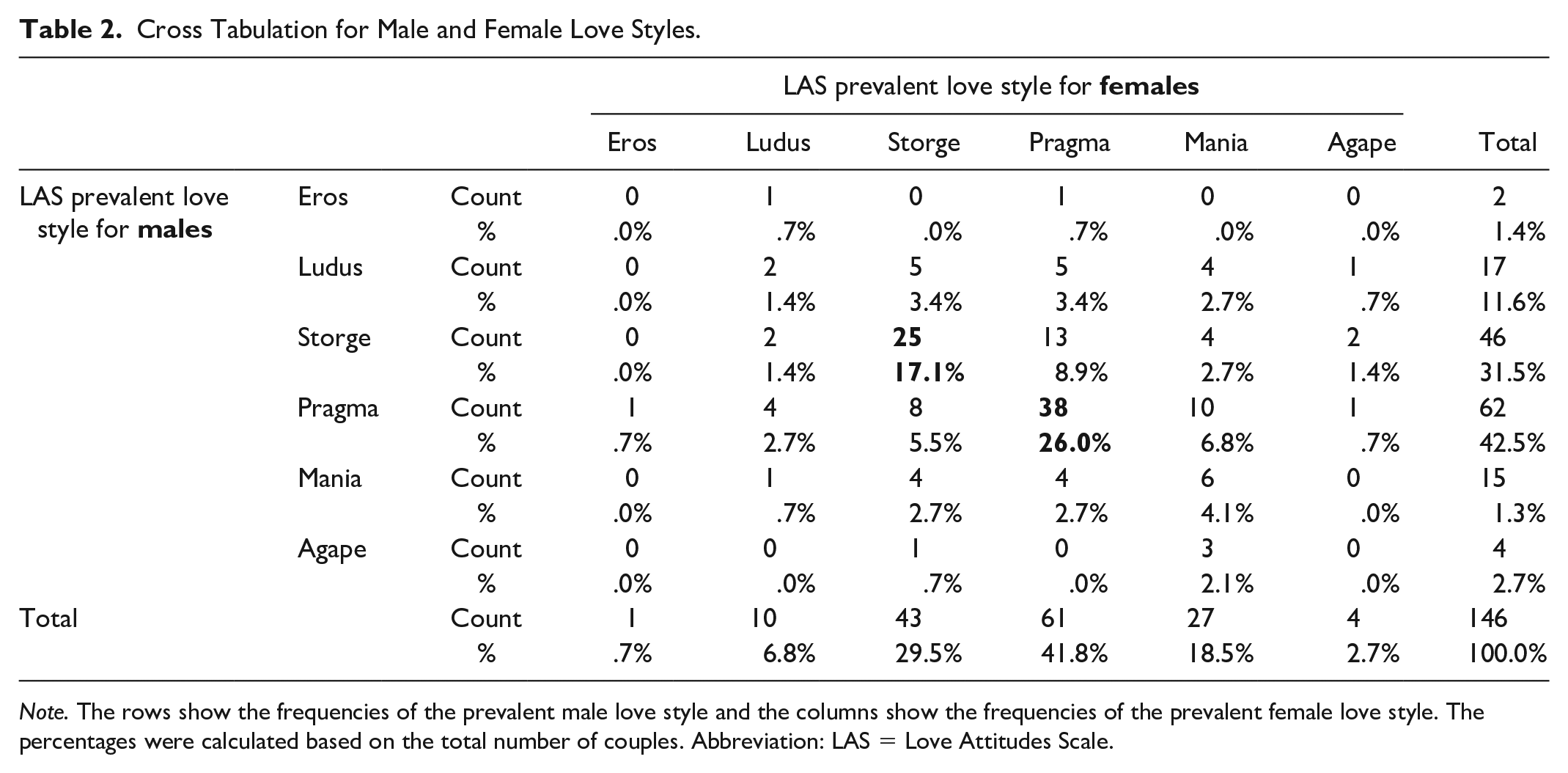
Note. The rows show the frequencies of the prevalent male love style and the columns show the frequencies of the prevalent female love style. The percentages were calculated based on the total number of couples. Abbreviation: LAS = Love Attitudes Scale.
We then examined the data in relation to the satisfaction of the couple, assessed using the DFRS (Table 3).
Descriptive Statistics of the Dyadic and Familial Satisfaction (DFRS) for Male and Female.

Note. DFRS = Dyadic and Familial Relationship Satisfaction Scale.
To evaluate the differences/similarities in satisfaction between males and females according to the DFRS scales, a multivariate ANOVA with a mixed design was carried out, applying as repeated measures the dimensions of the couple (male/female) and scale of satisfaction (dyadic/familial), considering presence/absence of the same prevalent love style in the couple as the between factor (1 = same and 0 = different love style; see Table 4).
Multivariate Analysis of Variance With a Mixed Design: Multivariate Effects.

Note. Significant differences (p < .05) are presented with an asterisk (*). Abbreviation: df, degrees of freedom.
The findings highlight a significant principal effect of the couple factor, F(1, 144) = 6.302, p = .013, partial eta squared = .042, for the grand mean scores of satisfaction for the male and female member; indeed, the female mean score of satisfaction (M = 3.017, SE = 0.054) was lower than the male mean score of satisfaction (M = 3.152, SE = .053). This significant effect is confirmed in the scale of satisfaction (dyadic/familial) × couple interaction, F(1, 144) = 5.160, p = .025, partial eta squared = .035. Specifically, females in the couple showed lower scores of familial satisfaction (M = 2.958, SE = 0.061) than dyadic satisfaction (M = 3.075, SE = 0.057). On the other hand, males had similar scores of satisfaction for dyadic (M = 3.169, SE = 0.055) and familial (M = 3.164, SE = 0.060) scales (Figure 1).

Estimated mean scores for male and female, regarding the scales of dyadic and familial Satisfaction.
There are no other significant effects. It is particularly interesting that the differences in participants in relation to the presence/absence of the same love style in the couple is not significant, F(1, 144) = 0.160, p = .690. These finding highlight that the means of satisfaction are similar for couples with the same versus different prevalent love style.
These data emphasize that the male and female member in a couple showed significant differences in their satisfaction. Specifically, the differences underlined the familial and dyadic satisfaction in the male and female member of the couple: females have lower familial than dyadic satisfaction, and their familial satisfaction is lower than in males. These differences are absent when we compared couples (male/female), regarding dyadic and familial satisfaction, with the same versus different prevalent love styles in their pair.
Discussion and Conclusion
Most research in the empirical literature on love styles includes samples comprising individuals and not couples and mostly use students, who—as stated by Neto and Pinto (2015)—are not representative of the wider population of people involved in love relationships. Hence, we cannot understand how the individual love style is expressed within the couple context. Besides, focusing on samples of individuals does not enable dyadic assessment, a method that is gathering considerable attention in the field of research on relationship quality (Bouchard, 2018; Durtschi et al., 2011). Using an explorative approach, we aimed to deepen the understanding of association between love styles and marital satisfaction in the heterosexual couple as the unit of analysis.
In particular, the first aim was to identify the love style prevalent in men and women. We observed that the two prevalent love styles in our couple sample were Storge and Pragma. The partners seem to experience friendship, companionship-driven love and commitment (Storge) and a rational attitude toward love (Pragma). These are also two styles to which the marital literature dedicates relatively little attention and empirical support compared with other love styles (Eros, Ludus, Agape and Mania). Perhaps Storge and Pragma have received less attention because they are relatively uncommon: Gana et al. (2013) reported Eros as the most common style. In addition, Storge and Pragma seem not to be important risk/protective factors of relationship satisfaction and other relational aspects, and this is different from Eros, Agape and Ludus (Hammock & Richardson, 2011; Vedes et al., 2016). So, regarding gender differences in the prevalent love styles, our findings confirm some research results and contrast with others. For example, we noted that Storge and Pragma are expressed equally by men and women, in line with Ferrer-Pérez et al. (2009) and in partial disagreement with other scholars, such as Zeigler-Hill et al. (2015), who found more Pragma in men (mainly with low self-esteem) than in women. Although the other four love styles had a poor prevalence in our sample, we noticed some interesting gender differences. While men in marital relationships tend to express passion, physical and emotional attraction (Eros) and also a playful and uncommitted attitude toward love (Ludus), women are more oriented toward love with an altruistic attitude (Agape) and they also tend to have an insecure and dependent experience of love (Mania). With regard to Eros and Ludus, these results are in line with other studies (Ortalda & Canale, 2010), while we observed some discrepancies regarding Agape and Mania. In some studies, Agape is more frequent in men than in women (Ortalda & Canale, 2010; Regan, 2016). Mania, on the other hand, as confirmed by our research, seems more frequent in women (Ortalda & Canale, 2010).
Our second aim was to examine whether partners have the same or a different prevalent love style. Using a cross tabulation with the prevalent love style of the male and female, we calculated an agreement index. We found that our couples mainly comprised partners with the same love style, particularly with regard to Pragma and Storge. So, our second hypothesis was not confirmed, because couples with similar love styles are more frequent than those with dissimilar ones. This outcome is in line with the literature domain that outlines similarity between partners for a variety of relationship issues (Weigel, 2008).
Our third aim was to examine the similarity of dyadic and familial satisfaction in each couple of our sample. We found that the values for the male and the female were very similar regarding dyadic satisfaction, but they were significantly different in relation to familial satisfaction. In particular, we found that women were less satisfied than their partner in the latter. This result seems consistent with the literature about the influence of children and home management on marital satisfaction of wives (Amstad et al., 2011; Perry-Jenkins et al., 2007).
Our fourth aim was to understand whether the presence of the same prevailing style in the male and the female was associated with relational satisfaction. We did not find a significant association. This result seems to contrast with the research that found an effect on relational satisfaction by similarity between partners, especially with regard to personality traits (Arranz-Becker, 2013). Nevertheless, our result is in line with studies that have shown no association between partner similarity and relational satisfaction with personality traits (Weidmann et al., 2016) and similarity in terms of self-esteem (Erol & Orth, 2014).
To summarize, our research reveals the prevalence of Storge and Pragma love styles, both in men and in women, and that similarity in such love styles by both partners is not related to marital satisfaction. Therefore, the couples in our sample seem to be characterized by partners who express a pragmatic and rational attitude toward love and who emphasize the importance of relational stability and the value of conservation. They tend to choose a partner on the basis of the features that are important for them and to consider their partner as a companion with whom to share their life (Hammock & Richardson, 2011; Ortalda & Canale, 2010; Sanrı & Goodwin, 2013). Moreover, the similarity between partners in these love styles seems not to be a risk or protective factor of marital satisfaction. Regarding relational satisfaction, our data show that partners evaluate familial satisfaction differently, suggesting that it is a multifaceted and multidimensional construct (Bertoni & Bodenmann, 2010; Fincham & Rogge, 2010; Raffagnino & Matera, 2015).
The fact that some of our results are not in line with most other studies could be due to way in which love is operationalised and categorised into styles. This does not allow the perception of the complexity of romantic relationship (de Munck & Kronenfeld, 2016). In their systematic review, Raffagnino and Puddu (2018) revealed variability within each style and the complexity of its association with the different and opposing factors of relationship quality. Within the same love construct, the frame is not as clear as the different theoretical models might suggest; on this matter, Lomas (2018) affirms the incompleteness of single love theories that do not exhaust the polysemous nature of love. It would be more appropriate to assess how the different styles coexist and are modulated in the individual and in the couple’s relationship. As our research focused on the prevailing style, it would be desirable to develop our knowledge by focusing on the coexistence of different love styles in the couple. This aim is supported by scholars like Berscheid (2010), who affirms the presence of different love types in the same relationship, and by those who state that love can change over time and depending on various relational contexts and dimensions. Indeed, love seems to change according to the different phases of life as a couple. Hammock and Richardson (2011), for example, revealed various correlations between different love styles and some variables in three relational phases: choosing a partner, maintaining a relationship and ending it. Regarding the life cycle of a love relationship, in terms of love styles, the relational satisfaction curve seems to go beyond the U-shape—as observed by Vaillant and Vaillant (1993)—and shows variability that is congruent to the life phases of a couple (Acevedo & Aron, 2009; Graham, 2011).
There are a few limitations of our research. First, we used convenience sampling, which is considered appropriate under certain circumstances, especially in exploratory research performed to generate new ideas—as stated by Lin and Huddleston-Casas (2005). This means that, to generalize the results, it is necessary to implement the research with random sampling. Another limitation is the choice of a cross-sectional research design, which is widely used but restricts the possibility of inferential conclusions. In relation to our topic, while we can assume that personal attitudes toward love pre-exist in partners regarding their love relationship, a cross-sectional design does not allow us to determine the direction of the possible influence among variables. Consequently, future research should focus more on a longitudinal design to observe the path of love styles in a relational context (Berscheid, 2010).
It would also be appropriate to extend the dyadic analysis of love styles to other dimensions of the relationship, such as intimacy, attachment and sexuality. In a multidimensional research design, this approach could allow researchers to observe possible variabilities, modulations and interactions in the association between attitude toward love and quality of the relationship. At the moment, we cannot exclude that the current lack of association between the similarity of love styles in partners and their relational satisfaction would change if we also evaluated other variable such as affection.
It should be noted that we did not assess the couples with respect to the different phases of their relationship. It could be important to distinguish couples with children from those without children, as the marital literature has outlined how the presence of children can become a risk factor for marital quality (Kwok et al., 2015; Schieman et al., 2018).
In conclusion, this pilot study confirms the importance of the dyadic approach in studying relational variables that comprise romantic love. At the same time, our research reaffirms the relevance of love in marital quality. Further investigations on this complex issue could have useful impacts for a couple in a clinical setting, helping to promote psychological and relational well-being between partners.
Footnotes
Acknowledgements
The authors would like to thank the participants for their essential contribution in the study.
Author Contributions
Made substantial contributions to conception and design, or acquisition of data, or analysis and interpretation of data: M.A.; L.P.; R.R. Involved in drafting the manuscript or revising it critically for important intellectual content: M.A.; L.P.; R.R. Given final approval of the version to be published: M.A.; L.P.; R.R. Agreed to be accountable for all aspects of the work in ensuring that questions related to the accuracy or integrity of any part of the work are appropriately investigated and resolved: M.A.; L.P.; R.R.
Declaration of Conflicting Interests
The author(s) declared no potential conflicts of interest with respect to the research, authorship, and/or publication of this article.
Funding
The author(s) received no financial support for the research, authorship, and/or publication of this article.
