




Abstract
Politics-related tension has been affecting many families worldwide, and Hong Kong is no exception. Given the lack of scientific research on such a topic, we aimed to advance understanding on the roles of family conflict over political issues by examining our proposed model of parent-child political value discrepancies—family conflict—family relationships. From 2018 June to 2019 May (right before the social movement in the summer of 2019), we successfully collected data from 299 parent-child dyads across two waves of survey, 9-months apart. Our analyses confirm that political value discrepancies with children predicted parents’ conflict experienced at home, which in turns predicted their family satisfaction/well-being 9 months later. Similar effects were also found for children, except that value discrepancies did not seem to be as relevant in predicting these teenagers’ conflict with parents. More importantly, the aforementioned effects were qualified by parents’ personality (i.e., neuroticism) and parents’ and children’s communication styles (i.e., destructive styles). That is, detrimental effects of political value discrepancies and family conflict can actually be reduced if parents are less neurotic and parents and/or children adopt appropriate communication styles at home. Our research design allows us to delineate the inter-influences between a parent and his/her child on politics-related conflict, generating both conceptual and practical implications. Interventions for promoting family welfare may target on modifying learners’ neurotic personality and reinforcing constructive communication styles.
Plain language summary
Politics-related tension has been affecting many families worldwide, and Hong Kong is no exception. Given the lack of scientific research on such a topic, we aimed to advance understanding on the roles of family conflict over political issues by examining our proposed model of parent-child political value discrepancies—family conflict—family relationships. From 2018 June to 2019 June (right before the social movement in the summer of 2019), we successfully collected data from 299 parent-child dyads across two waves of survey, 9-months apart. Our analyses confirm that political value discrepancies with children predicted parents’ conflict experienced at home, which in turns predicted their family satisfaction/well-being 9 months later. Similar effects were also found for children, except that value discrepancies did not seem to be as relevant in predicting these teenagers’ conflict with parents. More importantly, the aforementioned effects were qualified by parents’ personality (i.e., neuroticism) and parents’ and children’s communication styles (i.e., destructive styles). That is, detrimental effects of political value discrepancies and family conflict can actually be reduced if parents are less neurotic and parents and/or children adopt appropriate communication styles at home. Our research design allows us to delineate the inter-influences between a parent and his/her child on politics-related conflict, generating both conceptual and practical implications. Interventions for promoting family welfare may target on modifying learners’ neurotic personality and reinforcing constructive communication styles.
Keywords
Introduction
Politics refers to “activities that relate to influencing the actions and policies of a government or getting and keeping power in a government,” (Politics, n.d.). We care about politics because it is by its nature influential to our lives. At the macro level, discrepancy in opinion of political issues may spark and fuel social instability. One notable example is the Occupy Wall Street movement in the U.S. which was mainly against the federal government’s bailout of some major financial institutions after the financial tsunami in 2008 (White & Lasn, 2011). On the other hand, there were also voices supporting such economic policies (Crotty, 2011). At the individual level, political disagreement can be detrimental to one’s health conditions (e.g., Fraser et al., 2022) and interpersonal relationship. For example, numerous media reports discussed how the last U.S. presidential election has divided many American families (e.g., Tavernise, 2020). A similar example in East Asia is the weakening bonding within Taiwanese families because of the divisive political ideology between pro-independence (“pan-green”) and pro-unification (“pan-blue”) members (e.g., M. Chen, 2014).
Politics-related tension has also been growing in Hong Kong, especially after the Occupy Central Movement (a.k.a. “Umbrella Revolution”) initiated by the pro-democracy camp in late 2014. The movement, which demands “true universal suffrage,” stifled transportation and therefore some business and social activities in the central business districts (CBDs) for about 2 months (Hilgers, 2015). In relation to this movement, local people were also divided into two camps: anti-Government (“yellow ribbon”) and pro-Government (“blue ribbon”). The tension probably peaked during and after the Social Movement in the summer of 2019. It was reported that families with both “yellow ribbon” and “blue ribbon” members had significantly weakened relationships (T. P. Chen, 2014), and some even sought family counseling services (A torn social fabric, 2014). However, reports on the potential consequences were mostly media reports or based on qualitative analyses (e.g., Lai-LaGrotteria, 2023).
The current study focuses on conflicts between Hong Kong parents and their children over political issues. It has long been found that people from different generations typically endorse different values and ideologies (see e.g., Douvan & Adelson, 1966; Fingerman et al., 2019). Parents and their children are likely to have discrepancy in values and may thus have escalated conflicts with one another and become estranged (Gilligan et al., 2015), and our study empirically investigates this subject matter.
Literature on political behavior typically examines individuals’ evaluations of certain political issues and relates such evaluations to trust in authority and voting behavior (see Morgan et al., 2010; Wisneski et al., 2009), but seldom addresses the psychological and social impact of individuals’ political ideology on their relationships with others, including their families. Family research has identified a number of themes of conflicts between parents and children, including interaction style, habits and lifestyle choices, child-rearing practices, politics and ideology, work orientation, and household standards (Clarke et al., 1999; Nunez-Regueiro & Nunez-Regueiro, 2021). Political issues represent a unique and major source of intergenerational conflict. To our best knowledge, however, there has been very little quantitative research on parent-child conflict over political issues. What remains to be seen is a comprehensive model that looks into the antecedents and consequences of parent-child disagreement over political issues. Our study attempts to fill this void in the literature.
The current research aims to examine the psychological and social impact of parent-child conflict over political issues on both parents and children. The chosen outcome variables fall into different domains, namely, individual well-being (personal) and family satisfaction (relational). Given the potential impact of parent-child conflict, the present study also addresses its determinant. We consider discrepancy in political values as an important antecedent of such conflict. We also consider factors that may qualify the relation between value discrepancy and conflict, and the impact of conflict on the outcome variables. We propose family members’ personality and selective online exposure as moderators of the former relation, and family members’ age and communication response style as moderators of the latter (see Figure 1).

The proposed conceptual model of the antecedents and consequences of family conflict over political issues (Dotted lines denote the inter-influences between a child and his/her parent).
To examine the temporally causal relations among the variables, the present study adopts a two-wave longitudinal design with the waves being 9 months apart. Given the nature of our research questions, we assess pairs of parent and child (i.e., dyadic data), and follow the Actor-Partner Interdependence Model (APIM; Kenny, 2018; Kenny et al., 2006) as the analytical approach. Individual family members’ outcomes are dependent on not only their own, but also their counterparts’ experiences and perceptions, and this can be demonstrated by the APIM. The consideration of temporal causation and inter-influence between family members ensures a rigorous test of our proposed model.
By including constructs from different domains, our model attempts to integrate findings from research in diverse disciplines, including family dynamics, personality, positive psychology, lifespan development, and communication. In addition to its theoretical importance, the proposed study bears significant applied implications. It aims to provide an empirical answer to the public concern of intergenerational conflict over political issues in Hong Kong families. Hong Kong people generally belong to the Chinese culture and are collectivists. Family issues are always local people’s focal concern (Leung et al., 2021; Low, 2021; Yau & Smetana, 1996). Moreover, our study also helps delineate roles of important factors such as online behavior and constructive response style in the mechanism of family conflict. Such findings can serve as scientific basis for designing family welfare programs. To promote the welfare of families with intense conflicts due to political issues, educators/counselors may then target on modifying online behavior and reinforcing constructive response style. The following sections cover the specific research questions examined.
Antecedents of Family Conflict over Political Issues: Discrepancy in Values Between Parent and Child
“Values are internalized social representations or moral beliefs that people appeal to as the ultimate rationale for their actions” (Oyserman, 2002, p. 16150). Values are central to us. We tend to have conflicts with one another when we endorse different values (Kouzakova et al., 2012), and research has shown the negative impact of parent-child value discrepancies on both parties (see e.g., Manzo et al., 2022, for the negative effects on children).
Political issues have been acknowledged as a unique and main theme of intergenerational conflict (Clarke et al., 1999). However, there is a lack of empirical data on the relation between political value discrepancy between parent and child and family conflict over political issues. Extrapolating from general findings that intergenerational value discrepancy is associated with more intergenerational conflict (Manzo et al., 2022; Rosenthal et al., 1996), we propose that parents and children will experience more conflicts with each other over political issues when they have larger discrepancy in political values (e.g., “I would support my country, right or wrong,”Schwartz et al., 2014) than those with a lesser extent of discrepancy (as Hypotheses 1A for parents and 1B for children).
Moderating Effect of Personality
The five-factor model of personality (McCrae, 2020; McCrae & Costa, 1999) identifies the five traits of extraversion, agreeableness, openness to experience, conscientiousness, and neuroticism. Whereas some traits have often been linked to conflict experience, for example, the strong relationship between neuroticism and work-family conflict experience as reported in Allen et al.’s (2012) meta-analysis, we are more interested in the potential moderating roles of personality traits in the current study. Conflict resolution literature has documented that agreeableness, openness, and neuroticism play significant roles in conflict management (see Tehrani & Yamini’s, 2020 meta-analysis). For instance, Vater and Schröder–Abé (2015) reported that agreeableness is one of the strongest predictors of positive conflict resolution behaviors. Gurtman (1995) revealed that an open individual would be more flexible to solve problems and understand other’s perspective more easily. Regarding neuroticism, neurotic individuals were less likely to control their impulses and handle their disagreement with partners effectively (Delatorre et al., 2022). In other words, individuals with different personality traits will manage potentially conflictful situations differently, leading to different extents of conflict experience. In addition to the direct effect of personality on conflict experience, more research has been conducted to examine such moderating roles of personality traits in conflict management (e.g., Selvarajan et al., 2016; St-Onge et al., 2021). Based on these arguments and findings, we hypothesize that parents and children will experience more family conflicts due to value discrepancy if they are higher in neuroticism than those lower in neuroticism (as Hypotheses 2A for parents and 2 B for children). We will also examine the potential moderating effects of agreeableness and openness.
Moderating Effect of Selective Online Exposure
A growing body of literature looks into the linkage between online viewing and politics-related behavior through the concept of selective online exposure, that is, the general tendency to seek out agreeable ideas in various online platforms (e.g., Gupta et al., 2023). Regarding the role of selective online exposure in responses to political issues, Sunstein (2007) showed that Internet consumption of political information led people to adopt pro-attitudinal perspectives and actively avoided counter-attitudinal perspectives, leading to the phenomenon of polarization. Lenzi et al. (2015) reported that children’s reading news on social network sites contributed to offline news discussions with parents, which may lead to a higher chance of triggering family conflict over political issues. Keeping these findings in mind, we advance that the relation between value discrepancy and perception of family conflict will be accentuated among those who practice selective online exposure more than those who practice less (as Hypotheses 3A for parents and 3B for children).
Consequences of Family Conflict over Political Issues: Life Satisfaction, Happiness, and Family Satisfaction
In addition to the development of family conflict (addressed in Part 1 of our conceptual model), the current study also examines the impact of family conflict (in Part 2 of our model). One outcome variable of interest is individual well-being, and we operationalize this construct focusing on life satisfaction (Diener et al., 1985). Life satisfaction has been considered as a major outcome variable in family conflict. For instance, parent-child conflict on family matters was found to be negatively associated with psychological well-being and life satisfaction among adolescents (e.g., Chen-Gaddini et al., 2020; Dost-Gözkan, 2019; Manzo et al., 2022; Phinney & Ong, 2002). Likewise, parent-child conflict was consistently found to be negatively correlated with psychological well-being and life satisfaction of parents (e.g., Keresteš et al., 2012). Shek (1999) also provided important evidence on the negative impact of parent-child conflict on life satisfaction of both parent and children samples in Hong Kong. However, this study only included an overall conflict measure and did not look into different conflict domains. Nevertheless, we expect that this general pattern of impact of family conflict holds for family conflict over political issues. That is, family conflict over political issues will have detrimental effects on both parents’ and children’s life satisfaction and general happiness.
Findings from past research also reveal a negative association between family conflict and one’s satisfaction toward the family. Among them, Aquilino and Supple (1991) found a negative effect of family conflicts over lifestyle choices (e.g., dressing and dating) or work issues on family satisfaction among parents. Van Doorn et al. (2009) used a daily diary method and reported that adolescents’ experience in family conflict was negatively correlated with their relationship satisfaction with parents and family. In line with these, we predict a negative association between family conflict over political issues and the three different measures of personal and family satisfaction, namely, life satisfaction (as Hypotheses 4A for parents and 4B for children), happiness (as Hypotheses 5A for parents and 5B for children), and family satisfaction (as Hypotheses 6A for parents and 6B for children).
Moderating Effects of Constructive Response Style
Research in positive psychology reveals that constructive response style is salutary to relationship building, and responding positively to others’ negative behaviors during conflict often contributes to a more satisfying relationship (e.g., Gable et al., 2004; Reivich et al., 2011). Constructive response style refers to the general tendency to act and respond positively and enthusiastically in interpersonal relationships. For instance, Rusbult et al. (1991) reported that one’s willingness to react constructively and to inhibit reacting destructively was significantly associated with his/her own satisfaction, commitment, and partner’s perspective taking among dating couples. LaFreniere and Kulkarni’s (2022) findings also reveal that young adults’ negative communication behavior when handling conflicts with parents would have negative impact on their relational satisfaction.
Extending these insights to the current analysis, we predict that constructive response style used by parents/children when handling family issues in general will moderate the impact of family conflict over political issues on the three outcome measures of life satisfaction, happiness, and family satisfaction (as Hypotheses 7A, 8A, 9A for parents and 7B, 8B, 9B for children). That is, for parents/children who have a general tendency to use a constructive style when handling family issues, the impact of family conflict over politics on each of the satisfaction measures will be weakened (i.e., less negative impact of such conflict on their well-being). For parents/children adopting a destructive style, the negative impact of family conflict will instead be strengthened.
To recap, we propose a model of antecedents and consequences of parent-child conflict on political issues (Figure 1). Our two-wave study aims to examine the following nine sets of research hypotheses. For Part 1 of the model, we propose that:
(1) Intergenerational discrepancies in political values will be positively related to parents’ (H1A) and children’s (H1B) perception of family conflict over politics over time;
(2) Parents and children will experience more family conflicts due to value discrepancy if they are higher in neuroticism than those lower in neuroticism (Hypotheses 2A for parents and 2B for children);
(3) The relation between value discrepancy and perception of family conflict will be accentuated among those who practice selective online exposure more than those who practice less (Hypotheses 3A for parents and 3B for children);
For Part 2 of the model, we propose that:
(4) Perception of family conflict over political issues will be negatively associated with life satisfaction (Hypotheses 4A for parents and 4B for children) over time;
(5) Perception of family conflict over political issues will be negatively associated with happiness (Hypotheses 5A for parents and 5B for children) over time;
(6) Perception of family conflict over political issues will be negatively associated family satisfaction (Hypotheses 6A for parents and 6B for children) over time;
(7) Constructive response style used by parents/children when handling family issues in general will moderate the impact of family conflict over political issues on their life satisfaction (as Hypotheses 7A for parents and 7B for children). That is, for parents/children who have a general tendency to use a constructive style when handling family issues, the impact of family conflict over politics on their life satisfaction will be weakened (i.e., less negative impact of such conflict on their well-being). For parents/children adopting a destructive style, the negative impact of family conflict will instead be strengthened;
(8) Similarly, constructive response style used by parents/children when handling family issues in general will moderate the impact of family conflict over political issues on their happiness levels (Hypotheses 8A for parents and 8B for children);
(9) Similarly, constructive response style used by parents/children when handling family issues in general will moderate the impact of family conflict over political issues on their family satisfaction (Hypotheses 9A for parents and 9B for children).
Method
Participants
A total of 299 parent-child dyads were collected from June 2018 to May 2019, across the two waves 9 months apart. The first wave was conducted from June to August 2018, and the second wave from March to May 2019. As shown in Table 1, 76% of the parent sample were female and 24% male, aged between 32 and 72 (with mean age at 48). Majority of them (78%) had either primary or secondary school education. For the child sample, 56% were female and 44% male, aged between 15 and 25 (with mean age at 17). Majority of them (84%) were secondary school students.
Sample Characteristics at Time 1 of Data Collection (N = 299 dyads).

Note. Perceived SES from “1 – lower class” to “5 – upper class.”
Procedure
We recruited children and parents in a number of ways. To recruit late adolescents, we contacted local secondary schools in different socio-economic regions in Hong Kong to recruit students aged between 16 and 18 years, aiming to cover family samples from diverse background. Parental consent was obtained whenever necessary. To recruit children who were young adults (aged from 18 to 25), we distributed flyers in local universities. We also approached unemployed young adult through local employment service centers and youth service centers, and employed young adult in work settings. Similarly, we also recruit unemployed parents through employment service centers, and working parents in organizational settings. For some of the parent-child dyads, we first recruited children (late adolescents and young adults) who were then asked to invite one of their parents to participate as well. For the rest of the dyads, we recruited parents who were then asked to invite one of their children (16–25 years) to respond to our survey. Ethics approval (ref: SBRE-16-470) was granted by the first author’s university under its Survey and Behavioural Research Ethics Committee. Informed consents were obtained from all participants.
To be eligible for the survey, children had to reside with at least one parent who agreed to participate. At Time 1, each parent-child dyad was given a first-wave packet containing a consent form, a questionnaire, and a pre-paid return envelope for each party. Each dyad was instructed that the study would involve two waves and both parent and child had to reply to receive cash coupons as souvenir, but that each party should complete and return their questionnaires separately. Once we received the completed surveys from both the parent and child, they were given a USD25 cash coupon. At Time 2 (9 months later), each dyad was sent a package containing the second-wave survey. Once the completed questionnaire was returned to us, the parent-child dyad received another USD25 cash coupon. To prevent individuals (e.g., children) from completing both sides of our survey without actually involving the other party (parent), on each consent form, we alerted the participant that our research team might contact the other party to confirm his/her participation.
Regarding the 9-month duration between the two data collection points, our choice was based on the fact that longitudinal family studies involving data from parent-adolescent dyads (with a similar design to ours) typically use time intervals of around 6 to 15 months between data collections (e.g., 6 months in Dubois-Comtois & Moss, 2008; 15 months in Lyons & Sayer, 2005; 1 year in Shek, 1999), with retention rates around 50% to 70%. For feasibility, we thus specified an interval of 9 months.
In terms of critical events happened during our data collection period (i.e., between June 2018 June to May 2019), we did a relevant search on news in Hong Kong. Apart from a few court cases of several high-profile activists being convicted/sentenced for their involvements in various protests and the disqualification of several pro-democracy lawmakers from the Hong Kong Legislative Council for taking their oaths of office improperly in 2018, other headline news in the survey period were mostly related to social, economic and livelihood issues, for example, the reports on the construction errors in the Shatin-to-Central railway link in June 2018, the impact of Typhoon Mangkhut in September, the Hong Kong chief executive’s proposal of the Lantau Tomorrow Vision in October, and the opening of Hong Kong—China express rail in September and subsequent ruling of the Court of First Instance in December that juxtaposed border checkpoint at the Hong Kong West Kowloon railway station was constitutional. In 2019 February, the Hong Kong government proposed the fugitive offenders amendment bill on extradition which was certainly critical, leading to subsequent mass protests in 2019 June and onward. However, it should be noted that our data collection had already been completed before the onset of the mass protests.
Measures
All survey materials were presented in Chinese, after back-translation if Chinese version was not available. And the focal measures include:
Political Values
For parent-child discrepancy in values, we measured parents’ and children’s political values using Schwartz et al. (2014) scale (α = .65–.79 in the current study). Items such as “I would support my country, right or wrong.” were rated on 6-point “Very much like me” to “Not like me at all” Likert scales. We then took the absolute difference of each member’s (of a dyad) response to each value item and summed them to represent a value discrepancy score for that value domain (e.g., in civil liberties).
Family Conflict over Politics
We captured family conflict over political issues by adapting the conflict subscale of the Moos Family Environment Scale (Jaycox & Repetti, 1993; α = .65–.70). Items such as “Family members often criticize each other due to political issues” were 6-point “Very much like us” to “Not like us at all” Likert scales.
Satisfaction with Life
We measured individual well-being using Diener et al.’s (1985) 5-item life satisfaction scale, on 5-point “Strongly agree” to “Strongly disagree” Likert scales (α = .88–.93, e.g., “The conditions of my life are excellent”).
Happiness
Individuals’ level of happiness was captured by a single item adapted from Abdel-Khalek (2004, 2006, i.e., “Do you feel happy in general?” on a 5-point “Strongly agree” to “Strongly disagree” Likert scale).
Satisfaction with Family Life
We adopted Zabriskie and Ward’s 5-item SWFL scale (2013, α = .92–.93) to capture family satisfaction. Items such as “So far I have gotten the important things I want in my family life” were rated on 5-point “Strongly agree” to “Strongly disagree” Likert scales.
Personality variables
We assessed personality traits of interest, that is, openness to experience (α = .68–.71, e.g., “I see myself as someone who is curious about many different things”), agreeableness (α = .56–.61, e.g., “I see myself as someone who is helpful and unselfish with others”), and neuroticism (α = .65–.69, e.g., “I see myself as someone who gets nervous easily”), using John and Srivastava’s (1999) personality inventory. All items were rated on 5-point “Strongly agree” to “Strongly disagree” Likert scales.
Selective Online Exposure Scale
Selective online exposure was assessed by items adapting from Jun (2012; α = .67–.79). Items such as “To what extent you feel the Internet had helped interact with people who share political views” were rated on 4-point “A lot” to “Not at all” Likert scales.
Self and Perceived Other’s Communication Style
We captured constructive-destructive response style for negative events following Rusbult et al. (1991; α = .67–.89). Items such as “When I am angry with my [parent/child] and ignore him/her for a while, he/she will talk to me about what’s going on” were rated on 5-point “Never do this” to “Constantly do this” Likert scales.
In addition to the focal variable of age, we also collected demographic information including gender, education level and self-reported socio-economic status.
Analytical Plan
Given the exploratory nature of our proposed model and the large number of variables involved (see Figure 1), we decided to break down the analyses into two separate parts, both utilizing the nature of the dyadic data source and the longitudinal design. The first part is concerned about the development of perception of family conflict over political issues within a participant (e.g., a parent), that is, Hypotheses 1A and 1B, and how this relation is qualified by participants’ personality (Hypothesis 2A and 2B) and media exposure (Hypotheses 3A and 3B; see Part 1 in Figure 1). Specifically, we performed a series of multiple regressions for the parent and child samples, respectively, to test if T1 value discrepancies (i.e., the absolute differences in the values rated by a parent and his/her child; this is a dyadic measure derived from each parent-child dyad) and if the value discrepancies by moderators would predict family conflicts experienced by the parent and the child at T2. Figure 2 captures the logic of this set of analyses.

Analytic model for examining effects of T1 political value discrepancies on T2 family conflict over political issues, as specified in Part 1 of the conceptual.
The second part of the proposed model addresses the outcomes of family conflict within a participant (i.e., Hypotheses 4–6) and how these relations are subject to the participant’s response style (i.e., Hypotheses 7–9). In other words, this is a standard Actor-Partner Interdependence Model. We followed Cook and Kenny (2005) and conducted various linear regression analyses capturing both the actor and partner effects. That is, our analyses contained longitudinal and dyadic data and thus revealed the temporally causal associations among the variables within a participant, while the influences of the counterpart were also considered (Kenny et al., 2006). we followed the Actor-Partner Independence Model (APIM) to examine the main effects of family conflict over political issues on the family interaction outcomes 9 months later, by conducting a series of regression analyses for the parent and children samples, respectively (see Cook & Kenny, 2005). Specifically, for the parent sample, we use T1 parent perceived conflict (actor effect) and T1 child perceived conflict (partner effect) and the various T1 interaction terms (i.e., the interaction term of each of the proposed moderators and family conflict at T1) to predict T2 parent outcomes. Similarly, we use T1 child perceived conflict (actor effect) and T1 parent perceived conflict (partner effect) and the various interaction terms to predict T2 child outcomes for the children sample. Figure 3 captures the logic of this set of APIM analysis. Similar model was conducted for the child sample.

Analytic model for examining effects of T1 family conflict over political issues on T2 parent outcomes following APIM, as specified in Part 2 of the conceptual model. A similar set of analysis is conducted for the children sample.
Results
Before going into the details of regression analyses addressing our four sets of research hypotheses, Table 2 presents the zero-order correlations of the focal variables in our proposed model across Time 1 and Time 2. Consistent with our expectations, all the correlations were associated in the right directions, for example, more family conflicts over political issues leading to worse well-being measures. However, eye-balling such correlations does not directly address the complicated relations proposed in our model. The following sections describe the analyses addressing each of the hypotheses.
Zero-Order Correlations Among the Focal Variables Across Waves (N Varies from 286 to 299).
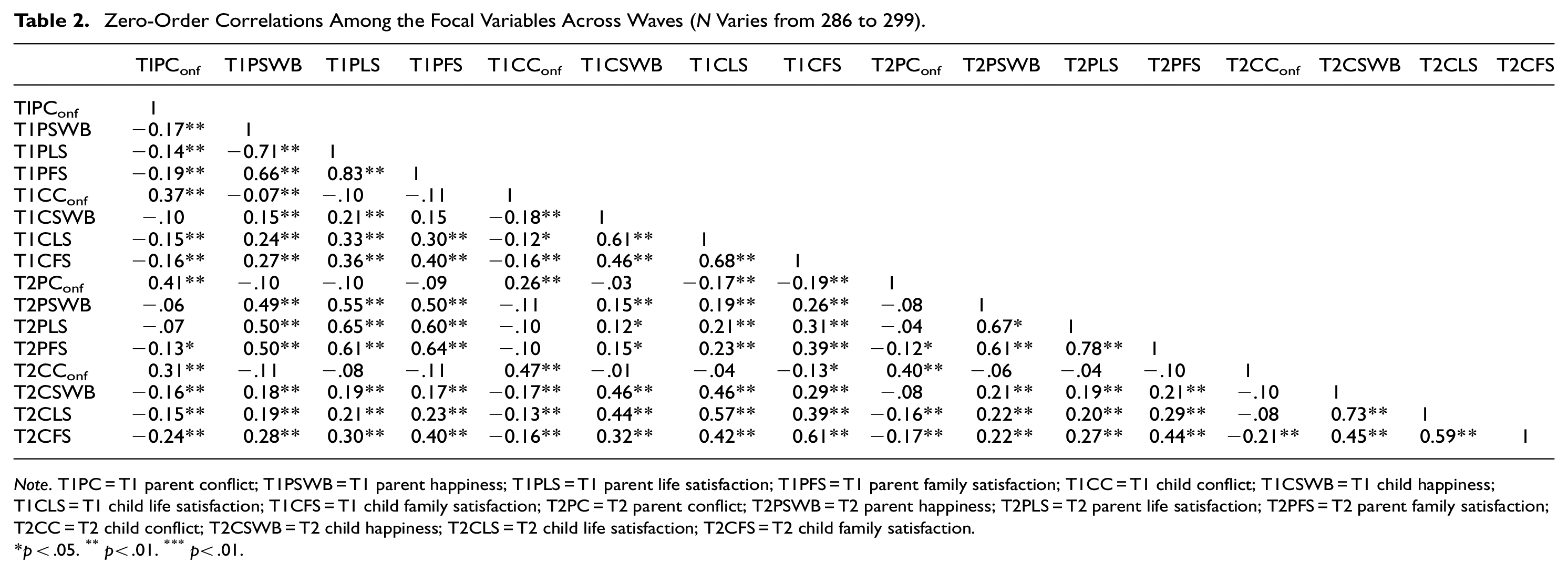
Note. T1PC = T1 parent conflict; T1PSWB = T1 parent happiness; T1PLS = T1 parent life satisfaction; T1PFS = T1 parent family satisfaction; T1CC = T1 child conflict; T1CSWB = T1 child happiness; T1CLS = T1 child life satisfaction; T1CFS = T1 child family satisfaction; T2PC = T2 parent conflict; T2PSWB = T2 parent happiness; T2PLS = T2 parent life satisfaction; T2PFS = T2 parent family satisfaction; T2CC = T2 child conflict; T2CSWB = T2 child happiness; T2CLS = T2 child life satisfaction; T2CFS = T2 child family satisfaction.
p < .05. **p< .01. ***p< .01.
Focusing on Part 1 of our conceptual model (Figure 1), multiple regressions were conducted to address our first set of hypothesis that intergenerational discrepancies in political values (i.e., patriotism, civil liberties, and law and order) will contribute to family conflict over political issues. For the parent sample, regression results partially support our prediction (Hypothesis 1A). Parent-child discrepancies in the fundamental political value of Civil Liberties at T1 were associated with parents’ reported T2 conflict at the 0.10 level (ß = 0.09, p> .10; see the main effects in Table 3), that is, the more diverging views the parents and their children had on whether people should enjoy civil liberties in a society at Time 1, the more family conflict the parents would experience over the next 9 months. Considering the strong effects of including the T1 perceived conflict as a control variable, we believe this effect supports our first hypothesis. Discrepancies in the other 2 political variables did not produce any significant effects.
Predicting Parents’ Time 2 Perceived Conflict Using Time 1 Political Value Discrepancies and Their Interactions with Parents’ Neuroticism.

Note. T1 perceived conflict, age, gender (dummy-coded with male as 1), educational level, and SES as control variables.
Numbers are unstandardized coefficients; ~p< .10. *p< .05. **p< .01. ***p< .01.
For the child sample, value discrepancies were unable to predict family conflict reported by the children. In other words, value discrepancies with parents were not the main antecedent for children’s conflict at home. We attempted various analyses (absolute vs. signed differences in creating discrepancy scores, different clusters of values, etc.), yielding similar results. Hypothesis 1B was not supported.
To examine whether personality traits (Hypotheses 2A and 2B) and selective exposure to online materials (Hypotheses 3A and 3B) will moderate the effect of intergenerational discrepancies in values on such family conflict, we aimed to look for significant interaction effects (i.e., the interaction term of each of the proposed moderators and value discrepancies at T1 to predict conflict reported at T2) in the aforementioned hierarchical multiple regression analyses for the parent and child samples, respectively. For the parent sample, the regression analyses provide some support for Hypothesis 2A. Specifically, significant interaction effects were found for the Civil Liberties discrepancy by Neuroticism (ß = 0.20, p> .05; see the interaction effects in Table 3). The final regression model was significant, F(12, 286) = 6.53, p< .0001, R2=0.22, adjusted R2=0.18. Simple slope analyses (as shown in Figure 4) revealed the interaction pattern that the positive link between T1 Civil Liberties discrepancy and T2 conflict was stronger for those parents higher in T1 neuroticism than those lower in it. That is, the detrimental effects of value discrepancy (as leading to more family conflict) were more pronounced among parents who were more neurotic, as compared to those lower in it. Such patterns of interaction effects from the parent sample are consistent with behavioral research on interpersonal/family conflicts (e.g., McNulty, 2008). It should also be noted that the main effect of Neuroticism (ß = 0.11, p> .10) was also marginally significant, confirming the robust effect of neuroticism on conflict experience. No interaction effects were found for agreeableness and openness. Moreover, no moderating effects of selective exposure to online materials were found, failing to support Hypothesis 3A.

Simple slope analysis for the civil liberties discrepancy by neuroticism interaction effect on parents’ perceived conflict.
For the children sample, again no significant interactions were found, failing to support Hypotheses 2B and 3B. Together with the null results for Hypothesis 1B, these findings reveal that the impact of political discrepancies seemed to be less severe for these youngsters as they probably had other more pressing issues when interacting with parents.
Focusing on Part 2 of our conceptual model (Figure 1) that family conflict over political issues will predict the important outcomes of life satisfaction (Hypotheses 4A and 4B), happiness (Hypotheses 5A and 5B), and family satisfaction (Hypotheses 6A and 6B), regressions following the APIM approach were conducted. For the parent sample, APIM results indicated that children’s T1 conflict (i.e., a partner effect) significantly predicted parents’ T2 Happiness (ß = −0.16, p> .05; see the main effects in Table 4), providing support for Hypothesis 5A. Instead of parents’ own T1 rating, this significant partner effect illustrates the complex mechanism in family interactions that children’s reported conflict at T1 can adversely impact their parents’ happiness level 9 months later. And with the T1 happiness measure entered as a control variable, this significant effect bears particularly important implications. When we excluded the T1 corresponding measure as a control measure (for exploratory purposes), additional significant effects were found. For instance, APIM results revealed that parents’ T1 conflict (i.e., an actor effect) significantly predicted their own T2 Family Satisfaction (ß = −0.15, p> .05; when T1 Family Satisfaction was not controlled for), demonstrating the obvious negative effects of family conflict on these parents’ family life over time as Hypothesis 6A stated. No support was found for Hypothesis 4A. Taken together, main effects of family conflict (either from the parent himself/herself or from his/her child) over political issues at T1 were found to predict these parents’ happiness and family satisfaction 9 months later. These findings provide some general support for our expectation that family conflict over political issues will affect parents’ well-being over time.
Predicting Parents’ Time 2 Happiness Using Time 1 Parents’ Perceived Conflict (As Actor Effect) and Children’s Perceived Conflict (As Partner Effect), and the Interaction Between Parents’ Conflict and Parent’s Perception of Children’s Neglect Communication Style.

Note. T1 happiness, age, gender (dummy-coded with male as 1), educational level, and SES as control variables.
Numbers are unstandardized coefficients; *p< .05. **p< .01. ***p< .001.
For the children sample, significant main effects of family conflict over political issues at T1 were found to predict their Life Satisfaction (Hypothesis 4B), Happiness (Hypothesis 5B), and Family Satisfaction (Hypothesis 6B) 9 months later. Specifically, APIM results revealed that parents’ T1 conflict (i.e., a partner effect) predicted these children’s T2 Happiness (ß = −0.15, p> .05; F(7, 291) = 12.90, p< .0001, R2=0.24, adjusted R2=0.22; see Table 5) and T2 Family Satisfaction (ß = −0.16, p> .05; F(7, 291) = 29.75, p< .0001, R2=0.42, adjusted R2=0.40; see Table 6), demonstrating the negative effects from parents’ on their personal and family satisfaction over time. Again, when we excluded the T1 corresponding measure as a control measure (for exploratory purposes), additional significant effects were found. For instance, APIM results revealed that children’s own T1 conflict (i.e., an actor effect; ß = −0.15, p> .05) as well as parents’ T1 conflict (i.e., a partner effect; ß = −0.18, p> .05) both significantly predicted their own T2 Family Satisfaction when T1 Family Satisfaction was not controlled for. Consistent with Hypotheses 5B and 6B, these findings from APIM illustrate the dynamic nature of family interactions that both children’s own perceived conflict and parents’ perceived conflict over political issues can adversely impact children’s family satisfaction level 9 months later. These findings also reflect the systematic nature of responses provided by our children sample. No support was found for the measure of life satisfaction (Hypothesis 4B).
Predicting Children’s Time 2 Happiness Using Time 1 Children’s Perceived Conflict (As Actor Effect) and Parents’ Perceived Conflict (As Partner Effect).

Note. T1 happiness, age, gender (dummy-coded with male as 1), educational level, and SES as control variables.
Numbers are unstandardized coefficients; *p<.05. **p< .01. ***p< .01.
Predicting Children’s Time 2 Family Satisfaction Using Time 1 Children’s Perceived Conflict (As Actor Effect) and Parents’ Perceived Conflict (As Partner Effect).

Note. T1 family satisfaction, age, gender (dummy-coded with male as 1), educational level, and SES as control variables.
Numbers are unstandardized coefficients; *p<.05. **p< .01. ***p< .01.
Finally, to address our last set of hypotheses of whether constructive response styles will moderate the effects of family conflict on the aforementioned outcomes (Hypotheses 7–9), we aimed to look for significant interaction effects (i.e., the interaction term of each of the proposed moderators and perceived family conflict at T1 to predict T2 parents’ and children’s outcomes) in our APIM analyses for the parent and child samples, respectively. For the parent sample, APIM regression analyses provide some support to our prediction. A significant interaction was found for T1 parents’ conflict by parents’ perception of children’s Neglect style (ß = −0.17, p> .01; an actor effect) on parents’ T2 Happiness (see the interaction effect in Table 4). And the overall model was significant, F(9, 289) = 12.05, p< .0001, R2 = 0.27, adjusted R2 = 0.25, providing support for Hypothesis 8A. Simple slope analysis revealed that the detrimental effect of conflict was weaker when parents perceived their children as less likely to adopt a neglect style of communication (see Figure 5). Another significant interaction effect was found for T1 children’s conflict by children’s own Voice style (ß = −0.10, p> .05; a partner effect) on parents’ T2 Family Satisfaction (see Table 7). The overall model was significant, F(9, 289) = 23.92, p< .0001, R2 = 0.43, adjusted R2 = 0.40, supporting Hypothesis 9A. Simple slope analysis revealed that the negative association between T1 children conflict and T2 parent satisfaction was stronger for those children who tended to voice out their opinions (see Figure 6). No support was found for the measure of life satisfaction (Hypothesis 7A). .

Simple slope analysis for the T1 parents’ conflict by parents’ perception of children’s neglect style interaction effect on parents’ T2 happiness.
Predicting Parents’ Time 2 Family Satisfaction Using Time 1 Parents’ Perceived Conflict (As Actor Effect) and Children’s Perceived Conflict (As Partner Effect), and the Interaction Between Children’s Conflict and Children’s Voice Communication Style.

Note. T1 family satisfaction, age, gender (dummy-coded with male as 1), educational level, and SES as control variables.
Numbers are unstandardized coefficients; *p< .05. **p< .01. ***p< .001.

Simple slope analysis for the T1 children’s conflict by children’s own voice style interaction effect on parents’ T2 family satisfaction.
For the children sample, a significant interaction effect was found for T1 children’s conflict by children’s perception of parent’s voice style (ß = −0.08, p> .05; an actor effect) on children’s T2 life satisfaction (see Table 8). The overall model was significant, F(9, 289) = 17.64, p< .0001, R2=0.35, adjusted R2=0.33, providing support for Hypothesis 7B. Simple slope analysis revealed that the negative association between T1 children conflict and T2 children satisfaction was stronger for those children who perceived their parents as more likely to voice out their opinions (see Figure 7). No support was found for Hypotheses 8B and 9B.
Predicting Children’s Time 2 Life Satisfaction Using Time 1 Children’s Perceived Conflict (As Actor Effect) and Parents’ Perceived Conflict (As Partner Effect), and the Interaction Between Children’s Conflict and Children’s Perception of Parent’s Voice Style.

Note. T1 life satisfaction, age, gender (dummy-coded with male as 1), educational level, and SES as control variables.
Numbers are unstandardized coefficients; *p< .05. **p< .01. ***p< .001.

Simple slope analysis for the T1 children’s conflict by children’s perception of parent’s voice style interaction effect on children’s T2 life satisfaction.
Consistent significant interaction effects found in both the parent and children samples support our expectation that appropriate communication styles used in the family can alleviate the detrimental impact of conflict on both the parents and their children when confronting political issues.
Discussion
To recap, some empirical support for the main effects of the proposed value discrepancies→family conflict→family outcomes links as specified in the conceptual model were found. Specifically, value discrepancies with children significantly predicted parents’ conflict experienced at home (Part 1 of the conceptual model), which in turns predicted their family satisfaction/well-being 9 months later (Part 2 of the model). Similar effects were also found for children, except that value discrepancies may not be as relevant in predicting their conflict (Part 1 of the model). We reckon that other factors (e.g., peer influence, school works, other life/family issues) may be more relevant for explaining teenagers’ conflict with parents). After all, whereas these main effects may seem intuitive, no systematic findings have been reported in the literature, especially with the rigorous methodology of dyadic data sources and temporal causation as adopted in the current study.
Whereas some may query if the null results from the children sample on the value discrepancies—family conflict link may be due to poorer data quality (e.g., some teenagers might be less serious and provided random answers when completing the surveys). One cannot rule out such a possibility, However, it does not seem to be valid as many significant findings were observed in the children sample when we moved to the research questions of the impact of conflict on their personal and family well-being as specified in Part 2 of our model. We thus incline to stick with our speculation that these teenagers/young adults probably have other more pressing issues when interacting with their parents. For instance, Clarke et al. (1999) reported that children viewed parent-child conflict as most often related to “concerns about communication and interaction,” followed by “differences over personal habits and lifestyles choices” (p. 263). Padilla et al.’s (2016) findings on Mexican families reveal that differences in familism values were associated with parent-child conflict over time. Lowe and Arnett (2020)’s analysis of a national sample in the U.S. suggests that monetary conflict with children are prevalent in the family. A multitude of issues over various life domains are relevant to teenagers’ conflict with parents. And unlike their parents who had been exposed to political issues for a much longer period of time, our teenager participants may just have less interested in politics, leading to less impact on them even when there are values discrepancies with parents.
Apart from the main effects in the conceptual model, those moderating effects of parent personality (i.e., neuroticism) and parent’s and child’s communication styles (i.e., voice and neglect styles) on the aforementioned links are particularly interesting, revealing the more complicated nature of those main effects. Specifically, the detrimental effect of value discrepancies leading to family conflict can be alleviated if parents are less neurotic (i.e., the moderating effect specified in Part 1 of the model). As mentioned earlier, more research has been conducted to examine the moderating roles of various personality traits in the conflict management literature (e.g., Selvarajan et al., 2016; St-Onge et al., 2021). Our findings corroborate the view that in addition to its main effect on conflict experience, personality may play important moderating roles in family conflict research. Recent evidence on the usefulness of mindful parenting workshop is also in line with our finding. Specifically, Lo et al.’s (2022) mindfulness-based program reveals that such training can provide parents strategies for regulating their negative emotions and thus reducing their reactive responses when facing family conflicts. Parents may be more likely to control their neurotic impulses through such trainings, thus reducing the negative impact.
Similarly, the negative impact of family conflict over political issues on one’s well-being can be reduced if parents and/or children adopt appropriate communication styles (i.e., the moderating effect specified in Part 2 of the model), for example, less use of the communication style of neglect. These findings also shed light on recent discussion that parent-child conflicts can even be adaptive for relational development if both parents and children learn how to express and share their views and emotions constructively. Specifically, Branje’s (2018)extensive review of the role of emotional variability in parent-child relationship suggests that parent-adolescent dyads (with most research findings on mother-child relationship) who are more rigid in emotional sharing are less likely to be supportive and share freely during conflict interactions, leading to more undesirable outcomes. Thus, this author argues that parent-child conflicts can provide a context for both parties to learn and switch their emotions and behavior flexibly, promoting relationship quality in the long run.
Conceptually, our rigorous methodology and APIM analyses have generated meaningful findings that have not been reported in the literature. Our dyadic data sources allow us to separate the actor and partner effects, shedding light on the dynamic nature of family interactions that research relying on single data source simply cannot capture. Practically, findings on the relevant moderators (such as neuroticism and communication styles) provide basis for designing interventions targeting such factors so as to improve family relationships.
Limitations and Future Directions
One limitation is the lack of an overall statistical test of the entire proposed model. Given the large number of variables and relations proposed, we broke down the model into separate sets of analyses. Whereas one may find such analyses fragmentary, we aimed to look for preliminary support of the proposed relations. With our rigorous research methodology, we hope our findings can serve as basis for future research in the field of intergenerational conflict over political issues in the family.
Second, it is somewhat disappointing to see the null results of the proposed moderator of selective exposure to online materials. Whereas we reasoned that such exposure would intensify the link between value discrepancy and family conflict, we found no such moderating effects for both parent and children samples. One possible explanation is that online exposure has become such a mundane daily activity that there just is not much individual difference, as evident in the rather low variance of this measure for both samples. Further research may look into the type of media that individuals use and how such choices may moderate the relationship. More sensitive measures may also be developed to capture this concept. For instance, instead of individual survey measures, Gupta et al. (2023) examined the development and effects of polarized online exposure during COVID-19 through a machine learning application programing interface to perform text analysis of comments posted on related online videos. Given the ever-increasing impact of the Internet, we urge for more research of the role of selective online exposure on parent-child conflicts over politics.
Third, the children sample consisted of participants both under and above 18, raising a concern of whether these young adult—parent relationships are actually interdependent for our actor-partner analyses. Whereas one option is to exclude those above 18 and examine the under-18 sub-sample only, we believe a more sensible choice is to examine the entire sample with age as a covariate in all our analyses, retaining the statistical power. Given the difficulty of collecting such data (and the efforts paid), we hope that keeping our entire sample would provide a better representation of teenagers and young adults in Hong Kong. Moreover, we should also note that as one inclusion criterion during our data collection, children had to reside with at least one parent who agreed to participate in our surveys. This requirement somehow may reflect a more interdependent nature of these young adults living with their parents.
Fourth, one certainly can argue that our samples were still not truly representative, limiting the scope of generalization. Given the difficulty of collecting such data, we do believe our multiple channels of data collection have somewhat minimized any potential biases in our data and findings. In terms of generalization, however, we have to highlight the fact that our data were all collected before the 2019 social movement, when the general political atmosphere was relatively calm. As mentioned above, even though the controversial fugitive offenders amendment bill on extradition was first introduced in 2019 February, large-scale protests did not happen until mid-June 2019 and our data collection had already been completed by then. Moreover, individuals in our child sample were likely to be the more “tamed” majority of youngsters who still maintained “harmonious” relationships with their parents. At least they still communicated with each other and completed the surveys. Given the drastic changes in the political atmosphere during and after the social movement in 2019 summer, one surely may find very different results if the data were collected after 2019 fall, or now. Nevertheless, we do believe our samples represent the majority of Hong Kong families. And given the lack of empirical data on such a topic, future research should continue to examine the family dynamics when political tensions may become more intense.
Lastly, whereas the impact of political issues on family life is one core domain for individuals, we argue that such research, with rigorous methodological design, should also be extended to another equally important life domain, namely, in the workplace. Recalling our significant findings of the detrimental effects of political conflicts on both parents’ and children’s family satisfaction and well-being, we argue that it would be important to also examine if such effects will be observed in the workplace. Future research should examine how young people’s political considerations/concerns, for example, the direction and magnitude of political discrepancies (i.e., own vs. colleagues’ or supervisors’ political stance) in the workplace, will interact with various social (e.g., peer influence) and psychological (e.g., work commitment) factors in their career exploration and aspiration, especially against the backdrop of the rapidly changing economic structure and employment opportunities in the post-COVID19 era.
Conclusions
Politics has become an increasingly divisive issue in our society, leading to tensions and disagreements that can fracture communities and average families. Findings from our longitudinal study of parent-child dyads in Hong Kong reveal the mechanism of how value-discrepancies across the two generations may lead to familial conflicts and decline in their general well-being over time. Importantly, our findings also suggest that such detrimental effects can be alleviated if appropriate measures are taken, such as interventions for alerting and modifying individuals’ neurotic behavior, or reinforcing their constructive communication styles in the family. As political polarization is unlikely to disappear anytime soon, it is hoped that our findings will stimulate more systematic research on delineating its impact and generating potential resolutions for families.
Footnotes
Declaration of Conflicting Interests
The author(s) declared no potential conflicts of interest with respect to the research, authorship, and/or publication of this article.
Funding
The author(s) disclosed receipt of the following financial support for the research, authorship, and/or publication of this article: The current study was funded by the Hong Kong Research Grants Council under General Research Fund (grant number: 14603117)
Ethical Approval
Our study was approved by the Survey and Behavioural Research Ethics Faculty Sub-committee of Social Science at the Chinese University of Hong Kong

Data Availability Statement
The data that support the findings of this study are available from the corresponding author upon reasonable request.