



Abstract
A new round of garbage classification campaign is carrying out in China. Using Chinese General Social Survey (CGSS) Data in 2013, the study focuses on the influence mechanism of social capital on garbage classification in China and the difference between urban and rural areas. Descriptive analysis, Ordered Logit model and “Coefficient clustering method” were used in this study. The results show that social capital (online social capital, social network, social trust) can effectively promote garbage classification after controlling the relevant individual characteristic variables in China. China’s garbage classification is embedded in the Chinese social environment. Further analyzing the marginal effect of social capital found that online social capital has the large marginal effect. The effect of social network is greater than the influence effect of social trust. But the marginal effect of social trust is higher than the marginal effect of social network. And social trust has the largest marginal effect. This not only makes up for the previous literature’s neglect of online social capital, marginal effect, but also illustrates the importance of online social capital. And it proves the interaction between traditional Chinese social network and modern social trust. In addition, the influence of social capital on urban and rural garbage classification is heterogeneous in China. Both social trust and social network have influence on the urban classification garbage. However, only social network have a significant influence in rural areas, and social trust has not played a role. China’s garbage classification should focus on social factors, that is, the influence of social capital. It is necessary to follow the coupling between the top-down logic of government and the bottom-up logic of society, and realize the nationwide participation. It is of great significance for promoting the sustainable development of China and the sustainable development of the world.
Introduction
China is considered to be one of the most polluted countries in the world. Its global environmental performance index (EPI) ranking dropped from 94 (133 countries) in 2006 to 120 (178 countries) in 2018, below the average level of countries with the same income. According to the first National Pollution Survey, of the 5.926 million sources of pollution identified, 1.446 million are domestic sources, accounting for nearly a quarter of the total (Xinhua News Agency, 2010). China has become the world’s largest garbage producer since 2004. How to better carry out garbage classification has not only become the key to tackle garbage pollution, but also a major challenge that the government, society, and the public facing. Garbage classification is the behavior of residents to collect household garbage and put it in a designated place. It is the key link to realize garbage harmless treatment, reduction, and resource management, which is of great significance to the sustainable development of society (Zhong & Hwang, 2016). Since the mid to late 20th century, developed countries have successively implemented garbage classification. In 2000, the Chinese government started garbage classification on a pilot basis within eight cities including Beijing, Guangzhou, and Shanghai. In 2017, the State Council determined that 46 key cities including Beijing, Tianjin, and Shanghai will implement garbage classification first. On July 1, 2019, Shanghai fully launched compulsory garbage classification. Since then, China has started a large-scale garbage classification campaign. Cities such as Beijing, Guangzhou, and Shenzhen have also actively implemented compulsory garbage classification. However, the management effect of garbage classification in China still has a large gap compared with developed countries in reality. Tracing back to the 20-year history of garbage classification in China, cities have successively formulated relevant policies and regulations to promote it, but the effect is not good as expected.
Why does it happen? This article believes that the previous garbage classification was unilaterally promoted by the government, ignoring the role of social factors. In the field of garbage classification, “Administrative mobilization” and “Multi-participation” are two main lines of study, and these two lines provide different research perspectives (Limei & Huanhuan, 2021). On the one hand, garbage classification focuses on the exertion of government’s function under centralization, which provides a perspective of “Administrative mobilization.” On the other hand, the implementation of policy at the grass-roots level depends on the local participation of the public, shaping the relationship network between the government and society, providing a research perspective of “Multi-participation..”
The role of social capital has not been fully emphasized and reflected, which greatly reduces the implementation and effectiveness of the policy of garbage classification. China is a relational society. Social network and social capital have exerted particular influences from ancient times to the present. Therefore, garbage classification is embedded in certain specific social situations (Pei, 2019). First, the peer-group effect produced by social network will make people consciously implement environmental protection. Second, as the core of social capital, social trust is the lubricant of collective cooperation. Compared with social network and social norms, social trust is the most direct factor that prompts individuals to take environmental collective actions. It can strengthen environmental concerns and promoting environmental collective action. Through self-strengthening and accumulation, it can effectively reduce transaction costs and enhance the autonomy of voluntary cooperation (Zhang & Zhao, 2019). In fact, garbage classification is a complex and systematic project, which not only requires top-down government promotion, but also needs bottom-up social support. Residents embedding in the structure of social network, their intentions and behaviors of garbage classification are more affected by social capital. Consequently, the influence of social capital on garbage classification needs to be taken seriously.
At present, promoting public participation has become a mainstream and actively implemented measure to solve the problem of garbage classification. And garbage classification is inseparable from all kinds of social capital. Social capital is not only the social basis for people to participate in garbage classification, but also the social fact that the whole society needs to pay attention to. With the deepening of research, online social capital has also been entered the scope of research. The interaction and information transmission of online social capital can promote people’s environmental protection behavior. Although the impact of social capital on environmental protection behaviors has been verified in the west there are relatively few studies on the impact of social capital on garbage classification in China. Moreover, the comparison of the marginal and influential effects of social capital is ignored. so as the influence of online social capital is also ignored.
How to give full play to the role of Chinese people in garbage classification is not only related to the sustainable development of Chinese society, but also of positive value to the environmental governance of all countries in the world. Therefore, what is the influence mechanism of social capital on garbage classification in the China? What are the marginal effects of the various components of social capital? At the same time, the “coefficient clustering method” is used to compare the effects of each part. Answering the above questions cannot only test the role of social capital in the specific situation in China, expand the content of social capital research, but also lead the public to participate in garbage classification, improve the environment, and promote sustainable development.
Literature Review and Research Hypothesis
At present, the analysis of environmental protection behaviors mainly focuses on two aspects. First, it emphasizes that environmental protection is an active choice of people. Another view holds that environmental protection behavior is determined by the overall external environment in which people live, which is a kind of “passive choice”.
Garbage classification, as an action to promote the sustainable development of society, not only needs the input of government, but also is closely related to the social capital. In terms of environmental sociology, people have been very concerned about linking effective policy implementation with various resources and social capital in specific communities (Macias & Williams, 2014). Social capital is a concept that emerged as early as in Marx’s writings on how capital arises from social relations, Durkheim’s studies on social integration and Weber’s studies on social closure. Contemporary social scientists including Bourdieu, Coleman, Putnam, and LinNan have further developed this concept since the 1980s. Social capital promotes the cooperation behavior of environmental protection by generating the change of residents’ environmental attitude. The theory behind environment-related social capital assumes that the abundance of social capital (e.g., trust between individuals or communities or social connections in voluntary organizations) promotes information-sharing (Jin, 2013). Trust and cooperation are closely linked. In addition to information effects, social capital can also play a role through peer effects. The use of the stock of social capital may affect an individual’s environmental preferences, as reciprocity or other members of the community who believe that they share common values will take similar action (Marbuah, 2019). Some scholars analyzed the data from the 2010 Comprehensive Social Survey and examined the relationship between three types of social capital and pro-environmental behaviors. In their view, social capital may be an important mechanism for environmental behavior, although it has not yet been fully explored (Macias & Williams, 2014).
Social Capital and Garbage Classification
Bourdieu first proposed the concept of social capital in 1980. Social capital has the functions of social integration, organization and coordination, standardization, promotion of communication, and participation. Social capital is generally divided into three dimensions: social network, social trust, and social norms. Fukuyama (1998) takes social capital as a society-centered view, believing that social capital is an informal norm that facilitates mutual cooperation between two or more individuals. It exists in people’s social interactions and can promote collective solidarity and cooperation. As the carrier of social capital, social network can effectively restrain the opportunism and “free riding” tendency in the collective behavior of residents by promoting information flow and individual interaction, thus reducing the non-compliance behavior caused by the lack of information. Social network, and the attitudes and information shared on these networks, greatly influence how individuals think about and respond to environmental issues. A person’s social network and the daily interactions embedded in it can promote the acquisition of information and the accumulation of knowledge. Social network build communication channels for people and influence the information they share. Informal social control and the support of network members can promote more environmental behaviors. For example, people who interact more with neighbors and family members are more likely to turn to these social network to learn and get advice on recycling (Cho & Kang, 2017; Macias & Williams, 2014). Anderson and Schirmer (2015) argue that social network and social capital facilitate public participation in low-carbon behavior. Banerjee (1992) found that social interactions between individuals can affect their environmental behavior, allowing individuals to learn more from the outside world. Song Yanqi (2010) believes that social capital is a “double-edged sword..” And social capital is indispensable to environmental protection, but it also have certain “failures” and negative effects. We should treat Social capital should be treated dialectically and gave full play to its greatest advantages, while avoiding some negative effects it may have.
The relationship between social capital and environmental governance has been well established at the micro level. However, the relationship between social capital and environmental governance remains to be further developed at the macro level (Ishihara & Pascual, 2009). Some scholars have also discussed the influence of individual social capital and social capital of community on environmental behavior in different community environments (Du & Liu, 2016). They emphasized the influence of background environmental factors. Environmental behavior should be analyzed in a certain social context (Cho & Kang, 2017). Western scholars found that social capital does not significantly improve the national environmental quality as expected according using cross-sectional data from 53 countries. Based on this, some researchers increased the sample number to 116 countries and found that some aspects of social capital, such as social trust, significantly improved environmental performance, while social network represented by associations deteriorated environmental performance (Marquart-Pyatt, 2007). Paudel and Schafer (2019) analyzed the effects of social capital on water pollution based on data from 53 local municipalities in Louisiana. The final results showed that social capital only had a significant non-linear effect on nitrogen pollution in water.
Although the above studies have discussed the impact of social capital on environmental protection behaviors, most of them are based on the social context in western. In the context of China, there are still few studies on the impact of social capital on garbage classification. Thus, this article establishes:
According to Ostrom’s theory of self-governance, relevant scholars believe that garbage classification in China cannot rely on the government alone, but rather by the people, who are the direct producers of household waste and the beneficiaries of effective governance, really play its main role (He, et al., 2015). Based on the hypothesis of rational man, individuals tend to “Free-ride” when carrying out their actions and get into the dilemma of collective action. The network, trust, participation, and norms in social capital can guide people to reduce “free-riding” behavior through trust reciprocity, information dissemination, normative constraints, and relationship network, it is effective to restrain people’s opportunism in public environmental governance and create conditions for people to achieve cooperation (Jia & Zhao, 2020). While the role of social capital in improving the collective management of natural resources increasingly recognized, the impact of social trust on public environmental protection behavior is little known, particularly in developing countries (Pretty & Ward, 2001). Some researchers looked into whether or not trust (i.e., interpersonal and institutional trust) can explain carbon dioxide (CO2) tax payment on gasoline consumption among individuals in Sweden. The main finding is that both types of trust significantly promote the payment of carbon tax (Marbuah, 2019). Ding Taiping (2019) found that the social trust of people on both sides of the Taiwan Straits has different significant influences on their respective behaviors. Tam and Chan (2018) found that trust effectively strengthens the connection between environmental concerns and environmental actions. Trust has a significant positive impact on environmental behavior in different national contexts (Hao et al., 2019). Thus, it is proposed that:
The Influence of Online Social Capital on Garbage Classification
With the deepening and maturity of research, online social capital has gradually entered the research horizon. However, from the current research, most of the research ignores the influence of online social capital on garbage classification. With the development of society, online social capital increasingly plays an important role in influencing environmental behavior. New internet applications, such as social networking sites and instant messaging, can be used to build and sustain online social capital. Environmental publicity and education through traditional online social capital (newspapers, radio, etc.) can subtly cultivate people’s environmental awareness, arouse their attention and discussion on environmental issues, and guide the public to participate in environmental protection activities (Lu & Sun, 2018). The new online social capital represented by the internet not only build and maintain the benefits and knowledge gained or perceived by the Chinese people based on this, but also increase the communication among the public. This will enable the public to actively search for environmental information, participate in discussions on environmental issues, and then participate in more environmental work (H.-j. Jin et al., 2017). Yang and Yu (2019) answered how to use resource mobilization to achieve desired communication effect in the circumstance of new media, according to the theory of online social mobilization and the theory of resource mobilization.
The academic circles also focus on the influence of education level, social class, family income, regional difference, sex, age, and other factors on the environmental behavior. Some scholars believe that demographic factors such as gender and age affect environmental behavior. As the Steel (1996) survey shows, American women are more environmentally conscious than men, and older women are more environmentally conscious. Other studies have found that the more educated people are, the more environmentally friendly they are. Stern et al. (1999) have come to the same conclusion, arguing that women are more environmentally conscious. Lee (2009) found that women who were married and had younger children were more likely to be environmentally friendly. Dunlap and Jones (2002) believed that environmental awareness is the extent to which people are aware of environment-related problems, and are willing to contribute to the solution of these problems. The above research shows that the influence of demographic characteristics on environmental protection behavior cannot be ignored.
To sum up, although the research on the impact of social capital on environmental protection behavior is relatively mature, the impact of social capital on garbage classification has not been discussed much in China. In addition, the comparison of the effects and the marginal effects of various parts of social capital has not paid much attention. It also ignores the influence of online social capital on garbage classification.
Data, Variables, and Methods
Data
The data used in this study comes from the data of Chinese General Social Survey (CGSS) in 2013 jointly conducted by Renmin University of China and Hong Kong University of Science and Technology. The survey adopts the four-stage stratified sampling method, and 100 counties (districts) are selected from 28 provinces (municipalities directly under the central government and autonomous regions nationwide). Four communities are randomly selected from each county (district), 25 families are randomly selected from each community, and 1 person is randomly selected from each family for interviews, which has a strong national representativeness. Social capital and related issues in the environment module are specifically selected.
Variables
Dependent variables
Garbage classification. We use the question “have you ever been engaged in garbage classification in the last year?” and assign values sequentially for it: never = 1, sometimes = 2, often = 3.
Independent variables
Social capital. In this paper, we mainly measure social trust, social network, and online social capital. Among them, social trust is measured by “how much do you trust the vast majority of people in this society?,” which is divided into five categories: very distrustful, relatively distrustful, average, relatively trusting, and very trusting. For this question, the score ranges from 1 to 5. The social network, we use the question “How often do you socialize with your neighbors (visiting each other, watching TV, eating, playing cards, etc.)?.” For this question, the score ranges from 1 to 7. The higher the score, the more frequent the social entertainment activities with their neighbors. And the social network is better. Online social capital, mainly by asking for newspapers, magazines, radio, internet, mobile phone customization information media usage, such as: never, rarely, sometimes, often, very often, the score ranges from 1 to 5. Using factor analysis, two types of online social capital were extracted. One is traditional online social capital, mainly related to newspapers, magazines, and so on and the other is new online social capital, mainly internet and mobile phone information. The Alpha reliability coefficient is 0.66, indicating that the two extracted factors have good reliability and validity.
Control variables
Gender: divided into male and female; Education: use the questionnaire “what is your highest education level?,” there were four categories: primary school and below, secondary school, junior college and undergraduate and above; There are two types of work: work outside the system and work inside the system. Age: calculated by “What Year were you born?”; Health status is measured by the question “what do you think your health status is?,” divided into two categories: unhealthy and healthy; At the same time, take the logarithm of individual annual income; whether or not to know the serious pollution of domestic garbage in the area can be divided into two categories: know and do not know. The region is divided into eastern, central, and western regions.
See Tables 1 and 2 for details.
Description Statistics of Correlation Variables.

Description Statistics of Correlation Variables.

Note. SD = standard deviation.
Methods
This article uses quantitative research methods. The data analysis of this paper is divided into three parts.
First, the Ordered Logit model is used to explore the effects of social capital on garbage classification and the difference between urban and rural areas. The Ordered Logit model is suitable for the dependent variable as an ordered multi-classification variable. In this study, the garbage classification variable is mainly divided into three types: often, sometimes and never.
Second, since the parameter estimation results of the ordered logit model can only give limited information in terms of significance and symbols. To visually identify the impact of each variable on the garbage classification, this paper further estimates the marginal effect of each variable.
Third, the relative effect of each influencing factor is decomposed by the method of “Coefficient clustering method,” which makes the analysis of this paper more clear. “Coefficient clustering method” is a post-estimation method created by Heise. The coefficient clustering obtained by this method is the influence of a series of variables on the dependent variable through a latent variable. The main function of this method is to compare the relative intensity of a series of variables. This relative influence intensity is standardized, and the standard deviation is 1, so it can be directly compared.
Data are entered into Stata15. Significance levels are *p < .1. **p < .05.***p < .01, indicating statistical significance at 10%, 5%, and 1%, respectively. It should be noted that this study is based on cross-sectional data analysis, so any causal relationship must be read carefully.
Results
It can be seen from Tables 1 and 2 that only 12.3% of respondents often garbage classification, and more than 55% of respondents never garbage classification. This shows that the level of garbage classification in China needs to be further improved, and the participation of the general public is urgently needed. The majority (78.17%) of the respondents have a secondary school education or below (87.17%) of the interviewees knew that garbage pollution was serious in their area. However, in sharp contrast, only 12.3% of the interviewees often garbage classification. This shows that the public is not very involved and not motivated. This may also be one of the reasons why the effectiveness of garbage classification is not significant. More than 70% of the respondents have a trusting attitude toward other people in the society. They interact with neighbors, family and friends more frequently, with an average score of 4.3. The average age of the respondents was 45 years old. Their average income is 23814.43 Yuan, and there is a certain income gap between individuals.
Table 3 shows the frequency and percentage of garbage classification carried out by Communist Party of China (CPC) members, Communist Youth League members and ordinary people. It can be clearly seen that CPC members and Communist Youth League members are more inclined to garbage classification compared to ordinary people. Here, it is necessary to emphasize the particular role of membership in the CPC. Currently, the CPC has nearly 90 million members, which will have a unique impact on China’s garbage classification. It is also in line with China’s actual situation. First of all, a party member itself means a kind of membership, which is a special and concrete form of social capital in China. Compared with non-CPC members, they may show a higher level of garbage classification. Second, China implements vertical leadership, and the CPC has great authority in the ideological guidance and behavior management of party members. The CPC Central Committee and the Chinese government advocate the concept of garbage classification and green development, which is bound to require party members to start from themselves, so as to drive the whole society to carry out garbage classification. Since party and government organizations, public institutions and state-owned enterprises all adhere to the vertical leadership of the CPC, and most of the members are communists, the respondents with the political status of communists will adopt garbage classification more actively. At the same time, the relatively high ideological awareness of the CPC members, who receive more information on garbage classification, will also promote the group more consciously identify to with garbage classification. In addition, the party and government organizations at all levels also require the CPC members to take the lead and play an exemplary role in carrying out garbage classification, which indirectly influences ordinary people. It promotes the participation of Chinese people in the garbage classification to some extent. It can be seen that this research presents a mode of environmental protection action with Chinese characteristics.
Interactive Table of Political Situation and Garbage Classification Behavior.
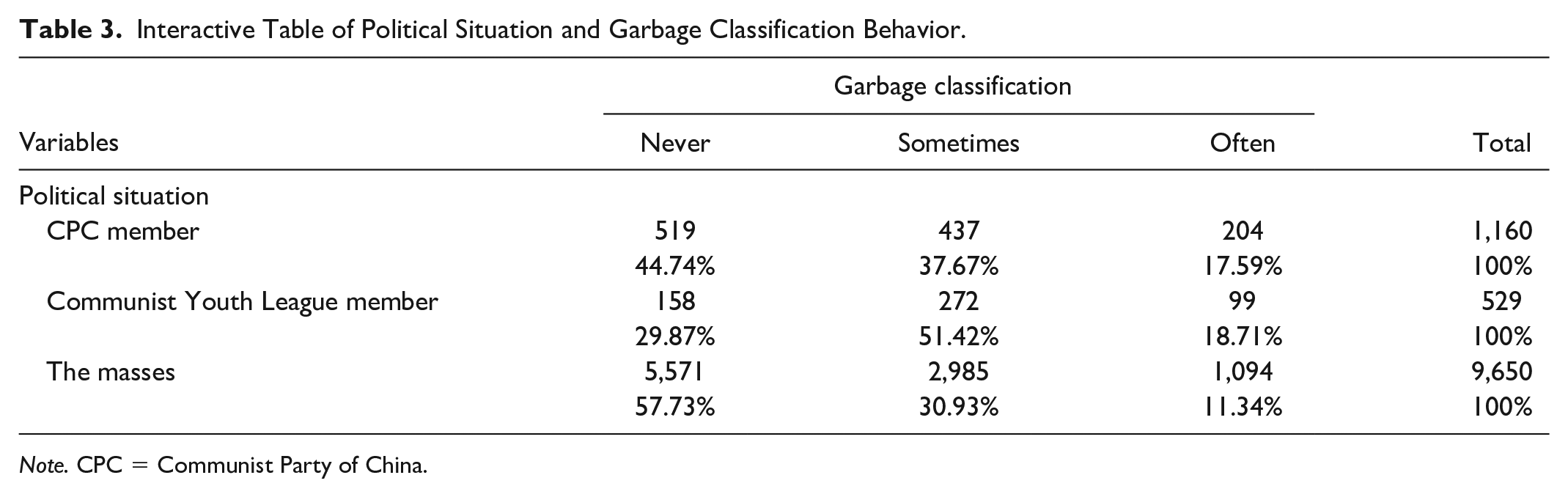
Note. CPC = Communist Party of China.
The Influence of Social Capital on Garbage Classification
Both Models 1 and 2 adopt the Ordered Logit Model. Among them, Model 1 only puts the control variables, and Model 2 is a full model, so the next report focuses on the results of Model 2.
As can be seen from Table 4, Model 1 examines the effect of control variables on garbage classification. Among them, gender, education, type of work, health status, region, annual income, and whether knowing the garbage pollution is serious all have a significant impact on the garbage classification. In Model 2, we first look at the impact of social capital on garbage classification. In terms of social capital, social trust, and social network have a significant impact on garbage classification. Among them, compared with respondents who do not trust other people, respondents who trust other people are 1.38 times (e0.320≈1.38) more likely to garbage classification. Hypothesis 1b is verified. This is consistent with western research conclusions. This shows that social trust is the “cohesive agent” of collective actions of the people. By establishing trust between individuals, the possibility of collective action can be improved, which is conducive to the implementation of garbage classification. At the same time, for every additional unit of the social network, the likelihood of people adopting garbage classification increases by 2% (e0.0192 -1≈0.02). Hypothesis 1a is verified. The social network can not only connect each individual and produce the same group effect, but also can share information with each other through interaction, which improves the possibility of garbage classification. In summary, Hypothesis 1 has been verified. Therefore, social capital has a significant impact on garbage classification in China. This is consistent with the relevant research in the west, which shows that the research on the impact of social capital on the environment in the west is also applicable to the specific situation in China. From the current, relevant researches ignore the influence of online social capital on garbage classification. In terms of online social capital, both traditional online social capital and new online social capital have exerted a significant influence on the garbage classification. For every unit of traditional online social capital, the probability of people adopting garbage classification increases by 29% (e0.256 -1≈0.29), and for every unit of new online social capital, the probability of garbage classification by the public increases by 22% (e0.198 -1≈0.22). It shows that the role of traditional online social capital is greater than that of new online social capital, and its role cannot be ignored. Hypothesis 2 is verified. Because of its uniqueness, online social capital improves people’s connection with each other and the efficiency of sharing relevant knowledge and methods of garbage classification. It makes easier for people to garbage classification. And people are more conscious of garbage classification. This is mainly because of their mutual support and implicit control.
Results of Ordered Logit Model for Social Capital Influencing Garbage Classification.

Note. With reference to item: aVery distrustful =1; bMale=1; cPrimary school and below =1; dWork outside the system=0; eUnhealthy =1; fEastern region=1; gWhether know garbage pollution =1.
, **, and * indicate statistical significance at 1%, 5%, and 10% respectively.
p < .1. **p < .05. ***p < .01.
The following is the impact of control variables on garbage classification. Gender has a significant impact on garbage classification. Women are 1.3 times (e0.262≈1.3) more likely to adopt garbage classification than men. This is consistent with the research in western. Education also has a significant impact on garbage classification. The people with secondary school, junior college or undergraduate and above are 1.33 times (e0.285≈1.33), 1.51 times (e0.414≈1.51) and 1.69 times (e0.524≈1.69) more likely to garbage classification than people with primary school and below. This suggests that the more educated you are, the more likely you are to garbage classification. The type of work also has a significant impact on garbage classification. People working in the system are 1.14 times (e0.134≈1.14) more likely to adopt garbage classification than those working outside the system. That may be because most of the people who work in the system are members of the Chinese Communist Party, highly motivated and under pressure from the organization. Healthy people are 1.18 times (e0.166≈1.18) more likely to adopt garbage classification than unhealthy people. This may be because healthy people pay more attention to garbage pollution. If they want to stay healthy, they must eliminate or stay away from pollution. For every unit increase in personal annual income, the probability of garbage classification increased by 19% (e0.177 -1≈0.19). This means that the higher the income, the more garbage classification. People in central and western regions are 0.66 times (e-0.423≈0.66) and 0.68 times (e0.390≈0.68) more likely than people in eastern regions not to adopt garbage classification. The reason why the regional factor is added is mainly because China has a large area and there may be certain differences in different regions, which will affect the test results. It can be seen from that there are indeed different differences in different regions. This also inspires us to pay attention to hierarchical and classified management when promoting garbage classification. People who do not know the serious garbage pollution are 0.79 times (e-0.230≈0.79) more likely not to adopt garbage classification than people who know the serious garbage pollution. This verifies the impact of environmental perception on garbage classification.
The Marginal Effect of Social Capital
As can be seen from Table5, Regardless of social capital or control variables, they can significantly increase the possibility that people often and sometimes garbage classification, and significantly reduce the possibility that people never garbage classification. Specifically, traditional online social capital can increase the possibility of often garbage classification by 2.59%, increase the possibility of sometimes garbage classification by 2.95%, and reduce the possibility of never garbage classification by 5.54%. The new online social capital can increase the possibility of often garbage classification by 2.00%, increase the probability of sometimes garbage classification by 2.28%, and reduce the probability of never garbage classification by 4.29%. It can be seen from that the marginal utility of traditional online social capital is greater than the marginal utility of new online social capital. This shows that in the process of advancing garbage classification, we must pay attention to the role of traditional online social capital. At the same time, we cannot ignore the influence of new online social capital. In terms of social trust, relatively trusting can increase the probability of often garbage classification by 2.90%, increase the probability of sometimes garbage classification by 3.90%, and reduce the probability of never garbage classification by 6.80%. Very trusting can increase the probability of often garbage classification by 2.03%, increase the probability of sometimes garbage classification by 2.85%, and reduce the probability of never garbage classification by 4.87%. Social network can increase the probability of often garbage classification by 0.2%, increase the probability of sometimes garbage classification by 0.22%, and reduce the probability of never garbage classification by 0.42%. This shows that the marginal utility of social trust is greater than the marginal utility of social network. Since China has been a relational society since ancient times, it has shown the characteristics of a different order pattern. The social network formed is just a small circle with a small influence, while social trust has a large influence and scope on the whole society. In summary, it can be seen from the above that there are some differences between the marginal utility of social capital. Specifically, the order of marginal utility is: social trust>traditional online social capital>new online social capital >social network.
Marginal Effect of Factors Influencing Garbage Classification Behavior.

Note. With reference to item: aVery distrustful =1; bMale=1; cPrimary school and below =1; dWork outside the system=0; eUnhealthy =1; fEastern region=1; gWhether know garbage pollution =1.
, **, and * indicate statistical significance at 1%, 5%, and 10% respectively.
p < .1. **p < .05. ***p < .01.
The Decomposition and Comparison of Influence Effects
To further compare the relative effects of the above micro-factors on garbage classification, we introduce the method of “coefficient clustering” for analysis. Table 6 is the result of coefficient clustering analysis based on the estimation of the model in Table 4. When comparing within the same equation, the effect and constraint of all influencing mechanisms can be 1 for effect comparison, while the absolute value of coefficients can be directly used for comparison between different equations.
Comparison of the Effects on the Mechanism of Garbage Classification in China.

, **, and * indicate statistical significance at 1%, 5%, and 10% respectively.
p < .1. **p < .05. ***p < .01.
As shown in Table 6, in general, the influence effect of control variables is 49.6% (0.357/0.719 = 0.496), and the influence effect of social capital on garbage classification is 50.3% (0.362/0.719 = 0.4715). It can be seen from that the control variables and social capital have basically the same impact on garbage classification. On the one hand, it illustrates the important influence of social capital on garbage classification. On the other hand, it also illustrates that individual characteristics also play an important role in garbage classification. This may be because garbage is generated by individuals, and garbage classification is closely related to individuals. Then look at the specific impact of social capital. The impact of traditional online social capital on garbage classification is 41.9%(0.809/1.93 = 0.419), while the impact of new online social capital on garbage classification is 30.1%(0.581/1.93 = 0.301). It can be seen from that the influence of traditional online social capital is greater than that of new online social capital. This shows that publicity and education about garbage classification can effectively encourage people to garbage classification. At the same time, the role of new social capital cannot be ignored. The influence effect of social trust on garbage classification is 2.72% (0.0525/1.93 = 0.0272), and the influence effect of social network on garbage classification is 25.13% (0.485/1.93 = 0.2513). The effect of social network is far greater than that of social trust, which is very consistent with the pattern of “guan xi” society in China.
Urban-Rural Differences in the Influence of Social Capital on Garbage Classification
As is known to all, China is a vast country with uneven development and a large gap between urban and rural areas. Therefore, it is necessary to understand the impact of social capital on garbage classification between urban and rural differences. It can be seen from Table 7 that online social capital can promote garbage classification in rural and urban areas. This shows that online social capital that has been neglected in the past can have an influence on garbage classification and needs to be taken seriously. Interestingly, both social trust and social network have a significant impact on the garbage classification of urban. For rural areas, only social network have an impact on garbage classification. This is related to the reality in China. In rural areas, because of the degree of modernization relatively low, the social network is still playing an important role. And the contractual awareness of social trust has not yet been established. In urban areas, with the development of modernization, the contract consciousness of social trust is gradually established. In addition, the level of education plays a greater role in the city. Therefore, the influence of social capital on garbage classification of urban and rural is still different. Previous studies have often neglected the comparison between urban and rural areas.
Urban-Rural Differences of Influencing Factors on Garbage Classification Behavior of Chinese People.

Note. With reference to item: aVery distrustful =1; bMale=1; cPrimary school and below =1; dWork outside the system=0; eUnhealthy =1; fEastern region=1; gWhether know garbage pollution =1.
, **, and * indicate statistical significance at 1%, 5%, and 10% respectively.
p < .1. **p < .05. ***p < .01.
Conclusion
A new round of garbage classification campaign is emerging in China. Garbage classification can not only promote the sustainable development of China, but also has important significance for promoting the sustainable development of the world. This research has contributed to the general literature by examining whether the social capital theory developed and tested in the west is applicable to the China. The contribution may provide whether they reflect that social capital is related to more general environmental behavior. Based on the data of Chinese General Social Survey in 2013, this research explored the impact of social capital on garbage classification and its difference between urban and rural areas in China. The study found:
In the specific situation in China, social capital has a significant impact on garbage classification. In other words, online social capital, social network and social trust can all promote garbage classification. It confirms that the influence of social capital on environmental protection is also applicable to the specific situation in China. Among them, online social capital plays an important role in garbage classification. The public can make environmental protection behaviors according obtain relevant resources and confidence through media contact. People interact and communicate through the internet and other new media, which not only establishes the network to exchange information, but also can influence each other’s environmental protection actions and conduct garbage classification (Zhang & Jin, 2016).
Previous studies have often neglected the discussion of influential mechanisms and the marginal effects of social capital. This paper focuses on the comparative analysis of the marginal effects and influential effects of social capital, which makes the impact mechanism of social capital on garbage classification more clear. At the same time, it also makes up for the lack of research on this aspect in the literature. From the perspective of marginal effects, social trust has the largest marginal effects. The marginal utility of each unit of social trust is greater than the marginal utility of each unit of social network. Among the overall effects, online social capital has the largest influential effects, followed by social network, and finally social trust. In other words, the impact of social network on garbage classification is greater than the impact of social trust. The above findings are related to the special situation of China. First of all, in terms of online social capital, China has a large area and a large population. Only relying on a small-scale social network and a trusting society that has not yet been fully established cannot have a completely decisive impact on garbage classification. Online social capital can efficiently save time, and conveniently enhance interaction, exchange and share relevant information, so its marginal effects and influential effects on garbage classification are relatively huge China has been a relational society since ancient times, and social network have shown the characteristics of a differential pattern. This kind of social network still plays an important role in society. Therefore, its impact on garbage classification is greater than that of social trust. This also shows that in China, garbage classification is embedded in the traditional social structure, that is, the social network. But an interesting finding is that although social network dominated by small circles prevail in China, the marginal effect of social trust is still greater than that of social network. It also illustrates the importance of building a trusting society. The reason why social capital can help people overcome the dilemma of human collective action is that it can create the relationship of trust among residents. Social trust, as the glue that binds all aspects of society, is the most important factor in promoting cooperation. Trust is also a common understanding of exchange rules, which allows individual actors to have expectations of others’ behavior and follow the trust principle in the absence of complete information or legal guarantee. Social trust is an important factor to mobilize the public’s willingness to protect the environment. The above comparison of marginal effects and influential effects is relatively rare in the previous literature, and it is also a small contribution of this research.
In addition, comparing urban and rural areas, it is found that the impact of social capital on the urban and rural garbage classification is heterogeneous due to the influence of different modernization development levels and traditional Chinese social structure. To be sure, online social capital has had a significant impact on urban and rural garbage classification. The difference is that both social network and social trust have a significant impact on garbage classification of urban. For rural garbage classification, only social network have a significant impact on the garbage classification, while social trust has not promoted the garbage classification of rural. One explanation may be that trusting society is gradually cultivated in urban areas, while social network still dominate in rural areas. Previous studies only discussed the impact of social capital on urban and rural areas in general, and did not specifically distinguish the differential impact of each component of social capital. The reason why the research has conducted a detailed study of this is mainly because if we want to better carry out garbage classification and encourage people to actively participate in garbage classification, we must combine the different actual conditions of Chinese cities and villages, classify and deal with them, and implement targeted methods and measures.
Analysis of control variables such as personal characteristics shows that individual attributes also have an impact on environmental protection behaviors such as garbage classification in China. Public participation is urgently needed to solve environmental problems and achieve sustainable social development.
At present, the environmental pollution crisis in China is becoming increasingly serious. Although the government continuously introduces various powerful environmental measures and means, it often ignores the dominant position of Chinese people in environmental protection. The characteristic of social structure in China makes the social network is not reflected into specific target. Their social network are more embodying in the relationship of neighborhood and colleagues. This led to the formation of “small circles,” and the boundaries between these circles were blurred. This is also the Chinese people are less one of the reasons for conservation groups to participate in social public activities. At the same time, it is the difference between China and western countries, which deserves our attention. Therefore, the government should strengthen the top-level design of policy for garbage classification, further formulate and improve garbage classification related laws and systems, make use of the media, strengthen public education, promote and encourage the full participation of society. At the same time, social capital should be cultivated to build up people’s trust in the government, accumulate social capital, and create a good social environment for Chinese to participate in garbage classification. Finally, we should give full play to the exemplary role of CPC members and actively promote garbage classification. Government-led garbage classification follows the “top-down” administrative management mechanism to promote, but ignores the bottom-up informal system embedded in social capital by ordinary people (Rahnama & Sharifzadeh Aghdam, 2018). In the future, we should combine the two approaches of top-down and bottom-up, so as to establish effective management mechanism of public participation in garbage classification. In this process, efforts should be made to explore a mode of environmental protection action driven by government organizations, led by communist party members and interconnected with ordinary people, so as to better promote sustainable social development. This is also a feature of China that is different from western countries, which deserves attention and reference.
Finally, the research also has some limitations. First, it failed to analyze its impact on garbage classification from three aspects: bonding social capital, bridging social capital, and linking social capital. Second, it only considers the impact of microscopic factors on garbage classification, and does not take macro-environmental factors into account. Third, the data used is cross-sectional data, ignoring time dynamic data. These are worthy of further study in the future.
Footnotes
Declaration of Conflicting Interests
The author(s) declared no potential conflicts of interest with respect to the research, authorship, and/or publication of this article.
Funding
The author(s) received no financial support for the research and/or authorship of this article.
