




Abstract
Social media has emerged as a robust medium for discourses on sexuality given its capacity to challenge mainstream narratives and empower personal views on self-expression. In Nigeria, the growing interest in homosexual expressions through online platforms is yet to receive significant research attention, although scholars are hinting at the influences of social media. The present study examines social media as a relatively novel platform for discourses on homosexuality in Nigeria. It attempts to ascertain users’ willingness to express opinion, directions of opinion, and factors affecting opinion formation. Within the purview of social integration paradigms, the study reviews current perspectives in global homosexuality narratives. Using descriptive and hermeneutic analysis, it examines data from 323 Facebook users selected through snowball sampling technique as well as 300 comments purposively selected from “verified” Instagram accounts. The study finds significant willingness to express opinions, propelled by “rising interest in the topic.” Within a persisting climate of negative opinion, the study locates subsisting influences of socio-cultural institutions on opinion formation. It discusses the implications of the influences of the institutions and political propaganda, which nourish heterosexism and negative bias against homosexuality.
Introduction
In 2004, gay rights activist, Bisi Alimi, became the first Nigerian to declare his homosexuality while playing guest on the Nigerian Television Authority’s (NTA) Funmi Iyanda show—New Dawn. The reaction of the NTA was swift and reflective of the role of mainstream media in silencing the minority opinion. The show’s live format was canceled. Subsequent shows were prerecorded and screened by the NTA hierarchy to avoid what was considered “causing public offence.” In effect, the NTA reasserted a climate of opinion rejecting homosexuality in Nigeria. When compared with social media, the NTA experience presents a stark contrast to the freedom of expression associated with online platforms (Aryal, 2014).
Increasingly, online platforms, the mainstream media, and some developed country governments are leveraging their influential status to promote trends and propaganda for and against homosexuality (Jones, 2019; Olanrewaju et al., 2015; Opara et al., 2016; Zhang et al., 2020). Studies report that social media and cyber activists, bolstered by the relatively high recognition of homosexuality in the global North, have started to advocate more acceptance for homosexuality in the global South (Opara et al., 2016). Social media, particularly, has ensured that control of public communication is no longer the preserve of mainstream media and the political elite, thereby enabling individuals and groups to create and to judge their own identity-based content through personal and group platforms (Botsman, 2017; Jones, 2020). Scholars, thus, express the concern that social media may disrupt the present socio-cultural arrangements impelling negative views on homosexuality (Opara et al., 2016). This may account for the anti-homosexuality propaganda targeted at lesbian, gay, bisexual, transgender, and intersex (LGBTI) groups by national and international political and nongovernmental organizations (Jones, 2020; Olanrewaju et al., 2015).
Nigeria is one of the many African countries where the LGBTI community is estranged by law and ideology, and where entrenched, pre-existing beliefs have sidelined further critical inquiry into public opinion on homosexuality (Arimoro, 2018; Ukah, 2018). As social media has emerged as an important platform to voice hitherto submerged opinions (Aryal, 2014; L. Zheng & Zheng, 2014), there is a need to ascertain how the platform may be contributing to the homosexuality narrative in Nigeria. The present study, therefore, aims to highlight the homosexuality discourse in view of an existing climate of silence and strong negative opinion in Nigeria. It measures social media users’ willingness to express opinion on homosexuality, direction of opinion, and factors affecting opinion. Empirical data are crucial on these issues, especially whether social media has sparked a move away from the stage of discussing homosexuality only as a debate based on right and wrong (Perry & Gozeznbach, 2000). Specifically, the study asks the following research questions:
Homosexuality, as used in the study, generally refers to individuals’ sexual behavior, orientations, identity, and feelings of attraction toward persons of the same gender. Unless in occasions when the acronym LGBTI is necessarily needed, we use homosexuality (or homosexuals) as an umbrella term to refer to LGBTI (community and issues), which stands for lesbian (homosexual women), gay (homosexual men), bisexual (sexual inclination to people despite their gender), transgender (self-image or identity which is opposed to one’s physical sex), and intersex (natural possession of the biological attributes of males and females).
Rationale for Negative Public Opinion on Homosexuality: Social Media Opportunities
Public opinion is the aggregate of viewpoints of individuals in society about social issues, especially when the individuals are divided in their views about issues of public interest. Public opinion includes agreements and disagreements about a social issue, although there is often a consensus or climate of opinion seen as the majority opinion (Ahrari, 2010). Public refers to an assortment of people of diverse backgrounds and characteristics, who express their personal views (rather than group) using public media (Scheufele & Eveland, 2001). This underscores the centrality of the media in public opinion formation. Dominant views in the media may be seen as the majority or public opinion, while unvoiced views, even if widely held, may never become public without the media (Noelle-Neumann, 1993; Scheufele & Eveland, 2001).
A polling service in West Africa, NOIPolls, has been tracking homosexuality in Nigeria since 2013. It notes that the major subjects in discourses include acceptability and attitudes toward homosexuality, awareness, laws, rights, and access to social services, influences of globalization, and biological questions about homosexuality. Its 2017 survey shows that The vast majority of Nigerians (91%) do not believe that people are born homosexual, indicating that there is little belief in scientific and genetic justification or explanations for stable same-sex attraction. This figure represents a 1% increase when compared to the 2015 findings. Correspondingly, 83% of those surveyed specified that they would not be willing to accept a family member who is homosexual, whereas 13% expressed a willingness to accept an LGB family member. Comparing current results with the 2015 findings revealed a 4% decline in the number of people who say they would not accept a gay family member.
Notably, the majority of public opinion in Nigeria is that homosexuality is against the culture and religious beliefs of many African countries, and is, therefore, not acceptable (Human Rights Watch [HRW], 2016; Nwaubani, 2017; Oduah, 2014). Studies show that LGBTI students face internalized homophobia (self-hate), stress, and rejection in Nigerian learning institutions and homes as result of bullying, victimization and harsh rules from parents, heterosexual students, staff, and school administrators (Alozie et al., 2017; Okanlawon, 2020; Ukah, 2018). Amid indications of higher tolerance for lesbians than gays, and cautious friendship with homosexuals, LGBTI students in secondary schools and universities still face dire consequences with regard to safe schooling (Okanlawon, 2017; Olumide et al., 2018).
Some scholars, however, observe that religious-cultural opposition to homosexuality is almost a singsong that sidelines other important global issues about the subject (Alvaré, 2015; Ukah, 2018). It is argued that homosexuality discourses should juxtapose universal principles of the right to self-expression and socio-cultural approaches to sex, marriage, and family (Ukah, 2018). Therefore, how should legal, religious and cultural views be used in addressing acceptance or rejection of homosexuality in light of global principles against hate speech and discrimination against people based on sexuality, gender, ethnicity, race, creed, or political leanings (Adebanjo, 2015; Alvaré, 2015; Temperman, 2011; Ukah, 2018)? Some scholars infer that African leaders fail to consider these views and instead leverage entrenched anti-homosexuality opinions to seek electoral support, display independence from international pressures, and consequently enact anti-homosexuality laws as evidenced in Nigeria’s anti same sex law of 2014 (Jones, 2020).
Conversely, other scholars point to perceived contradictions in calls to remove discriminations against people based on sexual orientations and identity as was done in 2018 by then British Prime Minister, Theresa May (Arimoro, 2018; Opara et al., 2016). May had observed that anti-homosexuality laws imposed on colonies by Britain were wrong then, and still is, and as a result should never have happened (Arimoro, 2018). Remarkably, in some areas in colonial Nigeria, there was apparent cultural support for homosexuality (e.g., women marrying women although not for sexual relations), prompting the British to enact anti-homosexuality laws (Arimoro, 2018; Cantu et al., 1999; Ukah, 2018). This raises the question: Why did the colonial government take the lead in introducing anti-homosexuality laws using culture and religion as major reasons and turn round to oppose Africa for upholding what they (the British) introduced? However, researchers have hinted at the distinction between May’s recent call for the removal of discrimination against the LGBTI community and decriminalization of same sex unions, which some sections of the Nigerian media tended to confuse (Arimoro, 2018).
In view of cited precolonial cultural practices that seemingly supported same sex unions, scholars opine that religion, rather than culture, is the more reason for rejection of homosexuality in Nigeria (Alimi, 2015; Arimoro, 2018). This is because the dominant religions in Africa teach many anti-homosexuality doctrines and are far more widely practiced than distinct African cultures. In addition, given the place of religion in people’s worldview, it comes as no surprise that religious views inform the opinion of adherents on homosexuality (Adeboye, 2016; Janssen, 2019; Opara et al., 2016). Although the foregoing issues need to transmute from research ideas to the “court of public opinion,” they may become even more pronounced as social media gains traction as a platform for homosexuality discourses, hence the present study (Opara et al., 2016; Zhang et al., 2020).
Factors Affecting Public Opinion on Homosexuality
Smith (2011) notes that public opinion is highly polarized on homosexuality as a result of factors affecting attitudes toward the subject. A 2013 Pew Research Global Attitudes Project (Brewer, 2014) reports widespread acceptance of homosexuality in North America, the European Union, and much of Latin America, but broad general rejection in predominantly Muslim nations and in Africa, in parts of Asia and in Russia. Scholars have linked the growing acceptance of homosexuality in some countries with the rise in secularism, influence of social institutions (legal, religious, cultural, educational), evolution of the internet and variations in the number of people professing adherence to religious faiths (Brewer, 2014; Campbell & Monson, 2008; Lewis, 2005; Roggemans et al., 2015; Smith, 2011). Hooghe and Meeusen (2013) observe that acceptance of homosexuality in much of Europe is linked with legal recognition of same sex relationships there. In the same vein, criminalization of same sex marriage in Nigeria is linked with rejection of homosexuality in the country (HRW, 2016; Oduah, 2014; Olanrewaju et al., 2015). Janssen (2019) found a positive relationship between religiosity and rejection of homosexuality around the globe. Even with the rise in secularism, religious practices and identification with a religion, as forms of religiosity, are apparently the most important social factors explaining rejection of homosexuality worldwide (Adamczyk & Cheng, 2015; Janssen, 2019; Ng et al., 2015).
In Ghana, Zimbabwe, Kenya, Nigeria, Malawi, and many other countries of Africa, political leaders and faith preachers tend to respect the predominant religious and cultural inclinations of people when they speak about homosexuality, seek elective offices or enact laws (Amoah & Gyasi, 2016; Arimoro, 2018; Brewer, 2014; Janssen, 2019; Okanlawon, 2020; Tesunbi, 2010; Ukah, 2018). It is said that over two thirds of African nations have outlawed same sex unions and the region has the least tolerant attitudes toward the LGBTI people in the world (Jones, 2019). Some researchers believe that socio-economic development, having more contact with homosexual people, improvement in civil rights advocacy and individual freedoms will increase LGBTI tolerance in Africa (Adamczyk & Cheng, 2015; Alozie et al., 2017; Zhang et al., 2020; Finseraas et al., 2018; La & Mandemakers, 2018).
For instance, in view of Africa’s intense anti-homosexuality stance, South Africa (a comparatively more developed society) provides an extreme contrast in being the first nation in the world to constitutionally recognize the rights of LGBTI people and to outlaw all forms of discrimination against them based on their sexual identity and orientations (Jones, 2019, 2020). South Africa has made remarkable contributions to the “international LGBTI education networking through its rights-based recognition framework . . . Post-apartheid South Africa has contributed substantially to the inclusion of LGBTI rights as part of human rights discourse both domestically and abroad” (Jones, 2019, p. 461). Scholars have, however, also recognized evidence of discrimination, policy oversights, and nonrecognition of LGBTI rights in South African families, still reflecting the strong anti-homosexuality stance in Africa (Henningham & Jones, 2017; Jones, 2019; Livermon, 2012; Meer et al., 2017).
In addition, Zhang et al. (2020) note that the culture of self-expression and economic advancement do not absolutely explain tolerance for homosexuality in some developed societies. They observe that LGBT communities have faced less tolerance in some economically developed countries like South Korea and Taiwan owing to deep respect for family values. Studies, thus, indicate that gender, family relationships, and personal beliefs play important roles in LGBTI tolerance (Collier et al., 2012; James & Drakich, 1993; Pereira et al., 2016; Santona & Tognasso, 2018). Several studies likewise associate internet use in developing countries with homosexuality tolerance, with the belief that some of the above factors may have started playing out in social media (Baek, 2015; Chen et al., 2015; Gan et al., 2017; Valenzuela et al., 2014; Zhang et al., 2020; S. Zheng et al., 2019). Consequently, the present study examines the role of social media on opinion toward homosexuality in Nigeria, where concern is growing on factors that may disrupt the existing course of public opinion (Opara et al., 2016).
Theoretical Insights
With reference to Durkheim’s social integration theory, scholars have explored the basis of sexual prejudices and their relationships with religious, cultural, and socio-economic indicators of social relationships and perceptions (Amoah & Gyasi, 2016; Durkheim, 1987; McGeorge & Carlson, 2011). Culture refers to inherited, accepted, and shared practices, beliefs, symbolisms, cognitions, feelings, and orientations that govern the general life of a particular people often defined by race, ethnicity, language, locality, or country. Religion refers to the principles or ideology, and teachings governing belief in a supernatural being whose avowed expectations and continual revelations are supposed to influence the worldview of adherents of a religion. Although religion and culture are related, people of several cultural backgrounds from across continents may profess one religion, though cultural beliefs have been found to affect how a given religion is practiced in various places or even the same countries (Arimoro, 2018; Ukah, 2018). In addition, people do not often change their culture the same way they can change religious denominations.
Ordinarily, however, it is often the case that people refer to religion and culture as the main basis for the rejection of homosexuality in Nigeria (Adeboye, 2016). This is connected with the concept of social integration, which refers to a situation in which personal inclinations are conditioned by shared cultural orientations and social systems (educational, religious, cultural) (Durkheim, 2005; Turner, 1981). Thus, negative portrayal of homosexuality is a result of institutionalized heterosexism, that is, a methodical way of attack, relegation, and discrimination of LGBTI people (Amoah & Gyasi, 2016; McGeorge & Carlson, 2011). Although nonheterosexuals are systematically stigmatized, it is taken for granted that heterosexuals, as “normal” people, are automatically entitled to social benefits, rights, services, and recognitions (Durkheim, 2005). Accordingly, McGeorge and Carlson (2011) classify sexual orientation into heteronormativity (normal, natural nonproblematic sexuality), institutional heterosexism (systematic discrimination against nonheterosexuals), and heterosexual privilege (natural license to civil liberties and rights). Similarly, in referring to the negative bias theory, Zhang et al. (2020) note that the rising interest of online users in homosexuality may be connected with widespread intolerance and negative portrayal of the subject. This, they say, is also linked with the tendency of online news outlets to be attracted to negative topics as a way to command cyber traffic. According to Zhang et al. (2020, p. 3): For many heterosexuals, homosexuality is often strange and new to them and different from their sexual behavior . . . the Internet media is also willing to report homosexuality-related news, because homosexuality-related news tends to generate tremendous social response and attention. Therefore, according to the theory of negativity bias, the preferences of online media and netizens on homosexual events or news could ultimately affect the public’s homosexuality tolerance.
In light of the foregoing, the present study estimates if the opinion of social media users on homosexuality aligns with social integration perspectives, that is, heterosexism and negative bias in how opinions are expressed. It also assesses how factors such as fear of isolation play a part in users’ willingness to hold opinions (Hochheimer & Al-Emad, 2013; Noelle-Neumann, 1974). German political scientist, Elizabeth Noelle-Neumann, propounded the theory of spiral of silence in 1974 to express the effect of what she called perceived climate of [the majority] opinion on the minority opinion holders. The theory talks about individuals’ willingness to publicly express an opinion when they feel that such opinion may be against the majority opinion. The perceived climate of opinion is so powerful that it forces the minority opinion holders into silence out of fear of isolation. Consequently, people either remain silent or conform to the majority opinion to avoid being cut off from social circles or being seen as social deviants (Noelle-Neumann, 1993; Scheufele, 2008).
Method
The study adopted survey and textual analysis methods. Survey was applied to Facebook, while textual analysis was applied to Instagram. At the time of the study, Facebook was the fifth most visited website and the highest visited social networking site (SNS) in Nigeria. Instagram was the 14th most visited website and the second most visited SNS in Nigeria (Webclick, 2018). This informed the selection of the two platforms, in addition to being virtually the only SNSs that are open to (and with the capacity for) generic and extensive discourses such as sexuality and human relationships among Nigerians (personal observations in comparison with WhatsApp and Twitter). Despite a population of 22,000,000 and 6,000,000 active Facebook and Instagram users in Nigeria, respectively (NapoleonCat, 2018), the study did not attempt to get a statistically representative sample of social media users because, having employed a technique to reach the widest spread of users possible, we intended to allow participants to indirectly reflect their willingness (not consent at this point) to comment on homosexuality. In addition, opinion researchers on social media observe that the nonrepresentative nature of social media users and lack of reliable sampling frames force social media researchers to use nonprobability samples (Fox & Rainie, 2014; Murphy et al., 2014; Stern et al., 2017).
Therefore, a snowball sampling technique was used to select samples from willing participants. A consent letter was posted via Facebook inviting those willing to participate in the study to click on a web link posted in the consent letter. The letter was shared to the general public and not only to friends on Facebook. Initial respondents were requested to suggest other Facebook users by sharing the letter on their Facebook pages (Bhutta, 2012). A Facebook advertisement was also used to increase the reach of the consent letter among users. In the end, 323 Facebook users indicated willingness to participate in the survey. The consent letter clearly stated the purpose of the research and was used to fulfill the ethical requirements of the research. If the questionnaire were sent to the direct message of randomly selected Facebook users, there would likely be different reactions. It might be considered an intrusion of privacy, since they were not informed before. The Facebook survey was conducted using a self-developed, structured questionnaire created on the website—esurveycreator.com.
Measurement
There were three sections in the 20-item questionnaire. The first sought to elicit demographic information, namely, age (16–20, 21–25, 26–30, 31–35, 35 and above), gender (male, female, transgender), and religion (Christianity, Islam, traditional, other). The second contained multiple-choice nominal items on support for homosexuality and factors affecting opinion expression. Being nominal items, each response option was scored 1. The last section of the questionnaire contained Likert-type items on willingness to express opinion and direction of opinion on various areas such as LGBTI acceptance and equality of access to social services. The Likert-type items were measured on ordinal scales rated as follows: strongly disagree (1), disagree (2), neither agree nor disagree (3), agree (4), and strongly agree (5). Access to the questionnaire was via a website link on the consent letter (https://www.esurveycreator.com/s/4c4d52d). Once activated by a participant, access lasted for 30 days.
To calculate reliability, a pilot test was done using 32 students from the University of Nigeria, Nsukka who were active Facebook users. The three major sections in the questionnaire yielded a Cronbach’s alpha coefficiency of .721, .742, and .724, respectively. The items were, therefore, reliable. The website (esurveycreator.com) initially analyzed questionnaire responses from the participants. It presented data in percentages. The data as presented on the website were further analyzed using descriptive statistics of frequencies, means, and standard deviation.
Textual Analysis of Instagram Posts
Three “verified” Instagram blog accounts in Nigeria (Instablog9ja, TundeEdnut, and thephenomenal_girl) were selected. Instagram verification is about having a blue tick in front of an account name, depicting that an account has more than 1 million followers, high user influence, and lots of activities on the page. This helped to ensure the validity and reliability of data from the accounts (Murphy et al., 2014). Comments from the three blog pages were selected. Three posts on homosexuality on the three Instagram blogs/pages were purposively selected and analyzed (because they were on homosexuality). The selected posts revolved around three major topics that sparked discussions about LGBTI rights on Instagram. One hundred comments were selected from each Instagram page, making a total of 300 comments, which formed the sample size for textual analysis. Textual analysis of Instagram comments was done through the hermeneutics or interpretative analysis as explained by Bernard (2000). This involves interpretation through analysis of the words of the texts to proffer their meanings and directions. Textual analysis was added to Facebook survey because studies indicate that social media researches often use textual data in form of individual (conversational, user-to-user) posts (Murphy et al., 2014).
Results (Facebook Survey)
Table 1 shows that the majority of the respondents are males (83.6%), of the Islamic religion (68.4%) and between 26 and 30 years of age (41.7%). Only 0.6% of the respondents are transgender, while 2.4% are between 16 and 20 years of age. This implies that the majority of the respondents are above 20 years, which reflects the age group that are expected to have more access to mobile phones and the internet.
Demographic Characteristics of Respondents.

Opinions toward homosexuality were ascertained using four Likert-type scale items whose results are presented in Table 2. From the table, 83.4% disagree that homosexuality is a welcome phenomenon in Nigeria. Also, 71.1% agree that it is not acceptable for two persons of same sex to get married, while 60.7% disagree that homosexuals have equal right to social services, although 22.1% think otherwise. On seeing homosexual people as fellow human beings, only 29.3% of the respondents are in support, while 49.0% are not in support. With a grand mean of 2.05 that is less than the cut-off mean score of 3.00 on a five-point Likert-type scale, these results clearly indicate that homosexuality is perceived negatively among the respondents.
Respondents’ Opinion on Homosexuality.

Note. SDA = strongly disagree; DA = disagree; N = neutral; A = agree; SA = strongly agree.
Fear of isolation was considered a factor that affects the respondents’ willingness to express themselves freely about homosexuality. This was done to distinguish the factor from other factors that may still discourage positive opinions from some people who may not have fear of isolation. To ascertain the effect of fear of isolation on opinion on homosexuality, four Likert-type scaled items were used to obtain data whose results are presented in Table 3. From the results, 72.4% indicate that they are not worried about being accepted over their opinions on homosexuality, while 76.1% are not fazed by the risk of being unfollowed due to comments posted on the subject. Also, 76.7% disagree that they are afraid of being criticized by people who are dear to them because of their views on homosexuality, while 72.4% do not feel threatened by the thought of being insulted by people for expressing their opinions on homosexuality online. The overall mean score for the four items is 1.86, which is far less than the 3.00 cut-off mean score on a 5-point Likert-type scale, indicating, in general, that there is no fear of isolation among the respondents as it pertains to expressing their opinions online about homosexuality.
Agreement of Respondents on Fear of Isolation.

Note. SDA = strongly disagree; DA = disagree; N = neutral; A = agree; SA = strongly agree.
The likelihoods of the respondents to express their opinions online when they know they are in the minority and in the absence of social media were evaluated using frequencies and percentages and the results are presented in Table 4. The table reveals that 93.1% are likely to express their opinions on homosexuality even when in the minority, while 43.6% are likely to do the same in the absence of social media.
Expression of Opinion.

The factors that motivate free expression of opinions on social media were ascertained using a multiple-response questionnaire item, which enabled each respondent to select as many options as deemed suitable. The summary results are presented in Table 5. As each respondent was expected to select at least one factor, the number (frequency) of respondents out of the 323 who selected each factor could be as high as 323, the total number of respondents. This explains why the total responses exceeded 323. Table 5 reveals that “rising interest in the topic,” with 67.0% response rate, is the highest motivating factor toward free expression opinions. The second highest motivating factor is absence of profile picture, with 54.5% response rate. The least motivating factor is discriminations against homosexuals with 11.2% response, followed by personal view (27.3%).
Factors That Motivate Expression of Opinions.

The factors that discourage the respondents from free expression of opinions were ascertained using another multiple-response item whose summary results are displayed in Figure 1. From the figure, the two factors that discourage the respondents the most are religious belief indicated by 301 (93.2%) respondents, and because the public often feels that the topic should not be discussed, by 284 (87.9%) respondents. Also, concern about being contradicted, identified by 148 (45.8%) respondents and “I do not want to be associated with the issue,” identified by 104 (32.2%) respondents also discourage free expression of opinions on homosexuality on social media but not as high as religious belief and that “the issue should not be discussed.” The factors that discourage the respondents the least are lack of interest, followed by “not seeing the topic often on social media,” cultural belief, and negative media views.
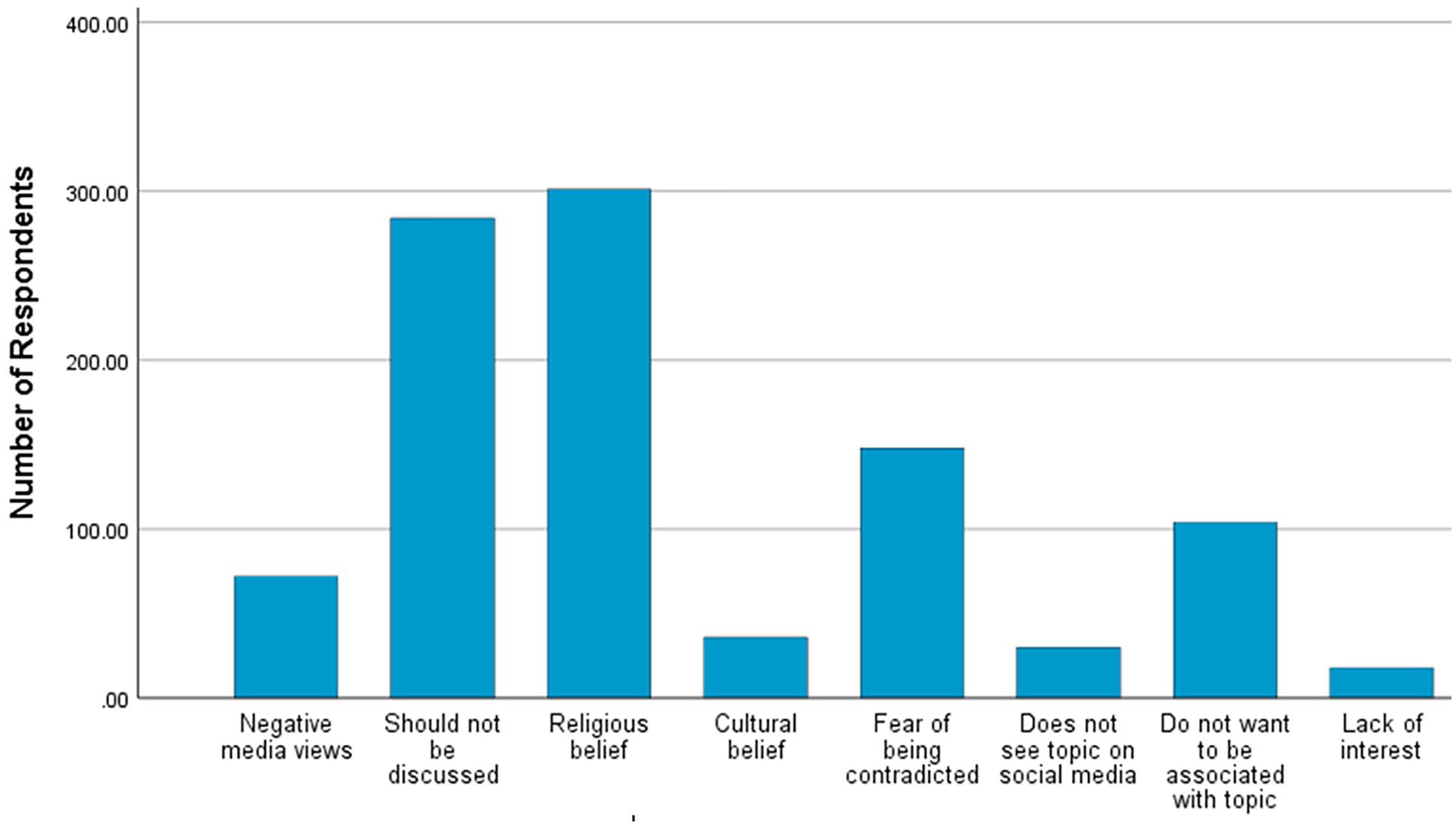
Chart of factors that discourage opinions.
Instagram Users’ Opinion on Homosexuality
In line with the hermeneutics technique as explained by Bernard (2000), comments of social media users on Instagram were continually interpreted to understand their meanings and directions. As earlier noted, three homosexuality-related posts/stories on three different Instagram blogs/pages were selected and people’s comments were analyzed. The selected posts revolved around three major topics that sparked discussions about homosexuality on Instagram. The topics were as follows:
Kiki Mordi’s outburst on same sex marriage ban in Nigeria (Instablog9ja) on December 27, 2019
Prince William’s approval to his children being gay in the future (Phenomenalgirl) on June 27, 2019
Gideon Okeke’s (Nigerian actor) condemnation of fashion designer Marc Jacobs and Char Defrancesco’s marriage (Tundeednut) on April 9, 2019.
Analysis of the comments reveals three directions of opinion on homosexuality: positive, negative, and moderate. Participants who are positive are in support of homosexuality; those who are negative oppose it, while those who are indifferent are moderate with their opinions. The majority of comments are in strong opposition to the issue. Out of the 300 comments, there are 224 negative comments (74.7%), 63 moderate comments (21%), and 13 positive comments (4.3%). The three directions observed from the textual analysis lead to the following categories:
Negation of religious and cultural beliefs
Homosexual rights as part of human rights
Leniency or homosexuality tolerance
Negation of Religious and Cultural Beliefs
Many of the participants, who strongly oppose homosexuality, argue from the religious and moral perspective, albeit in poor language. One of the commenters, Queenmarachi (Tundeednut) says: “This is sin. Don’t come with we sin differently bullshit please” and Damolaalaga (Instablog9ja) says “Hellfire is the humble abode for anyone who does Sodom and Gomorah. How dare you reverse God’s creation?” Excel_andrew (Tundeednut) complemented the comment and said “Hell is real. God dyed Sodom estro and Gomorah because of this same act.”
Other comments based on religion and culture reflect the same line of opinion such as comments from Adex (Instablog9ja), Kennygee (Instblog9ja), Ayuba (Phenomenalgirl), Bb_morenike (Instablog9ja), Irepbdg (Tundeednut), Kuntaakinte(Instablog9ja), Okechukwu (Instablog9ja), Goodfellamoney (Tundeednut), Officialsix (Instblog9ja).
Those who view homosexuality from the cultural perspective opine that homosexual people are imitating the western world. Commenters regard homosexuals as not conforming with the mainstream sexual orientation of African people. Okikidayo (Instablog9ja), for instance, comments that “gays need to change their orientation and stop copying the ‘so-called civilized evolved new age movement.” Other such comments are from commenters like Polpoer (Phenomenalgirl, Effizy (Tundeednut), Shankababu (Tundeednut), Freeman (Phenomenalgirl), Eyinjuomodumare (Instablog9ja), Ebaycarder (Instablog9ja), Odegalagos (Instablo9ja).
Homosexual Rights as Part of Human Rights
Some Instagram users see homosexuality as part of fundamental human rights of freedom of expression. This category feels that opposition toward homosexuals is discriminatory and infringes on the autonomy and freedom of individuals. They believe that legalizing homosexuality means allowing freedom of sexual orientation which in turn translates to respecting fundamental human rights. A commenter, Nspodcast1 (Instablog9ja) notes thus: Homosexuals have rights and should be respected. The Nigerian anti-gay law is discriminatory and Nigeria is a secular society, an equal society, meaning that it belongs to everyone and so everyone must be treated equally and be allowed to express their love for whomever and however. Majority cannot decide for the minority as it is their duty to protect the minority.
Other such commenters express the hope that homosexuality will be decriminalized in Nigeria in the future, for instance, comments from Aeesha.I (Phenomenalgirl) and Ugo (Phenomenalgirl).
Leniency (Tolerance)
Although most Instagram users are overtly against homosexuality and some obviously in support, a group of discussants who have reservations toward the issue do not agree that extreme measures and violent actions are proper. They believe that homosexuals should be left undisturbed. Queen Benny (Instablog9ja) advises social media users “to stop judging people for sinning differently.” Similar comments come from Abdulk9 (Instablog9ja), Jelly_jenah (Tundeednut), Towyeen_ty (Instablog9ja), Idupaul (Instablog9ja), Cindypill (Phenomenalgirl).
Discussion of Findings
The study examines the role of social media in extending discussions on homosexuality in Nigeria in view of existing negative opinion outside social media. It focuses on Facebook and Instagram users’ willingness to express opinion, directions of opinion, and factors affecting opinion on homosexuality. Results indicate that males, the young age range of 26 to 30 and people of the Islamic religion expressed more willingness to voice opinions, with very few indicating any gender that is not male or female. This possibly represents a connection between gender, religion and age on one hand and public willingness to comment on homosexuality as a subject on the other hand (Murphy et al., 2014; Pereira et al., 2016; Santona & Tognasso, 2018; L. Zheng & Zheng, 2014). Studies show that men generally have a higher tendency than women to voice opinions on sexual matters because of gender stereotypes, socio-cultural restrictions, and stigmatization (James & Drakich, 1993; Santona & Tognasso, 2018). Religion is seen as the most important factor affecting the rejection of homosexuality in Africa (Brewer, 2014; Janssen, 2019; Ukah, 2018). Older people are known to voice the most negative opinion on homosexuality, while the younger populations show greater willingness to discuss the topic (Brewer, 2014; Collier et al., 2012; James & Drakich, 1993; NOIPolls, 2017; Santona & Tognasso, 2018).
The majority of respondents expressed negative opinion toward homosexuality. This was indicated in the low number of those welcoming homosexuality as a phenomenon or agreeing with same sex unions as noted in previous research (Alozie et al., 2017; HRW, 2016; NOIPolls, 2017; Nwaubani, 2017; Oduah, 2014; Okanlawon, 2020; Olanrewaju et al., 2015; Olumide et al., 2018; Ukah, 2018). Although the grand mean for opinions on homosexuality indicated a negative valence, participants showed higher acceptance for “equality of access to social rights.” This aligns with the results of other studies, which show that despite widespread negative attitudes toward the LGBTI community, an increasing number of respondents still believe that they (LGBTI) are equally entitled to social rights and services (Arndt & de Bruin, 2006; de Briun & Arndt, 2010; Mtemeri & Maziti, 2015; NOIPolls, 2017).
There was low fear of isolation among respondents, possibly indicating high willingness to voice opinions. The great majority were likely to express their opinions on homosexuality even when in the minority. Less than half of the respondents indicated that they were likely to express their opinions in the absence of social media. This shows that social media provides most of the respondents the avenue to express their opinions on homosexuality. Other studies have recorded similar findings (Botsman, 2017; Jones, 2020). Factors such as “lack of interest” and “absence of homosexuality as a topic on social media” did not affect opinion formation, and this is an indication that issues on homosexuality may be rising in frequency on social media as also evidenced by some studies (Jones, 2017; Opara et al., 2016; Zhang et al., 2020; S. Zheng & Zheng, 2014). However, religious belief and concern about the peculiar nature of homosexuality in Nigeria still apparently override the increased willingness to express (positive) opinion on homosexuality.
Therefore, apart from helping to rank the encouraging and discouraging factors in the estimation of the respondents, the multi-choice response options on the factors show a correspondence between pre-existing negative public ratings of homosexuality and social media opinions. This, further, reflects the possible influences of social (integrating) institutions and propaganda as shown in the literature (e.g., culture, media, religion, education, and politics) (Arimoro, 2018; Jones, 2017, 2020; Ukah, 2018). This may also be the reason that the majority of the respondents did not indicate being motivated by their own personal views to comment on homosexuality.
In addition, discourses did not remarkably indicate a shift from views based on notions of right and wrong (Perry & Gozeznbach, 2000). By implication, other views such as considerations of the right to self-expression vis-à-vis virulent attacks against the LGBTI community have yet to significantly permeate public opinion among social media users (Adebanjo, 2015; Alvaré, 2015; Temperman, 2011; Ukah, 2018). This upholds the views of some researchers on the connection between opinion on homosexuality and some of the indicators of homosexuality acceptance such as socio-economic development, respect for family values, gender, and the culture of, and right to, self-expression (Adamczyk & Cheng, 2015; Alozie et al., 2017; Zhang et al., 2020; Finseraas et al., 2018; Jones, 2017; La & Mandemakers, 2018). In furtherance to the above, thematic issues and opinions emanating from Instagram comments highlighted the debate nature of discourses as well as the moral and religious questions posed by homosexuality. This was in addition to comments being rendered in very impolite language and uncouth retorts. Like the responses from Facebook survey, the proportion (74.7%) of Instagram comments on the moral or religious issues around homosexuality far outsized that of all other areas put together (culture, human rights, tolerance, legal issues, and equal access to social services).
Although the willingness to express opinion was expressed more as liberty to express conformist negative opinion, there was clear indication by the respondents of their readiness to express nonconformist opinion if necessary. As Nwaubani (2017) notes, the slight growth in homosexuality acceptance noticed in recent polls in Nigeria should not be discountenanced in view of past experiences of absolute negative opinion. The present study upholds this view. The 63 moderate comments (21%) and 13 positive comments (4.3%) show an aggregate of 25.3% of non-negative opinion, and may be seen as signaling a move toward more tolerance as reported by NOIPolls (2017). The 4% decline in the number of those who said they would not accept a homosexual family member between 2015 and 2017 (NOIPolls, 2017) may have a link with the diminishing influence of local culture on opinion on homosexuality. Instructively, culture was among the least discouraging factors in the present study, a fact supported by scholars with regard to the relative effects of religion and culture as factors affecting opinions on homosexuality (Alimi, 2015; Arimoro, 2018; Brewer, 2014; Janssen, 2019; Ukah, 2018). Indeed, while social media may be changing the social-cultural arrangement driving opinions about homosexuality (Opara et al., 2016), it has yet to fundamentally lower the influences of social institutions (especially religion), which nurture negative bias and socially-induced heterosexism (Amoah & Gyasi, 2016; Durkheim, 1987; McGeorge & Carlson, 2011; Opara et al., 2016; Turner, 1981). Thus, the social integration paradigm is still useful in explaining social media users’ opinions on homosexuality.
Conclusion
Social media users still voiced negative opinion on homosexuality, despite displaying increased willingness to air opinion and growing recognition of equality of access to social rights. There was an affirmation of the weaker influence of culture (than religion) on opinions toward homosexuality. The almost ironic relationship between reported willingness to express opinion and negativity of opinions calls for more enlightenment on attitudes to sex, family and marriage, especially in terms of the essential differences between discrimination against people based on sexuality and criminalization of homosexuality. In addition, the uncontrolled language of discourses needs to be reconsidered. The social media platforms of the ministry of youth, for instance, can undertake a guided campaign on homosexuality in the language of comments as well as on other highlighted issues in sexual expression and identity. For instance, more acceptance of homosexuality may lead to a legal crisis in Nigeria and more strained relationships in families where some still hold strong negative views about homosexuality. There is, therefore, the possibility of more violence against the LGBTI community and their supporters in the future. Rights campaigners can take note of this and start introducing social media discussions that can help society deal with the situation. Future studies may attempt a comparative analysis of social media users and offline populations on homosexuality to show the differences in willingness to voice opinion. Future studies can also use more diverse samples in terms of socio-economic attributes across Africa to track the course of public opinion.
Footnotes
Declaration of Conflicting Interests
The author(s) declared no potential conflicts of interest with respect to the research, authorship, and/or publication of this article.
Funding
The author(s) received no financial support for the research and/or authorship of this article.
Ethical Approval
For ethical compliance, a consent letter was posted on Facebook and participants duly indicated interest to participate in the study. They willingly visited the survey website to complete the questionnaire.
