




Abstract
Policy measures of governments toward addressing urban housing provisions seem to neglect the urban poor, especially in Nigeria. Presently, the world population estimated at 50% urban is aggravated by rural-urban migration. This is true of Enugu city in Nigeria, where urban housing challenges affect the poor residents. Enugu is one of the major Christian populaces in Nigeria where the Catholic Church is conspicuously a fulcrum for socioeconomic attractions. This makes it imperative for the Catholic Church to be involved in addressing pro-poor housing challenges. This study therefore examined urban public housing provision in Enugu metropolis with a view to determine pro-poor housing policy delivery involving the Catholic Church. Mixed research method was adopted. Interviews and observations were conducted randomly within the identified 23 informal/slum or squatter settlements adjourning the 18 formal neighborhoods of Enugu metropolis while the social inclusion theory formed the basis of the study. Findings showed that the identified 118 Catholic parishes also canonically engage in socioeconomic development of the neighborhoods as the available public housing provisions in Enugu were skewed away from the urban majority who are low-income earners. This indicates poor government attention to the housing needs of low-income households who resort to informal/squatter settlements. This article therefore recommends Catholic Church-Government collaboration toward inclusive, holistic, and proactive pro-poor housing delivery in Enugu. Effective utilization of housing cooperative societies, as well as a single-digit interest loan package for housing finance, was also recommended for the Government-Church collaboration to achieve inclusive social housing delivery in the city.
Introduction
The issue of housing has been a global problem in every human settlement. The situation is further aggravated by rapid urbanization with its associated trends in rural-urban migration because people tend to often relocate in search of better living conditions. The World Bank observed that some 12 to 15 million new households, requiring an equivalent number of dwellings, are each year added to the cities of the developing countries (Federal Ministry of Housing & Urban Development [FMHUD], 2012; The World Bank, 1993). While existing affordable housing units are inadequate, the urban poor are forced to find shelter wherever they can and where decent persons would not choose to live. This trend is an indication of social exclusion, which results in the emergence of squatter settlements. Population pressure and the quest for shelter have resulted in sporadic and haphazard physical developments as well as urban slum conditions as observable in Nigerian cities, especially Lagos and Enugu. These cities were colonial cities and today are known globally. They respectively ranked 25th and 553rd among the largest cities of the world (National Population Commission, 2013).
The inception of settlements during colonial era was with some sense of physical planning. Enugu is one of such cities and has presently expanded tremendously. With a growth rate of 2.553% and net migration rate of −0.22 migrant(s)/1,000 populations, Enugu is ranked the 553rd city of the world, and the first resilient city in Nigeria (Nigerian Demographic Profile, 2013). Invariably due to rapid urbanization and rural-urban migration that is common with most cities of developing countries, Enugu in Nigeria is inundated with increasing land use conversions, contravention of planning standards, and poor infrastructure and facilities. The outcome is the emergence of urban and peri-urban slums/squatter settlements emanating from gross housing shortages, increasing housing rents and high land value in the city. Urbanization and migration trends in settlements are usually facilitated by some institutions such as the government, churches, and companies among others as portrayed by Rodger (1999). These induce expansion and development and should be accorded policy considerations. Moreover, the Church is often an integral part of attraction for socioeconomic development of settlements through the building of schools, vocational centers, hospitals, and other health facilities as well as the provision of infrastructural facilities, which attracts population thereby inducing migration and the associated effect. More often than not, the contributions of the Church to urbanization and migration issues in settlements are overlooked instead of being involved in addressing the resultant challenges.
The term “Church” in this article refers to the Catholic Church with what she signifies as universal, Apostolic, and public juridic person as also stipulated in Canon: 1257 to 1258 of the Code of Canon Law (1983), indicating that all temporary goods, which belong to the Church, are ecclesiastical goods and are regulated by the Statutes and Canon Codes of the Church. The temporary goods of the Church include structural development in the area of education, health, and housing with special emphasis on the poor (John Paul, 1987).
Incidentally, the increasing need for urban residential housing, which obviously far outstrips its provisions particularly for the urban poor, has led to the emergence of slum conditions and squatter settlements in cities. This makes it more pertinent for an inclusive housing policy for adequate residential housing supply to accommodate residents, including the poor. This study therefore looked into the effects of rural-urban migration on housing, particularly in Enugu metropolis with a view to establishing the need for involving the Catholic Church toward addressing the pro-poor housing challenges in the city.
Literature Review
Migration and urbanization affect the growth of cities as well as the housing stock, and this has implications for quantitative and qualitative urban housing deficit that culminates to slum formation. The observed imbalance between urban population and housing agrees with the views of Mabogunje (1975) and Osuide (2004) that government interventions on housing have not met the escalating needs of the urban population, especially the poor. More so, more than 30% of Nigerian population is resident in urban areas, the poor inclusive. However, Leeds Housing Strategy (2005) averred that attention has gone beyond housing affordability and availability to whether housing services meet the needs of all in the city. This is in line with the goal of adequate housing for all populace according to the UN Sustainable Development Goal (SDG 2015–2030) number 11: making cities and human settlements inclusive, safe, resilient, and sustainable. The UN-Habitat Global Housing Strategy (2020) and United Nations Educational, Scientific and Cultural Organization (UNESCO; 2020) also put forth the main objective of realizing the right to adequate housing based on the principle of inclusive cities as the foundation for sustainable urban development including housing and slum upgrading so as to ensure social integration and equality.
Housing has been variously defined by different authors. However, Osuide (2004) and Mba (1992) defined housing as the process of providing a large number of residential buildings on a permanent basis with adequate physical infrastructure and social services in planned, decent, safe, and sanitary neighborhoods, to meet the basic and special needs of the population. Housing delivery is seen as a social responsibility of the government for its citizens. This is yet to be actualized in Nigeria. Okonkwo (2003) and Ukwu (1980) saw this as an emerging and serious problem yearning to be addressed. Rural-urban migration has aggravated housing problems in the cities as increased demand for land has led to increase in cost for housing provision and increase in house rent. These and other factors have forced many migrants to settle for substandard housing at places where people would ordinarily reject to live. This forced settlement at places where people would ordinarily reject to live reminiscences of what was evident in Igboland of Nigeria in the early days of Christianity in the area, when the natives gave missionaries desecrated land areas and evil forests for Church developments and activities whenever they request for land.
Assumptions of Public Housing Policy
There are assumptions on urban public housing policies. Graham (2015) identified these assumptions of policy-makers in his work on five African National Urban Housing Profiles for Malawi, Ghana, Zambia, Liberia, and Lesotho. According to Graham, some constant assumptions seem to rule policy-making despite being far from the truth. Such assumptions were that (a) urban land and housing are expensive and unaffordable than in the past, (b) rents are too high and skyrocketing, (c) the solution to the housing problem is to build cheaper houses, (d) mortgages for poorer households are part of the solution, (e) affordable housing is possible through formal sector private investments, (f) establishment of a National Housing Trust Fund will help many households own their own home, (f) housing affordability depends upon household income, (h) land registration is the solution to nonbankable land, and (i) new supply policy should be based on single household villas on serviced plots and that every household should become an owner of a home.
Studies in seven sub-Saharan Africa countries found that these assumptions are generally untrue (Graham, 2015). Graham argued that the burden of poor urban housing delivery could be blamed on the ill-conceived opinion of policy-makers and on the socioeconomic constituents of the urban populace, which see to the inability of governments to deliver on the housing needs of all categories of urban residents. By the assumptions, the high-income groups seem to be mostly favored, while whatever consideration left is meted on the middle-income groups. The urban low-income groups are relegated to the background and left to cater for their own housing needs. This explains the inevitable and sporadic emergence of squatter settlements in most cities of developing and even some developed countries.
A Review of Public Housing Policy Interventions in Nigeria
The urban public housing policy interventions from colonial to postindependent Nigeria have been in the form of direct construction, site and services scheme, and housing financing. According to Olayiwola et al. (2005), Government Reservation Areas (GRAs) reflected the colonial English nostalgia for the “garden city.” Concerns over urban public housing delivery in Nigeria resulted in the housing for the native workers of colonial administrators. This policy of development of housing units for government workers was further advanced in postindependent Nigeria. Olayiwola et al. (2005) portrayed the policies as being exclusively for the needs of the new elites in the higher hierarchy of the state apparatus. The first National Development Plan of 1962 to 1968 introduced housing as part of industrial estates, land acquisition, and town planning and indicated government’s aim of producing 24,000 housing units during the plan period but could only build 500 housing units before the Nigerian civil war in 1967. By the second National Development Plan of 1970 to 1974, the government officially accepted housing as part of its social and political responsibilities and emphasized housing provision for all social groups whether displaced or not from the competitive housing market (Olayiwola et al., 2005).
In view of the second National Development Plan of 1970 to 1974, the government programmed a public housing policy for an immediate construction of 54,000 housing units within the period, of which 10,000 units were meant for Lagos and 4,000 units for each of the then 11 states of the federation. At this period in time, the Federal Housing Authority was established to take charge of direct construction and distribution of the housing units. In the distribution of the proposed housing units, 60% was meant for the low-income groups, 25% for the middle-income, while 15% was meant for the high-income social strata. Olayiwola et al. (2005), however, casted doubt on the implementation of the housing project looking at the disproportionate capital expected to be expended on the middle- and high-income housing and the little amount allocated to be spent on low-income housing. The National Development Plan of 1975 to 1980, which was a period of oil economy in the country, inherited the leftovers of the earlier plans, and a total sum of 1.83 billion naira was allocated for implementation within the planned period. This plan among other things proposed the construction of 202,000 housing units per year throughout the federation, of which 46,000 units were for Lagos, 12,000 were to be built in Kaduna, while 8,000 units were for each state capital. This plan was not realized as the Federal Government made a cancelation of the housing program.
In an apparent response to the cancelation of housing program by the federal government, the then civilian government of Lagos State in 1979 to 1983 took up a state housing program of 50,000 units. This was not realized due to the military takeover of government and the subsequent declaration of government’s inability to provide housing for Nigerians on grounds of restraining economic situation. This declaration resulted in housing ownership being left for private developers with implications for costs and affordability.
The 1991 National Housing Policy of the federal government was launched to address the worsening housing condition in the country. The aim of the policy was to ensure that all Nigerians own or have access to decent housing accommodation at affordable cost by the year 2000 in line with UN policy on housing for all. To meet this target, construction of 700,000 housing units was required in the country (Onibokun, 1985). The implementation of this policy still suffered major setbacks (FMHUD, 2014; Kwanashie, 2003; Olayiwola et al., 2005). In 2002, the Federal Government’s renewed commitment toward housing provision led to the establishment of the FMHUD. However, Efobi and Anierobi (2014) observed the commercialization of housing by the Federal Housing Authority, which is responsible for implementing government housing programs designed by the ministry. This they do by developing and managing real estates on a commercial basis. They have also encouraged state governments on establishing housing authorities for housing development. From the foregoing, it can be observed that government housing policies have been frothing with inconsistencies in housing delivery for the teeming population. It follows therefore that pro-poor housing provision has been relegated to the background. However, Onibokun (1985); Kwanashie (2003); Olayiwola et al. (2005); and FMHUD (2014) identified some influencing factors on public housing delivery to include lack of financial prudence, accountability, inefficient and ineffective administrative machinery, mass importation of foreign technology, material, personnel, and inflation, as well as incomprehensive analysis of the national housing requirement. Despite all these, urbanization and rural-urban migration persist and the urban poor are the worst affected in the emerging housing challenges in the cities as they suffer social exclusion from housing delivery.
Social Inclusion Theory
The campaign against problems of social exclusion experienced worldwide underlies the social inclusion theory. According to Morgan (2018), the concept of social inclusion as an emerging terminology is mostly in use by the United Nations to encompass the ideas of equity, social, economic, and the proactive protection of human rights. This concept is adopted as antidote against the problem of social exclusion experienced globally, and designed for the social empowerment and development of the low-income poor masses. Social inclusion, therefore, seems to be an ideology for the social protection of the poor in the society. However, social inclusion has no universal accepted definition.
Some school of thought sees social inclusion as a basis for addressing human rights deprivation, while others see it as a set of policies and institutions that support pro-poor growth and equity. In defining social inclusion therefore, Krishna and Kummitha (2017) saw it as a means to address the multidimensional deprivations caused by social exclusion. They were concerned with the meaningful approach to understanding the concept and idea of social inclusion. For them, human rights approach is the tool to understanding social inclusion. This agrees with Morgan (2018) who affirms that social inclusion seeks to secure social settings in which everyone is guaranteed basic rights to sustain his or her life.
Lynn (2002) was of the view that social inclusion seeks the removal of institutional barriers and the enhancement of incentives to increase the access of diverse individuals and groups to assets and development opportunities. The view sees policies and institutions as a tool for social inclusion. Silver (2015) agreed with the two schools of thoughts but asserted that social inclusion is derived from the fact of social exclusion. It is evident in line of the foregoing that large number of the population in any given community is excluded from one thing or another. As such, the emerging concept of social inclusion as advanced by the United Nations is eminent. Despite the UN Millennium Development Goals 2000 and the SDGs that emphasized on housing for the poor, the urban poor still seem to be excluded from decent housing and accommodation in public housing provisions. Yet housing provision is a social responsibility of the government for its citizens. Because the core idea of social inclusion implies the capacity of governments in their policies and institutions to ensure actions that do not neglect the poor, it becomes pertinent to involve nongovernmental institutions such as the Catholic Church to collaborate toward a nondiscriminatory and equitable society, the poor inclusive. This core idea should be pro-poor in its social norms. Summarily, the effect of migration and urbanization if viewed from social inclusion theory should engender policies that can address the housing challenges much more equitably, thereby eliminating the realities of slums and squatter settlements for better living conditions.
The Study Area: Enugu
Historical Development of Enugu City
Enugu emerged as the headquarters of Eastern Nigeria since early 1960s and as an administrative capital city of Enugu State in 1991 as well as the rallying point for the people and cultures of the southeastern Nigeria hinterlands. As a capital city, it attracted many government establishments, tertiary educational and health institutions, industries, financial houses, commercial centers, as well as infrastructural and basic amenities among other characteristics. These attractions have triggered rural-urban migration such that the city has been experiencing rapid urbanization phenomenon occasioned by influx of people. From its initial location as coal miner’s camp in an area of 151 miles (243 km), and a population of about 3,170 people by 1921, the city has grown to about 722,664 people in 2006 occupying the present day Coal Camp residential neighborhood (Enugu State Government Handbook, 2010; Enugu State Ministry of Culture and Tourism, 2012).
Historically, Enugu, fondly called the “coal city,” is situated between latitude 06° 21°N, 06°30°N, longitude 07°26°E, and 07°37°E, with land area estimated at about 72.8 km2. The city was named after “Enugwu Ngwo,” a hill settlement of the Ngwo people of the Igbo tribe of Nigeria, and owns its origin from coal mining activities of colonial era. In 1917, the discovery of coal deposit in the area gave rise to the initial settlement around the foot of the hills, which grew to the city called Enugu of today and the engulfing other communities like Nike, Amaechi, Ngwo, and Ugwuaji, among others (Enugu State Government Handbook, 2010; Enugu State Ministry of Culture and Tourism, 2012; National Population Commission [NPC], 2006). This expansion is depicted with other neighborhoods that have added to the original coal miner’s camp.
As migrants flocked into Enugu, the need and demand for spiritual attention of the migrants became necessary. As a result, Church activities were organized around the settlement which soon became the fulcrum of socioeconomic development. Subsequently, the first Catholic Parish was built at the coal miner’s camp by 1926 and was named St. Patrick on the land granted by the Coal Corporation. As the coal settlement expanded, spiritual activities also expanded. Such activities required the availability of land and financial resources for the erection of Churches and parish houses, and these were also met such that by 1962, the Catholic Diocese of Enugu was erected with about 20 parishes and chaplaincies. The city of Enugu had, however, continued to grow and expand such that at the end of 2019, there were 118 parishes and chaplaincies spread across various urban formal and informal neighborhoods within the city (Catholic Diocese of Enugu, 2018, 2019, 2020 Directory). These parishes engage in physical and socioeconomic development activities in their area of jurisdiction in accordance with the Code of Canon Law (1983). At such time, the Catholic Diocese of Enugu had all these, which were acquired and managed as temporal goods of the Church in accordance to canonical norms. The temporal goods include structural development in the area of education, health, and housing and increase with increasing population.
The growth of the city of Enugu is evident from the various national population census figures from 1952 to 2006 and from a single neighborhood settlement camp of coal miners to the present day 18 neighborhoods of various sizes and densities. Furthermore, the city has recorded a population of 62,764 in 1952; 462,514 by 1991, and 722,664 in 2006 census figures with more than 159,306 numbers of houses as indicated in the housing survey of 2006 census. Hence, with a projected population of about 1,072,304 people by the year 2018, housing challenges in Enugu are likely increasing and might remain a problem facing the development of the city, especially for the urban poor.
The Church in the Urbanization and Rural-Urban Migration in Enugu City
The presence of coal mining settlements in Enugu attracted the Catholic Church to care for the spiritual needs and later extended to other socioeconomic development needs of the people. The then Catholic missionaries attended to these spiritual needs from the Catholic parish of Eke town that later established a coal camp mission outstation, which later became St. Patrick Catholic Parish built in 1926. While the Church was attending to the spiritual needs of the residents of the coal settlements, she contributed to the socioeconomic development of the area. The Church, besides building Churches, also built schools and hospitals thereby attracting more migrants. These efforts enhanced urbanization of Enugu coal settlements. One of the schools built then is today the College of the Immaculate Conception (CIC), Enugu, while the health center built then is today the Mother of Christ Specialist Hospital, Enugu. All these material goods have been increasing over time with the growth of the city.
Historically, the Church came into Eke town through Onitsha in 1910 and triumphed as the cradle of Christianity in Enugu. Iloeje (2012) affirmed that it was from Eke town that the Catholic faith spread to the coal mining urban settlements that is today known as Enugu, and as faraway places as Idah, Otukpo, and Makurdi in Benue state, and to Abakaliki and Ogoja in Ebonyi state and Cross River state, respectively. The construction of the railway for the coal mining activities made Enugu more attractive to migrants. According to Omenka (2012), highly educated Christians from Onitsha and Sierra Leone who helped in spreading the faith were among the many alien migrant workers. As Christianity spread, other churches and schools were built as well as houses for teachers, catechists, Church workers, and their families in all the places that churches were established. The resident teachers and catechists became instrumental in the rapid spread of the Catholic faith as well as socioeconomic development of the area. This contributed immensely to the development of many more urban neighborhoods in Enugu.
The Enugu coal settlement expanded and became the administrative headquarters of the eastern region in 1929 and later capital of Southern province in 1951. The Catholic Church also grew with this expansion, and in 1962, the Catholic Church in Enugu was designated a diocese. The first bishop of the diocese, John Cross Anyogu, died in 1967, just at the beginning of the Nigerian civil war. The death of Bishop John Cross and the civil war set back the work of evangelization in the diocese and beyond. At the end of the civil war, the Federal Government of Nigeria expelled all expatriates including priests and the religious working in Enugu and the whole of Eastern Nigeria. The work of rehabilitation and reconstruction of the battered people led to the appointment of a new Bishop for Enugu, Godfrey Mary Paul Okoye, who was transferred from Port Harcourt (Iloanusi, 2012). The faithful bishop remained undaunted and went on spreading the faith and enhancing the socioeconomic development of the diocese by building more Churches, schools, hospitals, and even universities. Within this period, two more dioceses, namely, Nsukka and Awgu, were created out of the then Enugu diocese that was created in 1962. The spread of Catholic parishes by neighborhoods across Enugu metropolis as well as the urban population including the low income or urban poor have led to the rapid urbanization of Enugu city.
The Catholic Church in Enugu furthermore, through her Catholic Institute for Development, Justice, and Peace (CIDJAP), built the Nwanne Di Na Mba low-cost social housing estate in 1996 with funding from European Union, Brussels, and the Papal Missionary Works, Germany (Obiora & John, 2012). Obiora and John affirmed that the estate is one of the Church’s interventions and contribution to the solutions of the problems of inadequate and decent housing for the poor families in the large city of Enugu. From the forgoing, it is obvious that the Catholic Church on her own has the capacity to advance the socioeconomic wellbeing of the people. The Catholic Church has also been contributing to the urbanization of human settlements while also contributing to the solutions of various socioeconomic developmental problems facing the people, particularly the poor. Despite all these, the government is yet to tap into the capacity of the Church particularly on the issue of pro-poor housing challenges. This study, therefore, aims to determine ways of involving the Church in the government housing policy so as to facilitate on the much eluded pro-poor urban housing delivery in Enugu in particular for the social inclusion of the urban poor in cities.
Research Method and Analysis
This study adopted a mixed research method. Secondary and primary data were utilized. Secondary data on urbanization and rural-urban migration, housing, urban population, and contributions from the Church were got from literature, published reports of relevant government establishments such as the population survey of the NPC (1991), and the official gazette of Enugu State Housing Authority as well as the official Catholic Diocesan Records. The 1991 population survey was updated to 2018 using the geometric projection method at the 3% growth rate for Enugu.
The primary data were generated through interviews of randomly selected household heads, clergy, and urban managers of the identified 23 informal/slum or squatter settlements adjourning the 18 formal neighborhoods of Enugu metropolis as well as the direct personal observations of housing conditions in the area. Identification of Churches according to neighborhoods as well as the existing public housing provisions was carried out, and respondents comprising household heads were randomly selected. The social inclusive theory was utilized in this study as a basis for addressing human rights deprivation as a set of policies and institutions that support pro-poor growth and equity. The information from the primary and secondary sources was empirically analyzed to arrive at the findings.
Findings and Discussions
Evolution of Enugu and Distribution of Catholic Churches Within the Neighborhoods
The study gathered from urban managers that urban population of Enugu is distributed across formal and informal/squatter settlements and the Church is found to be a prominent point of socioeconomic attraction in the areas. Responses from the clergy indicated that canonically, the Catholic Church has institutional powers and has over time exhibited effectiveness toward solving the housing problems among other needs of the people, particularly the poor as enshrined in her biblical mandate. These have been evolving or progressing to meet the contemporary needs of modern society as observed in Enugu. The tools for organizational and technical capacity of Churches which are established in the general norms (The Catholic Church, 1918; Revised The Catholic Church, 1983) were observed to be the centrifugal force that brings people of different socioeconomic backgrounds together, thereby inducing migration. Moreover, the study drew from the clergy that the Church has some existing mechanisms toward socioeconomic development of the people. The study also observed that the Church had inaugurated the Pontifical Commission for Justice and Peace, iustitia et Pax in January 1967 by Pope Paul VI, which enabled the establishment of specialist institutions such as the CIDJAP toward addressing the social needs of the people. Furthermore, the Catholic institutions were technically structured to deliver on technical skills, pro-poor housing projects among other societal problems all over the world with funding from the Church and international donor agencies.
The study also revealed that the city of Enugu systematically evolved and grew along with the Catholic Church. From the coal mining settlement of 1909 and the Church’s arrival in 1910, Enugu developed to a township status in the 1917 Township Ordinance of Lord Lugard. The coal mining operation, of which the city of Enugu evolved, had attracted influx of people through rural-urban migration including Church missionaries. Interestingly, the Church has remained and continued to grow despite the fact that coal mining operation in Enugu has stopped. The initial colonial coal miner’s camps that had a catholic station have today grown into an urban residential neighborhood called “Coal camp layout.” Some other coal mining settlements such as Iva Valley and old colonial GRA also grew with Catholic stations into urban residential neighborhoods. These catholic stations have today grown with physical and socioeconomic developments to become Catholic parishes such as St. Patricks’ Ogbete, Our Lady of Lourdes Iva Valley, St. Ambrose Ngene Evu, St. Peter, and Ugwu Aaron, among many others in different neighborhoods of Enugu.
Besides, the study showed that the growth of the initial Enugu mining settlement into a city had the Holy Ghost Catholic Cathedral as part of the city center and ushered in some other residential neighborhoods even after the Nigerian civil war of 1970. These include New Haven Layout, Independence Layout, Idaw River Layout, real estate, Trans-Ekulu housing estate, Maryland, and Thinker’s Corner layouts, Obiagu, Asata, Ogbete, Ogui, and Abakpa-Nike neighborhoods among others which all have separate Catholic parishes that serve as points of socioeconomic attractions in Enugu metropolis.
However, problems associated with increasing population occasioned by rural-urban migration is a challenge to housing provision in Enugu metropolis, such that the emanating housing pressure has compounded the problems and generated urban slums and squatter settlements. In effect, most low-income earners and urban poor reside at urban slums and squatter settlements across the urban residential densities. The study identified the informal/squatter settlement to include Ugbo-Odogwu, Ugwu Aaron, Ugwu Alfred, Ikiriki, Idaw-river, Ngenevu, Ugbo Paul, Ugbo Owa, Ugbo Oye, Ugbo Ezeji, Ogwuagor, Ugbene, Ugwu bottle, and Ugbo Geofrey among others from where the residents come to adjourning formal neighborhoods for daily businesses.
Incidentally, responses showed that the squatter settlements were found to also have their own Catholic parishes and stations that serve as fulcrum of attractions for social and religious activities, social engagements, empowerment, and skilled acquisitions in line with the social teachings of the Church, which deals with the needs of the poor. The study identified 23 informal/slum or squatter settlements which had a total of 24 out of the 118 Catholic parishes distributed within them and adjourning 18 formal neighborhoods in Enugu metropolis. The socioeconomic development in the area was also part of the engagements of the Church including housing, schools, vocational and health facilities as well as some infrastructure, which makes for a conducive living environment. These give succor and encouragement to the people living in the area. These are indicated in Figures 1–5 and Tables 1–5.

Picture of a typical urban poor informal/squatter settlement in Enugu metropolis and the Catholic Church as the fulcrum of attraction for physical and socioeconomic development.
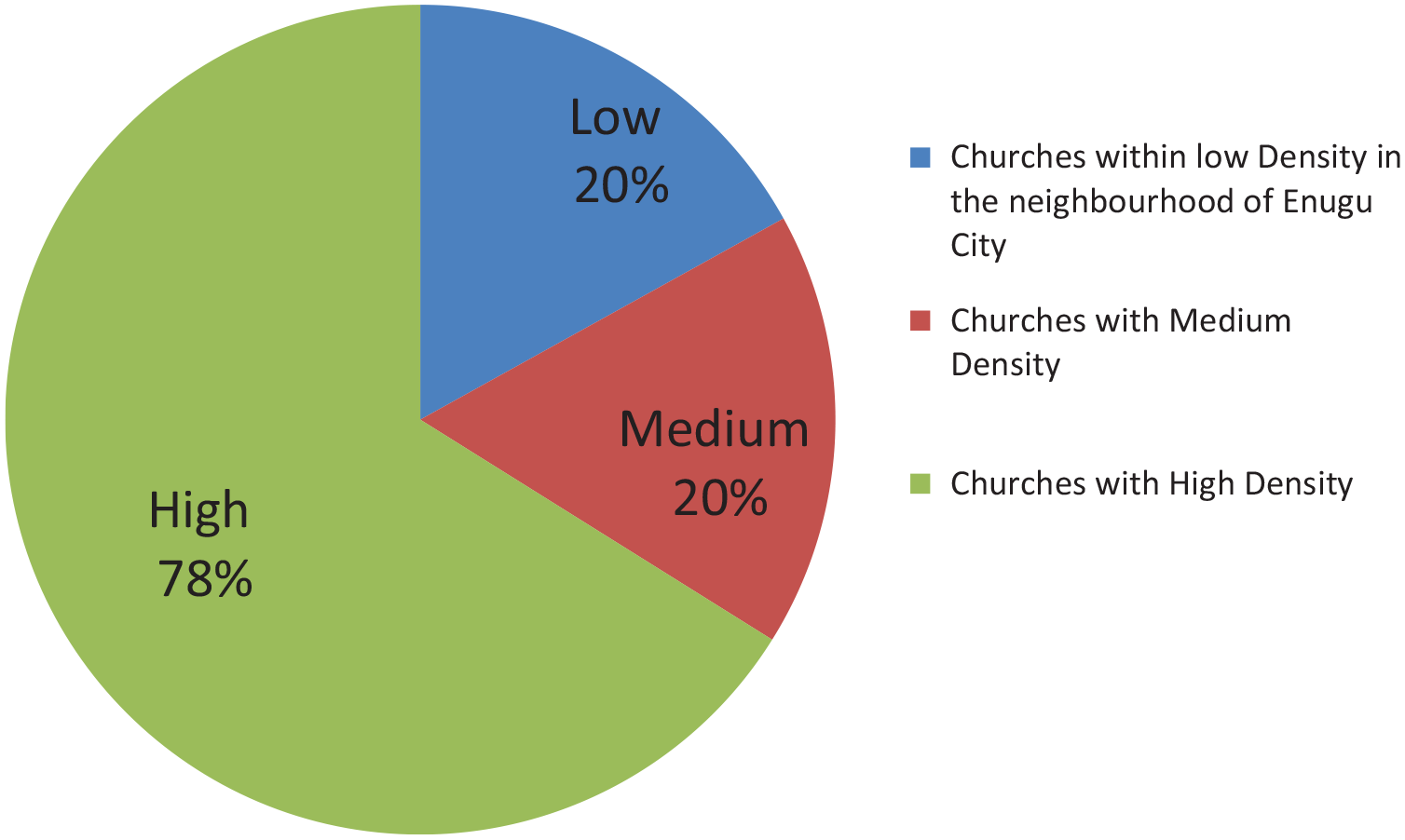
Distribution of Catholic Churches by urban residential neighborhood densities in Enugu.

Distribution of population of Enugu metropolis by neighborhood densities by years.

Physical condition of a typical urban poor informal/squatter settlement in Enugu metropolis.
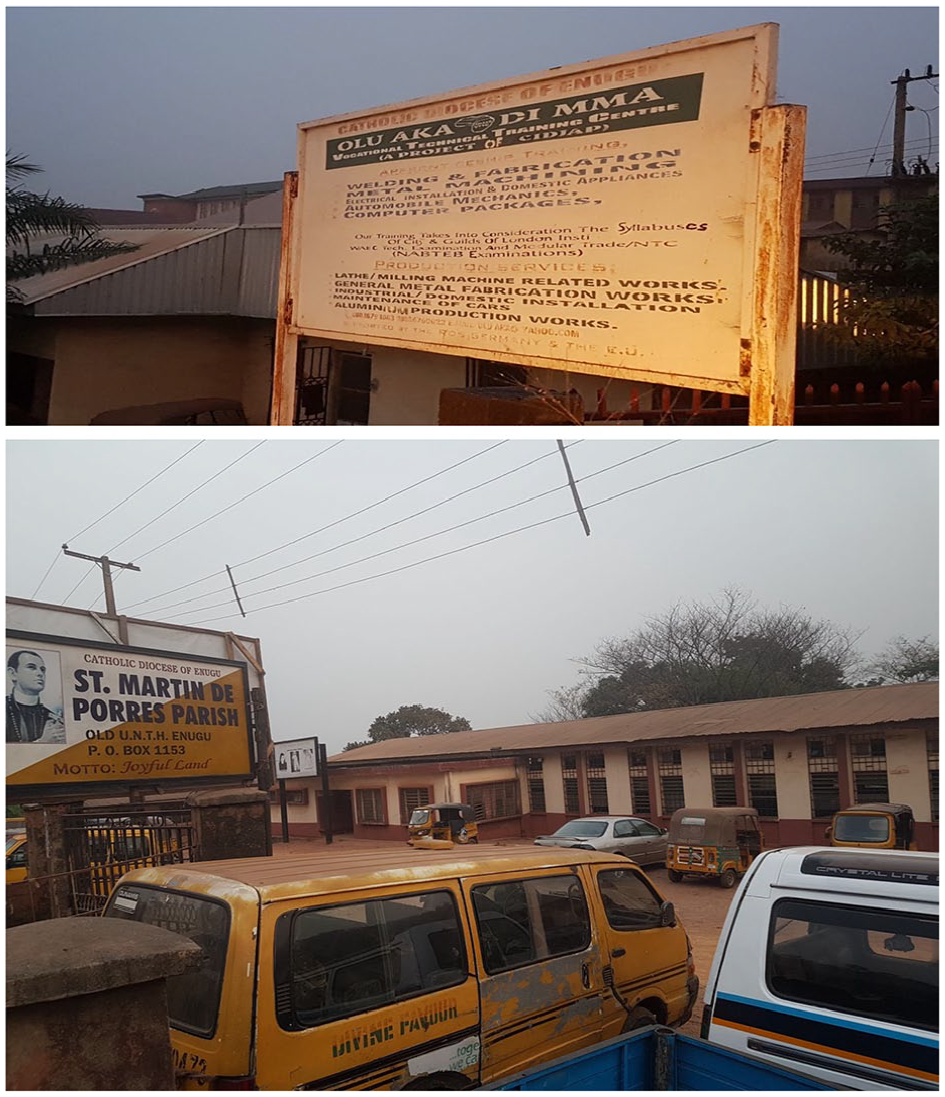
Pro-poor interventions scheme of the Church in some typical urban informal/squatter settlement in Enugu metropolis.
A Sample of Identified Urban Poor Informal/Slum Settlements of Enugu Metropolis.

Source. 1991 Census figures of Enugu from National Population Commission, projected to 2015; Catholic Diocese of Enugu (2018, 2019, 2020 Directory) and Research Survey by the Authors; 2019.
Distribution of Catholic Churches by Urban Residential Densities in Enugu.
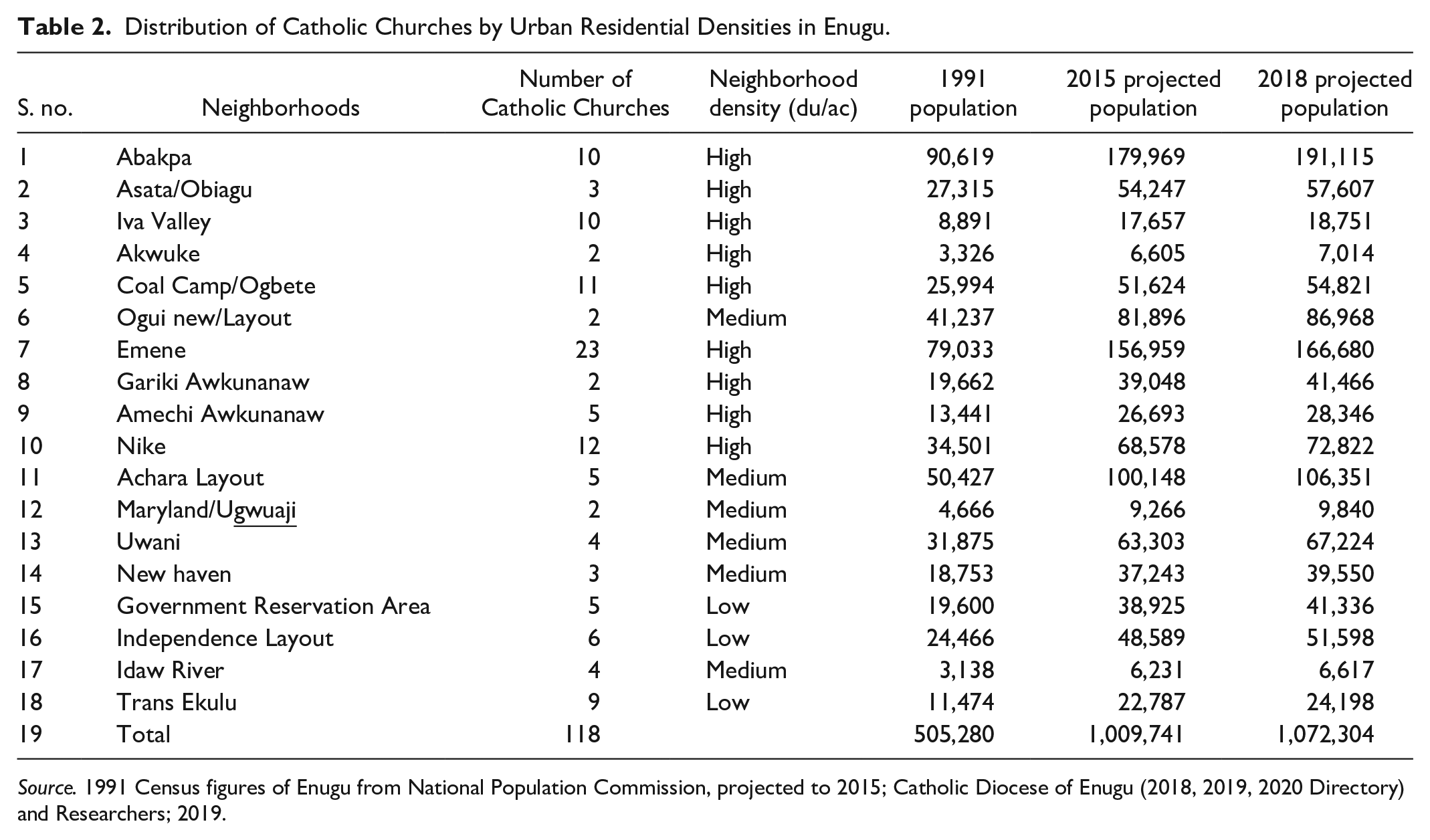
Source. 1991 Census figures of Enugu from National Population Commission, projected to 2015; Catholic Diocese of Enugu (2018, 2019, 2020 Directory) and Researchers; 2019.
Distribution of Population of Enugu Metropolis by Neighborhood Densities.
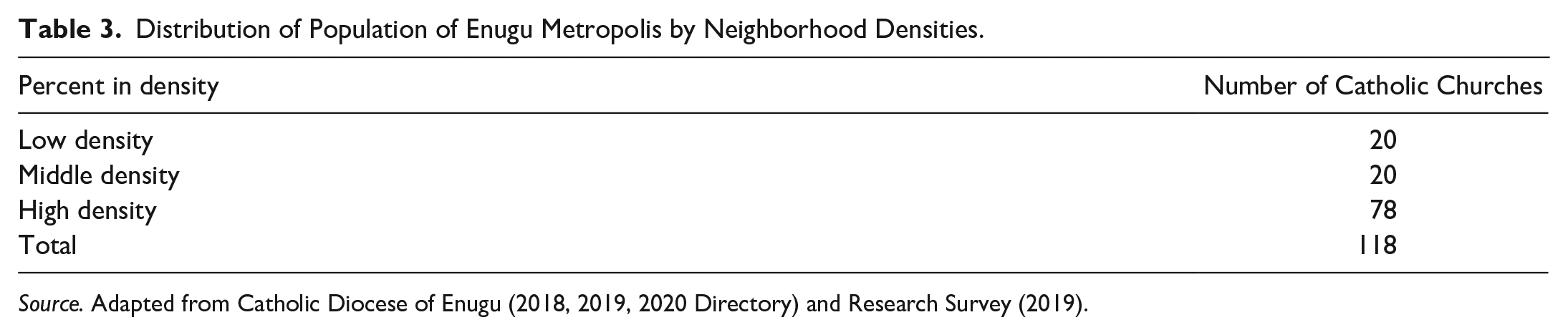
Source. Adapted from Catholic Diocese of Enugu (2018, 2019, 2020 Directory) and Research Survey (2019).
Population Distribution of Enugu Metropolis by Neighborhood Densities by Years.

Source. Adapted from National Population Commission by Research Survey 2019.
Prominent Public Urban Housing in Enugu.

Source. Enugu State Housing Authority (2019), Researchers’ survey (2019).
Table 1 shows a sample of identified urban poor informal/slum settlements and the estimated economic and demographic characteristics of the low-income residents in need of shelter. The existing Catholic parishes as well as the adjourning formal urban neighborhoods to these informal settlements are also indicated and depicted in Tables 1–5 and Figures 1–5.
In Table 1, it is indicated that the study identified more than 238,881 estimate of urban low-income population who are in need of shelter. These urban poor populations are distributed across the informal/slum settlements adjourning formal settlements in Enugu metropolis and live on an average income that ranges from ₦ 109,708 to ₦ 442,544 per annum (about US$243.8–US$550/year).
Furthermore, the identified sample population has Catholic parishes that serve as points of physical and socioeconomic development within the area. Table 2 indicated the neighborhood densities as low, medium, and high residential as a function of the detached unit per acre (du/ac) as defined by EDAW (2006). This is an indication of the need to involve the Church in addressing the pro-poor housing issues in the city. In Tables 3 and 4, the distribution of population in Enugu Metropolis and their densities are identified, while Figures 1 and 2 identify the distribution of Catholic Churches by urban residential neighborhood. Figures 3 and 4 gave the pictures of typical urban housing conditions in Enugu Metropolis.
Government Efforts Toward Urban Public Housing Delivery in Enugu
This article observed that the ever-increasing population of Enugu has also increased the enormity of the urban housing challenges in the city. Government intervention efforts toward urban public housing provisions in the city of Enugu are skewed away from the urban majority residents, who are observably the low-income earners and more pathetically, the urban poor. The study further observed that some housing schemes initially proposed to also accommodate the low-income group were later diverted for high-income earners by the government.
Table 4 below shows some prominent government housing interventions in the city. The table shows that most of the existing housing provisions were built for the high-income earners at the rate of 83%, while the remaining 17% were built for the middle-income earning groups, thereby excluding the low-income groups/urban poor. This is an indication of social exclusion in the urban public housing delivery for Enugu metropolis. It follows, therefore, that government often pays more attention to provision of housing for high-income earners in the city.
Efforts of the Catholic Church Toward Addressing Pro-Poor Urban Housing Challenges in Enugu City
In this study, findings indicated that the Catholic Church has made spirited contributions toward addressing the challenges of urban housing in Enugu city. Such effort ranges from workers housing scheme to the full development of an entire residential estate, such as the Nwanne Di Na Mba low-cost social housing estate at Emene urban neighborhood. This estate is exclusively for the urban poor.
Besides, empirical evidence as indicated in the inaugurated Pontifical Commission for Justice and Peace, iustitia et Pax in January 1967 by Pope Paul VI, enabling the establishment of specialist institutions such as the CIDJAP toward addressing the social needs of the people shows the capacity of the Catholic Church on the physical development. These are observed in Enugu metropolis through building and rebuilding of schools, churches, hospitals, and public places before and even after the Nigerian civil war in 1970 to empower the people, particularly the poor and needy. Furthermore, the Catholic Church also engaged in wealth creation through such initiatives as skills acquisition, agricultural revolutions, and microfinance program among others. Such pro-poor interventions include the CIDJAP low-cost social housing schemes and farm projects; Olu Aka di Mma Vocational Industrial Technical Training Centre, Coal Camp, Ogbete, Enugu; Umuchinemere Procredit Micro Finance Bank; many hospitals and maternities as the Annunciation Specialist Hospital; and Ntasi Obi Ndi No N’ Afufu Community Specialist Hospital, among others.
This study further identified that the Catholic Church has the power, the effectiveness, and tools to solve the housing problem through her organizational and technical skills and economic-financial support as provided in the Code of Canon Law that guide her actions in social and temporary responsibilities as mandated in the bible. Following the canonical and encyclical teachings of the universal Church and based too on inauguration of the Pontifical Commission for Justice and Peace, iustitia et Pax in January 1967 by Pope Paul VI, Enugu Catholic Diocese established the CIDJAP in 1986, and by 1996, CIDJAP was able to execute some pro-poor housing projects with funding from her members and international donor agencies. Through this social project, the Catholic Church aims to expand building of decent houses for the low-income families and urban poor who resides mostly within slum areas and squarer settlements of the city.
Recommendations and Conclusion
Pro-poor housing delivery can essentially be fast-tracked through collaboration between the Catholic Church and the Government because this study has identified the capability of the Church in addressing urban housing challenges in Enugu metropolis. In this regard, a holistic and proactive intervention is highly recommended to cater for the rights to social security of the urban poor. This recommendation takes care of social inclusion of urban poor in urban housing delivery in the city. The identified 118 Catholic Church parishes across the 18 urban formal and informal neighborhoods in the city of Enugu Metropolis can serve as coordinating units for pro-poor housing schemes for residents. Giving that the poor urban low-income group live on an average income that ranges from ₦ 109,708 to ₦ 442,544 per annum (about US$243.8–US$550/year), an effective utilization of cooperative societies as well as a single-digit interest loan for housing finance was a recommended package for the Government-Church collaboration toward sustainable pro-poor housing delivery in the city.
This study therefore reiterates the need for the Church-Government collaboration on pro-poor housing delivery that is anchored on corporative societies and improved access to housing finance for individuals and associations that wish to build their own houses. Such finances should be pegged at a single-digit interest rate of not more than 9% to encourage developers to undertake housing at such meager income of about US$243.8–US$550/year.
Finally, the state government should also endeavor to make lands available as well as designate some areas for the singular purpose of development of pro-poor housing schemes. These can be in the form of satellite towns within the city. This will help expand the city in a planned pattern and at the same time facilitate the availability of land for urban pro-poor housing delivery. The use of indigenous building materials such as mud blocks and bamboo should be considered to make the housing units affordable and sustainable. In such housing schemes, town planners should be involved for proper planning. These recommendations will go a long way in addressing the urban housing problems in Enugu, posed by migration and urbanization trends.
Footnotes
Declaration of Conflicting Interests
The author(s) declared no potential conflicts of interest with respect to the research, authorship, and/or publication of this article.
Funding
The author(s) received no financial support for the research, authorship, and/or publication of this article.
