



Abstract
Policy internationally is supportive of intersectoral partnerships (ISPs) for promoting positive outcomes among people with complex social, psychological, and physical needs. This realist-informed study describes the development of a program theory to provide insight into enactment of effective ISPs. Interviews were completed with 18 senior staff with leadership roles in six ISPs, including voluntary, statutory, and commercial organizations, supporting people with complex health and social care needs. An iteratively developed and refined program theory, termed the “Incite” model, was developed, with collaboration with participants and an advisory group, including people with lived experience. Important contextual conditions that emerged included organizational culture, historical perspectives, policy, and social determinants of health. Mechanisms included desire for change, creating safe psychological spaces, establishing shared values, and talking about power. Outcomes included transformed world view, increased psychological safety, clarity of purpose, fluidity of relationships, and power shifting. Three phases of partnership development were also identified within the model. This study has led to a clearer, more rigorous, and systematic understanding, with recommendations for how ISPs might be developed or expanded. How the Incite model may be operationalized is discussed, as well as implications for policy, practice, and research.
Keywords
Improving the lives of people with complex health and social care needs does not constitute a single response or a prescribed service intervention. Instead, the multiplicity and complexity of need should be mirrored in services provided (Hardwick, 2013; Neale et al., 2014; White, 2007). Significant social determinants of health lie outside the health sector; therefore, action within and between sectors (intersectoral action) is required (Mikkonen & RaphaeL, 2010; Shankardass et al., 2012). Partnerships require relationships, procedures, and structures that are different from practice as usual (Lasker et al., 2001). Policies emphasize the importance of partnership to improve outcomes (The Scottish Government, 2018). However, there is no comprehensive guide that sets out how partnerships can be achieved (Cook, 2015). Building partnerships is time-consuming, resource-intensive and very difficult (Petch et al., 2013). It is not surprising that many partnerships fail to thrive (New Economics Foundation, 2012).
Partnership and collaboration are required for intersectoral practices. Collaborative thinking has been described as transformative (Best et al., 2010; Greenhalgh et al., 2009). People and organizations change when they are exposed to new partners (Jetten et al., 2012; Johansson, 2004; Joseph Rowntree Foundation, 2010). Actors within partnerships have the potential to think and act comprehensively, carrying out interventions that coordinate services, strategies, and systems (Erickson & Andrews, 2011; Trickett & Beehler, 2013; Trickett et al., 2011). When complex social issues are being tackled (substance abuse, domestic violence, alcohol issues, etc.), collaboration requires the formation of new groups to encourage work across stakeholders and joint action (Allen, 2005, 2006; Allen et al., 2008). As described in other literature, “coordinating councils” (Allen, 2005, 2006; Allen et al., 2008), “community coalitions” (Fawcett et al., 1997), or “community collaborations” (Lasker & Weiss, 2003) can engage in a variety of activities aimed to promote change, including being well positioned to promote knowledge among key stakeholders, promote relationships among key stakeholders, and foster interagency working through social ties or relationships that cross sectors.
In this research, “intersectoral partnerships” (ISPs) are the focus. The term ISP has been used to describe partnerships that involve collaboration among different sectors: including the state (statutory/public sector), the market (private/commercial sector), and the third sector (voluntary/charity sector; Waddell & Brown, 1997). These sectors harness human and social capital from diverse partners and are a response to problems that have historically not responded well to single-sector intervention (Herens et al., 2017). ISPs reduce duplication (Trickett & Beehler, 2013) and stimulate innovation and creativity (Cameron et al., 2014). It is through combining the perspectives, resources, and skills of partners something new and valuable is created, a whole that is greater than the sum of its parts (Stevens, 2011; Welbourn, 2012). It is collaborative, boundary-traversing partnerships that are particularly capable of implementing comprehensive multicomponent interventions (El Ansari et al., 2001; Gillinson et al., 2010; Trickett et al., 2011).
Developing effective ISPs is an important policy target (The Scottish Government, 2018) but remains a challenge. The reasons for success or failure are complex. It is known that partnerships benefit when there are clarity of roles and clear responsibilities (Greenhalgh et al., 2009; Jagosh et al., 2012; Woodhead et al., 2017). Among other attributes, conditions, or factors identified as contributions to good partnership working are the inclusion of stakeholders, mutual trust, honesty, reliability, shared vision, interdependence, open communication, appropriate distribution of power, political influence, governance, executive support, and skilled convenors (Marchal et al., 2013; McCormack et al., 2013; Wand et al., 2010). Poor performance factors include personal agendas, individual egos, politicking, poor managerial relationships, geographical distances, and cultural differences (Dowling et al., 2004; Trickett & Beehler, 2013). However, there are many gaps in the literature and the heterogeneity of ISPs makes studying them difficult. As ISPs are complex interventions, research approaches that embrace dynamic systems are required. Realist methodologies are particularly amenable to such problems.
Realist research is a form of theory-driven research that seeks to build explanations on how programs achieve their objectives (Pawson, 2006; Pawson et al., 2005; Pawson & Tilley, 1997; Wong et al., 2016). Realist perspectives and theory building approaches are well equipped for investigating complexity (Gilmore et al., 2019) and causal pathways of interventions (Dalkin et al., 2015). Pawson (2006) asserted that the prime focus of realist practice is to explore the underlying theories of social, policy, or health interventions (termed program theory). The way programs operate is described in terms of this “program theory,” which is a particular way of articulating how a program may achieve its objectives, by focusing not on activities, but instead on causal mechanisms (Wong et al., 2016). Program stakeholders are a key source of such theory. The key assumption is that a particular intervention works through mechanisms (M) in different contexts (C) leading to outcomes (O) (Pawson, 2006). From this perspective, interventions work because the individuals who are involved in complex interventions make decisions, and engage in a social and psychological processes whose operation leads to outcomes (Pawson, 2006). The reasoning and actions of these actors (i.e., “mechanisms”) are what causes outcomes (Dalkin et al., 2015; Emmel et al., 2018; Pawson & Tilley, 1997). External factors (e.g., policy, environment, or cultures) either favor or disfavor activation of mechanisms (i.e., “context”; Pawson, 2006).
A number of realist-informed investigations of sectoral partnerships and ISPs focused on people with multiple and/or complex needs have sought to identify key features. Jagosh et al. (2015), in their study on successful community-based participatory research, concluded that trust and power sharing were key features. However, power sharing was not discussed as distinct from trust. Herens et al. (2017, p. 312) described intersectoral collaboration as a strategy to “find and bind” participants. Herens et al. (2017) identified that building and maintaining trust was a key mechanism to increase effectiveness and align projects. Trust also retained people within the partnerships and served to attract others. Boydell and Rugkasa (2007) focused on the ways in which partnerships created the conditions that made change possible. Empowerment, bridging social ties, and creative solutions were key features that made change possible. Evans and Killoran (2010) concluded that projects with a strong sense of purpose, focused on community needs, and which were able to operate effectively at the micro level and connect strategically were more likely to make progress. Overall, however, the current literature does not explain what happens in a successful ISP. The frameworks developed thus far do not appear to identify the key mechanisms that enable ISPs to be effective and accomplish more than can be done by individual sectors on their own (Hunter & Perkins, 2012). No previous study has developed a program theory of intersectoral collaboration for people with complex and multiple health and social care needs.
Method
Aims
The current study examined the efforts of six ISPs focused on improving health, well-being, and opportunities for people with complex health and social care needs. These ISPs provided support to individuals in response to specific needs and were defined by geographical location or in respect to service requirements. Common features of good practice were obscured by differing models for provision, apparently dissimilar client groups, and a diversity of providers and contributors. Key success features and elements of effective practice required investigation and synthesis. It was important to understand, from the people involved themselves, what factors were necessary to replicate this work. The goal of this current study was therefore to develop a retrospective program theory of successful ISP development. The focus was not on the interventions provided by the ISPs, or outcomes for service users, but rather how the different stakeholders had been successful in developing, negotiating, and continuing to maintain partnerships. The focus was therefore on professional collaboration among the agencies and sectors involved, and the factors or processes that led to the development of a successful partnership.
Selection of ISPs
The ISPs in this study represented partnerships that were currently active within one urban local authority in Scotland, which met following criteria: They (a) were part of the health authority’s strategic plan for mental health and well-being (Irvine et al., 2011), (b) included partners from two or more sectors, (c) had been established for 2 or more years, and (d) had a focus informed by and directed toward people with difficult to meet needs, including trauma, substance misuse and enduring mental or physical health problems (see Table 1 for included ISPs).
ISPs Included in the Research.
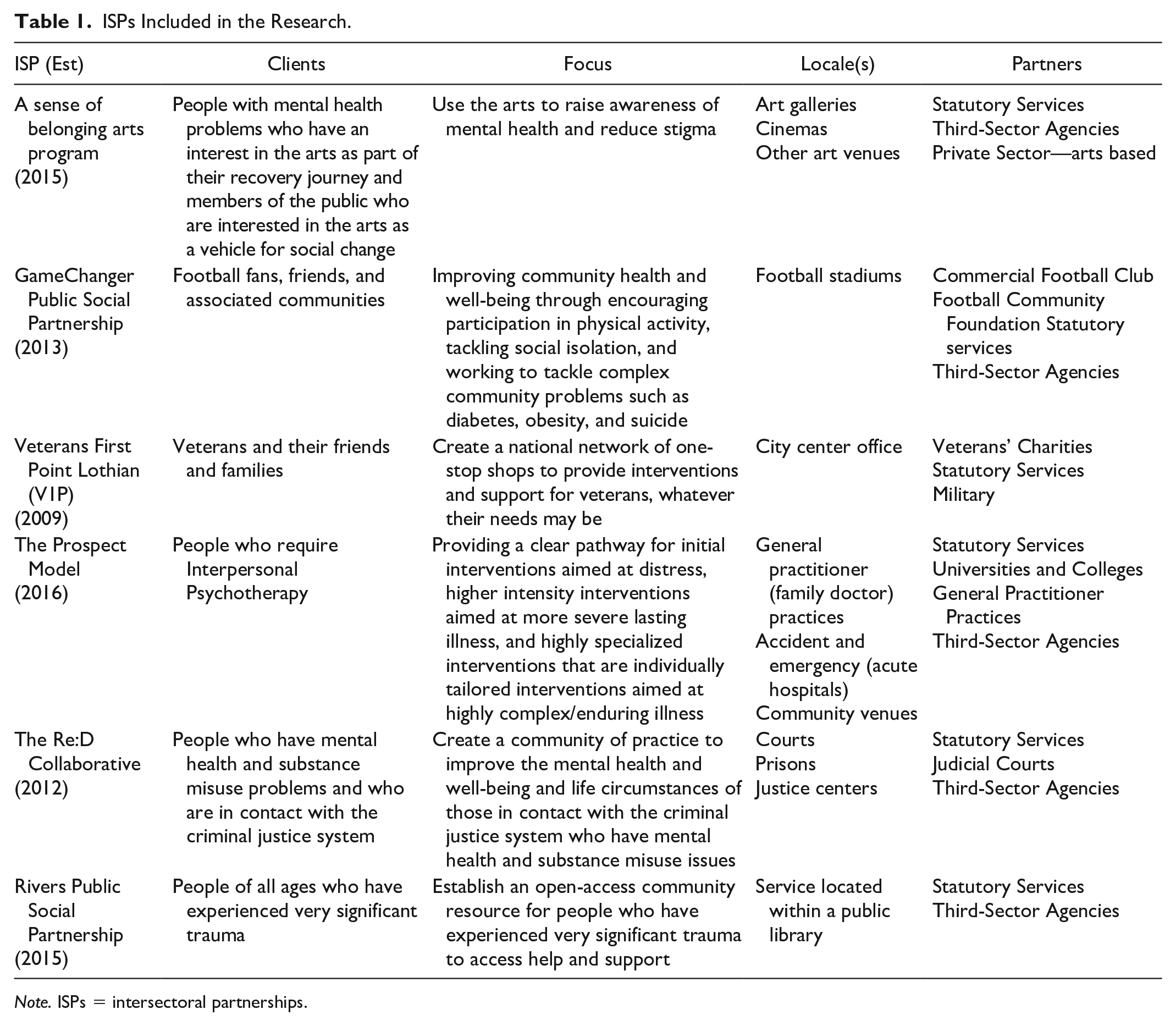
Note. ISPs = intersectoral partnerships.
The six ISPs had partners from a variety of sectors, including private, the state/statutory sector, and third sector. People who attended the partnerships received help from doctors, social workers, psychologists, volunteers, justice system workers, and various other kinds of clinical, social and advocacy services. The ISPs reflected a number of shared concepts, including community services, recovery, maximizing opportunities for people, and values-based practice (Irvine et al., 2011) and they were all aimed at developing partnerships to meet the needs of people with more complex needs (e.g., enduring mental health, trauma, substance misuse, obesity, or suicide prevention).
Design
The study was completed by health and social care professionals, who had experience of developing and evaluating ISPs, as well as experience of working with public, private, and voluntary sectors. One author (corresponding author) had preexisting professional relationships with the individuals included in this study. The researchers used qualitative and realist methods. The utility of realist-informed approaches combined with qualitative research has previously been established (Gilmore et al., 2019). The aim was to develop a retrospective program theory of effective ISP development.
Advisory Group
The advisory group consisted of four people with lived experience of accessing mental health and addictions support, and four professionals. People with lived experience were volunteers, recruited through networking and had been involved in similar processes previously. It was planned that the group would meet 3 times: first, to cover introductions, the interview schedule, and program theory; second, to discuss the findings and emerging theory; and, third, to review before finalization. However, due to the usefulness and enthusiasm of the group, two additional meetings were conducted. Debate and review of the study outcomes were completed, as well as a discussion on impact and application. The researchers engaged and supported email communications between meetings, acknowledging that members may have wanted to reflect outside of meetings.
Initial Program Theory
A draft or initial program theory is required to progress a realist-informed investigation (Pawson, 2006). The researchers, in collaboration with peers and colleagues, developed an initial program theory by synthesis and analysis of several sources. A summary of literature was developed first. This literature review included seminal theoretical work from sociology, psychology, economics, and social movements (Bhabha, 1996, 1999; Bourdieu & Wacquant, 1992; Bowlby, 1973; Coote, 2012; Diani, 2000; Diani & Mcadam, 2003; Elias, 1978, 1987, 1991, 1994; Foucault, 1995; Fox, 1993; Freire, 1973, 1994, 1998; Goffman, 1962, 1974, 1981; Gramschi, 1995; Granovetter, 1973; Habermas, 1973, 1987; Lefebvre, 1991; Putnam, 2000; Soja, 1996, 2009; Tajfel & Turner, 1979, 1986; Turner & Oakes, 1986) and realist-informed investigations with similar foci to our own (Boydell & Rugkasa, 2007; Cheyne et al., 2013; Evans & Killoran, 2010; Hawe et al., 2009; Herens et al., 2017; Jagosh et al., 2015; Macaulay et al., 2011). Gray literature, including policy documents, strategies, and commissioning plans; ISP statements of values and intentions; reports to government agencies; newsletters/flyers; and, where available, published protocols and evaluation data were also reviewed. The researchers developed the initial program theory using the realist framework of context, mechanism, and outcome (CMO). This analysis also drew upon the researchers’ own experiences of working with ISPs. The researchers also presented and discussed the proposal and initial program theory with the research advisory group. The draft program theory contained 11 contexts, 17 mechanisms, and 12 outcome areas across eight preliminary themes. Through these processes, draft mechanisms, contexts, and outcome were developed, communicated, and debated before the primary research interviews. Among the early ideas identified as important for exploration were power, and how this needed to be considered, understood, and managed; how partnerships could define/refine relationships; the importance of spaces; and the importance of narratives. Initial mechanisms focused on factors that may drive positive outcomes. These included organizational drivers (such as power sharing, communication, and practicalities of working together), personal influences (such as belonging to a new community, reciprocity, feeling safe, and having new experiences), and context (such as politics, policy, culture, and funding). Throughout, the researchers’ interest in outcome was targeted at understanding and elucidating the development of an efficient, effective partnership between statutory, commercial, and/or third-sector partners delivering health and social care objectives for people with complex health and social care needs.
Data Collection
A semi-structured interview schedule was designed containing exploratory questions based on the initial program theory (see Table 2). A pilot interview was carried out, resulting in refinements. Interviews were audio recorded and lasted 60 to 90 min. The questions aimed to encourage participants to recount experiences and to collaborate with the researchers in making interpretations. This relationship (between interviewer and interviewee) is different from traditional qualitative interviews because it occurs within the context of an egalitarian discussion, including debate, argument, and recognition of the expertise on both sides (Pawson, 2006; Pawson et al., 2005).
Example Realist-Orientated Interview Probes Used in the Study.

Note. ISP = intersectoral partnership.
Participant Selection
The study employed purposive sampling (Patton, 2002). From the six identified ISPs, 18 individuals were approached and all agreed to be interviewed (see Table 3). Participants were selected on the basis of expertise, influence, and leadership positions. Professionals with such experience are mechanism and outcome experts (Pawson, 2006). The strategy aimed to collect in-depth data, rather than large-scale quantification (Patton, 2002). Rule-of-thumb guides suggest 15 participants as the minimum required (Guest et al., 2006). Six ISPs were included; therefore, a sample of 18 participants (three per ISP) was adequate. The sample reflected the three sectors—statutory sector (seven interviewees), private sector (three interviewees), and third sector (eight interviewees). Participants were judged to be very experienced, and each had knowledge and/or involvement in two or more ISPs, or experience of working in another sector.
Interviewees Included in the Research.

Note. ISP = intersectoral partnership.
Analysis
Interviews were professionally transcribed by a third party and read several times by each team member. The analytic procedure drew on qualitative approaches of thematic and framework analysis involving familiarization, identification of a thematic framework, coding of the data according to the framework, charting the themes, and mapping and interpreting (G. McGhee et al., 2007; Ritchie & Spencer, 2002; Seale, 1999; Stringer, 2007). Each of these steps was adapted to focus on realist aspects of CMO (Gilmore et al., 2019). One researcher (corresponding author) completed the main coding with close supervision from a researcher with significant qualitative experience (second author). The focus of the analysis and coding was to find and align the evidence to demonstrate that particular mechanisms may be generating particular outcomes and to demonstrate what aspects of context may matter. Context, mechanism, and outcome were used as sensitizing concepts in construction of the coding design and the initial analysis, and as an organizing framework in ongoing coding cycles. Data were therefore coded in these terms. Coding rules for context focussed on identifying aspects of the physical and social environment that favored or disfavored mechanism activation. Coding for mechanisms identified any explanation or justification why a service or a resource was used by an actor to achieve an outcome, and their reasoning on processes and successful/unsuccessful strategies employed. Outcomes were the intermediate outcomes linked to mechanisms, and participants’ views on features of a successful ISP. Concepts were identified and incorporated into the coding framework as required. The data were revisited on several occasions. Detailed tables of CMOs with supporting data were developed. Themes were derived to represent clusters of related CMOs. Concepts (themes, contexts, mechanisms, and outcomes) were sorted and grouped to be mutually exclusive and coherent through designation with a single unifying label, aiming for increasingly greater levels of abstraction and explanation.
Rigor and Trustworthiness
All interpretations were recorded alongside quotes to maintain an audit trail. The researchers were aware that an “insider” perspective may have influenced the analysis. A key aspect was the process of reflexivity (Palaganas et al., 2017). The researchers used logs to record their thoughts, feelings, attitudes, and reactions. Throughout, researchers were challenging assumptions and conduct. In addition to the components of subjectivity and social action, rapport was key. When the researchers commenced interviews, they introduced themselves as researchers (rather than a professional role). The stance was to use introspection and reflection (Bloom & Sawin, 2009) to make explicit links between knowledge, personal experiences, and social context. The dynamic between the researcher and participants resulted in asking probing questions that touched on personal motivations and emotions that were being provoked (Palaganas et al., 2017). To further ensure rigor and trustworthiness (Forero et al., 2018), a presentation was made to 14 of the 18 participants. A revised program theory, and draft recommendations were shared. The participants strongly articulated support, recognizing themselves in the analysis. A similar presentation was made to the advisory group, where feedback was also positive, and orientated toward a desire for future educational approaches, such as manuals and training, based on the work.
Ethics
Ethical approval was provided by the Queen Margaret University Ethics Committee. Participants provided written informed consent and were free to withdraw at any time without giving any reason.
Results
How Were Successful ISPs Developed?
Narrative accounts of the development of partnerships were felt by the participants to be important, covering “phases” of development. A brief summary is presented below.
The first phase was termed the “invite” phase. Here, stakeholders were invited to an event to discuss drivers and opportunities. This phase enabled people to engage with curiosity. Participants elaborated on how this attitudinal stance was fostered by the media for presentation, on the initiation of narrative through metaphor, and on the time given to exploration and dialogue. Participants described how their strong sense of being driven to “do right” by the people whom they served was a motivator. Participants described how this phase made them feel excited about opportunities, wanting to understand the new partnership, and having permission to “walk away” if required.
People were subsequently invited to complete short statements detailing why they wanted to be part of the ISP and what they could offer. People completing the forms were then invited to be part of ongoing activities. Being in this “create” phase allowed participants to feel a sense of belonging to the process. The “create” phase was described as constructed to create a different framing of problems and solutions. Participants stated that they were making a commitment to continue to understand partners’ contributions, which led to shared commitment to actions. In this phase, participants described wanting to do something, which started with the sharing perspectives, where different points of view were exposed, and congruence of values examined.
Once ISPs have passed through initial stages, participants described the “enactment” phase. Here, a platform for change was created, focussing on delivery. Attitudes toward failure were important. Participants appreciated that actions that did not achieve intended outcomes were not viewed as a negative, but rather as a natural consequence of engaging in a complex innovation. This perspective was supported through reframing experiences as opportunities and giving permission to take radical actions.
Realist Analysis
In the realist approach, special attention is paid to mechanisms. Mechanisms represent the collective or individual reasoning, actions, thoughts, and reactions of human agents enacted to facilitate outcomes (Dalkin et al., 2015; Emmel et al., 2018; Pawson & Tilley, 1997)—in this case, the mechanisms that supported progression through the invite, create, and enactment phases toward becoming a functioning ISP, delivering health and social care objectives for people with complex health and social care needs. In this article, the focus is mainly on these mechanisms. For brevity, contextual elements (factors that favor or disfavor activation of mechanisms) and outcomes (intermediate and overall outcomes) are briefly summarized. See Table 4 for an overview.
Realist Analysis: Context, Mechanisms, and Outcomes.

Note. ISP = intersectoral partnership.
Context
Context comprises factors that favor or disfavor the activation of mechanisms and therefore the development of successful ISPs. Such elements are already well described in the literature and not felt to be the novel findings. A brief overview is provided.
Context 1: Social determinants of health
A climate of significant debate around social determinants of health was supportive of ISP development. The interrelated and deep-seated nature of social determinants of health were a strong driver within the development of the ISPs. Here was strong acknowledgment and frustration that there was a significant body of knowledge on social determinants, but that knowledge was not being utilized. Lack of recognition of the impact of basic rights, such as housing not being met, and the effect of that on individuals’ ability to engage, was highlighted.
Context 2: Policy
The policy context in relation to the aspirations of improving health and well-being in Scotland was well understood by participants. However, frustrations were expressed by participants that the policy narrative was still focussed on traditional service responses and “silo” working. This was despite a policy vision describing enablement, empowerment, and recovery, with legislative levers such as self-directed support and community empowerment that could unlock more effective responses. Participants within this study described a disconnection between policy intent and policy enactment, which left a space for ISPs to fill.
Context 3: Organizational cultures
Participants expressed views of how prevailing organizational cultures were part of the reason why innovative practice was hampered. Participants stated that there was organizational protectionism and resistance to change. Negative behaviors included withholding information, defending practice, retaining power, and hiding failures. A paradigm of “outright competition” detracted from collaboration. Public agencies retained a privileged and powerful position. This was in contrast to the low power of charity or third-sector agencies. There was stratification with some roles (e.g., doctors) being positioned higher than others. The private sector was viewed as exerting influence for financial gain. The mechanisms necessary to counteract these contextual impediments were core aspects of the ISPs.
Context 4: Historical perspectives
Historically, organizations labeled people by their behaviors, lifestyle choices, or problems. Practices focused on reactive, crisis, or punitive responses. Negative societal attitudes were often reflected in services, for example, immigrant populations being excluded, offender populations being punished rather than rehabilitated, lack of attention to gender-specific needs, and misuse of alcohol contributing to social problems. ISP function was embedded in this climate of negative representations of people with more complex needs. Traditional service responses still focused on changing the behavior of individuals rather than focusing on what societal conditions contributed to continuing exclusion across generations. This context was both negative and motivating, providing obstacles and strong evidence that new responses (i.e., ISPs) were necessary.
Mechanisms
Mechanisms are clustered thematically in five areas. Quotes are provided where appropriate.
Mechanism Cluster 1: Power
The nature of power and how this was dealt with was foundational to the development of the ISPs. Participants frequently identified issues around personal and organizational power, both within the interplay and dynamics of the partnership and the power status they perceived their role or organization to have. The mechanisms were “talking about power” and “understanding power,” which led to intermediate outcomes in terms of power sharing and power shifting.
Talking about power
Participants expressed that unless the “conversation” on power was explicit and overt, ISP staff remained rooted in traditional roles and responses, which resulted in “more of the same” interventions that did not meet the objectives of improving provision for people with multiple and complex needs. ISPs were also viewed as supportive of highlighting the reality of power imbalances: If we just try and pretend that everybody’s equal it doesn’t really . . . I don’t know, it’s never going to work. (15: Voluntary Sector)
The creation of a space for acknowledgment and discussion around power positioned the ISP as a place where all voices could be heard: I think sometimes it can be helpful to be explicit about the power relationships because then it makes it clear, it can be easy to feel like you’re not on the same footing as everyone else. I mean unless it’s explicitly said that you are, and unless it’s explicitly laid out about who’s got the power to do what. Okay this group’s taking the lead on this, but this group’s taking the lead on that bit, then everyone is clear that that power is meant to be shared. . . (8: Voluntary Sector)
Talking about power offsets the risk that the ISPs would perpetuate historical silos rather than challenging traditional power structures. The explicit recognition of power signified the potential for shift in power: . . . if you feel your voice isn’t being heard or you’re not really contributing anything valuable or your contribution isn’t making a difference, why would you keep coming? So if you’re being heard and there is elements of power sharing and all of that I think that does absolutely help. (13: Voluntary Sector)
Understanding power
Understanding power within the ISPs was multifactorial: It entailed an understanding that power was not absolute and could move between sectors as appropriate and recognition that power could be misused or abused. Both these elements were important in order for the ISPs to be optimally effective. Participants also stated that power was not predetermined or absolute. Power was “earned” by visibility, showing that a sector or organization or person displays that they have the best knowledge to hold the power: There’s an acknowledgement of actually I don’t have all the answers and neither do you and that’s both within sectors and across. (5: Public Sector)
There was some recognition that power could be misused or abused. There was also some frustration expressed regarding people who have been historically ascribed power and who were not using it, not prepared to share it, and/or misusing it to belittle, chastise, or punish: People don’t work well with a punishing regime. Whereas look what happens when you reward and you praise, actually, people start flourishing and you get more from people in the system. (5: Public Sector)
Mechanism Cluster 2: Narrative
Narrative, or how the ISPs created a foundational story, including the objectives and benefits of the partnership, was identified as a central element. Participants described how naming the ISP translated into a recognizable “brand” served to encapsulate the character of the ISP and build a sense of shared purpose. The mechanisms driving outcome within narrative were “establishing shared values,” “creating appeal,” and “seeing all perspectives as valid.” These were most linked to intermediate outcomes in terms of authenticity of relationships and decision-making, increased commitment to the ISPs, and fluidity of relationships.
Establishing shared values
Having shared values was explicitly stated an essential mechanism for ISP effectiveness. Shared values were often introduced and discussed as part of people’s initial contact to the ISP, creating a foundation for working together: I think from the outset there was a very clear proposal with quite a clear description of what was expected and intended, and the likely outcomes and benefits. So, that was then really quite easy to support . . . it would be difficult to see why we wouldn’t support it. (18: Public Sector)
Participants acknowledged that they were bringing their own values to the ISP, but for an ISP to function, a set of shared values needed to be developed and “owned” by the participants: It had an identity. People got it. They knew what it was about. They understand. They could see the potential benefit. I think everyone . . . I think all the partnerships benefitted from that. (18: Public Sector)
The mechanism of establishing shared values entailed people being honest and transparent about their personal or organizational values, imperatives, and agendas. This was also described by some participants as difficult, as it challenged their worldview.
Creating appeal
Creating appeal was described by participants as a mechanism for stimulating curiosity through using attractive and engaging methods, approaches, or processes. Examples included using public figures who were perceived as “heroes,” for example, sports people; being in “different” spaces to discuss ideas and work together, for example, nonclinical spaces; and the use of a creative medium to convey information and provoke discussion, for example, drama. The positive stories (narratives) associated with the ISPs were perceived as inspiring, with the knowledge that individuals were “doing something different” and therefore engendering motivation and willingness to engage: Our own experience with 106 kids or whatever it was who had trouble managing their diabetes, was that they weren’t going to listen to clinicians but they listened to a football player. Go figure, go figure, you know. (14: Private Sector)
Seeing all perspectives as valid
The starting point of the narrative, or underpinning story for all the ISPs, was about intersectoral solutions to improve outcomes for people who were often marginalized. This led to a conclusion that no one would be marginalized within the ISP, and therefore, it was critical to the success of the ISP that all perspectives were seen as valid. Participants stated that “respectful” organizations valued their clients and staff regardless of who they were, or their perceived status or importance. Participants discussed how the ISPs viewed people (regardless of role, circumstances, or health status) as having something to contribute: So when you actually meet the organisation and the individuals, it’s having to share your understanding, that’s when it becomes much easier and . . . to have that kind of mutual respect and willingness to listen and learn. To see that we do it this way but actually we could do it your way. (2: Public Sector)
Participants described how this served to equalize and level out roles, which created a sense of belonging. The ISPs facilitated participants gaining a wider understanding of different perspectives through dialogue. Seeing all perspectives as valid did not necessarily entail agreeing with the stated position of others. Participants described how at times this led to conflict but that it was mitigated through shared narratives and shared values: I think it’s also, it kind of normalises it in a sense. We’re not labelling or pigeonholing people. It’s something that everybody can identify with. Whether you’re . . . at whatever level you’re involved. Whether you’re involved as a service user or as a head of service or as a partner, we all, I think . . . we know what that means, to have a sense of belonging. (17: Voluntary Sector)
Mechanism Cluster 3: Identity
The development of an effective intersectoral identity, or how the different ISP actors perceived themselves, their roles, the structures of the partnerships, and how they (re)claimed and celebrated their new identity were identified as central. The mechanisms were “challenging professional identity” and “redefining professional and personal identity.” These mechanisms were linked to intermediate outcomes in terms of increased social capital and developing positive relationships with ISP recipients.
Challenging professional identity
Participants described how their own professional identity could blind them to the possibility of other approaches to helping people; they described being involved in the ISP as challenging the “default setting”: So, realising that there are all sorts of ways of managing some of these problems . . . doesn’t always necessarily . . . the way we do is best. Learning about what people . . . different agencies do because we. . .haven’t really been that aware . . .we don’t really know necessarily what works. (2: Public Sector)
Participants also described how the ISP process supported them to see beyond the problems or behaviors that clients may be displaying, and instead consider the context of the person’s wider life and lived experience, and how this could lead to different solutions for different people: But they [service users] were speaking as equal partners and recognising the role they actually . . . what they were actually able to offer. For me, that’s what was different. That was a shift in my thinking about how the . . . if you like how the Re:D approach was actually working. It was about brokering these kinds of relationships. (18: Public Sector)
Redefining professional and personal identity
Participants reflected on changes that being part of the ISP had meant not just for their professional role but for their own personal identity. Participants described strong resistance to change which was particularly challenging to the voluntary sector, which historically had been placed in a position to compete for funding rather than to collaborate: It’s difficult working with the public sector but actually it can be more difficult working with voluntary organisations at points. Despite the view of charitable organisations ultimately focusing on a common good, the competition between them I think almost detracts from that. (4: Private Sector)
Explanations were given as to how involvement in the ISPs had enabled some participants to review their roles, and the opportunities that they could take through the ISPs to influence people’s lives. Participants reflected on how the ISPs had shifted or had reinstated the importance of relationships and social capital for them: It’s good to be moved by people sometimes, it really is good to be moved by people . . . sometimes we can fight our own emotions when we should actually just allow our own emotions to be there because it’s a positive thing. I think it broadens your experience; it broadens your depth as a human being. (14: Private Sector) Yeah, and there’s no doubt about it. It has made me feel a better person, and that’s a bit selfish, right. You can kind of say, well, you did it to make you feel . . . but it has made me feel as if I’ve actually been able to kind of facilitate some change, whether that be a little bit of visibility, whatever it might well be . . . but I know that this stuff really does create change in people’s lives. (3: Private Sector)
Such reflection and review was a mechanism for ISP success. The ISPs were perceived to give people space to reflect on their practice or to reflect on others’ experiences, which in turn influenced their practice, and the ongoing work of the ISP: I think staff create a culture where people can trust each other and be prepared to be vulnerable in that kind of setting so you can . . . if you’re able to do that then you can be open and honest about your role and difficult . . . it’s that reflective supervision bit that you can say I’ve experienced this and this is what happened to me and this is how I responded. I think if you do that, you’re in with a better chance of being able to validate and recognise the importance of each other’s roles within that. It’s an attitude isn’t it? To me, it’s about being reflective and being willing to recognise what other people can contribute, along with what you can contribute. (18: Public Sector)
Mechanism Cluster 4: Momentum
Creating, building, and sustaining momentum were not the responsibility of a single individual, agency, or sector but a joint responsibility of all. Momentum was identified as pivotal to ISP development. There was discussion regarding the importance of maintaining momentum, of not becoming “stuck,” and of the issues which could cause inertia. “Desire for change” and “pace of change” were the mechanisms. There was recognition that this was not always a steady incremental flow but context dependent. Emotional connectivity, aspiring to sustainability, increased societal awareness, and transformed worldviews were intermediate outcomes associated with momentum.
Desire for change
To create, build, and sustain a new ISP, desire for change was required. Desire for change was reflected in deeply held personal beliefs and experiences. Participants described their frustration at the continuation of a current state of practice that was intolerable to them, and often informed by insights into institutional oppression perpetuated against marginalized people. There was a feeling that services needed to radically change and innovate so that marginalized groups could access what they need: . . . because I think these kinds of initiatives require a fair amount of change and taking some risks, not always doing what might be popular or . . . you’re inevitably going to get a hard time about certain things. You’ve got to have people who have an intuitive sense of . . . I was going to say the right way to go but how can I put this into words? I suppose . . . this is going to sound really corny but a really . . . a good moral compass, somebody who’s going to know just . . . it’ll be in their DNA that if you’re not seeing people from deprived areas, for example, then there’s something wrong in the system. (10: Public Sector)
Pace of change
Participants recognized that there was not a steady state in relation to momentum, that at times it may accelerate or slow down, and therefore a mechanism was pace of change. Pivotal events were triggers for accelerating and continuing momentum. When change was rapid, it created disruptive moments that would provoke and engender further change within participating organizations: There is a momentum and it’s not a sort of continuous momentum, but you’ve got to keep it flowing fast enough to keep the momentum but not too fast. It’s that pace, sometimes it’s going to slow, sometimes it’s going to quicken. Momentum is not a steady state. (10: Public Sector)
Mechanism Cluster 5: Safe, secure space
The challenge of ensuring that safe and secure spaces were available for service users and of maintaining a psychologically safe and secure space for ISP staff to collaborate in was discussed extensively. It was clear from participants’ opinions that developing such spaces was an issue that was very important. The mechanisms were “creating a safe psychological space,” “creating a safe meeting space,” and “using places with ascribed meaning.” These were associated with intermediate outcomes in terms of feeling psychologically safe and having more authentic relationships with ISP partners and service users.
Creating a safe psychological space
Belonging to the partnership was described as a “safe haven,” which enabled different approaches and an environment where failure would not be judged. Participants said that they could have conversations with knowledge that they would be listened to, it would not be repeated to others, and that they could be supportive and open with each other: It involves, I think, staff creating a culture where people can trust each other and be prepared to be vulnerable. (18: Public Sector)
This was particularly important in the case of any conflict or difficulty, where temporary withdrawal or revision was required from the partnership. Participants also described congruence of ISP values and their own values, which supported a psychologically safe space.
Creating a safe meeting space
Participants valued the creation of a safe meeting space for stakeholders to come together. The space allowed time to be exposed to each other’s views, process these views, feel listened to, and have an emotional response to discussion. This provided a platform for shared learning across sectors in relationship to their role with others and their collaborations: I do think people . . . in order to contribute you do need to feel safe and valued. Then the spaces, the physical spaces are important for people as well, but I wonder if the . . . I think you do need to feel psychologically safe. (15: Voluntary Sector)
Using spaces with ascribed meaning
Using spaces with positive cultural connotations or using spaces perceived to be notable or “different” was a key mechanism. Participants understood the power of environments to promote or constrain positive actions, thoughts, and behaviors: Your environment is all important because that’s what dictates and moulds and shapes your behaviour and the way you act and see things. (10: Public Sector)
The participants within one initiative described the meanings ascribed to the place used (a football/soccer stadium) and how that had had a positive effect in terms of appealing to staff and service users. Participants ascribed an emotional connection to the space and feelings of safety, belonging, and reverence. The space was known and understood to be part of the community, so it was familiar and welcoming: . . .a football [soccer] club has a great big building that people almost call home . . . the people who come here feel very much at home; it’s kind of their place, it’s a place they come to which they see as theirs a lot of the time. (14: Private Sector)
Similar views were expressed around the spaces used by partners in an arts-focussed ISP, with public art spaces such as galleries having positive meanings and connotations: There’s a good thing, the whole thing about the space. I would say [the space] it is also that, that feeling of a safe space. No, not a space . . . a space people can connect with, and that’s why despite all the difficulties and the ups and downs each year of tech not being done on time and rooms changing and everything else. The group still feel that they want to be in that space, and they feel that’s where the exhibition belongs and fits, and they feel good about being in that space. (8: Voluntary Sector)
Participants were aware of how community spaces acted in contrast to stigmatizing “clinical” spaces. In “clinical” spaces, diagnosis or other stigmatizing aspects were usually visible through signage (e.g., “addiction”): . . . actually it’s a huge change for people to go into a community space that is . . . doesn’t have a glass front and channels [laughs] because people are like scared, screened off, ticked off . . . where it’s like you walk in the front door and there’s like one desk for mental health, one desk for addictions. . . (8: Voluntary Sector)
Utilization of nonclinical spaces, it was felt, could reduce fear, trepidation, and stigma for people by offering help in spaces with positive connotations. This was felt to be important by the participants, and a mechanism for ensuring congruence between espoused values and practices.
Discussion
This study has developed a refined program theory of ISP development to provide solutions for people experiencing complex health and social care issues. Existing research has focused on service development or change, with less focus on intersectoral innovation. The current study demonstrated the associations among momentum, spaces, identity, narrative, and power, as expressed through an interaction of mechanisms, contexts, and outcomes.
Power was important concept. Researchers have proposed that democratization of structures is an important aspect of partnerships (Repper & Perkins, 2003; Sapouna et al., 2011; Schon, 2010; Shildrick & Macdonald, 2013; Trickett et al., 2011). The data from the current study demonstrate that the ISPs were constructed spaces in which participants were asked to acknowledge and engage in discussions about power. By triggering mechanisms of talking about power and understanding power, the issue of power was explicit. Power shifting and power sharing were the outcomes. An interesting finding regarding power concerns the inclusion of commercial partners in the ISPs. Power exerted by business and media has often been excluded from conversations around health and social care partnerships (Eastwood et al., 2016). Findings from the current study support the idea of expanding ideas around power to include aspects relating to economic capital. By including holders of power from the private or commercial sector, their power, which is often economic, can become part of the ISP, increasing reach and capacity. Theories of social capital (Bourdieu, 1977; Putnam, 2000), emotional capital (Bourdieu, 1977), and economic capital (Bourdieu, 1977) strengthen these explanations.
An important barrier to the development of collaborative programs is a lack of shared understanding models, or theories of working (Evans & Killoran, 2010; Herens et al., 2017). An important finding from the current study, with regard to “narrative,” is that by building a value-base, which encompasses ideas around structures, processes, and culture, a powerful, supportive, and encompassing story is constructed. This narrative then in turn supports the ISP through the complexities of providing interventions. However, if a shared strategic vision is created too early and is too fixed, it can constrain activity (Evans & Killoran, 2010). In the current study, the mechanisms of developing appeal and seeing all perspectives as valid helped to avoid the problem of rigidity, allowing priorities to emerge, rather than be imposed. This left space for the ISPs to grow and allowed for a fluidity that was shaped by various factors.
The present study adds to the understanding that creating places where people can be open with one another will help encourage collaboration. Such participatory spaces are places for creating partnership, where people can acquire skills and become more effective (Cornwall & Coelho, 2006; Trickett & Beehler, 2013; Trickett et al., 2011). “Identity” was a key idea, focussing on the interplay of professional and personal identity. The current study provides insight into Habermas’s (1987) “third concept” of identity as the power of dialogue between self and the other (p. 131). Habermas described how people talk about themselves and others, how they position themselves, and where they locate themselves within a community. In the current study, participants described how their engagement and involvement in the ISPs had enabled them to consider different discourses, with the ISP opening up new possibilities for identity, or alternatively for congruence between preexisting identities to be reached. The ISPs gave participants a chance to explore their own identity. Javdani and Allen (2010) conceptualized the promotion of knowledge and relationships as interdependent processes that reflect growing social capital evidenced through increased knowledge about issues, and local systems response through the development of personal and organizational relationships. This social capital has a generative potential (Javdani & Allen, 2010) and yields further collaboration (Javdani & Allen, 2010; Lasker & Weiss, 2001; Mandarano, 2009). Relatedly, some participants reflected on how their initial motivation to become a health (or helping) professional was reactivated by their involvement in the ISP.
The ISPs had all developed momentum, that is, a pace of change that was effective and self-sustaining. Taking time to mobilize different parties and informal networks has been previously identified as a success factor (Herens et al., 2017). Our study found that desire for change and pace of change were key mechanisms. Our study indicates that to maximize pace of change and develop momentum, partnership members need to feel connected, which in turn spurs further momentum that continues to transform worldview, which may then begin to reshape organizational cultures. The study provides novel findings in relation to the importance of how an ISP needs to interlock the “story” or the narrative with momentum, and the momentum will in turn become part of the story, rather than a more traditional narrative with beginning, middle, and end.
The findings of our study confirm that creating a safe space mitigates against fragility and unsettled responses of individuals when confronted with unfamiliar ideas or situations. Important outcomes were increased psychological safety and authentic relationships. The creation of safe spaces was closely linked to the developmental phases. In fact, it may not have been possible to progress if a safe space did not exist. It is clear that a safe space served to manage or eradicate negative behaviors which other researchers have highlighted (Glasby & Lester, 2004; Mukumbang et al., 2016) and which have led to abandoned programs (Evans & Killoran, 2010). The findings of the current study demonstrated that ISPs could achieve greater success when different settings such as art galleries and football stadiums, places with positive meaning, were used. Other studies have demonstrated that settings produce emotions and behavioral responses (Curtis, 2010; Hawkins & Abrams, 2007). The current study’s findings accorded with the work of J. M. Irvine (2007), who suggested that particular configurations of “scripts,” the performance of the “actors,” and the “staging” are each important.
The Incite Model
Our aim was to create a new program theory. The selected title of the theory was the “Incite” model (Figure 1). This title was selected to motivate and inspire. The word incite means to stir to action or feeling: excite, foment, galvanize, goad, impel, inflame, inspire, instigate, motivate, move, pique, prick, prod, prompt, propel, provoke, set off, spur, stimulate, touch off, trigger, work up (Roget, 2014). The program theory covers the five themes, namely, (a) narrative, (b) momentum, (c) identity, (d) safe secure space, and (e) power, with three phases (a) invite, (b) create, and (c) enact. The model can be used to guide the development of partnerships across sectors to improve outcomes for people with complex needs. The model provides a response to the identified gap of how to identify the mechanisms that enable ISPs to thrive. The ideal outcome of the Incite model is an effective ISP delivering health and social equality objectives.

The Incite model.
Recommendations for Research and Practice
Recommendations for research are the following: (a) undertake research to explore stakeholder reactions to Incite, (b) develop a realist evaluation protocol to assess ISPs using Incite, and (c) develop national and international research partnerships to review use of Incite. Consideration of the concepts from Incite offers an opportunity, and guidance, for practitioners. The questions detailed in Table 5 can be used to support reflection and review of nascent or preexisting ISPs. In response to research findings that note the effectiveness of multifaceted and active educational approaches such as practical manuals and reminders (e.g., Cornelissen et al., 2011), next steps for the Incite Model include development of manualized practical materials that operationalize the findings in a manner that can be applied to real-world situations.
Reflective Questions to Help Organizations Review on Their Partnership Processes and Outcomes.

Note. ISP = intersectoral partnership.
Limitations
Participants voluntarily self-selected to participate. It was the intention to select senior individuals who would be able to give a full analysis of the ISPs. This may have created bias in favor of participants most enthusiastic about ISPs. It is possible that if junior or “on-the-ground” staff had been selected, the outcomes may have been different. Inclusion of people with lived experience may also have enhanced this research. However, professionals have the experience of working with a range of people, and they will be able to provide an account of the purpose of programs, the actions taken, and the underpinning processes that led to program success (i.e., mechanisms). Nonetheless, the advisory group for this study did include people with lived experience. Discussion and dialogue through these meetings brought expressions from individuals that the findings made sense and resonated with the group. It may be appropriate for future research to examine the Incite model from the perspectives service users. Furthermore, although mechanisms for citizen and end-user participation were interwoven into the narratives and a key aspect of the ISPs, these have not been explored deeply in the current research and would warrant further extrapolation. Finally, the model is not empirically tested, and future research will be required to operationalize and implement Incite in different real-world situations.
Conclusion
The Incite model can be used to structure and guide the development of ISPs for people with multiple and complex health and social care needs. Discussions surrounding the appropriate conceptualization of and response to people with complex patterns of need have seen significant change over recent decades. In particular, there has been a change away from “treating” people to a more ecological, collaborative, and recovery-focused approach which is shaping health and social care research and practice. Involving and including the lived experiences of people and including the development and use of ISPs are gaining recognition as being increasingly important and desirable. Such work reflects not only fundamental shifts in practice but a deeper and more nuanced understanding of the complexities of lives lived and correspondingly the support and help that is thus required.
Footnotes
Acknowledgements
The authors would like to acknowledge the input and commitment of a number of people and agencies, including study participants and members of the research advisory group; Aid & Abet; Armed Forces and Veterans Health and Wellbeing Group; CAPS Advocacy; City of Edinburgh Council; Clear Design; Cyrenians; Edinburgh Health and Social Care Partnership; Edinburgh Leisure; Edinburgh Social Enterprise Network; EVOC; Health in Mind; Healthy Active Minds; Hibernian Community Trust; Hibernian Football Club; Leith Festival Association; MECOPP; Mental Health Foundation; Network Rail; NHS Lothian; Patients Council, Royal Edinburgh Hospital; Police Scotland; Prospect Team; Rivers Centre; SAMH; Scottish Mental Health Arts Festival; Summerhall; Strange Town Theatre Company; Street Soccer; Support in Mind; the Citadel; the Stafford Centre; the State (Leith) CIC; Turning Point; V1P Lothian; Willow.
Authors’ Note
The content in this work was derived from a Doctoral thesis (Irvine Fitzpatrick, 2019).
Declaration of Conflicting Interests
The author(s) declared the following potential conflicts of interest with respect to the research, authorship, and/or publication of this article: The first author has a role that provides strategic leadership within the health authority where this research has taken place and for the ISPs included.
Funding
The author(s) disclosed receipt of the following financial support for the research, authorship, and/or publication of this article: We acknowledge funding contributions from the Scottish Government’s Third Sector Division and Mental Health Division and Community Covenant Grant.
