




Abstract
Due to the spread of the English language in various domains and the fact that English is used as a global language, researchers and educators have started to rethink the models and aims of English language teaching in different settings. From the World Englishes (WE) perspective, this study investigated the attitudes of Chinese university students toward the localized variety of “China English,” as well as the students’ identity construction and negotiation during their English language learning journey. Data were collected through a questionnaire completed by 190 respondents and interviews conducted with 20 participants. The findings revealed the students’ positive attitudes toward China English and non-conformity to English as a native language (ENL). This further reflected the communicative function of English and the students’ interest in forming a Chinese cultural identity. However, the students also showed self-contradictory attitudes toward China English, as most did not want to be clearly identified as Chinese when using English. The data revealed some important reasons for this attitudinal conflict, including the belief that ENL is the standard form of English, as well as the students’ desire to develop an identity as competent second language learners of English. The findings suggest the importance of increasing awareness of the global spread of English and reforming English curricula and assessment in contexts where local varieties of English are emerging.
Introduction
As a widely used language and the most frequent choice for international communication, English has played various roles in different global contexts (Crystal, 2003). Due to the spread of English worldwide, non-native English speakers (NNESs) now outnumber native English speakers (NESs) (Seidlhofer, 2011). When English is used for intercultural communication, communication strategies and intelligibility are more important than the so-called standard English; in this sense, language proficiency is no longer measured against the standard English norms (Rose & Galloway, 2019; Seidlhofer, 2011). Therefore, to meet the learning needs and goals of English learners around the world, some scholars have begun to challenge the traditional native-oriented approach to English language teaching (ELT). This is especially true for students who use English in their encounters with people from various linguistic and cultural backgrounds. With this in mind, ELT practitioners will likely need to revisit some entrenched traditional pedagogical practices based on the fixed standard English norms. Specifically, they will need to harness cultural identity and implement a more appropriate pedagogic model of ELT in local ELT contexts to increase awareness of the diversity of English and meet the diverse needs and goals of language learners (Fang & Ren, 2018; Galloway & Rose, 2015, 2018).
From the perspective of World Englishes (WE), the local use of English in China, known as China English, has been recognized among many Chinese people as a variety of English (Ma & Xu, 2017), albeit with some controversy (Fang, 2017a; Yang & Zhang, 2015). Therefore, scholars have proposed combining select features of China English into the ELT curriculum to help Chinese students develop a greater sense of ownership of the English language and project their own identity onto international communication (Wen, 2012; Xu, 2010). Previous studies have focused on the acceptance of China English among Chinese university students or teachers (He, 2017; He & Li, 2009; He & Zhang, 2010; W. Wang, 2015). Some studies have demonstrated students’ increasing awareness and acceptance of China English because of its linguistic attainability and cultural friendliness (He, 2017; He & Li, 2009), while others have reported low recognition and negative perceptions of China English due to native ideology and the Chinglish stigma (W. Wang, 2015; Yang & Zhang, 2015). However, many studies have not explored some of the in-depth reasons underlying the attitudinal responses. Thus, it is worth investigating Chinese language learners’ attitudes and identity construction in relation to China English in the Chinese context, where more than 400 million people are learning English for various purposes (Wei & Su, 2015). The findings will provide some insights into university students’ attachment to native English and their beliefs regarding how English should be taught and learned.
Identity construction is another critical issue related to the use of English and ELT. The connection between language attitude and identity has been investigated because speakers’ language attitudes are also guided by their cultural and social identities (Fang, 2020; Jenkins, 2007; Pan, 2019; Y. Wang, 2020). Attitudes toward a certain language may contribute to understanding an individual’s social identity because “the expression of attitudes is part of the process of constituting groups, and is part of social belonging” (Garrett et al., 2003, p. 226). For instance, Schneider (2003) emphasized that the reconstruction of the identity of NNESs comes from distancing oneself from NESs rather than aligning oneself with them, along with the development of non-native varieties of English. It is key that the official English Language Education Policies (ELEP) of China explicitly specifies that students majoring in English should develop familiarity with and appreciation of Chinese culture and traditions (Ministry of Education, China, 2000). Today, students in China are trained to cultivate the spirit of patriotic spirit (Tian et al., 2017). From this perspective, China English may have aroused students’ awareness of cultural variations and improved their ability to “(re)negotiate and (co)construct students’ relations and Chinese identities during English language learning and use” (Xu & Sharifian, 2017, p. 215). Therefore, it is important to determine whether Chinese college students use English to value their Chinese cultural identity, which is rooted in their first language (L1), or distance themselves from it. Thus, this study investigated Chinese university students’ attitudes toward China English as well as their identity construction in relation to learning English. The findings are expected to facilitate discussions on how teachers can implement a pedagogic model that supports Chinese students’ English language learning and allows them to express their identities and successfully engage in communication.
We are aware that the term Global Englishes (GE) is an umbrella term referring to the global spread of English (see Figure 1), encompassing research in the fields of WE, English as a lingua franca (ELF), and English as an international language (EIL) (Galloway, 2017). WE “is to be commended for focusing scholarly attention on the diversity of English and legitimizing different Englishes as varieties of the language in their own right with relatively stable features in the societies in which they are used” (Galloway, 2017, p. 7). Drawing from the WE paradigm, ELF explores the fluidity of English language use across different L1 speakers within and across geographic boundaries. With the focus on ELT, EIL places a greater emphasis on the implications of the globalization of English. It has been argued that GE looks at “the linguistic, sociolinguistic and sociocultural diversity and fluidity of English use and English users in a globalized world” (Rose & Galloway, 2019, p. 4).
The WE paradigm is adopted in the research study discussed in this article because it focuses more on English emerging among Chinese speakers in China. However, we are aware of the limitation of Kachru’s three-circle model, which overlooks the fluid and dynamic nature of the growing use of English in the modern world (Cogo & Dewey, 2012; Pennycook, 2010). Despite its limitations, WE showcases new Englishes in different geographical contexts and advocates adopting a “polymodel” approach to ELT.

The global Englishes paradigm (Galloway, 2017).
Literature Review
China English: An Emerging Variety of English
China has the largest English-learning population in the world (Bolton, 2003; Wei & Su, 2015). English is widely used in various domains beyond education in China. For example, Adamson (2004) noted the unprecedented role of English in procuring well-paid jobs in the commercial sector. Based on the WE paradigm, some have argued that China English should be regarded as an emerging variety of English (X. Q. Hu, 2005; Xu, 2010), although China lies in the expanding circle in which people traditionally regard English as a foreign language (Kachru, 1992). From the GE perspective, the ideology of native-speakerism has been challenged with a focus on the legitimization of the varieties of English. The recognition of these varieties calls for documenting their distinctive features, showcasing how they are influenced by the speakers’ L1 and culture (Galloway, 2017). Within the WE paradigm, three terms are primarily used to describe the English spoken by Chinese people: Chinglish (Jiang, 1995), China English (Ge, 1980; X. Q. Hu, 2005), and Chinese English (Xu, 2010; Xu et al., 2017). These terms have slightly different connotations when used by different scholars.
Chinglish refers to an interlanguage that is a type of “broken English” with a heavy Chinese influence as well as a developmental stage of a variety of English spoken by Chinese learners of English (Ma & Xu, 2017). This term is loaded with social stigma, and it suggests grammatically incorrect or nonsensical English used in Chinese contexts. Ma and Xu (2017) defined Chinese English as “a variety that has emerged as a result of language and cultural contact between ‘native’ varieties of English and Chinese language and culture” (p. 191). Based on this definition, Chinese English may show signs of linguistic transfer and cultural conceptualization from the mother tongue. Y. Wang (2018) conceptualizes Chinese English as a lingua franca and sheds lights on the study of China English. In her view, “the endonormativity of Chinese speakers’ English is tied to the development of China” (p. 161). As a performance variety, China English is based on “normative English” and includes Chinese characteristics in its lexis, sentence structure, and discourse to express specific terms within Chinese society and culture (Li, 1993; Xu, 2010). This article adopts the term China English because Chinese English may be equated with “Chinglish” and connotes a negative meaning (Li, 1993).
China English has been promoted as a possible pedagogical choice to challenge the dominance of English as a native language (ENL) and raise awareness of the learners’ L1 identity (Marlina, 2017; Wen, 2012; Xu, 2010). Previous studies (Cheng, 1992; Deterding & Kirkpatrick, 2006; Kirkpatrick & Xu, 2002; Xu, 2006, 2010) have discussed the various linguistic levels of China English from its phonological, morphosyntactic, pragmatic, and discourse-related features. For example, Xu (2008, 2010) attempted to codify the linguistic features of China English based on spoken and written data. According to Xu (2010), Chinese English words can be divided into three categories at the lexical level: Chinese loanwords in English (e.g., dim sum, feng shui, and kung fu), nativized English words in Chinese contexts (e.g., family planning, individualism, labor camp, and migrant workers), and common English words (e.g., eye, nose, food, and love) shared with other varieties of English. At the syntactic level, Xu (2008) differentiated between the features of spoken Chinese English data (i.e., interview transcripts) and written Chinese English data (i.e., newspaper articles and short stories) to show that some features of China English are largely a result of the transfer of syntactic properties from Chinese to English (e.g., adjacent default tenses, null-subject/object utterances, subject pronoun copying, yes–no responses, tag variation strategy). At the discourse and pragmatic levels, various Chinese cultural concepts have surfaced in China English, such as politeness, hierarchy, social distance, and implicatures (Ma & Xu, 2017).
The Native English Model and ELT in China
Native English, typically British or American English, is often adopted as the model for ELT in a Chinese context, as the learners’ English-language proficiency is often oriented toward a monolingual native-speaker model in contemporary English proficiency tests (e.g., College English Test, TOEFL, IELTS) (Fang, 2020; Y. Wang, 2020). For example, the Chinese “College English Curriculum Requirements” (2007) requires students to produce “correct pronunciation and intonation” (p. 7) and “follow talks by people from English-speaking countries” (p. 13). Moreover, with the increase in the use of English Medium Instruction (EMI) in institutions of higher education in China, there is an ever-increasing demand for English language proficiency (Botha, 2016; Fang, 2018; G. W. Hu & Lei, 2014).
As people from multilingual and multicultural backgrounds use English in various contexts, English communication involves the use of multilingual resources to construct meaning and achieve mutual understanding (Cogo, 2012; Jenkins, 2012). In this situation, intelligibility among English users is more essential than adherence to standard English norms. As Kirkpatrick (2007) argued, the ENL model undermines the self-confidence and self-respect of local teachers because targeting the ENL model by blindly adopting the monolingual EMI approach fails to reflect the reality of how English is used in the global context. To challenge the use of native English as a determinant of competence, Kirkpatrick (2007) proposed combining local varieties of English with more established varieties of that language and argued the importance of encouraging students to challenge the traditional English model by using their L1s to express their identity and promote solidarity. Seidlhofer (2011) suggested teaching English learners communication strategies to improve their ability to negotiate and accommodate different ways of speaking. Galloway and Rose (2015) outlined Global English Language Teaching (GELT) to provide a framework for evaluating and designing curricula. Thus, ELT should focus on exposing learners to various varieties of English to increase their awareness of linguistic and cultural diversity (Galloway & Rose, 2015; Jenkins, 2015; Rose & Galloway, 2019).
Attitudes Toward China English and the Formation of Identity
Despite the advantages of combining local English varieties with pedagogical models, previous attitudinal studies have revealed that some language learners are self-contradictory when making decisions regarding the acceptance of their own English use in comparison to the “ultimate” goal to be native-like (Jenkins, 2007). For example, X. Q. Hu (2004) found that the vast majority of the Chinese students in their study had never heard of China English (84.5%); instead, they believed that proficiency in standard American or British English should be their goal (79.1%). Kirkpatrick and Xu (2002) found that only 28% of the students in their study agreed with the notion that “one day there will be a variety of English called Chinese English,” and few of them (17.5%) appeared happy to sound like a Chinese person when they spoke English. In their study, He and Li (2009) showed that a majority of the participants had heard of China English (84.2%), and they predicted a trend that more people were becoming more aware of and tolerant toward China English.
Some studies have adopted the Acceptability Judgment Task (AJT) to explore the in-depth reasons underpinning the participants’ attitudes toward China English. For example, W. Wang (2015) found that China English has not been widely accepted by university students, but China English accents have a higher recognition than its features in lexes, syntax, and discourse pragmatics. She argued that the widespread ideology of native-speaker English and the stigma attached to Chinglish significantly contributed to the negative views of China English. Similarly, Yang and Zhang (2015) found that Chinese tertiary English teachers showed positive attitudes toward lexical features, but they still stigmatized the syntactic and pragmatic features of China English.
More importantly, language is not only a tool for communication but also a way to position identity (Jenkins, 2007; Norton, 2013). Recent research has shown that identity is complicated, unstable, and fluid (Edwards, 2009; Norton, 2013). Norton (2013) defined identity as “how a person understands his or her relationship to the world, how that relationship is constructed across time and space, and how the person understands possibilities for the future” (p. 45). Researchers have suggested that the entrenched pressure to conform to native-speaker norms in ELT could pose a threat to the learners’ cultural identities (Guo & Beckett, 2007; Niu & Wolff, 2007). For example, Kirkpatrick (2007) argued that language learners should have the right to express their L1 identities when speaking English. Similarly, Modiano (2009) argued that non-native varieties of English should be viewed as manifestations of the linguistic and sociocultural identities of second language (L2) speakers. In their study on the L1 identities of Chinese English speakers, Pan (2019) found that the participants’ favorable attitudes toward and acceptance of China English might be partly due to their strong cultural identities and national pride. Similarly, Gu (2010) and Fong (2017) stated that the increasing exposure to the English language would help Chinese people maintain their Chinese cultural and national identities and could increase their patriotism due to the successful integration of the English curriculum with Chinese culture and tradition. Sung (2014a) also revealed that “accent is exploited [. . .] as a resource for projecting a hybrid identity which expresses both global and local orientation” (p. 53). Moreover, Fang (2017b) investigated Chinese university students’ attitudes toward English accents using a questionnaire and interviews and found that some students hoped to be regarded as successful English speakers based on their accents, but they did not want to lose their identities as Chinese speakers.
In summary, most of the previous studies adopted either direct measures, such as questionnaires and interviews, or indirect measures, such as AJT, to investigate the participants’ attitudes toward China English. Few studies have incorporated both approaches to elicit people’s explicit and implicit attitudes. Therefore, this study aimed to explore the complexity of Chinese university students’ explicit and implicit attitudes toward China English and the construction of identities in relation to language learning. It is hoped that this study will shed light on the importance of integrating China English into the ELT curriculum. The study aimed to address the following research questions:
Methodology
Setting and Participants
This study was conducted at one of the main universities in Jilin Province, which is located in the northeastern part of China. According to the university’s website (2019), there are more than 70,000 full-time students; of these, there are more than 8,000 doctoral students and 20,000 postgraduate students. The university has extensive exchange programs with international universities. Teaching resources are fully used to enhance the English language proficiency of all students while enhancing their abilities to use English in professional and cultural interactions.
University students taking the course, College English, were selected as the study’s participants because they are significantly involved in daily English-language learning. At the tertiary level in China, students need to finish their 2-year compulsory English courses. Their English language learning materials are native-oriented, with British and American texts and pronunciation models dominant in the teaching materials and assessments (Fang, 2020; Guo & Beckett, 2007; He & Zhang, 2010; Y. Wang, 2020). The participants were non-English majors because this population significantly outnumbers English major students at the focal university. These students will graduate and enter various sectors in which they will communicate with people from different lingua cultures. Thus, their needs should be addressed in terms of which English pedagogical model that is employed.
For the questionnaire, the recruited participants consisted of 190 freshmen and sophomores (M = 46.3%; F = 53.7%) who were taking the College English course. The age of the participants ranged from 17 to 21, and all the students had studied English for at least 9 years prior to their university studies. They were all at the lower-intermediate to intermediate level of English proficiency, according to the English scores on their university entrance exam (IELTS 5.5 to 6 point/CEFR B2 level). The participants were studying in six disciplines: law (32), business (28), chemistry (35), computer science (30), basic medicine (35), and administration (30).
Data Collection
The mixed-methods approach was adopted to explore the complexity of the participants’ attitudes as well as the reasons and factors underlying them. First, a questionnaire based on and adapted from several previous studies (Galloway & Rose, 2015; He & Li, 2009; Mollin, 2006) was used to obtain a general idea about the participants’ attitudes toward China English and their identity construction. These results guided the researchers to further explore the participants’ deeper attitudes through discourse in subsequent interviews with 20 of the participants. The interactive nature of the qualitative technique can reveal the relationship between attitude and identity, as “discourse [. . .] consists of a system of beliefs, attitudes, and values that exist within particular social and cultural practices” (Danielewicz, 2001, p. 11).
First, the participants were asked to complete a questionnaire (see Appendix A). Items 1 to 7 from the questionnaire explored the participants’ views about English. Items 8 to 11 were adopted from a study by He and Li (2009) that investigated students’ attitudes toward China English. Items 12 to 19 examined the participants’ identity construction. In the second section of the questionnaire, the respondents were asked to evaluate 10 statements of variant English that were selected from Mollin’s (2006) questionnaire. For each item, they were asked to rate the items’ correctness, acceptability, and intelligibility level. These three dimensions were selected to explore whether ENL was an entrenched standard and whether independence from ENL norms could be realized in the Chinese ELT context. All of the respondents could easily notice deviations in all of the examples. As the original version of the questionnaire was in English, we included some explanations in the directions in Chinese to assist the participants in understanding what was required of them in the various tasks.
Interviews were conducted by following the questionnaire as a means of triangulation to identify the reasons underpinning the participants’ attitudinal responses and to further investigate their identity construction. Twenty participants (10 freshmen and 10 sophomores) were asked to explain their choices for each of the items in the questionnaire. The researchers tried to recruit voluntary respondents who expressed a willingness to participate in the interviews (see Table 1). The interviews were conducted in either Putonghua or English, depending on the interviewees’ preference. Most of the participants chose to use Putonghua to communicate during the interviews because doing so would enable them to respond to the questions in more depth (Mann, 2011).
Profile of the Interview Participants.

Data Analysis
The descriptive data derived from the 19 items in the first section of the questionnaire were analyzed using Statistical Package for the Social Sciences (SPSS). To test the internal consistency of all the questions, Cronbach’s alpha coefficient was calculated. The Cronbach’s alpha coefficient values of the students’ responses to the scales were .678, .670, and .625 (as shown in Table 2), indicating the acceptability of the scales. The mean percentages of the different choices were then calculated to determine the participants’ attitudes toward China English. For the second section of the questionnaire, the mean scores of the students’ responses for each instance of variant English were determined, and paired t-tests were conducted to evaluate whether there were any significant attitudinal differences between the categories of intelligibility and acceptability and between the categories of correctness and acceptability. The effect size of each comparison was determined using Pearson’s correlation coefficient for the two groups.
Reliability of the Scales in the Questionnaire.

A thematic analysis was conducted to examine the qualitative data (Schreier, 2012). To minimize the subjectivity of the judgments, the first two authors were involved in the coding process. First, several preconceived themes were developed based on the literature and research questions. Then, the authors listened to the 20 interviews several times and transcribed them verbatim. During the coding process, the authors refined the coding framework when the data did not fit the categories. Then, the data were mapped onto the categories. The data were then imported into NVivo software to search for and identify words that were mentioned frequently in the interviews. Then, all of the comments were re-examined, and the authors agreed on approximately 96% of the classifications. The authors discussed every disagreement regarding the classifications, which led to developing and refining the thematic framework. The updated framework was used to guide the data analysis and examine each interview again; eventually, the authors reached a consensus on all the classifications.
Findings
Questionnaire Results
Students’ view of English (Questions 1–7)
The questionnaire results (see Table 3) showed that 95.8% of the respondents agreed that English was a useful tool for communication (Item 1). The majority of the respondents (79%) stated that English no longer belongs only to native speakers; rather, it belongs to anyone who uses it (Item 3). 73.7% of the respondents agreed that deviational use was tolerable as long as the speaker could be understood through accommodation and negotiation (Item 4). Furthermore, most of the respondents believed that English should be used to communicate with NNESs (79.0%) rather than NESs (52.6%; Item 7 and Item 6, respectively). The results revealed that the respondents were aware of the communicative role of English (Item 5) and that they would like to use their linguistic resources to achieve their communicative goals. However, only 48.4% of the respondents stated that English should be taught differently from how NESs communicate (Item 2).
Students’ Attitudes Toward the English Language.

1: strongly disagree; 2: disagree; 3: no opinion or do not know; 4: agree; 5: strongly agree.
Students’ attitudes toward China English (Questions 8–11)
It was found that 68.4% of the respondents had positive attitudes toward China English, and 52.1% believed that only the local variety of English in China could adequately express ideas that were specific to Chinese culture (Item 8 and Item 9). 69.4% of the respondents were in favor of learning the specific features of China English in addition to Anglophone varieties of English in college English courses. They were also in favor of incorporating Chinese norms and values into English learning for local and international communication (Item 10 and Item 11) (see Table 4).
Students’ Attitudes Toward China English.
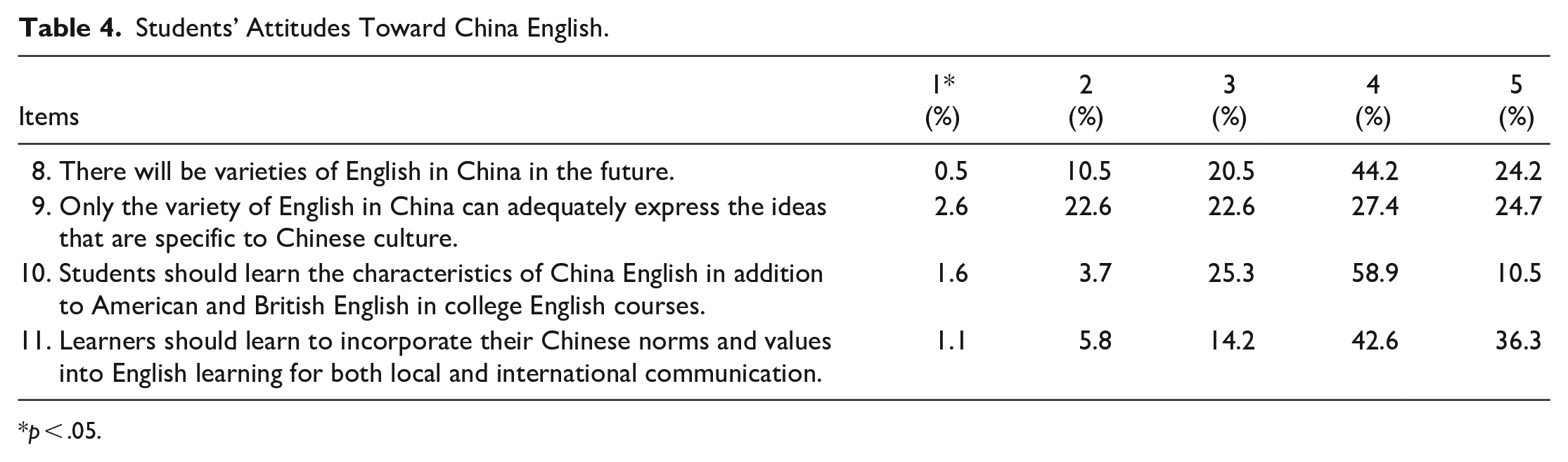
p < .05.
Students’ identity contribution (Questions 12–19)
Despite having positive attitudes toward China English and an awareness of the communicative role of English, only 36.8% of the respondents wanted to be clearly identified as Chinese when speaking English (Item 13), and 63.7% demonstrated a desire to speak native English (Item 14). It was found that 84.2% of the respondents expressed that they did not mind being identified as an NNES (Item 12). 68.5% expressed that college English should be taught by both English teachers from China and native-English-speaking teachers (NESTs), with a preference for NESTs (Items 15, 16, and 17). Interestingly, more than half (52.6%) of the respondents considered their mother tongue to be a resource rather than an interference (Item 18 and Item 19) (see Table 5). These results revealed the respondents’ contradictory attitudes: they seemed to acknowledge the communicative function of English and accepted China English as a variety of English, but they aspired to speak native English and had constructed identities as perpetual learners of English (Zheng, 2013).
Students’ Identity Contribution.
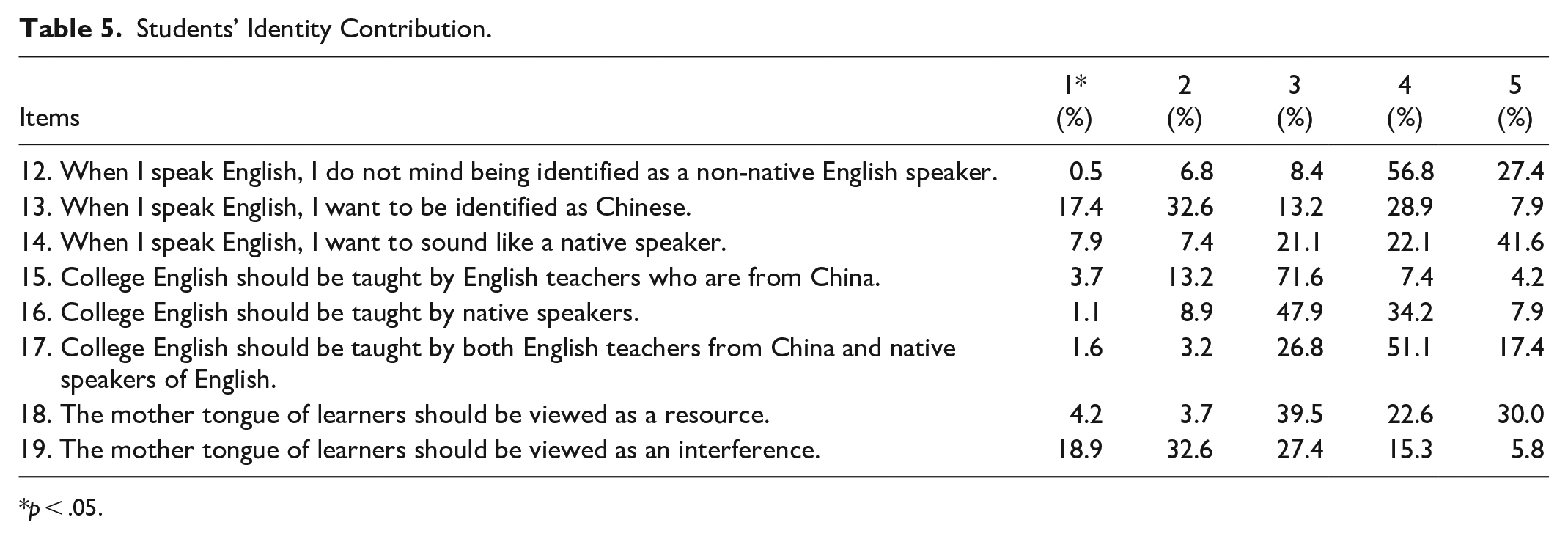
p < .05.
According to Kachru (1992), NNESs’ attitudes develop over three stages related to the development of English varieties: aspiration for NES norms, recognition of non-native features, and acceptance of non-native use of English. The current study’s results suggested that the respondents were in the second stage of development and were moving away from aligning themselves with native speakers’ English and moving toward distancing themselves from native speakers’ English. Thus, to test which norms (i.e., native standard English norms or flexible norms) the students adopted when speaking English, they were asked to evaluate the morphosyntactic features of a series of utterances as acceptable, intelligible, or correct.
Ten common features of China English were tested, including omission of an article or definite article (Item 1 and Item 10), omission of the third-person singular (Item 2), use of “isn’t it” as a universal question tag (Item 3), plural markers with non-count nouns (Item 4), aspects (Item 5 and Item 9), complementation after the preposition “to” and adjectives (Item 6 and Item 7), and use of “about” after a transitive verb (Item 8). The paired t-test results for acceptability and correctness yielded more significant differences than those for acceptability and intelligibility (see Table 6). The results showed that the respondents considered “deviated” language forms to be acceptable as long as they were intelligible.
Evaluation of English Expressions (adapted from Mollin, 2006).

p < .01, *p < .05.
Interview Findings
The interview findings are arranged according to the three main themes: Attitudes toward China English, Students’ identity construction, and Emerging norms of ELT. The themes were developed using the coding process in NVivo software (see Appendix B for all the codes and subthemes).
Attitudes toward China English
Among the 20 participants in the interviews, some (Participants 1, 2, 4, 11, 13, 14, and 15) expressed negative attitudes toward China English, while 13 had more positive attitudes. Among the participants who expressed negative attitudes toward China English, four (Participants 2, 11, 13, and 15) frequently mentioned that China English is not well-codified.
Extract 1: There is no standard in China English, which shows great variety among different speakers. If we just learn China English in school, when we go abroad, people will not understand our English. (Participant 2)
Participant 2 pointed out that there was no universal standard for China English and highlighted the problem of unintelligibility in China English. He took for granted that standard English is intelligible, and he presumed that the use of China English results in a communication breakdown.
Three participants (Participants 1, 2, and 4) held a deeply rooted belief in the superiority of native English in comparison to China English.
Extract 2: China English is just like a dialect of English. [. . .] We all need to learn standard English. It is just like we can speak a dialect, but we all need to learn Putonghua in school to achieve mutual understanding. (Participant 4)
Participant 4 did not realize that even the so-called “standard English” is a dialect when indicating that China English is a non-standard form of English. Comparing Putonghua and English indicates a hierarchy in norms. From this participant’s perspective, there should also be a standard form of English.
These participants’ negative attitudes toward China English seemed to be related to the function of English in China. Unlike other varieties of English, China English only functions as a performance variety.
Extract 3: China English is different from Indian English; Indian English was a post-colonial variety of English. [. . .] China English is not used by people in their daily lives (Participant 14).
Participant 14 viewed English as a communicative tool to interact with people with different L1s, which confirms the reality that “English is not inherently used intranationally among Chinese speakers of English on a daily basis” (Fang, 2017a, p. 79). She represented a group of participants who disclaimed that Chinese English speakers have ownership of their own English. According to this participant, China English has not developed legitimacy as a variety of English.
Thirteen participants (Participants 3, 5, 6, 7, 8, 9, 10, 12, 16, 17, 18, 19, and 20) mentioned linguistic rights, Chinese identity, and the rising power of China as factors supporting the legitimacy of China English as well as the practice of incorporating aspects of China English into university courses. For instance, “I think Chinese people should have their own China English to express its unique culture and norms” (Participant 3); “China has played an important role in the world. In order to let more people know more characteristics of China, we should strive to develop a Chinese variety of English” (Participant 19); and “As China is becoming more and more powerful in the world, China English will become an important variety of English in the future” (Participant 12).
These extracts showed that China’s socioeconomic development and increasingly powerful position in the world have played an important role in shaping these students’ attitudes toward China English. From their perspectives, the legitimacy of China English would develop as China’s symbolic power and economy continue to grow.
Students’ identity construction
The interview data allowed for a deeper investigation of the participants’ desired identities. Among the 20 participants, six expressed a desire to sound more like NESs. A recurring reason for this was the desire to communicate more effectively with others.
Extract 4: I hope to speak fluent English in order to communicate with others. But sometimes it is really hard for me because it is difficult to learn the accent and the tone of NESs. (Participant 1)
Here, Participant 1 expressed an identity as an unsuccessful English learner. This identity reveals the participant’s conformity to ENL norms. In a similar vein, five participants (Participants 1, 2, 4, 11, and 15) stated that being identified as a Chinese person speaking English was an indicator of limited English-language proficiency. The desire to sound like NESs could be explained by the participants’ wish to accommodate their interlocutors.
Extract 5: I want to sound like an NES when I speak English with foreigners because this can shorten the distance between the two communicators. In this time when speaking native English, you will gain more respect. (Participant 15)
Here, Participant 15 equates native-sounding English with intelligible English when stating his motivation to sound like an NES. He also imagines that sounding like an NES would enable him to gain respect from others in intercultural communication experiences. Thus, he related near-NES English to an identity as a perpetual English learner.
Five participants (Participants 3, 6, 7, 9, and 12) expressed a desire to be clearly identified as Chinese when speaking English. Chinese cultural identity emerged as one of the reasons to be identified as Chinese. The data revealed that some of the participants (Participants 3, 6, 7, 9, and 12) wished to express their identities through English with L1 features.
Extract 6: When I speak English, I want to sound like a Chinese speaker of English, since there is no reason to cover up my nationality when speaking English with foreigners. [. . .] Above all, I could not change my accent. (Participant 6)
Participant 6 regarded her use of English as a way to verify where she came from and to express her cultural identity as a Chinese speaker of English.
The use of China English was also considered to be a way to engage in shared practices, as expressed by Participant 5: “Sometimes I find the English spoken by my Chinese teacher easier to understand because of the mother tongue we share.” In her interview, the importance of using English with some local features reinforces a shared linguistic and cultural identity with other Chinese speakers of English. She represented the group of participants who would like to align themselves with other Chinese speakers and who have a local cultural identity when using English.
Emerging norms of ELT
The emerging norms adopted by the participants might explain the increasing positive attitudes toward China English. When the participants were asked about the reasons why they supported emerging norms in English language learning, the recurrent topics were “English as a communicative tool,” “global language,” and “tolerable mistakes.” The notion of intelligibility appeared to be the primary concern when communicating with international interlocutors.
Extract 7: I think English has changed into a global language. People from different countries use English to communicate with each other. So, I don’t mind if people can tell from my accent that English is not my first language, as long as we can understand each other. (Participant 10)
Participant 10 emphasized intelligibility in international communication over mastery of ENL. Furthermore, seven participants (Participants 5, 8, 10, 14, 16, 17, and 18) demonstrated tolerance for differences from ENL.
Extract 8: For me, English is just a communicative tool. NNESs could make some errors in English communication. I think these are tolerable errors, as long as they don’t cause any communication problems. Even NESs make errors when they speak English. (Participant 8)
Participant 8 used the term, “tolerable errors,” when addressing his attitude toward differences from ENL as long as the speaker was understandable. This quote indicates that certain participants acknowledged the use of English in global contexts, and they want to focus on “the interactional and transactional purposes of the talk and on their interlocutors as people rather than on the linguistic code itself” (Seidlhofer, 2011, p. 98).
Discussion and Implications
The questionnaire was designed to answer the first and second research questions by eliciting the participants’ attitudes toward China English and their own identity construction. The data showed that more than half of the participants had positive attitudes toward China English, and most of them could imagine a future variety of English spoken in China. The respondents were also in favor of learning about the characteristics of China English in addition to Anglophone English in college English courses. In previous studies by Kirkpatrick and Xu (2002) and He and Li (2009), few of the participants recognized China English; however, the findings from the current study indicate an increasing awareness and acceptance of China English among university students. The questionnaire data also show that the majority of the respondents are aware of the role that English plays in the Chinese context with a preference that English classes focus on efficient international communication.
Furthermore, most of the students believed that Chinese people should learn English to communicate with other NNESs, and their attitudes toward non-conformity to ENL norms appeared to be slightly positive. This finding is different from the results reported by He and Zhang (2010) in which the participants showed a clear preference for native-speaker grammatical norms, and the results reported by W. Wang (2015), where a high percentage of the participants rejected most of the China English expressions they understood as syntactical features. In contrast, the current study revealed that most of the students accepted the morphosyntactic features of China English as long as they could understand them. The discrepancy might be due to the fact that W. Wang’s (2015) study tested different syntactical features, namely, yes–no responses, subject pronoun copying, adjacent default tenses, modifying–modified sequencing, and top comment structure. Thus, non-conformity to English grammatical norms needs to be considered on a case-by-case basis, and it may not be easy to obtain a generalized conclusion. The findings in this study, however, are compatible with Y. Wang’s (2013) findings, where the participants were also positive toward non-conformity to ENL norms, “considering their needs and wants to communicate efficiently and project their Chinese cultural identity properly” (p. 276), although the participants would still believe the essence of native standard, a desire for fixed norms with a perception of social advantage of ENL (Y. Wang, 2013, 2020).
Notably, although the participants acknowledged the communicative function of English, most of them still considered native English to be the goal of English learning, perhaps because they believe that sounding like an NES would facilitate communication with people with different L1s. As shown in the questionnaire, in general, the respondents did not want to be identified as Chinese while speaking English, and most still aspired to sound like an NES. Some students seemed to believe that native English accents are more intelligible than non-native English accents, which, in fact, is not true in international settings (Jenkins, 2007). It seems contradictory that most of the students acknowledged the communicative function of English while still aspiring for near-NES English. However, this result might be due to the traditional native-oriented approach to English-language teaching in China and the lack of accent exposure. Most of the participants claimed that college English should be taught by both English teachers from China and NESs, with a preference for the latter. This result reveals that some of the respondents negatively aligned themselves with other Chinese speakers and expressed identities as perpetual English learners. For them, sounding like an NES was an indicator of a good learner identity. In contrast, some of the respondents positively aligned themselves with other Chinese speakers and expressed an L1-based cultural identity when using English.
Interviews were conducted to mainly answer the third research question. First, the data reveal three reasons why the participants had positive attitudes toward China English: linguistic rights, Chinese cultural identity, and the rising power of China. The data also reveal three reasons why the participants had negative attitudes toward China English: belief that ENL is the standard form of English, desire for fixed norms, and English as a performance variety (cf. Y. Wang, 2013, 2020). However, the insistence on standard English is not tenable in the sociolinguistic context in which NNESs have gradually gained ownership of English (Seidlhofer, 2011). As NNESs are major forces in shaping and changing the English language (Mauranen, 2012), native varieties of English do not create a high level of intelligibility to satisfy the needs of intercultural communication in more fluid and emergent contexts.
The interview findings also underscored the connection between language attitude and identity (Jenkins, 2007; Sung, 2016). More specifically, the interview responses showed that the participants’ conformity or non-conformity to ENL seemed to correlate with their desired identity construction and negotiation. Those that showed conformity to ENL wished to express their identities as perpetual language learners; those that expressed non-conformity to ENL tended to emphasize a shared Chinese cultural identity. The findings indicated that Chinese university students’ non-conformity to ENL could also be driven by practical considerations of intelligibility. Therefore, it cannot be assumed that “there is always a desire on the part of L2 speakers/learners of English to use their L2 accent in order to express their lingua-cultural identities” (Sung, 2016, p. 62).
In light of the relationship between attitude and identity in English language learning, it is important that English teachers be aware of the role of identity in their students’ learning process and provide them with options in terms of which kind(s) of English they aim to achieve. This study also raises issues related to English pedagogy. First, both teachers and students should increase their awareness of the global spread of English. They should overcome the tendency to judge learning outcomes based on native-oriented monolingual standards; rather, they should aim to “develop a repertoire of shared ways of speaking in order to achieve mutual understanding” (Sung, 2014b, p. 96). The stakeholders should regard students’ L1s or local versions of English as resources that facilitate learning (Fang, 2020; Fang & Ren, 2018; Galloway & Rose, 2015, 2018).
Second, policy-makers need to determine the prospects of the development of English varieties and advocate for the concept of multilingualism and multicultural self-identity against the backdrop of globalization. Traditional top-down policies should be revisited by adopting a bottom-up approach and listening to more stakeholders to determine their needs and goals for English language learning (Fang & Widodo, 2019; Rose & Galloway, 2019).
Third, assessment of English language proficiency should be re-evaluated to meet the current sociolinguistic realities of English. Of course, this is a difficult task considering that standardized international assessments are native-oriented and they generally fail to recognize the local features of English (Brown, 2014; Jenkins & Leung, 2019). In turn, many ELT practices are still primarily native-oriented, even though many local teachers are NNESs. Therefore, it is time for ELT to focus on local contexts and consider local ecosystems (Fang & Widodo, 2019; Sifakis, 2019) and that “ELT practitioners should not simply work to satisfy the wish to conform to ENL norms but critically consider such an aspiration” (Y. Wang, 2013, p. 278). This change will require the development of materials and textbooks that are designed to empower local teachers to supplement local varieties of English into traditional ELT. Consequently, students will learn to increase their “intercultural awareness and develop their agency in learning and using English” (Fang & Ren, 2018, p. 391). However, according to curriculum innovation theory, the decision to either adopt or reject innovation can be challenging and complex. Thus, teachers’ understanding of the relative advantage of modification and a new kind of teacher training are needed (Rose & Galloway, 2019).
Conclusion
Before drawing any conclusions, it is important to note that this study had some limitations. First, the data were collected at only one university located in northeastern China. Although the data were collected using both a questionnaire and interviews, the findings should be interpreted carefully, and they might only be applicable to similar contexts (Lincoln & Guba, 1985). Second, this research only presents students’ self-reported attitudes and levels of awareness without observing their actual English language use. A more detailed picture of the link between attitude and behavior will need to be further explored by observing classroom activities and the students’ daily communication in English.
In summary, this study contributes to the understanding of the complex relationship between attitude and identity in relation to local varieties of English. The data obtained in this study show that Chinese university students have increasingly positive attitudes toward China English as an emerging variety of English; the findings also demonstrate the complexity of the students’ identity construction and negotiation in relation to learning English (Bolton, 2003; Jenkins, 2007; Norton, 2013). The results suggest that some students are not conforming to ENL norms to project an L1 identity and achieve communicative efficacy. However, most of the participants still insisted on ENL as the goal of learning English. Therefore, it appears necessary to modify the pedagogy model used in ELT and challenge the exclusive focus on ENL to make English-language learning more consistent with the learners’ goals for global communication. This modification would also help align the curricula with real-life uses of English and promote the learners’ ownership of English. Future research could be conducted in similar contexts within China and abroad to draw a comparison and to obtain a more detailed understanding of the relationship between attitude and identity. Research that includes classroom observation can also provide more information on how people use English for both intra- and intercultural communication and how the language is currently being taught in various contexts.
Footnotes
Appendix A
Appendix B
Declaration of Conflicting Interests
The author(s) declared no potential conflicts of interest with respect to the research, authorship, and/or publication of this article.
Funding
The author(s) disclosed receipt of the following financial support for the research, authorship, and/or publication of this article: The research was funded by the Undergraduate Teaching Reform Project of Jilin University (2019XYB031), Social Science Fund of Jilin Province (2021C134), the Fund of the Construction and Practice of Academic Discourse Competence Framework in the Cultivation of International Talents (2019GJTD02), and the grant from The Humanities and Social Sciences of the Ministry of Education (18YJA740034).
