




Abstract
After four decades of anti-intrusion policies of the Islamic Republic of Iran (IRI) against the English language, the time has come to evaluate their success rates and to study the status of this language in Iran. This study has thus investigated the status of the English language in Iran on two levels: one concerning the state’s policies and another, the people’s attitudes. To do so, we carried out research on the content of education documents of the IRI and the English language teaching textbooks employed in the education system. To locate the society’s stance on the English language, we administered a survey study on 472 participants randomly sampled from undergraduate students from four state universities. We concluded that there is an evident gap between the approach of the Islamic government and the people’s approach toward English language in the current Iranian society.
Introduction
Since the arrival of European missionaries in 1841 in Persia, teaching of foreign languages has always been on the frontline of arguments between the Iranian Muslim society and the Christian West. French, German, and English were among the major foreign languages that found their way into Persia. However, the English language has survived until today despite being perceived as the “language of enemies” (Borjian, 2013) by the Ayatollahs for the past four decades. It has also been seen as a “tool for progress” (Riazi, 2005) for a period 1950-1979.
The following article thus aims to analyze the lasting battle between the Iranian Islamic community and the penetration of Western culture in the form of English language teaching (ELT). In sum, this article tries to answer the primary question (What is the status of ELT in Iran?) and the following secondary research questions:
In response to these questions, we will present our findings on how the Islamic regime of Iran has approached the English language teaching in its education policies and the textbooks employed. Then in answer to the third question, we will point out the results of a survey administered on 472 students from four different universities in Iran. By referring to these findings, we try to conclude whether the Iranian regime’s approach toward the English language matches with the attitudes of the students toward the English language.
Findings of this study will help educational policy makers, especially those in more traditional and/or more religious countries, to decide whether it is possible to seal off their cultural, religious, and/or traditional values against penetration and spreading of the English language and/or Western culture. Our findings will also help the Islamic Republic of Iran (IRI)’s authorities to determine whether their educational policies have been successful in meeting their anti-Western-intrusion goals.
Literature Review
Since the establishment of Anglo-Persian Oil Company (1908), English has been restraining its other opponents, including French, Russian, and German from expansion into the Iranian society. The following section explores the journey of ELT in Iran.
The English Language in Iran: 1901 to Present
The English language was mostly prominent in Iran during the reign of Pahlavi prior to the arrival of the Islamic regime. In the early 1900s, the British socialite, William Knox D’Archy, could win assent of the Persian king on oil concession in Persia. Since then, the English language, despite oppositions made by extremist clergies, has been entrusted a new role of opening doors to modernity in Iran.
After the establishment of the first Iranian modern educational institution, Dar-al-Fonoon, in 1851, the main objective of the foreign language instruction was communication and understanding of French, which was the medium of instruction (Sadiq, 1965). The administration in Dar-al-Fonoon was based on Western teaching methods, especially on French system of education, and most of the teachers were native French speakers.
After the excavation of oil by the British engineers and the expansion of dependency of the Iranian economy on its oil revenue, English served as the substituting foreign language. However, after the Anglo-Soviet invasion of Iran in 1941 and ensuing attempts to nationalize the Oil Industry by the Iranian Prime Minister of the time leading to the nationalization of the oil industry, the United States was able to achieve a greater presence in Iran. The American Dream, as well as the expanding presence of the United States into the rest of the world, especially in the Middle East, enticed the Iranian state to develop its economic, political, military, and educational relationships with the United States. Many Iranian students, teachers, and professors went to study in the United States to advance their professional, technical, and communication skills (Khajavi & Abbasian, 2011).
As Strain and New York State English Council (1971) reports, one of the focal objectives of the Iranian education system was bilingualism. English was instructed as a foreign language during the last 6 years of the Iranian K-12 programs between 1934 and 1970 and was increased to 7 years afterward (Bagheri, 1994). In 1950, the Iran-American Society, first official language institution teaching English in Iran, was established. American English teachers were sent to various parts of the country to host training workshops for native Iranian teaches, and study-abroad programs, such as Fulbright activities (1950-1959), were actively encouraged as part of the attempt by the United States to increase its involvement in teaching English as a foreign language in the Iranian schools (Khatami, 1977; Strain & New York State English Council, 1971). Moreover, English was the key requirement for entering the military. In the process of military modernization, most of the high-ranking officers were sent to the United States to study military sciences. Hence, they had to pass some courses in English as a prerequisite (Tollefson, 1991). Motivation of the Iranian students in learning English was relatively high as well; Strain and New York State English Council (1971) writes that more than 90% of the Iranian school students elected English as a foreign language.
All these factors led to a situation of modernization becoming amalgamated with the Iranian culture. “If Iran before Islam had a mainly Persian identity and Iran after Islam had an Islamic-Iranian identity, Iran after the exposure to the West found a triple identity, that of Islamic-Iranian-Western” (Riazi, 2005, p. 102). However, this mixture was not well welcomed among the religious majority of the Iranian society who feared endangerment of the society’s Islamic identity. In 1979, the society led by an Islamic fundamentalist, Ayatollah Khomeini, rebelled against the secularization and Westernization with the principal momentum of diluting Western norms and espousing the Islamic values, which he felt were being marginalized during the modernization era in Iran.
After the victory of Islamic Revolution in Iran in 1979, ELT has rapidly begun to disappear. All ELT institutions were shut down, and native-speaking English teachers and university professors were expelled. Moreover, the ELT materials were placed under rigid censorship and were purged of any Western norms and messages. In addition, the Islamic regime entrusted locally trained nonnative English language teachers to develop indigenized textbooks empty of any elements advertising English or Western culture. In sum, the Iranian education system went through an Islamization process that could be described as a “process of de-modernization” (Paivandi, 2012). Consequently, teachers opposing the ideology of Islam and Islamization of the educational system were expelled from the system. Certain restrictions were applied to both schools and their students; co-education, which was normal prior to the Revolution, was substituted with single-sex schools. In addition to those changes, a series of religious activities were added to the education system.
Those speedy reforms, however, were not completely applauded by the Iranian society. Despite the hostility of the Islamic regime toward English (Dahmardeh & Hunt, 2012), the society began to answer its needs by opening an increasing number of privately run ELT centers. Debates on minimizing the dependency of the Iranian economy on oil industry and promotion of alternative industries such as tourism grew stronger. The Iranian traders and industry owners, as well as workers and business owners, especially in tourist destinations such as Tehran, Kerman, and Tabriz, realized that their future was contingent on improving their communicative skills in English (Khajavi & Abbasian, 2011). English could also find its way through the heart of the Islamic regime. The Iranian government established Press TV and some other TV channels as well as several written media in English (Khajavi & Abbasian, 2011) to broadcast its ideological views and news.
Method
It is impossible to achieve a thorough understanding of the status of a foreign language in a society by merely referring to educational documents, especially in a context of Iran. In fact, because of swift changes in the governance and social structure of Iran after the 1979 Revolution, a gap between needs of the society and the policies applied to the education system by the government is inevitable. Therefore, this study has employed a mixed-method approach to compare the state attitudes toward the English language versus the Iranians’ approach.
Any government’s stance toward a subject usually mirrors itself overtly in education policy documents or in the words of officials (e.g., their public announcements and speeches). However, a portion of the actual policies of a state might be covert in the form of a hidden curriculum. Analysis of the textbooks’ content used by the state may reveal its hidden curriculum. This study thus has analyzed the content of the IRI’s education policy documents (Fundamental Reform Document in Education [FRDE] and National Curriculum of Islamic Republic of Iran [NCIRI]) along with the discourse of the officials mentioned in these documents (i.e., Ayatollah Khamenei) and the ELT textbooks used in Iranian schools.
To find whether the regime’s approach toward the English language has been reflected in the Iranian society, or at least among the graduates of the education system, this study surveyed 472 participants (see Table 1). The participants were randomly sampled from undergraduate students (IRI’s K-12 graduates) studying at state universities.
Participants in the Survey.

The employed questionnaire was done in two batteries. Battery A covered items seeking for participants’ background information in terms of their gender, socioeconomic status, and extra-curricular English language learning activities. Battery B included 32 five-point Likert-type scale items evaluating participants’ attitudes toward English in general, its learning, and its role in the Iranian society. The reliability of the questionnaire was analyzed and proved by calculating Cronbach’s alpha index (α = .78).
Findings
How Does the Islamic Regime in Iran Address ELT?
There are two main education policy documents guiding the Iranian education system. In the following section, we present our findings in relation to their content analysis.
Frde
In 2006, the Iranian Supreme Leader, Ayatollah Ali Khamenei, criticized the education system and policies practiced since the 1979 revolution in Iran and asked for reforms: We [Islamic regime] are in need of evolution and reorientation of education. The current education system in our country is not based on our way of thinking, our plans and our philosophy; the foundation of the current education has not been based on the philosophy we are currently pursuing. (Cited in Ministry of Education of the Islamic Republic of Iran, 2011).
Khamenei then instructed the state to incorporate Islamic values as the main goals of the education system: The most outstanding thinkers should spend time and energy to plan for education. The philosophy of Islamic education should be clear and the future horizon of our country’s education system has to be clearly based on this philosophy. We should be aware of what we are pursuing and where we are heading. Education has to be planned in accordance with clear guidelines and defined orientations. This is what we need. Education has to get rid of daily routines. This is the basis of our words. (Cited in Ministry of Education of the Islamic Republic of Iran, 2011).
His orders led to the formation of a “fundamental reform” in the educational system in Iran. The new system aims at producing the “perfect humankind” being devoted to Islamic lifestyle: We [Iranian society] are in need of an education system capable of materializing Hayate Tayyebah (the ideal Islamic life), universal justice and Islamic-Iranian civilization. In light of such a sublime human capital, humanity shall be prepared for realization of a global reign for perfect humankind, and under such governance, the talents and potentials of the humankind shall boom toward perfection.
Therefore, the main objective of FRDE was materialization of Hayate Tayyebah (an idealistic Islamic life). To learn how it would achieve its goal, we analyzed all sections of FRDE dealing with language and foreign language instruction. It was found that language is considered as one of the key elements that form the national identity. However, foreign languages (i.e., the English language) and their education are often perceived as threats to the Islamic and national identity of Iranians: . . . Irritating the national language, taking away the national Islamic identity, and modeling instead of making a [native] model are not [means] of advancement. The way out is introducing a native solution. We should sow our own seeds and take care of them to grow. Do not try to copy others [foreigners], do not try to speak foreign languages, and do not borrow their overused experiences. (Ministry of Education of the Islamic Republic of Iran, 2011, p. 259)
Khamenei instructed the government to construct an Iranian Islamic model of education; meanwhile, he warned against learning foreign languages (e.g., the English language). His approach clearly reflects the core attitudes of the IRI toward teaching English. To obey his orders, Ministry of Education of the Islamic Republic of Iran (2011) introduced Strategy 1-5 dealing with teaching foreign languages. That strategy was a “provision of foreign language education within the optional (Core-elective) section of the curriculum framework by observing the principle of stabilization and enforcement of the Islamic-Iranian identity” (p. 32). In other words, teaching English was meant to strengthen “Islamic-Iranian identity” of the students.
Nciri
The NCIRI is a Supplementary document to FRDE prepared and written by the Supreme Council of Education and the Iranian Ministry of Education in 2012. In its epigraph, the Minister of Education of the time (Hamid Reza Babaei) writes, The highly important responsibility of the “National Curriculum” is preparing and providing useful equipment in order to design, compile, perform and assess educational syllabi in nationwide to location-specific level. Those syllabi should be based on the Islamic training philosophy and systemized educational and pedagogic concepts in order to provide children and young adults with a fun and charming school atmosphere. (Ministry of Education of the Islamic Republic of Iran, 2013, p. 4)
His words highlight the core role of the “Islamic training philosophy” in the formation and construction of NCIRI. Although he does not provide any definition for “Islamic training philosophy,” by noting the subject matters introduced by NCIRI, it is possible to predict which areas are more expected to be influenced.
NCIRI (Ministry of Education of the Islamic Republic of Iran, 2013) lists 11 areas as the main subject matters of the Iranian education system. These areas are 1: Islamic philosophy and thoughts, 2: Quran and Arabic language, 3: Farsi Language and Literature, 4: Culture and Art, 5: Health and Physical Training, 6: Vocation and Technology, 7: Human Sciences and Social Studies, 8: Mathematics, 9: Experimental Sciences, 10: Foreign Languages, and 11: Life Skills and Family. It is hard to expect Islamic pedagogy to influence science, but those subject matters dealing with culture, languages, and arts may accept Islamic modifications.
Subject Matter 10, Foreign Languages, is one of those topics that may accept Islamic philosophy modifications directly and/or indirectly. Two pages of 69-page NCIRI deal with teaching foreign languages. The descriptions are general and include vague statements that hardly give any detailed statements regarding how to deal with foreign languages education. NCIRI defines the role of the foreign language education as providing “suitable basis for understanding, reception, cultural exchange and transfer of human knowledge . . . for different purposes and different addressees within the frame of Islamic values” (Ministry of Education of the Islamic Republic of Iran, 2013, p. 37).
NCIRI also sees importance of foreign languages education in paving social interactions under human societies’ collaboration and the growth of technology. It states that to do purposeful and fruitful relationships, it is important that students learn another language “to be able to contact other societies and to get familiar with findings and achievements of other societies in the region and in the world” (Ministry of Education of the Islamic Republic of Iran, 2013, p. 37). The other aim for foreign languages instruction is developing interpersonal and intercultural communication for purposes such as tourism, trade, and sociopolitical consciousness. However, the main purposes of foreign languages teaching are “cultural exchange” and “transfer of human knowledge” but within the framework of Islamic values.
NCIRI instructs the onset of foreign languages education from the beginning of the first middle school cycle with the main objective of teaching the four linguistic skills and familiarizing students with “communicative skills.” However, the goal setting for the outcome of the instruction is that “in the second cycle of middle school (years 9-12), students will be able to read intermediate level texts and comprehend them” (Ministry of Education of the Islamic Republic of Iran, 2013, p. 38). Students’ writing skills are limited to having the ability to write short passages. In other words, the communicative skills meant by NCIRI are in fact pen and paper skills rather than performing live communication with speakers of foreign languages.
The foreign languages offered are English, French, and German. However, due to limitations in teaching and other resources, English is the main foreign language in Iran. The course content and learning outcomes are vaguely discussed. Nothing can express this issue better than the exact sentences of the NCIRI: Foreign languages education should pass the limited circle of teaching theories, approaches and methods, and should act as a foundation for enhancing national culture and values as well as personal values. The approach of foreign languages instruction is an approach based on active communication and self-esteem. During the primary stages of [FL] instruction, the educational content will be about local issues and the learners’ [immediate] needs such as health, everyday life, their surrounding environment, cultural values, and norms of the society in a way interesting for the students. In higher levels, the course content will be chosen in relation to cultural, scientific, economic, political, and likewise subjects matched with the course content and textbooks of other subject matters, in order to deepen students’ comprehension. By the end of the second Middle School, students should have the ability to read and understand simple technical texts and to write articles. During the second Middle School cycle, enhancing repertoire of technical vocabulary [of students] will lead to [their] better comprehension of texts and their ability of academic communication. (Ministry of Education of the Islamic Republic of Iran, 2013, p. 38)
ELT in Iranian K12 ELT Textbooks
After the victory of the IRI, the regime expelled almost all native-speaking English teachers and applied strict censorships to all ELT materials and textbooks. Meantime, the teaching of English was postponed from ages 12 to 13. Islamization policies were not limited to these; content of ELT materials and textbooks was also revised to minimize any possibility of reflecting English cultural traits. In fact, the current textbooks (i.e., Birjandi, Maftoon, Nikpoor, & Khadir, 2015; Birjandi Soheili, Nourozi, & Mahmoodi, 2014a, 2014b, 2014c; Khadir Sharabian et al., 2013a; Khadir Sharabian et al., 2013b) reflect Islamic and Iranian cultural traits but in English letters. Some snapshots from the high school English textbooks (English book 1, 2, and 3) picture the situation quite well (see Figure 1).
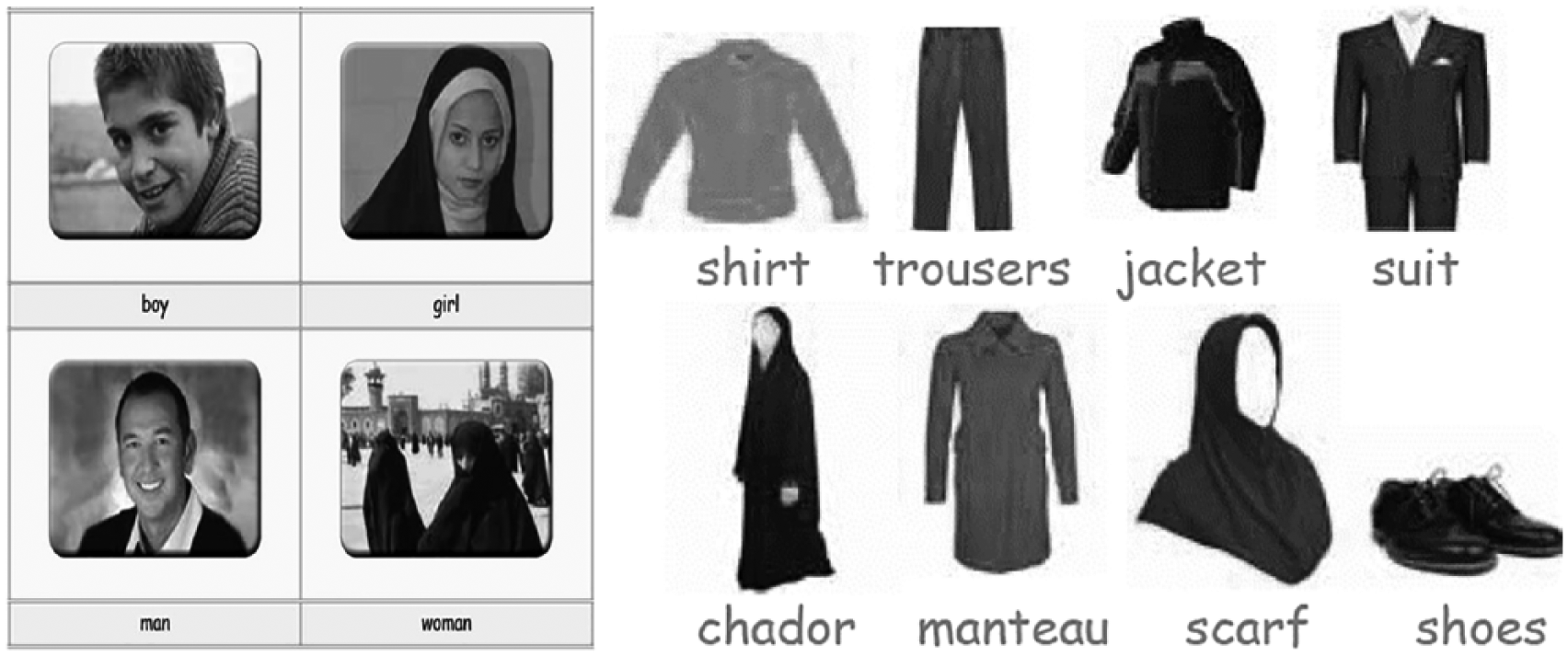
Snapshots from Iran’s high school English textbooks (English book 1).
As pictures show, the IRI material developers have minimized any references to Western culture as much as possible. Some of the words presented in textbooks are not English at all. For example, manteau (a type of women’s outlets pronounced as /manto/) is listed in the “new words” section in English Language I (2014a), but could not be found in English dictionaries. In fact, manteau is a French word that means “a sleeveless cloak.” However, the dress used by women in Iran with this concept is a long loose outer garment usually fastened with six to eight buttons in front.
The IRI material developers also try to indoctrinate Iranian students with Islamic thoughts. None of the images used in the Iranian ELT textbooks include relationship between the opposite sexes other than the ones allowed according to Sharia (e.g., father–daughter or father–mother). There is not even one single image used in any of the English language textbooks showing an ordinary intergender relationship in the West such as an opposite sex teacher–student context (e.g., see Figure 2).
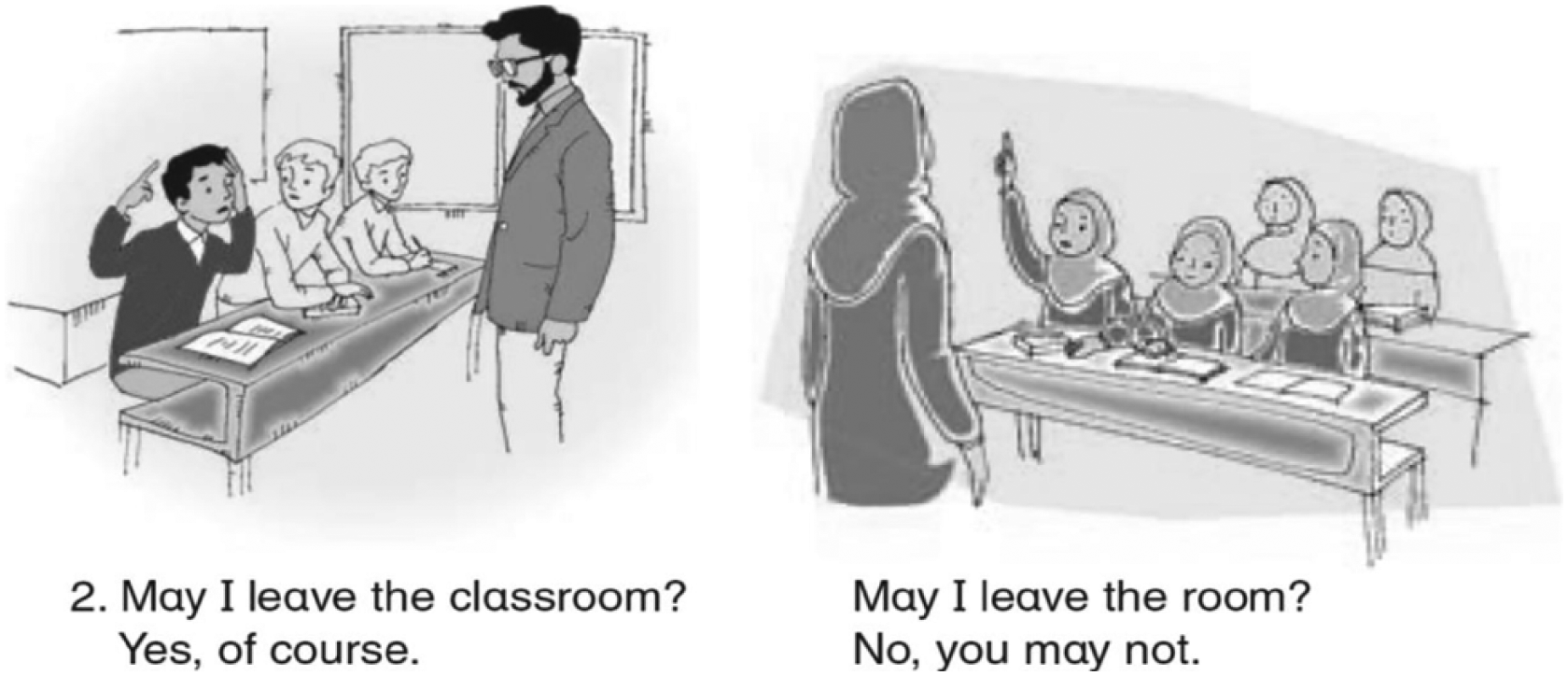
Single sex student–teacher relationship (Snapshot from Prospect 2).
In addition, textbook images depict roles prescribed by the traditional Islamic society of Iran (e.g., see Figure 3). For example, because Sharia prescribes the breadwinning role for men, it does not welcome women working outside of homes for income purposes. Therefore, as exemplified in Figure 4, the Iranian ELT textbooks try to imply that women should not work, and if they do, they are ought to have some specific careers (e.g., as a teacher or a nurse).

Traditional gender-specific roles (snapshot from Prospect 2).

Jobs and careers with respect to Sharia (Snapshots from English Book 1).
In addition, the textbooks emphasize more on teaching grammar, vocabulary items, and reading comprehension. Their teaching methodology is a limited version of grammar translation method and some insights from audio-lingualism. In other words, the Iranian ELT is missing the objective of improving students’ productive skills and/or familiarizing them with the cultural competency required for communicative purposes. In fact, the English language is not considered as a means of communication, but rather its usage is foregrounded (e.g., see Figure 5).

Productive skills tasks (Snapshots from English Book 3).
As portrayed in Figure 5, even productive tasks are not designed to enrich students’ productive skills for communicative purposes. “Speak Out” tasks, employed in English book 1, 2, and 3 (Birjandi et al., 2014a, 2014b, 2014c), are in fact parroting rote tasks asking learners to mechanically repeat some specific sentences. “Write It Down” tasks also present drills that are in fact mechanical grammar tasks rather than productive items enabling Iranian students to express themselves in writing.
The English Language in the Eyes of the Iranian Society
A mere reference to official government documents does not suffice to determine the approach of a society toward a language and thus, this study has tried to survey the attitudes of the graduates of the Iranian K-12 toward the English language. In the meantime, the functionality of the English language for different purposes in the eyes of the sampled students has been studied. In the following section, our findings in this regard are presented.
In general, participants in this study showed positive attitudes toward the English language. In response to items asking whether participants “like” or “hate” English, the majority exhibited positive feelings about the English language, and only a small fraction of them reflected negative attitudes (see Table 2). Despite the disapproving feelings of some participants against the English language, it needs to be highlighted that none of them have ignored the necessity of learning it. However, few participants (roughly 4.4%) have considered no benefits in learning the English language in their lives.
Attitude Toward English Language.

In line with the importance earmarked by the participants regarding the learning of English language, it is evident that the participants pointed out the importance of English competency in fulfilling their instrumental demands (as shown in Table 3). More than 90% of the sampled Iranian students believe that knowledge of English is advantageous for them. The results among male and female students were consistent; however, female participants have shown slightly greater positive attitudes toward the functionality of the English language in meeting new people, finding jobs both in Iran and in other countries, as well as pursuing further education.
Functionality of English Language in Fulfilling Instrumental Demands.

Education plays an important role in gaining social prestige and in improvement of an individual’s position in a society; English language education is not an exception. To find whether English language knowledge is functional in locating individuals’ position in the Iranian society, we questioned the prestige associated with English language knowledge and the support English language learners may receive from their immediate society (friends and families).
More than half of our participants see knowledge of English as a mark of prestige and literacy in their society (see Table 4). This notion is more evident among male participants; however, female participants pointed at a greater support they receive from their friends and families with learning English. Female participants do also receive more financial support from their families to learn English language.
Status of English language in the Iranian society.

As already highlighted, the Iranian regime has tried to minimize the intrusion of the English language in the society. However, the society may not always assent with the policies practiced by their governors. To find whether the Iranian students agree with anti-English approach of their Islamic government, our participants were questioned whether they advise the teaching of English language to others. They were also questioned if English language should be included in the curricula of high schools and universities (see Table 5).
How the English Language Should be Addressed.
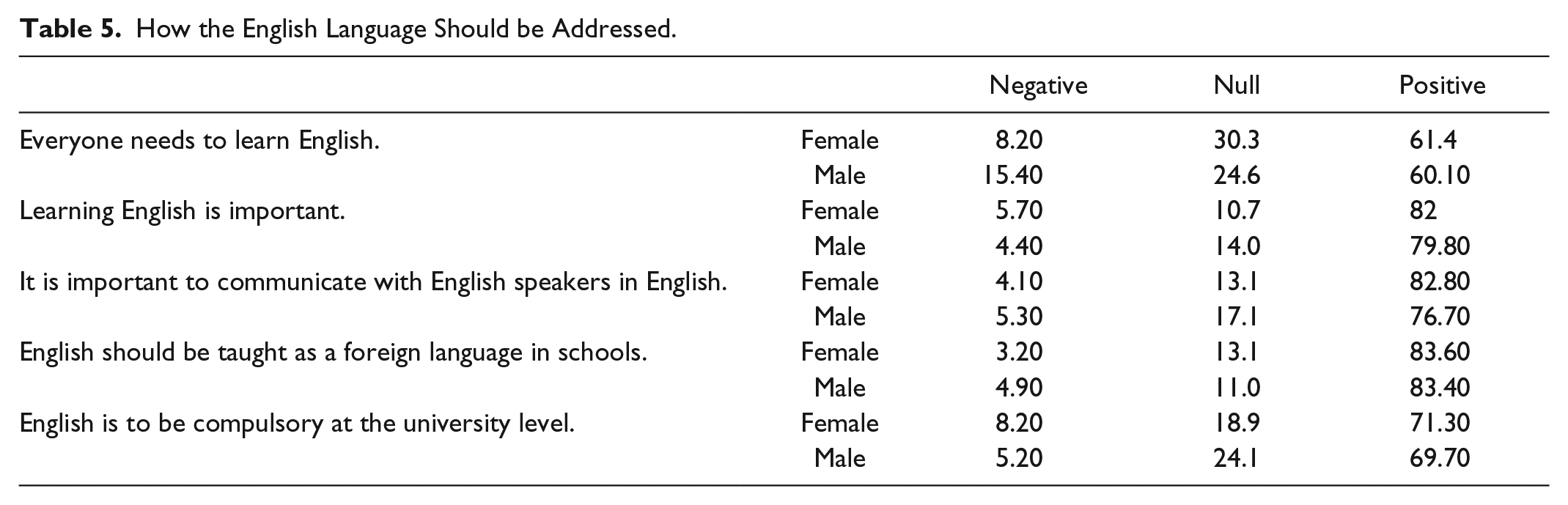
Majority of participants (more than 60%) advise everyone to learn English. This issue has been more prominent among female students; the number of male participants with negative attitudes toward widespread teaching of English language in Iran was almost double in comparison with the female students. Similar findings have also been achieved when female participants were questioned whether learning English is important to communicate with English speakers.
Should English language be included in the curricula of Iranian schools and universities? The answer is positive. Majority of participants (roughly 83%) believed that English as a foreign language needs to be tutored in the Iranian schools. Almost similar number of students advise offering English language as a compulsory subject in the Iranian universities. However, in comparison females have shown greater negation in compulsion to teach English in their universities.
Discussion and Conclusion
This study has attempted to investigate the standing of ELT in Iran on two levels: the state policies and the micro-level of the society’s attitudes toward the language. The findings highlighted a gap between the Islamic regime’s approach toward ELT and the sentiments of Iran’s younger generation.
The Islamic regime of Iran see the English language as a threat to its Islamic identity. The Iranian Supreme Leader, Ayatollah Ali Khamenei, criticized the before-Islamic-Revolution education system and ordered for a revolution in education of Iran. Thus, the regime has employed an education system based on their “way of thinking . . . and philosophy” that aims at producing a “perfect humankind” who believes in “Hayate Tayyebah, universal justice and Islamic-Iranian civilization.” Based on this objective, the regime screened the teacher training programs, dismissed all native speakers of English from the system, and employed English language teaching materials censored from any hints to the English language culture.
The English language teaching textbooks in the Iranian K-12, rather than teaching the authentic English language as used in the English speaking countries, are perhaps a translation of the Islamic-Iranian culture into English words. They never point at any kind of opposite sex relationships else than the ones permitted by the Sharia (i.e., father-daughter relationships). They do also imply specific roles for the females in the Iranian families (i.e., as housewives that shall look after preparing meals) and specific jobs as nurses and teachers. They do not aim at enlarging the cultural repertoire of the Iranian students in the English language and limit productive skills by employing parroting tasks and grammar translation approach toward teaching the English language.
In contrast with the attitude and approach of the regime toward the English language, the Iranian society, or at least the younger generation, show positive attitudes. They do see the English language as a functional language that can assist them in meeting their instrumental needs (i.e., finding jobs or furthering education) and in gaining a better social status and enhanced prestige.
The anti-intrusion policies of the IRI might have roots in their assumption that the West is plotting to overthrow the regime (Beeman, 2008) or the belief that “discourses of Christianity are strongly embedded in the field of TESOL” (Mahboob, 2009, p. 176). However, we can conclude that regardless of the government’s views, the English language has smoothly found its way to the heart of Iranians. The Iran’s younger generation is aware of the importance of English competency in the modern age and in fulfilling their instrumental needs. This awareness also reveals itself in the society. The knowledge of the English language constitutes an important element in locating social status, and Iranian families financially support their children’s decisions in improving their competency in English.
It needs to be pointed out that the Islamic regime of Iran has been partially successful in limiting the penetration and influence of the English language culture. In response to the item questioning the participants whether “native English speakers are friendly and kind,” 60.50% of them neither agreed nor disagreed. We assume that limiting the access of students to the English language authentic materials and echoing an artificial image of the English language in the textbooks employed in the Iranian education system are the main responsible elements for this finding. The political stance of the regime, its limited investment in tourism, and few contacts of the society with the West may have been also influential. We suggest interested researchers to address this notion.
Supplemental Material
Questionnaire – Supplemental material for English Language Education Throughout Islamic Republic Reign in Iran: Government Policies and People’s Attitudes
Supplemental material, Questionnaire for English Language Education Throughout Islamic Republic Reign in Iran: Government Policies and People’s Attitudes by Aman Rassouli and Necdet Osam in SAGE Open
Footnotes
Declaration of Conflicting Interests
The author(s) declared no potential conflicts of interest with respect to the research, authorship, and/or publication of this article.
Funding
The author(s) received no financial support for the research, authorship, and/or publication of this article.
Supplemental Material
Supplemental material for this article is available online.

Author Biographies
References
Supplementary Material
Please find the following supplemental material available below.
For Open Access articles published under a Creative Commons License, all supplemental material carries the same license as the article it is associated with.
For non-Open Access articles published, all supplemental material carries a non-exclusive license, and permission requests for re-use of supplemental material or any part of supplemental material shall be sent directly to the copyright owner as specified in the copyright notice associated with the article.
