




Abstract
Contracts are essential for managing the relationship among public–private partnership (PPP) partners. However, the impact of contracts on the trust between partners is unclear, especially in PPP projects. From the multifunctional perspective of contracts, this study aims to investigate how different dimensions of contractual functions affect distinct types of trust and the moderating role of information transparency between them. The empirical results of the data collected from Chinese PPP professionals show that the three dimensions of contractual functions have positive effects on trust, including goodwill trust and competence trust. However, contractual adaptation has the strongest impact. Moreover, information transparency positively moderates the relationship between contractual control, adaptation, and trust. This study provides new insights on contracts and trust in PPP projects. It can guide PPP project partners to value the process of contract design and information disclosure to cultivate specific types of trust.
Keywords
Introduction
Public–private partnership (PPP), which has been extensively applied over the last decade in China, refers to a long-term cooperative relationship between public and private sectors (Cui et al., 2018; H. Wang et al., 2017; S. Zhang et al., 2015). The advantage of PPP lies in mitigating financial pressure, facilitating innovation, and enhancing the quality of public services, thereby improving efficiency and production (Hwang & Zhao, 2013). However, to take advantage of the potential benefits of PPP, trust between partners is critical because it helps to increase the willingness related to the consequent need for cooperation (Warsen et al., 2018). In addition, many studies highlight the importance of trust in solidifying the relationship between the partners to achieve successful PPP projects (Schomaker & Bauer, 2020; Smyth & Edkins, 2007). However, despite the various positive impacts of trust in effectively implementing and delivering PPP projects, researchers pointed out the difficulties in trust-building during the PPP project life cycle, especially in the early stages (Rufin & Riverasantos, 2012; Warsen et al., 2019; Xiong et al., 2019). PPP project partnerships are relatively unfamiliar with each other. Coupled with the highly complex project environment (Cruz & Marques, 2013) and the unfavorable interest between partners (Marques, 2018), it is difficult to develop. Hence, trust-building is vital and extremely challenging in the early stages of PPP projects.
Managing PPP projects inevitably relies on contracts to establish formal business relationships between partners (Mwesigwa et al., 2020). Under such context, an obvious question is whether relational trust between PPP partners is facilitated or hindered by the contract structure. The potential effects of contracts on interorganizational relationship management have been recognized. However, the empirical findings are mixed, and the impact of contracts on the trust between partners is unclear. Previous studies suggested that contracts might be a sign of negative intent (Herold, 2010; Lumineau, 2014), which can result in hostility and undermines relationship development. For example, a study by Zaghloul and Hartman (2003) pointed out that a contract is the cost of mistrust. In contrast, some researchers who examined the effects of contracts maintain that this construct is a critical determinant in motivating active cooperation among project members in construction projects (Lee et al., 2018; Mwesigwa et al., 2020). Jiang et al. (2016) proposed that a complete contract helps to improve the relational element to achieve successful project outcomes. Xu et al. (2018) concluded that contractual risk allocation significantly influences the trust relationship between owners and contractors. The scholars argued that detailed contracts benefit effective communication and conflict resolution (You et al., 2019).
These studies are inadequate as they do not consider contextual factors, especially the external environment. PPP projects have long contract duration, large investment scale, numerous stakeholders, and complex construction environment (Cruz & Marques, 2013). Moreover, it is not easy to separate contract governance from external environmental factors (M. Cheng et al., 2020). Information transparency, which refers to the degree of information sharing and disclosure, is the information environment in which PPP partners are based (Schnackenberg & Tomlinson, 2016). Information transparency is an influential institutional force that bears the perception of information quality (Schnackenberg & Tomlinson, 2016), potentially influencing the effectiveness of contracts (Shou et al., 2016). For example, the construction environment with poor information sharing can easily cause information asymmetry. In this situation, the effectiveness of the contract in enhancing trust might be weaker because contract terms drafted based on asymmetric information can be destructive (Shou et al., 2016). Therefore, this suggests that information transparency might be necessary for investigating the boundary conditions of the relationship between contractual functions and trust. However, although people continue to recognize the importance of information transparency (Ismail et al., 2019; Neto et al., 2020; O’Shea et al., 2020), there is lack of quantitative literature on the impact of information transparency in long-term projects and complex project environments.
Another potential reason for the aforementioned inconsistent conclusions is that contracts only be viewed as an aggregate construct. The latest research argued that contract terms have multiple functions: contractual control, coordination, and adaptation (W. Wang et al., 2018). This classification provides a holistic perspective for understanding interorganizational contracts (W. Wang et al., 2018) and is supported by some researches (Gao et al., 2018; Wang, Lu, & Fang, 2019; You et al., 2019). However, this perspective is still scarce in the existing literature. By following the aforementioned research, contract terms with different functions that possess various legalistic natures (Lumineau, 2014) may potentially have complex connections with different types of trust. However, few studies explored the mystery between contractual functions and trust; some studies called for investigating the multidimensional concept of contracts and explored their interactions with trust (Wang Fufang, 2019; S. B. Zhang et al., 2020).
Therefore, to fill the aforementioned research gap, based on social exchange theory (SET; Blau, 1964, 2017), contract theory (Lumineau & Henderson, 2012; W. Wang et al., 2018), and information asymmetry theory (Arrow, 1978), this research classifies contractual functions into contractual control, coordination, and adaptation, and categorizes trust into goodwill trust and competence trust in the context of PPP projects. This study has two objectives:
How do the three types of contractual functions affect goodwill and competence trust, and to what extent?
What is the role of information transparency in shaping the aforementioned effects?
The structure of this article is as follows. The theoretical background of contractual functions in PPP projects, interorganizational trust, and information transparency was reviewed. In the next section, we proposed the research hypotheses that concern the link between contractual functions and trust along with the moderating roles of information transparency. Furthermore, we highlighted the methods and measures of this study. We then discussed the critical implications of the findings and pointed out the limitations and future research work.
Literature Review
SET
SET is a sociological theory and an important theoretical perspective for studying the relationship between organizations (Khalid & Ali, 2017). Blau (1964, p. 91) defines social exchange as “voluntary actions of individuals that are motivated by the returns they are expected to bring and typically do in fact bring from others.” Social exchange relationship based on SET is also applicable to PPP project governance. This is because the cooperation between PPP partners has some typical characteristics of social exchange relationships: Partners are highly dependent, emphasizing norms and rules (Blau, 2017). Obviously, the interaction between PPP partners can be regarded as a management activity with typical social interaction characteristics. SET has also widely contributed to theory building on the antecedents of trust (Khalid & Ali, 2017). According to SET, trust emerges through social interactions between exchange partners (Blau, 1964). The proponents of SET argue that trust is likely to be shaped in an interorganizational setting through verbal cues regarding contracts, counterparts, and effort (Bottom et al., 2006; Trivers, 1971). By triggering the operation of the psychological system of reasoning that regulates social exchange, it provides the basis for trust-building (Bottom et al., 2006; Mayer & Argyres, 2004). This theory enhances our understanding of the impact of contractual function on interorganizational partnerships.
Information Asymmetry Theory
At the same time, to study the moderating effect of contractual function and trust, we applied information asymmetry theory. Information asymmetry theory was first proposed by Arrow (1978). It refers to the asymmetric distribution of information between the owner and the recipient when the information is transmitted between different subjects (Arrow, 1978). Spence (1978) proposed the signal theory to solve the problem of inefficient market adverse selection. Information asymmetry mainly exists in market transactions, and the asymmetry of information before and after the contract is signed will cause different problems (Hölmstrom, 1979). Information asymmetry occurs before the contract is signed, which will lead to “adverse selection” (Akerlof, 1978). After the formation of the contract, the asymmetry of information will cause the problem of “moral hazard” (Hölmstrom, 1979). Information asymmetry is common among construction project participants, especially in PPP projects (Dolla et al., 2020). It can lead to the risk of moral hazard and adverse selection, which is harmful to project management (Xiang et al., 2015). A lot of evidence showed that the existence of asymmetric information increases costs, reduces project efficiency, and increases the probability of project failure (Li et al., 2020). Information transparency can help alleviate information asymmetry to the greatest extent (Pesek et al., 2019; Ping Ho et al., 2015). For example, Forsythe et al. (2015) found that the higher transparency and access to construction project information provided by the Building Information Model system can reduce the information asymmetry that appears in the construction contracting relationship. Information transparency refers to the degree of information sharing and disclosure (Schnackenberg & Tomlinson, 2016). It can be integrated into the theoretical framework of SET and contract theory, which can further moderate the relationship between contractual function and trust.
Contractual Functions
The contract stipulates the rights, obligations, and responsibilities of the parties in a formal written form (Schepker et al., 2014). Contracts are considered as a safeguarding or controlling mechanism to mitigate opportunistic risks, sustain cooperation, and maintain long-term relationships (Poppo & Zenger, 2002). Large-scale construction projects are usually dynamic and highly complex, and project participants have an inherent motivation to benefit from negative behaviors (Williamson, 1979). Especially in PPP projects that require complex technology, the highly interrelated working relationship between project participants leads to blurring the boundaries of responsibilities, thereby creating conditions for the growth of opportunism (J. Liu et al., 2016). Therefore, PPP contracts are usually concluded to restrict the behavior of the participants in the transaction. For a long time, some scholars have explored the effect of PPP contractual control on the relationship between organizations. For example, Kivilä et al. (2017) believe that PPP contracts are a protection or control mechanism that can reduce the relationship risk caused by conflicts of interest between project participants. Contractual control includes specifying rights, stipulating sanctions, penalizing violations of commitments, and involving third parties to resolve disputes (Gao et al., 2018; Lumineau & Henderson, 2012).
A multifunctional perspective provided by the contract theory suggested that apart from the above control function, contracts should also have the coordination and adaptation function (W. Wang et al., 2018). Contractual coordination promotes information exchange and communication between project participants, thereby reducing misunderstandings and improving collaboration efficiency (Malhotra & Lumineau, 2011). In particular, PPP projects involve many stakeholders and the relationship network is complex. Thus, the interaction between partners needs to be coordinated by a mechanism. The coordination of the contract can be enhanced by depicting the division and execution of tasks between the parties to the transaction (Schepker et al., 2014). Contractual coordination includes clearly describing tasks, specifying roles and responsibilities, explaining the contract meaning, and facilitating communication (Gao et al., 2018; W. Wang et al., 2018). Besides, the contract also helps deal with unforeseen and unpredictable emergencies in the trading environment through mutually agreed regulations (Schepker et al., 2014). Flexible contracts are based on the prerequisites of post-adjustable rules and the scope of transaction activities, highlighting the dynamic sequence of transactions (Wu et al., 2018). Managing the uncertainty of the internal and external environments is critical to the success of PPP projects (Delhi & Mahalingam, 2020). Cruz and Marques (2013) believe that PPP projects are facing higher uncertainties, and there are many risk factors in their projects, and the dynamic nature of the environment determines that risks inevitably exist in the PPP project life cycle. Contract flexibility can respond to changes or uncertainties in internal and external environments (Wu et al., 2018). Therefore, to manage the ever-changing environment of PPP projects, flexible contracting is required in the implementation process to cope with the changing environment (Demirel et al., 2017). Contractual adaptation includes rules for dealing with future uncertainties and changes in engineering procedures to avoid potential disputes, and so on (Gao et al., 2018; W. Wang et al., 2018). In PPP projects, Klijn and Koppenjan (2016) proposed that contracts have four significant features: sanctions, complexity, flexibility, and renegotiation. A sort of study constructed contracts as a composite variable of assigning roles, coordinating tasks, and adapting to uncertain future situations (Benítez-Ávila et al., 2018). However, these studies have not clearly distinguished the different aspects of contract terms. The framework reflecting the relative effectiveness of different dimensions of contract functions in affecting various results is still insufficient. Based on the above issues, proper contract design is needed to control opportunism, coordinate activities, and adapt to uncertainties during the PPP project life cycle.
Interorganizational Trust
Interorganizational trust refers to the willingness to accept vulnerability based on a positive expectation regarding the intentions or behaviors of the counterparty (Kumar et al., 1995). Interorganizational trust, which is regarded as the key to efficient operation of PPP projects, is the mutual trust between organizations (H. Wang et al., 2017; Xue et al., 2010). Considering that the Nooteboom (1996) study is widely used in the construction industry, this study applies the two-dimensional trust framework based on competence and goodwill trust. Here, goodwill trust refers to the expectation of the principle that the other party has moral obligations and responsibilities to safeguard the interests of others, while competence trust refers to the expectation of the principle that the other party has the necessary technology, experience, and reliability to perform its obligations (Nooteboom, 1996).
Majority of existing trust literature focuses on antecedents, consequences, and measures in the construction industry (Jiang et al., 2016; Maurer, 2010; S. B. Zhang et al., 2020). Regarding antecedents, the validity of contracts in governing interorganizational relationships and their impact on trust are controversial in the academic community. Chow et al. (2012) pointed out that more in-depth analysis is needed from different perspectives under different backgrounds. PPP projects involve high complexity, uncertainty, and increased dependence. Thus, contracts serve as an important reference point throughout the project life cycle (Hart & Moore, 2008). Therefore, it is essential to test the effect of contractual functions on trust in the context of PPP projects.
Information Transparency
The definition of information transparency varies with different academic disciplines. Social psychologists described information transparency as the extent to which personal goals are easy for others to understand. The marketing field treats the degree of information visibility and accessibility as two important contents. In strategic alliances, information transparency refers to the openness of data regarding current production, order with supply chain partners. Consistent with this perspective, Rawlins (2008) defined information transparency as the disclosure of timely, accurate, reliable, and balanced information. Similarly, Y. Liu et al. (2015) believed information transparency includes information accessibility and objectivity. Thus, the common connotation in these studies is that information quality is crucial for conceptualizing information transparency. Therefore, Schnackenberg and Tomlinson (2016) defined information transparency as an evaluation of the quality of information, including the degree of disclosure, accuracy, and clarity of information about partners and the construction market in PPP projects.
As per recent research, some degree of information transparency is necessary because PPP projects generally involve large public projects with limited information disclosure (Hood et al., 2006; Ismail et al., 2019). For a long time, the concept of information transparency was unclear (Albu & Flyverbom, 2016), resulting in hostility to disclosure. Thus, this research intends to address some unsolved problems regarding information transparency in PPP projects. Although information transparency was discussed significantly in different disciplines, it was rarely investigated in PPP projects. Furthermore, this research provides quantitative supporting evidence for the impact of information transparency on the exchange relationship in PPP projects.
Research Hypotheses
Effect of Contractual Control Functions on Trust
Contractual control may be detrimental to the development of goodwill trust. According to transaction cost economics, the control provisions, by specifying rights, defining the scope of action, and clarifying penalties for violations, aim to curb opportunism and to save ex-post transaction costs (Lumineau & Henderson, 2012). By orienting information processing for surveillance and inspection of partner actions (Malhotra & Murnighan, 2002), the introduction of a contract indicates distrust (Herold, 2010). Therefore, it makes the partner feel that they are under suspicion, which reduces their trusted perception (Das & Teng, 1998; Kaufmann & Stern, 1988). Low trusted perception would undermine the cognition that the counterpart is trustworthy (Malhotra & Lumineau, 2011; Yang et al., 2011) because of the strong mutual nature of trust. Control clauses establish necessary actions and rules that limit the effectiveness of trust in making adjustments (Malhotra & Murnighan, 2002). Furthermore, control clauses can induce negative emotions, actions, and expectations, which may reduce the likelihood of trust development. Formalization tends to cause attribution errors (Tenbrunsel & Messick, 1999). When binding contracts are used, the partner is more likely to attribute the cooperation of others to the constraints imposed by the contracts rather than intrinsic moral motivation (Lumineau & Henderson, 2012), thereby limiting the willingness to judge the other party as being benevolent.
As mentioned above, although contractual control may adversely affect trust based on goodwill intention, it is likely to enhance perceptions of competence trust. By minimizing incentives for deception and renegotiation, control clauses indicate that contract drafters have rich experience in risk control (Benítez-Ávila et al., 2018). Control functions create strong institutional rivets between the partners and support the development of competence trust because they indicate the task execution knowledge of the firm (Lu & Yan, 2016). Furthermore, clear goals and objective performance evaluation standards provide impartial tools to evaluate partners’ efforts (Love et al., 2015), thereby demonstrating the firm’s excellent interpretation and professional evaluation capabilities. Furthermore, the time required to draft a set of mutually agreed documents leads to clarification of expectations and assumptions (Faems et al., 2008), thus promoting competence attribution, which leads to a more open understanding of the partner’s perspective. Therefore, contractual control increases competence trust between PPP partners. Hence, the following hypotheses were proposed:
Effect of Contractual Coordination Functions on Trust
The terms of coordination are expected to increase goodwill-based trust. The norms and procedures for coordinating project execution form a blueprint that increases the willingness to work together. Information exchange and communication between partners can be fostered using such coordination mechanisms (Schepker et al., 2014). Therefore, the partners can know each other properly and reduce the perceived behavior uncertainty that undermines trust. Moreover, coordination represents consistent objectives. In this climate of common expectations (S. B. Zhang et al., 2016), people take it for granted that the other is unlikely to behave unethically to maintain their symbiotic relationship, thereby amplifying goodwill attribution. By establishing channels to resolve differences in perspectives, harmonized terms can help mitigate misunderstandings and reduce damage to goodwill attribution during conflicts (Malhotra & Lumineau, 2011). Finally, the more coordinated the provision, the more significant effort both parties put into the design and negotiation of the contract (Reuer & Ariño, 2007). This implies the willingness of both parties to be reliable partners and further encourages relational ties.
Apart from promoting goodwill trust between PPP partners, contractual coordination has a positive impact on competence trust. The drafting of contract coordination clauses strengthens the in-depth information collection of partners (Cheung et al., 2008). This enhances the mutual cognition of the information processing abilities of the partners. As stated previously, coordination is more of an expression of consensus (Woolthuis et al., 2005) and thus supports competence judgments (i.e., communication skills, coordination skills, and expression skills) through provisions providing common goals and methods to achieve them (Dahlstrom & Nygaard, 1999). Finally, contractual coordination serves as repositories for knowledge regarding the governance of collaboration (Chen et al., 2018), which may improve joint learning and contribute to accumulating knowledge. Therefore, the following hypotheses were considered:
Effect of Contractual Adaptation Functions on Trust
The contractual adaptation clause specifying the rules for adjusting future uncertainties and the highly flexible and adjustable framework (Gao et al., 2018) may provide the best basis for building trust. Consistent with this line of reasoning, Malhotra and Murnighan (2002) found that non-binding contracts play a vital role in establishing goodwill trust. Moreover, the pre-contract design framework provides flexible planning and strategic flexibility (Song et al., 2018; Wu et al., 2018), which encourages loyal commitments among partners (Praxmarer-Carus, 2014), thereby promoting the development of sustainable relationships (Delhi & Mahalingam, 2020). In short, contractual adaptation creates an atmosphere of collaboration in which issues and conflicts do not necessarily undermine trust. This may address future uncertainties by establishing a mutual understanding area between partners to coordinate the interests and perspectives of different participants (Lundin et al., 2015). Solving problems together or redefining conflicts to help partners better share resources can deepen trust in good faith.
Contract flexibility provides an effective dynamic response scheme for future risks (Cruz & Marques, 2013), thus promoting attributions of competence trust. The appropriate authorization mechanism is also an essential part of contract flexibility (Demirel et al., 2017). It grants the right to address problems within a certain scope (Lee et al., 2018) without negotiating everything in advance with the other side, thereby reflecting a particular kind of affirmation of ability. Hence, we proposed the following hypotheses:
Moderating Role of Information Transparency
With a high degree of information transparency, it is possible to have a high degree of goodwill trust because higher transparency creates an atmosphere of solidarity (Foscht et al., 2018). Therefore, contractual control is perceived as a rational strategy for managing needs rather than a threat to the relationship. Thus, information transparency negatively regulates the relationship between contract control and goodwill trust. In addition, the provision of objective information provides an important impetus for deeper involvement and information processing by the human resource department of the partner (Che et al., 2019), which helps to understand and interpret the terms of contract coordination and further enhances the understanding of intentions of the other partner. Therefore, the positive relationship between contractual coordination and goodwill trust can be strengthened with the improvement of information transparency. Information transparency is a more open external supervision (Grimmelikhuijsen & Meijer, 2014) that demonstrates the willingness of partners to cooperate in good faith. Under the conditions of high information transparency, individuals believe that even if there is a dynamic adjustment in the future, the other partner will not take actions that are not conducive to cooperation, thereby magnifying the effect of contractual adaptation on goodwill trust. Therefore, this research proposes the following hypotheses:
When designing contracts, a lower level of information transparency can cause information asymmetry between PPP partners. The partner dominated by information may transfer risk (S. B. Zhang et al., 2016). This increases the perception that the contract is based on protecting self-interest (Shou et al., 2016). In this case, the partner with information disadvantage will take it for granted that the other partner lacks sufficient experience or ability and utilize external forces to obtain self-interests. Therefore, partners may doubt the credibility of contract control to deal with future unforeseen risks, leading to a lower level of trust. Moreover, the provision of objective information provides a vital basis for partners to participate and process information deeply (Albu & Flyverbom, 2016). This benefits the understanding and interpretation of contractual coordination terms and strengthens the awareness of the capabilities of PPP partners. Furthermore, due to low information transparency, the formulation of flexible clauses may be difficult, even at a large cost (Cruz & Marques, 2013). This weakens the ability of flexible contracts to respond to comprehensive responses to future unforeseen changes. Therefore, the following proposals were considered:
The conceptual framework is shown in Figure 1.

Conceptual model.
Method
Sampling and Data Collection
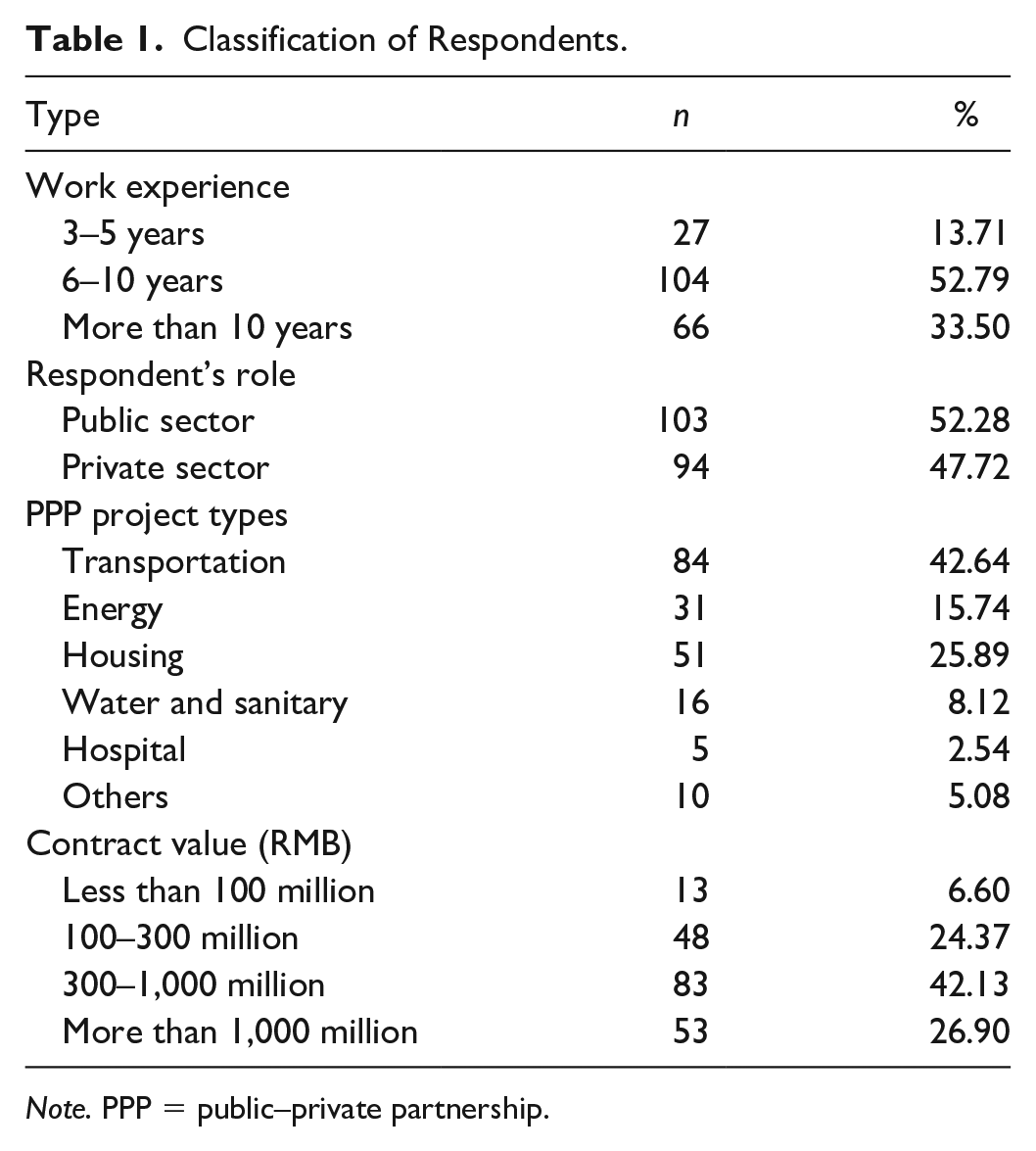
An online questionnaire was used to collect data in this research. From the PPP expert database of China Public Partnerships Centre, we initially chose a random sample of 150 experts and invited them to participate in this survey. The targeted respondents had to meet two criteria: They should have participated in one or more PPP projects as public sector or private sector; they must have undertaken the role of contract management or relevant leaders. The criteria above were satisfied by 84 active participants who answered our questionnaire. Among them, 46 active participants invited two or three colleagues to participate in this survey. Eventually, 210 questionnaires were collected, out of which deleted 13 invalid questionnaires. The survey was conducted from February 2020 to June 2020. The descriptive statistical analysis is shown in Table 1.
Classification of Respondents.
Note. PPP = public–private partnership.
Variable Measurement
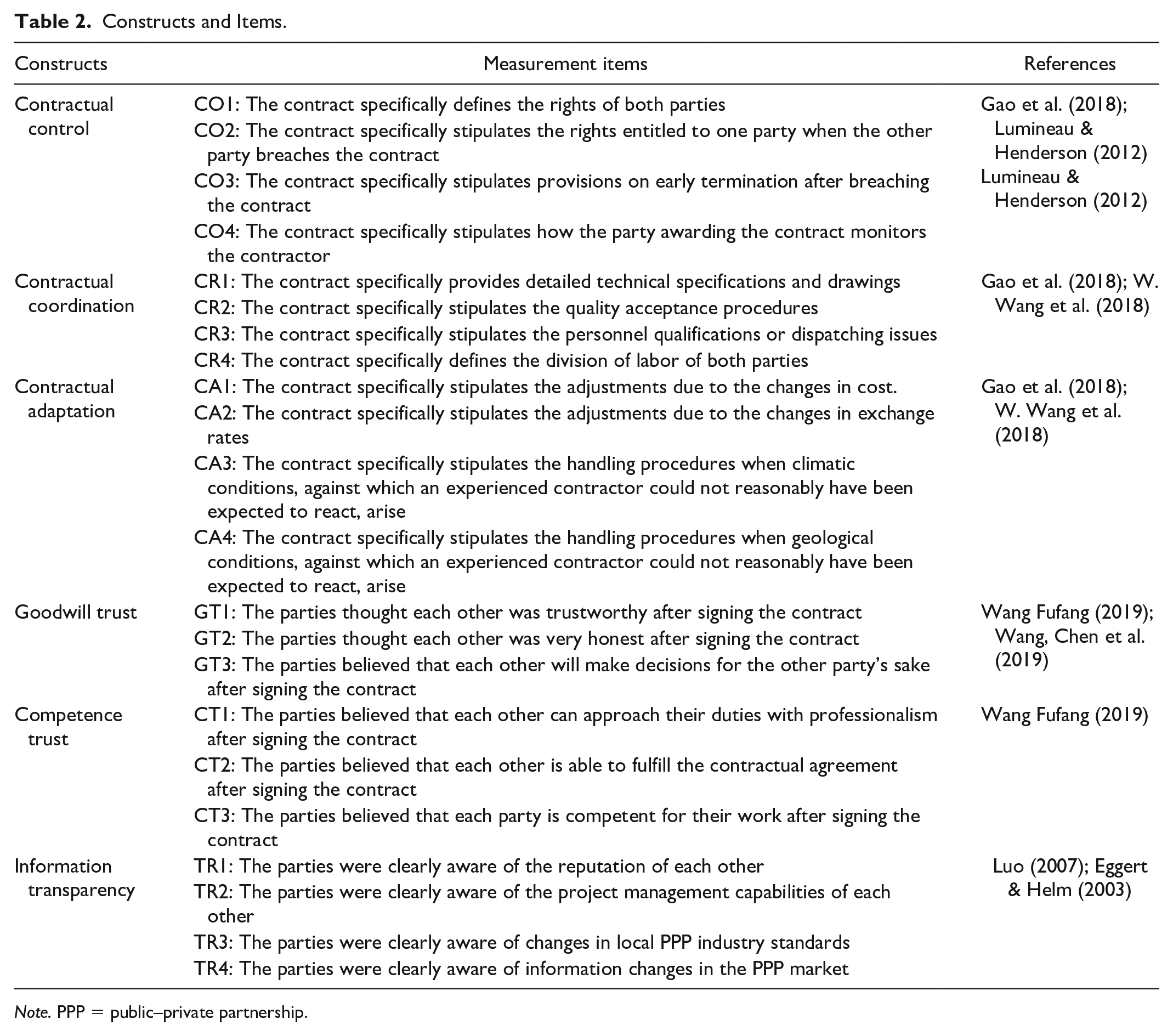
The variables measured in this research were adapted or developed based on relevant literature, and all items were strictly translated and back-translated. To verify the items and match the context of Chinese PPP projects, four rounds of in-depth interviews were conducted with five PPP research experts and three practitioners who were engaged in PPP projects for a long time. Furthermore, to ensure that the questions were understood by the respondents, 20 practitioners with PPP project management experience were invited to answer the questionnaire. Before large-scale sampling, a pilot test was conducted by distributing questionnaires to PPP practitioners. The test included three steps. The corrected item-total correlation and Cronbach’s alpha methods were adopted to refine the measurement items. The Kaiser–Meyer–Olkin test and Bartlett test were used to assess whether factor analysis could be used. If yes, then exploratory factor analysis was performed. By using these three steps of the pilot test, the validity and reliability of the questionnaire were identified. After rectifying all measures, the questionnaire was used for large-scale sampling (Table 2). All the items were measured using a 5-point Likert-type scale (1 = strongly disagree, 5 = strongly agree).
Constructs and Items.
Note. PPP = public–private partnership.
Trust
Trust is a complex phenomenon that evolves dynamically with the change in complex environments and the continuous interaction of participants in an organization network (Chow et al., 2012). To ensure the accuracy and reliability of research conclusions, this study investigated the trust when the contract was signed and did not involve the continuous trust generated at other stages because the aim was to investigate the effect of contracts on trust during the signing phase. Following the research of Wang et al. (2019) and Wang et al. (2019), we used three items (GT1–GT3) to measure goodwill trust following the signing of the contract. In addition, another three items (CT1–CT3) for competence trust were designed with reference to Wang et al. (2019) and the time of trust was clearly indicated in the questionnaire.
Contractual functions
The items of contractual functions were designed based on prior studies (Gao et al., 2018; Lumineau & Henderson, 2012; W. Wang et al., 2018). Contractual functions were mainly regarded as three aspects: contractual control, coordination, and adaptation. Four items were designed to measure contractual control (CO1–CO4), contractual coordination (CR1–CR4), and contractual adaptation (CR1–CR4), respectively, with appropriate modifications to fit the research context.
Information transparency
There are multiple ways to measure information transparency in the extant literature, but they are less applicable to construction projects, especially PPP projects. Combined with the features of PPP projects, four items (TR1–TR4) were designed to measure information transparency by referring to the studies of Luo (2007) and Eggert and Helm (2003), after wording modifications were adapted to fit in the context. All items and sources are shown in Table 2.
Data Analysis and Results
Structural equation modeling (SEM) was adopted for data analysis. SEM can handle multiple dependent variables at the same time. In contrast, multiple regression is restricted to examining a dependent variable at a time (E. W. Cheng, 2001); Compared with regression techniques, SEM provides complete information about the extent to which the research model is supported by the data (Gefen et al., 2000). While other SEM tools exist, partial least squares structural equation modeling (PLS-SEM) was adopted to analyze the impact of contractual functions on trust for various reasons. First, unlike SEM, which is most suitable for theoretical testing, PLS-SEM is better for exploratory studies because it can deal with complex models (Hair et al., 2011; Rigdon et al., 2017). Other researchers also claimed that this method is ideal for models containing over five latent variables (Khosravi et al., 2020; Sarstedt et al., 2017). In addition, it offers accurate estimates of the paths among various constructs by simultaneously assessing structural and measurement models (Elbanna et al., 2013). PLS-SEM is increasingly applied in construction project studies to test complex relationships similar to our research model (Benítez-Ávila et al., 2018; M. Cheng et al., 2020; Khosravi et al., 2020; Lee et al., 2020; Wang Fufang, 2019; L. Zhang & Qian, 2017). Therefore, PLS-SEM is beneficial for our data analysis.
Measurement Model Results
According to Hair et al. (2013), the reliability and validity of the measurement model should be evaluated first. Cronbach’s alpha and construct reliability (CR) were used to evaluate reliability, whereas average variance extracted (AVE) and Fornell–Larcker criterion were used to evaluate convergence validity and discriminate validity, respectively. As shown in Table 3, Cronbach’s alpha values and CR values of the six variables were greater than .7, which fulfilled the recommendation of Hair et al. (2013), indicating good structural reliability. The AVE values were greater than 0.5, which indicated that it had good convergence validity (Hair et al., 2013). As shown in Table 4, the square root (bold in the table) of AVE values of the six variables were greater than the correlation coefficient among other variables. This indicates good discriminate validity (Moore & Benbasat, 1991).
Reliability and Convergence Validity.

Note. AVE = average variance extracted.
Discriminate Validity.

Note. The value on the diagonal is the square root of AVE. AVE = average variance extracted.
Regarding common method bias (CMB), in addition to program control in this study, Harman’s single-factor test was performed to assess the extent of CMB (Podsakoff & Organ, 1986). The results showed that the first factor accounted for 38.719% of the total variance, which was less than 50%, as suggested by Podsakoff and Organ (1986). Based on the suggestion of Podsakoff and Organ (1986), we used variance inflation factors (VIFs) to assess multicollinearity. For each variable, the range of VIF values was 1.887–2.776, which is lower than 5 (Obrien, 2007). Hence, there was no significant multicollinearity problem. Moreover, factor-level VIF values resulting from a full collinearity test are all below 3.3, further indicating that the CMB is not an issue in this study (Kock, 2015).
Structural Model Results
Based on the suggestion of Wetzels et al. (2009), we evaluated the fitting degree and prediction ability of the structural model using the goodness-of-fit (GOF) index and constructed the cross-validated redundancy index

where

Results of the structural model.
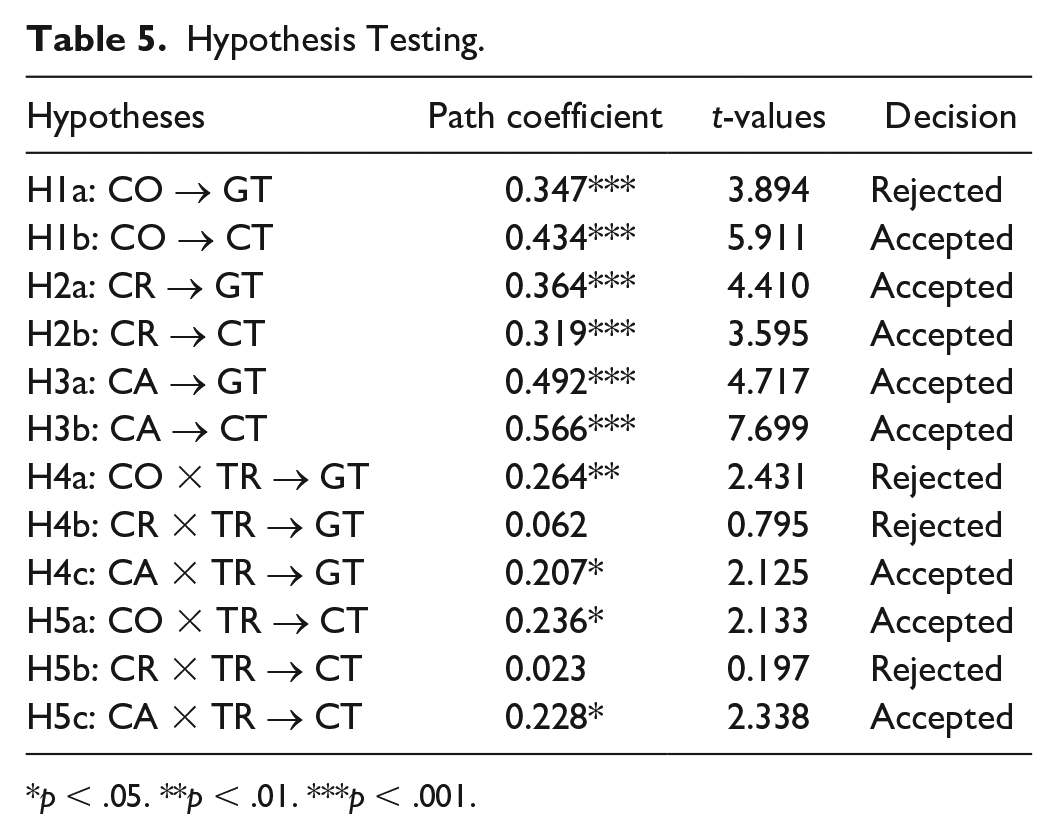
We evaluated the significance and effect of path coefficients by bootstrapping 5,000 subsamples (Hair et al., 2013). As observed in Table 5, contractual control had a positive effect on goodwill trust and competence trust (β = .347, t = 3.894; β = .434, t = 5.911). Therefore, H1a was not supported, whereas H1b was supported. Contractual coordination had a positive effect on goodwill trust and competence trust (β = .364, t = 4.410; β = .319, t = 3.595). Therefore, H2a and H2b were supported. Contractual adaptation had a positive effect on goodwill trust and competence trust (β = .492, t = 4.717; β = .566, t = 7.699), so H3a and H3b were supported. In addition, information transparency positively moderated the relationship between contractual control and goodwill trust (β = .264, t = 2.431). Therefore, H4a was assumed not to be supported. Information transparency had no significant moderating effect on the relationship between contractual coordination and goodwill trust (β = .062, t = 0.795). Therefore, H4b was not supported. Information transparency significantly moderated the relationship between contractual adaptation and goodwill trust (β = .207, t = 2.125). Thus, H4c was supported. Information transparency positively moderated the relationship between contractual control and competence trust (β = .236, t = 2.133), so H5a was supported. Information transparency had no significant moderating effect on the relationship between contractual coordination and competence trust (β = .023, t = 0.197). Therefore, H5b was not supported. Information transparency positively moderated the relationship between contractual coordination and competence trust (β = .228, t = 2.338), so H5c was supported. To further test the moderating effect of information transparency, we performed a simple slope analysis (Figure 3).
Hypothesis Testing.
p < .05. **p < .01. ***p < .001.
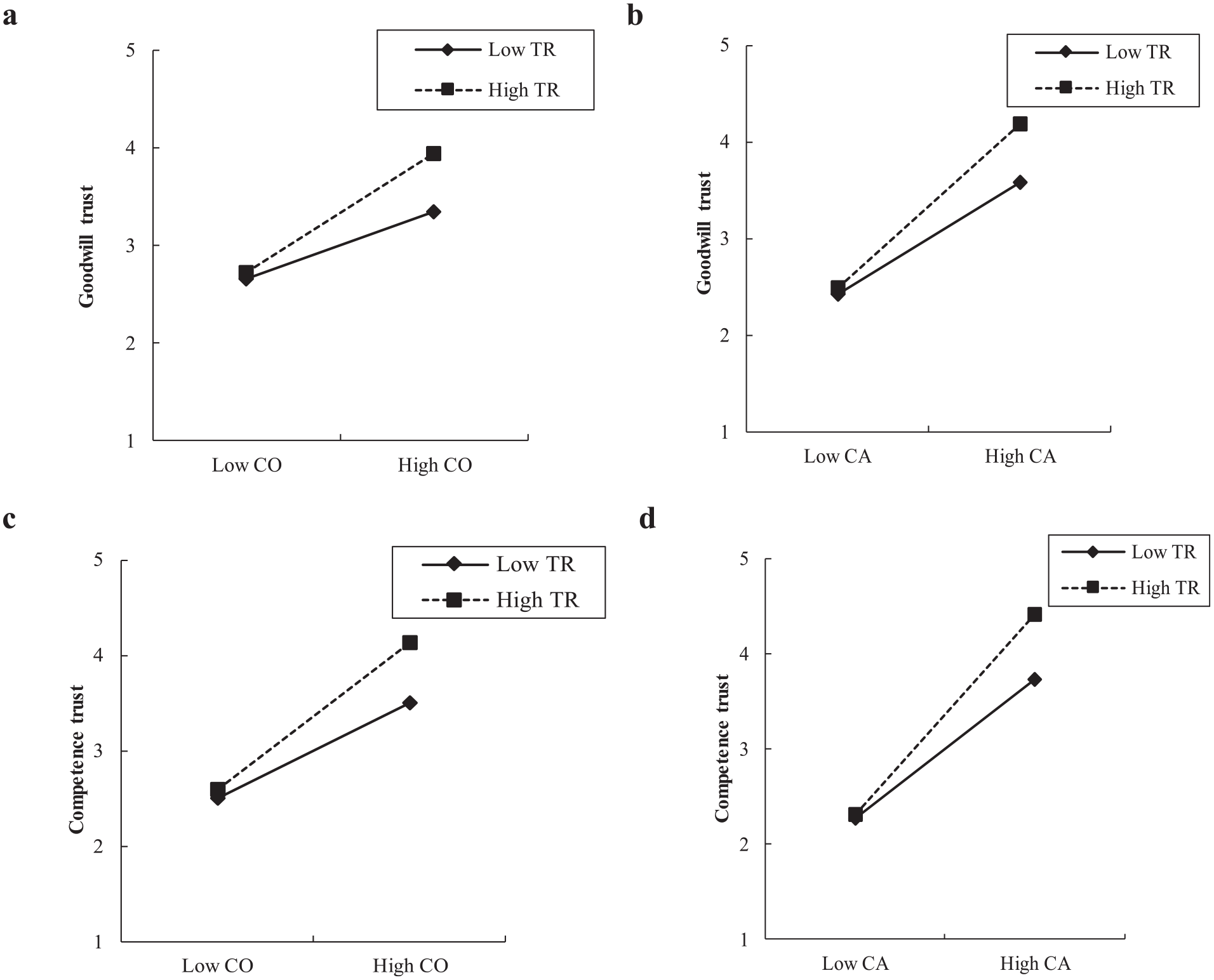
Decomposing the interaction effects: (A) CO × GT, (B) CA × GT, (C) CO × CT, and (D) CA × CT.
Discussion
Effect of Contractual Control Functions on Trust
The results showed that contractual control was positively associated with goodwill trust. The views of previous studies regarding the impacts of contractual control on goodwill trust are contradictory. For example, Malhotra and Lumineau (2011) concluded that contractual control harmed goodwill trust. However, the results of this study are consistent with the study of Lu and Yan (2016), which indicates that contractual control is beneficial to enhance the relationship between partners. This may be due to the characteristics of the PPP project. PPP projects usually involve high complexity owing to various tasks, technologies, organizations, and a lack of prior relationships. Hence, the contract should contain control clauses to ensure the correct behavior of project partners. In such cases, detailed control contracts are more likely to be accepted by partners. Therefore, contractual control does not negatively affect goodwill trust. Contractual control has a positive impact on competence trust. Consistent with the study of Tsamenyi et al. (2013), the results suggested that contract negotiation and institutional embedding in the early stages of relationships facilitate the generation of competence trust.
Effect of Contractual Coordination Functions on Trust
The results showed that contractual coordination had a positive effect on goodwill trust. This finding is similar to the research conducted by Lumineau (2014; undertaken in other contexts), which theoretically analyzes that coordination mechanism encourages relationship development. Generally, PPP projects have a long cooperation cycle and high technical complexity, so conflicts between partners are inevitable. Thus, contractual coordination can enhance trust and help partners achieve their organizational goals. The finding revealed a significant positive relationship between contractual coordination and competence trust. M. Cheng et al. (2020) confirmed that contractual coordination benefits communication and information sharing, all of which are useful for accumulating competence-based trust.
Effect of Contractual Adaptation Functions on Trust
The results showed that contractual adaptation had a positive impact on goodwill trust. Furthermore, it supported the inference of Song et al. (2018) that the adequate level of flexibility provision can improve the relationship between the owner and contractor. When flexible contracts were introduced in PPP projects, it helped project partners handle unforeseeable and unpredictable circumstances during the project life cycle, which can optimize the relationship between project participants (Demirel et al., 2017). Moreover, we conjectured that contractual adaptation would be positively related to competence trust (H3b). The finding revealed a significant positive relationship between contractual adaptation and competence trust. According to Lee et al. (2020), a contract provides a flexible framework to help move toward a stronger bond and relationship. It is also consistent with the viewpoints of Cruz and Marques (2013), who suggested that a flexible contract design is beneficial in coping with uncertainties in PPP projects.
Moderating Effect of Information Transparency
The research suggested that information transparency positively moderates the relationship between contractual control and goodwill trust. This finding is consistent with the viewpoints of Kumar and Ganguly (2020), who found that timely information disclosure is conducive to coordinating relationships. This means that information transparency is a crucial step for deeper cooperation between partners. Information transparency positively moderates the relationship between contractual control and competence trust. Information transparency can also reflect the soundness of market mechanisms. When partners learn about open and transparent information, they better understand their project management capabilities and reputation. In other words, when the basic information is clear between the contracting parties, the parties do not need to work hard to retrieve information. Thus, control clauses will be easier to understand and adopt. Information transparency was found to have no moderation effect on the influence of contractual coordination on trust because coordination means that the two parties have fully communicated and exchanged information. Hence, there is no significant difference at a different level. The research suggests that information transparency positively moderates the relationship between contractual adaptation and trust. In an environment of open and transparent information, it is easier to reach a consensus on some events during the contract drafting or signing stages. This reduces the friction related to handling uncertain events and is therefore beneficial to the development of relationship trust. The research responds to Shou et al. (2016) that proposed to study the effectiveness of contracts in specific institutional environments.
Theoretical Implications
This study investigates the impact of contractual functions on trust and the moderating role of information transparency in PPP projects. The findings of the study advance the application of contract theory, SET, and information asymmetry theory in understanding how contractual functions enhance trust between partners. First, this research enriches the current contract literature by clarifying the construct of contractual functions in PPP projects, that is, we defined and provided measurements for the three constituent dimensions. Second, our research attempts to associate contractual functions and trust in the early stages of PPP projects. It complements the existing trust literature because previous studies hardly involved trust in the early stages of PPP project research. Moreover, our result also extends SET by implying contractual functions serve as an essential predictor of trust between PPP partners. Third, the information asymmetry theory was utilized to investigate the moderating impact of information transparency on the relationship between contractual functions and trust. This study enhanced the new applications of information asymmetry theory. Besides, by defining and providing measures for information transparency, this study strengthens our understanding of its concept and role, thus further enriches the uncertainty management literature. Finally, this research provides new knowledge to PPP management literature related to enhancing trust between PPP partners by empirical evidence confirming the strong explanatory power of integrating SET, contract theory, and information asymmetry theory model.
Practical Implications
This research provides practical information for enhancing the relationship trust between partners in PPP projects. This study confirmed the positive effect of contractual functions on trust between PPP partners. Hence, project managers should value the development of an appropriate contract framework. Furthermore, the designed contracts should match the trust requirements of the transaction item. For example, in projects with higher behavioral uncertainty, the need for goodwill trust is more significant than competence trust. Hence, it is essential to appropriately enhance adaptation and coordination clauses rather than control clauses while negotiating and drafting a contract.
We found that a high level of information disclosure is more comfortable to enhance trust. Therefore, project partners should pay attention to improving information transparency through information disclosure and sharing. Emerging technologies, such as blockchain and smart contracts, are recommended to apply in PPP projects to enhance information sharing, encourage mutual exchanges, and promote the openness and transparency of information because information transparency can result in a successful project partnership.
Limitations and Future Work
Although this research has some theoretical contributions and practical significance, it still has some limitations. First, the questionnaire survey was limited to the domestic context of China. Future sample collection can be expanded to other countries to compare further and analyze our conclusions. Besides, due to the difficulty of sample collection, the type of industry in the sample collection was not restricted. Future research may consider collecting data for specific industries separately and conducting comparative studies of different industries to test the model. Second, given the importance of information transparency, exploring the approach of improving information transparency can be considered as the next research direction. This can be achieved by popularizing BIM technology, blockchain technology, and smart contracts in PPP projects. Third, due to cost, time, and other constraints, the statistical data in this study are static cross-sectional data. However, the influence of contractual functions on trust may not be constant throughout the cooperation process. Therefore, the dynamics of contractual functions and trust through longitudinal research designs should be considered in future studies to understand how this relationship evolves. Finally, this study only investigated the direct impact of contractual functions on trust and the moderating role of information transparency in the relationship based on social exchange, contract, and information asymmetry theories. However, other theories, such as signaling and agency theories, may be also useful and should be taken into account to have a more comprehensive understanding of the role of contracts.
Conclusion
Given the high uncertainty and complexity of PPP projects, the development of trust between partners in the early stages of projects is vital and challenging. Our research on this challenge began by exposing the complex interaction between contracts and trust in the process of PPP contract signing, which had not attracted attention previously. Based on the previous literature regarding interorganizational governance, relationship contracts, and PPP, this research considers the context of information transparency and conceptualizes the multidimensional construct of PPP contractual functions to explore its complex effects on trust between PPP partners. A survey with 197 PPP professionals in China found that contractual functions are positively associated with trust between PPP partners. In particular, contractual adaptation has the most significant influence on trust. Furthermore, information transparency positively moderates the relationship between contractual control, adaptation, and trust, including goodwill trust and competence trust. According to the research results, the contractual element should operate as a trigger for cultivating trust between PPP partners. In addition, the disclosure of information should be emphasized in PPP projects.
