




Abstract
The excessive use of social media is an emerging phenomenon with several negative consequences in an entrepreneurial context. Based on the stressor–strain–outcome paradigm, this research aims to unveil the following: that social media late-night usage can affect two psychological strains (life invasion and technostress) among female entrepreneurs and thus influence their behavioral outcome (cognitive engagement). This study empirically tested the proposed mediation model using an online survey of 225 female entrepreneurs from the small- and medium-sized enterprise sector. A partial least squares structural equation modeling (PLS-SEM) was implemented to obtain the results. The findings indicate that late-night social media usage significantly raises life invasion and technostress among female entrepreneurs. Moreover, internal strains (life invasion and technostress) reduce female entrepreneurs’ cognitive engagement and significantly mediate the association between late-night use of social media and entrepreneurial cognitive engagement. This study draws associated practical and theoretical contributions based on findings, which were not previously discussed.
Introduction
The popularity of the internet has encouraged social media to penetrate citizens’ lives. The trend of social media overuse is becoming more and more apparent in routine life. Scholars commenced discovering the negative role of social media in the educational research environment. For instance, Cao et al. (2018) discussed the sophisticated use of social networking sites (SNS) and their negative consequences on poor academic performance. In most cases, students use their phones to interact with others through social media sites. In addition to the current research on social media, most of the previous research is based on the educational sector (Fu et al., 2021; Luqman et al., 2017; Maier et al., 2015; Malik et al., 2021; Shi et al., 2020); however, the negative influence of social media on entrepreneurs have received little attention. Therefore, from the entrepreneurship perspective, the negative influence of social media and its related results are crucial and timely to investigate.
Some scholars focus their attention on measuring the use of social media in a professional context. Brooks (2015) discovered that social media could cause technostress and negatively affect task performance. Similarly, work-related social media is also the source of employee border conflicts that lead to emotional exhaustion (McDowell et al., 2019; Van Zoonen et al., 2016). Furthermore, a significant portion of entrepreneurial studies is related to males instead of females. Most research conducted on female entrepreneurship is interrelated to either the reasons why females decide to become entrepreneurs (Ahmed et al., 2019; Buttner et al., 1997; Narayanasamy et al., 2011; Sarri & Trihopoulou, 2005) or the hurdles that females face during the start of their business (Brindley, 2005). Female entrepreneurs are a critical “untapped source” of a country’s sustainable economic development (Gupta & Mirchandani, 2018; Minniti & Naudé, 2010; Nsengimana et al., 2017; Sarker & Palit, 2014). Moreover, different work outcomes have different significance for men and women because of the social construction; diverse responses to various stress factors on work play an important role (Schaufeli et al., 2008). Because of a lack of scholarly interest, an in-depth analysis is required to significantly contribute to prevailing literature to determine the adverse effect systematically and empirically on social media on female entrepreneurs’ work engagement in developing countries. This study focuses on a specific negative aspect of social media, which is late-night usage, and offers the following research question: How does late-night social media usage affect female entrepreneur’s cognitive engagement?
Due to personal dissimilarities, there is no standard or time limit to illustrate social media use limits. However, excessive use of social media can have an inverse effect on users’ health and daily life (Enez Darcin et al., 2016). For example, late-night people who use social media via mobile or laptop regularly experience solitary life, disturbing emotion, and even a high degree of stress (Panova et al., 2020).Meanwhile, late-night or excessive social media use is positively associated with technostress and life invasion (Ayyagari et al., 2017; Cao et al., 2018). Therefore, it is essential to emphasize the damaging influences of late-night social media usage on cognitive engagement, particularly in female entrepreneurs of small- and medium-sized enterprises (SMEs). In a professional context, cognitive engagement is referred to as “the intentional and actively focused awareness of one’s tasks, objectives, or organizational activities that are characterized by willingly calling one’s attention to and having positive thoughts about one’s work, to improve one’s effectiveness at those tasks, objectives, or activities” (Kuok & Taormina, 2017). Due to stress and life invasion, the individual may not attend their work activities as they are required to do. Therefore, this study aims to empirically prove the adverse effect of late-night use of social media on female entrepreneurs’ cognitive engagement through technostress and life invasion as mediating factors.
Grounded on the stressor–strain–outcome (SSO) model, this study posits late-night use of social media as a stressor to induce internal strains (life invasion and technostress) among female entrepreneurs, thereby having an impact on their behavior outcome (cognitive engagement). This article makes certain contributions to the current study area, first, by concentrating on the dark side of social media and expanding knowledge on the adverse effects of information technology on entrepreneurial environments, especially female entrepreneurs. Second, this investigation uncovers how stressors influence the internal mechanism of female entrepreneur cognitive engagement, along these lines, enhancing the relevance of the SSO model. Finally, given this investigation’s findings, researchers and experts can structure intercessions or strategies to decrease social media damages to female entrepreneurs.
Theoretical Support and Conceptualization
The Dark Side of Late-Night Social Media Usage
Social media late-night use can hamper the productivity of the employee and have a detrimental effect on their welfare and psychological health. The study of Tarafdar et al. (2015) substantiates the claim that social media sites (i.e., Facebook, Twitter) prevent employees from concentrating on the actual job work. In the workplace and the field of education, it was discovered that the overuse of smartphones might divert students from classroom activities and reduce their learning endeavors (Mendoza et al., 2018). Technology usage can result in reduced academic and work performance, but social media networking websites have the potential for addiction (Pearson & Hussain, 2015). It was shown that people using phone-based social media applications before bed might have phobias because they cannot control themselves from leaving the phone (Fu et al., 2021).
Addictive social media behaviors can result in tension between users and their work environment, ultimately affecting job engagement. Based on social cognitive theory, this study assumes that social media addictive behavior will ultimately damage entrepreneurial cognitive engagement to work (Rich et al., 2010). People who are using social media excessively late at night will have reduced performance the next day because they tend to invest more cognitive energy and time on social media sites and ignore other activities (Andreassen et al., 2016), potentially affecting their morning behavior. Therefore, this study deduces that the overuse of social media late at night slightly reduces an entrepreneur’s cognitive engagement. Moreover, long-term use of social media decreases individuals’ cognitive engagement in the workplace. The high level of technostress can sometimes lead to reduced task performance, diminishing problem-solving skills, and taking excessive time for information processing (Moqbel & Kock, 2018). Consequently, it can be postulated that this behavior may negatively influence female entrepreneurs’ cognitive engagement in the workplace.
In this study, we theorize that excessive use of social media before bedtime has two aspects. First, late-night use of social media exhibits a negative effect on female entrepreneurial cognitive work engagement. Second, it has a significant impact on female entrepreneur personal issues, including life invasion and technostress. In particular, we can also believe that through the negative impact of life invasion and technostress, late-night usage may lead to insufficient entrepreneurial engagement in the workplace.
Stressor–Strain–Outcome (SSO)
The current study framework is based on the SSO model to explain the stress process in entrepreneurial cognitive engagement (Koeske & Koeske, 1993). Stressors are environmental stimuli that a person meets and that convey stress (Ayyagari et al., 2017). Strain and outcomes are an individual’s personal emotional and behavioral responses to stressors (Tarafdar et al., 2019). Meanwhile, these strains attune the effect of stressors on outcome variables. The SSO model has been used in the past to understand stress phenomena in the workplace (Lee et al., 2016). However, in entrepreneurship, the implementation of the SSO model has not been sufficiently investigated in previous studies. The integration of user-created content with social media functions can establish and sustain social relationships, information sharing, communication, multifunction, self-disclosure functions, and entertainment (Shi et al., 2020). In particular, these social media features will expose too much information, frequent communication, and social requirements to individuals and entrepreneurs. When the demand for social media exceeds entrepreneurs’ ability to handle it, they may feel stressed. This stress may further affect the psychological state of female entrepreneurs and lower their cognitive engagement in the workplace.
Harmon and Mazmanian (2013) confirmed that even non-work time, smartphone-based email checks are prone to creating friction between work and social life. Therefore, it could be suggested that outcome factors interact with the psychological response and perceived stressors. The research model for this study included two valuable practical user experience. The first is “life invasion,” which refers to a negative view that excessive social media use plays an undue fundamental role in daily life and has invaded ones’ routine (Ayyagari et al., 2017; Cao et al., 2018; Ragu-Nathan et al., 2008). The second is “technostress,” which referred to an individual’s psychological state due to their failure to deal with current needs brought about by the use of social media (Steelman & Soror, 2017). Work engagement is referred to as “the simultaneous employment and expression of a person’s self-preference in task behaviors that promote connections to work and to others, personal presence and active full performances” (Kahn, 1990). In this study, entrepreneurial cognitive engagement is the dependent variable, which refers to “engaging in easy tasks with purposeful and strategic use, make the cognitive investment in learning, and engaging in metacognitive and self-regulated learning” (Rich et al., 2010). Some researchers have linked students’ academic engagement with their academic performance (Cao et al., 2018; Turel & Qahri-Saremi, 2016). However, the lack of scholarly connection about the late-night use of social media from the SSO model’s perspective motivates the authors to investigate the possible consequences in female entrepreneurial cognitive engagement.
Female entrepreneurs’ cognitive engagement is an important behavior outcome of using social media that can be negatively affected by high-level technostress and life invasion. Therefore, to link late-night social media usage (specific stressor) and technostress and life invasion (strain) with cognitive engagement (outcome), the SSO model can be effective because it emphasizes the negative effect of the environmental stimulus on the internal and external behavior of female entrepreneurs. Therefore, the SSO model’s sequential process has been used to test the theoretical assertions made in this study, including how late-night use of social media, life invasion, and technostress affect the cognitive engagement of female entrepreneurs in the workplace.
Research Model and Hypothesis Development
Late-Night Social Media Usage
The literature quantifies “excessive” usage of technology as “the extent to which social media use is longer than the time planned” (Caplan & High, 2006). The term overuse of technology is primarily associated with a negative connotation because of its negative consequences for the user. However, the underlying process resulting in negative consequences is still a mystery. Rarely has any study provided an insight into individuals’ thinking processes and how technology use has negatively affected the individuals (King et al., 2013). Nevertheless, all individuals possess a limited amount of cognitive resources (Egan, 2008). Regarding the study of Kahn (1990), employees have limited “cognitive resources” at work, including investing energy considering and focusing on the work. With an inflow of immense information comes the possibility of overstretching the already limited cognitive resources. The amount of overwhelming information that an individual needs to process with the late-night use of social media is very likely to drain cognitive resources, leading to a sense of confusion and stress (Zhang et al., 2016).
Another implication for social media late-night use can be later bedtimes, sleep disturbance, and other sleeping disorders, which leads to mental stress (Fu et al., 2021; Lemola et al., 2014). In particular, screens of smartphones and computers emit a bright light that may suppress “melatonin secretion.” Melatonin is a hormone that signals it is night and time to sleep to the human body, and its disruption is associated with various diseases such as mental disorders and extraordinary stress (Tähkämö et al., 2019). Information overload caused by psycho-cognitive limits is a serious problem while spending too much time on social media. Individuals with exhausted cognitive limits tend to feel tired and stressed (Shi et al., 2020).
Excessive usage of technology comes at a personal cost, but the time spent on social networking websites puts the user’s relations with their friends and family under strain (Turel & Serenko, 2012). Excessive use of technology might also result in work-technology friction. The tremendous amount of information shared on social media, mostly pictures and content by friends, require the user to respond promptly, hence, putting their work obligations under stress. This exercise requires extra time, energy, and keeping up with the fast-paced trends on social networking websites, sometimes staying awake at night. This obsessive behavior of individuals drains cognitive energy out of them and negatively affects his/her work and other life events (Turel & Qahri-Saremi, 2016).
Furthermore, like relationships in the real world, social media connection requires time and attention. It was noted that entrepreneurs with a high number of social media friends and connections were spending an increased amount of time interacting and maintaining those connections (Manago et al., 2012). To respond promptly, the user may have to put other essential tasks such as work obligations or other life events on a back burner, thereby negatively affecting work and personal life (Turel & Qahri-Saremi, 2016). Users may also feel an increasing amount of strain when they cannot maintain their social media interactions at a required level. Past studies have shown that late-night use of social media could result in various behavioral and psychological problems such as life invasion and stress (Luqman et al., 2017; Maier et al., 2012; Xanidis & Brignell, 2016).
Besides, excessive social media usage may also affect the work environment in general by introducing task distraction. Addictive usage of social media can reduce employees’ task attention because of the proximity of the source of distraction (social media website) in the form of installed applications on smartphones and tablets (Nikbin et al., 2020). Moreover, deficient self-regulation keeps them constantly plugged to social media late-night usage and work the next day (Vishwanath, 2015). This constant mental occupation of cognitive resources that individuals deploy to think about things they want to do on social media makes it difficult for them to pay ample attention to essential tasks required by a female entrepreneur. Therefore, this study hypothesizes that:
Life Invasion and Entrepreneurial Cognitive Engagement
The concept of life invasion as a result of social media occurs when social media usage becomes a part of one’s life (Ayyagari et al., 2017). The result is the individual is connected to social media websites all the time, and user’s leisure time and work activities are all invaded by social media for hours every day through usage on smartphones and computers (Vitoux et al., 2009). Social media users experience life invasion because of the increasing demand for behavioral adjustments required to adapt to these new conditions and new social media usage routines (Ragu-Nathan et al., 2008). Furthermore, recent research has established the linkage between unintended effects of social media overuse, such as life invasion (Ayyagari et al., 2017; Cao et al., 2018; Tarafdar et al., 2013). Due to its negative consequences, this phenomenon has been studied in the sphere of educational performance. However, life invasion was seldom discussed in the field of entrepreneurship. Therefore, this study proposes that life invasion negatively affects the female entrepreneur’s cognitive engagement at the workplace when using social media late at night. We posit that
Technostress and Entrepreneurial Cognitive Engagement
Technostress includes stressors that are “technology-induced stimuli, events, or demands” (Ragu-Nathan et al., 2008). Stressors produced through technostress are called “technostress creators,” which cause individual responses called strain (Ayyagari et al., 2017; Tarafdar et al., 2015). In a large part of the literature, technostress is a phenomenon that is associated with adverse outcomes. An individual might suffer from a specific form of a psychological strain called technostress due to excessive usage of technology (Ayyagari et al., 2017; Shi et al., 2020; Tarafdar et al., 2019).
Dealing with technostress requires additional energy from entrepreneurs as they get into the habit of using social media over a prolonged period and, sometimes, overnight. It can redirect time and cognitive resources from their learning and cognitive engagement with daily tasks necessary for entrepreneurial success. Moreover, it can be assumed that female entrepreneurs suffering from technostress are more likely to demonstrate the inability to respond adequately to their work assignments because they cannot maintain the cognitive poise between technology use and work. Thus, we posit that:
Figure 1 depicts this research model, which has been tested on the female entrepreneurs’ data in Pakistan.
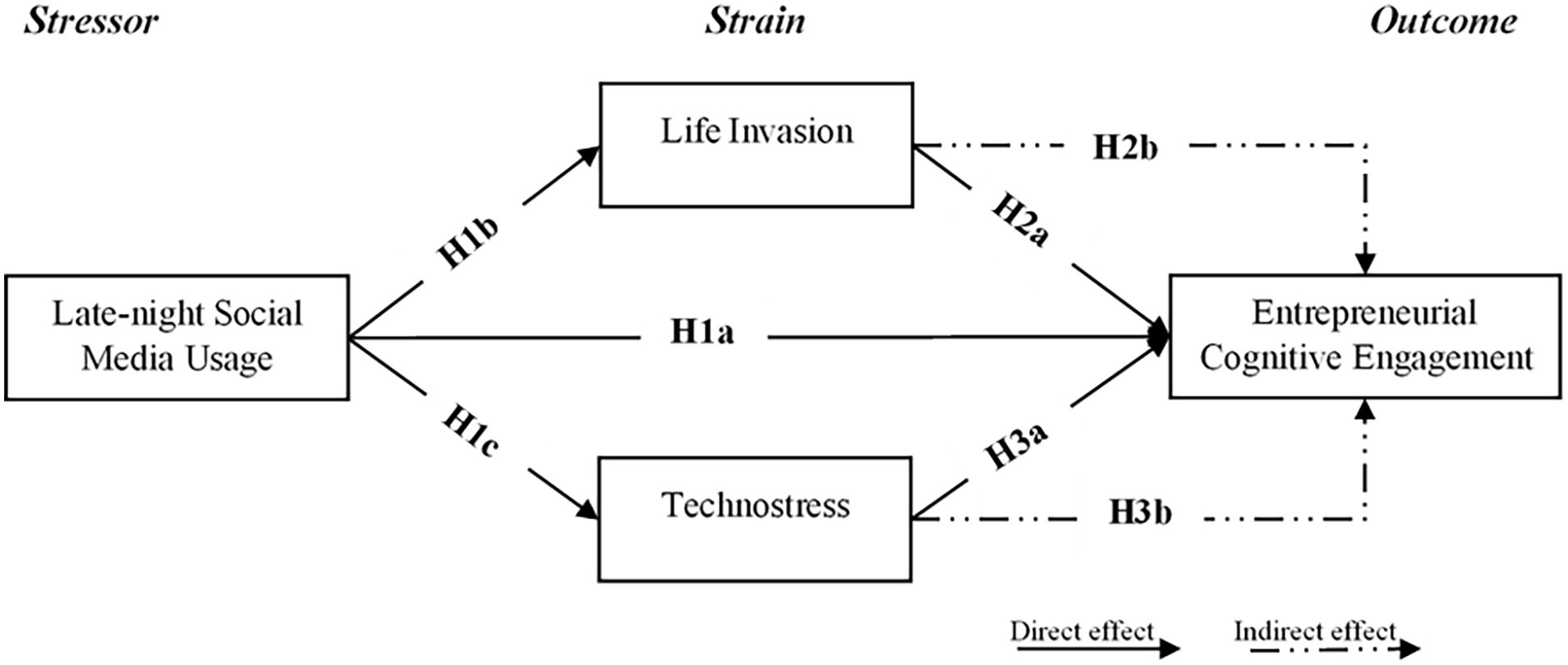
Research model.
Method
Selection of Study Context
To investigate these hypotheses’ affiliation, the proposed studies were conducted within the southern part of Punjab province, Pakistan. The area is a mix of quite populated urban regions and rural deserts such as Cholistan and Thal with very low population density. The required data were gathered using an online survey approach through a structured questionnaire. The data were collected from female entrepreneurs working in administrative divisions such as districts, tehsils, and union councils. This assists in identifying the participation of female entrepreneurs in the current study.
Construct Operationalization
This study used a 5-point Likert-type scale, where responses oscillated from 1 = strongly disagree to 5 = strongly agree. All measurement objects have been adapted from the earlier investigations and revised to fit the current study viewpoint (see survey items in the appendix). Furthermore, to check the survey questionnaire’s content validity, a team of one professor, two postdoctoral scholars, and the authors of this study evaluated the research instrument. After the required modifications, we finalized the questionnaire for data collection. In addition, an extensive data collection within the shortest available time at the lowest cost from the massive and scattered populace with maximum viable interactions comprised the key benefit motivating the use of online survey techniques (Granello & Wheaton, 2004).
Data Synthesis
A link for the questionnaire was sent through email, and the final sample consisting of 225 valid responses was used in this study. The participants were free to reply to the survey, and no incentives were offered. Consistent with Hair, Sarstedt, et al. (2014), the 10-fold rule entails that the sample size for partial least squares structural equation modeling (PLS-SEM) should be at least 10 instances; the maximum quantity of highest indicators that form the original path unique to a particular factor in the proposed model. Based on this, the required sample size was calculated as 50. However, the literature indicates that a sample size of 200 or more is required when undertaking an SEM analysis (Kline, 2005). The authors of this study circulated the questionnaire among 600 female entrepreneurs and expected to receive a large number of responses for applying SEM analysis. The authors circulated the questionnaire to female entrepreneurs only registered in the Punjab Small Industries Corporation, Pakistan. We had collected a list of female entrepreneurs from the regional headquarters of The Punjab Small Industries Corporation, Pakistan, and adopted a random sampling method to select 600 female entrepreneurs from the list. The data collection took place between December 2019 and February 2020, and a total of 237 responses were obtained. Of these, 12 were removed from the final analysis due to incomplete responses.
Therefore, after removing incomplete responses, 225 final responses were utilized in the final analysis. This study used PLS-SEM to examine the data to evaluate the path between constructs by exploring SmartPLS v3. As per studies, this software is more suitable for processing intermediary constructs and moderating the underlying path (Hair, Hult, et al., 2014; Sarstedt et al., 2019). Initial data screening was done in SPSS v26.
Empirical Results
In this section, we present the overall results of the statistical analysis to test the study hypotheses. Before applying SEM, we applied descriptive analysis to determine the overall demographic characteristics of our respondents. The results are presented in tables and figures and interpreted below.
Respondents’ Demographics
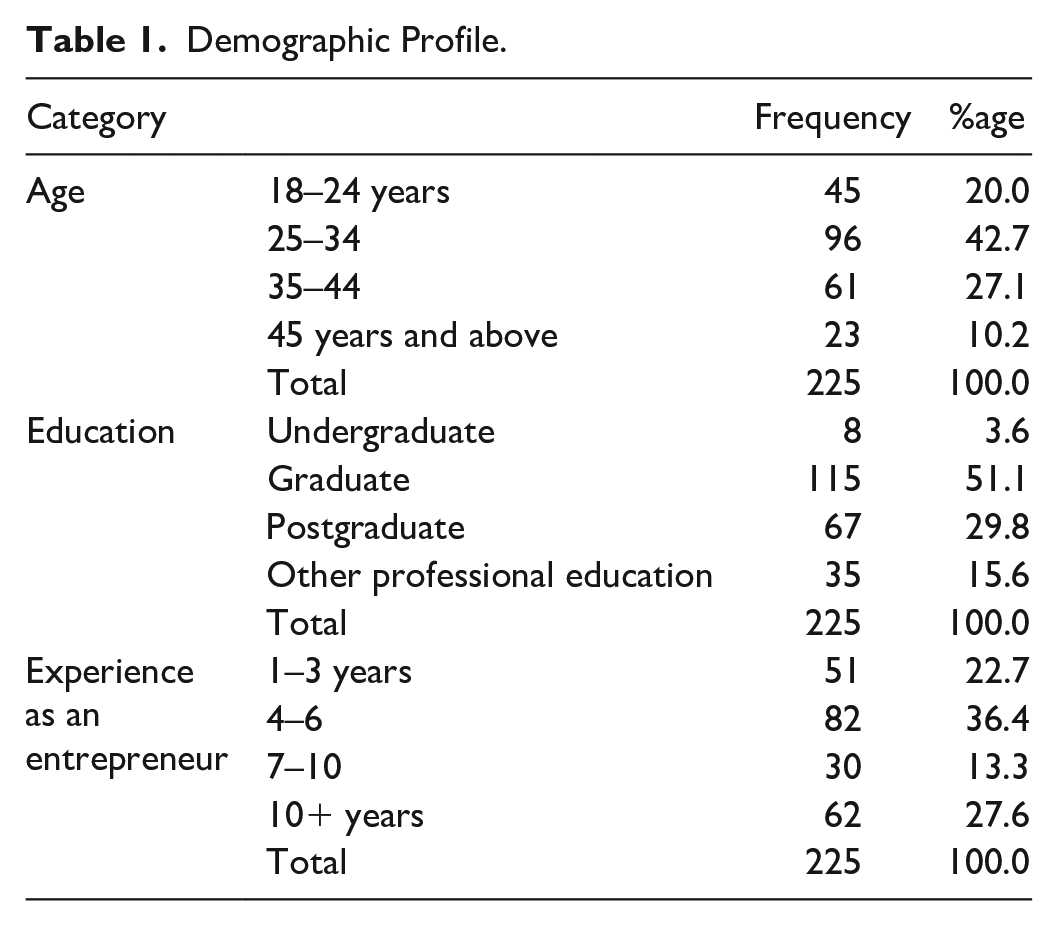
Table 1 sums up the attributes of key attendees of this study (their age, education, and work experience). Of the respondents, 20% were less than 24 years old, 42.7% were between the ages of 25 and 34 years, 27.1% were 35 to 44 years, and 10.2% were above 44 years. The majority of respondents were highly educated: only 3.6% were undergraduate, 51.1% were graduate, 29.8% were postgraduate, and the remaining 15.6% have some other professional certification. The findings showed that 22.7% of participants have 1 to 3 years of work experience as an entrepreneur, 36.4% had 4 to 6 years of experience, 13.3% had 7 to 10 years of experience, and 27.6% had more than 10 years of entrepreneurial experience.
Demographic Profile.
Convergent Validity and Reliability Analysis
The values of convergent validity and reliability are shown in Table 2. The computed Cronbach’s alpha values range from .889 to .946, which confirmed the construct reliability. Convergent validity is “a method to evaluate the correlation level of multiple indicators in the same structure” (Hair, Sarstedt, et al., 2014). To verify the convergence effectiveness of each construct, the confirmatory factor analysis (CFA) was applied. The composite reliability (CR) values range from .889 to .946, and the average variance extracted (AVE) ranges from .67 to .780. The suggested values of Cronbach’s alpha and CR should be higher than .7, and AVE should be higher than .5 to show that the data are highly reliable and valid (Fornell & Larcker, 1981b; Hair, Sarstedt, et al., 2014). The outcomes showed that convergent validity and reliability were not an issue.
Construct Reliability and Validity.

Note. AVE = average variance extracted; ECE = entrepreneurial cognitive engagement; LI = life invasion; SMU = late-night social media usage; TS = technostress.
Discriminant Validity
Discriminant validity is a recognized prerequisite for analyzing the relationship between latent factors. It ensures the empirical uniqueness of the constructs in an SEM (Henseler et al., 2014). Three methods were used to evaluate the discriminant validity. First of all, make an association of the square root of AVE with inter-construct correlations. Second, the cross-loading method was used to test the survey items to verify the correlation. Third, the applied Heterotrait–Monotrait Ratio (HTMT) method confirms the discriminant validity (Fornell & Larcker, 1981b; Hair, Sarstedt, et al., 2014; Henseler et al., 2014).
As shown in Table 3, the instrument’s discriminant validity is measured by associating the correlation between factors with the square root of AVE. The diagonal value displays that AVE’s square root value is higher than the correlation coefficient of each variable, and it has good discrimination effectiveness (Fornell & Larcker, 1981a).
Fornell–Larcker Criterion.

Note. Diagonal values are the square-root of the average variance extracted from each construct, Pearson correlations are shown below the diagonals, *p < .05. ECE = entrepreneurial cognitive engagement; LI = life invasion; SMU = late-night social media usage; TS = technostress.
According to the literature, construct cross-loadings are also employed to ensure the discriminant validity. The loading of each item must be higher than its subsequent construct. The results in Table 4 fulfilled the cross-loading criterion, and the values are according to the threshold values.
Constructs Cross-Loadings.

Note. All factor loadings are significant at the p < .001 level. ECE = entrepreneurial cognitive engagement; LI = life invasion; SMU = late-night social media usage; TS = technostress.
Conclusively, the HTMT ratio criterion was applied to authenticate the discriminant validity further. The value of the HTMT ratio, which is closer to 1, indicates the lack of discriminative validity (Fornell & Larcker, 1981b). Therefore, in this study, Table 5 shows that the highest value is .750, below the aforesaid recommended threshold, and proves no issue of discriminant validity in this study.
HTMT Ratio Criterion.

Note. HTMT = Heterotrait–Monotrait Ratio; ECE = entrepreneurial cognitive engagement; LI = life invasion; SMU = late-night social media usage; TS = technostress.
The Empirical Results of the Structural Model
Subsequently confirming the research model’s reliability, convergent, and discriminant validity, the PLS-SEM was applied using SmartPLS v3 (Hair, Sarstedt, et al., 2014; Henseler et al., 2016). Figure 2 shows the value of the path coefficient, also shown in Table 6. This study used the bootstrap method to gauge the significance level of path analysis.

SEM results.
SEM Results With Bootstrapping (Direct + Indirect Effects).
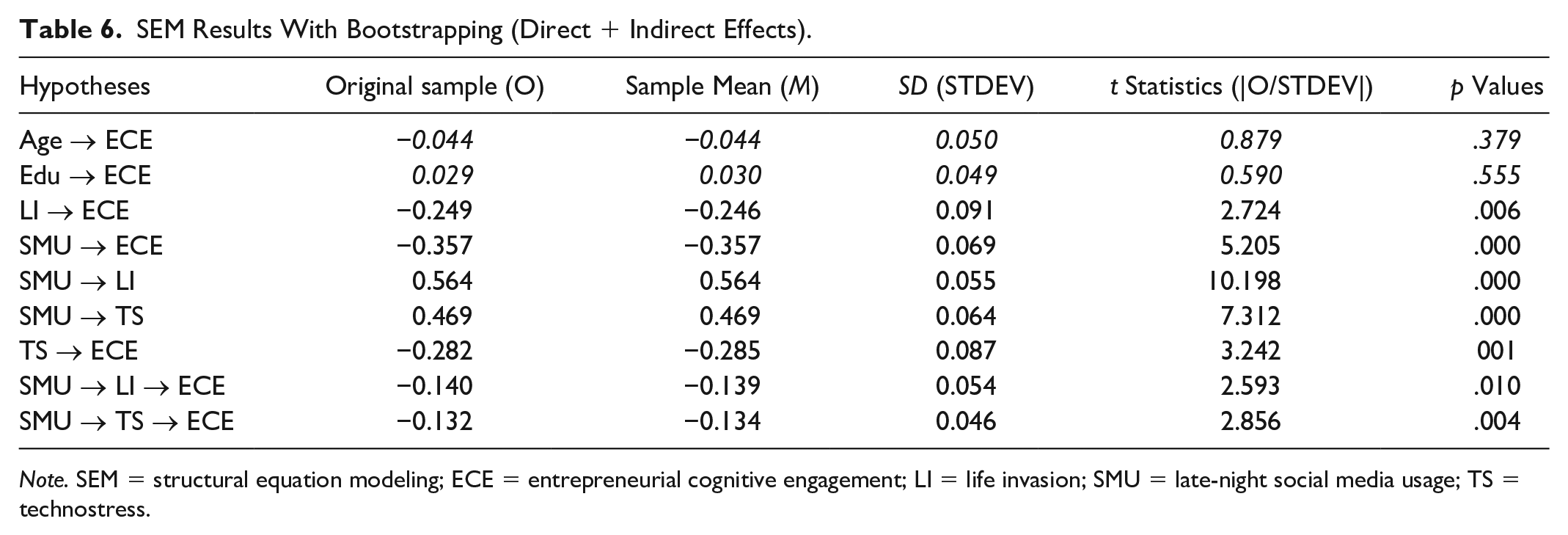
Note. SEM = structural equation modeling; ECE = entrepreneurial cognitive engagement; LI = life invasion; SMU = late-night social media usage; TS = technostress.
The results show that the value of R2 of entrepreneurial cognitive engagement is .582, which indicates that the selected factors explained 58.2% of the variation. Similarly, the R2 of life invasion is .318, which specifies 31.8% of the variation, and the R2 of technostress is .220, showing 22.0% of the variation from the latent construct in a path model. Moreover, the results show that the structural model is a good fit (Normed Fit Index [NFI] = 0.912, Standardized Root Mean Square Residual [SRMR] = 0.033).
The results of this analysis show that stressor (late-night social media usage) is positively and significantly linked with the strain (life invasion, technostress), while they are negatively linked to the outcome (entrepreneurial cognitive engagement). The beta coefficient value is −.357, p =.000, identifying the negative influence of late-night social media usage on cognitive engagement. Moreover, late-night social media usage is positively linked to life invasion (.564, p = .000) and positively related to technostress (.469, p = .000). Meanwhile, the exact values of the path coefficients and significance for PLS-SEM analysis (direct and indirect effects) are given in Table 6, representing the results of bootstrapping, showing the values of t statistics higher than the suggested value of 1.96. These findings confirm the significance of the constructs associated with the theoretical model (Streukens & Leroi-Werelds, 2016). Both selected strain factors (life invasion and technostress) are negatively related to entrepreneurial cognitive engagement. The beta value of life invasion and cognitive engagement is −.249, p = .006, and technostress is .282, p = .001, confirming the significant and negative impact of strain on the outcome of the SSO model. Age and education were used as control variables that do not significantly contribute to the dependent variable.
The current article also hypothesized the mediating role (indirect effect) of strain factors (life invasion, technostress) on the relationship between late-night social media usage and entrepreneurial cognitive engagement. The bootstrapping results are shown in Table 6, as suggested by Preacher and Hayes (2004). The beta coefficient of the mediating role of life invasion is −.282, significant at .010. Simultaneously, the beta coefficient of the mediating role of technostress is −.132, significant at .004. These values indicate that life invasion and technostress significantly and negatively mediate the link between social media late-night use and female entrepreneurs’ cognitive engagement in Pakistan.
Common Method Bias and Multicollinearity
The common method bias (CMB) theoretically confirms the validity of the study. The authors provided the survey instruction to inform the participants that there are no true or false answers, and their replies would be kept anonymous and confidential to avoid the CMB issue. The inner variance inflation factor (VIF) was also used to measure the CMB problem using SmartPLS v3, as suggested by Kock (2015). The study found values ranging from 1.4 to 2.7, which are under the suggested threshold values of less than 3.3; therefore, it can be concluded that CMB was not a problem in this study.
In SmartPLS v3, an outer-VIF was used to evaluate the multicollinearity of the survey items further. According to the literature, if the value of outer-VIF is less than 10, then multicollinearity may not be a problem (Hair et al., 1998; Mason & Perreault, 1991; Shieh, 2010). We inferred from the results that the highest value of the VIF was 4.76, which is below the threshold value; therefore, no severe problems of multicollinearity in this research were found. The findings show that this research model does not have problems of CMB and multicollinearity, indicating that there are significant differences between the factors that can be used in the structural model.
Discussion
This study revealed significant findings. First, this study revealed that the late-night use of social media harms female entrepreneurs’ cognitive engagement. Therefore, H1a is accepted based on empirical results. The study results revealed that late-night social media usage raises the technostress and life invasion of female entrepreneurs. These findings are braced by a large-scale study led by the Royal Society for Public Health (2017) that social media overuse leads to the feeling of being overwhelmed and has negative consequences for mental health such as technostress. Based on the findings, late-night social media usage is a significant stressor that influences cognitive engagement, technostress, and life invasion. Therefore, we argued that late-night use of social media platforms serves as a source of distraction from the actual work and induces stress. These outcomes are also in line with the prior studies of Cao et al. (2018) and Shi et al. (2020), which suggest the positive impact of late-night use or overuse of social media on technostress and life invasion. Therefore, H1b and H1c are also accepted. The result advances the perception of the adverse effect of late-night social media use on female entrepreneur technostress and life invasion.
Second, derived from the SSO framework, the selected strains (technostress and life invasion) were expected to have a negative association with female entrepreneurs’ cognitive engagement in Pakistan. The study findings indicate that life invasion and technostress are essential factors in influencing female entrepreneurs’ cognitive engagement in the organizational environment. The argument was that as a result of life invasion and technostress, the individual feels an enormous amount of strain, which prevents them from actively engaging in entrepreneurial activities. When life invasion and technostress occur, female entrepreneurs would not be able to focus on their work. The findings are supported by other studies showing the adverse effects of life invasion and technostress, such as low productivity (Lee et al., 2016). Hence, they ought to alter their behaviors to prevent negative emotional and cognitive status. Therefore, we have accepted H2a and H3a.
This study also explored the mediating impact of life invasion and technostress on the relationship between late-night social media usage and cognitive engagement of female entrepreneurs. The findings confirmed the partial mediation of life invasion and technostress. Both mechanisms were significantly predicting reduced cognitive engagement. However, the path for social media late-night usage → life invasion → cognitive engagement was stronger than social media late-night usage → technostress → cognitive engagement. Briefly, in addition to the direct negative effect of late-night use of social media on female entrepreneurs’ cognitive engagement, late-night use of social media may also raise the life invasion and technostress and indirectly affect the females’ entrepreneurial cognitive engagement to work. So, H2b and H3b are statistically accepted in this study. Through these empirical findings, the authors unveiled the new dimensions of measuring the adverse effect of late-night usage of social media on entrepreneurial cognitive work engagement, particularly in the context of a female entrepreneur in developing economies.
Conclusion, Research Implications, Limitation, and Future Direction
Conclusion
Based on previous academic work on the excessive use of social media, current research results help to improve our understanding of late-night usage of social media and its underlying effects on cognitive work engagement. By employing the SSO paradigm, this study empirically tested the proposed model to confirm the adverse effect of late-night social media usage and assess its link with the females’ entrepreneurial cognitive engagement to work. Results show that late-night use of social media reduces female entrepreneurs’ cognitive engagement through increased technostress levels and life invasion.
Research Implications
Despite the copious accessibility of research on social media overuse, the adverse effect of late-night social media usage on female entrepreneurs’ cognitive engagement has received limited attention. The present examination has both theoretical and practical implications. In terms of theory, this study is the first to use the SSO framework to clarify the negative impact of late-night usage of social media on female entrepreneurs’ cognitive engagement. This will provide a new theoretical lens to understand how the late-night usage of social media influences the work engagement of female entrepreneurs running SMEs in developing countries. Moreover, prior studies discussed the technostress and life invasion as a predictive strain to reduce individual performance or academic performance. Consequently, this article advances current knowledge by emphasizing the direct and indirect role of life invasion and technostress in reducing cognitive engagement ensuing from the late-night use of social media.
In terms of practice, by explaining the adverse effect of late-night use of social media, this research gives useful insights for female entrepreneurs wishing to combat their work engagement’s negative impact. Expressly, as proven by this study, female entrepreneurs can limit social media use, particularly at night, and can understand the risks related to the late-night usage of social media either for work or personal purposes. Although, in modern society, it is often hard to mitigate social media use due to its widespread availability and connectivity, this research shows a negative impact on cognitive engagement, which may provide a way to understand how to treat or reduce the technostress and life invasion by reducing the late-night use of social media.
Limitation and Future Research Direction
This study has some limitations. First, while confirming the importance of the research model, this study adheres to the SSO framework and focuses on the mediating role of life intrusion and technological pressure. This research recognizes that cognitive engagement is subjected to other physical and emotional processes such as task distraction, exhaustion, and cognitive emotion, which can be measured by future scholars to validate this model further in the area of entrepreneurship.
Second, the study was based on examining only the female entrepreneurial cognitive engagement in Pakistan. Considering the potential effect of social and cultural context, cautions need to be taken when expanding the results to the female or male entrepreneur from other cultural backgrounds.
Finally, this study only discussed female entrepreneurs’ cognitive engagement, which is one of the vital facets of overall work engagement. Future researchers may explore psychical and emotional engagement of an entrepreneur by extending this model to give findings that are more generalizable.
Footnotes
Appendix
SMU1: “I think the amount of time I spend using social media applications is excessive.”
SMU2: “I spend an unusually large amount of time using social media applications before sleep.”
SMU3: “I believe I spend more time using social media as compared to other people before sleep.”
LI1: “I have to be in touch with social media application all the time even during my vacation.”
LI2: “I feel my personal life is being invaded by excessive use of social media application.”
LI3: “I am in touch with my friends too much over social media applications, even during my vacation.”
LI4: “I have to sacrifice my vacation and weekend time to use social media applications.”
TS1: “I am forced by social media to live very tight time schedules.”
TS2: “I am forced to change habits to adapt to new developments on social media.”
TS3: “I feel my personal life is being invaded by social media applications.”
TS4: “I feel burned out from my social media activities.”
Reflecting on your experience with overnight usage of social media applications.
ECE1: “At office, my mind is focused on my work.”
ECE2: “At office, I devote a lot of attention to my work.”
ECE3: “At office, I focus a great deal of attention on my work.”
ECE4: “At office, I am absorbed by my work.”
ECE5: “At office, I concentrate on my work.”
Declaration of Conflicting Interests
The author(s) declared no potential conflicts of interest with respect to the research, authorship, and/or publication of this article.
Funding
The author(s) disclosed receipt of the following financial support for the research, authorship, and/or publication of this article: The author(s) acknowledge the ILMA University of Karachi, Pakistan for the financial and material support provided to complete this research.
