



Abstract
Since 2014, many refugees and asylum seekers from Africa and the Middle East have arrived in Europe. At the same time, we also observe that the public’s attitudes toward this group are becoming increasingly negative. Because of the rapid increase in refugees and asylum seekers in a short period of time, these attitudes may change rapidly. However, little research has investigated to what extent attitudes toward this group shift over a short term. The purpose of this study with repeated cross-sectional design is to find out to what extent threat perceptions toward refugees have changed over the course of 10 months, from September/October 2017 (Time 1) to June/July 2018 (Time 2), in Flanders, Belgium. This region is chosen for its specific political and refugee context. Results indicate that perceived safety threat has increased between Time 1 and Time 2. There are no clear changes in reported realistic or symbolic threat. There are no significant gender differences, but we do find that older and lower educated respondents experience greater safety threat than younger and highly educated respondents. With these results, we contribute to a better understanding of attitude change in a volatile refugee and political context.
Introduction
Migration, and the public’s attitudes toward migrants/migration, has traditionally received much attention in the public debate. The past few years, this attention and interest have become even more pronounced among scholars, policy makers, and the public. The main driver of this is likely to be the European refugee crisis, as many European countries are struggling to cope with the large number of incoming asylum seekers and refugees, the likes of which has not been seen in Europe since World War II. The number of refugees who entered Europe reached an all-time high in 2015 (1.3 million applications), more than twice the previous year’s figure (Eurostat, 2018), and 2016 (more than 1.2 million asylum seekers entered the European Union). In 2017, the number of applications (705,705) started to decline (Eurostat, 2018). Discussions about how to cope with the refugees have taken a prominent place in news media coverage, political discussions, and in policy formation around the world in recent years (De Coninck et al., 2021). Recent studies have shown that a considerable number of Europeans appear to hold increasingly negative attitudes toward these newcomers (Ceobanu & Escandell, 2010; Hainmueller & Hopkins, 2014; Jacobs et al., 2017; Meuleman et al., 2009; O’Rourke & Sinnott, 2006; Rustenbach, 2010). This is illustrated by recent electoral successes of populist right-wing parties across Europe, as they highlight (violent) incidents involving refugees and the economic and perceived social burden of this group on European societies.
Group threat theory poses that members of a certain group perceive threat when another group can do them harm (Stephan et al., 2009). Traditionally, two types of threat are distinguished: realistic and symbolic threat (Schmuck & Matthes, 2015; Stephan et al., 2009). Realistic threat suggests that the competition for access to scarce resources (e.g., jobs, housing . . .) leads to conflict between groups (Esses et al., 2017), while symbolic threat is defined as the perceived harm by newcomers with distinct morals, norms, and values (Riek et al., 2006; Zárate et al., 2004). Closely related to these two types of threat is fear of crime (or safety threat), which has also been found to relate to attitudes toward refugees (von Hermanni & Neumann, 2019). In recent years, news media have become increasingly important actors through which people gather information about refugees (Boomgaarden & Vliegenthart, 2009). Literature has shown that news media generally represent newcomers in an unfavorable light, often portraying them as an economic and security threat (De Poli et al., 2017). Regardless of actual crime numbers, this negative representation may stimulate a greater fear of crime among the public (Hollis et al., 2017).
The site of our study is Flanders, Belgium, because it has recently been forced to deal with a new dimension of the refugee crisis, transit migrants attempting to reach the United Kingdom by boarding trucks at Flemish highway stops. This phenomenon, a likely consequence of the closing of the Calais refugee camp in November 2016 (Associated Press, 2016), has received a large amount of negative media attention in Flanders (“Agenten aangevallen door migranten,” 2018; “Dode bij vechtpartij tussen transmigranten,” 2018)—but was largely absent from coverage in other European countries. The phenomenon of transit migrants boarding trucks was mostly limited to Belgium during this time, since this country provided the ideal alternative for transit migrants to try and enter the United Kingdom following the closing of the Calais refugee camp. In addition, Flanders held municipal elections during the study. In the buildup to these elections, migration, security, crime, and national identity were major talking points (Cheddad, 2018; Saerens, 2018). The dynamic and highly politicized refugee situation in Flanders therefore makes it a fitting region to investigate how attitudes toward refugees have evolved over the course of a year.
In what follows, we provide a theoretical overview of group threat theory and discuss how the European refugee crisis may have affected different threat perceptions among the Flemish population. Subsequently, we contextualize the Flemish (and by extension, Belgian) situation with regard to the refugee crisis and its political context: What actions were taken to cope with the large number of incoming asylum seekers and refugees, and who took these actions? We then discuss the research aims, followed up with a description of the data collection and measures used. We conclude by outlining our findings and discussing their implications.
Group Threat Theory
Group threat theory suggests that the arrival of migrants stimulates feelings of threat among the majority group because of the perceived competition for political and economic power or a perceived danger to their physical and material well-being (Stephan et al., 2009). According to Stephan et al. (2009), two types of threat are generally identified: realistic (which could be economic or crime-related) and symbolic (which could be cultural or religious) threat.
Realistic threat relates to the competition for power, resources, and general welfare (Stephan et al., 2009). As groups compete for these resources, they view migrants as competitors, which stimulates negative prejudice. In general, this is more pronounced among individuals in more precarious socioeconomic positions, such as people with fewer work skills, less education, and those who are unemployed (Lancee & Pardos-Prado, 2013). As highlighted by von Hermanni and Neumann (2019), another dimension of realistic threat is related to physical insecurities such as security and crime threat. However, although fear of crime is sometimes merged with the realistic threat dimension (Stephan et al., 2009), several recent studies suggest that fear of crime explains unique variance in threat items and in intergroup attitudes (Cottrell & Neuberg, 2005; Landmann et al., 2019). This indicates that such fear of criminal acts (or safety threat) could be considered a threat dimension that is distinctly different from the perceived threat of financial difficulties (realistic threat).
Symbolic threat refers to the fear that migrants will challenge the majority group’s religion, values, belief systems, ideology, or worldview (Stephan et al., 2009). This threat is seen as real or perceived harm inflicted by immigrants or refugees with differing values, norms, and beliefs, and is more prevalent and enduring than realistic threat (Riek et al., 2006). Again, a higher socioeconomic status may act as a buffer against symbolic threat perceptions: Highly educated citizens cope better with a culturally diverse society because they hold more cosmopolitan views and more positive attitudes toward ethnic minorities (De Coninck et al., 2021; Yitmen & Verkuyten, 2018).
The European refugee crisis has likely affected threat perceptions of Europeans toward refugees. With regard to realistic threat, the large number of asylum seekers and refugees entering Europe in a relatively short time frame sparked unrest about the potential economic cost of accommodating this group (Obaidi et al., 2018; von Hermanni & Neumann, 2019). With regard to safety threat, several violent incidents over the past years in Europe involving refugees and asylum seekers, ranging from small-scale altercations to large-scale terrorist attacks, were widely discussed in the public debate and on news media (Landmann et al., 2019), which contributed to growing fears about rising crime rates and threats to individuals’ well-being due to the refugee presence. Despite this growing fear, Nunziata (2015) has shown that immigration has no impact on actual crime rates. The migration crisis has also stimulated greater symbolic threat. As Pickel (2017) states, “in the context of the current refugee crisis, the attitude of rejection has been increasingly directed toward members of one specific religious group—namely, Islam” (p. 21). Because most European-based asylum seekers are Muslim, anti-immigrant political parties often leverage negative portrayals of Muslim culture to justify restrictionist asylum policy agendas. Consequently, the symbolic restrictionist argument is at least partly predicated on the belief that forced migrants espouse values that somewhat align with Islamic extremism and are incongruent with liberal Western values (e.g., gender equality, freedom of religion; Abeywickrama et al., 2018; Landmann et al., 2019).
The Belgian (and Flemish) Refugee Situation
In 2015, when the number of incoming refugees and asylum seekers peaked, between 35,000 and 45,000 applications for international protection were registered in Belgium, which is more than double the number of previous years. More than 60% of these refugees and asylum seekers originated from Iraq, Syria, and Afghanistan (Commissariaat-Generaal voor de Vluchtelingen en de Staatlozen [CGVS], 2016; Eurostat, 2018). Belgium, and Europe in general, struggled to cope with these large numbers. In November 2015, Belgium laid out a distribution plan which stated that each municipality or city had to take in the number of refugees proportional to its population size, level of income, available reception locations, and dependent on previous reception efforts (Federaal Agentschap voor de Opvang van Asielzoekers [Fedasil], 2015). Governmental projections indicated that Flanders would have to accommodate almost twice as many refugees as Wallonia and the Brussels Capital Region (Vlaamse Vereniging voor Steden en Gemeenten [VVSG], 2016). In subsequent years, Belgian policy makers made efforts to decrease the influx of asylum seekers into Belgium through dissuasion campaigns, restrictive integration policies, the deportation of those whose asylum applications were unsuccessful, and the stimulation of voluntary return migration (Fedasil, 2018; Willems, 2015).
By late 2017, the annual number of applications for international protection had returned to pre-2015 numbers (Eurostat, 2018). However, Belgium, and Flanders in particular, has recently been confronted with a new facet of the refugee crisis, namely transit migrants. Many refugees initially came to Europe with the goal of reaching the United Kingdom (de Wit, 2015; Parkinson, 2015). This led to the exponential growth of a refugee camp near the city of Calais, in the north of France. This camp was located near the port of Calais and the Eurotunnel, thereby providing refugees the dangerous opportunity to (attempt to) enter the United Kingdom by stowing away on cars, trucks, or trains (de Wit, 2015). Due to reports of increasing violence, unhealthy living conditions, and growing numbers of refugees, the Calais camp was cleared out by French authorities in November 2016 (Associated Press, 2016). By late 2017, large groups of refugees were spotted near Flemish truck stops at highways. Their goal has remained the same, to stow away on transport to take them to the United Kingdom. This situation has quickly become unstable, as violence (among refugees, between refugees and truck drivers, between refugees and police) has erupted in several instances (“Agenten aangevallen door migranten,” 2018; “Dode bij vechtpartij tussen transmigranten,” 2018). This new phenomenon has gained a considerable amount of news media attention throughout 2018, as political parties used these dangerous situations to sway voters in light of municipal elections in October 2018 (Saerens, 2018).
Since the start of the refugee crisis, populist right-wing parties have gained a great deal of popularity in several European countries. One of the reasons for this is the stance that these parties take against immigration (Tartar, 2017). However, in Belgium, populist right-wing parties did not gain much traction throughout this crisis. A possible explanation for this could be that Belgium already had a center-right-wing government prior to (and during) the refugee crisis. The Flemish nationalist and conservative party N-VA (New Flemish Alliance) was elected as the largest party of Belgium and Flanders in the federal and regional elections of 2014 (Adam & Deschouwer, 2016). Since then, the influence of the N-VA on Belgian and Flemish policies has been substantial. Throughout the refugee crisis, polling indicated that the N-VA had largely maintained its popularity from 2014 (“Peiling: N-VA behoudt koppositie,” 2018).
In October 2018, Belgium held its first elections since 2014. Although these served to elect municipality and city councils only, the refugee crisis made coping with newcomers a major theme (Saerens, 2018). Furthermore, security and identity also developed as additional key issues (Cheddad, 2018). Themes that receive much attention in the media also tend to be more present in the public debate and are considered to be more important by the public than those that are less present (Boomgaarden & Vliegenthart, 2009; Dunaway et al., 2010; Schlueter & Davidov, 2013), which had led to the development of the so-called agenda setting theory. This effect is more pronounced for topics that the audience has limited personal experience with (such as migration; McLaren et al., 2018). N-VA continues to remain a major party following the municipal elections in October 2018, while far-right-wing party Vlaams Belang performed better than anticipated (Vlaamse Overheid, 2018).
Aims and Research Questions
Our aim is to compare threat perceptions toward refugees in two representative samples of the Flemish adult population aged 18 to 65 years in 2017 and 2018. Although refugee numbers in Flanders have continued to decline during this period, it is unclear if this is associated with an accompanying shift in attitudes. More specifically, we want to investigate to what extent threat perceptions (i.e., realistic threat, symbolic threat, safety threat) among the public have evolved, and whether this differs by sociodemographic characteristics. Flanders is chosen for its specific context: The recent intensification of the refugee issue in Flanders, and the forthcoming elections, along with a long and heavily mediatized election campaign, make Flanders a rather unique region to compare attitudes over this year. Although migration is not a competence of local governments, it has been a key theme in the run-up to the October elections. With these considerations in mind, we want to provide answers to the following research questions:
Data and Methodology
We fielded an online questionnaire to Flemish adults aged 18 to 65 years at 2 times: in September/October of 2017 (Time 1 [T1]) and in June/July of 2018 (Time 2 [T2]). We selected online polling as our methodology because of its (cost) efficiency. Because we wanted to measure attitudes, it was possible that events could occur mid-fieldwork which may influence public opinion on refugees (e.g., a terror attack). To minimize the chances of such a scenario playing out, we wanted to keep the fieldwork period brief but still obtain a sufficiently large data set. Each survey was fielded for 3 weeks, and the Belgian polling agency that we worked with (iVOX) drew a quota sample out of its available panel of 150,000 individuals with heterogeneity in terms of age and gender. The response rate at each time was about 35%, and responses were weighted by gender and age to ensure that the data were representative for these characteristics. By the end of the two rounds, we collected a total of 2,257 responses (857 at T1 and 1,400 at T2). It is important to note that the two samples consist of different individuals, making this a repeated cross-sectional design rather than longitudinal. The surveys itself were distributed via the polling agency’s own survey tool, and the survey language was Dutch. Respondents were unable to skip questions, but some did have a “no answer” option. Each question in the survey was presented on a different page, and respondents did not have the option to return to previous questions and change their answer. An incentive was included as potential participants were informed of the possibility to win gift certificates after completion of the questionnaire. See De Coninck et al. (2019) for more information on the data set of T1.
Measures
Threat perceptions
A first type of threat measured, through three items, was realistic threat: “Would you say that refugees who come to live here generally take jobs away from workers in Belgium, or generally help to create new jobs?” (0 = create new jobs, 10 = take jobs away), “Many/most refugees who come to live here work and pay taxes. They also use health and welfare services. On balance, do you think refugees who come here take out more than they put in or put in more than they take out?” (0 = put in more than they take out, 10 = take out more than they put in), and “Would you say it is generally bad or good for Belgium’s economy that refugees come to live here from other countries?” (0 = good for the economy, 10 = bad for the economy). The Cronbach’s alpha of this scale was .88 at T1 and .88 at T2, indicating high internal reliability. To measure symbolic threat, we used the following item: “Would you say that Belgium’s cultural life is generally undermined or enriched by refugees coming to live here from other countries” (0 = cultural life is enriched, 10 = cultural life is undermined). A third threat dimension was on safety threat. The item we used to assess this threat perception was “Have Belgium’s crime problems increased or decreased by refugees coming to live here from other countries?” (0 = crime problems have decreased, 10 = crime problems have increased). These indicators originated from the same module on migration attitudes from the European Social Survey (2014).
Demographics
Respondents were asked to indicate gender, birth year, postal code, and educational attainment. We calculated the precise age of our respondents based on their year of birth. Flemish adults were mostly middle aged—between 35 and 54 years old (44.8%); 32.7% was younger than 35 years and 22.5% was older than 54 years. The gender ratio was evenly balanced, with 50.2% males and 49.8% females. Based on the postal codes, we grouped respondents by province in which they resided: Antwerp (29.4%), East Flanders (22.6%), Flemish Brabant (16.5%), Limburg (14.0%), and West Flanders (17.4%). In terms of educational attainment, we found that the largest group of respondents had a nonuniversity tertiary education (34.7%). Here, we also noted some differences between T1 and T2. At T1, the largest group consisted of respondents whose highest degree was upper secondary education (34.9%), whereas this shifted to nonuniversity tertiary education (38.5%) at T2. An overview of the sociodemographic characteristics of our respondents by T1 and T2 can be found in Table 1.
Overview of the Sample by Time 1 and Time 2 (in %, Standardized Residuals Within Brackets).

Note. p < .05 denotes significant differences between T1 and T2.
Analytic Strategy
The data were analyzed using SPSS. First, we conducted independent samples t tests for age, gender, place of residence, and educational attainment by T1 and T2 to investigate if there were significant differences in these characteristics between our samples (see Table 1). We also present a correlation matrix with realistic threat, symbolic threat, and safety threat (see Table 2). To investigate whether there were any significant shifts in threat perceptions between T1 and T2, analyses of covariance (ANCOVAs) were carried out. Subsequently, we ran two-way analyses of variance to investigate if and how threat perceptions differed between both rounds and by selected sociodemographics (see Supplemental Table A1).
Pearson Correlations Between Realistic Threat, Symbolic Threat, and Safety Threat in Flanders, Belgium, at Time 1 (Lower Left) and Time 2 (Upper Right).

p < .01.
Results
In a first step, we conducted independent samples t tests or cross-tabulation comparison for age, gender, place of residence, and educational attainment by T1 and T2 to investigate if our samples differ in terms of these characteristics. The results in Table 1 show that educational attainment (t = −2.97, p < .001, Cohen’s D = −0.13) was the only sociodemographic characteristic to significantly differ between T1 and T2. We can also observe this in the descriptive overview: At T1, the largest share of respondents had completed upper secondary education, whereas this was a nonuniversity tertiary degree at T2.
Table 2 presents Pearson correlations between mean scores on realistic threat, symbolic threat, and safety threat for T1 and T2 separately. We found that realistic threat was strongly associated with symbolic threat (rT1 = .75; rT2 = .78), whereas its association with safety threat was somewhat weaker (rT1 = .64; rT2 = .68). The same can be said for the association between symbolic threat and safety threat, with a correlation coefficient of .59 at each time.
When considering the results of the ANCOVA in Table 3, results showed that one out of three threat perceptions significantly differed between T1 and T2 when their means had been adjusted for age, gender, educational attainment, and place of residence. While perceived realistic threat (F = 1.45, p = .228) and symbolic threat (F = 1.39, p = 1.39) both decreased across the 10-month period of observation, results showed that this was not statistically significant. Safety threat, finally, was the indicator that changed the most—a significant three-point increase (on a scale of 11) across the period of observation (F = 1,123.11, p < .001).
Analysis of Covariance of Realistic Threat, Symbolic Threat, and Safety Threat by Time 1 and Time 2 in Flanders, Belgium.
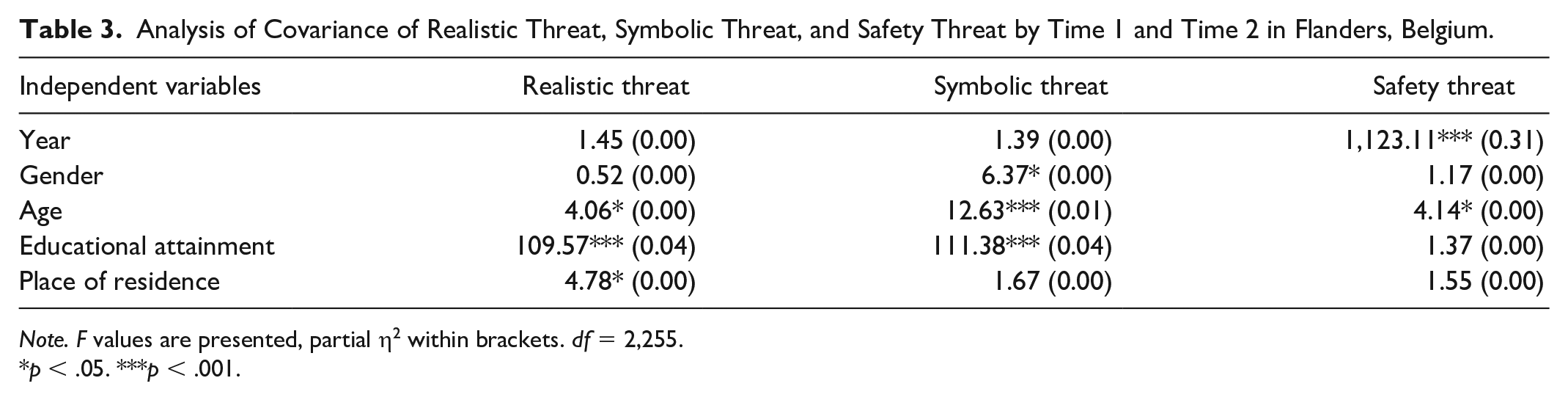
Note. F values are presented, partial η2 within brackets. df = 2,255.
p < .05. ***p < .001.
The results in Figure 1 indicate that in terms of perceived realistic threat and symbolic threat, no notable shifts emerged between both measurements. In 2017, women seemed to experience greater perceived realistic threat and lower symbolic threat than men. By 2018, women seemed to perceive less threat. However, interactions between timing and gender did not reveal any significant associations with these types of threat. Age effects point to a positive relationship between age and threat perceptions (i.e., the older the respondent, the higher their perceived realistic and symbolic threat), although this declines somewhat as respondents get older in 2017. In 2018, this is no longer the case, and we found that older respondents had greater levels of realistic and symbolic threat than young respondents. Results on the relationship of educational attainment with threat perceptions indicated that in 2017, the lower educated perceived the highest levels of threat, and the most highly educated perceived the lowest levels of threat. This pattern largely remained the same in 2018, with the sole exception that it was now those with a lower secondary education who experienced the highest levels of both types of threat. Regarding place of residence, residents of West Flanders held the highest levels of realistic threat in 2017. These levels dropped considerably over the course of the next few months, leading to inhabitants of Limburg experiencing the highest levels of perceived realistic threat by mid-2018. Perceived symbolic threat appeared to be highest in Limburg in both 2017 and 2018.

Realistic threat, symbolic threat, and safety threat by gender, age, educational attainment, and place of residence in 2017 and 2018 in Flanders, Belgium.
Next to this, we also noted a strong increase in perceived safety threat. We identified no gender differences at either measurement. Concerning age, we found that safety threat decreased by age in 2017. By mid-2018, this relationship had shifted, and the results now indicate that older respondents were more afraid of crime than younger respondents. A similar pattern was found for educational attainment. Whereas in 2017, highly educated individuals were found to hold more safety threat than lowly educated, this pattern has reversed by 2018. Differences in safety threat between provinces were limited at either measurement.
Discussion
This study compared threat perceptions toward refugees of adults in Flanders, Belgium, from September/October of 2017 with those from June/July of 2018. The results show that Flemish adults report greater safety threat over the 10-month period of observation. We believe that two factors are key in explaining this shift. A first is the extensive news media coverage of the new dimension of the refugee crisis related to transit migrants. The numerous news reports of unsafe and violent situations created by refugees attempting to stow away on trucks or buses near busy highways—many of which people use daily—could be related to such fears. To illustrate this point, we performed a search on Nexis Uni, a digital databank that provides access to more than 17,000 print and online newspapers and journals, television and radio broadcasts, newswires and blogs, and extensive legal sources, using the keywords “highways” and “transit migrants.” The results of this search indicate that between October 1, 2017, and October 1, 2018, Flemish newspapers published 69 articles containing these words, often focusing on the dangerous situations that occur as a result of these migrants’ presence and activities on Flemish highways. From October 2016 to October 2017, only a single article was written about this in Flemish newspapers, while a search from October 2018 to October 2019 yielded 35 articles. Given the spike in news articles on transit migrants in the year that this study was conducted and the negative evolution of attitudes toward refugees, we encourage news media to take a more nuanced stance toward transit migrants. As Boomgaarden and Vliegenthart (2009) have shown, the way media frame certain societal themes affects the public’s attitudes toward them. We suggest, with these results, that these attitudes can change over a relatively short period of time which perhaps indicates that the effect of news media on threat perceptions has so far been underestimated.
Second, and closely related to the first, we must look at the central position that themes such as security and crime took in electoral campaigns. It is possible that election rhetoric, where political parties attempt to fire up their base on their key themes, has contributed to this. The N-VA, being a conservative party, heavily emphasizes these elements of (in)security in migration, which resonates more with older and lower educated individuals (Jacobs et al., 2017). These findings are in line with much of the literature on group differences in attitudes toward migration or newcomers (Chandler & Tsai, 2001; De Coninck, 2020). The fact that N-VA remained one of the leading political parties in Flanders in the October municipal elections, along with the increased share of votes for far-right party Vlaams Belang (Vlaamse Overheid, 2018), supports the claim that the Flemish population is influenced by elements which these parties emphasize.
Perceived realistic and symbolic threats have not or only slightly evolved between T1 and T2. Again, gender differences are limited, but we do find that older and lower educated respondents report higher degrees of threat than younger and higher educated respondents. An explanation for these evolutions (or lack thereof) may again be found in media coverage of the then upcoming elections. As noted, migration, security, and crime had become major talking points in the public debate (Saerens, 2018). Literature also states that subjects, which are widely covered in news media, are perceived as more important by the public (Boomgaarden & Vliegenthart, 2009; Dunaway et al., 2010; Schlueter & Davidov, 2013). Realistic threat, which is related to issues on job security and the national economy in this study, hardly shifts as reports also reached the public that national and regional economies were doing very well, with declining unemployment rates, a record number of job openings, and increased economic growth (Statistiek Vlaanderen, 2018).
It is interesting to note that while realistic and symbolic threat hardly evolved between T1 and T2, there is a clear increase in safety threat between T1 and T2. While studies traditionally include elements of safety threat in the operationalization of realistic threat (Stephan et al., 2009; Zárate et al., 2004), our findings may point to a greater divergence between threat perceptions than commonly assumed, especially when attitudes toward refugees are investigated. This follows Landmann et al.’s (2019) study where the authors distinguished no less than six different types of threat perceptions in Germany. They emphasize that concerns about criminal acts (i.e., safety threat) predicted general attitudes towards refugees particularly well [. . .], presumably because they constitute the most existential form of threat. Concerns about out-group members’ criminal acts, however, are usually merged with realistic threat items [. . .]. To better account for the high impact of safety threat and its existential nature, this form of threat should be considered as a unique threat type. (Landmann et al., 2019, p. 1415)
Although our study is innovative in the sense that we have measured changes in threat perceptions over the course of 10 months, some limitations should be noted. As mentioned in our methodological overview, we distributed an online survey to the Belgian adult population. A first limitation here is that, given our repeated cross-sectional design, respondents at T1 and T2 are different. This being said, sociodemographic characteristics in both samples do not differ significantly except for educational attainment (see Table 1). With this concern in mind, it should also be stressed that we cannot generalize our findings to a wider population than those of Flanders, as the specific local conditions may have led to our findings. However, our results may inform other studies using similar designs, as we indicate that intense media coverage of a specific subject does affect public opinion, especially in the context of an electoral campaign. In addition, while we measured realistic threat through three items, symbolic threat and safety threat were measured through a single item each. However, previous studies have shown that single-item measures are often more unreliable and invalid than multi-item measures (Bergkvist & Rossiter, 2007; Sarstedt & Wilczynski, 2009). In light of this, the results for these constructs should be interpreted with caution, and future research would benefit from adopting multi-item measures for all threat perceptions.
Our study identified an increase in safety threat betweenT1 and T2, but we cannot say with certainty whether this decline has been steady, or whether these perceptions have alternately decreased and increased between measurements. Therefore, it is recommended to set up research that measures these attitudes monthly over prolonged time frames. Although our study adds to literature on attitude evolution in Flanders, we recommend that future research adopts an (inter)nationally comparative research design. Aside from the European Social Survey and Eurobarometer, which also use repeated cross-sectional designs, no surveys measure attitudes toward migration longitudinally. It seems especially vital now, during a time in which attitudes on minority groups are shaping election results and governments, that scholars should attempt to map and contextualize these evolutions. By comparing Flemish attitudes with those of other countries or regions, further insight could be gained in understanding how attitudes on minority groups evolve. Including important drivers of attitude formation on minority groups, such as news media consumption, could reveal an even more important picture which may aid in the development of policies.
Conclusion
In this article, we wanted to investigate how threat perceptions change over the course of 10 months (from September/October 2017 to June/July 2018) in Flanders, Belgium. Safety threat was found to vary between measurements, as it significantly increased over the 10-month period of observation. We suggest that a higher frequency of media coverage on the refugees in the Flemish region, which often focuses on violent incidents, and the increased attention that the refugee issue has received in light of the (at that time) upcoming municipal elections have contributed to the observed shifts in attitudes and threat perceptions.
Supplemental Material
sj-docx-1-sgo-10.1177_21582440211036884 – Supplemental material for What a Difference a Year Makes: Changes in Refugee Threat Perceptions in Flanders, Belgium
Supplemental material, sj-docx-1-sgo-10.1177_21582440211036884 for What a Difference a Year Makes: Changes in Refugee Threat Perceptions in Flanders, Belgium by David De Coninck and Willem Joris in SAGE Open
Footnotes
Declaration of Conflicting Interests
The author(s) declared no potential conflicts of interest with respect to the research, authorship, and/or publication of this article.
Funding
The author(s) disclosed receipt of the following financial support for the research, authorship, and/or publication of this article: This research was supported by funding from the Belgian Science Policy Office (BELSPO), as part of the framework program Belgian Research Action Through Interdisciplinary Networks (BRAIN-be), through the contract number BR/165/A4/IM²MEDIATE.
Ethical Statement
This study was approved by the Social and Societal Ethics Committee of KU Leuven (G- 2017 07 854).

Supplemental Material
Supplemental material for this article is available online.
References
Supplementary Material
Please find the following supplemental material available below.
For Open Access articles published under a Creative Commons License, all supplemental material carries the same license as the article it is associated with.
For non-Open Access articles published, all supplemental material carries a non-exclusive license, and permission requests for re-use of supplemental material or any part of supplemental material shall be sent directly to the copyright owner as specified in the copyright notice associated with the article.
