



Abstract
Safety is an essential public good, more so in urban locales, and it has become imperative to understand safety in the city from the perspectives of diverse city dwellers. This paper explores young people’s perspectives on safety and its promotion in the city, using a group of young people in St. John’s, Newfoundland and Labrador (NL). The study answers the question, what are young people’s perspectives on safety and safety promotion in the city? A conceptual framework on safety promotion and discourse analysis methodology informed the design and conduct of the study. Following purposive sampling, 23 young people aged 15 to 24 years participated in face-to-face interviews and data were analyzed deductively and inductively to identify themes. Three themes emerged which constitute participants’ safety discourse as follows: 1. Safety as essential for health and wellness—portraying safety as mental, physical, and social health; 2. Safety as threatened by behavioral and environmental factors; and 3. Safety promotion as personal and public responsibility—where individuals must act responsibly and leaders must invest in public safety measures. Consistent with the character of discourse, participants constructed safety as fundamental to human health, frowned upon behaviors and practices that threaten safety, and allocated responsibility for safety promotion. Male and female participants alike shared the view that safety is essential for health and wellbeing, and that promoting safety should be the collective responsibility of individuals and public leaders. On threats to safety, although female and male voices were represented, male participants were predominant in identifying factors related to traffic violations, criminal activity, and other forms of public nuisance. Findings of this study have implications for the empirical literature and for practice. The findings indicate that young people have a nuanced understanding of safety and are able to provide relevant suggestions on how to promote safety in the city. Their safety discourse identifies important threats to safety which, if addressed, will promote individual and collective feelings of safety. Consistent with what is known of discourses, the safety discourse aims to sanitize the community environment, to monitor and discipline individual behavior, and to shape institutional policies and practices.
Plain language summary
The study answers the question, what are young people’s perspectives on safety and safety promotion in the city? A conceptual framework on safety promotion and discourse analysis methodology informed the design and conduct of the study. Following purposive sampling, 23 young people aged 15-24 years participated in face-to-face interviews and data were analyzed deductively and inductively to identify themes. Three themes emerged which constitute participants’ safety discourse as follows: 1. Safety as essential for health and wellness portraying safety as mental, physical, and social health; 2. Safety as threatened by behavioral and environmental factors; and 3. Safety promotion as personal and public responsibility where individuals must act responsibly and leaders must invest in public safety measures. Consistent with the character of discourse, participants constructed safety as fundamental to human health, frowned upon behaviors and practices that threaten safety, and allocated responsibility for safety promotion. Male and female participants alike shared the view that safety is essential for health and wellbeing, and that promoting safety should be the collective responsibility of individuals and public leaders. On threats to safety, although female and male voices were represented, male participants were predominant in identifying factors related to traffic violations, criminal activity, and other forms of public nuisance. Findings of this study have implications for the empirical literature and for practice. The findings indicate that young people have a nuanced understanding of safety and are able to provide relevant suggestions on how to promote safety in the city.
Keywords
Introduction
Globally, safety and how to control risks or threats to safety have become an important topic for policy analysts, politicians, professionals, and public health scholars (Beck, 2006; Bodson et al., 2008; Maurice et al., 1997). The reason is that, on one hand, safety is perceived as an essential public good that is fundamental to wellbeing and, on the other hand, there is the perception that threats to safety have multiplied in today’s society (Beck, 1992, 2006; Chernilo, 2021; Jarvis, 2007; Jong, 2022). Beck (1992, 2006), in his “world risk society” thesis, is one of the scholars who have contributed to the view that risks to safety have increased in scope and it is imperative to understand and control them. Community welfare scholars and policy makers discuss safety in relation to family and community life, the workplace, schools, and sports and recreation (Bodson et al., 2008; Crawford, 1998; Whitzman, 2008; Wilcox, 2006). These safety discourses usually implicate young people in a paradoxical way; young people are either “at risk” and need protection (Public Health Agency of Canada, 2019; Turnbull, 2016) or they constitute a threat to safety in the community and should be controlled (Childs et al., 2011; Dembo et al., 2010; Francis, 2021; Goldsmith, 2006; N. Hughes, 2011; Kennelly, 2011; Murray et al., 2021; Ricciardelli et al., 2020). For example, while child protection policy emphasizes the safety and protection of young people (Marit & Rami, 2022; United Nations, 1989), Goldsmith (2006) has discussed the “widespread perception that more crime is committed by young people and that the crimes they commit are now more serious” (p. 16).
The purpose of this paper is to explore young people’s perspectives on safety and safety promotion in cities as discourse. The study uses a qualitative exploratory approach and draws on principles of discourse analysis (Fairclough & Wodak, 1997). Rather than see young people as a group that is either at risk or that poses a threat to safety, the aim is to tap into their knowledge to broaden our understanding of safety and safety promotion. The main question of the study is: what are young people’s perspectives on safety and safety promotion in the city? This question is broken into four interrelated questions: how do young people define safety; what factors influence safety in their neighborhoods; what do they do to keep safe; and what do they think should be done to promote safety? The rationale for this study is its ethnographic convenience as well as its empirical and practical significance. Although the question is relevant for Canada as a whole, we heeded the ethnographic imperative to “dig where you stand” (Lindqvist, 1979) by working with young people in NL as the starting point of the exploration. Here, we are digging into issues of safety in the city from the experiences and perspectives of young city dwellers. NL has a small population, about half-a-million, of which youth (aged 15–24 years) constitute about 11% (Government of Newfoundland and Labrador, 2022). Interestingly, however, NL is ahead of the federal government in creating policy structures that tap into young people’s knowledge to promote public health and safety. Canada’s Youth Policy was launched only recently in 2019 (Government of Canada, 2020). In contrast, the NL Youth Advisory Committee (YAC) whose mandate is to ensure “that all youth in the province enjoy the highest level of safety and security, have a high standard of education and health and are engaged in the economic and social life of the province” (Newfoundland & Labrador Youth Advisory Committee, 2009, p. 6) was initiated over 2 decades ago. In addition, in 2017, the Premier’s Youth Council was established with the goal of bringing “a youth perspective to topics important to youth and the Government of Newfoundland and Labrador” (Premier’s Youth Council, 2019, p. 2). The foregoing suggests that NL provides a good ethnographic ground to explore the stated question with young people. Here, St. John’s, which is a relatively small provincial capital city, serves as a microscope to look at safety in cities through the eyes of young city dwellers. The study is also justified on the basis of its empirical and practical significance. Given that we are not aware of any similar prior/recent exploration in the NL context, the study will contribute to empirical knowledge on the topic and inform interventions on safety in the city.
Literature Review
Young people’s perceptions of and concerns about safety in their neighborhoods is a growing area of qualitative and quantitative empirical scholarship. In this section, we provide a brief review of current literature on the topic and point out how the present study adds to the literature. Current research with youth has identified themes on what makes young people feel safe or unsafe in the community. These themes relate to features of the physical environment, road traffic system features, public safety practices, and social cohesion factors (Carver et al., 2009; De Wet et al., 2018; Johansson et al., 2012; Russell et al., 2023; Slaato et al., 2023; Yang, Liller, Tyson, et al., 2022). Regarding the physical environment of the community, research shows that young people perceive cleanliness, functional lampposts, and fire hydrants among others as safety enhancing whereas they perceive an environment filled with litter and trash and dysfunctional lampposts and fire hydrants as unsafe (Yang, Liller, Coulter, et al., 2022; Yang, Liller, Tyson, et al., 2022). Perceived road traffic safety is another important factor in young people’s concerns about safety in their neighborhoods (Carver et al., 2009; Johansson et al., 2012; Yang, Liller, Tyson, et al., 2022). The research shows that proper road features such as stop signs, pedestrian lights, clearly marked walking tracks, speed bumps and speed limits, intersection density, and traffic lights are associated with perceived safety among young people (Carver et al., 2009; Johansson et al., 2012; Yang, Liller, Tyson, et al., 2022). The connection is that whereas observance of these features enhances feelings of safety, traffic violations resulting, for example, from drunk driving are threats to safety for young people (Johansson et al., 2012). Related to this, Carver et al. (2009) have reported that improved traffic safety is associated with increased use of “active transport” among youth. Active transport is defined as “walking” or “biking” to various destinations in the neighborhood (Carver et al., 2009). Indeed, some research has shown that perceived neighborhood safety overall is associated with increased child outdoor physical activity (Nicksic et al., 2018; Saimon et al., 2015). However, the relationship between feelings of safety and participation in neighborhood activities may not be a one-way traffic from safety to participation, as Musai et al. (2013) have reported that social participation increases feelings of safety. This finding suggests that feelings of safety and social participation may be mutually reinforcing.
Community social cohesion factors also shape young people’s perceptions of safety (Allik & Kearns, 2017). The presence of supportive people, opportunities for social inclusion, and the absence of conflict or crime promote feelings of safety among youth, whereas an atmosphere of conflict, crime, drug use, and fights where weapons are within easy access is perceived as unsafe (De Wet et al., 2018; Johansson et al., 2012; Nicksic et al., 2018; Russell et al., 2023; Slaato et al., 2023; Yang, Liller, Coulter, et al., 2022; Yang, Liller, Tyson, et al., 2022). For example, conflict, crime or fights in which weapons may be used may induce the fear of harm on the way to or from school, work, or recreation centers and, therefore, may affect youth’s health and participation in school and other activities (De Wet et al., 2018; M. R. Hughes et al., 2015; Nicksic et al., 2018). Regarding safety and health, research has found that “Lower general feelings of safety” in an atmosphere of “higher rates of violent crime” are “associated with worse self-rated health” (Putrik et al., 2019). In addition, young people feel unsafe in the face of gang activities and people perceived as pedophiles or rapists (Johansson et al., 2012; Nicksic et al., 2018; Yang, Liller, Coulter, et al., 2022). Youth have also identified some behaviors and attitudes that adults put up which make them feel unsafe. These include negative comments, intimidation, being judgmental, and prejudice and discrimination based on gender, sexuality, ethnicity, and age (Nicksic et al., 2018; Russell et al., 2023; Sykes et al., 2017). Sykes et al. (2017), for example, found in their adolescent sample that discrimination based on ethnicity or race was a significant marker of a perceived unsafe neighborhood with low social cohesion. Other studies (M. R. Hughes et al., 2015; Zuberi, 2018) have found that youth feel safer in neighborhoods with low violence and high “protective social ties,” although “social connections can also tie youth to violence… which threatens their perception of safety” (Zuberi, 2018, pp. 90–91).
“Public safety” is another theme that features in young people’s perceptions of safety in rural and urban settings (Yang, Liller, Tyson, et al., 2022). Public safety factors are distinguished from community physical environmental factors because they have more to do with what is provided on a daily basis to make people feel safe (i.e., to know that help is available as and when needed to keep safe). In this regard young people have pointed to availability of an emergency contact line (e.g., 911), presence of police personnel and security guards, fire departments within close proximity, and security systems for homes and public buildings as public safety factors that promote their sense of safety (Doyle et al., 2016; Yang, Liller, Tyson, et al., 2022). Doyle et al. (2016), for example, found that the presence of uniformed security personnel, especially foot patrol police officers, significantly increased feelings of safety.
The brief review shows that there is important literature on what makes young people feel safe or unsafe in their neighborhoods. This literature provides grounds on which new research will build. More importantly, however, studies that include questions on how young people define safety, what they do to keep safe, and their views on safety promotion are in short supply. The current study fills this gap in the literature, especially in the context of NL where there is no known previous research on the topic.
Theoretical Perspective
The safety promotion (SP) perspective (Maurice et al., 1997) provides a framework for understanding young people’s perspectives on safety and its promotion in this study. The SP perspective defines safety as “a state or situation devoid of physical, material or moral threats, which must lead to a perception of being sheltered from danger” (Maurice et al., 1997, p. 181, italics in original). The framework identifies two dimensions of safety: real safety (RS), which registers “objective behavioral and environmental” incidents and perceived safety (PS), which refers to subjective feelings of being safe (Maurice et al., 1997, p. 181). SP links safety to health, positing that behavioral and environmental factors have a combined effect on safety, which in turn influences health and well-being (Maurice et al., 1997). SP also outlines three conditions for the guarantee of personal and public safety. The first condition is a “Climate of social peace.” This requires that communities, groups, countries, races, etc. co-exist harmoniously without recourse to violence. The second condition is “Control of dangers related to injuries.” This calls for behaviors and environments that prevent occurrences of bodily harm or deprivation to individuals. The third condition is “Respect for the physical, material or moral integrity of people,” which refers to a state of absence of crime or violence, or “the harmonious and non-violent co-existence of individuals in a community” (Maurice et al., 1997, p. 182). The SP model further outlines two approaches to safety promotion; a “problem-oriented approach” and “setting-oriented approach” (see Maurice et al., 2001 for an extension of the model). The problem-oriented approach takes measures to identify and prevent specific safety risks such as traffic-related risks and violence, whereas the setting-oriented approach implements interventions that “improve the real and perceived safety of citizens” (Maurice et al., 1997, p. 183).
In addition to the SP perspective, the study draws on the community safety (CS) framework (Squires, 2006; Whitzman, 2008; Wilcox, 2006). According to Wilcox (2006, p. 62), a CS approach is preferred to notions of crime prevention because it is more inclusive; “referring not only to crime in the community but also to wider socioeconomic issues.” Similarly, Crawford (1998) has conceptualized CS as an approach that guarantees safety by tackling “wider social problems such as fear, anxieties, and other quality of life issues” at the local level and through a partnership between “relevant public, voluntary and private sector organizations and community groups” (p. 238). Whitzman (2008) provides a further elaboration on the CS approach. Whitzman (2008) explains that CS is about the prevention of all forms of injury and harm, and the protection of people from hazards and threats emanating from criminal and anti-social behaviors, both intentional, such as violence and crime, and unintentional, such as road traffic and other accidents. CS also includes efforts that equip individuals and groups to deal with threats they face in daily life (Whitzman, 2008).
Both the SP and CS are ecological systems theory approaches (Bronfenbrenner, 1979). According to Bronfenbrenner (1979), the community is an ecological system consisting of three main system levels; the micro system, the mezzo system, and the macro system whose interactions shape individuals’ development, health, and wellbeing. These perspectives suggest that safety and threats to safety are experienced at the micro level of individuals and families, the mezzo level of neighborhoods and social networks, and the macro level of cultural beliefs and institutional policies and practices. According to the systems theoretic perspective, therefore, safety promotion requires the mobilization of resources and energies to effect changes at the interfaces between the micro, mezzo, and macro levels. These perspectives should help us make sense of what young people think about safety and safety promotion in their given social context.
Study Context—St. John’s, NL
As stated earlier, we are digging where we stand, St. John’s, NL, in the exploration of young people’s perspectives on safety and its promotion in the city. St. John’s is the capital and the largest city in the province of NL, and holds the reputation of being the oldest European settlement in North America. St. John’s is a harbor city, with a current estimated population of 110,525 and a median individual income of $40,000 (Statistics Canada, 2022). Of the city’s population, nearly 52% are women+ and 12.5% are young people aged 15 to 24 years (Statistics Canada, 2022). Being a port city, the hub of the province’s offshore oil and gas industry, and home to the only University in NL, St. John’s is a top destination for business people, students, and tourists alike. As a result, the city’s population is gradually changing from being predominantly White to becoming racially and culturally diverse. Downtown St. John’s is well known for the colorful row houses, the hastle and bustle along the historic Water Street, and the vociferous nightlife on George Street. The town of Paradise and the city of Mount Pearl are neighbors to and share a public transit system with St. John’s.
In the area of crime and safety, St. John’s is perhaps not notorious. A 2014 survey showed that 86% of St. John’s residents were satisfied with safety, compared to 88% for Canada (Statistics Canada, 2020). Statistics Canada (2020) also shows that, in a 10-year period (2008–2018), police-reported crime rate for St. John’s decreased by 18%, compared to a 17% decrease for Canada. However, the report also shows that in 2018 police-reported overall crime rate for St. John’s was within the same range as the rates for NL and for Canada, and that 1,434 incidents of violent crime per 100,000 population were reported by police in the city, compared to 1,143 such incidents per 100,000 population for Canada (Statistics Canada, 2020). The foregoing suggests that there are safety concerns in St. John’s, which the current study will explore from youth’s perspectives.
Methods
The study was designed as a qualitative exploratory research and used discourse analysis approaches (Berdychevsky et al., 2016; McMullen, 2011; Potter, 2004; Willig, 2003). Discourse is described as the social construction of reality through the medium of language and communicative practices (Foucault, 1972). According to Foucault (1972), discourses shape how individuals and groups think, behave, and act by claiming a special knowledge about some aspects of social life. This study therefore explored how young people define safety, how they describe factors that influence safety in their neighborhoods, and how they talk about what should be done to promote safety as discourse. Participants’ responses were analyzed and interpreted following principles of discourse analysis (Berdychevsky et al., 2016; Fairclough & Wodak, 1997; McMullen, 2011; Potter, 2004; Willig, 2003).
Participants
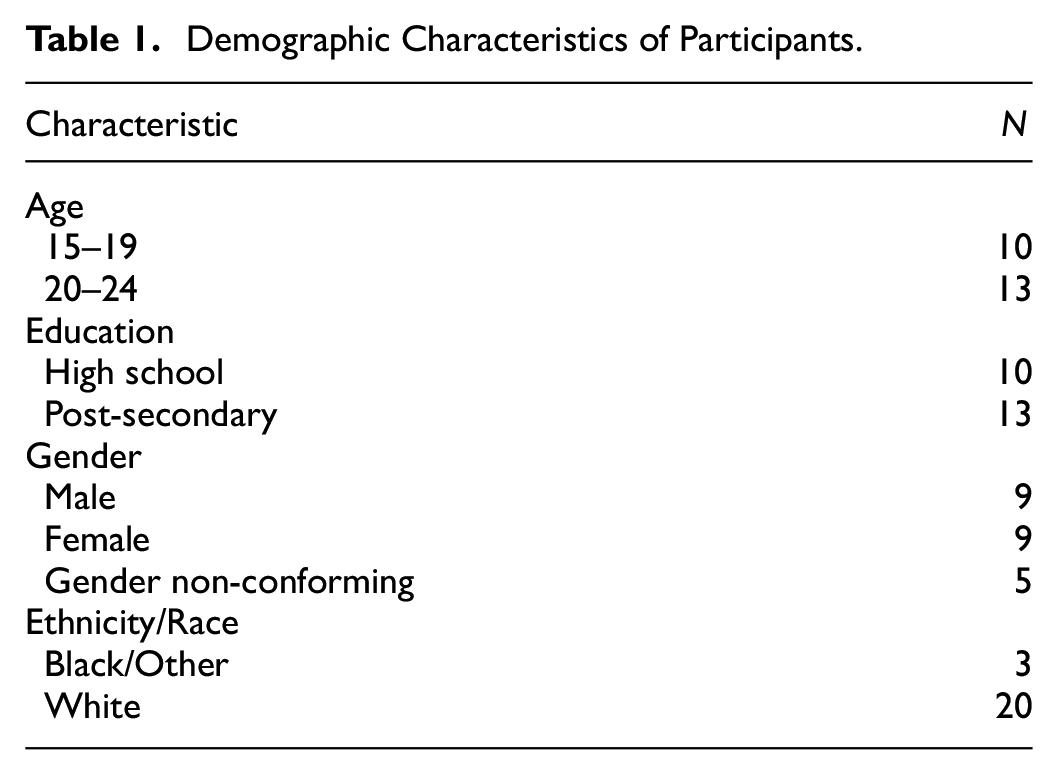
Based on availability and purposive sampling, the study recruited 23 young people aged between 15 and 24 years from St. John’s, Mount Pearl, and Paradise. Posters inviting interested youth to participate in the study were placed at community centers, mall entrances, and premises of youth serving organizations. The posters included contact details of the Principal Investigator (PI) so that prospective participants could call to indicate their interest. There was also a field outreach to community centers and other locations, where we solicited participation. The sample of 23 consisted of 8 youth who called to express interest and assessed as suitable, and 15 youth recruited during field outreach. The sample included youth in high school and postsecondary school, male, female, and gender non-conforming youth, and White and minority youth. Five of the participants had part-time employment, one identified as a sex worker, and one was a nursing mother. Table 1 provides more information on the sample.
Demographic Characteristics of Participants.
Data Collection
Data were collected from April to August 2019, through audio-recorded semi-structured interviews. Following transcription the transcripts were audited for completeness and anonymity. The interviews focused on the four questions stated above. Two youth-friendly agencies provided private rooms for the interviews. These agencies provide opportunities for young people from diverse backgrounds across the city to engage in extra educational and recreational activities. Interviews lasted an average of 50 minutes and were conducted in English. All participants gave consent. Ethical clearance was obtained from the PI’s home university (ID #20180353-SW).
Data Analysis
The transcribed data were imported into NVIVO 12 software and data were analyzed deductively and inductively following the steps and strategies outlined by McMullen (2011). The transcripts were read a number of times. This enhanced familiarity with the data and gave a sense of what participants were saying and how they were framing their answers. Based on this familiarity, key phrases regarding how participants described safety and factors that influence safety, and how they assigned responsibility for safety promotion were extracted and assigned preliminary codes. The extracted data were then subjected to “intensive analyses” with a set of guiding questions as follows: how is safety related to physical and emotional health and to social relations; what should be absent or present for people to feel safe; how do behavioral and environmental factors feature in statements on factors that influence safety; what specific behaviors and environmental issues influence safety; and how are participants presenting themselves in relation to behaviors that threaten safety? Other questions were: who is/are identified as having responsibility for safety promotion, how do participants justify the allotment of responsibility, and what specific instructions or suggestions do participants provide for safety promotion? Open and axial coding and concepts from the SP and CS perspectives helped to organize the data into meaningful units and patterns (see Table 2), and to summarize main themes for interpretation. The process produced an empirical set of claims that is presented as a safety discourse. The three themes of the discourse are: 1. Safety as essential for health and wellness; 2. Safety as threatened by behavioral and environmental factors; and 3. Safety promotion as personal and public responsibility.
Coding of Data on What Safety Means, Threats to Safety, and Safety Promotion.

Findings
Figure 1 illustrates participants’ safety discourse. It highlights the significance of safety for health, factors that threaten safety’, and responsibility for safety promotion.

Discourse on safety in the community.
Safety as Essential for Health and Wellness
Participants described safety as something connected to health and essential for everyone. They posited that safety is a state of emotional, physical, mental, and social health, which thrives in an atmosphere of social harmony, control of dangers, and respect for personal integrity. The following are illustrative of this construction of safety: Safety exists on many different levels… Cos you can be safe physically somewhere, but it can be a very toxic place mentally to be. So, it’s lot of different levels of feeling secure, comfortable, open and relaxed. (Female, 22 years). Safety means to feel comfortable wherever you go, really. (Female, 20 years). Safety is protection and to feel secure and not have to worry about anything… You know, not just physical safety but like mental stuff too. (Gender non-conforming, 19 years).
Participants further illustrated how a climate of social peace is essential for safety and wellbeing by connecting safety to the presence of trustful people, clear rules and regulations, and law enforcement: Safety is where you are surrounded by allies. Safety allows you to express your emotions and speak your mind. (Female, 19 years). … it is surrounding yourself with people who will encourage you, that will make you feel like, ooh, you don’t need to be afraid. (Male, 18 years). The police make it safe for us. Their presence to enforce the rules of the roads ensures that you feel safe. (Female, 17 years).
However, contrary to what the preceding quote posits, one participant regarded police presence not as a sign of safety but of insecurity: I see the police routinely on my street and that is not good. So, safety in my community means absolutely nothing. (Male, 23 years).
Safety as Threatened by Behavioral and Environmental Factors
Participants identified threats to safety as behavioral and environmental in nature. From their perspectives, behavioral factors are intentionally or otherwise enacted behaviors that threaten perceived or real safety. Among these factor include inappropriate disposal of dangerous litter, assault, harassment, homophobic acts, and stalking: Broken glass on the road. Syringes and needles on the road. There is no valid excuse in my eyes to leave an exposed needle. What is so enticing about walking home drunk and smashing your bottles on the sidewalk? Or chucking it and leaving it on the curb and then someone gets a flat tire because of your carelessness? (Male, 23 years). I am afraid of being attacked for who I am and who I identify as. It is very scary not only to be attracted to the same sex, but also to identify as a different gender than I was assigned at birth. Several times when I am walking home from the store, people driving by yell out slurs at me. It is not a nice experience. (Gender non-conforming, 21 years).
Road traffic violations resulting from drug use and theft or property crime are other behavioral threats to safety identified by participants. Concern over these was predominant among male participants. For example: I guess my type, not now, but the type of people that are high and tuff. So, I know a lot of people drive high or do things high like that and that’s very scary and it’s putting everybody’s safety at risk. (Male, 21 years). Sometimes, when I am walking around and people are driving pass, for sure, I am scared. This is because I have been in a car accident before. I got hit by a car. (Male, 18 years). As far as I know, when it comes to blue crimes, robbery and theft, we are probably up there in the top 5. There is a young couple, probably just a few years older than me, and they are going around literally holding people up and robbing them, here in St. John’s. (Male, 20 years).
One participant identified “crazy” behavior at nighttime as a unique threat to safety: You know, nighttime is a lot worse than daytime because that is when all the crazy people come out. People are either drunk, mentally crazy or something else. (Male, 19 years).
Participants also identified factors related to the physical environment and public safety factors that influence safety. Environmental factors included poorly lit streets, snow covered sidewalks, streets without bicycle lanes, and absence of surveillance cameras at hot spots. There was the strong sense that these threats are particularly of concern at nighttime: What I will think about is that in some areas, we have less lighting than others do and then maybe for example somebody is walking alone and they feel unsafe in a more darkened area. (Female, 19 years). I feel like the nighttime is scary because less people are around and some areas have poor lighting. That is why it does not feel safe for me. (Female, 18 years). You could get killed while going out at night. (Male, 18 years).
Safety Promotion as Personal and Public Responsibility
Responsibility for safety promotion encompasses what participants would do to keep safe, what they would advise others to do to keep safe, and what they think public leaders should do to promote safety overall. On one hand, participants argued that individuals must avoid anything that jeopardizes their safety, and must take measures to keep safe when their safety is on the line. On the other hand, they proposed that public leaders need to take safety enhancing measures and to enlist the cooperation of individuals and other stakeholders in building a safety culture. In participants’ reasoning, individuals should be safety conscious by practicing risk avoidance and self-defense: I don’t walk alone after dark, typically. Unless I absolutely have to. I tend to avoid any altercation with people if they are in an elevated state; like if they are frustrated or hungry. (Male, 19 years). If anyone is involved in drugs and alcohol, it kind of changes the thought process and all that. If it affects someone in a negative way, then they can definitely cause harm or put themselves in a vulnerable situation. (Male, 21 years) Like if I am going to a party and I know there is going to be drugs there, then I am probably not going to that party. Like that is my way of protecting myself. (Female, 20 years). I have discussed taking self-defence course with my partner, just in case anything comes up. I maintain a certain level of fitness so that I can protect myself even without the self-defence course. But I also generally avoid places that I feel unsafe going to. (Female, 23).
One participant took the notion of self-defense a step further: I don’t know if I should even say this. However, before, I wouldn’t leave my house without having my pocketknife on me. You know. I wouldn’t go around showing it to people or something, but it is the only thing that made me feel safe. (Male, 24 years).
Participants further suggested that individuals should be prosocial by, for example, not isolating themselves or not keeping where they go or what they do secret: Tell family where you are going and when you are to leave and get into a car. Tell them where it is and who you are going to be with. This, I think, provides safety for yourself and others. (Male, 20 years). Somebody shared that maybe, especially in the night if they have to walk the street, they pretend to be on the phone. And, yes. I have done that many times. Sometimes, I usually call my mom. I will say hey mum, give me 5 minutes. And then we will talk on the phone for some time. (Female, 22 years).
In addition to individual action, participants argued that public leaders need to take action to promote safety. First, municipal governments should clamp down on illegal drug use and traffic violations and control criminal and anti-social activity.
More awareness around cannabis use and drunk driving focused on the youth. I have been to Cannabis NB in New Brunswick and they also do that, they are like, hey by the way, here is a piece of paper. Don’t drink and Drive. (Female, 24 years). …training against bullying should be part. Teachers should go through maybe yearly training to deal with uncontrollable situations in school. (Male, 20 years). …campaign against sexism and homophobia which we face every single day. It’s like the patriarchy built it up for us to hate other women for no reason. I feel that sexism and gender discrimination are one that affects everything all the time. (Gender non-conforming, 21 years).
Further to the above, participants suggested facilities and services that should be put in place to enhance personal and public safety. Among the services, participants identified mental health counseling, drug rehabilitation, and outdoor recreation.
Some people may want psychologists and counseling, so that the children, they can lead them away from drugs, to try to open up and heal their wounds or something. (Male, 23 years). One thing, there should be more of, I guess, more of a watch on people who are being released from prison. They should definitely have more services on keeping them out of trouble. (Female, 20 years). …have more programs and stuff for people doing drugs and stuff like that. Probably, like rehab programs and stuff. I guess to have programs with presentations to show them what happens and what the effects of doing drugs have on people. (Female, 19 years).
Among factors related to public safety, participants suggested installation of more street lights and surveillance cameras as well as increased police patrol.
Definitely more police can be driving around and monitoring areas and seeing if there is anything suspicious or if anyone looks like they are up to no good. (Male, 19 years). …there is definitely a need for more police around and there isn’t really much of that right now. There should probably be cameras and stuff, like around downtown, where people will be driving like savages sometimes. (Male, 21 years). There could be more street lights possibly, and like cameras put somewhere hidden away to watch out for criminal activity. (Female, 20 years).
One participant emphasized the need for skills training for some individuals with unique life circumstances as something that would promote safety: …the government should fund as many programs that they possibly can to get young people interested in work. Something to help people who are stuck, especially homeless people. A lot of homeless people could take advantage of programs to try to better their lives and become active part of the community. (Gender non-conforming, 19 years).
Discussion
This study explored young people’s perspectives on safety and safety promotion as a safety discourse. The study drew on SP and CS perspectives (Maurice et al., 1997; Whitzman, 2008; Wilcox, 2006) and the broader ecological systems framework (Bronfenbrenner, 1979) to analyze this discourse in terms of how participants define safety, what they identify as threats to safety, what they do to keep safe, and what they suggest be done to promote safety in the context of St. John’s, NL. Twenty-three youth provided data that were analyzed for themes as presented above. The safety discourse among participants highlights the significance of safety, threats to safety, and responsibility for safety promotion, and the discussion is an attempt to help readers make sense of and interpret this discourse. Male and female participants alike shared the view that safety is essential by defining it as encompassing emotional, physical, and social health. Similarly, there was convergence between male and female participants in attributing responsibility for safety to individuals and public leaders. On threats to safety, however, although female and male voices were represented, male participants were predominant in identifying threats related to traffic violations, criminal activity, and “crazy” behavior. The sample was low on racialized participants, so we cannot tell how racialized youth construe safety differently or how they differ in their views on what threatens safety as reported in other studies (e.g., Brunson & Miller, 2006; Francis, 2021; Sharp & Atherton, 2007; Sykes et al., 2017) or how safety would be promoted. However, we can draw something from two participants who identified as gender non-conforming; one made references to “prejudice” and “racism” and their negative effects on safety, while another was concerned about being “attacked” or “harassed” for their minority identity status. This suggests that, as reported somewhere (Davis et al., 2009; Gower et al., 2021; Sykes et al., 2017; Wells, 2009), there are probably subtle and unique differences in perspectives on safety and in concerns over threats to safety between mainstream youth and youth of minority identities.
How do participants present the concept of safety in this discourse? Participants use emotion-laden terms such as comfort, happiness, mental health, and trust to describe safety. They also define safety as the presence of social relations that enhance this state of being and as the absence of incidents that jeopardize it, such as conflict, crime, and violence. It makes intuitive sense to argue that conflict, crime or violence will negatively affect health, and that the absence of these suggests the prevalence of healthy social (and interpersonal) relations. This discourse, as presented by participants, finds support in the SP and CS approaches, where safety requires a healthy social climate, harmonious co-existence, and protection against harm, hazards and threats (Maurice et al., 1997; Whitzman, 2008). Further, the connection between safety and health pointed out by participants is consistent with the position that safety “is an essential resource for everyday life, needed by individuals and communities to realize their aspirations” (Gard & Larsson, 2017, p. 360). It also corroborates studies that report that feeling unsafe is associated with poorer self-rated overall health (Putrik et al., 2019). Consistent with the notion that discourses create their objects of reference (Foucault, 1972), whether or not one agrees with participants, it is obvious that they are appropriating knowledge and vocabulary in current circulation to define safety for their given context, and that their ideas find support in the literature.
The threats to safety discourse finds support in the theoretical and empirical literature, as it identifies behavioral and environmental dangers to safety (Collins, 2001; Fabiansson, 2007; Gard & Larsson, 2017; Johansson et al., 2012; Maurice et al., 1997; Torner, 2008; Whitzman, 2008). For example, the empirical literature shows that fear of violence (Collins, 2001; De Wet et al., 2018; Fabiansson, 2007; M. R. Hughes et al., 2015; Russell et al., 2023; Zuberi, 2018) and the presence of unfriendly people or criminals (Johansson et al., 2012; Nayak, 2003) threaten youths’ safety and constrain their exploration of the community. Further, consistent with the discourse, current research shows that environmental and public safety factors such as poor street lighting, litter, poor road traffic features, and low police patrols are safety concerns in urban communities (Carver et al., 2009; Doyle et al., 2016; Johansson et al., 2012; Yang, Liller, Coulter, et al., 2022; Yang, Liller, Tyson, et al., 2022). The threats to safety discourse suggests that people feel unsafe in the absence of a “climate of social peace,” or when “dangers related to injuries” are not controlled, or when individuals’“physical, material, or moral integrity” is not respected, as required by the SP model (Maurice et al., 1997). However, the character of discursive practice comes out in participants’ discussion of threats to safety. In identifying threats to safety, participants use expressions that suggest blame, criticism, or faultfinding. On one hand, individuals are faulted for actions or behaviors that threaten safety. Some of these behaviors are assault, harassment, hate, robbery, and drunk driving. Others include inappropriate disposal of trash such as broken glass and used needles and condoms, and some individuals are constructed as appearing “sketchy” or “acting crazy.” On the other hand, municipal leaders are blamed for factors such as poor street lighting, low police patrols, lack of bicycle lanes, poor snow clearing on sidewalks, and lack of security cameras, which are perceived threats in the environment. Interestingly, the discursive agents are either absent from among those who are to blame or they are present but not at fault; as one participant suggested, even if they used to behave in similar ways, they no longer do so, “not now.” Here, participants are engaged in what we may refer to as subjective positioning and self-enhancement (Davies & Harre, 1990; Sedikides, 2021); they position themselves as an incorruptible knowledge authority with the moral right to evaluate others’ actions in relation to safety. Participants seem to have taken the position that someone else is implicated in the behaviors that threaten safety, which they have to point out as concerned observers.
The discursive self-enhancement of participants further reflects in their safety promotion discourse, which discourse we can understand in light of the theoretical and empirical literature on safety promotion and crime prevention (Dov, 2008; Gard & Larsson, 2017; Maurice et al., 1997; Torner, 2008; Whitzman, 2008). On the one hand, according to participants, individuals must act to keep safe by avoiding people, places, and things that threaten safety, and must defend themselves when in danger. On the other hand, public leaders must invest in public safety measures by providing programs to support vulnerable people and by improving on features of the built and physical environment. It seems that participants are encouraging the cultivation of a “safety climate,” which supports safety and health promotion (Gard & Larsson, 2017; Torner, 2008). Gard and Larsson (2017, p. 360) define a safety climate as “shared perceptions of policies and practices influencing safety.” They also conceptualize safety promotion as “the process by which individuals, communities, and others develop and sustain safety” by modifying “structures, contexts, attitudes, and behaviors related to safety” (p. 360). Further, the call on government to provide life enhancing programs for various individuals, including school dropouts, the homeless, and ex-convicts, and to improve public safety conditions is in line with the “problem-oriented” and the “setting-oriented” approaches to safety promotion (Maurice et al., 1997). It is also consistent with the CS approach’s emphasis on addressing socioeconomic and “quality of life” issues (City of Red Deer, 2016; Crawford, 1998; Whitzman, 2008; Wilcox, 2006).
Nevertheless, the selectivity and positionality in discursive practices continue in participants’ discussions of responsibility for safety promotion. Their allotment of responsibility follows the same logic as in the threats to safety discourse. Consistent with the argument that the behaviors of certain individuals are threats to safety, participants expect individuals to take responsibility for safety by giving up bad habits and by learning to keep safe. Their own experiences and efforts, such as avoiding drugs, not roaming the streets at night, avoiding raucous people, or practicing self-defense, serve as templates for others. An instance of this discursive self-enhancement (Davies & Harre, 1990; Sedikides, 2021) is where one participant talks about carrying a pocketknife for self-defense without reflecting on how such a weapon threatens others’ safety (although he adds the caveat “I don’t know if I should even say this”). In addition, there is the argument that some people are troublesome in the streets at nighttime. However, we do not know what participants themselves are doing or how they are acting in the streets at nighttime; whether they are innocent patrons of the night street life or they are birds of same feather with those who “act crazy.”
Similarly, according to participants, since public leaders are to blame for environmental factors that threaten safety, they must fix this by ensuring a climate of peace, controlling dangers related to injury, and implementing measures such as surveillance cameras, police patrols, street lighting, bicycle lanes, and snow clearing. Municipal leaders should also provide services that enhance perceived safety and wellbeing, such as mental health counseling, outdoor recreation, job skills training, public campaigns against drunk driving, and drug rehab programs. The significance of some of these measures to safety is perhaps obvious. For example, street lighting may improve perceived safety since one can see the way clearly or see what/who is approaching so as to take a precautionary action. Similarly, police patrols may enhance feelings of safety because patrol officers can quickly intervene in case someone is in danger (Doyle et al., 2016). However, it is not very obvious how security cameras influence feelings of safety. On one hand, perhaps people feel safe in the presence of surveillance cameras because they believe the camera will help to arrest anyone who attacks them or threatens their safety (Schuck, 2017). On the other hand, perhaps security cameras deter criminal behavior because of the fear that one may not escape arrest for a criminal behavior. Whichever way one looks at it, the discourse suggests that surveillance cameras are a technology that city administrators should deploy to promote feelings of safety.
Overall, the safety discourse makes sense in light of the ecosystems theory framework. At the micro level, on the one hand, the discourse instructs individuals not only to be safety conscious by watching where they go and whom they interact with, but also to stay away from illegal drugs, stop drunk/impaired driving, and stop engaging in other forms of criminal behavior. On the other hand, at the macro level, the discourse admonishes public leaders not only to provide surveillance, such as security cameras, police patrols, and street lighting, but also to provide programs that enhance well-being, such as counseling services, skills training, outdoor recreation, and drug rehab services. The discourse fits well within the logic of liberal democracy where personal responsibility and public accountability converge to guarantee safety and security for everyone (Hook & Markus, 2020; Queiroz, 2018; Wolterstorff & Cuneo, 2012). As scholars of political ideology have noted, liberal democracy requires that citizens act responsibly in their pursuit of happiness and that the state (represented by public institutions and leaders) “protect them [citizens] from serious violations of their natural rights by their fellow citizens or by foreigners” (Wolterstorff & Cuneo, 2012, p. 2).
Study Limitations
This study has some limitations of note. The sample was relatively small and participants were recruited from one city—St. John’s. In addition, the sample was predominantly White Caucasian and the majority were heterosexual female or male identifying youth. As a result, the perspectives of young people from other parts of NL or those of racialized youth and youth of other minority identities are not fully represented in the data. Therefore, readers need to interpret and apply the findings with caution.
Study Implications
This study has empirical implications as it adds to the existing literature. It also has practice implications as it provides guidance for safety promotion practice.
Empirical Implications
The study makes a contribution to the existing literature in three ways. First, the study adds to existing literature by highlighting the significance of safety for health and wellness. The emphasis that safety is not guaranteed only by the absence of crime and physical harm, but also by the absence of emotional toxins is an important addition to the literature. Second, the study contributes to the literature by identifying and illuminating behavioral and environmental threats to safety. It draws attention to the human factor and to institutional lapses that play into the safety-insecurity nexus in the community. And, third, the study postulates personal responsibility and public accountability measures for safety promotion. This study does not stop at identifying what makes people feel safe or unsafe, it adds to knowledge on safety promotion from the perspectives of young people. Although this study makes an important contribution to the empirical literature, further research with young people is needed to enhance our understanding of safety issues in rural and urban NL. Other researchers are therefore invited to join in this exploration.
Implications for Practice
Although further research with larger samples of young people is needed to explore safety concerns across NL communities, findings of the current study have implications for practice. First, municipal governments are called on to invest in public safety measures. These include increased police patrol across the city, improved street lighting, improved snow clearing on sidewalks, the creation of bicycle lanes on major streets, and the installation of security cameras at designated spots. In addition, the findings suggest that municipal government invest in programs that serve and empower vulnerable people to make them feel socially included. These include youth mental health counseling, drug rehab services such as harm reduction programs, reintegration of ex-convicts, skills training, and campaigns against illegal drug use and drunk driving. These practice suggestions are consistent with the safety promotion measures outlined by Maurice et al. (1997).
Conclusion
Young people have a nuanced understanding of safety and are able to provide relevant suggestions on how to promote safety in the community. Their safety discourse identifies important threats to safety which, if addressed, will promote individual and collective safety in the city. Consistent with what is known of discourses, the safety discourse aims to sanitize the community environment, to monitor and discipline individual behavior, and to shape institutional policies and practices. It is hoped that future research will engage many more young people to share their perspectives on safety and safety promotion in rural and urban communities in NL.
Footnotes
Declaration of Conflicting Interests
The author(s) declared no potential conflicts of interest with respect to the research, authorship, and/or publication of this article.
Funding
The author(s) disclosed receipt of the following financial support for the research, authorship, and/or publication of this article: This work was supported by an internal research grant awarded by Memorial University of Newfoundland’s Seed, Bridge and Multidisciplinary Fund (Grant no. 20171274).
Ethics Approvals
This study received research ethics clearance. Approval was granted by Memorial University of Newfoundland’s Interdisciplinary Committee on Ethics in Human Research (No. 20180353-SW).

Data Availability Statement
Data sharing not applicable to this article as no datasets were generated or analyzed during the current study.