




Abstract
Teacher online learning is an important way to solve teacher shortage and improve teachers’ professional development. However, previous research works that focused on teacher-as-learner satisfaction with online learning were not enough. The aim of this study is to investigate factors that influence teacher satisfaction with online learning. The potential relation and whether there are differences in gender and teaching year among the factors were also studied. The Teacher Satisfaction Index (TSI) model is newly proposed based on the American Customer Satisfaction Index (ACSI) model. A questionnaire survey was administered to 108 middle school teachers from four cities in China. Structure equation modeling was used to corroborate the initial model hypotheses regarding the relationship between variables (teacher satisfaction, teacher perceived quality, teacher expectation, teacher loyalty, and teacher complaint). A t-test and analysis of variance were conducted to investigate whether gender and teaching year were related to teacher satisfaction with online learning. Three main findings emerged. First, perceived quality predicted by teacher expectation significantly influenced teacher satisfaction with online learning. Also, teacher satisfaction significantly affected complaints and loyalty. Second, gender had no effect on the five variables. Third, teaching year played a significant role in teacher expectation. This study provides empirical evidence on what factors affect teacher satisfaction with online learning, gives insight into the development of the teacher online learning system, and suggests designer and administrator strategies for the platform content design and management.
Keywords
Introduction
The application of information and communications technologies (ICTs) in school and classroom practices has led to various changes, including education reform, new education policy, curriculum changes, and new technological learning tools integrated into classroom practice (Tsiotakis & Jimoyiannis, 2016). With the development of internet technology, online learning has become an important method for teachers’ professional development in addition to face-to-face approaches (S. Zhang et al., 2017).
Today, teachers face increasingly higher demands. Teacher shortages are a significant problem across the world, especially in the fields of mathematics and science, even in developed countries (Schleicher, 2012; Tsiotakis & Jimoyiannis, 2016). In the Program for International Student Assessment (PISA) 2009 assessment, a lack of qualified mathematics or science teachers hindered instruction in schools that enrolled an average of close to 20% of 15-year-olds. Expanding the team of qualified teachers and resolving teacher shortages in specific subjects are also challenges of the teacher demand and supply (Organisation for Economic Co-operation and Development [OECD], 2012).
Teachers’ professional development is relevant not only to the supply of quality teachers, but also to solve the specific issue of teacher shortages (Schleicher, 2012). It is regarded as an important component of teachers’ professional growth (Kao & Tsai, 2009; Matzat, 2013). It can not only increase teacher quality but also improve student learning and enrich the educational institution. (Chow et al., 2018). To meet the needs of teachers’ professional development, effective professional development programs need to be offered on a continuous basis with the support and encouragement of policy makers and practitioners, to include training, practice, and feedback (OECD et al., 2005; Schleicher, 2012).
Online learning provides teachers with real, flexible, and personalized ways to communicate (Chieu & Herbst, 2016; Duncan-Howell, 2010). It allows participants to access flexibly anytime, anywhere (Cole, 2000). There are many definitions of online learning that reflect the diversity of presentation and delivery of the materials using the platform. It ignores the learner and the learning process (Ally, 2004). Ally (2004) defined online learning as the use of the Internet to access learning materials; to interact with the content, instructor, and other learners; and to obtain support during the learning process, in order to acquire knowledge, to construct personal meaning, and to grow from the learning experience. (p. 5)
The definition contains all aspects of online learning. As a result, teachers’ online learning can be interpreted as teachers act as learners in online learning. Learning process was conducted in the online learning platform. By means of online learning platform, teachers can learn independently; download learning resources anytime and anywhere; interact with content, instructor, and other teachers; and cooperate and share among teachers, so as to realize knowledge construction.
However, online learning does not necessarily lead to better learning (Yanson & Johnson, 2016), and participants’ satisfaction is lower (Buchanan & Palmer, 2017) in comparison with face-to-face learning. Previous research on the process of online learning has focused on the development of learning platforms, online course resources, and evaluation mechanisms (Holland, 2019; Thorsteinsson & Page, 2008; Yanson & Johnson, 2016; T. Zhang, 2014). Less attention has been paid to the perceptions of teachers as direct participants in online learning. Teachers’ intentions and perceptions of online learning environments should be considered given the importance of online learning in their professional training (Hung, 2016).
Therefore, this study investigates the factors that affect teacher satisfaction with online learning, including whether gender and teaching year are influencing factors. The main questions have been stated as follows:
What are the factors affecting teacher satisfaction with online learning?
How to improve teacher satisfaction with online learning?
This study presents a new model of teacher satisfaction with online learning, called the Teacher Satisfaction Index (TSI). The TSI model is used to design and investigate teacher satisfaction with online learning from the teacher’s perspective. The study findings help researchers identify influencing factors, which can then be improved or limited in accordance with teacher professional development goals. Specifically, it provides a reference for online learning system designers and administrators. It also points out the details of problems in teacher online learning, from the viewpoint of five dimensions, and offers suggestions for improvement, providing reference for teachers’ professional learning and the optimization of online learning platforms.
The following sections discuss related literature, theoretical frameworks, and factors affecting teacher satisfaction in online learning. The current research design based on the TSI model is explained and tested through a data analysis using structural equation modeling (SEM). Finally, the research results and the implications for theory and practice are discussed, along with the study limitations and directions for future research.
Literature Review
Online Learning
Online learning has become a new popular model in modern education (Sun et al., 2008). With the expansion of internet use, the application of smart devices with online learning platforms has spread rapidly all over the world (Cidral et al., 2018). Moreover, the form of online learning is increasingly diverse. Yet although failures take place in online learning, little is known about why many users stop engaging in online learning after their initial experience (Sun et al., 2008). In addition, only limited efforts have addressed teacher-as-learners in online learning environments (Darab & Montazer, 2011; Hung, 2016).
Most research on online learning for teachers has focused on the use of online learning in instruction and online learning environments. For example, S. Zhang et al. (2017) proposed an online learning approach to support teachers’ online professional development. Yanson and Johnson (2016) examined how pretraining socialization and task complexity affected e-learning design in an online environment. The results indicated that those who received face-to-face socialization performed better than those who received either online socialization or no socialization. Holland (2019) identified two principles about how informal online learning can be effectively designed outside a formal online course structure: (a) interaction opportunities support knowledge construction and learner empowerment; and (b) segmented, titled, and tagged learning objects facilitate personalized learning. The online learning platform in multimodal collaborative virtual environments improved student learning performance and aspects of the subjective (Doumanis et al., 2018).
Online Learning Environments
In addition, there are many forms of teacher development systems in different countries, such as the Advanced Broadband Enabled Learning (ABEL) Program, Teacher e-Learning (TeL) Project, and Learning Connections (LC). These systems were applied at different times and involved different teachers (Owston et al., 2008). The FISTE (a Future Way for In-Service Teacher Training across Europe) project was established to improve communication and teacher’s work through the context of online education (Thorsteinsson & Page, 2008).
Studies about platforms have explored Massive Open Online Courses (MOOCs), community discussion boards, email listservs, internet browser use, digital learning objects, websites, blogs, Facebook, and more (Holland, 2019). T. Zhang (2014) reconstructed a network learning platform based on cloud computing. After the platform was set up and teachers used it for a period of time, the teachers’ new role was investigated as the research subject of questionnaire surveys and interviews on network learning. In addition, current teacher online training platforms include Staff Development for Educators (http://www.findeen.co.uk/staff_developmentfor_educators.html) developed by Stanford University, Seeing Math (http://seeingmath.concord.org) developed by the U.S. Department of Education, and California Visual Campus (https://www.cvc.edu/), designed specifically for teacher education by the University of California.
As online learning is conducted using ICT, the learning environments are increasingly complex. Learners’ satisfaction with online learning determines whether they will continue to use the system (Sun et al., 2008). Different aspects of online learner satisfaction must be incorporated to measure e-learning systems (Wang, 2003). Therefore, understanding which factors affect learners’ satisfaction is significant as a starting point in encouraging learners use the online learning system, improve their educational outcomes, and develop the online learning system.
Teacher Satisfaction With Online Learning
Teachers act as learners in online learning. In current research on online learning for teachers, only limited efforts have focused on teacher satisfaction in online learning environments. For example, there was a research work that showed that teachers were satisfied with online learning (MOOC) as adult learners (Vezne, 2020). Sun et al. (2008) found that learners’ computer anxiety, instructor attitude, course flexibility, course quality, perceived usefulness, perceived ease of use, and diversity in assessment are the critical factors affecting learners’ satisfaction. Moreover, learner perceived satisfaction has positive relations with information quality, system quality, instructor attitude, and diversity in assessment (Cidral et al., 2018). Performance expectancy, sense of belonging, and norms of reciprocity have significant effects on online participation (Diep et al., 2016).
To better understand how to make teachers continuously and voluntarily participate in online learning, it is necessary to explore the influencing factors of teachers’ satisfaction with an online learning system. Based on the question, this study proposes a theoretical model integrating teacher satisfaction in an online learning system in China.
Theoretical Background
On one hand, the development of ICT has brought shocks and changes to traditional teacher education. However, it also brings new opportunities and challenges to teachers’ professional development. How to apply network technology more appropriately to education has become a hot issue for scholars around the world in recent years. Accordingly, the form of education has greatly diversified. Some professionals have applied the huge potential of online resources to teacher education. For instance, at present, a new model of teachers’ continuing learning for professional development, Web-based Advance Study of Teacher (WAST), is proposed by Chinese scholars. WAST enables teachers to access richer educational resources and to learn and develop on a personalized online platform that is suitable for their own development.
WAST: The Practice of Teacher Online Learning
WAST is a practice of teacher online learning in China designed for teachers to engage in organized independent learning activities. It is supported by a network of collaborative learning platform. However, it is not a substitute for traditional teaching and face-to-face centralized training. Instead, it is an expansion, extension, and development of traditional teacher education and learning (Yu et al., 2011). The model was proposed by Ma Li, who is the Director of the National Teachers Education Association and former Chairman of the Department of Teacher Education of the Ministry of Education.
In China, within teacher education reforms, a new concept and model of school-based learning have gradually been established. With the strong support of the Ministry of Education, school-based activities are expanded and are flourishing in more schools and wider regions. Recently, modern ICT has injected new power into the development of school-based research and marks a new stage in teacher learning. Using the channel of school-based learning, many district-level teacher education institutions have closely integrated with each other in many sections, such as teaching and research sections, continuing education schools, and electrical education institutions. They have also established teacher learning networks at the regional level. This gives full play to the role of distance education, thereby helping teachers develop themselves professionally and establishing teacher online learning communities. As a new model for teachers’ continuing education in the information age, WAST represents not only the application of network technology but also the transformation and innovation of the teacher’s professional development model.
The framework of WAST consists of five main components: network platform as enabling technology, WAST community as the activity agent, blended learning as a core factor, e-resources and interactions as key elements of success, and evaluation and management as assurance (Figure 1). The construction of the Chinese teacher network platform adopts a three-tier architecture of “support, application, and portal.” The support layer ensures transparent access to resource integration and multiple channels of communication. Then, the application layer comprehensively utilizes centralized or decentralized resources to provide corresponding activity columns and management processes according to different education services. Finally, the portal layer provides different access paths for different users. It is mainly divided into two categories: community portals (schools, collaboration groups, and individual studios) and business portals (research and training) (Figure 2).

Framework of WAST (Li et al., 2011).

Chinese teacher network platform architecture (Li et al., 2011).
Although the emergence of WAST makes teacher continuing education more flexible and diversified, its benefits are still insufficient in some areas. Currently, there are six major problems with WAST. First, the repository construction has weak points. Second, better design and promotion of activities are needed. These areas are still under research. Third, the diversity of the WAST environment can lead to extremely uneven teachers’ professional development. Fourth, the platform technology is weak. Fifth, there is not enough interaction among members of the learning community. Sixth, the evaluation and management system for online research is insufficient (Ding, 2014; Huang et al., 2015). Due to the complexity of the network environment, some teachers have withdrawn from WAST. This indicates that some teachers are not satisfied with the online learning environment, and teachers’ satisfaction directly determines whether they will participate in it. Therefore, this study focused on improving teacher satisfaction and improving teachers’ professional development.
Research Model
Feedback has a powerful effect on learning. It is considered one of the 10 most significant influences on learner achievement (Hattie & Timperley, 2007). For this reason, some researchers have shifted their research focus to educational feedback (Handley & Cox, 2007; Walker, 2009; Weaver, 2006). Based on the American Customer Satisfaction Index (ACSI), this study proposes the TSI as a new research model. The TSI evaluates teacher satisfaction with online learning to obtain their feedback and then proposes suggestions for improvement in a targeted manner.
The ACSI is an economic model based on customer satisfaction built by the National Quality Research Center of the University of Michigan Business School in 1994. It “measures the quality of the goods and services as experienced by the customers who consume them” (Fornell et al., 1996, p. 7). It interprets customer satisfaction with products or services provided by companies in various industries to explain the customer’s value. Furthermore, it analyzes the utilization efficiency of economic resources from a macro perspective (Tang, 2001). The ACSI thus reflects the entire process of consumer’s consumption as well as customer satisfaction.
The ACSI model is a cause-and-effect model with indices for the drivers of satisfaction on the left side (customer expectations, perceived quality, and perceived value), satisfaction in the center, and outcomes of satisfaction on the right side (customer complaint and customer loyalty) (Figure 3). The indexes are multivariable components measured by several questions that are weighted within the model. The customer evaluates issues concerning the determinants of each index. In Figure 3, the arrows represent “impacts.” By measuring indexes and impacts, users can determine which factors affecting satisfaction could be improved and which factors have the greatest effect on customer loyalty (Angelova & Zekiri, 2011).

ACSI model.
The ACSI has become the most popular index model for customer satisfaction measurement in the world. Currently, in Europe and the United States, its application in higher education is a trend. It has also become an important reference indicator for the evaluation and supervision of education quality (Wu, 2020). There are many educational application examples of the ACSI model. For instance, Serenko (2011) used the model to investigate several antecedents and consequences of student satisfaction with Canadian university music programs. The students’ level of program satisfaction was also measured. The results indicated that customer satisfaction is strongly affected by program quality and is slightly impacted by its perceived value. Satisfaction strongly increases program loyalty, marginally raises tuition change loyalty, and slightly decreases complaining behaviors. Badri et al. (2010) used the ACSI to collect responses from the parents of learners in Abu Dhabi schools and identify the drivers and behavioral consequences of overall satisfaction. The results revealed that improving the performance of quality components of school’s services would help to boost trust in school management and ultimately Abu Dhabi Education Council (ADEC); the strong relationship between overall satisfaction and trust outcomes supports the importance of monitoring customer satisfaction.
In addition, Chinese scholars established a college student satisfaction model based on the ACSI and European Customer Satisfaction Index (ECSI) frameworks to study the effects of student activities on their satisfaction. Students’ activities had proved that it had important influence on the student perception to education quality and perception value (Zhang et al., 2008). Qian (2009) built a structural model of online education student satisfaction based on the ACSI. The participants were 3,621 students in online learning. The results showed that learning process, resources, and student service value are important factors affecting student satisfaction, and service value is an intermediary variable between service quality and student satisfaction. Other scholars built a distance learner satisfaction model based on the ACSI, RTVUCSI, including its overall framework, index system, and calculation. (Su et al., 2009).
If online learning is regarded as products, the learning process will be consistent with the consumer cognitive process. Some researchers investigated factors influencing learner satisfaction based on the ACSI model. Dai et al. (2017) proposed Learner Satisfaction Model of Chinese University MOOC Platform through removing the customer complaint variable of ACSI.
Wu, Si, and Han proposed MOOCs Continuous Learning Willingness model based on ACSI and ECM models, including five variables: perceived quality, perceived value, learning support service satisfaction, expectation confirmation, and continuous learning willingness. As shown in Figure 3, there is a direct relationship between customer expectation and customer satisfaction. Therefore, removing perceived value does not affect the relationship between expectation and customer satisfaction. Similarly, perceived quality can affect customer satisfaction directly, or it can affect customer satisfaction indirectly through perceived value. Removing perceived value from the analysis does not affect the relationship between perceived quality and customer satisfaction. In summary, the removal of perceived value in the ACSI model has no effect on the study.
The TSI model (Figure 4) is proposed based on the ACSI model. It contains five variables: teacher satisfaction (VA), teacher perceived quality (VB), teacher expectation (VC), teacher loyalty (VD), and teacher complaint (VE). The effects of the variables on each other were tested by developing hypotheses, and the relations of their variables to each other are discussed below.

TSI model.
Hypotheses
In the context of online learning for teachers, teachers are the primary customers. Customer satisfaction is regarded as a key factor influencing consumers’ future purchase intentions (Taylor & Baker, 1994). Therefore, we may conclude that teacher satisfaction plays an important role in future online learning. According to O’Loughlin and Coenders (2002), teacher expectation is the quality of education that teachers expect to receive, and it is closely related to previous learning experience with online environments or services. The relation of customer expectation to customer satisfaction is direct and positive, and there is also a positive relation to perceived quality (Awwad, 2012). In addition, previous research has studied the effect of perceived quality on satisfaction in terms of three factors: information quality, system quality, and service quality (Bailey & Pearson, 1983; DeLone & McLean, 1992; McKinney et al., 2002). All three factors have a significant effect on satisfaction (DeLone & McLean, 1992; Rai et al., 2002; Zhu et al., 2002). Therefore, this study hypothesizes H1 to H3 as follows:
Customer loyalty is defined as the promise to continuously repurchase or repair preferred products/services in the coming consumption (Oliver, 1999). It is an essential component of understanding whether the customer is satisfied (Bei & Chiao, 2001). Teacher loyalty is considered the intention to continue to participate in online learning. However, after learning in the online environment, teachers may complain about the online system even though they express loyalty. When the actual perceived quality has exceeded teacher expectations, the teachers will be satisfied, which may lead to their loyalty to online learning and a decrease in complaint.
If teachers are not satisfied with their online learning experience, they will complain to others about their terrible experience, thus decreasing loyalty. Therefore, H4 to H6 are hypothesized as follows:
In addition, teachers’ sociodemographic characteristics have an effect on their online participation, such as their age, gender, employment status, educational level, and number of years teaching (Diep et al., 2016; Hung, 2016). In this study, the effect of gender and teaching year on the variables in the TSI model is investigated. As shown in Figure 5, the research model is proposed based on the study hypotheses.
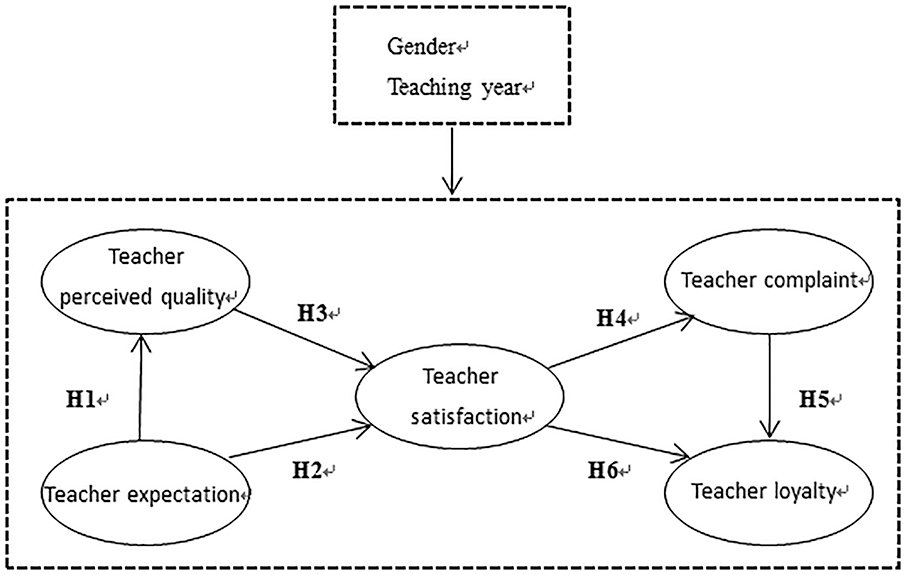
The research model.
Methods
Research Design
The WAST program helps teachers become qualified to teach middle school by increasing their knowledge of pedagogical theories and developing their practical skills. Teachers can do online activities such as watching teaching videos, taking tests, and communicating with other learners.
To test the research hypotheses, a questionnaire survey was adopted as the method of data collection. After the schools and teachers give their permission, the teachers were invited to complete the questionnaire in the field or online. The participants were introduced to the objectives of the study and the importance of their responses. They were told that there were no right or wrong answers, and all responses were valued. What is more, the survey participation was voluntary in nature, and the opinions were anonymous such that only the researchers knew the respondents’ identities (MacKenzie & Podsakoff, 2012).
Instrument
An online learning satisfaction index system was constructed based on the TSI model. Then, based on the index system, a 22-item questionnaire was designed. The questions adopted a 5-point Likert-type scale, and it is easy to understand the complete list of scale descriptors (1 = “strongly disagree,” 2 = “disagree,” 3 = “neither disagree nor agree,” 4 = “agree,” and 5 = “strongly agree”) (Dawes, 2008). The research group tested and discussed all the items. Professors offered suggestions in face-to-face meetings and by email. Based on their suggestions, two items were removed, leaving 20 items in the final questionnaire. Following the researchers’ and professors’ recommendation, we distributed the items into five variables: teacher expectation (three items: Q5–Q7), teacher perceived quality (six items: Q8–Q13), teacher satisfaction (three items: Q14–Q16), teacher loyalty (two items: Q17–Q18), and teacher complaint (two items: Q19, Q20). Q1 to Q4 gathered basic information on the participants (Supplemental Material). Table 1 presents a summary of the questionnaire items. Finally, the reliability and validity of the questionnaire were tested. The results showed that the questionnaire items could reflect the variables.
Description of the Questionnaire Items.

Participants
In total, 135 teachers were contacted. They were from five junior high schools in four cities in China. The five schools provided teachers with opportunities for online learning, and all teachers had experience with online learning. After the removal of incomplete and invalid questionnaire responses. There were 108 valid responses. The specific statistics are shown in Table 2.
Sample Information.

Data Analysis
The data analysis was conducted with a three-step methodology: the measurement model and the SEM. In the first step, the reliability and validity of the measurement model were tested by Cronbach’s alpha (Cronbach’s α) and confirmatory factor analysis (CFA) using SPSS19.0 software. In the second step, a t-test and analysis of variance (ANOVA) were conducted to investigate whether gender and teaching age were related to teacher satisfaction with online learning in the WAST environment. In the third step, the research model (Figure 5) was analyzed using SEM, supported by AMOS23.0. The paths between the five variables were modified.
Results
Measurement Model Testing
Cronbach’s α was calculated to validate the internal consistency reliability. As shown in Table 3, the value of Cronbach’s α ranged from .899 to .909. These values were all greater than .7, indicating that the instrument’s reliability was high (Hair et al., 1995). Its validity was tested using CFA. For teacher satisfaction with the online learning scales, there were five potential variables, so the measurement scale was clearly divided into five dimensions in the previous stage. The meanings of all the items were clearly described and distinguished from one another. All the items included in the five common factors were consistent with the previous classification.
Descriptive Statistics and Internal Consistency Reliability.

In addition, Table 2 shows that the average value for teacher expectation was 3.59, which is generally high. The average value of teacher expectation was 3.13, and the expectation average for promotion of the teachers’ own professional development was 3.28. However, when teacher expectation is compared with traditional study, online learning offers greater efficiency and more enthusiasm. The mean value of responses to this item was 4.35. This suggests that the teachers may have been affected by their original thinking about learning. Before participating in the program, they already believed online learning had no practical significance. However, the teachers still had some expectations about online learning. In terms of perceived quality, the average value was 3.89, which is higher than the average for teacher expectation.
Despite the problems with online learning, the teachers were relatively satisfied with three items: X6 (3.83 nearly satisfactory), X7 (4.35), and X8 (4.48). The average of satisfaction was 3.40, which was lower than the expectation average. So teacher complaint was generated during the process. The average value of item X13 was 3.07, and the average value for item X14 was 2.38. This indicates that teachers had some complaints during the learning. A higher complaining value makes the satisfaction rate lower. The mean values of the two items representing teacher loyalty were 3.89 and 3.54, respectively, and the value of X16 was close to 4. This indicates that the teachers will likely continue to participate in online learning.
SEM Testing
The potential relationships were tested by SEM. AMOS software was used to test the hypothesized model. The initial model tests of goodness of fit were a prerequisite condition for valid interpretations of the variables in structural relationships (Kline, 2005). The initial model needed to be modified for satisfying goodness of fit. Therefore, the initial model was modified twice based on data and hypotheses. The indices of the final model revealed that the model fit the data well (λ2/df = 1.84, p < .001, normed fit index [NFI] = .926, comparative fit index [CFI] = .955, root mean square error of approximation [RMSEA] = .064, standardized root mean square residual [SRMR] = .058) (Arpaci & Baloğlu, 2016). The results of the SEM analysis are shown in Figure 6 and Table 4. Teacher expectation toward teacher perceived quality (W1 = 0.289, p < .05), teacher perceived quality toward teacher satisfaction (W3 = 0.485, p < .001), and teacher satisfaction toward teacher loyalty (W6 = 0.351, p < .01) were statistically significant. Therefore, H1, H3, and H6 are confirmed.

Final teacher satisfaction model.
Path Coefficient Between Variables.

p < .05. **p < .01. ***p < .001.
Teacher complaint toward teacher loyalty (W5 = −0.294, p < .001) and teacher satisfaction toward teacher complaint (W4 = −0.382, p < .001) were statistically significant. Thus, H4 and H5 are confirmed. However, teacher expectation toward teacher satisfaction (critical ratio [C.R.] = 0.803 < 1.96, p = .422 > 0.05) was not statistically significant. Therefore, H2 is not upheld, reflected by the “deleted” (dotted) path in Figure 6.
Influence of Gender
A t-test was conducted to confirm whether gender influenced the five factors of teacher online learning. The results showed that the p-values of the five variables were all greater than .05. Therefore, in terms of the five variables, there were no significant differences.
Influence of Teaching Year
The participants were divided into four groups according to the number of years they had been teaching: (a) less than 1 year (including 1 year), (b) 1–3 years (including 3 years), (c) 3–5 years (including 5 years), and (d) 6 years or more. An ANOVA was conducted to investigate whether teaching age showed statically significant differences in the five dimensions of the TSI in the WAST environment. The findings show that teachers in the first and second groups had a significant difference in teacher expectation (F = 4.132, p = .021 < 0.05). In other words, expectation varied among the teachers with 1 year of experience or less and those with 1–3 years of experience. Teachers in the different teaching year groups only showed significant differences in expectation, and there were no significant differences in other dimensions.
Discussion
Improve Teacher Perceived Quality for Teacher Satisfaction
Figure 7 is drawn based on the results. Each item in the graph that represents “teacher expectation” and “teacher perceived quality” becomes larger, which causes “teacher satisfaction” to become larger as well. When teacher perceived quality is improved, teacher satisfaction is also improved, and higher teacher expectation brings higher perceived quality. Therefore, teacher satisfaction can be indirectly increased by improving teacher expectations.

Relation of teacher expectation, teacher perceived quality, and teacher satisfaction.
The mean value of teacher expectation was 3.59, which means that teachers’ recognition of online learning was generally higher. Teachers expected that the effect of the promotion of the online learning environment on their professional development would not be obvious. However, they believed that online learning can promote enthusiasm for self-learning and efficiency of learning in comparison with traditional learning. On the contrary, the results reflect that the teachers’ impressions of traditional and online learning are outdated. That is, they think that the differences in learning are merely in form. To change teachers’ low expectations, online learning platforms should increase their publicity.
In addition, improving perceived quality can directly influence teacher satisfaction. In the previous studies, the quality of online learning system had a positive effect on learner satisfaction (Aparicio et al., 2017; Cidral et al., 2018; Costa et al., 2016; McGill & Klobas, 2005). In general, teacher perceived quality regarding online learning has psychological implications. Rodriguez et al. (2008) investigated students’ perceptions of online learning quality; given comfort, motivation, satisfaction, and experience, the results revealed that satisfaction of online learning was related to perceived quality for students with online learning experience and hybrid learning experience. Teachers are willing to click to watch relevant expert videos and then enter some topic courses to learn or even communicate with other teachers or experts to share their learning experiences actively. Peltier et al. (2007) proposed a causal model to investigate factors affecting perceived quality of the online learning experiences. The findings showed that course content, course structure course, and instructor mentoring directly influenced the perceived quality of the online learning experiences. The platform designers and instructors would improve teachers’ perceived quality from the three aspects. Then, they may participate more frequently in online learning and grow more familiar with the platform’s various functions. They will also apply the knowledge learned in online learning to real teaching.
However, from Table 5, it can be concluded that teacher satisfaction with various factors of quality of online learning is generally satisfactory. The teachers were dissatisfied with the ability in researching and writing and platform interaction. Therefore, online learning platforms should improve these two aspects while maintaining the original advantages. Improvements can be made in the following areas.
Satisfaction and Load Coefficient of Main Factors Affecting Perceived Quality.

First, teachers’ ability in scientific research and ability to write papers should be fostered. Platform designers can create a teacher research section on the online learning platform. Experts in this section will lead teachers to study teaching materials in an in-depth manner and summarize their experiences together. Teachers will eventually complete papers and share them on the platform. When the new section is added, it will be necessary to strengthen the construction of the platform information systems and raise teachers’ enthusiasm to participate.
Second, the ability for instructional design should be developed further. Teaching quality largely depends on making the right pedagogical and technological decisions (Goodyear, 2015), and instructional design is the process of making the right decisions. Therefore, teachers need to improve their ability for instructional design. Instructional design plays an important role in the success of online learning (Winfield et al., 1998). On the contrary, the online learning environment needs to provide relevant instructional design videos by experts, with detailed explanations of teaching content analysis, learner analysis, teaching method analysis, and so on. In addition, the experts should explain how to design lessons and demonstrate excellent instructional design case. Moreover, the online learning platform should provide a discussion community for the teachers watching the videos. Here, teachers will be able to review each other’s teaching designs and engage in mutual discussions. Then, as technology has become a part of classroom in the information age, the platform needs to focus on teachers’ ICT capability. Effective techniques such as online discussions have proved successful (Lowney, 2016). Finally, teachers can effectively integrate technology and teaching to improve their teaching efficiency.
Third, teacher interaction on the platform should be promoted further. Interaction with others has a positive effect on learner satisfaction (Cidral et al., 2018; Sun et al., 2008). To enhance teachers’ interactions, the online learning platform can provide a module for organizing teachers to prepare lessons collaboratively. The specific process would be to select topics for the lesson preparation, collect resources, discuss the ideas online, exchange teaching plans, and communicate the results. In this way, teachers from all localities can be closely integrated through online teaching and research, and they can develop their professional skills through online collaborative lesson preparation.
Finally, supplements are needed for teachers’ educational knowledge and subject knowledge. Providing access to information or expert knowledge is a critical factor in learning success (Chunngam et al., 2014). This knowledge includes educational knowledge and subject knowledge. Therefore, the platform should update the overall educational contents continuously. For example, new cases used in teaching should be added, and teaching media (e.g., video) should be updated.
Encourage Teachers to be More Loyal
As shown in Figure 8, when the graph item representing “teacher complaint” becomes smaller and “teacher satisfaction” becomes larger, the item representing “teacher loyalty” becomes larger. Therefore, reducing teacher complaint and improving teacher satisfaction in online learning can improve teacher loyalty.

Relation of teacher complaint, teacher loyalty, and teacher satisfaction.
As shown in Table 6, teacher complaint in online learning mainly arises concerning two topics: platform management and platform content. Therefore, this study suggests reducing teachers’ complaint in relation to these areas.
Satisfaction and Load Coefficient of Main Factors Affecting Complaint.

In terms of the platform content, resource contents should be paid more attention. Resource contents have a positive effect on online learning success (Bandeira et al., 2016) and should be updated in a timely manner. Concerning platform management, designers should offer more suitable background information and functions for teachers. Enhancing technical support is helpful to overcome difficulties that arise in the process of online learning. Ertmer and Ottenbreit-Leftwich (2013) suggested that “future technology integration efforts should focus on helping teachers engage students in authentic technology-enabled learning environments” (p. 175). In addition, a mechanism needs to be developed to regulate teachers’ behaviors in the online learning environment, and this can be taken as the standard for evaluating teachers.
When teacher perceived quality improves and teacher complaint reduces, teacher satisfaction and teacher loyalty improve. Thus, moving teachers from a complaining to loyal stance can improve their participation in online learning. These are critical factors in teachers’ professional development and can contribute to resolving the teacher shortage.
Gender and Teaching Year Effects
In the previous studies, men considered that they were better than their female counterparts in computer and technical subjects (Adamus et al., 2009; Werner et al., 2004), and self-assessments of internet competence were more positive for male teachers compared with female teachers (Hung, 2016). Women considered computers as being mainly for social media, and they were more involved in communicative activities (Cuadrado-García et al., 2010). Women also demonstrated greater capability than men in online communication (Tsai & Tsai, 2010). In this study, gender had no influence in the five dimensions of the online learning environment. This is consistent with previous findings that gender had no effect on satisfaction or attitude in e-learning (Cuadrado-García et al., 2010), on self-directed learning (Hung, 2016), or on online learning (Lin & Hsieh, 2001).
As for teacher expectation, the number of years of teaching was only significant in regard to teacher expectation. As Hung (2016) pointed out, senior teachers were more willing to learn in an online learning environment than younger teachers. In this study, teachers with 1 year or less than 1 year of teaching experience exhibited higher expectation than teachers with 1–3 years of experience. This finding may echo previous research findings suggesting that young adults have particular learning preferences or styles (Hung, 2016; Teo, 2013). Young teachers are more active and confident than elder teachers in accessing learning materials and interacting with others. Therefore, young teachers may be more expected than elder teachers to communicate with others in online learning environment. Thus, the high expectation of teachers with less teaching experience should be maintained, and the expectation of teachers with more teaching experience should be raised. This is critical to improve their satisfaction with the online learning environment, as teacher expectation has a positive relation to teacher satisfaction. This provides a basis for the development and design of online learning systems. Different levels of teaching content should be designed for teachers in different teaching years.
Conclusions and Implications
Online learning provides real, flexible, and personalized opportunities for teachers to engage in professional development (Chieu & Herbst, 2016; Duncan-Howell, 2010) by overcoming the limitations of time and space. Learners’ satisfaction with online learning determines whether they continue to use the system (Sun et al., 2008). This study contributes to research on teacher satisfaction with online learning in three ways. First, based on the theoretical framework of WAST and previous theory, the TSI model was proposed. The TSI was then applied to the design of a questionnaire and empirical research. The study hypotheses explained teacher satisfaction. Second, the study confirms that teacher satisfaction was predicted by teacher perceived quality, which was predicted by teacher expectation, and teacher complaint played an important role by affecting teacher loyalty. In addition, teacher satisfaction predicted loyalty. Gender had no effect on the five dimensions, and teaching year only had a significant influence on expectation. Third, based on these findings, strategies were put forward to improve teacher satisfaction by increasing teacher perceived quality and decreasing teacher complaint.
This study has theoretical implications in that it contributes to online learning satisfaction theory. The proposed TSI model is based on the ACSI model (Fornell et al., 1996). A practical implication is that this study offers a reference for online learning system designers and administrators. The main purpose of the research is to investigate the factors that affect teacher satisfaction with online learning. The findings are relevant for the development of online learning platforms (e.g., improving platform content resources and enhancing technical supports). In addition, the designers and administrators of online learning environments can continuously improve the platform and learning community so as to enhance teacher participation and improve teacher satisfaction. Overall, the study details problems found in relation to the five dimensions and provides suggestions for improvement, thereby serving as a reference for teachers’ professional learning and the optimization of online learning platforms.
Moreover, the TSI model enables researchers to measure and investigate the relationship among the five variables and assess the extent to which they influence each other in online learning. Researchers can also use the TSI model to design instruments to collect data on various factors related to online learning and teachers as learners. Finally, the findings of this study help researchers identify factors that need to be improved or reduced.
Limitations and Future Research
One limitation of this study is that the sample lacks diversity. The survey included at least five middle school teachers in each province, but the overall number and representation of the sample are in need of further consideration. In future research, a larger sample including teachers from rural areas will be used, to put forward more general conclusions.
Another limitation is that only two sociodemographic characteristics were confirmed. Other sociodemographic characteristics, such as education level, may influence teacher online learning. For example, in terms of communication and self-efficacy, teachers with a master’s degree are better than teachers with a bachelor’s degree in online learning environments (Hung, 2016). Thus, other sociodemographic characteristics should be considered in future research.
The third limitation is that only five latent variables were included in the TSI model. The five variables are internal factors of teachers. However, external factors might also have an effect on teacher satisfaction with online learning. For instance, computer self-efficacy and teacher online training satisfaction have a positive correlation (Lu et al., 2016). In future research, a complex model with more correlated variables should be proposed, and more comprehensive suggestions should be put forward.
Supplemental Material
sj-doc-1-sgo-10.1177_21582440211036440 – Supplemental material for Developing a New Model for Understanding Teacher Satisfaction With Online Learning
Supplemental material, sj-doc-1-sgo-10.1177_21582440211036440 for Developing a New Model for Understanding Teacher Satisfaction With Online Learning by Dongping Liu and Hai Zhang in SAGE Open
Footnotes
Declaration of Conflicting Interests
The author(s) declared no potential conflicts of interest with respect to the research, authorship, and/or publication of this article.
Funding
The author(s) disclosed receipt of the following financial support for the research and/or authorship of this article: This work was supported by the Jilin Engineering Research Center of Integration and Innovation of Education and Artificial Intelligence (2019694) and Jilin Trans-regional Science and Technology Innovation Center of Educational Artificial Intelligence (20200602015ZP).

Supplemental Material
Supplemental material for this article is available online.
References
Supplementary Material
Please find the following supplemental material available below.
For Open Access articles published under a Creative Commons License, all supplemental material carries the same license as the article it is associated with.
For non-Open Access articles published, all supplemental material carries a non-exclusive license, and permission requests for re-use of supplemental material or any part of supplemental material shall be sent directly to the copyright owner as specified in the copyright notice associated with the article.
