



Abstract
Critical thinking is an important life skill that needs to be nurtured in young minds during the primary education years. This study explored pre-service teachers’ perception of barriers to their efforts in promoting critical thinking skills in classrooms, and further explored possible solutions to overcome these perceived barriers. The study used an exploratory mixed-method research design. Data were collected through an online survey and subsequently a focus group discussion to explore further the results of the quantitative data. Twenty-two pre-service teachers responded to the online survey, and subsequently seven pre-service teachers were selected for the focus group discussion. Issues related to teacher preparedness to assess pupils’ critical thinking skills, inadequate background knowledge on critical thinking, and lack of appropriate resources emerged as barriers to promoting the development of critical thinking skills in classrooms. The study suggests changes in teaching methods courses offered in teacher preparatory programs and changing perceptions toward critical thinking skills as possible measures to promote the development of critical thinking skills in the classroom.
Keywords
Introduction
“Critical thinking is a survival skill that you need to make your way through life” (Johanson, 2010, as cited in Allamnakhrah, 2013, p. 1). During the end of the 20th century, rapid technological advancement led to immense changes in the way of life, and critical thinking skills such as analysis, decision making, and evaluation became necessary components for employment, communication, and education (Allamnakhrah, 2013). The importance of critical thinking was not left unnoticed by the Western world and has since become a subject of focus for countries in the Gulf Cooperation Council (GCC) region (Allamnakhrah, 2013; Alwadai, 2014; Bataineh & Alazzi, 2009). For instance, the Kingdom of Bahraini Education Law of 2005 defined one its objectives as, “Promoting the individual’s critical thinking that contributes to the technological, scientific, economic, and social advancement” (United Nations Educational, Scientific and Cultural Organization–International Bureau of Education [UNESCO-IBE], 2011, p. 2).
Evidence gathered over a 3-year period (2014–2017) from the experiences of teacher candidates as well as their supervisors during teaching practicum in the primary schools in the study country revealed poor critical thinking skills among the pupils in the primary schools with teachers focusing on lower order thinking skills. A report conducted by UNESCO-IBE (2011) supports the observation made by the pre-service teachers and their supervisors, that majority of Bahraini students’ critical thinking skills are the level of “satisfactory or inadequate” (p. 19). Understanding the barriers that hinder the promotion of critical thinking skills in Bahraini schools is essential for future educators. Identifying the barriers can lead to finding appropriate solutions and improving the acquisition of critical thinking skills of Bahraini students. Therefore, this study sought to identify pre-service teachers’ understanding of critical thinking and the barriers to its promotion within Bahraini schools. Specifically, the study attempts to answer the following questions: How do pre-service teachers understand the concept of critical thinking? What do pre-service teachers perceive as barriers in promoting the development of critical thinking skills? What are the possible solutions to the perceived barriers to promoting critical thinking skills in primary schools?
Literature Review
Extensive literature is written about critical thinking. However, research about teachers’ perceptions of critical thinking and the barriers of implementing critical thinking have only recently emerged, especially in the Arab region (Allamnakhrah, 2013). Thus, the research will focus mainly on critical thinking definitions, perceptions, and the factors that hinder critical thinking within classrooms.
Definitions and Perspectives of Critical Thinking
As Saleh (2019) noted, critical thinking applies to all sorts of knowledge and implies the active engagement of learners in the process of knowledge construction through reflecting and thinking deeply. Critical thinking skills was given little to no attention in classrooms until the 1950s, but it soon became an essential part of the curriculum (Bataineh & Alazzi, 2009). Over the years, many leading experts and scholars defined critical thinking, and one of the major contributors is Facione (1990). He wrote extensively on the philosophy behind critical thinking, including a project called The Delhi Report, which arrived at the following definition, We understand critical thinking to be purposeful, self-regulatory judgment which results in interpretation, analysis, evaluation, and inference, as well as explanation of the evidential, conceptual, methodological, criteriological, or contextual considerations upon which that judgment is based. Critical thinking is essential as a tool of inquiry. (p. 3)
Halpern (1996), emphasizes that “critical” is not used negatively as a judgment or criticism, but rather an evaluation with the main purpose of providing precise feedback to be used for the improvement of the thinking process. In 1941, Glaser identified three components of critical thinking that continue to inform our idea about critical thinking today. The three components are, 1. An attitude of being disposed to consider in a thoughtful way the problems and subjects that come within the range of one’s experience, 2. Knowledge of the methods of logical inquiry and reasoning, and 3. Some skills in applying those methods. (As cited in Bataineh & Alazzi, 2009, p. 58)
Benjamin Bloom’s taxonomy is one of the first to explore critical thinking. It is attributed to the higher level order thinking skills, which includes analysis, synthesis, and evaluation. This contrasts Bloom’s lower order thinking skills, which are knowledge, comprehension, and application that mainly focus on recall and comprehension (Choy & Cheah, 2009). However, there is lack of consensus on what the concept of critical thinking skills means and what skills it exactly refers to (Saleh, 2019, p. 2).
With increased attention on nurturing critical thinking skills over the years, teachers began to familiarize themselves with the term. However, studies by Bataineh and Alazzi (2009) revealed that teachers have a vague idea about the term “critical thinking” and ways of its implementation. Further research shows that only 19% were able to define critical thinking and 9% use it daily (Allamnakhrah, 2013). Bataineh and Alazzi (2009) present similar results with Saudi educators who have very strong perceptions about critical thinking but fall short in developing the skill within classrooms.
Barriers That Hinder the Implementation of Critical Thinking
According to Alwadai (2014), researchers found that teachers view critical thinking depending on eight aspects. These aspects are “teaching methods, appreciation of teaching thinking, teacher’s educational background, teaching experiences, teaching methods classroom equipment, the learning materials, and the societal, and school communities” (Alwadai, 2014, p. 3).
In addition, Choy and Cheah (2009) noted that one of the issues that influences teachers’ perceptions about critical thinking skills is the belief among teachers that students cannot think critically alone which is compounded by students’ lack of interest or enthusiasm in class discussions as a teaching strategy. In Allamnakhrah’s (2013) research conducted in Saudi Arabia, the author noted that students dislike critical thinking because of its unfamiliarity. A similar observation was made by Alwadai (2014), in a study in Saudi Arabia, and that critical thinking is foreign throughout the academic stages, in addition to students’ weak capability. For instance, a study conducted in the United States revealed low-level capability of students as an obstacle to the development of critical thinking skills (Enabulele, 2011).
There is still no consensus as to whether critical thinking skills can be taught. However, it has been argued that it is necessary to teach critical thinking and that students will be able to acquire critical thinking skills as a result of learning content (Bataineh & Alazzi, 2009). The Alnofaie (2013) study shows that teachers are often evaluated by their progress of the content that they are assigned to, which adds pressure to cover it within a given time. For example, teachers from Saudi Arabia in a study noted that much of the lesson time is dedicated to covering content and no time is left to implement critical thinking (Bataineh & Alazzi, 2009). Another factor identified is that the dominant method of instruction focuses on lecturing, rote learning, and memorization, which does not promote critical thinking within classrooms (Allamnakhrah, 2013; Alwadai, 2014). In a Jordanian study, the authors also noted that the educational system focuses heavily on preparing students for formal testing that does not require critical thinking. Consequently, students channel all their efforts toward succeeding in formal tests that rely on facts and recall (Bataineh & Alazzi, 2009).
In addition, classroom structure is also viewed as a barrier in acquiring critical thinking skills. Bataineh and Alazzi (2009) indicated that large class sizes posed a challenge to effective implementation of critical thinking. Saudi teachers also pointed out that adequate facilities have not been provided in schools which leaves students and teachers with inadequate lighting, safety, and classroom size (Alwadai, 2014). The availability of resources is an essential condition to implement critical thinking; for example, school systems must be equipped with ICT resources, and curricula designed to promote collaborative learner-centered environment to which students will relate and respond (Boholano, 2017). On the contrary, more than 70% of educators in an Iranian study were of the view that large number of students in class, large number of students per total teaching load, and lack of appropriate instructional materials do not impede the implementation of critical thinking skills in classrooms (Aliakbari & Sadeghdaghihi, 2013). A study about perceptions of critical thinking in Ghana discovered that there was an inconsistency between the curriculum goals and the provided resources (Owu-Ewie, 2008, as cited in Allamnakhrah, 2013). Bataineh and Alazzi’s (2009) study also shows that the textbooks and school equipment within Jordanian schools do not foster critical thinking. Surprisingly, when teachers criticized the lack of materials that they had for teaching critical thinking, they found that the ministry guidelines did not require critical thinking as part of the learning process.
Previous research shows that teachers seem to have shortcomings when it comes to understanding critical thinking and how to implement it within classrooms. Alwadai (2014) concludes from his study that Islamic teachers have limited knowledge of critical thinking and “do not use or welcome” it (p. 46). Bataineh and Alazzi (2009) state that teachers attribute their limited knowledge to the absence of teacher educational programs that allow them to learn more about critical thinking. Alnofaie (2013) states, “There is no clear guidance for language teachers on how to implement this pedagogy” (p. 232). Teachers also added that universities do not address teaching critical thinking, and limited funding does not allow for preparation of professional development courses (Bataineh & Alazzi, 2009). It is evident that critical thinking is not viewed as part of the learning culture in some countries and societies.
Despite the challenges identified in studies (e.g., Alwadai, 2014; Bataineh & Alazzi, 2009), Hughes (2014) outlined a set of 20 activities for promoting critical thinking in the language classroom, including (a) developing a critical mind-set, (b) opinion and reason generator, (c) critical questioning, (d) recognizing context, (e) making connections between topics, (f) evaluating the reliability of sources, (g) stance, (h) identifying main arguments and supporting evidence, (i) fact or opinion, (j) vague or accurate, (k) where is it from? (l) reading between the lines, (m) false conclusions, (n) writing headlines, (o) find the expression, (p) predicting the content of the text, (q) practicing the language for expressing critical thinking, (r) a for-and-against essay, (s) preparing a group discussion, and (t) assessing a presentation (for learning the application of each of these activities, see Hughes, 2014, pp. 8–26).
According to Allamnakhrah (2013), although critical thinking is promoted in some Western societies, teachers can only apply it efficiently if they have the essential knowledge. On the contrary, China, an Eastern country, is wary of critical thinking because of a likely change in the dynamics of the society. The author notes that the society of Saudi Arabia does not practice critical thinking but rather submits to people in authority. In addition, education is not associated with critical thinking because of its conflict with society (cited in Bataineh & Alazzi, 2009). For example, in Jordan, some parents and teachers are concerned that critical thinking will make students disrespect their elders’ opinion (Bataineh & Alazzi, 2009). Critical thinking is increasingly gaining attention in the Arab world; as a result, research is continuously being conducted to understand the concept and its role in the society. Although there appears to be a consensus among educators, that critical thinking is an important thinking skill, there is lack of consensus among educators on the definition of critical thinking (Halpern, 2001). As observed by Md Zabit (2010), that most teachers agree it is important for students to develop critical thinking skills, however, students have poorly developed critical thinking skills partly because of how the skill has been taught by teachers (Alwadai, 2014). A review of literature reveals very few studies conducted in the Kingdom of Bahrain (see Al-Jasim & Al-Hamdan, 2012). This present study contributes to the literature, the challenges to implementing critical thinking in Bahrain schools from the perspective of teacher candidates. The objective is to provide training institutions an opportunity to focus on developing the skills of teacher candidates to integrate critical thinking activities in designing instructions and to overcome some of the challenges of implementing critical thinking in the classroom.
Method
A mixed-method research design was used to explore pre-service teachers’ opinions on the barriers that influence the implementation of critical thinking and possible solutions to those barriers. “The combination of both types of data tends to provide a better understanding of the research problem than one type of data in isolation” (Mertler, 2017, p. 12). Specifically, sequential explanatory design was applied, which means the quantitative data were collected and analyzed, followed by the collection and analysis of the qualitative data. The qualitative data were used to assist in explaining and interpreting the findings of the quantitative component of the study (Creswell, 2008). To collect the quantitative data, an online survey was used and subsequently a focus group discussion to explore the issues that emerged from the findings of the quantitative data.
Participants of the study were third- and fourth-year students in a bachelors’ teacher preparatory program at a public university in the Gulf Region. The participants were purposively selected because they have taken courses in critical thinking and have had 4 weeks of teaching practicum each academic year. The participants included three males and 19 females with age range from 20 to 22 years. Each of the students has a high school diploma and will be awarded a bachelor’s degree in education at the end of the 4-year training program.
The survey questions consisted of three sections that included partially adapted questions from Alwadai (2014) and Enabulele (2011). The questions were Likert-type questions ranging from 1 = strongly disagree, 2 = disagree, 3 = undecided, 4 = agree, and 5 = strongly agree, and participants indicted their level of agreement or disagreement with the statements. The reasons governing the use of the questions from Alwadai’s (2014) research is because of the similarities in the cultural background, while the questions adapted from Enabulele’s (2011) allow for a better understanding on how pre-service teachers define critical thinking.
A two-step process was employed to determine the reliability of the data collection instrument. To check its validity, copies of the survey were distributed to three instructors and five pre-service teachers. The participants were encouraged to hand in any kind of feedback they thought was necessary. After getting feedback from the preliminary study, the survey was adjusted accordingly. In addition, to establish the reliability of the survey, the researchers used SPSS 22.0 and calculated a Cronbach’s alpha of .990, which presented a high degree of internal consistency of the survey items. These steps were taken to improve the validity and reliability of the teacher survey data.
The first phase of the research involved the distribution of the survey to teacher candidates of all four specializations (Math & Science, English, Arabic & Islamic, and Cycle 1—specialization for lower grades: 1, 2, and 3) in the third- and fourth-year group; however, only 22 students responded. The completed questionnaires were analyzed and findings determined. Based on the result of the survey data, seven participants were randomly selected from the 22 participants who responded to the survey for a focus group discussion to explore possible solutions to the barriers to the implementation of critical thinking in Bahraini schools.
Analysis and Results
Mainly descriptive statistics was conducted for the quantitative data, and a summary from the focus group discussions used to support the findings from the quantitative data. The findings are divided into two parts. The first part includes statements focused on perceptions and conception of critical thinking. The second part focuses on possible barriers of critical thinking. The pre-service teachers indicated the degree to which they agreed or disagreed with the provided statements.
Critical thinking statements and definitions
Participants responded to eight statements related to their perceptions and understanding of the concept of critical thinking. This was to address the question of “How do pre-service teachers define and perceive critical thinking?” The results revealed that 87% of participants believe they know a lot about critical thinking, as shown in Table 1. In addition, all the participants agree that critical thinking activities, such as problem solving and decision making, allow students to use their higher order thinking abilities. Furthermore, Table 1 shows that 86% of participants believe that critical thinking can make learning enjoyable to students.
The Extent to Which Pre-Service Teachers Agree or Disagree With the Definitions of Critical Thinking.

Barriers to promoting critical thinking
Participants responded to statements related to possible barriers to the implementation of critical thinking in Bahraini classrooms. “What are the barriers that hinder the implementation of critical thinking skills in Bahraini schools?”
The first barrier participants were asked about was student ability. Participants believe that, as shown in Table 2, students lack important background knowledge that helps them think critically. During the focus group with the pre-service teachers, some participants were of the view that perhaps critical thinking is not promoted as it should be within the Bahraini educational system. Probing further as to how critical thinking skills could be improved among the pupils despite their limited background knowledge of the concept. The focus group suggested that pupils can be engaged in simple activities with a systematic increase to more challenging levels. According to the participants, this approach could improve the development of critical thinking skills by the pupils. The suggestion underscores the finding from the survey which indicated that 41% of the pre-service teachers believe that students find it difficult to practice critical thinking activities. Overall, the participants were of strong opinion that classroom activities should integrate critical thinking skills on an incremental basis.
The Extent to Which Pre-Service Teachers Agree or Disagree With Statements on Student Ability as a Constraint to the Improvement of Critical Thinking Skills.

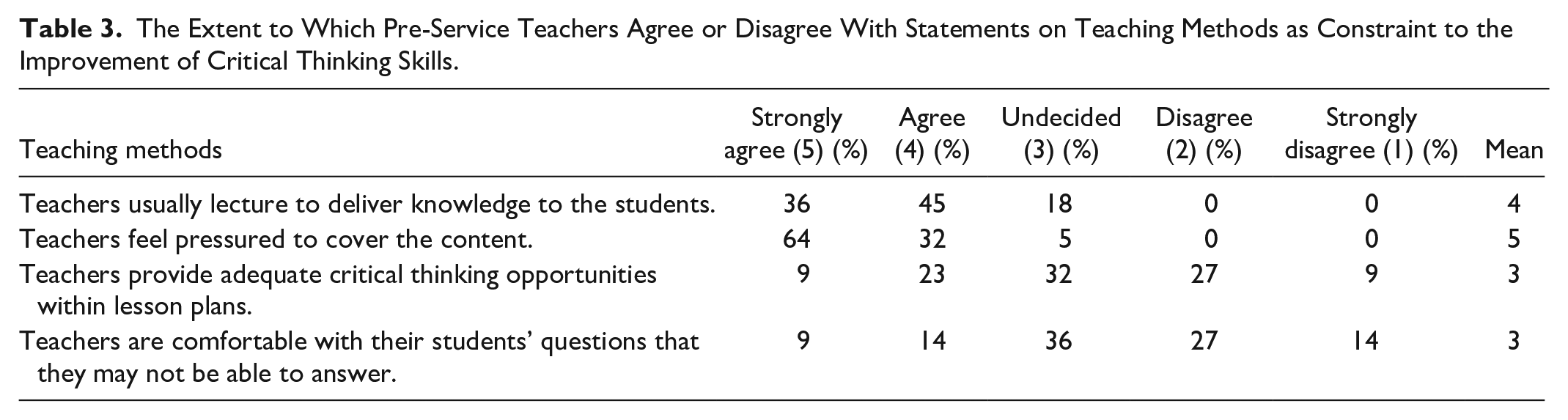
Another barrier identified as a hindrance to the implementation of critical thinking is teachers’ teaching methods. Participants believe that the major obstacle is that teachers are constantly under pressure to complete the curriculum, and therefore they adopt teaching strategies that will enable them to achieve that objective to the detriment of integrating the development of critical thinking skills in the teaching methods. As to how this obstacle could be overcome, participants were of the view that teachers should focus on the important content of the curriculum while incorporating critical thinking skills to the selected content and avoid the temptation to complete the curriculum.
Furthermore, Table 3 shows that the majority of participants think that more often than not, teachers teach content to students through lecture. During the focus discussion, participants were of the view that techniques such as questioning and use of stories when integrated into lecturing can promote active student engagement with the content. The findings from the focus group discussion confirm the results from the survey data on the question of whether teachers provide adequate critical thinking opportunities in the classroom. A majority (36%) of the participants surveyed disagree that teachers provide adequate critical thinking opportunities in their lesson plans.
The Extent to Which Pre-Service Teachers Agree or Disagree With Statements on Teaching Methods as Constraint to the Improvement of Critical Thinking Skills.
When participants were asked about aspects of Bahraini classroom structure, 60% said that they believe teachers do not have the necessary amount of resources that would help them implement critical thinking in the classroom. The issues of inadequate resources were explored during the focus group discussion, and the participants offered suggestions such as searching online for information, creating materials themselves, and/or tasking students to create materials as part of their assessment. However, as shown in Table 4, 46% of participants believe teachers are not prepared to assess critical skills development of students. With regard to addressing this challenge, participants of the focus group discussion were of the view that, assessing critical thinking should be part of pre-service teachers’ professional training, and for in-service teachers, they need to avail themselves for short courses on assessment, and attending conferences and workshops to enhance their knowledge and skills in the assessment of critical thinking skills. In addition, teachers can seek expert opinions through various means of communication.
The Extent to Which Pre-Service Teachers Agree or Disagree With Statements About Classroom Structure as a Constraint to the Improvement of Critical Thinking Skills.

When participants were asked about instructional strategies and resources, majority (86%) of the participants disagreed with the use of memorization as the main method of instruction in the classroom. Interestingly, about 60% (see Table 5) of the participants agreed that they are capable of integrating critical thinking skills development activities in the classroom and at the same time cover the expected content. Finally, 50% of the participants believe that the resources available do not help nurture critical thinking in the classroom.
The Extent to Which Pre-Service Teachers Agree or Disagree With Statements on Instructional Strategies and Resources as Constraints to the Improvement of Critical Thinking Skills.

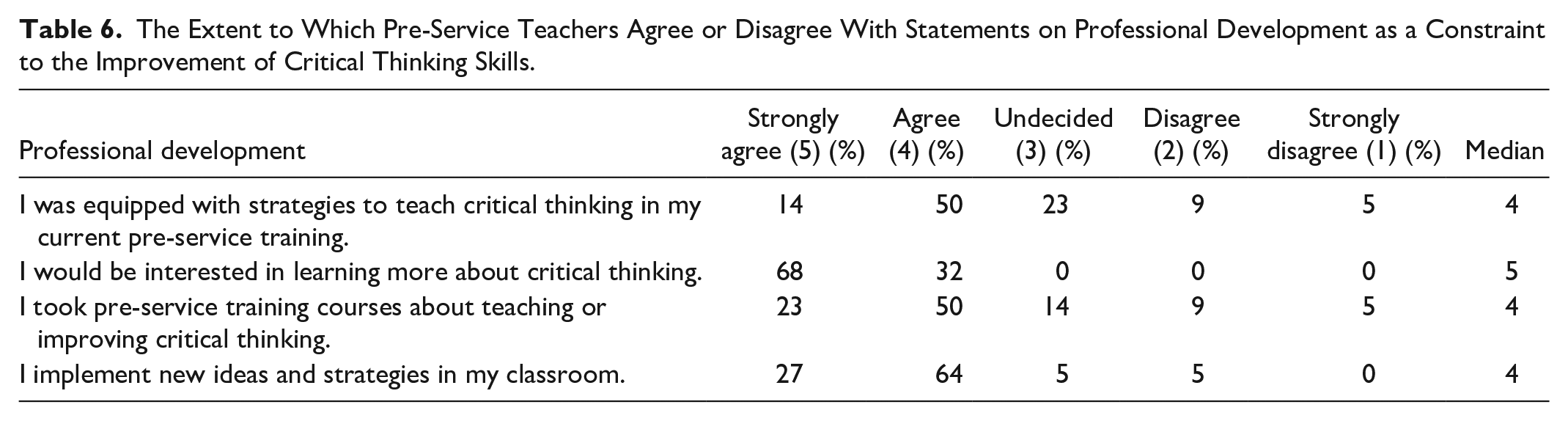
Participants showed positive reactions when they were asked about their professional development. Most of the participants stated that they are very interested in learning more about critical thinking. They also stated that they would implement new ideas and strategies in their classrooms. Furthermore, the majority of participants, as shown in Table 6, said they have learned how to teach critical thinking during their pre-service training.
The Extent to Which Pre-Service Teachers Agree or Disagree With Statements on Professional Development as a Constraint to the Improvement of Critical Thinking Skills.
Finally, participants were asked about cultural influences. Majority (91%) of the participants believe if students’ critical thinking improves, it will lead to the improvement of the Bahraini society. As revealed in Table 7, 45% of the participants were undecided on whether critical thinking is favored in the Bahraini culture. In the focus group discussion, participants did suggest that culture probably plays a role in how critical thinking is viewed. The focus group suggested the development of educational activities to increase awareness on the important role of critical thinking in the development of cognitive skills.
The Extent to Which Pre-Service Teachers Agree or Disagree With Statements Regarding the Influence Society Has on Improving Critical Thinking Skills.

Discussion
The study results indicate that, Bahraini pre-service teachers identify students’ background, teaching methods, classroom structure, and resources as some of the main barriers to the implementation of critical thinking in classrooms. Some of the barriers identified in the present study correspond to the barriers to critical thinking skills stated in Fani (2011). Similarly, the findings are consistent with findings from other studies (Al-Kindi & Al-Mekhlafi, 2017; Allamnakhrah, 2013; Alwadai, 2014; Bataineh & Alazzi, 2009). The participants recognized the importance of critical thinking and viewed it as an integral part of their classroom dynamics. An overwhelming majority of the participants showed a positive understanding of the definition of critical thinking. This can be attributed to the finding that participants believe they received adequate knowledge and skills to teach critical thinking during their pre-service training. However, about 60% of the participants (see Table 5) agreed that they are capable of integrating critical thinking skills development activities in the classroom and at the same time cover the expected content. Further research is necessary to understand the extent of the participants’ understanding and implementation of critical thinking in the classroom. It is important to explore how the participants would have defined critical thinking without the reliance on the statements provided in the survey. Moreover, there is a difference between understanding and practicing, an issue that needs to be addressed. As Bataineh and Alazzi (2009) indicated in their Jordanian study, teachers’ claims of understanding and implementing critical thinking within their classrooms were not evident when observed. Similarly, in the Californian study, which concluded that critical thinking was a primary objective in their instruction, only 9% used it in their teaching (Allamnakhrah, 2013). The participants indicated some shortcoming in their ability to assess critical thinking. The findings of the study reveal that lack of proper assessment is a barrier to teaching critical thinking. In addition, about a third (36%) of the participants disagree that teachers provide opportunities for critical thinking in their lesson plans. Therefore, further research into the extent participants apply critical thinking in their classrooms will allow for a better insight into Bahraini teachers’ understanding and perception of critical thinking. Contrary to the research by Choy and Cheah (2009), a large majority of the participants shared that critical thinking could make learning enjoyable. This positive view is a possible indicator of the extent of its implementation in Bahraini classrooms. The results imply that there may be a need for teachers to be involved in workshops and courses to add to their knowledge of critical thinking and provide techniques for its actual implementation within their classrooms.
The study result correlates with studies of Alwadai (2014), Allamnakhrah (2013), and Bataineh and Alazzi (2009), which identified student ability is one of the major obstacles to critical thinking. The participants identified students lack sufficient background knowledge to think critically and the preference for activities that result in factual answers. This finding is similar to the finding of Alwadai (2014)—the author found that 79% of the respondents prefer factual tasks and a lack of interest by students to engage in critical thinking activities. However, as Lai (2011) noted, “background knowledge is a necessary but not a sufficient condition for enabling critical thought within a given subject” (p. 2). Furthermore, the participants believe Bahraini students cultivated an attitude, which is that critical thinking activities are difficult to conduct. This observation suggests a possible misconception among Bahrain students about critical thinking that needs to be corrected. The misconception by students may be due to incorrect implementation of critical thinking in Bahraini schools, which contributed to the negative perceptions toward critical thinking activities. Furthermore, teachers’ perceptions of students’ abilities can affect the extent of their implementation of critical thinking in their classroom. This was evident in the study conducted by Choy and Cheah (2009) where the teachers were not confident in their students’ ability to think critically. The participants in this study concluded that critical thinking is not promoted in the Bahraini educational system. This raises the concern of whether culture plays a role in the lack of critical thinking in Bahraini schools. Despite having positive beliefs about critical thinking improving Bahraini society, the participants showed that they were unclear about critical thinking being culturally favored. Additional research is needed to identify the extent to which culture plays a role in effecting the implementation of critical thinking. The beliefs of the interviewed participants were similar to the study conducted by Bataineh and Alazzi (2009), who stated that, “Questioning is viewed as opposing the accepted ways of doing things; thus, it is not promoted by the educational system” (p. 63). Yet “inquisitiveness” is one of the dispositions for critical thinking (Lai, 2011, p. 2).
An issue the study identifies is the pressure that teachers face in covering content that does not allow them time to engage students in critical thinking. This is consistent with Bataineh and Alazzi (2009) and Alwadai (2014), who noted that teachers feel the need to cover content to the extent that it leaves little room for them to implement critical thinking skills. However, the study shows that the participants believe they can cover content and engage in critical thinking activities simultaneously. Lai (2011) describes that approach as “infusion approach, which involves in-depth instruction in the subject matter with explicit instruction on general principles of critical thinking” (p. 31). Additional research is necessary to conclude if pre-service teachers have the pedagogical strategies to cover content and critical thinking. As Allamnakhrah (2013) found in his study, the majority of teachers he interviewed were not able to explain how to cover the content and foster critical thinking. It seems pertinent for teachers to be taught in a way that allows them to tackle both tasks without feeling overwhelmed. Another issue identified is lack of resources and that the content of the available resources or textbooks do not nurture critical thinking. The participants presented alternative ways to get resources, but the study emphasizes the need for an intervention from the Ministry of Education (MOE) to provide adequate resources that foster critical thinking. Providing materials that promote critical thinking is important, as Bataineh and Alazzi (2009) stated, when textbooks reinforce a harmonious society, students are more likely to accept all the answers provided by the book and tend not to be provided with any opportunity to think critically. They elaborate saying, “Textbook statements also employed descriptive styles and very often came to conclusions that jeopardized the initiation of critical thinking. In addition, the learning experience in school was largely artificial in nature” (Bataineh & Alazzi, 2009, p. 59).
The findings of the study correspond with the studies conducted by Alwadai (2014), Allamnakhrah (2013), and Bataineh and Alazzi (2009) who suggested that critical thinking may be hindered by teaching methods and classroom structures. The participants agreed that the classroom set up and preparation time is inadequate in supporting the implementation of activities that promote the development of critical thinking skills. The findings suggest that classroom setups in the study country needs to be re-organized to support methods applied in the classroom to promote critical thinking skills. For instance, there are approximately 25 to 30 pupils in each classroom in the study country. Alwadai (2014) concurs that crowded classrooms lead to an increase in the difficulty of improving students’ critical thinking skills. To address the challenge posed by the classroom structure, teachers can set up cooperation between students and ensure that it actually takes place (Al-Kindi & Al-Mekhlafi, 2017). The study yields interesting results that are different from studies conducted around the Gulf region. Unlike the results of Allamnakhrah’s (2013) study, this study shows that memorization is not the main method of instruction in Bahraini schools. However, the participants were unsure whether memorization promotes the development of critical thinking skills. Moreover, participants mentioned that lecturing remains the major means teachers deliver content knowledge to students. Alwadai (2014) describes lecturing as an “impediment” to the improvement of students’ critical thinking skills (p. 46). Despite the relatively small sample size, an insight into pre-service teachers’ perceptions of critical thinking and the barriers to its promotion in classrooms was highlighted.
Conclusion
Critical thinking is a necessary skill that transcends education and is an essential part of human cognitive abilities (Alwadai, 2014). Overwhelming majority of the participants demonstrated understanding of the concept of critical thinking. However, several barriers that hinder the implementation of critical thinking in Bahraini schools were identified. The barriers identified include the students’ background, the teaching methods employed in class, the classroom structure, and the available resources that do not foster critical thinking as main barriers to the implementation of critical thinking in Bahraini classrooms. This study suggests that pre-service teachers in Bahrain understand and grasp the importance of critical thinking. The results indicate that teachers in Bahrain need additional knowledge and skills on the implementation of critical thinking in the classroom. A significant finding from this study is the need to address student-teacher’s misconceptions of critical thinking. The misconception may be attributed to the ambiguous definitions of critical thinking. The responsibility falls upon universities, teaching faculty, and the Ministry of Education to provide professional development workshops and other opportunities for teachers to learn more about critical thinking. The evidence from this study suggests that culture contributes to the barriers in implementing critical thinking in classrooms. The negative influence of culture on implementing critical thinking in classroom was also reported by Saleh (2019) in a study among Libyan EFL university instructors. Furthermore, inadequate resources do not provide opportunities for the fostering of critical thinking in the classroom. Nurturing critical thinking skills development could be a criterion for the selection of classroom materials. This study concludes that the use of teaching methods such as lecturing and large class sizes, and available resources are obstacles to the promotion of critical thinking skills in the classroom. Teachers must employ appropriate teaching methods that promote the development of critical thinking skills among pupils in the classroom.
This study will serve as a step toward addressing the observation made in the 2011 report of UNESCO-IBE about the inadequate critical thinking skills among students in Bahrain. This study is crucial in overcoming the barriers of critical thinking in Bahraini classrooms. The study informs pre-service teachers about the barriers of implementing critical thinking in their classrooms and to work toward producing students who are more critical, and by extension, a critical society. The study adds to the growing body of literature on the status of critical thinking in the Middle-Eastern countries. Moreover, it might raise awareness with policy makers reaching institutions and educators about the importance of critical thinking and the barriers to critical thinking implementation in the classroom. Finally, the study provides Bahrain Teachers College instructors insight into the preparedness of teacher candidates to adopt critical thinking in Bahraini classrooms. Consequently, the Teachers College should offer instructors courses and workshop for the appropriate integration of critical thinking in their instruction (Saleh, 2019). The instructors intend to provide specific training courses to teacher candidates. One of the limitations of the study is the relatively small sample size; the study can be repeated with larger sample size of in-service teachers. In addition, future studies should use classroom observation and in-depth interviews to explore the issues for a more comprehensive result.
