




Abstract
This study assessed pre-service teachers’ levels of global-mindedness and explored the predictors of such attitude using the Global-Mindedness Scale (GMS). The study examined whether individual scale factors such as gender, perceived competence in non-native language or culture, frequency of interaction with people of diverse backgrounds, and teaching experience are good predictors of pre-service teachers’ global-mindedness. The survey was conducted through Qualtrics with privacy protection. The SPSS was used, and multivariate analysis of variance (MANOVA) and multiple regression tests were utilized to analyze the data. The research results were based on 184 survey responses of undergraduate students who have declared an education major or minor at a Midwest state university in the United States. The results revealed that the independent variables of gender, perceived competence in non-native language or culture, and teaching experience are significant predictors of the pre-service teachers’ levels of global-mindedness.
Introduction
Globalization is an axiomatic topic in political, social, economic, and educational fields. The global education movement started in the 1960s and reached its golden age in the 1980s and 1990s (Gaudelli, 2003; Tye, 2009). Global education is a social movement and, as such, calls for consciously infusing global perspectives into all curriculum areas (Tye, 1991). As an education that focuses on the comparison of world cultures, global education examines the universality of experiences as a result of new political, economic, and social systems derived from the awareness of varying cultural characteristics (Raby, 1999). Focusing on intercultural communication, cooperation, and the interconnectedness of the world, global education is founded on teaching using a world-centric mind-set, avoiding placing limitations on student perspectives by considering events in isolated contexts or constraining teaching to ethno-specific points of view (Kirkwood, 2001). Stakeholders, such as government and non-government agencies, universities and colleges, teacher educators, and practitioners, advocate the development of global education. The National Governors’ Association (1989) stated that every student must have access to international education in school, and college and university graduates must become acquainted with non-native languages or cultures and be ready to participate in global dialogues and global markets. Merryfield (1994) pointed out that “global and international education should be a high priority of higher education and teacher education” (p. 7), and the American Association of Colleges for Teacher Education is committed to assuring that “a global perspective is brought to policy and programs associated with the preparation of education professionals” (Merryfield, 1994, p. 8). Through the efforts of global-minded teachers, the values of globalization are passed on to students.
Past research has focused on global education in various forms. Hanvey (1976) proposed five dimensions related to global perspectives—perspective consciousness, state of the planet awareness, cross-cultural awareness, knowledge of global dynamics, and awareness of human choices. Other researchers (Anderson, 1982; Lamy, 1982; Torney-Purta, 1982; Tucker, 1982) studied global education in classrooms and in teacher education programs. Hett (1993) first defined global-mindedness and designed an instrument to measure it. Later researchers (Golay, 2006; Hosseinali, 1995; LeCrom, Greenhalgh, & Dwyer, 2015) tested the hypothesis that study abroad programs have a positive influence on the development of global-mindedness. However, few research studies have addressed the global-mindedness of pre-service teachers. Given the lack of empirical study of pre-service teachers’ levels of global-mindedness, more research is needed.
Past studies have given different definitions to terms related to global education. This study sought to clarify critical terms, such as global education, global perspective, and global-mindedness. This quantitative study assessed pre-service teachers’ global-mindedness using Hett’s (1993) GMS to determine what individual factors such as gender, perceived competence in non-native language or culture, frequency of interaction with people of diverse backgrounds, and teaching experience might influence pre-service teachers’ global-mindedness. Based on the research results, this article presents the findings and their implications for teacher education programs, refines understandings relating to global and cultural education, and provides suggestions for future studies.
Review of the Literature
Past development of international and intercultural learning is an indispensable part of global education. The Association of American Colleges and Universities (AAC&U; 2007) stated that higher education should take the primary responsibility in this new global century to help the students engage in the global community collaboratively and competitively. Specifically, educators should adopt new approaches and create interdisciplinary curricula to guide the students to achieve higher standards while avoiding the drawbacks of standardization (AAC&U, 2007). Deardorff (2011) noted that there are two means to developing intercultural competence. One is through the curriculum; the other is through co-curricular activities. Merryfield (1995) claimed that global education is vitally important in preparing college students to participate in the increasingly interconnected and diversified world. The implementation of global education requires new methods and solutions for educators of future teachers. Merryfield and her colleagues at Ohio State University (OSU) Professional Development School Network in Social Studies and Global Education formulated three hypotheses about learning and teaching in global education. The first hypothesis stated that educators should have intercultural experiences and cross-cultural skills, obtained through education and service learning. The second hypothesis stated that educators should be knowledgeable of globalization to avoid stereotypes or misconceptions. Last, Merryfield proposed that educators collaborate with each other and reflect on the school environment and global curriculum. To prepare students for the 21st century, Deardorff (2011) suggested internationalizing the campus to incorporate global perspectives into students’ personal development programs.
Hett (1993) suggested that global-minded people were those “who possess an ecological world view, believe in the unity of the human species and the interdependence of humanity, have multiple loyalties and are futurists” (p. 69). Hett defined global-mindedness as “a worldview in which one sees oneself as connected to the world community and feels a sense of responsibility for its member, a commitment reflected in an individual’s attitudes, beliefs and behaviors” (p. 143). She developed a valid GMS assessing the levels of global-mindedness on responsibility, cultural pluralism, efficacy, globalcentrism, and interconnectedness aspects. Hett listed the characteristics that higher GMS students would have:
(a) be female, (b) have attained junior or senior class standing in college, (c) have taken several internationally-oriented courses, (d) report regularly reading international news in a newspaper, (e) express high political interest and liberal political attitudes, (f) be an activist, (g) often interact with persons from countries and cultures other than their own, (h) be proficient in a second language, and (i) have spent significant time outside of their own country. (p. 148)
Applying the GMS as a research tool, Hett (1993) confirmed a variety of hypotheses she generated from a literature review: (a) Women score higher on the GMS than men, (b) there is a significant correlation between the number of global study courses learned and global-mindedness, (c) there is a significant difference in the global-mindedness scores between students who attend internationally oriented programs frequently and those who do not, (d) students who report their political attitude as more liberal score higher than those who say they are more conservative, (e) students with two or more of their friends from countries or cultures other than their own score higher than students with fewer than two such friends, (f) second language proficiency is slightly related to global-mindedness, and (g) there is a significant difference in GMS between students with different levels of international experience.
Zhai and Scheer (2004) conducted a quantitative study on undergraduate students declaring agriculture majors in the College of Food, Agriculture, and Environment Sciences at OSU. Zhai and Scheer combined an adapted GMS with the Attitudes Towards Cultural Diversity and Pluralism Scale to use as a survey instrument. The research results showed that the students’ global and cultural sensitivities were moderate. There was a statistically significant correlation between students’ global perspectives and their attitudes toward cultural diversity. Female students were more sensitive toward global and cultural issues than male students. Students who frequently contacted people of diverse backgrounds had higher scores in this survey. The research results suggested that overseas experience, age, home origin, and global courses taken were not related with their levels of global and cultural sensitivity. Zhai and Scheer recommended a blueprint for future research. Some of their suggestions were to conduct the research among freshmen, sophomores, juniors, and seniors to see any differences; recruit research subjects from other majors or minors; and administer the survey in a different study period or at different colleges.
Using GMS and the Teacher Multicultural Attitude Survey (TMAS) as data collection instruments, Acolatse (2010) investigated global-mindedness and multicultural attitudes of 102 teacher candidates in a Mid-Atlantic university. Half of the 102 participants were post-bachelor teacher candidates, and another half of them were 5-year teacher candidates. This cross-sectional causal-comparative study indicated that teacher candidates with a prior bachelor’s degree scored higher than those without bachelor’s degrees in responsibility, cultural pluralism, efficacy, and interconnectedness dimensions. It further specified that teacher candidates with a prior bachelor’s degree have a more positive orientation regarding diversity issues in the classroom. The research also showed a positive relationship between GMS and TMAS scores. Contrary to Hett’s (1993) findings, the research signified that gender and ability to speak a second or foreign language had no effect on the GMS and TMAS scores. However, age, global courses taken, teaching experience, traveling abroad, and exposure to diversity displayed positive interactions.
The review of literature indicates that there are effective ways of developing teachers’ global-mindedness. Zahn, Sandell, and Lindsay (2007) suggested that creating international partnerships and learning experiences are effective ways for teachers to develop global-mindedness. Zahn et al. addressed the function of the International Program Advisory Committee and International Studies Committee of the College of Education at Minnesota State University, Mankato (MSU). They reviewed MSU’s cooperation with the partner universities in Russia, Australia, Thailand, and Mexico. The review results showed that the College of Education focused on students’ experiential learning and maintained student teaching and practicum through the exchange programs of the partner universities.
Kehl and Morris (2008) investigated the differences in global-mindedness among three different groups of students. The three groups of students were students who were preparing to participate in a study abroad program, students who had finished a study abroad program of 8 weeks, and students who had finished a study abroad program of a semester. There were no significant differences between students who were preparing to participate in a study abroad program and students who had finished a study abroad program of 8 weeks. There were significant differences, however, between students who were preparing to participate in a study abroad program and students who had finished a study abroad program of a semester. There were also significant differences between students who had finished a study abroad program of 8 weeks and students who had finished a study abroad program of a semester. Kehl and Morris (2008) suggested participation in a semester-long study abroad and a curriculum requirement for developing global-mindedness.
Definition of Terms
Some terms related to global education seem synonymous, and most researchers use them without distinction. However, these terms are different in meaning due to their different origins (Hicks, 2003). The lack of clarity of the definitions of terms may result in vagueness in this research field. To avoid ambiguous concepts, it is critical for this study to offer some operational definitions. Globalization is the interrelated nature of political, social, economic, and educational issues, which link every corner of the globe (Baliles, 1989; Hicks, 2003). Global education is a social movement that focuses on the initiative of global programs, the implementation of global curriculum, and the outcomes of global learning, which calls for consciously infusing global perspectives into all curriculum areas (Tye, 1991). Global perspective is an outcome of a student’s global learning and openness toward the diverse world. Global-mindedness is an attitude toward cultural diversity and the interconnectedness of the world, a responsibility and self-efficacy of making the world better, and a tradition of thinking and behaving globally (Hett, 1993). Taylor (2013) suggested two ways of looking at global-mindedness: ideological approach and pragmatic approach.
Method
Using Hett’s (1993) GMS, this research assessed whether individual factors such as gender, perceived competence in non-native language or culture, frequency of interaction with people of diverse backgrounds, and teaching experience influence pre-service teachers’ global-mindedness. In addition, this research examined whether junior or senior students have higher levels of global-mindedness than freshman and sophomore students. The research questions are as follows:
The research method for this study was a quantitative survey design. This section describes the research methods and procedures. It addresses the research hypotheses, population of the study and the sample, protection of the subjects, research instrumentation, and data collection and data analysis processes. The hypotheses are as follows:
The population of the research study included undergraduate students 18 years of age or older, having declared an education major or minor at a Midwest state university in the United States. The sample of the study was a convenience sample from the university. This research study used 184 responses, exceeding the moderate effective size of 86. Data analysis included all the valid responses. The Institutional Review Board (IRB) at my university reviewed the description of the research. In the informed consent, I notified the participants that they could choose whether to respond to the survey or not and could withdraw at any time during the survey session. The survey was designed using campus data collection software, Qualtrics, and was carried out online with privacy protection. I did not collect participants’ personally identifiable information during the survey. The survey process was confidential. Data used for analysis and publication were in an aggregated form. No personal information was associated with the data. Records associated with the research project were securely stored.
To assess pre-service teachers’ global-mindedness, I used Hett’s (1993) GMS, which includes 30 items on a 5-point Likert-type scale ranging from strongly disagree to strongly agree. Hett invited four content judges to establish the content validity index (CVI) for the scale. The CVI for the GMS was .88 (Hett, 1993). In terms of internal consistency reliability, the Cronbach’s alpha was .90. The reliability of each of the five factors ranged from .65 to .80, thus establishing factorial validity (Hett, 1993). There are five dimensions in Hett’s (1993) GMS: (a) responsibility, a care for others all over the world and an obligation to take action to assist those in need; (b) cultural pluralism, a comprehension of different cultures and a willingness to appreciate the differences between cultures; (c) efficacy, a commitment to participate in global activities and a conviction that an individual’s effort can make the world better; (d) globalcentrism, a tradition of thinking and behaving globally rather than locally and a sense of full global consideration when making decisions; and (e) interconnectedness, an acceptance of globalization and an enthusiasm to participate in the global activities to bring the whole world together.
The participants were full-time undergraduate students, at the age of 18 years or older, having declared an education major or minor at a Midwest state university in the United States. I used a demographic questionnaire to collect the data to measure the participant demographics with respect to the following:
gender
class standing
perceived competence in non-native language or culture
frequency of interaction with people of diverse backgrounds
teaching experience
Participants were expected to indicate the perceived competence in non-native language or culture by choosing either Statement 1, “I feel competent in using a non-native language or interacting with others of another culture,” or Statement 2, “I do not feel competent in using a non-native language or interacting with others of another culture.” Participants had to select the frequency of interaction with people of diverse backgrounds. The options for this category included never, seldom, occasionally, often, and always. Participants also had to indicate whether they have had teaching experience by marking either yes or no under this category.
Using campus data collection software, Qualtrics, I designed a survey that combined GMS and the demographic questionnaire to collect data. The survey was carried out online with privacy protection. I sent emails requesting responses from potential participants. Each email contained an informal cover letter to inform the participants of the purpose of the study and their rights. The email also included a web link to the designed survey for the convenience of participants. I used the SPSS, Version 19, to analyze the data. For Question 1, I used MANOVA tests to analyze data. Two samples of data, one from Group 1, which includes freshmen and sophomores, and another from Group 2, which includes juniors and seniors, were collected. For Question 2, I used multiple regression tests to analyze data. This study used four independent variables to predict pre-service teachers’ levels of global-mindedness: gender, perceived competence in non-native language or culture, frequency of interaction with people of diverse backgrounds, and teaching experience.
Results
I combined the GMS and a demographic questionnaire as survey instruments to collect the data. Given the limited time and money for conducting this research, the sample of the study was a convenience sample. There were a total of 184 participants who had declared an education major or minor at a Midwest state university that provided complete responses. No consequential events happened domestically or abroad that might have influenced the pre-service teachers’ global-mindedness. The survey was conducted in an ordinary college environment.
This study was a complete case analysis. Among the 184 participants, 98 of them (53%) were freshmen and sophomores, and 86 of them (47%) were juniors and seniors. There were 142 female participants (77%), making them the majority group in this sample. There were 77 participants (42%) who felt competent in using a non-native language or interacting with others of another culture, and another 107 (58%) who did not. There were 22 participants (12%) who seldom interacted with people of diverse backgrounds, 83 participants (45%) who occasionally did, 51 participants (28%) who often interacted with people of diverse backgrounds, and 28 participants (15%) who always did. There were a total of 90 participants (49%) who had teaching experience and 94 participants (51%) who had no teaching experience.
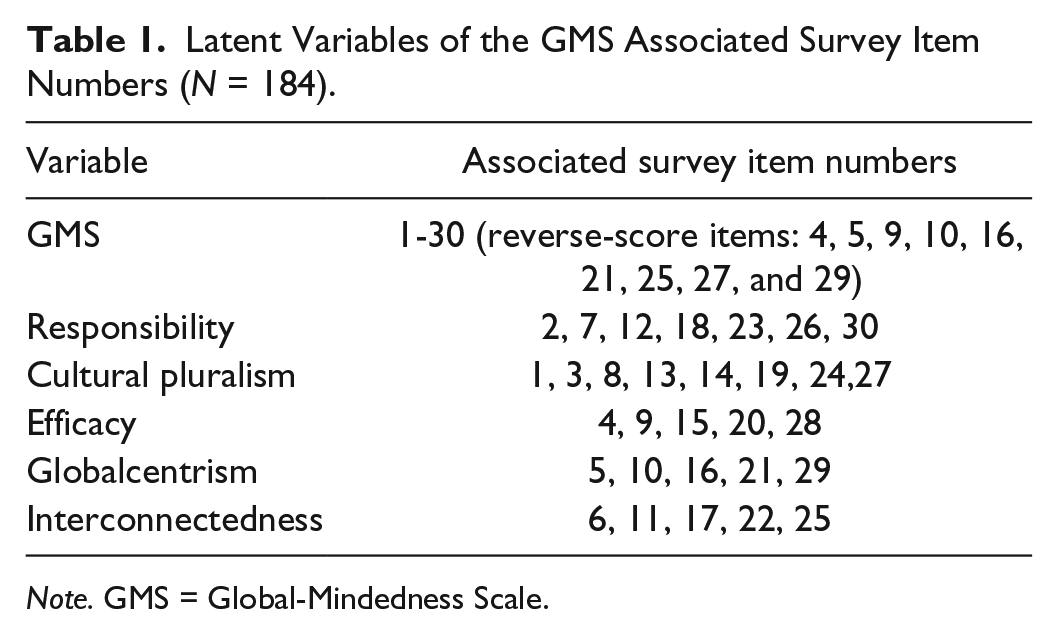
The instrument, GMS, which includes 30 items on a 5-point Likert-type scale, provides responses that range from strongly disagree to strongly agree. The range of the scores is from 30 to 150. Table 1 shows the latent variables of the survey and the associated survey item numbers.
Latent Variables of the GMS Associated Survey Item Numbers (N = 184).
Note. GMS = Global-Mindedness Scale.
The GMS 4, 5, 9, 10, 16, 21, 25, 27, and 29 are reverse-score items. I recoded these items into new variables using SPSS and ran the cross-tabulation analysis on each new variable against the original variable to make sure that everything was correct. I ran a descriptive statistical analysis on GMS variables. The top two items with the highest mean scores were GMS 8 and GMS 15. The content of GMS 8 was, “Americans can learn something of value from all different cultures,” and the content of GMS 15 was, “It is very important to me to choose a career in which I can have a positive effect on the quality of life for future generations.” The bottom two items with the lowest mean scores were GMS 5 and GMS 10. The content of GMS 5 was, “The needs of the United States must continue to be our highest priority in negotiating with other countries,” and the content of GMS 10 was, “Americans should be permitted to pursue the standard of living they can afford if it only has a slight negative impact on the environment.”
I used the compute variable function in SPSS, to create new variables to sum up responsibility, cultural pluralism, efficacy, globalcentrism, and interconnectedness scores. Table 2 lists the six variables and the measures of central tendency.
Descriptive Statistics for Six Summed Variables (N = 184).

Note. SE = standard error; GMS = Global-Mindedness Scale.
Table 2 lists the means, standard errors of the means, standard deviations, possible score ranges, and sample score ranges of GMS total scores. It shows the measures of central tendency for summed scores of five GMS latent variables.
I ran MANOVA tests for Question 1 and multiple regression tests for Question 2 to analyze the data.
For the assumption analysis of MANOVA, I ran Levene’s test to evaluate the univariate equality of variances for each group. The assumption of homogeneity of variance was met. The assumption of homogeneity of covariance matrices was met. Data were most certainly not random. Data were assumed independent because there was no information to conclude otherwise. I then ran the descriptive statistics for the means scores on the five latent variables of global-mindedness between Group 1 (freshmen and sophomores) and Group 2 (juniors and seniors). Table 3 shows the results.
Descriptive Statistics for the Means Scores on the Five Latent Variables of GMS Between Two Groups (N = 184) Rates.

Note. GMS = Global-Mindedness Scale.
Group 1 = freshmen and sophomores; Group 2 = juniors and seniors.
Descriptive statistics in this general linear model showed that pre-service teachers in Group 2 had higher mean scores on the latent variables of cultural pluralism, efficacy, globalcentrism, and interconnectedness than those in Group 1. Pre-service teachers in Group 1 had slightly higher mean scores on the latent variable of responsibility than those in Group 2. For the MANOVA tests for Question 1, Pillai’s trace indicated that there was not a significant effect of class standing on the mean scores of any of the five latent variables of global-mindedness between pre-service teachers in Group 1 and those in Group 2, V = .01, F(5, 178) = .50, p = .77. Wilks’ lambda indicated that there was not a significant effect of class standing on the mean scores of any of the five latent variables of global-mindedness between the two groups, Λ = .99, F(5, 178) = .50, p = .77. Hotelling’s trace indicated that there was not a significant effect of class standing on the mean scores of any of the five latent variables of global-mindedness between the two groups, T = .01, F(5, 178) = .50, p = .77. Roy’s largest root indicated that there was not a significant effect of class standing on the mean scores of any of the five latent variables of global-mindedness between the two groups, Θ = .01, F(5, 178) = .50, p = .77. Multivariate tests of Pillai’s trace, Wilks’ lambda, Hotelling’s trace, and Roy’s largest root were not significant, p > .05, two tailed.
The test results failed to reject the null hypothesis. The differences in the mean scores on latent variables of responsibility, cultural pluralism, efficacy, globalcentrism, and interconnectedness between pre-service teachers in Group 1 (freshmen and sophomores) and those in Group 2 (juniors and seniors) were only by chance alone. This conclusion indicated that the follow-up ANOVA tests on each of the dependent variables and the follow-up discriminant function analysis were not necessary.
For the assumption analysis of multiple regression, I checked to see whether the dependent variable was linearly related to each of the independent variables as appropriate. Independent variables of gender, perceived competence in non-native language or culture, and teaching experience are dichotomous variables. These variables were not included in this linearity checking. Examination of the scatterplot revealed that there is no evidence to indicate the non-linearity between respondents’ global-mindedness total scores and frequency of interaction with people of diverse backgrounds.
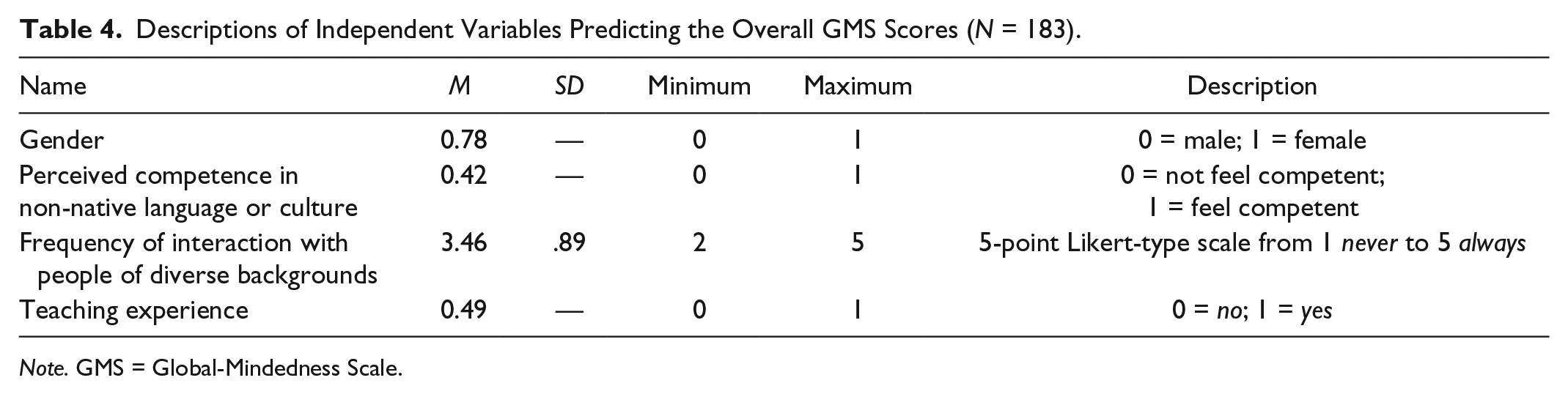
I generated minimum and maximum values for Mahalanobis distance, Cook’s distance, leverage, covariance ratio, and the standardized DFFit and DFBeta values to check the influential cases. The model was an adequate fit of the sample data. The model would fit the sample better without the extreme and influential Case 115. I then verified the assumptions of independence of errors, the normal distribution of residuals, linearity, and homoscedasticity to determine whether the model could generalize to other samples. The results indicate that the model could generalize to other samples. I recoded the variables of gender, perceived competence in non-native language or culture, and teaching experience. Evaluation of frequency statistics and cross-tabulation outcomes indicated that the new variables were successfully created. Table 4 shows the descriptions of independent variables predicting the global-mindedness total scores.
Descriptions of Independent Variables Predicting the Overall GMS Scores (N = 183).
Note. GMS = Global-Mindedness Scale.
Among the 183 participants, 78% were female and 49% had teaching experience. There were 42% of participants in this sample who felt competent in using a non-native language or interacting with others of another culture. The average score of frequency of interaction with people of diverse backgrounds is 3.46 (M = 3.46, SD = .89). I ran the multiple regression analysis using the recoded independent variables. Table 5 shows the results.
Regression Analysis for Variables Predicting the Overall GMS Scores (N = 183).

Note. R2 = .15; Adjust R2 = .13. GMS = Global-Mindedness Scale.
Standard Error of B.
p < .05. **p < .01, two tailed.
Concerning the F test in the ANOVA table, F = 7.54, p < .001, the model was significant. The model was significantly better at predicting the outcome than the mean. There was a total of 15% of the variance in the pre-service teachers’ levels of global-mindedness that could be explained by the model. When adjusted for sample size and numbers of predictors, the variance explained dropped to 13%.
The test results rejected the Null Hypothesis 2. The pre-service teachers’ levels of global-mindedness could be predicted from demographic variables of (a) gender, (b) perceived competence in non-native language or culture, (c) frequency of interaction with people of diverse backgrounds, and (d) teaching experience. The independent variable of gender was a significant predictor of the pre-service teachers’ levels of global-mindedness, p < .05, two tailed. The independent variables of perceived competence in non-native language or culture and teaching experience were significant predictors of the pre-service teachers’ levels of global-mindedness, p < .01, two tailed. Female students scored 4.16 points higher on the GMS than male students, holding the other variables constant. Students who felt competent in using a non-native language or interacting with others of another culture scored 5.31 points higher on the GMS than students who did not feel competent in using a non-native language or interacting with others of another culture, holding the other variables constant. Students who had teaching experience scored 4.90 points higher on the GMS than students who did not have teaching experience, holding the other variables constant. The variable of frequency of interaction with people of diverse backgrounds was not a significant predictor of the pre-service teachers’ levels of global-mindedness in this model.
Discussion
This section summarizes the findings of the research questions. It depicts how the findings relate to the previous research and discusses their implications for the teacher education programs. It also includes the recommendations for future studies.
I ran a MANOVA test for Question 1. The MANOVA test was not significant, p > .05, two tailed. I stopped and did not run the follow-up ANOVA tests on each of the dependent variables and the follow-up discriminant function analysis because the MANOVA test was not significant. The test results failed to reject Null Hypothesis 1: There is not a statistically significant difference in the mean scores on any of the five latent variables of (a) responsibility, (b) cultural pluralism, (c) efficacy, (d) globalcentrism, and (e) interconnectedness between pre-service teachers in Group 1 (freshmen and sophomores) and those in Group 2 (juniors and seniors). In this model, there was not a statistically significant difference in the mean scores on any of the five latent variables of global-mindedness between pre-service teachers in Group 1 and those in Group 2.
The research results showed that students who had declared an education major or minor at a Midwest state university in the United States had consistent scores on the five latent variables of the GMS, regardless of their class standings. The results did not confirm Hett’s (1993) statement that higher GMS students would be juniors or seniors in college. However, there was a limitation for this study. Group 1 students were freshmen and sophomores; Group 2 students were juniors and seniors. The sophomores and juniors were so close in grade level, but they were assigned into two groups. This may be a bias in this research. Further research is needed to investigate the bipolar groups, such as freshmen and seniors, to see whether there is a statistically significant difference in the mean scores on any of the five latent variables.
I ran a multiple regression test for Question 2. Concerning the F test in the ANOVA table, F = 7.54, p < .001, the model was significant. The test results rejected Null Hypothesis 2: Gender, perceived competence in non-native language or culture, frequency of interaction with people of diverse backgrounds, and teaching experience do not predict a significant proportion of the variance in global-mindedness total scores. The independent variables of gender, perceived competence in non-native language or culture, and teaching experience were significant predictors of the pre-service teachers’ levels of global-mindedness.
Female students scored higher on the GMS than male students. This result concurred with Hett’s (1993) and Zhai and Scheer’s (2004) findings. Hett’s (1993) study suggested that women would score higher on the GMS than men. Zhai and Scheer’s (2004) study stated that female students are more sensitive toward global issues.
Students who felt competent in using a non-native language or interacting with others of another culture scored higher on the GMS than students who did not feel competent in using a non-native language or interacting with others of another culture. This confirmed Hett’s (1993) findings that higher GMS students would be proficient in a second language. This explained why the National Governors’ Association (1989) proposed that college and university graduates be familiar with or fluent in non-native languages and cultures to be ready to meet the challenge of global communication and global business. Lambert (1989) asserted that foreign language courses are the beginning of international studies. Colleges and universities should provide sufficient non-native language and cultural courses for students and focus on students’ proficiency in non-native language teaching and learning. In the meantime, culture-related courses, such as intercultural communication and adaptation to multicultural learners, are helpful to develop pre-service teachers’ global-mindedness. Campus offices, such as the Department of International Affairs, should organize activities to engage students in experiencing different cultures. Colleges and universities should host students with different cultures and provide opportunities for those students to exhibit their cultures and interact with each other.
Students who had teaching experience scored higher on the GMS than students who did not have teaching experience. This concurred with Acolatse’s (2010) statement that teaching experience displayed a positive interaction with GMS scores. Teacher education programs in colleges and universities should establish good relationships with school districts to engage pre-service teachers in practical teaching. Teacher educators and administrators should build field observations, practica, student teaching, and internships into their curricula to prepare future teachers with a more accurate and sensitive outlook on global issues. The supervisors of student teachers should remind the pre-service teachers that students in their future classrooms may come from different language and cultural backgrounds. Future teachers should be ready to work with multilingual and multicultural students and further global-mindedness through interactions with the students in their classrooms.
The variable of frequency of interaction with people of diverse backgrounds was not a significant predictor of the pre-service teachers’ levels of global-mindedness in this model. There were other variables that might affect the pre-service teachers’ levels of global-mindedness, such as the length of study abroad experience and the number of global courses taken, that were not included in the model. Further research should take into account those factors that would affect the overall GMS scores.
Recommendations for Future Research
Although the findings of the research revealed pre-service teachers’ global-mindedness added to the knowledge base, there is more research to be conducted to promote a deeper understanding of this topic. Further research may analyze a full range of effects on the development of global-mindedness. Suggestions for future research follow.
Future studies may replicate this study using different samples to test all the hypotheses. For instance, one might look at a setting with more cultural diversity or a setting in another country. Because participants self-reported their frequencies of interaction with people of diverse backgrounds, it would be interesting to repeat the study with an established criteria for frequency of interaction to see if current findings hold. In concert with this, one could also examine how the teaching experience factor is influenced by the amount of time teaching or time teaching in diverse settings. For the individual factor of class standing, future researchers may divide the participants into different groups, such as bipolar groups, or examine all four class standings instead. If all four class standings were examined, then bipolar groups could be pulled from the data. Next, future studies may focus on a comparative study of pre-service teachers’ and in-service teachers’ levels of global-mindedness to find whether there are differences between the two groups. Future researchers may use different research methods to investigate people’s global-mindedness. For instance, a mixed-methods approach would allow both quantitative and qualitative data inputs to be woven together to bring broader understanding. In addition, future researchers may select other effective instruments to assess the pre-service teachers’ global-mindedness, perhaps then comparing the research results with the ones in this study.
Footnotes
Declaration of Conflicting Interests
The author(s) declared no potential conflicts of interest with respect to the research, authorship, and/or publication of this article.
Funding
The author(s) received no financial support for the research and/or authorship of this article.