



Abstract
We empirically determine the role of different forms of infrastructure on a country’s trade. We use an augmented gravity model that incorporates infrastructure in the estimation of merchandise trade flows. We take panel data, including China and 21 selected Asian economies, from 1999 to 2018. We find that the panel ordinary least squares (OLS) and poisson pseudo maximum likelihood (PPML) model estimations prove to be significant. Proxies for Transport Infrastructure including roads, railways, and sea transport, and Proxies for information and communication technology (ICT) infrastructure consisting of mobile, electricity, and internet connections show a strong and positive impact on trade while air transport and landline phone connection have an unexpected negative effect on trade. The positive estimates for quality of infrastructure signify that high standards of Transport and ICT infrastructures lead to increased trade flows of the exporting and importing countries. Results also show that cultural similarity leads to increased trade flows between China and its trading partners in Asia.
Keywords
Introduction
As nations focus on sustainable development and globalization goals in the modern era, international trade plays a critical role. International trade provides a platform for nations to cooperate and exchange goods and services according to their requirements (Bankole et al., 2015b). The importance of infrastructure on affecting diverse outcomes on the economy, including trade and commerce, cannot be neglected, and their impact on the exports and imports of the country cannot be denied. Infrastructure is considered the backbone of a country’s economy as it enables efficient use of the available resources through enhancing mobility and accessibility (The World Bank, 2020b; World Trade Organization, 2018). It ensures time and cost-efficiency. For the same reason, trade within the country is also enhanced and developed. Infrastructure within a country can foster trade is the main direct expected outcome. It is also obvious that enhancement in trade, exports, and imports is often assumed to lead to more employment, higher wages, and similar positive results (Donaldson, 2018).
Lack of infrastructure diminishes the growth and development trends of the developing and underdeveloped nations (Chakraborty & Nandi, 2011). Existing infrastructure in the developing nations presents a far worse scenario for the nations as the infrastructure is eroding and depleting day by day, causing huge investments in the renovations and maintenance of the projects (Orbital Insight, 2019). Countries like Pakistan, Sri Lanka, India, Thailand, and so on have to spend most of the budget and government income on maintaining and repairing the existing infrastructure projects. These investments are proving to be fruitful for the nations (Seethepalli et al., 2008). They can be further enhanced through new and innovative projects with more area coverage in the countries. The low quality of infrastructure creates a gap and increases vulnerability toward high cost and time inefficiencies (Bartle, 2017; I. U. Rahman et al., 2020). These factors halt and break the trends of increased growth of the nations and countries and take a long time to recover from such situations. This condition is mostly true for the developing nations that suffer to a greater extent due to lacking infrastructure systems in the boundaries of the nations.
Current studies in the literature have focused on the importance of physical infrastructure within a country and have shown that new and improved infrastructures lead toward the progress of trade, commerce, industry, economic activities, cooperation, and integration (Akpan, 2014; Baniya et al., 2020; Coşar & Demir, 2016; Duranton et al., 2013; Hoang et al., 2020; Zhai, 2018). Transport infrastructure plays a distinct part in the economy, especially in the mobility and transportation of tradable goods and services. Road and highways create an easy means of bridging the gap between producers and manufacturers, suppliers, consumers, exporters, and importers. In terms of productions in a country whose economy is mainly based on export goods and items, the country must have a good physical infrastructure and means to provide access to the raw material and smooth flow of final products, that is, exports, to the destination. Regional infrastructure is possibly a good measure of the increase in productions and economic activities within the regions and leads to better outcomes and socioeconomic development of the areas and thus the country (Duranton, 2015). The more the coverage of infrastructure within the regions, the higher the chances of the region accelerating its growth through access and utilization of the main social and economic assets and resources.
As an evolving economic bloc in recent years, Asia has seen a proliferation of regional integration and collaboration initiatives. On one hand, Asia’s trade volume has been rapidly increasing, while on the other hand, the trend and characteristics of infrastructure facilities have been rapidly evolving with the likes of mega projects of China—Belt and Road Initiative (BRI), China Pakistan economic corridor (CPEC), and so on. Different spatial and socioeconomic features distinguish segments of the communication network, resulting in a heterogeneous infrastructure network.
Asia is a key economic area for building a network of infrastructure connectivity, and China’s export-based economy and infrastructure development policies provide a strong framework for analysis. Like other nations globally, most Asian nations depend on China for trade and commerce. China’s trading partners include both high- and low-income nations with different socioeconomic conditions and infrastructure networks, which provides new dimensions in terms of the relationship between trade and infrastructure. Therefore, this article aims to address the relationship between trade and different types of transport and information and communication technology (ICT) infrastructure using the case of China and selected trading partners in Asia.
According to the literature, historically, transportation and ICT infrastructure were analyzed separately or without evaluating all subcategories to determine trade. Transport and ICT infrastructure are crucial for trade. A lack of attention to transport and ICT infrastructure may lead to inefficiencies and a failure to achieve trade goals. This research attempts to analyze all possible outcomes related to trade that may result from different infrastructures and provide further proof in the literature. In addition, the current article also attempts to partially fill the literature gap by examining the economic, cultural, and geographical factors’ impact on trade of China and its trading partners over the period 1999–2018. Moreover, the PPML model proposed by Silva and Tenreyro based on the Gravity Model is also adopted for the research (Santos Silva & Tenreyro, 2006). Furthermore, the article also provides implications for policymakers to enhance future trading activities and economic cooperation.
The article is divided into five main sections. Following the introduction, the second section covers the relevant literature works and articles. The third section provides details of the research methodology based on the theoretical and empirical framework. The next section explains the main results and outcomes based on diagnostic tests and regression analysis. The final section highlights the key findings and implication of the research.
Literature Review
The study of the relationship between trade and infrastructure is not a new phenomenon. Past and current studies have focused on determining the role and importance of infrastructure development on a country’s economic indicators, including trade (Bougheas et al., 1999; Donaubauer, Glas, et al., 2016; Francois & Manchin, 2013). Different pieces of literature have focused on the relationship between trade and infrastructure in both qualitative and quantitative aspects. The literature widely illustrates that it is still a problem to determine the precise effect of infrastructure on trade. Any considerations, such as relevant geographical characteristics, interrelationships between various types of infrastructure and use of infrastructure resources, may be due to the broad variety of estimates found in the literature.
In addition, there are problems regarding infrastructure forms. According to Bouet et al. (2008), measuring the impact of infrastructure on trade is complicated due to the interactive nature of different types of infrastructure. The authors further reiterated that any greater influence of telephone access, on the other hand, is dependent on the support of the road system and vice versa. Therefore, it is necessary to include all the major types of infrastructure in determining the true impact of infrastructure on trade.
Trade and infrastructure are important research areas, with several studies documenting empirical evidence in these aspects. We present the literature studies in two ways: first, the relationship between trade and transportation infrastructure, and subsequently, the link between ICT infrastructure and trade. We provide an extensive discussion of empirical literature in transportation and ICT infrastructure in this part.
Transport Infrastructure
The significance of infrastructure within a country to boost trade and economic development cannot be overlooked (Lakshmanan, 2011). Infrastructure, including both communication and transport infrastructures, is crucial for the progress of a nation, growth of the economy, trade and commercial relations with its partners (Bougheas et al., 1999). Good and quality infrastructure promotes and assists the other economic indicators (Clark et al., 2004). The flow of goods, access to services, and movement of resources across all industries and sectors, not only within the economy but also in terms of global markets and international cooperation, are key factors in the economy. As obvious as it is, it is believed that development and advances in infrastructure improve economic progress and substantially affect nations’ living standards and social welfare.
Earlier studies mainly concentrated on determining the relationship between trade and infrastructure based on quality and costs. Literature studies have shown a positive and significant relationship between trade and transport infrastructure quality (Baniya et al., 2020; Blonigen & Wilson, 2008; Clark et al., 2004; Shepherd & Wilson, 2007). According to these studies, improved efficiency of seaports will lead to an increase of approximately 25% in the trade of the country. These studies were limited to the quality of sea transport infrastructure, while other modes of transportation were not included. Based on the importance of port efficiency in the case of Latin American nations, Sánchez et al. (2003) showed that port efficiency measures have significant impacts in reducing transportation costs of trade. In terms of infrastructure, transportation of tradable goods and services through seaports and sea routes is one of the significant sources of transport infrastructure. The effect of sea transportation is highly significant and has been an important determinant of trade between nations in history as well as the modern era. Arvis et al. (2010) supported the arguments put forth by Limao and Venables and explained that landlocked countries have relatively higher transportation costs than countries with access to seaports and sea routes.
In contrast to better quality infrastructure, the characteristics and outcomes of poor quality infrastructure for the society are of serious concerns for the countries. Countries face a decline in output and income caused by fewer infrastructure facilities and structures (Nordås & Piermartini, 2006). Lack of infrastructure facilities can harm the progress of the economic structure of the nations. All other setups in the economy are affected due to the unavailability or poor performance of infrastructure facilities. Moreover, focusing on the infrastructure related to the Belt and Road Initiative (BRI) projects, Soyres et al. (2019) suggested that minimizing transportation costs and increasing trade flows in countries may enhance and improve the transport infrastructure. In addition, the location of a country plays an important role in this regards, and the access to seaports and sea routes and distance of the seaports from the main industries determines the trade and costs related to it.
Although previous studies have highlighted the importance of different transport infrastructure in trade, yet the study on combined effects of each component on trade is rare. In addition, the evidence on the relationship between air transport and trade is scarce. Considering these aspects, in this article, we add these factors to the model estimation.
Information, Communication, and Telecommunication Infrastructure
Infrastructure related to ICT is an important aspect in terms of international trade. Landline telephone connections, internet, electricity, and cell phone subscriptions can impact the economy and trade through decimation and flow of information among all the sectors. Ahmad et al. (2011) measured and analyzed the extent of the effect of ICT infrastructure. He established that the use of ICT infrastructure, including Telephones, cellphones, and the internet, has a positive impact on the trade of Malaysia with the partners of trade. According to Levchenko (2007) and Méon and Sekkat (2008), halts in the decimation of information throughout the economic sectors and institutions, delays in delivery of shipments, failure in timely transport and transfer of goods and services, and deficiencies in communication are few of the obstacles created due to poor infrastructure. Lackings in ICT infrastructures can have undesirable effects on the economies.
Bankole et al. (2015a) used the costs on telecommunications in an augmented gravity model and showed a negative and significant impact of the costs on telecommunications on trade. It can also be assessed that telecommunication and costs on telecommunications are also necessary while considering a nation’s infrastructure and its impact on the trade with its partner nations (Zhen-Wei Qiang et al., 2004). In this regard, Fink et al. (2005) showed that costs incurred on telephone calls have affiliation with the trade flows of a country. The study showed a negative relationship between both and presented that the cost of telephone calls led to a decline in the trade, especially in the services. The same effect was also supported and presented by other scholars (Nicoletti et al., 2003; Li & Wilson, 2009). Although some of the ICT infrastructures have been studied and presented in previous research studies, there is still a need to study and estimate the overall impact of the main sources of infrastructure, including all transport and communication infrastructure components. Apart from the three main ICT components (internet, telephone, and cellphone), electricity is also believed to play a key role in the production process. This article will take into account the electricity component as part of the ICT infrastructure.
Regional differences also exist in terms of infrastructure across the globe. In the case of Asia, most of the nations are developing, and some countries lack proper transport and communication infrastructure compared with other nations of the world. Estache et al. (2006) and Estache and Goicoechea (2011) showed the level of the transport and communication infrastructure for Asia and Central Asia and revealed that the main transport infrastructure, including railways and freight transport for the Central Asian nations, was very less and the quality was poor. Donaldson (2018) pointed out the importance of railway networks based on archival data on colonial India. Railway networks are also a major part of the transport infrastructure in terms of developing Asian nations, but the condition of the railways system is outdated and of low standards. Countries like China, Japan, Singapore, South Korea, and Malaysia have maintained high standards in terms of transport and ICT infrastructure and achieving high levels of trade, but other nations require following the same patterns. Therefore, it is essential to focus on the aspect of different types of infrastructure and study the link of infrastructure in enhancing trade of the countries.
In terms of analysis and measurement of bilateral trade flows, different approaches have been used in the past pieces of literature (Athukorala, 2011; Gaulier et al., 2007), while some have focused on the use of the Gravity model (Baniya et al., 2020; Chen, 2016; Hoang et al., 2020; Truong et al., 2019). The key rationale applied in early econometric models for modeling trade flows is the gravity approach. Researchers centered on the specification of the gravity model, which is analogous to Newton’s Law of Gravity (Anderson & Van Wincoop, 2003). Walter Isard (1954) first introduced the Gravity model in the field of economics. The model estimates bilateral trade flows based on economic sizes and distances between the two economies in its conventional approach. But a more better and recent application of Gravity was proposed by Santos Silva and Tenreyro (2006) in the form of PPML approach, which considers the issues of non-zero error and correlation in the model (Frankel, 1997). Based on the past literature and the importance of the Gravity Model, this research will use a similar method based on the PPML approach for the estimation purpose.
The impact of major integrated kinds of infrastructure on trade flow indicators, such as exports, is not considered in the literature studies. Several scholars, in particular, were unable to include key Transports and ICT infrastructures in assessing trade flow metrics in Asian economies (quality infrastructure, trade, etc.). This article has not only focused on the main infrastructure components, including railways, roads, waterways, and air transport but added telecommunication infrastructure in the model inclusive of mobile phone connections, landline phone connections, internet services, and electricity infrastructure. The inclusions of these variables provide new dimensions to the study and create new opportunities and evidence on determining the trade in the case of developing nations. Dummy variables for cultural similarities based on the study of Quer et al. (2017), landlocked countries, financial crisis and countries bordering China are also included as control variables for robust outcomes. The article mostly follows the augmented model similar to the one presented by Limao (2001) and uses the PPML model for estimation purpose. The addition of new indicators in modeling and use of PPML will enhance the outcomes of the model and provide robust estimates on the impact of new infrastructures on trade in terms of China and its trade partners in Asia.
Research Methodology
The design and setup of the article were in accordance with the theoretical and empirical approach appropriate for the model estimation. The data of 12 estimators for 21 selected economies of Asia, including China, for a sample period of 20 years (1999–2018) was gathered and organized to approximate the equation. A total of 400 observations were taken for sampling purposes.
We use the gravity model of trade as the base for this research (Bergstrand, 1985; Isard, 1954). The gravity model explains a positive relationship between the GDPs of the trading countries and exports between them. It assumes that the exports between different nations will be high if their respected GDPs are high and vice versa. Contrary to that, the distance between the trading nations has a negative relationship with the trade and exports of the nations. The greater the distance, the lower will be the trade and vice versa. Following the gravity model, this article assumes an augmented form of the model with the inclusion of new variables and dummy variables to estimate the relationship of the dependent variable (trade flows) and independent variables. In its basic form, the gravity model is specified as follows:

where the subscripts i and j represent the origin and destination countries, respectively; exportij is the value exports (Trade flows) from i to j; GDPi is the gross domestic product of the exporting nation i; GDPj is the gross domestic product of the importing nation j, and finally Distij is the land distance between country i and country j.
In the linear form, the general equation is represented as

If aggregate trade is estimated, theoretical bases and gravity model literature demonstrate intersectional effects and endogeneity bias of trade and its components. Therefore, we consider bilateral trade flows for the trading partners separately as exporting and importing nations to mitigate this issue. Moreover, we use panel data analysis to minimize the bias caused by unobserved heterogeneity in the model for calculations.
Following the literature (Anderson, 2011; Duranton et al., 2013), the gravity model in an extended and modified form will be put in the article to analyze the infrastructure and trade flows magnitudes of the coefficients of the variables for countries of Asia. However, the OLS model proposed by Anderson and Van Wincoop (2003) leads to heteroscedasticity bias due to the issue of zero trade. To tackle this issue, Santos Silva and Tenreyro (2006) proposed a new PPML model for the estimation of Gravity model equations. They showed that the PPML model provides consistent results when used in Gravity models of trade. Keeping in view the theoretical and empirical studies, we apply the PPML model in our estimations and present our model as follows:

where, expijt = country i (China) exports to country j in year t, gdpit = exporting country’s GDP in year t, gdpjt = importing country’s GDP in year t, distij = economies i and j’s capitals cities (Distance in km between China and Selected Asian Economies),
Moreover, the vector
Data Illustration
We use secondary data for the estimation of our model. All the data were collected from online resources, including relevant websites of institutions and organizations of the sample countries. The data for dummy variables were collected and estimated from the relevant websites. The LPI index of the World Bank was collected from the website and added to the model (The World Bank, 2018). Variable of distance was added as the length between the capitals of the countries, which past researchers also used.
The main sources of the data included the websites of the World Bank, the Statistical Bureau of China, the Asian Development Bank, and the APEC database. The data of distance between capital cities (China and its trading partners in Asia) were collected from an online website, and data on culture similarity were derived based on information at World Atlas. Details of the data sources are as follows (Table 1):
List of Variables and Data Sources.
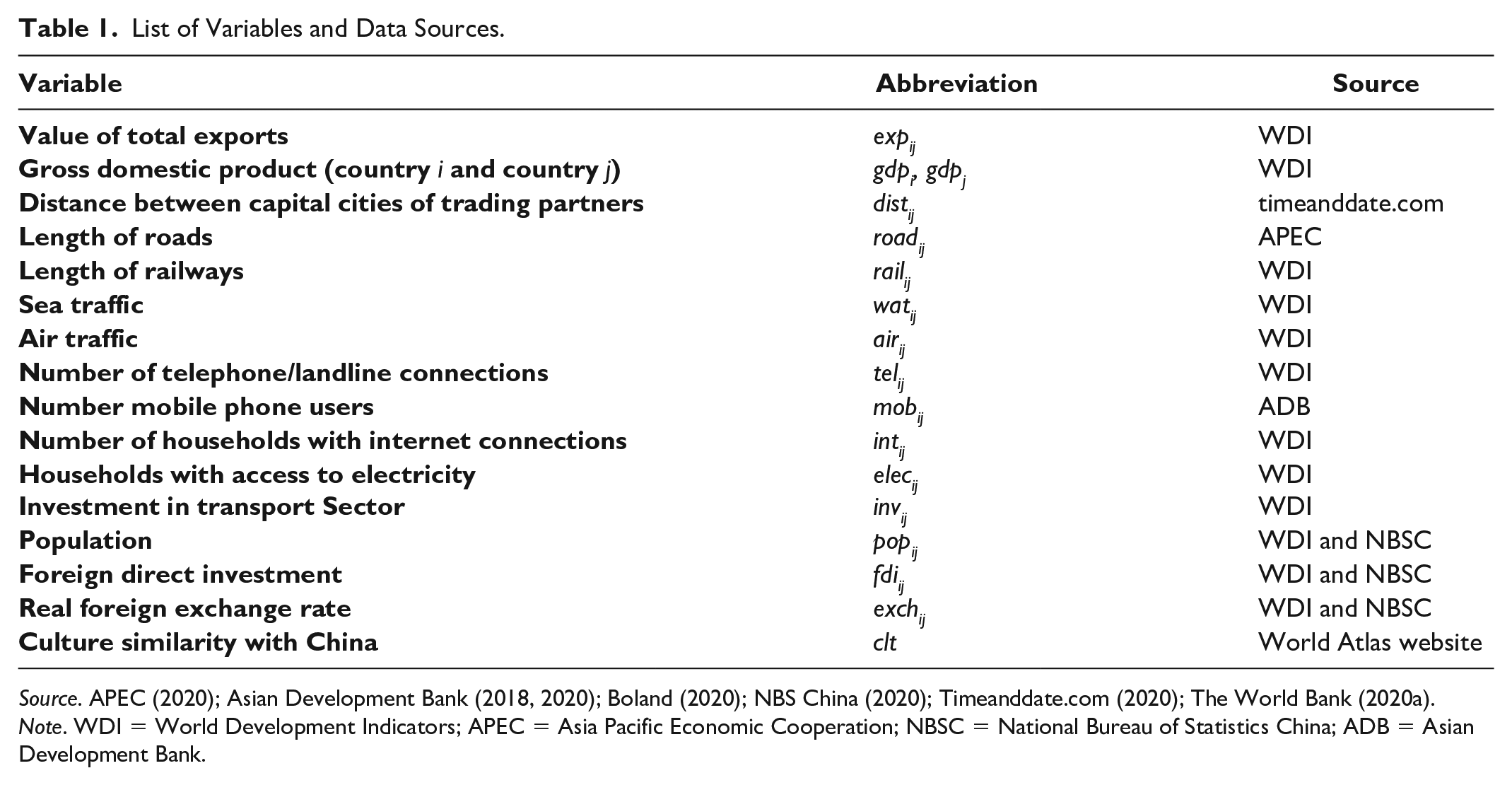
Source. APEC (2020); Asian Development Bank (2018, 2020); Boland (2020); NBS China (2020); Timeanddate.com (2020); The World Bank (2020a).
Note. WDI = World Development Indicators; APEC = Asia Pacific Economic Cooperation; NBSC = National Bureau of Statistics China; ADB = Asian Development Bank.
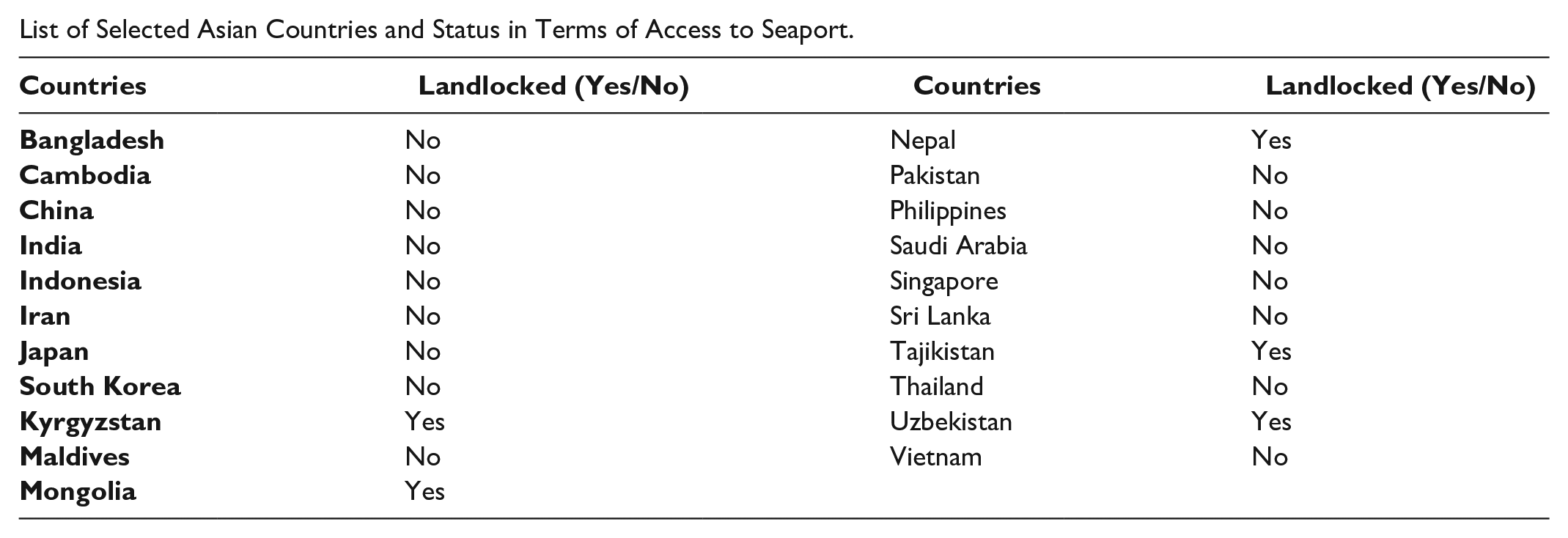
Apart from the above variables, other dummy variables are not included in this table. The Authors develop the dummy variables, including nations bordering with China, countries with seaports, financial crisis, and year dummies. The names, along with the location of the selected countries trading with China, are presented in the appendix. The countries are chosen based on data availability as well as consideration of socioeconomic and geopolitical factors in relation to China.
Result Estimation
The results of the article matched the expected outcomes. To check the presence of a connection between the regressors of the estimation, the OLS Fixed and Random effects and PPML models were applied. Diagnostic tests for the panel data, including the Hasuman test, panel unit root test, and panel co-integration test, were undertaken to avoid spurious regression and irrelevant inferences. Given the considerable rise in studies on panel unit root and the co-integration gravity model, variables were mostly disregarded (Afolabi et al., 2016). Afolabi et al. (2016) suggested different methods can be adopted to check whether variables are nonstationary and the variables are co-integrated. Thus, the Fisher-Type unit root test was conducted to check if the variables are stationary or not, while the Pedroni co-integration test was adopted to estimate the long-run association between the variables. Multicollinearity, autocorrelation and heteroskedasticity tests were covered under the PPML regression as PPML coefficients are fitted after adjusting these issues and thus, provide unbiased estimates. Finally, the model was fitted based on control variables and checked for robustness through PPML robust estimation.
Descriptive Statistics: Summary
The summary of descriptive statistics of all the variables of the model, including the dependent and independent variables, is shown in Table 2, which explains a brief overview of different statistical outputs of the variables. The results were based on 22 variables, out of which 21 were independent variables while expi is the dependent variable. The independent variables were further divided into two parts; (a) 15 main variables, and (b) six dummy variables. The dummy variables will also be used as control variables along with population, real exchange rate and investment, and foreign direct investment (FDI). The sample size consisted of an average of 800 observations. The average value for all the variables provides a clear summary and idea about the changes and weightage of the variables.
Descriptive Statistics.

The mean value of exports was USD 7956190.9 for China, and its trading partners, representing the trade flows in the model. For the given period, the mean values for the annual GDPs of China and trading partners are USD 4.164 trillion and USD 2.309 trillion that show the GDP of China is much higher as compared with the trading partners. One of the main reasons for this can be the population of China and higher levels of growth that lead to an increase in all the other factors of the economy. The average distance between the capitals of the trading partners with China is 2259.05 km with a minimum distance of 594 km. Some Asian nations are located at a close distance from China, and some are neighboring countries, including Pakistan, Mongolia, India, and Nepal. The impact of distance of different nations on their trade with China will provide basic analysis in terms of the Gravity model.
The variables for transport and communication infrastructure are also summarized. In terms of transport infrastructure, the average length of the roads for the sample is 166066.07 km with a minimum value of 118.58 km and highest at 4689842 km for the given timeframe. Similarly, the results also suggest that in terms of transport infrastructures (road, rail, wat, air), road infrastructures have the highest coverage while waterways have the lowest average coverage. It can be deducted that infrastructure related to waterways and air transport require enhancements.
The four main ICT infrastructures, i.e., elec, tel, mob, and int, are also highlighted in the table. The majority of households, as compared with cellphones, landlines, and internet services, utilizes electricity connections. The use of the internet and cellphones is still new and limited in rural regions of most Asian countries. Some countries acquired internet and cellphone service in the first decade of the 21st century; therefore, the minimum value for these variables is also zero for some countries. Population, investment in infrastructures, and FDI for the countries show high standard deviation value due to the economic differences between China and the trading Asian countries. These variables also act as controls in our model. The FDI for the selected Asian economies is averaged at USD −5.012 billion, demonstrating that most nations’ FDI outflow exceeds the inward flow of FDI. In the case of the real exchange rate, the average value of the exchange rate for the period 1999 to 2018 is at 1.45833 against dollars. The exchange rate of China and the trading partner against the dollar is at the maximum value of 29011.492 (as in the case of the Vietnamese dong) and a minimum value of 0.5494425.
The dummy variable for the quality of transport and information and communication infrastructure assumed only two values of minimum zero and maximum one. As mentioned earlier, the values of dummy for quality of infrastructure are based on the rankings and rating of LPI scores. Similarly, the dummy for the landlocked trading partner of China as represented by llck also assumed only two values of minimum 0 and maximum 1. Countries access and availability to seaport and sea routes are given dummy value of 1 and otherwise 0. To understand and check the effect of cultural similarity on trade between china and its trading partners, the clt is also added in the model as a dummy factor (value is 0 if dissimilar and 1 if culturally similar with China). The dummy for financial crisis fcr assumes a minimum value of zero, which represents the period before 2008 and 1 for the post-2008 era. The dummy is added to analyze the trends in international trade between China and its trading partners before and after the financial crisis.
Panel Unit Root Test
For panel data, the Fisher-Type Unit Root Test based on the Augmented Dickey-Fuller test is estimated to determine the presence or absence of unit root in the model, which is to test if the variables in the model are stationary or not. Non-stationary variables cause unbiased estimates in regression analysis (Choi, 2001). The Augmented Dicky Fuller Test is widely used in testing if the variables are stationary or not. However, Choi argues that the inverse chi-square test is applicable and more potent when the number of panels is definite. The null hypothesis assumes that the main regressors and variables in the model retain unit root (Choi, 2001; Im et al., 2003). The outcomes of the Fisher-Type Unit Root tests are presented below:
The results of inverse normal, inverse logit, and the modified inverse chi-square test statistics are also presented, which affirm the strength of the inverse chi-square test. The value of the probability to reject the null hypothesis should be less than 0.05 (5%) (Sjö, 2008). According to the above table, all the main variables of our model had a probability value of less than 0.05, due to which we reject the null hypothesis. Thus, most of the model variables are stationary at levels and a few at first difference.
Panel Co-Integration Test
Before performing regression analysis, it is necessary to determine whether there are long-run associations between interest variables. The co-integration test implies that a series of variables move together in the long run (Canning & Pedroni, 2004). For the panel co-integration test, it is also a necessary condition for the variables to be stationary at order (I) or first difference. As shown in Table 3, most of the variables do not have unit root at the first difference, which enables us to run the co-integration test. We use the Pedroni co-integration test to check long-run associations among our variables. The co-integration test’s null hypothesis is the same as other tests and postulates the absence of co-integration among the factors of the equation and model (Canning & Pedroni, 2004; Engle & Granger, 1987; Sjö, 2008). Table 3 shows the outcomes of the Pedroni co-integration test.
Fisher-Type Unit Root Test based on Augmented Dickey-Fuller Tests.

Significance of p value: *** p < .01, ** p < .05, * p < .1.
Table 4 shows the co-integration test outcomes. The probability values for most of the tests under Pendroni (6 out of 11) are below the threshold level of 0.05 for rejection of the null hypothesis. Thus, the null hypothesis of no co-integration among our variables is rejected, which indicates our variables co-integrate in the long run under the gravity model, which is similar to earlier findings (Gengenbach et al., 2006). After establishing that our variables are stationary and are co-integrating in the long run, we proceed to the regression analysis.
Pedroni Co-Integration Test.

Estimation Model
Table 5 presents the results of the generalized least squares (GLS), Panel OLS, fixed and random, PPML and Robust estimations using the augmented gravity model. Column 1 through column 5 show panel OLS estimates while column 6 demonstrates the output of Panel OLS fixed effects. The estimates of the PPML approach and robust outputs are presented in columns 7 and 8, respectively. To avoid the problem of multicollinearity in the OLS model, scholars have proposed the use of nested regression models (Lin, 2008). Some experts have proposed using different forms of ridge regressions to solve multicollinearity issues (Rashwan & El-Dereny, 2011 ). In contrast, others proposed using the PPML to derive robust and unbiased estimations (Magerman et al., 2016). We have adopted the PPML regression and nested regression models for resolving multicollinearity in our model. In addition, the PPML estimates fit the model for autocorrelation since the technique assumes the condition of no autocorrelation. Furthermore, because autocorrelation, multicollinearity, and heteroskedasticity are avoided when using the PPML model, it can produce unbiased and consistent estimates (Álvarez et al., 2018; R. Rahman et al., 2019). Thus, the PPML regression model is used for the estimation and robust coefficients of the model. The results for PPML and Panel OLS regressions are consistent for most of the main variables in the model, as shown in Table 5.
Panel Regression Estimations.

Before applying the PPML, it is important to check whether our model fits random effects or fixed effects. The PPML approach is more useful for data that matches the model of fixed effects; the Hausman (1978) test is then conducted to decide if the data fits the model of random effects or fixed effects. The null hypothesis tested is that the variables conform to the model of random effect. The Hausman test demonstrates that the null hypothesis is rejected. The value of the probability of chi-square is 218.349 while the p value is less than .05, so we are able to reject the null. Thus, the PPML model can be used for model estimation.
Table 5 clearly shows the value of the coefficients, the elasticity of the main variables, the standard errors, and the magnitude of the outcome on the dependent variable (trade flows). Most of the variables, including the main variables, dummy variables, and the control variables, show significant outcomes at 1%, 5%, or 10% level. Gross domestic products (gdpi & gdpj) for both China and its trading partners showed expected positive signs with significant results. In the case of the distance between China and its trading partners (distij), the estimation showed negative and significant results, which are in line with the theory and our assumptions showing the more distance, the lower will be the trade between countries (Bankole et al., 2015b; Bougheas et al., 1999; Donaldson, 2018).
The main variables of transport infrastructure (roads, rail, wat) and ICT infrastructure (elec, mob and int) had the expected positive sign with highly significant values at 1% and 5% significance level. The estimations are in line with the expected results and literature studies (Fink et al., 2005; Z. Li et al., 2012; Nordås & Piermartini, 2006). This shows that the infrastructure, including transport and communication, have a significant impact on the trade of China and its trading partners. The estimators also demonstrated low standard errors. Surprisingly, the coefficients of air transport and cellphone usage show a negative impact on the trade. The real exchange rate for both China and its trading nations (exrtij) also showed a significant and negative impact on the trade between the nations. Moreover, population (popij) showed a significantly negative impact on trade for the OLS and PPML estimates.
Outcomes for the dummy variables of the model were also in line with the expected results. The dummy variable representing the quality of infrastructure in both China and its trading partners of Asia (qual) showed positive and significant results (1% for OLS and 10% for PPML). The result provided further evidence to the literature (Bankole et al., 2015a; Sardar et al., 2019; Truong et al., 2019). The dummy for landlocked nations (llck), shows the importance of access to sea routes and sea transport in determining a nation’s trade. Following literature works, the estimates show that countries with no access to sea transport have less trade as compared with countries with access to sea routes and seaports (Munim & Schramm, 2018). Similarly, the dummy (clt) representing the Asian nations showing similar cultural backgrounds as China also showed a positive and significant impact on the trade, which is in line with the theory but contradicts some recent findings (Hoang et al., 2020). In addition, dummies for countries bordering china (bor) and pre- and post-financial crisis years (fcr) estimated to be negative. The negative sign for bor shows countries that border with China tend to have lesser levels of trade. In contrast, the negative sign in the case of fcr suggests that trade of Asian countries were negatively affected after the financial crisis in 2008. For all the estimates, the year dummy has been added to control for multilateral resistance in the model along with other dummies and control variables.
Discussion
The gravity model’s representing variables, that is, gdpi and gdpj highlighting the value and size of the national output and income of the countries, and the distances between China and its trading partners, that is, distij, all showed outcomes in accordance with the assumptions of the gravity model (Anderson, 2011; Baniya et al., 2020; Isard, 1954). The results for gdpi and gdpj were positive and significant at a 1% level of significance, showing the high effect of the gdpi and gdpj on the trade flows. The value of the coefficient of 0.524 indicates that a 1% increase in the GDP value will lead to an increase in the value of the trade, flows by 0.524 units. Moreover, the coefficient of GDP for the trading partner of China represented by gdpi was also significant at 1% level and attained the value of coefficient as 0.111 that showed that if the trading partner of China increases its GDP by 1%, its value of trade flows will increase by 0.111 units. It can be deduced that the impact of the GDP of the exporting country (China) on trade flows is greater than the impact of importing countries (Asian Partners). Higher GDP levels between trading partners contribute to an increase in trade activities mainly due to high consumption and demand patterns in the countries.
Furthermore, contrary to the outcomes of the GDPs, the value of Distance between the trading partners (distij) assumed a negative (−) sign which showed an inverse relationship of distance between nations and the trade flows, which is in accordance with the theory of the gravity model. The coefficient of −0.079 of distij shows a significant negative impact on the trading countries’ trade flow and is significant at 1%. The coefficient for distij can be interpreted as an increase in the distance of 1% will decrease the trade flows by 0.079 units illustrating the substantial impact on the trade flows. The proximity of trading partners can help in the reduction of transportation cost due to shorter distance, which in turn can enhance trade and cooperation.
The variable for the transport infrastructure, including roads, railways, and sea and waterways, shows expected positive signs. Railways proved to be significant at 1% in all the regressions, while roads and wat proved to be significant at 1% for panel OLS and 5% level in the case of PPML estimations. The output demonstrates that the more the increase in the transport infrastructure of China and trading economies, the more the country’s trade flows. The output can be explained as 1% increase in the length of roads, railways, and the amount of sea/waterways infrastructure will increase the trade flows of China by 0.019, 0.141, and 0.024 units, respectively. The outputs establish high implications and influence of transport infrastructure on the trade flows, which are consistent with the theory (Coşar & Demir, 2016; Jouanjean et al., 2016; I. U. Rahman et al., 2020). Transport infrastructure plays a key role in enhancing economic activities and the flow of tradable goods and services within and across the borders. Shockingly, the coefficient of air transport was the negative estimated value of −1.133, which shows that it has a significantly negative impact on trade. The output can be attributed to the fact that most of the trade is transferred through other means of transport in Asian nations, which are mostly connected by land. Compared with airfreight, transportation through roads, railways, and sea routes are preferred mostly due to lower costs.
Similarly, the proxies for ICT infrastructure of the trading partners of China represented by mob, int, and elec provided positive and significant estimations at a 1% level while unexpectedly mob estimated to be negative and significant at 1% level. The elasticity values for mob, elec, and int estimated at 0.24, 0.143, and 0.03, respectively, which shows a positive impact of these ICT infrastructures on the trade flows of the trading Asian nations. In comparison, tel estimated to be −0.12 showing an increase of 1% would result in reducing the trade flows of the Asian nations by 0.12 units. This outcome can be linked to the fact that cellphones have gradually replaced landline phones and are in more common use in different fields, including trade and commerce. These estimations can be easily assessed that both the transport and ICT infrastructure are vital in determining the trade flows (exports). Similar to Portugal-Perez and Wilson (2012), the rise in the level of infrastructure facilities both in transport and ICT sectors can have considerable implications in enhancing the trade flows and developing the economic indicators of all the developing nations.
Estimates of the real exchange rates for China and Asian Partners (exrt) showed negative and significant values. Although there is a difference in the exchange rate policies of the different nations in Asia with managed and floating exchange rates, still the results showed significant outcomes. The exchange rate coefficient is −0.012, which can be interpreted as the values of trade flows will decline by 0.012 units due to an increase in the exchange rate value by 1%, which is in line with the economic theory of exchange rate. These results enable us to determine and assess the importance of real exchange rates in determining the values of trade flows of the nations. Although the rise in exchange rate tends to reduce trade flows in this case, other factors and policies can alter the impact of the exchange rate on trade. The impacts of the exchange rate on trade can vary from country to country based on the economic conditions and policies.
Diverse results were shown by the dummy variables inculcated in the equation. The dummy variables for quality of infrastructure showed positive results, while the dummy for landlocked nations showed negative results. As mentioned earlier, the level of infrastructure and the quality of infrastructure are necessary for influencing the trade and trade flows of nations. Similar outcomes were reported by previous scholars (Abeliansky et al., 2021; Nordås & Piermartini, 2006; Sadikov, 2007). The coefficients of the dummy variables for assessing the quality of infrastructure for both China and its trading partners (qual) presented significant figures at 1% for OLS outputs and 10% significance level in the case of PPML estimates, showing the importance of quality of infrastructure in terms of trade flow. The coefficient parameters were calculated to 0.037 for qual, which showed that the level of trade flows would rise by 0.037 units due to an increase in the level of the quality of infrastructure. Based on the estimations, it can be predicted that countries with the objective of achieving a higher level of trade flow through infrastructure development should also focus on improving and enhancing the quality of the infrastructure, especially ICT infrastructure (Abeliansky et al., 2021). Likewise, clt also estimated to be positive with a significance level of 1% in OLS and 10% under the PPML approach. The cultural similarity between China and its trading partners contribute to the enhancement of trade between them.
Landlocked nations (llck) and countries bordering China (brd) showed coefficient output at 5% and 10% significance levels, respectively. The signs of the variables were negative (−), which is in accordance with the past theories (Akpan, 2014; Limao, 2001). The coefficient of llck (−0.15) shows the impact of the availability of sea transport and sea routes for the trading nations. The results can be interpreted as the level of trade flows is estimated to decrease by 0.15 units due to the unavailability of sea transport and facilities. The negative sign is in accordance with previous studies, which suggest that countries with no access to sea routes will be affected by the reduction in transport routes through seaports and sea routes (Carrere & Grigoriou, 2008; Fugazza et al., 2014; Fugazza & Hoffmann, 2017; Jiang et al., 2018; Li & Schmerer, 2017). Surprisingly, the negative coefficient of brd (−0.036) implies that countries bordering China have lesser trade than nations that are not bordering China. The results contradict some of the literature due to several reasons. The countries that border China are mostly low-income economies like Nepal and North Korea, while high-income economies like South Korea and Japan are near China but do not share a border with it. On the other hand, some neighboring countries like India, Nepal, and North Korea are unable to trade freely due to internal conflicts, political differences, or international sanctions.
To check the changes pre and post-financial crisis years, fcr is added as a dummy based on the years before and after 2008. The negative coefficient is significant, and its estimated value of −0.083 explains that the trade of China and its Asian Partners declined after the Financial crisis of 2008. Due to the crisis, the world demand reduced, thus the economies had to suffer losses in production, which led to a decline in overall world trade. Although China recovered quickly after the crisis due to government policies (I. U. Rahman et al., 2020), the rest of the Asian economies suffered from economic growth and trade decline.
In addition, the R-square value showed suitable outcomes for the overall model. The value of R-square was set at 85.9 for the PPML model, which is high. The high value of R-square depicts that the variables are able to explain 85.9% of the change in the dependent variable of our model. Moreover, the standard errors of the variables, including the main independent variables and the dummy variables, are also low, showing the effectiveness of the model in explaining the relationship and impact of the independent variables and the dependent variable.
Finally, the robustness was checked by tallying the main and robust PPML model results in column 8 of Table 5. The estimates provide robust standard errors in the model, which enhances the reliability of the estimates. In addition to robust estimate, there are different measures of the trade, like investment, used in the literature (Baniya et al., 2020), which was included in the model for robustness testing. We also added additional independent variables (inv, fdi and inc). As the table illustrates that the coefficients, the parameters, and the standard errors of the estimators have not changed significantly; thus, we can conclude that the outcomes of the PPML approximations are robust.
Conclusion and Policy Recommendations
Conclusion
During recent years, the progress and development in the world can be attributed to enhancing relationships between different nations based on trade and economic cooperation. Developing nations are on the path of achieving higher growth and development through the benefits and gains from trade.
Based on the findings of this article, it is evident that for the enhancement of trade, utilization of the resources and increasing the exports of a country, the impact of infrastructure is undeniable. This article shows further evidence of the fact that the enhancement of physical infrastructure, including components of transport and communication infrastructure, will increase the exports of the countries. Infrastructure is a crucial element that affects trade positively and can pave the way for increased trade through amplified efficiency of the goods and services transport and transfer. Finding also showed that countries without access to sea routes and unavailability of ports and waterways face many problems while trading with other nations as sea routes are considered the cheapest way of exchange for exports and imports between nations. These countries have to use alternative ways of transportation for the transfer of goods and services, which can cushion the gap created due to the absence of sea routes and seaports. In addition, the findings also highlighted that population, financial crisis, and exchange rate influenced the trade flows negatively. Contrary to the popular hypothesis, the impact of air traffic transport, common border and use of landline telephones presented negative impacts on trade between China and Asian economies. Moreover, cultural similarity plays a positive role in enhancing trade, according to the findings.
The core point of the article is based on the fact that infrastructure in the form of either transport or ICT infrastructure has enormous implications in defining the economy and economic conditions of the countries. Cultural Similarity and Proximity also plays a crucial role in building relations and cooperation with trading partners. The research results suggest that to improve the economic performance in trade and trade flows, a country can build up its main infrastructure units and form a strong base of the sector. By doing so, the country will achieve higher growth and advancements in all of its sectors.
Policy Recommendations
Based on the result of the article, it is evident that the impact of infrastructure (both transportation and communication) on trade between China and its trading partners is significant, which makes it necessary to focus on the sector. Countries can develop and improve their trade by focusing on their internal transportation and communication facilities, which will not only promote mobility and economic activity within the region but will also improve international trade. Governments should focus on improving communication infrastructure and making it available to the majority of the population to reap more benefits from services and immerse the population in a smooth and rapid flow of information, which can boost trade and economic activity.
In addition to increasing the infrastructure services and facilities, it is imperative to focus on the improvement of the quality of the existing infrastructure. To enhance trade and economic activities within and outside the borders of the nations, countries should adopt policies for the improvement of the existing infrastructure facilities. By doing so, the countries will be able to develop the infrastructure sector more and could enhance the mobility and transportation of goods and services. In addition, increasing cooperation with bordering nations and sharing cultural values can enhance soft power and improve bilateral relations. Cultural exchanges and developing soft power can act as a key for sustainable and enhanced cooperation.
In terms of China, when compared with the eastern areas, the western parts of China can be used more efficiently, and resources can be obtained more simply through infrastructural development. In this regard, the Chinese government, led by President XI Jing Ping, has already launched major infrastructure projects centered on the development of infrastructure in western regions and linking them to expand and boost trade with its trading partners. BRI and CPEC projects can certainly lead China into a new world of trade and business partnerships and the development of linkages with other nations in addition to development and progress.
The findings of the studies allow us to advocate that Asian economies change their policies in favor of investing in new infrastructure development and renovation of current facilities. China has already surpassed the United States in terms of the high quality and performance of transportation infrastructure and other relevant infrastructure (Donaubauer, Meyer, et al., 2016; The World Bank, 2018). The level of economic growth and enhancement of trade that China has achieved is credited to the developments and innovations in both Transport and ICT infrastructures. China’s megaprojects, such as BRI and CPEC, as well as international collaborations, aim to improve all major infrastructures, both in terms of transportation and ICT. Such projects provide a foundation for Asian countries to participate in, develop, and expand their economies, as well as enhance trading opportunities. In addition, the Chinese government, which intends to spend and invest vast sums in building new infrastructure in Asian economies, should also prioritize soft power development through cultural exchange programs.
Future Research
The implications of the model used in this article are adverse and can provide a base for other nations to focus on implementing projects related to infrastructure development. The article included the main determinants of the trade flows using PPML estimation based on the augmented gravity model. Time variant was used, but due to the unavailability of the relevant data, the variable was dropped. The time distance between nations can be used for future research purposes to check the impact of infrastructure in reducing the time distance between trading nations and trading goods. This will certainly provide better evidence on the influence of infrastructure in increasing the trade flows by enhancing mobility and providing time efficiency by reducing the time of transportations of imported and exported goods.
For future references and research purposes, the use of New Infrastructure (Wikipedia, 2020) and other non-physical infrastructure can be included and focused. The non-physical infrastructure can contribute to better results, as the influence of non-physical infrastructure on trade and economic development are also adverse and assumed to be significant. An index based on different types of infrastructures can also be developed and estimated for enhanced modeling and analysis. Further studies in this regard can open new paradigms in the infrastructure and information and communication sectors. Furthermore, in-depth analysis of air transport and types of good traded through air routes are required, which may also provide unique outcomes for future researchers and scholars.
Footnotes
Appendix
List of Selected Asian Countries and Status in Terms of Access to Seaport.
|
|
|
|
|
|---|---|---|---|
|
|
No | Nepal | Yes |
|
|
No | Pakistan | No |
|
|
No | Philippines | No |
|
|
No | Saudi Arabia | No |
|
|
No | Singapore | No |
|
|
No | Sri Lanka | No |
|
|
No | Tajikistan | Yes |
|
|
No | Thailand | No |
|
|
Yes | Uzbekistan | Yes |
|
|
No | Vietnam | No |
|
|
Yes |
Acknowledgements
We are highly indebted and grateful to all the generous support, valuable feedback, and expert reviews received during the completion of the article from the team of Center for Trans-Himalaya Studies, Leshan Normal University. Special thanks to Prof. Lang Lihua, Dean, School of Economics, Capital University of Economics and Business Beijing, for his useful comments and guidance. We duly appreciate and sincerely acknowledge the contributions of all colleagues and staff members.
Declaration of Conflicting Interests
The author(s) declared no potential conflicts of interest with respect to the research, authorship, and/or publication of this article.
Funding
The author(s) received no financial support for the research, authorship, and/or publication of this article.
Ethics Statement
Not applicable as the article is not for animal and human studies.
