



Abstract
China’s 21st-Century Maritime Silk Road Project (involving USD1 trillion) is one of the most ambitious projects in human history. Although this trans-continental project presents tremendous development opportunities for businesses and cities within and outside China, there is nascent progress in some cities, for example, Quanzhou. With limited development prospects, enterprises are considering partial or total relocation to central cities to overcome bottlenecks and exploit future opportunities. Past relocation literature offers limited and contrasting insight into enterprise relocation’s antecedents and outcomes, especially for China. This article has attempted to fill this gap by exploring the factors affecting relocation decisions in Quanzhou using a sample of 441 employee self-reports. The logit regression model indicated that employees and cadre groups consider four factors before headquarter relocation, including preferential policies and industry environment (e.g., subsidies and tax), management resources (e.g., standardized management), intelligence and software resources (e.g., brand awareness), and international communication and market space (e.g., market openness). The intelligence and software resources were the least prioritized relocation factors among all four factors. The article presents important policy implications based on current results.
Keywords
Introduction
In the past few decades, the tremendous socioeconomic contributions of industrial clusters in China have attracted significant interest in the social, political, economic, environmental, and geographical aspects of industrial clusters (Bo, 2013). Spatially, corporate headquarters are commonly located in urban areas of China due to several factors, including but not limited to the infrastructure, economic activities, technological advancement, and transportation systems (Wan et al., 2009; Houkai & Mei, 2013). Past research has examined various aspects of relocation, such as mode, formation mechanism, and resources. Although relocations remain a significant but rare event in corporate history (Coeurderoy & Verbeke, 2016), this topic has been under-researched until relatively in recent years (Balogun et al., 2019; Laamanen et al., 2012). With the extant literature mainly representing either qualitative or conceptual papers, there is a severe deficiency of international studies and empirical models on headquarter relocation (Biyue, 2014; Tyll et al., 2018; Weiping, 2005). Contrary to other countries, headquarter relocation is a frequent phenomenon in China. Chinese enterprises consider global or intercity headquarters migration for premium resources for expansion, competitive advantage, and talent acquisition (Biyue, 2014). Headquarter relocation has become more relevant recently because of China’s growing socioeconomic influence (cf. Bo et al., 2012; Chen et al., 2020). At the end of 2015 alone, nearly 46% of the 2,078 A-listed companies moved to large metropolitan cities, for example, Beijing, Shenzen, and Shanghai (Chen et al., 2020). Of the few available international studies on China, scholars have mainly produced literature in the local language on factors such as firm productivity (Weiping, 2005), corporate performance, and economic outcomes (Biyue, 2014; Biyue & Xiaojie, 2012; Chen et al., 2020; Jiang & Bo, 2002; Jiang et al., 2004), political favoritism (Chen et al., 2020; Liu et al., 2020), environmental regulations and pollution fees (D. Wang & Zhang, 2019; Xu et al., 2019), and re-agglomeration (e.g., Zhang et al., 2019) in the context of headquarter relocation. Specifically, Biyue (2014) asserted the need for future studies to overcome the current deficiency of bilingual and local case studies and explore relocation factors indigenous to China. This knowledge gap poses serious decision-making challenges for enterprises and decision makers. This case study reflects an attempt to overcome prior gaps by offering an initial case study of headquarter relocation in Quanzhou city.
In the same vein, an urban area’s economic prosperity and power are a function of the sizes and numbers of headquarters operating there. Thus, the case study of Quanzhou may provide a better explanation of the growing influence and economic power of urban areas in China, especially those located on the new and old (21st-Century) Maritime Silk Road. It is one of the largest metropolitan port-cities in China. With an estimated population of nearly 8 million, it is a prefecture-level city in Fujian province. From the 11th to the 14th centuries, this city was visited by well-known historians and travelers, including Marco Polo and Ibn-e-Battuta. During those times, Quanzhou was famous among foreign traders as Zayton (olive). Subsequently, Figure 1 depicts Quanzhou’s global, geostrategic, and economic importance. Quanzhou is not only an economic powerhouse of China. For the past 18 years, this city has ranked among the top 10 cities in the Fujian province. The city’s main economic output originates from nearly 100,0000 private companies and five industrial clusters: equipment manufacturing, petrochemical, footwear, textile, clothing and chemical fiber, and construction materials. These industrial clusters contribute an impressive USD20 billion (approximately) to the total national output (Fujian Provincial People’s Government, 2017).

Maritime Silk Road, and 21st-Century Maritime Silk Road.
Despite the constant growth and maturity over the past three decades, many enterprises are considering partial or total headquarter relocation to break the bottleneck of commercial development in Quanzhou. This decision partially reflects an attempt to overcome spatial limitations and, at the same time, to seek a comprehensive development environment, structural transformation, and industrial upgrade. Some of the factors restricting the expansion and development of private enterprises include low availability of high-end talent, technology, information access, communication, market access, external integration lag, financing difficulties, and the scarcity of land resources. For these enterprises, the most popular central cities/industrial clusters for partial and total relocation are Xiamen, Shanghai, and Beijing. Xiamen has been the most preferred relocation destination for several reasons. Special Economic Zone, established by Xiamen City, provides low-cost relocation destinations with a better urban environment, talent and technology platform, market convenience and openness, logistics supply chain, and cultural background. Figure 2 depicts the most desirable relocation destinations among the enterprises in Quanzhou.

The geographical distance between Quanzhou and migration destinations (i.e., industrial clusters preferred by enterprises in Quanzhou).
This primary purpose of this article is to examine factors influencing headquarter relocation in the industrial cluster of Quanzhou, China. The article makes several significant contributions to current theory and research in corporate migration. First, this article offers the first empirical model of headquarter relocation factors in China, while most prior works on the migration of corporate headquarters comprise academic reviews and conceptual pieces. Second, this work is the first English paper that comprehensively explains the indigenous factors that regulate headquarter relocation decision-making of private enterprises in Quanzhou. Third, the article empirically validates the 15-item measurement scale for headquarter relocation factors. Although introduced by Biyue (2014), no published article has translated and tested the items for global application due to the language limitations.
This article is organized as follows. After a brief introduction in the first section, the review of literature section explores earlier theoretical and empirical works on the local, regional, and global relocation of enterprises and their headquarters. The hypotheses development section explains the methodology, comprising of methods, measures, and other econometric techniques. From 441 self-reports, the study used different data analysis techniques to examine the factors influencing headquarters relocation decisions. The fourth section presents the results and discussion. Section V includes the conclusion, practical implication, limitation, and future direction.
Review of Literature
An Overview of the Study Area
Predominantly, the relocation literature resides at the heart of the enterprise migration theory (1950s). This theory is based on the neoclassical location theory, the decision-making behavior theory, and the social network theory. Broadly, prior literature reflects two distinct strands of research. The first research strand represents studies that focused on the factors affecting the selection of location among new enterprises or those where the workers were remotely located. The second strand represents studies examining relocation decisions in enterprises that seek to change their current locations. There is, however, significant variance and ambiguity in the descriptions of corporate site and relocation. For instance, Van Dijk and Pellenbarg (2000), using several scenarios, described partial migration as the merger and subsequent movement of two enterprises or a section/department movement to a new location. Decker and Crompton (1993) differentiated relocation decisions into tangible and less tangible: (a) tangible represented decisions concerning capacity expansion and cost reduction and (b) less tangible involved decisions about improving an enterprise image/brand and employee well-being. Bagchi-Sen and Hayter (2001) argue that enterprise relocation stands on three distinct approaches: behavioral, neoclassical, and institutional.
In the same vein, the behavioral perspective assumes that, with restricted information and limited rationality, several factors are pivotal to relocation decisions, further adding that the decision makers act as “satisfier.” The neoclassical perspective posits that relocation decisions are predominantly influenced either by corporate motives to maximize profits or reduce costs. Developed during the 1990s, the institutional perspective questions the other two approaches for assuming the “aspatial” nature of the firm’s environment, arguing that the spatial elements are central to outcomes. The sociocultural contexts greatly influence relocation decisions. In contrast, the theory of new economic geography (cf. Fujita, 1985; Krugman, 1995) is a relatively new concept that offers spatial antecedents (i.e., transport costs, labor, and market size) to enterprise relocation. Based on this approach, Tallman et al. (2004) and Jiang and Bo (2002; Jiang et al., 2004) explored headquarter relocation in the context of industrial clusters in China. Elgar et al. (2009) also distinguish among the relocating firms and new firms based on Hensher et al.’s (1992) approach for purchasing vehicles that involve a comparison between transaction and history perspective. The approach offered the preferred context to examine the historical trends and adjustment (similar to transactions) in automobile stocks to study relocation. Regardless, researchers agree that the migration theory and location literature remains widely deficient in empirical studies (cf. Balbontin & Hensher, 2019; Kimelberg, 2014).
Previous Research on the Factors of Headquarters Relocation
Van Dijk and Pellenbarg (2000), using a Logit model, found the tensions of location, revitalization needs, and proximity to a better urban environment as essential predictors of enterprise migration in the Netherlands for the period 1995 to 1996. Bodenmann and his colleagues utilized the nested Logit model to examine enterprise relocation in Sweden from 1991 to 2006. Some of the main factors motivating relocation decisions of enterprises were the larger size and environment of the municipality, sector’s diversity index, sector’s employment rate, graduate-level talent, access to the workforce, and business development (cf. Bodenmann, 2011; Bodenmann & Axhausen, 2012). Using a multinomial logit model, Guimarães et al. (2000, 2003), in a series of studies, examined the location factors for new firms in Portugal for the period 1985 to 1992. The Conditional logit and Poisson regression model results suggested that distance from developed urban areas, level of education, industry-specific clusters, manufacturing agglomeration, and presence of industry-specific talent plays a significant role in attracting firms to relocate. Gabe and Bell (2004) explored the number of business investments in the United States from 1993 to 1995 using the Poisson regression model. They found that the size and level of a metropolitan city, industry, education facilities, government’s nonpublic spending expenditures, agglomeration, and concentration of industry were the main determinants of business investments. For Europe, Asia, North America, and Oceania, Brouwer et al. (2004) studied the relocation factors from 1997 to 1999 using the Multinomial logit model (whether or not assumption). The empirical estimates indicated that most firms that relocated had more than 1,500 employees, 80 years of establishment history, and experience of mergers, takeovers, or acquisitions.
In the same context, Brinkman et al. (2011) adopted a dynamic general equilibrium model to explore the factors that trigger the relocation, entry, and exit of firms inside and outside central business units. The data suggested that firms with older age, high employee numbers, and large size preferred relocation in the clusters or central business units. In a discussion paper, Linnenluecke et al. (2011) suggested that climate change factors such as the rising number of bushfires and temperatures were the primary reasons motivating businesses to relocate. For the Netherlands, Risselada and Schutjens (2012) used the ordinary least squares (OLS) regression model to predict that the current situation of transport and industry, the value of the property, and neighborhood characteristics contributed to the migration of enterprises for the period 2001. For the United States, Kimelberg and Williams (2013) also found some important relocation factors, for example, the rental rates, crime level, availability of labor, permit issuance efficiency, state benefits, physical attractiveness, traffic, highway access, parking, land cost, and infrastructure. Elgar et al. (2009) used a conditional logit model to examine the zonal-level relocation of enterprises for Canada in 2006. The empirical estimates identified that the distance to the capital, office numbers, number of available jobs, zonal density, distance to exiting a location, and proximity of zone to business owner’s location were the main factors driving relocation decisions. Strauss-Kahn and Vives (2009), using the nested-logit model, examined headquarter relocations in the United States from 1996 to 2001.
Congruent with that mentioned earlier, Kimelberg (2014) offered two decision-making factors of headquarters relocation: (a) an enterprise’s need to reduce its operating cost and attain an adequate workforce (high talent and skilled) and (b) to exploit market opportunities for innovation and collaboration. This, to some extent, is a colloquial description of the agglomeration perspective (cf. Hensher et al., 2012). The authors used a supply-chain context across different industries to conclude that relocation decisions were primarily centered around moving near upstream and downstream markets. Consistent with Fallah et al. (2014), Artz et al. (2016) confirmed that the presence of well-educated workers, industrial clusters, the concentration of suppliers (upstream or downstream), and customers motivate relocation of new firms to rural areas while creating agglomerations economies. Hensher et al. (2017) used a three-stage equation to establish that the effectiveness of employee density, education level, income, and accessibility were the main headquarter relocation factors. Balogun et al. (2019) observed a predominant concern for investment (growth/profit), employment, education opportunities for kids, tax opportunities, and cultural richness among senior executives while making headquarter relocation decisions in Australia. Y. Jiang et al. (2018) analyzed the relocation factors for the information and electronic sectors in the Yangtze River Economic Belt, China. The main relocation factors were labor and transportation costs, the market scale, land rent, and the relocation policies. For Austria, Nell and Schmitt (2018) found that both the inbound and the outbound relocation motives included value creation, increased proximity to crucial markets, access to highly skilled workers, cost reduction, cheap labor, low taxes, and expense savings. Tyll et al. (2018) concluded that the primary drivers of headquarter relocations in Germany included demerger or mergers of corporates and function centralization. Still, regional differences in the tax policies played an insignificant role in relocation decisions. In another study, Rupasingha and Marré (2020) found that population density and proximity to urban location had significant influence while the host market specialization or potential had an insignificant effect on headquarter relocations in the United States. On the contrary, Anguelov and Jewitt (2020) revealed that headquarters relocation from Silicon Valley (United States) has occurred between 1990 and 2018 due to generous tax policies and subsidy packages offered by the Canadian states and the Northeast regions. In the same year, in a thesis, Saarinen (2020) comprehensively covered headquarter relocation factors for countries in Europe using data of 168 relocation cases from 2009 to 2019. As per results, urban areas attracted the highest number of headquarters of international enterprises. Firms preferred destinations with a smooth political environment, high-quality institutions, low taxes on labor income and corporate income, international airports, less population, numerous headquarters, similar industry/sector, and better support services. This study emphasized the importance of airports. Adler and Florida (2020) explored relocation decisions among Fortune 500 companies in the United States for the period 1955 to 2017 using the Counts model. The results corroborated the prior findings while asserting the significance of talent (human capital), population size, and big international airports. Chow et al. (2021) recently assessed the effect of corporate income tax and other policies on relocation decisions among U.S. firms from 1998 to 2010. The author applied a linear baseline and a Logit model for robustness evaluation. The results showed that a 1% decrease in tax rates was linked to a decline in the probability of interstate headquarter migration ranging between 9.3% to 27%.
More recently, few Chinese scholars have published empirical papers in the Chinese literature that shed on the headquarter relocation factors in China, although most of them focus on environmental regulations. For instance, Xu et al. (2019) analyzed the panel data of 524,205 firms to examine the link between environmental regulations, relocation cost, R&D innovation, and firm relocation. The results indicated that environmental regulation intensity positively impacts corporate relocation. The authors further added that the connection between regulation intensity and corporate relocation is adversely affected by relocation cost and R&D innovation, although such effects varied across regions and provinces. In another study, D. Wang and Zhang (2019) focused on the impact of wastewater and waste gas environmental regulations on firm relocation decisions during the phase of rapid urbanization in China. The authors concluded that the pollution fee associated with wastewater reduced intercity relocation at the provincial level, but waste gas pollution fees increased firm-level relocation to poorer counties with less stringent environmental regulations. Zhang et al. (2019) used the propensity score matching technique to examine the interdistrict and intercity relocation characteristics and performance of 544 firms in Hangzhou. The estimates indicated that firms relocated from close to distant suburban areas due to factors such as re-agglomeration. The presence of highways and development zone had an extrusion and siphon effect on relocating enterprises. The authors also revealed that business performance induced firm migration to new areas. In another study, Liu et al. (2020) assessed the influence of local government risks and directors’ political connections on headquarter relocation among the public listed firms in China using data from 2001 to 2012. Using the Logit regression and OLS approach, the authors concluded that weak government governance and the political connection of directors with the host counties and the central government encouraged firms to relocate from the northeast and mid-west regions to the eastern parts of China, for example, Shanghai and Beijing.
Hypotheses Development
Preferential Policies and Industry Environment
In his seminal work, Jiang and Bo (2002; Jiang et al., 2004) explained that the desired destination’s environment acts as a crucial normative and guiding framework for relocating firms seeking land subsidies, advanced industrial support, and government services. Delbecque et al. (2014) empirically established that tax and minimum wage systems are strong predictors of partial or total relocation among firms. Likewise, Strauss-Kahn and Vives (2009) observed that the large U.S. firms (formed through M&A) prioritized advanced industrial conditions, preferential policies, and state services for headquarter relocation. Some of these aspects included excellent airports, low taxes and average wages, high-level business services, industry specialization, and headquarters. Chow et al. (2021) found that interstate headquarter migration was significantly sensitive to changes in corporate income tax relocation costs, and other policies. As per Elgar et al. (2009), international airport hubs and superior environmental mix (i.e., urban, infrastructure, human, cultural, entertainment, finance, and investment, and market) have a significant pull effect on the relocating enterprises. Deschryvere (2009) added that relatively sophisticated, regulated, and competitive environments are considered fertile ground for standardized management and culture development among relocating firms. According to Kimelberg and Williams (2013), low rental rates and land costs, developed infrastructure, high state benefits, physical attractiveness, convenient traffic, parking system, and highway access play a significant role in headquarters relocation decisions. Recent literature also supports that the most common headquarters relocation priorities include extensive firm networks and resource concentration (Markle & Shackelford, 2014); better capital asset and infrastructure (Aguezzoul, 2014); subsidized energy and tax rates (Tarczynska, 2016); and a conductive industry atmosphere to develop corporate culture (Koven & Koven, 2018). Anguelov and Jewitt (2020) have also reported a predominant influence of preferential policies on headquarter relocations in the United States, a view consistent with latest findings (e.g., Chow et al., 2021; Saarinen, 2020). In parallel, Chinese literature (e.g., D. Wang & Zhang, 2019; Xu et al., 2019) indicates that firms are more concerned about preferential policies related to environmental pollution (taxes and fees) before making a move. Thus, it is predicted that:
Management-Related Resources
To align with evolving business practices, scholars argue that headquarters should act as management training centers to facilitate the development of organizational culture, management standardization, and corporate image (Birkinshaw et al., 2006). Chan et al. (1995) empirically validated that capital operating platforms significantly impact plant and headquarter relocation. Mucchielli and Saucier (1997) observed that European firms ranked organizational restructuring and flexible response to new markets and innovative products as a top priority to attain standardized management and reduce operating costs swiftly. Ekholm and Forslid (2001) asserted the need for headquarters relocation close to business service centers and other headquarters, further adding that commercial service centers can generate many economies of scale benefits. Cities and industrial clusters tend to specialize in providing either management or production services. With headquarter aggregation, enterprises can gain convenient access to specialized management or production facilities in the metropolitan commercial center. These benefits may include support for technological innovation, capital operation, standardized management, and enterprise culture development (Duranton & Puga, 2005; see also, Fujita & Thisse, 2006). Tyll et al. (2018) stated that the centralization of functions and processes during corporate mergers (through relocation) helps firms save operating costs through efficient systems, ultimately improving business expansion and image. Balogun et al. (2019) argued that senior executives prefer locations with more excellent opportunities to develop corporate culture, enhance management systems, and improve capital operations. However, Liu et al. (2020) found that top management in China seeks relocation to expand their political connection with the power centers and peers in the same industry and beyond. They also search for better institutional quality and operational cost while simultaneously evading areas with weak governance. With a vast majority of family-owned businesses, Quanzhou’s enterprises seek to internationalize and enrich their management resources. Thus, it is speculated that:
Intelligence and Software Resources
Although brand awareness is less tangible, it is regarded as the most significant driver of headquarter relocation. Decker and Crompton (1993) stated that enterprises move to central cities that offer higher brand awareness via advanced media centers and marketing communication networks. Multiple media outlets and marketing channels help firms disseminate information about their product, services, and vision. Alternatively, some academics have assigned greater importance to places with a higher probability of informal or soft information exchanges (cf. Duranton & Puga, 2005; Fujita & Thisse, 2006). Baldwin (2006) elaborated that the power of agglomeration resides in the concentration of knowledge activities. From the labor-intensive to technology-intensive to capital-intensive stage, firms need many intellectual and software resources. Kimelberg (2014) argued that a talented and skilled workforce remains pivotal as it creates innovation and collaboration. Hensher et al. (2012) explained that central cities have a high capacity to retain and attract highly diverse and experienced talent that facilitates the transfer of technical knowledge, expertise, and spillovers within and outside the industrial cluster. Guimarães et al. (2000, 2003) established that technology/technical information follows talent. Gabe and Bell (2004) supported that enterprises relocate to central cities, as high-quality talent prefers to work in locations with better education facilities for their children. Besides, there is constant flow and exchange of talent as headquarters relocations benefits enterprises in terms of the technical information spillover (Kline & Moretti, 2014). Hu et al. (2020) reported up to a 10% increase in the house prices in the host cities, a spillover effect resulting from corporate relocation. As per Nell and Schmitt (2018), high-skill workers and human capital were among the top priorities of relocating firms. This view is consistent with current findings that central cities are prioritized as they have quality education institutions, well-educated professionals, and a high concentration of software (technical) skills (cf. Artz et al., 2016; Hensher et al., 2017; Koven & Koven, 2018). Adler and Florida (2020) recently established that human capital or talent and population size of the host country or region has been the main relocation among Fortune 500 companies between 1955 and 2017. In contrast, scholars (e.g., Li, 2005) have found that indicate that Quanzhou lacks high-quality talent, educational institutions, technical expertise, and media industry/outlets, along with limited opportunities for brand awareness and development. Similarly, there are fewer training centers, teachers, and educational facilities for employees and their children. In this situation, it is predicted that:
External Exchange, Communication, and Market Space
Past research suggests that market openness, transportation infrastructure and access, and global access dominate relocation decisions. For instance, Bel and Fageda (2008) found that firms seeking to relocate headquarters place acute emphasis on transportation infrastructure and intercity information costs. In another study, Strauss-Kahn and Vives (2009) found that firms preferred to relocate their headquarters to cities that were political capitals, economic hubs, and located near large markets, professional suppliers, international airports, and train networks. In terms of market space, Krugman (1991) elaborated that regional clusters and production specialization are based on forming a certain geographical or market space such that enterprises gather at specific low points and develop economies of scale to gain increased compensation and competitive advantage. Wang (2003) found that local firms seeking global expansion relocated their corporate headquarters to markets providing smooth interactions and communication with foreign firms, suppliers, and customers. The authors also noted that such locations also provided convenient network and transportation links to international markets. Deschryvere (2009) argued that relocation to open markets allows businesses to share the cost and other resources through win-win partnerships in various production factors. Martinez-Fernandez et al. (2012) pointed out that relocating firms are keen to explore business networks and clusters with a high concentration of resources with developed transportation and communications links (see also, Artz et al., 2016). Indeed, convenient trade routes, efficient transportation systems, cost reduction, and global access are the most important relocation factors (Koven & Koven, 2018). However, Nell and Schmitt (2018) asserted that proximity to crucial markets is relatively more significant than others. Yet, Valentino et al. (2019), however, established that poor institutional quality (i.e., bureaucratic quality, law and order, and corruption level) in a certain region encouraged the executives to relocate. In another study, Y. Jiang et al. (2018) confirmed that market openness, convenient transportation access, and external communication were central to enterprises relocation to central cities and industrial clusters in China. Recent studies such as Saarinen (2020) confirmed the strategic importance of global communication and external exchange, but the authors highlighted the unique siphon effect of large international airports and seaports on enterprises (see also, Adler & Florida, 2020). At present, Quanzhou enterprises have limited access to international exchanges and market space due to their geographical location and inadequate information environment. The city lacks an efficient and globally competitive transportation system. Other communication networks and logistic facilities (i.e., port terminals, office facilities, airports, hotels, and exhibition centers) are less developed and offer little incentive for international businesses, suppliers, and customers. Thus, it is hypothesized that:
Figure 3 explains the conceptual model.

The logit regression model.
Method
Econometric Model
The probability of corporate headquarters relocation was computed using the following logit regression equation.

where,
Participants and Procedures
In this study, the participants were business owners, senior middle managers, supervisors, and employees from different private enterprises operating in Quanzhou, China. Of 512 questionnaires, the researchers received 441 valid questionnaires (response rate = 86.13%). The survey instruments were distributed through an affiliate network. For demographics details, the respondents included business owners (25.8%), senior middle managers (27.7%), supervisors (13.6 %), and employees (29.9%). The data analysis was conducted through SPSS 2.0, AMOS 2.0, and STATA.
Measures
Following the work of Biyue (2014), data on the headquarter relocation preferences in Quanzhou city were collected through a 15-item battery, representing four main variables: (a) preferential policies and industry environment; (b) management resources; (c) intelligence and software resources; and (d) international communication and market space. Biyue (2014) developed the 15-item scale using pilot study, interviews, expert opinion, industry visits, and previous studies (cf. Biyue & Xiaojie, 2012; Jiang & Bo, 2002; Jiang et al., 2004; Tallman et al., 2004). In this study, the scale selection was based on the rationale that Biyue (2014) specifically focused on the impact of headquarter relocation factors on enterprises’ performance in Quanzhou city, China. Survey respondents shared their relocation preference as 1 (headquarter relocation) and 0 (no relocation). The headquarter relocation included the relocation of an enterprise’s administrative, operations, marketing, and R&D headquarters.
Results and Discussion
Reliability and Consistency
Table 1 depicts the reliability statistics. The reliability of the instrument was tested through the Cronbach alpha (α) coefficients, the corrected item-total correlation (CITC), and the compound-related square (squared correlation). As per acceptable standards, the CITC values >0.4 (cf. Cristobal et al., 2007) and Cronbach’s (α) coefficients ≥.8 show represent good internal consistency. As shown below, the CITC values of all the subitems were >.6828 on average, showing strong internal consistency. The Cronbach’s (α) coefficients of all the subitems and variables averaged .7928 and .835, respectively.
Reliability Statistics: CITC, Squared Correlations, and Cronbach’s Alpha (α).

Note. CITC = corrected item-total correlation; ECMS = external exchanges and market space; ISR = intelligence and software resources; MR = management resources; PIE = Policy and industry environment.
Validity Statistics
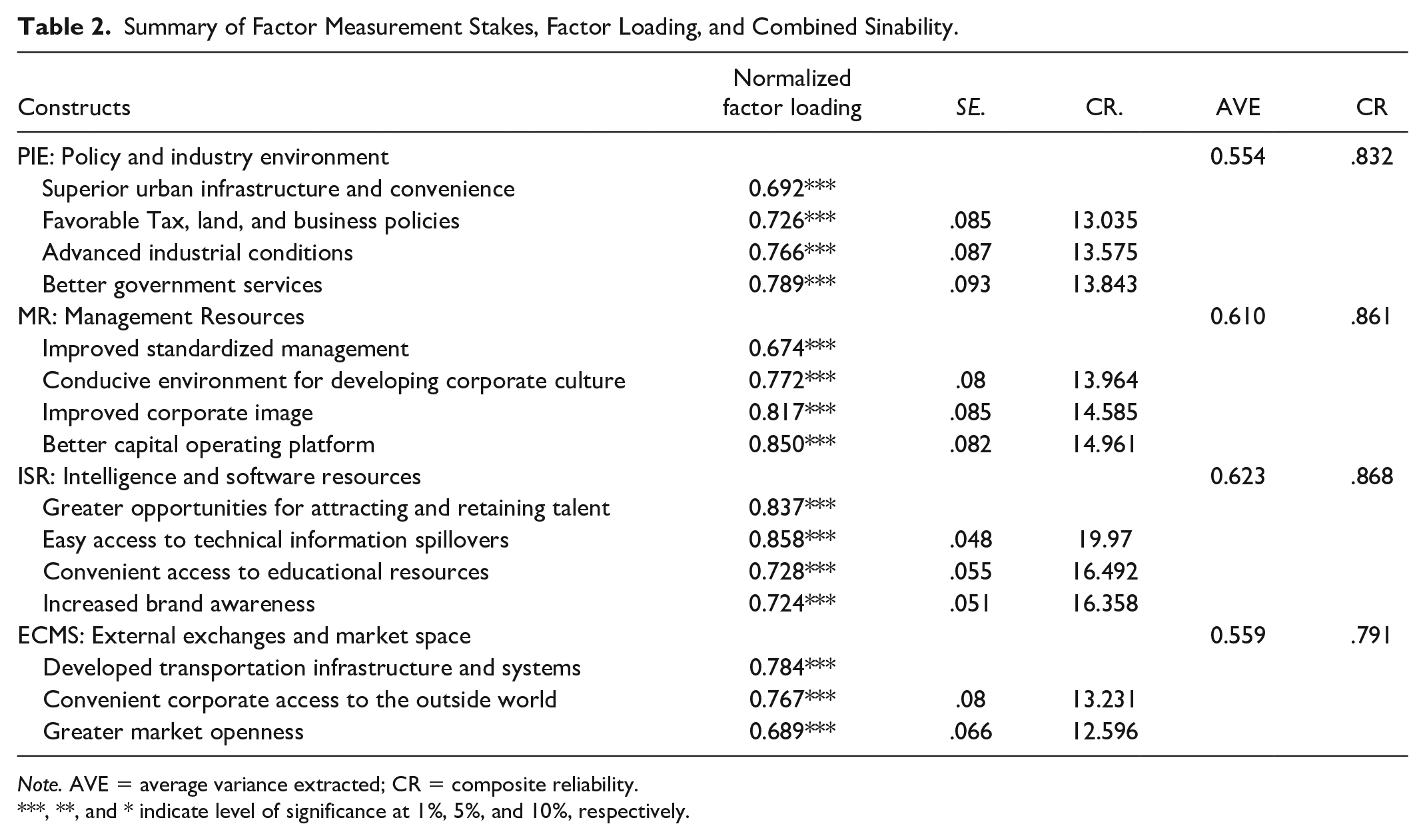
Table 2 demonstrates the results of validity testing, including the factor loading scores, composite reliability (CR), SE, and average (AVE). As seen subsequently, the factor loading score of each item averaged above 0.5 on average, offering empirical evidence for the significance test. The factor loading scores, AVE, and CR of all the four variables were well above the acceptable threshold: Policy and industry environment (factor loading= 0.692-0.789; p < .001; AVE = 0.554; CR= 0.832); management resources (factor loading= 0.674-0.850, p < .001, AVE = 0.610, CR= 0.861); intelligence and software resources (factor loading= 0.724-0.858, p < .001, AVE= .623, CR= 0.868); external exchanges and market space (factor loading= 0.689-0.784, p < .001, AVE= .559, CR= 0.791).
Summary of Factor Measurement Stakes, Factor Loading, and Combined Sinability.
Note. AVE = average variance extracted; CR = composite reliability.
, **, and * indicate level of significance at 1%, 5%, and 10%, respectively.
Confirmatory Factor Analysis and Model Goodness
Table 3 shows the confirmatory factor analysis (CFA) and model goodness outputs. CFA is the most appropriate statistical tool for testing scales and the structure of factors (Haozheng & Bifang, 2009). As seen subsequently, the base model (BM) was compared with different competing models (Model 1-Model 6). According to the commonly accepted standards, CMIN/DF=1–3; root mean square error of approximation (RMSEA) ≦ 0.08; standardized root mean square (SRMR) ≦ 0.08; comparative fit index (CFI) ≧ 0.9 (Hayes, 2013). As seen subsequently, fitness indicators such as, the RMSEA, SRMR, and CFI of BM are superior to exceed the standard threshold, compared to Model 1 to Model 6. Similarly, the BM reflected the lowest AIC and BIC values. The AIC penalized the more complex models (i.e., Model 1-Model 6; see for review, Burnham et al., 2011; Williams et al., 2009).
Model Goodness and Fitness Comparison.

Note. CMIN/DF = 1-3; RMSEA and SRMR ≦ 0.08; CFI ≧ 0.9; PGFI and PNFI ≧ 0. BM = (M1, M2,M3,M4); RM1 = (M1+M2, M3+M4); RM2 = (M1+M3, M2+M4); RM3 = (M1+M2+M3, M4); RM4 = (M1+M2+M4, M3); RM5 = (M1+M2, M3,M4); RM6 = (M1+M3,M2,M4);“+” Merge into one factor. PGFI = Parsimony Goodness-of-Fit Index; PNFI = parsimonious fit index; CMIN/DF = minimum discrepancy per degree of freedom; AIC = Akaike information criterion; BIC = Bayesian information criterion; RMSEA = root mean square error of approximation; SRMR = standardized root mean square; CFI = comparative fit index.
Logit Regression Model
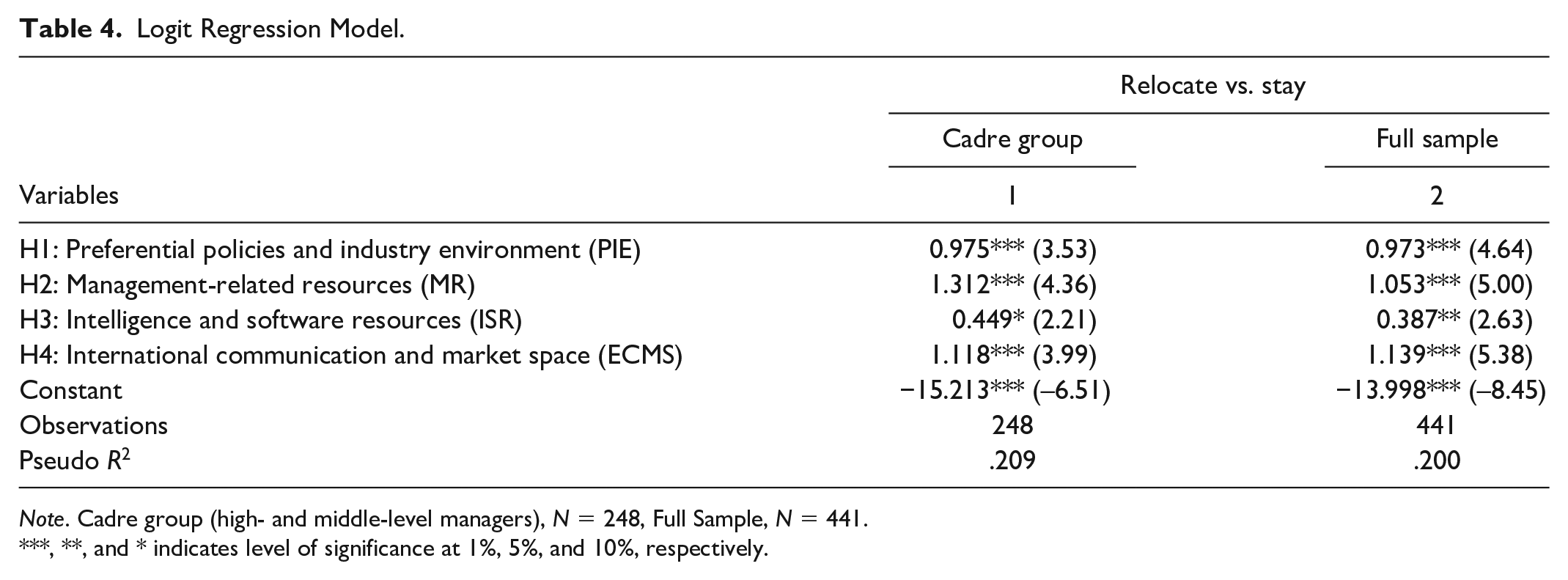
Table 4 depicts the results of the logit regression model. This model tests the nonlinearly related to explanatory variables and explains if the predictable probabilities lie in the 0 to 1 range. Gujarati (1988) recommends it as the most suitable technique to analyze binary or dichotomous dependent variables. In this study, the model included a cadre group (high- and middle-level managers) and the full sample to quantitatively analyze the extent to which various factors influence the relocation decisions. As per Gujarati and Porter (2009), a score >0.5 shows a positive impact (on relocation decisions), whereas values <0.5 reflect a negative impact. Overall, all employees and cadre group strongly endorsed all the four factors as important determinants of headquarter relocation in Quanzhou city as evident by the regression coefficients of factor ISR (cadre group = .449, full sample = .387) and ECMS (cadre group= 1.118, full sample= 1.139) were more significant than PIE (cadre group= .975, full sample= .973) and MR (cadre group = 1.312, full sample = 1.053). By comparing the R2 of the cadre group (.209) and the full sample (.200), the cadre group model had a stronger explanatory ability than the full sample group. Given the present results, past literature also supports that firms seek superior management resources (standardization, corporate culture and image development, and operating capital) to enhance their competitive advantage (cf. Balogun et al., 2019; Biyue, 2014; Tyll et al., 2018; Valentino et al., 2019). Next, international communication and market space results supported prior assertions (e.g., Adler & Florida, 2020; Martinez-Fernandez et al., 2012; Fujita & Thisse, 2006; Koven & Koven, 2018; Nell & Schmitt, 2018; Saarinen, 2020; Valentino et al., 2019). With the increasing globalization and local competition in China, firms seek new local and international territories with greater opportunities for learning, development, and expansion (Biyue, 2014; Y. Jiang et al., 2018).
Logit Regression Model.
Note. Cadre group (high- and middle-level managers), N = 248, Full Sample, N = 441.
, **, and * indicates level of significance at 1%, 5%, and 10%, respectively.
In the same way, the result for preferential policies and industry environment provided support for extant works (e.g., Anguelov & Jewitt, 2020; Chow et al., 2021; Saarinen, 2020). Researchers have asserted that firms are often peculiar about the availability of high-skilled workforce and education institutions in the new relocation destination (e.g., Adler & Florida, 2020; Biyue, 2014; Hu et al., 2020; Koven & Koven, 2018). Employees, specifically the cadre group, assigned less significance to the ISR than the other three factors in the present context. Nonetheless, the overall results are consistent with the factors proposed in the neoclassical, behavioral, and institutional theory (cf. Brouwer et al., 2004).
Conclusion and Policy Recommendations
This article examined the factors influencing headquarter relocations using the case study of the private enterprises in Quanzhou. The article identified four main relocation factors: PIE, MR, ISR, and ECMS. Using the IBM AMOS2.0, the data for the relocation factors were formulated into an empirical structure and checked for robustness through CFA and other fitness indicators. The results for both the measuring instruments and the baseline model were consistent with the preset statistical standards. The logit regression model showed that all four factors significantly affected enterprises’ relocation decisions in Quanzhou. However, ISR was considered less significant than the other three factors, especially among the cadre group members.
The article offers some critical policy implications based on the present findings. First, the current results provide crucial information for city governments and policymakers to introduce preferential policies and improve the industry environment to retain, service, or attract local/foreign firms in their existing or newly established industrial clusters. Second, current findings assert the need for new policies and investments that can increase (or at the least equate) the number of learning opportunities of standardized management (SM). These opportunities can range from conferences, workshops by international SM agencies (e.g., GAAP and IFRS), to attracting well-reputed SM firms and setting up SM labs. Quanzhou enterprises are more likely to stay if perceived SM benefits (e.g., market competitiveness, cost reduction, and global expansion) are at par with competing firms in central cities. Third, an imminent need for local government to develop and sponsor special programs for corporate culture and image development. Acting as a bridge, the Quanzhou government should develop collaborations among Quanzhou’s enterprises that seek a globally compatible corporate culture and image. The government can facilitate mechanisms for benchmarking with reputed local/international firms. Keeping in view the specialization of each industrial cluster in Quanzhou, the government should foster internationalization and diversity by offering subsidies and incentives for local/foreign firms. The selection of these firms should be based on their best practices in SM, corporate culture, and image. Finally, the reported significance of international communication and market space in relocation decisions reflects a shared desire among enterprises to interact with and learn from global businesses. Thus, the government is encouraged to create platforms, infrastructures, and an environment that can help enterprises exchange with international companies and other stakeholders.
The limitations of this work are discussed hereafter for future research. First, the chief limitation of this study pertains to a single research context. Researchers are encouraged to validate the current framework by comparing industrial clusters across China and around the world. Second, the study has offered present findings based on the logit regression model. Perhaps, future studies can establish further exploring the aspect of causality using longitudinal data for generalized results.
Footnotes
Declaration of Conflicting Interests
The author(s) declared no potential conflicts of interest with respect to the research, authorship, and/or publication of this article.
Funding
The author(s) received no financial support for the research, authorship, and/or publication of this article.
