




Abstract
Although the research on social-economic and demographic inequities of parents and their approach to formal child care (early childhood education and care [ECEC] system) is increasing, the territorial effects on child care remain underresearched. In Lithuania, the importance of the accessibility and availability of formal child care services are highlighted by the political agenda. However, the residential location is not considered enough to explain the differences in parental approach to child care in rural and urban regions. The article seeks to analyze how families’ child care choices and family welfare priorities are related to parental socioeconomic backgrounds, territorial dimension (residential location of parents), and general life satisfaction. The article uses the subsample of representative population survey data of the working-age generation cohort (34–48 years old cohort), focusing on respondents who have children below 4 years old and benefit from formal child care services in Lithuania. The main results contribute to explaining parental preferences to benefits-in-cash or services-in-kind (child care) family welfare priorities and their socioeconomic backgrounds, including residential location. The less is the residential location size (rural areas), the more likely respondents would support the benefits-in-cash system rather than formal child care services.
Introduction
Current research indicates that socioeconomic factors affect parents’ approach to formal child care (early childhood education and care [ECEC] systems; Abrassart & Bonoli, 2015; Saraceno, 2011; Van Lancker, 2013). Research on families’ social and economic bias and their approaches to early child care service provision has been developing in a few directions. The number of studies providing empirical evidence on the relationship between households with different incomes and ability to afford child care services has increased (Ghysels & Van Lancker, 2011; Lancker & Ghysels, 2012). Children from higher income households are more likely to be cared for in formal child care facilities than children from lower income families (Abrassart & Bonoli, 2015). Little is known about the relationship between parental residential location, socioeconomic inequalities, and access to early child care systems. Some significant research focusing on low-income families in rural areas who face challenges in benefiting from formal child care systems due to economic difficulties and geographical disparities has been performed. Empirical studies have used statistical evidence on poverty, family care, and household income to identify the effect of socioeconomic predictors on families’ use of child care services (Davis & Weber, 2001; Maher et al., 2008; Monroe & Tyller, 2001; Walker & Reschke, 2004).
Since their accession to the European Union (EU) in 2004, Baltic countries have made significant progress in ensuring wide access to the ECEC system for all age groups. On average, the enrollment in formal child care among children aged 3 to 6 years old increased from 83.6% in 2004 to 93.6% in 2018, placing Baltic countries next to Scandinavian countries (Eurostat, 2020). Due to the variations in parental leave schemes and child care service policies, children’s participation in ECEC at early ages (less than age 3) is less than 30% in all Baltic countries (Eurydice, Education, Audiovisual and Culture Executive Agency, European Commission, 2019). Therefore, the discussion on ECEC service provision in countries defying affordability, availability, and quality of education to families with different socioeconomic backgrounds is relevant. In European countries, the targets of ECEC policies were set by the 2002 European Council (the so-called Barcelona targets) to improve the coverage of ECEC services for children younger than 3 years by 33% (European Commission, 2013). The importance of the accessibility and availability of formal child care services are also highlighted by the Western political agenda using the distributional welfare policy approach and challenging new social risks (Taylor-Gooby, 2004).
In general, the Lithuanian ECEC system in which the center-based services provision structure is implemented is highly integrated. Children of different age groups are integrated into one institutional and educational system administered by the municipalities (LAU1 level, local administrative units). Municipal administrations supervise different child care service characteristics such as ensuring availability and affordability, enrollment procedures, the recruitment of pedagogy staff, and tuition fees. Central authorities regulate child care policy formation and quality and coordinate the implementation of educational requirements at the municipal level. Despite the centralized policy approach and intensive state subsidies for ECEC development, Lithuanian rural regions lag in children’s enrollment in ECEC among different age groups. As shown in Figure 1, regional differences in proportion of formal child care participation are considerable among more urban (the largest regions of Kaunas, Klaipėda, and Vilnius) and other rural regions. For example, only 44.8% of children from 3 years old to 6 years old in the Taurage region were enrolled in a subsidized ECEC system in 2019 compared with the number of children at the respective age (Figure 1). Second, the coverage of public ECEC institutions is territorially equalized. However, other socioeconomic determinants, such as the unemployment rate or low household income, affect children’s low involvement in the formal child care system.

Proportion of children in the early childhood education and care system in Lithuanian regions compared with the number of children at the respective age (for children from 3 years old to compulsory school age [6 years old]), 2019, percentage.
In light of this situation, we analyze how families’ child care choices and family welfare priorities are related to their socioeconomic backgrounds, territorial dimension (residential location of parents), and general life satisfaction. First, we analyze family welfare choices to prioritize the benefits-in-cash or services-in-kind that is used as an explanatory framework to identify the different choices regarding distributional welfare mechanisms. In this examination, benefits-in-cash refer to nationally regulated financial assistance measures for families, including child care allowances, subsidies for child care providers, and other financial payments. Services-in-kind represent a variety of family service measures such as the ECEC system, work–family reconciliation options, and flexible workplaces (Nygård et al., 2019). Second, due to the limited number of hypotheses, the important aspects of national family policy measures, such as social benefits, workplace guarantees, or flexible family–work reconciliation, are not included in our analysis. Instead, we consider a determinant of parental satisfaction with the ECEC services that refers to the service quality of public child care institutions. The selected approach to child care services is helpful to testing the capacity of the ECEC system to support families from both urban and rural areas. Third, we also include life satisfaction aspects studied extensively to relate important social, behavioral, and subjective well-being constructs (Erdogan et al., 2012). Here, life satisfaction indicates the use of economic and social resources available for families with different socioeconomic backgrounds. This article uses a unique dataset based on representative survey data. The data were collected specifically to study the patterns of family changes and socioeconomic inequalities among the working-age generation of 34 to 48 years old (N = 3,005) who started their independent lives in post-Soviet Lithuania. We assume that the differences in parental preferences for family welfare priorities can be explained using parents’ socioeconomic backgrounds and their residential location (urban or rural area) factors. Therefore, the case of Lithuania provides a consistent unique framework for assessing the consequences of the centralized ECEC provision system for families’ choices. Second, the article discusses the national ECEC framework in which a centrally coordinated institutional approach has limitations in overcoming the spatial inequalities of families accessing the child care system. Our examination contributes well to the research on the relationship between child care system characteristics and parental socioeconomic status that generates child care choice bias (Abrassart & Bonoli, 2015; Van Lancker, 2013).
This article is organized in contextual, theoretical, and methodological analytical parts. First, we consider formal child care in developing child care systems for Baltic countries, including Lithuania. The Baltic countries specifically represent the contextual case of unitary center-based ECEC settings while the other European countries vary in terms of authorities’ responsibilities, the coordination of child care levels, and financing schemes. Despite the active regulation of central authorities, the region has experienced an exponential shift to higher child care involvement rates in ECEC. The Lithuanian case provides an ideal setting for testing hypotheses on the relation between the unitary child care system and the rural–urban divide. We also define the article’s theoretical model to examine the socioeconomic determinants of parental choice regarding child care services in urban and rural areas. Finally, we introduce the variables and methods for the statistical evaluation of the model and discuss the findings.
The ECEC Enrollment Trajectory of Baltic Countries
In 2019, the European Council submitted the Recommendation on High-Quality Early Childhood Education and Care Systems in Europe, admitting that well-developed ECEC systems help prevent social inequalities and educational disadvantages at a very early age. The other key factor is related to the advancement of institutional provision systems in child care, including affordability, availability, and accessibility. The combination of institutional ECEC factors contributes to the reconciliation of work and family obligations and improves the socioeconomic situation of households (Council of the European Union, 2019).
The Baltic countries are an example of a unitary ECEC system highly regulated by the central authorities. However, there are significant differences in the access to, availability of, and affordability of the ECEC systems, such as enrollment rates and financial schemes, according to the national arrangements. Considering the overall participation level in early childhood education in Baltic countries, Lithuania has demonstrated the most progress in increasing the involvement of children between 4 years old and compulsory education in the ECEC system (see Figure 2). In 2000, the ECEC participation rate was only 60%. In 2017, the percentage increased significantly to 86% to meet the Europe 2020 strategy’s educational benchmark. The improved access to the early child care system corresponds well to the European Council targets established in the Barcelona meetings in 2002 to exceed the provision of formal child care to 90% of children by 2020 in EU countries (European Commission, 2013). The document acknowledges the importance of achieving a 95% involvement rate in the early childhood education system in national countries (European Commission, 2013).

Participation in early childhood education between 4 years old and compulsory education in the Baltic countries, 2000–2017, percentage.
Similarly, during recent decades, Latvia has also demonstrated advancements in accessing the early child care system, similar to the Lithuanian progress. By 2018, the overall enrollment rate of children from 4 years old to compulsory age of education reached 96.3%. Estonia demonstrates an unusual pattern of highly developed ECEC services with an average participation rate of more than 85% in 2000–2017. According to recent statistical data, all Baltic countries significantly improved access to formal child care facilities by achieving an overall participation rate of children (ISCED 0 educational level) of more than 90% in 2017.
Second, the factors of early-age participation rates in the ECEC system and female labor participation are important. The analysis of the different characteristics of ECEC system services, such as learning and safe environments, affordable infrastructure, and the professional skills of staff, demonstrate that high-level services have positive long-term effects on family life. In contrast, low-quality child care services have negative impacts on work and family duty reconciliation, especially on the socioeconomic situation of families and female employment rates (Melhuish et al., 2015). Access to affordable early child care services contributes to increased labor market participation and improved socioeconomic statuses among families (Knijn & Saraceno, 2010; Melhuish et al., 2015; Plantenga et al., 2008). The low affordability of places for children less than 2 years old demonstrates the specificity of the child care (parental) leave policy systems in the analyzed countries. For example, Lithuania supports 2 years of paid parental leave. Participation in the ECEC system is not guaranteed for the early-age group children. In contrast, the institutional family policy system ensures paid parental leave for one of the parents under 2 years old, which enables parents to receive child allowances for home child care. The formal institutional barriers of parental leave systems are attributed to the underdeveloped system for early-age child care. For example, the participation rates in the youngest age group in Lithuania, Latvia, and Estonia are relatively low (6.5%, 8.1%, and 6.2%, respectively [Eurydice, Education, Audiovisual and Culture Executive Agency, European Commission, 2019]). The differences between the participation rates in other age groups are less mitigated in Baltic countries. Lithuania is reported to be among countries with lagging use of formal child care, especially for early-age groups (Bussolo et al., 2015).
In general, political priority for the early child care system is associated with a higher labor force participation among females, which increases the socioeconomic situation of households. While the overall employment rate for female is favorable in all age groups and corresponds to the EU-28 average, the lowest rate for women occurs in Lithuania (82.7% for women aged 25–54 years) (Table 1). The statistical data demonstrate that the overall enrollment of children in the formal child care system in Lithuania is more likely to reflect the discrepancies of flexible working arrangements for females and parental leave policy arrangements. For example, in Lithuania, the parental leave scheme guarantees securing employment for a female until the child is 3 years old.
Use of Formal Child Care and Employment Rates of Females.

Source. Eurostat (accessed July 14, 2020).
In contrast, both the female employment rates and the percentage of children in formal child care in all age groups are relatively higher in Latvia and Estonia. The Organisation for Economic Co-Operation and Development [OECD] review acknowledges that accessibility and the provision of good-quality early child care are essential to tackling families’ socioeconomic inequalities, especially in regions with lower economic advancement. The persistent inequities in accessing the ECEC system in urban and rural regions continue to challenge Lithuanian families (OECD, 2017).
ECEC in Lithuania: Territorial Challenge
The institutional design of the national ECEC system is essential in analyzing its availability to families with different socioeconomic backgrounds from different residential areas. The vertical governmental redistribution of benefits-in-cash to services-in-kind also contributes to the different perceptions of parental choices and the affordability of formal child care. For example, the level of functional and financial autonomy of ECEC systems demonstrates that families with different socioeconomic backgrounds prioritize in-kind benefits over services-in-kind benefits. In Lithuania, significant variation in the supply of affordable ECEC facilities in rural and urban regions is observed within the lowest supplies in Kaunas and Vilnius’s largest cities.
ECEC Enrollment in Urban and Rural Areas
There are significant disparities in enrollment in the early child care system in urban and rural areas. In all age groups, the enrollment rate in the ECEC system is continuously increasing, especially in urban areas (Figure 3). Between 2014 and 2020, the participation rate of early-age children in urban areas experienced the highest increase. According to Statistics Lithuania (2021), the overall participation rate for children 1 to 2 years of age was 20.5% in rural areas and 53.8% in urban regions in 2020; while for a 1- to 6-year-old age group, the rates were 40.7% and 90.2%, respectively. The problem of a sufficient supply of facilities in the child care system in urban areas remains a political challenge at both the central and municipal levels. Territorial disparities regarding the supply and demand for formal child care services indicate shortages in the resource distribution, the funding allocation, and political priorities (National Audit Office, 2018). Statistical data demonstrate that the demand for child care services is substantially higher in urban areas; however, the supply is higher in rural areas. For example, the capital region Vilnius possesses the highest demand for ECEC facilities. The second policy challenge is accessibility to ECEC service provision in rural areas, where the poverty rates and income-related inequalities of families are significant (European Commission, 2018). The child care enrollment rate in rural areas is significantly lower and has been recognized as a critical challenge to territorial development and social inclusion (European Commission, 2019). Thus, there is a need to increase the demand in rural areas (through increased accessibility and increased parental awareness of the benefits of the child’s participation in ECEC).

Trends in enrollment in preschool and preprimary education systems in rural and urban areas in Lithuania for different age groups, 2014–2020, percentage.
From the parental perspective, access to ECEC education is ensured for only a portion of children. According to the National Audit Office of Lithuania (2018) survey, the participation rate for children less than 5 years old differs significantly in rural municipalities where on average, 14% to 67% of early-age children attend child care facilities. A shortage of parental choice regarding the nearest ECEC institution is reported in 30 municipalities (out of 60 in total). Parents were offered the opportunity to attend more remote kindergartens, but only 37 of the 60 municipalities provided school transportation. Another statistics state that one third (36%) of children in social risk families did not participate in preschool education at all (National Audit Office of Lithuania, 2018). The political agenda to increase accessibility to early child care service and care provision in rural areas requires innovative solutions, especially those responding to the needs of parents’ socioeconomic inequities. The OECD (2017) report demonstrates that public investments in early child care facilities and services provided in rural areas have long-term effects on regional development (Shewbridge et al., 2016, pp. 81–82).
Institutional and Financial Framework of an ECEC Network
Another important factor in explaining the parental approach to family welfare priorities and ECEC services in rural and urban areas are financial and political schemes. The central government undertakes efforts to regulate the demand and supply for child care services and the availability of facilities for families with different socioeconomic backgrounds using the infrastructural approach. In Lithuania, the regional equalization and service standardization approach for child care services is applied by the central government to minimize the differences in the territories (regions). Service provision is funded jointly by governmental subsidies and municipal contributions (European Commission, 2019). Therefore, specific financing mechanisms have been established to regulate the dispersion child care services in rural and urban areas since 2011. Governmental subsidies finance 20 hr per week for each child using the principle of the “child financial basket,” disregarding the ECEC institution (public or private). The financial model was introduced between 2002 and 2012 for all educational levels, including the early child care system. The reform focused on the priorities of service efficiency and quality, decreasing regional disparities, and optimizing the institutional network (Shewbridge et al., 2016). Recent changes in pupils’ declining educational performance have demonstrated that the financial model has significant shortages. For example, it is incompatible with the demographic decline and regional socioeconomic development challenges. In contrast, the financing scheme has intensified territorial fragmentation and remodification of the institutional network and sacrificed the quantity of the service provision over the quality (National Audit Office of Lithuania, 2018). Moreover, the other educational reforms have also affected the development of the ECEC infrastructure. For example, a year that precedes the beginning of primary education (from 7 years old) became compulsory in 2016 (Law on Education, Amendment No. XIIP-3375(2), 2015).
Concerning public expenditures, Lithuania spent only 18.4% of its budget on ECEC in 2017. This is the lowest level compared with EU countries (the EU average is 32.0%; European Commission, 2019). Despite the significant fertility rate drop and persistent demographic decline, the share of national state subsidies to implement educational services, including the ECEC system on the municipal level, is continuously increasing (see Figures 2 and 4). According to the European Commission (2019) Report on Education and Training Monitor in Lithuania, overall educational achievements lag despite growing public expenditures on education. A significant share of expenses is being spent on school transportation and meals (26.2% compared with the EU average of 12.2% in 2017). The resource distribution problem at different educational levels forces municipalities to rearrange the institutional network of ECEC and secondary schooling. However, territorial disparities in educational service quality and educational achievements remain a significant challenge for families (MOSTA, 2019).

State subsidies for municipalities and share of education expenses (in millions EUR).
The government and municipalities make efforts to tackle the availability of child care services to families of all income; therefore, the expansion of the institutional network became a pillar for urban local authorities, expanding the number of institutions by 8.95% from 2014 to 2020. Contrary, the number of facilities in rural areas has declined significantly by 25.6% during the same period (see Figure 5).

Number of preschool education institutions in rural and urban areas in Lithuania, 2014–2020, units.
The statistical data indicate that equal access to ECEC facilities in rural and urban areas is a challenge. Despite the decline in child care facilities, the availability of vacancies for children is better in rural areas than in urban areas where the imbalanced supply and demand is monitored. The decrease in the number of ECEC institutions mostly affected rural areas that faced the challenges of decreased population, especially among working-age families, in the 2014–2020 period.
Factors Affecting Parental Choices Regarding ECEC in Rural and Urban Areas: A Conceptual Framework
This article analyzes the factors predicting the patterns of parental preferences for ECEC services in rural and urban areas. Based on the theoretical literature, we focus on the main factors affecting the use of ECEC services in different territories, including policy-side (parental approach to welfare) and socioeconomic-side factors (socioeconomic background and residential location of families). First, the parental approach to the ECEC system might be constrained by the dominating parental preferences for benefits-in-cash or services-in-kind. Second, the options to use formal child care depend on socioeconomic characteristics of families in different areas.
Family Welfare Priorities and Effect on ECEC Approach
The first theoretical argument we use concerns parental preferences for benefits-in-cash or services-in-kind approaches that contribute to explaining the ECEC preferences of families. The rationale behind the explanation of child care approaches in families reflects welfare state changes and different approaches to responsivities in family care and the role of the state (Esping-Andersen, 2009; Pfau-Effinger, 2005). For example, a new social policy framework underlines the importance of equal opportunities, the activation of education systems, and the expansion of family-centered services rather than focusing on economic performance and productivity (Esping-Andersen et al., 2002; Gilbert, 2004; Morel et al., 2012). The different state perspectives regarding expanding benefits-in-cash or services-in-kind for families reflect the redistributive capacities of social security programs. The risks of an aging population and declining fertility rates challenge social policy systems to reconcile the requirements of economic efficiency in service provision and family needs in social and economic security (Cantillon, 2011, p. 445). Gosta Esping-Andersen and John Myles (2009) underline the importance of service-oriented policies that address families’ new social needs, such as the reconciliation of childbearing and child care obligations with professional duties and flexibility in the labor market. The policies that accommodate the approach to developing the service infrastructure rather than focusing on vertical economic redistribution in social benefits tend to overcome the barriers of the conventional welfare regime’s categorization (Esping-Andersen & Myles, 2009). The combination of care, earnings, and gender constructs creates different parental arrangements that vary from egalitarian to traditional. Some authors argue that the empirical data support the more conventional approach of Eastern European countries (Bulgaria, Romania, and Hungary) to child care and childbearing institutions allowing mothers to stay at home rather than rely on formal child care services (Lappegård et al., 2012).
Socioeconomic Background of Families in Using ECEC Services
Second, the family socioeconomic background is essential in assessing ECEC services. Researchers have widely acknowledged the policy development and advancement of ECEC systems with different countries, practitioners, or policymakers focusing on affordable and reasonable quality ECEC services to families with different socioeconomic backgrounds (Abrassart & Bonoli, 2015). For example, empirical findings have supported the relationship between different family income groups and the affordability of child care services (Abrassart & Bonoli, 2015). The correlation between parent income and the use of the child care system is also affected by the participation of parents, especially by females in the labor market, and is differently organized in European countries (see, for example, Cantillon et al., 2001; Ghysels & Van Lancker, 2011; Lancker & Ghysels, 2012). Other studies emphasize the importance of parents’ other socioeconomic structural factors, such as parental education level, gender, or professional occupation. The relationship between education, household income, and other structural factors and child care choices has been supported in numerous social inequality, family, and parenting studies using empirical data (Cantillon et al., 2001; Debacker, 2008; Ermisch, 2008; Farfan-Portet et al., 2011). The coherence between child care policies, service implementation, and socioeconomic profiles has turned to various regional- or local-level institutional arrangements. For example, OECD research recognizes the variety of contextual factors including the families’ role, working conditions, governance input, or educational agenda that also regulate the national-level child care provision (OECD, 2001).
Socioeconomic factors affect parents’ child care choices in urban and rural areas. Data from an OECD study based on the EU SILC (EU Survey on Income and Living Conditions) demonstrate significant differences in the use of child care services between families with different incomes. A large share of low-income families is less likely to use ECEC services than higher-income families. The trend is observable in most EU countries, except those in Scandinavia and Austria (OECD, 2011). Similar studies based on the EU SILC data also confirm the same hypothesis, proving the statistical relationship between family income and the ability to use child care services explicitly visible in Eastern European countries. High-income families are more likely to use child care services than low-income households (Van Lancker, 2013, pp. 22–23). Therefore, the discussion of the different child care ideals is relevant as there is a relationship between parents’ education level, especially that of mothers, and child care preferences, formal or informal. The differences in household income, gender role perceptions, and other socioeconomic structural factors are crucial in defining parental choices for early child care options (see, for example, Duncan & Irwin, 2004; Jappens & Bavel, 2012; Uttal, 1999). Chiara Saraceno (2011) provides a comprehensive overview of different child care packages including working arrangements, parental leave, formal child care schemes, and the impact of employment on parenthood in EU countries. She concludes, “Different social groups refer to and elaborate alternative ‘normatives’. These are embedded in mothers’ and parents’ value systems . . .” (Saraceno, 2011, pp. 92–93).
The Territorial Distribution of ECEC Services and Family Preferences
Third, parental preferences for the ECEC system are related to the territorial distribution of the ECEC institutional network and services. Flexible reconciliation of formal child care systems and employment structures is a political expectation in many countries. Other empirical studies suggest that access and availability are more important than the financial costs of child care services (De Henau et al., 2007). However, the relation between parental preferences for family welfare priorities and access to child care services in different urban and rural areas is less well covered by substantial empirical evidence. The recorded differences in poverty rates, household income, and employment in rural and metropolitan regions suggest that the accessibility and use of formal child care systems might also be affected. Low-income parents from rural areas in the United States are less likely to cover formal child care expenses because of economic hardships and low employment rates among mothers (Atkinson, 1994; Katras et al., 2004; Maher et al., 2008). According to American researchers, compared with urban families, those in rural areas were more likely to rely on child care subsidies and less likely to use child care centers. Rural families’ preferences were based on home-care arrangements for children (Davis & Weber, 2001). Reliance on informal child care providers is typical for rural families as an alternative to the lack of an affordable and available child care system. The lack of accessible resources, both public and private, for ECEC system development influences family economic and social welfare (Maher et al., 2008; Monroe & Tyller, 2001; Walker & Reschke, 2004). However, there are significant differences in formal ECEC systems among the other countries. For example, the territorially equalized child care system in Scandinavian countries achieves highly effective results regarding children’s educational achievements and family socioeconomic status (Eurydice, Education, Audiovisual and Culture Executive Agency, European Commission, 2019).
Finally, the summary of the theoretical arguments identifies three hypotheses that explain parental preferences for the ECEC system and the territorial dimension. These hypotheses include (a) the parental welfare approach to benefits-in-cash or services-in-kind considering their attitude toward ECEC services, (b) parental satisfaction with ECEC services, and (c) socioeconomic factors and parental residential location (urban and rural region). Our first hypothesis references the socioeconomic differences of families in rural and urban residential areas (urban and rural regions) that affect their satisfaction with ECEC services (Hypothesis 1 [H1]). We follow the theoretical argument that lower-income parents from rural areas are less likely to be satisfied with child care services, mostly because of their limited economic income and geographic access. This explanation is supported by numerous empirical studies (e.g., Cantillon et al., 2001).
Consequently, the second and third hypotheses concern the parental attitude to family welfare priorities to expand benefits-in-cash or services-in-kind and their residential location. We suggest that families with socioeconomic differences are more likely to develop different preferences toward ECEC services in different residential areas. We hypothesized that families in rural, less populated areas would be more likely to support expanding benefits-in-cash because of the shortage of available and accessible child care educational and care services (Hypothesis 2 [H2]). Finally, we hypothesized that urban families in a better socioeconomic situation would be more likely to support child care services-in-kind and have relatively higher satisfaction with ECEC services (Hypothesis 3 [H3]).
Data and Method
Data Collection Procedure
To test our hypotheses, we use the empirical data of the “Families and Inequalities” survey in 2019 in Lithuania. The representative population survey is a part of the research project “Families, Inequalities and Demographic Processes” that focuses on transitional family processes during the last two decades in post-Soviet Lithuania. The project aims to identify how the family life course trajectory and family structure cause social and economic inequalities at the population level and how inequalities structure the transmission of disadvantages at the micro level. The empirical emphasis of the project is the specific birth cohort of 1970–1984 for which the active period of the family life course (partnership formation, childbirth and child raising, and marital life) progressed under the contextual conditions of the social, economic, and political transformations beginning in the 1990s in Lithuania. The overall dataset consists of a representative sample of respondents of the 34 to 48 years old cohort (N = 3,005). Data were gathered using personal interview data collection methods in private households. The survey questionnaire covers an extensive list of questions on childbearing intentions, child care preferences, marriage and divorce experiences, evaluation of the different quality of life characteristics, attitudes toward religion, intergenerational relations, family policy, and social mobility. The sample adequately represents sex, residential location, employment, and regional distribution (rural and urban areas).
Data Sampling
The listwise deletion method was used to manage missing data in the sample. The filter was used to limit the sample of respondents (male and female) to those with children below 7 years old and experience in the early child care system. We reduced the sample to 357 respondents by excluding the answers from respondents who did not have children below 7 years old (preschool age) and did not evaluate the ECEC system. We excluded a significant part of the sample that does not contain information on respondents’ experience using ECEC services. The survey included filter questions where the respondents who do not have current early child care experience could switch to the other part of the questionnaire. The findings of this study are relevant only for families with children below 7 years old.
In the effective subsample, most respondents (birth cohort of 1970–1984) were female (58%) rather than men (42%). Concerning education, one third of parents had university (tertiary) education (36.1%), 29.1% reported having a college education, 21.8% reported having a vocational education, and the rest reported having less education. Concerning the number of children in a family, 33.5% of families had one child, and 49.8% had two children. In addition, 70.4% of respondents reported that their children were enrolled in an early child care program. The remainder of the early-age children (29.6%) were cared for at home.
Selection of Variables
Our statistical model includes several dependent and independent variables. We focus exclusively on parents with recent child care services experience because it allows us to measure their preferences for the family welfare approach in different residential areas.
Dependent variable
Our dependent variable is the parental preference for family welfare priorities (benefits-in-cash or services-in-kind). We refer to the theoretical considerations of different state distributive approaches to family care and the role of gender inequality in expanding family services or benefiting them (Esping-Andersen et al., 2002; Gilbert, 2004; Morel et al., 2012). It also reflects the broader discussion on the social policy shift to the recalibration of individual and state responsibility on welfare systems, including the extent of public services and benefits provided for families and children (Gilbert, 2004). The reference question on the evaluation of the government priority to expand the social benefits system for families or develop the quality and availability of family services infrastructure was used for the measurement model. The respondents were asked to evaluate their preferences for governmental family welfare priorities. The respondents answered survey questions on their approval of the statements “The government’s priority is expanding the system of social benefits for families” and “The government’s priority is to develop the quality and availability of family services infrastructure” (agree/disagree—5-point Likert-type scale). The respondents agreed or disagreed with the statements. The questions were coded as reference category in the logistic regression analysis.
Independent variables
The list of independent variables contains important socioeconomic indicators of respondents (education, personal income per month, household income per month, age, sex, size of residential location, and number of children in the family). The socioeconomic indicators have been widely used in child care services studies that successfully measure the relationship between families’ socioeconomic status and their child care choices (Abrassart & Bonoli, 2015; Van Lancker, 2013). The variable on the size of the residential location was reduced to several categories referring to the official statistics on residence population dispersion and population size in Lithuanian regions (Statistics Lithuania, 2020). We computed several categories on residential location size: (a) below 2,000 inhabitants (35.5%; rural area), (b) from 2,000 to 50,000 inhabitants (16.4%; rural area), (c) large cities above 50,000 inhabitants (16%; urban area), (d) Kaunas (second-largest city, 11.5%; urban area) and (e) Vilnius (capital area, 20.6%; urban area).
The additional independent variables on parental satisfaction with ECEC services and life satisfaction were computed using the factor extraction method. The goal of factor analysis is to reduce the number of variables for our regression model to improve the interpretability of the results. In the questionnaire, the respondents were asked to evaluate the quality of educational content, child safety, service costs, parents’ involvement in governance, nutritional quality, and working hours of early child care system services using a 5-point Likert-type scale (very satisfactory/not satisfactory at all). The parental evaluations of the ECEC system reveal the combination of their past experiences and future expectations, including their approach to welfare priorities (more benefits-in-cash or services-in-kind). Using the factor extraction method, we created an item on “satisfaction with ECEC services.” Another factor of overall satisfaction with child care services at both levels (ECEC and early schooling) includes parental perception and approach to the overall education system. The respondents were asked to evaluate their overall satisfaction with the early child care and education system and children’s achievements using a 5-point Likert-type scale. We coded the variable as “overall satisfaction with child care services at both levels (ECEC and schooling).” We also included the life satisfaction factor that measures the perception of health, sleep, work, income, residential location, leisure, and family time indicators (using the survey question on the evaluation of different aspects of personal life). The respondents were asked to evaluate the various aspects of their own lives using a 10-point Likert-type scale. All factors were included in the first, second, and third model estimates to test the hypotheses (see the factor loadings in Supplemental Annex 1).
Measures
The next steps of the statistical analysis include the statistical measurement of the variables used for the logistic regressions. All independent variables were tested using nonparametric correlation coefficients that determine the degree (positive or negative) to which the variables are associated with each other (Supplemental Annex 2: Correlations of Independent Variables). We estimated OLS (ordinary least squares) logistic regressions to test our hypotheses using the subsample of respondents (35–45 years old cohort) who have young children and use ECEC services. The article’s findings are relevant only to the part of the respondents who have children below 7 years old.
Results
Descriptive Analysis
If we examine the evaluation of different formal child care system characteristics (quality of educational content, safety, monthly costs, parental involvement, nutrition, and working hours), they represent the organizational, financial, and educational qualities of the child care services. We rely on the assumption that the aspects of ECEC services are treated differently by parents with a different approach to family welfare priorities. For example, the monthly costs for child care services are important for parents who benefit from a highly developed child care service infrastructure and are active users.
First, we perform descriptive cross-tabulations revealing the statistical relationships between the different ECEC service characteristics and the parental approach to family welfare, see the cross-tabulations in Supplemental Annex 3 (n = 357). We expected to find different parental choices, such as the importance of educational content or parents’ involvement in educational institution governance, for the child care system. Contrary to our expectations, there are no significant differences between the two groups of parental approaches to family welfare, considering the governmental priority to expand family benefits or sustain family services and infrastructure. Both parental groups are highly satisfied with the quality of ECEC educational content and other components of parental care (safety of children, parents’ involvement in governance, nutrition, and working hours) that positively coincide with the national achievements in developing an equal national ECEC system. However, the differences between the two parental approaches concerning the costs of monthly services for ECEC services are statistically significant. The parents who support the governmental priority to expand the system of social benefits for families are relatively more satisfied with the financial costs than parents who support developing the quality and availability of the family services infrastructure. The economic burden for families who require expanding formal child care systems is more challenging. The centralized system of early child care defines Lithuania’s specificity; however, municipalities use public subsidies and have the autonomy to determine the total average monthly fees for child care services (Eurydice, Education, Audiovisual and Culture Executive Agency, European Commission, 2019).
What seems to particularly matter for our hypothesis on the relationship between parental socioeconomic differences in urban and rural regions and parental attitudes toward ECEC services was residential location size differences. Univariate analysis indicates that the parental approach to family welfare priorities supporting the benefits-in-cash or services-in-kind approach was related to the size of their residential location and aggregated life satisfaction factor (Figure 6). Respondents who support the government priority to expand the social benefits system for families in different residential areas are more likely to have a lower level of life satisfaction. In contrast, parents supporting the expansion of family welfare services are more likely to be satisfied with the different dimensions of life satisfaction. The exception is observed in the capital area of Vilnius. The respondents who favor expanding social benefits for families have a high life satisfaction level compared with those who support the family services infrastructure. The statistically significant difference results in an assumption regarding the disadvantages of child care infrastructure development in the capital area characterized by the shortage of available and accessible services for families in need. In other words, the difference suggests that the less accessible ECEC services in the more populated capital area affect parents’ preferences to expand social benefits.

Size of residential location, life satisfaction, and parental approach to family welfare priorities, n = 425.
Regression Model Results
Furthermore, our first hypothesis assumes that parental socioeconomic differences in different sized areas affect parents’ satisfaction with the ECEC service provision (H1). We also hypothesized that families in rural areas are more likely to support the expansion of child care benefits-in-cash because of the shortage of available and accessible ECEC services (H2). In contrast, the third hypothesis suggests that urban families in a better socioeconomic situation are more likely to prioritize child care infrastructure and service development (services-in-kind approach) and evaluate the ECEC system relatively better (H3). Three regression models were estimated to assess parental approach to family welfare priorities considering the impacts of different socioeconomic factors and satisfaction with ECEC services. The statistical model analysis demonstrates that the size of the residential location, education, and life satisfaction factor matter in predicting the parental approach to family welfare priorities (Table 2).
OLS Regression of the Effect of Residential Status, Family Welfare Priorities, Satisfaction With Child Care Services, and Demographic Variables on Respondents Aged 35 to 45 With Children Below 7 Years Old (Reference—Parental Approach to Family Welfare).
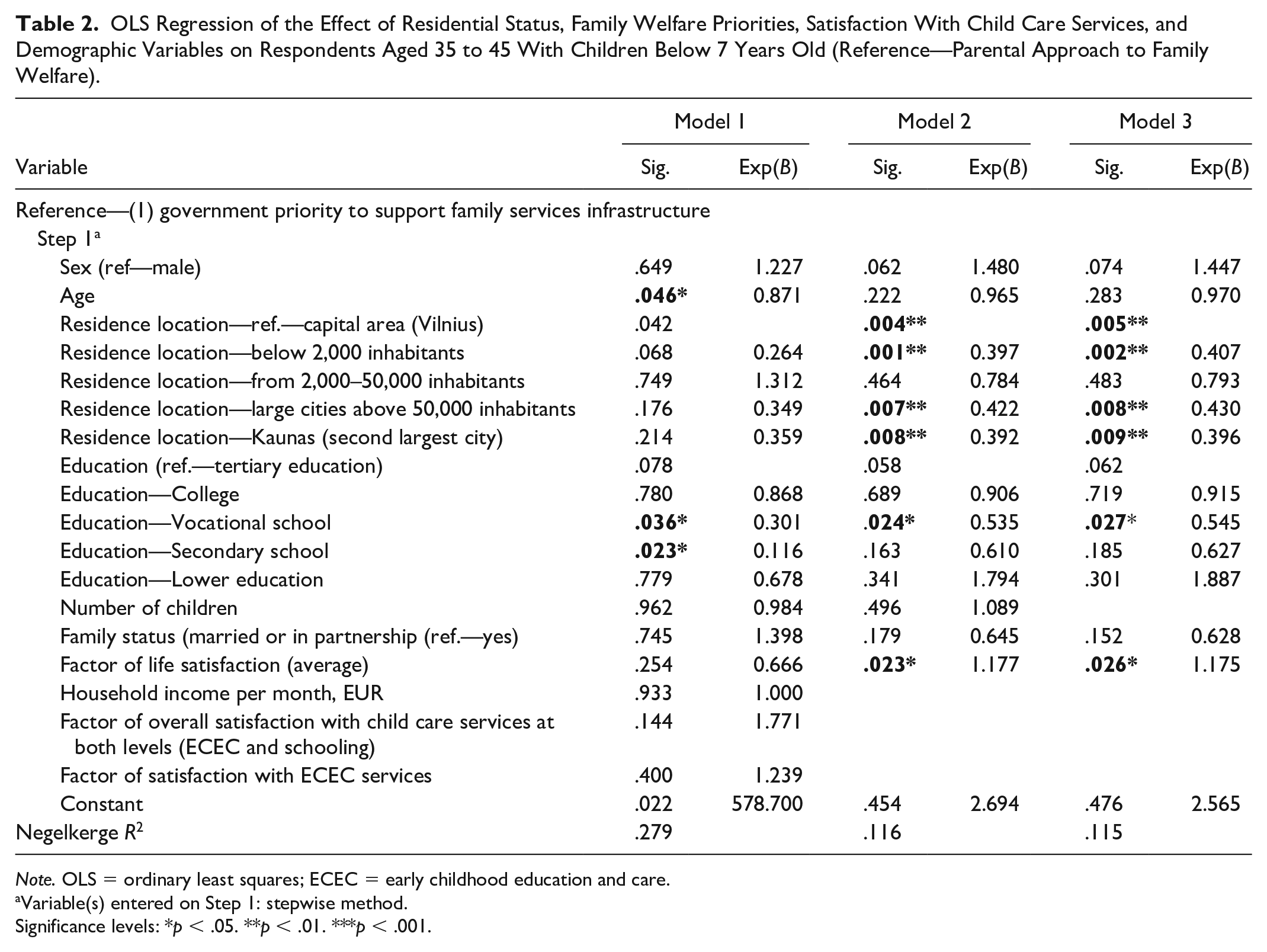
Note. OLS = ordinary least squares; ECEC = early childhood education and care.
Variable(s) entered on Step 1: stepwise method.
Significance levels: *p < .05. **p < .01. ***p < .001.
After controlling the variables of household income, overall satisfaction with child care services at both levels (ECEC and schooling), and satisfaction with ECEC services, the second and third regression models, were estimated to support the hypothesis on the impact of residential location (residential location size). The variables of education and age party support the hypothesis (H1) on families’ existing socioeconomic differences and their support for family welfare priorities. Older respondents were only 12% more likely to support the government priority to support family services compared with the younger generation. Their attitude toward the need for a more developed family services infrastructure is more favorable than that of the other group of respondents; however, the age differences do not have a high statistical significance. Educational attainment level has a greater impact on predicting family welfare priorities and relationships with families’ socioeconomic differences. For example, respondents with less educations have a more positive attitude toward the importance of a benefits-in-cash approach that is observable in all three models. Parents with lower vocational education were 70% less likely to support the importance of the government priority of the family services infrastructure compared with respondents with a tertiary education (Model 1).
Respondents who reside in rural areas (below 2,000 inhabitants) were 63% less likely to support the government priority to develop the family services infrastructure than respondents in the capital area (Models 2 and 3). In addition, respondents from large cities above 50,000 inhabitants and the second-largest city of Kaunas are also less likely to prioritize the regulatory approach to expand the family services infrastructure. Furthermore, 57% and 60% of the respondents from these respective areas were less likely to support family services than parents from the metropolitan capital area (partial support for H2 and H3). Finally, life satisfaction is also considered, and the results support the assumption on the relationship between different characteristics of family welfare (e.g., health, household income, family, leisure, work, and sleep) and family welfare priorities. The aggregated factor of life satisfaction was included in the three regression models. The models support that respondents who have a higher level of life satisfaction are more likely to support the government priority to support the family services infrastructure compared with parents with a lower level of life satisfaction (partial support for H1).
Summarizing the empirical evidence partly supports the hypothesis on the relationship between families’ socioeconomic differences, their residential location, and their parental approach to family welfare. We expected to find a higher importance of child care services at both levels (ECEC and schooling) for all rural and urban families. Our assumption on the significance of different ECEC service characteristics to parental welfare preferences supporting the benefits-in-cash or services-in-kind approach lacks reasonable empirical evidence. As demonstrated in the previous chapter, the ECEC system in Lithuania is territorially equalized and unitary in terms of educational quality standards and institutional networks. However, the effects of the supply and demand for child care services are more relevant to urban than rural areas. The empirical evidence only partly supports the assumption of the relationship between satisfaction with the formal ECEC system and other socioeconomic inequalities of families, such as income, education, and occupation.
Discussion and Conclusion
In response to recent discussions on the development of the early child care system and its relation to family welfare, this article aims to contribute to studies on the determinants of child care concerning parents’ socioeconomic status. Previous research on families’ socioeconomic differences and their preferences for formal ECEC systems has demonstrated economic uncertainty in low-income households (Abrassart & Bonoli, 2015; Cantillon et al., 2001; Henley & Lyons, 2000). The effects of employment are observable in working females seeking to reconcile professional and family obligations (Cantillon et al., 2001; Saraceno, 2011). Therefore, the extensive discussion on child care choices and ideals is relevant to highlighting gender roles and family perceptions of family welfare approaches relying on social benefits or family services (Ciccia & Bleijenbergh, 2014; Grunow et al., 2018; Schober & Stahl, 2016; Vincent et al., 2008).
Nevertheless, the rural and urban differentiation of families’ status in using formal child care services has been less covered in social policy studies (Ghysels & Van Lancker, 2011; Lancker & Ghysels, 2012). Special attention is given to families from low-income rural areas (Katras et al., 2004; Maher et al., 2008). Therefore, the article contributes to discussing parental socioeconomic differences and their attitudes toward ECEC and family welfare in Lithuania. We have explained parental attitudes toward developing benefits-in-cash or services-in-kind welfare policies and their socioeconomic backgrounds. Even though our statistical sample is homogeneous in terms of respondents’ age (34- to 48-year-old cohort having children below 7 years of age), our empirical data indicate the importance of the determinants of education and size of residential location on parental family welfare choices. Respondents’ educational attainment level and residential location size are negatively correlated with their support for government support for extending the quality and availability of family services rather than focusing on family benefits. The lower the educational level and size of the area (more rural) are, the more likely parents are to rely on the government support system of social benefits for families. Surprisingly, the determinants of household income, family status, and number of children do not have statistically significant effects on parental choices regarding the family welfare regime. The spatial determinant could be explained using previous studies on rural areas where low-income families cannot afford formal child care services and prefer to rely on social benefits. Less education is also linked with the households’ economic situation and partly explains the limitations of female participation in the labor market (Cantillon et al., 2001). Our study indicates the effects of the size of parental residential locations on their preferences for family welfare priorities. The smaller the residential area is, the more likely respondents are to support the benefits-in-cash system rather than family services. The effect could be explained using the arguments of the socioeconomic status of households in rural areas that typically struggle with low income, unemployment, and the lack of a public services infrastructure. The effect could also be due to the gendered household relation patterns that consider different employment aspirations and motherhood/fatherhood assumptions of rural families (Halliday & Little, 2001).
Finally, the article also contributes to the previous findings on the effects of formal child care participation and increasing territorial disparities (Kazepov, 2008; Neuman, 2005). The main argument highlights the importance of territorially equalized ECEC systems that can contribute to minimizing the effects of families’ inequalities in terms of accessibility, affordability, and quality of child care services. In addition, the entitlement to formal child care systems must be enabled together with a balanced financial mechanism that guarantees the equal access of children from different households to the ECEC system (Moss, 2007). The article demonstrates no statistically significant differences in evaluating different ECEC characteristics such as educational quality, access, affordability, organization of service provision, and governance between parental groups with different family welfare approaches. The exception is the monthly financial costs for child care services essential for respondents supporting family services development. We assume that this tendency represents the ECEC system’s specificity in Lithuania by signaling the effects of the territorial distribution of child care services for families with different socioeconomic backgrounds. The financial affordability of child care services is strongly related to the need for targeted publicly subsidized schemes and progressivity in fee structures. Affordable fees significantly determine low-income families’ choices for formal child care services (Abrassart & Bonoli, 2015, p. 804). There is still little evidence that proves the relationship between parental socioeconomic status and satisfaction with different ECEC system characteristics. From the family policy perspective, attention to the development of a high-quality ECEC system is essential in sustaining positive effects for families in different rural and urban areas. The territorially equalized and unitary child care system in Lithuania has significantly improved compared with those of the other Baltic countries. The ECEC system’s achievements may provide a reasonable explanation for increasing children’s participation rates but face structural limitations for improving the socioeconomic barriers of households.
Supplemental Material
sj-pdf-1-sgo-10.1177_21582440211032641 – Supplemental material for Family Choices on Welfare and Territorial Disadvantages: The Perception of the Child Care Services Approach in Urban and Rural Areas
Supplemental material, sj-pdf-1-sgo-10.1177_21582440211032641 for Family Choices on Welfare and Territorial Disadvantages: The Perception of the Child Care Services Approach in Urban and Rural Areas by Jurga Bucaite-Vilke in SAGE Open
Supplemental Material
sj-pdf-2-sgo-10.1177_21582440211032641 – Supplemental material for Family Choices on Welfare and Territorial Disadvantages: The Perception of the Child Care Services Approach in Urban and Rural Areas
Supplemental material, sj-pdf-2-sgo-10.1177_21582440211032641 for Family Choices on Welfare and Territorial Disadvantages: The Perception of the Child Care Services Approach in Urban and Rural Areas by Jurga Bucaite-Vilke in SAGE Open
Supplemental Material
sj-pdf-3-sgo-10.1177_21582440211032641 – Supplemental material for Family Choices on Welfare and Territorial Disadvantages: The Perception of the Child Care Services Approach in Urban and Rural Areas
Supplemental material, sj-pdf-3-sgo-10.1177_21582440211032641 for Family Choices on Welfare and Territorial Disadvantages: The Perception of the Child Care Services Approach in Urban and Rural Areas by Jurga Bucaite-Vilke in SAGE Open
Footnotes
Declaration of Conflicting Interests
The author declared no potential conflicts of interest with respect to the research, authorship, and/or publication of this article.
Funding
The author disclosed receipt of the following financial support for the research, authorship, and/or publication of this article: This project has received funding from European Social Fund (project No 09.3.3-LMT-K-712-01-0020) under grant agreement with the Research Council of Lithuania (LMTLT).

Supplemental Material
Supplemental material for this article is available online.
References
Supplementary Material
Please find the following supplemental material available below.
For Open Access articles published under a Creative Commons License, all supplemental material carries the same license as the article it is associated with.
For non-Open Access articles published, all supplemental material carries a non-exclusive license, and permission requests for re-use of supplemental material or any part of supplemental material shall be sent directly to the copyright owner as specified in the copyright notice associated with the article.
