



Abstract
The theory of wicked problems, originating from Western academic discussion, has evolved since the 2000s toward a universal diagnostic of societal challenges. In this article, we employ a systematic literature review to investigate the application of the concept of wicked problems in studies focusing on the African context. Our aim is to understand the additional value and limitations of using the concept in a non-Western frame of reference. We conclude that the concept remains underutilized in studies concentrating on Africa; moreover, when it is used, it is mainly by academics of Western or Anglophone origin. Overall, the concept of wicked problems is mainly applied descriptively rather than theoretically. Based on the analysis of the themes and issues characterized as wicked, we elaborate toward a typology that takes account of the concrete “manifestations” (e.g., health issues such as AIDS/HIV and its treatment history) and “mechanisms” (e.g., historical path dependency) that condition the presence of wicked problems in the African context. The article contributes to the theory of wicked problems by developing a typology that distinguishes between interlinked and contextual problems (often characterized through the concept of “dual wickedness”), and proposes that problems can become exacerbated when the two dimensions are simultaneously present.
Introduction
Wicked problems is a concept often used to describe complex social and socio-ecological issues that are characterized by the difficulty of problem formulation and the multiplicity of stakeholders involved in defining and addressing the problem. Wicked problems are contested, unique, complex, and unsolvable and involve emergent aspects, meaning that the effects of applied solutions cannot be known (Rittel & Webber, 1973; see also Danken et al., 2016). Since its introduction in the 1970s, the concept continued its quiet existence until the 2000s, when it was rediscovered by scholars (Conklin, 2005; Grint, 2005; King, 1993; van Bueren et al., 2003) as a means to describe and discuss contemporary challenges. Its usage has sharply increased in the 2010s (Danken et al., 2016; Xiang, 2013). On June 26, 2020, our search of articles in the academic journal database Scopus with “wicked problem(s)” in the title, abstract, or keywords returned a total of 1,839 articles since the concept’s introduction in Rittel and Webber’s seminal article in 1973. Of these, 1,634 (89%) were published in or after 2010. Interestingly, the concept seems to have spread to many different global contexts, with the exception of Africa. This discrepancy was first identified by Xiang (2013) and persists to the present day. Our filtering of the above-mentioned search results resulted in 63 articles with a connection to Africa, a mere 3% of the total.
The concept’s limited usage in the literature on Africa does not, however, mean that the continent’s countries, societies, and peoples are free from serious challenges. According to the SDG Center for Africa & Sustainable Development Solutions Network (2019, p. 21), in Africa “the majority of countries are off-track on most of the 17 [Sustainable Development Goals],” with good health and wellbeing, infrastructure, and peace, justice, and strong institutions currently seeming to be furthest from reach. Other assessments draw similar conclusions. For example, the OECD characterizes most African countries as, to varying degrees, fragile states (OECD, 2018), which face various environmental, political, economic and societal issues (OECD, 2016). Based on World Bank data, Christiaensen and Hill (2019) report that the absolute number of Africans living under the international poverty line of 1.90 USD has risen between 1990 and 2015, even though the share of poor in Africa has decreased. Furthermore, simulations by The World Bank (2018, p. 25) estimate that 87 % of the world’s poor will live in Sub-Saharan Africa in 2030.
The problems faced by contemporary African societies are unquestionably different from the issues that gave rise to the concept of wicked problems 50 years ago in Western society (see Ritchey, 2013; Skaburskis, 2008). For example, infrastructure-related issues were presented as an example of tame problems by Rittel and Webber (1973, p. 156) but may in fact be wicked problems in an African context (Suleiman & Khakee, 2017). In this systematic review, we examine the literature on wicked problems in Africa. We frame our review within the context of the limited use of the concept of wicked problems in this literature, and recent critical discussion on the concept, addressed in Section “Wicked Problems” of this article. Here, our aim is to review the ways wicked problems have been described in the literature on Africa, thereby revealing how the concept is understood in this regional context, and to contribute to the vivid discussion around the concept. We approach this through our first research question: What are the main themes and concrete manifestations of issues described as wicked in the African context?
Second, we further explore the relative absence of the concept of wicked problems in the literature on Africa. It is clear that many African societies face persistent and complex challenges. However, as previously mentioned, the concept has not been broadly utilized in this context, especially compared with the number of articles focusing on wicked problems in other geographical areas. Possible reasons for this have been briefly discussed (Xiang, 2013) but have not been systematically investigated. We approach this issue from a critical stance, aware of the concept’s Western background, and aim to uncover possible reasons for its lack of use with our second and third research questions: What are the geographic foci of articles that use the concept of “wicked problems” in the African context? Is the concept of wicked problems utilized and therefore seen as applicable by authors affiliated with African cultures?
This article proceeds as follows. First, Section “Wicked Problems” explores the concept of wicked problems and its critique. Section “Researching African Societies With Western Concepts” then discusses the issue of applying the concept to non-Western contexts, utilizing the concept of fragile states as an example. Section “Methods and Materials” presents the systematic literature review process, methods of analysis and the research material. Next, Section “Results” illustrates the results of our three research questions. After that, the discussion in Section “Discussion” introduces a typology of wicked problems in Africa based on the literature reviewed and discusses the limitations of the study. Finally, Section “Conclusion” presents our conclusions and questions for further research.
Wicked Problems
The introduction of the wicked problems concept is commonly attributed to Horst W. J. Rittel and Melvin M. Webber’s Dilemmas in a General Theory of Planning published in 1973. However, it should be noted that the first publication on the concept was by Churchman (1967), who commented on a seminar presentation by Horst W. J. Rittel (on both the concept’s history and its publication history, see Skaburskis, 2008).
Rittel and Webber argued that the predominantly technical issues or tame problems faced by societies could be solved by professionals, who could both define and solve the issues they encountered. Ultimately, society would be left with problems “that are much more stubborn,” characterized by ambiguity, uncertainty and a multiplicity of stakeholders and values. Technical and scientific approaches of identifying and solving such “problems of open societal systems” would thus be ineffective (Rittel & Webber, 1973, pp. 156, 159–160). The original 10 characteristics of wicked problems as defined by Rittel and Webber (1973) are presented in Figure 1. These problems have been condensed and developed by later authors, including Conklin’s (2005) five characteristics and the super wicked problems introduced by Levin et al. (2012).

Characteristics of wicked problems (Rittel & Webber, 1973).
Rittel and Webber’s eagerness to reject technical problem-solving approaches should be understood within the context of the events that unfolded in the United States in the 1960–1970s (Ritchey, 2013; Skaburskis, 2008). However, the 21st century rediscovery of the concept demonstrates that scholars have found that it resonates with the complex issues facing contemporary societies: poverty and economic issues, climate change, terrorism, and health care, to name but a few (see Danken et al., 2016).
Scholars have become increasingly aware of the utility of wicked problems for drawing attention to the complexity and interlinkedness of societal issues and the multiplicity of stakeholders involved. Following and building on Turnbull and Hoppe (2019), Termeer et al. (2019, p. 177) view the concept as a rhetorical tool for “critiquing other concepts or studies for not addressing major uncertainty, system complexity or political conflict, for proposing magic solutions or panaceas for societal problems, or, in interdisciplinary research, for overlooking the social side of technologies or natural processes.” Thus, the concept can remind academia of the real qualities of and issues faced by societies, because, as argued by Noordegraaf et al. (2019, p. 280, original emphasis), “[w]ickedness theory enables scholars to bring together academic and organizational and societal concerns.” In addition, the wicked problems literature often suggests possible “survival methods” for addressing such issues (Raisio, 2009, p. 482; Noordegraaf et al., 2019), and is useful for underlining the “complexity in social, natural and political processes” (Alford & Head, 2017, p. 399).
However, in parallel with rising interest in utilizing the concept of wicked problems, its perceived usefulness in describing the complexity of societal issues has also been increasingly questioned. For example, Peters (2017, p. 386; see also Ritchey, 2013) argues that the concept “has become a fad in the academic literature” and that it is used for describing “almost any problem that is difficult to solve and which has a variety of alternative causes.” In addition, Rittel and Webber’s (1973) original list of 10 characteristics is long and rather obtuse. According to Danken et al. (2016, p. 17), “[this] lack of a clear-cut definition makes it difficult to advance and consolidate scholarly knowledge on wicked problems in public administration research.”
Critiquing and discussing the broader theory-like literature around the concept, Noordegraaf et al. (2019, p. 280) identify three “weaknesses of wickedness theory.” First, they consider that the concept and the related literature “ignores people and their practices” and fails to take account of how wicked challenges are actually perceived and addressed. Second, they argue that the collaborative, trust-building and learning-based approaches often suggested for addressing wicked problems are “too romantic” and may in reality may be obstructed by factors related to the problem, or may be additional benefits of common action rather than methods themselves. Finally, they consider that “wickedness theory has unclear managerial and professional implications,” as it fails to provide practical tools for dealing with practical issues linked to wicked problems, such as resource allocation (Noordegraaf et al., 2019, pp. 280–283). Inspired by these three alleged drawbacks, a summary of the discussion in a wicked problems special issue by Termeer et al. (2019), and the recent literature, we identified five types of critique leveled against the concept of wicked problems: (1) conceptual ambiguity, (2) false dichotomy, (3) not grounded in reality, (4) solution normativity, and (5) unhelpfulness. These categories are presented in Table 1 with definitions and examples.
Critique of Wicked Problems in Recent Literature.

While the concept clearly has its own strengths and weaknesses, Termeer et al. (2019, p. 177) suggest, based on the literature published in the same special issue, that “conflict, complexity and uncertainty look like promising candidates for specifying wickedness.” This re-definition would also match Danken et al.’s (2016, p. 28) literature review synthesis of wicked problems as “chronic public policy challenges that are value-laden and contested and that defy a full understanding and definition of their nature and implications.” We view these proposals as a constructive approach to addressing some of the drawbacks of “wickedness theory” while acknowledging its contribution. However, we also accept Termeer’s et al. (2019, p. 167) view that “developing dimensions of wicked problems (i.e., conflict, complexity and uncertainty) into more analytically precise research tools and linking them more closely with contemporary policy science developments” is required to further develop the concept. Earlier research on wicked problems has studied scholars’ understanding of the concept (Danken et al., 2016; Peters & Tarpey, 2019), mapped the public policy issues that conform to the characteristics of wicked problems (Kirschke et al., 2019), and developed more granular typologies for identifying such problems (Alford & Head, 2017). However, concrete issues described as wicked have not been extensively investigated (for a list of issue groups described as wicked, see Danken et al., 2016). We address this by reviewing a subset of wicked problems in the literature on Africa.
Researching African Societies With Western Concepts
How should challenges faced by African societies be researched, approached and described? Westerners may generalize Africa into a single unit in their research topics (see Briggs & Weathers, 2016), even though such an approach is problematic: the continent comprises 54 countries and many more cultural and ethnic groups (Booker, 2014). On one hand, since the 1960s it seems that (Western) research has embraced this plurality by focusing on “a clearly defined society, population, sector, geographically defined area, or topic” rather than on broader unifying aspects or geographical areas of Africa (Lassiter, 2000, p. 2). However, some African scholars see emphasizing the unique perspectives and cultural aspects of the continent as important (see Lassiter, 2000), especially as “[m]ost of that which is received as knowledge about Africa is produced in the West” (Mama, 2007, p. 4). Almost a decade later, Briggs and Weathers (2016), found that this assertion remained true. Africa-based authors may also possess insights that would otherwise be excluded from research (Yankah, 1995, as cited in Briggs & Weathers, 2016), and conducting research has not necessarily been possible for Africans in the colonialist past. Thus, the dominance of non-African researchers may present challenges for African scholars. For example, Irele (1991, p. 62) considers that “the Western academy remains the unique source of validation for the African scholars,” forcing them to use a foreign language and concepts in “a derived discourse.” An example of such a concept is fragile states or state fragility, used by governments and international organizations like the OECD, World Bank and EU (see Grimm et al., 2014) and often linked to African contexts (see OECD, 2018).
A fragile state is usually understood as “a distressed state that lacks the elements necessary to function effectively,” with issues such as conflicts, corruption, economic problems, weak governance and the poor legitimacy of governing institutions (Osaghae, 2007, p. 692). However, the concept has also been heavily criticized. Boege et al. (2009, p. 14) argue that it imposes the “modern Western-style Weberian state” on non-Western contexts, while “we should focus more attention on models of governance that draw on the strengths of social order and resilience embedded in community life of the societies in question and work with the grain of actually existing institutions on the ground.” In their summary of a special issue, Grimm et al. (2014) argue that the concept of fragile states can be used by external actors to justify their policies and the concept may thus be defined opportunistically. Nonetheless, the OECD has continued to use the concept and has developed it in a more analytical direction, rather than merely employing it as a “label” (see Grimm et al., 2014), by increasing the detail of the criteria for determining between different levels of state fragility (OECD, 2016). Nevertheless, this discussion underlines the importance of concept choice. In relation to our research, it is pertinent to ask whether it would be possible to use and define wicked problems in a way that acknowledges the unique characteristics of non-Western societies.
Methods and Materials
Our study conducts what is known as a systematic literature review (see, e.g., Gjaltema et al., 2019; Voorberg et al., 2015). According to The Cochrane Collaboration (2015), a systematic review is a “review of a clearly formulated question that uses systematic and explicit methods to identify, select, and critically appraise relevant research, and to collect and analyse data from the studies that are included in the review.” While “traditional” literature reviews are used for argumentational purposes by selectively choosing the literature, systematic literature reviews are “methodical, comprehensive, transparent and replicable” and thus potentially less biased (Siddaway et al., 2019, p. 751). We combined this systematic approach with scoping review methodology. This was chosen as the review approach, as the focus of this research was the use of the concept of wicked problems throughout the literature published on Africa rather than only in the research results. In addition, scoping reviews are suited to answering research questions that are broader in nature than those usually addressed in systematic literature reviews. Scoping reviews require no formal assessment of the quality of the literature reviewed, and indeed no such assessment was performed, as it was not the focus of this study. When applicable, we followed the checklist of the PRISMA extension for scoping literature reviews (PRISMA-ScR) when reporting the review (Arksey & O’Malley, 2005; Munn et al., 2018; Tricco et al., 2018).
First, the following eligibility criteria were developed based on the research questions. All studies were required to fulfill the criteria to be included in the review.
Study Eligibility Criteria
Conceptual focus—as the concept is established, wicked problems should be explicitly defined with references. This indicates that the study is using the concept as understood in the academic discourse.
Geographical area—the study is conducted in or focuses on the continent of Africa or any African country.
Report Eligibility Criteria
Reports should be published in peer-reviewed journals.
Books, book chapters, book reviews, conference papers, discussion papers, commentaries, or letters to editorial boards are not eligible.
The report should be written in English.
Publication status—both published articles and articles in press are included.
Publication date—the report should be published in or after 1973, the year in which Rittel & Webber’s (1973) article on wicked problems first appeared.
Search Strategy
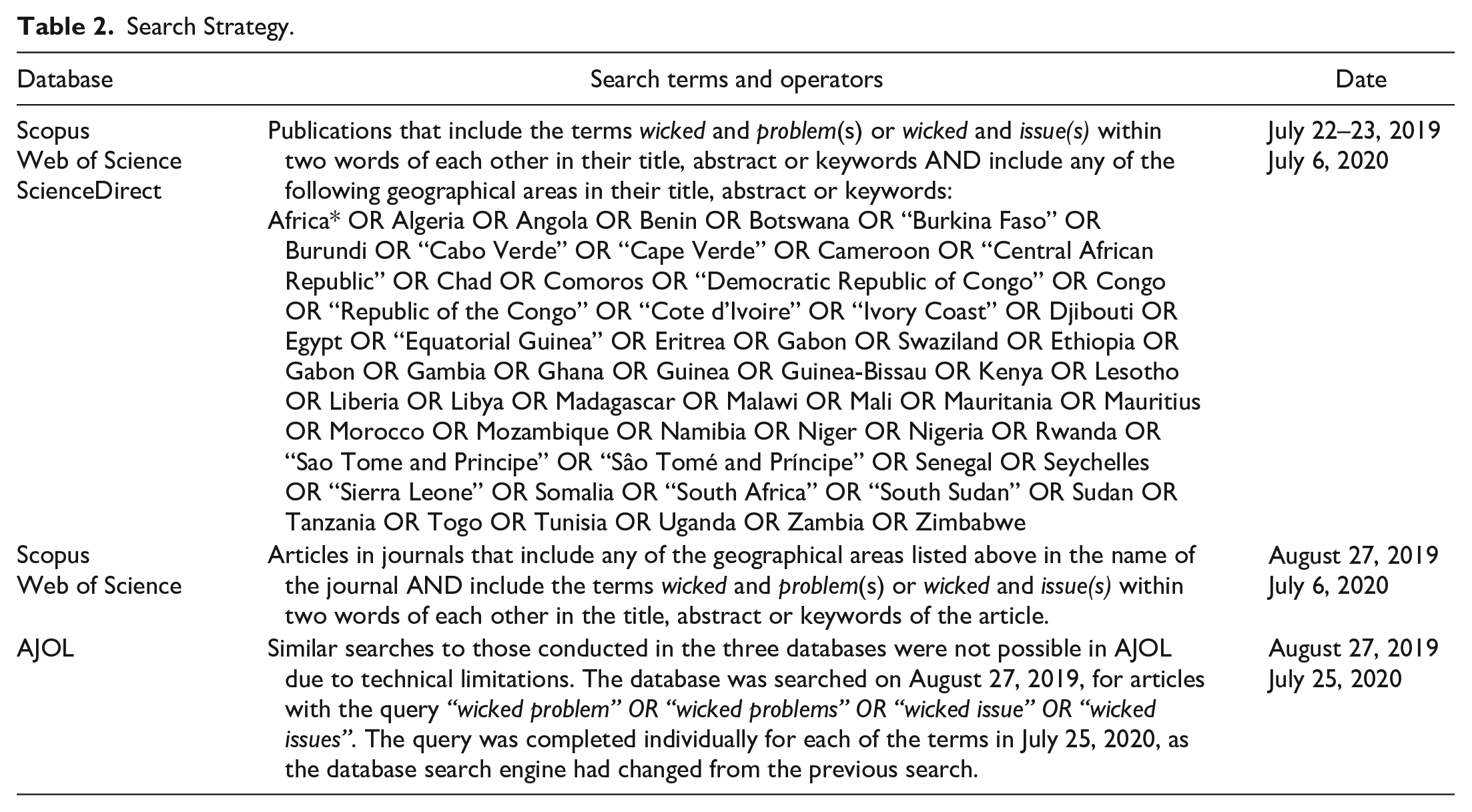
Searches were conducted in four databases: Web of Science, Scopus, ScienceDirect, and African Journals Online (AJOL). Different sets of search queries were developed due to differences in the search tools of the databases. The countries used as search terms were based on the United Nations African Group (United Nations Department for General Assembly and Conference Management, n.d.). The first searches were conducted in July and August 2019, with additional searches in July 2020. The search strategy is presented in Table 2. The searches returned a total of 159 results. Removal of duplicates produced 110 unique results for the screening phase.
Search Strategy.
Screening
The screening process is described in the PRISMA flow chart presented in Figure 2 (Moher et al., 2009). When obtaining publications for this phase, it became evident that the majority of books and book chapters discovered in the search phase could not be obtained. Therefore, the report eligibility criteria were adjusted to exclude books and book chapters from this review. This change resulted in the removal of 11 publications. Two articles (Ramaswamy, 2015; Yawson et al., 2020) could not be obtained for this review, as the authors were unable to access them. Therefore, a total of 13 publications were removed, leaving 97 articles for the screening phase.

PRISMA flowchart (adapted from Moher et al., 2009).
The titles, abstracts and keywords of 71 articles found in June–August 2019 were read and their eligibility assessed independently by three assessors. Next, the selected articles and the reasons for the omission of each excluded article were discussed at a meeting. Based on the discussion, the inclusion criteria were adjusted to reduce ambiguities, after which the adjusted and final set of criteria was applied to the whole body of 97 articles, including the articles found in the additional searches conducted in June 2020. The screening and eligibility assessment phases resulted in the exclusion of 52 articles, leaving a total of 45 articles for the review.
Description of Materials
The publication years presented in Figure 3 confirm the growing interest in the concept during the 2000s identified by other authors (see Danken et al., 2016; Xiang, 2013). The volume in which one article appeared (Westin et al., 2012–2013) was listed as spanning 2 years; the latter year was coded as the publication year.

Publication years of articles included in the review.
Analysis
Articles included in the review were analyzed with inductive qualitative content analysis (Elo & Kyngäs, 2008) by the main author. To answer the first research question, we developed a two-phase content analysis process. In the first phase, the main issues explicitly discussed as wicked problems in each article were coded. This was performed by identifying the issue explicitly referred to as a wicked problem, or, in case there was no explicit linkage between an issue and the concept of wicked problems, by closely reading the text. However, while solely focusing on identifying problems explicitly “labelled” (see Peters, 2017) as wicked produced a list of wicked problems, this failed to reveal why the issues were viewed or discussed as wicked; moreover, this method tended to identify issues discussed at a general level without a practical or concrete context. Consequently, a second phase was developed to analyze manifestations, in other words, the concrete ways in which the issues identified as wicked in the first phase were manifested according to the texts. The literature on both wicked problems and problem formulation suggests that a deeper understanding of problems is key, as “every wicked problem can be considered to be a symptom of another problem,” thus any issue can be attributed a causal mechanism (Rittel & Webber, 1973, p. 165; Rochefort & Cobb, 1993).
This two-stage process allows us to compare the wicked problems identified in this literature review with the earlier review (Danken et al., 2016), and to discern between the first phase, which we consider to be more descriptive in terms of the reviewed literature, and the interpretative second phase. Also, a deeper understanding of the wicked problems discussed in the articles is likely to reveal perspectives that otherwise would have remained hidden. To answer the second and third research questions, key information (the geographical foci of the articles, author affiliations, publication years, research material) was collected by reviewing and tabulating the relevant information from all the articles (for a similar approach, see, e.g., Isoaho & Karhunmaa, 2019).
Results
What are the Concrete Manifestations of Wicked Problems in the Reviewed Literature?
Themes explicitly named as wicked problems
In this section, we describe the results from the first coding phase, where issues explicitly referred to as wicked problems were identified from the reviewed articles. After identifying and coding these explicit issues, they were thematically grouped according to the “issue areas” identified in an earlier literature review of wicked problems by Danken et al. (2016). This allowed us to compare the themes we identified with the results of this earlier review. Danken et al. (2016) reviewed, with no geographical restrictions, a total of 105 articles in the fields of Public Administration, Business Economics, and Environmental Sciences published between 1991 and August 2014. It is thus possible that some of the studies included in our review had been reviewed earlier by the authors. For purposes of clarity and transparency, we limited identification of themes to one main theme per article. Danken et al. (2016) did not reveal the protocol for identifying the “issue areas” in their earlier review, requiring us to develop our own process.
For example, we based one such issue area on Bouma and McBratney (2013, p. 137), who discuss wicked problems in terms of “the six major global environmental sustainability issues” of food and water security, energy sustainability, ecosystem service delivery, biodiversity protection and climate change and their linkages with soil security. We coded all of these issues as a single issue belonging to the group Environmental Resource Management. The results of the first coding phase grouped according to the issue areas identified by Danken et al. (2016), with a comparison of their respective rankings, are presented in Table 3.
Main Issues in Reviewed Articles Grouped According to the Issue Areas of Wicked Problems by Danken et al. (2016).

One article on water security (Ingram & Memon, 2019) was included in this group.
Similar to the earlier review, Environmental Resource Management was also the largest group in our sample, with 11/45 contributions. However, in Danken et al.’s review, Climate Change was included as a subcategory of Environmental Resource Management and involved a significant number of contributions. By contrast, we identified only one article with climate change as the primary issue of focus: FitzGibbon and Mensah (2012). Most of the articles that we included in the Environmental Resource Management group mainly concern issues related to natural resources and human–nature interaction, such as community wildlife management (Balint, 2007), natural resource conflicts (Bond, 2016), coral reef degradation (Bruggemann et al., 2012), views on environmental issues (Quigely et al., 2015), the captive lion industry (Williams & ‘t Sas-Rolfes, 2019), and invasive species (Woodford et al., 2016). The following group, Health and Healthcare, mostly consists of articles that view HIV/AIDS as a wicked problem from different perspectives or due to different reasons (Burman, 2018; Burman & Aphane, 2017; Burman et al., 2017; Chasi, 2017; Tsasis et al., 2015), although it also includes one article on health governance (Khoo, 2013). In turn, the Sustainability group (6/45) includes a variety of research papers focusing on sustainability or sustainable development and defining this as a wicked problem (Acey, 2016; Booker, 2014; Davison et al., 2016; McGibbon & Van Belle, 2015; Perry et al., 2018; van der Laan et al., 2017). These are followed by the group Unemployment, Social Exclusion, and Social Assistance, including the subgroup of Poverty, which contains four articles concerned with poverty (Gold et al., 2018; Onyango, 2009; Onyango & Jentoft, 2010) or conflicts and violence (Reinecke & Ansari, 2016), the Food Security group, with three articles on food and water security, and seven smaller groups with 1–2 articles each. Two articles were categorized as Conceptual Papers, where no clear main wicked problems could be identified. In one of these, Booker (2014) applied the framework developed in the article to an example case; however, no clear wicked problems could be identified. In the other, Farrell (2011) used a case located in Africa as an example in the discussion, but this was not the main focus of the article.
Furthermore, in our reviewed literature, we failed to find the issues of two groups identified in the Danken et al. (2016) review: Energy and Global Terrorism, which was named as a subgroup of the Security and Defense issue area. Moreover, most notably, we identified only one article whose main focus concerned the Security and Defense issue area (Asamoah, 2020), though this was the second largest group in the Danken et al. (2016) review.
Concrete manifestations of wicked problems
In the second coding phase, we analyzed the concrete manifestations of the issues identified in the first phase. For example, after discussing sustainability issues framed as wicked problems, Bouma and McBratney (2013) continue by presenting the case of green water credits, which are designed to improve the quality of water in Kenya. In this context, the authors describe a variety of complex social-environmental issues: soil degradation and its effects on, for instance, groundwater, farming, and a reservoir used for electricity production, and the difficulties in choosing the appropriate soil protection measures for all farmers due to differences in both soils and crops (Bouma & McBratney, 2013). These issues were coded and finally grouped under the theme Environmental and Natural Resource Management. As another example, Bruggemann et al. (2012) discuss the reasons for coral reef degradation in Madagascar and present multiple reasons for this problem based on the previous literature. Each of these reasons was coded as a concrete manifestation in its respective group.
This approach allowed us to identify seven distinctive main wickedness themes in the reviewed literature, which are presented in Table 4. Each theme contains lower-level categories, which we termed Manifestations and Mechanisms, as it includes both the ways the issues described as wicked problems are manifested in the literature (e.g., Wildlife and Fisheries Management issues, HIV/AIDS, Food and Water Security, Poor Governance), and the mechanisms that can be seen as the mediators, carriers or causations of these issues (e.g., Stakeholder and Value Multiplicity, Colonial History). One of the conceptual articles (Booker, 2014) was excluded from this phase, as no concrete issues could be found.
Wickedness Issues and Related Problem Mechanisms and Manifestations.

While this categorization partially overlaps with the thematic list, it nevertheless provides a more detailed description of the issues scholars consider are linked to wicked problems in Africa. Moreover, the ordering of the groups by prevalence in the literature we reviewed also provides a first glimpse of the central aspects of wicked problems discussed in the African context. Based on an in-depth reading and analysis, three observations can be made.
First, the article frequencies reveal a significant overlap between all main themes and especially between Ambiguity (30/45 articles), Institutional weakness (24/45), and Environmental and natural resource management (23/45). As such, the articles we reviewed seem to have described complex issues with multiple causation mechanisms and manifestations. This is supported by the high prevalence of the Ambiguities group, which covers the majority of articles reviewed and whose manifestations and mechanisms are multiplicity of stakeholders and values, complexity, unknowns, and a lack of clarity. Quigely et al. (2015) is an example of an article including all three most prevalent wickedness themes and their interlinkedness, as it discusses, for example, the simultaneous existence of differing cultures and worldviews in Kenyan society, the failure of the government to take into account indigenous ways of life in environmental governance, and the degradation of the environment by different actors through the exploitation of natural resources.
Our second finding is the presence of the Historical path dependencies group. Here, we understand path dependency as the history of a process determining its future development (Kay, 2005, pp. 553–554). Especially relevant to this group is the concept of dual wickedness introduced by Suleiman and Khakee (2017). In our view, this concept could potentially advance the discussion on wicked problems by providing a perspective rooted in the African context. Suleiman and Khakee (2017) describe how water tariff policies inherited from the colonial era have hampered the ability of a water utility company in the Ghanaian city of Accra to charge for water and how “appropriate institutions do not exist to produce optimal socio-economic outcomes and improve water services” (p. 333). The authors discuss and portray this urban water reform as a wicked problem and on this basis develop the novel concept of dual wickedness. Here, the concept describes the socio-cultural atmosphere in Ghana, which has been influenced by the continuing effects of its colonial history, dependence on external development actors, endemic corruption, the general sentiment among Ghanaians that “the state is not theirs,” and the consequent lack of a “sense of collective ‘ownership’ of public property.” Dual wickedness means “wickedness within wickedness,” and delineates how “political and social malaise in Ghana requires a thorough understanding of history, politics and power dynamics,” which is further complicated by external donors being “regarded as an extension of colonialism.” The authors consider that because the memory of the colonial era is “shared by the society as a whole, the implementation of a reform of a public policy is likely to be difficult, if not impossible since the experience resides in the collective memory of the society” (Suleiman & Khakee, 2017, pp. 329–330).
Overall, articles in the historical path dependencies group discuss the continuing impact of colonial or apartheid history on people or broader cultural contexts. For example, Acey (2016) discusses the entrenchment of the top-down governance introduced during Nigeria’s colonial era and its unsuitability for solving the issues prevalent in the country. In turn, Bennett et al. (2017, p. 59) argue that “[s]ocio-economic inequalities such as poverty still remain a challenge in post-apartheid South Africa and continue to impact the country by contributing to the burden of disease and social health faced by the population,” with the poorest potentially being the worst affected. Furthermore, Chasi (2017, p. 497) discusses Nelson Mandela’s efforts to communicate the HIV/AIDS problem and claims that the president was forced to work in a post-apartheid situation where leadership was difficult and “in societal arrangements that quite intractably constrain what they [leaders] can do to secure a more just social order.” Other problems in this group include the long-term effects of colonial (and post-colonial) rule on indigenous peoples and ethnic groups (Home & Kabata, 2018), and more general social and ecological issues in South African post-apartheid society (Mertens, 2016).
Though most clearly related to the theme of historical path dependencies, dual wickedness and its emphasis on the centrality of contextual understanding could arguably characterize many of the issues and literature reviewed here. For example, while discussing economic deprivation, Onyango (2009, p. 43) observes that wicked problems such as poverty are “quite unique to a particular area” and thus “solutions . . . cannot be the same in two different places.” Therefore, even defining poverty requires contextual understanding (Onyango, 2009). In turn, Bruggemann et al. (2012) discusses how local belief systems may be one of the causes of coral reef degradation. Heimer (2013) again describes the ethical decisions made on a case-by-case basis by researchers working with patients in HIV/AIDS clinics. Burman (2018), Burman and Aphane (2017), and Burman et al. (2017) highlight the continuing negative effect of the old ABC HIV/AIDS prevention campaign on contemporary medical practitioners’ work, which requires a departure from the established ABC way of thinking. Moreover, problems intertwined with histories of colonialism, authoritarian regimes, the multiplicity of value systems, external influence, and overall contextual differences are discussed by multiple authors (e.g., Balint, 2007; Burman, 2018; Gold et al., 2018; Khoo, 2013; Onyango & Jentoft, 2010; Reinecke & Ansari, 2016; Ricker-Gilbert et al., 2013; Vogel et al., 2016).
Third, the close-up reading in this second coding phase produced the finding that the concept of wicked problems is integrated into the problems identified in the literature at two distinct levels—descriptive and theoretical. Most of the articles (32/45) use the concept in a merely descriptive way, and this descriptive usage in most cases seems to have three phases: first, a problem is presented; next, it is labeled as a wicked problem; last, different descriptions of wicked problems or suggested means of addressing the wicked problem are discussed based on the literature and in relation to the issue at hand. For example, while Ricker-Gilbert et al. (2013) underline that the issues addressed in agricultural input subsidy programs share some of the characteristics of wicked problems, they fail to integrate the concept or the characteristics of wicked problems otherwise into their review. This is congruent with Peters’ (2017) argument that wicked problems have become a “fad” in the academic literature and are used to describe a wide set of issues without deeper adherence to wicked problems theory. In such cases, the concept functions as a rhetorical device that links the issue discussed to the wicked problems discourse and potentially emphasizes an aspect compatible with the theory (see Peters, 2017; Peters & Tarpey, 2019; Termeer et al., 2019; Turnbull & Hoppe, 2019). In line with Peters, we too argue that such descriptive usage of wicked problems has low potential for contributing to the development of the wicked problems literature or the concept, as such research fails to provide new perspectives on wicked problems; rather, it simply subsumes the issues in question within the concept.
The other way of using the concept is theoretical. Here, the characteristics of wicked problems as derived from the literature are considered as a theory or a framework against which it is possible to analyze an issue or build new theories. Of the 13 articles utilizing the concept theoretically (Asamoah, 2020; Balint, 2007; Barry & Fourie, 2002; Booker, 2014; Davison et al., 2016; FitzGibbon & Mensah, 2012; Heimer, 2013; Ingram & Memon, 2019; Okeke-Ogbuafor et al., 2020; Onyango, 2009; Quigely et al., 2015; Woodford et al., 2016), we found that the article by Suleiman and Khakee (2017), discussed above, contributed most to the discussion on wicked problems by providing a strong perspective rooted in the African context.
What Are the Geographic Foci of Articles That Use the Concept of “Wicked Problems” in the African Context?
The geographical focus of the articles was identified by gathering information on the location of the research or its geographical context. More than one focal area was allowed for each article. The results are presented in Figure 4. A clear majority (24/45) of the articles included in this review focused on South Africa, followed by articles written in the context of or focusing on the whole continent or larger areas of the continent (Africa overall, 8/45), and Kenya (7/45).

Geographical foci of the articles.
Is the Concept of Wicked Problems Utilized and Therefore Seen as Applicable by Authors Affiliated With African Cultures?
For this research question, information on the geographical location of the institutional affiliation of each author was collected. Affiliation was identified from all included articles based on the affiliation mentioned on the first page of each article. Here, to allow for a more detailed analysis, we distinguished between lead authors and other authors. Lead authors were identified as authors who were either (1) mentioned first in the author list or (2) were marked as corresponding authors. Authors of single-author articles were grouped as lead authors. If more than one affiliation was mentioned for a single author, only the first affiliation was coded. The affiliations of two lead authors were not disclosed, and these were grouped as Unavailable.
It should be noted, however, that this is very basic information on the connection between the concept of wicked problems and research and institutions in certain cultural contexts, and as such provides no information on the cultural or ethnic background or nationality of the authors. The geographical locations of the affiliated institutions of lead authors and authors employing the concept of wicked problems in the African context are presented in Figure 5.

Geographical distribution of the affiliated institutions of lead authors and other authors.
As mentioned in the previous section, articles focusing on South Africa accounted for over half the reviewed articles (24/45). Similarly, South African research institutions were the most represented single group for both lead authors (17/45) and other authors (28/78). The authors (lead and other) were affiliated with five different African countries in total: Ghana, South Africa, Kenya, Madagascar, and Tanzania. Each of these countries was also represented as a focal area. Roughly half of both the lead authors (23/45: South Africa, Ghana, Tanzania, and Madagascar) and secondary authors (38/78: South Africa, Kenya, and Madagascar) were affiliated with African countries. Of course, this also means that roughly a half of both the lead authors (22/45) and other authors had published in affiliation with research institutions in countries outside Africa. Nearly as many lead authors were affiliated with research institutions in the United States, the United Kingdom, and Canada together (14/45) as with South African institutions (17/45). The high prevalence of Swedish authors seems to be linked to two articles.
The results can be compared with information on the division of scholarly output between the continent’s countries. A query made with the online tool SciVal (www.scival.com) of publications released in 2009–2018 and listed in the online database Scopus revealed that the 10 countries with the most academic publications in Africa (South Africa, Egypt, Tunisia, Nigeria, Algeria, Morocco, Kenya, Ethiopia, Ghana, and Uganda, respectively) accounted for 85% of all articles published in African countries. Of these 10 countries, authors from research institutions in only three countries (South Africa, Kenya, and Ghana) are represented in our sample. For example, no articles from Egypt were included in our review, even though it is the country with the second-most publications after South Africa.
An explanation for this difference might be language. All the lead authors of the articles included in this review were either affiliated with research institutions from countries with English as one of their official languages (leads from Canada, Ghana, Ireland, South Africa, Tanzania, South Africa, the United Kingdom, and the United States accounted for 33/45 lead authors) or some other language linked to a Western culture (altogether 22/45 lead authors were affiliated with European and North American research institutions). Ghana, South Africa and Tanzania were the only African countries with which lead authors were affiliated. Similarly, except for the Democratic Republic of Congo and Madagascar, all the geographical focal areas included in our review had English as one of their official or widely used languages. Six of the top 10 of African countries with the most academic publications (Egypt, Algeria, Morocco, Tunisia, Ethiopia, Uganda) were not represented in our sample either as focal areas or as the locations of research institutions. Of these, only Uganda has English as an official or widely used language (Central Intelligence Agency, 2021).
Our key finding is that the usage of the concept of “wicked problems” in research focused on Africa is strongly linked to South African and Western research institutions. Furthermore, the research itself is mainly focused on African countries with English as one of the predominant languages. Even though the majority of academic literature, especially that found in journals, is published in English (see Amano et al., 2016; Hamel, 2007), language differences may account for the lack of research literature utilizing this concept in the African context. Scholars from non-Western cultures, non-native English speakers, or scholars primarily using other-than-English languages in their work may not use, be aware of, or see wicked problems as a suitable concept for their cases (for a discussion on non-native English speakers and academic publishing, see Salager-Meyer, 2008). For example, in their analysis of articles published in Africa-focused journals, Briggs and Weathers (2016, p. 486–487) suggested that “academics based outside Africa write on topics different from those chosen by academics based inside Africa” and that “Africa-based authors are writing on topics that do not map neatly onto the broader Anglophone political science literature.” Likewise, it would seem that wicked problems is a concept predominantly used by researchers linked to Western institutions—to researchers who know and use English in their work and who are familiar with this Western research strand. As discussed by Briggs and Weathers (2016), such differences in topics between African and Western researchers may also be one explanation for the low citation numbers of articles published by African-based authors.
Discussion
As mentioned earlier, much of the literature on wicked problems has thus far focused primarily on the characteristics of wicked problems, and many authors have contributed to this theme. As our analysis confirmed, these characteristics, such as conflict, complexity, and uncertainty (Termeer et al., 2019), are nonetheless compatible with many different understandings of wicked problems (see also Danken et al., 2016). However, less research has focused on the specific issues referred to as wicked, a gap we have attempted to address through the research question “What are the concrete manifestations of issues described as wicked in the African context?” Based on the results reported in the section on the concrete manifestations of wicked problems, we developed a typology of wicked problems in Africa, presented in Figure 6.

A typology of wicked problems in Africa.
The typology is formed on the basis of the main themes and the manifestations and mechanisms identified in the literature included in this review. It consists of the three groups of interlinked, exacerbated, and contextual problems. Interlinked problems are broad, ambiguous issues characterized by multiple causes linked to other problems and other groups in the typology. Such issues include input subsidies (Ricker-Gilbert et al., 2013), highly complex socio-economic-ecological issues (Gold et al., 2018), conflicts between groups of people or people and animals (Bond, 2016), the management of invasive species that cause environmental harm but provide economic and social benefits (Woodford et al., 2016), and poverty (e.g., Okeke-Ogbuafor et al., 2020; Onyango, 2009; Onyango & Jentoft, 2010). Exacerbated problems are also somewhat complex in terms of their linkages, but at the same time they also display some context-specific characteristics. Such issues may include HIV/AIDS-related problems connected to previous attempts to control the epidemic (Burman & Aphane, 2017), issues that require contextual consideration due to a conflict between “official ethics” and “ethics on the ground” (Heimer, 2013), and institutional weakness epitomized by overall poor governance, corruption, and dependence on external actors (e.g., Mwangi, 2009; Okeke-Ogbuafor et al., 2020; Suleiman & Khakee, 2017). Institutional weakness may also fall into the contextual problems category, as the issues associated with institutional weakness may vary greatly between states and are strongly contextual (see, e.g., Asamoah, 2020).
The issues that are most clearly contextual problems are those included within the historical path dependencies theme. Suleiman and Khakee’s (2017, p. 329) concept of dual wickedness describes this end of the continuum well: to understand issues in their contexts “a thorough understanding of history, politics and power dynamics” is required. This notion is also compatible with the original description of wicked problems by Rittel and Webber (1973, p. 173): though two problems may seem similar, “there always might be an additional distinguishing property that is of overriding importance.” This context-specificity has not been included in the contemporary characterizations of wicked problems as issues with conflict, complexity, and uncertainty (Danken et al., 2016; Termeer et al., 2019), but, interestingly, the emphasis on context-specific solutions is reflected in the adaptive, participatory, and transdisciplinary methods often suggested for addressing wicked problems (Xiang, 2013; Head & Xiang, 2016). The wicked problems in Africa reviewed in the present study are, for their part, highly context-specific and politically, culturally, and historically intertwined. For example, Home and Kabata (2018, p. 3) describe the case of “descendants of Nubian soldiery that served the British colonial power” living in Kenya. Nubian soldiers were recruited by the British at the beginning of the 20th century and remained in Kenya after their service. The British colonial administration did not, however, consider them citizens. This denial of citizenship, and thus any land rights, was inherited by their descendants and continued until 2017, when the situation was to some extent settled (Home & Kabata, 2018). Thus, while the issue at hand is certainly conflict-ridden, complex and uncertain, it is also highly contextual. Understanding history is crucial for understanding and dealing with such wicked problems. Such contextually and culturally aware “decolonizing” approaches have also been advocated by several scholars (Mama, 2007; see also Asante, 1998; Khupe & Keane, 2017; Mkabela, 2005; Ndimande, 2012).
Why then is the overall popularity of the concept not replicated in the African context? Xiang (2013, p. 2) asked if this discrepancy could “be a reflection of the difference in developmental stages between developed and developing countries?” In the light of the body of literature reviewed in the present study, this seems unlikely. Rather, the underuse of the concept of wicked problems is probably attributable to cultural or language backgrounds. Indeed, earlier research has revealed that the topics selected by Africa-based authors differ from those of their non-African counterparts (Briggs & Weathers, 2016).
Finally, we are aware of the limitations of this review. The articles we analyzed are from a broad range of disciplines, employ multiple different methodologies, include both conceptual and empirical research and cover a variety of topics. To ensure the inclusion of a significant portion of the wicked problems literature published in the African context, we placed no restrictions on the type of research (empirical or conceptual) in the inclusion and exclusion criteria, which have been presented in the section on methods and materials. However, this choice also presented challenges. The number, plurality and diversity of the articles reviewed complicated the consolidation of information on them and lowered the level of detail. However, this drawback was addressed through clear reporting and by answering the first research question in two phases, the latter of which was more interpretative and grounded. In addition, we are aware of the “Anglophone” (Briggs & Weathers, 2016) background of the concept we are researching and the potential issues concerning Western scholars contributing to research on Africa.
Conclusion
In this systematic literature review, we analyzed 45 peer-reviewed academic articles on wicked problems in the African context and consequently answered three research questions. First, we studied the main themes and issues characterized as wicked. As in a similar study of wicked problems by Danken et al. (2016) (without geographic limitation), we found Environmental Resource Management to be the most frequent theme, but with one striking difference: climate change played a key role in just one article, while Danken et al. (2016) found a significant number of such articles. The second most frequent theme in our sample was Health and Healthcare (ranked no. 3 by Danken et al., 2016), which mostly consisted of articles that viewed HIV/AIDS as a wicked problem from different perspectives or for different reasons. Interestingly, in contrast to Danken et al. (2016), where it was the second largest group, only one article fell under theme of Security and Defense in our study.
To better understand—and articulate—the contextual characteristics of wicked problems in our sample, we conducted a more grounded qualitative content analysis of the wicked problems most repeatedly discussed. We classified these, on one hand, as concrete manifestations (environmental and resource management, health, economic issues, and human rights issues), and on the other hand, as mechanisms (ambiguity, institutional weaknesses, and historical path dependencies). Even though some of these manifestations and mechanisms overlapped with the previous thematic analysis, conducting a parallel analysis of both substantive (i.e. concrete manifestations) and process (i.e. mechanisms) issues allowed us to progress toward a typology of wicked problems in Africa. As illustrated in Figure 6, wickedness can be constituted either by the interlinkedness of several simultaneous problems, which result in ambiguities in defining the problems and their root causes, or by contextual complexities, often derived from historical path dependencies, that undermine effective governance interventions. When these factors coexist, problems tend to become exacerbated, as, for example, in the case of finding viable treatments for AIDS/HIV, where the poor historical track record of disease treatment has contributed to a low level of trust and agency in managing the problem.
Answers to the second and third research questions on the geographical division of authors and research subjects indicated that the concept of wicked problems is still mainly utilized by authors affiliated to English-speaking African countries or non-African countries. We suggested that this was probably due to a lack of knowledge or acceptance of this Western or U.S. concept among African academics.
The theory of wicked problems is an important tool in the effort to characterize the most severe challenges facing societies, and we consider that this concept can also contribute to problem diagnostics, critical reflection, and policy learning in the African context. In line with the views of Alford and Head (2017) and Noordegraaf et al. (2019), we consider the concept relevant for both academics and practitioners around the globe when drawing attention to complex social realities. The concept serves as a means for academia to assess different societal challenges and problem types and can empower practitioners faced with seemingly intractable problems. In addition, it can provide them with an established toolkit for tackling the issue at hand (Raisio, 2009). However, as this review and the vivid discussion around the concept has demonstrated, it remains a work-in-progress. Wicked problems can and should be developed from the foundation established by Rittel and Webber in 1973 to accommodate contemporary global contexts, Africa included.
Of the wickedness themes identified in the present study, we found that the notion of dual wickedness (Suleiman & Khakee, 2017)—the importance of contextuality—resonated with both the literature we reviewed and approaches advocated by other scholars focusing on Africa. Moreover, it also highlighted an important aspect of wicked problems. Based on the contextual issues in the literature reviewed in the present study, we argue that context-sensitivity should be incorporated into characterizations of wicked problems. This may also address some of the criticisms of the concept presented in Table 1 and could be compatible with the notion of context-aware, practice-based, on-the-ground-oriented wickedness suggested by Noordegraaf et al. (2019) as a response to the “weaknesses of wickedness theory.”
This article focused on the “problematique” or analysis and comparison of the most salient and frequent wicked problem themes and issues that characterize African societies in the literature. Future research should alter the perspective and begin exploring the “resolutique” or appropriate means to address such challenges; this could potentially allow further elaboration of the theory of wicked problems to better take into account the huge contextual differences that prevail between Western and non-Western societies. The results and discussion presented in this article will also inform future research questions, such as the way complex issues should be approached at street-level. Based on this review, it would seem that the wicked problems literature on Africa has thus far failed to address the way citizens and practitioners experience and respond to wicked problems. Thus, it remains unclear whether the notion of wicked problems resonates with the day-to-day challenges confronted by African citizens and practitioners alike. Moreover, in a broader context, the wicked problems literature has focused strongly on Defense and Security (Danken et al., 2016)—why is this not reflected in the context of Africa? Finally, it would be important to map African complexity-related research and practical approaches to these multifaceted problems, as many of the issues reviewed and discussed by the scholars in this review could be characterized as complex.
Footnotes
Acknowledgements
The authors would like to thank the participants of the 2019–2020 University of Helsinki ECGS Consumer Citizens and Sustainable Transitions Master’s Thesis Seminar for their invaluable comments and discussion on earlier drafts.
Declaration of Conflicting Interests
The author(s) declared no potential conflicts of interest with respect to the research, authorship, and/or publication of this article.
Funding
The author(s) received no financial support for the research and/or authorship of this article.
