




Abstract
Higher education students are considered to belong to a population susceptible to poor sleep health; however, there is a lack of broader evidence reviews. This systematic review aims to map out and categorize the existing literature related to higher education students and sleep. The present evidence map is based on a comprehensive systematic literature search of ten electronic databases, which resulted in 15,286 unique citations. After title/abstract, and full-text screening: 515 studies were included in the final map. Most of the studies were cross-sectional (n = 357, 69%), while 77 (15%) studies assessed the effectiveness of an intervention. Sixty-eight (13%) studies followed a cohort prospectively over time, and 8 (2%) studies utilized a qualitative design. The most frequent outcome was the proportion of sleep problems, which was reported in 226 (44%) studies. Weekday sleep duration was reported in 156 (30%) studies. Results from this mapping process suggest that evidence about students` sleep health is emerging; however, the evidence base is mostly quantitative and descriptive, and there is a lack of sleep health programs designed for students.
Introduction
Higher education students, typically in their early twenties, are considered to belong to a particularly vulnerable population with high risk for poor sleep health (Hershner, 2020; Sivertsen, Vedaa, et al., 2019). The majority of higher education students is young adults in a period of transition, where several are living away from home for the first time, aiming to balance educational demands, making new social relations, and maintain a healthy lifestyle with a good sleep hygiene practice (Foulkes et al., 2019).
The most common sleep health characteristics studied in students have been sleep duration and insomnia symptoms (i.e., the inability to fall or stay asleep) (Hershner, 2020). Sleep is considered a positive resource (Buysse, 2014), that promotes physical and mental well-being pivotal for academic achievement (José Sá, 2020). However, we lack clear guidance on how much sleep is sufficient for students to stay alert. Research findings indicate that self-reported sleep duration of 7 to 8 hr is sufficient (Watson et al., 2015). Cognitive performance involving vigilance attention, cognitive processing speed, and working memory are sensitive to sleep duration below 7 hr. There is no clear evidence that sleep duration longer than 8 hr has an impact on these domains. Young adults who slept less than 7 hr were more likely to report poor general health and low overall physical and mental Health Related Quality of Life (HRQoL) than those sleeping 7 hr or more (Watson et al., 2015). Students have also reported poor academic outcomes and poor self-rated academic proficiency, including delayed study progress and failed study examinations (Hayley, Sivertsen, et al., 2017) as a consequence of sleep loss. According to restorative theory (Ezenwanne, 2011; Hale et al., 2020), the purpose of sleep is to reorganize and store information, and the cortical neurons that are involved in memory and attentive learning need to rest in sleep.
Research efforts of medical and allied professions like nursing have resulted in a broader conceptualization of sleep (Hale et al., 2020), and sleep is considered a multidimensional entity. The contemporary concept of “sleep health” moves beyond individual symptoms and disorders, and integrates issues related to how individual behavioral factors (e.g., sleep habits), sociodemographic factors (e.g., ethnicity, education), interpersonal factors (e.g., social support, relationship stress), and environmental factors (e.g., community and societal characteristics) (Hale et al., 2020). Students’ sleep health involves a complex interaction between the individual and their environment. Motivation, work ethic, personality, socioeconomic status, health problems, course workload, and organization and structure of the academic program, all influence sleep (José Sá, 2020). There is a lack of broader evidence reviews on students` sleep health characteristics, and the knowledge about interventions and current research gaps remains unclear.
Populations most vulnerable to poor sleep health should be considered a top research priority, and it is recommended to identify and address the gap in which the evidence is not yet translated into preventive interventions (Hale et al., 2020). Therefore, the objective of the current review is to map the evidence base related to students` sleep health by answering the overarching research question: What is known about higher education students and sleep?
The specific objectives are to (a) systematically identify, organize, and summarize the quantity of scientific evidence related to students and sleep, and to (b) identify the key themes associated with students` sleep health characteristics.
Method
A systematic mapping review methodology was conducted to present an extensive evidence map (O’Leary et al., 2017; Sutton et al., 2019) of students and sleep. The purpose is to map out and categorize existing literature to commission further primary research by identifying gaps in the current research literature (Sutton et al., 2019). The evidence mapping process followed the steps described by Wang et al. (2016): (a) develop a comprehensive literature search strategy, (b) establishing study eligibility criteria and a systematic study selection process, (c) systematically retrieve, screen and classify data, and (d) visualize findings in an evidence map. A specialist librarian in health science research collaborated in designing the search strategy, the selection of databases, and the librarian conducted the searches.
Information Sources
We searched 10 databases for publications from January 2000 to May 2019: the databases Medline and Embase for health science articles in general, PsycINFO to cover mental health issues, and Cinahl for nursing and qualitative studies. The Cochrane Library was chosen to identify controlled studies, ERIC and Education Source to cover educational and pedagogical issues, SocINDEX searching for community and social studies, and Scopus for interdisciplinary studies. The literature search was supplemented by an additional search in Google Scholar via the search engine Harzing’s Publish or Perish version 6 for newer research published between 2016 and 2019.
Search Strategy
The literature search strategy consisted of two parts: a part for sleep and another part for students. Both searches included a combination of index terms and keywords depending on the database thesaurus. For databases with a less developed thesaurus, alternative strategies were used to identify the greatest possible share of the relevant literature. The full literature search strategy is described in detail in Supplemental Table S1.
Eligibility Criteria
As this was a map of the research evidence, we included independent of design, qualitative and quantitative primary research studies. Conference abstracts were included if enough information was presented. The inclusion and exclusion criteria for the searches and study designs are listed in the PICOS table (Table 1). Efforts were made to include studies with non-English language to achieve a broader map. The selection included studies in English, French, German, Spanish, Italian, and Scandinavian languages. Gray literature and guidelines were not included.
PICOS* Table of Study Selection Criteria.

PICOS = Population, Intervention, Comparison, Outcome, Study design.
Data Collection and Selection
The searches were performed in May 2019. Citations and abstracts from the search results were imported into the Covidence software (Babineau, 2014) and duplicates were removed. Prior to commencing the screening process, a calibration exercise was conducted to ensure reliability in selecting articles for inclusion. All review authors discussed and agreed about eligibility criteria and the selection process in a consensus meeting. The meeting entailed independently screening a random sample of 10 articles, and discrepancies were resolved by discussion and clarification of eligibility criteria. The remainder of the search results were screened on titles/abstract followed by full-text screening. The screening processes were conducted randomly, dual, and blinded. First, second, and the last author solved disagreements appearing between screeners.
Appraisal of Methodological Quality
Evidence mapping does not generally include quality assessment. However, inspired by the CERQual (Confidence in the Evidence from Reviews of Qualitative research approach) framework (Lewin et al., 2015), the limitations related to primary research study design, the relevance of the findings for the student population, the coherence of the review finding across the included studies, and the adequacy of data were assessed to establish how much confidence to place in the evidence map findings. The level of confidence is graded as high, moderate, low, or very low. The CERQual approach was initially established to make a transparent assessment of how much confidence decisionmakers and key-end-users can place in findings from the data synthesis (Lewin et al., 2015).
Data Coding Strategy/Data Mapping Method/Synthesis of Results
The data were analyzed according to a two-step process aimed at addressing the two research objectives. Information about study characteristics for all studies was extracted and imported into IBM SPSS (Statistical Package for the Social Sciences) Statistics 24 version. The information included the year of publication, sample size, mean age, design, type of students, weekday sleep duration, the proportion of sleep problems, sleep quality, and daytime sleepiness when reported. One author extracted data into a data collection form with help from other co-authors, and one author crosschecked entries. Disagreements were resolved through co-author discussion.
To identify key factors associated with student sleep characteristics (i.e., objective 2) a thematic analysis was performed (Vaismoradi et al., 2013). The studies were categorized according to aims, and the main theme of the studies was identified to uncover what key factors related to students` sleep have been identified/explored across the included studies. One author performed the thematic analysis, and two other authors validated the findings.
Scatterplots showing fitted lines with 95% confidence intervals were produced to visualize the weekday sleep duration (hours) across continents and globally by year of publication. The same type of scatterplots was also produced to visualize the proportion of sleep problems across continents and globally by year of publication. Australia was not included in these plots due to a lack of information about sleep duration and the proportion of sleep problems in Australian studies.
Results
We screened 15,286 titles/abstracts and 2,787 potentially relevant full-text articles, and 515 articles fulfilled the eligibility criteria (Figure 1) comprising data from 744,584 participants with a median sample size of 237 (range 4 to 135,874). Most of the included studies were published after 2010, with 16% (n = 80) published before that time. Study data represented all continents: North America (n = 195, 38%), Asia (n = 171, 33%), Europe (n = 82, 16%), South America (n = 38, 7%), Africa (n = 17, 3%), and Oceania (n = 5, 1%). The United States (USA) was the country most frequently represented with 173 (34%) studies.

Flow diagram of study selection.
The majority of the studies were cross-sectional (n = 357, 69%), while 77 studies assessed the effectiveness of an intervention (i.e., randomized controlled trial [RCT] [n = 46, 9%] and quasi-experimental [n = 31, 6%]). Sixty-eight (13%) studies followed a cohort prospectively over time, and only 8 (2%) utilized an exclusively qualitative design. The most frequent outcome measures were related to the proportion of sleep problems, which was reported in 230 (45%) studies. Weekday sleep duration was reported in 158 (31%) studies, and 144 (28%) assessed sleep quality using the Pittsburg Sleep Quality Index (PSQI) measurement at baseline (Buysse et al., 1989). Daytime sleepiness, measured with the Epworth Sleepiness Scale (ESS) (Johns, 1991), was utilized in 48 studies (9%). The summary of findings is displayed in Supplemental Table S2.
Students’ Sleep Health Characteristics
The evidence map comprised a sample of 365 (71%) studies representing university students (i.e., undergraduate and graduate students), and 146 (28%) studies representing college students. Across all studies, the mean age of the students was 21.4 (SD = 2.3) years. Students in Europe and North America sleep on average 7.12 hr during the week, which is approximately 0.5 hr longer than students on other continents (Figure 2). Across all studies, the reported mean sleep duration on weekdays was 6.95 hr (SD = 0.6). Globally, the reported proportion of sleep problems was 48% (SD = 19.5), ranging from 40% in Europe to 55% in Africa and South America (Figure 3). The severity of sleep problems was assessed with the PSQI at baseline in 144 studies, and the mean score across studies was 6.42 (SD = 1.9) with no statistical differences between continents. Average daytime sleepiness was 8.63 (SD = 1.2) across the studies utilizing the ESS, and the mean proportion of excessive daytime sleepiness was 35%.

Sleep duration across continents by year of publication (N = 156).

Proportion of sleep problems across continents by year of publication (N = 226).
Key Themes Related to Students Sleep
Twenty-four main themes were identified across the included studies, which are outlined in Figure 4. The most common objective was to explore students` sleep characteristics (n = 83, 16%), of which 72 (87%) were cross-sectional studies. Associations between sleep and mental health (e.g., depression, anxiety) were the main objective in 65 (13%) studies, of which 53 (82%) were cross-sectional studies. Sixty-five (13%) studies were concerned about associations between students` sleep health characteristics and academic performance, with cross-sectional designs being the most common (n = 53, 82%). Although qualitative approaches were frequently included across studies (e.g., sleep journals and/or open-ended-questions included in quantitative measures), only eight studies, cumulatively including 177 participants, were categorized as qualitative. The main objectives of the qualitative studies were to explore student experiences of sleep related to academic performance, technology, daily functioning, dream content, stress, and shift work. Among the 77 intervention studies (i.e., RCT and quasi-experimental), complementary and alternative medicine (CAM) interventions (e.g., mindfulness) were the most common (n = 16, 21%), followed by cognitive behavioral therapy (CBT) approaches (n = 11, 15%), and interventions related to sleep hygiene (n = 10, 13%) (Figure 5).
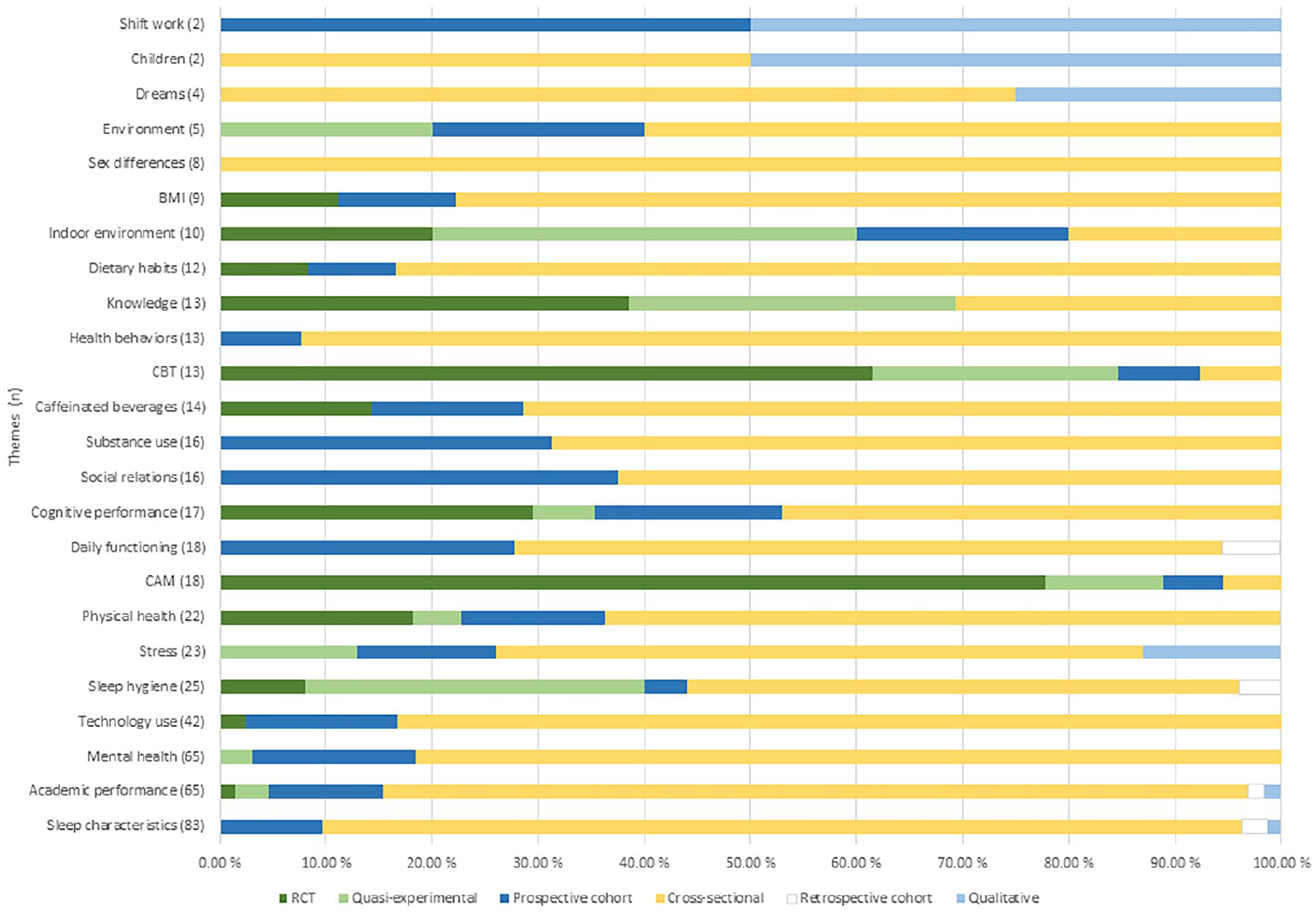
Key themes across study design.
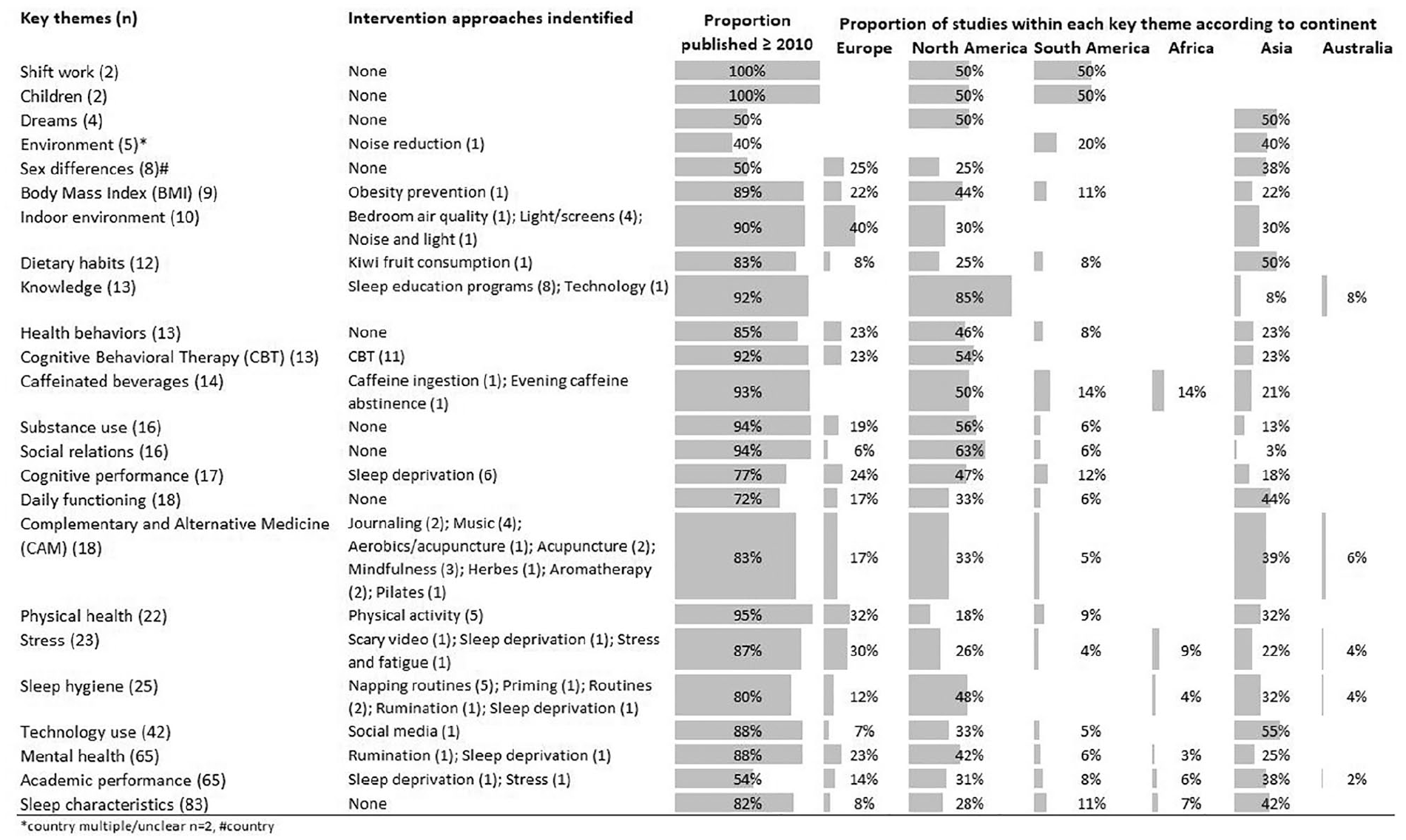
Map of key themes according to study characteristics.
Confidence in Findings
Our overall CERQual assessment of confidence was graded as moderate, indicating trustworthiness. There were substantial concerns regarding methodological limitations as the majority of studies utilized a cross-sectional design. The evidence map exposed a lack of prospective and intervention studies, and very few studies explored student experiences related to sleep through a qualitative perspective. We have moderate concerns about relevance; the included studies originated from a broad range of countries representing all five continents. However, the majority of the studies were from westernized countries and few studies explored different contexts within the student population (e.g., subgroups). There were minor concerns about coherence since the data were reasonably consistent across countries.
Discussion
The present review is unique; presenting a comprehensive map over the research evidence related to higher education students` sleep health characteristics across quantitative and qualitative study designs. The focus on students in higher education is important, as contemporary sleep health research suggests that sleep problems may play a causal role in the development of diseases (Frank & Heller, 2019). Therefore, efforts to improve sleep health among students may have the added benefit of reducing disparities in health and well-being during the study-years and later in life (Hale et al., 2020; Hershner, 2020; Watson et al., 2015).
Our estimate of a worldwide proportion of sleep problems among the general student population at approximately 50% corresponds well with previous research. According to a large cross-sectional study (N = 55,322 students), mean days per week with sleep problems was 2.43 (SD 1.3) (Hartmann & Prichard, 2018). Becker et al. (2018) (N = 7,626 students) found that 62% of students met the cut-off criteria for poor sleep, and 37% slept more than 7 hr per night. In comparison, the global prevalence of insomnia symptoms in the adult population is approximately 30% to 35% (Morin et al., 2015). Our findings support the assumption that students have poorer sleep health compared to the general population. Across included studies utilizing the PSQI, only 17% of studies reported a PSQI-score in the normal range (i.e., ≤5). A similar finding was observed in the Norwegian Students’ Health and Wellbeing Survey (SHoT) (N = 50,054 full-time students, mean age 23.2) (Sivertsen, Vedaa, et al., 2019) where one in three students report symptoms of deteriorated sleep to a degree where it meets the requirements of an insomnia diagnosis. The SHoT study findings also emphasized that students` sleep patterns vary, with limiting sleep on weekdays and extending sleep on weekends which can cause untoward circadian effects or social jetlag (Sivertsen, Vedaa, et al., 2019).
We observed a slightly higher proportion of sleep problems among students from Asia compared with students from Europe. A review of sleep patterns and problems during adolescence found that Asian adolescents went to bed later and obtained less sleep than the American and European adolescents (Gradisar et al., 2011). Higher academic stress among Chines students (Chen et al., 2014), school starting early and accelerating demands of schoolwork with grade advancement (Zhang et al., 2010), are some factors suggested influencing the amount of sleep attained by Asian students. The highest proportion of sleep problems was found among student populations originating from Africa and South America. It is difficult to compare study results across diverse continents; however, a higher proportion of sleep problems was associated with countries characterized by conflicts and/or social and economic disadvantages. These results are concerning and emphasize students’ vulnerability to stressful life situations and the impact on sleep health independent of educational systems (Kallsen et al., 2020).
Twenty of the studies (4%) included in our evidence map were concerned with students’ chronotype; primarily linking chronotype with academic performance. Bed and rise time in students reflect both external obligations and circadian preference. External obligations, which impact the timing of sleep, are typically the first obligation of the day, which for most students is the start of the first lecture. Circadian preference is an indicator of the internal clock and can be considered as a spectrum from “morning lark to night owl,” indicating that at certain times of the day a student will be more vigilant (Hershner, 2020). Sleepiness is defined as the inability or difficulty in maintaining alertness during the major wake period of the day, resulting in unintended lapses into drowsiness or sleep (Hershner & Chervin, 2014). In general, evening chronotypes are associated with lower academic performance despite adequate performance on measures of memory, processing speed, and cognitive ability (Hershner, 2020). It has been suggested that a later lecture-start-time may improve academic performance (Lima et al., 2009). However, our results are mixed, indicating that despite later start time may improve student well-being, the academic gain remains unclear.
Sleep disturbances are associated with academic performance (Galván, 2020; Vedaa et al., 2019), and 77 (15%) of the studies in the evidence map focused on academic or cognitive performance. However, only 10% of these studies were intervention studies, indicating that we lack appropriate sleep health interventions to enhance academic performance. This should be a concern for both educators and society as students` sleep health is critically important for academic success (Hershner, 2020; José Sá, 2020). Hartmann and Prichard (2018) reported for each additional day a student experienced sleep problems, the probability of dropping a course increased by 10% and lowered the cumulative grade point average (GPA) by 0.02. Similarly, in the SHoT study (Vedaa et al., 2019), insomnia was associated with a higher risk of failed examinations (odds ratio [OR] = 1.31, 95% confidence interval [CI] = 1.25, 1.37) and delayed study progress (OR = 1.32, 95% CI = 1.22, 1.42). Interestingly, the SHoT study found a curvilinear relationship between sleep duration and risk of academic failure; both sleeping less than 5 h, and 10 h or more, were associated with higher odds of failed study examinations, compared with sleeping 7 to 9 hr (OR = 1.46, 95% CI = 1.33, 1.63 and OR = 1.53, 95% CI = 1.33, 1.75, respectively). Thus, when a student is struggling academically, screening for a sleep disorder should be considered. Sleep disorders (Sateia, 2014) may impact academic success through excessive daytime sleep propensity, irritability, poorer HRQoL, lower motivation, or decreased executive function (Hershner, 2020). Further, poor sleep quality is associated with excessive substance use in students (Navarro-Martínez et al., 2020), and a recent review of 17 studies (Russell et al., 2019), suggests that poor sleep (e.g., insomnia symptoms) is associated with increased suicide/self-harm risk in university undergraduates. In the Norwegian SHOT study, a significant increase in sleep problems from 2010 to 2018 was observed, corresponding with a high prevalence of mental problems such as anxiety and depression, especially among female students (34%) (Sivertsen, Råkil, et al., 2019). Difficulties initiating or maintaining sleep were linked to increased risk of both social and emotional loneliness (Hayley, Sivertsen, et al., 2017). This is of high concern, as mental illness accounts for approximately 50% of the overall burden of disease between 10 and 24 years of age (Mei et al., 2020), and sleep problems commonly co-occur with mental health symptoms such as depression and/or anxiety (Bauducco et al., 2020; Becker et al., 2018; Owens et al., 2017; Russell et al., 2019). Outcomes related to students` emotional and mental health were frequently observed in our evidence map. Notably, most studies were cross-sectional with an association between sleep problems and students` mental health, however, directionality is uncertain. The general lack of intervention studies in the evidence map may reflect the fact that it is complicated to design interventions to improve sleep quality because poor sleep quality can be a manifestation of complex aspects of sleep and daytime dysfunction (Hershner, 2020).
The most common intervention observed were related to Cognitive Behavioral Therapy (CBT) and/or mindfulness-based interventions, and several studies indicated a positive effect on sleep curtailment in students where CBT interventions were found to improve sleep health (e.g., reduced PSQI score) compared to control. This is in line with findings from the general adult population, where CBT is the first-line treatment for chronic insomnia. According to a recent review (Ong & Moore, 2020), mindfulness-based interventions for insomnia and sleep appears to have a similar treatment effect but is less potent than CBT. Mindfulness meditation increases awareness of mental and physical states that are present when experiencing insomnia symptoms. Instead of changing the source of stress, mindfulness and meditation promote changing the relationship with stress (Ong & Moore, 2020).
Other barriers to good sleep hygiene in students identified in the evidence map are technology (e.g., computer, cell phones, exposure to light before bed), substances (e.g., caffeine and energy drinks, alcohol, stimulant use), study schedule, and lack of physical activities. These factors are similar to the findings from a state of the science review (Owens et al., 2017) which summarized the evidence from 90 studies in the area of college students’ sleep. In addition, a recent meta-analysis of 23 studies including 35,684 participants (Alimoradi et al., 2019), reported the overall pooled OR of having sleep problems if addicted to the internet was 2.20 (95% CI = 1.77, 2.74). Screen time can also be linked to short sleep duration and metabolic function. Regarding shortage of physical activity; self-reported data indicate that university students spend 7.29 hr per day being sedentary according to a meta-analysis based on 119 studies (Castro et al., 2020). Frequent technology use is one of the most distinctive features that differentiate the current student population from previous student cohorts, and our results indicate that this is an essential area which warrants more research attention.
Strength and Limitations
Evidence mapping is an emerging review methodology which facilitates scoping research in broad topic areas (Bragge et al., 2011). Usually, in-depth quality appraisal and synthesis of primary study results are not feasible. However, the current evidence map provides a unique overview of study characteristics and themes explored over time related to students` sleep health in addition to evidence gaps. The search strategy was extensive, the screening process robust, and 515 studies were included in the final map. The included studies represented approximately 750,000 students from more than 60 countries. Despite the fact that the majority originated from Western countries, we also identified studies from African and South American countries, which provides valuable information about sleep characteristics in students from the southern hemisphere. Our evidence map identifies a general lack of sleep health interventions for students as studies mainly had a cross-sectional design. Most studies rely on retrospective self-report of habitual sleep duration which may over- or under-estimate the proportion of sleep problems (Watson et al., 2015). Our findings must be interpreted with caution since there is a considerable variation in higher education programs across continents. However, the results were reasonably consistent across and within studies and identify higher education students as a high-risk population globally which would benefit from further attention. Interestingly, very few qualitative studies were identified. Considering the uncertainty related to which sleep health interventions are associated with positive outcomes for students, a more in-depth understanding of student sleep health experiences obtained from qualitative research methodologies should be pursued to facilitate the development of sleep health interventions tailored to student’s needs.
Conclusion
Our evidence map provides a comprehensive overview of a broad range of research related to students’ sleep health based on a systematic search of 10 databases including literature published over the last two decades. Results suggest that students are frequently targeted in sleep health research; however, the evidence base is primarily descriptive and future research efforts should aim at developing and test interventions in close collaboration with key stakeholders including students, educators, policymakers, and the sleep research community.
Supplemental Material
sj-pdf-1-sgo-10.1177_21582440211032162 – Supplemental material for What is Known About Students and Sleep: Systematic Review and Evidence Map
Supplemental material, sj-pdf-1-sgo-10.1177_21582440211032162 for What is Known About Students and Sleep: Systematic Review and Evidence Map by Ann Kristin Bjørnnes, Astrid Torbjørnsen, Berit Taraldsen Valeberg, B. Bente Sparboe-Nilsen, Ida Hellum Sandbekken, Kari Almendingen, Marit Leegaard, Ingrid Ravn, M. Torill Sæterstrand, Borghild Løyland, Lisbeth Gravdal Kvarme, Bettina Holmberg Fagerlund, Lisbeth Valla, Nina Misvær, Kirsti Riiser, Inger Utne, Hanne Rostad, Anette Winger, Elena Albertini Früh, Heidi Holmen, Ribu Lis, Sølvi Helseth and Ellen Karine Grov in SAGE Open
Supplemental Material
sj-pdf-2-sgo-10.1177_21582440211032162 – Supplemental material for What is Known About Students and Sleep: Systematic Review and Evidence Map
Supplemental material, sj-pdf-2-sgo-10.1177_21582440211032162 for What is Known About Students and Sleep: Systematic Review and Evidence Map by Ann Kristin Bjørnnes, Astrid Torbjørnsen, Berit Taraldsen Valeberg, B. Bente Sparboe-Nilsen, Ida Hellum Sandbekken, Kari Almendingen, Marit Leegaard, Ingrid Ravn, M. Torill Sæterstrand, Borghild Løyland, Lisbeth Gravdal Kvarme, Bettina Holmberg Fagerlund, Lisbeth Valla, Nina Misvær, Kirsti Riiser, Inger Utne, Hanne Rostad, Anette Winger, Elena Albertini Früh, Heidi Holmen, Ribu Lis, Sølvi Helseth and Ellen Karine Grov in SAGE Open
Footnotes
Declaration of Conflicting Interests
The author(s) declared no potential conflicts of interest with respect to the research, authorship, and/or publication of this article.
Funding
The author(s) received no financial support for the research, authorship, and/or publication of this article.
Ethics Statement
Not applicable

Supplemental Material
Supplemental material for this article is available online.
References
Supplementary Material
Please find the following supplemental material available below.
For Open Access articles published under a Creative Commons License, all supplemental material carries the same license as the article it is associated with.
For non-Open Access articles published, all supplemental material carries a non-exclusive license, and permission requests for re-use of supplemental material or any part of supplemental material shall be sent directly to the copyright owner as specified in the copyright notice associated with the article.
