



Abstract
This study examines the impact of the COVID-19 pandemic on Chinese education and teacher training in Malaysia, a multi-ethnic society with a unique Chinese educational system. It delineates two primary understandings of Chinese education: as a medium for ethnic language and culture preservation, and as a second language instruction. Utilizing a content analysis of government policies and statements from prominent Chinese educational organizations, this article identifies key challenges faced by Chinese teachers in Malaysia during the COVID-19, including high turnover rates, shortages of qualified educators, and the transition to online teaching, which has strained existing resources and support systems. It then explores the current responses to these challenges, categorizing them into official guidelines, private organizational support, and overseas assistance. Findings reveal that while local organizations have provided valuable resources and training, government support has been insufficient and often indirect, leaving teachers to navigate their vulnerabilities largely unsupported. The article argues for enhanced collaboration between the government and professional organizations to ensure the sustainability and quality of Chinese education in Malaysia, emphasizing the need for equal educational rights and cultural maintenance for the Chinese community. This article contributes to the understanding of educational responses during crises in multi-ethnic contexts and highlights the necessity for systemic support for marginalized educational systems.
Introduction
Chinese education can be understood in two distinct ways: the first pertains to “Chinese language education,” where Chinese is regarded as a second language, encompassing the study of Chinese literature as a formal discipline. The second definition refers to the ethnic language and culture education undertaken by overseas Chinese communities to preserve their mother tongue and heritage (Sua, 2013). In Malaysia, a multi-ethnic nation primarily comprising Malays, Chinese, Indians, and various indigenous minorities, Chinese education aligns with the latter definition, representing a comprehensive educational system established by Malaysian Chinese to learn and inherit their ethnic language and culture (Sua, 2013; Xia et al., 2018). In this context, Chinese education in Malaysia transcends the notion of a second language; it serves as the medium of instruction across subjects, including Chinese Language and others.
Malaysian Chinese education encompasses three main types of schools: national Chinese primary schools, national Chinese secondary schools, and Chinese independent secondary schools operating outside the government system. In addition to primary and secondary institutions, it also includes several private tertiary institutions and professional organizations dedicated to Chinese education. The survival and development of Chinese education in Malaysia have historically faced numerous challenges, including a shortage of qualified teachers, limited government and institutional support, and deficiencies in teacher education (United Chinese School Committees Association of Malaysia [UCSCAM], 2012, 2014). The establishment of these schools and organizations reflects the Malaysian Chinese community’s commitment to mother tongue education and their efforts to foster coexistence among diverse racial and cultural groups in Malaysia.
While previous research has examined the evolution of Chinese education in Malaysia over the decades (Ang, 2014; Ee, 1988), the effects of the COVID-19 pandemic on Chinese education and teacher training remain underexplored. Similar to global trends, the pandemic has posed significant challenges in Malaysia. This study analyzes recent government and institutional policies regarding teacher education in Malaysian Chinese education, focusing on two primary research questions: (1) What new challenges have emerged for teachers in Chinese education during the COVID-19 pandemic? and (2) What resources and interventions have been implemented by the government and professional organizations in Malaysia to support these teachers?
The article begins by outlining the historical development of Chinese education and teacher training in Malaysia. It then provides an overview summarizing how COVID-19 has impacted teacher education around the globe. After that, it details the methodology employed in this study, including data identification and analysis methods. Following the presentation of findings, the discussion assesses the extent to which government and organizational responses have addressed the new challenges and outlines potential future actions. The article concludes by acknowledging its limitations and highlighting its contributions to the field.
Chinese Education and Teacher Training in Malaysia
Since gaining independence in 1957 and the inclusion of Sabah and Sarawak in 1963, Malaysia has evolved into a post-colonial nation with a diverse ethnic landscape. The establishment of a unified and stable country through an educational framework that respects and preserves various racial identities and cultures has been a key agenda and challenge in Malaysia (Brown, 2007; Sua, 2013). The Malay-dominated Malaysian government aims to assimilate different ethnic groups into a national identity through a common language and education system, thereby fostering a harmonious multi-ethnic society while diminishing particular group identities, such as that of Malaysian Chinese (Noor & Leong, 2013). The three primary ethnic groups—Chinese, Indians, and Malays—have differing perspectives on this issue and have engaged in extensive negotiations with the government to achieve a harmonious coexistence of national culture and cultural diversity (Kaur et al., 2017; Sua, 2013). This context forms the broader backdrop for understanding Chinese education in Malaysia.
The origins and development of Chinese education are deeply intertwined with Malaysia’s ethnic politics and the marginalization experienced by Chinese education since the colonial era (Ang, 2014; Sua, 2013; Xia et al., 2018). In 1951, the Chinese community in Malaysia advocated for inclusion in the national education policy through the Barnes and Fenn-Wu Reports, asserting their right to receive education in their mother tongue and recognizing Chinese schools within the national education framework (Ee, 1988). However, these proposals were rejected in the 1950s, as they were perceived to disadvantage the Malay population (Xia et al., 2018). As a compromise, the Chinese community accepted the Fenn-Wu Report’s recommendation to maintain Chinese schools as “vernacular schools” rather than fully integrating them into the national education system. This decision was made in the hope that it would promote inter-racial harmony and national unity while allowing for diversity in the medium of instruction (Brown, 2007; Samuel & Khan, 2013).
For many years, Chinese schools in Malaysia have used Chinese as the primary medium of instruction, with Malay as the national language and English as the international language taught alongside it (Ee, 1988). Due to the marginalization of Chinese education within the broader Malaysian education system, these institutions have had to operate rather independently to survive, which has directly impacted the stability and security of teachers working in Chinese schools (Samuel et al., 2014). For instance, the job security and salaries of teachers in Chinese schools are significantly lower than those of their counterparts in other educational institutions. Nevertheless, many Chinese school teachers remain dedicated to preserving Chinese education. Numerous educators have transitioned from government-funded schools to Chinese independent schools, motivated by their commitment to mother tongue education (Collins, 2006; Sua & Teoh, 2015).
In response to these challenges, two prominent organizations—the United Chinese School Teachers’ Association of Malaysia (UCSTAM) and the United Chinese School Committees Association of Malaysia (UCSCAM)—were established in 1951 and 1954, respectively. These organizations advocate for the recognition of Chinese education and facilitate professional development for Chinese school teachers (Sua, 2013). Throughout the 1970s, after years of advocacy, Chinese education in Malaysia experienced a relative revival, particularly in terms of teacher education, which gained increased attention regarding salaries, qualifications, and professional development (UCSCAM, 1973).
In 1984, a Committee on Teacher Education was established in conjunction with UCSTAM and UCSCAM, tasked with enhancing teacher training for independent Chinese schools (Ang, 2017). To address the shortage of qualified teachers in Chinese education, these organizations initiated an “Independent Chinese Secondary School Central Working Committee” to create further educational pathways for graduates to study abroad and return as teachers, while also improving pre-service training mechanisms for current educators. However, the challenges associated with this study-abroad model, such as the likelihood of graduates remaining abroad after completing their studies, persisted. Additionally, the pre-service training system heavily relied on foreign models, which did not fully meet the needs of local Chinese teachers (Ratnavadivel, 1999). Consequently, improving the pre-service training of Chinese teachers remained a significant challenge, contributing to the uneven quality of educators in these institutions (Ratnavadivel, 1999).
In-service training has also played a crucial role in teacher professional development. Due to the lack of government support, the advancement of teachers in Chinese education has primarily depended on collaborative projects between relevant organizations and foreign universities (Sua, 2013). However, these initiatives heavily relied on foreign universities and often excluded certain subject areas, such as Music, Physical Education, and Business Studies. In 1994, the “Independent Chinese Secondary School Working Committee” mandated that in-service teachers lacking formal education qualifications must undertake relevant courses during their free time and school holidays (Ang, 2017). Additionally, the Professional Diploma in Education Program was officially transferred to New Era University College in 1999, paving the way for localized teacher education for independent Chinese secondary schools. This transition resulted in an increased number of Malaysian Chinese teachers obtaining professional diplomas in education.
Entering the 2000s, the establishment of more professional organizations and universities responsible for teacher training in Chinese education has continued, including the Department of Education at New Era University College and the “Sim Mow Yu Chinese Education & Teacher Training Centre” at Southern University College. The “Independent Chinese Secondary School Working Committee” also revised its organizational mission to focus on promoting teacher training (UCSCAM, 2023). International cooperation remains a vital avenue for Malaysian Chinese school teachers to access both pre-service and in-service training (Raman & Sua, 2015). Consequently, various documents published by professional organizations, including the Education Blueprint for Independent Chinese Schools in Malaysia (2018), have underscored several critical areas for future teacher training: (1) refining existing curricula for professional education qualifications, (2) developing a dedicated institution for teacher training in independent Chinese schools to establish a well-structured local training system, (3) providing in-depth training for teachers, (4) promoting self-directed learning, (5) enhancing school-based teacher training, and (6) increasing financial assistance (UCSCAM, 2018). Training channels have also expanded to include: (1) courses organized by relevant organizations, (2) Professional Education Certificate courses, and (3) professional development for school-based teachers (UCSCAM, 2018).
Navigating Teacher Education in the Era of COVID-19: A Global Overview
The COVID-19 pandemic has significantly influenced teacher education across the globe, prompting various nations to adapt their training programs to meet the challenges posed by remote learning and the urgent need for digital competencies (Flores & Swennen, 2020; Selvik & Herrebrøden, 2024). In the United States, for example, teacher preparation programs quickly shifted to online formats, emphasizing the development of digital skills essential for effective remote instruction. Universities collaborated with K-12 schools to provide pre-service teachers with practical experiences in virtual teaching environments, thereby bridging the gap between theory and practice during an unprecedented time (Darling-Hammond & Hyler, 2020). This swift transition highlighted the necessity for teacher education programs to be agile and responsive to changing educational landscapes.
Similarly, in Australia, the pandemic underscored the importance of resilience in teacher education. Australian universities adapted their curricula to include more emphasis on online pedagogy and the integration of technology in teaching practices. Teacher education institutions also enhanced their partnerships with schools to facilitate mentoring and support for teachers as they navigated the challenges of remote learning (Sharma et al., 2022). This response not only aimed to equip future educators with necessary skills but also fostered a sense of community and collaboration among educators during a time of isolation.
In the United Kingdom, the pandemic prompted the government to introduce new initiatives aimed at supporting teachers and enhancing their professional development. For instance, the Department for Education launched a series of online training modules focused on remote teaching strategies, mental health support for educators, and inclusive practices for students with diverse needs. Several programs have also been proposed for initial teacher education (La Velle et al., 2020). These initiatives and programs reflected a recognition of the evolving role of teachers as facilitators of learning in a digital context and emphasized the need for ongoing professional development in response to the pandemic.
In contrast, some developing countries faced significant challenges in adapting teacher education to the realities of COVID-19. In China, for example, many teacher education institutions (especially in rural areas) struggled to transition to online platforms due to a lack of infrastructure and resources (Lin, 2024). The reliance on traditional face-to-face training methods made it difficult for educators to gain the necessary skills to teach effectively in an online environment. As a response, some organizations began to explore alternative models, such as utilizing mobile technology for teacher training and creating community-based support networks to enhance educators’ capabilities during the pandemic.
These international experiences highlight the diverse approaches taken to adapt teacher education in response to the COVID-19 pandemic. The lessons learned from various countries provide a broader context for reconsidering the current and future initiatives in Malaysian Chinese education and its teacher training. As teacher education evolves in the wake of the pandemic, it is crucial to consider the unique needs of Malaysian Chinese teachers and the socio-political context in which they operate, ensuring that all educators are well-prepared to navigate future challenges.
Methodology
To understand how the COVID-19 pandemic has created new challenges for Chinese education and teacher training in Malaysia, as well as the resources and interventions provided by the government and professional organizations to support teachers, this study focuses on the policies and statements issued by the Malaysian government and leading Chinese education-related organizations (i.e., UCSTAM and UCSCAM) on their official websites. The government website serves as a comprehensive source for public information about the education system’s response to the pandemic. The websites of UCSTAM and UCSCAM were also selected due to their leading roles in sustaining Chinese education in Malaysia and supporting teachers during this crisis.
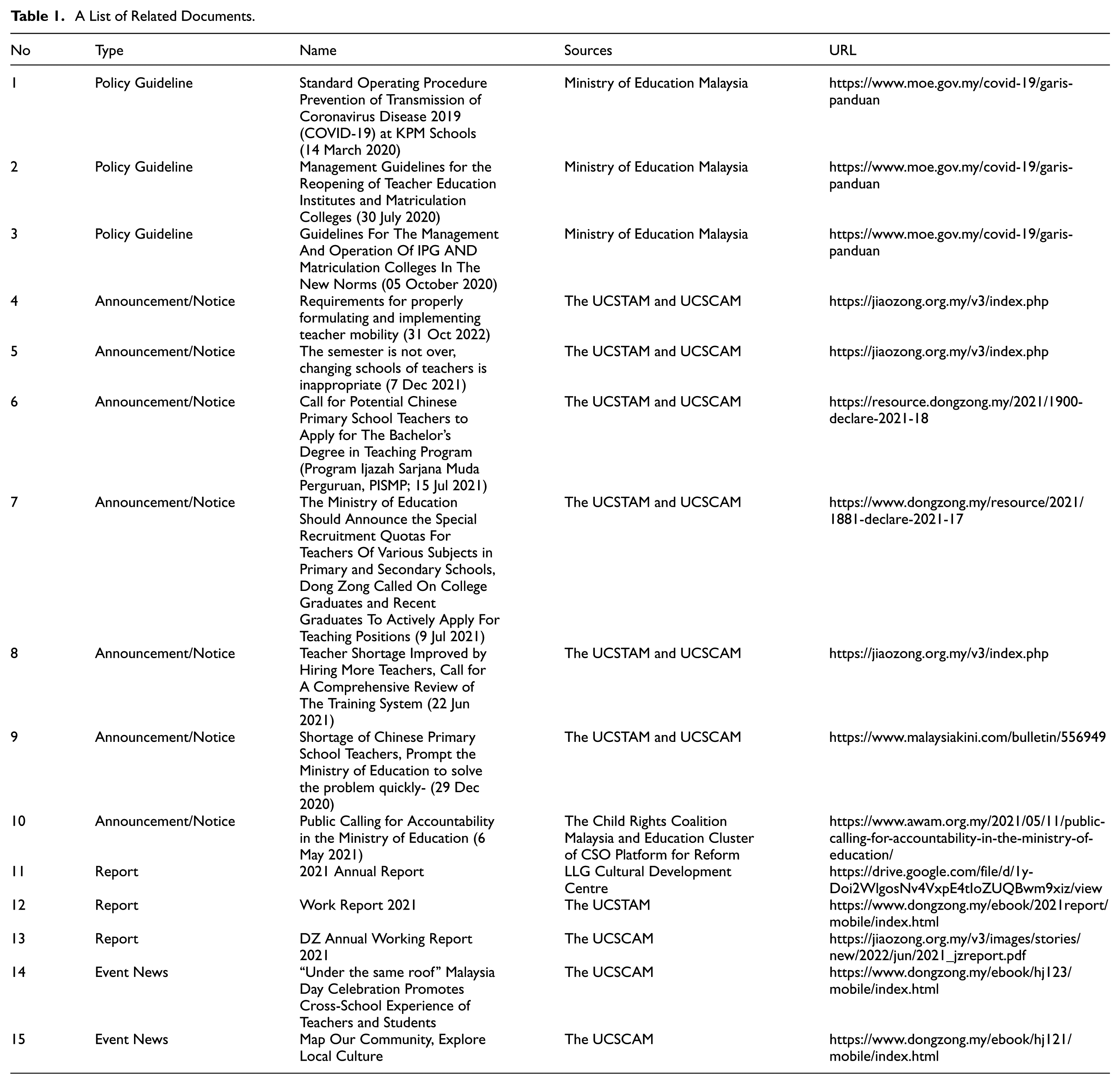
This study employed “teacher education” and “Chinese education” as keywords to search across various sections (e.g., “policy guidelines,”“announcements,” and “reports”) on the three websites, focusing on the period from January 2020 to February 2023 to capture the latest developments related to the pandemic. A total of 31 documents were identified, which were subsequently reviewed to extract content pertinent to the study’s focus. Specifically, their content was analyzed to address the following research questions: (1) challenges faced by teachers in Chinese education during COVID-19 and (2) resources and interventions provided by the government and professional organizations to support these teachers. Ultimately, 15 relevant documents were identified and summarized in Table 1. Representative content was translated from Malay and Chinese into English for data coding and analysis.
A List of Related Documents.
We them applied summative content analysis to examine the relevant data, as this method is particularly effective for analyzing text data and interpreting it through systematic categorization of content, allowing for the identification of themes and patterns (Hsieh & Shannon, 2005; Weber, 1990). During this process, we organized the content into two primary categories: “challenges” and “strategies,” aligning them with our research questions. Within each category, we utilized an inductive approach to allow themes to naturally emerge from the data. Table 2 presents examples of how these categories and themes were coded.
Categories and Examples of Themes Covered.

Findings
The findings reveal that the outbreak of COVID-19 in 2020 disrupted educational development plans and introduced three significant challenges to teacher training and Chinese education in Malaysia: (1) teacher mobility and shortages, (2) qualifications and teaching quality, and (3) the adoption of online teaching as a new model for teacher education (Child Rights Coalition Malaysia and Education Cluster of CSO Platform for Reform, 2021). The corresponding strategies implemented by the government and organizations can be summarized into three categories: (1) official guidelines, (2) private sector initiatives, and (3) overseas support.
Challenges
High Turnover and Insufficient Teacher Numbers
To maintain social distancing, the Ministry of Education discouraged Chinese education schools from implementing a rotating class model (UCSTAM & UCSCAM, 2020). Consequently, most schools opted to retain a full-day schedule while significantly reducing class sizes and increasing the total number of classes to accommodate all students simultaneously (UCSTAM & UCSCAM, 2020). This decision, which scattered students across more classrooms, resulted in a shortage of teachers (UCSTAM & UCSCAM, 2020). The UCSCAM expressed concern that “the shortage of teachers has negatively impacted teaching quality in Chinese schools and severely affected students’ learning rights” (UCSTAM & UCSCAM, 2020). In light of this situation, the UCSCAM urged the Ministry of Education to expedite the assignment of new and temporary teachers (UCSTAM & UCSCAM, 2020).
Unfortunately, there is no evidence that this request was taken seriously or acted upon, as no additional qualified teachers were allocated to support Chinese education institutions. Moreover, some teachers left their positions due to difficulties adapting to online teaching and increased workloads following the pandemic (UCSTAM & UCSCAM, 2021d). One document noted that the government’s approval of teacher transfers occurred without consideration of its implications for the sustainability of Chinese schools or the provision of alternative solutions or support:
The Ministry of Education recently announced the results of teacher transfer applications. Among the 20,772 applicants, 11,469 (55%) were approved, marking the largest number of teacher transfers in history. Considering the welfare of teachers, including prolonged separation from their families or partners, the Ministry of Education approved their transfer applications. (UCSTAM & UCSCAM, 2021d)
This situation presents a dilemma. On one hand, the personal reasons prompting teachers to leave or transfer are understandable and justified. On the other hand, the departure of these teachers has increased the workload for those remaining, complicating the management of normal teaching and learning processes due to insufficient staff (UCSTAM & UCSCAM, 2020).
Unqualified Teachers and Low Teaching Quality
Another related challenge is the quality of teachers and their instructional effectiveness. During the COVID-19 pandemic, in light of teacher shortages in Chinese schools, the Ministry of Education urgently reassigned some teachers to national-type Chinese secondary schools. However, many of these teachers did not meet the qualification requirements for teaching in Chinese schools, with some lacking fluency in Chinese (UCSTAM & UCSCAM, 2022). One document highlights:
It is inappropriate for the Ministry of Education to assign teachers who were originally scheduled to teach National School Chinese Language in elementary schools and Chinese Communication in middle schools to national-type and vernacular middle schools for teaching Chinese. The UCSCAM emphasizes that these teachers lack a background in Chinese language education and do not possess the SPM Chinese language qualifications, making them unsuitable for teaching in Chinese primary and national middle schools. The Ministry of Education’s erroneous allocation of teachers has seriously violated the actual needs of teaching and the spirit of educational professionalism. (UCSTAM & UCSCAM, 2022)
Another document pointed out that many of those dispatched to national-type Chinese secondary schools to teach Chinese Literature were originally qualified only to teach Elementary Chinese and Daily Communication in Chinese at the primary level (UCSTAM, 2021). As a result, the assignment of unqualified teachers to various subjects within Chinese education has severely compromised the quality of both teaching and learning. This situation poses significant challenges for teacher education and the overall reputation of Chinese schools.
Ineffective Online Teacher Education
The COVID-19 pandemic has compelled stakeholders in Chinese education to seek alternative pathways for teacher education development in Malaysia. The pandemic disrupted in-service training for Chinese school teachers and created numerous challenges associated with online teaching. As mentioned, Chinese independent secondary schools operate outside the government system, relying heavily on partnerships with overseas colleges and universities for teacher education resources. During the pandemic, many international study tours and programs were canceled, leading to a shift toward online training courses. For instance, on-site seminars in Taiwan were replaced by online workshops (Taiwan Overseas Chinese Affairs Commission, 2023). However, online teacher education was a novel approach for both teacher interns and educators and remained in an exploratory phase. Review documents indicate that the quality and effectiveness of online training varied and did not adequately meet the diverse needs of teachers (UCSCAM, 2021).
Strategies
Official Guidelines
To address these challenges, the government and organizations related to Chinese education have implemented a series of countermeasures. Since 2020, the Ministry of Education has provided clear instructions for class arrangements based on reports from the Ministry of Health and the World Health Organization (Ministry of Education Malaysia, 2020c). One document states:
The Ministry of Education is continuously monitoring the spread of COVID-19 based on reports issued by the Malaysian Ministry of Health and the World Health Organization. The purpose of these guidelines is to assist school management under the Ministry of Education in implementing measures to control the spread of the disease. (Ministry of Education Malaysia, 2020c)
In particular, to facilitate the swift resumption of the education system, policies were introduced in July 2020 that primarily focused on teachers’ responsibilities and school management (Ministry of Education Malaysia, 2020a, 2020b).
All members of Teacher Education Institutes (IPG) and Matriculation Colleges were required to adhere to the Management Guidelines for the Reopening of Teacher Education Institutes and Matriculation Colleges established by the Ministry of Education Malaysia. The management of IPG and Matriculation Colleges is responsible for implementing safety and hygiene measures and ensuring compliance with social distancing protocols (Ministry of Education Malaysia, 2020b).
Schools and teacher education institutions were also tasked with monitoring students for symptoms, reporting them to relevant authorities, promoting hygiene practices, and standardizing the use of masks. This clearly positioned teachers as guardians of students’ health and safety during the pandemic, further increasing their workload.
In July 2020, Chinese schools in Malaysia began preparations for class resumption in accordance with government directives, strictly following the standard operating procedures for pandemic prevention established by the Ministry of Education, and developing a model for resuming classes (UCSCAM, 2021). The Ministry of Education initially stipulated that class sizes should be limited to 20 students. Consequently, many large Chinese primary schools opted for a rotating attendance system due to insufficient classroom space, a practice that continued until mid-2022. As of 2023, all schools have returned to in-person instruction; however, this transition has proven more challenging to sustain than pre-pandemic operations, primarily due to the loss of many teachers.
To address the teacher shortage, the Institute of Teacher Education Malaysia, responsible for teacher recruitment under the Ministry of Education, began recruiting students for the Bachelor of Teaching Program in March 2021 (UCSTAM, 2021). However, following the initial enrollment period, primary school teacher positions remained unfilled, necessitating a second round of recruitment in July 2021. Even today, the shortage of teachers remains a significant issue, and the government’s collaboration with non-governmental organizations (e.g., UCSTAM) to recruit teachers and encourage qualified candidates to participate in pre-service training for Chinese primary schools has been largely ineffective (UCSTAM, 2021;UCSTAM & UCSCAM, 2021a, 2021b, 2021c).
In summary, while official guidelines address some challenges posed by COVID-19, their effectiveness remains questionable. Furthermore, many issues related to teaching and teacher education in Chinese schools, such as addressing the diverse needs of students impacted by COVID-19, have been relatively overlooked in these official guidelines. Additionally, because most Chinese schools lack recognition within the government education system, the review materials reveal a notable absence of direct government support for teachers in these institutions. Consequently, teachers have had to rely heavily on support from other stakeholders, including private organizations.
Private Sector Initiatives
As previously mentioned, UCSTAM and UCSCAM are two major non-governmental organizations dedicated to advancing Chinese education and facilitating communication with government entities. Since the 21st century, these organizations have significantly contributed to the professional development of Chinese teachers through various courses, including the “Professional Diploma in Education” offered by UCSCAM and New Era College. However, the pandemic necessitated a shift to online delivery for these courses, which resulted in a decline in quality as many teachers were unaccustomed to online learning (UCSCAM, 2021). Consequently, since 2020, these organizations have increasingly focused on providing support for teachers in adapting to online instruction. For instance, UCSCAM established an “Online Teaching Group” to assist Chinese independent school teachers in transitioning to online teaching and created a digital platform to convert teaching-related textbooks into e-books (UCSCAM, 2021).
Additionally, online training courses have been organized to facilitate continued professional development for Chinese independent school teachers. According to the 2021 Work Report, UCSCAM conducted 13 domestic online training courses from February to October 2021, with participation from 3,121 teachers (UCSCAM, 2021). Simultaneously, UCSTAM launched a communication platform called “Cloud Classroom” in June 2020, enabling teachers of Chinese primary schools to share educational experiences and learn from one another (UCSTAM, 2021). UCSTAM also encouraged teachers to utilize platforms such as Zoom or Voov for exchanging ideas about teaching methodologies, including problem-based learning (UCSTAM, 2021). Moreover, numerous online lectures and forums were conducted during the pandemic, including training sessions for novice teachers, subject-specific seminars, and workshops on teaching design and methodology for all educators (UCSCAM, 2021).
Unfortunately, the reviewed documents did not provide insights into the effectiveness of these efforts in helping teachers adapt to online teaching, likely due to the temporary nature of these initiatives, which lasted approximately 2 years. Following the easing of pandemic restrictions in 2023, some in-person teacher education activities have resumed. For example, workshops, photography contests, and other events have been reinstituted to enhance teachers’ understanding of the Chinese community’s role within the nation and to improve their knowledge, skills, and values regarding teaching students from diverse backgrounds (UCSCAM, 2022b). One document noted:
The UCSCAM utilized the theme of “Under the Same Roof” during the Malaysia Day celebration to organize a series of activities, including an essay collection, a photography competition, and a “My Pen Pal Exchange Program.” These initiatives aim to showcase Malaysia’s multicultural nature and remind teachers and the public of the importance of understanding cultural differences and maintaining multicultural values. (UCSCAM, 2022b)
These activities also sought to encourage teachers in Chinese schools to engage with their local communities and enhance their awareness of the current status and mission of Chinese education (UCSCAM, 2022a). As stated in one document:
Place-based learning emphasizes outdoor education, advocating for the use of local communities and environments as foundational elements for curriculum and teaching. This approach strengthens the connection between schools and communities, fostering students’ civic engagement and participation in community activities. To encourage teachers to integrate community involvement into their daily teaching, UCSCAM organized a “Cultural Mapping - Community Education Workshop,” which was open to 27 Chinese independent school teachers, allowing them to develop innovative teaching models and experience the value of cross-ethnic-and-cultural communication. (UCSCAM, 2022a)
Overseas Support
During the pandemic, Chinese education in Malaysia benefited from support from overseas institutions, particularly universities and colleges in mainland China and Taiwan. These institutions provided assistance in setting up online workshops and “Global Chinese Network” live classes, which were well-received by Malaysian teachers (Taiwan Overseas Chinese Affairs Commission, 2023; UCSCAM, 2021). These workshops and classes aimed to equip Chinese language teachers with the latest digital teaching concepts, methods, skills, and trends, thereby enhancing their ability to effectively teach Chinese online. Some workshop-style courses also focused on helping teachers improve their physical and mental well-being and reduce stress during the pandemic (UCSTAM, 2021). One document described the content of the online workshop for Chinese teachers, stating:
The course encompasses various teaching skills and theories relevant to Chinese education, as well as cultural classes (e.g., tea art, folk song appreciation) designed to cultivate teachers’ temperaments, alleviate stress, and encourage the integration of Chinese culture into their personal and professional lives. (UCSTAM, 2021, p. 54)
In addition, overseas institutions developed online platforms and audio-visual resources (UCSTAM, 2021). The online teaching videos available on these platforms can be accessed by teachers in Chinese schools across Malaysia at their convenience, facilitating ongoing self-improvement.
However, the support provided by overseas institutions primarily originates from Chinese-speaking regions (i.e., mainland China and Taiwan), which presents several limitations: some content does not align with the Malaysian context; teacher education resources tend to focus more on mastering Chinese language skills and promoting Chinese culture; and support is largely centered on in-service training for teachers. Consequently, the localization of overseas support remains limited, resulting in unequal access to resources among teachers of different subjects in Chinese education: teachers of Chinese language, mathematics, and science often benefit more than those teaching English and Malay.
Discussion
Our findings indicate that since the onset of the COVID-19 pandemic, teachers in Malaysian Chinese education schools have faced significant challenges but have received only limited and indirect support from the government. While local professional organizations and overseas entities have provided some assistance, these efforts have not effectively addressed the underlying challenges. Issues such as teacher shortages, unqualified educators, and low teaching quality persist. Given that the pandemic has become the new normal and has profoundly impacted the traditional model of Chinese education in Malaysia, the marginalized status of Chinese education and its teachers has left them vulnerable.
Currently, the development of Chinese education in Malaysia appears to have reached a state of stagnation, becoming an issue primarily confined to the Malaysian Chinese community and increasingly isolated from the broader educational system. Although the Malaysian government promotes the value of diversity, this commitment often remains superficial and abstract. This is problematic because Chinese education in Malaysia is not merely a vehicle for language learning; it serves as a critical avenue for cultural preservation and the assertion of equal educational rights for various ethnic groups. Our findings reveal that Chinese education and teacher training in Malaysia during the pandemic heavily rely on the Chinese community and receive minimal government support, which contradicts the government’s stated commitment to valuing diversity and supporting different communities within the nation.
To revitalize Chinese education and its teacher training, we argue that the government must provide more direct and concrete support, recognizing that the Chinese community is an integral part of the nation with educational rights protected by national law. Additionally, professional organizations should place greater emphasis on addressing the diverse needs of teachers in Chinese schools. Furthermore, it is crucial to foster substantial collaboration between the government and professional organizations in the development of Chinese education, as this initiative cannot and should not be solely managed by the Chinese community. These recommendations are grounded in our findings and are consistent with the commitments of both the government and professional organizations to value and uphold diversity.
The limitations of this study include that it did not have space to explore how the COVID-19 pandemic has influenced teachers’ perceptions of Chinese education or how the situation may differ in other countries, such as Singapore. Future research should be encouraged to investigate these issues in detail and from a comparative perspective.
This article contributes to the existing literature on Chinese education in Malaysia and the broader field of multicultural education. By providing a detailed examination of the challenges faced by Chinese educational institutions during the COVID-19 pandemic, it enriches our understanding of how global crises impact localized educational practices in multi-ethnic societies. The study offers a Malaysian perspective that explores the intersection of cultural identity, educational policy, and teacher training, thereby paving the way for future comparative research between Chinese education in Malaysia and similar contexts, such as Singapore. Additionally, the findings highlight critical gaps in current educational policies regarding minority language education, underscoring the need for reform and development in educational systems that support cultural diversity.
In practical terms, the article offers valuable guidance for educators, administrators, and policymakers. It presents actionable recommendations aimed at navigating the unique challenges posed by the pandemic, thereby enhancing the quality of teaching and learning in Chinese schools. By identifying the professional development needs of teachers, the study provides a reference for designing targeted training programs that can be effectively implemented by educational organizations. Furthermore, the findings advocate for improved resource allocation strategies and stronger governmental support for minority language education, which can empower schools to operate more effectively during crises.
Conclusion
This study sought to unravel the complex landscape of teacher development within Malaysian Chinese education during the unprecedented disruptions wrought by the COVID-19 pandemic. By situating our investigation at the intersection of policy directives and professional practice, we have illuminated not only the acute challenges that surfaced in this period but also the persistent vulnerabilities that have long shaped this educational sector.
The pandemic accentuated ongoing issues (most notably, teacher shortages and high turnover) while further exposing the mismatch between teachers’ academic backgrounds and the demands of their teaching assignments in Chinese schools. Although government policy interventions during the crisis aimed primarily at operational continuity, our analysis suggests that these measures failed to address the deeper and more systemic needs of the teaching workforce, particularly in terms of discipline-specific professional development and long-term retention.
At the same time, non-governmental organizations and partnerships, especially those with overseas institutions, responded swiftly with online training and digital resources. However, these initiatives often did not sufficiently account for the unique curricular and cultural context of Malaysian Chinese education, leading to gaps in relevance and equity among teachers of different subjects. The result has been a growing reliance on community-driven efforts to support teacher development, revealing both the resilience of local actors and the limitations of broader policy frameworks.
Reflecting upon these findings, it becomes evident that the fate of Malaysian Chinese education hinges not only on safeguarding cultural heritage but also on cultivating robust, context-sensitive systems to enable teachers to thrive. The crisis has underscored the urgent need for collaborative, targeted strategies between governmental bodies, professional organizations, and the communities they serve. Rather than viewing these challenges as discrete episodes, policymakers and stakeholders must recognize them as part of a larger continuum that requires sustained attention and adaptation.
Ultimately, this study highlights the crucial importance of investing in tailored teacher development programs and fostering meaningful policy innovation. In doing so, it aims to contribute to a wider dialog about educational equity in multilingual societies, and to encourage future research that centers the lived experiences and aspirations of teachers navigating the evolving terrain of minority education.
Footnotes

Ethics and Informed
The authors report that these considerations were not relevant for this study.
Consent Statements
The authors report that these considerations were not relevant for this study.
Funding
The authors disclosed receipt of the following financial support for the research, authorship, and/or publication of this article: This work was supported by the [University Grants Committee (Hong Kong) Early Career Scheme] under Grant [number 28600524], and [National Office for Philosophy and Social Sciences Youth Project] under Grant [number CAA220305].
Declaration of Conflicting Interests
The authors declared no potential conflicts of interest with respect to the research, authorship, and/or publication of this article.
Data Availability Statement
Data sharing not applicable to this article as no datasets were generated or analyzed during the current study.