



Abstract
Emotion plays important roles in learning, memory, and other cognitive processes; it does so not only in the form of macro-level emotion (e.g., salient affective states and self-reportable motivational currents) but also in the form of micro-level emotion (e.g., subtle feelings and linguistic attributes that are usually processed subconsciously without special attention). According to the Emotion-Involved Processing Hypothesis (EIPH), processing that draws attention to emotional aspects (EmInvProc+) is postulated as a deeper version of semantic processing which has cognitive advantage to facilitate linguistic processing and retention more than non-emotional semantic processing (EmInvProc−). This study empirically investigated whether the EIPH can be experimentally corroborated for learners of a distant foreign language (viz., Japanese learners of English). In the experiment, participants processed visually presented English words that were either positively or negatively valenced under different conditions, followed by the test session in which they engaged in memory tests. Two processing modes were compared (EmInvProc+ vs. EmInvProc−). The dependent variables were correct recall frequency, correct recognition frequency, and correct recognition reaction time. It was revealed that EmInvProc+ was more cognitively facilitatory in making stronger foreign language lexical memory traces than EmInvProc− for all the measures employed in the experiment, regarding both accuracy (correct response frequency) and fluency (correct response reaction time). Therefore, it is implied that EmInvProc+ can be regarded as a sui generis deeper level of processing that is qualitatively distinguishable from mere semantic processing, supporting the Emotion-Involved Processing Hypothesis.
Keywords
Introduction
“We need emotional content . . . Don’t think. Feel! It’s like a finger pointing away to the moon. Don’t concentrate on the finger, or you will miss all the heavenly glory” (Chow et al., 1973). If you focus only on the finger―what can be thought―you are missing the moon and the heavenly glory, which is achievable only through what can only be felt. As if to echo with this spirit of kung fu quoted from the famous film Enter the dragon, the importance of transcending mere thinking (i.e., cognition) to reach the direct whole-bodily feeling (i.e., emotion) has been recognized not only by martial artists and athletes but also by philosophers, scientific researchers, and educators. Traditional Cartesian dichotomy to prioritize cognition over body/emotion has already been overcome by organic philosophers such as Alfred North Whitehead, Henri Bergson, and early pragmatists including Charles Sanders Peirce, William James, and John Dewey (cf. Kanazawa, 2019d for review). These philosophical insights to acknowledge the fundamental role of emotion in cognition have been corroborated by scientists of multidisciplinary fields such as physics, sociobiology, psychopathology, cognitive science, neurobiology, educational psychology, neurology, behavioral economics, kansei engineering, developmental psychology, evolution science, and artificial intelligence, to name only a few (cf. Kanazawa, 2019b for review). Cognition and emotion are an evolutionary continuum rather than distinctively separate entities. Moreover, emotion is no more an inferior part of human psyche than higher cognition is. Furthermore, emotion does not necessarily inhibit and distract cognitive processes but can energize cognition when harnessed optimally. As theories suggest, it is emotion that regulates cognitive processing (Storbeck & Clore, 2007).
Echoing with the rise of affectivism in academia (Dukes et al., 2021), the fields of applied linguistics, second language acquisition (SLA), and psychology of foreign language learning have recently seen the affective turn (Pavlenko, 2013), making emotion as an outstanding keyword of inquiry (Dewaele, 2011; Swain, 2013; Sharwood Smith & Truscott, 2014; White, 2018). 2 Studies on EmAL (pronounced as /ɪmάːl/; Emotion in Applied Linguistics; cf. Kanazawa, 2020c, p. 97) has been enlarged and enriched by various theories and findings such as emotional intelligence (Kanazawa, 2019e; Dewaele et al., 2008; Salovey & Mayer, 1990e), flow (Csikszentmihalyi, 1990; Dörnyei et al., 2016), and positive psychology (Kanazawa, 2019a; Oxford, 2016; Seligman & Csikszentmihalyi, 2000a). One of the fields that EmAL perspectives should enable further progress is vocabulary studies (emotion in applied linguistics–vocabulary [EmAL-VOC]), in which both lexicon studies (e.g., Dewaele & Pavlenko, 2002) and acquisition studies (e.g., Schütze, 2017) can be located. Studying EmAL-VOC requires a researcher to delve deeper into micro-level emotion (Kanazawa, 2016c), that is, subtle and elusive types of emotion that are often not salient enough for narrative self-reporting. It includes whether the meaning of each word is positive, non-emotional, or negative (lexical valence) and whether the semantic processing requires activation of emotional structure in the cognitive architecture (processing mode).
Lexical Valence: Passive-Static EmAL-VOC Study
A notable perspective from the interconnectedness of cognition and emotion in EmAL-VOC is that emotion can energize cognition and facilitate learning, retention, memory, and acquisition when harnessed well. This is an established phenomenon known under such names as emotionally enhanced memory (Talmi et al., 2007) and affective input enhancement (Truscott, 2015). Kanazawa (2016c) experimentally investigated whether different conditions of lexical valence (positive words vs. neutral words vs. negative words) result in different incidental recall lexical retention when the initial encoding was a semantic processing (valence decision task). It was revealed that positive words were learnt significantly better than negative words and marginally better than neutral words under semantic processing—a positive psychological finding synchronous with previous foreign language vocabulary memory studies (e.g., Ayçiçeği & Harris, 2004; Ayçiçegi-Dinn & Caldwell-Harris, 2009). Previous psycholinguistic experimental studies have shown that the (non)emotionality of each lexical item and how the items were processed have different impact on the subsequent vocabulary learning, indicating lexical valence as an important factor to consider for a vocabulary study (Ferré, 2003).
Processing Mode: Pragmaticistic Turn Toward Active-Dynamic EmAL-VOC Study 3
The investigation in many of the previous studies was mainly about the different effects of lexical emotional valence in lexical processing and retention. In view of the fact that lexical valence is a pre-established micro-level emotion which is to be semantically accessed and retrieved, lexical valence can be interpreted as a relatively static kind of emotion which is passive in nature. However, educational development is a dynamic process, and thus, micro-developmental perspectives are called for to understand and study emotion better in the context of education (Immordino-Yang, 2010). After all, as Barrett (2017) eloquently states, “emotions are not reactions to the world. You are not a passive receiver of sensory input but an active constructor of your emotions” (Barrett, 2017, p. 31). Although investigating the relatively static lexical valence that is accessed and activated passively and the processing depth in more detail by utilizing varied experimental paradigms and neurophysiological measures would be interesting and desirable as a theoretical and psycholinguistic study (i.e., language science), the effort and research resource needed to proceed to such psycholinguistic investigation could also be used otherwise for higher pragmaticistic value, namely, to aim to meet the emotional design of research (cf. Kanazawa, 2020b) and to be more pedagogically implicative and educationally practical (i.e., language education). What is needed for a better theoretical contribution to EmAL is an understanding of how micro-level emotion can contribute to the acquisition of new language in an active-dynamic manner. Therefore, micro-level emotion on the active-dynamic side of vocabulary learning and vocabulary acquisition (i.e., input processing) is worth further investigation than passive-static lexical valence per se from the perspective of language education.
Here, instead of delving deeper into the psycholinguistic theoretical profundity and intricacy, which would require much more time and rigorous experimental studies to reach a satisfactorily comprehensive conclusion, the pragmaticistic turn is attempted, proceeding to the investigation into processing mode: the Emotion-Involved Processing Hypothesis (EIPH; Kanazawa, 2018, Kanazawa, 2020b; Kanazawa, 2020c; Kawasaki et al., 2018; Figure 1). 4
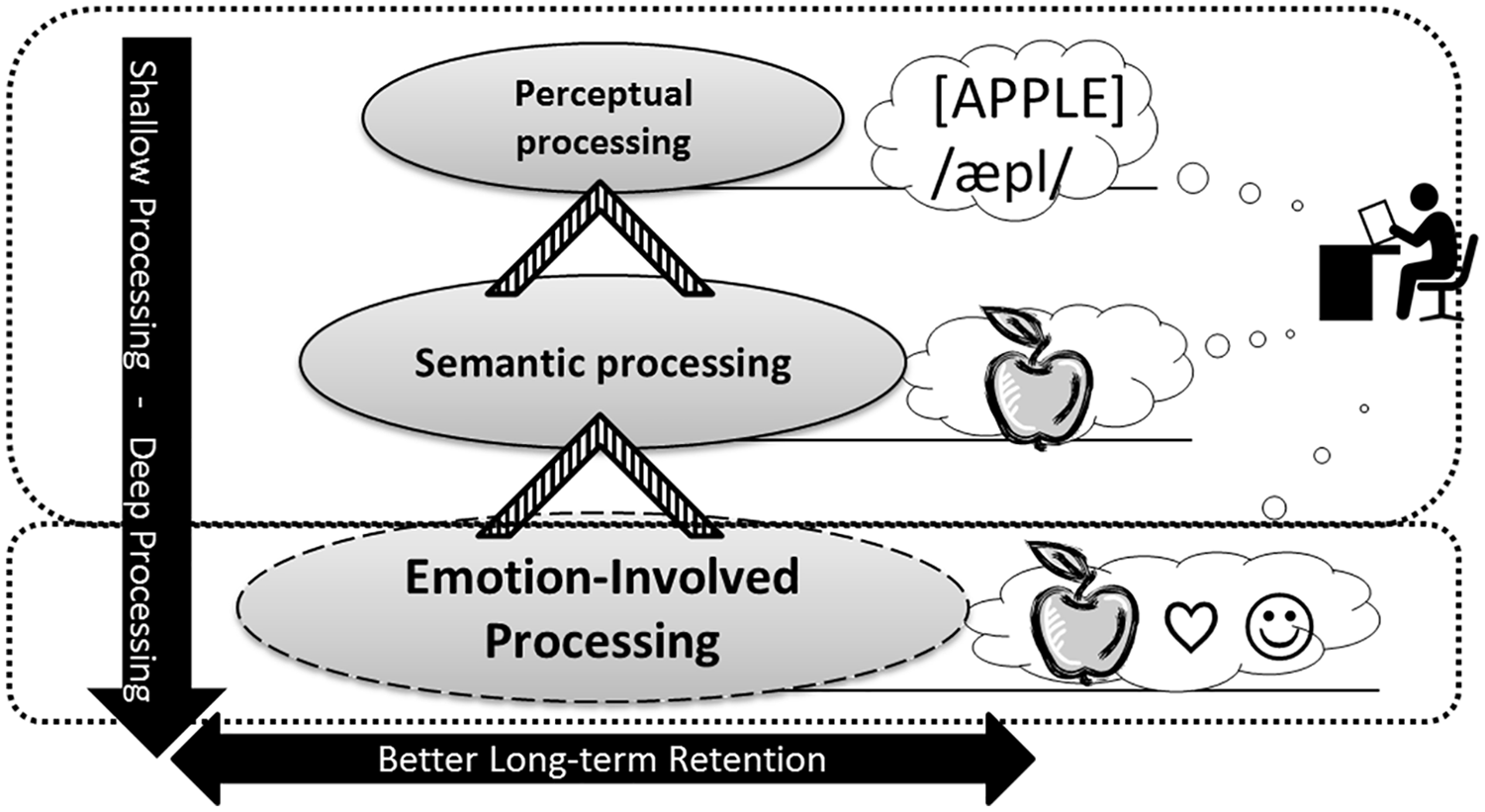
Emotion-Involved Processing Hypothesis (EIPH); in which Emotion-Involved Processing is hypothesized to be an even deeper level of processing (Craik & Lockhart, 1972) than semantic processing, resulting in better long-term retention.
This article concerns the pragmaticistic issue that is more implicative to the educational practice and pedagogy: is the Emotion-Involved Processing an effective processing for vocabulary learning compared with non-emotional semantic processing, as is hypothesized in the EIPH?
Previous Experimental Studies—Manipulating the Levels of Processing (LoP)
There are relevant cognitive psychological experimental studies that are implicative in designing the methodology for this study. An established task widely used in the study of emotion in language learning and processing is the lexical decision task, in which participants judge whether the presenter word is a word or a nonword (e.g., Kousta et al., 2009). Lexical decision task is also useful for the sake of applying behavioral study to neuroscientific and psychophysiological studies, utilizing such tools as electroencephalography and functional magnetic resonance imaging to collect rich data both online and off-line to delve deeper into the neural mechanism and substrates behind emotion processing (e.g., Kuchinke et al., 2005; Vigliocco et al., 2014).
Another effective experimental paradigm is the manipulation of the levels of processing (LoP) conditions in the study session. For example, Ferré (2003) tested whether positive or negative words are remembered better than neutral words while adopting encoding tasks differing in the LoP—shallow/perceptual processing (counting the number of vowels) and deep/semantic processing (rating the level of emotionality). It was revealed that the negativity effect was observed only in the deep processing condition, whereas positive words were recalled more than other words in both encoding conditions. Reber et al. (1994) utilized different LoP tasks (focusing on vowels, image, or emotional feelings), finding that emotionally neutral words were in fact recalled better or the same as for emotional words under deep processing conditions. These studies suggest whether and how different valences affect at the level of deep processing is a controversial issue with opposing empirical evidence (cf. Kanazawa, 2016c; Kanazawa, 2020a for review). It is also notable that most previous studies in this field compare shallow versus deep LoP. In view of the EIPH, the new hypothesis explained in the previous section (cf. Kanazawa, 2020b for philosophical and cross-disciplinary review), comparison between different deep processing modes (viz., emotion-involved vs. non-emotion-involved) may well be the main research purpose, which is one of the originalities of this study.
Jay et al. (2008) reported that emotional words facilitated memory in the deep processing condition while the effect was absent in the shallow processing condition. One thing to be noted in their study, however, is that both positive and negative words were in the same group of emotional words; thus, it is likely that each valence worked differently, resulting in no effect detected as the category of emotional words itself. It is therefore desirable to compare differently valenced words (positive vs. negative) for future studies.
Manipulation of the LoP conditions is utilized for foreign language studies as well. A study targeted to Turkish users of English as a foreign language by Ayçiçegi-Dinn and Caldwell-Harris (2009) utilized a shallow processing task and three types of deep processing tasks, followed by an incidental recall test. The result corroborated the superiority of positive words over non-emotional words and negative words on lexical memory. Another study targeted at highly proficient Catalan–Spanish bilinguals by Ferré et al. (2013) investigated whether emotional words were better remembered than neutral words with varied conditions of shallow processing (vowel counting) and deep processing (concreteness rating). It was revealed that positive words showed a higher recall than neutral words, regardless of processing modes and languages. Conrad et al.’s (2011) lexical decision experiment revealed that positively valenced words were processed faster for both first language speakers (German or Spanish) and second language speakers (Spanish or German). As the examples above indicate, most previous foreign language studies utilize two languages that are linguistically close with each other (viz., Indo-European languages). There are few studies examining the foreign language effect between languages that are distant with each other—the prominent example being English for Japanese speakers, the languages that are linguistically the farthest with each other (Nishikawa-Van Eester, 2016; Kanazawa, 2021b).
Objectives and Hypotheses
The main purpose of the study was to investigate whether the deep/semantic processing which intrinsically induces dynamic micro-level emotional reference (i.e., Emotion-Involved Processing; EmInvProc+) had a cognitive benefit on incidental foreign language lexical memory compared with semantic processing devoid of emotion (EmInvProc−) for users of a distant foreign language under the laboratory setting. The subsidiary purpose of the study was to confirm whether positive lexical valence (valence+) had a cognitive benefit on incidental foreign language lexical memory compared with negative lexical valence (valence−). Based on the Deep Positivity Hypothesis (Kanazawa, 2020a; Kanazawa, 2020d) 5 and the findings of previous experiments, it was expected that valence+ had cognitive advantage compared with valence− in deep/semantic processing. The recognition test was implemented for this experiment to collect online data for further analysis. Although smaller in number compared with recall tests, recognition tests have been used in both first language and foreign language lexical memory studies (e.g., Ayçiçeği & Harris, 2004). Recognition reaction time (RT) has been used as an online indicator in experimental research on LoP (e.g., Gauer et al., 2014). The research questions were as follows:
Based on the EIPH (Kanazawa, 2020b), the following hypotheses were proposed across the RQs:
Method
Participants
The participants of the experiment were Japanese learners of English, whose native language is linguistically distant from English (N = 32, age: M = 24.08, SD = 9.10; age of acquisition: M = 11.60, SD = 1.96; 17 males and 19 females). They were undergraduate or graduate students whose majors were in the range of humanities. Judging from their reported scores of the TOEIC® test (M = 603.00, SD = 188.86) and the E-Mochizuki Test (Aizawa & Mochizuki, 2010; M = 5,374.00, SD = 511.67), the participants can be regarded as intermediate to advanced level learners of English. The vocabulary size test was used to estimate foreign language proficiency (Kanazawa, 2016b). Informed consent from each participant was assured through the pre-experiment paper-based explanatory instruction of the procedure, and the privacy policy of the experiment and the consent form. The experimental procedure abides by the Kwansei Gakuin University Regulations for Behavioral Research with Human Participants and the American Psychological Association (APA) Ethics Code (Article 8.02; informed consent to research; APA, 2010).
Materials and apparatus
One hundred ninety-two valenced English words were selected from the proto-ANEW-JLE wordlist (Kanazawa, 2016c). The words were highly frequent, which ensured each stimulus to be processed both semantically and fluently. Half of them (n = 96) were used as target stimuli and the other half (n = 96) as recognition distractors at the test session. Ninety-six target words were subdivided into four groups of words (Table 1), two of which consisting of positive words and the other two of negative words. Two groups of identically valenced words were allocated differently to different processing modes at the study session. The pairing of word groups and processing modes was counterbalanced between participants.
Details of Target Word Subdivision.

Note. Values in parentheses are standard deviations. Concreteness and imageability scores are not listed because of the lack of data in several lexical items in the original database (Coltheart, 1981). Foreign language valence scores (English words rated by Japanese speakers) were retrieved from Kanazawa (2016c; very negative = 1, very positive = 4) and first language valence scores (English words rated by native speakers) were retrieved from Bradley and Lang (1999; very negative = 1, very positive = 9). EmInvProc+ = Emotion-Involved Processing, EmInvProc− = Non-Emotion-Involved Semantic Processing.
To reduce the effects of potential interfering variables, it was ensured that there were no significant differences neither among four target word groups nor between target words and recognition distractors for the following lexical attributes: the number of letters, the number of syllables, the British National Corpus (BNC) frequency, the English familiarity rated by Japanese speakers (Yokokawa, 2009), the English familiarity rated by native speakers (Coltheart, 1981), the concreteness (Coltheart, 1981), the imageability (Coltheart, 1981), and the lexical decision latency of native English speakers (Balota et al., 2007). Sixty English nonwords were selected from the ARC Nonword Database (Rastle et al., 2002). To ensure semantic access during lexical decision, all the selected nonwords were legal sequences in English (nonwords with orthographically existing onsets, orthographically existing bodies, and legal bigrams). SuperLab® 5.0 (Heller et al., 2014) was used for stimulus presentation and data collection.
Procedure
The participants took the experiment individually in a laboratory room in which either one or two participants took the tasks either alone or simultaneously. There was no difference between the two conditions of the simultaneity of participants because the room was separated by a partition and neither auditory stimuli nor an oral reading task was included in the present experiment. Followed by a short questionnaire, the tasks were implemented. The tasks can be divided into two sessions: the study session and the test session (Figure 2).

The procedure of the experiment.
The study session consisted of two tasks: Emotion-Involved Semantic Processing Task (EmInvProc+) and Non-Emotion-Involved Semantic Processing Task (EmInvProc−). The emotional valence judgment task and the lexical decision task were implemented for EmInvProc+ and EmInvProc− conditions, respectively. The emotional valence judgment task and the lexical decision task were adopted because they have been compared with each other in relevant previous studies (e.g., Ferré et al., 2018) and both of them are known to require semantic processing even for foreign language users (Barcroft, 2015; Kanazawa, 2016b). 7
The EmInvProc+ task consisted of 48 trials following four practice trials. A trial proceeded in the following flow: (a) “Press Space Key” instruction until any key response, (b) the presentation of “#####” as the fixation point for 500 ms, (c) the presentation of a stimulus at the fixation point up to 4,000 ms, and (d) the blank screen for 1,000 ms. (Figure 3). During Step (c), the participants were instructed to feel the meaning of each presented word and judge whether it had a positive or negative meaning by pressing either the “B” key or “N” key. “B” and “N” keys corresponded to “It is a positive word” and “It is a negative word,” respectively. When either key was pressed, the presented word was erased and it proceeded to Step (d). Because each target word was programmed to be presented for no more than 4,000 ms at the longest, the participants were asked to rate each word precisely and quickly without spending long time contemplating them. After the presentation of every 24 trials, an indicator was presented on the screen on which the remaining percentages of trials were shown. The indicators were presented until the space key was pressed. The aim of the presentation of indicators was to reduce the fatigue effect by letting the participants have a short rest to recover their attentional resources while noticing how much they had progressed.

The flow of a study trial.
The EmInvProc− task consisted of 96 trials following four practice trials. There were twice as many trials as there were in EmInvProc+ because there were nonword distractor stimuli (n = 48) in EmInvProc− task. The flow of an EmInvProc− trial was identical to that of an EmInvProc+ trial except for the instruction at (c). During Step (c), the participants were instructed to think about the meaning of each word and judge whether it was a word or a nonword by pressing either the “B” key or “N” key. “B” and “N” keys corresponded to “Yes, it is a word” and “No, it is not a word,” respectively. When either key was pressed, the presented word was erased, proceeding to Step (d) and the next trial. The trials were randomized each time the program was run, and the order of the study tasks was counterbalanced between participants so as to nullify the primacy effect and the recency effect potentially caused by presentation order.
The test session was preceded by a 3-min break, during which the researcher asked several questions to the participants regarding his or her response to the questionnaire. All the conversation was in the participants’ native language (Japanese, the language distant from English) to avoid any interference with the incidental memory of English words encoded in the study session. The aim of this break was to reduce the recency effect caused by short-term memory. To secure the incidental nature of learning, the contents of the following tests were not informed in advance.
There were two kinds of memory tests in the test session: the paper-based recall test and the computer-based recognition test. The answer sheet of the recall test consisted of two sections: confident section, in which only those words remembered confidently were to be written, and maybe section, in which dubious words were to be written. The recognition test consisted of 192 trials, in which words were visually presented on the screen one word at a time. Half of the words presented (n = 96) were the words which had been presented in the encoding tasks in the study session, while the other 96 words were newly presented words. The participants were instructed to judge whether the presented word was the former (old) or the latter (new) by pressing the “B” key or “N” key, respectively. In the interval of every 10 words, there appeared a screen showing the remaining number of trials to let the participants know how much they had progressed lest the attentional resources should deplete. After the recall and recognition tests, the E-Mochizuki test was implemented to estimate the participants’ vocabulary size.
Data Analysis and Research Design
For the sake of data cleaning, trials with RT beyond or below 2 SD (for both the study tasks and the recognition test) were removed. Two different criteria were adopted to mark the recall test: sensitive scoring and strict scoring (cf. Webb, 2008). For the sensitive scoring, both confident and maybe words were counted, and spelling mistakes were condoned when intelligible while unacceptable morphological deviations were not counted. For the strict scoring, only the words in the confident section were scored and no spelling mistake was condoned. The research design was two factors (2 × 2 levels) within-subject experiment.
The independent variables of the present experiment were four different combinations of valence (+/−) and EmInvProc (+/−) in the study session. The dependent variables were correct recognition frequency, correct recognition RT, and correct recall frequency in the test session. Repeated measures 2 × 2 analysis of variance (ANOVA) was conducted for the statistical analysis on SPSS® Version 23. Post hoc analysis was conducted only when the interaction effect was significant because each factor included only two levels, and thus, the locus of the significant difference in main effect could easily be detected by consulting the descriptive statistics.
Results
The results are explained with respect to each research question. First, the results corresponding to RQ1 are explained. The RQ1 was to investigate what differences there were between (a) EmInvProc+ and EmInvProc−, and (b) valence+ and valence− regarding incidental recognition frequency. The descriptive statistics of correct recognition frequency are shown in Table 2, which is graphed in Figure 4.
Descriptive Statistics of the Effects of EmInvProc and Valence: Correct Recognition Frequency.

Note. Values in parentheses are standard deviations. d’ = Z (hit rate) − Z (false alarm rate); EmInvProc+ = Emotion-Involved Processing, EmInvProc− = Non-Emotion-Involved Semantic Processing, valence+ = positively valenced words, valence− = negatively valenced words.

The mean correct recognition frequency data.
The inferential statistical analysis using repeated measures ANOVA revealed a significant main effect in processing mode, that there was a significant difference between EmInvProc+ and EmInvProc−, F (1, 35) = 15.16, p = .00, partial η2 = .30. However, neither the main effect of valence nor the interaction effect was significant, F (1, 35) = 2.14, p = .15, partial η2 = .06, and F (1, 35) = 0.41, p = .52, partial η2 = .01, respectively.
Second, the results corresponding to RQ2 are explained. The RQ2 was to investigate what differences there were between (a) EmInvProc+ and EmInvProc−, and (b) valence+ and valence− regarding incidental recognition speed. The descriptive statistics of correct recognition RTs are shown in Table 3, which is graphed in Figure 5.
Descriptive Statistics of the Effects of EmInvProc and Valence: Correct Recognition RT (ms).

Note. RT = reaction time; EmInvProc+ = Emotion-Involved Processing; EmInvProc– = Non-Emotion-Involved Semantic Processing; valence+ = positively valenced words; valence− = negatively valenced words.

The mean correct recognition RT (ms) data.
The inferential statistical analysis using repeated measures ANOVA revealed a significant main effect in processing mode, that there was a significant difference between EmInvProc+ and EmInvProc−, F (1, 35) = 5.41, p = .03, partial η2 = .13. The main effect of valence was marginally significant, F (1, 35) = 3.76, p = .06, partial η2 = .10. There was no interaction effect, F (1, 35) = 0.34, p = .57, partial η2 = .01.
Third, the results corresponding to RQ3 are explained. The RQ3 was to investigate what differences there were between (a) EmInvProc+ and EmInvProc−, and (b) valence+ and valence− regarding incidental recall frequency. Separated according to the scoring criteria, the descriptive statistics of correct recall frequency are shown in Table 4 and Table 5, which are graphed in Figure 6 and Figure 7, respectively. The number of recall data is smaller than that of recognition data because of the reason explained in Note 2.
Descriptive Statistics of the Effects of EmInvProc and Valence: Correct Recall Frequency (Strict Scoring).
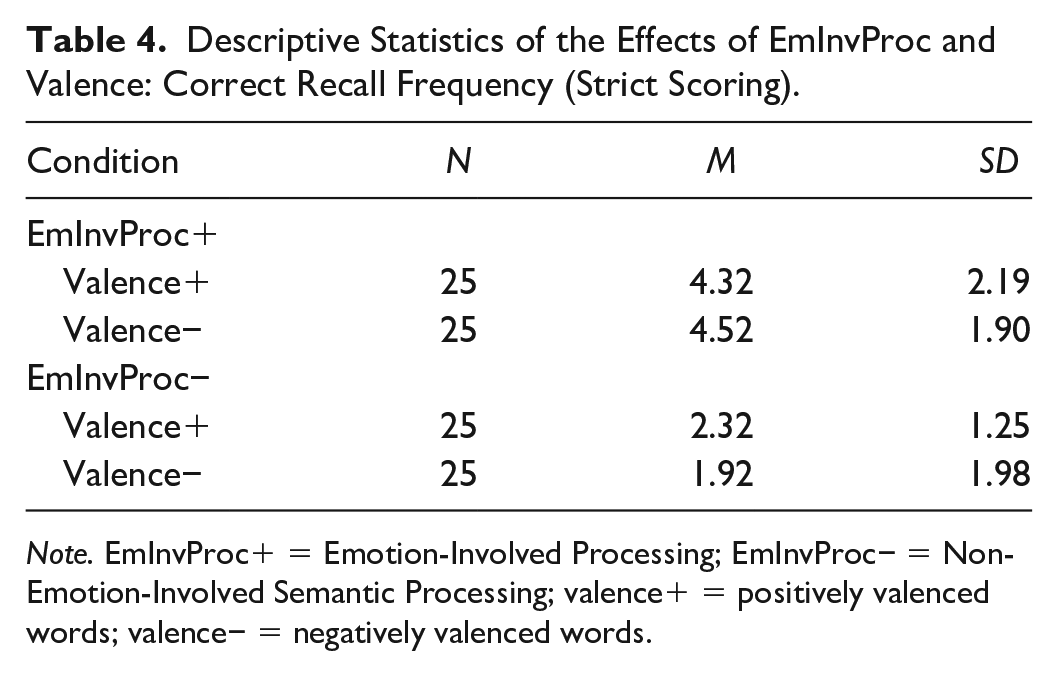
Note. EmInvProc+ = Emotion-Involved Processing; EmInvProc− = Non-Emotion-Involved Semantic Processing; valence+ = positively valenced words; valence− = negatively valenced words.
Descriptive Statistics of the Effects of EmInvProc and Valence: Correct Recall Frequency (Sensitive Scoring).

Note. EmInvProc+ = Emotion-Involved Processing; EmInvProc− = Non-Emotion-Involved Semantic Processing; valence+ = positively valenced words; valence− = negatively valenced words.
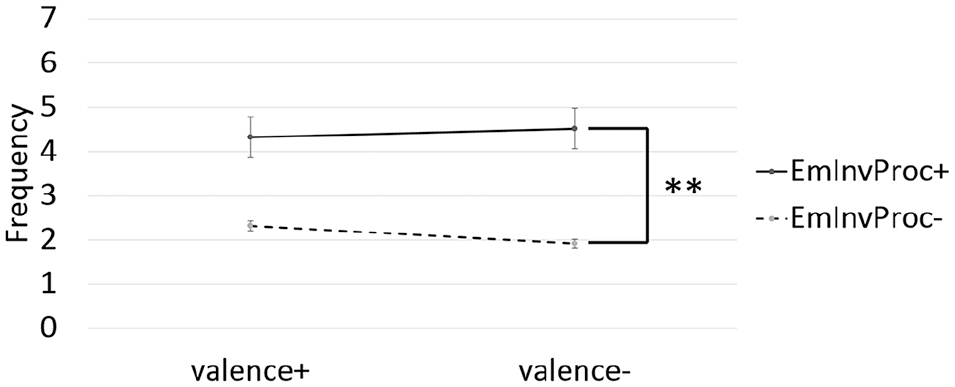
The mean correct recall frequency data (strict scoring).
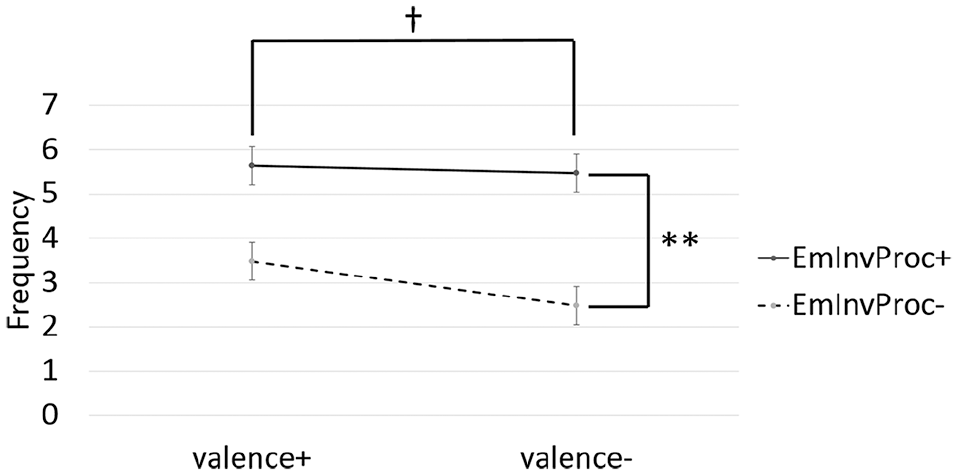
The mean correct recall frequency data (sensitive scoring).
For strict scoring data, the inferential statistical analysis using repeated measures ANOVA revealed a significant main effect in processing mode, that there was a significant difference between EmInvProc+ and EmInvProc−, F (1, 24) = 36.01, p = .00, partial η2 = .60. However, neither the main effect of valence nor the interaction effect was significant, F (1, 24) = 0.14, p = .71, partial η2 = .01, and F (1, 24) = 0.92, p = .35, partial η2 = .04, respectively.
The results of the statistical analysis for sensitive scoring data were consistent with those for strict scoring data. There was a significant main effect in processing mode, indicating a significant difference between EmInvProc+ and EmInvProc−, F (1, 24) = 50.02, p = .00, partial η2 = .68. However, neither the main effect of valence nor the interaction effect was significant, F (1, 24) = 3.11, p = .09, partial η2 = .12, and F (1, 24) = 1.10, p = .30, partial η2 = .04, respectively.
Discussion
Hypothesis 1 of the present experiment was as follows: EmInvProc+ items would result in better performance than EmInvProc− items regarding all incidental recognition frequency, incidental recognition speed, and incidental recall frequency. For Hypothesis 1, it was revealed that EmInvProc+ was more cognitively facilitatory in making stronger foreign language lexical memory traces than non-emotional semantic processing (EmInvProc−) for all the measures employed in the experiment, regarding both accuracy (correct response frequency) and fluency (correct response RT). Therefore, it is implied that EmInvProc+ can be distinguishable from mere semantic processing. The finding has a theoretical implication related to the renowned LoP framework (Craik & Lockhart, 1972), which has had a strong influence on second language acquisition (SLA) theories and practices. 8 As was reviewed in Kanazawa (2020b), the LoP framework postulates that semantic processing is deeper processing which is gifted with the best retentional advantage compared with shallow perceptual processing. The present finding suggests that the Emotion-Involved Processing may well be regarded as a sui generis deeper level of processing that is qualitatively distinguishable from mere semantic processing, supporting the Emotion-Involved Processing Hypothesis.
Hypothesis 2 of the present experiment was as follows: valence+ items would result in better performance than valence− items regarding all incidental recognition frequency, incidental recognition speed, and incidental recall frequency. For Hypothesis 2, positive lexical valence was not significantly found to be more cognitively facilitatory in making stronger foreign language lexical memory traces than negative lexical valence. The result echoes with the fact that previous studies resulted in mixed findings about whether positivity or negativity is facilitatory (cf. “Previous Experimental Studies—Manipulating the Levels of Processing (LoP)” section of this article). Positivity effects and negativity effects are usually reported in comparison with neutral conditions; thus, it can be inferred that such emotion effects may disappear when all the target stimuli are emotional. However, it is still notable that there was a marginal significant advantage of positive lexical valence for recognition speed, which is an online parameter that was not measured in Kanazawa (2016c), where retentional performance had been analyzed solely via off-line data collection.
Limitations and Further Studies
This study is not free from limitations. First, the limited number of participants weakens the generalizability of the research outcome. Collecting more data from a larger number of participants and cohorts is called for in future study. Second, only the lexical decision task was used as the semantic processing task. Although there are many previous studies in favor of utilizing this task and multiple measures were taken to ensure semantic processing in this study (cf. Note 7), it is still to be noted that several studies imply that the lexical decision task may not always guarantee semantic access (Miki, 2014). Introducing more diverse semantic tasks will enable more meticulous analysis as to which types of semantic processing results are deeper. Third, only two conditions were compared about vocabulary valence (viz., positive vs. negative). Although comparison of different edges of valence instead of emotionality (emotional vs. non-emotional) was the design of the study and limiting the number of levels to two will make it easier to apply the design for further neuroscientific studies, the absence of non-emotional stimuli is not ecologically valid, which may well have interfered the results, especially in terms of Hypothesis 2. Future behavioral studies should incorporate three levels of valence (positive, neutral, and negative) to investigate whether the insignificance of positivity effect in this study was due to the lack of neutral stimuli. Fourth, for the retention task, a casual conversation about the participants’ answers in the questionnaire was selected to ensure that the participants move away from the state of individual task concentration by engaging in a casual and naturalistic conversation. Another experiential reason for not selecting a nonverbal laboratory task (such as calculation or visual n-back) was to avoid wearing out participants’ attentional resource (fatigue effect), which could work negatively in the following test session. All the conversation was in Japanese—a language linguistically distant from English—to avoid any interference with the incidental memory of English words encoded in the study session. However, it is true that a nonverbal task that is less cognitively demanding could have been utilized to negate any multilingual interference. Future studies should utilize a nonverbal task for the retention task. Solving and overcoming these limitations will be needed in the further studies, for which this study may well be utilized as a solid stepping stone with its own haecceity (Peirce, 1887-1888/1931, para 1.405).
Conclusion, Pedagogical Implication, and Future Directions
The present EmAL-VOC study revealed that actively charging micro-level subconscious emotion via focusing attention on affective aspects of lexical words surely facilitates retentional cognition, even for users of a distant foreign language. Because a learner can actively select what lexical aspect to pay conscious attention to within the limited cognitive resource and change the target flexibly, the Emotion-Involved Processing can be interpreted as an active-dynamic kind of emotion (cf. Note 21 of Kanazawa, 2020b, p. 201). Therefore, it can be inferred that the active-dynamic Emotion-Involved Processing plays an important role in foreign language vocabulary learning, as same as (or potentially even more so than) the passive-static lexical valence attribute. The finding echoes with the affective neuroscientific notion that educational development is a dynamic process where micro-developmental perspectives are called for to understand and study emotion better (Immordino-Yang, 2010).
Apropos of foreign language pedagogy, the present finding corresponds to and extends Nation’s (2020) remark on the deepest level of attention that favors vocabulary learning – elaboration – by proposing that the Emotion-Involved Processing can be incorporated as an additional criterion for designing and evaluating vocabulary learning materials and activities. The message for educators is clear: do not just have students think about the content, but also make them feel it! Moreover, educational material developers are encouraged to incorporate the emotional boost of cognition into the wordlist and the foreign language vocabulary learning activities, which is one of the author’s ongoing research projects (Kanazawa & Lafleur, 2019).
Last but not least, more diverse methodologies should be integrated, and collaboration with other EmAL researchers ought to be pursued for future study. Namely, the rise of the dynamic system theory perspectives and narrative studies urges quantitative affective researchers to supplement their study with qualitative approaches, one promising direction being mixed methods approaches. In reality, there have been scarce foreign language vocabulary learning or acquisition studies that shed light on emotional perspectives, resulting in a smaller community of relevant researchers. Cognitive psychological EmAL-VOC study, although not very popular so far, will not only broaden the perspectives of emotion researchers with other methodologies and interests but also pave a way for a new direction of quantitative affective research. 9 To borrow Dewaele’s (2019) beautiful metaphor, such a new direction of EmAL-VOC, when its researchers’ community becomes larger, will provide a plethora of new “implications for the garden of theory and practice” (Dewaele, 2019, p. 85).
Footnotes
Declaration of Conflicting Interests
The author declared no potential conflicts of interest with respect to the research, authorship, and/or publication of this article.
Funding

An Ethics Statement for Animal and Human Studies
Approval and support by Kwansei Gakuin University’s relevant faculty members were given. Experiments were conducted abiding by the Kwansei Gakuin University Regulations for Behavioral Research with Human Participants. This study abides by the American Psychological Association (APA) Ethics Code (Article 8.02; informed consent to research; APA, 2010).