



Abstract
In this study, we analyze the state of information warfare on Twittersphere between India and Pakistan in the wake of Pulwama attack in Kashmir region and the subsequent surgical strikes by Indian forces inside Pakistan. We selected two leading Twitter hashtags on the conflict from the two countries each. A total of 20,000 tweets were manually analyzed. Contrary to the existing scholarship on digital information warfare, we found citizens from both countries produced most of the content. Among the citizens, those Twitter handles that showed affiliations with the heads of governments that we consider as trolls were the leading contributors. Moreover, the study found that contributors from the two countries mainly posted on their own hashtags and did not engage in counter-arguments with the contributors from other country. This resulted in overwhelming support for the two countries in their own assorted hashtags and outright criticism in the hashtags originating from the other country.
Introduction
Digital information warfare between Russia and her Western rivals has attracted a lot of academic attention in the past few years. One can find dozens of research articles and books on the subject (Giles, 2016; Keller & Klinger, 2019; Woolley & Howard, 2017). These studies mainly discuss the alleged Russia’s online propaganda during the Ukrainian conflict (Hoskins & Shchelin, 2018) and online disinformation campaigns during elections in the United States and other European countries (Hoskins & O’Loughlin, 2015; Lucas & Nimmo, 2015; Ramsay & Robertshaw, 2018). Although there is no solid evidence of how these digital campaigns actually influenced public opinion, researchers believe the sheer frequency of content on social media platforms created confusion and disorder among the people (Woolley & Howard, 2018). Others cite the success of pro-Trump and pro-Brexit campaigns as an evidence of social media having been able to influence public opinion to some extent (Bastos & Mercea, 2017; Freelon & Wells, 2020; Howard et al., 2016).
While making a departure from the spotlight on Russia’s information war on West and her neighboring countries, in this study, we are investigating the digital warfare between the two nuclear archrivals—India and Pakistan. The two countries have been actively engaged in information warfare practices for the past few decades (Seth, 2016). However, so far, academic work in this context has been done on the traditional media (Iqbal & Hussain, 2018; Seth, 2016) and the active cyberspace war arena remains unexplored so far. Neyazi (2019), in a seminal study, analyzed the computerized propaganda unleashed by India during conflicts with Pakistan, but no such study exists in the Pakistani context. An empirical comparative investigation would help analyze the extent and direction of digital information warfare in the Indian subcontinent.
This is worth examination because the two countries having a combined population of 1.5 billion people have seen massive penetration of social media in the past two decades. In India, more than 600 million people have access to internet. Similarly in Pakistan, more than 76 million citizens having access to internet, thus making it the 10th largest population of internet users in the world (Pakistan Telecommunication Authority, 2019). The Indian Prime Minister Narendra Modi has about 60 million followers on Twitter while his Pakistani counterpart Imran Khan has over 10 million followers on Twitter. According to Twitter audit (www.twitteraudit.com), which classifies followers based on their quality, 18% of Narendra Modi following is fake while Imran Khan has 14% fake followers. Similarly, Pakistani military spokesperson has 3.9 million followers with 15% fake followers while his Indian counterpart has 6.6 million followers with 28% fake followers. Although it is contestable whether these people have created the fake followers or the bots following them because of their popularity (Neyazi, 2019), the sheer reach and expanse of these accounts is phenomenal.
Due to cheap human resource in the region, both the governments and their militaries have engaged paid social media armies consisting of thousands of employees for propaganda purposes (Cheema, 2020; Jorgic & Pal, 2019). Many observers and commentators have pointed to the jingoistic role of these online trolls in the recent conflicts (Biswas, 2019; Chawla, 2020; Sriram, 2019). While borrowing from the relevant scholarship, in this study, we analyze the digital information warfare between India and Pakistan during the Pulwama attack (February 14, 2019) in the Indian-administered Kashmir and the subsequent surgical strikes by Indian forces in Pakistani territory (February 26, 2019) in which an Indian pilot was captured. Before discussing these events, a brief account of the 73-year-old tumultuous history of Indo-Pak relations is presented for a better perspective on this study.
Relations Between India and Pakistan
Both India and Pakistan got independence from the British Empire in 1947. However, soon after independence, the two countries were at loggerheads over the annexation of princely state of Jammu and Kashmir (Qadir, 2002). Pakistan referred to the independence accord in which all the Muslim states were to be part of Pakistan and Hindu states to be part of India. Kashmir being predominantly a Muslim state had to be included in Pakistan. Indian government, on the other side, maintained that the Hindu ruler of Kashmir had acceded to India and there was no need of plebiscite. This led to the first Indo-Pak war that broke out in 1948 in which Kashmir was divided into two parts—the Pakistani-administered Kashmir and Indian-administered Kashmir.
However, this division could not satisfy either of the states and, in 1965, another major war erupted between the two countries. The war ended after a peace truce in which they agreed to resolve their bilateral issues (Oh et al., 2011). In 1971, a third war started between them, which led to the dismemberment of Pakistan—Bangladesh emerged as a free state, which was earlier part of Pakistan (Iqbal & Hussain, 2018).
From 1970s onward, an arms race started between the two countries where they invested heavily in missile and nuclear technologies. In the later part of 1990s, they detonated atomic bombs and got the status of nuclear-capable countries. But even the nuclear deterrence did not completely work and, in 1999, the two countries were engaged in the fourth war commonly known as Kargil War. However, this war was limited to the Kashmir region and did not escalate to other parts due to pressure from international community (Rabasa et al., 2009).
Alongside these four major wars, in the past two decades a number of major escalations have occurred. Attacks on the Indian parliament in 2001, Mumbai attack in 2008, and Uri attack in 2016 are the major deadly events in which India accused Pakistan for hobnobbing with the militants (Mathur, 2017). Similarly, Pakistan has accused India of aiding and abetting the Pakistani Taliban who have orchestrated dozens of deadly attacks (Hussain, 2020; Hussain et al., 2021). Likewise, Pakistan accuses India for supporting insurgency in the resources-rich province of Balochistan (Hussain & Lynch, 2019; Hussain, 2015).
Pulwama Attack and Surgical Strikes
Two of the most recent events that jolted the already fragile relations were Pulwama attack in the Indian-administered Kashmir and the retaliatory surgical strike by India in the Pakistani territory, which was declared an act of war by the latter (Al Jazeera, 2019). On February 14, 2019, a militant group attacked Indian soldiers in the Pulwama district killing 40 of them. India quickly blamed Pakistan for the attack. Pakistan offered a joint investigation into the matter. India did not agree to the offer and vowed to conduct surgical strikes to wipe out camps of militant groups inside Pakistan (BBC, 2019).
On February 26, 2019, India conducted airstrikes in Pakistan on an alleged militant hideout and claimed to have killed many of them (The Hindu, 2019). Pakistan accepted the airstrikes by Indian pilots but maintained these hit unpopulated areas and resulted in no casualties or infrastructural damage. This event intensified border skirmishes in which more than 20 civilians were killed on the two sides (BBC, 2019). On February 27, 2019, Pakistan conducted airstrikes inside the Indian-administered Kashmir. The same day, Pakistan shot down an Indian jet and captured its pilot Wing Commander Abhinandan Varthaman. Initially, India refused the Pakistani claim but later accepted that one of its pilots was missing and caught by Pakistan (The Hindu, 2019).
Both the mainstream and social media of the two countries reported these events with minute details through highly patriotic fervor (Al Jazeera, 2019; Sriram, 2019). A leading Pakistani newspaper Dawn lambasted this media war frenzy and cautioned that there would be a complete annihilation in case of war between the nuclear powers (Dawn, 2019). In this study, we analyze these two events on the Twittersphere to examine the extent and nature of information warfare between India and Pakistan.
Literature Review and Theoretical Framework: From Traditional to Digital Information Warfare
Information warfare is defined as use and management of information and communication technology in pursuit of competitive advantage over an opponent (Thornton, 2015). It refers to all means of manipulative uses of information to achieve military and political goals (Thornton, 2015). A key objective of information warfare is to create confusion, disorder, and distrust among the enemy lines (Boyd-Barrett, 2015; Jowett & O’Donnell, 2015; Lucas & Nimmo, 2015; Ramsay & Robertshaw, 2018). It is mainly carried out in the form of disinformation campaigns (Thornton, 2015; Welch, 2013) and propaganda (Jowett & O’Donnell, 2015).
Traditionally, information warfare is studied in the context of foreign policy strategies of nation-states, with mass media such as newspapers, radio, and television sitting at the center of disinformation campaigns (Jowett & O’Donnell, 2015). Since the First World War to the invasions of Afghanistan and Iraq and civil wars in Libya and Syria, a voluminous amount of literature is available on how the media was used as weapons of wars by the conflicting parties (Allan & Zelizer, 2004; Carruthers, 2011; Kamalipour & Snow, 2004; Knightly, 2002; Thussu & Freedman, 2003). These studies reveal media promoted jingoistic patriotism and advanced the nationalistic agendas of warring states instead of doing objective reporting of conflicts. After the 9/11 incident, Hafez (2002) argued the U.S. media openly advocated war on several Muslim countries. Likewise, during the military buildup toward the Iraqi invasion, the U.S. media was accomplice with the administration to file a fake case of weapons of mass destruction (Lynch & McGoldrick, 2005). Likewise in the context of Indo-Pak conflicts, a number of researchers (Iqbal & Hussain, 2018; Joshi, 2016) found the media coverage as propagandistic and highly escalatory. Summarized the propagandistic role of media in these terms: The media of both the nations have been fighting a proxy war that is blurring out factual and unbiased coverage of events in the subcontinent. Overly nationalistic posturing and jingoism lie at the heart of this. Journalists, columnists, TV anchors and analysts of the one country are busy exposing the {bias and hypocrisy} of the other, and in the process, adding insult to a 64-year-old injury.
The ubiquity and spread of social media platforms provide excellent opportunities to the conflicting parties to coordinate propaganda campaigns. Researchers believe the advancement of information technologies and the evolving forms of social media are transforming the conduct and spaces of modern information warfare (Fahmy, 2019; Grondin, 2012). New actors have made a foray into the mediated warfare who were erstwhile ignored by the traditional media. Social media platforms are particularly suitable for the conduct of information warfare due to the low cost and ease with which disinformation and propaganda can be produced and distributed globally (Fahmy, 2019; Hoskins & O’Loughlin, 2015). These news battlefields of information warfare offer rich avenues to many conflict actors to produce narrative and counter enemy narratives.
In current times, digital information warfare and its conceptual siblings like disinformation and propaganda have got surplus of academic attention during the Russia–Ukraine conflict over Crimea in 2014. One best example of disinformation is believed to be the Russian media framing of Crimean conflict that led a top military general of North Atlantic Treaty Organization (NATO) in Europe calling the Russian operation “the most amazing information warfare blitzkrieg we have ever seen in the history of information warfare” (Frolova, 2015).
Many countries, including Russai, China, Israel, United Kingdom, United States, India, and Pakistan, have integrated social media platforms into military operations that are being optimally utilized for propaganda purposes (Galeotti, 2015; Hoskins & O’Loughlin, 2015; Maltby & Thornham, 2016; Tanchak, 2017; Till, 2020; Tumber & Webster, 2006). Researchers have also analyzed the online propaganda by terrorist groups like Al-Qaeda and Islamic States to promote their cause and get more recruits (Fahmy, 2019; Klausen, 2015; Zeitzoff, 2014). Similarly, other actors like humanitarian organizations use new media platforms to share their perspectives with the global audience (Khaldarova & Pantti, 2016). Through persuasive techniques, these actors aim to influence public opinion to achieve specific targets (Till, 2020) or more generally creating good image for themselves at the international stage (Hoskins & O’Loughlin, 2015).
Studies on Digital Information Warfare
Relevant studies on the propagandist role of social media networks can be broadly distributed in three categories. The first group of studies deals with the Russian disinformation campaigns in Western countries during elections (Alandete, 2017; Bastos & Mercea, 2017; Bessi & Ferrara, 2016; Freelon & Wells, 2020; Grassegger & Krogerus, 2017; Howard et al., 2016). The second group of studies deals with the Russian–West conflict, particularly the Russian–Ukraine conflict (Baumann, 2020; Frolova, 2015; Golovchenko et al., 2018; Makhortykh & Bastian, 2020; Tanchak, 2017; Thornton, 2015). The third of studies discuss the propaganda strategies of Al-Qaeda and Islamic State of Iraq and Syria (Fahmy, 2019; Farwell, 2014; Gohdes, 2018; Simons, 2019).
In most of the studies on the disinformation campaigns during elections, researchers found that social media platforms were being weaponized to spread hyper-partisan content and propaganda (Bastos & Mercea, 2017; Bessi & Ferrara, 2016; Freelon & Wells, 2020). For example, in the U.S. context, Bessi and Ferrara (2016) found thousands of fake Twitter accounts that tweeted about the 2016 U.S. elections were politically divisive that aimed to create confusion among the netizens. Similarly, Freelon and Wells (2020) investigated the political orientation of the tweets related to the Russian trolls during the U.S. elections. They found that although accounts promoted links to both sides of the ideological spectrum, conservative trolls were more active than liberal ones. In the context of the U.K. referendum, Bastos and Mercea (2017) found thousands of Twitter accounts run by social bots. These tweets were generally in favor of Brexit campaign and the researchers believe these may have influenced the outcome keeping in view the close margin of support for Brexit (Bastos & Mercea, 2017).
Similarly, during the Crimean conflict between Russia and Ukraine, researchers investigated the disinformation campaign by the Russian trolls (Golovchenko et al., 2018). They found the Russia was able to confuse the world community on the exact events in the region and hence no clear-cut military or political policy could be made to deal with the situation. Finally, Klausen (2015) analyzed the role of social media in the operational strategies of Islamic State jihadists. Through extensive networking and empathetic expression, the ISIS was able to coordinate with sympathizers in the West from the conflict zones in Syria and Iraq.
Apart from the above, some relevant work in Asian and African contexts is also available (Bolsover & Howard, 2018; Maweu, 2020; Neyazi, 2019). For example, Neyazi (2019) examined the propaganda strategies of India during confrontation with Pakistan. The researcher found a great deal of online public opinion manipulation by a handful of sources with the help of trolls and bots. More than one third of tweets were generated using heavy automation—only 25 Twitter handles generated 19% tweets, whereas 84 Twitter handles generated nearly one third of the tweets on the Uri attack. Similarly, on the alleged surgical strike, 52 Twitter handles generated almost 30% of tweets celebrating the strikes (Neyazi, 2019). Neyazi (2019) concluded this should be a cause of concern as it shows that a minority of Twitter users could create a false perception of public opinion around certain critical national issues. In case of China, however, Bolsover and Howard (2018) found no evidence of pro-Chinese-state automation on Twitter in their study on the alleged automation and opinion manipulation in China. Automation, on the contrary, was associated with the anti-Chinese-state perspectives.
Identifying Trolls and Bots
Identifying the nature of trolls and bots has been the major occupation with researchers who are working on the disinformation and propagandist content on Twitter. Bots are software-driven digital agents producing and distributing social media messages (Howard & Kollanyi, 2016). Trolls, on the contrary, are disguised human-driven accounts. These are run by paid social media armies who run multiple of accounts to produce new content and counter the opposition online (Freelon et al., 2020).
Common users cannot differentiate between a bot and a human. Studies have shown bots got retweets at the same rate as other humans (Bessi & Ferrara, 2016). Another study found that up to 15% of accounts on Twitter are bots (Varol et al., 2017). In a major crackdown to stop bots, Twitter suspended nearly 70 million accounts in July 2018. Bots are often deployed to spread fake news to achieve certain objectives (Shao et al., 2017). During U.S. election 2016, a total of 36,746 Russian accounts produced approximately 1.4 million tweets. Howard and Kollanyi’s (2016) study of political bots in the Brexit referendum showed that bots had a small but strategic role in the referendum conversation. Less than 1% of the account generated almost one third of all the messages.
Neyazi (2019) has identified three types of methods to detect bots: first, the computational method to detect bots through machine learning like botometer (e.g., Davis et al., 2016; Howard & Kollanyi, 2016); second, the qualitative method that analyzes content and source characteristics of tweets like bots exhibit strong negative emotion and frequent retweet (Dickerson et al., 2014); and finally, the mixed-method approach (Bolsover & Howard, 2018; Neyazi, 2019).
Compared with bots, trolls are difficult to be recognized because they lack unambiguous indicators of automation (Freelon et al., 2020). Reliable identification of such accounts requires collaboration with social media companies, which usually do not allow access to the data. With the rise of many fact-checking organizations that can easily detect computational manipulation, governments around the world are now recruiting trolling armies. Trolls are paid professionals to run propaganda by setting up fake accounts on Twitter and Facebook to targeted propaganda and troll opposite groups. Alongside bots whose functionalities are comparatively limited, many researchers have analyzed the diverse nature of content generated by trolls (Freelon et al., 2020; King et al., 2020; Neyazi, 2019).
In China, for example, studies have shown that government relies on trolls to propagate certain perspective (Bolsover & Howard, 2018; King et al., 2020). These researchers believe manually created and disseminated propaganda is more effective strategy. King and colleagues (2017) found online propaganda was mostly executed by the state employees acting as part of their regular jobs in China. In another study on the China–Taiwan relations, the researcher did not find any evidence of state intervention rather these were nationalistic Chinese social media users who promoted the cause of reunification in the Taiwanese internet sphere (Monaco, 2017).
So alongside government-sponsored troll armies, private individuals can resort to propaganda especially during conflicts to promote their national cause. This is important contribution because the burgeoning literature on digital information warfare sees civil society as the main target of disinformation that is deemed most vulnerable to such campaigns. In a seminal study, Golovchenko et al. (2018) found that common people actively engaged in countering propaganda. They analyzed Russia–Ukraine conflict where the civil society in the two countries actively promoted their own perspectives and challenged the opposite perspectives.
Method
Twitter is considered to be the most favorable sites for analyzing global debates on important issues due to its close connections with the overall government and media narratives (Golovchenko et al., 2018) and the relatively accessible nature of data (Howard & Kollanyi, 2016). For this study, we identified two competitive hashtags originating in India and Pakistan on the two conflicts each—Pulwama attack and the surgical strikes. We selected #Pulwamaattack as it contained the largest number of tweets out of all the hashtags originating from Indian side and #Pulwamadrama from the Pakistani side for being the bulkiest hashtag on the event. Similarly, on the surgical strikes, we selected #Indiastrikesback and #Pakistanzindabad respectively from each country. The data were collected through TweetDeck.
For data analysis, we adopted two related techniques to analyze content. To know the slants, we manually coded tweets as favorable to India, favorable to Pakistan, and neutral tweets. For this purpose, only 5,000 tweets were selected from a given hashtag—1,000 tweets per day and hence a total of 5,000 tweets from a 5-day duration. Overall, 20,000 tweets were included in the sample for the four hashtags stretched over a time period of 5 days. For a tweet to be included in the study, it should have at least five retweets. This allowed us to select tweets that had some influence and reach. It also helped to get a more representative data. For the identifications of key words and themes, we applied NVivo software.
To know the contributors, we checked the profile information of all the selected tweets and assigned them to six exclusive categories (see Table 1). These included public officials (government and military officials, ministers, and diplomats), politicians (members of political parties at national and local level), media (both print and electronic media and journalists), celebrities (showbiz and sports personalities), citizens (common people who are not affiliated with the above groups), and the other category that included all those whose profile information was incomplete, tweets by organizations, and people belonging to countries other than India and Pakistan.
Distribution of Contributors in the Selected Hashtags.

Because certain reports and studies had shown the presence of bots and trolls in the Indo-Pak context (Neyazi, 2018, 2019), we followed the method of Neyazi (2019) to distinguish bots from humans on Twitter. Twitter handles that sent 50 or more tweets in a day have been defined having used heavy automation, but may not necessarily be a bot. However, in this study, we did not find Twitter handles that produced up to 50 tweets per day. We collected the data from the four hashtags between March 15, 2020, and April 5, 2020. Because the two events had occurred a year ago, we could not run botometer on the data because it needs fresh data to detect bots.
To identify trolls, we consulted the profile information of Twitter handles. Because many reports have already indicated that the social media teams of Prime Ministers and militaries of two countries were running trolls factories (Cheema, 2020; Fahmy & Hussain, 2020; Jorgic & Pal, 2019; Sriram, 2019), we applied two techniques to distinguish a troll account from ordinary citizen accounts. First, Twitter handles that showed affiliations with the prime ministers and militaries of either India or Pakistan were treated as trolls. Second, a Twitter handle to be treated as trolls should produce at least 15 tweets per day. Although we cannot say with certainty that a Twitter handle producing more than 15 tweets per day would be a troll as more engaged citizens can produce more tweets, still this procedure enabled us to identify users having trolling tendencies.
Four coders were trained for data coding purpose. One of the authors of this study did coded 500 tweets from each of the four hashtags for checking intercoder reliability. Krippendorff’s alpha was calculated for the six contributors and we got higher (.8) values for all these categories. Similarly, for the three slants category, minimum Krippendorff’s alpha value of (.71) was achieved for the neutral category, which is academically acceptable owing to the large number of data. For the identification of troll accounts, Krippendorff’s alpha of (.96) was achieved.
Research Questions
Who are the key contributors on the selected hashtags on Twitter on the Pulwama attack and surgical strikes?
What is the extent of trolls in the selected hashtags on Pulwama attack and surgical strikes?
How and to what extent the selected hashtags on Twitter relating to Pulwama attack and surgical strikes give (un)favorable coverage to India and Pakistan?
What are the key attributes of content on the selected hashtags on Twitter on the Pulwama attack and surgical strikes?
Research Findings
Overall, the study found that the two countries aggressively used the Twitter platform to promote their agendas. Interestingly, they utilized their own selected hashtags for propaganda purpose and ignored the enemy country activities online. Next follows a discussion on the four questions separately.
Research Question 1: Who Are the Key Contributors on the Selected Hashtags on Twitter on the Pulwama Attack and Surgical Strikes?
As shown in the above Table 1, an overwhelming amount of data were generated by the common citizens compared with the rest of the stakeholders in the Indo-Pak conflict. As many as 78% of the tweets were contributed by the citizens, 10% of the tweets were produced by media, 5% were contributed by politicians, and 4% contributed by the mainstream media organizations. These findings are interesting because the literature on information warfare mainly argues that weaponized information is generated by state machinery to target the innocent citizens. In their recommendations, many Western scholars have called for protective measures to safeguard common people from disinformation campaigns and save democracy (Aro, 2016; Fahmy & Hussain, 2020; Tanchak, 2017; Thornton, 2015). However, in this study, we found that citizens from both India and Pakistan actively engaged in online debate to promote the agenda of their own countries. In a seminal study, Golovchenko and colleagues (2018) found that during the plane crash incident in Ukraine, citizens from both Russia and Ukraine were at the forefront in the online (dis)information exchanges.
Literature on conflict communication usefully explains these trends in popular jingoism. In protracted conflicts (like the Indo-Pak conflict), common people imbibe the dominant nationalistic narratives generated by the elites (Bar-Tal, 2013; Hussain et al., 2021; Lynch & Galtung, 2010; Robinson et al., 2010). According to Bar-Tal (2013), the sociopsychological conditions in such conflicts strengthen enemy images and patriotic tendencies among citizens. The historic enmity between India and Pakistan and the competitive warring sociocultural narratives provide ample opportunities to citizens to vent their anger in these online debates.
Research Question 2: What Is the Extent of Trolls in the Selected Hashtags on Pulwama Attack and Surgical Strikes?
To distinguish trolls accounts from the citizens’ accounts in the four selected hashtags, handles that showed affiliations with the prime ministers or militaries of the two countries and produced up to 15 or more tweets per day were considered as troll accounts. As shown in Table 2, 59% of all the tweets in the four hashtags were produced by trolls. These findings are in line with the findings of a number of reports by journalists and analysts who found that prime ministers and militaries of both countries were running troll factories of paid and volunteers who had played significant roles in the two events discussed in this study (Chawla, 2020; Cheema, 2020; Fahmy & Hussain, 2020; Jorgic & Pal, 2019; Sriram, 2019). For example, Cheema (2020) reported that the popular troll Farhan Virk who was heading the Team Imran Khan (Pakistani Premier) had over 1,000 members and had trended close to 4,500 hashtags. During the Pulwama attack and the subsequent events, Virk guided a successfully propaganda warfare against India (Cheema, 2020).
Distribution of Tweets Produced by Citizens and Trolls.
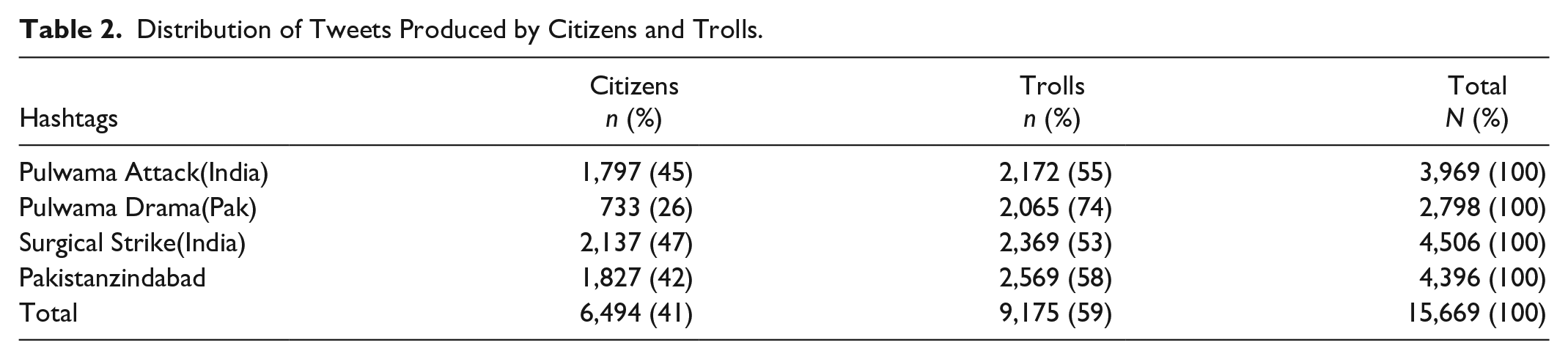
Separately, 55% of content on the #pulwamattack was contributed by Indian trolls compared with the 74% content produced by the Pakistani trolls on #pulwamadrama. Similarly, 53% tweets were generated trolls on #Indiastrikesback compared with the 58% content on #Pakistanzindabad that was produced by the Pakistani trolls. Overall, the table shows trolls contributed more on the hashtags initiated in Pakistan compared with India.
Research Question 3: How and to What Extent the Selected Hashtags on Twitter Relating to Pulwama Attack and Surgical Strikes Give (Un)favorable Coverage to India and Pakistan?
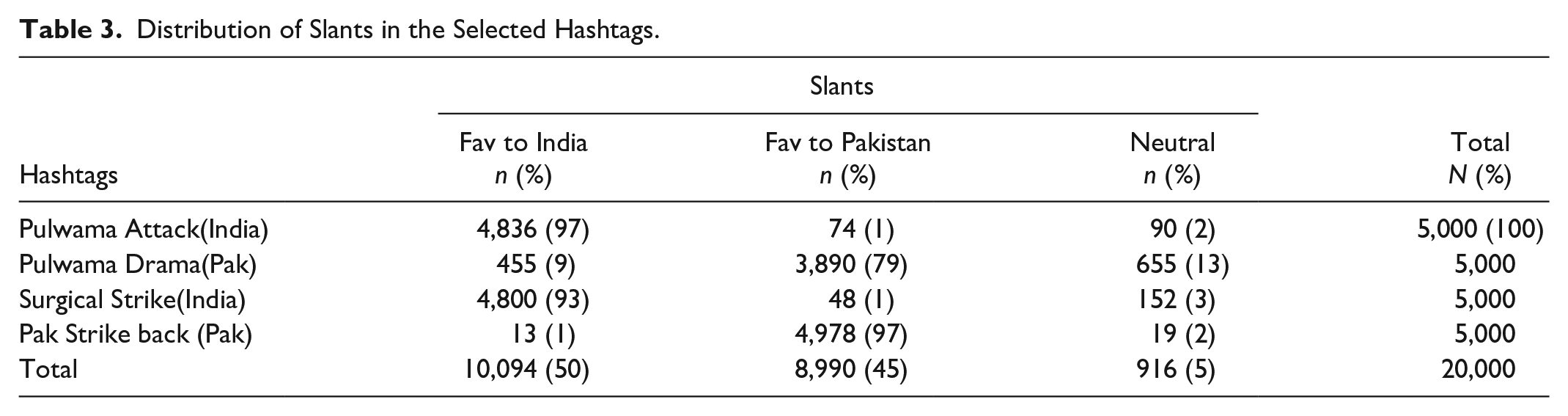
As shown in Table 3, the hashtags originating in India on Pulwama attack and surgical strikes (#Pulwamaattack and #Indiastrikesback) overwhelmingly produced pro-Indian content. Likewise, the hashtags originating in Pakistan (#Pulwamadrama and #Pakistanzindabad) on the two events predominantly produced favorable content to Pakistan. However, the hashtag #Pulwamadrama produced more neutral content (13%) compared with the #Pakistanzindabad that produced predominantly pro-Pakistan content. This can be due to the reason that the Pulwama attack occurred in India in which 45 soldiers were killed and hence initially there were some objective tweets on the event and even 9% of the coverage was favorable to India. This thin favorable coverage also includes tweets generated by the Twitter handles operating from India.
Distribution of Slants in the Selected Hashtags.
This strong antipathy toward each other is also reflected in the public opinion polls in the two countries. According to Pulse Consultant Survey (2017), as many as 95% people in Pakistan consider India as their worst enemy. Likewise, in India more than 75% people see Pakistan as their enemy (Pew Research, 2018), with 63% believing Pakistan as the worst enemy.
However, as the aforementioned table shows, Twitter handles from both India and Pakistan used hashtags originating from their respective countries on the two events. The almost negligible amount of favorable tweets in the opposing categories indicate the citizens did not indulge in counterattacks directly; rather, they chose to post only in the hashtags of their own countries. These findings are unexpected because we believed owing to the historic enmity between India and Pakistan, citizens would engage in counter-arguments on Twittersphere to defend their respective countries. However, this did not happen and much in line with the study of Golovchenko and colleagues (2018) where they found Twitterati from Ukraine and Russia engaged in separate platforms to promote their national cause—in our study, actors followed their own country’s hashtags.
Research Question 4: What Are the Key Attributes of Content on the Selected Hashtags on Twitter on the Pulwama Attack and Surgical Strikes?
As shown in Figure 1, the key words in the #Pulwamattack that originated in India in the wake of Pulwama attack included terror attack, martyrdom of Indian soldiers, revenge, condolences, criticism on the Indian Prime Minister Narendara Modi, and Pakistan. The world cloud shows that overall the 5,000 tweets on the #Pulwamattack supported the Indian stance like calling it a terror attack in which Indian soldiers had embraced martyrdom. Alongside condolences, they criticized Pakistan for being involved in this attack and called for revenge.

Key attributes of the Pulwamaattack hashtags.
On the contrary, as shown in Figure 2, in the #Pulwamadrama that originated in Pakistan included keywords like Indian occupied Kashmir, stop blaming Pakistan, Modi behind attacks, Kashmiri hate comes, upcoming elections, and Pulwama terror attack. Overall, this hashtag criticized India for blaming Pakistan for the attack, which according to the Twitterati occurred due to the resistance by Kashmiris. The tweets maintained that Prime Minister Modi was behind these attacks because elections were approaching in India.
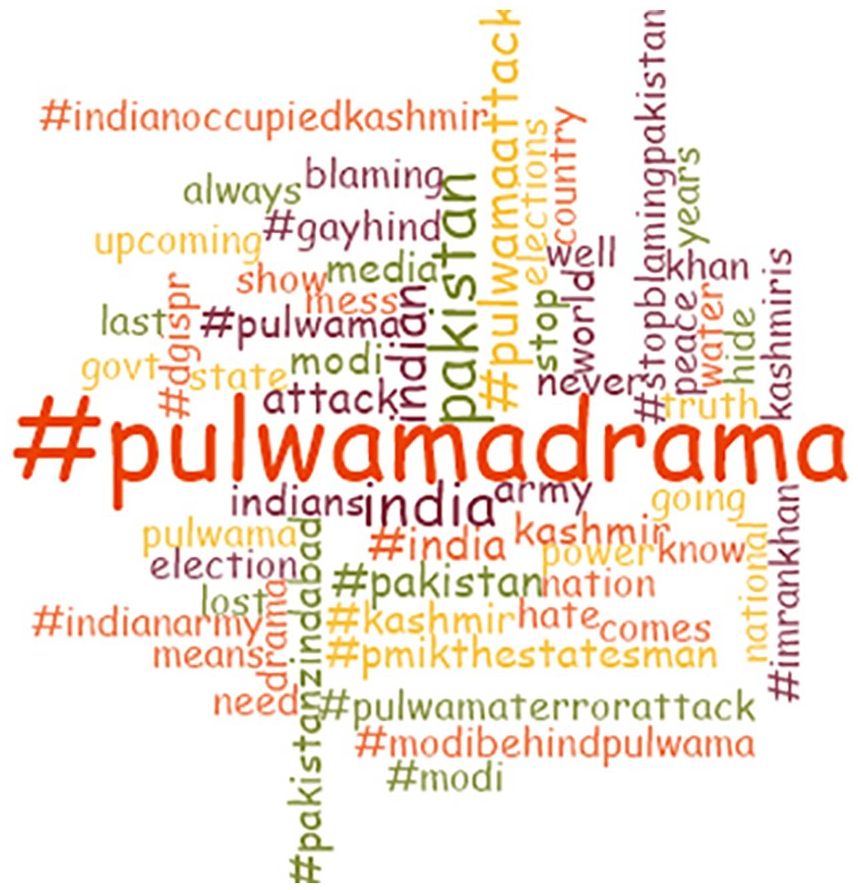
Key attributes of the pulwamadrama hashtags.
On the surgical strikes, Figure 3 depicting #Indiastrikesback that originated in India following the surgical strikes in Pakistan included key words like Indian air force, bring back Abhinandan, Balakot, surgical strikes, terrorism, India strikes Pakistan, nation comes first, Modi, say no to war. Overall, this hashtag celebrated the surgical strikes inside Pakistan to bring back their imprisoned pilot and hit at the terror facilities. The Indian air force was hailed for successful strikes.

Key attributes of the Indian strikes hashtags.
Figure 4 depicting the #Pakistanzindabad included key words like Pakistan leads with peace, Pakistan air force our pride, Pakistan strikes back, Indian pilot Abhinandan, Imran Khan, say no to war. Overall, this hashtag highlighted the Pakistan air force for launching strikes on India and capturing one of her pilots. The Twitterati were full of patriotism and celebrations amid some calls for peace in the region.

Key attributes of the pkaistanbzindabad hashtags.
On the whole, the four figures reveal that the assorted hashtags overwhelmingly contained either pro-India or pro-Pakistan content based on their origins. As disused earlier, these findings are unexpected because we expected to get more mixed results where actors from both India and Pakistan would engage in a single platform for arguments and counter-arguments. Although such interactions can be toxic, these also provide opportunities to people to explore different perspectives that can contribute to greater understanding between conflicting parties. However, in these four leading hashtags, we found that the Twitterati were occupied with advancing their own perspectives instead of countering the perspectives of the opponent group. One major reason for this distribution of opinion could be role of trolls. Because the trolls dominated the activity on the platform, they followed their own country hashtags and refrained from intruding into the hashtags of enemy country. This is not in line with the propaganda techniques applied in the Western world where Twittersphere is mainly loaded with contradictory arguments.
Conclusion
In this study, we analyzed content on Twittersphere relating to two deadly events between India and Pakistan, including the attack on Indian soldiers in Pulwama district in Kashmir and the subsequent surgical strikes inside Pakistan. The key objective of the study was to analyze the extent of information warfare in the digital platforms.
Quite in line with the mainstream literature, we expected least audience engagement and more governmental propaganda. However, as the findings in Table 1 indicate, common people produced bulk of information and openly defended their country’s perspective. Both India and Pakistan have been at loggerheads since the separation of Indian subcontinent in 1947 and have fought four major wars alongside numerous border skirmishes. This protracted conflict has now penetrated into the sociopsychological environment in the region and majority of people across the border consider each other country as the worst enemy (Pew Research, 2018; Pulse Consultant Survey, 2017). This enables the political and military elites to fan patriotic emotions of the citizens for their personal interests. For example, the Indian Prime Minister Narendra Modi and Pakistani Prime Minister Imran Khan hard stance against each other helped them winning the elections (Chawla, 2020).
In this study, although we did not find bots, we were able to identify trolls. Table 1 indicates that citizens were on the forefront in venting anger on the Twittersphere, but we found in Table 2 that the troll armies masqueraded as common citizens have dominated the debate. Despite its weaknesses, our method helps identify the larger troll activities that many analysts have discussed (Cheema, 2020; Fahmy & Hussain, 2020; Jorgic & Pal, 2019; Neyazi, 2019; Sriram, 2019). Interestingly, Twitterati from both countries overwhelmingly posted in hashtags that originated in their own countries. This is why there is abundance of pro-Pakistan and pro-India content in the respective hashtags. The qualitative analysis reveals the #pulwamattack and #Indiastrikesback mainly narrated events that supported Indian nationalism. On the contrary, #pulwamadrama and #Pakistanzindabad predominantly narrated the two events from Pakistani perspective.
This is not surprising because the jingoism and ultra-nationalism of troll factories dominated the debates. The populist prime ministers of the two countries have invested in the social media propaganda and this study highlights their contributions. But this does not mean that ordinary citizens or other stakeholders in these bilateral conflicts are less belligerent. The sustenance of enemy image and the hyperpatriotic youth in the two countries provide excellent opportunities to the policymakers to foment these emotions for their political and militaristic gains.
Mainstream media also remains the major beneficiary of this bellicosity. During violent conflicts, ratings of media increase exponentially in India and Pakistan that bring more revenues (Hussain & Siraj, 2019; Iqbal & Hussain, 2018; Neyazi, 2019). Likewise, the social media platforms are interested in this region having a population of over 1.5 billion people where majority is of younger people. While several researchers have hoped that social media would help resolve conflicts due to audiences’ exposure to multiperspectives (Fahmy & Hussain, 2020; Youngblood, 2016), the opposite seems to be occurring in modern conflicts (Fahmy, 2019). Our study also supports this later argument where the Twittersphere is full of blind nationalism and raw patriotism instead of bringing the people together.
One major contribution of this study is that national populations are not vulnerable to foreign online information warfare as feared by many scholars. People in Pakistan had negligible presence on the Indian hashtags and similarly Indian had negligible presence on the Pakistani hashtags. Despite opportunities, common people participate in national platforms to register their opinions instead of interacting directly with the foreigners. This minimizes the chances of external propaganda that many Western researchers are so concerned about.
These findings, however, should be seen in the context of specific limitations of this study. First, we selected just four leading hashtags on these two events and we cannot say with certainty whether other hashtags had the same characteristics. Second, our data are restricted to just 5,000 tweets per hashtags. A tweet to be included in the study had to be retweeted at least 5 times to be included in the sample. A more representative sample or the while corpus of data may show something different from our findings. Third, because our data were old, we could not run botometer on it. Had the study been envisioned in advance when the events were unfolding, probably better results could have been achieved.
Footnotes
Declaration of Conflicting Interests
The author(s) declared no potential conflicts of interest with respect to the research, authorship, and/or publication of this article.
Funding
The author(s) received no financial support for the research, authorship, and/or publication of this article.
