



Abstract
The concept of blended learning, a combination of online and face-to-face learning, has become popular in educational settings. Using qualitative methods, this study investigates the role of blended learning and in-service teachers’ perceptions. Blended learning was used for 19 in-service teachers during their summer degree program at a Chinese university. After the course, teachers were asked to write their reflections on blended learning, its role in diverse classrooms, and using it in their teaching career. The results showed that the teachers appreciated the use of blended learning for diversity, but they were against adopting it in their teaching due to limited pedagogical skills and the exam-oriented education system in China. Moreover, some teachers believed that traditional teaching is more effective for providing students with the necessary knowledge, while blended learning was viewed as difficult to manage. The study provides a better understanding of teachers’ perception of blended learning which contributes to global educational development.
Introduction
Today’s classrooms are full of students with diverse backgrounds where teachers are continuously challenged to improve instruction to meet the learning needs of students (Diallo & Maizonniaux, 2016). The intensification of technological globalization in the past three decades has raised the question of how teaching and learning practices can be enhanced using information and communication technologies (ICTs) in diverse classrooms. Well-informed and carefully planned integration of ICTs has significant potential to help students and teachers become constructive producers of knowledge by mixing theory and practice (Katić, 2008). ICTs allow students to create a good learning environment and deliver a strong foundation for task-based and engaged learning. Blended learning, which emerged and is embedded in institutions worldwide, is a concept that combines face-to-face and online instructional activities (Boelens et al., 2015). It uses ICTs to make teaching and learning enjoyable and achieve better learning outcomes. One characteristic of blended learning is its relevance to the interests and practices of contemporary learners. Modern learners, especially those accustomed to interactive technology, are often not comfortable with an information transmission approach based on lectures or other traditional learning methods (Garrison & Vaughan, 2008).
This study aimed to explore the role of blended learning in mediating diversity in the classroom and teachers’ perceptions of using it. The study presents and analyses results of a research project on blended learning in Chinese academia, where primary and middle school in-service teachers participated in a summer course taught through a blended learning approach. After exposure to blended learning for 3 months, the student teachers were asked about the role of blended learning in promoting inclusion in the classroom and their attitude toward using the approach. For this project, we created interactive blended learning to meet learning needs and provide an opportunity to understand the fundamental features of the teaching method. This is mainly based on the notion that teachers’ understanding of learning theories and practices affects their view of the application of different learning activities in the classroom (Ertmer, 2005). Earlier research on blended learning provides profound insight into the benefits of blended learning in learning practices, such as improving pedagogical richness and student outcomes, increasing self-directed learning, providing greater flexibility for teachers and students, making education more accessible to students, providing opportunities for professional learning, and catering to students’ individual needs (Dakduk et al., 2018; Graham et al., 2013; Kim et al., 2014; Osguthorpe & Graham, 2003; Smith & Hill, 2018; Vaughan, 2007; Yusoff et al., 2017).
As such, blended learning helps teachers improve students’ learning and keep them engaged during the learning process. The approach is becoming increasingly common in higher education, with many universities integrating blended learning in their teaching guidelines (Castro, 2019). However, there is little research regarding teachers’ perception of blended learning (Kaleta et al., 2007; Porter & Graham, 2015). This study aims to address this gap. This issue is important considering the diverse educational settings of many nations, including China. There is a significant difference among Chinese students’ ethnic background and socioeconomic status (Hannum & Wang, 2010; Liu et al., 2020). In addition to the majority of Han people, China has various minority ethnic groups such as the Uygur, Manchu, Zhuang, Hui, and Miao populations (Hannum & Wang, 2010). Despite the economic reform and opening up of China, the income gap among Chinese residents has increased in the last two decades, and there is a correlation between socioeconomic status and academic achievement of students, largely associated with access to sufficient resources and opportunities (Liu et al., 2020).
We argue that integration of ICTs in education helps improve students’ learning and minimize educational inequalities by promoting inclusion and providing better opportunities using various methods such as blended learning (Soeiro et al., 2012), online classes for students in rural regions (Zhang et al., 2015), remote classrooms for connecting rural students with urban teachers and students (J. Yang et al., 2019), computer-supported collaborative teaching between schools (H. H. Yang et al., 2018), and providing digital learning resources to rural schools (Yu & Wang, 2006). However, there is currently insufficient research concerning the practice of blended learning within the curriculum and teachers’ individual lesson plans. In addition, not much is known regarding teachers’ opinions on using blended learning in classrooms and its role in dealing with diverse classrooms.
Therefore, this article provides vital insight into teachers’ perspectives regarding blended learning and its applicability in teaching practice. It also contributes to shaping the practice of blended learning, particularly in Chinese schools. The following section discusses related and relevant literature. Then, we explain our research methods, followed by an analysis of the findings of the study in three themes. We discuss in-service teachers’ prior teaching approaches, their blended learning experiences, and their effect on the teachers’ future teaching practices.
Blended Learning in Diverse Educational Settings: A Literature Review
Educational settings reflect the nature and diversity of societies. Even though globalization has caused the flow of national and transnational cultures across the globe leading to cultural homogenization, societies do not fit into a single mold (Torres, 2002; L. Wang, 2007). Cultural identities vary, as they are partly chosen by people and partly determined by one’s background (Hall, 1996). Culture and other socioeconomic characteristics have significant effects on the delivery of quality education (Pieterse, 2015; Spencer-Oatey, 2012; Tatto, 1996). In this context, blended learning is expected to accommodate diverse students with different needs and interests and promote inclusion (Soeiro et al., 2012). According to Banks (2001), this is mostly rooted in the belief that diversity in a classroom is a strength rather than a problem.
Teachers often adopt blended learning to improve students’ learning experiences. Studies on blended learning have largely followed two patterns. The first and most widely examined is connected to the integration of ICTs in teaching and learning (Lin et al., 2014; Ngimwa & Wilson, 2012; N. Wang et al., 2021; Zhou & Xu, 2007). The second and less-explored pattern, particular in China, concerns the adoption of blended learning. Humbert (2007) surveyed 37 faculty members in France regarding the decreasing quality of students’ interaction, the difficulty of dealing with online interactions, and the lack of time to prepare online content and activities. Porter and Graham (2015) applied a blended learning framework to determine institutional strategies, structures, and support mechanisms of higher education faculties. These studies share three factors that help explain the fundamental principles in teachers’ adoption of blended learning to address student diversity and promote inclusion.
First, educational institutions, particularly their emphasis and decision approaches, have a vital impact on teachers’ lessons delivery (González, 2012). Despite its vast educational reform and development, China has been focusing on exam-oriented education, which many scholars saw as a problem (Ashraf et al., 2017; Guo et al., 2019). Emphasis on rote memorization and examination has affected the selection of teaching approaches and student performance (Dello-Iacovo, 2009). As a result, many teachers use teacher-centered approaches, such as lecturing with limited or no student participation (Lu, 2012; Tsegay & Ashraf, 2015). Indeed, such an approach fails to recognize the participation of many students, particularly those who do not perform well and, thus, leads to students’ boredom and disinterest in the teaching-learning process (Daschmann et al., 2013). Guo et al. (2019) argued that pedagogies that promote rote memorization are the main cause of students’ lack of creativity.
Second, teachers’ perception of education and teaching greatly affects their teaching practices. Such perception includes teachers’ personal principles and ideologies regarding education, ideas about effective methods of teaching and learning, and thoughts on teacher and student roles in classroom settings (Valcke et al., 2010). They create psychological and conceptual frameworks for acquiring new experiences and making decisions that determine the teachers’ classroom behavior (Ertmer, 2005; Goodman, 1988; Kagan, 1992; Kim et al., 2014; Valcke et al., 2010). Banks (2001) noted that beliefs are connected to one’s sense of self. In other words, they are part of one’s identity rather than being simply socially constructed entities (Akerlof & Kranton, 2000; Howard, 2000), while also being constantly shaped and reshaped with time and experience (Hall, 1996). Banks (2001) argued that teachers should have fundamental beliefs that all students can learn. Hence, students must be treated equally in terms of attention and recognition, while at the same time being treated differently according to their needs and interests. Research further shows that the consistency between teachers’ beliefs and actions depends on their education of the teaching–learning process and their subject–matter knowledge (Wilcox-Herzog, 2002; see also Chan, 2016).
Third, teachers need relevant and adequate knowledge of the pedagogical method they want to apply. The same is true for the adoption of blended learning because knowledge of using both ICTs and different methods of teaching is required to apply blended learning effectively. This suggests that teachers with adequate pedagogical skills use a variety of teaching methods that could provide profound and significant student learning (Bliuc et al., 2012). As such, blended learning is listed at the forefront for its ability to recognize every student within a classroom. It allows students to learn at their own pace and be part of the class discussion, regardless of their socioeconomic or academic differences (H. H. Yang et al., 2018; Yu & Wang, 2006). In conclusion, as Tatto (1996, p. 156) indicated, “the beliefs held by teachers and teacher educators about teaching practice and student diversity as well as the views of teacher education programs about how teachers learn to teach” might present some difficulties in incorporating student diversity as a building block in teaching and learning. This is particularly prevalent with teachers and educational institutions that focus on what Freire (2010) calls the “banking concept of education,” an approach that views students as adaptable and manageable beings.
Methods
Research Setting
This study is part of a large research project assessing the formal arrangements of blended learning in Chinese academia, and the readiness of educators to apply blended learning in their teaching and learning practices. Universities offer full-time and part-time masters programs that require a minimum of 3 academic years. The full-time master’s program is a 3-year program focusing on subject-specific courses to train students, while the part-time master’s program aims to train in-service professionals in their specific fields. Our participants are in the part-time master’s program, in which in-service teachers attend university during the summer break (June to August). This study was conducted as part of the Professional English course in the part-time Master of Education program. The in-service teachers had diverse geographical, academic, and socioeconomic backgrounds. They had completed undergraduate studies in different majors, such as education, management, psychology, physics, and mathematics, and worked in different educational settings, such as kindergartens, primary schools, middle schools, high schools, vocational institutes, and higher education institutes, as teachers and/or management staff in different parts of China. The Master of Education program is intended to enhance their knowledge about educational sciences and train them to work effectively in educational settings.
Research Design
This article applies a qualitative experimental approach to explore the role of blended learning in diverse classrooms and the perception of in-service teachers toward it (Creswell, 2013). The main idea here was to expose the participants (in-service school teachers) to blended learning and capture their experiences and perceptions on the model, as well as their reflections on their prior teaching practices. Therefore, we designed a blended learning course, combining traditional teaching practices with online learning. Figure 1 illustrates detailed information about the blended learning model and activities designed for this study.
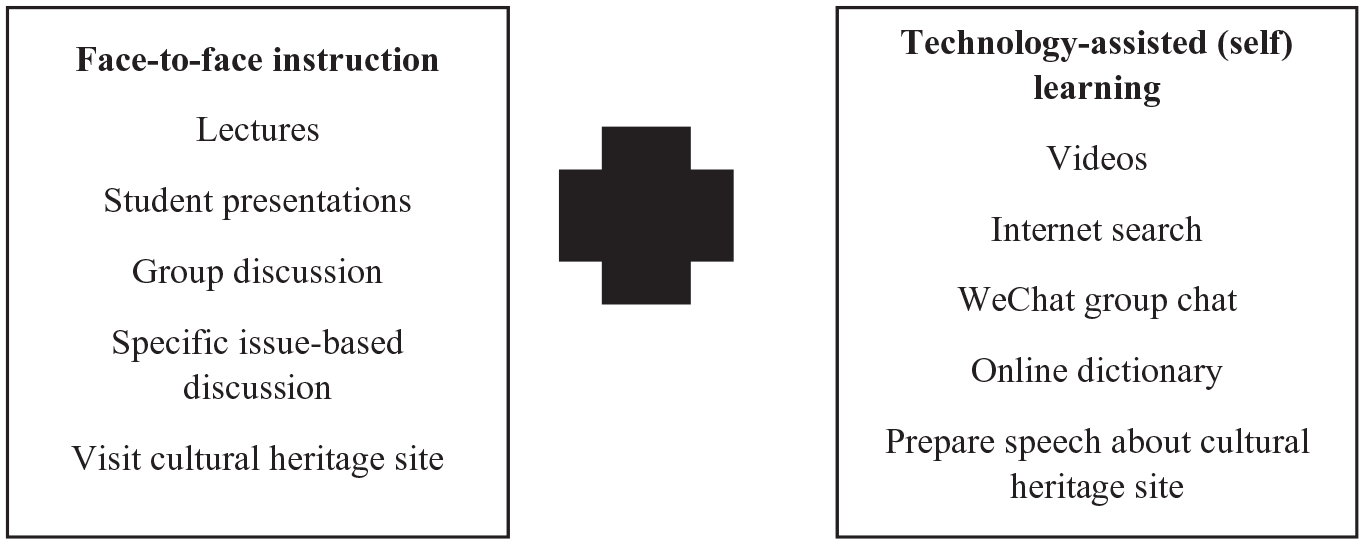
Blended learning model (designed by the authors).
All participants have been using technology for study and work, but they had never attended a course fully taught through a blended learning method. Therefore, the aim of the course and the blended learning approach including the functions of different technological tools (such as WeChat group) for distributing materials and sharing ideas, and online searching for productive learning experiences were explained in detail. Rather than simply mixing traditional learning with ICTs, we added different teaching methods from both traditional learning and technology-mediated learning.
When students become familiar with the course objectives and the teaching approach used, the class started with an intention of helping students take their learning beyond the physical classroom. As indicated in Figure 1, the learning settings included various methods and tools to maximize the impact of education for students. After in advance sharing of course materials and preparatory reading with students, most classes started with face-to-face learning. Face-to-face learning sessions mostly included participatory short lectures led by the instructor on course content, group discussion on specific topics selected by the instructor and/or students, students’ individual presentations, and speeches on a particular topic or field visit.
In most cases, these activities were technology-assisted; for example, WeChat was used to share information and facilitate class discussion because WeChat is one of the most commonly used communication (social media) networks in China and can be easily installed on computers and smartphones. Its significance in blended learning has been noted, particularly for its instant communication, sharing of information, and distribution of audio-visual and text files between the instructor and students, and among students (N. Wang et al., 2021). In addition, students were given various semi-online projects and assignments to advance their independent learning. Students used the internet to search for information and WeChat to discuss ideas at any time.
Participant Selection
The “Professional English” course was a selective two credit hours (32 hours in total) course. Prior to selecting the course, all the students were provided with a course outline including teaching aims and methodology, and they were informed that the course was part of a research study. Twenty-one students enrolled in this course were recruited for this study. The final sample consisted of 19 participants, as one man and woman worked in college and department of education, respectively, which is out of the scope of this study focusing on primary and middle school teachers. Among the 19 participants, 17 were female, and two were male. Table 1 provides detailed profiles of the participants.
Participants’ Profiles.

Data Collection and Analysis
A qualitative survey method was used to collect data for this study (see Figure 2). Qualitative surveys ask open-ended questions to solicit information such as suggestions, comments, and other responses from participants (Creswell, 2013). We started the class by collecting the demographic information of the participants and asked them open-ended questions concerning their previous teaching experiences and methodologies, and their attitudes toward blended learning for diverse classroom settings. After explaining the course content and aims, the instructor taught the class using blended learning. The class was designed with a combination of traditional teaching and online learning to inspire student interaction and improve their learning experiences through various learning strategies.

The experimental approach used for this study.
At the end of the course, follow-up data were collected through a qualitative survey asking participants to write a reflection on their experience of blended learning and answer some open-ended questions. We selected this method with the aim of assessing the participants’ experience of blended learning and their perception of adopting this method in their classrooms. This method provides in-depth information about participants’ beliefs, experiences, and motivations (Creswell, 2013). The survey was conducted in Chinese to facilitate information collection and responses were translated by a fluent speaker. Informed written consent was obtained prior to participation, and pseudonyms were used to safeguard the safety and privacy of participants.
Data were analyzed using a thematic approach to provide rich and detailed interpretations of participants’ beliefs, experiences, and context (Braun & Clarke, 2006; Sarantakos, 2013). In particular, Braun and Clarke’s (2006) six phases of thematic analysis were used: familiarize with the data, generate initial codes, search for themes, review themes, define and name themes, and write-up. Accordingly, we were able to develop initial codes from the participants’ opinions and experiences. These initial codes were grouped into comprehensive themes to address the cases in this study and explore the role of blended learning in mediating diversity in classrooms, as well as teachers’ perceptions toward using it. After developing the codes into comprehensive themes, we inductively categorized the contents of initial coding to draw out their narratives under comprehensive themes. The inductive approach uses the data under investigation to build themes, while requiring investigation of any recurring themes relevant to the goal of the project within the data (Hawkins, 2018). This process of coding and developing comprehensive themes was central to better understand in-service teachers’ attitudes toward blended learning in classroom settings. Three major themes were identified, as shown in the findings below.
Blended Learning: Teachers’ Experiences and Perceptions
This section presents the findings of the study. As shown below, the findings are categorized into three themes.
Teachers’ Prior Teaching Approaches
As seen in Table 1, the participants had an average of 6 years of teaching experience, with 9 and 4 years being the longest and shortest, respectively. However, this does not necessarily mean that they had the required pedagogical knowledge and skills to use a variety of methods, including blended learning (Tsegay et al., 2018). The findings of this study indicated that most of the participants used a mixed pedagogical approach in their schools. On one hand, the participants had the required ICTs to improve their pedagogical practices. On the other hand, the teachers lacked appropriate pedagogical skills and felt pressurized due to the exam-oriented education system. Regarding this, Liu and Karen said: Because of the computer network in the school and classrooms, we can use the Internet to search videos, news materials, and other contents needed in the classroom based on the lesson prepared. However, I had no training in blended learning and I was afraid of trying because it might be a loss of students’ time and energy, affecting their academic performance. (Liu) I teach my students in accordance with their aptitude. I arrange group work in classrooms and homework for different levels (written and practical). I use different teaching materials, such as textbooks, chalk, and computers/tablets. In particular, there are many games in the Schivo software, which can be used for teaching-learning processes within and after class. However, students must pay more attention to books and tests. (Karen)
This suggests that the ICT infrastructure in their schools is good. They also had sufficient teaching aid. Indeed, research indicates that the integration of ICTs and curricula has shown significant progress in China, with almost full coverage in some cities (Guo & Yang, 2016). In addition, ICT education in China is one of the most important aspects of teacher education, and teachers and management staff are offered in-service training to continuously improve their ICT skills and competencies (Jingtao et al., 2010). This could give teachers opportunities to use various interactive teaching methods and finish their course content in time. However, our results indicate that teachers are doubtful about the consistency between interactive teaching methods and student performance in examinations. This statement relates to teachers’ pedagogical knowledge and emphasis on the education system, an idea echoed by most of the participants in this study.
As can be seen, Liu did not want to risk trying blended learning. She was afraid that she might fail due to her limited pedagogical skills. Above all, she perceived that rote memorization could be more effective in preparing students for examinations. Similarly, Karen viewed her teaching and learning process as in line with the academic competition of students, particularly at national examinations. Accordingly, their focus was to engage students in cooperative and creative learning and prepare them for competitive tests. Chan (2016) noted that the effect of examinations is also a major issue among parents, who want to see their children secure grades that would ensure their admission to a good university. This, therefore, adds pressure for teachers to focus on helping their students score good grades. Nevertheless, contrary to many of our participants’ views, Chen and Jones (2007) indicated that blended learning has a better effect on learning outcomes and skill development than traditional classroom settings. For instance, students in blended learning classrooms had stronger perceptions of their improvement in analytical skills than those who took the same class in a traditional classroom setting (Chen & Jones, 2007). Similarly, Alsalhi et al. (2019) found a positive impact on the academic achievement of ninth-grade science students. It is also important to note that academic achievement is determined by many factors, such as cognitive ability, students’ motivation, effort and self-confidence, socioeconomic status, academic engagement, parents, teachers, peers, and culture (Phillipson & Phillipson, 2012). As such, teachers are not solely responsible for the academic success or failure of students (see also Tsegay & Ashraf, 2015).
Few participants in this study believed that students should be taught by mixing online and offline teaching practices. For instance, Biyu stated that teachers often need to keep in mind that students’ learning is an autonomous and spontaneous process. This could help them put the students at the center of their teaching and learning process, while maintaining the students’ autonomy and paying attention to their diversity. She further opined, Online and offline teaching can complement each other in a limited way, so that students with different progress and characteristics can find their own learning, which guarantees the effect of teaching and learning for diverse students. In teaching, I have used physical teaching aids, multimedia, personas, situational performances, and other teaching resources. First, through the Internet, I was able to collect more practical teaching contents to enrich and expand my teaching programs. Second, I was able to use the Internet to conduct on-site teaching displays for children, so that they can learn through practice, such as playing. As far as possible, open classroom questioning is set up and classroom games are designed to be interactive rather than one to one. In addition, teaching aids are made as diverse as possible to meet the psychological needs of different children. (Biyu)
Biyu has identified significant points in relation to her beliefs and experiences. In line with Banks’s (2001) argument, she pointed out that teachers need to learn how to engage with diverse students. This involves mixing both online and traditional methods to make the teaching and learning process interesting and enjoyable. Nevertheless, even after the end of the experimental class, it is worth mentioning that Biyu was not willing to make her pedagogy entirely interactive. Rather, she wanted to limit it to a certain level. From her perspective, she was not confident in her pedagogical skills and the support of the school administration and parents.
Xiaoli and many others added that the teaching and learning systems in China are mostly based on a teacher-centered approach. This, to some extent, is rooted in the educational system where teachers have many other priorities such as preparing students for exams, or academic publishing in cases of higher education. Therefore, according to Xiaoli, “Teachers do not have time to plan their classes in depth.” This is a very big challenge, since student-centered learning requires a lot of preparation and soliciting the contribution of every student in the class. Teachers need to create a conducive atmosphere, such as a horizontal relationship, to develop a sense of trust and tolerance between themselves and students, and among students (Hooks, 2010). Unless this is done, teaching becomes transmitting knowledge that limits students to receiving, filing, and storing of information (Freire, 2010; Tsegay et al., 2018).
Teachers’ Experiences With Blended Learning
The results revealed that the participants had access to the internet and other teaching facilities. However, they were unable to effectively blend these resources into the teaching and learning process due to inadequate knowledge of blended learning and the exam-oriented education system in China.
All participants noted that this was their first time to experience blended learning and explained their experiences in comparison to traditional teaching. They expressed that their experience helped them recognize the benefits of blended learning, such as motivating students’ learning, creativity, and independent learning. First, like many other participants, Lan, Fang, and Rose expressed that the class blended various online and offline teaching methods and aids in ensuring students’ optimum participation and learning. They stated that these teaching tools were significant in making the classroom more dynamic and vivid, which boosted students’ interest and learning. Liu stated, Blended learning strategies can enrich the classroom and make it more energetic. Compared with the traditional classroom, the use of these methods made students more interested in the classroom. However, we should give more opportunities to students and pay attention to the improvement of their abilities.
Here, Liu pointed out two significant benefits of blended learning and the demand it presents to teachers, particularly in involving students and assessing their progress. Liu’s experiences with blended learning were better than with traditional classrooms in creating an interactive session where everyone is motivated to contribute. Nevertheless, she felt that the amount of opportunity given to students was insufficient. This statement is mainly directed at class size, session duration, and the teachers’ ability.
Fozia indicated that one of the main advantages of the blended learning class was “its capacity to save time to carry out group discussions, projects, and other activities.” This supplements research that shows that blended learning could be more effective in time management and conducting a variety of activities (Bowyer, 2017; Singh, 2003). Singh (2003) indicated that blended learning programs take about one-half of the time of traditional classrooms and provide better learning outcomes. Yet, Liu argued that class size matters. It is not difficult to imagine that a 1-hour session in a class of 21 students might not provide each student with sufficient opportunities to speak. To consolidate this, Bowyer (2017, p. 17) highlighted that blended learning requires a “strategic use of classroom time,” with a focus on active and meaningful activities. This might be the main reason that Liu noted the importance of teachers’ capability, particularly their pedagogical knowledge, attitudes, and skills. They need to be well trained and experienced to pay attention to the participation and progress of their students (Tsegay et al., 2018).
Furthermore, many participants argued that the blended learning class helped them become independent learners. Biyu and Fozia explained: The interactive teaching of the teacher motivated me to continue learning out of class using online materials. The application of such teaching tools in the classroom is conducive to arousing students’ enthusiasm. In this way, I was able to improve my efficiency of independent learning and make the most out of the blended learning class. For instance, I found classroom discussion and online reading to be favorable tools to keep students’ independent learning. At the same time, such diversified teaching tools are important means to ensure the learning of diverse students in the classroom. (Biyu) Hybrid learning enabled us to deepen our learning and use our skills. This helped students to participate in the management of their own learning and effectively stimulated their autonomy and initiative, whereas the teacher was able to find more time to support and guide students. (Fozia)
The majority of the participants associated the cultivation of independent learning with the role of blended learning to arouse students’ interest. As Biyu and Fozia stated above, it is the motivation to interact, contribute, and, thus, learn which inspired students to study at their own time and pace. Fozia saw this as a solution to the time constraints due to class size and duration of the session. Her point aligns with research showing that time should be used carefully and strategically to organize a variety of activities and ensure the participation of all students (Bowyer, 2017; Singh, 2003). Moreover, Singh (2003) noted that the concept of blended learning is rooted in the principle that learning is a continuous process, rather than a one-time event.
Fozia’s statement suggests that interactive classroom environments and independent studies make blended learning effective for diverse classrooms. Students can blend not only face-to-face and online instructional activities but also combine classroom and independent studies. Most resources, such as reading materials, are often placed online or sent to students ahead of time to facilitate their independent studying and save time. Therefore, as Lans said, learning is not limited to the classroom. In some cases, the classroom moves outside, where students learn through field trips and other projects. Most importantly, students’ interest and passion in learning continue through independent studies. Liu, Terez, and Song added that the harmonious classroom environment helped the teacher and students communicate freely with respect and care for each other’s ideas. Indeed, this is what Freire (2010) called participatory pedagogy, where the teacher and students share responsibility for the educational process. This, therefore, challenges the idea that teachers hold all the knowledge. Rather, the teacher and students engage in a horizontal relationship and a shared teaching and learning process.
Teachers’ Perceptions Towards Blended Learning
The findings show that the experimental class helped most of the participants gain basic knowledge and understanding of blended learning. Many participants changed their attitudes toward the teaching approach, particularly regarding motivating students and meeting the needs of diverse students. However, their responses show that they are not ready to adopt blended learning in their classrooms for various reasons.
After attending the blended learning classroom, most of the participants experienced the benefits of blended learning, but they did not change their perception of applying it in their classrooms. Even though they found blended learning to be more efficient, effective, and inspiring, many argued that it is demanding in nature to both teachers and students, while others insist that it does not fit with their pedagogical skills and the country’s education system. Peter said, At present, there is no “hybrid teaching method” course. The method requires some teaching experience and integrates any existing significant resources. The requirements for teachers are relatively high as they need to spend more time and energy in preparation. Therefore, I do not want to use it blindly because I think it is irresponsible.
Research indicates that teachers are more likely to achieve students’ interaction and improve their academic performance using blended learning (Alsalhi et al., 2019; Chen & Jones, 2007; Singh, 2003). However, as shown above, participants such as Liu and Peter are afraid that their pedagogical skills may be insufficient to effectively conduct blended learning and, thus, expose their students to academic failure. This partly emanates from the level of academic competition among students and schools (Ashraf et al., 2017; Guo et al., 2019). In Peter’s support, Lan further expressed her concern by saying, “Without proper management, blended learning could be an open class where students talk about everything without any focus.” Her argument is that lack of focus could cause students’ boredom, rather than inspiration. It is noted that boredom negatively affects academic performance (Daschmann et al., 2013). Many participants echoed similar perceptions concerning the complexity that Chinese teachers face to simultaneously achieve two goals: ensuring learning that promotes inclusion and academic performance. Overall, the findings of this study suggest that those who emphasize the lack of pedagogical skills and the Chinese education system as their challenges may utilize blended learning if these problems are addressed. Moreover, such teachers are less likely to try adopting blended learning by themselves, as they perceive that the problem and solution lie beyond their jurisdiction.
Furthermore, some participants believed that blended learning is not appropriate for elementary and middle school students, whereas others stated that they may use it. For instance, Karen was firm in her belief that “students must pay more attention to studying and preparing for their exams.” In addition to her exam-oriented perception, Karen highlighted that “managing students in blended learning is difficult, whereas mixing online and offline educational settings may cause more confusion and complication than inspiration for independent study, particularly among young students.” Mei and Wen gave similar suggestions, as Mei identified that she had no idea if blended learning can be used in teaching the Chinese language. The common feature among these participants is that they lacked profound knowledge about blended learning. Unsurprisingly, the basic theoretical information provided as part of the experimental class was insufficient. Hence, their limited knowledge made them see the approach as too complicated. This is not to overlook the beliefs of teachers, preparations made, and pedagogical skills required for applying blended learning. However, it is important to note that most of these participants explained that they use ICTs in their teaching and learning process, which is one requirement of blended learning.
In contrast, Qing, Maria, Sarah, and Terez said that they might try blended learning in their classrooms. They explained that they found blended learning to be interesting and motivating for using ICTs more effectively. Maria and Sarah stated: I feel that blended learning is interesting, and I have been using videos, PPTs, and other teaching materials during my classes. However, I did not plan these activities very accurately to be interactive, like in blended learning. I will try it now. (Maria) I want to try it in my class because I feel it is interesting to make learning enjoyable, and it can facilitate teaching and professional growth. I think my students will like it, but I do not know if I will get permission from my school to try it. (Sarah)
Here, we can see the participants’ strengths, motivations, attitudes, and concerns. Maria’s statement indicates that integrating ICTs into the classroom was not new to in-service teachers, but they were not planning their teaching and learning activities to ensure participation and learning for every student. With exposure to blended learning, these four participants were motivated to try it in their classes. They were confident that their students would benefit and, thus, like the method. However, Sarah’s statement shows that she first needs permission from her school administration. This indicates the presence of heavy administrative control and parental pressure over Chinese teachers, which in turn limits their choice and students’ creativity (Dello-Iacovo, 2009; González, 2012; Mullen & Browne-Ferrigno, 2018). It is also important to remember that these teachers had limited pedagogical skills concerning blended learning.
Overall, the in-service teachers’ reflections were mainly connected to their prior experience, which was characterized by a lack of adequate pedagogical skills and an exam-oriented educational system. In addition, some believe that teachers should provide students relevant knowledge through traditional methods rather than depending on blended learning, which is difficult to manage. Few are willing to apply it in one or more of their classes anticipating that their schools would support them.
Conclusion
In this study, we discussed two significant issues. First, we explored the pedagogical experiences and practices of in-service Chinese elementary and middle school teachers. The findings show that teachers’ pedagogical practices were mainly characterized by their domination of class activities, not the integration of ICTs. Despite the availability of ICTs and other teaching aids, the in-service teachers indicated that their priority was to help students focus on the goal (examinations) rather than the process (learning). This suggests that students can memorize the course content for the sake of examinations, but actual learning that motivates creativity and transformation hardly occurs (Freire, 2010). Second, after applying blended learning, this study investigated the experience of the participants regarding the teaching-learning approach and their attitude toward using it. The participants enjoyed the experimental class and were able to experience the benefits associated with blended learning. However, with few exceptions, they were not ready to implement the teaching method in their classes. Most participants claimed that they had less autonomy in in-class curriculum planning and lacked adequate pedagogical knowledge and skills to incorporate blended learning. In addition, they noted that both blended learning and the Chinese education system are demanding. They felt that they could not meet the two demands simultaneously. Therefore, this study implies that there is more to be done in the Chinese education system to promote blended learning, and thus, students’ actual learning and creativity.
Many educational institutions are shifting toward online and blended learning due to the COVID-19 pandemic. Therefore, the present study is significant beyond China. However, further investigation is required. As this study is based on data collected from in-service school teachers, similar research that captures the views of other stakeholders, including senior educational officials, is necessary to increase the credibility of the results. In addition, research exploring the role of blended learning in Chinese education transformation in response to the COVID-19 pandemic is required to broaden people’s understanding of blended learning and its role in Chinese schools.
Footnotes
Acknowledgements
The authors wish to thank article editor and editorial admin for their gracious editorial support. They also thank the reviewers for reading and providing constructive feedback on earlier versions of this article. They further acknowledge Sage Author Services powered by Editage for providing language editing.
Declaration of Conflicting Interests
The authors declared no potential conflicts of interest with respect to the research, authorship, and/or publication of this article.
Funding
The author(s) disclosed receipt of the following financial support for the research, authorship, and/or publication of this article: This research is supported by the National Natural Science Foundation of China (The Research Fund for International Young Scientists, Grant no. 71950410624). Opinions reflect those of the authors and do not necessarily reflect those of the grant agencies.
