




Abstract
The notion of governance networks urges study of complex interaction processes rather than formal institutions. We argue that the study of interaction in governance networks should be widened to include different ways in which interaction shapes network outcomes. Here, we focus on a dimension of governance networks that is understood as fundamental and problematic, but that as yet has not been researched through the study of interaction: the construction of responsibility in such networks. We propose a model for the analysis of responsibility construction through (implicit) negotiation on the three proposed elements of responsibility and their links: stakeholder identities, contributions to reform, and norms. This model called “the triangle of responsibility in network governance” is the main result of our research. In addition, we offer an empirical case that illustrates both the problem of responsibility construction in network governance and the usefulness of our model, thereby providing proof of concept.
Keywords
Introduction
Responsibility, like most intangible phenomenon, is socially constructed. This goes for responsibility of individual people as well as groups. This is relevant for the case of governance networks in which different stakeholders collaboratively aim for reform in complex policy domains. This reform can be related to diverse societal problems, such as the energy transition, water management, or food production. In many such networks aiming for reform, progress happens slowly, and it is often scant. As society increasingly depends on such networks for solving complex societal problems, more insight in possible explanations for this slow progression is urgently needed. In this article, we propose that insight in the construction of (non-)responsibility in such networks helps to understand this phenomenon. Responsibility construction is studied through a newly constructed model, combining insights from theories on responsibility construction from the individual-focused, psychological perspective (Schlenker et al., 1994) and a more interaction-focused, constructivist perspective (Uzzell et al., 2012). These insights are combined into a model of responsibility construction in governance networks (named “the triangle of responsibility in network governance”), proposing that responsibility is collectively constructed through (implicit) negotiation on different elements of responsibility. This model was constructed through a process of grounded-theory construction involving the methodical gathering and analysis of data from a stakeholder dialogue of a governance network, exemplary for governance networks aimed at reform of resource management as described above. The specific network studied was aimed at reform in Dutch livestock farming, a sector commonly seen to be in need of a so-called “license to produce,” referring to the diminishing public support for current livestock farming practices. This dialogue brought together 40 key actors involved with livestock farming in the Netherlands. Many of these actors were well acquainted through their cooperation in previous collaboration efforts. The stakeholder dialogue was aimed to take stock of the progress made and, most importantly, to identify a way forward to which all network parties would commit. It was a dialogue aimed to go beyond talking about possible futures, but to specifically aim for a preferred alternative, collectively. While the meeting started out from a shared sense of urgency, interactions were cordial and disagreements were limited, no concrete actions or commitments were formulated. Results were abstract and limited in terms of practicability, not going beyond plans already made in previous programs, as was explicitly anticipated. At the same time, there was no open conflict, and the meeting ended in the same cordial spirit as it started. How, that is, by what process, could the dialogue evolve and end without any real challenge to the status quo? This is the question we seek to address in this article. We do this by zooming in on the interaction and, more specifically, the construction of responsibility in this governance network.
Structure of the Article
Based on the setup of the research, the article is set up in two sections. The “The Triangle Model of Responsibility in Network Governance” section presents a model for understanding the construction of responsibility in governance networks. We first introduce the most important themes of our research: interaction in governance networks, responsibility, and responsibility construction. Then, building on these theoretical starting points, we adapt them to come to a model of responsibility construction in governance networks: the “triangle of responsibility in network governance.”
In the “Proof of Concept” section, we offer proof of concept by applying this new model to an empirical case. We start by explaining the methodology used for the application of our newly designed model to the empirical case (see “Methods for the Case Study” section). We will then zoom in on the empirical case, focusing on network interactions (see “Empirical Case: Livestock Farming in the Netherlands, a Sector Under Challenge” section). After this, we present case findings that show the applicability of our model, stressing that the results from this empirical case are meant as proof of concept for the new model (see “Proof of Concept” section).
Finally, we draw conclusions, zooming in on the relevance of the model for the study of governance networks and their contribution to the resolution of complex problems.
The Triangle Model of Responsibility in Network Governance
Interaction in Governance Networks
When different kinds of organizations have an ongoing interaction around a socially relevant topic, and collaborative action is needed to make progress, such a network of interdependent stakeholders can be defined as a governance network. The organizations involved in such a network can be diverse in nature, for example, business, non-profit, science, or government. The networks can differ in their development stage and corresponding aims, which are related to the degree of consensus within the network. While some governance networks focus on managing resources within an established set of norms and practices, others are (still) facing complex problems that demand for complex and extensively deliberated problem solving before the way forward can be agreed upon. Such governance networks are aimed at reform, which is the kind of network we are referring to in this study. Because of the long deliberation process involved with reform aimed at establishing norms and practices, which often take many years or even decades, these networks tend to have a long history of interaction, causing them to share regulative, normative, cognitive, and imaginary elements. Because of this, the seemingly loose structure that holds these interdependent actors together may becomes denser and more established over time, enhancing their regulatory and decision-making power, as well as their public purpose (Sørensen & Torfing, 2007). Because governance networks are a collaboration of organizations from different societal domains, they help to bridge gaps when facing complex societal problems that demand action from private as well as public parties. Therefore, they became more important and predominant in modern societies in the past decades in which many complex problems were confronted (Marcussen & Torfing, 2007).
In recent years, network effectiveness, which can be defined as “the attainment of positive network-level outcomes that could not normally be achieved by individual organizational participants acting independently” (Provan & Kenis, 2008, p. 230), has increasingly received attention. This has shed light on the actual ability of governance networks to live up to expectations. As governance networks deal with complex, conflict-ridden, and ill-defined policy problems, overcoming these problems often means that the status quo, the current way of doing things, has to be challenged. These challenges can be theoretical (generating ideas, making plans) or practical (devising and implementing new legislation to govern conduct, implementing new ways of doing, etc.).
Network effectiveness has been studied from different angles. Following up on early research (most prominently Provan & Milward, 1995), researchers have mostly theorized effectiveness in terms of network characteristics as explanatory factors. Turrini et al. (2010) identify contextual, structural, and functional characteristics (centering on management) as explanatory of effectiveness. Raab et al. (2015) similarly present structure and context as explanatory factors, while adding network governance mode as a third factor. Provan and Kenis (2008) zoom in on different modes of network governance and the possible conditions for effectiveness of each of these. In the study of governance networks and their effectiveness, institutionalist approaches are prominent, as Torfing and Sørensen (2014) note. They also point out that this “may seem a bit strange,” considering that “the notion of governance networks urge us to study complex interaction processes rather than formal institutions” (Torfing & Sørensen, 2014, p. 337). Certainly, there is attention to interaction in the debate, and interaction has even been taken by some to be a defining feature of governance, of which network governance is one manifestation as discussed by Kooiman (2003) in his book Governing as governance. In this book, Kooiman conceptualizes governance as a process of interaction between different societal and political actors, with interdependencies between them growing, as modern societies are increasingly complex, diverse, and dynamic. However, this attention to interaction is often at a relatively high level of abstraction, not looking at interaction up close, as with Kooiman’s (2003) influential typology of interaction as interference, interplay, and interventions. Interaction is also often considered from an institutionalist perspective, focusing on the development of shared rules for interaction, norms, logics, understandings, trust, and cognitive schemes (Hajer & Versteeg, 2005; Torfing & Sørensen, 2014) by which networks develop into entities able to act and perform. Furthermore, much of the research focuses on relatively stable, institutionalized, and even formalized manifestations (see, for example, Hajer & Versteeg, 2005; Raab et al., 2015; Turrini et al., 2010). This restricts our exploration of interaction in networks in important ways. First, many networks brought into life are not of the most stable kind—do not institutionalize to the degree found with networks that have been mostly subject to scholarly analysis. More temporary, fluid, and open networks tend to remain underresearched, even as these are as much present in present-day societies as more stable ones, and may be faced with similar expectations and rooted in a similar rationale. Second, with institutionalist approaches to the study of interaction, we tend to focus on those forms of interaction that contribute to stability and performance, rather than those processes that, for example, may inhibit stability or complicate endeavors to perform (Torfing & Sørensen, 2014).
Some literature, however, does zoom in on the complexity and dynamics of interaction in networks. This literature predominantly analyzes strategizing involved with negotiating diverse interests and perspectives. For example, Klijn and Koppenjan (2015, pp. 66–80) chart the ways in which actors’ perceptions shape their objectives, actions, and targets. In their analysis, a wide range of strategies can develop, including, for example, coalition-building strategies, conflictual strategies, and collaborative strategies. Notably, these strategies typically describe actors as seeking to work toward a particular type of decision that matches their perceptions and objectives, under conditions where they are faced with other actors having diverging perceptions and working toward other decisions. No strategy that they identify conceives of strategy working toward non-decision, as we found to be the result in the case described in the “Introduction” section—a result to which we saw interactions contribute in important ways. Nor do strategies as described by Klijn and Koppenjan relate well to the implicit yet impactful strategizing away from decision, in spite of apparent agreement that we saw in the case presented above. As Ostrom et al. (1994) state, actors involved in governance networks facing collective action problems do face temptation to act in their own interest rather than the common good, creating the need to develop and cultivate conditions for reciprocity to support network effectiveness. The Institutional Analysis and Development framework developed by Ostrom et al. (1994) to gain necessary “polycentric” process oversight does, however, not explain how such pre-conditions for reciprocity in the network are (discursively) created. In short, in our view, the analytical frameworks available for studying interaction in governance networks appear to run short when it comes to comprehending some of the dynamics one may find in governance networks.
In our view, interaction that takes place in governance networks deserves to be studied to make sense of these complexities. A basic argument that we seek to make in this article is that the study of interaction in governance networks should be widened to include different ways in which interaction may shape network outcomes. We propose to approach this in terms of network effectiveness, centering on so far underresearched yet important dimensions of interaction. We are particularly interested in how decisions are deliberated, or in other words, in the process through which the translation from ideas to full-fledged policy is born in interaction. What actually happens in the interaction and with what consequences for outcomes?
Responsibility
In this article, we focus on a dimension of network governance that is understood as fundamental and problematic to network governance (Kickert et al., 1997), but that as yet has not been researched through the study of interaction: responsibility. Responsibility is commonly defined as being responsible, answerable, or accountable for something within one’s power, control, or management. These ways of describing responsibility also connote liability (Schlenker et al., 1994). Being liable is commonly defined as having a (legal) obligation, for example, for a person, group, or organization to pay taxes or perform a service. This obligation (or liability) that comes from having responsibility could well be a certain action or an action plan, which is the kind of responsibility that is interesting in terms of our research on network effectiveness. Assigning responsibility for a certain task can be understood as the birth of a certain action. Such explorations on the conceptual meaning of responsibility have been conducted by philosophers (Swinburne, 1989), as well as by scientists with a legal (Hart, 1968) or psychological (Heider, 1958a, 1958b; Kelley, 1967) background.
Responsibility is a key dimension of decision making in governance networks, concerning the allocation and acceptance of responsibility for actions that contributes to desired outcomes. Without such allocation and acceptance, stakeholders in networks remain in a position in which responsibilities are not taken, leading to stagnation in the pursuit of desired outcomes (Hulme, 2009). In other words, network actors taking responsibility can be conceptualized as a crucial link between network deliberations and decision making. By studying the construction of responsibility, we therefore think much can be learned about network effectiveness.
Theorizing construction of (non-)responsibility in governance networks makes it possible to analyze how, in a particular instance, responsibilities get to be defined and assigned, or not, and how. The answer to the questions why and how governance networks fail or succeed at being effective can then be formulated in terms of network interaction. Seeking to make this possible, the key result presented in this article is a model for the study and assessment of construction of responsibility in networks through the study of interaction (the “triangle of responsibility in network governance”). We substantiate the validity of this model through the empirical case discussed in the “Introduction” section, which we present as our proof of concept.
Construction of (Non-)Responsibility
The assigning and accepting of responsibility within a governance network takes place through interactions between the network actors. By assigning and accepting responsibilities, network actors can construct responsibility discursively. By obstructing this construction process, either on the side of assignment or on the side of acceptance, non-responsibility is constructed. To study the discursive construction of responsibility, we build on the work of Schlenker et al. (1994), who have created an individual-focused psychological model for responsibility, consisting of interlinked elements. This model, starting out with the two widely acknowledged facets of responsibility, causality and answerability (cf. Davis, 1973), integrates these into a model centering on the linkages between constitutive elements. Taking causality and answerability together, responsibility comes about through the relation between three different aspects: identity, event, and prescriptions. When an actor is linked by his or her or its identity to certain prescriptions, and those prescriptions are applicable to a specific event, then responsibility can be assigned to that actor in relation to that event. The model that Schlenker et al. (1994) developed expresses these linked elements in what they call the responsibility triangle (see Figure 1).

The responsibility triangle.
For Schlenker et al. (1994), responsibility acts as a psychological adhesive that connects an actor to an event and to relevant prescriptions that govern conduct. People are held responsible to the extent that (1) a clear, well-defined set of prescriptions is applicable to an event (prescription–event link); (2) the actor is perceived to be bound by the prescriptions by virtue of his or her identity (prescription–identity link); and (3) the actor is connected to the event, especially by virtue of appearing to have personal control over it (identity–event link). (p. 639)
When points and linkages of the responsibility triangle are not evident, responsibility cannot be assigned, because there is room for alternative interpretations. This possibility for alternative interpretation calls for a closer look at the concepts of prescriptions, event, and identity and how the linkages between them result in responsibility. First, prescriptions can perhaps most easily be linked to responsibility as prescriptions govern conduct, thereby assigning responsibilities. According to Britt (1999), the prescriptions–event link has for a long time primarily been examined in legal analyses of responsibility, in the context of the clarity of laws as a basis of holding individuals accountable for their conduct (Hart, 1968), making prescriptions synonymous to laws. Prescriptions that govern conduct need actually not necessarily be laws or even be formally institutionalized. All prescriptions that govern conduct are relevant to responsibility construction, with discussion of their validity and applicability being part of the construction process itself, as will be discussed later. This includes, for example, prescriptions that stem from social roles or moral implications. The definition of prescriptions in relation to responsibility can therefore most accurately be drawn from Jones (1994, p. 546) to include “all rules and standards, without regard to their origins or means of enforcement.” What types of prescriptions are relevant to the construction of responsibility is therefore dependent on the identities involved and the context given by the event. As Schlenker et al. (1994) state, social identities invoke certain prescriptions related to these identities. As a parent, for example, one is expected to take role responsibilities like providing the child with food, clothes, and education. Also, the nature of the event might invoke certain prescriptions, for example, being at a family dinner might invoke responsibility to make conversation, dress in a certain way, or bring food and beverages. Driving at an intersection invokes the responsibility to behave as is expected of someone at such an event, like stopping for a red traffic light or giving way to other drivers.
Similarly, the relevant identity aspects for assigning responsibility depend on the event and prescriptions. This is what Schlenker et al. refer to as “identity images.” When Schlenker et al. talk about “identity images,” they refer to ‘a set of identity images that are relevant to the event and prescriptions and that describe the actor’s roles, qualities, convictions, and aspirations. Roles, qualities, convictions, and aspirations that make up identities have an implication for the prescriptions that relate to them and the control they have over the event. For example, the prescriptions that apply to a police officer at a car crash differ from those applicable to a bystander, as does the level of control he or she is expected to have over the event. Finally, also the nature of the event depends on the identity and prescriptions it is related to. An accident at an intersection, for example, might be called an accident by the accused driver, but an infraction by a police officer. In short, the assignment of responsibility depends on the interpretations of the identity, prescriptions, and event involved, and the linkages between them.
Responsibility thus comes about through the introduction of theories of responsibility (Cobb, 1994) charting, for example, causal relations, behavioral options, and (social) roles. Uzzell et al. (2012) call this the construction of responsibility, which is discursive in nature. In the interactive process of construction, responsibility can be assigned when a certain theory of responsibility comes to dominate. In Schlenker et al.’s model, such domination can be understood in terms of the three points of the responsibility triangle (which we call aspects of responsibility) and the strength of linkages between them. Schlenker et al.’s model draws mainly on theoretical extrapolation of previous studies on responsibility (Davis, 1973; Hart, 1968; Heider, 1958a, 1958b; McKeon, 1957) and does not mirror the proposed theories to actual cases. However, here we draw on Uzzell et al. (2012). Because responsibility can be interpreted in many different ways, the linkages are established in interaction, in what we call the construction of responsibility (Uzzell et al., 2012). This construction process, as described by Uzzell, turns the responsibility triangle form Schlenker et al., situated in a psychological framework, into a social framework of interaction. This applicability of the triangle of responsibility on the level of interaction demonstrates how this originally psychological model can be applied on the level of governance networks, governance networks being interdependent stakeholders in interaction.
The Triangle of Responsibility in Network Governance
To better understand why governance networks fail or succeed in assigning responsibility for the actions that are necessary to reach outcomes, the way in which responsibility for actions is assigned, or not, must be understood. Schlenker et al.’s (1994) psychologically oriented responsibility triangle and Uzzell et al.’s (2012) theorization on the interactive construction of responsibility can be usefully combined and employed for the analysis of construction of responsibility in governance networks. To begin with, we can adapt the responsibility triangle itself so that it can be used for analysis of responsibility in governance networks. While Schlenker et al.’s responsibility triangle is oriented toward the evaluative aspect of responsibility—the assessment of an actor’s behavior as (not) responsible—we can develop this model into a form by which we can assess what is seen as responsible future conduct. In our context, we can further refine this model to focus on responsibility for contributions to reform. The linkage between identity and event then becomes the linkage between stakeholder identities and contribution to reform. The linkage between prescriptions and events becomes the linkage between norms and contributions to reform. The linkage between prescriptions and identity becomes the linkage between norms and stakeholder identities. When it comes to responsibilities for reform in a governance network, we can say these depend on a number of conditions with regard to linkages and aspects. First of all, responsibilities depend on the linkage between norms and contribution to reform by which clearly defined norms are applicable to contributions to reform that stakeholders are to deliver. Second, we hold that these responsibilities depend on the linkage between norms and stakeholder identities by which stakeholders are bound to these norms in terms of their identities. Third, we hold that these responsibilities depend on the linkage between stakeholder identities and contributions to reform by which stakeholders are constructed as having control over the contributions to reform they have to make.
Like Schlenker et al., we chose to visualize this model in a triangle, interlinking the three concepts of the responsibility triangle, now conceptualized on the scale of governance networks. Such a visual representation helps to represent complex concepts and their interlinking in a more simple and transparent way than written explanations can—in this case with the purpose of describing a complex social reality (Pabjan, 2003). Building on Schlenker et al., we named the model the “triangle of responsibility in network governance.”
Beyond the linkages between these three aspects, also these three aspects themselves should be of a certain quality to construct responsibilities. First, there must be norms that are held to be sufficiently valid by actors, and actors must be sufficiently in agreement about the content and validity of these norms. This concerns all norms that apply to the actors (or stakeholder groups) in the network that govern their conduct. Second, stakeholder identities must be clear, and actors must be sufficiently in agreement about these identities and the roles, qualities, convictions, and aspirations they entail. Third, contributions to reform must be specified in executable, clearly defined actions. Finally, we maintain that responsibility is a matter of negotiation between stakeholders in which they act strategically with regard to the construction of their own responsibility and those of others. Based on these premises, the following propositions with regard to the requirement of construction of responsibility in the context of reform of complex problems can be formulated: For the norms-contributions to reform link to be strong, a clear and salient set of norms must be perceived to exist and applied to contributions to reform and should govern conduct (e.g., clear laws, moral codes, and social roles). These norms should be clearly specified, not subject to alternative interpretations, not in conflict with other potentially applicable prescriptions, and clearly pertinent to the contribution to reform in question. The link between contributions to reform and norms is weaker if norms are ambiguous, subject to alternative interpretation, conflicting, difficult to prioritize, obscure, or of questionable pertinence to the contribution to reform because of a problem either with the norms or with the assessment of the contribution to reform.
The link between stakeholder identities and norms is strong if a particular set of norms unambiguously applies to stakeholders with a particular set of attributes and the stakeholder clearly has and accepts those attributes. A weak link is characterized by goals and norms that, given the stakeholder’s identity, are ambiguous, conflicting, subject to alternative interpretation, difficult to prioritize, obscure, or of questionable relevance to the actor. Consequently, when the link between norms and stakeholder identity is strong, a set of norms applies to the stakeholder, and these norms give purpose and direction. Finally, also the stakeholder identity-contributions to reform link needs to be strong for responsibility to be assigned to stakeholders. The stakeholder identity-contributions to reform link increases in strength as a direct function of the perceptions of the extent to which the stakeholder has personal control over the contribution to reform. Therefore, to decline responsibility, the stakeholder can attribute performance to external factors that diminish control (adapting from Schlenker et al., 1994, pp. 638–639).
Proof of Concept
In this second section of the article, we apply the “triangle of responsibility in network governance” to an empirical case to provide proof of concept.
Methods for the Case Study
The “triangle of responsibility in network governance” presented above provides a set of concepts to analyze the interactions by which responsibility is discursively constructed. Furthermore, these constructions can be assessed relative to an integrated set of propositions. If responsibilities within the network are constructed in interaction, we can propose that responsibilities can be disagreed or agreed upon, and we can also propose that responsibilities can be more or less clearly developed and assigned. We can also propose that actors within the network may contribute to (dis)agreement on these matters through interaction and may also advance or hinder the development and assigning of responsibilities. By analyzing interaction by which these actors contribute to such construction processes, taking the adapted form of the responsibility triangle as a guideline, we can further our understanding of how reform is advanced or hindered by the ways participants in the network engage in questions of responsibility concerning themselves and others. To test this model as a heuristic lens for analyzing interaction around responsibility, we have analyzed the stakeholder dialogue discussed above. We consider this dialogue suitable because it was set up to address a complex issue through collective engagement, calling together parties whose vision and potential role were considered important for outcomes. To us, this qualified the dialogue as an instance of a governance network in action. In addition, the dialogue can be defined as a discursive environment in which visions are exchanged between stakeholders, wherein we can distinguish between visions stakeholders express with regard to their own responsibilities and visions other stakeholders express about that stakeholder’s responsibility.
The dialogue was observed and recorded, resulting in 17.5 hr of dialogue. The dialogue was then transcribed and analyzed through discourse analysis. Discourse analysis is the study of language-in-use, the analysis of which can clarify how responsibilities are actively brought about through language. By discourse analysis, we identified the elements of the dialogue that contributed to the construction of responsibility, in its different dimensions, and analyzed the different ways in which these elements contributed to the construction of responsibility. Building on the adapted responsibility triangle (Figure 2), analytical questions were developed by which to analyze the material. Following Gee’s (2011) practical method of working with specific questions to be asked of discursive material, we researched:
For the construction of stakeholder identities, what stakeholder identities did participants construct, for the stakeholder they were there to represent, as for others? How did participants construct relations between stakeholder identities and position these different identities?
For the construction of norms, we researched the norms participants constructed in the dialogue. What different norms and types of norms did participants construct?
For reforms, we researched whether participants constructed contributions to reform, and what kinds.
To research the linkages between stakeholder identities, norms, and reforms, we asked questions of the material that zoomed in on the relations between each point in the adapted responsibility triangle. First, we researched the nature of linkages between norms and stakeholder identities, as constructed by participants, studying how norms were constructed as more or less applicable to stakeholder identities. Second, we researched the nature of linkages between norms and contributions to reform, as constructed by participants, studying whether and how norms were constructed for contributions to reform. Third, we researched the linkages between stakeholder identities and contributions to reform, as constructed by participants, studying how stakeholder identities linked stakeholders to contributions to reform. We used the software application ATLAS.ti to code the transcriptions based on the formulated questions on responsibility construction. The coding of the transcripts allowed us to navigate through them and make selections of certain passages for closer analysis. The six forms of construction (stakeholder identities, norms, contributions to reform, and the linkages between these three) were subsequently assessed with regard to the requirement of construction of responsibility in the context of reform of complex problems, as discussed in our theoretical discussion.

The triangle of responsibility in network governance.
Empirical Case: Livestock Farming in the Netherlands, a Sector Under Challenge
The Dutch livestock farming sector produces animal products for the international market. To be able to do so, the sector has gone through immense changes that led up to the highly intensive Dutch livestock farming practices of today. These practices, which have evolved over decades, are now deemed problematic as intensive livestock farming is losing societal support and thereby its so-called “license to produce.” As these practices have evolved over decades, shaping not only farming but all production chains involving livestock farming, this societal demand for change can truly be defined as a complex problem. It is widely understood to be a problem with great urgency too, as many governmental, political, scientific, and activist publications show.
Already in 1995, Sicco Mansholt, the spiritual father of the intensification of the Dutch farming system, stated that farming had become “a system of organized irresponsibility” (Aarts et al., 2010, p. 2). Six years later, a prominent government-assigned advisory committee concluded that the animal husbandry sector faced great problems in terms of animal welfare standards, public health hazards, and environmental pollution. The committee stated that we needed to let go of the idea of international competition and ever-increasing cost efficiency, adding that far-reaching reforms were necessary to regain societal support (Denkgroep Wijffels, 2001). Subsequently, in 2003, minister Veerman of agriculture stated that “the system was deadlocked” and that the only way forward was to start making great changes (Aarts et al., 2010, p. 2). In reaction to these calls for change, actors throughout the production chain joined forces with non-governmental organizations (NGOs) and governmental organizations to make plans for change, resulting in the “Future vision for livestock farming” in 2008 and the more practical “Implementation Agenda for Sustainable Livestock Farming” in 2009 (Ministry of Agriculture, Nature Management and Fisheries, 2008, 2009).
Both initiatives aimed to provide answers to the challenges posed by committee Wijffels in 2001, but scholars concluded that still nothing was actually happening that resulted in the much-needed changes (Aarts et al., 2010; Boone & Dolman, 2010; Van Zeijst, 2010). In more recent years, measures were implemented to restrict further growth of the livestock sector, for example, by the introduction of norms on land-bound dairy farming (“grondgebondenheid” in Dutch) in 2015 and phosphate norms in 2017 that came after dissolution of the milk quota. Also, for example, pig farmers were actively supported in discontinuing their farm by attractive financial arrangements. Still, these large-scale policy measures did not achieve real systemic changes in the livestock sector in terms of total size, spatial dimensions, or intensity, as figures on these dimensions show (Peet et al., 2018). In a reflection on the Dutch food system in 2020, Krijn Poppe concludes that the sector is “at a crossroads” and therefore “has to choose between alternative futures,” having to “agree on the place and future of agriculture in this country” (Poppe, 2020, p. 7, 22).
In recent years, different stakeholder dialogues were organized, aimed to achieve the necessary reforms. We studied one of these dialogues as a case of network interactions suitable for our purposes. This dialogue brought together stakeholders from the primary sector, feed industry, meat industry, retail, civil society, local and provincial government, and knowledge institutes. In total, leading representatives from 40 different stakeholder groups were present. To protect the privacy of the participants of the dialogue, more details about these stakeholders and the timing of the dialogue cannot be shared in this article. This dialogue was, however, chosen for this case study because it is a good example of a relatively informal governance network in action. Because of their shared history, many of those participating shared past interactions, past and current collaborations, cognitive schemes and cordial relating, and an objective. Some participants also stressed their interdependence during the dialogue. At the same time, interdependencies in this network likely have their limits. For example, the civil society organizations that were present were highly dependent on the farmers, meat industry, and retail actors for achieving their goals. However, farmers, meat industry, and retail have likely not had their dependency on the civil society organizations as challengers of their legitimacy as a primary concern, overriding their dependency on consumers and each other. It is within this ambiguous context of interdependency that we think our analysis should be set.
The aim of the stakeholder dialogue was to discuss what was needed to really make a shift happen and to also appoint roles in reaching these outcomes. Thereby, the dialogue had to go beyond sharing visions, but was meant to collectively come up with a prefered alternative, to provide concrete actions and assign responsibilities among the stakeholders.
At the start of the dialogue, it was clear that the stakeholders shared some important starting points. All parties present agreed that livestock farming had to become more sustainable to regain a license to produce. In relation to this, the scale of farms was discussed as well as the state of animal welfare, environmental pollution, and public health issues. Also, the role of the farmer in society was discussed, stressing the need for a viable business model for farmers and their problematic social status within local communities. Furthermore, the international context of livestock farming was discussed, making clear that meeting national societal demands is very hard for a sector producing for an international market in which prices are the main means of competition.
Acknowledging the need to address all these issues to be able to move to more sustainable modes of production and win back the license to operate, participants stressed the need for an l vision for the future based on higher standards than the sector was legally held to presently. At the same time, participants stated and explored the need for a vision that did not only address issues of environment, public health, animal welfare, landscape, and the proper societal standing of the rural family farm but also offered an income to farmers. And to make this happen, participants commonly addressed the need for identification of complementary roles for the primary sector, retailers and government.
During his closing statements, the facilitator stressed the achievements of the dialogue. There was agreement on basic starting points and willingness to engage also in the future: “we see possibilities to search for a solution together.” However, contentwise, conclusions that he drew were generic: the possibility to develop market concepts as direction to develop further a need to raise standards, the need for solutions to integrate different requirements, the need for the primary sector to be in the lead, and the need to enroll government in handling potential problems with anti-trust regulations. As these conclusions were discussed during the final part of the meeting, some participants, mostly from scientific and civil society organizations, expressed concern over the lack of specificity in the conclusions. As one participant put it, “we’ve touched upon content, we’ve explored some, but really taking up an issue and dealing with it, that hasn’t happened.” In addition, a lack of actionable results was identified. A participant tried still to achieve progress on this front: “it would be a sign of strength if parties sitting here could indicate what they are going to do with it. How does this create movement? What do to now?” Some also complained about sector actors’ role: “I hear from primary sector actors that they want to take steps and make agreements, but all I see is non-committal.” One primary sector actor again stressed a key dilemma: “as soon as we make a higher standard the norm in the Netherlands, lots of farmers will be finished in no time. You would have to market that, and take it slow.” Another stressed the need for all to come together: We want to take steps as a sector, but we need ambition for that, and politics. We want to take up that challenge and as far as we are concerned the ambition of the chair of this dialogue can’t be too large. We wholeheartedly say yes, but others have to join, from the chain and the market.
The facilitator too called on those present to make the choice to make change happen together.
Two days of talking, from an apparent position of agreement on key starting points with regard to the nature of the problems and their urgency, did not lead to a coming together of actors on how to proceed, beyond generic agreement on possibilities. To understand why this is so, we need to look more deeply into the dialogue. By what means was this situation attained? How did it happen that this network appears not to have had their dialogue bear the fruit participants ostensibly sought? We will shed light on this by answering a two-dimensional research question that zooms in on responsibility as an important conceptual lens through which to analyze the dialogue: How did stakeholders construct (non-)responsibility in interaction, and how can our analysis of this construction contribute to assessing and understanding governance networks’ capacity to contribute to shared objectives?
Proof of Concept: constructions of non-responsibility
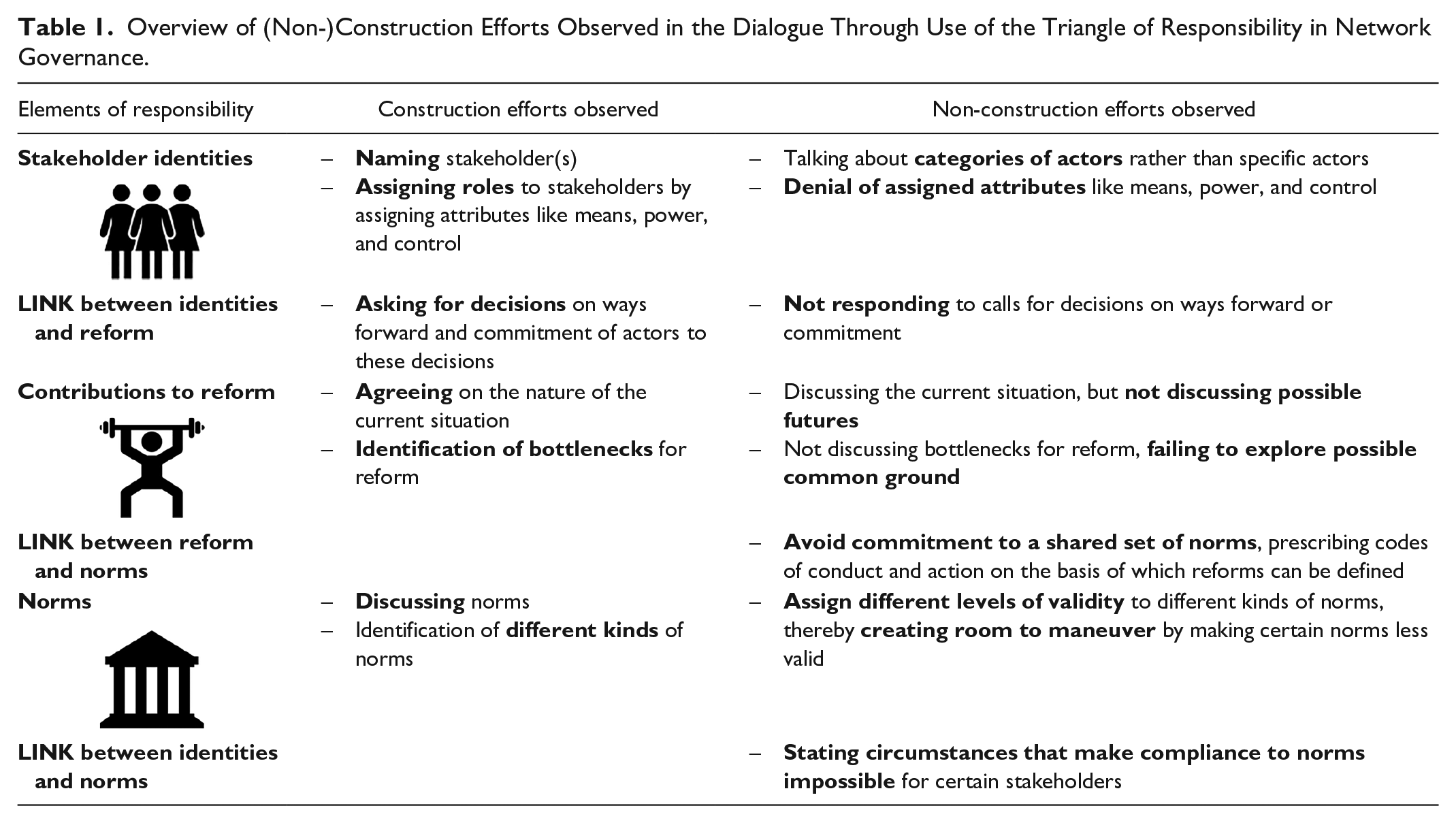
Without seeking to be exhaustive in the ways in which construction of (non-)responsibility took place, we illustrate below how the model helped to surface different instances in which this construction significantly presented itself, employing the proposed model. While we found instances of construction of both responsibility and non-responsibility, we focus on construction of non-responsibility. We do this to shed light on the limitations in network effectiveness that our analysis exposed in this case—limits that at least some participants sensed, but that otherwise did not become explicit in the dialogue or the participants’ reflections on it. An overview of the findings is provided in Table 1, with the different acts of (non-) construction in bold.
Overview of (Non-)Construction Efforts Observed in the Dialogue Through Use of the Triangle of Responsibility in Network Governance.
Stakeholder identities, reforms, and the linkages between them
Constructing stakeholder identities
Different stakeholder identities were named during the dialogue. Stakeholders frequently spoke of “government,” “the sector,” “farmers,” “citizens,” “consumers,” “residents,” and “retail” as actors who need to make certain contributions to reform. These responsibilities are based on the premise that if a stakeholder has certain attributes, a specific kind of behavior is to be expected of this stakeholder in terms of roles, qualities, convictions, and aspiration. However, stakeholder identities tended to remain as broadly constructed as the terms suggest—pointing to categories of actors rather than specific actors who can be approached and from whom commitment to responsibilities can be asked. This left much room for actors to maneuver if actors called on responsibilities. In the dialogue, it was not specified who exactly were meant by “the government” or “the sector,” for example. Moreover, stakeholders that are assigned attributes related to their roles, qualities, convictions, and aspirations need to acknowledge having those attributes. By denying attributes, stakeholders can excuse themselves of specific contributions to reform associated with those attributes. In this case study, excusing appeared around identity attributes of means, power, and control. Excusing in terms of means happened when stakeholders from the primary sector repeatedly stated that they did not have the means to act on certain responsibilities. For instance, a representative of a farmer’s organization argued that farmers can only build one stable during their lifetime and that because of this, opportunities for farmers to contribute to reform are limited. An example of excusing in terms of control can be found in stakeholders from retail stating that they were not able to implement certain standards because of the Dutch laws on economic competition. Excusing in terms of power happened when stakeholders from the sector repeatedly stated that they would not be able or willing to take certain measures because they lack the necessary power. For example, the following statement portrays the government as the only stakeholder with the power necessary to take certain measures, as in the following statement by a primary sector representative: The sector can do many things, as we have discussed. About the government, we said: what is the role of the government that it has and will continue to have? In other words: what things can’t be done by the sector? That’s the discussion about location and location conditions. That’s something the government will have to keep doing. The sector can’t do that.
In statements like these, the attributes of the government and of the sector are weighed against each other, determining their respective responsibilities in terms of identity.
Constructing reforms
Stakeholder identities consist of attributes related to roles, qualities, convictions, and aspiration that need to be clearly defined and accepted by specific stakeholders in order for responsibilities to be successfully assigned. The same goes for the contributions to reform these responsibilities entail. By reaching agreement on the untenable nature of the current situation at the beginning of the dialogue, a starting point for discussing reforms was created, which participants repeatedly confirmed during the dialogue. However, contradictions between perspectives continuously emerged. For example, stakeholders embraced the need for an integrative process of change, in which the different relevant policy areas were identified and put opposite each other to find possible synergies and bottlenecks. However, going beyond the identification of these synergies and bottlenecks turned out hard, because stakeholders had very different ideas on how these should best be addressed. For example, discussions on farm size and location, identified as important parameters for overcoming problems in terms of environment and landscape, explored options and issues but did not lead to resolution. For example, a discussion about setting a boundary for the total number of animals did not evolve into a discussion on what this number should be. Instead, the discussion continued on whether such a boundary would be a good idea and whether such a boundary would actually lead to the necessary reform. This was called into question by other stakeholders, who stated that setting a boundary on numbers is not the right way to go, as numbers do not define animal welfare. This discussion took place between a smaller group of stakeholders, specifically set up to explore possibilities for integration of policy measures for animal welfare, the environment, and sector prosperity.
Such exchanges, in which stakeholders discuss possible reforms but do not find common ground on which future reforms can be build, are exemplary for the dialogue. Stakeholders rarely reacted directly to the actual content of statements but rather posed opposing statements from their own viewpoint. Thereby, stakeholders often positioned themselves in the discussion rather than seeking common ground. Interaction thereby often did not lead to resolution of difference on what reforms to strive for. Rather, the number of possible reforms grew as the discussion continued. Such dynamics are commonly identified in governance networks (Klijn & Koppenjan, 2015). But this dynamic is embedded in a dynamic around responsibility, as we will show.
Constructing the link between stakeholder identities and contributions to reform
A strong link between stakeholder identities and contributions to reform enables responsibilities to be assigned. Stakeholders who deny having the right attributes to make certain contributions to reform, however, weaken the link between stakeholder identities and contributions to reform, agreed upon or not. Regardless of whether these rejections of responsibility are well founded or not, the fact that they are numerous throughout the dialogue shows a tendency toward rejection of responsibilities. This meant that there were many moments that could have presented potentially catalyzing moments of ideas being translated into action through responsibility construction. But this did not happen. It must be stated, however, that there was a clear divide between stakeholders from the primary sector and retail on one hand, and civil society actors on the other. The latter called on the former, or the meeting as a whole, to define attributes, define reforms, and establish links between the two, by asking for decisions on ways forward and commitment of actors to these decisions. These invitations, however, lead to little or no response from retail and sector representatives. This pattern of “pulling” away from responsibilities by certain stakeholders, accompanied by a “pushing” of these responsibilities by others, is recognizable throughout the dialogue, hindering progress.
Reform, norms, and the linkages between them
Constructing norms
As no collectively recognized reforms to strive for were defined, it was also not yet possible to establish new norms that specify what contributions to reform need to be made by what actors. Existing and hypothetical norms and types of norms, however, talking in past and future tenses, were discussed. Different manifestations of norms were named: laws, societal norms, and covenants. These norms were discursively presented as being different in terms of their level of ambition, flexibility, origin, and validity. Concerning ambition and flexibility, laws, societal norms, and covenants were discussed as setting standards with different levels of ambition. Laws, for example, were often estimated as having lower standards than societal norms and covenants and also as belonging to a “previous era.” Societal norms and covenants, on the contrary, were more often described as innovative in setting newer, higher standards in terms of, for example, animal welfare and pollution control. Propositions on these fronts, however, were met with contestation from sector representatives, as in the following statement by a pig farmers’ organization representative: What I’m struggling with: I hear that we all want to do more than is legally obliged in the Netherlands. We all think that is necessary, but as a farmer you have to face the market where the bill is settled in a ruthless fashion. And if we say: “we together believe that the bar should be at this particular level, legally,” and we leave this room tonight and we say, “we are going to act the tough guy and put the bar up here,” then we sign the death warrant for our farmers.
Considering origin and validity, stakeholders constructed laws as setting hard boundaries for acceptable action. Societal norms were constructed as being more “soft,” describing desirable standards to strive toward. This same softness was assigned to covenants, which were often articulated in terms of goals and ambitions rather than implementing a hard bar. In contrast, when referring to laws, stakeholders spoke of “the law,” implying that there is one, absolute law that trumps alternative norms, for example: My limitation is regulation on competition. We had a few cases, I won’t name them, in which we said: “let’s set ambitions that go further than the law.” But within 24 hours, the national competition authority [enforcing anti-trust law] knocked on our door. It happens all the time. Maybe that some things are approached differently, because people are already saying “there should be a gold standard.” Let a 1000 flowers bloom. (Retail representative)
In addition to such statements about the possibilities of retailers to set production standards being limited, stakeholders also referred to animal welfare standards and labels introduced through NGOs. However, for these standards to be valid, stakeholders from the primary sector and retail stated that they should be made into laws first. In addition, deviation from laws was referred to as illegal and punishable. In contrast, when stakeholders talked about societal norms or covenants, they referred to these as norms that “should be obliged” or that “should be set.” People who disobey these norms were described as “free loaders” or “free riders,” making deviation from these norms a moral choice, be it a problematic one. Societal norms and covenants therefore were presented as less absolute than laws.
Constructing the link between reforms and norms
By speaking of norms, stakeholders in the dialogue constructed (non-)responsibilities by constructing norms that prescribe specific kinds of conduct and action, as valid or invalid. In this way, the link between different types of norms (covenants, societal norms, and laws) and the kinds of conduct and action they prescribe, leading to reform, was constructed as being weak or strong based on their differences in their level of ambition, flexibility, and origin related to their validity. Different stakeholders advanced or denounced different norms advancing different standards for livestock farming, thereby hindering or strengthening linkages between norms and reforms.
Producers described the law as the only norms they have to stick to, thereby diminishing covenants and societal norms, while stakeholders from other societal groups describe covenants and societal norms as equally valid. In short, different kinds of norms for reform were constructed. As laws, societal norms, and covenants set different standards and are assigned different levels of validity, having these different sets of norms created the possibility for the stakeholders to choose one of these sets over another and not commit to a shared set of norms, prescribing codes of conduct and action on the basis of which reforms could be defined. Thereby, the norms that apply to contributions to reform were ambiguous, creating room to maneuver and decline responsibilities.
Norms, stakeholder identities, and the linkages between them
Constructing the link between norms and stakeholder identities
Stakeholders can be made responsible for reforms only when a clear set of norms is constructed as applicable to specific stakeholders. Absence of the same creates weak linkages between stakeholder identities and norms. Throughout the dialogue, we observed two different ways in which stakeholders influenced the strength of the link between norms and stakeholder identities. The first is by stating that there are circumstances that make compliance to norms impossible for certain stakeholders. To decline responsibility, stakeholders challenge the quality or applicability of norms, considering the lived reality of farmers. For example, representatives of farmers’ organizations stated that the continuity of norms leaves much to be desired, leaving farmers in a position where it is difficult to live up to expectations and survive: The hard thing is that at one time, a farmer is pulled in this direction, and then another direction, and within that segment, a farmer has to make his investments.
A second way in which stakeholders influence the link between norms and themselves is by stating that norms violate their stakeholder-specific attributes. For example, It is my concern that we as retail are not meant to be a policeman of the whole chain. We do not want to be put into that role. (Retail representative)
With the statement above, the retail representative was not challenging laws or an existing covenant. He did, however, challenge any suggestion that retail has a key and decisive role in steering the collective shift to more sustainable production, as some participants argued, mainly by suggesting that retail has the option to stop selling products not meeting certain higher standards of production. Such contributions to the dialogue pointed to the fact that it is at the point of purchase that final and crucial consumer decisions are made. By arguing against such linkages between norms and identities, stakeholders contributed to weakening the construction of responsibilities.
Discussion
The only way to solve complex and ill-defined problems in the face of conflicting demands and objectives is by bringing together the relevant and affected actors and facilitate a process of collaborative problem solving that encourages mutual learning and fosters joint ownership to new and bold solutions. (Torfing & Sørensen, 2014, p. 335)
This is how Torfing and Sørensen paraphrased a key starting point for network governance presented by Klijn and Koppenjan 10 years before. Indeed, high hopes for network governance seem something of a constant in the debate on it. This does not mean effectiveness has been taken for granted. The literature on network governance has certainly problematized performance and made efforts to identify factors contributing to effectiveness, from an institutionalist perspective, and with a strong focus on managing complexities of network governance from that perspective (Klijn & Koppenjan, 2015; Ostrom et al., 1994; Provan & Kenis, 2008). Our analysis takes a different angle: Zooming in on dynamics around responsibility that take shape in the interaction taking place in a network, we lay bare the role of this construction in moving and preempting decision and action. We show that the ambition to attain “collaborative problem solving encouraging mutual learning and fostering joint ownership to new and bold solutions” can be frustrated deeply through the interaction in a network. Moreover, we showed that it is important to pay close attention to this process and its implications, because the grave implications of the construction of non-responsibility were never acknowledged and addressed.
The stakeholder dialogue started out from a broad agreement that there is a crisis that needs to be acted on and that the livestock farming sector itself absolutely needs to act to advance sustainability. Coming together in a retreat for 2 days, with a range of key stakeholders and a prominent, respected, and able facilitator, the network appeared to be set for success. The meeting started out cordially, and with much apparent mutual understanding. When the meeting ended, that same cordiality and mutual understanding was still there, on a basic level of agreement on the issue and the need to act. The facilitator concluded on a positive note. At the same time, progress, after 2 days, appeared little concrete, and some stakeholders explicitly lamented this and wondered if now, in fact, change would indeed happen. At the same time, what might have gone wrong was not actually addressed. This is not surprising. Much of the turning down of the same had been through implicit and diverse acts preempting establishment of responsibility. Through their discursive acts, stakeholders stopped the establishment of shared norms, reforms based on these norms, identities from which to enact reforms, and strong linkages between the three. First, considering norms, reforms, and the linkages between them, diverse norms for behavior were asserted, and conflicts between these were not addressed and resolved, but left to be. Because norms were not agreed upon, standards for contributions to reform could not be defined. Second, considering norms, identities, and the linkages between them, to decline responsibility, stakeholders challenged the quality or applicability of norms, considering the lived reality of farmers. Norms regarding production were shifting or existing regulation was tight, making acting upon norms very difficult for farmers. Third, considering identities, reforms, and the linkages between them, by denying identity attributes, in this case means, control, and power, stakeholders rejected specific contributions to reform.
In short, while in apparent agreement on the urgency of the situation and the need to act, stakeholders discursively avoided taking responsibility for action. They did this without open conflict: By asserting and accepting diverging norms and not seeking agreement on goals, stakeholders simply did not move to a stage where contributions to reform could be assigned. By arguing that norms upholding sustainability could not be applied to farmers because of their nature, participants from the primary sector denied the capacity to commit to responsibility. By denying means, control, and power to act, the sector, similarly, denied capacity to commit to responsibility.
Our analysis offers us proof of concept, substantiating our theoretical discussion. It also offers some basic lessons as to the relevance of considering network effectiveness in terms of construction of responsibility. First, the analysis shows us how, implicitly, negotiation of responsibility can be a key element in the interaction in a governance network without it being explicitly addressed as such. Second, the analysis shows us how we can understand the result of interaction in a governance network better by surfacing this negotiation by discourse analysis. Third, it shows that network governance may create situations where responsibilities are not only not taken but also not addressed. The cordial and mutually respectful dialogue may have been a good exploration of needs, intentions, ideas, and challenges. But as an instrument for furthering change, its value has been delimited by the choice to stay away from the question of responsibility. And, finally, the analysis shows the importance of problematizing the assumed power of networks. While taking part as key players and as those on whose shoulders responsibility rests, participants made many efforts to deny identities as powerful actors or their power to act. The stepping away from responsibility happened in multiple small instances without the facilitator or stakeholders intervening to address it as a problem for the network’s effectiveness. While in many instances participants denied ownership of the problem, at no point were implications of this accepted and articulated: that this network was not in a position to effectively address the problem it came together for. Responsibility assignment and issues around this were not made explicit, no matter how key they were, and remained under the radar.
Our findings will have been influenced by the specificity of our case, for example, in the sense that some participants working toward non-decision will likely have been motivated a least partly by the material impact that defining and taking responsibility would have had on some of them, while for others this impact would have been less material. In other networks, stakes and their distribution will be different, and this will likely shape interaction toward different outcomes. However, our model (the “triangle of responsibility in network governance”), being generic, can be applied in many other cases and can thereby help make explicit to network actors and analysts thereof, how governance networks construct responsibility in interaction, and with what consequences for network effectiveness. It is in particular in the context of development of ownership, and barriers to this ownership, that we see our model’s added value. An important value of the “triangle of responsibility in network governance” lies in its usefulness as a tool for making explicit, and thereby addressable, issues and processes around responsibility.
This analysis may thereby also form a starting point for developing facilitation of network governance that makes this negotiation of responsibility explicit so that it can be acknowledged and addressed by network members. In light of ownership questions, such facilitation can help explore the options for taking ownership, identify barriers, and articulate and address the consequences. Such an endeavor may help develop necessary collective action for the future of livestock farming, as well as for other fields in which governance networks deal with complex issues, such as climate change, food security, and public health.
Footnotes
Declaration of Conflicting Interests
The author(s) declared no potential conflicts of interest with respect to the research, authorship, and/or publication of this article.
Funding
The author(s) received no financial support for the research, authorship, and/or publication of this article.
