



Abstract
Guided by affective events theory (AET), our inquiry aims at examining the relationships among affective work events, affective states, affect-driven behaviors, and attitudes of international faculty working in the Malaysian institutions of higher learning. Specifically, the impacts of interpersonal conflict, as a work event, on international faculty’s affective states were in focus. In addition, the mediating role of job performance, as an affect-driven behavior, on the relationship between affective states and job satisfaction, as an attitude, was examined. Data were collected from 152 respondents and partial least squares structural equation modeling (PLS-SEM) was applied to estimate the proposed theoretical model. Our model was examined from an explanatory-predictive perspective and exhibited a high level of out-of-sample predictive power. In addition, the results of the analysis highlighted the role of interpersonal conflict in causing affective states and affective states in causing job satisfaction. However, empirical evidence was not provided for the mediating role of job performance within the proposed model. Finally, given the fluctuating nature of the affective states, a robustness check verified the nonlinear relationship between positive affect and job performance. Implications of the findings, limitations, and recommendations were elaborated.
Keywords
Introduction and Context
As a means to become more globalized, universities have taken different initiatives to incorporate internationalization and have re-evaluated their roles and approaches toward learning in the context of a globalized society (Bourn, 2011). These entities are viewed as the growth machines of economy and technology in the developing countries. Given the importance of the internationalization practices in the academic settings, the notion of a borderless knowledge-driven economy has considerably increased the need for institutions of higher learning to attract international talents (Wildavsky, 2010) and become more globalized and internationalized. It is important to highlight that the concept of human movement—that affects and is affected by factors such as race, ethnicity, social structure, and political policies—is viewed as a global phenomenon of people searching for an improved existence and an increased quality of life (Vandeyar, 2020). In the context of Higher Education (HE), the mobility among international faculty is encouraged by common push-pull factors such as economic and non-economic decisions, career opportunities, and access to facilities and funding (Mihut et al., 2017). Related to the concept of mobility is the space and pace of globalization in HE, thus creating a greater impetus toward the internationalization of institutions of higher learning (Saltmarsh & Swirski, 2010). While the review of the literature shows that the issues related to the internationalization and globalization in HE have gained the attention of the researchers (see Bourn, 2011; Hamann & Zimmer, 2017; Larbi & Fu, 2017; Lau & Lin, 2017; McAllum, 2017), the area of the daily affective experiences of the faculty has remained as a relatively unexplored area within the literature. More specifically, only limited studies (e.g., Ghasemy, Erfanian, & Gaskin, 2020; Ghasemy et al., 2019; Ouweneel et al., 2012) were found in HE context focusing on the antecedents and consequences of academics’ emotions.
Arguably, international faculty may not be able to advance societies and serve the hosting countries if they are not emotionally prepared. In fact, as explained by affective events theory (AET; Weiss & Cropanzano, 1996), emotional responses to affective work events are the key determinants to the individuals’ job performance and job satisfaction and in our case, the international faculty.
Focusing on Malaysia as a developing economy with ambitions for internationalization, international faculty refers to the non-Malaysian individuals holding a foreign passport and employed on a full-time basis at Malaysian institutions based on 1- to 3-year contract arrangements (Wan & Morshidi, 2018). Not only the increase in the number of private institutions, but also the internationalization in HE, as a global trend, has contributed to the growth in the number of international faculty in Malaysian HE domain (Wan & Morshidi, 2018). According to the 2018 statistics published by the Ministry of Higher Education Malaysia, 8.16% (n = 4,462) of the faculty working in Malaysian institutions have been international faculty, of which 67.46% (n = 3,010) were affiliated to the private institutions. Therefore, it is vital to understand them and to put efforts in selecting, hiring, and retaining international scholars into the academy. In line with this, a recent study by Wan and Morshidi (2018) investigated the selection and retention of the international faculty in three Malaysian public research universities and offered a typology of international faculty with three types including (a) those recruited for the purpose of global university rankings, (b) those expected to contribute predominantly through research and publication, and (c) those recruited based on some special needs.
This said, and given the inadequacies in the literature of the predictors and outcomes of emotions experienced by the international faculty and to rectify this shortfall, this study mainly seeks to examine whether a few of the main AET’s central predictions are supported by empirical data. Particularly, the article contributes to the growing literature surrounding international faculty and globalization through focusing on psychological states and affective work events as determinants of job satisfaction and job performance of international faculty at Malaysian universities. Furthermore, while based on AET, there is no linkage between job performance and job satisfaction, due to the conflicting results in terms of the effect and the direction of the relationship between these two constructs (Judge et al., 2001; Schermerhorn et al., 2010), the evaluation of the impact of job performance on job satisfaction was considered in this study.
As a result, our inquiry makes a theoretical contribution regarding the verification of a few basic tenets of AET in HE landscape from a predictive-explanatory perspective and enriches the current literature regarding the impact of affective states (e.g., emotions and moods) on two outcomes namely, job performance and job satisfaction. This is crucial since, from the leadership perspective, for example, emotional intelligence (Cherniss et al., 2006; Goleman, 2013) has been a major contributor to different organizational outcomes. In addition, it links HE with psychology, leadership, and organizational behavior disciplines and provides policy makers with a set of practical and evidence-based policy recommendations with respect to creating emotionally safe universities where international faculty feel a sense of belonging and perform well.
The rest of the article is organized as follows: The second section reviews the literature and the theoretical arguments upon which the proposed theoretical model is based, third section describes the methodology, fourth section offers the results, fifth section presents the main discussions, conclusions and the implications of the findings, and final section covers limitations and future directions.
Theoretical Framework
Our study is built upon AET (Weiss & Beal, 2005; Weiss & Cropanzano, 1996). The theory primarily builds on the previous established cognitive appraisal models, is supported by many studies in the field of emotions, and has created a more encompassing theory of work behavior (Redmond, 2007). The basic notion of AET is that events, that are caused by work environment features, influence affective states, and the affective states subsequently and directly influence affect-driven behaviors (e.g., job performance) as well as attitudes (e.g., job satisfaction) of people (Schermerhorn et al., 2010). Moreover, personality dispositions have been viewed as the variables moderating the relationship between events and affective states (Weiss & Cropanzano, 1996). The figurative summary of the main tenets of AET has been shown in Figure 1.
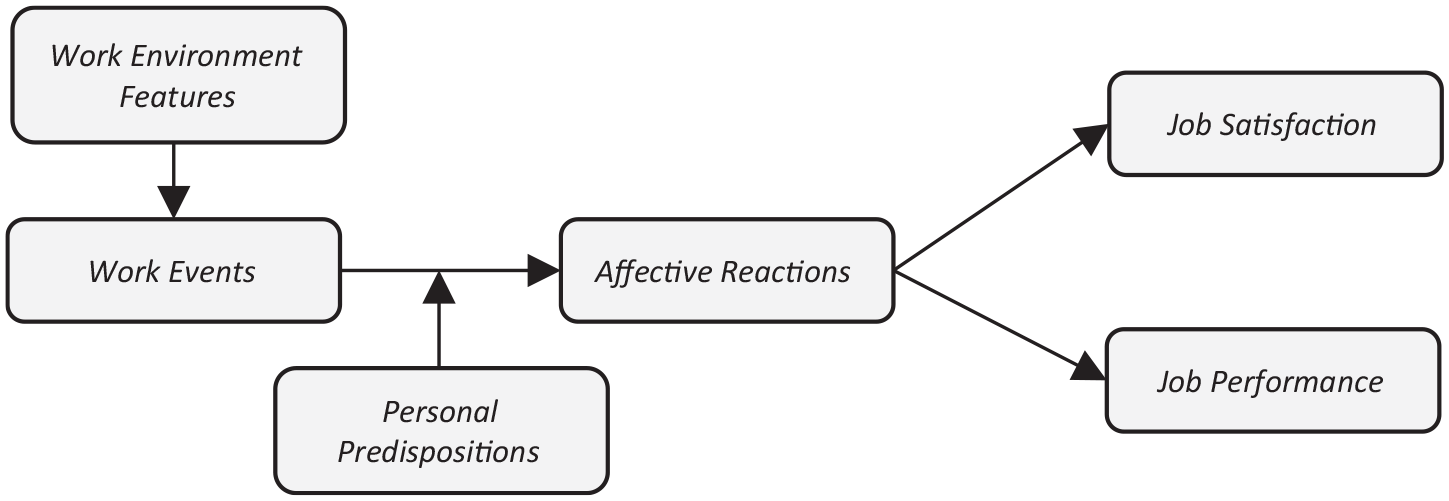
Figurative summary of affective events theory (Schermerhorn et al., 2010).
Although several investigations in different domains have empirically tested the structure of AET, we provide a review of the literature relevant to the theoretical framework of this study, exhibited in Figure 2.

Theoretical framework of the study.
It is important to highlight that interpersonal conflict, that is a work event, refers to having experiences of bad relationships or working with others with whom one does not get along (Schermerhorn et al., 2010); affect is defined as the range of positive and negative feelings in the forms of emotions and moods that is experienced by people in their life context (George, 1996); job satisfaction is describted as a positive or negative evaluative judgment of an individual’s job or job situation (Weiss & Beal, 2005; Weiss & Cropanzano, 1996); and finally, job performance is defined as the total anticipated value added to the organization by the discrete behavioral episodes that an individual carries out over a standard course of time (Motowidlo & Kell, 2003). Notably, given the role of gender and marital status, as two of the widely used covariates in organizational research (Bernerth & Aguinis, 2016), we considered them in our theoretical model.
The Impact of Events on Affective States
The review of the literature regarding the link between events and affective states shows that many studies have corroborated this causal effect. For instance, Bono et al. (2013) found independent linkages between positive work events, negative work events, and work–family conflict with some health-related problems such as perceived stress. In another study by Fuller et al. (2003), empirical evidence was found for the relationship between the stressful events and the state strain. In addition, the study by Schulz (2013) revealed a negative relationship between role conflict and faculty’s job satisfaction. Finally, Starzyk et al. (2018) found evidence for employees’ problem-focused voice in meetings being associated with a decrease in employees’ state negative affect at the end of the next workday. In line with previous studies drawn upon AET, we hypothesize the influence of interpersonal conflict, as a work event, on the affective states of the international faculty.
The Impact of Affective States on Attitudes
Guided by AET, Judge et al. (2006) found evidence for the effect of state hostility, as an affective states, on job satisfaction, as an attitude. In addition, Miao et al.’s (2016) meta-analysis study corroborated the positive relationship between the emotional intelligence of leaders and job satisfaction of followers. Moreover, Rezvani et al. (2016), in the context of Australian defense industry, found empirical evidence for the positive relationship between emotional intelligence of project managers and their job satisfaction, trust and project success. Finally, in the context of HE, Ghasemy, Erfanian, and Gaskin (2020) and Ghasemy, Mohajer, et al. (2020) found empirical evidence for the contribution of affective states to faculty’s job satisfaction. In line with these research findings, we developed the following two hypotheses:
The Mediating Role of Affect-Driven Behaviors in the Relationship Between Affective States and Attitudes
With regard to this linkage, Zhao et al. (2007) found empirical evidence for the linkage between negative affective states such as mistrust and violation with affect-driven behaviors (e.g., job performance and organizational citizenship behavior). In another study, the findings of Beasley and Jason (2015) verified the relationship between Person-Environment (P-E) fit, as an affective experience, with citizenship behavior, as an affect-driven behavior. Also, as found by Ashkanasy et al. (2014) in the context of open-plan offices, anger and frustration have been the causes of a few affect-driven behaviors such as territoriality (invasions of territory in workplaces). Finally, Whitman et al. (2010) found empirical evidence for the unit-level job satisfaction-job performance linkage. However, as addressed by Schermerhorn et al. (2010) and Judge et al. (2001), there is substantial debate on the issue of the causality between job performance and job satisfaction. For this reason, since it generally makes sense that when the employees perform well, they should feel good and be satisfied about their job (Schermerhorn et al., 2010), the causal job performance–job satisfaction linkage was added to the model to investigate whether affect-driven behaviors would predict attitudes of international faculty working in Malaysian universities. Consequently, the mediating role of job performance, as an affect-driven behavior, in the relationships between affective states and job satisfaction were hypothesized.
Method
Research Design
This survey study is a quantitative research work that is supported by the post-positivism worldview considerations and assumptions (Creswell, 2012). With respect to the nature of the study, our inquiry is an explanatory-predictive research work which mainly aims at investigating the statistical inference of path coefficients, effect sizes, predictive performance of the model, and the prediction errors (Henseler, 2018). In our study, we used an online self-report survey since it can be administered to a large sample quickly, though this type of surveys have disadvantages such as social desirability bias and response bias (Demetriou et al., 2015). Yet, self-report questionnaires deem to be suitable for measuring constructs such as job satisfaction and many other private events (Chan, 2009).
Analytic Procedure
To ensure the quality of the results of this explanatory-predictive study (Ghasemy, Teeroovengadum, et al., 2020; Hair et al., 2019; Henseler, 2018), partial least squares structural equation modeling (PLS-SEM) was run. This selection was based on reasons such as testing a theoretical framework from a prediction perspective and requiring latent variable scores for follow-up analyses (Hair et al., 2019) as well as undertaking an incremental research (Chin, 2010).
It is important to note that we considered the latest evaluative PLS-SEM analysis guidelines proposed by Ghasemy, Teeroovengadum, et al. (2020) and employed SmartPLS 3 (Ringle et al., 2015) for data analysis.
Measures and Covariates
The 10-item generic job satisfaction scale by Macdonald and Macintyre (1997) was employed to measure job satisfaction. The term “company” in one of the items in the original scale was changed to “institution.” The respondents rated the items using a 5-point equidistant and symmetric Likert-type scale ranging from 1 (strongly disagree) to 5 (strongly agree).
Spector and Jex’s (1998) four-item Interpersonal Conflict at Work Scale (ICAWS) was used to collect data for interpersonal conflict. A 5-point scale (1 = never, 2 = rarely, 3 = sometimes, 4 = often, 5 = always) was provided so that the respondents would be able to rate the items.
In addition, Watson et al.’s (1988) Positive and Negative Affect Schedule (PANAS) was employed to provide measurement for positive and negative emotions. This scale consisted of 20 words describing different positive and negative affective states. The respondents were asked about how they felt at work on the average and were provided with a 5-point Likert-type scale, ranging from 1 (very slightly) to 5 (extremely), to rate the items.
Notably, while endogeneity, as a source of bias in PLS-SEM modeling when estimating path coefficients (Hair et al., 2019), is a matter of concern in primarily explanatory studies and given the fact the current study is predictive-explanatory in nature, two covariates namely, marital status (married and single) and gender (male and female) were introduced to the proposed model to address the issue of endogeneity (Hult et al., 2018), as a recently recommended robustness check (Sarstedt et al., 2020).
All the items have been provided in the appendix.
Participants and Sampling Procedure
The target population in our study is the international faculty working in Malaysian institutions of higher learning. According to the Ministry of Higher Education Malaysia, the proportion of the international faculty working in Malaysian universities and colleges in 2017 and 2018 have been 9.04% and 8.18%, respectively. In addition, the statistics published by this ministry shows that the overall number of international faculty has decreased from 7,273 in 2017 to 4,462 in 2018.
The participants were selected based on a simple random sampling method via SurveyMonkey system. In total, 152 surveys were collected that appeared to be suitable for data analysis. Specifically, given that the maximum number of arrows pointing to a construct (job satisfaction) in our model is 5, the results of the power analysis (Cohen, 1988; Faul et al., 2009) show that the minimum sample size should be 122 to properly estimate the model with a statistical power of 80% and at 5% significance level to observe R2 values of at least 10%. Therefore, we did not face any issues related to the sample size adequacy. Due to the small number of missing values within the data and considering the fact that any procedure for handling a scarce number of missing values (i.e., less than 5% per indicator) lead to similar results (Hair et al., 2017), they were replaced with the median of the variables. Subsequently, two items of the job performance scale were reverse-coded to make them consistent with other items. As the next step of data screening, multivariate outliers were examined through computation and evaluation of the squared Mahalanobis distance (Byrne, 2016). This analysis showed the presence of no extreme outlying case in the data set. Table 1 exhibits the demographic profile of the 152 international academics in Malaysian universities and colleges who participated in this study.
Demographic Information of International Faculty in Malaysian Institutions (N = 152).

Common Method Bias
We considered procedural remedies to diminish common method bias (CMB) during data collection. Nevertheless, prior to the main analysis, the potential CMB was investigated through performing a full collinearity assessment approach (Kock, 2015), though there are controversies over its application in the context of PLS-SEM. According to Kock (2015), when a full collinearity variance inflation factor (VIF) statistic achieves a value greater than 3.3, there would be an indication of pathological collinearity, thereby warning that a model may be contaminated by the CMB. Our assessment showed that the proposed model in this study, with the maximum full collinearity VIF value of 1.849, might be considered free of CMB.
Results
Assessment of the Measurement Models
This evaluation involves examining indicator reliability, internal consistency reliability, convergent validity, and discriminant validity (Ghasemy, Teeroovengadum, et al., 2020). Indicators reliability assessment was done by examining the correlations between each item and the construct (Hair et al., 2017), known as composites’ loadings or correlation weights of the items (Hair et al., 2018). To establish indicator reliability and in line with the recommendations by Ghasemy, Teeroovengadum, et al. (2020), we considered the loadings above 0.708 and dropped the non-contributing items from all the constructs.
Indicator reliability assessment was followed by evaluating internal consistency reliability. We estimated both Cronbach’s alpha and composite reliability (CR) as well as the new measure of Rho_A (Dijkstra & Henseler, 2015). The evaluation of the reliability estimates showed that all the estimates were above 0.7 and desirably below 0.95, indicating no cause for concern in terms of internal consistency reliability. Next, the convergent validity was assessed through examining the average variance extracted (AVE) measure. The examination of the generated AVE measure of each construct revealed that all the AVEs were above 0.5, indicating no cause for concern. Notably, in line with the recommendations made by Ghasemy, Teeroovengadum, et al. (2020), we computed the one-tailed 95% percentile confidence intervals of the three reliability statistics as well as the AVE values to provide a more precise picture of the measurement scales’ psychometric properties. This showed that all the lower bounds of the reliability estimates’ confidence intervals and, as desired, their upper bounds of the confidence intervals were within the range of 0.7 and 0.95. In addition, we observed that the lower bound of the AVE values’ confidence intervals were above 0.5. These results, displayed in Table 2, indicated no matter of concern with respect to reliability and convergent validity issues.
Correlation Weights, Reliability Estimates, and Convergent Validity Statistics.

Note. In accordance with the recommendations made by Ghasemy, Teeroovengadum, et al. (2020), the one-tailed 95% percentile confidence intervals [5%, 95%] of the reliability and validity statistics have been provided. CR = composite reliability; AVE = average variance extracted.
As the last step, discriminant validity was assessed based on Heterotrait-Monotrait (HTMT) criterion (Henseler et al., 2015), and consistent with the recommendations made by Ghasemy, Teeroovengadum, et al. (2020), we considered the evaluative guidelines proposed by Franke and Sarstedt (2019) to evaluate the HTMT values. More specifically, while these values should be less than certain values (e.g., 0.85 or 0.9) to indicate the establishment of the discriminant validity of the constructs (Henseler et al., 2015), we performed a one-tailed bootstrap inferential test to ensure that the upper bounds of the HTMT confidence intervals were less than the recommended threshold. The results of our assessment, displayed in Table 3, showed that all the HTMT values and the upper bound of their confidence intervals were less than 0.85, thus discriminant validity was adequate based on HTMT0.85 criterion.
Discriminant Validity Based on HTMT0.85.
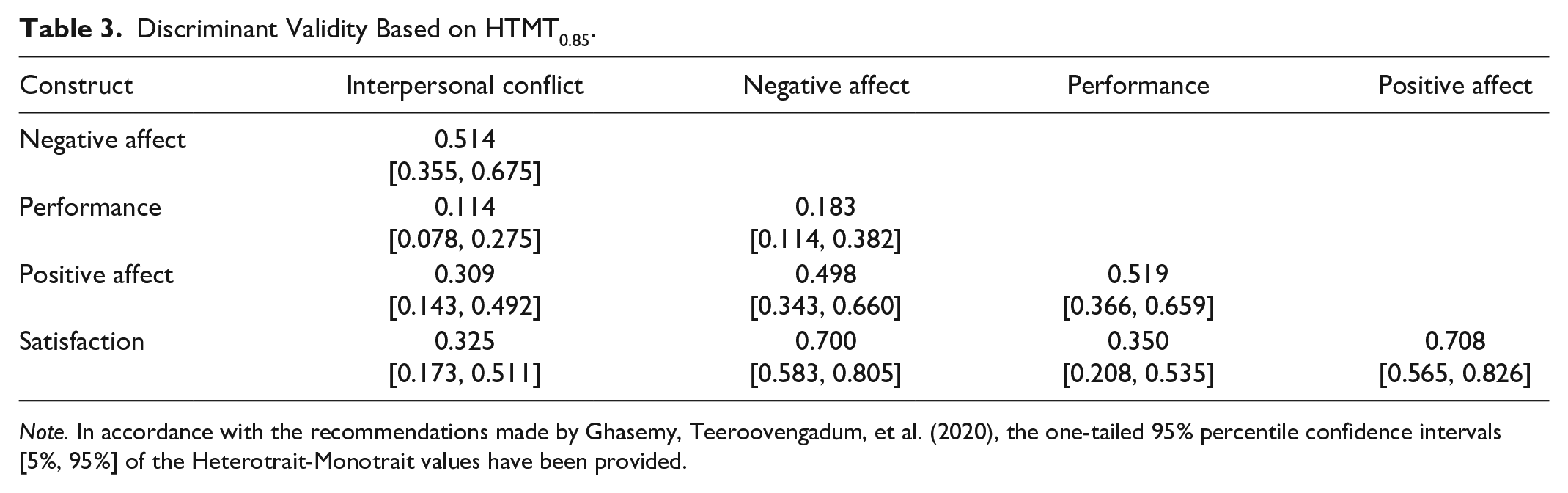
Note. In accordance with the recommendations made by Ghasemy, Teeroovengadum, et al. (2020), the one-tailed 95% percentile confidence intervals [5%, 95%] of the Heterotrait-Monotrait values have been provided.
Assessment of the Structural Model
As recommended by Ghasemy, Teeroovengadum, et al. (2020), the structural model evaluation in this study involved examining collinearity among the exogenous constructs, testing the significance and relevance of path coefficients as well as indirect effects, assessing model’s in-sample and out-of-sample predictive powers, examining f2 effect sizes as well as the unique contribution of the predictor variables to the R2 of the endogenous constructs.
To assess collinearity, while the VIF of each exogenous construct should be ideally less than 3 (Hair et al., 2019), the initial examination of VIF values showed that all the values were less than 2, thereby inferring no alert with respect to the collinearity issues.
Next, a one-tailed test of percentile bootstrapping at a significance level of 5% and with 10,000 subsamples (Streukens & Leroi-Werelds, 2016) was run to test the hypotheses. Regarding the examination of the covariates, we considered a two-tailed bootstrapping test at a 5% significance level and with the same number of subsamples. Table 4 has summarized the results.
Structural Model Evaluation Results.

Note. Bootstrapping based on n = 10,000 bootstrap samples; direct and the hypothesized effects assessed by applying a one-tailed test at 5% of significance level [5%, 95%]; effects of the covariates assessed by applying a two-tailed test at 5% of significance level [2.5%, 97.5%]; explained variance is the unique contribution of the predictors to the R2 values of the endogenous constructs. PCI = percentile confidence interval; VIF = variance inflation factor.
Our evaluation of the hypotheses testing results revealed that H1 to H4 were supported empirically. With respect to the relevancy of the path coefficients, all the significant paths representing H1 to H4 as well as the path running from positive affect to job performance were considered relevant due to the magnitude of the coefficients. Notably, the negative affect, in comparison with positive affect, had a stronger impact on the international faculty’s job satisfaction, as the target construct in our model. Focusing on the affective states, we observed that the magnitude of the path running from interpersonal conflict to the negative affect (0.459) was much stronger compared with the magnitude of the path linking interpersonal conflict with the positive affect construct (−0.273). Moreover, the relationship between positive affect and job performance was considerable and in fact, the strongest effect within the proposed model, as evidenced by the path coefficient with the size of 0.506.
With regard to the evaluation of model’s in-sample predictive power, contrasting R2 values with the evaluative cutoff points (0.25 = weak, 0.50 = moderate, 0.75 = substantial) proposed by Hair et al. (2019) showed that 56.7% of job satisfaction was explained by the five construct linked to it which was above the moderate level; the explanatory power of the model was relatively at a weak level in terms of explaining negative affect (R2 = 21.1%) and job performance (R2 = 22.3%); and only 7.4% of the variation in positive affect was determined by interpersonal conflict, indicating a very weak in-sample predictive power. Also, the assessment of the f2 effect sizes and contrasting them with the cutoff points (0.02, 0.15, and 0.35) suggested by Cohen (1988) showed that the effect size of negative affect on job satisfaction (f2 = 0.327) was relatively large. In addition, we observed that the effect sizes of positive affect on job performance (f2 = 0.250), the effect size of positive affect on job satisfaction (f2 = 0.238), and the effect size of interpersonal conflict on negative affect (f2 = 0.268) were above the medium level; and the rest of the effect sizes were small or ignorable.
Since the effect of job performance on job satisfaction was not statistically significant, it was not recognized as a mediating construct in our model and therefore, we failed to provide empirical evidence for H5 and H6. Given that H5 and H6 had been merely formulated based on the previous research findings, the rejection of these two hypotheses was consistent with AET as this theory does not assume any direct linkages between affect-driven behaviors (e.g., job performance) and attitudes (e.g., job satisfaction) (Weiss & Beal, 2005). Put differently, lack of empirical evidence for the mediating role of job performance provided more substantial support for AET.
The process of evaluating structural model evaluation was completed by running the PLSpredict analysis (Shmueli et al., 2019), albeit with the default settings, to evaluate the out-of-sample predictive power of the model. To hit this target, the mean absolute error (MAE) and the Q²_predict values of the PLS model as well as the MAE values of the linear model (LM) were focused. Table 5 has summarized the results with respect to job satisfaction, as the key endogenous construct within the model. The review of the Q²_predict values in the PLS-SEM results showed that all the Q²_predict values were positive. In addition, in terms of MAE values, the results revealed that none of the items of job satisfaction in the PLS-SEM analysis yielded greater prediction errors compared with the naive LM benchmark, indicating a high level of out-of-sample predictive performance of the model.
PLSpredict Results Based on Assessing MAE Values.

Note. MAE = mean absolute error; PLS = partial least squares; LM = linear model.
The final model displaying factor loadings, path coefficients, and model’s explanatory power for the endogenous constructs appears in Figure 3.
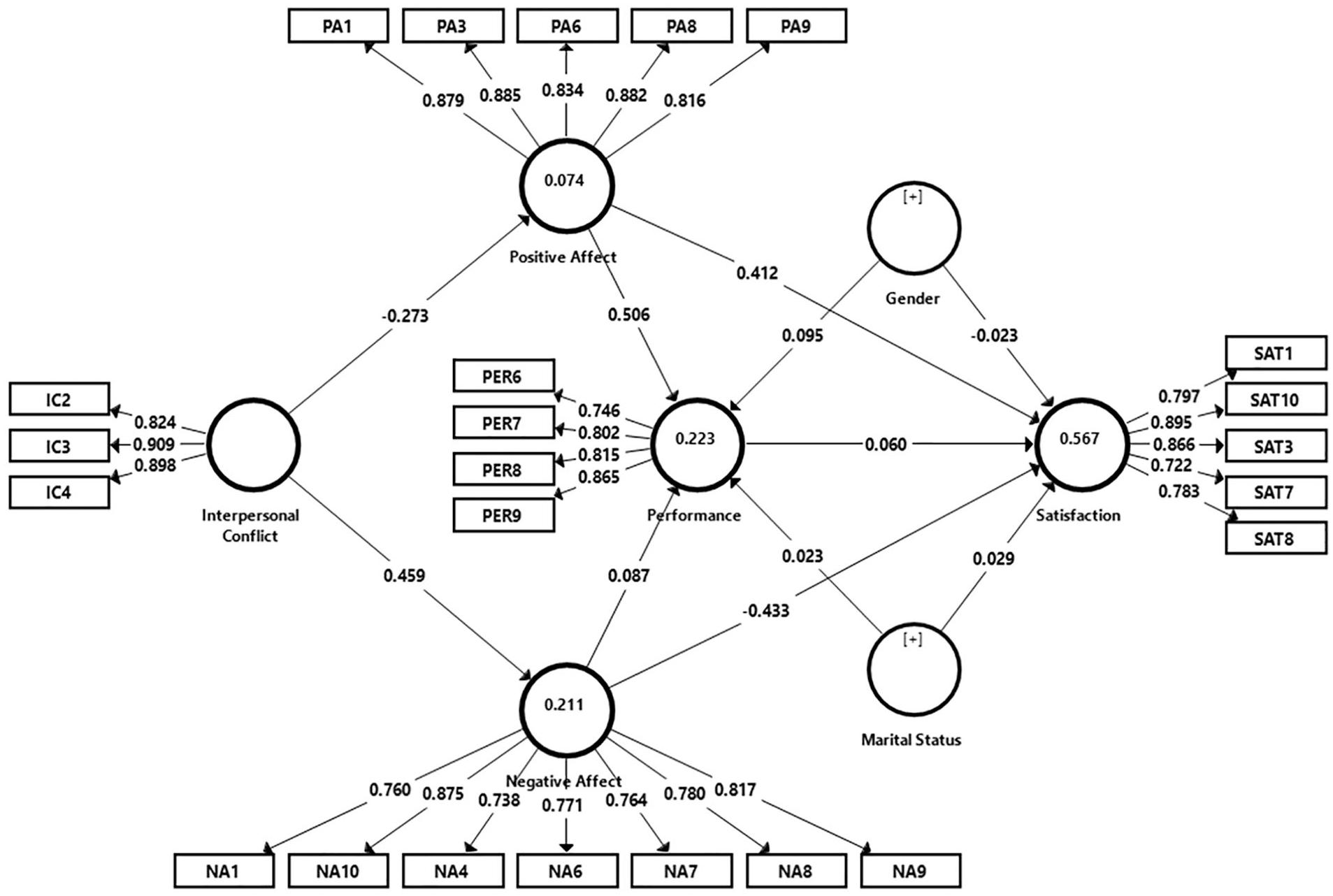
Final partial least squares model.
Robustness Check—Assessment of the Nonlinear Relationships
To assess nonlinear relationships (Hair et al., 2018), the quadratic effects between each pair of constructs were focused, albeit using the two-stage approach with default settings. This analysis was performed to check whether evidence is offered in terms of the linear effect’s robustness (Sarstedt et al., 2020). The results of the two-tailed percentile bootstrapping test at 5% significance level and with 10,000 subsamples revealed that only the quadratic effect of positive affect on job performance with the path coefficient of 0.154 was statistically significant (p = .047). In other words, this robustness check offered empirical evidence in terms of the linearity among the constructs within the path model with the only exception of the relationship between positive affect and job performance. Equation 1 explains the nonlinear relationship between positive affect and job performance within the model. Specifically, this is the equation of a quadratic effect (Hair et al., 2018) between the two constructs.

In addition, Figure 4 displays the linear relationship and the nonlinear curve between positive affect and job performance.
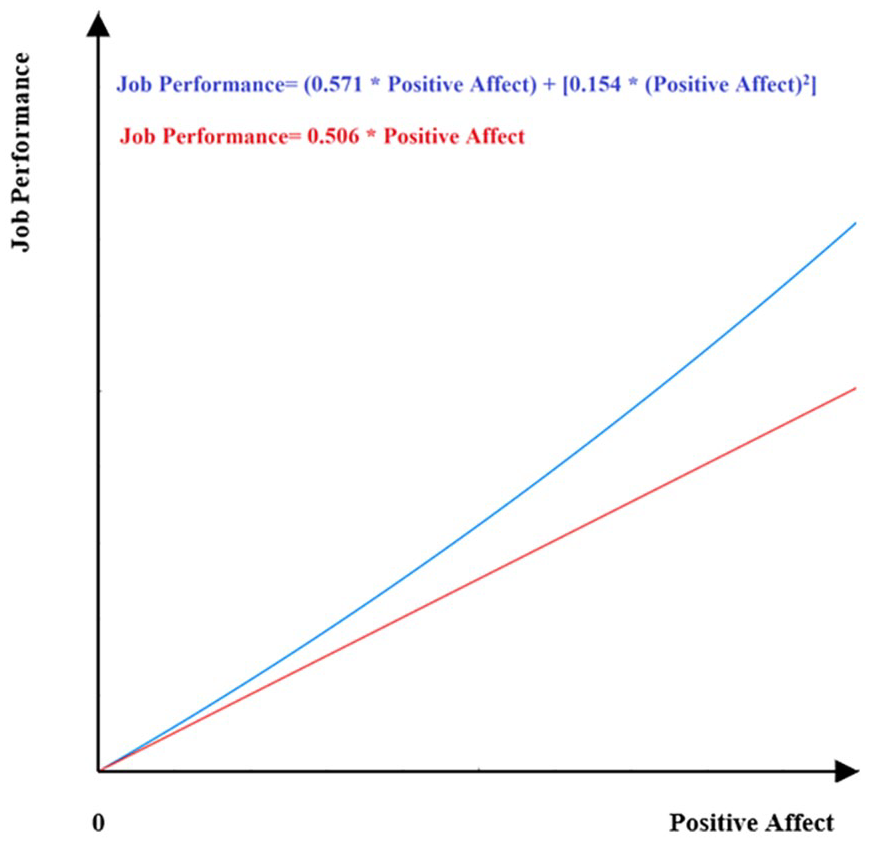
The linear and nonlinear relationships between positive affect and job performance.
It is important to note that given the quadratic effect was added to the model, the original linear effect of positive affect on job performance, which was 0.506, as displayed in Table 4, increased to 0.571, as shown in Equation 1, leading to the change of R2 value of job performance from 22.3% to 27.4%. Given that the f2 of the quadratic effect was 0.059, as suggested by Ghasemy, Teeroovengadum, et al. (2020) and based on the guidelines proposed by Kenny (2015), it was concluded that the effect size was large, implying the relevance of the significant nonlinear relationship between the positive affect and job performance. More importantly, due to the fluctuations of affect levels, affect-driven behaviors such as job performance are expected to be relatively short in duration and high in variability (Weiss & Cropanzano, 1996). This was in alignment with the concept of episodic performance introduced by Beal et al. (2005), as a way of better understanding how the fluctuation in emotional reactions impact concurrent job performance. Remarkably, while negative affective states are expected to fluctuate over time, we only observed a nonlinear relationship between positive affect and job performance.
Discussion, Conclusion, and Implications
This study, based on AET, aimed at investigating the impact of work events on emotional responses of international faculty which in turn, contribute to the affect-driven behaviors (e.g., job performance) and attitudes (e.g., job satisfaction). In addition, on the grounds of the existing literature, the causal relationship running from job performance to job satisfaction as well as the mediating role of job performance was investigated. Given that the impact of job performance on job satisfaction was not statistically significant, no empirical evidence was provided for the mediating role of job performance within the proposed model. This was consistent with the propositions of AET. In addition, focusing on job satisfaction as the key target construct in our theoretical model, the in-sample predictive power of the model was above the medium level and regarding the out-of-sample predictive power, our model exhibited a high level of predictive performance. Moreover, examining nonlinearity among the constructs within the model uncovered a nonlinear relationship between job performance and positive affect. Although we did not detect a nonlinear relationship between negative affect and job performance, our findings with respect to the nonlinearity between positive affect and job performance was in line with the concept of episodic performance where fluctuation of emotions play an important role in causing the individuals’ job performance (Beal et al., 2005).
Given the wide range of negative affect, the results of the analysis showed that feeling scared, hostile, distressed, nervous, ashamed, guilty, and irritable were among the main negative affect experienced by international faculty in Malaysian universities and colleges. While these negative affective states were identified as the main source of the international faculty’s job dissatisfaction, we observed that negative affect may not decrease the international faculty’s job performance. This, to a great extent, implied that these institutions might not be perceived by the international faculty as friendly and stress-free workplaces. As well, feeling determined, enthusiastic, alert, strong, and proud were identified as the main positive affective states quite strongly contributing to both job performance and job satisfaction of the international faculty. This was a promising finding since positive affect have been proven to cause other outcomes such as a more prosocial behavior (Dalal, 2005) and forms more favorable job attitudes and reactions (Judge & Ilies, 2004). The identified positive affective states appeared to communicate the message that the international faculty in Malaysian universities and colleges deem to stay strong in doing their jobs well and at the same time, they look for better positions, as indicated by their alertness and enthusiasm. This finding was also in line with the proposition that international faculty have a tendency to move from an institution in a developing or developed system to one of the most renowned institutions in the world (Wan & Morshidi, 2018). In addition, being efficient, effective, and hardworking were identified as the major aspects of international faculty’s job performance and with respect to the job satisfaction, issues such as satisfaction with salary, academic image and recognition, good and convenient working environments, and usefulness at work showed correlates with the international faculty’s job satisfaction.
Overall, while the study highlighted the importance of positive affect in contributing to the organizational outcomes, the results were in line with the findings of previous research works, thus providing further substantiation for AET from a predictive-explanatory perspective in the context of HE research. For instance, consistent with Schulz (2013), our results indicated a negative relationship between the conflict and job satisfaction. In addition, the non-significant relationship between job performance and job satisfaction was in line with the propositions made by AET (Weiss & Beal, 2005). Moreover, we observed a positive relationship between interpersonal conflict and negative affect as well as a negative relationship between negative affect and job satisfaction which were in alignment with the findings of Fuller et al. (2003) whose study revealed support for the influence of stressful work events on job satisfaction through perceived strain, as a negative affective state.
With respect to the practical and policy implications of the findings, policy makers at ministry level should consider introducing appropriate guidelines or internal memorandum to promote a climate of mutual trust and emotional safety in universities and colleges. This is crucial since our study shows that positive affect is an important predictor of both job satisfaction and job performance of the international faculty. Also at university level, the leaders are urged to focus on creating universities with minimal level of negative work events as they are negatively related to positive affect and positively related to negative affect of the international faculty, albeit with a much larger effect on their negative affect. More specifically, while conflicts, as work events, can be both functional and dysfunctional (Schermerhorn et al., 2010), recognizing situations that have the potential for conflict and addressing them in ways that will best serve the needs of both the organization and the people involved are among the main management activities of the organizations (Walton, 1987). Indeed, understanding conflict appears to be a relevant and critical issue in workplaces, especially in the current changing HE ecosystem since it will remarkably result in decreasing productivity. As an example, the study by Shultz and Guimaraes-Iosif (2016) showed that role conflict was considerably and negatively related to faculty’s job satisfaction in the U.K. research-intensive universities. In addition, top university management still would be able to introduce new internal circular or adjust existing ones addressing the diversity of the international faculty, as evidenced in Table 1. This seems to be vital since globalization is becoming a major driver for change within HE (Bourn, 2011). As displayed in Figure 3, all the significant paths were practically relevant, thus allowing the top management of universities to institute internal directives based on meaningful, evidence-based, and relevant information since the proposed model exhibited a high level of out-of-sample predictive performance. It is important to note that the findings of this research, to a considerable degree, are applicable to those countries with similar HE systems to Malaysia, in terms of the role of the ministry, university governance structure and arrangement, and in terms of employment of international faculty.
From a theoretical perspective, we provided substantial support for the applicability of AET, from a predictive-explanatory perspective, in both HE domain and international HE. In addition, the nonlinearity of the positive affect-job performance linkage appears to be another main theoretical implication of the findings which was in line with the concept of episodic performance (Beal et al., 2005). Finally, this study added a significant value to the limited HE literature regarding the affective states experienced by the international faculty.
Limitations and Recommendations
Researchers are recommended to focus on other propositions of the theory or even on more comprehensive models drawn upon AET to provide a bigger picture of the contribution of workplace features to work events, affective states, behaviors, attitudes, and judgment-driven behaviors. Sector-specific and discipline-specific research endeavors are recommended as well. Although in this study, job satisfaction, that is one of the main attitudes in workplaces (Mitchell, 2011; Schermerhorn et al., 2010), was in focus, researchers, however, are recommended to consider other main job attitudes. In addition, in line with the suggestions made by Saltmarsh and Swirski (2010), researchers are invited to make effective comparisons across cultural or linguistic groups of international faculty on a much larger scale. Related to this point is the issue of gender. Given the existence of empirical studies on the relationship between emotions and job satisfaction in the context of AET (see Ghasemy, Mohajer, et al., 2020; Ghasemy, Morshidi, et al., 2021; Yan et al., 2018, as examples), we recommend the researchers to investigate gender differences among the international faculty in future AET-driven research works. Specifically, the examination of the nonlinear relationship between positive affect and job performance should gain more attention in future research. Moreover, considering the development of the HE emotions scale from the perspective of students (White, 2013), we recommend researchers to develop and validate a new scale to provide measurement for the emotions experienced by the faculty. In terms of methodological recommendations and in line with suggestions made by Mitchell (2011), a longitudinal design, addressing the fluctuation of emotional responses over time, will provide more precise insights on this matter. Finally, we recommend estimating AET-driven models using the PLSe2 methodology (Bentler & Huang, 2014; Ghasemy, Hazri, & Gaskin, 2021; Huang, 2013) which has been proposed to have the advantages of both the PLS and maximum likelihood (ML) methodologies (Ghasemy, Hazri, & Gaskin, 2021) and can provide a more accurate picture of the interrelationships among the constructs in more complex frameworks such as reciprocal models.
Footnotes
Appendix
Items of the Survey Instrument With Means and Standard Deviations.

| Code | Item | M | SD |
|---|---|---|---|
| IC1 | How often do you get into arguments with others at work? | 2.09 | 0.85 |
| IC2 | How often do other people yell at you at work? | 1.64 | 0.84 |
| IC3 | How often are people rude to you at work? | 1.80 | 0.86 |
| IC4 | How often do other people do nasty things to you at work? | 1.72 | 0.90 |
| PA1 | I feel enthusiastic at work in general | 3.78 | 1.05 |
| PA2 | I feel interested at work in general | 4.03 | 1.01 |
| PA3 | I feel determined at work in general | 4.01 | 0.86 |
| PA4 | I feel excited at work in general | 3.76 | 1.07 |
| PA5 | I feel inspired at work in general | 3.76 | 1.05 |
| PA6 | I feel alert at work in general | 3.82 | 0.94 |
| PA7 | I feel active at work in general | 4.10 | 0.87 |
| PA8 | I feel strong at work in general | 3.88 | 0.96 |
| PA9 | I feel proud at work in general | 3.91 | 1.10 |
| PA10 | I feel attentive at work in general | 4.00 | 0.92 |
| NA1 | I feel scared at work in general | 1.63 | 0.95 |
| NA2 | I feel afraid at work in general | 1.55 | 0.91 |
| NA3 | I feel upset at work in general | 1.88 | 1.06 |
| NA4 | I feel distressed at work in general | 1.98 | 1.12 |
| NA5 | I feel jittery at work in general | 1.71 | 0.96 |
| NA6 | I feel nervous at work in general | 1.70 | 1.04 |
| NA7 | I feel ashamed at work in general | 1.32 | 0.74 |
| NA8 | I feel guilty at work in general | 1.33 | 0.72 |
| NA9 | I feel irritable at work in general | 1.63 | 0.98 |
| NA10 | I feel hostile at work in general | 1.49 | 0.91 |
| PER1 | I show a willingness to learn and improve | 4.41 | 0.62 |
| PER2 | I become involved and participates in employee meetings | 4.11 | 0.81 |
| PER3 | I rarely take on extra responsibilities | 3.76 | 1.03 |
| PER4 | I feel a sense of `ownership’ rather than being just an employee | 3.82 | 1.03 |
| PER5 | I seldom make suggestions on how to improve the work process | 3.50 | 1.19 |
| PER6 | When I want to reach a goal, I am usually able to succeed | 4.14 | 0.66 |
| PER7 | I complete work in a timely and effective manner | 4.15 | 0.67 |
| PER8 | I complete a large quantity of work | 4.12 | 0.68 |
| PER9 | I perform high-quality work | 4.09 | 0.78 |
| SAT1 | I receive recognition for a job well done | 3.47 | 1.07 |
| SAT2 | I feel close to the people at work | 3.82 | 0.86 |
| SAT3 | I feel good about working at this institution | 3.95 | 0.97 |
| SAT4 | I feel secure about my job | 3.17 | 1.19 |
| SAT5 | I believe management is concerned about me | 3.36 | 1.17 |
| SAT6 | On the whole, I believe work is good for my physical health | 3.86 | 0.91 |
| SAT7 | My wages are good | 3.32 | 1.11 |
| SAT8 | All my talents and skills are used at work | 3.57 | 1.05 |
| SAT9 | I get along with my supervisors | 3.94 | 0.73 |
| SAT10 | I feel good about my job | 3.96 | 0.92 |
Acknowledgements
The authors appreciate all the hardworking international staff in Malaysian higher education ecosystem who participated in this study. The first author dedicates the article to his late mother, Zahra Soltan Zamani for her unconditional care and love and wishes to express his very special thanks to Zeynab Khodaei, a true paragon of patience! This article is based on a larger research project on “Testing affective events theory in Malaysian higher education” led by Majid Ghasemy with co-researchers Hazri Jamil, Morshidi Sirat, and Mahiswaran A/L Selvanathan.
Declaration of Conflicting Interests
The author(s) declared no potential conflicts of interest with respect to the research, authorship, and/or publication of this article.
Funding
The author(s) disclosed receipt of the following financial support for the research and/or authorship of this article: This research was supported by the grant FRGS/1/2019/SS05/USM/02/5 from the Ministry of Education Malaysia to Majid Ghasemy.
Ethical Issues
The performed procedures were in accordance with the ethical standards of the institutional and/or national research committee (USM/JEPeM/19090523) and with the 1964 Helsinki declaration and its later amendments or comparable ethical standards. No consent was required since the participation was voluntary, information was anonymized, and the article does not include images that may identify the person.
