




Abstract
This study aimed to measure the satisfaction of Chinese university teachers with internal governance and explore its influencing factors. Building upon the framework of customer satisfaction models and the specific context of internal governance in Chinese universities, we developed a model for internal governance satisfaction in higher education institutions. Employing a quantitative research design, we devised measurement tools and collected data from China using a stratified random sampling method, with a total of 1,050 university teachers participating in an online self-reported questionnaire survey. The collected data were analyzed using mean comparison, analysis of variance, correlation analysis, and regression analysis. The results indicated that the satisfaction of Chinese university teachers with internal governance was at a moderate level numerically. Among the three sub-dimensions, pluralistic governance is perceived to be better than academic governance, and academic governance is perceived to be better than administrative governance. Furthermore, the study findings revealed that “educational background,”“talent qualifications,”“overseas study experience,” and “welfare benefits” had significant explanatory power for teachers’ governance satisfaction. These findings offer new insights and understanding into the satisfaction of Chinese university teachers with internal governance and its influencing factors. They can contribute to the development of new intervention measures in internal governance for Chinese universities aimed at enhancing teacher satisfaction.
Keywords
Introduction
During last decade of the 20th century, China’s higher education has experienced rapid growth, with the number of universities rapidly expanding and the development of disciplines steadily advancing (W. A. Li & Wang, 2013, pp. 1–3). However, challenges such as the lingering administrative tendencies and dilemmas associated with pluralistic governance continue to impede the modernization of internal governance in Chinese universities (Jian, 2020; Y. Wang et al., 2022). The Chinese government has successively introduced policies to improve the modern university system and university governance structure in China, including the “National Medium and Long-term Education Reform and Development Plan (2010–2020)” (2010), the “Overall Plan for Promoting World-Class Universities and First-Class Disciplines” (2015), and “China’s Education Modernization 2035” (2019). In spite of this, improving the internal governance of universities is still the primary focus and challenge of China’s higher education reform (Guo & Xu, 2018). Based on stakeholder theory, various stakeholders actively seek shared decision-making and controls and balances within the university’s internal governance system (Shattock, 1999) and seek to maximize governance efficiency and effectiveness through “shared governance” (Musselin, 2021). It is important to note that university teachers are also important stakeholders in the internal governance of universities and are important influencers in achieving governance goals (Yan, 2017). Teachers’ satisfaction with the internal governance of universities directly impacts their performance at work, directly impacting the development of universities (Brown, 2001; Gu et al., 2020).
While university teachers’ satisfaction with internal governance is a crucial issue, some surveys indicate that there are variations in teachers’ satisfaction with internal governance in higher education institutions (de Lourdes Machado-Taylor et al., 2016; Jones, 2013; Webber, 2019). However, in China, related research has predominantly focused on structural improvements in university governance (Han & Xu, 2019; Ruan et al., 2024), and empirical studies on university teachers’ satisfaction with internal governance are relatively scarce. This indicates a need for further empirical research on the satisfaction of Chinese university teachers with internal governance. Studies suggest that teachers’ satisfaction with internal governance is influenced not only by governance models and administrative management (Hai & Anh, 2022; Morris & Laipple, 2015) but also by individual backgrounds (Tyagi & Singh, 2019), cognitive expectations (J. Li & Xue, 2021), professional qualifications (Kathula, 2024; Szromek & Wolniak, 2020), benefits packages (Lei et al., 2021), and working conditions (Mwesigwa et al., 2020; Silvernail et al., 2021). For instance, Hong et al. (2023) found that teachers’ overseas study experiences can influence their beliefs and perceptions, which in turn affect their governance expectations and satisfaction. However, Du et al. (2010) found in his empirical study on Chinese universities that teachers were dissatisfied with salary and welfare. This indicates the necessity to go beyond focusing on the structural impacts of internal governance and to place greater emphasis on how individual differences affect teachers’ perceived satisfaction with internal governance.
Based on the above, it is necessary to investigate the current satisfaction level of Chinese university teachers with their universities’ internal governance and explore its influencing factors. Then, the key question arises: What is the current level of satisfaction teachers perceive towards internal governance at Chinese universities where continuous efforts have been made to improve internal governance? To investigate these issues comprehensively, this study uses Chinese university faculty members as research subjects. This study addresses the following core questions:
Question 1: What is the level of faculty satisfaction with the internal governance in Chinese higher education institutions?
Question 2: What are the significant influencing factors affecting faculty satisfaction with internal governance?
Literature Review
University Internal Governance
The term “governance” originates in Greek and Latin, meaning control and guidance. As a result of the publication of the “Governance and Development” report, governance has been widely studied and applied in various fields, such as politics and social management (Sui et al., 2021). University governance is derived from corporate governance, which can be divided into internal and external governance, and has been extensively researched in this area (Bryman, 2007; Enders, 2004; Jenks, 1973; Pusser, 2003).
Birnbaum (2004) defines university governance as a structure and process that balances the influence of statutory and professional power. University internal governance involves stakeholder participation in decision-making (Shattock, 1999) and includes the design of decision-making systems, coordination of stakeholder rights, and distribution of interests (Braun, 1999; Enders, 2004). Researchers identify four models of university internal governance: the collegial model, the bureaucratic model, the managerial model, and the entrepreneurial model (Rowlands, 2018; Zhu, 2020). With the rise of neoliberalism, the collegial model has gradually been replaced by the bureaucratic control model (Feller, 2009). By comparing the internal governance in Chinese and European universities, Y. Wang et al. (2022) identified distinct trends in strengthening academic or administrative power. The Chinese government has shaped the university’s internal governance framework, leading to three imbalanced power relationships (Jian, 2020). Under China’s new development pattern, which emphasizes high-quality development, enhancing university internal governance is crucial for improving governance performance (Sui & Wang, 2021). This shift in governance logic is also expected to affect faculty members’ rights and satisfaction with governance (Rowlands, 2018; Santiago et al., 2015).
However, the most notable feature of internal governance in Chinese public universities is the dual governance structure, characterized by the president’s responsibility system under the leadership of the Party Committee. The Party Committee holds unified leadership authority, supports the president, and ensures that the university operates according to the political guidelines of the Communist Party. The president is responsible for research, teaching, and administrative affairs (Han & Xu, 2019). Additionally, the internal governance of Chinese universities features a hierarchical structure. The Communist Party University Committee (CPCUC) and the University President’s Council (UPC) hold the highest authority, while other bodies, such as the Academic Committee, are subordinate to the CPCUC. In this organizational and cultural setup, characterized by a high power distance, university leaders often act more as administrators than as leaders (Liu, 2017; Ruan et al., 2024). In the governance process, Chinese universities adhere to the Party-Administration joint meeting mechanism, which emphasizes collective decision-making. Major decisions are made in meetings involving both key Party and administrative leaders, where administrators are the main participants, and faculty members have some influence. Although the Academic Committee is granted some authority over academic matters, the final decision-making power remains with the senior leadership (Zhuang & Liu, 2020). These political, administrative, and academic powers all shape the governance structure and power dynamics of Chinese universities (Sui & Wang, 2021).
Empirical studies indicate that Party secretaries also manage academic and teaching affairs, while university presidents are involved in political construction (Ruan et al., 2024; Shang & Zhang, 2021). This unclear delineation of power leads to ambiguous responsibilities between political and administrative authorities, blurred boundaries between administrative and academic powers, and the formalization of democratic roles (X. X. Li, 2023). Although existing research has addressed these characteristics and the issue of faculty power (Jian, 2020), there has been limited empirical exploration of faculty governance satisfaction. Therefore, given the unique internal governance ecology in China and the relatively weak power of faculty in this governance context (Rowlands, 2018; Santiago et al., 2015), it is necessary to focus on and further measure university teachers’ satisfaction with internal governance to improve the internal governance of Chinese universities.
Faculty Participation in the Internal Governance of the University
The participation of Faculty in internal governance matters at universities represents a legitimate practice following stakeholder theory and shared governance theory (Ehara, 1998; Maassen, 2000). According to researchers, faculty involvement in university governance serves as a vital institutional link in preserving universities as cultural institutions (Yan, 2017). It also guarantees universities the ability to pursue excellence and maintain academic freedom (Potter, 1983). Moreover, it is essential for establishing inclusive internal governance mechanisms in universities (Carvalho & Videira, 2019; Wise et al., 2020), and faculty has formal and informal two ways of internal governance participation (Chan & Yang, 2018).
Faculty has low participation in university governance (Hai & Anh, 2022; Planas et al., 2013). University characteristics, teachers’ academic grades, and responsibilities significantly impact their involvement (Gu et al., 2020). According to Brown (2001), increasing faculty governance participation may produce positive and negative effects, with the optimal level varying by decision-making context. Guo and Xu (2018) found that Chinese university faculty are more willing to participate in academic and personal issues but less in institutional development. Zhu (2017) identified issues such as limited ability to participate, adherence to disciplinary logic, and flawed system design as barriers. Hollon and Gemmill (1976) found that female faculty had lower decision-making involvement, work engagement, and job satisfaction compared to male faculty.
In China, according to the university governance theory proposed by Yuan (2019), the university governance system includes the political system led by the Party committee, the administrative system and the academic system. Additionally, Chinese universities exhibit unitary system characteristics, where government-funded staff with positions are involved in governance affairs such as health examinations, social security, and logistics management. These aspects can also be considered as elements of pluralistic governance (X. Zhang & Cai, 2024). Therefore, the internal governance participation and satisfaction of Chinese university teachers primarily focus on the framework of academic governance, administrative governance, and pluralistic governance.
Furthermore, despite variations among different countries and institutions (Gu et al., 2020), factors such as teacher participation quality (Kovač et al., 2003), academic power, and funding (Pflüger & Mojescik, 2023) are important factors influencing university teachers’ participation in governance and satisfaction. These should be considered as significant variables. However, although Chinese universities vary in type, with public institutions being predominant, they generally exhibit highly convergent internal governance contexts characterized by dual governance structures and hierarchical features (Ruan et al., 2024; Zhuang & Liu, 2020). Therefore, this study does not primarily differentiate between institution types. On the other hand, this research aims to provide data on the internal governance satisfaction of Chinese university teachers to address the lack of relevant empirical studies. While many factors are associated with teacher governance satisfaction, they primarily involve the extent of teacher participation in governance and their perceptions. Hence, the study will follow a theoretical framework that aligns with the Chinese context, considering the degree of teacher participation and perception in administrative governance, academic governance, and pluralistic governance as the main observed variables.
The Faculty Satisfaction and Influencing Factors in Internal Governance
Satisfaction reflects an individual’s psychological state and is a relative relationship between their expectations and actual experiences (Filiz, 2014; Ssesanga & Garrett, 2005). According to research findings, faculty satisfaction with university internal governance varies (Jones, 2013; Webber, 2019). For example, Erickson et al. (2021) surveyed 5,888 academics in the UK and found that they were only 10.54% satisfied with university governance. In a survey conducted by Du et al. (2010) in nine Chinese universities, the surveyor found overall faculty satisfaction average, with the lowest satisfaction reported regarding salary and benefits. Several studies found that faculty members are highly satisfied with university governance (de Lourdes Machado-Taylor et al., 2016). Furthermore, Filiz’s research showed that faculty members with differences in age, gender, and professional title may express varying levels of satisfaction with internal governance (Filiz, 2014).
The educational background might influence teachers’ perceived satisfaction with internal governance. Saiti and Papadopoulos (2015) found that teacher satisfaction is related to their level of education. Tyagi and Singh (2019) found that it is particularly important to provide equity for highly educated academic staff, whose perceived distributional justice and procedural justice both influence teachers’ perceptions of governance and further affect management effectiveness.
Based on this, we propose the following hypothesis:
H1: Educational background significantly affects teachers’ satisfaction with internal governance.
Talent qualifications may be an important factor influencing teachers’ satisfaction with governance. Studies have found that teachers at different levels enjoy varying opportunities for career development and resource acquisition, which affect their perceptions of governance satisfaction (Kathula, 2024; Moses, 1986; Szromek & Wolniak, 2020). Additionally, higher-level teachers are considered to have more opportunities for management and participation, making them more satisfied with governance (Lai, 2010; Mok, 2002; Pflüger & Mojescik, 2023). Based on this, we propose the following hypothesis:
H2: Talent qualifications significantly affect teachers’ satisfaction with internal governance.
Research suggests that overseas study experience also affects teachers’ satisfaction with internal governance. Hong et al. (2023) pointed out that different environments in overseas study experiences influence teachers’ beliefs, shaping their perceptions and views. Y. Y. Li and Zhu (2020) found empirically that teachers returning to China from overseas studies experience a gradual decline in satisfaction with job autonomy, work pressure, and sense of achievement. Considering the cross-cultural perspectives and the environmental and identity conflicts that overseas study experiences might bring (J. Li & Xue, 2021; Zhao & Yin, 2021), we propose the following hypothesis:
H3: Overseas study experience significantly affects teachers’ satisfaction with internal governance.
Welfare benefits might influence teachers’ perceived satisfaction with internal governance. Good welfare benefits are considered an important factor in enhancing teacher satisfaction (H. Song et al., 2020; X. F. Zhang et al., 2019). Widodo and Damayanti (2020) found that additional benefits and external rewards can improve teachers’ organizational commitment and sense of belonging. Lei et al. (2021) also pointed out that ensuring teachers benefit in various forms makes them more likely to feel they are treated and rewarded fairly. Therefore, we propose the following hypothesis:
H4: Welfare benefits significantly affect teachers’ satisfaction with internal governance.
Work status is believed to influence teachers’ satisfaction with internal governance. Research shows that the gap between teachers’ expectations and reality (Driscoll, 1978), dissatisfaction with governance procedures (Onwunli & Agho, 2004), and negative views on performance evaluation (Dasanayaka et al., 2021; Melo et al., 2010) affect their satisfaction. Additionally, leaders in teachers’ work (Morris & Laipple, 2015; Smylie, 1992) and leadership and decision-making styles (Hariri et al., 2016; Hussein Amzat & Abdul Rahman Idris, 2012) can significantly predict teachers’ satisfaction with internal governance. Based on this, we propose the following hypothesis:
H5: Work status significantly affects teachers’ satisfaction with internal governance.
Personal information might also influence teachers’ satisfaction with internal governance. Mwesigwa et al. (2020) pointed out that in evaluating teachers’ participation in governance, attention should be paid to information such as age, years of service, and position level. Redondo-Flórez et al. (2020) found that compared to male professors, female professors are more likely to experience emotional exhaustion and job burnout. Different personal information of teachers may reflect their varied attitudes and needs regarding governance (Silvernail et al., 2021; Williams et al., 1987), so we propose the following hypothesis:
H6: Personal information significantly affects teachers’ satisfaction with internal governance.
In summary, there is substantial international research on faculty satisfaction and its influence on university internal governance as part of the overall efforts to advance good governance in higher education. Scholars have emphasized the importance of structural improvements to university internal governance in China as well as strengthening faculty rights. In comparison, little research has been conducted in China on faculty satisfaction and its influencing factors in university internal governance. Moreover, most of the existing relevant research appears to be theoretical research and lacks empirical research based on survey data. Based on these considerations, this study will examine faculty satisfaction with the internal governance of Chinese universities and its influencing factors, thereby providing data support for enhancing faculty performance and promoting high-quality development in Chinese higher education.
Methodology
Model Construction
To measure the satisfaction of Chinese teachers with the current state of internal governance in universities, the study will construct the University Internal Governance Satisfaction Model for Faculty (UIGSM-F). The faculty satisfaction model can be constructed by rationally selecting relevant variables and elucidating their structural relationships among the chosen variables.
Variable Selection
This study uses the well-known American Customer Satisfaction Index (ACSI) model to construct the University Internal Governance Faculty Satisfaction Model (UIGSM-F). The ACSI model provides a customer satisfaction index ranging from 0 to 100 points for industries in the United States (Vinyard, 2015). The measurement model uses the customer as a data collection object, evaluates, and aims to improve organizational performance. The ACSI model has six structural variables: customer expectation, quality perception, value perception, customer satisfaction, customer complaint, and customer loyalty (Fornell et al., 1996). Structural variables are latent, abstract concepts that cannot be directly measured. They should be measured indirectly with the help of other segmented variables that can reflect their connotations. According to this study, all the structural variables of the model can be categorized into two types: independent variables and outcome variables (dependent variables). This research aims to measure the core outcome variables (faculty governance satisfaction).
In this study, university internal governance is an educational service for faculty and an environment affecting their performance and well-being. Due to the nature of working and living in this environment, faculty members naturally have expectations regarding the internal governance of their workplace. Although various factors may influence faculty members’ governance expectations, governance expectations serve as a critical initial variable in the faculty governance satisfaction model. Faculty members’ governance expectations directly affect their perceptions of the university’s internal governance. Higher governance expectations are correlated with lower satisfaction levels for the same internal governance system variables and vice versa. Accordingly, governance expectations represent a crucial independent variable similar to the customer satisfaction model.
Based on Yuan’s (2019) framework, the governance of Chinese universities is divided into political power system, administrative power system, and academic power system, and the research combines the specific situation of Chinese universities as a special unit system, that is, teachers can participate in many affairs such as logistics support. Therefore, we classify the rights and participation outside the academic and administrative spheres as pluralistic governance and finally form the framework of Chinese university governance for administrative governance, academic governance, and pluralistic governance. Under this framework, considering the highly isomorphic nature of internal governance in Chinese higher education institutions, factors such as institution type may have an influence. However, to measure university faculty satisfaction with internal governance, it is crucial to focus on faculty participation and perspectives within this governance system, especially in a context of convergence. Therefore, the study divides faculty’s perceptions of internal governance into three dimensions: the perceptions of academic governance, administrative governance, and pluralistic governance. Since perceptions are crucial in determining customer satisfaction, this study examines three major “perceptions” of the university’s internal governance system: academic governance, administrative governance, and pluralistic governance, which are essential in assessing teachers’ satisfaction with governance. The three “perceptions” serve as judgment indicators for teachers’ satisfaction with internal governance.
Teacher governance satisfaction, the core dependent variable in this theoretical model, represents university teachers’ satisfaction with the governance process and is the focus of this study. As mentioned earlier, variables such as teachers’ governance expectations, academic governance perception, administrative governance perception, and pluralistic governance perception collectively determine the outcome of teacher governance satisfaction. Moreover, teacher governance satisfaction has an impact on the segmented outcome variables within this model. Therefore, teacher governance satisfaction is a comprehensive outcome variable, reflecting the overall satisfaction effect. It results from teachers’ perceptions of administrative, academic, and pluralistic governance based on their expectations within a university’s governance system.
Based on the logic of the customer satisfaction model, this study posits that the effects of faculty governance satisfaction manifest themselves in three dimensions: complaints, loyalty, and work performance. Low faculty governance satisfaction leads to teachers’ complaints, reduced loyalty, potential career changes, and directly or indirectly affects work performance, reflecting the university’s governance efficiency and effectiveness.
In summary, the internal governance model of universities consists of 1 core variable (faculty governance satisfaction), four determinant variables (governance expectations, academic governance perception, administrative governance perception, pluralistic governance perception), and three outcome factors (work efficiency, complaints, loyalty). In contrast to the customer satisfaction model, the university internal governance faculty satisfaction model lacks “value perception” since governance is not solely a management service but also an institutional environment. In this study, internal governance in higher education excludes pricing considerations. Faculty governance satisfaction is based on teachers’ perceptions of the three types of power governance described in the customer satisfaction model.
Relationship Building
Based on the research model, the eight variables exhibit the following relationships. Firstly, governance expectations influence faculty governance satisfaction through three variables: administrative governance perception, academic governance perception, and pluralistic governance perception, so a direct measurement of governance expectations is not necessary. Secondly, faculty governance satisfaction arises from governance expectations and perceptions of academic, administrative, and pluralistic governance, which interact with each other. Thirdly, faculty governance satisfaction affects governance practice through sub-outcome variables, including complaints, loyalty, and work performance, with complaints interacting with loyalty and both influencing work performance.
The study constructed the University Internal Governance Faculty Satisfaction Model (Figure 1).

University Internal Governance Faculty Satisfaction Model (UIGSM-F).
Based on the theoretical model constructed above, the study operationally defines the “University Internal Governance Faculty Satisfaction Model” as the satisfaction level of faculty members of Chinese general higher education institutions with their internal governance systems operated in their universities. This governance system consists of three components: administrative governance, academic governance, and pluralistic governance. Faculty members’ governance satisfaction impacts their “complaints” and “loyalty” toward the university, ultimately affecting their teaching, research, and social service performance.
Scale Development
The researchers need to first develop a scientific measurement scale based on the above theoretical model and collect data through sampling to measure university faculty’s satisfaction with internal governance and explore its influencing factors. The study developed a measurement scale by using a self-administered method. Using the three power systems of university internal governance as the basis for the study, teachers’ perception of university internal governance is categorized into three first-level indicators: “administrative governance perception,”“academic governance perception,” and “multiple governance perception.” Developing the “University Internal Governance Faculty Satisfaction Survey Questionnaire (Test).” The scale utilized the Likert five-point scoring method.
For the test phase of the study, cluster random sampling was used to select teachers from two universities in Zhejiang Province as respondents. In total, 130 measurement questionnaires were distributed, and 114 were recovered, resulting in an effective recovery rate of 87.69%. After numbering the valid questionnaires, SPSS 22 was used to input, manage, and analyze the data. The study modified the self-made scale based on the item analysis, exploratory factor analysis, and reliability and validity analysis results.
Item Analysis
The study used extreme group comparisons for item analysis. Selecting 27% as the cutoff point is a common practice because it sufficiently distinguishes extreme values in the data while retaining most of the data set, thereby avoiding the selection of overly extreme samples (Thabtah et al., 2020; Ward, 2023). Choosing 27% as the cutoff is advantageous due to its simplicity and ease of calculation. Categorizing the top and bottom 27% as high and low groups maximizes differences between groups while maintaining a large sample size, thus enhancing the study’s credibility (Dai & Zhang, 2019, p. 82). Based on this, the total scores for each first-level dimension were divided into high and low groups based on the top and bottom 27%. An Independent Sample t-test of each group’s average score revealed significant differences between the high and low groups in each dimension, indicating good discrimination and that the scale meets standards for a self-made measure.
Exploratory Factor Analysis
Before compiling the questionnaire, the study consulted eight higher education management experts and reached a consensus to categorize teachers’ perceptions of university internal governance into three dimensions: “administrative governance perception,”“academic governance perception,” and “pluralistic governance perception.” The trichotomy demonstrated expert construct validity, allowing each dimension to undergo factor analysis in exploratory factor analysis (Qiu, 2009, p. 248).
Before exploratory factor analysis, perform the Kaiser-Meyer-Olkin (KMO) test and Bartlett’s sphericity test to ensure suitability. Extract factors using principal component analysis with eigenvalues greater than 1, apply the maximum variance method for rotation, and use the scree plot to determine the number of factors. Remove items with factor loadings less than 0.4 or greater than 0.3 on multiple factors, and repeat the process until a stable factor structure is identified.
Administrative Governance Perception
The test results showed that the KMO = 0.962, Bartlett’s sphericity test was 0.000, suitable for exploratory factor analysis. Two factors with eigenvalues greater than 1 were identified. After model adjustments and consideration of the scree plot, three items with low discriminant validity were removed. Ultimately, two factors were extracted and named “Power Constraints” and “Personnel Incentives,” with a cumulative explained variation of 60.835%. “Power Constraints” refers to administrative power.
Academic Governance Perception
The KMO was 0.938, Bartlett’s sphericity test was 0.000 (<0.001), suitable for exploratory factor analysis. Two factors with eigenvalues greater than 1 were identified. After several model adjustments and consideration of the scree plot, four items with low discriminant validity were removed. Ultimately, two factors were extracted and named “Academic Decision-Making” and “Academic Evaluation,” with a cumulative explained variation of 67.133%.
Pluralistic Governance Perception
The KMO = 0.944, Bartlett’s sphericity test was 0.000 (<0.001), suitable for exploratory factor analysis. There were two factors with eigenvalues greater than 1. After model revisions and observing the scree plot, five items with low discrimination were finally eliminated, and two factors were extracted. The two factors obtained from the exploration were named “subject participation” and “power supervision” respectively, and the cumulative explained variation was 71.713%.
After the above exploratory factor analysis, the factor structure of the research scale was obtained, as shown in Table 1.
Factor Structure of the Questionnaire on Faculty Satisfaction of Internal Governance.

Questionnaire Formation
Based on the analysis of the items mentioned above and the exploratory factor analysis, the “University Internal Governance Faculty Satisfaction Survey questionnaire” was finalized. The formal questionnaire consists of two parts: (1) Basic Information: This section contains 14 questions related to personal information, educational background, work status, overseas study experience, welfare benefits, and talent qualifications. (2) “College Internal Governance Faculty Satisfaction Measurement Scale”: This part of the questionnaire uses the Likert five-point scoring method and includes structural and observational variables. Compared with structural variables, observational variables can be measured directly and are used to measure the structural variables indirectly. According to the results of the above exploratory factor analysis of universities’ internal governance teacher satisfaction model, the three structural variables of governance perception can be decomposed into a few specific observational variables, as shown in Figure 2. Finally, the total 50 questions for the three structural variables are 24 questions on “Administrative Governance Perception,” 14 questions on “Academic Governance Perception,” and 12 questions on “Pluralistic Governance Perception.”
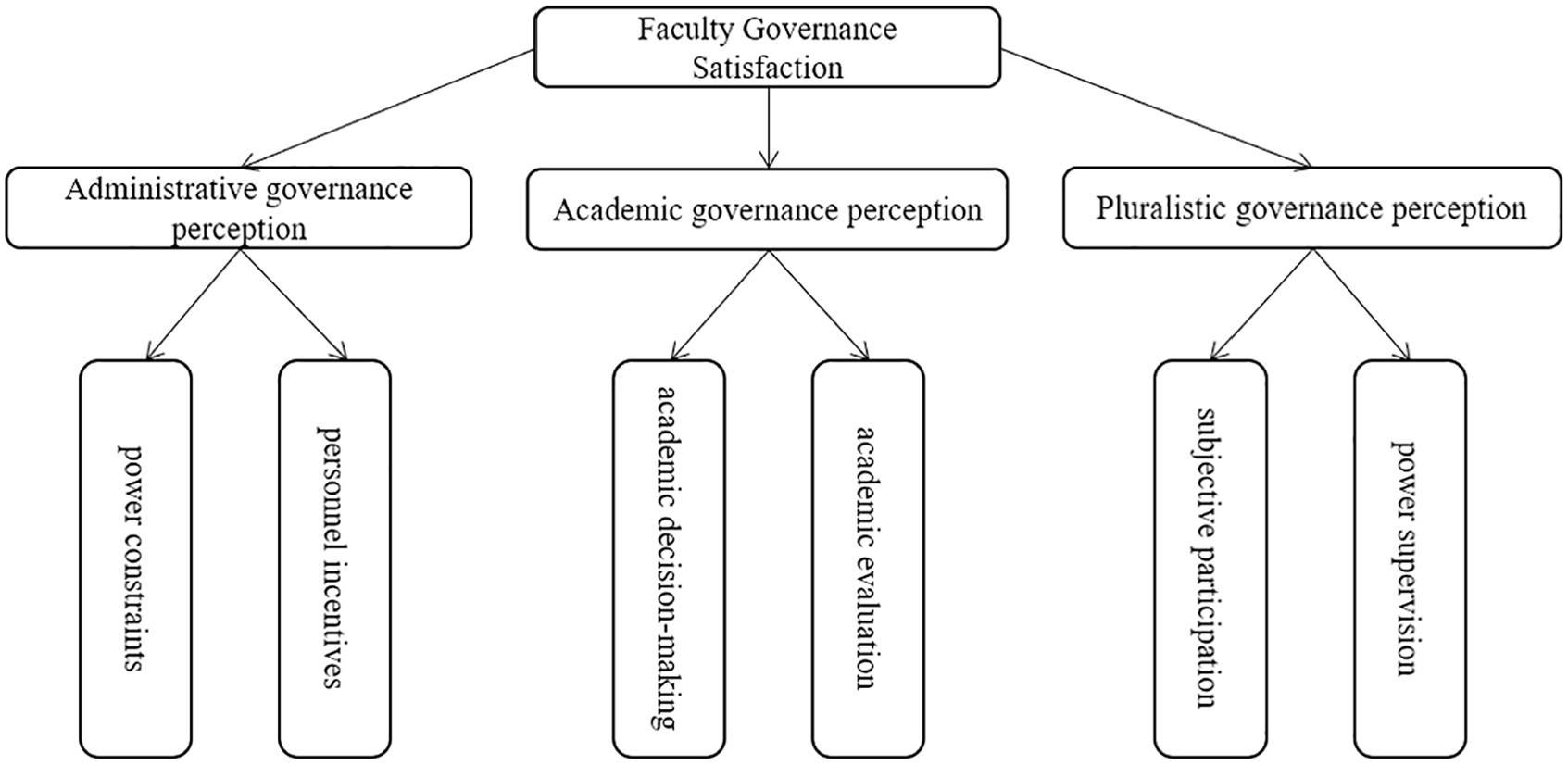
The structural dimensions of the “University Internal Governance Faculty Satisfaction Survey Questionnaire.”
Reliability and Validity
The formal test results showed that the “College Internal Governance Faculty Satisfaction Survey Questionnaire” was Cronbach’s α = .912, with reliability coefficients of .863 for administrative governance perception, .844 for academic governance perception, and .845 for pluralistic governance perception, indicating good reliability. Expert consultation during preparation and revision, along with factor analysis, confirmed the questionnaire’s overall expert validity and structural validity.
Sampling
This study takes Chinese university teachers as the research object, using regional and stratified random sampling. China’s higher education system is multi-level, including central deployment universities, provincial key universities, provincial general universities, and local colleges, located in the eastern, central, and western regions. Moreover, since Chinese universities are mainly public universities, and the president is responsible for the system under the leadership of Party committees, the internal governance of these universities is highly homogeneous (Z. R. Wang & Ma, 2023). The sampling process adhered to the principle of corresponding to the natural distribution of the entire population. Sampling units covered China’s eastern, central, and western regions, including 23 provincial-level administrative regions, 4 municipalities, and 3 autonomous regions (Inner Mongolia, Guangxi, Xinjiang). The research used the Internet to distribute questionnaires, selecting universities according to the principle corresponding to the natural distribution and finding email addresses of teachers from their websites. An online survey link and informed consent were sent, resulting in 1,108 collected questionnaires. After excluding those with significant random or missing responses, 1,050 valid questionnaires remained, achieving a 94.77% response rate. The study adhered to the Declaration of Helsinki, anonymized participants, used responses for academic research only, and ethical approval was obtained from the institution’s ethics committee.
The specific sample information is presented in Table 2.
Sample Information Table.

Results and Statistical Analysis
The study used Epidata3.1 to input and manage the data recovered from the formal test. SPSS 22 was employed for statistical analysis of the valid data and measures the current situation of faculty satisfaction in the internal governance of Chinese universities, then used difference analysis, correlation analysis, and regression analysis to explore the main factors affecting teachers’ internal governance satisfaction.
Satisfaction Status
The study used Likert’s five-point scoring method, with 3 as the medium level. With 50 items, scores ranged from 50 to 250 points. The average internal governance satisfaction score among Chinese university faculty was 3.05, indicating medium satisfaction. This may be because Chinese university faculty are not entirely satisfied with administrative and academic governance. For faculty governance satisfaction, the average perception score for administrative governance was 3.01, for academic governance 3.07, and pluralistic governance 3.10. This suggests that faculty perceptions of the three dimensions were generally medium, with pluralistic governance slightly more positive than academic governance, and academic governance slightly more positive than administrative governance. First, the higher perception of pluralistic governance may be due to low expectations (Zhu, 2017). Second, faculty’s perception of academic governance was medium, likely due to dissatisfaction with academic evaluation processes. Third, faculty’s perception of administrative governance was the lowest, likely due to perceived deficiencies in personnel incentives and other administrative aspects. Overall satisfaction and scores for each dimension are shown in Table 3.
The Current Status of Faculty Satisfaction with Internal Governance in Chinese Universities.

Note. N = 1,050.
The study conducted paired-sample t-tests on the three structural and six observational variables. Paired sample t-test is employed to examine whether there is a significant difference between the means of two related samples and the populations they represent (Afifah et al., 2022). Subjecting the same set of entities to two different treatments, collecting data, and conducting paired sample t-tests, helps determine if there are significant differences between variables, thereby inferring whether these treatments affect the research variables (Walters, 2021). The results indicate significant differences between these variables (p < .01), suggesting that these variables have both discriminative and influential power on the core variable of faculty governance satisfaction. Table 3 shows that overall faculty satisfaction with internal governance in China is moderate. The mean values rank governance satisfaction as follows: pluralistic governance perception > academic governance perception > administrative governance perception. The six observation variables rank as: academic decision-making > power supervision > power constraints > subject participation > academic evaluation > personnel incentives.
Difference Analysis
The survey for this study was conducted in public universities in China. These universities, with their distinctive internal governance characteristics, uniformly implement a system where the university president is under the leadership of the Party Committee, exhibiting dual governance structures and hierarchical features (Dong et al., 2020; Han et al., 2023; Ruan et al., 2024). During the governance process, these universities follow the Party-Administration joint meeting mechanism, where major decisions are made collectively by key Party and administrative leaders, and the power to make developmental decisions largely rests with the senior leadership (J. Song & Lai, 2022; Zhuang & Liu, 2020). Additionally, considering that satisfaction is a subjective perception influenced by individual differences (Filiz, 2014; Ssesanga & Garrett, 2005), we aim to investigate whether teachers’ differences impact their satisfaction with internal governance within this homogenous governance context.
Educational Background
The research hypothesizes that teachers’ satisfaction with university internal governance varies by educational background. The study employed statistical tests to explore the differences’ significance. The study recorded and assigned scores to each item of educational background, summed it up to get the “educational background” variable, and divided it into high, medium, and low groups based on the top 27% and the bottom 27%. A one-way analysis of variance (ANOVA) revealed significant differences among groups (sig. = .000, < .05), indicating heteroscedasticity. The results (Table 4) show that the faculty satisfaction scores of the low-level educational background group are significantly higher than those of the high and middle-level educational background groups, and the scores of satisfaction of middle-level educational background faculty are significantly higher than those of the high-level educational background group.
Multiple Comparisons of Faculty Governance Satisfaction Among Different Educational Background Groups.
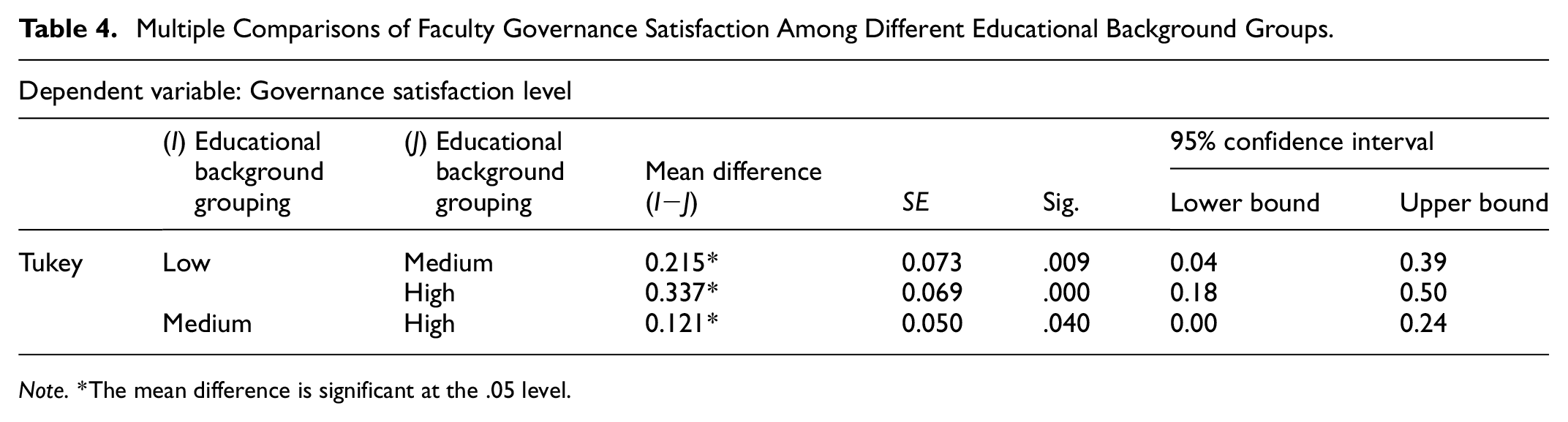
Note. *The mean difference is significant at the .05 level.
Talent Qualifications
The research hypothesizes that teachers’ talent qualifications significantly affect their satisfaction with governance. The study assessed satisfaction across different qualification levels by categorizing scores into high, medium, and low three levels based on the top and bottom 27%, and summed it up to get the “talent qualifications” variable. A one-way ANOVA revealed significant differences (sig. = .001, < .05), indicating heteroscedasticity among groups and significant differences in teacher governance satisfaction among different talent qualifications groups. Fisher’s LSD method showed that satisfaction scores were significantly higher in the low overseas experience group compared to the middle and high groups, and in the medium overseas experience group compared to the high group (Table 5).
Multiple Comparisons of Faculty Governance Satisfaction Among Different Talent Qualifications.

Note. *The mean difference is significant at the .05 level.
Overseas Study Experience
The study hypothesizes that teachers’ overseas study experience influences faculty governance satisfaction. The various items were assigned values and summed up to get an “overseas study experience” factor. Scores were then grouped into high, medium, and low levels based on the top and bottom 27%. A one-way ANOVA revealed significant differences in governance satisfaction among these groups (sig = .001, < .05), indicating heteroscedasticity. Using the LSD method for the post hoc test (Table 6), the research found that governance satisfaction scores were significantly higher in the low overseas experience group compared to the middle and high groups, and higher in the medium group compared to the high group.
Multiple Comparisons of Faculty Governance Satisfaction Among Different Overseas Study Experiences.

Note. *The mean difference is significant at the .05 level.
Welfare Benefits
The research hypothesizes that welfare benefits significantly affect faculty satisfaction. The study grouped welfare benefits items into a “welfare benefits” variable and divided them into high, medium, and low levels based on the top and bottom 27% of the total score. A one-way ANOVA showed significant differences among the groups (sig = .000, < .05), indicating heteroscedasticity. Tukey’s post hoc test results (Table 7) revealed that governance satisfaction scores were significantly higher in the high welfare benefits group compared to the middle and low groups, and higher in the medium group compared to the low group.
Multiple Comparisons of Faculty Governance Satisfaction with Different Welfare Benefits.

Note. *The mean difference is significant at the .05 level.
Work Status
The study hypothesizes that teachers’ work status would also have an impact on their internal governance satisfaction. Therefore, the study conducted a statistical analysis to examine these differences. The study assigned values to items related to work status, got the “employment status” variable by summing these values and then divided the work status scores into high, medium, and low groups based on the top and bottom 27% of scores. Subsequently, a one-way analysis of variance was conducted. The results of the variance homogeneity test show sig = .615, > .05, indicating homoscedasticity exists among the groups, which suggests that different work statuses do not significantly impact faculty governance satisfaction.
Personal Information
Finally, the researchers assumed that teachers’ individual natural information (gender, age, etc.) might affect teachers’ internal governance satisfaction, so a differential analysis was conducted. The results of the independent sample t-test on gender p = .080, > .05, indicate that the difference in teacher governance satisfaction between genders is insignificant. The results of one-way ANOVA analysis of age variables are p = .02, < .05, indicating that there is a significant difference in teacher governance satisfaction between different age groups. However, after testing with Fisher’s LSD method, it was found that there are no significant differences between groups.
Correlation Analysis
The study conducted a correlation analysis to explore further the influencing factors of teachers’ satisfaction with internal governance. Firstly, the correlations analysis among the three primary dimensions, namely “Perception of Administrative Governance,”“Perception of Academic Governance,” and “Perception of Pluralistic Governance,” showed that there is a highly significant correlation between the dimensions of faculty satisfaction toward the university internal governance, which also verifies the relationship between the three dimensions in the University Internal Governance Satisfaction Model for Faculty (UIGSM-F).
Educational background may be associated with faculty satisfaction with internal governance. The study divided the total teachers’ governance satisfaction scores into high, medium, and low groups based on the top and bottom 27% and conducted a cross-analysis with educational background. The results showed that respondents with low educational backgrounds predominantly fall into the moderate satisfaction subgroup. In the middle and high educational background groups, the highest proportion also falls into the moderate satisfaction subgroup. To investigate whether there is a correlation between the two, the study conducted a Chi-Square test between different education background groups and different teacher governance satisfaction groups. The result is χ2(4, N=1,050) = 27.302, p < .001, indicating a significant difference between education background groups and teacher governance satisfaction groups. Since both variables are ordinal, the study also used Spearman’s rank correlation to explore their degree of correlation. The result is ρ = −.151, p < .001, indicating a significant correlation between the two. Finally, the study calculated the Pearson correlation coefficient between educational background and teacher governance satisfaction. The results showed a coefficient of r (1,050) = −.159, p = .000, < .01 (Table 8), indicating a significantly low negative correlation. According to general interpretations, a coefficient less than .2 or .3 indicates a low correlation.
Correlation Between Various Structural Variables and Faculty Governance Satisfaction.
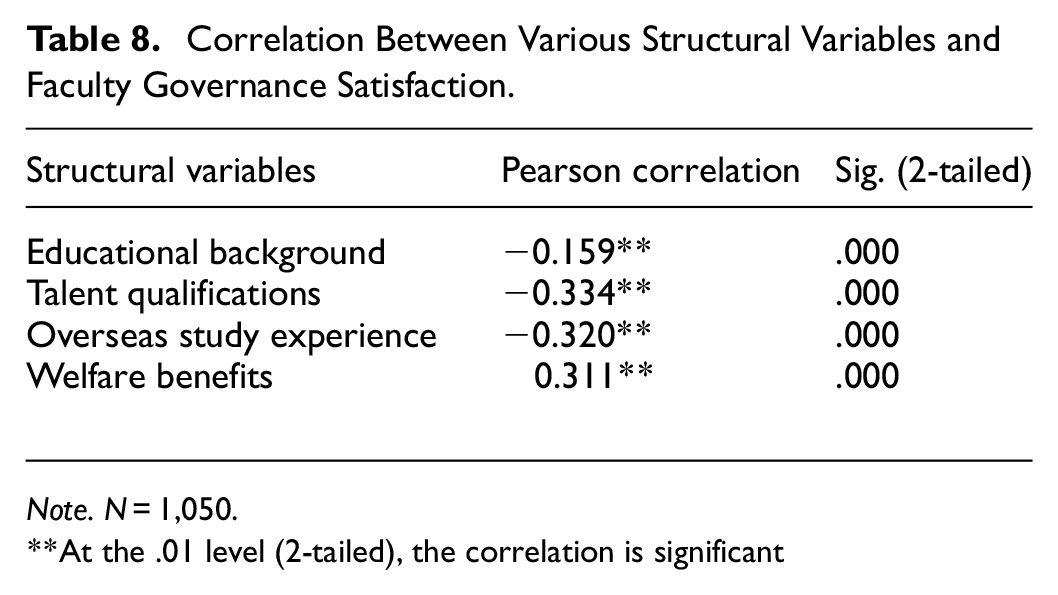
Note. N = 1,050.
At the .01 level (2-tailed), the correlation is significant
Talent qualifications may be associated with faculty satisfaction with internal governance. The study’s analysis showed that within the low-talent qualifications group, a relatively high proportion falls into the high satisfaction subgroup. In the middle and high talent qualifications groups, the highest proportion falls into the moderate satisfaction subgroup. The Chi-Square test result is χ2(4, N = 1,050) = 80.431, p < .05, indicating a significant difference between talent qualifications groups and teacher satisfaction groups. Spearman’s rank correlation (ρ = −.268, p < .05) and Pearson correlation coefficient (r (1,050) = −.334, p = .000, < .01) both indicate a significant moderate negative correlation between talent qualifications and faculty satisfaction.
Overseas study experience may be associated with faculty satisfaction with internal governance. The study began by analyzing the association between overseas study experience and teacher governance satisfaction. The cross-tabulations show that within the low overseas study experience group, a relatively high proportion falls into the moderate governance satisfaction subgroup. In the middle overseas study experience group, the highest proportion falls into the moderate governance satisfaction subgroup. In the high overseas study experience group, the highest proportion falls into the moderate satisfaction subgroup. Accordingly, based on the overall distribution, teachers’ overseas experience is related to their satisfaction with the internal governance of universities. On this basis, the study conducted a Chi-Square test between overseas study experience groups and teacher governance satisfaction groups. The result is χ2(4, N = 1,050) = 108.584, p < .001, indicating a significant difference between different overseas study experience groups and teacher governance satisfaction groups. Since both variables are ordinal, the study also used Spearman’s rank correlation to explore their degree of association. The results show ρ = −.310, p < .001, indicating a significant correlation between the two. To further confirm the research hypothesis, the study conducted a Pearson correlation analysis, and the correlation coefficient between overseas study experience and teacher governance satisfaction was found to be r (1,050) = −.320, p = .000, < .01 (Table 8), indicating a significant moderate negative correlation between the two.
Welfare benefits may be associated with faculty satisfaction with internal governance. The study was analyzed by following the above steps, and from the cross-tabulation of the two variables, it can be observed that in the low welfare benefits group, a higher proportion is in the middle satisfaction group; in the middle welfare benefits group, the highest proportion is in the middle satisfaction group, and for the high welfare benefits group, the highest proportion is in the high satisfaction group. The Chi-Square test results are χ2(4, N = 1,050) = 116.076, p < .05, meaning there is a significant difference between different welfare benefit groups and different teacher satisfaction groups. These variables are all ordinal, so the study used Spearman rank correlation to explore the degree of association between the two. The results show ρ = .294, p < .05, indicating a significant correlation between the two. Finally, the study conducted Pearson correlation analysis on the two variables and obtained the correlation coefficient r (1,050) = .311, p = .000, < .01 (Table 8), demonstrating a significant moderate positive correlation between welfare benefits and teacher governance satisfaction.
Regression Analysis
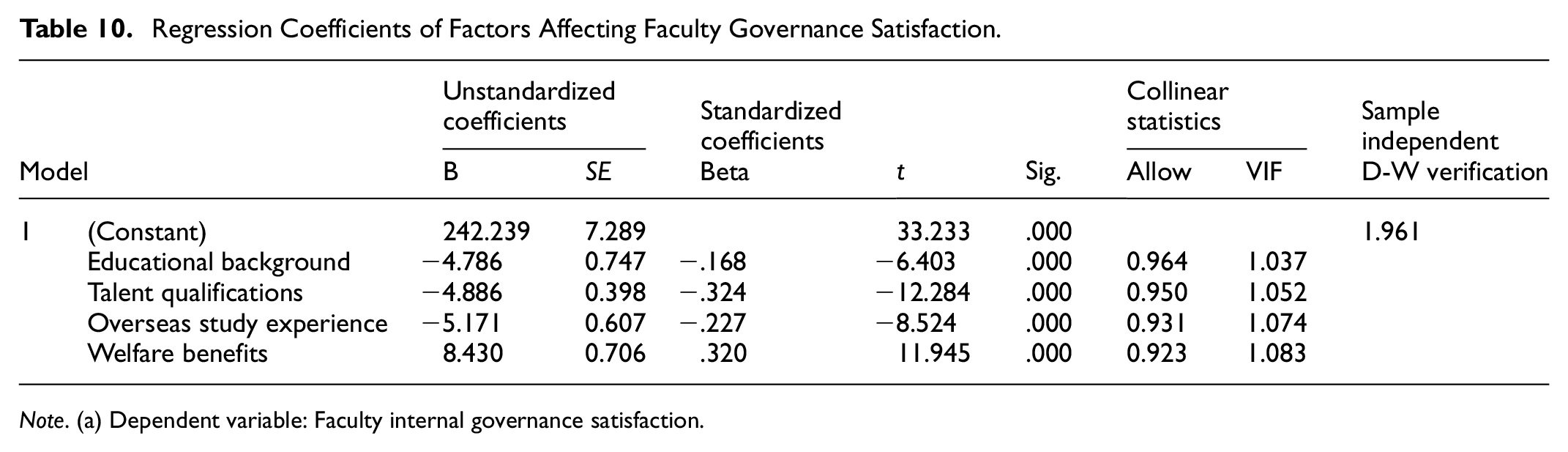
Based on the abovementioned analysis, the study further employed multiple regression analysis to explore the relationship between faculty governance satisfaction and various factors to analyze the explanatory rate and predictive power of factors like educational background, talent qualifications, overseas study experience, and welfare benefits. Satisfaction with faculty governance. The analysis found that all of the VIF values of collinearity statistics are less than 5. According to the Variance Inflation Factor (VIF) theory, VIF is generally not greater than 5. When VIF > 10, it indicates the presence of multicollinearity (Wu & Pan, 2014, p. 461). Therefore, the results suggest that there is no multicollinearity among the four independent variables, and further analysis can be conducted. The D-W statistic value is 1.961, which is close to 2. According to the relevant theory, when DW > 2, there is a positive correlation between the two residuals; when DW < 2, there is a negative correlation between the two residuals; only when DW is approximately 2, they are independent of each other (H. B. Zhang et al., 2007, pp. 264–265). Therefore, the samples in this study are mutually independent, and there is no self-correlation among the samples, which indicates a good data structure (Table 9). The multiple regression analysis of the four factors’ effects on faculty satisfaction is statistically significant, with an overall effect of F (4, 1,045) = 115.986, p < .001. The coefficient of determination R2 = .307 indicates that the four independent variables can explain 30.7% of the variance in faculty satisfaction. Generally, the effect size standard can follow Cohen’s rule of thumb, that is, small, medium, and large effect sizes correspond to .02, .13, and .26, respectively (Chen, 2015, p. 468). Therefore, the results of this study suggest a high effect size. As shown in Table 10, the regression coefficients for each structural variable factor are as follows: Educational Background [β = −.168, t (1,045) = −6.403, p = .000]; Talent Qualifications [β = −.324, t (1,045) = −12.284, p = .000]; Overseas study Experience [β = −.227, t (1,045) = −8.524, p = .000]; Welfare Benefits [β = .320, t (1,045) = 11.945, p = .000]. All of them can significantly predict teacher’s internal governance satisfaction to varying degrees. Based on this, the regression equation model is obtained:

In the model, Y: criterion variable, representing the teacher’s satisfaction with internal governance in the university;
X 1: Predictor variable 1, representing the educational background score;
X 2: Predictor variable 2, representing the talent qualifications score;
X 3: Predictor variable 3, representing the overseas study experience score; and
X 4: Predictor variable 4, representing the welfare benefits score.
Regression Model Summary.
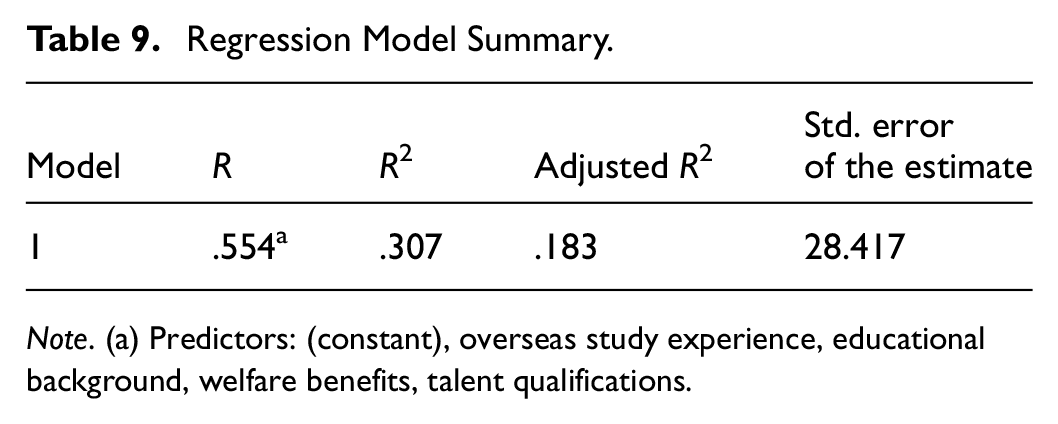
Note. (a) Predictors: (constant), overseas study experience, educational background, welfare benefits, talent qualifications.
Regression Coefficients of Factors Affecting Faculty Governance Satisfaction.
Note. (a) Dependent variable: Faculty internal governance satisfaction.
Discussion
The purpose of this study is to explore the degree of satisfaction of Chinese university teachers with internal governance and its influencing factors. Teachers are important stakeholders in university internal governance and the achievement of governance goals (Yan, 2017). However, there are still some deficiencies in the empirical research on the satisfaction degree of university teachers’ internal governance and its influencing factors in China. To address this, we developed a scale and collected data from 1,050 faculty members at Chinese universities for analysis. We found that Chinese university faculty satisfaction with internal governance is at a moderate level. Regarding influencing factors, the results support the hypotheses that “educational background,”“talent qualifications,”“overseas study experience,” and “welfare benefits” significantly impact faculty satisfaction with internal governance. However, hypotheses H5 and H6 were rejected, which is inconsistent with some existing research findings (de Lourdes Machado-Taylor et al., 2016; Filiz, 2014; Masum et al., 2015). A possible reason for this inconsistency is that Chinese university faculty generally face similar performance evaluations (Gu et al., 2020) and have limited influence in university governance (Du et al., 2010). Thus, differences in work status and personal information do not significantly impact internal governance satisfaction. Based on the research questions and findings, this study will specifically discuss the following three aspects.
The Satisfaction of Faculty with Internal Governance in Universities Is at a Moderate Level Numerically
The study measured Chinese samples and found that the average value of Chinese university teachers’ satisfaction with the internal governance of universities is 152.39. There are 50 items on the scale, and the score range of each item is 1 to 5, with a total range of the scale between 50 and 250, and the median value is 150. Therefore, the measurement value of university teachers’ satisfaction with the internal governance of universities 152.39 is at a medium level numerically.
As shown in Figure 1, the teacher satisfaction model of internal governance in universities, university teachers’ satisfaction with the internal governance of their university stems from their perception of administrative governance, academic governance, and pluralistic governance in university governance. Additionally, an individual’s satisfaction with something is significantly impacted by his or her psychological expectations (Driscoll, 1978). Therefore, on the condition that other factors are established, it can be inferred that there is a negative correlation between university teachers’ psychological expectations of internal governance and their satisfaction with internal governance. Therefore, in the study, the above four factors lead to the numerical medium level of teacher satisfaction with the internal governance of Chinese colleges.
Additionally, it is crucial to consider the implications of the moderate level of faculty satisfaction with internal governance in Chinese higher education institutions. Generally speaking, the overall pursuit of university internal governance is to maximize efficiency and effectiveness. Efficiency is the input-output ratio, referring to acting correctly, which considers the utilization rate of resources and pursues low waste of resources; effectiveness is doing the right things, considering the realization of goals, and pursuing high attainment of goals (Lindsay, 1981). According to the faculty satisfaction model of internal governance in universities, the governance satisfaction of university teachers will directly or indirectly bring about “complaints,”“loyalty,” and “work performance.” Although all three are outcome variables of faculty governance satisfaction, teachers’“work performance” is the “output” variable that gets special attention from university governance. The moderate numerical satisfaction of Chinese university teachers with the university’s internal governance will result in complaints and loyalty to the university and work and directly or indirectly impair their work performance, leading to the need for an improvement in the university’s internal governance efficiency and effectiveness. Enhancing the efficiency and effectiveness of internal university governance is crucial for China to build a strong higher education system and achieve “Double First-Class” status (Sui & Wang, 2021). Based on the correlation between teachers’ satisfaction with internal governance and the pursuit of university internal governance, more institutional supplies in different dimensions and levels are critical to improving teachers’ satisfaction if the current level of teachers’ satisfaction with internal governance is numerically medium.
There Are Significant Differences in Faculty Governance Satisfaction in the Sub-Dimensions
When developing the faculty satisfaction scale for internal governance in universities, the study divided the internal governance of universities into three dimensions, namely administrative governance, academic governance, and pluralistic governance, based on existing literature review, expert consultation, and researchers’ understanding of university internal governance. The results of the corresponding three structural variables are as follows: the perception of pluralistic governance is higher than academic governance, academic governance is higher than administrative governance, and paired-sample t-tests show significant differences between these dimensions. Further factor analysis subdivided these three structural variables into six observable variables: power constraints and personnel incentives, academic decision-making and academic evaluation, and pluralistic participation and power supervision. Pairwise t-tests among these six observable variables also show significant differences, with satisfaction scores ranking from high to low as follows: academic decision-making, power supervision, power constraints, subject participation, academic evaluation, and personnel incentives.
Firstly, teachers are least satisfied with administrative governance in the first-level factor dimension of satisfaction with university internal governance. 24 items about administrative governance perception are included in the scale, with a total item score of 120, an average score of each sample is 72.30, and an average score of 3.01 for each item. These data indicate that university teachers are not highly satisfied with the administrative governance of the universities. Administrative power is an important pillar of the governance of universities. University teachers live in the field of universities where they have to deal with and perceive administrative power all the time. Despite China’s continuous legal efforts to expand and implement university autonomy, such as the enactment of the “Higher Education Law,” university management remains largely administratively driven in practice. This administrative dominance leads to bureaucratic tendencies within university management and establishes a foundation for social relations that undermine governance by law. Under the leadership of administrative bureaucrats, hierarchical structures dictate the effectiveness of decision-making and shape the subordinate relationship between faculty and administrators (Yu, 2018). When university administration fails to provide teachers with due administrative services and welfare benefits (Du et al., 2010), teachers will naturally be less satisfied with administrative power. It has always been a persistent headache for Chinese universities to overcome the administrative tendency of their internal governance (Jian, 2020). Additionally, as a knowledge-intensive and creative profession, university faculty are generally believed to have more room for improvement in terms of their welfare benefits compared to others in society. On a macro level, the above can explain why faculties are the least satisfied with the University’s administrative governance.
Secondly, among the three primary factors, the highest satisfaction score was observed in pluralistic governance, with an average item score of 3.10. It’s important to note that pluralistic governance comprises 12 items with a total score of 60 points, and the average score of each sample is 37.16. Therefore, while faculty members express the highest level of satisfaction with pluralistic governance, their scores are only at the upper middle level of the numerical level. Pluralistic governance represents the concept of shared governance in universities (Ehara, 1998; Maassen, 2000). However, as a relatively new concept of stakeholder governance based on equality and democracy, in the specific governance context of China, faculty members may have relatively low expectations for pluralistic governance based on their academic awareness (Zhu, 2017). This helps to explain why university faculty members exhibit relatively higher satisfaction with pluralistic governance.
Thirdly, faculty satisfaction with academic governance falls in the middle among the three, with an average item score of 3.07. Overall, academic governance in higher education institutions is closely related to academic evaluation, which affects faculty members’ work and living conditions. However, the data (average item score of 3.02) also suggest that faculty members are not highly satisfied with academic governance.
Among the second-level factors of university internal governance satisfaction, academic decision-making > power supervision > power constraints > subject participation > academic evaluation > personnel incentives. Personnel incentives are related to the vital material interests of teachers, so at a time when the welfare benefits of teachers are at a comparative disadvantage, it is understandable that teachers are the most dissatisfied with this (Du et al., 2010). Additionally, academic evaluation is closely tied to faculty assessment, employment, and promotion. The current quantified trend in academic evaluation, which leans towards “scientific management,” has also contributed to faculty dissatisfaction. For university faculty, the academic decision-making of the institution on a macro-level, as well as the supervisory mechanisms of overseeing various powers, including constraints on administrative power, seem to be far from their lives, which could explain the relatively higher satisfaction levels in these three factors. Subject participation in the internal governance of universities will bring more opportunities for teachers to personally participate in university affairs (Onwunli & Agho, 2004). Still, the space for Chinese university teachers to participate in governance is limited, which will also bring about dissatisfaction with teachers’ governance.
Faculty Background and Welfare Benefits Affect Their Satisfaction Levels
Through difference analysis, the study found there are significant differences in faculty satisfaction with university internal governance in four dimensions: “educational background,”“talent qualifications,”“overseas study experience,” and “welfare benefits.” The correlation analysis in the study revealed the following relationships: “educational background” is significantly negatively correlated with faculty governance satisfaction at a low level; “talent qualifications” is significantly negatively correlated at a moderate level; “overseas study experience” is significantly negatively correlated at a moderate level, and “welfare benefits” is significantly positively correlated at a moderate level with faculty governance satisfaction. The regression analysis showed that these four factors can explain 30.70% of the variance in faculty satisfaction with internal governance, indicating good predictive power. In summary, “educational background” (H1), “talent qualifications” (H2), “overseas study experience” (H3), and “welfare benefits” (H4) are important factors influencing faculty satisfaction with internal governance, and the first three can be summarized as “faculty background.”
The analysis showed that among the factors affecting teachers’ satisfaction with internal governance, “educational background” and “talent qualifications” are similar. The former is the educational growth experience of university teachers, while the latter is a more direct representation of the professional growth of university teachers. The study found that these two factors are negatively correlate with teachers’ satisfaction with internal governance; that is, the better the teachers’ two major experiences are related to professional maturity, the more dissatisfied they will be with the current internal governance of universities (Guo & Xu, 2018). Similarly, the study of “overseas study experience” as another factor in the “faculty background,” indicated that the longer teachers have studied overseas, the less satisfied they are with the university’s current state of internal governance.
From Figure 1 the university internal governance faculty satisfaction model, it can be observed that teachers’“governance expectations” are the initial independent variable affecting teachers’ perception of satisfaction with university internal governance, which influences “administrative governance perception,”“academic governance perception,” and “pluralistic governance perception,” thereby collectively affecting teachers’ satisfaction with internal governance. However, teachers’“governance expectations” does not come out of nowhere. Generally, the higher the level of professional growth and the longer their overseas study experience, the higher their expectations for the “Ideal Type” of university internal governance will be due to a deeper understanding of “good” internal governance. Consequently, faculty satisfaction with internal governance tends to decrease when high “governance expectations” confront the real issues presented in university’s academic governance, administrative governance, and pluralistic governance. Based on this logic, “governance expectations” serves as an intermediate variable for “faculty background,” which impacts the faculty’s governance satisfaction. Furthermore, the teachers’“welfare treatment” directly influences their perceptions of administrative governance, academic governance, and pluralistic governance. The comparatively disadvantaged welfare benefits for Chinese university teachers are a significant factor leading to lower satisfaction levels with internal governance (Gu et al., 2020).
Based on the research findings mentioned above, it is clear that the way to improve the internal governance satisfaction of Chinese teachers is not to lower teachers’ governance expectations but to enhance their welfare benefits so that university teachers’ welfare benefits can match the long-term education and professional growth they experienced, as well as the high-end professionalism of their work. In addition, there must be provision of a scientific system to effectively improve the administrative governance (power constraints and personnel incentives), academic governance (academic decision-making and academic evaluation), and pluralistic governance (multiple participation and power supervision) of universities. Improving university teachers’ satisfaction with university internal governance will lead to higher work performance, which is an important pursuit of the university’s internal governance.
Conclusions and Implications
Chinese higher education is predominantly public, encompassing universities, colleges, and vocational schools, forming a vast system. However, the internal governance of Chinese universities is often influenced by political directives, policies, or projects, implementing the system where the president is responsible under the leadership of the Communist Party committee, which results in a noticeable isomorphism in internal governance structures. Within this governance context, our research finds that Chinese university faculty satisfaction with internal governance is at a moderate level. Faculty perceive pluralistic governance more favorably than academic governance, and academic governance more favorably than administrative governance. Educational background, talent qualifications, overseas study experience, and welfare benefits significantly explain variations in faculty governance satisfaction. In the process of modernizing higher education in China, it is particularly important to consider the impact of individual differences and perceptions on faculty satisfaction with internal governance (Cheng & Zhu, 2021). This empirical research not only addresses gaps in current Chinese studies but also provides new perspectives and data in a context where administrative and academic power imbalances and high internal governance isomorphism exist (Xiong et al., 2022). By distinguishing itself from previous structural improvement studies in China (Guo & Xu, 2018), this research supports enhancing the effectiveness of internal governance in Chinese universities and promotes high-quality development.
Implications
This conclusion has several implications for education policy.
First, Chinese universities should further improve faculty welfare. Good welfare benefits can increase faculty motivation and satisfaction (Murwaningsih & Fauziah, 2023). The government and universities should raise the basic salary levels to ensure competitiveness with other industries and provide more support for academic exchanges and research projects. This would align university faculty benefits with their extensive educational and professional development, as well as the demands of their high-level professional roles.
Second, Chinese universities should enhance scientific institutional provision. In the context of high governance isomorphism, improving faculty satisfaction with internal governance requires leveraging the strong driving forces of the government and universities. This includes clarifying responsibilities, establishing robust faculty incentive mechanisms, increasing faculty participation in decision-making, and creating effective governance communication channels. These improvements should address administrative governance (power checks and personnel incentives), academic governance (academic decision-making and evaluation), and pluralistic governance (diverse participation and power supervision).
Third, our research also offers valuable policy references for the internal governance and faculty satisfaction of universities in other countries. While Chinese universities’ internal governance is highly isomorphic, this unified approach can enhance the social service contributions of universities (Wan & Lv, 2024). This suggests that other countries could explore similarly effective internal governance models. Conversely, universities in other countries may have more diverse internal governance structures, but under the influence of new public management and comprehensive performance management (Dasanayaka et al., 2021), their internal governance may also exhibit homogenization. Thus, these universities should shift from an “institution-focused” to a “people-focused” governance mindset. This shift involves reducing the pressure of performance accountability on faculty, increasing faculty salaries, improving welfare benefits, and providing more career development opportunities to enhance faculty satisfaction and internal governance efficiency.
Limitations
When implementing research and interpreting its results, two limitations should be considered. Firstly, despite conducting a large-scale survey, methodological limitations are unavoidable. The cross-sectional design used in this study prevents establishing causation, allowing only conclusions based on correlation. It also complicates the revelation of the underlying mechanisms behind the influencing factors. In the future, research on related topics might consider using qualitative or mixed methods to delve deeper into these issues. Secondly, this study is conducted in the context of Chinese culture, especially considering the strong administrative power that can not be ignored in internal governance. Therefore, the factors influencing faculty satisfaction with internal governance may differ due to national and cultural variances, leading to potentially different results. Especially in the current landscape where new public management and performance management increasingly permeate university internal governance, it is necessary to conduct further research in other countries to explore more extensively and deeply the satisfaction of faculty with university internal governance and the influencing factors.
Footnotes
Acknowledgements
We are very grateful to our colleagues for their constructive feedback on the paper.

Ethical Considerations
The study adhered to the Declaration of Helsinki, anonymized participants, used responses for academic research only, and ethical approval was obtained from the institution’s ethics committee.
Author Contributions
Conceptualization, Lianyu Cai and Fenna Sun; methodology, Jiali Ying; investigation, Jiali Ying and Alemi Sayed Hussain Agha; writing—original draft preparation, Mingfei Jin; writing—review and editing, Mingfei Jin and Fenna Sun; supervision, Lianyu Cai and Fenna Sun. All authors have read and agreed to the published version of the manuscript.
Funding
The author(s) received no financial support for the research, authorship, and/or publication of this article.
Declaration of Conflicting Interests
The author(s) declared no potential conflicts of interest with respect to the research, authorship, and/or publication of this article.
Data Availability Statement
These data were derived from surveys conducted with Chinese university faculty members, with all personal identifiers removed to ensure participant confidentiality. Researchers interested in accessing the dataset can do so freely through the provided DOI link, adhering to the ethical guidelines outlined in the study’s ethical approval.