




Abstract
Environmental health (EH) is the study of environment and environmental factors affecting the health of human. Identifying the most relevant and up-to-date and updated teaching topics of EH programs is vital to ensure competent practitioners are nurtured. Thus, this study aimed to attain the view of current content of EH programs for EH professionals and intended to recommend topics necessary for education and practice. The level of importance of current and newly proposed topics for EH courses at diploma and bachelor’s level was assessed using a cross-sectional survey design. Practicing EH programs graduates were invited via social media and e-mails to participate in the survey. The respondents were asked to rank the importance of different EH topics based on 5-point Likert-type scale. Descriptive statistics were employed to report the importance of EH curricula at Malaysian tertiary institutions. It was found that between diploma’s and bachelor’s level, the bachelor’s graduates were expected to have high exposure in existing topics such as vector control management, legislation for EH and safety, health and safety risk assessment, as well as newly proposed topics including critical literature evaluation and innovation in creating awareness activities. The findings from this survey could serve as a guide to improvise EH curricula to ensure the EH programs continue to produce students with the necessary skills, knowledge, and competencies.
Introduction
According to World Health Organization (2018), environmental health (EH) includes all the physical, chemical, and biological factors related to a human being, and all the related factors affecting the behaviors. It consists of the assessment and control of environmental factors that can potentially affect health, well-being, and sustenance by preventing disease and creating health-supportive environments for all living beings. Similarly, a fundamental element for strong economy of a nation is environmental sustainability. To ensure the sustainability and continued growth, health and safety are important aspects in different sectors and the environment is one of the determinants of human health (Commission on Social Determinants of Health, 2008). Malaysian society is increasingly populated and urbanized, resources such as air, water, and land continue in high demand leading to widespread pollution (Department of Statistics Malaysia, 2016). National Policy on the Environment (DASN) of Malaysia aims to adopt an environmentally sound and sustainable development plan (Department of Environment, 2018). The development and implementation of National Environmental Health Action Plan (NEHAP), which consists of EH-related programs or activities, is being implemented by various agencies, stakeholders, and importantly EH practitioners including EH officers, public health inspectors, EH academicians to control and mitigate the emerging health impacts from EH hazards (Department of Environment, 2018).
In 1975, Public Health Instutitions under Ministry of Health, Malaysia, in collaboration with the Royal Society for the Promotion of Health based in London offered a 3-year Diploma of the Royal Society for the Promotion of Health. Nevertheless, tertiary education of EH had not made much progress until 1996, when Universiti Teknologi MARA opened its first diploma in EH and then followed by other public universities such as Universiti Sains Malaysia, Universiti Kebangsaan Malaysia, and Universiti Putra Malaysia offering their environmental studies and environmental sciences programs in relation to health. Lately, private universities such as Universiti Selangor, MAHSA University, Universiti Kuala Lumpur also have started to offer diploma and undergraduate degrees in EH to cater for the increasing demand for EH professionals in the country. The programs include all the EH scope such as food quality and safety, water and air quality, vector and pest management control, vector and communicable disease control, international health, health education, EH impact and risk-based assessment, waste and wastewater management, occupational health and safety, and the global health (Faculty of Health Sciences, 2017; Faculty of Medicine and Health Sciences, 2018). These programs address the need for EH students to understand and evaluate the risks posed by the stressors of the EH, through equipping them with the knowledge, expertise, and skills needed to take on and enhance their role as a professional in this field (Moldan, Janoušková, & Hák, 2012).
Moreover, it is important to determine whether the EH courses are relevant in term of employability of the graduates (Dunn et al., 2018). Students often perform well in the classroom or examinations to earn good grades; however, it is uncommon for them to fit in the working environments comfortably. The advancement of technology and the augmented complexity of EH and modern lifestyle point out to the necessity of EH program reassessment (Ahonen & Lacey, 2017; Friedman & Lee, 2015; Mujuru & Niezen, 2004). These include the need to look at EH curriculum to address issues of programmatic improvement and to determine the outcome measure of professional competencies of EH graduates (Rehfuess & Bartram, 2014). As EH programs have been introduced in Malaysia, there are no specific study reported on the need-based education and its current perspective in the practice. Therefore, this study was aimed to review the topics covered by EH curricula.
Method
Study Design
A cross-sectional survey was conducted from December 2016 to May 2017. Ethical approval was granted by the Research Ethics Committee of Universiti Teknologi MARA (UiTM; 600-RM-5/1/6). All the information obtained from the data collection was kept confidential.
Questionnaire Design
An online questionnaire form was designed using Survey Monkey, a platform that allows questions to be posted online and with nationwide access by EH practitioners. The questionnaire consisted of two main sections providing questions on
demographic data of respondents, and
list of current and potential topics deemed important to be included in the EH curricula.
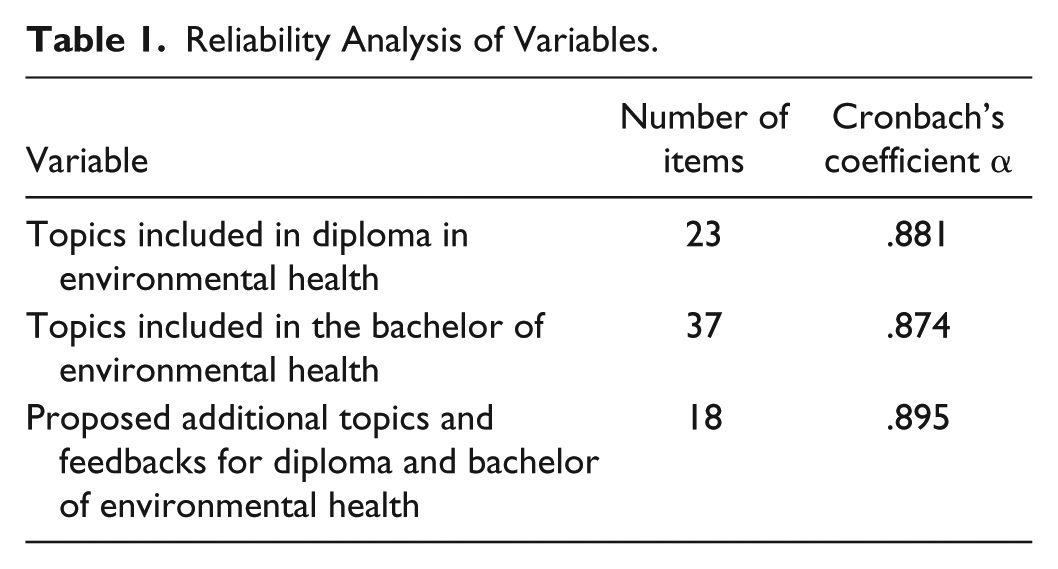
The list of topics was compiled from the programs (Diploma and Bachelor of EH or Environmental Safety) offered by University of Malaya, Universiti Kebangsaan Malaysia, Universiti Sains Malaysia, and UiTM. The scope and spectrum of EH were very broad; additional listed topics were proposed to each program. A 5-point Likert-type scale from not required (1) to highly required (5) was employed to reflect the importance of each topic. To enhance the understanding while filling in questionnaire, brief reflections of each Likert-type scale were included in the subheading: “not required,” “slightly required (introduction to the knowledge will be enough),” “uncertain (do not know),” “moderately required (using a basic concept),” and “highly required” (with hands-on experience on concept and training).” Face and content validity of the questionnaire were conducted by pilot-testing among five senior lecturers and members of EH fraternity. The comments and feedback received were used as a reference to improve the content, understanding ability, and completeness of the questionnaire. A pilot test was then performed to corroborate the reliability and validity of the questionnaire used in this study. The reliability test was applied to all variables. Internal reliability was performed on the responses from 20 respondents. Table 1 shows the Cronbach’s coefficient alpha for each measure for all variables, which suggested a good internal consistency. Nonetheless, the perceived importance of topics could have been affected by the respondents’ different background and varied working environments.
Reliability Analysis of Variables.
Respondents and Sampling Method
Convenience sampling was used to recruit respondents. All graduates of diploma or bachelor’s in EH or environmental safety and health from local or overseas universities were invited to participate in the survey. Those who had stopped practicing in this field for the past 2 years and students currently undertaking their diploma and degree were excluded from the study. Respondents were invited via e-mail and messenger service on social media with a copy of the link to the survey. The invitation message included an explanatory statement, the link to informed consent form, and the online questionnaire. An e-mail or messenger reminder was sent to all respondents 2 weeks after the initial invitation. A nonprobability sampling using convenience sampling was used for the study; therefore, no sampling frame and sample size calculation were not performed as suggested in literature (Omair, 2014).
Data Analysis
The data were analyzed using Statistical Package for the Social Sciences (SPSS), Version 17.0. Data sets from respondents with partial or missing data were excluded in the analysis. Descriptive statistics were employed to report the respondent demographic variables (n, %) and perceived importance of different topics based on Likert-type scale (M ± SD).
Results
Demographic and Working Information
A total of 152 respondents took part in the survey. As shown in Table 2, more than half (61.8%) of the respondents were females and majority of them (93.4%) aged less than 35 years old. They worked as an assistant EH officer (44.7%), mostly at District Health Office and Local Authority (59.2%). In this study, the respondents’ median duration of working experience was, with most had worked less than a year (44.7%) and majority of them (60.5%) graduated with a diploma in EH.
Demographic Characteristics of Respondents.

Perception of the Relevance of Curriculums of EH for Diploma and Bachelor
The mean scores of the importance of each subject of the diploma and bachelor’s of EH were shown in Tables 3 and 4, respectively. For diploma in EH, prevention and control of diseases, pest and vector management, and experiential learning were considered the most essential modules and relevant to EH studies (Table 3) as opposed to modules related to health and safety, vector management and EH legislation, which were marked as top priority for bachelor’s degree level (Table 4). This shows that the migration of interest in diploma graduates evolved consistently as bachelors’ undergraduates in EH practice. This could be attributed to the students continued understanding and need for EH-related issues facing the local and global community at large. Some topics such as pest and vector management were continuously sought after at higher degrees. This could be due to emerging public health issues, disease transmission, and research on vectors.
The Level of Importance of Topics for Diploma in Environmental Health.

The Level of Importance of Topics for Bachelor of Environmental Health.

Feedback of Additional Topics to be Included in Courses
Respondents then rated other new topics to be included in each of the EH-related courses (Table 5). The suggested topics were well accepted by respondents (mean score > 4). Critical evaluation of EH information and databases, conducting and evaluating current awareness programs were the top picks of respondents for both discipline of the study. Big data analysis and interpretation on public-related EH issues are being given due consideration and priority as global studies focused on early warning systems and the need for early detection systems worldwide. EH practice encompasses multidiscipline areas of studies that affect the general population and their daily routine lifestyles.
The Level of Importance of Proposed Topics for Diploma and Bachelor of Environmental Health.

Overall, when respondents were asked for their most interested subject area, nature science and social behaviors scored the highest, approximately at 45% each (Table 6). Most of them agreed that the major challenge (72.3%) faced in tackling environmental issue was minimal awareness and ignorance among public. Critical and creative thinking skills (37.2%) were rated as one of the most essential components required in handling the environmental issues.
Feedback on Subject Area, Challenges, and Required Skills for Environmental Health Education.

Discussion
This study provides the rating of the importance of each EH topic for the syllabi of diploma and bachelor’s levels. This is in line with other studies as to evaluate and revise the pedagogy for undergraduate training in EH is essential (Ahonen & Lacey, 2017; Marion & Sinde, 2015). In EH education, the programs comprise courses such as public health, food safety, workplace health and safety, health and safety in the home environment, public health, and environmental protection. To identify the skills and capabilities needed by EH professionals in different sectors, the research examined existing EH priorities of different subjects learned in each program. The results suggested that priority was given to subjects related to prevention and control of vector-borne diseases, water and food safety, and safety at work for the courses. On the contrary, fundamental knowledge in biochemistry and human science such as anatomy and physiology were relatively unfavorable subjects of the learning among EH graduates. This could be due to the nature of those subjects that may seem to be impractical subjects in their daily lives and work settings. Also, this might indicate the need for experienced EH practitioners who are capable to connect the invisible dots of these topics to EH.
In both diploma and bachelor’s degrees programs, attachment and training were rated highly important to prepare the students to environmental and public health workforce, ensuring them to be good at coordination and integration of multidisciplinary approaches to EH problems (Dunn et al., 2018). The theory of fundamental subjects or the knowledge imparted during class sessions should be applicable during the practical training and industrial attachment to promote individual understanding and competency (Knechtges & Kelley, 2015). Similarly, that integration of the flipped classroom and online learning courses could have positive impacts on learning and learning experiences in public health education (Galway, Corbett, Takaro, Tairyan, & Frank, 2014; Lean et al., 2018). The more interesting and faster information is shared, the more likely education will advance in content and learning effectiveness.
In facing an era of unprecedented changes, it is important to examine the opportunities and threats to EH programs for sustainable development in Malaysia (Mahat & Idrus, 2017). Moreover, the complexity of EH issues increase, which will necessitate a well-educated, competitive, and well-trained EH workforce (Ahonen & Lacey, 2017). In line with the national goals, universities aim to improvise programs that educate and prepare the next generation of EH professionals who are able to develop and implement effective plans for the communities, thus maximizing the health and well-being of the entire public (Foo, 2013). Fresh graduates of EH programs are expected to become skilled in many aspects including environmental monitoring, health promotion, risk assessment, emergency preparedness, and industrial hygiene. Some subjects involve the application of the tools and techniques and thus hands-on experiences during tertiary education are deemed essential. For example, it is crucial to conduct field studies such as pollution prevention, management, and restoration techniques for the subjects of industrial ecology, occupational safety, and health. Students should be trained to be familiar to human health risk assessment and management including the use of hazard identification, risk assessment and risk control (HIRARC), chemical health risk assessment (CHRA), hazard analysis and critical control point (HACCP), health risk assessment (HRA), occupational safety and health (OSH), international organization for standardization (ISO), and others (Haimes, 2015).
On the contrary, the new proposed modules aim to equip students with a broad understanding of the interrelationship between health impacts and the environmental hazards, public health, and well-being. It has been reported that in Malaysia, human activities have caused environmental quality degradation and affected the human health in multiple ways (Department of Statistics Malaysia, 2016). Contaminated food and water supply cause various types of food- and waterborne diseases such as cholera, typhoid fever, dysentery, viral Hepatitis A, and food poisoning (Department of Statistics Malaysia, 2016). In 2015, the incidence rate of food poisoning was at 47.3 per 100,000 populations of Malaysia (Department of Statistics Malaysia, 2016). Therefore, it is of urgent need to combat the issues by ensuring our EH enforcement officers are capable to overcome the barriers to the implementation of conservation, sustainable development, and continued environment protection. The main challenge that EH practitioners are facing was minimal public awareness and ignorance (72.3%), in the effort to maintain and protect the environment. Social behavior is the most challenging portion for any intervention activity to be successfully carried out and retained. Educating the community and community mobilization for intervention activities requires social behavior changes, which are often anguished and hurdled with skeptics and ignorance by the public.
Therefore, community-centered programs require experienced and skilled EH workers who are able to think strategically across the breadth and wealth of the fabric of EH (Ferraro & Hanauer, 2014). The ability to critically evaluate the associated EH factors and the potential impacts beyond specific intervention, which must be fully stressed and underpinned by the teaching and learning throughout the EH program. This is important as in line with the District Health Management in Malaysia, a full range of monitoring, surveillance programs and sustainable interventions to eliminate or mitigate stressors could be conducted periodically thereby protecting human health and promoting continued public well-being (Najwa et al., 2016). It is also desirable that the graduates are well equipped with the ability to undertake primary and secondary data obtained through the communities. With a deep conceptual understanding, they can critically interpret and evaluate the likely impacts on community health and well-being, in which later their expert views will be highly required for current and future policy and decision making (Ferraro & Hanauer, 2014).
Evaluating the level of importance of EH topics could garner vital and critical information, which ensures higher education providers should continuously provide quality and dynamic EH education. This also helps to revise the teaching and learning syllabi and system for meeting the job market requirement in the future. The suggested topics of knowledge and skills provided a baseline for syllabus review and assessment of the existing programs, preparing students for careers in EH in the coming years and beyond. The findings may serve as important groundwork for a more detailed meeting and consultation with the program stakeholders to further advance the emerging field of EH education. The progressive review and improvised courses with respect to the implementation of professional accreditation will ensure the universities in producing work-ready graduates who meet the market demand and public value of today and the future.
Conclusion
This study identified and determined the importance of EH topics for both diploma and bachelor’s programs in Malaysia. All new topics proposed including critical evaluation of EH information and database management and mining, conducting and evaluating health awareness programs, and applying online applications and Internet technologies to communities were perceived as relevant to the courses in advancing the role of community and public health officers. Hands-on, experiential training and work-integrated learning are highly valuable to prepare graduates of EH in the open market, playing a critical role as EH practice workforce.
Footnotes
Acknowledgements
The authors would like to express their gratitude to all respondents who had contributed to the survey, Ministry of Education, and Universiti Teknologi MARA (UiTM), Malaysia.
Authors’ Note
Kamaruddin Arshad and Qi Ying Lean have contributed equally to this work.
Declaration of Conflicting Interests
The author(s) declared no potential conflicts of interest with respect to the research, authorship, and/or publication of this article.
Funding
The author(s) disclosed receipt of the following financial support for the research, authorship, and/or publication of this article: This work was supported by Academic and Research Assimilation Grant (ARAS), 600-IRMI/DANA5/3/ARAS (0037/2016) from Universiti Teknologi MARA (UiTM), Malaysia.
