




Abstract
The present study aimed to determine the views of classroom teachers on the inclusion or exclusion of current issues in classroom instruction, to investigate these views based on the definition of current issues, the methods and techniques employed in the instruction of current issues, the analysis of the instruction, and the positive and negative consequences of the instruction of these issues in the classroom. The present research was conducted with the case study method. The maximum diversity sampling method was employed to assign the study group members. The study group included 10 classroom teachers employed in seven primary schools in Battalgazi, Yesilyurt, Doğanşehir, and Hekimhan districts in Malatya province, Turkey. The study data were collected with a semi-structured interview form. Content analysis and continuous comparative data analysis were employed. The participants stated that the discussion of current issues in the classroom would lead to positive outcomes such as the development of student empathy, instruction of tolerance for different ideas, development of the problem-solving skills, sensibility, and communication skills, and negative outcomes such as problems in peer relations, behavioral disorders, negative reactions, and conflict. It was determined that classroom teachers mostly discussed controversial issues such as Covid 19, environmental pollution and natural disasters, and the student-initiated discussions on Covid 19 and natural disasters in the classroom. About 20% of the participating primary school teachers stated that the level of proficiency of their colleagues was low in the instruction of current events.
Plain Language Summary
The primary objective of this study was to explore the perspectives of classroom teachers regarding the incorporation or exclusion of contemporary issues in classroom instruction. The investigation aimed to scrutinize these views concerning the definition of current issues, the instructional methods and techniques employed, the analysis of the instructional process, and the positive and negative consequences associated with addressing these issues in the classroom. Utilizing the case study method, this research employed the maximum diversity sampling method to select participants. The study involved 10 classroom teachers from seven primary schools in the Battalgazi, Yesilyurt, Doğanşehir, and Hekimhan districts of Malatya province, Turkey. Data were collected through a semi-structured interview form and analyzed using content analysis and continuous comparative data analysis. According to the findings, participants expressed that discussing current issues in the classroom yielded positive outcomes, such as fostering student empathy, promoting tolerance for diverse ideas, enhancing problem-solving skills, sensitivity, and communication skills. Conversely, negative consequences included issues in peer relations, behavioral disorders, negative reactions, and conflicts. The study revealed that classroom teachers predominantly engaged in discussions on controversial topics like Covid-19, environmental pollution, and natural disasters. Notably, student-initiated discussions on Covid-19 and natural disasters were prevalent in the classroom. Additionally, 20% of the surveyed primary school teachers reported a perceived low proficiency level among their colleagues in instructing on current events.
Introduction
The concept of current is associated with the present (news, issues, etc.) (TDK, 2020). Current issues refer to the recent or ongoing important national and international events with the power to influence the individual and society. Events that are no longer in the agenda, no longer considered by the people, or have lost their impact on the society are no longer current. Some events repeat over time and could become current again. Events and developments such as natural disasters, infectious diseases and wars are repeated over time and become current. Efforts should be spent to keep such issues current to maintain the public awareness about these issues (Gedik, 2008). Current events could affect the society and introduce a common ground for the individuals in a society. Therefore, neglecting current events could be equal to isolation from the society. Thus, each individual should have an idea about the current events (Yildirim & Özmen, 2022).
The instruction of controversial current issues could create significant opportunities for students and the society at large. When students discuss the current issues, they acquire the required knowledge, skills, attitudes and behavior in a democratic society, leading to an adequate environment for training the individuals in the society as active citizens (Avaroğulları, 2015; TunçŞahin, 2021). Instruction of these topics allows the students to adopt a collective awareness, and the dominant norms, value judgments, traditions and customs in the society. Furthermore, knowledge on current issues encourages individuals to be sensitive to social problems and try to find solutions. Via problem-based learning, students could acquire scientific skills such as communication, estimation, observation, classification and deduction (Deniz, 2018; Eryılmaz, 2015).
Current issues should be discussed in educational environments to train students who have the knowledge, skills, attitudes and values of the age, act with democratic principles, are aware of both national and universal issues and sensitive to these problems, continuously self-improve in line with scientific and technological advances, and have high-level cognitive skills. When these issues, which are sometimes expressed by teachers and sometimes by the students in the classroom, are discussed based on a certain plan and educational objectives, this would contribute to critical thinking and decision-making skills of the students, raise their awareness about current national and international events, and allow them to act responsibly about the social and environmental problems (Akdaş, 2013; Clarke, 2017; Hakkı Demircioğlu, 2013; İbrahimoğlu & Öztürk, 2013).
According to the curriculum developed by the Ministry of National Education of the Republic of Turkey (MEB, 2005), teachers and textbooks are not the only sources of knowledge for the students. Communication tools such as newspapers, websites, radio and television are among the tools that students could employ to access to information and opinion. Thus, as required by the constructivist approach, the current events and issues should be addressed in classrooms (Aktekin, 2010; Ünlüer & Yaşar, 2012).
Life itself includes several problem situations that need to be resolved, and several decisions that need to be made. It is necessary to discuss current issues for educational purposes to overcome daily problems and to make fast and accurate decisions in critical situations. These issues, which could be addressed especially in social studies classes, would allow active participation of the students in the process and lead to active structuring of their knowledge. In a learning environment with active student participation, permanent and meaningful learning would be facilitated (Akman & Bastık, 2016; Kabapınar & Baysal, 2004; Şiringel, 2006; Ünlüer, 2008; Zemin, 2013).
It was determined that the instruction of current events in the class had a positive impact on the critical thinking skills such as analysis, evaluation, inference and interpretation (Gürdoğan Bayır, 2010). Discussions on current issues not only contribute to students’ critical thinking skills but also support them to become active citizens. The discussion of the current issues in the classroom helps students to associate the past and the future events, and to integrate their educational and daily lives. Students improve scientific process skills when selecting certain current issues, discussing and interpreting these issues, or reporting their assessments about these issues. Current issues also play an active role in training individuals who could adapt to their environment, have scientific views and are sensitive to the issues in their environment (Arın & Deveci, 2008; Avaroğulları, 2015; Avery et al., 2013; Busey & Mooney, 2014; Deveci, 2007; Ezzedeen, 2008).
According to Hopkins (2005), addressing current events in the courses (a) leads to the development of problem solving, critical thinking, research, media literacy, articulation, listening, and reading comprehension skills, (b) the habit of following current events throughout life contributes to the training good citizens, and (c) debates and class discussions on current issues provide instructional opportunities (Yılmaz, 2012).
Current issues serve as a rich resource in social studies course when instructed based on the principles of vitality, from close to far, concrete to abstract, known to unknown and suitability for the students, and improve the effectiveness of the education (Eryılmaz, 2015; Yazıcı & Seçgin, 2010). Since current issues include social reality, they raise student interest and ensure their active participation in the class. Thus, current issues ensure an enjoyable and fun learning process, and also allow for a permanent and meaningful learning environment (Ersoy, 2013; Gürkan, 2009; Harwood & Hahn, 1990; Oulton et al., 2004). Previous studies reported that the instruction of current events in courses would improve the academic achievements of the students and retention of the learned knowledge (Anderman & Johnston, 1994; Sağlamgöncü & Deveci, 2023; Zemin, 2013).
Commemorative days and weeks are special periods where periodical current events are celebrated (Evik, 2013). According to Göçer (2004), commemorative days and weeks could be employed to provide advanced behavioral models for the students. Since the most effective way to create an adequate environment for the students to express themselves and develop social skills is extracurricular educational activities, these celebrations ensure active participation of the students in these periods.
Certain commemorative and celebration days or weeks are included in the curricula to raise student interest in the content, to provide detailed information on the topic through experiences that are adequate for the student level and for the acquisition of positive attitudes. New commemorative and celebration days or weeks could be included in or removed from the curricula based on social developments. Commemorative days and weeks could help students to acquire a sense of responsibility, raise their awareness on the conservation of cultural assets, improve social awareness, and assist character education (Dönmez, 2016). They create a perspective in the process of identity development. The traces formed in the imagination of the students guide them in their lives. When these imaginations are transformed into symbols, the traces would be externalized (Bastaban, 2019).
Training active citizens with democratic life skills has been emphasized in Turkish curricula. Current issues could be used to prepare students for life, train then active citizens, and raise their awareness about social realities. To train productive individuals who are sensitive to the environment and the topics with global significance should be instructed in courses (Akman & Bastık, 2016; Memişoğlu & Güçlü, 2017; Şen, 2019). In this process, the main task of the teacher is to provide an adequate environment for the students to follow and analyze current issues. The teacher should employ a meeting or seminar room instead of the traditional classroom during the discussions on current issues when possible. This environment should be organized to raise student interest, and the process should include current issues adequate for the level of children and employ methods and techniques adequate for the selected issue (Gedik, 2008). Thus, the teacher is responsible for the selection of current issues with educational value and instruction using adequate methods and techniques (Deveci, 2007).
When selecting the current events for instruction, teachers should prioritize the developmental traits of the students and the course content. Furthermore, attention should be paid to the significance of the event, its suitability for course acquisitions, connection with life, the attention and interest, and curiosity it would raise, social issues, and events with political content should be avoided, and active participation of the students should be ensured (Gürkan et al., 2020; Memişoğlu & Güçlü, 2017).
In the instruction of current events, motivating the students and organization of activities that would allow them to develop positive attitudes toward the course are of great importance. A classroom atmosphere that would entail positive psychology would allow the students to experience positive attitudes such as academic commitment, emotion regulation, joy, courage, and well-being. Because it could not be denied that individuals’ actions are associated with their emotions. The development of positive emotions is a prerequisite for academic achievement (Wang et al., 2021; Wang, Derakhshan, & Pan, 2022).
During instruction, the teacher should provide a role model, act based on a plan, create a democratic classroom climate, and manage time effectively. Furthermore, students should feel open to different views, and the teacher should state personal opinions after all students discussed their views to ensure open-mindedness of the students and develop a tolerant attitude toward opposite ideas (Gürkan et al., 2020). Also, teacher-student harmony and teacher’s level of interest and approval would affect student motivation, achievement, academic commitment and active participation. To achieve professional success, the teacher should be ready for change and have the skills to adapt to changing conditions, in other words, possess cognitive flexibility. Thus, teachers should fulfill their duties effectively to create a successful educational environment (Li, 2023; Wang & Derakhshan, 2023).
In the information age, students are expected to analyze and interpret the information, not to learn and repeat the knowledge they are instructed. For the permanence of learned knowledge, it should be implemented in life. Thus, the instruction methods and techniques that allow active participation of the students in the class should be preferred (Aydın & Balım, 2005). Active participation of the students in the instruction of current issues should be prioritized.
Suitable current issues with an educational value could be animated with dramatization and simulation techniques to ensure the active participation of students in the classroom. In classes where these methods, techniques and activities are employed, the students could associate the national and universal news they discuss in the class with the course topics. Furthermore, these methods, techniques and activities utilized in the discussions on current issues include certain dimensions that support individual ideas. Thus, students develop a critical perspective on events or facts and could analyze these events in depth (Gürkan, 2009).
Although the positive impact of the instruction of controversial current issues are generally accepted in the literature, certain studies suggested the opposite. Short and Carrington (1991) reported that the success rate of controversial issues that include incompatible information with the student’s prior knowledge would be very low. The problems experienced by the students in understanding current issues, connecting the past and the present, and the problems experienced by the teachers in catching up with the curriculum are considered important (Alagöz, 2014; Gürkan, 2009).
Thus, when current issues are discussed in a certain course, the discussion could be superficial due to lack of time, preventing effective instruction. When current events are instructed through regular activities independent of a particular course, this could be boring for the students and would not raise their interest. Furthermore, current issue themes may be unrelated. When these issues are instructed outside the social studies course, students may not associate the different information, preventing meaningful learning (Deveci, 2007; Kaltsounis, 1987).
Various factors hinder the instruction of current events with several educational benefits in the class. Parental indifference, the anxiety to catch up with the curriculum, the development of behavioral problems during discussions, digression from the topic, the information pollution caused by the false news, the negative effects of the current events, the inability of the students to question the facts, lack of media literacy, crowded classrooms and the negative effects of socioeconomic conditions are among these factors. Furthermore, politicization of current issues by the students, their inability to realize the significance of these issues, and lack of technological facilities could prevent the instruction of current events (Gürkan et al., 2020; Memişoğlu & Güçlü, 2017).
The Aim of the Study
The present study aimed to determine the views of classroom teachers on the inclusion of current issues in instruction and the instruction of these issues, and to analyze these views based on the significance of current issues, the methods and techniques employed in the instruction, the analysis of the instruction, and the positive and negative outcomes of discussing current issues in the classroom. In this research designed as qualitative, it is aimed to answer the following questions:
What are the views of the classroom teachers on the nature of current issues? What is the definition of current issues according to the classroom teachers? What are the views of the classroom teachers on the discussion of current issues in the class?
What are the views of the classroom teachers on the significance of current issues? What are the positive outcomes of the discussion of current issues in the education environment? What are the negative outcomes of the discussion of current issues in the education environment? What are the current issues introduced by the primary school students in the class? What are the current issues preferred by the classroom teachers in the class? What are the views of the classroom teachers on the instructional methods and techniques employed in the instruction of current issues? How do the classroom teachers conduct evaluation activities in the instruction of current issues? What are the self-competency beliefs of the classroom teachers about the instruction of current issues?
The Significance of the Study
The ultimate goal of education is to prepare students for life via the acquisition of knowledge, skills, attitudes and values. Thus, the application of the acquired knowledge, skills, attitudes and values in real life is extremely important. Only then, the students could actively participate in the process and realize permanent and meaningful learning by doing and experiencing. Furthermore, the topics should be instructed by associating the former with current events and problems to raise student awareness about the local, national, and global issues. Current issues can be utilized effectively in the implementation of critical educational principles such as vitality, actuality, openness, active participation, proximodistal approach, and from concrete-to-abstract. Current issues could be utilized in the development of curricula with problem-oriented design approaches. These approaches that aim to solve individual and social problems, would not only allow the students to transfer knowledge, skills and values to daily life, but also support the development of high-level cognitive skills such as critical thinking, creative thinking, reflective thinking, problem solving and decision making. Previous studies on the topic reported that the instruction of current events also increased student sensitivity to social problems. It contributed to student awareness by improving their ideas about social events and situations (Eryılmaz, 2015). Content development based on student interests and requirements would offer valuable learning opportunities especially in primary education. Thus, current issues could be included in curricula development with inquiry-oriented content approach. Current issues that would raise student interest would ensure active participation in the classroom. Furthermore, the content that would fulfill student requirements would lead to active instruction, allowing meaningful and permanent learning.
Current events could be used for different purposes in the class. Teachers could employ current events to provide examples, draw student attention, raise awareness about social problems, connect the present and the past, concretize and repeat the subjects, initiate a discussion, and to instill the love of homeland and nation. Also, current events could be used for the acquisition of certain skills such as decision-making, questioning, opination, forward-thinking, and problem solving (Memişoğlu & Güçlü, 2017).
Current events are used to improve comprehension in the class, connect the past and the present, draw attention, develop empathy, question life, increase learning level by concretizing the topic, ensure the permanence of the learned knowledge, and transfer the knowledge to daily life (Gürkan et al., 2020).
Primary school students experience difficulties in the comprehension of abstract topics and concepts since they are still in the concrete operational stage. Thus, students should encounter concrete objects, models and situations as much as possible. Current events attract student attention to the course content, making the course more attractive. It could lead to more meaningful and permanent learning via active participation in the class. Also, it improves life experiences (Durmuş, 2017; Eryılmaz, 2015; Sağlamgöncü & Deveci, 2023; Veziroğlu, 2022). Teachers could effectively employ current issues to facilitate acquisition of course achievements by the students and to support them in the development of accurate cognitive schemes about certain concepts.
The instruction of current news allows the students to improve problem solving and critical thinking skills, as well as lingual skills such as vocabulary, reading comprehension, verbal expression and listening. Instruction of current events helps students to understand the importance of these events, learning motivation, and pay attention to the news outside of the school. Instruction of current events strengthens the communication between students and parents. Because students often tend to imitate the behavior of their parents when citing the news. Exchange of ideas about news would increase familial interaction (Veziroğlu, 2022).
The study findings demonstrated that the instruction of current events with active learning techniques in the social studies course was effective in the acquisition of certain values such as sensitivity, responsibility, diligence and justice, as well as skills such as articulation in Turkish language, research, empathy, visual reading, and media literacy. Furthermore, the instruction of current events also leads to active participation in education and expression of student views freely in a democratic environment and acquisition of self-confidence (Sağlamgöncü & Deveci, 2023).
The stimulation of more than one sensory organ in the instruction is also important for permanent learning. Various materials, different instruction methods and techniques should be employed to create an instruction environment that could appeal to multiple senses. For example, a more active learning environment would be possible when students are allowed to watch a current event in mass media or by introducing a model or item in the classroom.
The proximodistal instruction based on the space, time and experiences is another instruction principle that facilitates the acquisition of the achievements. Especially primary school children are more affected by recent events in their immediate environment. Thus, these current events should be prioritized in the instruction of primary school children. Then, concretization of the topic and meaningful learning would be possible (Bekret, 2019).
The instruction that is initiated with local current events, should be followed by the instruction of national and then international current events. Furthermore, the topics and events associated with the course should be instructed in bidirectional temporal order starting from the present. Because the student interest in the immediate place and time is higher. When interesting current issues are employed, the student would focus on the course and active learning would be possible through active participation.
Activities developed based on news reports support the analysis of the facts by the students, development of different perspectives, interest in social problems, and improvement of problem solving and responsibility skills. It was determined that these activities improved education quality and the permanence of the learned knowledge. Also, it was determined that the learned knowledge and skills could be transferred to life, contributing to student behavior such as respecting one another and empathy. It was determined that student skills associated with working on worksheets to investigate current events improved their causality and deduction skills about the positive and negative dimensions of an event (Bekret, 2019; Memişoğlu & Güçlü, 2017; Ol, 2019).
One of the benefits of the instruction of current issues is the assistance it provides for the individuals who will immigrate to various countries for various reasons in the adaptation to the new society. Social adaptation of immigrants will ensure social peace and prevent social problems. Thus, the instruction of current events is significant in the integration of immigrants to the society (Bozkaya, 2021).
The discussion on current issues is initiated by both students and teachers in educational environments at all levels. These discussions would contribute to the development of the communication skills of the students and facilitate the acquisition of educational objectives when conducted with a certain plan. Furthermore, the inclusion of these issues in the instruction is important for the development of the sensibility about national and universal problems, different perspectives on a certain topic, tolerance, and democratic citizenship skills of the students. The attitudes, values and ideas of teachers, who implement the curriculum, play a key role in the acquisition of these values and skills by the students. Thus, the determination of the views of the classroom teachers is important in curriculum development.
The literature review conducted on studies on current issues revealed that there are only a few national and international studies. In the present study, the methods and techniques employed in the instruction of current issues, the analysis of the instruction, the positive and negative outcomes of the instruction of current issues in the classroom, and the teacher competencies about the instruction of current issues were addressed. Thus, it could be suggested that the study would fill the above-mentioned gap in the literature on the instruction of current issues in education and contribute to future studies.
Method
The qualitative research method was employed in the study. Since it aims to determine the consequences of a certain event, the “case study” method was adopted, and the study was designed as a “holistic single case study” since the study aimed to analyze and describe the current status of a phenomenon with a holistic approach. A case study is a qualitative approach where the researcher collects detailed and in-depth data on real life, a current limited system, or multiple limited systems over a period of time using multiple data sources such as observations, interviews, audio-visual material, documents and reports to determine the outcome or related themes (Aytaçlı, 2012; Cohen et al., 2000; Creswell, 2015).
The Study Group
The study population included classroom teachers employed in Malatya province during the 2020 to 2021 academic year. The study group included 10 classroom teachers assigned with the maximum diversity sampling method. The study was conducted with teachers who were employed in four districts in Malatya province with different demographics to diversify the data.
In purposive sampling, the assignment of the subjects is in the discretion of the author and individuals who were most suitable for the aim of the study are assigned as the participants. Maximum diversity sampling, a purposive sampling method, was employed in the study to reflect the maximum diversity in a relatively small sample. Maximum diversity does not aim to generalize, but to determine whether common phenomena are shared by a diverse population and to reveal different dimensions of the problem (Balcı, 2001; Tarman & Kuran, 2014; Yıldırım & Şimşek, 2003).
Data Collection
A semi-structured interview form, which is one of the data collection tools employed in qualitative research, was used in the study. The form was developed based on literature review conducted on studies on current issues. Interviews were conducted with classroom teachers based on the questions in the form.
Interviews entail communications between at least two individuals and the interview method is a frequently preferred data collection technique in qualitative research. Semi-structured interviews were conducted in the study. Semi-structured interviews may include multiple choice answers, but also aim to collect in-depth data about the views of the participants (Büyüköztürk et al., 2011).
First, institutional permissions were obtained to conduct the present study. The review conducted by the Social Sciences and Humanities Research and Publication Ethics Committee at the Republic of Turkey İnönü University concluded that the data collection tool employed in the study was in accordance with ethical principles. Then, the data collection was initiated. Before the interviews, the aim of the study was explained to the teachers and information on the research was provided. The interviews were conducted with only volunteering participants. Each participant was informed that the study data would only be used for scientific purposes and the participants could leave the study at any time.
Due to ethical concerns, the identity of the participants was kept confidential, and code names were assigned to the participants. Interviews were conducted face-to-face or via phone. During the interviews, open-ended questions that were not included in the semi-structured interview form were used when necessary to obtain detailed views of the participants. The interviews were recorded with the note-taking technique and transcribed later.
Data Analysis
To ensure the internal validity of the research, the semi-structured interview form developed by the author was submitted for expert opinion after the literature review and before the application. The draft interview form was developed based on the views a specialist and read to two teachers for evaluation to determine whether the questions were legible and comprehensible. Implementation was initiated after the draft form was revised. During the implementation, participant responses were transcribed and presented to the participant for confirmation, and any misunderstandings were immediately corrected. Before the study, the participating teachers were informed about the study and a natural environment was created for the interviews. Each interview lasted about 25 to 30 min.
The research model, study group demographics, the sample selection method, the development of the data collection tool, the data collection process, the data analysis, and the validity and reliability measures are explained in detail to ensure the external validity of the study. Furthermore, purposive sampling method was employed to select the individuals who would contribute to the aim of the study. To ensure reliability, all the findings are included and necessary precautions were taken by taking notes to prevent data loss.
The data collected with the interviews were analyzed with a qualitative data analysis software. Before the data were analyzed, each interview transcription was read to determine the general perspective of each participant. Then, the words and phrases in the interview manuscripts were determined as units in data analysis and employed in coding. Themes were determined based on these codes. Content analysis and continuous comparative data analysis were used in the study. Content analysis entails the categorization of similar phenomena, ideas, concepts, or structures, and then interpretation of these phenomena, concepts or structures in a way that readers can comprehend (Yıldırım & Şimşek, 2003).
Continuous comparative data analysis is based on coding the study data in categories and continuous comparison with the data of analysis. In the comparisons, when similar data could not be identified, the researcher creates a different category. Furthermore, categories that do not reflect the actual data could be modified or excluded from the study (Ekiz, 2015; Zdemir, 2010).
In content analysis, the authors initially examined the participant responses to identify and exclude irrelevant statements. Then, they coded the study data to determine the themes. Then, the themes were categorized and the study findings were reported (Wang, Derakhshan, & Rahimpour, 2022).
The interview data were analyzed by a qualitative data analysis software. Before the analysis, each interview manuscript was read to understand the general perspective of each participant. Then, the words and phrases in the interview manuscript were selected as data analysis units and coding was initiated. The data were read independently by the two authors to determine the codes. The themes were determined upon the agreement of the authors on the codes.
After the analyzes, the findings were presented. To improve external reliability, the authors discussed about the consistency between the findings and conclusion sections until a consensus was reached. Recommendations for future researchers and practitioners were presented based on the study findings.
Findings
The participating classroom teachers were asked to define the concept of current issues and the characteristics of the events that could be described as current issues. The themes obtained with the analysis of the study data on the concept of current issues are presented in Table 1.
The Views of Classroom Teachers on the Definition of Current Issues.

The classroom teachers in the study group were asked about their views on whether current issues should be discussed in the educational process. The view that the current issues which included information that could be used in daily life should be instructed was the most prominent view (n = 7). Three classroom teachers in the study group stated that only the current issues related to the topics covered in the class should be discussed in the classroom. One classroom teacher emphasized that the current issues should be included in education after they were revised based on the education level.
The participating classroom teachers were asked about their views on the positive outcomes of the discussion of the current issues in the classroom. The themes associated with the positive outcomes of the discussion of the current issues in the classroom are presented in Table 2.
The Positive Outcomes of the Discussion of Current Issues in the Class Based on Teacher Views.

The participating classroom teachers were asked about their views on the negative outcomes of the discussion of the current issues in the classroom. The themes associated with the negative outcomes of the discussion of the current issues in the classroom are presented in Table 3.
The Negative Outcomes of the Discussion of Current Issues in the Class Based on Teacher Views.

As seen in Table 4, the classroom teachers in the study group were asked the current events introduced by the students in the classroom. The analyses demonstrated that the students mostly introduced current events such as the Covid-19 pandemic and natural disasters in the classroom.
The Current Issues Introduced by the Students in the Classroom.

As seen in Table 5, The classroom teachers in the study group were asked the current events introduced by the teachers in the classroom. The analyses demonstrated that the teachers mostly introduced current events such as the natural disasters and Covid-19 pandemic in the classroom. These were followed by environmental pollution and commemorative days and weeks. The related themes and theme examples are presented below. Previous studies reported that the primary topics that teachers emphasized in the classroom included current issues such as democracy, environmental pollution and human rights (Kuş & Öztürk, 2019).
The Current Issues Introduced by the Teachers in the Classroom.

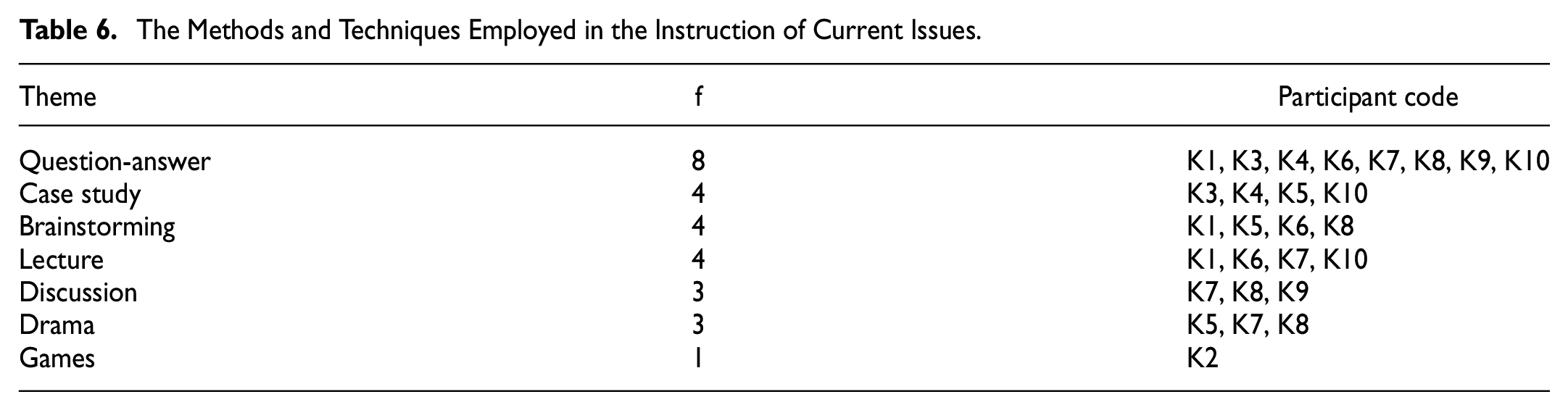
It was determined that the question-answer and case study methods were the most employed instruction methods and techniques in current issue discussions. The themes determined based on the findings on the methods and techniques employed in the instruction of current issues are presented in Table 6.
The Methods and Techniques Employed in the Instruction of Current Issues.
It was determined that the evaluation activities conducted after the discussion of current issues mostly included exchange of ideas on the issue, painting, and asking questions. The themes determined based on the findings on conducted evaluation activities are presented in Table 7.
Evaluation After the Instruction of Current Issues.

The qualitative analysis conducted to determine the teachers’ competence in the instruction of the current issues demonstrated that eight classroom teachers considered that their colleagues had adequate knowledge and experience in the instruction of the current issues. In a previous study, it was reported that educational cartoons were also effective in the instruction of environmental problems and environmental organizations (Topkaya & Doğan, 2019).
Discussion
1. Based on the statements of the teachers in the study group, current issues were described as events that occur in the current time period or occurred in the past but has been discussed periodically since then, concern the general public, reflected in mass media and social media reports, and has been a frequent topic of discussion between the individuals in the society.
Demirkaya-Gedik (2008) reported that the news reports in mass media such as newspapers, magazines, television, internet and radio could be considered current events. He argued that recent or ongoing events in immediate environment, in the nation and in the world, with significant effects on society and humanity could be considered current. The definition developed based on the current study findings was similar to the above-mentioned descriptions.
Gürkan (2009) claimed that current events include the knowledge on what is happening due to anthropogenic or natural causes and concern individuals and the society, affect personal or social decision-making and ideation systems and set the agenda. This definition was similar to the social aspect of the present study findings.
2. While 70% (7 statements) of the participating primary school teachers wanted to instruct current events that include knowledge that students could use in daily life, 30% (3 statements) stated that current events associated with the course topics should be instructed. A teacher emphasized the fact that current issues could be introduced in the class after they are revised based on the level of education.
Gürkan (2009) reported that almost all participating teachers employed current events in social studies courses. Furthermore, it was reported that most teachers allocated 10 to 15 min for discussion on current events during social studies classes based on the topic. Deveci (2007) reported that social studies teachers believed in the benefits of current events. Memişoğlu and Güçlü (2017), on the other hand, argued that teachers considered current events as complementary to the social studies course and employed them whenever necessary. These findings on the necessity of the instruction of current events were similar to the present study findings.
3. The most frequently stated positive outcomes of the instruction of current issues in the class included the improvement in student sensibility, raising student awareness, and preparing the students for life.
In a study by Memişoğlu and Güçlü (2017), teachers stated that current issues prepared students for life, increased their interest in the course, and allowed them to participate more effectively in the class. Furthermore, they stated that it supported the training of the students as active citizens by allowing them to recognize social realities. Gedik (2010) reported that the knowledge acquired by the instruction of current events could be beneficial in daily life. These findings on the preparation of the students for life through the instruction of current events were similar to the present study findings.
Bozkurt (2017) determined that current events had positive effects by increasing the student interest in the course, ensuring active participation in the learning environment, making the class a fun environment, and supporting the comprehension of the students. These positive effects were not similar to the present study findings.
4. The most frequently stated negative outcomes of the instruction of current issues in the class included negative impact on student psychology, development of negative attitudes, conflict, and parental reactions.
Bozkurt (2017) emphasized that the instruction of current events would create an atmosphere of conflict, lead to the arrival of the students unprepared for the class, prevent discussions at the student level, lead to different political and ideological opinions, prejudiced attitudes and behaviors, limit the time for the required instructions, and lead to negative student attitude and behavior. It was emphasized that this could lead to problems such as disruption of classroom order, lack of required material, deviation of the topic, and misunderstandings. These findings on negative attitudes and conflict were similar to the present study findings.
5. The qualitative analysis revealed that the current issues most frequently introduced by the students in the classroom included Covid 19 and natural disasters based on the views of the classroom teachers. These were followed by commemorative days and weeks, prominent figures, environmental pollution, and fanaticism.
Gedik (2010) reported that students mostly desired to discuss droughts and political issues. This was not similar to the present study findings.
6. The analysis findings revealed that the current issues that the classroom teachers in the study group frequently introduced in the classroom were Covid 19 and natural disasters. These were followed by environmental pollution and commemorative days and weeks.
In contrast with the present study findings, a study by Memişoğlu and Güçlü (2017) reported that teachers considered it adequate to discuss coups, terrorism and anarchy. Bozkurt (2017), on the other hand, determined that the most common topic that students desired to discuss in the class was terrorism.
7. The participating teachers stated that they mostly employed the question-answer method in the instruction of current issues. This method was followed by the case study, discussion, and brainstorming techniques. It was determined that the least employed technique in the instruction of current issues was game.
In a study by Deveci (2007), participating teachers mostly employed methods and techniques such as question-answer, discussion, research assignment and animation in the instruction of current events. The finding that question-answer and discussion were the most employed methods was similar to the present study findings. The employment of methods and techniques such as research assignment and animation was not consistent with the present study findings.
Bozkurt’s (2017) reported that social studies teachers employed research, the smart board, instruction of current issues, research assignments, and newspaper clippings in the instruction of current events. These activities were not similar to the present study findings.
8. The evaluation activities conducted after the instruction of current issues included exchange of ideas and asking questions on current issues. The least employed evaluation activities included brainstorming, visual reading and providing examples.
9. The qualitative analysis conducted on the competence of teachers in the instruction of current issues revealed that 8 out of 10 participating classroom teachers stated that their colleagues had adequate knowledge and experience in the instruction of current issues.
Conclusion
The contemporary educational approaches aim to prepare individuals for life and the acquisition of problem-solving skills by the students. The acquired knowledge, skills, attitudes and values could only be meaningful and permanent when implemented in daily life. Thus, instruction of current events is not a choice, but a requirement since these events are important for the society at large, could affect everyone, and set the agenda.
The loss of life and property in recent natural disasters revealed the significance of precautions and awareness about natural disasters in the society. Although natural disasters could not be prevented, instruction of current events is necessary to minimize the damages caused by these disasters.
In addition to the instruction of current events, these could sometimes radically change education. For example, the Covid 19 pandemic has completely changed educational space and time, leading to distance education in all institutions. Furthermore, vital events such as genetically modified organisms, extinction of species, climate change, water shortages and drought that threaten our future could not be neglected in education.
Current events that lead to the acquisition of the development of high-level mental skills, different perspectives, national and spiritual emotions, sensitivity for social problems, problem solving, active citizenship, environmental awareness, the culture of living together, empathy, and communication skills have been introduced by teachers or students in the classroom. Planned instruction of these events in the curriculum would improve and facilitate its effectiveness.
Educational activities should be conducted with the students and parents to eliminate or at least minimize the possible negative effects of the discussion of current events, and to create a democratic environment that would raise the awareness of the students about the instruction of current events.
Recommendations
Recommendations for Practitioners
- The participating teachers stated that instruction of current issues was necessary for the development of student sensibility, student awareness on national and global issues, and to prepare them for life, etc. Thus, current issues could further be included in the curricula.
- Most teachers participating in the study considered their colleagues adequate in the instruction of current issues, while some stated that their colleagues were inadequate. The pre-service training and in-service training programs that could be organized with the collaboration of the Ministry of National Education, Higher Education Council and universities could improve the competencies of the teachers in the instruction of current issues.
- Certain teachers in the study group stated that the instruction of current issues may lead to parental and school administration reactions. Thus, training programs for school administrators and parents could be organized.
Recommendations for Future Studies
- In future studies, the views of school administrators, parents, and students could be analyzed in addition to the views of teachers.
- Similar studies could be conducted in other educational levels.
- Future studies could investigate effective methods and techniques in the instruction of current issues.
- A scale could be developed for the evaluation activities that are conducted after the instruction of current issues.
- The competency of the current curricula could be analyzed in the instruction of current issues in future studies.
- Future studies could investigate the instruction of current issues in various courses.
Footnotes
Author’s Note
This study has been reproduced from the paper presented at the “8th International Congress On Curriculum And Instruction Curriculum Studies In Life Long Learning,” 2021, March 25-27, Burdur/Turkey.
Declaration of Conflicting Interests
The author(s) declared no potential conflicts of interest with respect to the research, authorship, and/or publication of this article.
Funding
The author(s) received no financial support for the research, authorship, and/or publication of this article.
Ethical Statement
Inonu University Social Sciences and Humanities Scientific Research Ethics Committee approved (date; 27.01.2021, number; 2021/3-11).

Data Availability Statement
Data sharing not applicable to this article as no datasets were generated or analyzed during the current study.