




Abstract
This article presents findings from research investigating the effectiveness of humor appeals (humor relatedness and humor mechanisms) to Indonesian millennials for predicting their attitudes toward printed ads and their purchase intentions. In total, 543 Indonesian millennials participated in three experimental studies to test the relationship between humor appeals and the need for cognition to predict their attitudes and intentions. It was found that humor appeals were effective in predicting millennials’ attitudes toward printed ads and their purchase intentions. However, the need for cognition did not significantly influence the relationship. Indonesian millennials were more likely to not engage in thinking processes when evaluating humorous ads, which may be influenced by their characteristics and cultural backgrounds.
Introduction
Many studies have investigated the effectiveness of advertising to improve attitudes toward ads and enhance purchase intentions. In this article, we present research focused on the millennial generation—those born between 1977 and 2000—which have particular beliefs and attitudes toward printed ads, particularly humorous ads (Moreno et al., 2017; Syrett & Lamminan, 2004; Taylor, 2018). For example, millennials are more likely to respond to “quirky” ads than are people from other generations (Taylor, 2018, p. 166). However, this phenomenon requires further investigation, as there has been limited empirical research on this generation (Taylor, 2018; Weinberger & Gulas, 2019). For this research, we used different types of humor mechanisms as manipulation because the usage of humor in advertising requires examination (Spielmann, 2014). In addition, we assess the need for cognition as a moderator between humor and millennials’ attitudes toward an ad, and their purchase intentions, to determine whether millennials think about their motivation in persuasive situations, such as when processing humor in an ad. This is because people with a high need for cognition are more likely to be motivated to respond to an ad that has valuable information compared with those with a low need for cognition (Spielmann, 2014). The present research makes two academic contributions. First, it provides empirical evidence on the effectiveness of certain types of humor in predicting millennials’ attitudes and intentions. Second, it provides empirical evidence regarding how millennials process messages in printed ads. Three experimental studies were conducted to determine whether humor is an effective method of persuading millennials and whether they use their cognition when evaluating ads.
Attitudes toward ads have been studied with a particular focus on affective, evaluative, and cognitive effects of advertising stimuli (MacKenzie & Lutz, 1989). Individual factors (e.g., age, gender, education, mood, or perception) as well as elements of ads (e.g., content, the use of appeals, endorsers, or product novelty) influence consumers’ attitudes toward ads (Belch & Belch, 2021; Bhutada & Rollins, 2015). Attitudes toward ads have been mostly studied as mediators in predicting consumers’ intentions to purchase a product (e.g., Huang et al., 2013; MacKenzie & Lutz, 1989). However, we only considered the influence of individual factors and elements of printed ads in predicting attitudes toward printed ads; we did not determine the effect of attitudes on purchase intentions.
Literature Review
For marketers, purchase intentions are important because they tend to predict buying behaviors. According to the theory of planned behavior, consumers are more likely to take action in the future, such as purchasing a product, if they have a strong motivational intention (Ajzen, 1991; Morwitz, 2012). They also normally have a plan or process or evaluate their wish to buy a product offered (Wu et al., 2011). Therefore, similar to attitudes toward ads, purchase intentions are also influenced by internal and external factors of consumers, including emotions, perceptions, and price (Bagozzi et al., 2016; Chen, 2012). In our research, we investigated these internal factors through the use of humor appeals in printed ads and the need for cognition to predict millennials’ attitudes toward printed ads and their purchase intentions.
Although humor appeals (i.e., humor mechanisms, types, and relatedness) have been studied in advertising, the use of humor mechanisms—particularly to determine the effectiveness of advertising in predicting attitudes and intentions—is novel (Spielmann, 2014). Humor mechanisms consist of arousal–safety, incongruity–resolution, and social humor, which are derived from Speck’s humor types (Speck, 1991; Spielmann, 2014). Humor is a multidimensional concept that combines basic dimensions—underlying humor processes and combinational dimensions—to create a mixture of underlying humor processes (Speck, 1991, p. 3). Three basic human processes have been suggested and are referred to in this article as “humor mechanisms”: arousal–safety, incongruity–resolution, and humorous disparagement (Speck, 1991, p. 5). Our research investigated how humor relatedness and humor mechanisms predict millennials’ attitudes toward printed ads and their purchase intentions.
Humor relatedness was also introduced and categorized by Speck (1991) as an important aspect to consider in advertising. An effective ad must be able to connect humor elements and message elements to its intention, themes, and structure (Speck, 1991, pp. 16–17). We were interested to determine whether “themes” or semantic relatedness in ads could influence millennials’ attitudes. Previous studies used related humorous taglines and pictures to describe the message elements of ads (e.g., Cline & Kellaris, 2007; Matthes, 2013). Although few studies have investigated humor relatedness, some have suggested that humor relatedness is important to improve the effectiveness of ads by predicting attitudes and behaviors (Eisend, 2007). We argue that millennials tend to be more aware of humor relatedness in printed ads, particularly in their content and arguments (Syrett & Lamminan, 2004; Taylor, 2018). Therefore, millennials are more likely to have higher and more positive attitudes toward such ads. A further aspect of humor that may influence attitudes and behaviors is humor strength, which is a measure of an audience’s perceptions of the humor presented in ads (Warren & McGraw, 2016). Millennials have different perceptions of humorous stimuli, which then differentiate their attitudes toward ads from other generations (Ruch & Hehl, 2007). This means that if an ad contains humor, millennials are more likely to respond to it (Spielmann, 2014). We thus argue that both humor relatedness and humor strength predict attitudes toward ads.
Two types of humor mechanism predominate as manipulations of humor in experimental studies: incongruity–resolution and arousal–safety (e.g., Spielmann, 2014; Warren & McGraw, 2016). In our three experimental studies, we manipulated the independent variable using one or both of these humor mechanisms. Incongruity–resolution humor in an ad is normally presented in text messages that are complex and confusing because they use sarcasm or satire (Speck, 1991; Spielmann, 2014). This means that the audience must read text messages that are presented, cognitively process their humorous content, and decide whether the ad is humorous or not (Speck, 1991). In contrast, the arousal–safety humor mechanism creates discomforting and anxiety feelings for the audience (Speck, 1991). This tends to manipulate audience affection rather than cognitive judgment (Speck, 1991; Spielmann, 2014). The use of images instead of text creates sentimental feelings and rational emotions, which create positive attitudes toward an ad (Spielmann, 2014). Both of these humor mechanisms were used as manipulations in our second and third experimental studies.
In addition to humor, we used fear appeal together with a humor mechanism in Study 2 to predict purchase intentions. Fear appeal utilization in ads is effective in shaping the attitudes and behaviors of audiences (Schiffman & Wisenblit, 2019; Tinkham & Yoon, 2013). Fear can significantly increase audience attention as well as the persuasive effect of an ad (Clow & Baack, 2016). Therefore, fear has commonly been used in preventive ads to promote safety (Tinkham & Yoon, 2013). In Study 2, we manipulated printed ads with both humor mechanisms and fear appeal to predict millennials’ purchase intentions and examined the differences between those two.
The final variable is the need for cognition, which is considered an individual motivational factor that tends to consistently influence audience attitudes and behaviors (Cacioppo et al., 1984; Pillai et al., 2011). Based on the elaboration likelihood model of persuasion, people who have a high-level need for cognition tend to evaluate ads via the “central route,” employing a comprehensive and thorough thinking process. Conversely, people who have a low-level need for cognition can be persuaded through the “peripheral route,” which uses only general impressions of things that do not need further evaluation or analysis (Cacioppo et al., 1984). With more general research participants (i.e., consumers), the influence on audience attitudes of the need for cognition has yielded conflicting results (Spielmann, 2014; Zhang, 1996). It is important that the need for cognition is assessed to determine whether millennials use their cognition to process humor in ads. One characteristic of millennials regarding their purchasing behaviors is that they are more likely to make rapid decisions (Moreno et al., 2017). However, millennials have a naturally unique awareness of “quirky” humor in ads, as well as a tendency to be “baggage-less free agents,” which makes it easy for them to adapt to change (Syrett & Lamminan, 2004, p. 73; Taylor, 2018, p. 166). Therefore, we suggest that millennials are more likely to cognitively process ads to make decisions about their attitudes and intentions.
Based on our literature review presented above, we suggest the following hypotheses:
Study 1 tested H1a, H1b, and H1c; Study 2 tested hypotheses H2a and H2b; and Study 3 tested hypotheses H3a and H3b.
Method
We conducted three studies to test our hypotheses using an experimental vignette methodology (EVM). The EVM is a methodology for assessing attitudes, intentions, and behaviors using a combination of surveys and scenarios (Aguinis & Bradley, 2014; Atzmüller & Steiner, 2010). The EVM allows the researcher to use both vignettes as stimulus and surveys to elicit participants’ attitudes, which in our studies was their attitudes toward ads and their purchase intentions (Aguinis & Bradley, 2014; Atzmüller & Steiner, 2010). We used printed ads as the stimulus being manipulated and surveys to measure the moderator and dependent variables. Printed ads were used as they are the most trustable and easy-to-recall ads (Nelson, 2018). As our EVM was conducted using a survey, there was no time limit on completing the questionnaire. However, the questionnaire could be completed in 15–20 min.
Ethical clearance for our research was provided by the Faculty of Psychology Ethics Committee (No. 104/FPsi.Komite Etik/PDP.04.00/2018). For each study, we developed fictional printed ads to suit our hypotheses. Fictional printed ads were used to reduce the effect of prior knowledge of participants (Haugtvedt et al., 1992). We prepared several sets of printed ads and conducted focus group discussions to select appropriate ads based on humor types. All instruments used in the experimental studies were translated into Bahasa Indonesia, using the translation procedure of Sousa and Rojjanasrirat (2011).
Data were collected using the commercial Survey Monkey online survey software. We conducted focus group discussions prior to collecting data to address validity issues in an online experiment (Muise & Pan, 2019). To increase internal validity, we manipulated our independent variables and automatically randomized participants using Survey Monkey (Horton et al., 2011). In our three experimental studies, we used a convenience sampling method to target participants by promoting our studies on social media, including Facebook and Instagram. We conducted each study separately by distributing research links via several social media platforms with a 3-week interval between each study. All participants were from Jakarta and its surroundings and received survey documentation in the same order: informed consent, manipulated ad (randomly assigned), manipulation checks, questionnaires, and debriefing information. We collected only age and gender as demographic data for all studies. All participants were told to input their birth year; therefore, we could make sure all participants are considered as millennials. There was no compensation provided to the participants. We used independent-samples t tests and analysis of variance (ANOVA) in SPSS and a regression analysis employing Hayes’s PROCESS macro for SPSS (Hayes, 2018) for analysis moderation.
Study 1
Design, Participants, and Procedures
A simple experimental between-subject study was conducted on 110 young adults (Mage = 21.25, SD = 1.59, male = 30%). The participants were randomly selected into either the related group or the unrelated group. Millennials were chosen as participants because they were assumed to consume soda beverages more often than other age groups (Gallup, 2013).
Independent Variable
We manipulated the independent variable using printed ads for a fictional soda drink named “Trop” (see Figure 1). The printed ads were intended to promote the soda drink as one with an authentic tropical fruity flavor. Both printed ads had a description as follows: “TROP, an authentic tropical fruity flavor soda drink. Hurry, try it and feel the freshness.” For the ad including relatedness (see Figure 1A), humor was generated by considering a dissonance between reality and expectation of an office situation. A man was pictured sitting in an office; however, he felt like he was sitting in a hammock on a tropical beach after drinking the soda. He looked happy and relaxed, although he was in an office. An additional humorous situation was included via a woman who looked shocked when she saw her boss acting oddly in the office. Humor was also employed with a slogan that said, “Tropical beach sensation everywhere.”
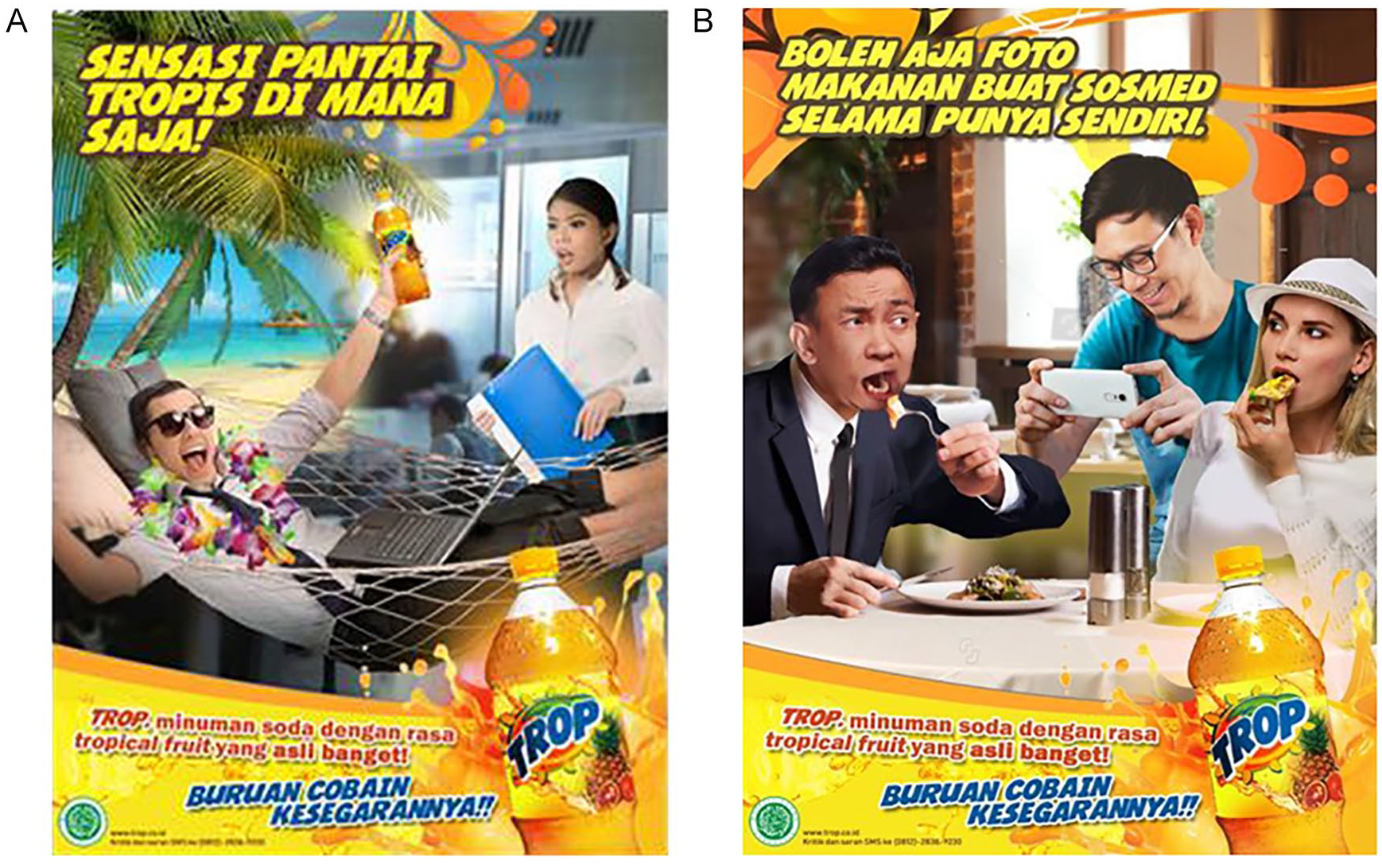
Printed ads for independent variable stimulus: (A) related stimulus and (B) unrelated stimulus.
For the unrelated ad (see Figure 1B), a restaurant situation was used. To make the ad humorous, it showed a young man taking a picture of a couple’s food rather than his own. The couple looked shocked as a result of the man’s actions, which created a humorous situation. In addition, a slogan that said “You can take pictures of food for your social media, as long as it is yours” was added to increase the humorous factor of the ad. This ad was unrelated in nature because it did not directly show that the soda drink had an authentic tropical fruity flavor. We used an incongruity–resolution mechanism in our slogans with the intention of creating sarcastic messages.
We used a two-item relatedness scale from Matthes (2013) as a manipulation check for the independent variable. Using a 6-point Likert-type scale, participants were asked about the relatedness of the humor, slogan, and situation used in the printed ads.
Dependent and Moderating Variables
Three semantic differential items were used to measure the dependent variable of attitudes toward the printed ads (Cline et al., 2003). Participants were asked to rate whether the printed ads were good/bad, pleasant/unpleasant, and favorable/unfavorable on 6-point scales.
Six items from Cline and Kellaris (2007) were used to measure humor strength (6-point semantic differential scale). Participants were asked to rate whether the printed ads were humorous/not humorous, funny/not funny, amusing/not amusing, playful/not playful, not dull/dull, and not boring/boring.
The need for cognition was measured using 18 items (6-point Likert-type scale, ranging from strongly agree to strongly disagree) from Cacioppo et al. (1984). Item examples included “I would prefer complex to simple problems” and “Thinking is not my idea of fun” (unfavorable item).
Results and Discussion
Table 1 presents a descriptive analysis of variables in terms of means, standard deviations, correlations between variables, and Cronbach’s alpha results for each variable used in Study 1. Significant, moderate positive correlations were found between attitudes toward the printed ads, relatedness, and humor strength (r = .48–.70). However, the need for cognition was not correlated with any other variable. The Cronbach’s alpha reliability scale for each variable indicated that all scales had good internal reliability. A manipulation check for relatedness confirmed that there were differences, F(1, 108) = 4.023, p = .047, in mean scores between the related (M = 2.910, SD = 1.106) and unrelated printed ads (M = 2.500, SD = 1.032).
Means, Standard Deviations, Correlations, and Scale Reliabilities.

Note. Diagonal entries are scale reliabilities (Cronbach’s alpha). Att = attitude toward the ad; HS = humor strength; NFC = need for cognition; R = relatedness.
Correlation is significant at the .05 level (two-tailed). **Correlation is significant at the .01 level (two-tailed).
The related ad (N = 55) was numerically associated with higher attitudes (M = 4.079, SD = 0.996) than was the unrelated ad (N = 55, M = 3.600, SD = 1.161). An independent-samples t test was conducted to statistically compare attitudes toward printed ads in the related and unrelated ad conditions to test our first hypothesis. A Shapiro–Wilk test for a normal distribution demonstrated that the related and unrelated printed ads were distributed normally (p > .05). A Levene’s test of homogeneity of variances showed that the variances for the related and unrelated printed ads were equal, F(108) = 1.567, p = .213. There was a significant difference in the scores for the related and unrelated ad conditions, t(108) = 2.322, p = .022, for attitudes toward printed ads. Therefore, H1a was supported.
We used two moderators in this study: humor strength (Moderator 1) and the need for cognition (Moderator 2). An analysis using the Hayes’s Model 2 PROCESS macro indicated that the model with two moderators was significantly different from zero in predicting attitudes toward printed ads, F(5, 104) = 25.498, p = .000, R2 = .551; see Table 2. While the interaction between relatedness and humor strength was not significant (β = −.047, t = −0.652, p = .516), the interaction between relatedness and need for cognition was statistically different from zero (β = −.324, t = 2.064, p = .043), although it only accounted for 1.8% of the variance, F(1, 104) = 4.260, p = .042, R2 = .018. Figure 2 shows the three-way interaction slope for the two moderators—humor strength and need for cognition. The probing interaction in the two moderators suggested that at both high (β = .348, SE = 0.113, t = 3.079, p = .003, 95% confidence interval [CI] = [.124, .572]) and low (β = .434, SE = .127, t = 3.404, p = .001, 95% CI = [.181, .687]) humor strength scores, the increasing need for cognition score led to increasing relatedness in predicting attitudes toward printed ads. Therefore, while H1b was not supported, H1c was supported.
Coefficients for Moderation Analysis.

Note. Att = attitude toward the ad; HS = humor strength; NFC = need for cognition; R = relatedness; CI = confidence interval.
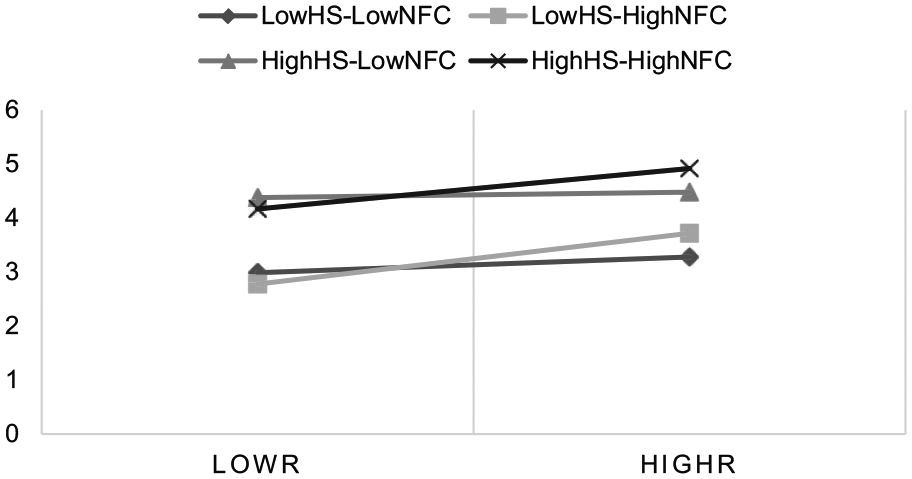
Three-way interaction slope for two moderators.
The result of independent-samples t test was consistent with previous findings that an ad with related humor performed better than an unrelated ad for predicting attitudes (Matthes, 2013).
Study 2
Design, Participants, and Procedures
A 2 × 2 between-subject experimental study was conducted on 254 young adults (Mage = 22.86, SD = 1.90, male = 24%, 66% response rate) who were randomly selected to view neutral, humor-only, fear-only, or humor–fear printed ads before they completed the online survey. We differentiated the printed ads based on gender to increase personal relevance as suggested by Mukherjee and Dube (2012). Therefore, male participants saw male actors on the printed ads and vice versa. We differentiated only gender in this second study, as participants may have felt fear appeal was relevant to them only if the actor had the same gender (Mukherjee & Dube, 2012). We also did not analyze data further based on gender as the number of males and females was not balanced.
Independent Variable
Manipulations of the independent variable were conducted using four printed ads—neutral, humor-only, fear-only, and humor–fear—promoting a certified national helmet for riders (see Figure 3). The national certified helmet was chosen for this analysis because it had been promoted regularly by the government to reduce motorcycle accidents in Indonesia. It is common in Indonesia to find both Bahasa Indonesia and English used together in the same ads. Therefore, we used a combination of both languages in Study 2. Fictional printed ads for the national certified helmet were created in different formats. The first was a neutral ad with no humor or fear appeal (see Figure 3A), which said that “if you use the helmet, you do not have to worry when driving.” Figure 3B and 3C shows humorous printed ads, for which we used a humor appeal to elicit participants’ positive emotions by using play signals (picture of the printed ads) and safety judgment content (a slogan that said “withstand with any impacts”). Fear appeal was used in Figure 3D and 3E by displaying the negative consequences (injured faces) of not wearing a proper helmet (through a message incongruity–resolution mechanism). The pictures showed that if you use a cheap helmet, you are likely to have more serious accidents. Both humor and fear appeals were used in the ad in Figure 3F and 3G, which showed that wearing the helmet kept the rider safe from accidents (i.e., arousal–safety mechanism).

Printed ads for independent variable stimulus: (A) neutral ad, (B) humor ad—woman version, (C) humor ad—man version, (D) fear ad—woman version, (E) fear ad—man version, (F) humor–fear ad—woman version, and (G) humor–fear ad—man version.
A fear tension arousal questionnaire from Keller and Block (1996) was used to check fear appeal manipulation via four items completed using a 6-point semantic differential scale. Participants were asked about their feelings after viewing the ad, including whether they were very unafraid/very afraid, relaxed/tense, calm/agitated, and restful/excited. Another semantic differential scale was used to check humor manipulation: the perceived humor check by Cline et al. (2003), which contained four items completed with a 6-point semantic differential scale. The items measured participants’ perceived humor after viewing the ad, including whether it was humorous/not humorous, funny/not funny, amusing/not amusing, and serious/unserious.
Dependent and Moderating Variables
Purchase intention as a dependent variable was measured using four items from Bagozzi et al. (2016). A 6-point semantic differential scale was used to measure whether participants would like to buy the product if it was available on the market. Examples of items included, “I would feel a strong urge to buy the helmet” and “I would feel the impulse to buy the helmet.” We used the same scale as Study 1 to measure the need for cognition.
Results and Discussion
The descriptive analysis (see Table 3) indicated that there was no correlation between purchase intention and the need for cognition. Internal reliability (i.e., Cronbach’s alpha) for both measurements was acceptable, although scale reliability for the need for cognition in this study was lower than in Study 1. An ANOVA was conducted to check whether manipulation checks were successful. There were significant differences between groups for both fear appeal, F(3, 250) = 6.675, p = .000, and perceived humor, F(3, 250) = 21.163, p = .000, which indicated that manipulations for both fear appeal and perceived humor were successful.
Means, Standard Deviations, Correlations, and Scale Reliabilities.

Note. Diagonal entries are scale reliabilities (Cronbach’s alpha). NFC = need for cognition; PI = purchase intention.
To test H2a, a one-way between-subject ANOVA suggested that there was a statistically significant difference between groups, F(3, 250) = 5.284, p = .002 (see Table 4 and Figure 4 for a means plot), that viewed the humor-only, fear-only, humor–fear, and neither humor nor fear printed ads. A Levene’s test of homogeneity of variances demonstrated that based on the means, the variances for purchase intention were equal, F(3, 250) = 1.098, p = .351. However, both Tukey (p = .001) and Bonferroni (p = .001) post hoc tests consistently suggested that the mean score for purchase intention was significantly different only between the group that viewed the fear-only ad (M = 3.025, SD = 1.159) and the group that saw the humor–fear ad (M = 2.284, SD = 1.162), which meant that participants who saw the humor–fear ad were more likely to have lower purchase intention than were those who saw the fear-only ad.
One-Way Analysis of Variance of the Use of Humor and Fear in Ad.

Note. CI = confidence interval.

Means plot of one-way analysis of variance.
To address H2b, a moderation analysis using Hayes’s PROCESS macro Model 1 (see Table 5) suggested that the need for cognition did not moderate the relationships between any of the experimental groups. Therefore, neither H2a nor H2b was supported.
Coefficients for Moderation Analysis.

Note. PI = purchase intention; NFC = need for cognition; CI = confidence interval.
Study 3
Design, Participants, and Procedures
We again conducted a simple experimental study with 179 young adults (Mage = 21.84, SD = 2.087, male = 25%), a 67% response rate. All participants were randomly selected to view either a neutral ad or an ad with arousal–safety humor.
Independent Variable
In this study, we used the printed ads shown in Figure 5. We promoted internet speed in the printed ads because this is sometimes not stable in Indonesia. We also wanted to investigate the effect of humor on different product types. Two printed ads were developed as stimuli for the independent variable. A neutral ad showed (see Figure 5A) that a fictional internet provider (White Mobility) employed a 5G connection with speeds up to 10 Gbps, which was the fastest internet speed in Indonesia. Another ad (see Figure 5B) was designed to increase tension (i.e., arousal–safety mechanism) when participants viewed it by using an obituary notice that the “buffering” period was dead. Both printed ads indicated that fast internet speed was currently in the news and was available from White Mobility.
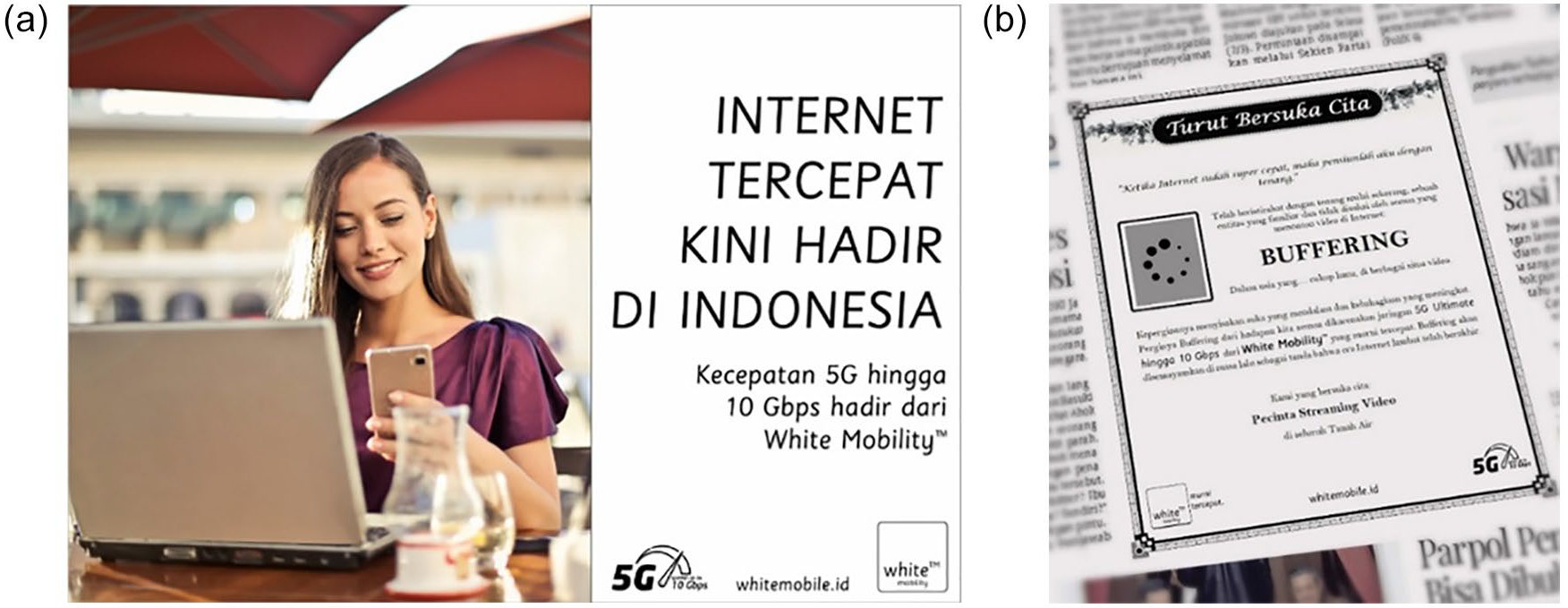
Printed ads for independent variable stimulus: (A) neutral ad and (B) ad with arousal–safety humor.
Manipulation checks for independent variables were also used. Arousal–safety humor was checked using Spielmann’s (2014) eight-item Likert-type scale instrument. A 6-point Likert-type scale ranging from completely agree (6) to completely disagree (1) was used to assess participants’ perceptions of each ad they viewed.
Dependent and Moderating Variables
We used the same instruments for the dependent variables (i.e., attitudes toward printed ads and purchase intentions) and the moderator (the need for cognition) as in the previous two studies.
Results and Discussion
All instruments used in this study had acceptable internal reliability (i.e., Cronbach’s alpha) as shown in Table 6. All variables were significant correlated to each other (r = .182–.659). The manipulation check for the independent variable was successful, F(1, 177) = 44.185, p = .000, between the neutral ad (M = 3.333, SD = 0.819) and the ad with arousal–safety humor (M = 4.145, SD = 0.814).
Means, Standard Deviations, Correlations, and Scale Reliabilities.
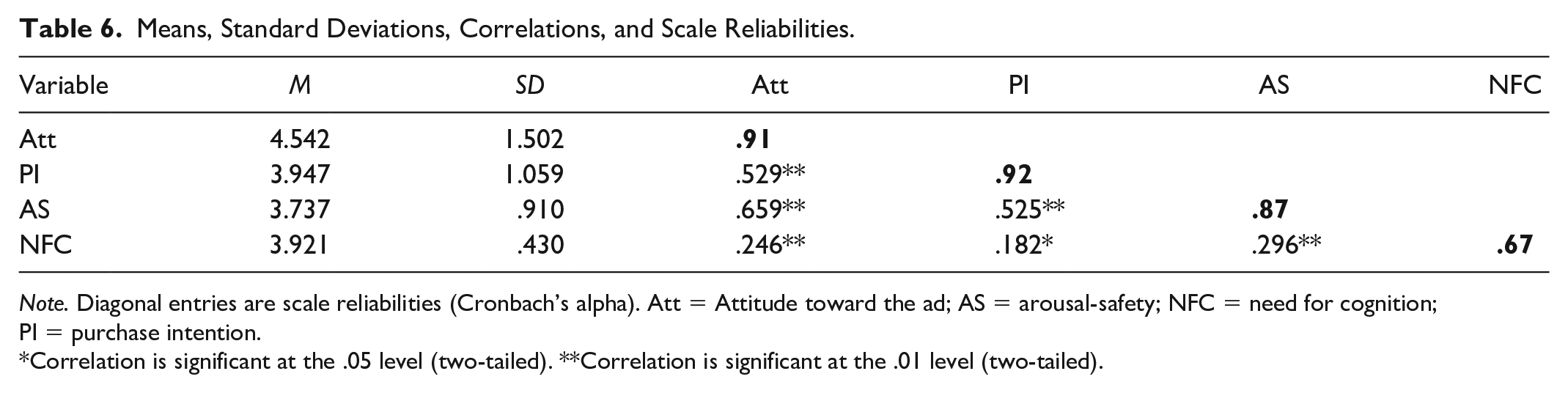
Note. Diagonal entries are scale reliabilities (Cronbach’s alpha). Att = Attitude toward the ad; AS = arousal-safety; NFC = need for cognition; PI = purchase intention.
Correlation is significant at the .05 level (two-tailed). **Correlation is significant at the .01 level (two-tailed).
A Shapiro–Wilk test indicated that responses were distributed normally (p > .05) for both attitudes toward the printed ad and purchase intentions. The descriptive analysis showed that an ad with arousal–safety humor (N = 90) was associated with higher attitudes toward the ad (M = 5.097, SD = 1.405) than the neutral ad (N = 89, M = 3.993, SD = 1.395). The same result was also obtained for purchase intentions for the ad with arousal–safety humor (M = 4.143, SD = 1.070) and the neutral ad (M = 3.753, SD = 1.016). An independent sample t test was conducted to test hypothesis H3a. A Levene’s test of homogeneity of variances showed that attitudes toward the printed ads and purchase intentions had similar variances: F(177) = 0.037, p = .847 and F(177) = 0.109, p = .742, respectively. For attitudes toward the printed ads, there was a significant difference in the score for the neutral and arousal–safety ad conditions, t(177) = −5.280, p = .000. A significant difference in mean score between the two printed ads was also evident for purchase intentions, t(177) = −2.504, p = .013. Negative t values for both attitudes toward the printed ads and purchase intentions suggested that arousal–safety in an ad created negative emotions, which then influenced participants’ attitudes and intentions toward the ad. Therefore, H3a was supported.
A regression analysis was performed on both attitudes toward the printed ads and purchase intentions to investigate the influence of the need for cognition as a moderator using Hayes’s PROCESS macro for SPSS (Model 1). The result of the moderation analysis suggested that the need for cognition did not influence the relationship between arousal–safety humor; nor did attitudes toward the printed ads (β = −.144, t = − 0.619, p = .537); nor purchase intentions (β = −.244, t = −1.313, p = .191). As a result, H3b was not supported.
General Discussion
Three experimental studies were conducted to investigate the effects of humor appeals (i.e., humor relatedness and humor mechanisms) on the attitudes of millennials toward printed ads and purchase intentions, including the effect of the need for cognition on the relationship. Across the three studies, we found that humor appeals were quite effective in predicting millennials’ attitudes toward printed ads and purchase intentions in commercial printed ads. Millennials who thought that humor presented in the printed ads was related to the products were more likely to have a higher attitude toward the printed ads (Study 1). Although our hypotheses for Study 2 were not supported, the results suggested that a combination of fear appeal and incongruity–resolution as a humor mechanism was a better predictor of purchase intentions in safety-related printed ads. Finally, an ad using an arousal–safety humor mechanism was a better predictor of attitudes toward printed ads and purchase intentions in Study 3. These results suggest that millennials have a tendency to prefer humorous printed ads based on their relatedness and humor mechanisms (Meriac et al., 2014; Taylor, 2018). In relation to the use of the need for cognition in influencing the relationship between humor appeals and millennials’ attitudes and intentions, we found that there was little such influence. Millennial participants in this research tended to not fully process the printed ads presented in the experiments.
Our results in relation to humor appeals support Speck’s (1991) humor theory, which states that humor appeal can increase consumer attention, which may eventually provide encouragement for them to buy a product. The results also support those of previous studies showing that Speck’s humor mechanism of arousal–safety is effective in promoting consumers’ attitudes and intentions toward printed ads (Spielmann, 2014; Weinberger & Gulas, 2019). In addition, a combination of a humor mechanism and fear appeal to promote safety behavior (i.e., wearing a helmet) persuaded consumers more effectively than did nonhumorous printed ads. However, the ad that used fear appeal only was able to persuade millennials more than was a combination of arousal–safety and fear appeal. We assumed that participants were directly aware of the consequences of not using a helmet from the message presented. Conversely, by using an image that combined arousal–safety mechanism and fear appeal, participants might perceive that the impact of an accident was “funny” because the actor was still smiling. Therefore, we believe that a message in safety-related printed ads is more appealing to millennials and will better promote understanding of the importance of using helmets to protect themselves.
Apart from evidence for the beneficial use of humor appeals in printed ads, we did not find meaningful support for the need for cognition. Although the need for cognition interacted with humor relatedness to predict attitudes toward printed ads, the effect was very weak, consistent with Spielmann (2014). We used printed ads in our studies and agree that the use of printed ads may have influenced the result (Spielmann, 2014). Although printed ads tend to be more trustworthy, and with content that is easier to recall (Nelson, 2018), we believe that broadcast ads may more strongly influence people’s attitudes and intentions. This is because the actor/s in broadcast ads can explicitly express their emotions or feelings. In addition, we could also relate the emotions or feelings to “thinking for pleasure,” a state in which people are more likely to enjoy real activities instead of thinking activities (Buttrick et al., 2019; Wilson et al., 2014). The increasing number of millennials in Indonesia may also create high competitiveness in many sectors, such as education, employment, and social interaction, which may force them to do more instead of thinking more (Buttrick et al., 2019). If we relate the result to the millennial characteristic of making more rapid decisions when buying products, we contend that millennials in Indonesia may be likely to make decisions without making further evaluations of products (Moreno et al., 2017). Both millennials’ lack of thinking for pleasure and their characteristics may explain why the need for cognition in our studies did not interact with humor appeals to predict their attitudes and intentions.
Besides providing empirical evidence regarding the attitudes and intentions of millennials toward printed ads, we believe that our research has practical implications for marketers. As our results suggested, the need for cognition did not influence the attitudes and intentions of the participating millennials. Therefore, we suggest that marketers could develop printed ads that do not require much thinking when targeting millennials. We believe that millennials may be more likely to react more positively to printed ads that provide instant information through social media, such as Instagram or Facebook (Moreno et al., 2017). This may increase millennials’ likelihood of viewing printed ads and eventually intending to buy the products.
We have identified some limitations to our research and provide suggestions for future research. First, although EVM studies provide better results than survey-only studies in terms of understanding the relationship between humor appeals and millennials’ attitudes and intentions, the results cannot be generalized to a wider population (Atzmüller & Steiner, 2010). Also, because we collected data in Indonesia, the research should be duplicated in other countries. Regarding the need for cognition, we suggest using longitudinal studies to determine whether the need for cognition differs over time. Second, we used different content and printed ads for our experimental studies. We suggest using the same content across studies but using different formats, such as audio or video (Weinberger & Gulas, 2019). In this way, the influence of the need for cognition can be better evaluated. Finally, future research should also compare the cultural background of participants to maximize its effects on humorous printed ads and the need for cognition tendencies. This is because research has shown that humor in general may be interpreted differently across cultures as well as across individuals differing by generation, age, and gender (Fikkers & Piotrowski, 2020; Gregory et al., 2019; Mayer et al., 2019).
In conclusion, humor appeals are effective in improving the attitudes of millennials toward printed ads and their purchase intentions. Conversely, we found no evidence for the usefulness of the need for cognition in influencing the relationship between humor appeals and attitudes toward printed ads and purchase intentions. Further research should incorporate cultural differences to evaluate whether the need for cognition is influenced by these factors.
Footnotes
Author Contributions
B.S. and M.D.M. conceived and designed the experiments, contributed to data analysis, and wrote and co-wrote the paper. N.C., S.K., L.A.K., A.B.M., R..P, and A.P.S. designed and performed the experiment tools, collected data, and contributed to data analysis.
Declaration of Conflicting Interests
The author(s) declared no potential conflicts of interest with respect to the research, authorship, and/or publication of this article.
Funding
The author(s) received no financial support for the research, authorship, and/or publication of this article.
Ethical Approval
Ethical clearance was provided by the Faculty of Psychology Ethics Committee—No. 104/FPsi.Komite Etik/PDP.04.00/2018.
Ethical Compliance Statement
All procedures performed in studies involving human participants were in accordance with the ethical standards of the institutional research committee and with the 1964 Helsinki Declaration and its later amendments or comparable ethical standards.
Informed Consent
Informed consent was obtained from all individual adult participants included in the study.
