



Abstract
Many scholars have focused on the role of exhibitions in business promotion, and numerous studies have been conducted. The exhibition may influence the audience’s behaviors through the dissemination of information and ideas, but few researchers have looked into this further. There is a distinct lack of research on the process of exhibition influencing people’s behavioral intentions. Based on the belief–emotion–norm theoretical model, this study integrates environmental beliefs, exhibition attachment, and an audience’s environmental behavior intentions into a research model to explain how the exhibition affects the audience. The Macau International Environmental Cooperation Forum & Exhibition attendees served as the research object in the current empirical study. The study’s findings suggest that audiences’ environmental beliefs may have a significant and positive impact on their attachment to environmentally themed exhibitions as well as their environmental behavioral intentions. This study also confirmed that attachment to exhibitions, a temporary space, can play an important mediating role between environmental beliefs and intentions to engage in pro-environmental behavior. The exhibition dependency, in particular, acts as a mediator between environmental beliefs and pro-environmental behavior intentions. Although the mediating effect of exhibition identity is insignificant, exhibition dependence–exhibition identity as a whole has a partial mediating effect in the process of influencing exhibition audiences’ environmental behavior. This research helps to improve our understanding of how environmentally themed exhibitions influence audience behavior. It also has implications for exhibition organizers in terms of better exhibition planning, more effective information transmission, and influencing audience behavior.
Keywords
Introduction
Exhibitions are a kind of commercial activity wherein exhibitors and other participants with similar interests or motives gather in one place for a short time to present their purposes and objectives (Camarero et al., 2010; Jin et al., 2012; Jin & Weber, 2013; Rittichainuwat & Mair, 2012). Previous studies have focused on the impact of an exhibition’s commercial function on exhibitors and visitors (Godar & O’Connor, 2001; Tanner et al., 2001). However, as places of service and experience, exhibitions also have an educational function (Fenich, 2013). People can acquire knowledge from an exhibition that will affect their subsequent behavior. In particular, exhibitions themed around environmental protection or sustainable development can increase visitors’ sense of social responsibility and affect their future environmental behaviors (Fenich, 2013). For example, an environmentally themed exhibition can lead participants to pay more attention to environmental issues, reduce carbon emissions in their daily lives, and achieve sustainable development (Fenich, 2013). Saribas et al. (2017) also found that environmentally themed exhibitions positively affect an audience’s environmental intention, and similar phenomena have been observed in other studies. For instance, a photo exhibition with an ecological–environmental theme was found to stimulate students’ awareness of environmental protection and influence their future pro-environmental behaviors. Although previous studies have revealed the possible relationship between environmental protection-themed exhibitions and visitors’ behavioral intention, few researchers have explored the mechanism of this impact.
The theories most commonly cited in the literature to explain people’s environmental behaviors are Stern et al.’s (1999) value–belief–norm theory, Ajzen’s (1991) theory of planned behavior, and Hidalgo and Hernandez’s (2001) theory of place attachment. These theories offer different perspectives on people’s environmental behaviors. The value–belief–norm theory posits that under the influence of different value orientations, people will form a specific worldview. This worldview will arouse beliefs, including awareness of behavioral consequences and attribution of environmental responsibility, which will in turn stimulate different levels of individual norms that ultimately lead to the implementation of environmental protection behaviors. The theory of planned behavior is derived from the theory of rational behavior, which posits that human behavior is the result of deliberate thinking, and in addition to attitudes and subjective norms, perceptive behavior control is enrolled in the theory to reveal people’s behavior more deeply.
Place attachment originated in the fields of geography and environmental psychology (De Dominicis et al., 2015) and has been widely applied in both fields and in leisure research (Kyle et al., 2003; J. S. Smith, 2015; Zia et al., 2014). It refers to the connection between an individual and their environment (Giuliani, 2003; Low & Altman, 1992). In previous studies, the research objects of place attachment have mostly been in long-term settings, such as communities and scenic areas. An exhibition space is temporary (He et al., 2019), and recent years have seen increasing research focus on attachment to temporary settings. Yi et al. (2018) assert that attachment to a place exists not only between people and real objects or entities but also between people and intangible objects or situations based on which they propose a conceptual model of exhibition attachment. Jin and Weber (2016) point out that few scholars have studied the factors that attract exhibition visitors from the perspective of attachment. The impact of attachment to a temporary place on human behavior evidently needs further exploration. In many prior studies of environmental behavior, people’s place attachment has been identified as an important variable to predict their pro-environmental behavioral intention. For example, place attachment has been found to effectively predict people’s environmental protection commitments, environmental protection behaviors in daily life, and behaviors that respect the natural environment (Halpenny, 2010; T. H. Lee, 2011; Vaske & Kobrin, 2001). However, these studies mainly focus on long-term settings, such as tourist attractions (Y.-K. Lee et al., 2019); natural environments, such as the seashore area (L. R. Larson et al., 2018); or communities where residents live (Gu et al., 2015). The relationship between people’s attachment to a temporary space and their environmental behavior has not been systematically studied. To fill this research gap, this study draws on the theory of belief–emotion–norm to build a theoretical model for the influence of attachment to a temporary space on visitors’ environmental behavioral intention, including exhibition attachment as a mediation variable and environmental belief as an antecedent variable. This study will verify the possible relationship between an exhibition and the audience’s future behavior intentions from the perspective of attachment to temporary places and effectively make up for the lack of relevant theoretical explanations of exhibitions’ impact on audience behavior (Mair & Jago, 2010; Mair & Laing, 2013).
Literature Review and Research Hypotheses
Review of Related Literature
In social psychology, belief is viewed as the enduring organization of perceptions and cognitions of the personal world (Krech & Crutchfield, 1948). Ajzen and Fishbein (2000) point out that human behavior may be driven by three different beliefs: those about the possible consequences of behavior (behavioral beliefs), about the normative expectations of others (immaterial beliefs), and about the existence of factors that may further promote or hinder implementation (control beliefs). Environmental beliefs are regarded as a system of attitudes and beliefs that determine people’s environmental behavior (Gray & Weigel, 1985); they are, thus, a form of behavioral beliefs.
Stern et al. (1995) and Dietz et al. (1998) divide environmental beliefs into two types: general beliefs and specific beliefs. General beliefs concern the human–environment relationship and refer to folk wisdom about the environment (Stern, 2000). Specific beliefs concern the existence of environmental issues, such as water shortages, ozone depletion, and global warming. Most prior research has used Dunlap and Van Liere’s (1978) New Environmental Paradigm (NEP) to measure general environmental beliefs. The NEP mainly measures the extent of people’s beliefs about the biosphere and how human activities affect it. This is a sort of “folk” ecological theory from which beliefs about the adverse consequences of ecological change can be easily deduced (Stern et al., 1995). The effectiveness of NEP and its ability to accurately reflect environmental attitudes have been repeatedly tested and recognized (Dunlap, 2008).
As consumers become more aware of contemporary ecological issues, their environmental beliefs and their ability to influence the environment through consumption decisions have an important impact on their attitudes and behavior (Young et al., 2010). Accordingly, people with strong environmental beliefs may be expected to have a more positive attitude toward consumption and activities that can promote environmental protection. This study also draws on NEP, which is frequently used by scholars, as an environmental belief.
Derived from environmental psychology, place attachment refers to an individual’s attachment to their own family, community, and society; it is the connection between an individual and a specific environment (J. Lee et al., 2012). McIlvenny et al. (2009) assert that a place is a geographical area where individuals integrate into or interact with the natural environment, producing a variety of life experiences, space usages, and interactions with local residents. Explaining the formation process of place attachment, Tuan (1977) contends that people’s subjective understanding, perception, and description of a place will lead to a sense of place, which develops into place identity and, ultimately, into place attachment.
For individuals, place attachment means various connections to a place in which emotion is considered the primary factor (Gieryn, 2000). Yuksel et al. (2010) identified emotional attachment as one of the three dimensions of place attachment, while scholars such as Giuliani (2003), Bricker and Kerstetter (2000), and Williams et al. (1992) have recognized emotional associations as the primary connotation of place attachment. Environmental psychologists also tend to describe place attachment in emotional terms, such as emotional investment in a place (Hummon, 1992) or “pride and happiness” (B. Brown et al., 2003). Of course, the cognitive connection between people and place (Bricker & Kerstetter, 2000; Gieryn, 2000; Gross & Brown, 2006; Moore & Graefe, 1994; Proshansky et al., 1983; Scannell & Gifford, 2010) and the behavioral connection (Scannell & Gifford, 2010; C. T. Tsai, 2016; S.-P. Tsai, 2012; Yi et al., 2018) are also components of place attachment. For example, Scannell and Gifford (2010) adopted the people–process–place framework to define place attachment as a bond between an individual or group and a place, expressed through affective, cognitive, and behavioral psychological processes.
In the conceptualization of place attachment, two-dimensional scales comprising place identity and place dependence are widely accepted in the fields of environmental psychology and tourism management (Kyle et al., 2005; Williams & Vaske, 2003; Yuksel et al., 2010). Place dependence refers to people’s functional attachment to specific places, such as local characteristics and place attributes (Prayag & Ryan, 2012; Suntikul & Jachna, 2016) or features that can meet tourists’ specific needs (Kyle et al., 2004; Stokols, 1981; Williams et al., 1992). Place identity highlights the symbolic meaning and purpose given to a place, which can be regarded as social identity (Yuksel et al., 2010). Emotional attachment has been proposed as a third dimension of place attachment by Yuksel et al. (2010); meanwhile, Ramkissoon et al. (2013) define four dimensions of place attachment: place dependence, place identity, place influence, and local social bonds.
As exhibitions can provide attendees with opportunities for acquiring knowledge, market research, social networking, leisure, and so on, Zhong and Luo (2018) describe them as “a place with reference value and a sense of belonging.” Exhibitions can foster a sense of community between attendees through the commitment of participation, leading to the formation of place attachment (Hahm et al., 2016; Yi et al., 2018). However, research on exhibition attachment has only gradually emerged in recent years, and the number of studies remains small (G. Brown et al., 2016; Woo & Jun, 2017; Yi et al., 2018). Drawing on Scannell and Gifford (2010), exhibition attachment can be considered as bonding to a special place, representing the nexus among people, their psychological process, and place (Fu et al., 2019). Yi et al. (2018) developed a scale of exhibition attachment that provides an important basis for this research. This scale measures exhibition attachment from two perspectives: exhibition dependence and exhibition identity. Exhibition dependence emphasizes how the functional aspects of the exhibition meet participants’ needs (i.e., cognitive expression), while exhibition identity stresses the emotional attachment (i.e., emotional expression) experienced by participants. In prior studies, attachment to long-term settings has been found to originate in social networks, community meanings, and a social nexus with others (Tuan, 1977), whereas attachment to a temporary space has been found to be cultivated by environmental quality (Stedman, 2006). As an exhibition is a temporary space, this study follows Yi et al. (2018) by regarding exhibition attachment as comprising exhibition dependence and exhibition identification. Supported by the opinions of Yi et al. (2018) and Lewicka (2011), this study also treats exhibition dependence and exhibition identity as two independent constructs to further explore their influence on exhibition visitors’ environmental behavioral intention.
With the rapid economic growth, there is a growing emphasis on environmental sustainability (Yang et al., 2019), Osbaldiston and Schott (2012) define pro-environmental behaviors as those that are relatively beneficial to the environment. They include any behaviors that protect the environment or minimize the negative impact of human activities on it (Cottrell, 2003). The term “pro-environmental behavior” is interchangeable with environmentally responsible behavior, environmentally friendly behavior, green behavior, and eco-friendly behavior (Miller et al., 2015). Common environmentally friendly behaviors include consuming less water and electricity, using public transport, tackling littering, recycling waste, and reusing plastic bottles (Caruana et al., 2014). Broadly speaking, pro-environmental behaviors derive from the interaction of knowledge, behavioral constraints and opportunities, and personal values and motives; they belong to socio-structural variables and psychosocial variables (Bamberg & Möser, 2007; Song et al., 2020). Previous research has shown that both environmental consciousness and green brand strategies have an effect on people’s pro-environmental behavior (Jian et al., 2020; Yang et al., 2021). In determining pro-environmental behaviors, factors such as environmental values or attitudes may be more important than sociodemographic and background factors (Bamberg & Möser, 2007; Steg & Vlek, 2009). Previous studies have also shown that beliefs may affect attachment and pro-environmental behavior intention (Wynveen et al., 2014). However, due to the difficulty in directly studying behavior, the behavioral intention has been proved to be an effective predictor of people’s future behavior (Gkargkavouzi et al., 2019; Lin & Roberts, 2020).
This research has benefited from the work of S. Lee et al. (2020). The study employs the Korean Demilitarized Zone as a case study to investigate how tourists’ beliefs influence the formation of destination attachment and how it influences behaviors that promote tourism development. According to S. Lee et al. (2020), the development of place identity is linked to the exchange of belief-related information; therefore, in environmentally themed exhibitions, the social and psychological relationships established by people with similar beliefs will bring spatial meaning to people (Proshansky et al., 1983). The meaning of place is a crucial component of place dependence (Brehm et al., 2013). When people have similar environmental beliefs, it is easier to form social connections between them, and, as a result, it is easier to form an attachment to the space where people gather. The study also found that people who hold similar beliefs are more likely to appreciate the functional value of space, which has a significant impact on the formation of place dependence. The findings of the abovementioned study clearly explain why people with strong environmental beliefs are more likely to become attached to environmental protection exhibitions. At the same time, it confirmed the role of place attachment as a mediator between belief and behavior (S. Lee et al., 2020).
Research Hypotheses
Environmental beliefs and environmental exhibition attachment
The influence of belief on emotion has been identified in many studies. For example, using Bayesian models, Paulus and Angela (2012) found that belief affected emotion and then future behavior. Han et al. (2017) also concluded that beliefs can influence emotions, which can, in turn, predict future behaviors or intentions. In Hsu et al.’s (2010) study of tourists visiting Hong Kong, the tourists’ behavioral beliefs were the decisive factor affecting their emotional reactions toward Hong Kong tourism.
In the realms of sport (Filo et al., 2012) and religion (Atkinson et al., 2017), scholars have also confirmed that belief significantly influences event attachment. Wynveen et al. (2014) investigated residents living near a national forest in California; they found that the more biocentric a resident’s worldview, the stronger their attachment to the national forest. Stern et al.’s (1995) findings indicate that personal values, social interaction, and environment cognition all affect the formation of the environmental worldview (EWV), which influences how an individual affects the environment of a specific place (Stern et al., 1995). The EWV is a set of general beliefs about the relationship among the earth, humans, and the environment, originating from the NEP. Wynveen et al. (2014) found that there might be a strong connection between the EWV and all dimensions of place attachment. This indicates that general beliefs and people’s cognitions of and emotions about a place might be connected. Considering that exhibition attachment has both emotional and cognitive connotations (Fu et al., 2019), this research proposes the following hypotheses:
Environmental beliefs and pro-environmental behavioral intention
When consumers believe that green consumption will benefit themselves, others, and/or the environment, they are more likely to act (i.e., consume) in an environmentally responsible manner (Han et al., 2010). Line and Hanks (2016) found that when consumers believe their behavior can positively affect the environment, they are more likely to choose, for example, green hotels. The relationship between environmental beliefs and pro-environmental behavioral intention has been extensively studied (Stern et al., 1998, 1999). Some results show that environmental beliefs may positively affect pro-environmental behavioral intention. Steg (2016) found that values reflect the general goals that people pursue and that they mainly indirectly affect pro-environmental behavioral intention through beliefs and norms. Schultz et al. (2004) also assert that an individual’s environmental beliefs can inspire their intention to adopt pro-environmental behaviors in future work and life. Although many studies have proved the relationship between beliefs, attachment, and behavioral intention, few have attempted to integrate them into one model for attachment to temporary settings, such as exhibitions. In addition, as this study also hopes to explore the mediating effects of exhibition identity and exhibition dependence on environmental beliefs and pro-environmental behavior intentions, from the perspective of data analysis, the research needs to make assumptions about the relationship between environmental beliefs and pro-environmental behavior intentions. To this end, the following hypothesis is proposed:
Environmental exhibition dependence and environmental exhibition identity
Exhibition dependence and exhibition identity can be considered as the attendees’ internalization of the exhibition experience (Choe et al., 2014; Jung, 2005). Yuksel et al. (2010) postulate that exhibition dependence is the degree to which an exhibition’s facilities and other functions meet the participants’ objectives; as such, it mainly focuses on the influence of functions on specific objectives or purposes. Relatedly, Stokols (1981) asserts that place dependence refers to the functional assessment of groups and individuals that helps them to carry out certain activities. Thus, exhibition dependence is based on a transactional view, that is, comparing this exhibition with other exhibitions in terms of effectiveness in supporting specific purposes and behaviors.
There are different interpretations of exhibition identity: It can refer to the self-regulation of participants in an exhibition environment (Gross & Brown, 2008; Hwang et al., 2005), an individual’s association with and preference for an exhibition (Yuksel et al., 2010), or the relationship between individuals and an exhibition (Suntikul & Jachna, 2016). As the current research object is an environmentally themed exhibition, and the exhibition theme is an important factor in attracting people to participate, this study posits that exhibition identity is a symbolic association between an individual and the exhibition and that this type of association may be caused by the consistency of the individual’s beliefs with the exhibition’s subject matter.
Many scholars have focused on the relationship between place dependence and place identity when studying place attachment. For example, in their study on exhibition attachment, Yi et al. (2018) observed that exhibition dependence has a positive impact on exhibition identity. Vaske and Kobrin (2001) found that when students carry out natural resource development-related work in the wild, place dependence leads to place identity. Several similar studies have also confirmed that place dependence is a positive predictor of place identity (e.g., Suntikul & Jachna, 2016).
Further to the abovementioned discussion, this study proposes the following hypothesis:
Environmental exhibition attachment and pro-environmental behavior
Prior studies have found that place attachment is an important predictor of pro-environmental behavior (Halpenny, 2010; Walker & Chapman, 2003). Besides disseminating information and promoting communication, an exhibition also aims to change people’s attitudes and behaviors (Mair & Laing, 2013). Lacey et al. (2007) argue that this type of change is due to the bond between the exhibition audience and the organizer; specifically, this bond encourages them to share their values, in turn influencing their behavior.
With respect to festivals, some organizers use their audience’s love for the festival as a platform for expressing their environmental protection values and cultivating the audience’s environmentally responsible behavior (O’Rourke et al., 2011). Likewise, in the field of tourism, the relationship between place attachment and environmental behavior has been confirmed by many scholars. For example, Vaske and Kobrin (2001) explored the influence of two subdimensions of place attachment, specifically place dependence and place identity, on environmental behavior. They found that an increase in place dependence was accompanied by a rise in place identity and, in turn, an increase in environmentally friendly behavior. Furthermore, this type of pro-environmental behavior is not restricted to the local area but is more general. Halpenny (2010) also found a significant positive relationship between place identity, place dependence, and pro-environmental behavioral intention.
This study posits that these prior findings on place dependence, place identity, and pro-environmental behavior have implications for exhibition attachment pertaining to environmentally themed exhibitions. As noted earlier, exhibition identity refers to the symbolic connection generated by an individual’s identity with an exhibition’s theme. The core focus of environmentally themed exhibitions is to promote the concept of environmental protection among participants. Therefore, when exhibition participants support the theme of environmental protection, it will be easier for them to engage in environmentally friendly behaviors. Exhibition dependence is the functional judgment of visitors that they can obtain environmental protection information and technology from the exhibition (Yi et al., 2018). Therefore, we can infer that when people can access more information about and available technology related to environmental protection at the exhibition, they will be more likely to enact environmentally friendly behaviors.
Accordingly, this study proposes the following hypotheses:
Mediating effects of exhibition dependence and exhibition identity
Attachment as an emotion has often been found to have a mediating effect on people’s behavior. For example, in further developing the value–belief–norm theory, Han et al. (2017) postulate that value orientation is based on beliefs and emotions and predicts the sense of obligation to take environmental protection actions, which leads to a willingness to be directly responsible for the environment. This demonstrates that emotion has a mediating effect in the transformation process from belief to behavior. The present study further posits that, as two dimensions of exhibition attachment, exhibition dependence and exhibition identity also have intermediary effects between belief and behavioral intention. We predict that the environmental beliefs held by exhibition participants will ultimately affect their future pro-environmental behaviors through their emotional connection with the exhibition. This is consistent with Lacey et al.’s (2007) interpretation of the mechanism through which an exhibition influences audience behavior.
In the study of Vaske and Kobrin (2001), place dependence positively influenced place identity, place identity positively influenced pro-environmental behavior, and place identity had a mediating effect between place dependence and pro-environmental behavior.
Further to the abovementioned analysis, this study proposes the following hypotheses:
The proposed research model is shown in Figure 1.

Proposed research model.
Materials and Method
Study Site
Macau has been the best convention and exhibition city in Asia by the Global Association of the Exhibition Industry (UFI) for the past 5 years. The Macao International Environmental Co-operation Forum & Exhibition (MIECF) is a premier event run by the Government of the Macao Special Administrative Region of the People’s Republic of China. It was first held in 2008 and will celebrate its 13th anniversary in 2020. The MIECF was certified by the UFI in 2011 and later also won Macau’s “Excellent Exhibition Award 2017,” showing its strong influence in the international exhibition market (MIECF, 2019). It consists of a series of environmental protection-themed activities, such as sessions, themed zones, and field visits, for the construction and technology industries; marketing activities, such as green business matching between sellers and buyers, for environmentally friendly businesses; seminars and presentations about environmental protection themes; and the green public day and “Eco-Market Macao” for the general public. The duration of the event is usually 3 days. The 12th MIECF was held at the Macao Venetian Resort and Convention Center from March 28 to 30, 2019. Covering an area of 16,911 square meters, the event included 508 exhibitors and 71 participating groups from 20 countries or regions. A total of 350 business cooperation intentions were reached, 44 business contracts were signed, and more than 4,700 visitors attended. According to the event’s official statistics, more than 51% of participants said they would definitely participate the following year, while 86% of visitors said they would recommend the next year’s exhibition to their friends. Many green plants were used to decorate the venue, and the exhibition facilities and the furniture used in the business negotiation space were made of recycled materials. Furthermore, the catering and leisure service areas used completely environment-friendly supplies and reusable carpets. On the public day, the exhibition organizers also incorporated many local environmental elements and launched a series of parent–child environmental protection-related games for students and families. The facilities and atmosphere in the exhibition venue can be seen in Figures 2 and 3.

The green environment design and facilities. (A) Design of dining and rest area and its green plant environment. (B) Green Business Matching zone with furniture made from recycled materials.
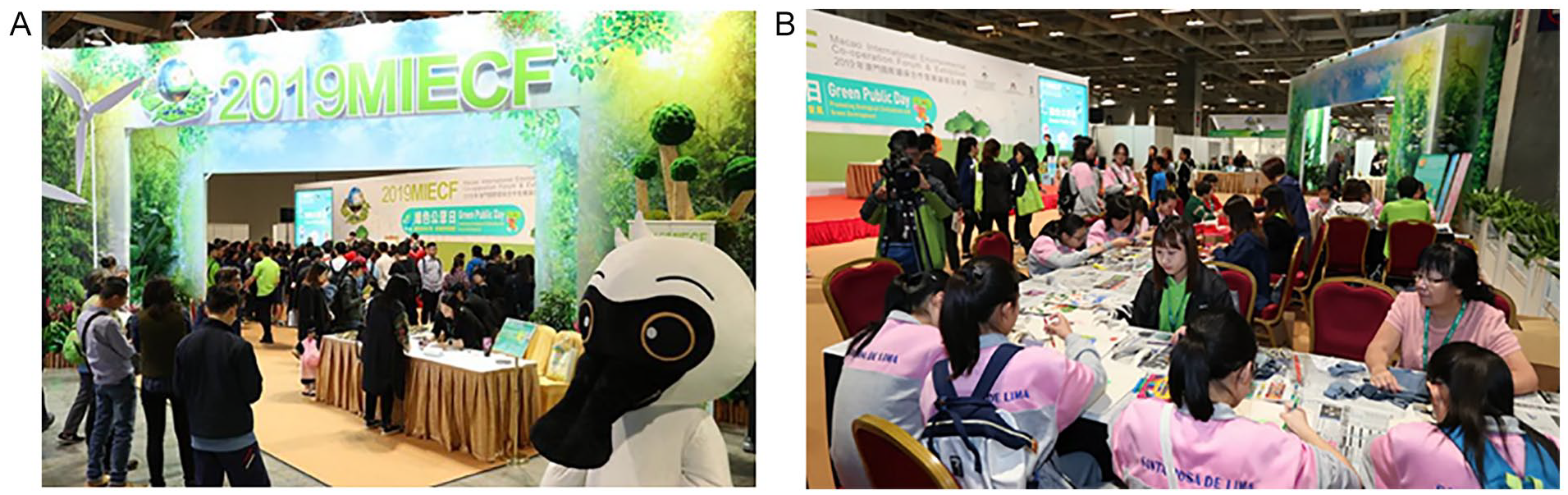
The photos of the public day and parent–child games area. (A) The attractive main entrance of the public day with an image of National Rare Protected Animal Black-faced Spoonbill. (B) Students and family members are participating in the games.
Measurement Instrument
This study used a questionnaire to collect data. The questionnaire is divided into five sections and contains 24 items: environmental beliefs (five items), exhibition attachment (six items), pro-environmental behaviors (seven items), and demographic information (six items). The scales used in the questionnaire are all based on previous research and have high reliability and validity. Particularly, the measurement scale of beliefs was adapted from Dunlap et al. (2000). It comprises five items, such as “If things continue on their present course, we will soon experience major ecological catastrophe.” To measure exhibition dependence and exhibition identity, as subdimensions of exhibition attachment, the scale designed by Yi et al. (2018) was used. It comprises six items, with three for each of the subdimensions, such as “Compared to other exhibitions, the setting and environment of this fair is the best” (exhibition dependence) and “I feel this fair is a part of me” (exhibition identity). The measurement scale of pro-environmental behavioral intention was adopted from Kim and Kim (2018). It comprises seven items, such as “I’m willing to pay more for environmentally friendly products.” For all items, respondents answered on a 7-point Likert-type scale. Please refer to Table 2 for the specific wording of all the items.
Social desirability bias (SDB) is the bias caused by respondents responding in a way that is more acceptable to social norms when confronted with socially sensitive constructs (Nunnally, 1978). SDB will have an impact on the measurement’s validity and, as a result, on how the results are interpreted. Although many scholars have proposed methods to deal with SDB, such as Fisher (1993) proposing the indirect questioning method to alleviate SDB, some scholars have pointed out that when confronted with indirect questioning, the interviewee may also intentionally make a biased response (Holtzworth-Munroe & Hutchinson, 1993; Hott, 1979). The existing research indicates that SDB control and measurement is still a hot research topic. During data collection for this study, the following factors were prioritized. First and foremost, this research was carried out using anonymous, self-administered surveys (Dodou & de Winter, 2014). Prior to the survey, it was repeatedly stated that the questionnaire should be completed anonymously and will not be used for any other purpose, allowing respondents to fill it out with confidence. Second, to reduce the potential impact of face-to-face research, electronic questionnaires were used in the research process of this study to reduce SDB (R. B. Larson, 2019). Third, the scales used to measure pro-environmental activities in this analysis are very advanced, and the objects appear to be neutral phrases, which will help minimize the effect of SDB.
Sampling and Survey
The questionnaire survey was conducted in the venue’s exhibition hall (Great Hall). All audience members of the 2019 MIECF aged 18 or older were eligible to participate. Because the exhibition’s theme is environmental protection, the audience may be characteristically sensitive to the topic of environmental protection, which introduces a degree of self-selection. Even on the public day, with activities designed to inform about the latest environmental protection technologies and opportunities to purchase various types of eco-friendly products, visitors may still belong to groups with strong environmental beliefs. For this reason, considering the efficiency and feasibility of data collection, this research adopted convenience sampling. Before the on-site survey, the research assistants were trained to ensure they clearly understood the research topics and questions. During the survey, they distributed the self-administered questionnaire to qualified respondents. The survey was mainly carried out at the exit of the exhibition hall and in the rest areas. A pilot test was conducted in the exhibition hall on March 28, 2019: 64 questionnaires were collected of which 53 were valid. The Cronbach’s α coefficient of the scales is between .7 and .9, showing sound reliability. In addition, based on the feedback of the respondents, the wording of the questions is specific and clear, so no adjustments were needed. The main survey was then conducted from March 29 to 30, 2019. A total of 232 questionnaires were distributed; 217 were collected of which 180 were valid, representing an effective response rate of 83%. Descriptive statistics of the respondents are reported in Table 1.
Profile of Respondents.

Data Analysis
For structural equation analysis, there is a wide range of software available. On the same data, Nam et al. (2018) used AMOS 23, LISREL 8.70, and Smart PLS 2.0 to perform structural equation modeling-based confirmatory factor analysis (CFA). While LISREL’s ability to explain dependent variables is greater than that of other analysis tools, the path coefficient and t-value results of these three analysis tools are comparable. As a result, none of the three analysis tools clearly outperforms the others. However, PLS has several advantages over LISREL, such as being suitable for small sample data analysis and not having overly stringent sample normality requirements (Chin, 1998). Models for formation indicators can also be created using PLS. In addition, PLS employs a method for reducing internal variable errors.
PLS, on the contrary, has some flaws. The study’s sample size, for example, is small, and highly skewed data may result in inflated standard bootstrap errors, lowering statistical power (Hair et al., 2016). As a result, researchers should assess the degree of nonnormality in the data and report skewness and kurtosis measures. Furthermore, when assessing discriminant validity, researchers should employ heterotraits–monotrait (HTMT) criteria rather than relying solely on traditional methods such as cross-loading and the Fornell and Larcker’s (1981) criteria (Henseler et al., 2015). For the reasons stated earlier, this study employs Smart PLS 3.0 software for data analysis.
In terms of specific data analysis steps, first, the skewness and kurtosis coefficients are used to determine the normality of the data (Kline, 2015). The measurement model’s reliability and validity were then examined, and the PLS method was used for CFA.
The PLS measurement model estimates differential validity in two ways. The first step is to examine the matrix of cross-composite elements. Each item in each variable should have a greater load than the other variables. The second stage examines discriminant validity using Fornell’s criteria. Discriminant validity occurs when the AVE value of a variable is greater than the square of the correlation coefficient between the variable and other variables. However, Henseler et al. (2015) proposed that PLS overestimates the factor load and underestimates the correlation between variables, while AVE overestimates the factor load and underestimates the correlation between variables. As a result, it is proposed that the method of estimating the HTMT ratio be applied to the discriminant validity test. The theory is that the average correlation coefficient between the variables’ internal items should be greater than the average correlation coefficient between the variables’ external items. If the quotient of the latter’s correlation coefficient divided by the former’s correlation coefficient is <0.85, the measurement model has discriminant validity.
Following that, the SEM method was used to analyze the structural model and investigate the previously proposed mediation effect. The Baron and Kenny approach and the Sobel z-test are the most commonly used methods for testing mediating effects. However, in recent years, these two methods have been increasingly questioned, with scholars pointing to anomalous distributions and inaccuracies (B. Lee et al., 2005; Rucker et al., 2011; Zhao et al., 2010). Thus, it is recommended that a bootstrapping method be used when testing mediation; Preacher and Hayes (2008) recommend using at least 5,000 iterations. In the present study, using Smart PLS 3 software and the bootstrap self-sampling method, random sampling from the original data (N = 180) was performed 5,000 times, and the error correction confidence interval was set to 95% for testing.
Furthermore, this study uses respondents’ identities (professional vs. general public) as a control variable and employs a multigroup analysis to investigate the differences in theoretical models for respondents with different identities. The current study used bootstrap resampling with 5,000 iterations to assess the stability of each variable (Hair et al., 2012).
Results
Measurement Model Analysis
The questionnaire’s common method deviation was first checked by one-way test method. All questions are subjected to exploratory factor analysis; if the unrotated first factor’s explanatory variance rate exceeds 50%, there is a high common method deviation (Podsakoff & Organ, 1986). The first factor extracted in this study has an explanatory rate of 42.903%, indicating that the common method deviation is within an acceptable range.
Prior to the structural equation model analysis, the skewness and kurtosis of the data were also tested, and both were less than the critical values of 3 and 8, respectively (Kline, 2015), indicating that the data essentially conformed to the characteristics of a normal distribution. Please see the Supplemental Appendix for more specific information.
To ensure the overall reliability and validity of the study, CFA was performed in PLS 3.0. According to Fornell and Larcker (1981), items with a factor loading of <0.5 in CFA should be deleted (Ariff et al., 2013; Pitzner & Drummond, 1997). All 18 questions exceeded this threshold and so were entered into the data analysis. The Cronbach’s alpha values of the four latent variables ranged from .810 to .912, the compositional reliability values ranged from .887 to .930, and the average variance extracted (AVE) values ranged from 0.634 to 0.742. The four latent variables in this study showed good internal consistency and convergence validity, being in line with the research requirements, as shown in Table 2.
Item Wording, Factor Loadings, and Reliability Values of the Study Measures.

Note. AVE = average variance extracted; CR = compositional reliability.
For the estimation of differential validity, the cross-composite matrix and discriminatory validity were examined, as shown in Tables 3 and 4, respectively.
Cross-Loading Values.

Note. EB = environmental beliefs; ED = exhibition dependence; EI = exhibition identity; PEI = pro-environmental behavior intention.
Discriminant Validity and Variable Correlations.
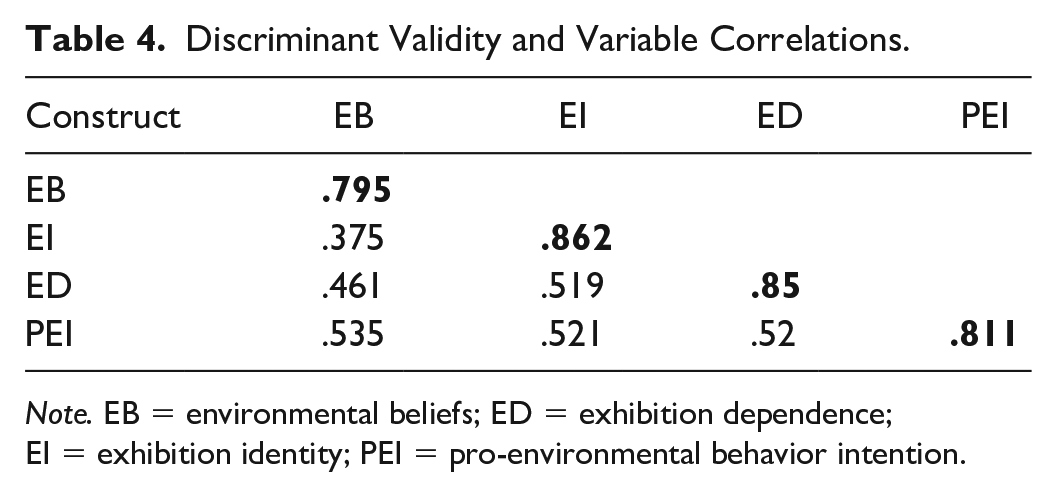
Note. EB = environmental beliefs; ED = exhibition dependence; EI = exhibition identity; PEI = pro-environmental behavior intention.
Per the data in the study, the collinearity indicator VIF was also below 3, which indicates there is no collinearity in the research data.
Henseler et al. (2015) suggest that PLS will overestimate the factor loading, underestimate the correlation between variables, and overestimate AVE. Therefore, they recommend adding the HTMT method to discriminant validity analysis. Applying this method in the present study, all the calculated values were below 0.85 (see Table 5), thus confirming the existence of discriminant validity among the variables.
Analysis of HTMT Discriminant Validity.

Note. EB = environmental beliefs; ED = exhibition dependence; EI = exhibition identity; HTMT = heterotraits–monotrait; PEI = pro-environmental behavior intention.
Structural Model Analysis
The PLS algorithm method is used to test how much the explanatory variables can predict the effect variables. Adapting the bootstrap resampling method, 5,000 samples were extracted for calculating the parameters and evaluating the significance of the model coefficients. Please refer to Table 6 for detailed information.
Structural Model Results and Effect Sizes (f2).

Note. EB = environmental beliefs; ED = exhibition dependence; EI = exhibition identity; PEI = pro-environmental behavior intention.
≤ 0.000; **≤ 0.05; *≤ 0.100.
As shown in Figure 4, the effect size (ƒ²) of environmental beliefs to exhibition dependence was 0.27, which is greater than the minimum threshold of 0.02 (R2 = .213, which is greater than the minimum threshold of 0.10). The effect size (ƒ²) of environmental beliefs and exhibition dependence to exhibition identity were between 0.033 and 0.215 (R2 = .293). The effect size (ƒ²) of environmental beliefs, exhibition dependence, and exhibition identity to pro-environmental behavioral intention was between 0.057 and 0.144 (R2 = .406), thus exceeding the minimum thresholds for ƒ² and R2.
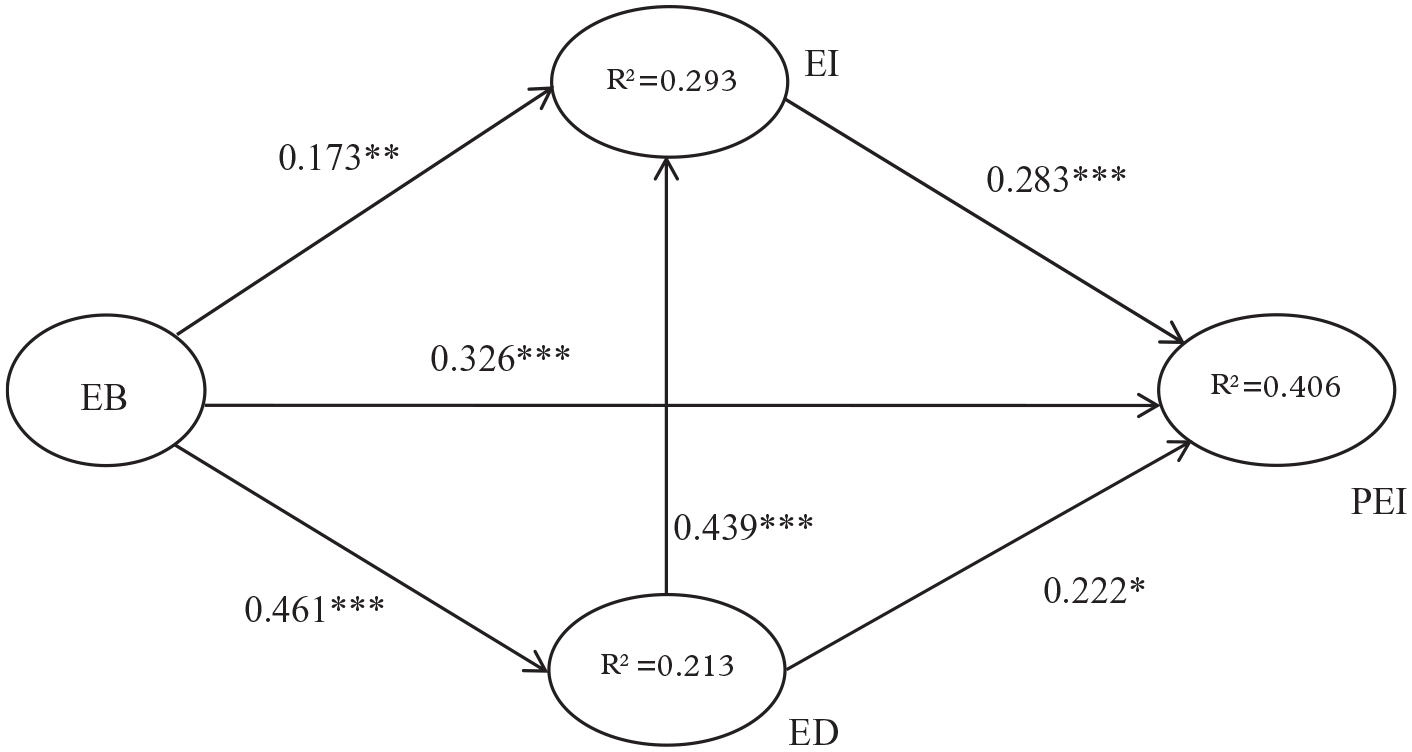
SEM results.
To further confirm the stability and compatibility of the model, cross-validation was carried out. The Q² value was between 0.135 and 0.260 and thus greater than 0, indicating that the model has cross-validity. In addition, the goodness of fit (GOF) of the overall model was 0.465, which is higher than the standard for good GOF (0.36) proposed by Wetzels et al. (2009), thus indicating that the model has high GOF.
According to the results of structural model path analysis (reported in Table 6), there existed significant relationship between environmental beliefs and exhibition identity (t = 2.635, p < .01), exhibition dependence (t = 6.440, p < .001), and pro-environmental behavior (t = 4.079, p < .001), respectively, supporting H1, H2, and H3. A significant and positive relationship between exhibition dependence and exhibition identity (t = 7.241, p < .001) was verified, thus supporting H4. The relationships between exhibition dependence and pro-environmental behavior intention (t = 2.163, p < .05) and exhibition identity and pro-environmental behavior intention (t = 2.619, p < .01) were also found to be significant, respectively, supporting H5 and H6.
This study also divides respondents into professional visitors and ordinary visitors to conduct multigroup analysis. PLS multigroup comparison was used to test for differences between the two groups of samples in the path coefficients of the theoretical model. As reported in Table 7, the results revealed no statistically significant differences between professional and ordinary visitors in environmental beliefs, exhibition attachment, and pro-environmental behavioral intention.
Multigroup Comparison Results.
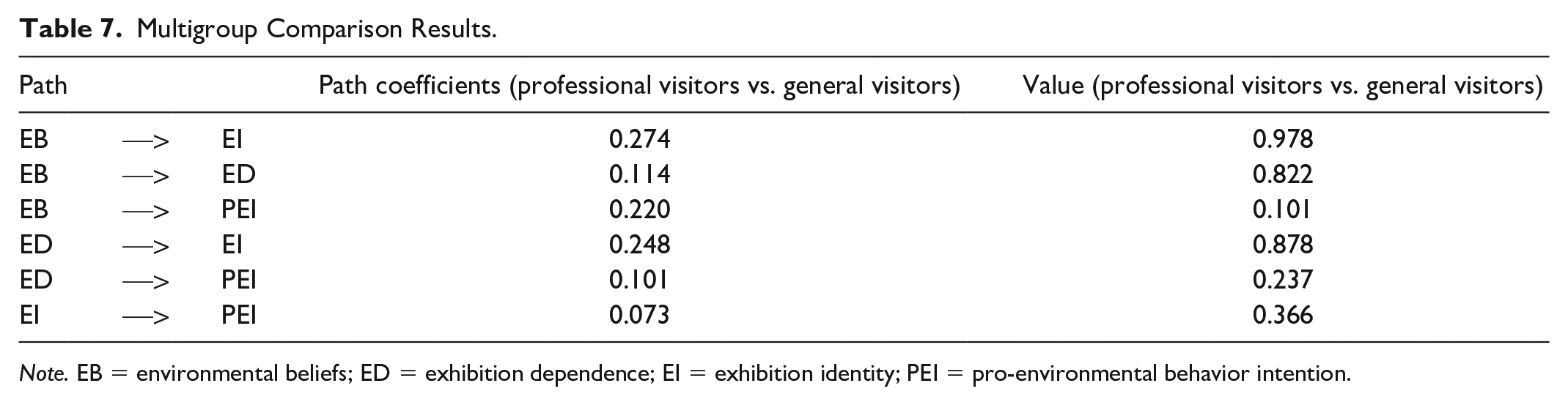
Note. EB = environmental beliefs; ED = exhibition dependence; EI = exhibition identity; PEI = pro-environmental behavior intention.
Mediating Effects
The results show that the mediating effect of exhibition identity between environmental beliefs and pro-environmental behavior was not significant, so H8 was not supported. Exhibition dependence had a partial mediating effect between environmental beliefs and pro-environmental behavior, thus supporting H7, and exhibition identity had a partial mediating effect between exhibition dependence and pro-environmental behavior, thus supporting H9. As prior studies have shown that place identity has a mediating effect between place dependence and pro-environmental behavior (Vaske & Kobrin, 2001), the present study further examined other possible mediating effects and long-term mediating effects. The results show that exhibition dependence had a partial mediating effect between environmental beliefs and exhibition identity. Although H8 was not initially supported, further analysis revealed that exhibition identity had a partial mediating effect between exhibition dependence and pro-environmental behavior. At the same time, the long-term mediating effects of environmental beliefs–exhibition dependence–exhibition identity–pro-environmental behaviors were also verified (as detailed in Table 8).
Analysis of the Structural Model.

Note. EB = environmental beliefs; ED = exhibition dependence; EI = exhibition identity; PEI = pro-environmental behavior intention.
Discussion
Theoretical Implications
This study examined the relationship between environmental beliefs, exhibition attachment, and pro-environmental behavioral intention among visitors to an environmental protection-themed exhibition. The main conclusions from constructing and testing the theoretical model are as follows.
First, the study found a statistically significant relationship between visitors’ environmental beliefs and their pro-environmental behavioral intention. This indicates that visitors with relatively strong environmental beliefs are also relatively more prone to develop pro-environmental behavioral intention. This is highly consistent with the findings of previous research, in which strong environmental beliefs encouraged people to actively participate in environmental protection behaviors (Beaumont, 1998; Bramwell & Lane, 1993).
Second, the study found a positive and statistically significant relationship between visitors’ environmental beliefs and both subdimensions of their exhibition attachment. The path coefficients revealed a higher impact of environmental beliefs on exhibition dependence (0.461) than on exhibition identity (0.173). Through mediation analysis, exhibition dependence was found to play a partial mediating role between environmental beliefs and exhibition identity. This is consistent with prior results suggesting a certain order of influence between exhibition dependence and exhibition identity (Suntikul & Jachna, 2016; Vaske & Kobrin, 2001; Yi et al., 2018). People’s emotional identity with respect to an exhibition needs to be realized through their functional dependence on the exhibition.
On the abovementioned relationship, Kyle et al. (2005) point out that place attachment only occurs when there is an interaction between people and the environment. Some scholars have further noted that this interaction is the process through which people understand settings and form value judgments (Milligan, 1998; Relph, 1976). This perspective can also be employed to somewhat explain the order of influence between exhibition dependence and exhibition identity. Accordingly, the role of cognition in exhibition attachment is also worth exploring. Evidence suggests that when visitors have stronger environmental beliefs, they can obtain more knowledge and information about environmental protection from environmentally themed exhibitions (Laing & Frost, 2019; Saribas et al., 2017), which will increase their dependence on the exhibition.
Regarding participants’ perception of the exhibition, the object of this study is a professional exhibition with the theme of environmental protection. Therefore, the exhibition content is highly professional, necessitating some expertise to understand the relevant content of the exhibition. Interestingly, though, this study found no significant differences between ordinary visitors and professional visitors on the path coefficients of the proposed model. So how do ordinary visitors without specialized knowledge understand the content of professional exhibitions? G. F. Smith et al. (1991) reason that, for practical purposes, beliefs are knowledge surrogates: When people cannot judge the correctness of a proposition, beliefs help them make decisions. On this basis, although ordinary visitors do not necessarily have environmental protection expertise, their environmental beliefs replace professional knowledge when attending the exhibition and support them to form a value judgment. This process helps them to form a strong feeling of exhibition attachment. Consistently, Kyle et al. (2005) consider place attachment as an interplay of affect and emotions, knowledge and beliefs, and behaviors and actions.
Besides the perspective of exhibition cognition and value judgment, the relationship between environmental beliefs and exhibition attachment can also be explained by the theory of involvement. Involvement originates from the theory of self-involvement in social psychology (Sherif & Cantril, 1947) and is applied to social attitudes and identity issues. It is usually interpreted as the perceived relevance of an object based on the individual’s internal needs, values, and interests or how important the object is to that person (Zaichkowsky, 1985, 1994). Generally speaking, the higher the degree of involvement, the closer the relationship between the individual and the object. Personal beliefs or values seem to have a positive effect on involvement (Iwasaki & Havitz, 1998), and involvement may significantly affect an individual’s attention (Tarkiainen & Sundqvist, 2009) and behavioral intention. In terms of environmental behaviors, Barber et al. (2010) found that the environmental involvement of wine tourists is positively related to pro-environmental behavior. Bowler et al. (1999) point out that positive environmental involvement leads to pro-environmental attitudes and ecological behavioral intention. Therefore, the involvement theory can be used to further explain this study’s finding that the audience’s environmental beliefs had a larger effect on exhibition dependence than on exhibition identity. People with strong environmental beliefs will regard environmentally themed exhibitions as being closely related to themselves, making it easier for them to interact with exhibitors or other visitors, thus creating functional dependence. The findings of this study not only support the influence of relevant beliefs held by the exhibition audience on the formation of temporary space attachment but also show that functional place dependence plays a partial mediation role between belief and emotional place identification in this influence process. The abovementioned findings contribute to a better understanding of the mechanism of people’s attachment to temporary space.
Third, this study found that visitors’ identity with and dependence on the environmentally themed exhibition can significantly enhance their pro-environmental behavioral intention. The findings can be explained as follows: For an audience, exhibition identity primarily refers to identifying with the themes and values conveyed by the exhibition (Mair & Laing, 2013). Also, people’s attitude toward the theme of the exhibition will ultimately affect their future behavior (Getz, 2008). The environmental information, technology, and products exhibited at an environmentally themed event can induce the audience to engage in pro-environmental behaviors in the future.
However, exhibition identity was found not to have a mediating effect between visitors’ environmental beliefs and pro-environmental behavioral intention. This finding suggests that the influence of visitors’ environmental beliefs on their pro-environmental behaviors does not arise directly from exhibition identity. Two further mediation analyses were conducted to explore the potential reasons for this result. Specifically, we tested the following two paths: (1) environmental belief–exhibition dependence–exhibition identity–pro-environmental behavior, and (2) environmental belief–exhibition dependence–exhibition identity. The results for (1) showed that the influence of exhibition dependence on exhibition identity had a mediating effect between environmental beliefs and pro-environmental behavior. This serves to remind us that the influence of an environmentally themed exhibition on the pro-environmental behaviors is a process: It is first necessary to meet the audience’s functional needs so that they can emotionally identify with the environmentally themed exhibition and its value and theme. The results for (2) verified this judgment. These two mediation analyses demonstrate that the impact of an environmentally themed exhibition on the audience’s pro-environmental behavior is a gradual, rather than one-step, process. Except for H8, all the hypotheses proposed in this study have been confirmed thus far. In terms of the mechanism of influence from environmental belief to exhibition attachment and pro-environmental behavior, although exhibition dependence and exhibition identity are two connotations of exhibition attachment, when proposing the hypothesis, this study incorporates them into the theoretical model as two relatively independent constructs. The abovementioned research findings indicate a close relationship and potential time series of influence between these two dimensions. This aspect also validates previous research on exhibition attachment. On the other hand, it reflects that the difference in the roles of the two dimensions of attachment merits further investigation and discussion.
Fourth, environmental quality is an important influencing factor for place attachment to temporary spaces (Breiter & Milman, 2006; Hultsman, 2001; Kuo et al., 2010; Robinson & Callan, 2005; Wu & Weber, 2005); thus, the environmental quality may have an important impact on exhibition attachment. It seems that people’s assessments of the functional and aesthetic quality of facilities strongly influence their attitudes to environmental quality (Wakefield & Blodgett, 1996). The good impression created by signs and/or symbols in the service environment generates satisfaction among customers, thereby positively affecting the perceived quality of the overall service environment (Siu et al., 2012). The MIECF venue was decorated by a large amount of green vegetation, and the exhibition used recyclable materials and reusable products. In such an environment, displaying the latest environmental protection technologies and products can not only attract visitors and meet their functional dependence but also deepen visitors’ emotional attachment.
At the same time, many local elements of Macao were integrated into the overall environmental design of the exhibition: For example, Macao’s unique architectural landscape elements were highlighted at the exhibition entrance, and the black-faced spoonbill, a protected bird species only visible in Macao, has become the exhibition’s official mascot (as shown in Figure 3A). For local visitors, these measures can link the temporary exhibition environment with long-term place attachment, which can be used to cultivate a sense of community in the exhibition (Hahm et al., 2016; Yi et al., 2018) that may, in turn, produce strong attachment to the exhibition. However, the current academic research rarely integrates and compares long-term and temporary attachments with one space: This warrants future attention.
Management Implications
This study also sheds some light on how to more effectively promote environmental sustainability behaviors. First, the attachment of the participants to the temporary space will strengthen the exhibition’s educational function and subsequent behaviors (Zorić & Hrovatin, 2012). As a result, the construction of various environmentally themed temporary spaces is conducive to encouraging people to engage in environmentally friendly behavior. In addition to holding various environmental protection exhibitions in formal exhibition venues, the government and environmental managers can hold environmental-related exhibitions or events in community parks or other public areas within the community (Mair & Laing, 2013). When developing related activities, more emphasis should be placed on fostering the audience’s attachment to the temporary space, followed by promoting the practice of pro-environmental behavior.
Second, this study introduces the audience’s environmental beliefs into the influencing process of an environmental protection exhibition, finding that these beliefs might not only directly affect the audience’s pro-environmental behavior but also significantly affect exhibition dependence and exhibition identity. As a result, in addition to providing an excellent exhibition environment, any exhibition should pay attention to conveying beliefs related to the exhibition theme to potential audiences in the early stages of the exhibition. In this way, related exhibitions can have a greater impact. In an exhibition, for example, with the theme of environmental protection, to increase the audience’s attachment to the environmental theme exhibition, the organizers of the exhibition should recognize the importance of environmental beliefs held by the audience. Visitors’ environmental protection beliefs and awareness can be strengthened through different channels before the exhibition opens, enabling more visitors to form functional and emotional attachments to the exhibition. On one hand, this will help to promote the audience’s pro-environmental behavior; on the contrary, it will positively affect the continuous development of the exhibition and the improvement of its social influence.
Finally, the findings of this study also serve as inspiration for exhibition planners; exhibition planning should focus on the incorporation of functional elements that encourage the practice of environmental protection behavior. Future exhibition managers should recognize that the functional design of an environmental protection exhibition is as important as the atmosphere design. In the study, the positive effect of an audience’s environmental beliefs on their pro-environmental behavior came via exhibition dependence and exhibition identity. Therefore, environmentally themed exhibition organizers need to create a good functional design to meet the audience’s needs. For this purpose, organizers can introduce a greater number of newer technologies and trends, more information, and other aspects related to environmental protection, thereby increasing visitors’ belief in the relevance and importance of the exhibition. Meanwhile, in planning and organizing the exhibition, more emphasis is needed on green issues and environmental protection, which directly helps the audience feel the concern of the exhibition on environmental protection. For example, the organizers of the MIECF applied green design principles in the services and facilities at the exhibition site. Participants scanned QR codes using their mobile phones to obtain relevant information (no paper information), only direct drinking water was provided to the audience and exhibitors (no bottled water), and a free public shuttle bus was available for all attendees, thus encouraging green travel. The design of the atmosphere has an important impact on temporary attachment. Introducing local elements will strengthen the local audience’s attention to the exhibition, in turn promoting long-term and temporary attachment, which strengthens the audience’s functional dependence and helps them to accept the exhibition. For an exhibition to more effectively convey the idea of environmental protection and positively affect the audience’s attitude and behavioral intention, the exhibition’s functional design and atmosphere should be carefully considered.
Limitations and Future Study Directions
This research has several limitations. First, due to time and cost constraints, only the audience of the 2019 MIECF was investigated. Despite the long history of this exhibition and its authoritative international quality certification, the study’s relevant conclusions need to be verified in the context of other environmentally themed exhibitions to demonstrate universality of the findings. Future research should be conducted on environmentally oriented exhibitions in different countries and regions.
Second, the core construct of exhibition attachment was adopted from a recent study that regarded it as comprising two dimensions. Thus, only the cognition and emotion aspects of exhibition attachment were included in the present study. To address this limitation, future research should consider the behavioral aspect of exhibition attachment, thereby more fully examining exhibition attachment and its relationship with pro-environmental behavioral intention.
Third, this study adapts previous research models and only uses quantitative research methods. Therefore, qualitative research methods should be adopted to construct and improve the influence mechanism of an exhibition’s educational functions from a broader perspective, based on in-depth communication and interaction with respondents.
Fourth, this study’s respondents were all attendees at an environmental protection exhibition. Due to the particularity of this exhibition’s theme, there is likely some degree of self-selection in the sample, and respondents’ environmental beliefs may have been relatively similar. These considerations may limit the universality of this study’s conclusions.
Finally, in future research, the appropriate grouping of respondents or introducing certain control variables will help researchers to explore path differences in the impact of environmentally themed exhibitions on different groups. Factors that should be considered include, for example, the number of times people visit the exhibition, their motivation for visiting, and the impact of social desirability bias.
Supplemental Material
sj-pdf-1-sgo-10.1177_21582440211027966 – Supplemental material for Environmental Beliefs and Pro-Environmental Behavioral Intention of an Environmentally Themed Exhibition Audience: The Mediation Role of Exhibition Attachment
Supplemental material, sj-pdf-1-sgo-10.1177_21582440211027966 for Environmental Beliefs and Pro-Environmental Behavioral Intention of an Environmentally Themed Exhibition Audience: The Mediation Role of Exhibition Attachment by Xi Li, Runzhe Yu and Xinwei Su in SAGE Open
Footnotes
Declaration of Conflicting Interests
The author(s) declared no potential conflicts of interest with respect to the research, authorship, and/or publication of this article.
Funding
The author(s) disclosed receipt of the following financial support for the research, authorship,and/or publication of this article: The author(s) received financial support for the research from Macau Foundation(Grant number MF2015)and Department of Education of Guangdong Province:[Grant number 2019GWTSCX027].

Supplemental Material
Supplemental material for this article is available online.
References
Supplementary Material
Please find the following supplemental material available below.
For Open Access articles published under a Creative Commons License, all supplemental material carries the same license as the article it is associated with.
For non-Open Access articles published, all supplemental material carries a non-exclusive license, and permission requests for re-use of supplemental material or any part of supplemental material shall be sent directly to the copyright owner as specified in the copyright notice associated with the article.
