




Abstract
This study examined the role of local government in community development in Nsukka Local Government Area of Enugu State, Nigeria. A total of 420 people participated in the study. The study sample of 420 persons comprised 220 community development officers selected from the study area and 200 adult educators randomly selected from Enugu State. The entire population of the study was used due to the size. A 21-item structured questionnaire developed by the researchers was used as the instrument for data collection. Mean and standard deviation were used to answer the research questions. The study revealed that the budget allocation sent by the government to the responsible departments in the local government is not always received as and when due for the effective implementation of community development projects. It was concluded that a higher monitoring authority should be set aside to monitor and supervise the existence of checks and balances between the regulations of the local government areas.
Introduction
The political history and constitutional development of Nigeria cannot be overemphasized from the evolution and continual growth of local government in Nigeria. The introduction of the Indirect Rule System by Lord Fredrick Lugard in 1914 signaled the evolution of the Nigerian Local Authority that later transformed into local government areas and has been a continuous and growing process in Nigeria till today (Ola, 2004). Native Administration Ordinance No. 14 of 1916 by Lord Lugard spelt out the colonial system of administration in Nigeria in the early part of the 19th century. It was under this form that the use of Traditional Institution of Chiefs and Rulers to administer the natives, but under the strict supervision of the colonial administrators, was developed (Nzelum, 1984).
The Native Administration System, particularly in Eastern Nigeria, resulted in the introduction of a modern local government system in Eastern Nigeria under the Local Government Ordinance of 1950. Furthermore, the Local Government Law No. 25 of 1950 suspended the 1950 Local Government Ordinance and, in 1960, after the Independence, the Eastern Nigeria Government replaced the 1955 laws and a new local government law No. 17 became effective (Nzelum, 1984). In Addition, Oluwatobi (2019) posited that amendments were made in 1961 and 1963. In this respect, a Ministry of Local Government was mandated to manage and direct the affairs of the New Local Government Councils created. This particular era witnessed the introduction of local government system based on the British Colonial model. The economic changes also affected the new direction. This also was the period of trial centered on the term “development,” which is the function and powers that can be devolved from the center of regional governments to the local authorities to carry out certain assigned functions with some degree of autonomy (Nzelum, 1984; Oluwatobi, 2019). Research by Hector (2004) observed development as a capacity of a national economy that initially had been static for a long time but which now sustains an annual increase of its gross national product at rates of perhaps 5% to 7% or more.
However, the period of civil war witnessed a new introduction that departed conceptually from the previous system. It involved the sole Administrator system. By this, a civil servant executive was appointed as the sole manager to oversee the affairs of the local government. However, a new system was also introduced in practice following the end of the civil war (Moses, 2001). In 1971, therefore, the Eastern government promulgated an edict establishing the Divisional Administration System, which created 39 Administrative Divisions in two categories: seven Urban and 32 Ordinary Divisions. This evolved a two-tier system of local administration (Agalamaya, 2004). In Nigeria, the National Guidelines for Local Government Reform was published in August, 1976 with the intention of making local government an effective basis of local community development, bringing government administration closer to the populace to make the people interact effectively with government (Otinche, 2014).
Interestingly, Oluwatobi (2019) defined local government as a political division of a country or (in a government framework) state, which comprises bylaw and has considerable organizing power over related issues, empowering the authorities to force charges or to apply work for endorsed reason. The overseeing body of such substance is chosen or something else is locally chosen (Oluwatobi, 2019). Contributing advance to the author viewed, a more inclusive definition of local government, and the one that captures the important records of local government, is contained in the 1976 guidelines for local Government Change. Concurring to the reform, local government is defined as a government at the nearby level responsible to work out through agent chamber, built up by law to work out powers inside characterized zones. These powers sought to grant the board considerable control over local undertakings (counting staffing), organization and money-related powers to start and coordinate the arrangement of benefits, and to decide and actualize ventures so as to kind word the exercises of the state and government in their ranges, and guarantee, through decentralization of capacities to the boards, dynamic cooperation throughout with individuals in local activity with maximum cooperation (Oluwatobi, 2019).
However, the Mohammed/Obasanjo administration, which overthrew Gowon regime in 1975, noted that local government bodies were considerably nearer to the majority of citizens; for this, Oluwatobi (2019) asserted that the state and the federal governments should therefore allocate more statutory powers to the local government to perform certain functions and services that were of primary concern to the people. To further emphasize the importance attached to local government, the administration made the establishment of a dynamic national local government system one of its preconditions for reforming national government to elected civilians. Two of the unstated objectives, easily deductible from the content of the guidelines, are the uniformizing of local government and the integration of the emirate system into a Nigeria-wide modern democratic local government system (Agalamaya, 2004).
Durinng 1986, a five-man committee was appointed for each of the 301 local governments (Nweke, 2010). The Buhari administration’s concern, as cited by Nweke (2010), to whittling, had sown the powers of local government in Nigeria and, at the same time, he set up the Dasuki committee to reconsider the local government administration in Nigeria. The Buhari administration was overthrown by Ibrahim Babangida. Under the Babangida Regime, some measures were taken to strengthen the local government system. Local government elections were also held throughout the federation in 1987 and the statutory allocation was increased from 10% to 15%; the payment of federal allocation to local governments was stopped and the allocation was paid directly to local governments. Nweke and Sabina (2005) postulated that, under Babangida administration regime, more local governments were created. Finally, the Babangida administration was succeeded by the Abacha regime. However, the previous governments had focused their attention on the political gains rather than community development, efficiency, accountability, transparency, and effectiveness. Therefore, the researchers’ target in this study is how then to attest that community development projects are actually being delivered or executed? More so, this target is the brain behind this study.
Basically, the objectives of local government in Nigeria, as posited by Nwankwo (2002), are as follows: to provide certain opportunities to practice democracy; to provide certain basic services for the citizens at the local level; to join the local citizens to solve their community problems and needs that could not be solved by the individuals alone; to become the nearest government to the local citizens at all levels of need, such as for reconstruction of roads and bridges in the rural area, supporting rural farmers through agricultural machineries, provision of recreation centers, construction of fish pond and public toilets, and building of hospitals, motor parks, and public library; and to become a useful instrument for the central and state government in the governance of the country. The functions of the local government, according to Ebonyi (2004), are of two kinds as pointed out in 1976 local government reforms. The first one is those in the exclusive list. The exclusive or mandatory functions of local government are those functions that they have to perform as a matter of right. On the contrary, the concurrent or permissive functions of local government are those they can perform in conjunction with the state and federal government. The author further posited that there is no local government that cannot execute its functions or responsibilities without the resources needed to achieve community development projects such as human resources (staffing, development, compensation, safety and health, and employee and labor relations), financial resources (state and government grant), economic resources (labor, capital, and technology), material resources (stationeries, sourcing, purchasing, and storing), and technological resources (Ebonyi, 2004).
Nwankwo (2002) identified the problems of local government in community development as follows: the local government is not fully effective and responsive in meeting the local citizens’ demands with regard to their development; for community problems to be solved, more citizens are yet to be interested in seeking election into local government council; the local government finds it a heavy burden to finance the primary and adult education at the grassroots; and local governments now depend heavily on external sources for their finance. As a result, many do not work hard enough to collect revenue internally; the affiliation among the local, state, and federal governments is yet to be seen as effective for development of any local community; allegation of corruption of the local government level still obtains; and the quality of local government staff still needs to be improved and more frequent and better training is required.
Community development in this setting can be said to be a self-directional effort of the people, by the people, and for the people. Eleberi et al. (2014) defined community development as a legitimate process to foresee community advancement, improvement, and instructive strategy to tackle social activity and development. Hills (2011) implied a facilitated approach whereby the community individuals embrace programs and ventures in an arranged way to enhance the livelihood situation of the individuals dwelling in that society. The author further points out that enhancement within the physical and fabric prosperity, including livelihood of individuals within the community, is necessary.
Community advancement, therefore, offers assistance individuals to recognize and create their capacity and potential needed to address their issues and needs which they share (Aruma, 2011). Community development is defined by Rahim and Asnarulkhadi (2010) as a process that leads to change in many aspects of community living which include social, economic, cultural as well as environmental. It is about continual improvement, first with the help of change agents and later, by the people themselves to bring about change in their lives, which ultimately improve their quality of life. Thus, the focus of community development process is the people’s involvement (hereafter the word “community” will be used) whereby the community members come together to take action collectively to meet their shared goal(s) or to generate solutions overcoming a shared problems. (p. 62)
Nonetheless, Rubin and Rubin (2001) defined Community development “as a process which occurs when people strengthen the bonds within their neighbourhoods, build social networks, and form their own organisations to provide a long-term capacity for problem solving (p. 3)”. Rahim and Asnarulkhadi (2010) further stated that community members who have the capacity to do something to enhance their quality of life are portrayed as having the ability to think, to decide, to plan, and to take action in determining their lives. Therefore, in any community development program, both economic and individual growth must be given equal attention so as to ensure that the process of community development achieves its due balance of continuity and sustainability. Operationally, community development is viewed as the individuals’ initiative to find resolution to their individual and popular struggle, dependence on their own possessions such as potential, and to be assisted on or after enhancing execution of developmental projects.
For effective community development to take place in the society, community development officers and adult educators must be involved through collective effort. Basically, community development projects do not support individuals to labor independently to recover the poor livelihood situation of their citizens in the communities without involving the local government administration who serve as a link between the community, state, and federal governments (Aruma, 2011). Community development projects, in any case, energize individuals to continuously investigate the openings of coming collectively to work as a cluster to advance/alter that will offer assistance to address viably winning issues within the communities and society at large (Aruma, 2011). Similarly, Nwagbala (2013) further posited that effective mutuality is not something that occurs consequently within the society, rather gets self-evident individuals within the communities to come together to identify problems militating against the implementation of community development projects and proffer solutions to such identified problems. Mezirow and Taylor (2010) asserted that suitable achievement in this condition could arouse social action that could help to overcome the people’s underprivileged livelihood circumstances in the society.
Community development aims to realize a feasible socioeconomic improvement, with the effort of the individuals as a support. Eleberi et al. (2014) summed community development objectives as follows: To educate and motivate the people for self help; to develop responsible local leadership; to inculcate among the members of a community a sense of citizenship and spirit of civic consciousness; to introduce and strengthen democracy at the grassroots level, through the creation and revitalizations of institutions designed to serve as instrument for local participation; to initiate a self generative, self-sustaining and enduring process of growth; to enable people to establish and maintain co-operative and harmonious relationship; and to bring about gradual and self-chosen in the life of a community with a minimum stress and disruption (p. 165).
In line with this, Olaitan (2008) and Asabe (2012) further outlined the objectives as follows: Provision of educational facilities; provision of essential amenities such as feeder roads, culverts, bridges, market, stalls, and so on; provision of cooperative organizations; participation in environmental sanitation; construction of dams and sinking of wells to provide water for both human and animals; and provision of health facilities such as dispensaries, maternities and leprosy clinic (p. 55, 56).
Accordingly, community development represents a bottom-up approach to development, which involves local groups in organizing, planning, cooperating, and implementing projects for the benefit of their community; emphasis on indigenous human and natural resources; and the interaction with outside bodies (e.g., government and nongovernmental agencies) from which necessary advice and support are sought.
Statement of the Problem
The study was carried out in Nsukka Local Government Area of Enugu State. The local government area is one of the 17 local government areas in Enugu State, Nigeria. The Nsukka local government area had a population of 309, 633 as of the 2006 population census conducted across 774 local government areas in Nigeria. It is in favor of this background that communities embark upon different self-help projects to raise the standard of living in the communities. The projects executed, or in process of execution, include good roads, water supply, health centers, maternity homes, town halls, community libraries, and so on. The demand for community development projects arose due to the inability of the government to adequately provide infrastructural facilities to communities in rural areas. There is a need to have community development officers, with financial and technical resources, to encourage the development at the grassroots level. One of the problems that linger is the differential completion rates of projects, whereas, once started, some are completed at the scheduled time others are abandoned. However, there are numerous hindrances that hamper the effectiveness of local government contributions toward community development projects, which include insufficient funds, economic and social inequality, and others. In addition to the above factors, community participation in community development projects’ planning and decision-making was found to be almost nonexistent. As part of their administrative autonomy, local government areas require to have a minimum set of supremacies and capabilities to set off regulatory legislation on critical issues affecting their control toward implementing development projects and regulate markets, sanitary services, slaughter houses, fire brigades, and mortuary and burial services. They also have the diplomacy to issue marriage and birth certificates, approve building plans and register properties, and so on. Observance into explanation of the problem that hinders local government in community development projects, an effort was made to investigate the role of local government in community development projects. Furthermore, to substantiate that, in the situation of Nigeria in general and the study area in particular, examining the role of local government in community development projects and how local government has helped to finance and execute community development projects was found to be insufficient and thus this research study was an effort to fill the research and knowledge gap. Researchers examined some of these development projects and thereby identified constraints affecting the implementation of projects and recommended possible solutions where necessary.
Purpose of the Study
The general purpose of the study is to examine the role of local government in community development in Nsukka Local Government Area, Enugu State, Nigeria and its implication for adult educators. The study sought to
Examine the role of Local Government toward community development projects;
Ascertain community development projects initiated, financed, and executed by the local government in the communities;
Ascertain resources needed to achieve development projects in the communities; and
Examine constraints affecting the implementation of development projects in the communities in the local government.
Research Questions
The following research questions were formulated to guide the study.
Method
The study adopted a descriptive research design to investigate the role of the local government in community development in Nsukka Local Government Area, Enugu State. The study was carried out in Nsukka Local Government Area of Enugu State. Enugu State is a state in Southeast Nigeria. The people of Enugu State are predominantly Christians of different denominations. It is made up of 17 local government areas. Enugu State is one of the southeastern states interested in community development projects. This is the reason why the state was chosen for the study. A total of 420 people participated in the study. The study sample of 420 participants comprised 220 community development officers selected from the study area and 200 adult educator representatives, randomly selected from Enugu State, Nigeria. The entire population was used due to the size. The instrument for data collection was structured a questionnaire developed by the researchers containing 21 items. In addition, the questionnaire was developed using simple English language words to facilitate understanding. The instrument was validated by three experts: one each from the Department of Adult Education, Department of Science Education (Measurement and Evaluation), and the Department of Educational Foundations (Sociology of Education Unit), all of whom were from the University of Nigeria, Nsukka. All corrections were effected before field testing. The reliability index of the instrument was determined and subjected to Cronbach’s alpha techniques, which yielded the reliability coefficient of .76, showing that the instrument is highly reliable. Mean and standard deviation were used to answer the research questions. A mean score of 2.50 and above served as the benchmark for acceptance level, whereas any item with score below 2.50 was rejected.
Results
Research Question 1: What are the roles of local government toward community development projects?
The data presented in Table 1 indicated mean responses and standard deviation of the roles of local government toward community development projects. The results show that the roles of local government toward community development projects are as reflected in Items 1 to 6. The grand cluster mean of 2.62 indicated that the respondents are in agreement that all the items represent roles of local government toward community development projects, which fall under agreement. The grand cluster value for the standard deviation is 0.36, indicating that the responses of the respondents are clustered around the mean. Therefore, it is interesting to observe that local government contributions toward the development of communities in the rural areas cover the six listed development effects as shown in the table above. The data on the table also indicated that the majority of respondents agreed that local government has excelled in the support of community development projects as part of their responsibility toward effective community development needs.
Mean Responses of the Roles of Local Government Toward Community Development Projects.

Note. SA = strongly agree; A = agree; D = disagree.
Research Question 2: What are the community development projects initiated, financed, and executed by the local government in the communities?
The data presented in Table 2 revealed the community development projects initiated, financed, and executed by the local government in the communities. The Table 2 above indicated that the reconstruction of roads and bridges in the rural areas is in progress. The grand cluster mean of 2.56 indicated that the respondents are in agreement that all the items, except Item 10, represent development projects initiated finance and executed by the Local Government in the communities. The grand cluster value for the standard deviation is 0.36, indicating that the responses of the respondents are clustered around the mean. The table shows that there is need for more financial assistance to enable the local government carryout more provisions and construction of fish ponds and public toilets.
Mean Responses of Community Development Projects Initiated, Financed, and Executed by the Local Government in the Communities.

Note. SA = strongly agree; A = agree; D = disagree.
Research Question 3: What are the resources needed to achieve development projects in the communities?
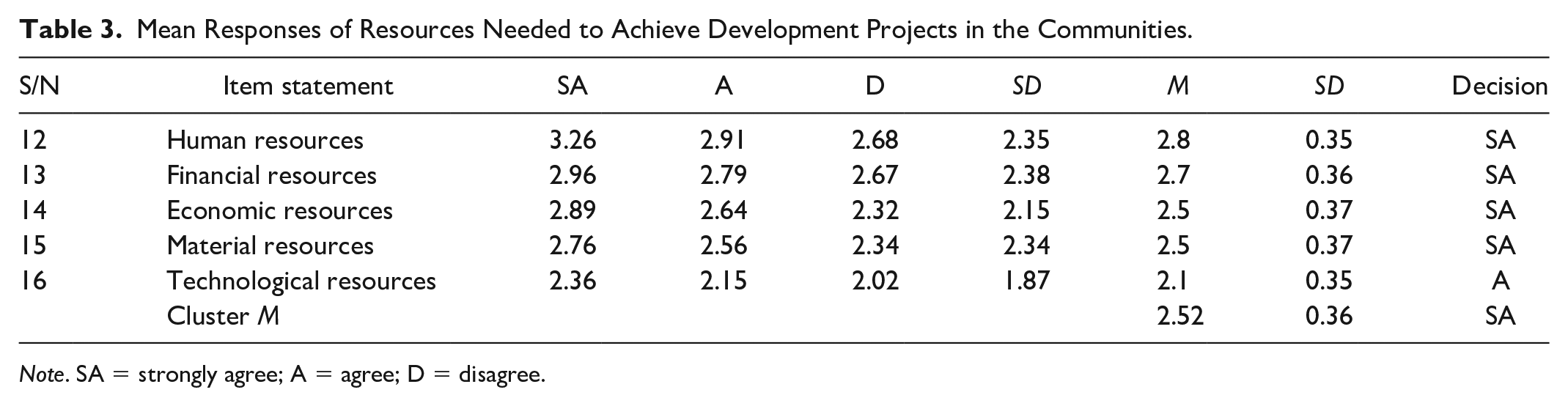
The data presented in Table 3 indicated that, for communities to developed, human efforts are mostly needed as shown in the table. The grand cluster mean of 2.52 indicated that the respondents are in agreement that all the items, except Item 16, represent resources needed to achieve development projects in the communities. The grand cluster value for the standard deviation is 0.36, indicating that the responses of the respondents are clustered around the mean. The table shows that there is need for educating people in the communities on the effectiveness of technological resources.
Mean Responses of Resources Needed to Achieve Development Projects in the Communities.
Note. SA = strongly agree; A = agree; D = disagree.
Research Question 4: What are the constraints affecting the implementation of development projects in the communities in the local government?
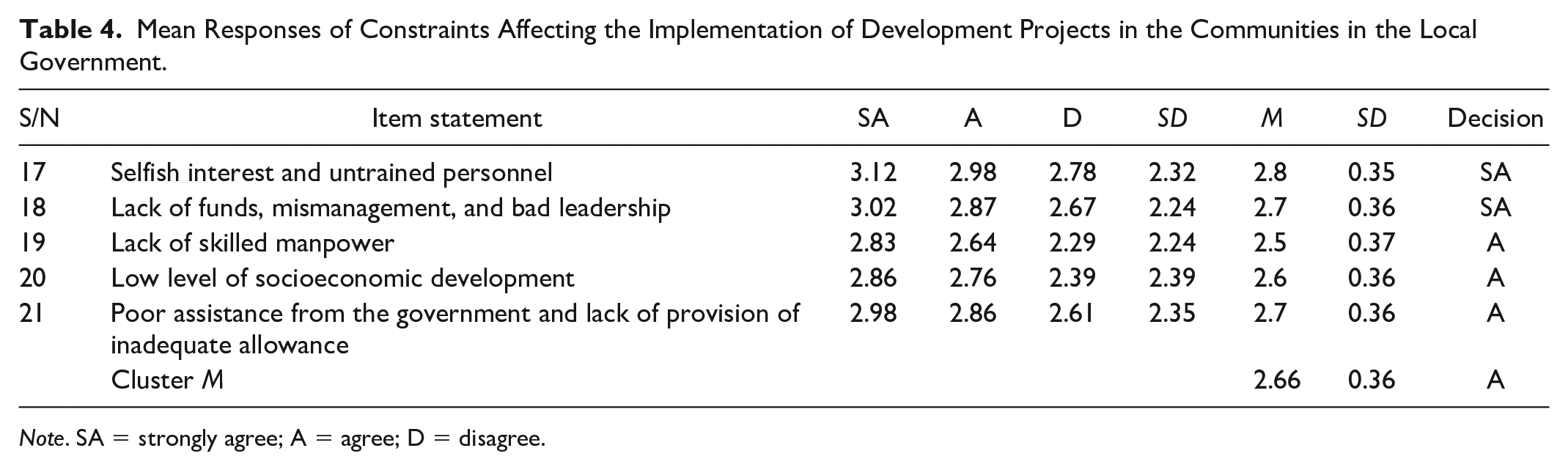
The data presented in Table 4 indicated that there are constraints affecting the implementation of community development projects in the local government. There are thus selfish interest and illiteracy; lack of fundraising, mismanagement, embezzlement, and bad leadership; lack of skilled manpower; level of socioeconomic development; and poor assistance from the government. The grand cluster mean of 2.66 indicated that the respondents are in agreement that all the items are constraints affecting the implementation of development projects in the communities in the local government. The grand cluster value for the standard deviation is 0.36, indicating that the responses of the respondents are clustered around the mean.
Mean Responses of Constraints Affecting the Implementation of Development Projects in the Communities in the Local Government.
Note. SA = strongly agree; A = agree; D = disagree.
Discussion
The findings of the study revealed the role of local government in community development projects, such as reconstruction of roads and bridges in the rural area, supporting rural farmers through agricultural machineries, provision of recreation centers, construction of fish pond and public toilets, and building of hospitals, motor parks, and public library. The findings are in agreement with Nwankwo (2002) who maintained that one of the objectives of the local government is to supply social services for the citizens at the local level, to join the local citizens to solve their community problems, and to become the nearest government to the local citizens at all levels of needs, such as reconstruction of roads and bridges in the rural area, supporting rural farmers through agricultural machineries, provision of recreation centers, construction of fish pond and public toilets, and building of hospitals, motor parks, and public library.
The findings of the study revealed that, for communities to be developed, human resources efforts are mostly needed to achieve development projects in the communities. Also in agreement were the findings of Ebonyi (2004) who reported and supported that there is no local government that can execute its functions or responsibilities without resources needed to achieve the community development projects, such as human resources (staffing, development, compensation, safety and health, and employee and labor relations), financial resources (state and government grant), economic resources (labor, capital, and technology), material resources (stationeries, sourcing, purchasing, and storing), and technological resources.
The findings of the study also revealed the constraints affecting the implementation of development projects in the communities in the local government, such as selfish interest and untrained personnel, lack of funds, mismanagement and bad leadership, lack of skilled manpower, low level of socioeconomic development, poor assistance from the government, and lack of provision of adequate allowance to encourage them reach out to the rural populace who dwell in the rural areas. These findings of the study are also in agreement with the study of Nwankwo (2002) who postulated that, for community problems to be solved, more citizens of quality need to be interested in seeking election into local government council; local governments must find it a heavy burden to finance the primary and adult education at the grassroots as they now depend heavily on external sources for their finance. As a result, many do not work hard enough to collect revenue internally; the relationship between the local, state, and federal governments is yet to be seen as one of the partners for development of any local community; the quality of local government staff still needs to be improved; and more frequent and better training is required to implement community development projects.
Implication of the Study for Adult Educators
The implication with regard to efficiency includes the following: the implication of the findings for community development efficiency. It is observed that the local government has contributed positively toward community development projects, especially in the rural areas. It is also necessary to recognize the active participation of the community development officers and adult educators with the youth through organizing educational programs, workshops, conferences, and seminars on how to carry out development projects in their various communities. With these findings, the local government will be able to employ more community development officers, adult educators, and also initiate the idea of encouraging them with financial grants that will motivate them reach out to more rural populace within the local government for the creation of awareness of provision of infrastructural facilities. By so doing, this will boost development and administration.
Similarly, the duty of the adult educators is to bring out workable remedies, thereby tackling the problems of development needs of the people to improve their standard of living. The members of the community-based development committees or officers are concerned with the development of their communities by supporting development projects and initiating development activities in the communities as a means of their development efforts. Another implication of this study is that the government should encourage and support the training of manpower in the area of adult education principle and practice, and community development needs. The government should also sponsor regularly organized training sessions for community leaders and participants in the form of conferences, seminars, and workshops to update their knowledge on the current issues and problems on modern development. Furthermore, adult education as a vehicle for transformation should, through its change agents, source out the felt-needs of the people, their aspirations, and measures adopted in the study. Ultimately, the discovery of the fact that there are no checks and balances that exist between the community development officers and the local government area toward the implementation of community development projects is worrisome.
Conclusion
Based on the research study, the following conclusions were drawn. One of the fundamental aims and objectives of the 1976 local government reforms is use of veritable vehicles for the transformation of community development projects in the rural areas through the provision of social services and other financial assistance for self-help projects, which can ultimately improve the people’s standard of living. According to the recommendations to the guidelines for local government reforms, these reforms were cited on the certainty that, as from now, every stratum of Nigeria bodies would benefit from the availability of self-help projects and other social services. The findings also indicate that the overall statement obtained from the various community development activities in the local government is not encouraging and this can be attributed to such factors that rural development projects have often developed and created much vested interest in politics that has today adversely affected community development projects. There is absence of well-trained community development officers needed to supervise and direct the people in community development plans and innovations. It would not be out of place to say that most of the problems militating against implementation of local government administration toward community development projects are lack of funds, mismanagement, embezzlement, and other related crimes among the chief executives and contractors, which seem to delay adequate provision of social services and amenities in the local government areas.
Recommendations
Based on the findings, the following recommendations were made:
A higher monitoring authority should be set aside to supervise the existence of checks and balances between the regulations of local government administrative duties and the department of works, housing, and social services.
Every new council that comes into power should be exposed to orientation workshops, which will enable them get acquainted with the local government guidelines of the 1976 reforms.
The communities in the local governments should be informed of their obligations to initiate community development projects to implement and then call for government assistance whether state or federal.
Local government politicians should work hand in hand with career civil servants to make every effort to motivate the worker. This is because without effective human resources management an organization conflict becomes imminent.
More self-help or community development projects should be initiated, financed, and executed by local governments to supplement their social services delivery.
The state or federal government should be sensitive to the allocation to the local government, thereby enabling it to execute more projects in the communities and also help recruit more qualified and experienced staff mostly needed in the personnel department.
The present system of local government, established to serve as a third-tier government, should be allowed by the state government to discharge its legitimate roles geared toward rural transformation.
Local governments should design an economic package that will enhance rural industrialization and, at the same time, create job opportunities through the same package.
There is also need to devise useful economic and social indicators that will assist the development planners and policy makers to monitor the extent of rural development.
There is need to call for the autonomy of the local government to be free from state control.
Footnotes
Acknowledgements
The authors appreciate all the corrections suggested and recommended by the experts before field testing.
Declaration of Conflicting Interests
The author(s) declared no potential conflicts of interest with respect to the research, authorship, and/or publication of this article.
Funding
The author(s) received no financial support for the research, authorship, and/or publication of this article.
