




Abstract
Postconflict redevelopment in Africa is noted for low government support but it is well concerned with self-help initiatives. The study determined the accomplishment level of such self-help initiatives in a postconflict community in Nigeria through primary and secondary data collection (n = 120) on the sociophysical activities of their community-based organizations (CBOs). These CBOs drew members from and executed projects within their immediate environment. They generated funds internally to finance essential projects to residents after the conflicts. Their activities toward security of lives and property, public infrastructure, credit facilities, and social development provisions to residents were perceived as accomplished unlike leadership training they offered to key leaders and moral and spiritual supports they rendered to their members. Since these CBOs were formed by residents who were neighbors, operated within their immediate locality, and accomplished more on essential postconflict sociophysical projects, they served as a team-pointer to bottom-up approach in postconflict sociophysical peace-building through self-help initiatives.
Keywords
Introduction
One major concern of both residents and policy makers in postconflict communities is economic revitalization and sociophysical development of the affected areas (Collier, 2003; Collier & Hoeffler, 2002; Narman & Vidanapathirana, 2005; Reinikka & Collier, 2001; Short, 2003). This can be accomplished through funding from the central purse, self-help, or external support. The fourth is the hybrid of two or more of the earlier mentioned approaches. Studies have shown that governments in conflict-affected regions of developing nations are poor and apathetic toward postconflict reconstruction (Do & Lakshmi, 2007; Ikejiaku, 2009; Luckham, 2011). This makes many of them to look outward for assistance from foreign nations and nongovernmental institutions. Postconflict development through external support is not bad. This is because it exerts no initial economic responsibility on recipients. However, it may have long-term negative effects of loan refund, lack of self-dependency, and delayed internal fund generating motivation in low-income countries.
Self-help, an inward looking strategy, may have its initial challenges but it encourages the people who are concerned to attend to their needs, and by this means, they develop self-motivated economic sustainability. The commitment of residents in conflict areas to self-motivated approach makes development through self-help to be more sustainable than depending on external aids from nonconflict regions. At the long run, such self-reliance approach will also positively influence the economic and sociophysical well-being of conflict-affected residents. Such positive effect may have its spatial dimension over times, sometimes spreading beyond the postconflict community’s boundaries.
This study was centered on the inward motivated school of thought. It perceived community-based institutions as self-help initiatives toward socioeconomic and physical development of communities, especially in areas that have just emerged from conflicts. Literature has shown that community-based organizations (CBOs) have proved their relevance in the local socioeconomic and physical developments of either conflict or nonconflict zones of lagging regions of the world (Ogundipe, 2003; Onibokun & Faniran, 1995; Onyeozu, 2010). This is so because they embark on self-help projects that are undertaken through voluntary efforts and utilize meager local resources to meet community’s needs that are either of small- or large-scale dimensions. What this means is that CBOs place an emphasis on joint efforts; they organize members for identification of their needs. They also embark on projects that meet these communities’ needs and maximize reliance on local initiatives and resources. Thus, CBOs make an active participation of individuals and corporate groups at grassroots a nucleus of sustainable development (Onyeozu, 2010). Over the years, these characteristics have given popularity to the organizations among local residents in developing countries (Barr, Dekker, & Fafchamps, 2010; Ekman, 2004; Molyneux, Hutchison, Chuma, & Gilson, 2007; Roe, Nelson, & Sandbrook, 2009).
The activities of CBOs in developing nations, especially in Africa where many governments have failed to sustain development of their local communities, have been reviewed in the literature (Agbola, 2002; Onyeozu, 2010). As opined by Cernea (1984), CBOs are local initiatives and resilience to failure of the central government. In another dimension, it is perceived as the bottom-up approach by the residents to cater for the shortcomings of top-town strategy by the government. The economic contributions of CBOs to development at the district level in developing countries have also been well considered in the literature (Barr et al., 2010; Larsson, Fuller, & Pletsch, 2012; MacPherson, 1995; Onyx & Bullen, 2000; Roe et al., 2009), but few works on their sociophysical effects are available in Africa, especially in conflict affected zones. Some of the past studies have focused on the impacts of CBOs at local level on agricultural development (Zurayk, 2010), physical aspect of communities (Bradshaw, 2006), the economy (Abegunde, 2009), social services’ provision (Katungi & Akankwasa, 2010), and the activities of nongovernmental institutions (Onyeozu, 2010) among others. Others like Biddle and Biddle (1968), Narayan (1995), Onibokun and Faniran (1995), Agbola (1998), and Abegunde (2004) linked CBOs with sustainable development, housing, local potentials and initiatives, and rural development, respectively. None of these past studies have been able to determine the level of sociophysical achievement made by CBOs in a conflict-affected area of sub-Saharan Africa. This gap was what the current study intended to fill.
One of the recent studies that were based on CBOs in Africa was carried out by Sangole, Kaaria, Njuki, Lewa, and Mapila (2014). The work measured the social capital, functioning, and accountability of farmers’ organization in Kenya, based on people’s participation. The author noted that farmer groups that integrated community driven participatory monitoring and evaluation had higher indexes for group social capital and performance with greater group cohesion while their members had higher satisfaction with group performance. The work, however, focused only on agro-based organization and did not expatiate on both its social and physical activities. It also lacked a spatial dimension. In addition, it was not based on the conflict affected economy. Hence, it could not have measured the achievement of such organization in a postconflict environment. Along this line, C. Claudia, Mincemoyer, and Perkins (2005) measured the impact of youth development programs, based on online youth life skills evaluation system using the achievement test. This work was Internet based with no physical geographical scope and so it was not concerned of sociophysical activities of CBOs in the built environment. The result of the work also centered on providing database where youths could access online information in a digital Internet community where there is no physical conflict that has resulted in community economic regression. Such online-based study could not have suggested the level of achievement made by CBOs that are location based. It could not also have revealed the spatial extent of the sociophysical facilities provided by CBOs in the study area.
Some other related past studies used residents’ perceptions to explain the impacts of CBOs on important and sensitive areas of the environment like housing (J. Claudia, 2003; The Urban Institute & Vidal, 2001), infrastructure (Mardirosian, 2010), governance (Cavaye, 2004), depressed economy (Abegunde, 2011), and disaster and conflict management (Fischer, 2006; Haider, 2009) among others. Although these are social and physical issues in the community, but the impact studies were not conflict related.
The commonality of conflicts in Africa, the current wave of advocacy for an inward looking strategy in postconflict sociophysical development, and the recent springing up of CBOs in the region have all pointed to the need for a relevant new study of this kind (Dimelu, Salua, & Igbokwe, 2013; Haider, 2009; Khwairakpam, Shankar, & Mukherjee, 2014). The current study therefore positioned Ile Ife, a city that has just emerged from communal conflict in sub-Saharan Africa as a case study. Such a specific study was not common in the region. Previous works on CBOs in the region (Abegunde, 2003; Agbola, 1988) were all silent on their level of accomplishment and were not carried out on postconflict communities.
The present study contributed to knowledge by providing information on the sociophysical operations of CBOs in a postconflict environment and justified this by the level of achievement they attained in the course of exerting their influences within a geographic scope. In the course of conducting the current study, interests were drawn to the socioeconomic and physical characteristics of these CBOs. These include their nature of operations, years of establishment, conditions of membership, sources and modes of fund generation, types of objectives they set and levels of their accomplishment on sociophysical projects, and the spatial extent of these within their geographic space. Such information could assist in establishing the CBOs’ thresholds and by this provide a basis for determining the success rate of their social and physical supports that they offered to residents in the study area.
The Literature
Community-Based Organization
CBO is also known as local organization, community development, neighborhood council, and united community among others across the nations of the world (Abegunde, 2009). Another institution that seems to be closer to it at local level is the nongovernmental organization (NGO). However, a distinction between CBOs and NGOs is that the former suggest simple institutions that cover a relatively small area with a local identity while NGOs have a sophisticated and complex structure and cover a wider area and project, though with a concern for local communities (Agbola, 1998).
Community Development Associations and Their Sociophysical Dimension
Studies on social and economic implications of community development associations abound in the literature (Abegunde, 2009; Kassahun, 2011; Mgawanyemba, 2008; Opara, 2010; Twombly, De Vita, & Garrick, 2000). Other works on their physical and spatial effects also exist but these studies were carried out by scholars who are located outside the region of Africa (Downey, 2006; Nikkhah & Redzuan, 2009; Wu & Tsai, 2008). Paradoxically, CBOs’ physical development impacts have been felt long ago among indigenous settlers in many traditional communities in Africa (Adebisi, 2009; Ayo, 2002; Oyerinde, 2005), especially in Nigeria where this study was based (Holdcroft, 1982; Olowu, Ayo, & Akande, 1991). Such physical impact was felt through self-help housing construction (Agbola, 1998), infrastructural provision and sustenance (Agbola, 1988), farming (Adeyemo, 2002), and development of public centers for community use (Narayan, 1995) among others. In community development planning, the physical operation of CBOs has its spatial dimension. The argument here is that all social, economic, and physical impacts of CBOs in any given community are within a geographic space, spatially concentrated or dispersed. However, most of these past studies have failed to link the physical attributes and activities of CBOs with their spatial effects. Attempts to achieve this has made the present study to determine the accomplishment level of the social and physical activities of the CBOs in Ile Ife, Nigeria, with a spatial perspective on the postconflict community. This was carried out to confirm the assertion that CBOs as local institutions are formed mainly by residents who are living within an immediate environment and that their operations are best enjoyed in the immediate neighborhood of the CBOs’ existence (Adebisi, 2009; Blunt & Warren, 1996; Glaser, 1986; Hasenfeld & Gidron, 1993). In addition, the current study was carried out to confirm if this also applied to conflict-affected areas of developing nations or not. It also aimed at determining the commitments of such CBOs to residents’ sociophysical and economic well-being and the reconstruction of their community, even after crises.
Accomplishment Index (AI)
AI as used in this study is a method of determining success or attainment level of a group based on the aim it sets to accomplish. This is computed by attaching scores that are having rated values (in ordinal form) to performance indexes under each of the CBOs’ set objectives. The AI in this study was referenced to the work of Likert (1932). The author developed Likert-type scale of performance rating, using scales 1 to 5. The scale with the lowest rate was counted as having the least score and vice versa, though in an ordinal format (Afon, 2006). This AI also has its roots in (but not exactly the same as) the achievement index that was propounded by an educationist named Valen Johnson of the Institute of Statistics and Decisions at Duke University who first developed the model to calculate grade point average (GPA) of students to appraise their academic accomplishments (Embretson & Reise, 2000; V. E. Johnson, 1997). According to V. E. Johnson (1997), achievement index is a measure of a student’s performance, relative to all other students taking classes at the institution. Since then, achievement index has become one of the statistical methods used to solve problems relating to students’ GPA. Researchers who have used the test in recent times include Lehman and Geller (2004), Odeck (2004), P. C. Gordon, Perrin, Sancar, and Stewart (2007), Boiche and Sarrazin (2008), Uthman (2009), and Flateby (2014) among others. Flateby (2014) applied this model in Georgia University and concluded that it could be used to ascertain students’ level of learning within a course, in a major, or across their entire undergraduate education.
According to V. E. Johnson (1997), three basic principles of achievement index must be followed to arrive at a meaningful conclusion (V. E. Johnson, 2003). First, students’ grades in courses must provide minimal performance in ordinal information and not necessarily in an absolute term. This will help the researcher to categorize respondents (students) into groups that are receiving the same grade and to rank these groups relative to other groups. Second, the ordinal information on grades obtained is used to make a summary score which indicates each student’s academic performance relative to the performance of other students. By this means, the pattern of all grades in all classes is determined. The third assumption is that consequences of the test must be explicitly spelt out before a conclusion is drawn.
AI in this study borrowed knowledge from these assumptions and used Likert-type scale (Afon, 2006) ratings of numbers 1 to 5 to rate respondents’ (CBOs heads) scores on the social and physical activities of CBOs in the study area. This fulfills the first principle of achievement index which claims that there is the need for ordinal information to categorize respondents into groups that are receiving the same score and to rank those groups relative to other groups.
In this study, AI was developed from the combination of pieces of information extracted from Likert-type scale (Likert, 1932) and achievement index (V. E. Johnson, 2003). This was used to determine the levels of success of main tasks and projects that were set to be accomplished by the CBOs within the past one decade in the study area. In line with the third assumption of achievement index of V. E. Johnson (1997), the level of success recorded or observed in the sociophysical activities of the CBOs in the study area was established.
Method for the Study
The Case Study
Ile Ife was chosen as the case study for this work. It is a traditional city and it is located in Southwestern Nigeria. Past studies revealed that the study area and its peripheral regions have records of CBOs’ operations (Abegunde, 2009; Ayinde & Torimiro, 2014), despite the protracted intercommunal conflicts that had affected the community for decades (Albert, 2001). The city is the most civilized part of a country that has the highest population in sub-Saharan Africa (World Bank, 2014). It is made up of two local government areas. These are Ife East and Ife Central Local Government Areas, whose headquarters are at Oke-Ogbo and Ajebandele, respectively. The two local governments consist of 21 political wards in the council areas with a population of 355,818 people (Sáenz, Embrick, & Rodríguez, 2009). This city is situated on Latitude 70.28°N and Longitude 40.34°E with an annual rainfall of 0.6 m which encourages farming of variety of crops (Ajala & Olayiwola, 2013). The city has one language (Yoruba) that promotes understanding among residents. This made the study area to conform to the general morphology of a traditional settlement, having a common culture and other forms of social attributes. These encourage a social interaction and also enhance a joint contribution toward fulfillment of a common goal. This could be why CBOs are common and age-long in the region (Ayo, 2002).
Such homogeneous cultural attribute was expected to gender unity rather than conflicts among residents. The reverse was the case in the study area. This is because two distinct groups of settlers are known to coexist in the city for centuries. Each of the group of these distinct two settlers has a local dialect commonly spoken within respective neighborhoods of each settlement. These two groups are the Ifes and the Modakekes (Akinjogbin, 1996). The former people were said to be the early settlers while the latter were said to be in the minority and were accommodated by the former, based on the consent of the forefathers of the Ifes who gave separate land to the Modakekes for farming while the minority group paid tributes to the host. Over time, the Modakekes multiplied and expanded and as expected, they have to claim the land given to them by the Ifes as their territory (Albert, 1999). The Nigeria Land Use Act of 1978 also supported such claim. The sociocultural difference between the two distinct settlers was easy to manage by the residents before and after Nigeria’s independence until the country gave special attention to local government system that encouraged grassroots development. Thus, lack of generally accepted formula to share political proceeds in the city as touching the two distinct settlers led to prolonged hostilities that escalated into communal conflicts (Albert, 2001; Ayo, 2002). Thus, the Siamese settlements that formed a city had engaged in several clashes over decades, and these have resulted in internal displacement, loss of lives and property, occupational disempowerment, and economic regression among others (Oyerinde, 2005). Between 1996 and 2003, the conflict took a critical dimension when the federal government decided to locate a new local government secretariat in Ife territory where there had been a previous one, shared by the two groups of settlers. The Modakekes felt that one out of the two local government secretariats must be located in their territory while the Ifes opined that their counterpart late settlers had no right to challenge the host. This generated crisis that destroyed property, grounded public infrastructure, displaced and claimed lives of residents, and negatively impacted their economy and education. According to Albert (2001), most Modakekes were peasant farmers while few of them were into plantation farming. On the average, a plantation farmer among them lost 2.75188 million Nigeria Naira (equivalent of US$18, 345.87) worth of farm crops while the Ifes lost nearly all the industrial establishments in their territory to the conflict (Abegunde, 2010). According to Oyerinde (2005), conflicts between the two settlements claimed 10,000 lives and paralyzed the economy for years.
Preliminary Survey
Prior to the collection of the data needed for this study, the researcher conducted a reconnaissance survey to the department of community development and CBOs’ leaders in the two local government councils in the study area. This was to know the total number of registered CBOs in each area. Information obtained on the total number of the registered CBOs also guided in the choice of the sample to be drawn from the population for this study. It also assisted in locating and identifying the respondents, seeking their consents and explaining the study intention to them. Basic information required before conducting the study therefore include the contact addresses and mobile phone numbers of all the registered CBOs’ heads in the study area. Relevant officers that were approached on these in the government offices obliged to these requests.
After locating the CBOs heads through phone contacts, their consents were sought and they all consented. During the reconnaissance survey, issues relating to the CBOs’ operations as acquired in the literature were discussed with all the CBOs’ heads that were to become the respondents. They all expressed their views, and relevant information that originated from the CBOs’ heads during preliminary survey was also incorporated into the list of data needed for the study. Thus, the concerns for the study were well structured and defined after the preliminary survey.
Results from the preliminary survey assisted the researcher in the preparation of the questionnaire to be administered on the CBOs’ leaders. Ideally, the reconnaissance survey led to the adoption of triangulation method for this study. While ethical permission was granted by each of the respondents, some of them requested for name anonymity on the pieces of information to be supplied. This was strictly adhered to in this study. The reconnaissance survey carried out also guided the researcher to apply the basic concepts that were designed and to establish the data needs for this study.
Relevant Terminologies
The term actual accomplishment index (AAI) in this study refers to the degree of achievement of the projects conducted by the CBOs in the study area as documented at the secondary source (the CBOs’ financial statement and other relevant materials) while the perceived accomplishment index (PAI) revealed the opinions of residents, based on their observations of the successes recorded by the CBOs’ sociophysical activities.
For ease of primary data collection and analysis, the sociophysical activities in this study were grouped into six categories. This was influenced by collective knowledge obtained from the works of Mathew-Njoku, Angba, and Nwakwasi (2009), Abegunde (2009), and Foster (2011) where the roles, activities, and operations of the CBOs in some developing countries were reviewed. The six groups are infrastructure facilities, credit facilities, security of life and property, social development, leadership training, and moral and spiritual support. Bildt (2003) also observed that these activities are very important in postconflict peace-building.
Infrastructure facilities as conceived in this study are the essential amenities provided for the benefit of the public for the social and economic development of the entire community. Observations made about these infrastructure facilities during reconnaissance survey revealed that they include pipe borne water, bore hole, public toilet and urinary, neighborhood hall, and roads among others. These facilities are necessary and mostly available in any given community, but this study focused on the specific ones provided by the CBOs in the study area.
The term credit facilities as used in this study refer to economic supports which were in form of credit loan and subsidy, given to the people (especially the CBOs’ members) with or without their requests to cushion the effects of conflicts on residents’ economy. The security of life and property offered in the study area to CBOs’ members was mostly in form of informal local community police support to members, based on requests. In other words, the CBOs either formed the team that served as local vigilante group or they employed those who would offer their services for economic return. What this means is that such employees served as security agents/guards to protect the CBOs’ members in their respective homes, especially at nights, although the security of life and property that are offered to CBOs’ members may sometimes also include provision of money to them to procure relevant materials and hire guards to protect residents’ lives and properties. According to Bildt (2003), this need is cardinal to sustainable postconflict peace-rebuilding.
Social development as it applies to this study includes provision of subsidized or free health and educational materials to CBOs’ members, training and granting of scholarships to indigent people in the public, offering of public enlightenment programs to sensitize residents on necessary information on community development, peace talk and movements among people, and rehabilitation of CBOs members’ affected houses and offices.
Information collected during reconnaissance survey on the moral and spiritual support activities of the CBOs include but not limited to raising free offering in form of cash, food, and clothing to the needy and rendering of moral assistance to CBOs’ members during social functions such as naming, marriage, burial, and graduation ceremonies among others. It also include offering of counseling and sending of encouraging words regularly to members during crises and keeping widows and orphans in secured homes to avoid solitude and depression. The reconnaissance survey also showed that leadership training for key CBOs’ leaders in this study was by sending CBOs’ leaders on train-the-trainers’ programs on peace-building, entrepreneurship, financial or community administration, and accountability.
Research Concerns
There were three basic issues of concern in this study. The first was to examine the socioeconomic and physical characteristics of the CBOs and to confirm the relationship that existed among these variables in the study area. The study also raised concern on how the sociophysical activities of the CBOs were accomplished in actual term (according to the documented information contained in the records of these organizations) and perceptively, based on the physical observations and judgments of the community opinion leaders who represented the end users of these projects in the study area. Along this line, the third concern was to establish the gap that could have existed between the qualitative and quantitative assessments of the CBOs’ accomplishment so as to determine the degree of residents’ satisfaction with the CBOs’ sociophysical activities. This was expected to assist in understanding the level of CBOs intervention in postconflict sociophysical performances and confirm the perception of the residents to the claims of the CBOs on their sociophysical services’ provisions in the postconflict area.
Data Sources and Needs
Two sources of data were explored for this study. These are primary and secondary sources. The latter was where financial statement, records on social, economic, and physical activities, of the CBOs in Ile Ife, Nigeria, was sourced from. The primary source was where direct information concerning the study was obtained through administration of structured questionnaire. Sourcing data from the two sources was informed by some reasons. First, to avoid bias, Organisation for Economic Co-Operation and Development (OECD; 2008) suggested sourcing information from more than a source on studies that are conducted in intercommunal conflict area. It should be recollected that this study was conducted on two settlements that have fused together to become one. Besides this, project delivery in many developing countries of the world requires end users’ opinions, irrespective of the reliability of the documents available with the donors at the secondary source. According to Ohail and Cavill (2008), this will reveal lapses between paper documents and physical reality after project execution and such is necessary in countries where leaders are corrupt, not accountable.
This study used triangulation method of data collection. This method allows collection of data from two or more different sources for a research purpose. Yeasmin and Rahman (2012) were of the opinion that this method could combine both the advantages of qualitative (perceived) and quantitative (actual) observations to arrive at meaningful conclusions. This is just as recent developments in the philosophy of science have contended that this method would provide avenue for both perceived and actual data to interact to solve research problems (Caracelli, 1997; Creswell, 2003; Hussein, 2009). According to Jacob (2001), By combining multiple observers, theories, methods, and empirical materials, researchers can hope to overcome the weakness or intrinsic biases and the problems that come from single-method, single-observer and single-theory studies. Often, the purpose of triangulation in specific contexts is to obtain the confirmation of findings through convergence of different perspectives. The point at which the perspectives converge is seen to represent the reality. (p. 3)
Information required of the CBOs for this study include their years of establishment, number of members, capital bases, average number of beneficiaries, likely sources of generating funds, spatial extent of operations, and pulling members within and out of the region of existence. These spatial extents of operations were determined through calculation of the distances of different places of operations and members’ addresses to each of the CBOs’ offices in the study area.
The leaders or heads of these CBOs were also contacted for secondary data, and relevant information were obtained from their associations’ archives on past number of projects they set to accomplish and the degree of fulfilling these. Others are the amount of money they anticipated for each project and the total amount of money they realized and all the internal and external sources of funds where they raised the money to finance these projects. These CBOs’ leaders were targeted for both primary and secondary data because they represented the interest of their members, lived among the residents, and were exposed to public comments on residents’ satisfactions about their organizations’ sociophysical activities in the study area. Studies have also shown that they can also be recognized as opinion leaders on studies that are community based (Gaventa, 2004; Khurram & Graham, 2008; Onyeozu, 2010). Thus, CBOs’ leaders in the current study were considered as community or opinion leaders during data collection.
Data Collection Technique
Data from the primary source were collected through design and administration of a structured questionnaire to all registered CBOs in Ile Ife. Reconnaissance survey revealed that there were 359 CBOs that registered with the local government councils in the city (Ife Community Development Units, 2006). Thus, Ife East and Ife Central local government councils had 135 and 193 registered CBOs from their 10 and 11 political wards, respectively (see Tables 1 and 2).
The CBOs by Local Government Distribution in Ile Ife, Nigeria.

Note. CBOs = community-based organizations.
Selected CBOs by Categorization in Ile Ife, Nigeria.

Note. CBOs = community-based organizations.
Forty percent (120) of these CBOs were randomly selected for questionnaire administration. The choice was influenced by earlier studies conducted on CBOs in the study area (Agbola, 1998). The lists containing the CBOs’ names in order of registration with the two local governments in the study area formed the sample frame. Two out of the first five organizations in each of the CBOs’ lists from the two local government councils were selected through balloting. The chance of selecting any CBO in the study area depended on the inclusion of its name in the CBOs’ lists at the local government registry because these lists served as the sample frame for this study. Subsequent samples were systematically selected (without replacement) in order of how the CBOs’ names were listed in the registers with each of the two local government councils. Information from reconnaissance survey revealed that the two local government councils used the same style to categorize these CBOs in their registries. As reflected in Table 2, this same categorization was used in grouping the CBOs in this study. This does not mean that the categorization should be generalized with what obtained in the literature; it is only peculiar to this study and the study area.
During data collection, the CBOs’ heads were asked to rate each of the six sociophysical activities in the questionnaire that was administered on each of them, using Likert-type scale of five points rating. These included highly accomplished (meaning the projects were completed and in use), accomplished (meaning the projects were not fully completed but were useful to the residents, thereafter), moderately accomplished (meaning that although the projects were not completed but residents have high level of hope that such works would not be abandoned but they would be useful in the nearest future because the level of delivery had crossed halfway), not well accomplished (meaning that the CBOs worked on the projects, although they were not currently useful in any form to the residents at the time of conducting this study, probably the work have not reached halfway), and poorly accomplished (indicating that the projects had public awareness but they did not go beyond inception stage, if at all they were commenced physically). In the same vein, information collected through secondary data on the level of sociophysical projects implemented were also categorized into five, namely, successfully completed (and in use), completed well above halfway (to the level at which residents did use it although it was not yet offering a full satisfaction), completed about halfway (at least halfway accomplished but it might not be useful to the residents in its current state), completed below halfway (and no resources forth coming to continue the work), and the project was desired and was just initiated/not embarked upon (the work was still at the inception stage). Worthy to note here is that the ratings for data from both primary and secondary sources were patterned alike. This is a requirement for an ex post facto research design and will aid the analysis of data that are collected through nonexperimental technique, especially when qualitative and quantitative data are merged together (Hussein, 2009).
Analytical Techniques Adopted
In the analysis, the ratings were assigned weight values of 5,4,3,2, and 1. These represent from highest degree of accomplishment or completion to the least, respectively. Analysis of data collected through questionnaire was tagged perceived accomplishment index while the degree of project completion from secondary source was referred to as actual accomplishment index.
The PAI or AAI for each of the six variables was obtained by finding the summation and dividing it by weight value (SWV) of the total number of CBOs’ heads that were interviewed (N) in the study. It should be noted that SWV was the addition of the product of the number of responses to each of the variables and the weight value attached to each rating (Afon, 2006). The mean (
Having used triangulation method of data collection, the study combined the results of PAI and AAI together through the use of ex post facto research technique to draw conclusions. According to Cohen, Manion, and Morrison (2007, pp. 264b-266), the mixed method allows for merging of preexisting and postfact data that can be matched in situations where it is unethical to control or manipulate the dependent variables. In this study, AAI obtained from secondary source became the preexisting one while PAI which was obtained latter through administration of questionnaire to confirm the validity of the former (information from the secondary source) served as the postfact data. On studies that require only two sets of data as the case was in this study, Kerlinger (1986) recommended the use of co-relational ex post facto research design which involves the collection of two sets of data by first identifying the antecedents of a current situation retrospectively, with a view to determining the relationship that could exist between this and the postdata, after merging them together.
In addition, this study also used correlation coefficient to test the relationship existing between socioeconomic characteristics of CBOs and the physical development impact they exerted on the residents in Ile Ife, Nigeria. This parametric analysis depended on data collected from the secondary source alone and used those variables that were numeric among them. Such analysis is universally recognized, unlike Likert-type scales that were computed using the interval measurement that requires justification.
The Use of Likert-Type Scale Ordinal as an Interval Measurement in This Study
The variables that were generated through Likert-type scale in this study were treated as (possessing) interval measurements. Such analytical technique requires detail explanations to avoid statistical confusion. Prior to this study, Likert-type scales, which unarguably are ordinal data and whose intervals cannot be considered as numeric have generated arguments in the literature as to be solely treated as nonparametric (Agresti, 2002) or to be absorbed in the parametric techniques (Razzaque, 2013; Zaimah et al., 2013). Scholars like Knapp (1990), Jamieson (2004); Chimi and Russell (2009); Henson, Hull, and Williams (2010); and Amah (2013) have opined that Likert-type scales are ordinals, lacking numerical intervals. Thus, Clogg and Shihadeh (1994) and Agresti (2002) contended that only nonparametric statistical analyses should be used to process data with ordinal scales and Kuzon, Urbanchek, and McCabe (1996) believed that deviation from this will lead to committing one of the terrible “sins” of statistical analysis. The works of Wilson, Wainwright, Stehly, Stoltzfus, and Hoff (2013) and Kornfeld (2013) were recent compliance to this school of thought. These scholars’ position is understood because Dolnicar and Grun (2007) noted that the user-friendliness and malleability of scale formats are not yet popular and are not well researched into. Such low level of popularity could limit Likert-type scales’ universal comprehension, acceptability, and benefit utilization.
In agreement with Dolnicar and Grun (2007), Davison and Sharma (1988) had earlier observed that parametric technique could be applied to analyze variables that have been collected from the field with interval characteristics. This argument was upheld by three pillars. First, there has not been a universal agreement among statisticians against the introduction of assumed interval measurements in Likert-type scale, just as “there have not been globally accepted measuring scale that can be used to translate intangibles into numbers” (Yusoff & Janor, 2014). These gaps have allowed researchers to use discretions that are psychologically reasonable and scientifically permissible to assign numbers to rated scales in their researches, depending on the peculiarities of their studies. Thus, many researchers have explored this to promote scholarship across the globe (Afon, 2007; Marateb, Mansourian, Adibi, & Farina, 2014; Sarafidou, 2013; Sullivan & Artino, 2013; Yusoff & Janor, 2014). For instance, as far back as about two decades ago, more than 70% of the articles that contained ordinal data and published within 5 years (1993-1997) in the Journal of Educational Psychology and that of American Educational Research Journal, Sociology of Education were analyzed using parametric technique (Harwell & Gatti, 2001).
The second reason is that Likert-type scale has been classified to be in the family of multicriteria model (Afon, 2006; Carrasco, Villar, Hornos, & Herrera-Viedma, 2011). There is therefore the need to establish the mean of its variables for easy comparison (Afon, 2007). Along this line, scholars like Jain (2013), Razzaque (2013), Zaimah et al. (2013), and Yusoff and Janor (2014) had used 5- or 7-point Likert-type scale in their works to treat ordinal data as intervals and they had tested them through parametric analytical techniques such as mean, ANOVA, t test, factor analysis, and multiple regression.
The third reason is the current global influence of technology and inclination of policy makers to facts and figures to solve world’s problems through objective judgment, even on social and cultural issues that require qualitative analysis. The phenomenon of turning ordinals to intervals serves as a compromising ground for researchers to meet the world’s needs on this and to make intangibles to become tangibles without losing the real values of research.
Scholars who completely oppose this development should note that not even all numerical scales are of absolute values. For instance, 50 °F is never considered as half of 100 °F in true experience. Thus, Geramian, Mashayekhi, and Ninggal (2012) and J. S. Gordon, Mahabee-Gittens, Andrews, Christiansen, and Byron (2013) advocated for a compromise on ordinal conversion to numerical and suggested that the introduction of quantitative scales that have limited numbers, rated in categorical form, with vague zero point and vague unit value would be of help (Yusoff & Janor, 2014). This made Likert-type scale of ordinal ratings of 1 to 5 values as used in this current study to be accepted as tangible enough to adopt respondents’ judgments on sociophysical projects that were carried out by CBOs in postconflict area of Ile Ife, Nigeria.
Ratings developed for assessing the sociophysical projects carried out by the CBOs in this study were patterned after the semantic differentials of Heise (1969) and Boone and Boone (2012) which argued that the higher the positive score implies the better the adjective that describes the issue or object concerned, the higher values attached, the greater the number and the wider the interval, though arranged in ordinal manner and the better to treat such data as numeric variables (Munshi, 1990). As Jamieson (2004) opined that the judgment of the researcher and normal distribution of the sample should be respected in applying parametric test to ordinal scales. Hence, an attempt at calculating the mean, standard deviation, and variance in this kind of a study is accommodated in the literature (Bartkowiak & Sen, 2007).
Findings
The results obtained in this study were categorized into three sections, based on the research concerns for the study. The first section examined the socioeconomic characteristics of the respondents and the CBOs they headed, while the second rated the opinions of the CBOs’ heads on the objectives they set and the projects they executed after the conflicts in the study area. The section also considered the postconflict successes that were achieved by these CBOs on the sociophysical projects that they executed based on the funds they generated from different sources over the space of 10 years. The accomplishments of their set objectives were rated using information that were gathered on the actual number of projects executed with the funds. The last section established the relationship between perceived and actual fulfillment of the CBOs sociophysical objectives in Ile Ife, Nigeria.
The Socioeconomic and Physical Characteristics of CBOs in the Study Area
The socioeconomic characteristics of the CBOs and their leaders in Ile Ife, Nigeria
The findings revealed that nearly all the CBOs’ leaders were literate, with close to two thirds (62.6%) and about one third (30.5%) of them having tertiary and secondary education, respectively. A handful (7.0%) of them had been to primary school. This could be why civil servants (54.2%) who were expected to be literate were dominant among them, whereas traders (10.8%), farmers (2.5%), and retirees (4.2%) were sparsely represented. Some CBOs’ leaders’ occupations (28%) were not categorically indicated during interview.
Table 3 shows that the gender gap among the CBOs’ leaders was very marginal. Thus, male respondents among them were 50.8% while their female counterparts were 49.2%.
The Socioeconomic Characteristics of the CBOs’ Leaders in Ile Ife, Nigeria.

Note. CBOs = community-based organizations.
Mode of fund generation by the CBOs in Ile Ife, Nigeria
Fund is necessary for the proper fulfillment of CBOs objectives. Table 4 reflects that personal contribution (64.2%) by members was the major source of fund generation in CBOs in Ile Ife. In other words, the members of the associations were expected to contribute certain amount of money as part of their commitments to their associations and to run the activities of the CBOs. Other sources of fund include donations through charity (12.5%), loans (4.2%), grants from government (3.3%), and money generated through investment of the associations (15.8%). It can be deduced here that funding in CBOs in Ile Ife was through joint contribution and money that they realized from their investment and not by government support. This study is in agreement with Eziyi (2009) that asserted that funding of CBOs in Nigeria is mainly an association’s members’ affair. It, however, contradicted the findings of Krivelyova et al. (2013) which was conducted across three developing nations in Africa where their governments and other donors contributed reasonably to local development programs at grassroots level. It should be noted that funding from such multiple sources in Krivelyova et al.’s (2013) work were not remitted to or coordinated by the CBOs of these countries as the case was in Eziyi (2009) and in the current study.
Mode of Fund Generation Among the CBOs in Ile Ife, Nigeria.

Note. CBOs = community-based organizations.
Years of establishment of the CBOs in Ile Ife, Nigeria
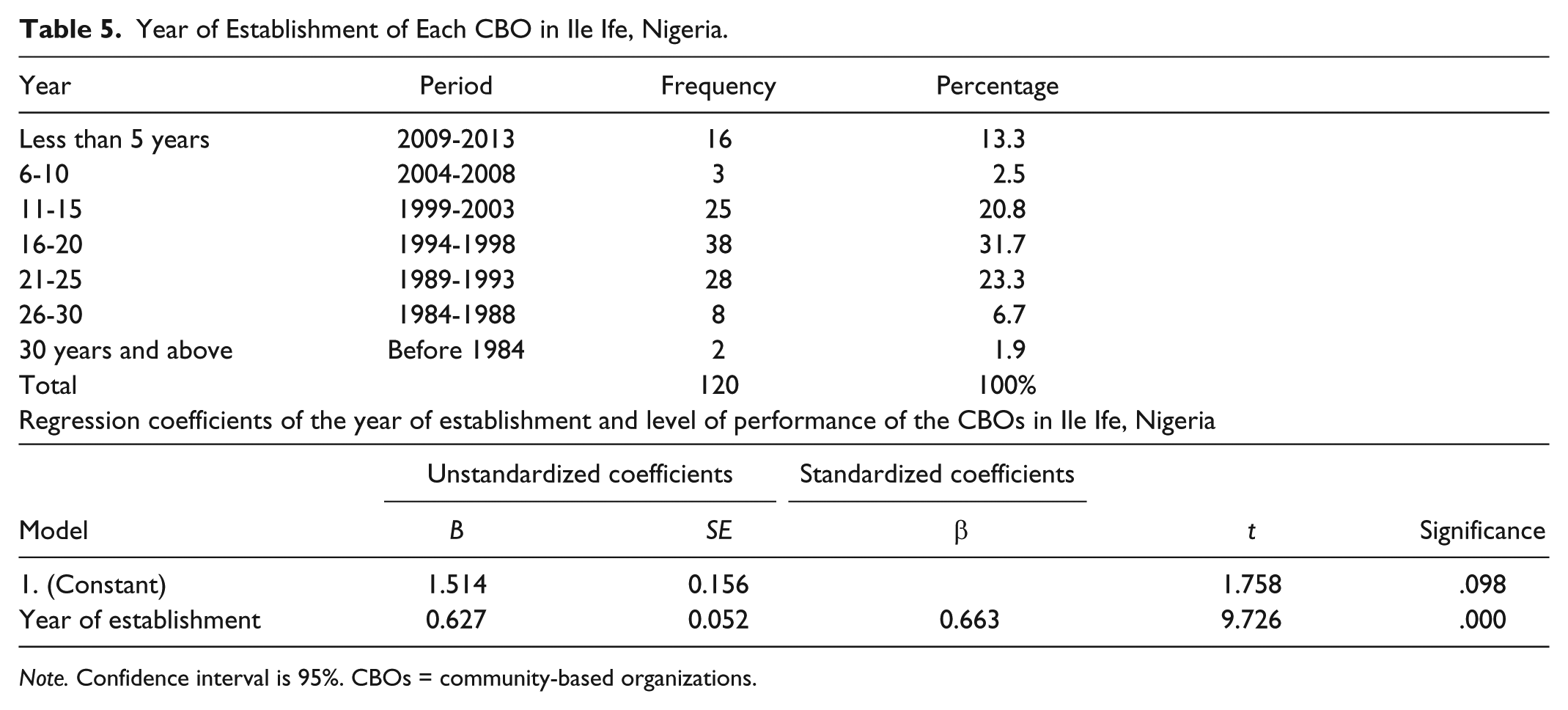
The years of establishing the CBOs covered by this study were grouped into seven. These include those established in the period of less than 5 years ago, between 5 and 10 years, 11 and 15 years, and 16 and 20 years to the time of conducting this study. Others include those established between 21 years and 25 years, 26 years and 30 years, and above 30 years to the time of conducting the survey for this study.
The choice of these categories was influenced by different past political era in the country. Table 5 reflects that a handful (13.3%) of these CBOs came into existence in less than 5 years ago while a very negligible percentage of them was established between 2004 and 2008 (2.5%), and above 30 years (1.9%) to the time of this study, respectively. Implicit to this is that most (75.8%) of the CBOs came into existence between 1989 and 2003; a period of about one and half decades.
Year of Establishment of Each CBO in Ile Ife, Nigeria.
Note. Confidence interval is 95%. CBOs = community-based organizations.
The CBOs proliferation reduced after this era as the table reveals that only 15.6% of them were established between 2004 and 2013; a decade period. Worthy to note is that the communal conflicts that affected the city ended in 2003. Residents were expected to have been displaced and new CBOs might not be easy to form until social order was fully restored. On the contrary, the few CBOs that were formed after, together with those existing before the conflicts must have aimed at improving the living conditions of the residents by fulfilling their local targets to prove their relevance in the conflict affected economy. In reference to this, the unstandardized coefficient of the sociophysical performance of the CBOs in Table 5 determines the strength of its relationship with the number of years of their existence (years of establishment). Thus, the coefficient for the years of establishing the CBOs (.627) in the table predicted an increase in their sociophysical performance. Since the relationship was significant (p = .000), it shows that there was a linear relationship between the tested variables. It can be inferred that the longer the years of establishment, the higher the level of sociophysical performance of CBOs in the postconflict community.
Membership of the CBOs in Ile Ife, Nigeria
Table 6 reflects the factors that influenced membership absorptions into the CBOs within the study area. As seen in the table, two fifths of the associations indicated that their membership was location (43.3%) and professionally (38.5%) based. In other words CBOs in the former group were formed by and limited to residents that were living together in specific neighborhoods or areas in Ile Ife. Thus, the membership of those CBOs was not opened to other residents that hailed from outside the immediate environment defined by the associations. This is expected in a postconflict area because loss of confidence, identity, and trust in distant residents can confine people to join CBOs in their immediate vicinity where comembers are known and the people are sure of security of life, confidentiality of information, and safety in interrelationship (Haider, 2009). In addition, Ife and Modakeke as Siamese settlements in a city called Ile Ife host residents who have distinct identities but are with discrete opinions due to past intercommunal conflicts that took place among them. Residents in such kind of environment would have choices of CBOs they would want to belong. This could be why 43.3% of the CBOs indicated that their members were from their immediate environment. Thus, about 30% of the CBOs in Table 2 who registered with the government as landlord associations must have had their membership from different neighborhoods where members who built their houses were living. Under this condition, membership becomes compulsory rather than voluntary (Chechetto-Salles & Geyer, 2006). Along this line, nativity (13.4%) of residents was a factor in absorbing membership to some CBOs in the study area. This indicates that resident’s origin (by street or quarters) was location specific and has its spatial dimension and this influenced over one tenth of the CBOs’ membership in the study area. The CBOs’ members who were influenced by their religions (4.8%) to join CBOs in the study area were very few and their membership may not be spatially inclined. Such low representation is insignificant but it reveals that residents’ beliefs can sometimes influence the choice of community development associations that they choose to join in Africa (Dimelu et al., 2013).
Distribution of the CBOs’ Membership in Ile Ife, Nigeria.

Note. CBOs = community-based organizations.
Correlation of the effects of the socioeconomic characteristics of CBOs on spatial attributes of Ile Ife, Nigeria
The result of the relationship between socioeconomic and spatial characteristics of the studied CBOs was conducted using Pearson’s correlation at p ≤ .01 significant level. As revealed in Table 7, there was a positive and direct relationship between income and six out of the seven tested variables. Of high significance among them are the relationships that their income had with the capital base of the CBOs (0.647), their years of establishment (0.523), the number of membership (0.711), and the number of members who have directly benefited from the socioeconomic and physical operations of CBOs in the study area (0.373). What this implies is that as the number of years of establishment increased, the capital base of these CBOs (through contributions from members and other sources of fund generation) could have positively influenced their investments and the attendant income. Because the joint contribution was the main source of fund generation in these CBOs (see Table 3), those of them with large membership would have had the opportunity of generating more funds to invest, resulting in high income. Thus, the number of people who claimed to have benefited in the CBOs’ projects was said to have been significantly influenced by their capital bases (0.430, p < .01), number of members (0.454, p < .01), and monthly income (0.373, p < .01). All these must have contributed to the spatial extent of the CBOs’ operations (0.475) in the study area. Considering the first concern for this study, this is an assurance that relationships existed between certain socioeconomic and physical characteristics of the CBOs in the study area.
Correlation Matrixes of the Effects of Socioeconomic and Physical Characteristics of the CBOs on Spatial Attributes of Ile Ife, Nigeria.

Note. CBOs = community-based organizations.
p ≤ .01.
Measurement of the Sociophysical Activities and Projects Carried Out by the CBOs in the Study Area
PAI of the sociophysical objectives fulfilled by the CBOs in Ile Ife, Nigeria
The success rate of the social and physical objectives that were set by the CBOs in Ile Ife was measured as CBOs’ PAI. According to Table 8, major services provided to members and communities were grouped into six. These are infrastructure facilities, credit facilities, security of life and property, social support, leadership training, and moral and spiritual assistance. These are considered as the objectives of CBOs in this study.
PAI of the CBOs’ Set Objectives in Ile Ife, Nigeria.

Mean Perceived Accomplishment Index (


Standard deviation (SD) = Square root of variance = Square root of 0.215 = 0.60.
Coefficient of variation = [(SD / AI) × 100]% = [(0.60 / 3.07) × 100]% = 19.51%.
Note. PAI = Perceived Accomplishment Index; CBOs = community-based organizations; SWV = summation and dividing it by weight value.
As reflected in the table, a little close to two thirds of the respondents indicated that the desire of their CBOs to provide credit facilities (56.6%) and social development (65.0%) was accomplished. This could be why their PAIs were well above the computed mean PAI (3.07). These are credit facilities (3.20) and social development (3.47). Although, the table revealed that on the average, the CBOs claimed to have provided security of life and property; and moral and spiritual supports to members and other residents in the study area. As shown in the table, these set objectives were not well accomplished in the study area because their AIs ranged between 3.01 and 2.66; which are below the mean PAI (3.07). Hence, the deviation about the mean of infrastructure facilities (−1.02), security of life and property (−0.06), leadership training (−0.41), and moral and spiritual supports (−0.13) were negative.
Actual postconflict sociophysical tasks and projects that were set to be and were accomplished through funds that were generated by the CBOs in Ile Ife, Nigeria
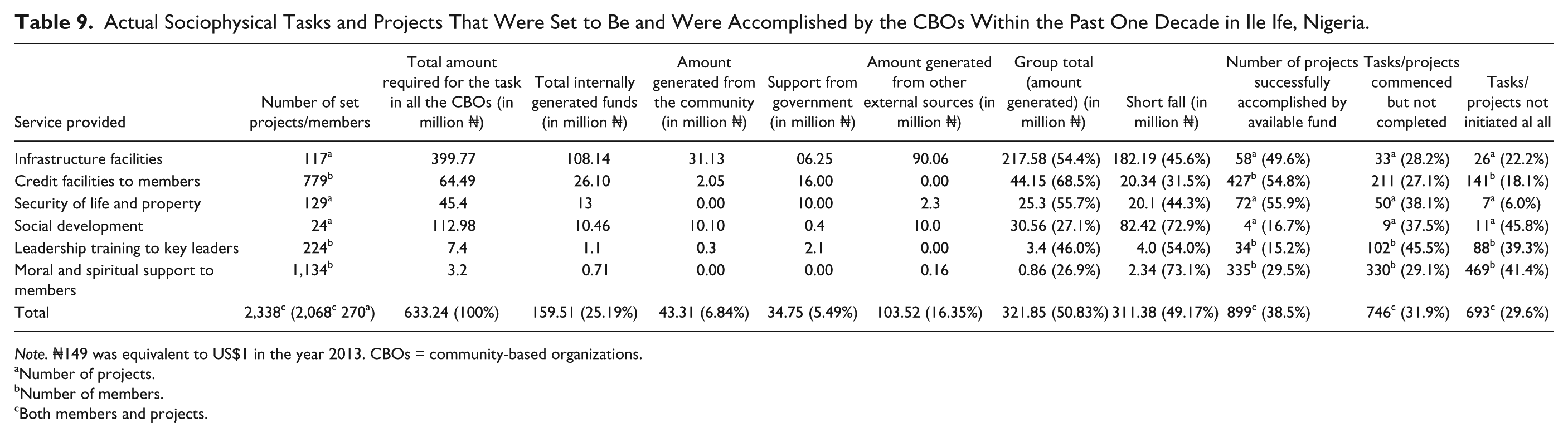
The secondary data collected on the sociophysical activities of the CBOs in Ile Ife revealed that they aimed at providing 779 credit facilities and 1,134 moral and spiritual supports to members and trained 224 key leaders of their associations after the conflicts in the study area. During this period, they also outlined 117 community development projects on infrastructural facilities, 129 social developmental programs, and 24 projects toward security of lives and property. These made 2,338 (2,068 for members and 270 projects for the community) decade plans of the organizations. Table 9 reflects that a total amount of 633.24 million Nigerian Naira (about US$4.2 million) would have completed the projects and tasks, all things being equal. The table shows that a little above two thirds of the amount needed to provide credit facilities to their members (68.5%) and more than half of what were projected for infrastructural facilities (55.7%) and security of lives and property (54.4%) were realized. These funds were mostly generated internally by members. Overall, these projects and tasks were poorly supported by the community (6.64%), except those that were under infrastructure provision. They were also least assisted by the government (5.49%). The bulk (25.19%) of the total contributions realized (50.93%) from sources of fund generation came from the CBOs’ members while only 16.35% of this were generated from external sources. The CBOs’ members’ inability to contribute beyond one quarter of the set fund evidently affected the completion rate of the projects or tasks. At the end of a decade, Table 9 shows that 38.5%, 31.9%, and 29.6% of the entire objectives were successfully accomplished, commenced but not completed, and not initiated at all, respectively.
Actual Sociophysical Tasks and Projects That Were Set to Be and Were Accomplished by the CBOs Within the Past One Decade in Ile Ife, Nigeria.
Note. ₦149 was equivalent to US$1 in the year 2013. CBOs = community-based organizations.
Number of projects.
Number of members.
Both members and projects.
Of these, security of lives and property (55.9%), credit facilities to members (54.8%), and infrastructural facilities to the community (49.6%) were projects or tasks with remarkable successes while only about one sixth of the social development programs and leadership training to key members were fully completed. Hence, about two fifths of the outlined projects or tasks that were set on social development programs (45.8%), moral and spiritual supports to members (41.4%), and leadership training (39.3%) were not initiated at all. This is because less than one third of the funds budgeted to accomplish the first mentioned two items were realized. Worthy to note in the table is that despite the realization of about half (46%) of the money that was expected to train the CBOs key leaders, 45.5% and 39.3% of the training were not commenced and not completed at all in the study area, respectively. On the average, about one third of all the tasks or projects were carried out but not completed within the 10 years after the conflicts in the study area.
AAI of the sociophysical projects that were carried out by the CBOs in Ile Ife, Nigeria
The degree of projects’ accomplishment according to the CBOs’ set objectives in Table 10 is denoted as AAI, and this is in agreement with the information contained in the secondary data that were collected from the CBOs in the study area (see Table 9). The fulfillments of the sociophysical objectives in the Table 10 were from 1 to 5 point ratings, in order of the level of their accomplishments. Projects or objectives that were successfully or nearly completed by the CBOs and were delivered for usage had the highest score and were rated 5 (91%-100%). In the contrary, projects that were set to be accomplished in the CBOs’ objectives but were not initiated or did not go beyond inception stage had the least score of one point rating (≤10%). Projects that were (at least) accomplished about halfway but did not (at most) go beyond two thirds of the stage toward completion had a moderate score of three (45%-67%). Those that were accomplished beyond their inception stages but were not really executed beyond halfway were rated as having two points (11%-44%) while those that were accomplished above two-thirds stage level but were not really completed were rated as having four points (68%-90%) in the study. Hence, the number of the projects that were successfully completed in each of these variables was not less than the summation of the number of projects that were not completed in each category.
Actual Accomplishment Index of the Sociophysical Projects Carried Out by the CBOs in Ile Ife, Nigeria.

Mean Fulfillment Index ȳ = 3.21.

Mean Fulfillment Index = 19.23 / 6 = 3.21, ȳ = 3.21.

Standard deviation (SD) = Square root of variance = Square root of 0.49 = 0.7.
Coefficient of variation = [(SD / AI) × 100]% = [(0.7/3.21) × 100]% = 21.81%.
Note. CBOs = community-based organizations; SWV = summation and dividing it by weight value; AAI = actual accomplishment index.
Number of members.
Number of projects.
Both members and projects.
As reflected in the table, the highest AAI was 4.07 (provision of security of life and property to members) while the least was 2.35 (provision of leadership training to key leaders). The average AAI (mean AAI) was 3.21. This means that variables on the provision of credit facilities’ to members (AAI = 3.90) and infrastructural facilities for public consumption (AAI = 3.70) were well above the mean AAI (3.21) in the study area. This was why the deviations about the mean of their AAIs (denoted as y − ȳ) were all positive (infrastructure facilities = 0.49; credit facilities to members = 0.69 and security of life and property = 0.86). In the contrary, the deviations about the mean of the AAIs of other variables like social development (−0.71), leadership training to key leaders (−0.86), and moral and spiritual supports to members (−0.50) were all negative because their indexes were below the computed mean. Expectedly, the summation of the total number of the projects that were not embarked upon and that were not completed at all in each of these latter three variables was above the total number of projects that were successfully completed under each of them as reflected in Table 9.
The Balance Between PAI and AAI of Sociophysical Projects Embarked Upon by the CBOs in Ile Ife, Nigeria
All the variables that were tested in the course of analyzing the PAI and the AAI on the sociophysical activities of the CBOs in Ile Ife were grouped into four. This was based on the results of their computed indexes, deviation about the means and their variances. This was to provide a platform to draw meaningful conclusions on the two analyses. Table 11 presents the groupings.
Balance Between Perceived and Actual Accomplishment on the Sociophysical Projects by the CBOs in Ile Ife, Nigeria.

Note. Mean Index for PAI =
Where accomplishment indexes (PAI and AAI) were all higher than the Computed Mean Index.
Where either PAI or AAI was higher than the Computed Mean Index.
Group A
The table reflects that only the variable on provision of credit facilities to members of the CBOs had the computed indexes for PAI (3.20) and AAI (2.27) to be both above their calculated mean indexes (PAI = 3.07, AAI = 2.08), with positive deviations (PAI = 0.13, AAI = 0.29) about their means. This means that its PAI and AAI indexes both agreed that CBOs in the study area have successfully delivered their sociophysical services to the residents in the postconflict community.
Group B
Findings showed that variables on social programs carried out by the CBOs in the community and that of security of life and property rendered to residents were in this category. The former had its PAI (3.47) above the mean index (3.07) while its AAI had negative deviation (−0.37) about the mean because its index (1.71) was below the calculated mean (2.08). Hence, the assurance that this variable had positively impacted the sociophysical development in the study area was influenced by the perception of the people (PAI = 3.47) rather than by the information that was generated from the actual amount of money that was spent (see Table 9) on all the projects (see Table 10) that were successfully completed. This was why the summation of the deviations about the mean of PAI and AAI of the social programs that were carried out by the CBOs was low, though it was positive [{(Y −
As reflected in Table 11, the average of the summation {[(Y −
Group C
The variable on provision of infrastructural facilities by the CBOs was in a separate class in this study because the average of the summation of the deviations about the mean of both PAI and AAI was negative {[(Y −
Group D
Two variables were in this category. These are leadership training to key leaders (PAI = 2.66, AAI = 1.76) among the CBOs and moral and spiritual support to members (PAI = 2.94, AAI = 1.88) in the study area. Both of these variables had their accomplishment indexes to be below their computed mean indexes (PAI = 3.07, AAI = 2.08) and negative deviations about the mean. Expectedly, their (Y −
Discussions
The current study established CBOs’ thresholds in postconflict area of Africa and provided a basis for determining their success rate on their sociophysical project delivery. The use of mixed method through ex post facto technique to collect and analyze quantitative (actual [AAI]) and qualitative (perceived [PAI]) data on the CBOs activities contributed to relevant past studies on peace-building in fragile communities (Creswell, 2003; Leone & Ward, 2013). This agreed with the works of Reinikka and Collier (2001), Collier and Hoeffler (2002), Collier (2003), Short (2003), Narman and Vidanapathirana (2005), and Luckham (2017).
Results of the survey first examined the socioeconomic characteristics of these CBOs and noted that most (75.8%) of them came into existence in about one and half a decade era, a period between 1989 and 2003. The CBOs’ number reduced between 2004 and 2013, a decade period. The former period was marked with intercommunal violent conflicts in many local communities across the nation (Internally Displaced Project, 2006; Oyerinde, 2005) which cause national economic regression (Behnassi, Pollmann, & Kissinger, 2013) as the Gross Domestic Product (GDP) of the country at that time was less than 18.2% growth annually (Ekpo & Umoh, 2012). This could be why Dongier et al. (2001) and Annan (2014) opined that economic regression and state failure in low-income countries breed violent conflicts (Collier & Hoeffler, 2002) but promote CBOs’ formation (Poskitt & Dufranc, 2011) to meet community needs (Barron, Diprose, Madden, Smith, & Woolcock, 2004; Ogundipe, 2003). This reveals the willingness of residents to internally raise fund for their communal well-being, even amid poverty. Along this line, most of the projects that were executed in the current study were financed through the money that was contributed mainly by the CBOs’ members (64.2%). This has a root in the self-determination theory of Nicholls (1984) and Deci and Ryan (2008) and the community need model of Burton (1990). Thus, resiliency to the failure of the central government (Larsson et al., 2012) and active participation of individuals and corporate groups at grassroots (Barr et al., 2010) are necessities in postconflict peace-building (Onyedinma & Kanayo, 2013; United Nations Department of Economic and Social Affairs, 2009). The period between 2004 and 2013 when the number of CBOs in this study was low was an era when the conflicts reduced and the GDP of Nigeria was increasing at an annual growth rate of about 6% (Barung, 2014). Although such experience may not equally translate to real economic development (Sanusi, 2010), it can be inferred that high number of CBOs that were created during economic recession must have contributed to the country’s economic growth that was recorded after conflicts. This positioned the current study within the bottom-up school of thought as CBOs at local level can be pro-poor tools for peace-building in postconflict communities. The study also served as an eye opener to the need for a research on the indirect relationship that could exist between CBOs’ proliferation and national economic development in the developing nations.
The current study showed that only 5.49% of the money raised by the CBOs came from the government while it was expected of her to contribute to CBOs purses to alleviate the sufferings of the conflict affected residents (Cernea, 1984; Keech, Munger, & Simon, 2012; Leeson, 2007). Results also showed that only a handful of the amount (16.35%) of the money raised by the CBOs came through some external sources. Although this contribution was low, it indicated that NGOs and donors assisted CBOs in fragile communities of Africa (Omofonmwan & Odia, 2009). The CBOs were not able to raise much money through loans, possibly because they must have lost their fixed assets that could serve as collateral securities during conflicts. Socioeconomically, one would expect that the membership of such associations that depended on members’ contributions to thrive should have a wider geographical coverage. However, findings showed that a sizable proportion (43.3%) of them was drawn from the immediate neighborhoods. This agreed with the works of Flórez (2002) and Lindley (2007) in Colombia and Somalia, respectively. Another issue of consideration in this current study is that its sample cut across different types of CBOs. In agreement with Haider (2009) and Skinner (2005), CBOs are formed by people of common interests who created different informal trades and unions to combat poverty. This could be why more than half of the CBOs were headed by well literate civil servants who though were employed under the government, they still engaged in CBOs that drew members from different informal sectors (La Porta & Shleifer, 2014; Peschka, 2011). Although, studies have shown that faith-based institutions are parts of the CBOs that do contribute to community development and peace-building across the world (Foster, 2011; La Porta & Shleifer, 2014; Nolte, 2009; The Urban Institute & Vidal, 2001), they seemed not to be represented in this study. The reason could be that they were not registered with the government because the sample in this study was drawn mainly from the list of the CBOs that registered with the local government councils in the study area. This study could not categorically account for this lapse but the works of Roberts, Odumosu, and Nabofa (2009) and Odumosu, Olaniyi, and Alonge (2009) threw light on this. They both claimed that Nigerian local governments do not register religious institutions as CBOs but they are responsible to their headquarters that registered with the government at federal level. Of interest in this study is the equality of the CBOs’ leaders’ males and females’ proportion. This differed from many past African studies where males dominated the sample size due to the cultural setting of the region (Chant & Gutman, 2000; Jensen, 2012). The current study upheld the notions that conflicts pave way for women (Jensen, 2012; Kvitashvili, 2007; Mackenzie, 2012).
The current study also examined the six CBOs’ objectives that were set to achieve their sociophysical activities and showed that all the tested six variables scored above half (PAI + AAI ≥ 2.51) of the 5-point scale in their ratings. Although this study pioneered the categorization of CBOs’ objectives into six groups in postconflict area of Nigeria, it gave credit to the works of Mathew-Njoku et al. (2009) and Foster (2011). Two of these objectives had the highest representatives among others. These are security of life and property to residents and credit facilities to members. This agreed with the works of Lindley (2007), Jensen (2012) and Badiora and Abegunde (2015) that showed that security of lives and property and financial support to residents who have lost property and breadwinners to conflicts are very crucial challenges in fragile communities (OECD, 2008). In addition, postconflict areas are always characterized by crime of all sorts, calling for security of lives and property (Shemyakina, 2006). Although the AAI of security of life and property was high in this study, its PAI was below its mean index with negative deviation about the mean. This means that the residents possibly desired higher level of security of lives and property than what the CBOs could provide. Similar condition trailed the AAI and PAI results of variable on the infrastructural facilities provided by the CBOs in the study area. This could be why Bowd and Chikwanha (2010) opined that security and infrastructural challenges in postconflict environment cannot be easily met by an average fund (Africa Region Disaster Risk Management Team, 2010; Reinikka & Collier, 2001). This calls for a rethink and pressure from international organizations on African governments to support CBOs and relief residents in postconflict communities. A body called National Emergency Management Agency (NEMA) which was created by the federal government of Nigeria (Federal Republic of Nigeria, 1999) and located at the country’s capital city can be replicated at local level to provide support to those CBOs in conflict-affected communities.
The study further showed that a little less than one third of what the CBOs budgeted to spend on social development was realized and the residents claimed to be satisfied with this. This may appear spurious but Fischer (2006) had earlier noted that residents’ social needs after conflict may not be economically highly demanding like their need for infrastructural facilities (McCandless & Karbo, 2011). Findings further revealed that variables whose PAI and AAI were both below mean index values, with negative deviations about the mean in this study, are leadership training to key leaders and moral and spiritual supports to CBOs’ members. As earlier reflected in Table 9, the study showed that very little money was realized and utilized under the former variable. S. Johnson (2001) claimed that the latter could be so because the standard of communal living among residents in Africa is very high (Onyedinma & Kanayo, 2013) and the CBOs efforts might have fallen below the people’s expectations.
There are many recent works that have used AI to analyze empirical data that were collected on researches (Afon, 2006; Belaire, Westphal, Whelan, & Minor, 2015; V. E. Johnson, 1997; Peyre, MacDonald, Al-Marayati, Templeman, & Muderspach, 2010; Satterfield, Gregory, Roberts, Chan, & Grayev, 2013; Ziemlewicz, Kim, Romandine, & Robbins, 2013). The present study seemed to be the first to pioneer the combination of AAI and PAI to empirically examine the sociophysical activities of CBOs in a postconflict area of Africa. Results showed that this can be replicated elsewhere, especially in other African low-income communities where protracted crises have resulted in cyclical poverty, calling for pro-poor inward looking strategies (Gambari, 2002; Machel, 2004). A study of this nature is currently very relevant as studies have shown that out of the total 79 countries that had passed through violent conflicts in the past few decades in the world, 65 of them are in the developing countries (Bowd & Chikwanha, 2010; Smith, 1994).
Footnotes
Acknowledgements
The author sincerely appreciate the contributions of the editor, all the unknown reviewers and every Sage Open administrative worker on this paper.
Declaration of Conflicting Interests
The author(s) declared no potential conflicts of interest with respect to the research, authorship, and/or publication of this article.
Funding
The author(s) received no financial support for the research, authorship, and/or publication of this article.