




Abstract
Entrepreneurial ties are a critical resource for development and survival of entrepreneurial firms; however, the mechanism of how entrepreneurial ties affect entrepreneurial performance remains unclear. This study advances existing research on social ties and entrepreneurship through investigating how entrepreneurial ties exert a curvilinear impact on entrepreneurial performance via absorptive capacity, and the curvilinear effect of entrepreneurial ties is contingent on environmental complexity. The present study uses a dyadic dataset of 223 entrepreneurs from creativity industries in China to examine hypotheses. The results show that entrepreneurs’ ties have an inverted U-shaped impact on entrepreneurial performance. We also partially find that this inverted U-shaped relationship is mediated by absorptive capacity. Finally, we also find that this inverted U-shaped relationship is steeper when environmental complexity is high, and this inverted U-shaped relationship turns into an almost positive linear when environmental complexity is low. Overall, these results contribute to a deeper understanding of how and when entrepreneurial ties lead to a curvilinear impact on firm outcomes.
Introduction
Entrepreneurial enterprises are critical drivers to promote the development of regional economy and social welfare (Aarstad et al., 2010; Chatterji, 2009; Hmieleski & Baron, 2009; Shan & Lu, 2020). Entrepreneurial performance is the fundamental embodiment of the vitality and the competitive advantage of a start-up enterprise (Carmona et al., 2012; Wilson & Stokes, 2013). It is also an important indicator in evaluating entrepreneurial outcomes (McCann & Vroom, 2015). Numerous entrepreneurial and managerial scholars have researched the performance of entrepreneurial firms, and they reveal that the performance of start-ups depends not only on internal resources, but also derives from resources outside of the firm’s boundaries (Cheung et al., 2010; Li et al., 2008; K. Z. Zhou et al., 2014). Using external social ties to acquire knowledge is a common means to obtain external resources (Capaldo, 2007; Carey et al., 2011; Corredor et al., 2015; J. Zhou et al., 2019), which helps to promote firm outcomes. For example, firms attain intricate, noncodified information from cohesive social ties (Li et al., 2010), and also, firms gain new and nonredundant information from loose social ties (Capaldo, 2007).
According to pervious research, this study defines entrepreneurs’ social ties, or entrepreneurial ties, as the interpersonal relationships of an entrepreneur and the resources embedded in their relationships (McFadyen & Cannella, 2004). From the perspective of social network theory, entrepreneurial ties are beneficial to entrepreneurial performance, because entrepreneurial ties will bring the entrepreneur access to external resources (Li et al., 2008, 2010), which can foster the growth of entrepreneurial firms. Previous empirical literature also indicates that entrepreneurial ties can enhance firm performance (Aarstad et al., 2010; Boso et al., 2013; Guo et al., 2014). However, several scholars’ viewpoints suggest that entrepreneurial ties do not always bring returns to their firms (Li et al., 2008; Yu et al., 2019; K. Z. Zhou et al., 2014), because too cohesive social ties can produce strong norms and mutual identification between entrepreneurs and their connections, which may generate a lock-trap (e.g., Lechner et al., 2010) and limit openness to information flows (e.g., Villena et al., 2011; Yu et al., 2019), which are all harmful to the growth of a firm. Thus, the relationship between an entrepreneur’s social ties and performance may be curvilinear and deserves to be tested further.
On one hand, previous research emphasized the critical role of social ties in cultivating absorptive capacity and performance (Carey et al., 2011; Li et al., 2010; K. Z. Zhou et al., 2014). The results of Li et al.’s (2010) research reveals that social connections can help entrepreneurs absorb tacit and noncodified knowledge from their external partners. Carey et al. (2011) also argues that social ties are channels of information flows, through which firms can absorb both tacit and observable knowledge. Findings of K. Z. Zhou et al. (2014) further reveal that entrepreneurs’ ties have a direct impact on the firm’s knowledge acquisition, assimilation, and exploitation. However, absorptive capacity has been proven to be key in promoting firm performance (e.g., Bergh & Lim, 2010; Kotabe et al., 2017; Tsai, 2001). From the perspective of social networks, entrepreneurs’ social ties offer a critical source of knowledge absorption, and the absorptive capacity might be a potential linkage between entrepreneur social ties and entrepreneurial performance. However, previous literature rarely considers absorptive capacity as a mediating mechanism to explain how entrepreneurial ties affect a firm’s performance. In this case, it is valuable to study how absorptive capacity mediates the relationship between entrepreneurial ties and entrepreneurial performance.
Scholars also suggest that the effectiveness of entrepreneurial ties may depend on external contextual characteristics (e.g., Acquaah, 2007; Li et al., 2010; K. Z. Zhou et al., 2014). Decision-making and outcomes of a firm largely depend on the complexity of the external environment (Porter, 1985; Swamidass & Newell, 1987). Social ties of entrepreneurs are critical sources of competitive advantage in a complex environment. When an entrepreneur is faced with a highly complex environment, there are diverse environmental elements surrounding them, which will increase the uncertainty of decision-making and impact resource instability (Ang, 2008; Duncan, 1972; Swamidass & Newell, 1987; Waldman et al., 2001). The entrepreneur can utilize social ties as channels to obtain more information and knowledge, and in turn social ties can be viewed as a method to buffer complexity (Aarstad et al., 2010). In this case, environmental complexity may moderate the curvilinear relationship between entrepreneurial social ties and firm performance.
To address these issues, the present study frames conceptual models shown in Figure 1 based on social embedded theory (Granovetter, 1983, 1985) and empirically tests how and when entrepreneurial ties affect entrepreneurial performance. The present study makes at least three contributions to social network and entrepreneurial management literature. First, this study helps us deepen our understanding on the effectiveness of entrepreneurs’ social ties by testing the inverted U-shaped impact of entrepreneurial ties on their firm’s performance. Almost all of the existing studies focus on examining the positive linear effect of entrepreneurs’ social ties, whereas our study proposes and examines the inverted U-shaped impact of entrepreneurial ties on their firm’s performance through integrating considerable returns and harms of social ties. Specifically, we argue that a high level of cohesive ties may be harmful to absorptive capacity and entrepreneurial performance. Second, this study can deepen existing literature on the understanding of how entrepreneurial ties affect entrepreneurial performance by investigating the curvilinear mediating effect of absorptive capacity between ties and performance. Third, this study provides us with the perspective to understand an enterprise’s decision-making and strategies bound up with its external environment through considering the contingent effect of environmental complexity on the curvilinear impact of entrepreneurial ties on absorptive capacity and performance. Through these efforts, this study aims to bring insight to the curvilinear and contingent relationship between entrepreneurs’ social ties and absorptive capacity and performance.
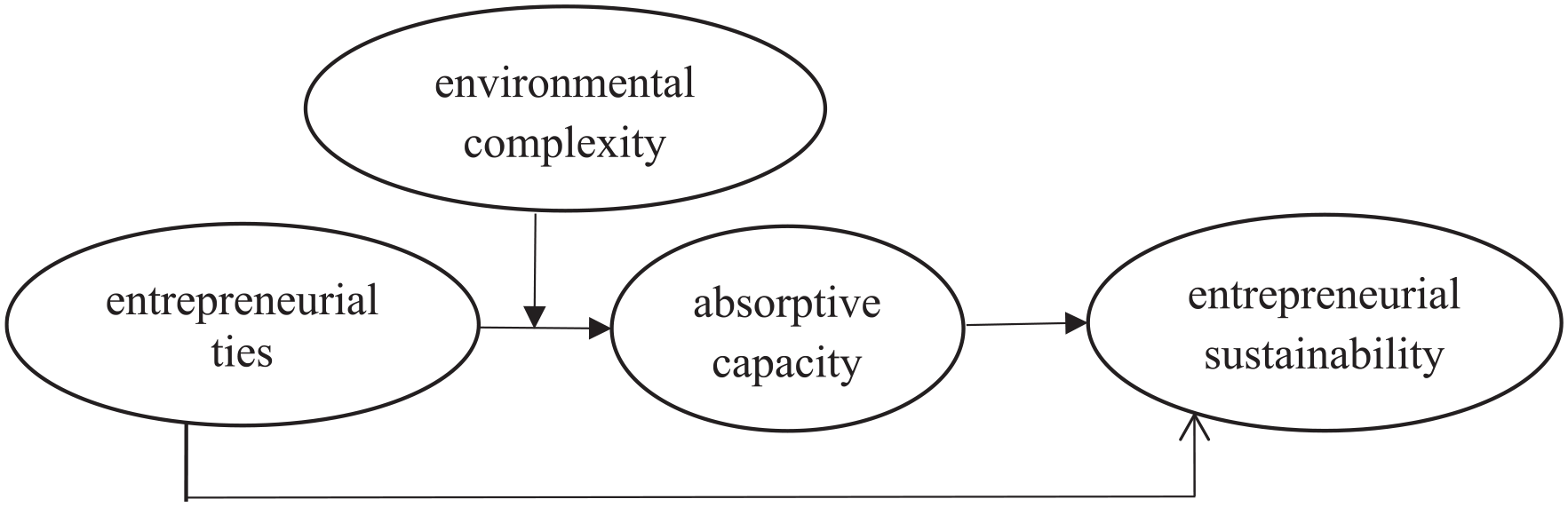
Conceptual model.
Theory Development and Research Hypotheses
Entrepreneurial Ties and Performance
According to social embedded theory (Granovetter, 1983, 1985), a certain degree of social ties plays a positive role in promoting entrepreneurial performance, because social ties provide entrepreneurial enterprises with necessary resources and information (Aarstad et al., 2010; Boso et al., 2013; Guo et al., 2014). The present study also proposes that an entrepreneur’s social ties benefit entrepreneurial performance for two main reasons. First, connections with external partners provide entrepreneurial firms with more resources, and, in turn, they can be used for entrepreneurial activities and eventually increase entrepreneurial performance (Hite, 2010; Rasmussen et al., 2015; Zhang et al., 2012). Second, connections with external ties provide entrepreneurs access to timely and high-quality information, which also can increase the probability of success (M. H. Chen et al., 2015; Kotabe et al., 2017). Access to this information can help entrepreneurs improve their ability to identify business opportunities, which is beneficial in promoting the growth of the enterprise. Also, this information can help the enterprise know more about the market and make decisions in a timely and effective manner to allocate resources, which can improve entrepreneurial effectiveness (M. H. Chen et al., 2015).
However, these benefits or returns may cease to work and may even turn harmful to a firm if social ties are too strong. First, entrepreneurs who are excessively embedded in social ties may suffer from unnecessary responsibilities, as social ties need an uninterrupted investment of time and resources (Guo et al., 2014; Lechner et al., 2010; Villena et al., 2011; Yu et al., 2019; K. Z. Zhou et al., 2014). When entrepreneurs assume additional responsibilities and allocate more resources to achieve this common yet unnecessary social responsibility, they will be locked in and can inhibit their entrepreneurial activities (Lechner et al., 2010; Uzzi, 1997, 1999). Overbuilding and maintaining social networks will cost entrepreneurs more time and resources, which also may limit the input of entrepreneurial activities of their firms (Okhmatovskiy, 2010). Second, entrepreneurs who strongly embed themselves in their social network may suffer from cognitive convergence and blindness, which will restrict and limit their openness to information and, in turn, decrease efficiency of the firm (Coleman, 1988; Nahapiet & Ghoshal, 1998). From the perspective of social network embedded theory, Uzzi (1997, 1999) finds that excessive embedding in the relational network will create a locked and closed environment for the focal enterprise, which will preclude it from obtaining information from the social network and, thus, harm the enterprise’s strategy adjustment. This locked effect limits the entrepreneur’s ability to seek new information, identify business opportunities, and explore new markets (Villena et al., 2011). Third, entrepreneurs who hold cohesive social ties with external parties will generate opportunistic and dependent behavior (Granovetter, 1983, 1985), because strong social ties make it easy for entrepreneurs to access the external partner’s resources or other supports, which in turn reduces their own focus on entrepreneurship aspects. Abundant resources may increase enterprise inertia and dependence, reduce R&D investment, and crowd out entrepreneurship and innovation (Yu et al., 2019). For example, several studies have suggested that the more entrepreneurs depend on social ties, the less they endeavor to improve entrepreneurial efficiency (X. Chen & Wu, 2011).
Therefore, entrepreneurs should strive for a balance in their embedding of social ties. From what we discussed above, the present study suggests an inverted U-shaped relationship between entrepreneurs’ social ties and entrepreneurial performance; that is, social ties will promote entrepreneurial performance in the first stage, but hinder performance after reaching a certain degree. Hence, we make the following prediction:
The Role of Absorptive Capacity
Firms realized that absorptive capacity is a critical driver of performance (W. M. Cohen & Levinthal, 1990). W. M. Cohen and Levinthal (1990) argue that absorptive capacity is an enterprise’s ability to identify and transform external information; the ability to apply external information to achieve organizational goals. Absorptive capacity is defined as the ability of acquiring, assimilating, transforming, and exploiting external knowledge and information (Ahuja & Katila, 2001; Jansen et al., 2005).
Entrepreneurs’ external social ties are typical cross-boundary resources, which are formatted in the process of interaction, exchange, and cooperation between the entrepreneur and other parties (Acha & Cusmano, 2005). These resources and interactive process can benefit the four dimensions of absorptive capacity. For example, the economic and social exchange between the entrepreneur and other parties can promote establishing a mutually beneficial unit, effectively helping the entrepreneur’s firm to acquire viscous knowledge (Rindfleisch & Moorman, 2003; Szulanski, 2000), accelerate sharing knowledge and exchange information (Inkpen & Tsang, 2005), and in turn facilitate the integration and assimilation of external information and knowledge (Grant, 2016; Takeuchi & Nonaka, 2000; Tsai, 2001). The economic and social exchange can also lead the firm to transform external knowledge and information into their own enterprise, and increase the knowledge stock of the enterprise, which can facilitate an enterprise’s exploitation (Tsai & Ghoshal, 1998). Some studies have empirically examined the benefits of social ties to absorptive capacity (Domurath & Patzelt, 2015; Naqshbandi, 2016).
However, if entrepreneurs build social relations that are too close with external stakeholders, the positive impact may decline or even become negative. This logic is consistent with the impact of entrepreneurial ties on entrepreneurial performance. First of all, establishing and maintaining a too cohesive level of social ties will make the enterprise commit to unnecessary obligations and require a continuous investment of time and resources (Lechner et al., 2010; Li et al., 2008; Villena et al., 2011; Zhou et al., 2014). This commitment means that excessive social obligations limit the entrepreneur’s learning efforts via restricting their cognitive resources on processing information (Villena et al., 2011). Second, different parties being excessively embedded in social ties may form cognition convergence among them, which can lead to collective blindness (Nahapiet & Ghoshal, 1998; Zhou et al., 2014). This may limit the acceptance and openness of the entrepreneur to new information and knowledge (Granovetter, 1983, 1985; Nahapiet & Ghoshal, 1998) and reduce the motivation to acquire new knowledge, thereby weakening the capacity for growth (Hagedoorn & Frankort, 2008). Finally, when entrepreneurs’ social connections reach an excessively high level, opportunistic and dependent behaviors may be observed (Granovetter, 1985). The opportunistic and dependent behavior can reduce their motivation to search and adopt new approaches to cope with challenges, because they are more dependent on the resources provided by external relations to achieve success (Yu et al., 2019). These all may be harmful to enterprises’ absorption capacity.
Overall, entrepreneurs’ social ties are beneficial to gain quality knowledge and information; however, if the degree of social ties exceeds a certain threshold, its positive effect will decrease and even have a negative impact on the absorptive capacity. Collectively, we predict,
Furthermore, we argue that entrepreneurial ties affect entrepreneurial performance through having an impact on the capacity of acquiring, assimilating, transforming, and exploiting external information and knowledge. On one hand, as argued above, there is an inverted U-shaped relationship between entrepreneurial ties and absorptive capacity. On the other hand, absorptive capacity can also affect firm performance (e.g., Cohen & Levinthal, 1990). Through acquiring knowledge, enterprises can enhance the depth and breadth of their own resource pool generated from external social ties, and provide internal support for innovative knowledge, developing innovative products, and other entrepreneurial activities (Chen et al., 2015). Such resources (e.g., market and technology information) can also help the enterprise quickly and accurately identify the changes and needs of technology and market so that enterprises can optimize the allocation of resources for entrepreneurship (Dyer & Singh, 1998). Through knowledge assimilation, enterprises can fully understand the knowledge and information resources acquired from external social ties, which can distinguish and supplement the enterprise’s existing knowledge (Atuahene-Gima, 2003). Through transferring knowledge, enterprises can combine the new knowledge and resources they assimilated with existing knowledge, thus generating innovative ideas and promoting reexamination and adaptation to external opportunities and threats (Todorova & Durisin, 2007). Through exploiting knowledge, enterprises can use knowledge resources accessed from external social ties to guide entrepreneurial activities, such as transforming external innovative knowledge into innovative products or services (Bergh & Lim, 2010; Kotabe et al., 2017; Tsai, 2001). Therefore, it can be inferred that absorptive capacity is strongly positively related to entrepreneurial performance. Combining H2a and what we have discussed above, this study predicts the following hypothesis:
The Role of Environmental Complexity
Environmental complexity refers to the degree to which the environment is competitive and heterogeneous (Grimm et al., 2005). In the context of a high-level environmental complexity, entrepreneurs are always faced with more rivals and competitors and a grim forecast for survival and development (McArthur & Nystrom, 1991). In this case, the environment that entrepreneurs face is unpredictable and unstable (Ang, 2008), which makes their enterprises vulnerable. Therefore, they must behave proactively and in a timely manner to respond; otherwise, they are likely to fail in the market (Li et al., 2008).
The present study infers that when environmental complexity is high, a moderate level of entrepreneurial ties is beneficial for absorptive capacity. When complexity is high, entrepreneurs need high-quality information and knowledge to cope with market competition and changes (Luo, 2003). Accessing quality information from external social ties is unlikely if they have few connections with outer parties, but the entrepreneur can build connections to obtain and update useful information (Li et al., 2008). As complexity intensifies, entrepreneurs proactively seek and absorb information and knowledge from existing ties (Luo, 2003; K. Z. Zhou et al., 2014). Simultaneously, connected parties have a strong motivation to share their specific information and knowledge to achieve collective adaptation (Ang, 2008).
Furthermore, we predict that when environmental complexity is high, strong social ties may be harmful to absorptive capacity. First, in an environment with high-level complexity, each party faces more rivals and competitors (McArthur & Nystrom, 1991), which makes them all pay more attention to unnecessary obligations (K. Z. Zhou et al., 2014). Confronting such a competitive burden, entrepreneurs may often make adjustments and compromises to consolidate existing partners (Ang, 2008; Wu & Pangarkar, 2010; K. Z. Zhou et al., 2014). If exchange parties invest in more time and resources to help each other, there is less time and resources left to access optimal knowledge absorption (Lechner et al., 2010). Second, to buffer complexity, exchange partners need to acquire, assimilate, transform, and exploit knowledge in a timely manner (Ang, 2008). In a highly complex environment, the market environment is unstable and fast-changing; therefore, the existing market knowledge of focus start-ups may be rapidly outdated (Porter, 1985). However, strong cohesive social ties can lead to cognition convergence and collective blindness, which hinders entrepreneur openness to new information and knowledge (Villena et al., 2011; K. Z. Zhou et al., 2014). Hence, in a highly complex environment, collective blindness may have a greater negative effect on accessing new information and knowledge, which may decrease effectiveness of knowledge absorption. Third, similar to collective blindness, opportunistic and dependent behavior caused by strong cohesive ties can reduce motivation to search and adopt new approaches to cope with challenges (Yu et al., 2019), which will become a more critical issue when environmental complexity is high.
In addition, we also predict that when the level of environmental complexity is low, the social ties of entrepreneurs will show a nearly positive linear impact pattern on absorptive capacity. Under the context of low environmental complexity, the industry competition is not so fierce and the resources are relatively stable. When the market changes slowly (McArthur & Nystrom, 1991), an entrepreneurial firm’s market knowledge will not be replaced quickly (Porter, 1985). It creates a buffer for acquiring new knowledge, in that the timeliness of information absorption is relatively not critical. In this case, unnecessary obligation, collective blindness, and dependent behavior caused by strong cohesive ties may not be important issues. Thus, strong cohesive ties would not bring a negative effect on absorptive capacity when environmental complexity is low. Therefore, we predict the following:
This study proposes that entrepreneurial ties have an inverted-U shaped effect on absorptive capacity that is regarded as a critical factor of entrepreneurial performance (H2b). Furthermore, this study also discusses the different impact patterns of entrepreneurial ties on absorptive capacity when the degree of environmental complexity confronted by an entrepreneur is distinct (H3). In combination, this study further predicts that environmental complexity moderates the mediating effect of absorptive capacity on the inverted-U shaped relationship between entrepreneurial ties and entrepreneurial performance. Therefore, this study might logically hypothesize a moderated-mediation model based on Edwards and Lambert’s (2007) entrepreneurial ties, absorptive capacity, environmental complexity, and entrepreneurial performance, as in the following:
Method
Sampling and Data Collection
The data used for this study were collected from creative industries in four entrepreneurial parks in China. These parks were established by the local government to encourage and support local entrepreneurial innovations (Junbo et al., 2010). This study designed separate measures for entrepreneurs and their partners; entrepreneurs self-reported their social ties with external parties and entrepreneurial performance, and their partners reported their firm’s absorptive capacity and environmental complexity.
All measures adopted in the present study were originally developed in English. Therefore, this study follows the approach of translation and back-translation proposed by Brislin (1970) to translate the scales. The steps for data collection are as follows. First, one author of this study contacts the park’s administrators through their own social relations, and explains the purpose of the study is to obtain their approval and help for accessing their respective business data sources. Second, with the help and recommendation of the parks’ administrators, we then contacted entrepreneurs and their team members recommended by the administrators and asked the entrepreneurial team to complete a matching questionnaire designed for this study. Third, the questionnaires for entrepreneurs and their partners were packed into two small envelopes separately, which were then packed into a larger envelope. A clear instruction on completing the survey and a pre-addressed and postage-paid empty envelope were also packed into this large envelope. Fourth, we mailed the questionnaires to recommended entrepreneurs while the partner’s questionnaire was distributed to their partner by the focal entrepreneur. Fifth, after completing the questionnaires, the respondents sealed and mailed back their filled-in questionnaires to an author of this study.
We distributed 360 sets of questionnaires, and 298 were collected. After deleting invalid and mismatched questionnaires, 223 valid dyadic questionnaires were retained, with the validity response rate of 61.94%. Of the 223 entrepreneurial firms, the average firm age is 7.52 (SD = 5.69), and average firm size 2.43 (SD = 1.26, after taking the log likelihood). The software and computer services industry accounts for the largest proportion (31.39%).
Measures
The measurement items and construct validity examinations are shown in Table 1. On the basis of Peng and Luo’s (2000) study, we revised their scale of managerial ties to measure social ties of entrepreneurs. Specifically, we drop the item that assesses the entrepreneur’s ties with competitors, because to preserve knowledge and competitive advantage, firms seldom share information with their competitors (Peng, 2003). Following the definition of absorptive capacity, we extract 7 items to form the scale of Wong et al. (1999) and Jansen et al. (2005) to evaluate the degree to which firms absorb information and knowledge from external parties. The measurement scale of environment complexity was adapted from Tan and Litsschert (1994), to access the degree of heterogeneity and diversity of the external environment. For entrepreneurial performance, we used a 5-item scale developed by Hunter (2011) to assess the level of performance comparing firm’s with competitor’s performance during the past year.
Results of Reliability and AVE.

Note. AVE = average variances extracted; ROE = return on equity; ROA = return on assets; ROS = return on sales; TLI = Tucker-Lewis Index; CFI = comparative fit index; RMSEA = root mean square error of approximation; SRMR = standardized root mean square residual; IFI = Incremental Fit Index.
Model fit index: χ2 = 679.37, df = 269, χ2/df = 2.53, IFI = .90, TLI = .89, CFI = .90, RMSEA = .08, SRMR = .06.
Control Variables
This study controlled firm age, size, and industry to rule out potential impacts of these factors on the results, because with the growth of firm size and age, enterprises may accumulate more social resources. As for the industry sectors, due to the different nature of the industries, some industries may get more support from government departments, which affects the level of the entrepreneur’s social ties. The firm age and size were reported in years and number of employees, respectively, and the industry sectors were coded as 10 dummy variables.
Reliability and Construct Validity
The current study used the coefficient of Cronbach’s alpha to test the reliability. Cronbach’s alpha of entrepreneurial ties, absorptive capacity, environmental complexity, and entrepreneurial performance are .86, .95, .89, .85, respectively, which are all greater than .70.
This study conducted confirmatory factor analysis (CFA) to test construct validity of the four variables. We used two criteria to examine the convergent validity. First, this study runs an overall model (four factor measurement model), and the results (see Table 1) of CFA showed that the key fit indexes are all acceptable (comparative fit index [CFI] = .90; Tucker-Lewis Index [TLI] = .89; IFI = .90; root mean square error of approximation [RMSEA] = .08; standardized root mean square residual [SRMR] = .06), and all factor loadings are significant and larger than .50, which altogether suggest an acceptable level of convergent validity. Second, the average variances extracted (AVEs) of each construct are larger than the .50 thresholds proposed by Fornell and Larcker (1981), which further suggests that convergent validity is acceptable.
This study also examined discriminant validity according to two standards. First, we conducted chi-square tests to compare the chi-square value between the unconstrained model and constrained model for each of the two constructs. If the chi-square value of the unconstrained model is significantly smaller than the constrained model, then the discriminant validity is acceptable (Gerbing & Anderson, 1988). The results showed that all chi-square values of the constrained model are significantly larger than the unconstrained model, which supported discriminant validity. Second, the square root of the AVEs for each construct is significantly greater than the correlation coefficients, which also supported discriminant validity.
Based on what we analyze above, the results show that the measurement construct has acceptable reliability and validity (see Table 2).
Descriptive Statistics and Reliability.
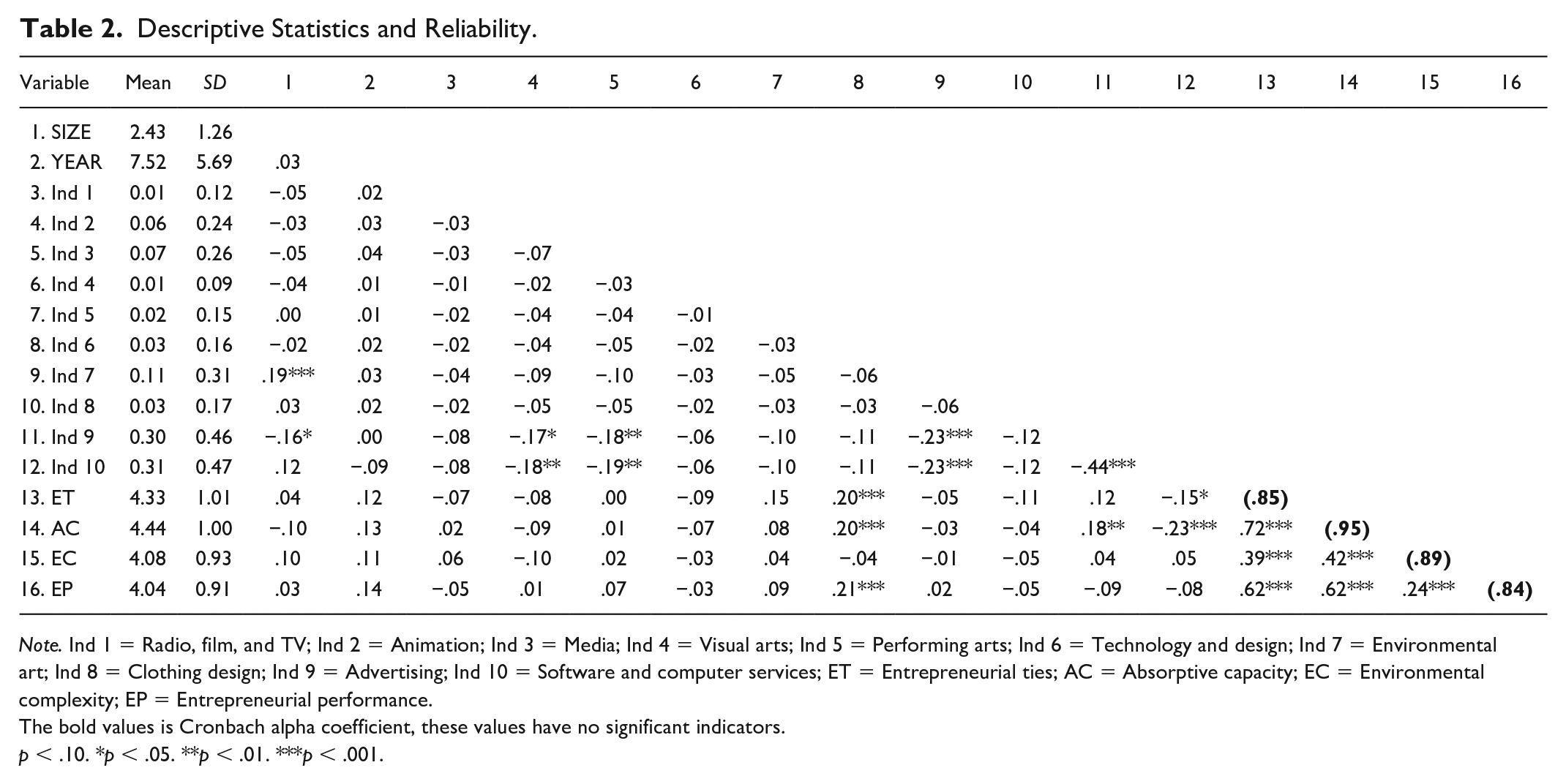
Note. Ind 1 = Radio, film, and TV; Ind 2 = Animation; Ind 3 = Media; Ind 4 = Visual arts; Ind 5 = Performing arts; Ind 6 = Technology and design; Ind 7 = Environmental art; Ind 8 = Clothing design; Ind 9 = Advertising; Ind 10 = Software and computer services; ET = Entrepreneurial ties; AC = Absorptive capacity; EC = Environmental complexity; EP = Entrepreneurial performance.The bold values is Cronbach alpha coefficient, these values have no significant indicators.
p < .10. *p < .05. **p < .01. ***p < .001.
Results
H1 predicts a quadratic (inverted U-shaped) relationship between entrepreneurial ties and entrepreneurial performance. In Table 3, the results of model 4 reveal that entrepreneurial ties are related to entrepreneurial performance positively and significantly (β = .20, p < .001), and entrepreneurial ties square are negatively and significantly related to entrepreneurial performance (β = −.13, p < .05). These results provide evidence to support H1. To verify that an inverted U-shape exists, this study tests whether there are negative slopes for large values of entrepreneurial ties, or positive slopes for small values of entrepreneurial ties when the threshold points are positioned in the range of the dataset (cf. Haans et al., 2016; Lind & Mehlum, 2010). Hence, the study conducts simple slope tests of the curvilinear relationship corresponding to five points (located at −2 SD, −SD, Mean, +SD, +2 SD) of entrepreneurial ties (cf. Aiken & West, 1991). The results are shown in Table 4: The regression curve has positive slopes at −2 SD, −1 SD, and Mean of entrepreneurial ties for entrepreneurial performance, b = .72, p < .001; b = .46, p < .001; b = .20, p < .001. Therefore, there is a positive slope for the left values of the turning point of entrepreneurial ties. At the +1 SD point, the impact slope of entrepreneurial ties on entrepreneurial performance is insignificant, b = −.06, n.s. A negative relationship between entrepreneurial ties and entrepreneurial performance is found at high degrees (+2 SD) of entrepreneurial ties, b = −.32, p < .05, which demonstrates that there are negative slopes for large values of entrepreneurial ties. Hence, H1 is supported. To better depict this curvilinear impact pattern of entrepreneurial ties on entrepreneurial performance, we plotted the relationship in Figure 2 according to the procedure recommended by J. Cohen et al. (2003). Figure 2 clearly shows that entrepreneurial ties have an inverted U-shaped effect on entrepreneurial performance.
Results of Optimal Scaling Regression.

Note. Ind 1 = Radio, film, and TV; Ind 2 = Animation; Ind 3 = Media; Ind 4 = Visual arts; Ind 5 = Performing arts; Ind 6 = Technology and design; Ind 7 = Environmental art; Ind 8 = Clothing design; Ind 9 = Advertising; Ind 10 = Software and computer services; AC = Absorptive capacity; EP = Entrepreneurial performance; ET = Entrepreneurial ties; EC = Environmental complexity.
p < .10. *p < .05. **p < .01. ***p < .001.
Simple Slope Test of Social Ties on Entrepreneurial Performance.

p < .05. ***p < .001.
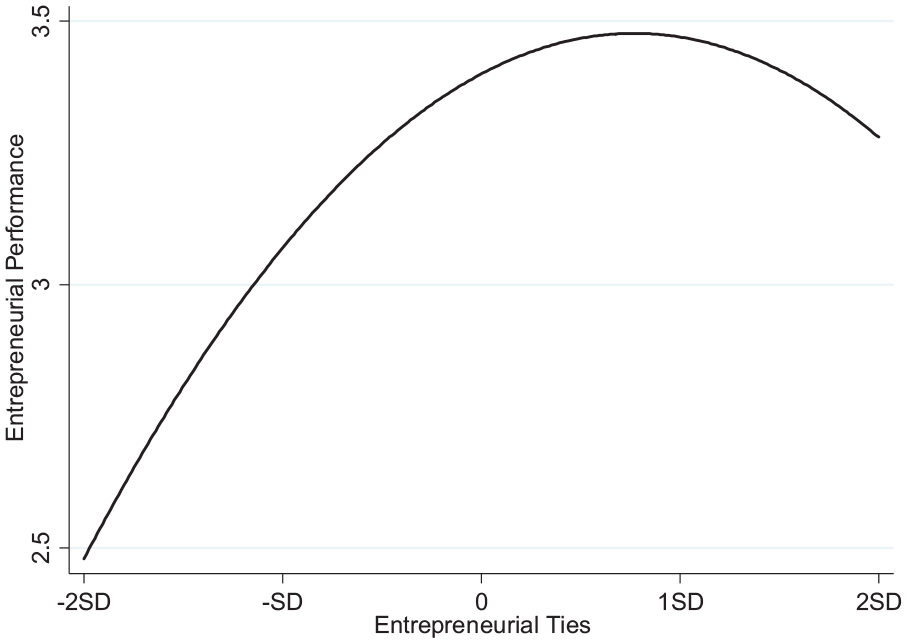
Curvilinear relationship between entrepreneurial ties and entrepreneurial performance.
H2a predicts a quadratic (inverted U-shaped) relationship between entrepreneurial ties and absorptive capacity. In Table 3, the results of model 4 reveal that entrepreneurial ties are positively and significantly related to absorptive capacity, β = .25, p < .001, and entrepreneurial ties square are negatively and significantly related to absorptive capacity, β = −.12, p = .05. The findings provide evidence for supporting H2. Similar to the examination of H1, this study also tested whether there are negative slopes for large values of entrepreneurial ties, or positive slopes for small values of entrepreneurial ties with the threshold points positioned in the range of the dataset (cf. Haans et al., 2016). Hence, the study similarly conducted simple slope tests of the curvilinear relationship corresponding to five points (located at −2 SD, −SD, Mean, +SD, +2 SD) of entrepreneurial ties (cf. Aiken & West, 1991). The results are shown in Table 5: The regression curve has positive slopes at −2 SD, −1 SD, and Mean of entrepreneurial ties for absorptive capacity, b = .77, p < .001; b = .51, p < .001; b = .25, p < .001. Therefore, there is a positive slope for the left values of the turning point of entrepreneurial ties. At the +1 SD point, the impact slope of entrepreneurial ties on absorptive capacity is insignificant, b = −.01, n.s. A negative relationship between entrepreneurial ties and absorptive capacity was found at a high degree (+2 SD) of entrepreneurial ties, b = −.27, p < .05., which demonstrates that there are negative slopes for large values of entrepreneurial ties. Hence, H2a is supported. To better depict this curvilinear impact pattern of entrepreneurial ties on absorptive capacity, we plotted the relationship in Figure 3 according to the procedure recommended by J. Cohen et al. (2003). Figure 3 clearly shows that entrepreneurial ties have an inverted U-shaped effect on absorptive capacity.
Simple Slope Test of Social Ties on Absorptive Capacity.

p < .05. ***p < .001.

Curvilinear relationship between entrepreneurial ties and absorptive capacity.
H2b predicts that absorptive capacity mediates the inverted U-shaped relationship between entrepreneurial ties and entrepreneurial performance. Because there is an inverted U-shaped relationship in this indirect path, it may distort the relationship between constructs by using the mediation effect testing method proposed by Baron and Kenny (1986; Hayes & Preacher, 2010). Thus, this approach is unsuitable for this case. Stolzenberg (1980) proposes that when the path in the impact of an independent variable (X) on dependent variable (Y) through the mediating variable (M) existed in a curvilinear relationship, the change rate of Y caused by the change of M due to the change of X is expressed by

Furthermore, Hayes and Preacher (2010) call this indirect effect (
Transient Mediating Effect of Absorption Capacity.

H3 in this study predicts that environmental complexity moderates the inverted U-shaped relationship between entrepreneurial ties and absorptive capacity. On the basis of model 1, environmental complexity and interactive terms (entrepreneurial ties × environmental complexity, entrepreneurial ties square × environmental complexity) were entered into the regression equation. The results of model 3 in Table 3 show that the coefficient of interactive term of entrepreneurial ties square and environmental complexity is −.19, p < .01; model 3. It suggests that environmental complexity moderates the curve relationship between entrepreneurial ties and absorptive capacity.
To look closely at the moderating effect of entrepreneurial complexity, we tested simple slopes of the regression curves corresponding to possible combinations of −2 SD, −1 SD, 0, 1 SD, 2 SD of entrepreneurial ties with different levels of environmental complexity (cf. Aiken & West, 1991). As shown in Table 5, in the environment with a high level of complexity, the simple slope of the regression curve has a significant positive value at −1 SD, −2 SD of entrepreneurial ties for absorptive capacity, b = .81, p < .001; b = .41, p < .001, and does not significantly arrive at 0 (Mean) of entrepreneurial ties for absorptive capacity, b = .11, n.s. A significant positive association between entrepreneurial ties and absorptive capacity are found at −1 SD and −2 SD of entrepreneurial ties, b = −.25, p < .05; b = −.60, p < .001. Interestingly, when environment complexity is low, entrepreneurial ties have a nearly positive linear impact on absorptive capacity. The simple slope of the regression pattern has a significant positive value at −1 SD, 0, 1 SD of entrepreneurial ties for absorptive capacity, b = .25, p < .01; b = .27, p < .001, b = .30, p < .01. A positive relationship between entrepreneurial ties and absorptive capacity is also found at lower (−2 SD) and higher (2 SD) entrepreneurial ties, b = .23, n.s.; b = .32, n.s., but they were all insignificant. Hence, H3 is supported.
To depict the impact pattern of entrepreneurial ties on absorptive capacity when the entrepreneur faced an environment with a different level of complexity, we plotted the curvilinear association between entrepreneurial ties and absorptive capacity according to the procedure proposed in J. Cohen et al. (2003). The pattern is shown in Figure 4. Specifically, when the entrepreneur is faced with a high level of complexity in their environment, and entrepreneurial ties are on the left side of the turning point (relatively low), entrepreneurial ties are positively related to absorptive capacity; and when entrepreneurial ties are at the right side of the turning point (relatively high), entrepreneurial ties have a negative impact on absorptive capacity. However, there is a nearly linear effect of entrepreneurial ties on absorptive capacity when complexity is low.

Moderating effect of environmental complexity on the curvilinear relationship between entrepreneurial ties and absorptive capacity.
H4 predicts that environmental complexity moderates the indirect impact of entrepreneurial ties on entrepreneurial performance via absorptive capacity. To test H4, we followed the analyzing framework proposed by Edwards and Lambert (2007), which argues that scholars can test the moderated-mediation effect through investigating significance of the indirect effect difference under different conditions. Accordingly, this study, respectively, first tested the indirect effect of entrepreneurial ties on entrepreneurial performance via absorptive capacity when complexity is high and low, and then compared the difference of this indirect effect. In this study, when environmental complexity was high, the indirect effects are .27 (p < .01), .16 (p < .01), .05 (n.s.), −.06 (n.s.), and −.16 (p < .01) at −2 SD, −1 SD, 0, 1 SD, 2 SD of entrepreneurial ties, respectively; and when environmental complexity was low, the indirect effects are .09 (n.s.), .09 (n.s.), .09 (n.s.), .09 (n.s.), and .09 (n.s.) at −2 SD, −1 SD, 0, 1 SD, 2 SD of entrepreneurial ties, respectively (see Tables 7 and 8). Together, the difference of the indirect effect was insignificant at the point of −2 SD, −1 SD, 0 of entrepreneurial ties b = .18, n.s.; b = .07, n.s.; b = −.04, n.s.; however, we found that there was significant difference of the indirect effect at the point of 1 SD, 2 SD of entrepreneurial ties b = −.15, p < .05; b = −.24, p < .01. Therefore, we conclude H4 is partially supported.
Simple Slope Tests of Entrepreneurial Ties × Environmental Complexity.

p < .05. **p < .01. ***p < .001.
Value of Independent Variable.

p < .05. **p < .01.
Discussion
Theoretical Implications
First, the present study enriches our understanding of the association between entrepreneurial ties and firm performance by testing the inverted U curve of entrepreneurial social ties. We find that there is an inverted U-shaped effect of entrepreneurial ties, which means that a moderate level of entrepreneurial ties can bring the greatest benefit to the firm; however, very strong entrepreneurial ties are harmful for improving entrepreneurial performance. This finding is consistent with previous research, which found a curvilinear impact pattern of ties on firm performance (Li et al., 2008; Yu et al., 2019). The present study is a new exploration in the field of entrepreneurship, which has enriched and toughened up our understanding of social ties, and also provides new evidence to explain the dual side effect of ties. On one hand, the current study deepens our understanding of why entrepreneurs should preserve but remain vigilant about their social ties with external partners. On the other hand, through disclosing an inverted U-shaped association between entrepreneurial ties and entrepreneurial performance, the present study responds to previous entrepreneurship and strategy research that called for testing the dual sides of social ties (Li et al., 2008; Villena et al., 2011; K. Z. Zhou et al., 2014).
Second, this study can help us understand how entrepreneurial ties impact entrepreneurial performance by examining the mediating effect of absorptive capacity. Although several studies have reported that social ties have a curvilinear effect on firm outcomes (Li et al., 2008; Yu et al., 2019; K. Z. Zhou et al., 2014), few studies have paid attention to exploring the mediating mechanism between social ties and firm outcomes. This study partially found the curvilinear impact of entrepreneurial ties on entrepreneurial performance through absorptive capacity. Although we have not found significant instantaneous indirect effect at high value (2 SD) of entrepreneurial ties, our results show that the instantaneous indirect effect changed from positive to negative with an increase in entrepreneurial ties, which suggested an inverted U-shaped mediating pattern. However, if entrepreneurs have a too cohesive network of social ties, their enterprises will easily be locked into that existing social network. The lock-trap will generate heavy common obligation, collective blindness, and opportunistic and dependent behavior, which can lead to failures for entrepreneurs to grasp new information and new resources, in turn making it harmful to performance. By investigating the mediating role of absorptive capacity, this study expands social network research and provides new support for how entrepreneurial ties influence entrepreneurial performance through absorptive capacity. Our findings of an inverted U mediating mechanism are beneficial to deepen our understanding of how entrepreneurial ties affect enterprises; our findings are also a response to deepen the exploration of the role of ties on firms that have been called by several scholars (e.g., Villena et al., 2011; Yu et al., 2019; K. Z. Zhou et al., 2014).
Third, this study can help us understand when entrepreneurial ties’ curvilinear effect affects firm outcomes by testing the contingent role of the complexity of external environment. The findings of this study show that entrepreneurs with moderate-level ties can improve absorptive capacity, whereas a high level of entrepreneurial ties will bring harm to firms (e.g., unnecessary obligations, collective blindness, opportunistic and dependent behavior), at times when entrepreneurs are faced with a high level of environmental complexity. Interestingly, we also found a nearly linear relationship between entrepreneurial ties and absorptive capacity when environmental complexity is low. This relationship as shown in Figure 4 demonstrates that the more complex the environment is, the steeper the inverted U-shaped relationship between social ties and entrepreneurial performance will be, whereas a nearly positive linear relationship between these two constructs when environmental complexity is low results. Because the market is relatively stable (McArthur & Nystrom, 1991), market knowledge will not be exhausted when environmental complexity is low (Porter, 1985). In this case, information and knowledge obtained from external parties can also maintain a certain effectiveness. By testing the contingent role of the environmental complexity faced by entrepreneurs, this study meets an important issue on when entrepreneurial ties benefit firms, and thus makes it better in understanding the contingent role of environmental complexity on the curvilinear effect.
In addition, we have further partially found that environmental complexity moderates the instantaneous indirect effect of absorptive capacity on the inverted U-shaped relationship between entrepreneurial ties and entrepreneurial performance, which clearly shows how the mediation effect changes at different values of entrepreneurial ties under different levels of environment complexity. By considering adding the contingent effect into analysis of the curvilinear effect of entrepreneurial ties, this study helps us to understand how various degrees of entrepreneurial ties differ in their role of affecting firms’ process and outcomes under different external environments, which also is a response to previous calls that the effect of ties may depend on external environmental factors (Li et al., 2008; Villena et al., 2011; Yu et al., 2019; K. Z. Zhou et al., 2014).
Managerial Implications
From what we find in this study, several managerial implications can be seen. First, apart from the benefits, entrepreneurs should also be cautious of the dark side of entrepreneurial ties. External parties provide support for obtaining useful information; however, too many cohesive ties may bring a locked effect, which hinder firms from searching for information, knowledge, or opportunities from external parties. In other words, entrepreneurs need to realize the degree of investment in the construction of the social network, and balance resources between the construction of an entrepreneurial network and actual entrepreneurial activities. Second, entrepreneurs should understand that entrepreneurial ties can have an impact on firm performance through affecting the firm’s absorptive capacity. For entrepreneurs, building and maintaining a moderate level of ties will allow the best absorptive capacity of enterprises, which in turn will result in the firm’s best performance; therefore, entrepreneurs should realize that a moderate level of ties with other parties is best. Third, entrepreneurs should realize the role of environmental factors in the relationship between social ties and absorptive capacity; in other words, entrepreneurial ties can benefit or harm absorptive capacity and performance in different environmental contexts. When the entrepreneur is faced with a high level of environmental complexity, moderate-level ties can allow their firms to utilize their existing social ties to gain useful information and knowledge resources. However, under environmental complexity, entrepreneurial ties become more harmful to absorptive capacity. Therefore, entrepreneurs should evade too cohesively embedding their social relations if they want to add absorptive capacity. In summary, the findings in this study show that entrepreneurs need to be cautious on the negative side of cohesive ties, which means that entrepreneurs should lessen their dependency on their partners (e.g., customer, supplier, government, etc.); alternatively, the entrepreneur should build and maintain a moderate level of ties to remain open to new and valuable information and opportunities.
Limitations and Future Research
The current study inevitably has several limitations that future research can address. First, we conducted this study in the Chinese context, the largest and fastest-growing country, where firms function under a condition of unstable and insufficient institutional frameworks (Guo et al., 2014; Peng & Luo, 2000). The firms always view ties assets as substitutes for formal institutional support (Xin & Pearce, 1996), which may lead to a difference from other economies in terms of tie utilization. More studies need to further test the universality of the findings in this study. Second, although this study just explores the contingency effect of environmental complexity on the effectiveness of ties, several other environmental characteristics may also influence the value of ties. For example, both environmental dynamism and competition can also influence accessing external resources (e.g., Villena et al., 2011; Yu et al., 2019; K. Z. Zhou et al., 2014), which in turn affects the richness of acquired information and knowledge. Further research involving different environmental factors and exploring their contingent roles would provide a richer understanding of the value of social ties. Third, this study collected cross-sectional data, which will hinder us from exploring the causal relationship between ties and outcome variables. Converse to our hypothesis, firm performance or management process may affect corporate relational governance (Hoetker & Mellewigt, 2010). Therefore, future research is called to use a longitudinal design to investigate the causal relationship between social ties and firms outcomes.
Footnotes
Acknowledgements
The authors are grateful for the contributions of the guest editors and anonymous reviewers for their suggestions on revising this manuscript.
Declaration of Conflicting Interests
The author(s) declared no potential conflicts of interest with respect to the research, authorship, and/or publication of this article.
Funding
The author(s) received no financial support for the research, authorship, and/or publication of this article.
