




Abstract
This article aims to capitalize on game theoretic techniques for optimal service marketing decision based on existing literature review. The study collated relevant literature and reviewed the relationship that exists between game theory and marketing mix—product, price, place, and promotion within the Telecommunication industry. Using the game theory techniques—prisoner’s dilemma, Cournot model, Bertrand model, quasi-game model, Stackelberg model for making marketing decisions—the article shows that there is a consensus among scholars that game theoretic techniques facilitate product, pricing, promotion, and distribution decision in the service industry. In addition, an integrated marketing mix model was developed to support this study.
Keywords
Introduction
Game theory recognizes decisions made among competing decision-makers (or players) in conflict or cooperating situation in business or other operations (Lucas, 1972; Moorthy, 1985). The players or decision-makers analyze decisions that affect other people’s decisions, which is to either maximize profit or minimize loss (Leyton-Brown & Shoham, 2008). Most marketing managers make decisions in today’s competitive business environment that go beyond providing products/services to their customers, but become innovative to serve their customers better (Erhun & Keskinocak, 2003). Their types of decisions about pricing strategy, advertising strategy, and other marketing strategies are made possible because of their interactions with customers, suppliers, competitors, and other business partners. Also, their type of decisions is mostly made in a competitive situation with or without complete and perfect information (Di Benedetto, 1987; Erhun & Keskinocak, 2003). This made game theory to be considered a useful tool to predict competitive behavior and decide on a marketing strategy (Dominici, 2011). It helps businesses to assess their added value to identify areas to focus on which the competitors are yet to (Brandenburger & Nalebuff, 2009).
There has been a range of scholars who studied the link between game theory and marketing decision (Chatterjee & Lilien, 1986; Di Benedetto, 1987; Dominici, 2011; Herbig, 1991; Moorthy, 1985); they all stressed the usefulness of game theory for marketing decision. Their research focused on commodity products; however, this study brought new insight into the intellectual discourse by focusing on service marketing and situate it within the context of telecommunication industry in Nigeria.
The telecommunication industry is one of the fastest growing industries in Nigeria with leading players such as MTN, Airtel, Glo, and 9mobile, formerly Etisalat. It is recognized as a highly competitive industry with changing trends, intense rivalry, and uncertain regulation; however, operators attempt to appeal to customers with their various marketing strategies to reduce operating cost, win new customers and retain existing customers, and increase profit (Arowolo & Folarin, 2015; Oyeniyi, 2011).
This study wants to review the literature to identify the various techniques of game theory for optimal marketing decision with particular focus on service marketing within the context of the telecommunication industry in Nigeria. The objective of the study is to determine the extent to which game theoretic techniques are applicable to service marketing decision.
This study contributes to the existing literature in different ways. First, this study provides insight into game theoretic models as it is related to each of the marketing mix elements. Based on game theory, this study analyzed Cournot model, Bertrand model, prisoner’s dilemma, quasi-game model, signaling model, and Stackelberg model. Second, this study captures the relationship that exists between game theory and marketing mix to make it a handy tool for researchers and practitioners. Third, the study proposes an integrated model that reflects game theoretic techniques as a major tool to facilitate product, pricing, distribution, and promotion decision.
The article is structured as follows. Section “Literature Review” reviews concepts of game theory, taxonomy, structure and strategies of game theory, and game theory in marketing; concepts of service marketing and marketing mix; and concept of competition. Section “Models of Game Theory and their Applications in Marketing Decisions” presents the use of game theory models for optimal marketing decision using numerical illustration. Section “Development of Proposition” presents development of proposition for game theory and marketing decisions with an integrated model. Section “Conclusion” concludes the study and presents managerial implication and suggestion for further development.
Literature Review
Game Theory
The concept of game theory presents a practical evaluation of the strategic decisions of players. The evaluation considers the way the decision-makers act and how they make their decisions (Farooqui & Niazi, 2016; Koçkesen & Ok, 2007). Game theory was first recognized in 1944 by John von Neumann and Oskar Morgenstern.
They were both recognized as a mathematical genius and economist, but now widely used in other research fields such as in operations research, education, sociology, psychology, biology, military science, computer science, political science, and business (Farooqui & Niazi, 2016; Leyton-Brown & Shoham, 2008).
Game theory was formulated as a mathematical model to study situations involving conflict and cooperation (Dominici, 2011; Moorthy, 1985); however, it is different from theory of games (i.e., game of skill), theory of chance (i.e., probability and statistics), and simulation (i.e., representing a model with similar characteristics) (Di Benedetto, 1987). The main aim is to find the best solutions to resolve conflicting objectives (Choi, 1991; Di Benedetto, 1987).
Taxonomy of Game Representation
Games in normal form
This game focuses on the strategies available to each decision-makers or players simultaneously and the resulting payoffs without knowing the decision of other players (Rapoport, 2001). The game is categorized into zero-sum and non-zero-sum.
Zero-sum
It is a two-person game in which the sum value that a player loses is the same sum value that the other player wins, which results in zero (Shubik, 1955). The game is commonly applied to business problems such as advertising and distribution (Dominici, 2011).
Non-zero-sum
It is a two-person game in which the amount of payoff of the two players is not necessarily zero (Rapoport, 2001). Non-zero game is applicable to business problems such as contract bidding and price wars (Shubik, 1955).
Games in extensive form
This is a game tree that shows all possible results by each player. The game is classified into perfect and imperfect information.
Perfect information
Players are informed of other players’ previous choices and moves one at a time and not simultaneously. Decisions are analyzed with backward induction to be at equilibrium. That is, decisions are made bearing in mind the players’ last possible choice (Turocy & von Stengel, 2001).
Imperfect information
The players are not perfectly informed about the opponents in terms of cost, level of capabilities, and knowledge; however, each player has a belief about the other player’s action (Turocy & von Stengel, 2001).
Games in characteristic form
Games in characteristic form are a multi-person cooperative game, which is also seen as a coalition/partnership formation. It is a multi-person theory that is formed between players, and the payoffs of each partnership could be obtained if the players agreed to cooperate (Di Benedetto, 1987).
Structure of game theory
Game theory describes the strategic behavior in the game, which is made up of (a) the possible course of action, which is called strategy—a strategy is the course of action, which the player adopts during the game; (b) possible strategies open to each player—for instance, to change the price of a product, the possible strategy is to lower the price, raise the price, or keep it unchanged; (c) the structure of information about the moves; (d) the outcome, which is determined by the decision-maker choice; and (e) the number of players (Moorthy, 1985; Mudambi, 1996).
Strategies in Game Theory
Pure strategy
This form of strategy can be found in games of normal and extensive form. In the normal form, the player selects a single action to play (Leyton-Brown & Shoham, 2008). In the extensive form, the classification into perfect and imperfect is considered; thus, pure strategy for perfect information selects a complete specification of deterministic action to play, whereas pure strategy for imperfect information selects one of the available actions to play (Leyton-Brown & Shoham, 2008).
Mixed strategy
Mixed strategy is seen as probability distribution over pure strategic options. Each player combines strategies that lead to a stable solution (Di Benedetto, 1987; Lucas, 1972).
Behavioral strategy
It is a class of probability distributions in which each player’s choice is made independently of his choice (Leyton-Brown & Shoham, 2008).
Dominant strategy
A strategy is seen to be dominant to a particular player no matter the strategy the other player chooses as it gives a better payoff (Erhun & Keskinocak, 2003).
Nash equilibrium
The player strategy is identified as the best response to other players’ strategies. In Nash equilibrium, no player is expected to diverge from his or her strategy (Erhun & Keskinocak, 2003).
Marketing Mix
The concept of marketing mix is one of the important and dominant concepts of the marketing paradigm. It was reportedly introduced by Borden (1965), but McCarthy (1960) identified marketing mix as 4Ps, that is, “Product,” “Price,” “Place,” and “Promotion.” However, Booms and Bitner (1981) recognized service marketing and extended the 4Ps to 7Ps, which include “Process,” “People,” and “Physical evidence.” With this, the concept of marketing mix is portrayed as the “combination of all factors of a marketing manager’s control to satisfy the target market” (Rafiq & Ahmed, 1995, p. 4).
Service Marketing
Service marketing is a subdiscipline of marketing to address market offerings that did not fit the traditional goods-based manufacturing model in the late 1970s and early 1980s (Huotari & Hamari, 2012). It developed quite independently, and the growth was traced into three stages: crawling out, scurrying about, and walking erect (Fisk et al., 1993). However, Vargo and Lusch (2008) introduced the service-dominant (S-D) logic that regarded consumer as an operant resource capable of co-producing and as a joint partner capable of co-creating value with the service provider and promotes a market with philosophy. With this, service marketing focus is on the consumer and also market-driven (Vargo & Lusch, 2008). The unique characteristics of service marketing include intangibility, inseparability, heterogeneity, and perishability.
Concept of Competition
The concept of competition is an important concept that is traced back to economics (Listra, 2015). The competition was on the premises of perfect competition as the ideal form of competition in which consumers have similar demand for products in terms of taste and product preferences despite the quantity, and firms adjust the quantity of the product in relation to changes in the market price (Hunt & Morgan, 1995). However, competition is now viewed to be heterogeneous, dynamic, and market-based (Hunt & Morgan, 1995).
Guided by the marketing concept, most firms’ focus on decisions is related to 7Ps and market orientation which varies across firms (Hunt & Morgan, 1995). The variation is because of the changes (i.e., technology, trade barrier, globalization, and consumer’s demand) within the business environment that make the firms position themselves for competitive advantage and superior performance (Mia & Clarke, 1999). Furthermore, these changes intensify the competition, leading to risk and uncertainty. Nevertheless, competition is found to dwell in the heart of marketing strategy, and the type of the marketing decision made by most firms defines the competition (i.e., new and existing competitors in the market) (Easton, 1988).
Game Theory in Marketing
Game theory is originally known to compete under certainty with complete and perfect information (Koçkesen & Ok, 2007). Later, scholars began to research into incomplete and imperfect information and applied it to their business decision-making situations, as most businesses do not take place under complete information but under incomplete information (Dominici, 2011; Herbig, 1991). They do not have complete knowledge of each other. First, they do not share the same objectives and goals with other firms; second, they do not know each other’s cost of production and profits; and third, they do not know their level of capabilities and knowledge, which differ from each other (Erhun & Keskinocak, 2003; Moorthy, 1985).
Taking a deep insight into the telecommunication industry in Nigeria, limited access to information technology as a result of failed operations by Nigerian Telecommunications Limited (NITEL) and deregulation of the sector enabled ECONET (NOW Airtel) to launch the first GSM (Global System for Mobile Communications), followed suit by MTN. However, making a call for N50 per minutes and buying a Sim card for N13,000 were considered expensive. Then, Globacom came on board and introduced per-second billing and other packages, which intensified the competition (Arowolo & Folarin, 2015; Stephen, 2012).
Game theory under incomplete information also uses mixed strategies to overcome the limits of complete information (Dominici, 2011). With mixed strategy, a competing firm cannot fully predict its competing firm’s random events and anticipate its strategic decision (Herbig, 1991).
Another concept is the Nash equilibrium, which is central to non-cooperative game theory. It explains how rational and intelligent firms would engage in equilibrium strategies (Moorthy, 1985). However, a firm would choose its strategy as the best reaction to the strategies shared by other competing firms, and the strategy cannot be improved unilaterally (Moorthy, 1985; Turocy & von Stengel, 2001).
Models of Game Theory and Their Applications in Marketing Decisions
Game theory application to marketing situations is considered a useful tool to predict competitive behavior and make decisions about marketing strategic decisions (Dominici, 2011). Although game theory in marketing is rarely applied, as the study is limited and too theoretic in nature, nonetheless, game theory has great use for marketing decision, as its relevance for managerial decision-making process can help him or her have a good insight of the marketplace (Di Benedetto, 1987; Herbig, 1991).
Prisoner’s Dilemma Paradox
The prisoner’s dilemma game is a matrix game that illustrates the value and limitation of game theory (Shubik, 1970). In the original version of prisoner’s dilemma, two prisoners were questioned separately about a bank robbery: If one confesses to the robbery and the other does not, the one who confesses is released, and the other receives a stiff sentence. If both confess, they receive moderate sentences. If neither confesses, they receive mild sentences for a lesser crime. (Mudambi, 1996, p. 697)
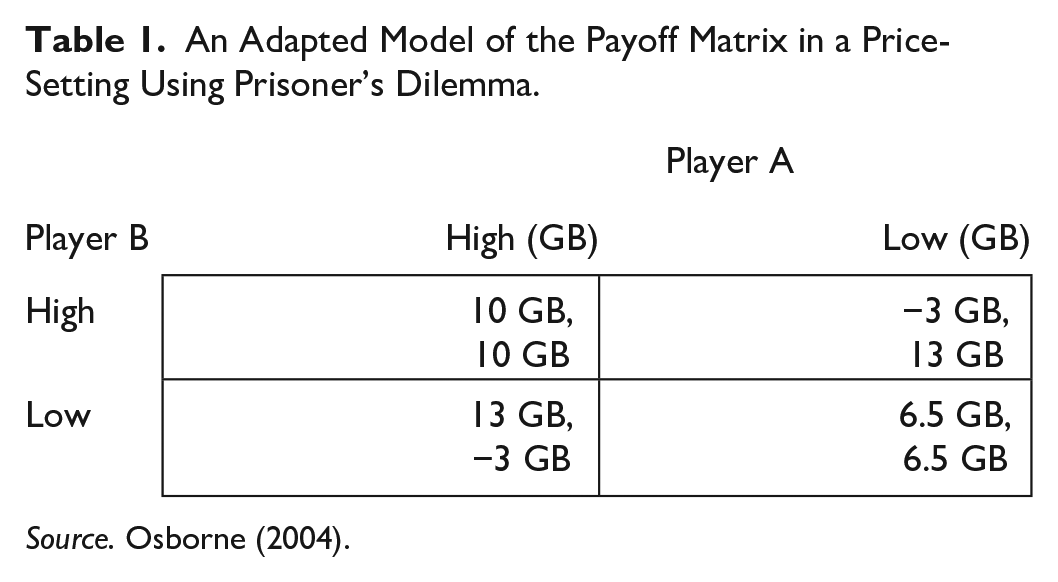
Relating it to game theory, the game is mostly used in the normal form of game theory. For instance, consider two players in the telecommunication industry, player A and player B, with a choice of providing fast and quality internet service to their customers and each firm wants to sell data to achieve the highest possible payoff as indicated in Table 1.
An Adapted Model of the Payoff Matrix in a Price-Setting Using Prisoner’s Dilemma.
Source. Osborne (2004).
If both player A and player B provide “high” quality, then each firm sells at 10 GB. If player A provides “high” quality and player B provides “low” quality, then the firm choosing “high” makes a loss of 3 GB, whereas the firm choosing “low” earns a profit of N1,200,000. If both firms go for “low” quality, then each of the firm sells at 6.5 GB (see Table 1). Having defined the prisoner’s dilemma game in normal form, there will be winners and losers among the players, and both players are in equilibrium when they both decide to provide high-quality internet service (Mudambi, 1996). In addition, both decision-makers of the firm decide her strategies all at once and cannot modify as the events unfold.
Cournot Model
The Cournot model assumes that the industry is modeled for firms in which the individual firm determines their output, and the price is regulated by the demand for the product to the total product made (Osborne, 2004). The model assumes that the cost of firm producing the units of product is Ci(qi), where Ci is an increasing function whereby more products make the cost of production high. However, if the firm’s total product is q, then the market price is P(q), where P is the inverse demand function. If (P) is positive, then the firm’s total product increases and price decreases.
The Cournot game assumes that as consumers are willing to pay more for the goods, the equilibrium price and output of each firm increase. As the production cost increases, the firm reduces and the price increases. Thus, an increase in c leads to two-thirds of a unit increase in the price (Osborne, 2004).
Bertrand Game
The Bertrand game model is associated with price and not quantity, and produces enough products to meet the demand (Osborne, 2004). The Bertrand game assumes the following:
If a firm’s price is below the unit cost, then the firm’s profit is negative.
If a firm’s price above the unit cost, then the firm’s profit is positive.
The different prices are the available strategies each firm might charge. Thus, the equilibrium for the firm is when the cost of producing the product is sold at a price that is equal to the marginal cost (Erhun & Keskinocak, 2003; Osborne, 2004). The Bertrand game explains that when the unit cost of production is constant for both firms and the demand is linear, the firm’s price is equal to the cost (Osborne, 2004).
Quasi-Game Theory
This theory considers the model of consumer behavior where the price is identified as the only indicator of quality (A. G. Rao & Shakun, 1972). The quasi-game model is considered as a non-cooperative game in which communication among players is not allowed. The dynamics of the game is as follows:
Brands at known prices are in the existing market.
The new brand chooses its price following the behavior concept with the mindset that the choice may affect the behaviors of existing brands.
The concept is further explained:
Behavior 1—non-cooperative equilibrium: Brand i chooses price Pi to maximize its payoff. The non-cooperative type of behavior could reasonably be chosen by all players, yielding to non-cooperative equilibrium solution for price.
Behavior 2—joint maximum for brand: Brand i is chooses Pi to maximize the sum of its payoff.
Behavior 3—joint maximum for industry: Brand i chooses Pi so as to maximize the total industry sales.
Behavior 4—minimax: Brand i chooses Pi so as to minimize the maximum value of brand i’s payoff function.
Stackelberg Model
The Stackelberg model assumes that a firm that attempts to determine his or her quantity to sell first is the Stackelberg leader and the firm that observes before choosing his or her output is the Stackelberg follower (Choi, 1991; Esmaeili et al., 2009). Thus, both firms seek to maximize their profits. The Stackelberg model is grouped into manufacturer-Stackelberg and retailer-Stackelberg.
Manufacturer-Stackelberg
The model shows the manufacturer as the leader and follower as the retailer. The manufacturer determines the price based on the response of the retailer and the competitor’s price (Esmaeili et al., 2009). The retailer also determines the price of each product to get the best out of profit from both brands (Esmaeili et al., 2009).
Retailer-Stackelberg
The model explains the retailer as the leader and manufacturer as the follower. The retailer takes the manufacturer’s reaction into account to make its own pricing decisions (Esmaeili et al., 2009).
It is assumed that channel members seek to optimize their own profit. Both the retailer’s and manufacturer’s profit are always positive regardless of the price and cost.
Comparative Advantage Theory of Competition
This theory developed by Hunt and Morgan (1995) assumes demand is heterogeneous and dynamic, and also that consumers have imperfect information about products that might meet their taste and preferences. Thus, the firm’s objective is superior performance. The theory also assumes that resources are tangible and intangible entities, and heterogeneous across firms and immobile.
Development of Proposition
Game Theory and Product Decision
The attempt of game theory on product decision is seen possible as studies focused especially on the area of product competition and market segmentation (Moorthy, 1985). This is because of the increasing number of firms serving the same market. Also, firms tend to establish a reputation of quality to enjoy the long-term benefits of charging a higher price (Moorthy, 1985).
Erhun and Keskinocak (2003) applied the use of Bertrand model to make a product decision. They note that other firms will sell at a particular price irrespective of the price they sell their product, and consumers will buy from those who charges the lowest price. If the firm charges the same, the market is split evenly. However, they also note that customers tend to choose product not based on price but on quality.
Kaiser (2001) applied the use of the Cournot model on product innovation by introducing product competition in the market. He notes that the introduction of the innovated product into the market can become possible if the firm introduces marketing activities (such as advertising, promotion). In the analysis, firms are assumed to make a decision whether or not to conduct product innovation, to determine their optimal effort and to compete against each other. Their findings show that the introduction of new product and marketing activity for new products decreases when the number of competition and product substitution increases. He further notes that the use of Cournot model for product innovation with marketing effort can lead to an increase in market size.
Relating it to the telecommunication industry in Nigeria, the big players of telecommunication industry—MTN, Airtel, 9mobile, and Glo—provide internet services to their customers and are seen to be at advantage over other small players because of the number of phone subscribers. Companies such as MTN allocate 20 GB data to its customer for N5,000; Airtel allocates 20 GB for N5,000; 9mobile allocates 15 GB for N5,000; and Glo allocates 18.25 GB for N5,000. However, MTN is seen to be the leader with a market share of 39.55% (Nigerian Communication Commission [NCC], February 2, 2021).
This shows that there is a competitive interaction around the product decision that the various companies make. Thus, this study considers the following proposition:
Game Theory and Pricing Decision
Pricing decisions are made in most organizations as they try to maintain or increase their market share (Erhun & Keskinocak, 2003). However, the attempt to use game theory for pricing decision has been considered possible in the business to consumer (B2C) market (Dominici, 2011). Considering the importance of game theory within the business environment, A. G. Rao and Shakun (1972) introduced quasi-game theoretic model, which focused on new and existing brand and various behavior types under a non-cooperative game. Their model considered two groups of consumers who believe price is an indicator of quality whenever they shop for a brand. The first group believes that high price of a brand leads to better quality; thus, they are inclined to pay for the product in the market. They are referred to as the “quality-conscious group.” The second group believes that all products have a standard range of quality, so they purchase the low-priced product within the range. They are referred to as the “price-conscious group.” This leads to various behavioral concepts, that is, Behavior Concept 1 (non-cooperative equilibrium) and Behavior Concept 2 (joint maximum for industry).
The work of Milgrom and Roberts (1986) focused on pricing as a signal of product quality. In their analysis, they had a sequence of possible actions, of the available information, and of possible payoffs, which yielded a game of incomplete information. They believe that customers know the firm’s quality based on the information passed to the customers. Hence, they focused on the customer’s choice of product, that is, high or low quality. Their result shows that high-quality product will have higher marginal benefits, which can only be achieved through pricing. Furthermore, their studies show that when the cost of production is the same for both high and low quality, it is required to engage in advertisement to obtain higher price. Dominici (2011) reviewed the work of Banyopadhyay et al. (2002) and notes that price is an indicator of quality if supported by reputation.
Relating it to the telecommunication industry in Nigeria, pricing decision takes an example similar to the product decision example. Table 2 shows the various data packages offered by the players, but the consumers are found to subscribe more to MTN. MTN is also identified to have the highest number of subscribers for data (internet) services and have the highest market share (NCC, February 2, 2021) (see Table 2).
Competitive Data Product Price from the Top Players in the Telecommunication Industry.

Source. NCC (February 2, 2021).
Note. NA = not available.
This shows that there is a competitive interaction around the pricing decision various companies make; thus, this study considers the following proposition:
Game Theory and Promotion Decision
Promotion decision is now established to have a noticeable impact on sales of consumer brands (R. C. Rao et al., 1995). However, the attempt of game theory to determine the optimal promotion decision has aroused the interest of scholars especially in the areas of advertising, retail promotion, trade promotions, budget prices, and special prices (Dominici, 2011; Koçkesen & Ok, 2007).
Shubik and Leviatan (1980 as cited in Dominici, 2011) proposed an advertising expenditure decision using prisoner’s dilemma to determine the payoffs in terms of short-term profit for each firm. Their study shows that a firm gains advantage over the other firm if it invests a lot in advertising. If both firms invest a lot, the profit decreases. However, if both firms decide to cooperate, the profit is maximized.
Corfman and Lehmann (1994) examined the use of advertising budget in a competitive setting using prisoner’s dilemma for four mature brands. Their study considered influencing factors such as past advertising spending and market share. Their result shows that firms are likely to advertise at a high level in long-term than short-term, and firms with a long-term profit objective are likely to advertise at a low level, whereas those with a short-term objective are likely to advertise at a high level in long-term relationship. However, Di Benedetto (1987) notes that an advertising decision may lead to incorrect decisions if it does consider other factors such as price and distribution.
R. C. Rao et al. (1995) examined competitive promotions across competitors in a large supermarket using prisoner’s dilemma. In their analysis, they note that there is always a strategy for each firm no matter the type of promotion a competitor uses; thus, a firm should always promote. Although promotions are profitable when their competitor promotes, however, their studies show that promotions are independent of competitor actions, and the strategy to use should be mixed strategies. Furthermore, they note that promotions do not affect long-run profits and market share.
Relating it to the telecommunication industry, NCC announced portability options for customers. MTN sparked the advertisement war in their porting advert using green attire (Etisalat, now 9mobile), which later changed to yellow (MTN) with the porting theme “I don port o.” Airtel illustrated a subscriber migrating from a yellow building (MTN) to a red building (Airtel). With the porting advertisement, Etisalat, now 9mobile, was seen to be leading the competition (Chioma et al., 2016).
This shows that there is a competitive interaction around the advertising decision the various companies make; thus, this study considers the following proposition:
Game Theory and Distribution Decision
Distribution decisions tend to face the challenge of whether to integrate vertically or use independent retailers; however, the use of marketing communication (i.e., promotions, advertising, etc.) is thought to relieve such conflict (Choi, 1991; Esmaeili et al., 2009). The attempt of game theory on distribution decision utilizes non-cooperative game theory to analyze the relationship between seller–buyer interaction in a channel (Choi, 1991). Empirical studies (Choi, 1991; Esmaeili et al., 2009) have shown that price plays an important role in determining the channel structure as well as other efforts expended in marketing products such as advertising and sales promotion (Choi, 1991; Esmaeili et al., 2009). However, power structure, product differentiation, and cost differences in channel prices and profit play a significant role in their interaction. Choi (1991) approached the problem of distribution decision-making using non-cooperative game to handle the communication between the seller and the buyer. The result from their analysis, that is, Stackelberg game, shows that distribution decision depends on the shape of the demand function especially when the products are less differentiated. Also, the retailer benefits more than the manufacturer.
Esmaeili et al (2009) in their study of the non-cooperative game to approach the problem of seller–buyer relations note that demand is more sensitive when marketing communications such as advertising and sales promotion are applied. Furthermore, the buyer tends to gain more if she is the leader than the follower.
Relating it to the telecommunication industry, NCC is in charge of broadband deployment, and it allocates the spectrum to them. The distribution of 4G LTE broadband to various players has heightened the competition in the industry in which they provide various attractive data package to increase or maintain the demand level of such service by their consumers (Bolaji, October 5, 2020).
Table 3 reveals the various attractive data packages by the four players in the industry to meet up with the various consumers’ demand.
Data Package.

Source. NCC (February 2, 2021).
This shows that there is a competitive interaction around the distribution decision the various companies make; thus, this study considers the following proposition:
Conclusion
This study of game theory for marketing decisions in the service industry is a useful tool despite within an environment of incomplete and imperfect information. Insights about the various game theory techniques to facilitate marketing decisions revealed that game theoretic techniques (i.e., prisoner’s dilemma, quasi-game, signaling, Stackelberg, Bertrand, and Cournot models) can enhance product, price, promotion, and place decision. The use of Bertrand and Cournot models as the applicable game theoretic techniques for optimal product decision shows that consumers tend to buy from those that charge the lowest price and go for quality products. Also, introduction of new products with marketing efforts tends to decrease as the competitor and product substitution increase. Quasi-game and Signaling as the applicable game theoretic technique revealed that high-priced brand attracts quality-conscious consumers, and promotional activities tend to differentiate both high- and low-quality products. Prisoner’s dilemma as the applicable game theoretic techniques for advertising decision shows that firms tend to have an advantage over other firms if they engage more in promotional activities. Promotions are profitable when their competitors promote. Stackelberg game as the applicable game theoretic technique shows that retailer benefits more than the manufacturer
This study, therefore, draws the attention of marketing managers to the advantage of engaging a service marketing scientist to make use of the models to make better and faster decision. With this, the scientist can easily analyze product competition and market segmentation; increase manager’s awareness about product differentiation, profit, product quality, and reputation; and understand budget.
This study also proposed an integrated marketing mix model that reflected game theoretic techniques as major tools available for the firm (people) to facilitate product, pricing, distribution, and promotion decision.
For future investigation using game theory for imperfect and incomplete information, the other three “3Ps” of marketing, that is, people, physical evidence, and process, can be researched.
An integrated marketing mix model is depicted in Figure 1.

An integrated marketing mix model.
Footnotes
Acknowledgements
Sincere appreciation to the Management of Covenant University who helped in carrying out the research.
Declaration of Conflicting Interests
The author(s) declared no potential conflicts of interest with respect to the research, authorship, and/or publication of this article.
Funding
The author(s) received no financial support for the research and/or authorship of this article.
