




Abstract
This research reveals expert perceptions of lay people and lay knowledge in environmental projects, such as information giving activities, research projects, and environmental planning projects. A semistructured interview method was employed with six researchers from a university in Sweden. Although the expert–lay relationship has traditionally been discussed within a “deficit model,” many experts in this research expressed a more positive view of lay people and lay knowledge; however, situations where lay knowledge was considered useful varied. The experts’ motivation for communication was analyzed within the four communication modes of education, responding, supplementing, and dialogue. Their recognition of the “deficit expert” was one of the remarkable findings: the experts acknowledged their knowledge and competence in understanding “reality” had its limitations and questioned the objectivity and universality of science in relation to environmental science.
Introduction
Expert knowledge, especially in natural science, has prevailed in environmental decision-making. For example, current ecosystem management policy (Udovyk, 2014) and conventional analysis of environmental matters (Adams, 2009) rely heavily on information from natural science. Although such scientific information and knowledge has been trusted and supported for its “objectivity” (Harding et al., 2009, p. 143), and has been taken as universal knowledge (Wynne, 1996), the authority of science supported by neutrality, universality, and objectiveness is questioned.
There is criticism of the notion of sole scientific knowledge, such as the connection between politics and the management of the Baltic Sea (Pihlajamäki & Thnkkynen, 2011). Turner (2001) discusses that expert knowledge is not neutral but an “ideology”; discursive structures that are unwittingly accepted by ordinary people as fact (pp. 125–127). Traditionally, in the epistemic division of labor, lay people fall outside of knowledge creation, with academia considering scientific knowledge as the sole knowledge, which should in turn be disseminated to lay people. However, some scholars are increasingly discussing the function of active lay involvement. Gibbons et al. (1994) points out that functionally such people are active agents in defining problems, discussing solutions, and evaluating acts. Nowotny et al. (2001) claim that “individual scientists are now much freer to co-operate with individuals from other groups and to transgress established institutional and group boundaries” (p. 103).
A difficulty here, though, is demonstrating the value of other forms of knowledge, which do not always emerge from within the scientific framework. For example, it is difficult for “Local Ecological Knowledge,” which is shared by specific groups of people about local ecosystems, to be understood and recognized by outsiders (Olsson & Folke, 2001, p. 87). While the results of natural science research are in the public domain, other types of knowledge might be shared and remain within communities or be based on the accumulated experience of individuals. Such knowledge cannot easily be described explicitly because the knowledge system is embedded in the specific context. Such local knowledge and local people are traditionally viewed within a “deficit” model, but the importance of such knowledge has been emphasized in recent discourses on environmental study and development to ensure rationality and sustainability. Whether experts actually see value in the perspectives of lay people and their knowledge is our central interest in this research. While experts mainly use scientific knowledge to make decisions, lay people often is said to have and share different knowledge systems, such as tacit knowledge and informal knowledge. The terminology of traditional, indigenous, and local knowledge is “very messy” (Harding et al., 2009, p. 152), with many scholars using the terms in different ways. In this article, we are going to put together these terms under the umbrella of “lay knowledge.”
Although much of the previous research about lay–expert division advocates that citizens should not just be passive receivers of scientific knowledge (e.g., Nisbet & Scheufele, 2009; Wynne, 1992), scientists tend to communicate with lay people with the purpose of disseminating scientific expertise (Royal Society, 2006). One of the key factors that make citizen engagement feasible within knowledge creation might be the attitude of scientists toward lay people.
In addition, relatively little is known about how experts see lay people and their knowledge in environmental studies. Examining what scientists think about local people may reveal indicators leading to both meaningful citizen involvement and sustainable decision-making.
Background
Discourse in the Public Understanding of Science and Public Involvement
Discussion in the public understanding of science (PUS) is traditionally based on the premise of deficit in the lay person, with experts providing expertise to ignorant lay people. Michael (2002) pointed out two main branches of the PUS: traditional and positivist PUS and critical and interpretationalist PUS. Traditional PUS sees science as improving citizens, related to the idea that lay people are “sociologically naive” (p. 361) whose understanding of science is inadequate. Lay people are assumed to know little; act irrationally; be emotional (Blok et al., 2008); resist new evidence (Burchell, 2007); rely on anecdotes (Moore & Stigeo, 2009); be subjective with personal inclinations (Burchell, 2007); be self-interested (Burchell, 2007; Burningham et al., 2007); and be easily frighten by media (Blok et al., 2008; Burchell, 2007). Also, scientists tend to view the public as homogeneous (Besley & Nisbet, 2011). Based on these portraits, a division of labor within epistemic asymmetry is created and maintained; experts are supposed to be knowledgeable while lay people are ignorant (Maranta et al., 2003, p. 150). According to Fujigaki (2008), assumptions of the deficit model are: science is based on knowledge that can give definitive answers to all questions, which lay people accept; the public’s knowledge is “deficient” while science’s is “sufficient”; and the public’s “deficiency” is measurable. PUS research has been informed by a knowledge gap view where the public mistrust science.
Other views have placed more value in the trust, credibility, and understanding of social relationships in scientific knowledge. One of the alternative discourses in the PUS is lay expertise, where lay people have local knowledge that is different from expert knowledge. It is emphasized that such context-dependent local knowledge can be generalized beyond small, specific groups of knowledge holders (Fujigaki, 2008). Lay people’s knowledge is conceived more and more as providing valuable insight for problem-solving because local knowledge is “more relevant to action than traditional, universal, abstract and context-independent scientific statement” (Lidskog, 2008, p. 77). Knowledge of local people is “dynamic and up-to-date, continually revised as conditions change” (Chambers, 1997, p. 173) as well as “factual and experiential” (Fagerholm et al., 2013, p. 674).
The notion of deficit in lay people, with experts just providing expertise to ignorant lay people has been changing (Stilgoe et al., 2014), as well as the traditional clear dichotomy between lay people and experts. Entradas (2015) points out that communication has transformed from the PUS to public participation, as the concept of public and public communication has changed. Public participation in environmental decision-making becomes especially important in risk assessment, management, and communication. Public participation in environmental planning is a legislative tool for broadening the knowledge base in environmental decision-making, not only in terms of expert knowledge but also in citizens making sustainable decisions in the name of democracy (Swedish Environmental Protection Agency, National Board of Housing, Building and Planning, 2000, p. 49). Local participation has two different dimensions: a goal and a method. While the goal of participation is just a means of gaining legitimacy in the process of making a decision, the dimension of method focuses more on the actual contribution of people to access proper knowledge and information (Buchy & Hoverman, 2000).
The most traditional approach in science communication is under the broader umbrella of knowledge deficit models (Table 1). The focus continues to be on the communication of science from experts to stakeholders in a top–down fashion, although Van Swol et al. (2019) argues that lack of knowledge is not necessarily the component of “deficit” citizens to make certain decisions, and it could be about the bias for common information out there (Van Swol et al., 2019, p. 1128). Another model is by bidirectional engagement models, of communication about science, which has been replacing the previous model. Broader public debates surrounding the “wicked” problems are said to rarely initiated or led by the scientific community, and with many instances not having scientific answers.
The Changing Nature of Science Communication (Dietram et al., 2017, p. 467).

Studies on Experts’ Image of Lay People
Despite increasing emphasis on the need for “dialogue” and “engagement” with locals by governmental authorities, the motivation of scientists to communicate with the public reflects the traditional deficit model (Dietram et al., 2017). Research by the Royal Society (2006) in the United Kingdom reveals that 80% of scientists believe the main reason for public engagement is to ensure the public is better informed about science and technology, or to raise awareness about science. In contrast, only 38% answered that it contributed to public debate and that debating ethical and social aspects is the main reason for public engagement. This result indicates that scientists want the public to learn or gain from science and technology rather than for the public to engage with scientific matters from their point of view.
Environmental problems often encompass not only epistemological questions of science but also socio-scientific issues such as political, economic, and sometimes ethical aspects that need to be addressed. Experts, who have to interact with citizens with regard to social aspects that are beyond their domain-specific scientific expertise, might fail to do so if they believe their science alone could solve the problem. However, the environment experts work to incentivize them to step back from direct interaction with the public because power, status, and promotions are less likely to be achieved in that forum (Besley & Nisbet, 2011; Chambers, 1997). Experts live in “professional prisons” (Chambers, 1997, p. 54), which give them very narrow views on specific matters, as scientists usually believe in a “reductionist, controlled, simplified, and quantified construction” (pp. 54–55). Scientists have an exclusive nature regarding the public.
One study about the image experts have of lay people introduces the concept of the “imagined lay person” (ILP) (Maranta et al., 2003), where experts create marginalized knowledge-less lay people in their minds. In establishing, controlling, and maintaining such functional authority, experts position lay people as passive and irrational to maintain the division. Loyalty to experts is a key concept of the ILP in that lay people have to accept scientifically supported expertise (Maranta et al., 2003, p. 164). Another empirical study about imagined lay involvement by Blok et al. (2008) reveals that experts commonly view lay people as having a lack of knowledge and that their perception of risk is not based on knowledge but on their “attitude,” and they behave “irrationally,” being easily frightened by risk, and manipulated by the mass media.
Of course, entering scientific debate about esoteric matters is impossible for most members of society. Public-bounded understanding of science and the tendency, for example, to trust in scientific information, is influenced by one’s personal stance on specific scientific topic (Bromme & Goldman 2014; Hendriks et al., 2016). Details and nuance shared by scientific community are invisible from outside; therefore, public inevitably makes understand simplified argument and have polarized certainty (Collins, 2014). However, limitations of the public’s capacity to understand scientific discussion does not mean that lay people do not or cannot contribute their knowledge in environmental projects because of the socio-scientific nature of the topics.
Importantly, how experts perceive lay people is also dependent on how much interaction they have had with them. There is a tendency for experts who actually interact with lay people to have a more positive view of them (Blok et al., 2008, p. 205), unlike in the common “deficit lay” model where the expert believes the public’s understanding of the uncertainty of science is poor (Landström et al., 2015). Much of the research on experts’ perceptions of the public, or lay people, have focused on their “imagination,” with little focus on perceptions cultivated through actual communication. Without being involved with lay people, experts can fail to appreciate the concepts of lay and expert are more nuanced, and having only two polarized terms is insufficient. Lay people without a scientific background, could be recognized as an “expert” with special knowledge through their engagement in a specific field, as well as providing a practical contribution in occupational and local settings (Collins, 2014).
Research Method
How experts value nonscientific knowledge from lay people who actively interacted within their communication is the central interest in this research. Therefore, we focus on experts’ perceptions toward lay people, such as local citizens, who were actually involved in their project. Thus, the term “lay people” here does not refer to the general public, but specific people. “Lay people” is a broad concept to define. Mikami (2010) submitted four structures of citizen-expert participation: citizens, actors, experts, and stakeholders. In this article, however, we define lay people as a somewhat bigger group: people who do not have specialized academic and scientific knowledge, but who might have influence on the environmental decisions made by experts. This is because in some cases, it seems difficult to distinguish between stakeholders and actors, as the “experts” whom we interviewed engaged and communicated with lay people in various projects. “Lay people” in this research simply means people who are neither “expert” nor “novice” on a certain environmental topic.
The term “expert” is defined as “one whose special knowledge or skill causes him to be regarded as an authority; a specialist” (Oxford English dictionary online). The word “expert” can include scientists and researchers who work in their study field, and professionals who work within or close to decision-making systems. The experts we mainly approached for this article are the former; the experts are researchers, mostly natural scientists.
To find informants, one of authors (Koizumi) sent emails to 14 university researchers including professors, postdoctoral research fellows, and PhD students registered on the program of Environment and Development at a university in Stockholm, Sweden. We read profiles available on the university website to find those who had been involved in any environmental project that interacted with lay people. We received replies from around half, and semistructured interviews were conducted with six of them (the list of interviewees is presented in Table 2). The 1-hour interview consisted of four parts: (a) interaction experience in an environmental project; (b) the difference between expert knowledge and lay knowledge; (c) the influence and value of nonexpert knowledge to them; and (d) tacit knowledge (the list of questions is presented in Appendix).
List of Interviewees.

To collect data, in-depth interviews were employed. In-depth interviews usually seek “deep” information, which might not be approached by survey or document research (Johnson, 2001, p. 104). The form of interview was semistructured, with prepared questions and additional questions depending on the interviewee’s answers. The reason for choosing this method was that this research needed to collect personal beliefs and values about lay and expert knowledge. Each interview lasted around 1 hour. All interviews were conducted in English because the interviewer was not fluent in Swedish. Having spoken with the interviewees, we believed using English did not cause problems, and also English language skills in Sweden are generally very high: In the EF English proficiency index, Sweden obtained first place in 2018, and second place in 2019. Most interviewees also conducted English language–based projects as well as teaching their courses in English at the university.
To see how the participants use terms such as “knowledge,” “lay,” and “expert,” the interviewer did not give any definitions but just used the words. During the pilot study, we defined “knowledge” to one interviewee, and they stated it was “wrong”; a long philosophical discussion then developed. This interesting experience made us choose to investigate how participants use and explain the terms rather than give our definitions from the outset. The interviewer asked clarifying questions during or at the end of the interview regarding their definitions of the terms when they were unclear from context.
After the interviews, all the data were transcribed. The data were then coded thematically (thematic coding method), and put in a matrix to compare and identify their discourses. By looking at the similarities and differences among the interviewees’ discourses, we tried to identify patterns. The analysis is divided into three sections: (a) lay people; (b) lay knowledge; and (c) relations between lay people and experts. To protect their identity, the experts in the interviews are given project names (Table 2).
Findings
We discuss our findings into two sections: the portrayal of lay people and lay knowledge, and communication models between lay people and experts.
Portrayal of Lay People and Lay Knowledge
In our research work, most interviewees portrayed lay people in a positive light, unlike the previous discourses explained in the literature. Some interviewees (Joakim: biologist; Hanna: geologist; Niklas: development study) said that lay people know much about the environmental issues around the experts’ projects or research. Common descriptions of lay people in this research concerned knowing and understanding their surroundings: “They, lay people or people out there, have more realistic views, I think” (Hanna: geographer); “local people are more, I think, concerned in material existence” (Niklas: development study). Another positive description among interviewees in this research was active engagement in their project (Hanna: geographer; Joakim: biologist).
On the contrary, Fredrik (geologist) described lay people differently from other experts: what lay people believe is often “wrong” and based on “misunderstandings,” and they are too “stubborn” and “lazy” to change those beliefs because they “don’t want to take any responsibility.” His discourse echoes Burchell’s (2007) proposition that lay people tend to be resistant to new evidence. Fredrik explained lay people’s attitudes are influenced by a manipulating media and indirect communication between them and scientists. His view on such lay people appears to be created through his experience of confronting local residents who did not believe the scientific results from water quality analysis and discussion with the public about overfishing and climate change.
We now look into the portrayal of lay people and lay knowledge among experts under two main themes: three patterns of recognition and discussion on objective science.
Three Patterns of Recognition: The Value of Lay Knowledge
Although all of the experts mentioned that lay knowledge is valuable, they found the value within different conditions and assumptions. Patterns of where they found value will be presented in this section. Table 3 shows the comparison of these three patterns.
Patterns of Recognition in the Value of Lay Knowledge.
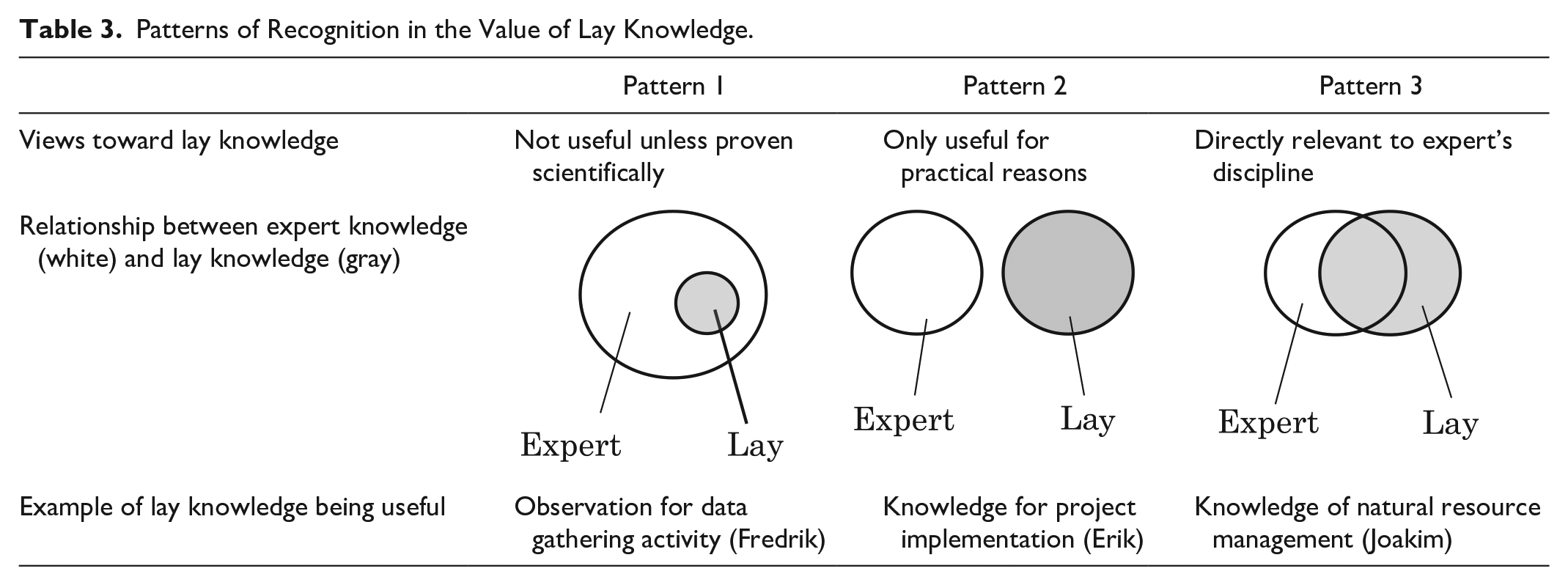
The first pattern is seen particularly in Fredrik’s (geologist) discourses. As explained, he believes there is no lay “knowledge” because what lay people know is influenced by arbitrary media and people’s will, and for him, knowledge should be scientific. He explained lay knowledge can be useful when it is used within a scientific framework: You can get observation and fact, from lay people, but you don’t have to agree with the conclusions, because you will use your scientific background, draw other conclusions. [. . .] We could get information in a scientific way. (Fredrik: geologist)
Therefore, he only finds value in what lay people know when it is proven scientifically. In his project, he analyzed water contaminants to explain the water quality to local residents, but some local people did not believe the results. He also mentioned many cases where lay people did not trust scientists, such as climate change, over fishing, and the number of wolves. His idea is to form his own communication mode, which will be explained in the following section.
The second pattern was seen in those who were part of a team in an environmental project, working with lay people as project colleagues rather than targeting people such as local stakeholders. Erik (ecologist) was a scientific expert in an environmental association and carried out various projects including putting pressure on a controversial policy and awareness raising with other concerned citizens. Joakim (biologist) mentioned that lay people in his project had knowledge and skills for “different types of job in the nature reserve,” such as building fences and natural resource management, which they needed. They see value in what lay people know in terms of the practical matters of implementation, but not in relation to the expert’s discipline: I was not thinking about such division [between lay and expert] too much, because they could have other things. For example, those who have been involved in politics, or local politics, have very useful information in that way. And, also, they could have networks to other people, people who are writing, publishing, building opinion. (Erik: ecologist)
He sees lay people as specialists who do not contribute to his expertise but do to project implementation. He found value in lay people’s knowledge because he is not an “expert” in their field of knowledge. In this second pattern, there might be a division of roles within the project: decision-making by the expert to define the situation, and support from nonexperts for practical matters. While the deficit model can also be seen as an epistemic division of labor, with a knowledge provider and receiver, in this research, it might be slightly different as most experts admit lay people are not just receivers but also knowledge holders within certain fields.
The third pattern in the recognition of the usefulness of lay knowledge directly relates to the expert’s discipline. In this case, experts acknowledged the relevance of lay knowledge to their own expertise (Joakim: biologist; Hanna: geographer; Johan: ecology; Niklas: development studies). They recognized the value of lay knowledge because lay people see situations or incidents through perspectives that scientists may hardly notice (Hanna: geographer; Niklas: development studies). Some of them mentioned a linkage between lay knowledge and scientific knowledge. For example, Joakim (biologist) explained that the difference between lay and scientific knowledge is just the “amount of knowledge.” His explanation implies that what lay people know is very relevant to experts’ knowledge, but it could be divided into small pieces. Niklas (development studies) also expressed that lay knowledge is not totally different from science but is based more on experiences of daily life. Therefore, to them, lay people’s knowledge is different from scientific knowledge in terms of form or perspective, but what they know and what they see is valuable for experts as it is relevant to their discipline. Of note, here is that some of them explained the relationship between lay knowledge and expert knowledge within a broader framework. The need to look at various perspectives was mentioned as a reason for the importance of lay knowledge by several interviewees (Erik: ecology; Niklas: development studies; Johan: ecology). Unlike the simple lay/expert dichotomy, lay knowledge is recognized here as one of various perspectives that need to be considered: So I think both types of, there’re different types of knowledge, all of them need to be scrutinized, interrogated, not just local knowledge. (Niklas: development studies)
Johan (ecology) mentioned the reason why it is important to include many aspects of knowledge in tackling environmental issues: there is no “single truth,” and a decision can affect a wide range of people. Table 4 shows the patterns and lay people in their projects.
Experts and Three Patterns in the Recognition of the Value of Lay Knowledge.

Objective and Universal Science?
Unlike traditional discourse on scientific knowledge, the experts in this research believe the authority of science does not stem from universality and objectiveness. Experts in this research generally believe that natural science around environmental study is not universal and objective, but includes uncertainty.
All of the interviewees denied the universality of natural science in relation to environmental studies as issues around the environment are context dependent (Johan: ecologist), and every environmental situation is unique (Hanna: geographer). Erik (ecology) emphasized that for environmental issues, objectiveness and universality are not pertinent as there are many variations; this is in contrast with classical natural sciences such as physics.
Although they deny the universality and objectiveness of scientific knowledge, the experts generally acknowledged the importance of scientific knowledge. Some of them legitimated scientific knowledge because lay knowledge is “interest oriented.” For example, Fredrik (geology) criticized lay knowledge as being influenced by wishes, hopes, and interests as well as by the media. Niklas (development studies), on the contrary, also connected science as well as lay knowledge to individual interest, value, and ideology. Others believe that science might be the better knowledge system over lay knowledge because of its way of establishing knowledge, such as the need for hard evidence and verification (Erik: ecologist); questioning acknowledged facts (Joakim: biologist); and a universal way to research and discuss topics (Fredrik: geologist). Moreover, Joakim (biologist) and Erik (ecologist) emphasized the need to follow scientific knowledge anyway for environmental decision-making.
Four Communication Modes: Motivation to Communicate With Lay People
All of the informants in this research stated that communication and interaction with lay people is important. Several different conditions make lay knowledge valuable to experts. Here, their communication mode, how they communicate with lay people, and for what reason is to be analyzed. Most of the experts described communication with lay people in positive terms, such as meeting people is “nice” and “interesting” (Johan: ecologist). In general, their motivation to communicate with lay people seems connected to their acknowledgment of the value of lay knowledge, as discussed previously.
Callon (1999) presented three different communication models for expert and lay people: education, debate, and co-production. As in the traditional deficit lay model, the education model of communication sees lay people as receivers of “correct” scientific information. The value of knowledge accumulated by experience is not recognized. Flow of information is one way. In the debate model, the uncertainty of science is recognized by scientists and lay knowledge is only used to enrich official scientific knowledge. The value of knowledge accumulated by experience is recognized but limited.
Lay people and their knowledge in the co-production model have a larger role in the production, orientation, and evaluation of knowledge within a close relationship with experts, even though science is still as important as in the other models. However, these models cannot simply be applied to all the interviewees in our research, such as experts’ motivation to share their knowledge because lay people want to learn (Hanna: geographer). Thus, four modes of communication are used to analyze their interactions based on Callon’s three models. Table 5 shows the four modes of communication and different expert perceptions toward lay people.
Four Communication Modes Between Experts and Lay People.

“Education” Mode
Unsurprisingly, Fredrik (geology) who said that what lay people know and believe is often “wrong,” described the purpose of communication as to correct misunderstandings among the public, and involving people in environmental decision-making is important only in as far as it is regulated by law: It’s our duty to, sort of, without them knowing it, we sort of educate them. We have to tell them over and over again of things that actually work, to convince them that. [. . .] you have to convince people with facts. (Fredrik: geology)
Unlike other interviewees, he does not believe that lay people have useful insight about the environment around them. He added the need to promote experts’ research; researches are often subsidized by governments using taxpayers’ money. Thus, lay people need to know what their money has been spent on and have influence on deciding what research should be subsidized. However, few respondents referred to this education mode. Johan (ecologist) mentioned his desire to increase knowledge and awareness of environmental issues as an expert: As an expert, I would like to increase knowledge in the general public, increase interest in environmental issues to understand the complexity and interrelationship in many different societies, and get engaged. (Johan: ecologist)
His motivation to provide knowledge is not strongly based on the view that lay people come from a position of ignorance. Unlike other experts in this research, Fredrik had experience of interacting with a wide range of people through various media including TV, radio, and the internet, where he received questions from the public including children. His view of the education mode might be cultivated through such experience, as well as his background in geology.
“Responding” Mode
As in the previous “education” mode, the “responding” mode provides expert knowledge. Demand from lay people for expert knowledge comes first, with an assumption that lay people come from a position of ignorance. Hanna (geographer) mentioned the importance of providing expert knowledge to lay people, which is based on her understanding that lay people want to learn from experts.
(Interviewee) How were those people during the project? Some were really engaged, and had knowledge, but also wanted to learn from us, so they were using us for knowledge with the intention of improving their own business, and getting inspired by us. (Hanna: geographer)
Hanna believes that experts could have a positive effect on them to allow them to be a “better farmer” or “better entrepreneur.” This view is not as pessimistic as the deficit model as she does not believe that science provides the only knowledge necessary to empower them. This may be because Hanna was working on a research project about urban agriculture in which she approached lay people who have related businesses or live close to the project site; this may make her feel she is providing knowledge to lay people which might be helpful to them.
“Supplementing Expert” Mode
As many of the experts believe that lay people can provide something valuable to experts, they are motivated to know about and utilize such knowledge in their projects. Those involved in research projects emphasized that researchers need to see them not through one perspective but through several (Johan: ecologist; Hanna: geographer; Niklas: development studies). As Wynne (1991) mentions, “supplemental knowledge” is required “to make scientific understanding valid and useful in that context” (p. 114); experts see lay people as sources of supplemental knowledge they can benefit from. This supplemental knowledge for experts is the dominant view among the experts in this research, as most see lay people as having valuable knowledge. In addition, a deficiency in expert knowledge caused by their absence from fieldwork is highlighted by the experts. Experts’ lack of understanding about how situations work in reality is one of the dominant themes in this mode: I think we, researchers, tend to sometimes just sit in offices, and read about the reality, but when you go out and realize, we have greater understanding about how reality works, and how they perceive the reality, and I think it is extremely important. (Hanna: geographer)
Hanna clearly mentioned the need to interact with lay people to gain perspectives that experts miss. Other experts referred to the importance of looking at a diverse range of perspectives (Johan: ecologist; Erik: ecologist; and Niklas: development studies) because expert knowledge based only on science is limited in terms of understanding a situation. However, the value of lay knowledge is highly controlled by experts. Consequently, there is a risk that only preferable lay knowledge might be spotlighted, and other contradictory views might be ignored. Importantly, an expert noticed this tokenistic use of lay knowledge: So, if it’s constructive for the project, or helpful for the project being implemented, I think yeah, it is okay, we can agree. But if it’s in conflict with the project’s ambitions, then I think local knowledge is seen to be not as valued. (Niklas, development study)
“Dialogue for Co-Production” Mode
The last mode for communication is dialogue: the creation of new knowledge from interaction between lay people and experts. Lay knowledge in this mode is not used to supplement scientific knowledge but to enrich mutual understanding. The main difference from the previous modes is that the lay role is essential. In the “education” and “responding” modes, lay involvement is totally excluded, and is limited in the “supplementing expert” mode. The dialogue mode challenges these limitations. An assumption in the other modes of communication is that lay knowledge is the polar opposite of “scientific” knowledge, which denies any competence to participate in knowledge production. Here, however, experts see continuity between lay and expert knowledge. Nonaka and Takeuchi’s (1995) idea of a knowledge spiral is also similar to the idea of co-production: creation of knowledge is “a continuous and dynamic interaction between tacit and explicit knowledge” (p. 30). For them, the process of transforming knowledge from tacit to explicit, and from explicit to tacit, is important to generate innovative ideas. In the interviews, few mentioned this co-production mode of communication, but Joakim (biologist) referred to the importance of interaction and competence to capture the knowledge of lay people.
Yes, absolutely. Even though it is hard to know exactly what and when, we all, all the time, interact with non-scientists both inside university and outside university. And there is lots of knowledge that is actually created in this interaction, all the other individuals and in the community. (Joakim: biologist) It will be important to approach them with respect, so that you actually start a conversation with these respondents with a mind-set that they actually have some kind of knowledge that they would be able to share with us. So it’s not that we’re going out to educate them. (Joakim: biologist)
Understanding diversity of perspectives is important as in previous modes, but the validity of lay knowledge is not controlled by experts. Niklas (development study) explained the importance of dialogue in understanding the different perceptions of phenomena. He implies that what experts know and lay people know are different perceptions caused by their differing situation and differing relationship to nature: I think, you need to talk to a broad range of people who have different backgrounds to understand how I rely on particular things, because I might have, you might have taken for granted ideas about how this works, then you need to talk to someone else and say no, I don’t think that is how it works. So, I guess to be open to other people’s perceptions about better phenomena. I guess, from my point of view, it is always about how humans interact with nature, always about these situated perspectives, sort of intersubjective understandings we can develop, but the actual understanding is established through dialogue, interaction. (Niklas, development study)
This also requires an expert to be a “receiver” of different knowledge. Even if contradictory information is submitted by lay people in this mode, experts must not reject it immediately assuming it is irrational or illogical. Experts, as well as lay people, need to consider that a situation can be different for an expert and a lay person according to their context, otherwise understanding others’ knowledge might be difficult: I saw the scientists, sort of, ignored local perspectives because they didn’t see it as systematically scientific, just as local people didn’t say the scientific knowledge was valuable because it did not reflect their experience [emphasis added]. Uh, so there was a legitimacy problem both ways. (Niklas, development study)
Funado (2008) pointed out lay people find their own words that make sense to them throughout dialogue, although lay people’s way of understanding science is different from that of experts.
Table 6 shows the four communication modes. The “supplementing expert” mode is the most common among the interviewees. Some of them cannot be categorized into just one section, such as Hanna (“responding” mode and “supplementing expert” mode), Johan (“education” mode and “supplementing expert” mode), and Niklas (“supplementing expert” mode and “dialogue for co-production” mode).
Experts and the Four Communication Modes.
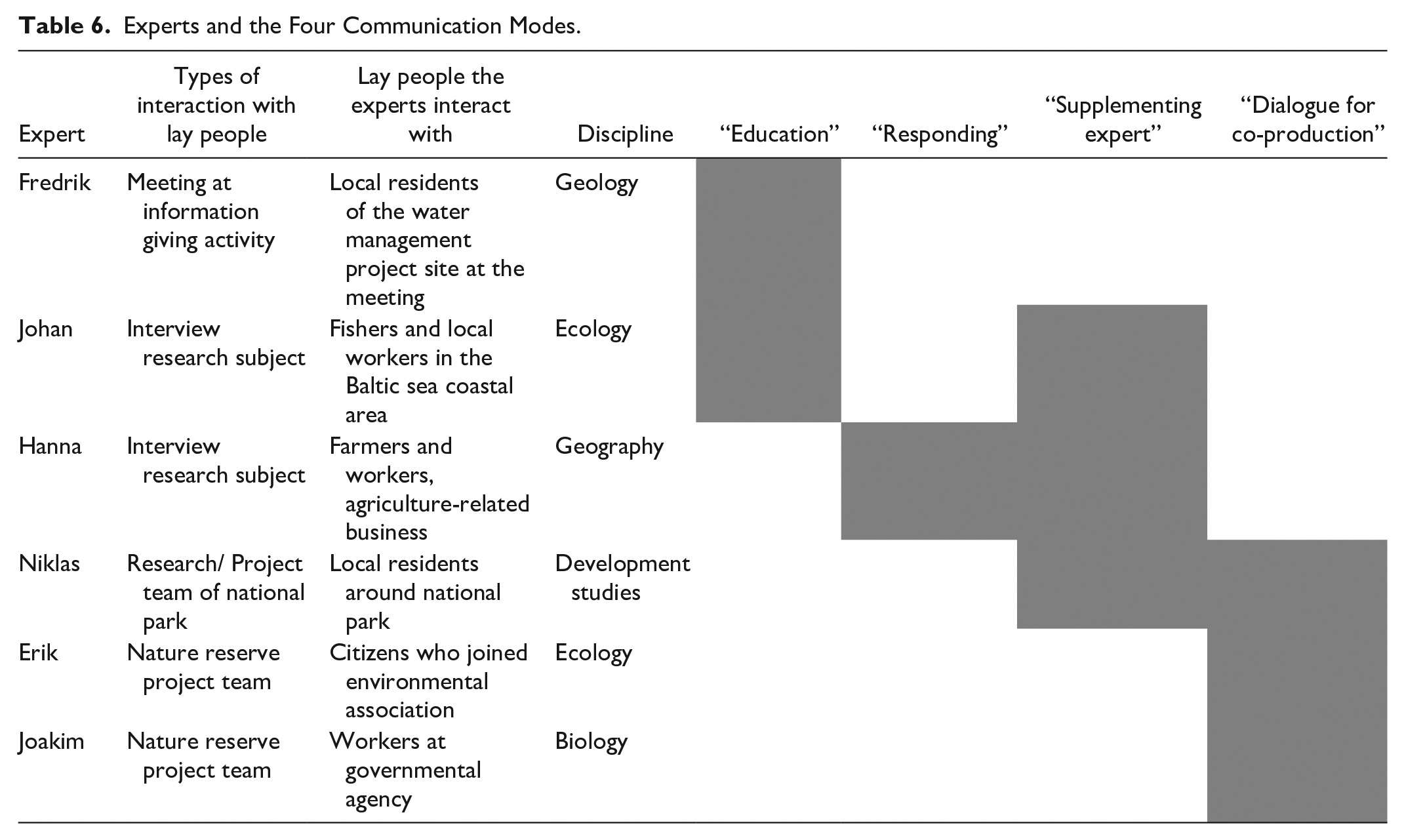
This difference on the value of lay and communication modes is of course connected to each project setting and the expected roles of lay people in the project. Those involved in a research project or a project including research (Johan, Hanna, and Niklas) seem to expect lay people to provide something relevant to the expert scientific knowledge (pattern 3/supplement mode).
Erik and Joakim, who worked with lay people as colleagues rather than people from targeted groups or local stakeholders, have a similar tendency that lay people’s knowledge is positioned in a different place from their domain (pattern 2/dialogue mode). Some projects dealt with more socio-scientific issues such as natural resource management (Joakim), which connect fishing or agricultural industries, and national park planning (Niklas), which can create benefits for the national and regional economy from tourism. They also share the pattern and mode (pattern 3/dialogue mode).
Another factor influencing their views toward citizens seems to be previous experience in their career of interaction with lay people. Although we did not include such a question in the interview, some of the interviewees mentioned their experience before the projects which might be reflected in the project setting.
Hanna had years of experience researching small-scale dairy farming prior to the interviews. She organized seminars to provide useful information for farmers which she believes made it easier for her to carry out the research because she was able to develop a close relationship and gain their trust. This successful experience might formulate her perception that lay people are motivated to learn, and they have relevant knowledge which supplements expert knowledge (responding mode and supplement mode/pattern 3).
Niklas (development study) worked as a manager of different actors related to national park planning, recognizing the value of lay knowledge for its relevance and that the process to integrate knowledge should not be dominated by experts (dialogue mode/pattern 3). He experienced work as a ranger and a fisher, which helped him to understand what people talk about, and not to dismiss their experience.
Concluding Discussion
This article started with the premise that knowledge held by nonscientists is not appreciated as potentially valuable in environmental decision-making, even though the participation of citizens and local stakeholders is encouraged. Our focus in approaching this issue critically was to examine the perceptions of those considered “experts” because of their powerful status within their particular communication arena. Therefore, the aim of this piece of research was to reveal these experts’ perceptions toward lay people and lay knowledge. The method employed was an in-depth interview with six people in a university in Sweden.
The tendency of experts in communicating with lay people to disseminate science rather than to debate, listen, and learn from them appeared very little in our research, unlike in previous researches. Rather, learning something valuable from them is the major motivation, even though what the experts found valuable differed widely. Among the experts who mentioned dissemination as an aspect of communication, not all referred to it negatively as in the “deficit model,” for instance the “responding” mode. This makes using a rigid set of communication mode categories difficult, with more variation within experts’ communication than suggested in the previous discussion in Callon (1999).
The unique feature seen in this study is the realization of the “deficit expert.” The results have shown experts perceive not only that lay knowledge is somehow valuable but also that an expert can be “deficient” in terms of their knowledge and their competence to understand reality. They recognize that science does not always provide complete knowledge to give solutions and explain phenomena. Actually, all of them denied that scientific knowledge could be totally objective in relation to environmental study. Although most of them acknowledge the importance of lay knowledge, and are motivated to gain something from their communication, as discussed in the four communication modes, their expert knowledge is prioritized and lay knowledge is possibly used in a tokenistic way. This is because, generally, scientists believe that scientific knowledge has better systems, as discussed in the three patterns of the value of lay knowledge. Thus, their recognition of the value of lay knowledge might be within a very limited range.
The “deficit model” of the relationship between lay people and experts has been criticized, and a number of nuanced relationships have been submitted by scholars. The experts interviewed in our research also showed nuanced perspective on the deficit hypotheses. Yao and Brossard (2017) argue that medialization and this postnormal era of science have also created a climate hospitable to a new type of scientist: someone who is willing and able to connect directly with public in mediate environment, typically online, for sharing scientific knowledge as well as its processes. Within the science of science communication, there is an empirical approach to defining and understanding audiences, designing messages, mapping communication landscapes, and evaluating the effectiveness of communication efforts (Kahan et al., 2017). Scientists who are trying to communication with public must be making their efforts to look at each element, although we could not cover them in details in our research.
The major contribution of this article has also been to expand the array of relationships between lay people and experts by highlighting six experts’ perceptions of lay knowledge. In short, what this research has revealed is part of the complex and layered perceptions of experts toward lay people, connected to their experience, career background, and personal beliefs. It raises doubts about a traditional, clear-cut explanation of the dichotomy between experts and lay people. On the contrary, part of the findings reveal variation in the communication mode used when disseminating science, not to educate but to respond to demands from lay people to learn more about their topic.
We are not saying that lay people have the correct view or would not benefit from more scientific knowledge but that experts should listen carefully to lay knowledge, including what is behind that knowledge because it might be something very important to be included in any environmental decision. As environmental decisions are often connected to politics, ignoring certain people or certain positions may cause tension and conflict. In addition, we need to remember that experts’ perceptions can also be connected to interests, which are far removed from the original objective as Merkelsen (2011) reminds us. It also requires experts not only to understand the context of the situation from within the world of their own expertise but to imagine what is in the world beyond.
Finally, we need to consider that the experts consulted in this research are all working in Sweden, a country with established democratic practice and collective decision-making (Larsson & Bäck, 2008). An environmental court system works effectively, where legally trained judges, technical advisors, and lay experts collaboratively make decisions (Bjällås, 2010). This social setting might also contribute to ease tensions between the authorities and the general public and that might create an inclusive atmosphere regarding various perspectives and values. Therefore, a different result could be expected if this study was conducted in another society.
Further research to examine how experts actually treat and act upon lay knowledge is needed as this research is only focused on perception. Actual behavior toward lay people could be completely different; however, much of our research revealed the positive aspects of experts’ perceptions toward lay knowledge.
Footnotes
Appendix
List of Interview Questions.

| Part 1: Experience from project |
Questions from their project - How long did the project take? - How many people from research institutions were involved? - How many people from governmental agencies were involved? - How long did the process take? - What was the toughest thing in the decision-making process? etc. |
| Expectations and impressions of lay people - What kind of (important) insight did you get from people who are not experts? - Did you reflect on their decision-making or not? Why? - What did you think about the involvement of those people? - Did anything from them impress you? - Was the number of participants from nonexperts enough? Why? What kind of information was missing? - Do you want to have more lay people in the project? Why? - Do you think participation of those people is a necessity? Why? - Anything you would like them to provide? |
|
| Part 2: Difference between expert knowledge and extended knowledge | - What are the strengths and weaknesses of data collected by natural scientists in this project? Why? - Is there a difference between knowledge which experts use and knowledge that nonexperts use? How? Examples? - Do you think (natural) science is universal? - Do you think science is objective? |
| Part 3: Influence and value of nonexpert | - Have you got important insight, information, or knowledge from people who do not have specialized scientific knowledge? - What kind of information coming from lay people is useful and valuable? - Do you think there is knowledge that only lay people can provide? - What kind of information coming from lay people do scientists usually not know? - (If they mentioned about interaction with lay people): How often do you have interaction with lay people? Do you think interaction with lay people is meaningful? Why? - Generally, how can citizens, or nonscientist, have influence on science and environmental study? |
| Part4: Tacit knowledge | - Have you heard about tacit knowledge? - Yes: Why, where, when? - Have you learned how to deal with tacit knowledge, local knowledge, or lay knowledge? |
Declaration of Conflicting Interests
The author(s) declared no potential conflicts of interest with respect to the research, authorship, and/or publication of this article.
Funding
The author(s) received no financial support for the research, authorship, and/or publication of this article.
