




Abstract
The rate of youth unemployment has been a major challenge for preceding and consecutive Ghanaian governments. There is evidence to suggest how different economic interventions to bridge this gap have failed to yield the expected results. The intended beneficiaries of these interventions are caught in a quagmire of what they perceive as opportunities within the environment which are sometimes divergent from that of government. This is due to the influencing role of two main factors: their knowledge and perception. We carry out a study to reveal the relationship that exist between entrepreneurial environment and entrepreneurial intentions and how knowledge and perception of the youth mediate this relationship. A sample survey of 187 youth using questionnaires were administered and the results analyzed using the partial least squares–structural equation modeling (PLS-SEM). Overall, entrepreneurial knowledge and perception variables showed a partial mediation in their relationship with entrepreneurial environment and entrepreneurial intention. Entrepreneurial perception showed a higher mediating effect of the two mediators on the target construct, entrepreneurial intention. Entrepreneurial perception showed the highest Cronbach’s alpha of .90 of all the variables. We advance the theory of entrepreneurship intention to show how the dual mediating interactivities are influenced by the entrepreneurship environment. The need to build a supportive entrepreneurial environment is critical in transforming the youth perception to boost their knowledge in entrepreneurship to engage in business enterprises. These are critical for policy makers, implementers, and entrepreneurial trainers.
Introduction
The world has been shaped by various activities, political, social, or economic, involving single actors or a combination of them. The result of these has had different levels of effect on the local and world economies. Entrepreneurs remain part of such actors who champion these changes. There are several economic systems exist, which promote entrepreneurship, from the informal perspective where through a collection of similar actors in analogous economic cohorts that get engaged in such economic activities at various levels (Godfrey, 2011). Weber has been credited as having classified such economic movements through his Social Change theory to impact society through the act of entrepreneurship (Godfrey, 2011; Weber, 1947). Similarly, Hoselitz’s Sociological theory related that entrepreneurship can thrive in societies where their cultural norms allow for variability and with such less rigid processes.
Within the Ghanaian setting, entrepreneurship has taken a more informal orientation in the past until in recent times. Cherukara and Manalel (2017) referred to works by McClelland who emphasized on the necessity of middle childhood as a formative stage of entrepreneurial attitudes to be built. McClelland posits that such periods are characterized by an imposition of high excellence in the early childhood with independence of thought built in the environment and building of an entrepreneurial mind-set in these young children. This consequently leads to developing the need for achievement culminating in habits that do not necessarily conform to routine and rather a desire for moderate risk with high responsibility measurable concrete tasks. This is obviously lacking within the Ghanaian context as government has begun efforts through its agencies for Youth employment like the National Board for Small Scale Industry (NBSSI) which educate people on concepts and practices of entrepreneurship. These interventions are however not too popular and widespread. There is a seeming fissure in the approach to which entrepreneurship is being disseminated and how the youth who are the targeted beneficiaries also perceive such interventions.
In simple terms, the concept of entrepreneurship is where a person (legal or natural) sees a potential profitable opportunity and exploits them, while finding new possibilities or avenues has been connected to the individual’s mindfulness, aptitudes, and experiences (Gilad & Kaish, 1991; Kirzner, 1979; Schumpeter, 1934), and entrepreneurs represent the actors who push this concept and carry out its responsibilities. The practical utilization of creative activities for public use are the foremost preoccupation of the entrepreneur and which has the tendency of setting a nation into the paths of prosperity (Say, 1971). The shaping or building the right entrepreneurial mind-set therefore remains critical for the building of entrepreneurship intents among the youth. It also remains critical to grow a strong knowledge base on entrepreneurship to shape thoughts in getting involved in the entrepreneurial activity with the requisite information.
In this study, we examine how within the entrepreneurial environment (EE) which refers to Ghanaian business environment, the entrepreneurial knowledge (EK) and perception results in entrepreneurial intention (EI) to start a business among Ghanaian Senior High school students. Youth enterprise has been targeted by the Ghana government as one of the ways of reducing the growing incidence of youth unemployment. In evaluating how the levels of knowledge and the perceptions about entrepreneurship activity impact EIs among our study sample, we seek to unearth the notions that underline the foundations of the entrepreneurial actions of our sample.
Theories of entrepreneurship have attempted to offer explanations to the reason for which some social groups are more inclined to be drifted into exhibiting some entrepreneurship behavior than other groups of people, offering reasons to justify such kind of behavior has endured more in emerging markets and economies which are hugely characterized by weak market institutions as evidenced in limited access to information, and absence of advanced establishments and systems. Within such an environment, it becomes extremely challenging to regularize the entrepreneurship activities, and Shepherd (2019) and Baumol (1996) depict the need to be focused on “a study of the influences that encourage or discourage the heterogeneous and undescribed set of activities that constitute entrepreneurship.” The provision or availability of natural endowments for carrying out business activity is as a result of genetical and sociocultural situations, extending from how education is organized, attitudes toward various economic achievements and to work including approval of items related to ethics (Baumol, 1996; Shepherd, 2019). One of the thinkers and protagonists of the Austrian School of thought, Schumpeter assert that entrepreneurs are individuals gifted with unique psychological gifts and with particular reference to profit being a motive. Motivated by such gaps in the methodological approach, this study offers to delve into the specific nature of the EE by diagnosing the factors in this environment that support or are inimical to entrepreneurship intention and toward its subsequent development in emerging markets as in the Ghanaian example.
Theoretical Background and Hypothesis
Entrepreneurial Environment (EE)
This aspect of EE depicts the various elements that condition or facilitate the operations of the entrepreneurial activity. This environment refers to an amalgamation of many features which ensure the evolution of various activities related to entrepreneurship. In the context of this study, the EE refers to the country Ghana and the type of conditions prevailing within it that either promote or stifle entrepreneurship. The students who represent the sample come from different regions in Ghana and are assembled in a boarding school facility and they bring in different levels of entrepreneurship based on their backgrounds and experience. Drawing from various empirical evidences it is inferred that nations that are less stringent on adherence to such rule and regulation, ensuring tax rebates and offer customized preparatory exercises as well as counseling for budding business-oriented persons have the likelihood to increase the commencement of new businesses (Dana, 1990; Ovaska & Takashima, 2019).
Entrepreneurship has gained popularity in many studies as a growing business field of study. The changes in the environment of businesses are thought as wellsprings in unearthing various business opportunities. These dynamics within the environment has been experimentally connected with expanded entrepreneurial action (Jones & Barnir, 2019; Sine & David, 2010). The environment within which entrepreneurs operate suggests the mixture of components which assume responsibilities for entrepreneurial development. Another critical element that tends to also increase the rate of carrying out business enterprises is the presence of financial resources and higher level educational institutions such as universities which train and carry out researches. They are observed as critical elements which influence the degree of growth in the establishment of novel businesses.
The business environment comprises external forces, factors, and institutions that are not within the controls of the business and are able to affect its operations (Mujahid et al., 2019; Pennings, 1982). It extends to competitors, suppliers, government, customers, legal, technological, and social factors among many others. These create a multifaceted scope through which the business must work with an unforeseeable environment. We align how such environmental conditions influence knowledge acquisition and perceptions under the context of entrepreneurship. These attributes vary from nation to nation or regional bloc to regional bloc. Studies show that nascent entrepreneurs are faced with various challenges which are not limited to inadequate financial support, limited information on business prospects, high taxes, and economic fluctuations (Chatterjee et al., 2019; Fogel, 1994; Young & Welsch, 1993).
The EK idea explains the level of intellect that a person must have to commence and run a business entity and it incorporates insight into recognition and exploitation of such enterprise (Garba, 2010; Inada, 2020; Pretorius et al., 2005). The content level of knowledge about entrepreneurship is characterized as the “know what” and this type of knowledge has an impact toward people’s ability of becoming would-be entrepreneurs in identifying and pursuing those chances (Alvarez & Barney, 2019; Shane, 2003) with the EE. In another sense, the environment affects entrepreneur’s performance due to cultural and social practices, and an individual’s perception of such practices ultimately is crucial for success to commence the business activity; however, the ultimate success is dependent upon the entrepreneur (Hendrawijaya, 2019). We therefore draw from the aforementioned positions to draw the following hypotheses:
Entrepreneurial Intention (EI)
Current studies recount a clear linkage between the perceived importance of education curricular content for students to EIs (Ahmad et al., 2018; Iwu et al., 2016; Ramadani et al., 2017). The intentions for such behavior is dependent on some existing attitudes (Ajzen & Sexton, 1999; Bilgiseven, 2019). A targeted intention toward a particular action is dependent on both the participants perception toward the individual and this has been studied through various relationships such as socially accepted behaviors and how they perceive their success or failure in the chosen line of action (Ferreire et al., 2012). Other studies revealed that how positively an individual views a new venture determines how strong an individual’s attitude is toward it in this case, entrepreneurship, and one’s intentions toward it (Bilgiseven, 2019; Campbell-Kibler, 2013).
Several scholars have accented to the ideology that one’s cognitive capabilities play an important role and ensure much impact on entrepreneurship (Mitchell et al., 2011). The Entrepreneurial Intentionality model depicts the entrepreneurial behavior which is conceptualized in the domain of the individual’s context (Bird & West, 1998; Tiwari et al., 2017). EIs can be defined as an individual’s aspirations to own his or her own business enterprise or a person’s orientations which eventually lead to creating their own ventures. Intents of an individual means their motivating efforts toward a planned goal (Armitage & Connor, 2001). This plan or decision may be due to an earlier exposure to an entrepreneurial situation through either experience or EK acquisition. The EI has several influences ranging from personality-trait, contextual, motivational, and background of the person.
Tiwari et al. (2017) and Bird and West (1998) demonstrate the part behavioral intentions play to determine entrepreneurship results; as this influences their committing to, organizing, setting of goals, communicating, and several types of work. In another sense, it is assumed that entrepreneurship intention is essential, or sufficient, to result in entrepreneurship. Personality traits highly determine one’s intention toward starting a business (Altinay et al., 2012). Risk-taking ability, self-confidence, autonomy, the desire for achievement, innovativeness, and internal drive of control are traits which affect an individual’s entrepreneurship intentions (Estay et al., 2013). Self-confidence is considered as a valuable motivation for a person to persevere and venture into a project directed at achieving his goals (Turker & Selcuk, 2009). Investigating EI trend will open up an in-depth understanding in the various techniques that motivate their sustainability in these ventures over the years. This in the long run will influence their development of the idea of entrepreneurial opportunities in their domain of operation within the EE. Environmental factors affect EIs and subsequent performance (Memon et al., 2014). Mueller (2016) highlights that there are factors within the environment such as family background and social environment that serve as influencing factors that facilitate the cultivation of entrepreneurship (Chen & He, 2010). External environmental factors influence an individual’s intention toward entrepreneurship (Autio et al., 2001; Giacomin et al., 2011). Jukka and Timo (1999) see entrepreneurship as a spiritual warfare that guides a person’s focus toward the path for undertaking a certain purpose. We posit the hypothesis on the EE leading to EI below:
Entrepreneurial Knowledge (EK)
The concept of knowledge acquisition has been traced in time past and emerging entrepreneurs require a repository of cognition to enable them decide on their cause of actions (Qian et al., 2013; Wiklund & Shepherd, 2003). EK is referred to as one’s in-depth knowledge into business startup and operation that embraces the art of recognizing and exploring entrepreneurship opportunity and exploitation and knowledge on the operativeness of beginning and sustaining a venture including human resource management production, marketing, and financial management (Pretorius et al., 2005; Smith & Chimucheka, 2014). These cognitive procedures remain very important as they apparently connect unique ideas stemming from diverging thoughts or the propensity to keep results that differ from constituted approaches for getting things done (Gilson & Madjar, 2011; Mumford & Gustafson, 1988).
H. B. Roxas and Azmat (2014) and Widding (2005) assert that knowledge and the ability to access it remain the most essential resource in the study and practice of entrepreneurship. EK is therefore captured to cover the various ideas, skills, and mentality which the entrepreneurs explore or should explore (Al Mamun & Ekpe, 2016; Jack & Anderson, 1999). There exist from previous studies two main domains of EK: the strategic management–oriented knowledge and the functional-oriented knowledge. The strategic management–oriented knowledge cuts across such areas as growth management, strategic and competitive analysis, exploration and exploitation of opportunities, and business environment evaluation (Buang & Awalludin, 2011; Yu & Chan, 2004). The functional-orientated knowledge expands through marketing, production, sales, financial management, and human resource (Hindle, 2007; Rodriguez-Lopez & Souto, 2019; Widding, 2005).
Another school of thought assumes that EK emits as a result of one’s access to a formal educational regime in line with entrepreneurship study (Cox et al., 2002; Sang & Lin, 2019; Souitaris et al., 2007) and this is where we situate our studies in relation to EK of students. In researching such entrepreneurs, cognizance is given to one’s gender, ethnicity, previous entrepreneurial experience, age, and income level as controlling variables that can possibly alter the entrepreneur’s willingness to pursue an EI.
A sociocognitive framework for identifying opportunities has also been proposed which incorporates intellectual development, namely gathering information, deliberating on, dialoguing, and resource evaluation by interacting actively with different groups of persons (Amir, 2015; De Koning & Muzyka, 1999). This makes knowledge one of the most cherished resource components in establishments to propel competitive advantage (Van Den Bosch et al., 1999). Abun et al. (2018) discovered in their research that the EK and EI are high among students and discovered a remarkable interconnectedness between EIs and EK of students. Charney and Libecap (2000) admit the relationship between entrepreneurial aspirations and insight into business and they assert that there is a definite association betwixt business knowledge and intention. Similar studies by B. Roxas (2014) regarding the effects of entrepreneurship intention indicate that there is a correlation between entrepreneurship knowledge and EIs and thereby stressing in their research the significance of spreading knowledge to raise students’ morale and tendency to get involved in entrepreneurship . Tshikovhi and Shambare (2015) sort to inquire into whether intermittent entrepreneurial trainings could have an effect on the attitudes and EIs of African students. In their research, they posited that one’s EIs are greatly influenced by their personal attitude as well as their knowledge in entrepreneurship.
Walter and Dohse (2012) emphasized in their studies that knowledge-based startups need access to resources within their domain. This, they stress, is of essence for individuals to comprehensively analyze such decisions to be entrepreneurs based on multilayered approaches that result in granting access to key strategic knowledge. Studies on the understanding of students’ intelligence capacities and intention to start their business in recommending that such reasoning enables them to enhance their ability to learn business skills and allows them to build intentions in transforming to be entrepreneurs (Pihie et al., 2013). B. G. Roxas et al. (2008) pointed out in their studies on the knowledge in entrepreneurship and intention and confirm that learners’ knowledge levels in entrepreneurship studies have an affirmative influence on student intention to start a business venture.
Similar findings are traced in the works by Miralles et al. (2016) and B. G. Roxas et al. (2018) pointing to how such knowledge acquisition through formal business education positively influences intentions to commence business through the mediating role of attitude and societal norms sharing positive relationship on entrepreneurial behavior. Studies on the relationship between the EK and its effect on EIs have been carried out and been concluded that the knowledge gained by students attending an entrepreneurship course will have a positive impact on the students’ intentions of starting a business (B. G. Roxas et al., 2008). This study advances the thesis that knowledge gained from a formal entrepreneurship education program will have positive effects on an individual’s overall EIs through the mediating influences of attitudes and social norms favoring entrepreneurial behavior (Miralles et al., 2016; B. G. Roxas et al., 2008). The study draws from the entrepreneurship education and intention relationship. This points out that there was an increased intensity with regard to starting a business within students who took part in entrepreneurial education and those who did not (Westhead & Solesvik, 2016). This study found that business students participating in EE modules were reported with high intensity of business intention. We assert and therefore hypothesize that
Entrepreneurial Perception (EP)
In this study, the environment is also attributed with influencing EP but towards EI. The entrepreneur represents a cognitive agent who operates in an enacted environment whereby the principal roles include interpreting, drawing logical understanding, and reducing biased uncertainties (Garud et al., 2014; Sarasvathy, 2014) of the business environment. Within the confines of EPs, the business opportunities are important to the abilities by the entrepreneur in creating ventures whereby such endeavors by the entrepreneurs positively influence business startups or EI according to the finding of studies by Edelman and Yli-Renko (2010). The key driver of EI is ‘perceived feasibility’, while the perceived resource availability is seen as the main feature in this scope of ‘perceived feasibility’(Fayolle & Linan, 2013; Ismail, Ahmad, & Yunus, 2012). It therefore points out to the fact that an entrepreneurs ‘given means’ becomes the repository for any entrepreneurial action as highlighted in the effectuation model (Sarasvathy, 2014). In reference to ‘given means’, this term is extremely subjected to the entrepreneurs perception and is dependent on how the entrepreneur understands his or her experiences, identity and a set of social networks. It is premised on these that such entrepreneurial action takes place. Perceptions about the market opportunities vary also among entrepreneurs due to varying opinions, levels of assessment, and expectation about their business surroundings (Dew et al., 2008; Sahai & Frese, 2019) making EP key to entrepreneurial opportunity development.
Extensive studies by Edelman and Yli-Renko (2010) conclude that the stronger the perception, the stronger the intentions of creating a business venture. The EPs often lead to an initiation and persistence by entrepreneurs to commence business enterprises (Edelman & Yli-Renko, 2010; Urban, 2019). This leads to another hypothesis that

Model for the study.
Research Methodology
This study was undertaken in the campus of New Juaben Senior High School, in the Eastern regional capital of Ghana. It was carried out among students in the Home Economics department. Typically, this cohort of program fall under the VOTEC stream. This has been classified under one of the headline issues by the Ministry of Education and other governments to reduce poverty, increase higher occupational prospects, provide employable skills, and improve perception on the TVET program (Albashiry, 2019; Boateng, 2012). It is categorized into pre-vocational skills (basic level of education), vocational (secondary level), as well as technical (tertiary level) in Ghana. This study is crucial in shaping behaviors and the attitude of knowledge-based economies (Barba-Sanchez & Atienza-Sahquillo, 2012; Molloy, 2016).
The use of the students as samples in the area of EI studies is justified by the fact that these individuals have more or less towed their career path and this approach offers an optimized way of assessing their readiness for such enterprises (Al-Jubari et al., 2019; Li & Chen, 2009).
Instruments
In this empirical study, we employed the 5-point Likert-type scale questionnaire capturing all the key variables under consideration to measure their influence on the dependent variable. As mentioned, the Likert-type scale measured ranges from 5 (implying strongly agree) to 1 (implying strongly disagree). This study employed the use of the partial least squares structural equation model (PLS-SEM) software 3.3.2 by Ringle and Sarstedt (2016) in determining both measurement and structural results of the responses. These were captured in structural forms of the results in between the variables. The measurement forms are represented using tables that give account of the variables, indicators, composite reliabilities, Cronbach’s alpha, and discriminant validity. These generally determine the validity and reliabilities of the respective indicators and run a bootstrap to show the strength of their relationship. The questionnaires were initially pretested using convenience sampling and this helped to identify aspects in the indicator questions needed to be fine-tuned to fit their respective constructs.
Construct Measures
The students formed the unit of analysis and in line with the overall agreement explained in the literature. The construct measures used for assessing the dual mediating effects of knowledge and perception on EIs in the environment covered the following construct items: EI, knowledge, perception, and environment. Referring to the previous literature by Ajzen and Sexton (1999), Campbell-Kibler (2013), and Tiwari et al. (2017), EI was measured based on three-item construct on the 5-point Likert-type scale. This construct represented the target construct that represented the target latent construct.
Also, the EK construct which represents one of the two mediating construct variables was made of five items. The selection of these items was consistent with studies by Tshikovhi and Shambare (2015), Souitaris et al. (2007), and Abun et al. (2018). The responses followed a 5-point Likert-type scale. The next construct measure item is EP which is also a mediating latent construct variable. It follows the same 5-point Likert-type scale measure and were made up of five indicator variables. These were based on earlier works by Edelman and Yli-Renko (2010), Sahai and Frese (2019), and Urban (2019). The sole independent exogenous latent construct variable was EE. This was made up of a three-item construct also based on the 5-point Likert-type scale. It was constructed premised on studies by Gomezelj and Kusce (2013) and Shane (2003).
Data Gathering
The data for this study were gathered during the 2017/2018 academic year through questionnaires that were administered by the guidance of one of the authors and assisted by two teacher volunteers. The questionnaires provided clear instructions per sections to explain the scale measurement (Leedy & Ormrod, 2014). The questionnaire was made up of three parts: respondent demographic characteristics, EE, EK, EP, and EIs. There was 187 retrieval of usable questionnaires out of a total of 196 questionnaires that were administered. These unusable questionnaires had multiple answers or had portions left unanswered.
Common Method Variance
In the study, a factor analysis was carried out which demonstrated that there is no common factor loading on all measures used (Chang et al., 2020; Jordan & Troth, 2020; Podsakoff et al., 2003; Podsakoff & Organ, 1986; Vinzi et al., 2010). Subsequently, therefore, common method bias was considered not to be a problem with the study data set (Vinzi et al., 2010). Common method bias according to Akram et al. (2019) and Bagozzi and Yi (1988) refers to the variances that are attributable to the various measurement methods instead of the constructs of interest considering the potential of becoming a possible validity threat to the study results (Akram et al., 2019; de Zubielqui et al., 2019). Testing for common method biasness is of essence before undertaking further hypotheses testing for the study. We use the Harman’s single factor test method to provide the needed evidence to indicate how the data set was void of common method bias, also with the total variance explained less than 50% (Akram et al., 2019; Podsakoff et al., 2003).
Results and Findings
The study was carried out among VOTEC students in the Home Economics program and the total sample size (n) of 187 was analyzed. They were made up predominantly 72.19% females and 27.81% males (see Table 1) and the model age (15–17 years) constituted 94.65% of the respondents.
Demographic Profile of Respondents.

Source. Field study, 2018.
Assessment of Measurement Model
The study considered and assessed the reflective measurement model and showed the respective reliability and validity outcomes. The various latent construct indicators were subjected to factor analysis (Hair et al., 2014). The composite reliabilities of the constructs were determined and they ranged between .851 and .931; these were higher than the bottom line (Hair et al., 2014). The discriminant validity is ascertained using the average variance extracted (AVE) correlation square root in comparison with the assumption that the AVEs are usually greater than the constructs indicating the variance (Fornell & Lacker, 1981; Hair et al., 2019; Radomir & Moisescu, 2019; Anlı, 2019). The discriminant validity test was carried out on all the construct variables in the model. From the table 3, the analysis show AVE results (bold values) greater than the estimated correlated values between the respective constructs. It therefore means that all the respective construct variables meet the discriminant vadility of the model, thereby aligning with studies by Hair et al. (2014; 2019).The AVE is a reliability indicator and according to Hair et al. (2014; 2019), reflective measurement model reliabilities exhibiting high loadings (>0.70) are satisfactory with regards to their internal consistency making our AVEs for the model sufficient.
Construct Reliability and Validity Measure.

Fornell–Larcker Criterion (Discriminant Validity).

Source. Field study, 2018.
Note. EP = entrepreneurial perception; EI = entrepreneurial intention; EE = entrepreneurial environment; EK = entrepreneurial knowledge.
Structural Model Assessment
Building from the assessment of the measurement model, the study confirms the validities and reliabilities of our model, out of which the structural relationships are established.
The target latent construct, EI showed a predictive power R2 of 89% which is very substantial. The two mediating latent constructs namely EK and EP predicted R2 values of 55% and 44%, respectively. In considering their level of influence or effect on each other, the relationship between the EE to EK showed .739 which is the highest effect relationships in the model. This is followed by EE to EP measuring .660, while EK to EI had the least effect of .233. This gave an overall view that exogenous latent construct EE had the highest dual effect on the mediating latent constructs EK and EP. Invariably, with regard to how these exogenous and mediating latent constructs influence the target or the dependent latent construct, the structural results reveal that EP (.489) has the most effect on EI followed by EE (.307) and EK (.233).
The PLS-SEM allows for further testing through bootstrapping (see Table 4) in determining the path coefficient (significance) of the relationships between the variables (Hair et al., 2014). This bootstrapping procedure employs sample of 5,000 made up of cases equal to the valid observations. It was based on the two-tail significance level of 5%. The results indicate that the four structural relationships are strongly significant with EK to EI being moderately significant.
Path Coefficients (Bootstrapping).

Source. Field study, 2018.
Note. EE = entrepreneurial environment; EK = entrepreneurial knowledge; EP = entrepreneurial perception; EI = entrepreneurial intention.
p < .05.
Mediating Analysis
The PLS-SEM is robust with models containing latent variables as well as tests, mediating effects or the indirect effects (Kibirango et al., 2017; Preacher & Hayes, 2008). It allows for studies at the early stages of theoretical development measurement (Martinez-Martinez et al., 2017), in-cooperating bootstrapping for distributed indirect effect samples which are either considered under simple or multiple mediator models (Preacher & Hayes, 2008) and can be used for constructs that have less than four indicator items (Kibirango et al., 2017). In general, many studies have factored the use of Sobel’s test in conducting the mediating analysis. However, it was limited to distributed assumptions which may not be responsible for indirect effects. The PLS bootstrapping has a higher statistical power as it makes no assumptions about variable distribution and is applicable to small sample sizes hence increasing confidence as it shows a higher statistical power (Hair et al., 2014).
Following from the procedure for PLS-SEM analysis of mediation, we established that since the direct effect (EE → EI) is significant, the indirect effects (EE → EK; EE → EP; EK → EI; EP → EI) must be determined within the PLS path model. The results of the bootstrap confirm significance and this leads us to assess the variance accounted for (VAF). The determination of the mediation in the mediating latent constructs (EK and EP), leads to carrying out the VAF. The VAF enables the determination of the size of the indirect effect and increases our understanding on the level of mediation by these mediating variables to the dependent variable or target latent construct:
VAF between EE → EK → EI is 36%
VAF between EE → EP → EI is 20.3% 20% VAF 80%
We conclude that both EK and EP partially mediate EE → EI (Hair et al., 2014).
Discussion and Conclusion
We set out to assess how the EE leads EI to commence a business enterprise aided by the mediating variables, EK and EP among the target samples. We employed the PLS-SEM to analyze collected data which were explorative in nature (Rigdon et al., 2017). Both measurement and structural models were determined and the respective relationship and significance carried out including the calculation VAF (Hair et al., 2014). The two mediating variables EK and EP partially mediate the process of attaining EIs with the exogenous latent variable construct, EE. Our joint mediating latent construct EK and EP demonstrated a partial mediating capability of 36% and 20%, respectively, through VAF measurement. We expand the literature on EI by first examining the effects of two mediating variables, EK and EP, among high school students.
Overall, EE showed a higher level of significance as seen in its relationship between EK and EP. In considering the path coefficient of the structural model (see Figure 2), we assess the relationship between the EE and EK and this showed the highest path value of .739. This implies that the EE shows a high level of influence on the acquisition of EK. The Ghanaian environment therefore has a way of affecting the knowledge acquisition by students. This is defined by the type of curricular taught at the Senior High School level that involves EK as shown in studies by Boateng (2012). The cross-triangulation interviews indicated that only vocational and technical education have aspects of entrepreneurial education embedded in their curriculum. The focus has been on skills acquisition. As aligned with the studies by Inada (2020), Pretorius et al., (2005), Garba (2010), and Alvarez and Barney (2019) that EE and EK interrelate to offer would-be entrepreneurs the opportunity to be equipped to recognize such opportunities and exploit them.

Structural results of PLS analysis.
Implicitly, the environment affects significantly the knowledge and perceptions of nascent entrepreneurs. The next most influential structural relationship is seen between EE and perception. In this, the relationship represents an exogenous latent construct and a mediating variable resulting in a value of .660. It implies that the environment of the students affects their perceptual abilities of entrepreneurship. It came to light that of all the three latent constructs that related to the target or dependent latent construct EI, EP showed the highest level of influence. All the hypotheses were confirmed by the results of the PLS-SEM analysis. These results affirm earlier studies that perceptions of opportunity by start-ups and perceived feasibility are necessary drivers for EI (Edelman & Yli-Renko, 2010; Ismail et al., 2012).
We established through our results that the EE affects more on these two mediating variables. Also comparing the two entrepreneurial mediating factors, perception affects more on EI than on EK. All the relationships established in the hypotheses are positively significant; however, EK to EI is moderately significant at p value of .047* within **p < .05. It is worthy to note that the perception of entrepreneurship leads more to the intention to commence the entrepreneurial activity. The high effect of the environment on EK and perception suggests that there exists the entrepreneurship potential. There is however more to be done in making the realization of this entrepreneurship potential among the youthful population, a reality to harness their entrepreneurial potential.
The relationship that exists between EE and EIs showed a coefficient value of .307. It denotes that the environmental factors influence students’ intentions to commence entrepreneurship even though the impact is not great. One’s experience with regard to family exposure to entrepreneurial activity, for example, owning or doing family business and other social environmental factors influence growth of entrepreneurship as this substantiates studies by Chen and He (2010). Similarly, a few of the respondents showed that the environmental factors influenced their intention to participate in entrepreneurship.
The influencing effect of the two mediating variables indicates high positive relationship between perception and intention. It was found that students who highly perceived entrepreneurship stood a high chance to start a business. This supports findings that high and strong levels of perceptions lead to commencement of business (Edelman & Yli-Renko, 2010; Urban, 2019); students’ level of perception precipitates entrepreneurial opportunity development (Sahai & Frese, 2019) and this was exhibited in the responses of the students. Students displayed just adequate knowledge in their willingness to carry out EIs. Similarly, the relationship between knowledge and intentions variable constructs was lower at .233. The low levels of EK inhibit those student startups. Since there is cultivation of knowledge and intentions, those with the knowledge showed such enthusiasm to commence business. Also such knowledge influences attitude as stipulated in the studies by Tshikovhi and Shambare (2015). It is this knowledge that promotes their levels of intentions to begin business (Pihie et al., 2013).
Limitation/Future Direction of Research Study
In this study, we focused on feedback from one school and may be limited to a generalization for the entire country. It would be necessary to expand this study to cover a larger sample to enable a broader perspective on this subject matter, notwithstanding that the outcomes of this study reveal several positives. First, it is necessary to delve into the factors that have contributed or accounted for EP having a higher effect on EIs through EK. Future studies could incorporate other methodologies as in the use of the importance performance matrix analysis (IPMA) which is a higher order dimension variance–based methodology to assess these elements embedded in the EP. Equally, there could be a comparative study between senior high and tertiary students on their perceptions to engage in the entrepreneurial activity. Policy makers and implementers need to incorporate the intentions of would-be beneficiaries to understand their state of cognitive preparedness to make their interventions successful and thereby helping to reduce the incidence of unemployment among the young people.
Footnotes
Appendix
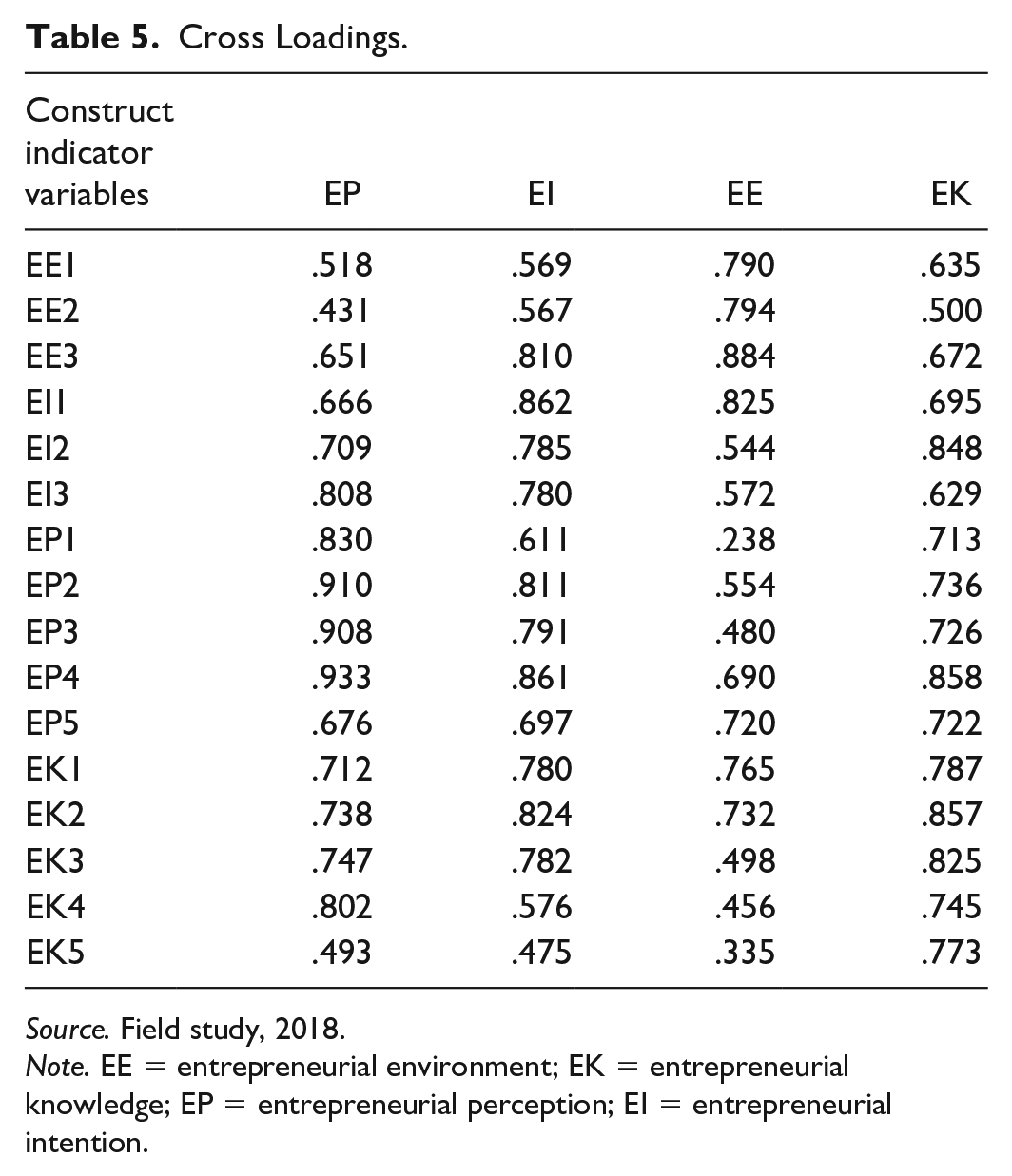
Cross Loadings.
| Construct indicator variables | EP | EI | EE | EK |
|---|---|---|---|---|
| EE1 | .518 | .569 | .790 | .635 |
| EE2 | .431 | .567 | .794 | .500 |
| EE3 | .651 | .810 | .884 | .672 |
| EI1 | .666 | .862 | .825 | .695 |
| EI2 | .709 | .785 | .544 | .848 |
| EI3 | .808 | .780 | .572 | .629 |
| EP1 | .830 | .611 | .238 | .713 |
| EP2 | .910 | .811 | .554 | .736 |
| EP3 | .908 | .791 | .480 | .726 |
| EP4 | .933 | .861 | .690 | .858 |
| EP5 | .676 | .697 | .720 | .722 |
| EK1 | .712 | .780 | .765 | .787 |
| EK2 | .738 | .824 | .732 | .857 |
| EK3 | .747 | .782 | .498 | .825 |
| EK4 | .802 | .576 | .456 | .745 |
| EK5 | .493 | .475 | .335 | .773 |
Source. Field study, 2018.
Note. EE = entrepreneurial environment; EK = entrepreneurial knowledge; EP = entrepreneurial perception; EI = entrepreneurial intention.
Declaration of Conflicting Interests
The author(s) declared no potential conflicts of interest with respect to the research, authorship, and/or publication of this article.
Funding
The author(s) received no financial support for the research, authorship, and/or publication of this article.
