



Abstract
There is a limited understanding of how knowledge transfer in deliberative planning takes place, especially in a rural context. This article examines the metamorphosis of knowledge that occurs in deliberative rural planning dominated by the community. Deliberation facilitates the transactive process in development planning through knowledge transfer between the planner and the community to ensure that the achieved policies are appropriate for the local conditions. By combining the notion of transactive planning from John Friedmann, organizational knowledge creation from Nonaka, and the knowledge transfer–acquisition loop from Luna Khirfan, this article proposes a model of knowledge transfer based on a case study of deliberative planning practice for rural development in Teluk Aru, Indonesia. Fourteen respondents from various groups were interviewed, including village government officers, subdistrict officers, district agency officers, and community members. The deliberation process took place in four transactive stages: (a) public involvement, (b) knowledge enhancement, (c) concept dominance, and (d) policy improvement. The participants need to go through all these stages to ensure that the achieved policies conform to substantive needs and the community’s wishes. The proposed model shows that not all participants are in the same situation when taking part in the deliberation. Some of them can internalize the knowledge gained, while others are in a zone that is not covered by knowledge transfer. This explains why rural planning does not bring in inherent knowledge, although many attended the deliberation. Power, deliberative ability, and seriousness in participating affect the process of knowledge transfer.
Keywords
Introduction
The deliberative democracy approach is often applied in planning. Deliberation can be used in community-based planning (deliberative planning) to appropriately implement regional development policies in local conditions, which involves a transfer of knowledge between the planners and the community (Beza, 2016; Puustinen et al., 2017). Mäntysalo and Jarenko (2014) argue that communicative planning theory supports planning by deliberative practitioners (Forester, 2013), increasing their judgment and legitimacy in developing strategic planning (Legacy, 2012; Legacy et al., 2014).
Friedmann (1973, p. 187) identifies this process as transactive planning where the planner contributes to concepts, theories, analyses, new perspectives, and systematic procedures, while the client (in this case, the community) contributes to in-depth knowledge of the context (local knowledge), realistic alternatives, norms, priorities, objective, feasibility assessment, and operational details. Although the learning discourse in planning has explained that knowledge transfer is part of social learning, the current understanding does not sufficiently explain how planners and clients synthesize and adapt to knowledge.
Deliberation shapes policies to fit local physical and social conditions through the transfer of knowledge. For instance, Beza observes that a community-based approach leads to appropriate knowledge transfer and the involvement of the community at the local scale allows planners to gain valuable insight into the local conditions for policy determination (Beza, 2016, p. 10). Legacy argues that tacit knowledge (knowledge that is understandable without verbalization) is essential in deliberative planning because it requires a more inclusive approach to decision making, embracing the community’s experience with the spatial conditions regarding the planning object (Legacy, 2012, p. 73). In deliberative planning, tacit knowledge is contributed by the local community, and professional knowledge is contributed by the planners. The community is allowed to participate in defining the problem, solving the problem, and decision making. Dandekar argues that nowadays community participation is recommended for various elements of governance, especially when considering general planning at the local level. In this arena, the theoretical transactive planning approach by John Friedmann has had a significant impact (Dandekar, 2018, p. 2). However, research still lacks on how the transfer of knowledge takes place in the field during deliberative planning at the local community level, especially for rural planning. The article aims to decipher this area with the following research question:
This study used a case study in a rural area in Indonesia (Teluk Aru) to address this question. In Indonesia, rural planning is carried out through deliberation, for example, in annual village-level meetings to discuss proposed development projects. Its practice involves dialogue among stakeholders, who can generally be divided into two groups: planners, who are part of the deliberative bureaucracy, and villagers. The knowledge transfer from planners to villagers and vice versa can provide insight into how planning deliberation takes place in local communities at the village level.
This article contributes to knowledge transfer in planning with a specific mechanism in local communities at the village level. Previous researches focused on knowledge transfer in urban planning where interactions take place between planners and decisions made by decision makers such as political officials (Davoudi, 2015; Ebrahim & Ortolano, 2001; Khirfan, 2011; Krenjova & Raudla, 2018; Schmidt-Thomé & Mäntysalo, 2014; Thorkildsen et al., 2015; Zapata, 2013). Khirfan (2011) has made an understanding of the metamorphosis of knowledge that undergoes synthesis and adaptation between cross-country planners. However, we still need to understand how this metamorphosis of knowledge takes place in a local planning context, such as rural planning deliberation dominated by the community. The community has the right to make decisions on planning activity priorities, an issue that this study addresses. This study is a preliminary review, examining the research topic in the global south context. It provides knowledge gained from analyzing deliberative planning practice for rural development in Teluk Aru, Indonesia.
The following section contains a literature review to provide a theoretical basis. The “Case Study and Methodology” section discusses the case study and explains how the data were managed and analyzed. The “Results and Discussion” section describes the results of the empirical data analysis and discusses the relationship between the findings and the literature mentioned in the introduction and the theories previously discussed. Finally, a model is proposed as the theoretical contribution of this work.
Deliberation in the Transactive Planning Approach
Transactive planning “represented a radical break with quantitative, spatial models of planning and proposed a more ‘people-oriented’ role for planners and a concern for the disadvantaged and inarticulate groups in society” (Friedmann & Huxley, 1985, p. 37), in response to the communication gap between planners and their clients. This implies that a way must be found to combine scientific and technical knowledge with personal knowledge in social interventions (Friedmann, 1973, pp. 171–190).
Transactive planning is an effort to bridge the gap between the planner’s technical knowledge and the community’s local knowledge. This approach is based on communication to direct regional planning policies so that they conform to planning knowledge. The policy briefing is carried out because of the social intervention that occurs by regional deliberative planning as a suitable instrument for bottom-up development planning. Transactive planning has democratic value and is an approach that is expected to create a middle path to achieve harmonization between the planners and the community and among the heterogeneous interests within the community.
The transactive planning approach focuses on the full experience of community life to reveal planning issues that have to be addressed. It involves face-to-face dialogue with the community, which has a direct impact on the planning outcome. Transactive planning minimizes field surveys and data analysis because it occurs more through interpersonal dialogues characterized by a mutual learning process (Hudson et al., 1979, p. 389).
However, there is still a limited understanding of the transactive process in community-level deliberation. The communicative planning literature does not offer a proper analysis of the knowledge transfer (transaction of information) that takes place during deliberation between the planners and the community. Consequently, it is difficult to see where problems come from the result of the deliberation process and is not surprising that some experts doubt the effectiveness of deliberation between planners and communities.
Community-level deliberation is challenged by actors who do not respect the basic rules of decision making and by power-based argumentation (Sager, 2013, pp. 42–252). Difficulties in operational consensus building regarding specific details occur because of contradictions between private and collective interests and the lack of control of the planner and the government on policy-making strategies (Voogd, 2001; Voogd & Woltjer, 1999). There is a growing debate on the need for greater recognition of the relationship between power and inequity, and the presence of unequal deliberative ability caused by asymmetric power distribution, which complicates the relationship between the state and local communities (Huxley, 2000; Mäntysalo & Jarenko, 2014). Empirically, it can be observed that the results of community-level deliberation tend not to reflect ideal planning techniques (substantive procedure) or not to conform to the technical guidelines for implementing the development activities that have been set.
There is a reason why communicative planning does not automatically lead to appropriate knowledge transfer during community-level deliberation. Deliberation tends to be done using a pragmatic approach. The first generation of deliberative democracy theorists, that is, Jürgen Habermas and John Rawls, made normative reasoning a basis of deliberation instead of transaction and exploration of information (Mäntysalo & Jarenko, 2014, p. 39). Deliberation should be an instrument to collect information, not suddenly create consensus based on shallow knowledge. Forester (2013) argues that, generally, planners understand deliberation as average pragmatism instead of critical pragmatism (p. 8). Average pragmatism sees deliberation as a debate, leading to skepticism and narrow agreements and policies, sacrificing public welfare. Critical pragmatism sees deliberation as transaction and exploration of information, minimizing debate. Sherman, in a case study mentioned by Forester (2013), shows how deliberation encompasses transaction and exploration of information. He sees deliberation as a medium for data transaction to transfer information instead of a debate that raises excessive skepticism. The exchange of information is an essential part of the deliberation process between planners and community.
The effectiveness of the transactive process is strongly influenced by the knowledge transfer that is required because of existing knowledge gaps resulting from different perceptions and perspectives and differences in knowledge between the planners and the local community. In deliberative planning at the local level, planners have technical thoughts/knowledge regarding strategies that can be implemented (generally referring to the governmental guidelines). However, the community is not necessarily homogeneous; there are different knowledge levels and different interests. Knowledge transfer is necessary to ensure that the planners and the community do not act autonomously so that planning effectiveness at the local community level is optimized. This knowledge distribution has an impact on the transactive process that occurs during the deliberative planning and on the compatibility between policies at the local level and the governmental guidelines for implementation.
Organizational Knowledge Creation
The organizational knowledge creation theory proposed by Nonaka and Takeuchi in 1996 can be used to explain knowledge transfer within the deliberative planning at the local community level. Knowledge transfer does not only happen on the level of individual community members but also at the level of the community as a whole. The community is harmonized into an organization, because the decisions are determined by the whole community and not by separate individuals (Larsson & Elander, 2001). Hence, this process can be perceived as a form of organizational knowledge creation.
Knowledge transfer through organizational knowledge creation is a process that supports knowledge creation by individuals as part of an organizational knowledge system. This process can be seen as a spiral of explicit knowledge that moves continuously through four modes of knowledge conversion, that is, (a) socialization, (b) externalization, (c) combination, and (d) internalization (which called “stages” in this study), following the knowledge transfer-acquisition loop from Nonaka and Takeuchi (1996). This insight can elucidate the transactive process that happens during deliberation at the local community level as was done by Khirfan (2011) for Amman in Jordan.
Socialization is the process of sharing experiences and thereby creating tacit knowledge such as shared mental models and technical skills. Externalization is the process of articulating tacit knowledge as explicit concepts. Combination is the process of systemizing these concepts into a knowledge system. Internalization is the process of embodying explicit knowledge in tacit knowledge. (Nonaka & Takeuchi, 1996, pp. 836–841)
Theoretically, this model could also reflect the effectiveness of the transactive planning process, because it provides a sequence of explanations for increased knowledge transfer experienced by the community. The greater the knowledge transfer that occurs, the more effective the policy that is produced.
Case Study and Methodology
This research applied the proposed transactive planning model to the forum discussions for village planning (Musrenbangdes) in Teluk Aru, Langkat district, North Sumatra province, Indonesia, as a case study to explore how the transfer of knowledge takes place in the field during the deliberative planning at the local community level. The result of the case study was used to develop a transactive process model.
Developing countries are commonly dominated by rural areas and hence their progress mainly depends on regional development. Since 2015, the Indonesian government has conducted an ambitious fiscal decentralization program called the Village Fund budget (Dana Desa) to which 10% of the national budget (APBN) is allocated. It is aimed at enhancing welfare and equity through the improvement of public services, economic stimulation, resolution of development gaps as well as empowering village communities. Discussion forums are organized in which both planners and the community participate to formulate what planning activities should be prioritized.
In community-based planning, deliberation is conducted through a transactive process to determine the planning policy implementation by development activity prioritization related to budget use. This is done with the intent to optimize budget utilization, in terms of both the efficiency and the effectiveness of budget spending on the targeted development activities. Related to the Village Fund program, village communities play an important role in the planning process (determination of development activities) and its implementation (execution). The transactive process takes place in meetings at the village level to ensure that the planned development conforms to the community’s wishes as well as to the implementation guidelines set by the central government (see Figure 1).

Planning practice in community-level deliberation.
Empirical data were obtained from snowball sampling. The data were collected through observation, document analysis, and semi-structured interviews using open-ended questions with 14 respondents from various groups, including three persons from the village government officers, three persons from subdistrict officers, two persons from district agency officers, and 6 persons from community members (villagers). Data collection was conducted from June to August 2018 in three rural areas in Teluk Aru, namely, Serang Jaya Hilir, Perkebunan Perapen, and Pematang Tengah.
Data management and analysis were carried out with an interactive model through interrelated processes, namely, data reduction, data presentation, and drawing conclusions (Maxwell, 2013; Figure 2). The use of this model was aimed at managing and analyzing the qualitative data, using a research design that does not start from a fixed starting point (theory development). It goes through a sequence of definite steps and emphasizes interconnection and interaction (in this study related to communication, that is, the interaction between researchers and informants) as well as observation and interviews. The analysis was carried out sequentially (Grbich, 2012). The data were analyzed thematically and then using pattern matching (Yin, 2014), matching the conditions in the field (observation) with the propositions and operational definitions that were built. The patterns obtained from the research results were compared with the proposed patterns (prediction). Then, an analysis of the similarities or differences between the aspects that make up the patterns was carried out. Finally, the synthesis of the findings was constructed within the realm of the used theory through the proposed conceptual framework.
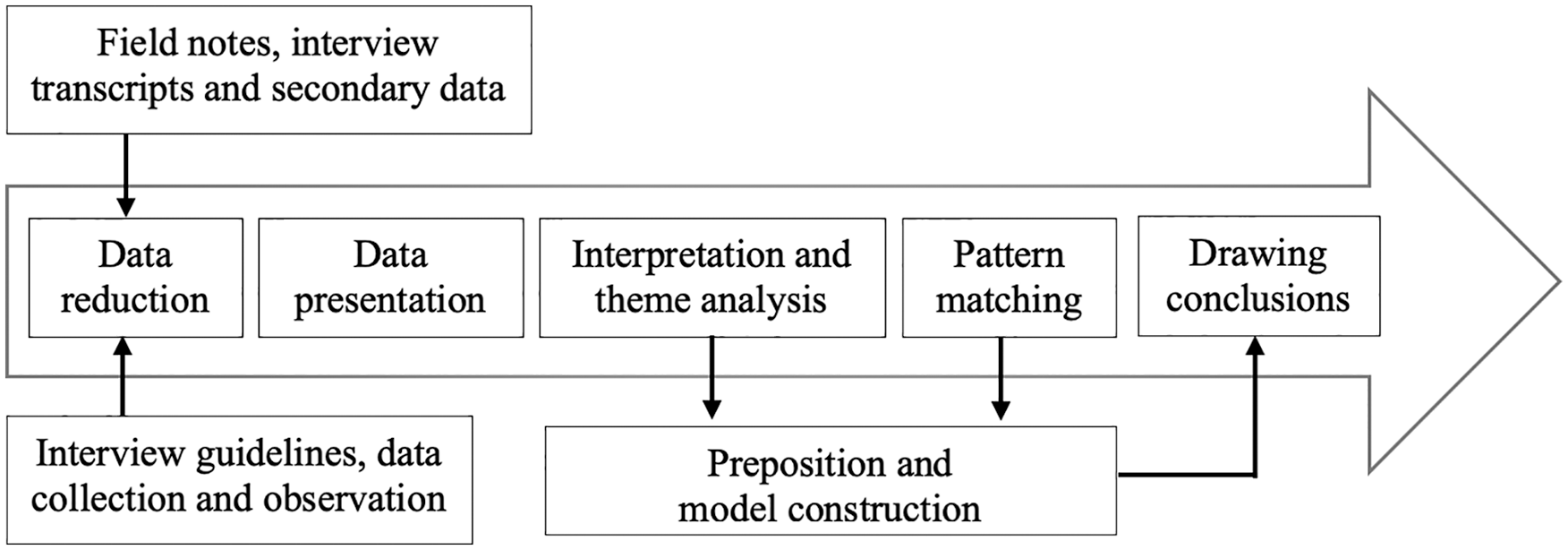
Data management and analysis.
Result and Discussion
Deliberation at the local community level involves various actors from various backgrounds with their respective interests. They are in a deliberation container with the development interests and are expected to follow their interests or those of the group within the community they belong to. Also involved in the discussion forums are “transfer agents,” who supervise the process and help the village community to follow the guidelines from the central government and its substantive procedures. Transfer agents include village government representatives, subdistrict representatives, district representatives, and village members.
The transfer agents have a background in planning and possess the knowledge required to provide technical guidance. The community is included among those who define the problem and objectives, and propose alternative plans, policies, and implementations. Thus, the community shares in the decision making, but all decisions are taken based on mutual agreement.
Knowledge transfer happens from the transfer agents to the community, whereby organizational knowledge is created. Thus, the various interests playing in the background of the interaction between the transfer agents and the community can merge in the deliberation process (Innes & Booher, 2015; Shalaby, 2013). This process goes through the four modes of organizational knowledge creation, that is, socialization, externalization, combination, and internalization, as shown in Table 1. This explanation of the knowledge transfer process was applied to the Village Fund deliberation process in the case study. Here, the characteristics of deliberation show the general direction of the dialogue. The transactive pattern shows the entities that carry out the mission of transactions between actors toward shared learning. Transactive results indicate the purpose of the transactive process at each stage that must be achieved to produce an ideal deliberation process.
Knowledge Transfer Process in the Deliberative Planning.
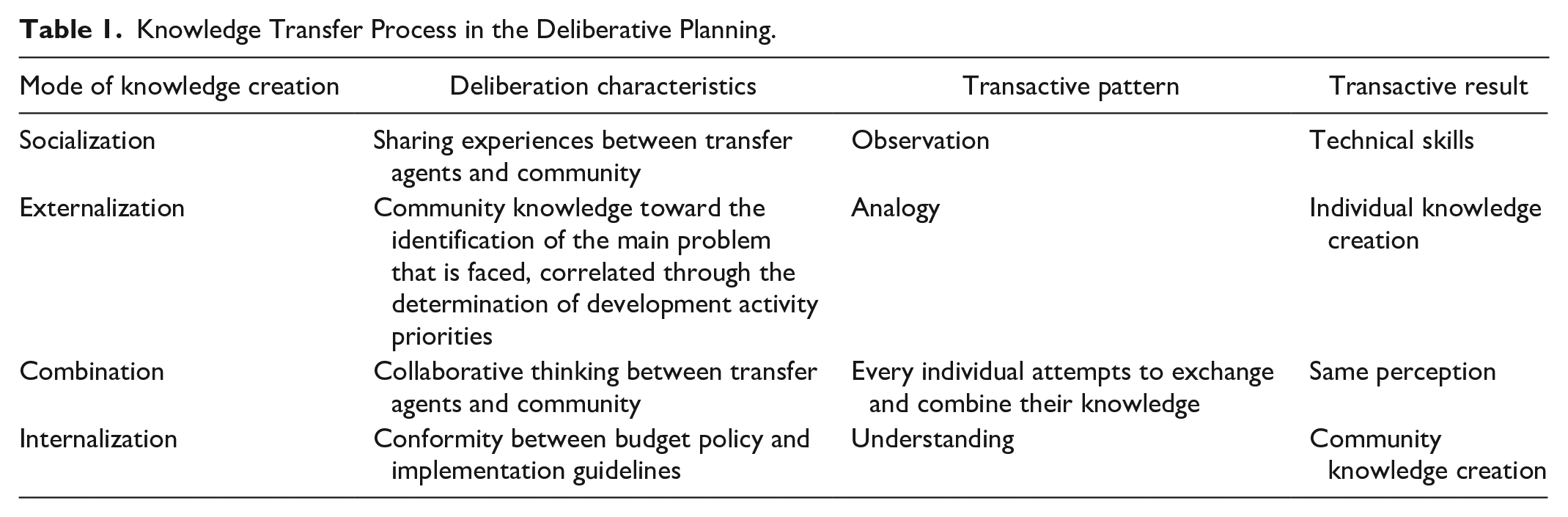
Socialization provides a knowledge space that is transferred by the transfer agents through observations that take place in the practice domain (Godschalk, 2014). This phase is marked by sharing experiences between the transfer agents and the community. Socialization is the first phase of knowledge transfer. In the case of the discussion forums for village planning, it consists of an explanation of the function of the Village Fund program, the priorities of the development activities, the nominal available budget, and examples from village governments that were successful in Village Fund management. This stimulates the community members to generate notions about what development activities they need to improve the welfare of the village. Ideally, the community members understand what the planners mean; however, in this particular stage, the emphasis of socialization is on challenging the wishes of community members that do not match the recommendations of the planners.
Planners provide technical knowledge about rural planning and appropriate development programs for our village. It is a form of advice encouraging us to understand village development better . . . We adapt it to the villager wishes . . . some inputs are very important such as the type and location of more appropriate development projects . . . and how we shape the community participation as a force to achieve legitimacy. (Villager, 2018)
Thus, the socialization mode requires public involvement in planning (Alexander, 2008) and puts demands on the transfer of planning knowledge (Rydin, 2007). This study calls the interchange between technical knowledge and experiential knowledge “the transactive process.” It works by bringing theory into practice (Friedmann, 1973) and can be described by the notion of organizational knowledge creation (Nonaka & Takeuchi, 1996). In planning, the transactive process is considered to have a minor contribution because it is embedded in the participatory planning practice. However, this study found that it plays a significant role in the absorption of information and the negotiation and consensus practice to achieve better policies.
In this mode, the dialogue addresses practical knowledge gained by the planners and the community, such as successful village development implementations in other villages. As most planners are not residents and most villagers do not have a planning education, the knowledge that the planners and the community exchange creates conformity between both groups. Thus, the knowledge gap between both groups is closed or reduced. This process starts with discussing mutually agreed-upon knowledge and then turns to oppose particular views. This develops the technical skills of each group.
Externalization is related to the identification of the principal problem that is faced when determining the development activity priorities. In the theoretical domain, this stage occurs when the community builds a mind-set as well as notions that are relevant for specifying the Village Fund budget. There can be a discrepancy in the priorities between physical and nonphysical development. The community can be divided into two groups: those who are responsive to the socialization by the transfer agents and those who are not. Both the community and the planners propose notions that will be negotiated during the next stage (combination) (Hytönen, 2016; Maidment, 2016).
In the deliberation, villager articulates that the proposed projects are based on interests that benefit the majority of the population . . . it becomes interesting because they are in the choice whether to prioritize personal or group interests in determining the main problem of the community. (Village officer, 2018)
In the externalization mode, the dialogue addresses theoretical knowledge. The participants seek to unify their opinions by aligning them with the common interest and the things they want to achieve jointly by individual knowledge creation. They formulate the main problem based on the constraints on daily activities and things that are felt to be lacking in village development, such as village infrastructure and economic, educational, and social facilities. Each participant has wishes, but these are limited by urgent priorities, such as development projects that a majority of the villagers will benefit from.
Combination is a phase in knowledge transfer that is decisive in organizational knowledge creation. In the theoretical domain, this stage takes place as a form of collaborative thinking between the transfer agents and the community (Fischer, 2006, 2016). The participants attempt to make their knowledge available through meetings, dialogue, and documents, in determining the development activity priorities. There are two options in this stage, that is, harmonization or disagreement. The facilitation by the transfer agents ends in this stage.
We prefer to share the unknown and support each other in formulating public policies. We can’t always stand up for opinions when people need attention. Mutual respect becomes the foundation to be able to unite various thoughts. (Villager, 2018)
The character of the villagers who value other people’s opinions and respect each other makes the combination mode work by supporting wishes that truly require development projects. However, they still need to have rational reasons to support it. Thus, the dialogue in this mode addresses theoretical knowledge. All participants attempt to exchange and combine their knowledge to achieve the same perception. The village budget’s interdependence makes them participate more seriously when discussing the various interests, informing the decision making.
Internalization occurs in the practical domain and is reflected by the result of the deliberation. It produces a budget policy that reflects the priorities of the development activities and that is written down in the village planning document. Thus, the budget policy is the result of the creation of organizational knowledge. The effectiveness of the transactive process as knowledge transfer through deliberation can be measured at this stage. Most of the understanding has been formed and is internalized by the actors involved, as marked by a budget policy that conforms to the governmental guidelines. However, in particular circumstances, this cannot occur because organizational knowledge creation was not optimally achieved.
The planning document becomes an illustration of the community’s thinking in developing their village. From it, we can see the strategic choice of development they wanted. We can judge this and argue whether the results are appropriate or not through further evaluation. However, we found that not everything they planned was appropriate, such as the nominal budget that should have been borne by the district was included in the village budget and some inappropriate development projects were still listed in the document. On the other hand, we see that what the planners convey can also be understood by the community through appropriate project proposals. (District officer, 2018)
This mode shows conformity between the budget policy and the implementation guidelines. In our view, this indicates the extent to which the community understands the direction of village development. This condition arises from the process of organizational knowledge creation by reaching a collective agreement. However, we doubt that the obtained policies provide room for effective decision making as there is a problem with the transaction process involving knowledge that is not evenly distributed.
The effectiveness of fiscal decentralization to village governments through Village Fund planning depends on appropriately determining the priorities in budget allocation through deliberation. From this point of view, a model is proposed that is based on transactive planning and the organizational knowledge creation theory as discussed above. According to this model, planning is a form of deliberation that involves a transactive process consisting of four stages that must be completed to realize effective planning and optimum policy implementation. These four transactive stages are (a) public involvement, (b) concept dominance, (c) knowledge improvement, and (d) policy improvement, as shown in Table 2. For each stage, the achievement level can be determined so the model can also be used to assess the effectiveness of the deliberative planning.
The Four Stages of the Transactive Process in Village Fund Deliberation.

Public involvement can be seen through community presence and participation in each stage of Village Fund implementation. In general, Village Fund implementation is divided into four phases, namely, (a) planning, that is determination of the development activities and budget allocations; (b) administration, that is management of the financial budget; (c) implementation of the development activities; and (d) reporting and accountability. During development planning at the local level, community participation is required to decide the development activities and accordingly draw up the budget policy. Participation can be done through attendance with adequate representation of each hamlet and community group.
The planning stage can vary, starting with deliberation at the hamlet level and then moving on to the village level. Deliberation at the hamlet level is more difficult than at the village level because of the lack of transfer agents as at this level, there is only the head of the hamlet who acts as a transfer agent. At the sub-village level, the community members involved in deciding the development activities, after which the result is brought to the village level. In the planning stage at the sub-village level, the deliberation is still tentative and filled with disagreement on the priorities set by the central government. Deliberation at the hamlet level is generally guided by the hamlet head without the presence of other village officials, village facilitators, subdistrict representatives, or district representatives. It prioritizes cooperativeness without intensive supervision. Participation in the deliberative planning at the hamlet level prioritizes attendance, conformity with the development activities approved by the community members, and internal negotiations between local communities (Bond, 2011; Turnhout et al., 2010).
As well as bottom-up planning system, this mechanism began with community meetings to discuss proposed development projects. At least five to ten people from each hamlet attend village planning, male and female (mostly a village have six hamlets, hence in the deliberation may be attended up to sixty participants). Fiscal decentralization through village funds has increased community participation. They feel entitled to determine development projects. (Subdistrict officer, 2018)
The public involvement stage shapes the socialization mode. Especially in village-level planning, participants come together to share information, representing each hamlet and community group. They bring a diversity of knowledge to the policy-making arena. During the subsequent planning process at the village level, consultation becomes more important because every component is interrelated, that is different interests, the priorities set by the central government, and the adequacy of financing. In village meetings, the level of public involvement can be seen from the attendance of community members and the active participation of the community in the discussions.
Knowledge enhancement is obtained when knowledge transfer between the transfer agents and the community has taken place, creating organizational knowledge. This arises from the interaction between the community members and the transfer agents. Increased knowledge emerges when there is an effort to prioritize the budget use according to the guidelines set by the central government in the village’s budget policy document (APBDes) so that its implementation runs smoothly and according to regulations. This process requires the accompaniment of local communities in the deliberative planning. Knowledge enhancement cannot occur immediately; it is a process in which comprehension and knowledge debriefing are realized through socialization, technical guidance, and supervision. The expertise of the transfer agents, transferred through dialogue and direction of the community in gaining an understanding of Village Fund management, is decisive for the knowledge increase achieved because it influences the level of community response in expressing opinions about shared interests during the determination of development activity priorities. If knowledge transfer has been achieved in the previous stage (public involvement), then at this stage, the community has sufficient knowledge about the Village Fund guidelines.
Interaction of planner and villager shape knowledge that focuses on local conditions. I think the planner is very helpful in suggesting development projects that are really needed. However, this can be articulated differently by society because of its various interests. Therefore we always advise the participants to always communicate authentically. (Village government officer, 2018)
This stage works through the externalization mode, where the participants obtain a better understanding of their needs and a broader insight into potential development projects (activities) that are suitable for their village. As Teluk Aru village is located in a coastal area, the proposed land area development endeavors and projects facilitate coastal life, such as fishing boat assistance, fish seed rearing, and fish pond assistance. On the contrary, the participants also became more aware of the potentials of the coast. To maximize these, they proposed to create fishing groups and projects that improve the coastal economy.
Concept dominance can occur when the development activity priorities are determined, both during planning consultation at the hamlet level and at the village level, although in general it is more likely to occur during deliberation at the village level. Concept dominance emerges through the transactive process between the planners and the local community, which is directed by the planners to be in line with the budget use guidelines set by the central government. At this stage, while certain parties dominate the deliberation, all community members do not have the same purpose in the deliberation. Therefore, they should be seen as a collection of groups with their particular interests. To call it a community—implying one single interest in the deliberation—is misleading because the community consists of different groups that have purposes that are not entirely homogeneous, leading to political arguments or interest group activity during the deliberation. This eventually leads to knowledge transfer in deliberation through concept dominance.
Various interests make participants argue with each other, giving rise to a dominating argument. Generally, people are not too determined to defend their arguments if accompanied by the right reasons. They prefer to yield for the public interest. (Villager, 2018)
In this stage, which works through the combination mode, power and deliberative ability play an important role. The case study showed that the community preferred to put forward proposals submitted by local community leaders, other villagers who are considered to be influential within the community, religious leaders, and women (group) leaders. This made the dialogue run more smoothly, but it also hindered inclusiveness when the proposals submitted did not support minorities. On the contrary, some of the participants’ lack of deliberative abilities also prevented suggestions from being fully conveyed. To them, standing in front of a forum to express their opinion requires a great deal of courage. In this stage, arguments are conveyed in public, informing the establishment of organizational values; however, some obstacles, such as rhetoric, the requirement to express opinions in public, and inappropriate negotiating, can lead to the dominance of certain parties in determining the policy priorities.
Policy improvement is a form of understanding by the local community in determining the development activities that should be prioritized in the village planning document. At this stage, the community members have already responded to the knowledge transfer provided by the transfer agents. The community understands and implements this knowledge through approval of development activities that conform to the guidelines. Thus, policy improvement is the ability of the community to properly consider the Village Fund guidelines based on knowledge. The ultimate goal of knowledge transfer by the transfer agents is the creation of increased involvement of the community. At this stage, conformity emerges between the priorities of the development activities desired by the community and the guidelines provided by the central government. Domination of certain parties, either transfer agents or local groups, does not occur because organizational knowledge creation has been achieved.
Transfer of knowledge from planners to the community improves the quality of village planning formulations. This may be due to increased public knowledge after going through the socialization stages provided by the planners. But I am not sure if all the participants achieved this, as they really know what is appropriate to propose. However, I think there are still deliberation participants who do not understand village development management even though they have been taught. (Villager, 2018)
At the end of this stage, the community reaches an agreement on the planning policy document. They reach the internalization mode by establishing an attitude toward what is believed to be the best alternative, changing the local community’s knowledge and setting policy priorities that increase the community members’ understanding. They align the priorities of the development activities desired by the community and establish priority guidelines. Here, the transaction process facilitates the adjustment of local community knowledge and the setting of policy priorities.
A model is proposed that explains the sequence of stages the transactive process goes through during deliberation, finally producing a village planning document that follows the implementation guidelines (see Figure 3). This model has a pyramid form, which represents the transactive stages in the deliberation process and the modes of knowledge transfer that occur at each step. The higher the deliberation achievement, the more the result will conform to the implementation guidelines, which means that the deliberation process was optimal, reducing planning ineffectiveness as a result of inappropriate budget allocations. The model also shows that at the top of the pyramid, the number of people who genuinely understand the Village Fund budget allocation policy is less than the total number of participants, so the local policy decisions will not conform to the central government’s guidelines. The ideal condition is that all of the participants reach the internalization. So that results in policy improvement.

Model of knowledge transfer in deliberative planning at the local community level.
It is assumed that all participants gather and receive the same transfer of knowledge at the beginning of the deliberation. At this public involvement stage, the number of socialization participants is the same as the number of participants. Furthermore, when they articulate what has been taught (externalization), different views based on their knowledge in interpreting knowledge make participants begin to understand things being taught in various ways. It means that various kinds of interpretation of knowledge can be generated along with the knowledge enhancement stage, which may be following the original plan created by the planner, or does not, by following their miss interpretation. This stage starts a gap in responding to the knowledge conveyed by planners. Participants who misinterpret knowledge will enter the zone of deliberation that is not covered by knowledge transfer.
Furthermore, when they defend their interpretation (which can be right or wrong), the gap becomes more significant in the concept dominance stage. Here, the combination among the participants who understand the knowledge correctly and the wrong one in interpreting the knowledge occurs. The decision makers in the context of this deliberation are all the participants. Hence, when policy making is supported by most villagers who are part of the deliberation area not covered by knowledge transfer, it will result in bad policies.
Meanwhile, when policy making is supported by most villagers achieving internalization, it will produce a policy improvement. In the final stage, internalization seems to be only owned by participants who genuinely understand what the planner said. It will lead to policy improvement. Thus, this study concludes that a useful planning document is produced by villagers who mostly understand what the planners say up to the internalization stage. However, inadequate documents are generated by villagers who are mostly in deliberation and do not achieve internalization.
Difficult discussions and intervention by dominant actors can cause the knowledge transfer process not to reach its peak, that is, policy improvement (internalization). This leads to a discrepancy between the budget policy and the implementation guidelines. Thus, the knowledge transfer process is only accomplished up to a lower level, for example, only up to public involvement (socialization), or only up to knowledge enhancement (externalization). In other words, this discrepancy emerges because of ineffective organizational knowledge creation by the transfer agents, because the deliberation does not reach policy improvement (internalization). It can be demonstrated by using the model that there is a deliberation area that has not been covered by knowledge transfer.
Each community member attending a village meeting (musyawarah desa/musdes) initially has a different viewpoint because of their different interests. Deliberation is useful as a transactive process if policy improvement (internalization) is reached. The internalization through planning practices carried out by the planners and the community leads to knowledge dissemination, thus effectuating better decision making when compared with the previous stage (Laurian, 2009; Puustinen et al., 2017). Internalization increased by knowledge transfer results in knowledge being spread throughout the community and brings better decisions, that is, decisions that follow the implementation guidelines. When internalization takes place, the community members will increase the knowledge they need for understanding the data. Therefore, the more extensive the internalization process, the more likely it is that an agreement will be reached.
Internalization leads to ease of expressing their interests toward social accountability for better community benefits. Therefore, conceptually, an effective deliberation process is characterized by knowledge transfer that reaches internalization, that is, the spread of knowledge to improve planning effectiveness at the local community level, which ultimately produces ideal planning that conforms to the appropriate substantive goal (the countability between knowledge and practice).
In addition, community-based planning should not build a practical consensus but a critical consensus. If deliberation is seen as average pragmatism, only a practical consensus can emerge, the results of which tend to create problems. However, deliberation based on critical consensus encourages the transactive processes that take place within it to create better policies. This is what is called a critical consensus.
Community-level deliberation should not be regarded as planning between actors who have symmetrical power but as planning under asymmetrical power relationships. Communicative planning means that deliberation should fulfill the precondition of a power balance between the actors involved. Booher and Innes (2002) argue that network power could be assumed as a flow of power that all participants share (p. 221). Within deliberation, consensus building is isolated from ideology, asymmetric power, and structural political-economic power (Forester, 1999; Innes, 1996). However, in reality, community-level deliberation (especially for rural areas) takes place under asymmetrical power relationships. Asymmetrical power arises from differences in gender participation (Antlöv, 2003; Guijt & Shah, 1998), the influence of local elites (Bebbington et al., 2004), and social inequality (Beard & Dasgupta, 2006). The element of power plays a significant role in deliberation. Asymmetrical power influences deliberative ability, that is, the ability to communicate, debate, and argue. Mäntysalo and Jarenko state that calculation of power relations is needed (Mäntysalo & Jarenko, 2014, p. 42).
Conclusion
The community-based planning approach has been debated because of problems emerging from the policies it produces. The lack of control of the planner and the government on policy-making strategies has been proposed as the cause (Huxley, 2000; Mäntysalo & Jarenko, 2014; Sager, 2013; Voogd, 2001; Voogd & Woltjer, 1999). However, this article shows that this could also be due to a malfunctioning transactive process.
The transactive process model proposed in this article can be used to explain the transfer of knowledge in deliberative planning at the local community level and as an instrument to assess the level effectiveness of the deliberation process. The characteristics of the case study were found to reflect the four stages of knowledge transfer in deliberative planning. A community’s failure to appropriately execute Village Fund management could be due to an implementation of the deliberation process that deviates from the model. All four stages need to be completed during deliberation so that the budget policy that arises conforms to the implementation guidelines from the government and its substantive procedures. Assessment of this assumption can be achieved through the evaluation of each of the four stages.
This study proposes a model in providing an understanding of how knowledge transfer in community-level deliberation occurred. It describes a combination of transactive stages and modes of knowledge transfer. This stage consists of public involvement, knowledge enhancement, concept dominance, and policy improvement. This model evaluates that not all participants are in the same situation when conducting deliberations. Some of them were able to internalize the knowledge they got until the end of the stage. However, others were in a zone that did not cover the transfer of knowledge. This explains why rural planning does not bring in inherent knowledge, although many follow the deliberation. Power, deliberative ability, and seriousness in participating affect the process.
The role of the planner is more of a facilitator than that of a decision maker. Planners who carry out their mission of making the deliberation results conform to governmental guidelines can find conditions that make them struggle with the different interests of groups within the community. These various groups bring serious interventions into the decision-making process. This phenomenon is identified as community-level deliberation under asymmetric power. This tends to lead to a lack of influence of the planners on decision making. Intervention in deliberation can reach a point where planners are not optimal in spearheading deliberative policies that are in line with the governmental guidelines or their basic knowledge. Thus, the planners are not capable of optimally directing the deliberation process. As a result, the transactive process does not work well and fails to produce effective planning.
The proposed model can be used in further empirical studies in other fields or as a reference for related issues, although it should be noted that the proposed model is an idealized conceptualization of the transactive process that took place during deliberative planning at the local community level in Teluk Aru, Sumatra, Indonesia; it may not be suitable for other cases. Future research could focus on describing to what extent knowledge transfer can occur under asymmetrical power.
Footnotes
Declaration of Conflicting Interests
The author(s) declared no potential conflicts of interest with respect to the research, authorship, and/or publication of this article.
Funding
The author(s) disclosed receipt of the following financial support for the research, authorship, and/or publication of this article: The local Government of Langkat Regency funded this research as part of a full Ph.D. scholarship.
