



Abstract
Local education governance has allowed neighborhood schools to offer community-oriented curricula and activities, and public schools have been operated to serve only residents’ children within the defined areas. The rise of neoliberalism may, however, undermine political foundations of the traditional political systems. This article explores how self-governed local education authorities function and evolve under neoliberalism by revisiting core values in localism and neoliberalism. By looking into the voluntary open-enrollment policy in Ohio, this study finds that the local governments surrounded by dissimilar neighborhoods are more likely to depend on the mechanism of localism to protect local authorities and locational privileges. This research argues that neoliberal policies safeguard community interests by deeply engaging with interchanging resources across their borders in regional market environments.
Localized public policies have been expected to better comprehend community circumstances and meet residents’ preferences. This common belief has allowed local governments to exercise legal power over the provision of public services. Strong control and voluntary action at the community level in the United States have become instrumental in the creation of considerable variation in local public services (McDermott, 1999; Tiebout, 1956). For instance, the U.S. public schools have offered community oriented curricula and activities, and diverse interests in individual communities have leveraged substantial variations in the size and usage of public school revenues and expenditures by local education authorities. School boards with strong governing and decision-making power have dictated school catchment areas to benefit children in a given community. Therefore, the traditional policy to assign children to a school district based on their home address has become an exclusive and distinctive arena in which local control and power can be exercised to protect residents. School attendance zones and district boundaries have been served as a major proxy to maintain and reproduce community identities. While local power and autonomy have shaped a number of American public policies, neoliberalism has increasingly influenced public sectors for the last few decades. Neoliberalism argues that free-market mechanisms can more efficiently and effectively deliver public services than regulated markets with governmental intervention (Friedman, 2002). New policy benefits and impacts devised by the neoliberal model are theoretically open to anyone and anywhere, rather than being geographically bounded and localized in a given jurisdiction.
As federal and state governments have recently addressed neoliberal policies and business-like practices, the convergence of neoliberalism and localism in the public policy sector calls for a new political foundation for local politics and community driven initiatives. Indeed, the expansion of school choice programs, which empower families to shop for other schools beyond their district boundaries, has challenged the traditional school zone scheme. Under the traditional place-based governance, the emerging use of market metaphors, such as competition and open market, in public spheres appears to conflict with current local authorities over public schools. Local governments are asked to redesign their role to be in favor of or against capital-driven and market-oriented forces. Despite these dramatic changes in local politics, the responses of local education agencies to school markets are relatively understudied. This article explores how self-governed local education authorities function and evolve under neoliberalism by revisiting the core values of both localism and neoliberalism.
Localism in Neoliberalism
This section overviews the agreement and disagreement between localism and neoliberalism and then demonstrates the potential tension in school policies, specifically focusing on interdistrict open-enrollment plans in the United States.
Agreement With Neoliberalism
Accumulated self-interests and assimilation processes lead to the clustering or separation of individuals, which have in turn built a community with a common history and culture. The collective power of individuals within a shared region develops a public entity, that is, local governments, to customize policies and programs for residents’ interests and needs. Along with efforts toward the local embeddedness of policies, special emphasis on volunteer work and grassroots participation in U.S. politics has also contributed to establishing self-organized agency (Briffault, 1990a, 1990b; Wilson, 2011). In general, civic involvement with top-tier central authorities, such as federal and state governments, has been limited to voting and petitioning. The bureaucratic processes of large-scale systems have struggled to offer sensitive and timely responses to local needs. On the other side, the relatively small size of local governments allows residents to directly engage in the decision-making process. The close contact between voters and politicians can bring more accountable governments to taxpayers in representing residents’ rights and preferences. Democratic participation through individual and group activism has been expected to produce greater satisfaction with policies and stronger bonds between members. Therefore, the autonomy of residents over their surroundings has played a substantive role in shaping the functions and structures of economy, education, and politics within a defined area. This localization not only results in differentiation in public policies and services across communities but also enables one place to be distinguishable from its neighborhoods (Briffault, 1999).
Local governance has encouraged individuals in a given community to engage in local decision-making practices, and its theoretical aspirations and commitments have protected local identities representing collective individuals (Pratchett, 2004; Stoker, 2004). This core tenet of localism, which values the maximization of community autonomy, parallels that of neoliberalism, which devotes particular attention to the individual right of choice. Under neoliberalism, individual choice behaviors incentivize local authorities that responsibly use tax money and effectively respond to community members’ interests. Similar to localism that places emphasis on localization of public policies and practices, the neoliberal wave in public sectors has promoted consumer-driven projects and facilities by closing a distance between taxpayers and service providers. Moreover, localism and neoliberalism share a common concern for both individuals and society that stems from criticism of bureaucracy and centralization. Thus, Clarke and Cochrane (Clarke & Cochrane, 2013) have called localism a type of spatial liberalism in criticizing the lack of efficiency, equity, and democracy in centralized government systems. As the visions and principles of neoliberalism resemble the natures and roles of local politics with a great degree of autonomy, localism in the United States has presented a potential to be well-integrated with the ideas of neoliberalism.
Disagreement With Neoliberalism
Given that localism delineates the collective actions of individuals within a shared region, the likes and dislikes of these individuals toward publicly funded services shape community identity and provide social cohesion (Tiebout, 1956). This logic has argued that a shared territorial base formed through ideological consensus and common preferences can function as a practical backbone for sustaining and strengthening the power of individuals (Hirst, 2000; Pindell, 2003). However, though residents’ civic involvement in government decisions can result in localized policies and services, such localization does not sufficiently represent democratic local environments (DeFilippis et al., 2006; Kenis & Mathijs, 2014). Civic engagement and political participation in the real world have limited influence on local autonomy and control over public services. The feasibility of localized policies has relied heavily not upon collective self-interests but on residents’ taxes in a given community (Jacobs & Manzi, 2013; Weir, 1996). Since the ability, rather than willingness, to pay for locally levied taxes accounts for the varying price, availability, and quality of public goods that are provided by local governments, local governments have regularly drawn and redrawn the boundaries of service areas by dictating who is included and who is excluded within a certain area. Interwoven with collective power, local autonomy, and self-interests, the geographic boundaries become not only evidence of but also the instruments for identifying a geopolitical entity by examining the individuals who live within a particular border (Pindell, 2003; Saiger, 2009).
Localism is representative of place-based privileges, or sometimes locational disadvantages and geographical differentiations, whereas neoliberal policies introduce global markets and open competition that place little emphasis on home address as a requirement for service benefits. As the rise of markets stimulated by the neoliberal ideology diversifies channels for administering public products and services, the role of governments, particularly those that have fostered local monopolistic markets, has shifted from that of a sole, exclusive provider toward one of various vendors (Lemke, 2001). Community residents, who have been regarded as passive recipients of centralized public services, are encouraged to shop for public services regardless of their home addresses (Bartlett et al., 2002; Starr, 2014). As federal and state governments increasingly allow nonprofit and business organizations to serve residents through contracting and partnership, service providers have also begun to consist of large-scale corporations that have offered nationwide or statewide services and programs less bounded with geographies. In other words, despite the special attention to individuals in both localism and neoliberalism, the growth of neoliberal policies does not always support residents. Formulated in this market-oriented environment, geographic neutrality and the openness of regional policies can challenge geopolitical power and place-based local identities in the discourse of localism by weakening a clear-cut spatial divide between us and them. Neoliberal experiments in the public policy sector have a great likelihood to diminish localism-based zoning power that has bonded populations to local services and therefore excluded adjacent communities.
Localism in Education
School catchment zones and district boundaries provide an ideal case for demonstrating how localism intensifies invisible geographic divides and eventually strengthens local governance (Frankenberg et al., 2018; Saiger, 2010). School catchment areas, which were initially drafted to serve children of taxpayers within the jurisdiction of local education agencies, have mirrored geographies in identifiable information such as ideological inclination, demographic composition, housing value, and property tax rate (Denton, 1995; Mitchell et al., 2010; Reardon & Owens, 2014; Richards & Stroub, 2015; Urquiola, 2005). District boundaries for school enrollment also reflect demographic and socioeconomic characteristics in each locality as a reliable proxy for defining neighborhood characteristics (Black, 1999; Clapp et al., 2008; Downes & Zabel, 2002; Gibbons et al., 2013; He, 2017). Strong local governance in education has granted residents an exclusive right to enroll a child in any community schools within the zone.
Although localism in education has been a sign of the bonds between schools and residents, the existence of in-boundary school restrictions has devalued the benefit of localism in education. As school boundaries restrict or obstruct nonresident students from crossing boundary lines, gaining access to a school outside of one’s home zone requires additional effort and expenses. To transfer a child to another zone, their families need to afford a local property tax; assimilate to local contexts based on race, class, and income; and ultimately move their place of residence to the zone of the desired public school (Dougherty, 2012; Ryan, 2010). This spatially restricted access to educational opportunities has exacerbated inter-local differences in public schools. Given the high reliance of the U.S. public school system on local property tax, considerable variations in local expenditures across school districts have eventually resulted in discrepancies among school districts. Local school districts with predominantly disadvantaged populations have undergone a lack of financial support and have been stigmatized as having low-performing schools (Green et al., 2017).
Potential Tension in Education
While localism in education has been denounced for fragmented and disconnected landscapes built on capitalism (Bischoff, 2008; Troutt, 2007), the rise of neoliberalism in education has received attention for its use in physical spaces. Current neoliberal school policies, including a national curriculum and high stakes state assessments, have interrupted educational activities and programs that were previously localized by school district boards, thus discouraging variation between localities (Schafft & Biddle, 2013; Stemler et al., 2011). Furthermore, advocates of neoliberalism have applied market mechanisms to locally administered schools by launching various school choice initiatives. This attempt to diversify educational service providers has degenerated local education agencies into merely one of varying providers for the education of children. The neoliberal notion of loosening the connection between residence and school challenges and threatens the core values of localism by discrediting community benefits and privileges and denying large local contributions to education budgets.
In the traditional viewpoint that schooling is a type of private property granted to parents, zoning power under localism has justified the use of public money by local education agencies for children living in a given community. Under neoliberalism, however, parents are empowered to enroll children in a desired school, even if that school is outside of the district’s boundaries. Despite the common focus on individuals from both localism and neoliberalism, doubt has emerged over whether the two ideologies can be compatible. Recently, federal and state authorities have exercised significant influence over local politics, and their massive monetary resources have pushed local authorities to adopt regional policies. Yet, this does not necessarily mean that collective power in a single community is reduced or nullified. Given that a growing number of localities have constructed dynamic relationships with varying institutions and upper-level governments (Pratchett, 2004), new actions by local educational agencies, such as modifications or customizations of market-oriented school policies in accordance with local conditions, can be carried out when localism is to meet the increasing challenge of neoliberalism. This new adjustment between local and higher-level government authorities raises questions about how traditional localism expresses identities differently in a competitive environment and how neoliberalism is domesticated within a certain local landscape. On the grounds that the interrelationship between local and state governments is not a zero-sum game (Clarke, 2009; Fuhrman & Elmore, 1990), regional and even global policies do not leave local identities in a dependent or powerless position under neoliberalism. Individual local agencies are expected to be a cornerstone that facilitates and institutionalizes neoliberal values and principles.
As a case in point, interdistrict open-enrollment, which is a noncompulsory school policy in many states, has been widely introduced to facilitate student transfers across school district boundaries by expanding school options for children in less-advantaged communities. Many states have adopted this neoliberal policy but have at the same time delegated the actual implementation of interdistrict open enrollment to local authorities to minimize community resistance. As the details of this voluntary state policy are mainly shaped by local education agencies, permission to attend a school in another district relies heavily upon the availability in that school district. Students are also given priority rights when enrolling in schools within their home districts. Since student transfers are bound under a reciprocal contract between the sending and receiving school districts, local education agencies play a major part in shaping and developing markets prior to the offer of choice. Although local authorities have struggled to find the balancing point between localism and neoliberalism in public spheres, current research on neoliberal school policies, including interdistrict open enrollment, has paid little attention to the collective power of individuals within a shared area.
Data and Methods
To contemplate the interplay between localism and neoliberalism through local responses to state-driven policies, this study examines the voluntary open-enrollment policy in Ohio through the lens of a critical geographic standpoint.
Research Context
The Ohio Department of Education has allowed students to transfer to directly adjoining districts since 1989, and it expanded the interdistrict open-enrollment plan into a statewide option in 1998. Once the board of education at an individual school district makes a discretionary decision on student transfer between districts, a limit of commutable school districts, which may consist of solely adjacent districts or of all districts, is also specified (Ohio Rev. Code Ann., § 3313.97, 2011; Ohio Rev. Code Ann., § 3313.98, 2009). Although this inter-district open-enrollment plan stems from competition—one of the main tenets of neoliberalism—among school districts in valuing new students from outside of a district’s boundaries as a new source of funding, the Ohio school boards have broad authority and control over details of policy adoption and implementation.
In the 2016–17 school year, about 80% of the total 612 Ohio school districts voluntarily participated in the interdistrict open-enrollment plans (see Figure 1). The students of 454 school districts were able to transfer to any other school district by leaving their home community, whereas the students of 44 school districts were only able to choose another school in an adjacent district. The local educational agencies that completely restricted the enrollment of nonresident students were clustered in five cities: Cincinnati, Cleveland, Columbus, Dayton, and Toledo. The four city school districts, excluding the Toledo City School District, were mostly enclosed with the school districts that did not participate in open enrollment. While the four urban school districts, Cincinnati, Cleveland, Columbus, and Toledo, took part in statewide open-enrollment schemes, their neighboring school districts did not send or receive student transfers. In comparison, the Dayton City School District only served students who resided within the city’s boundaries.
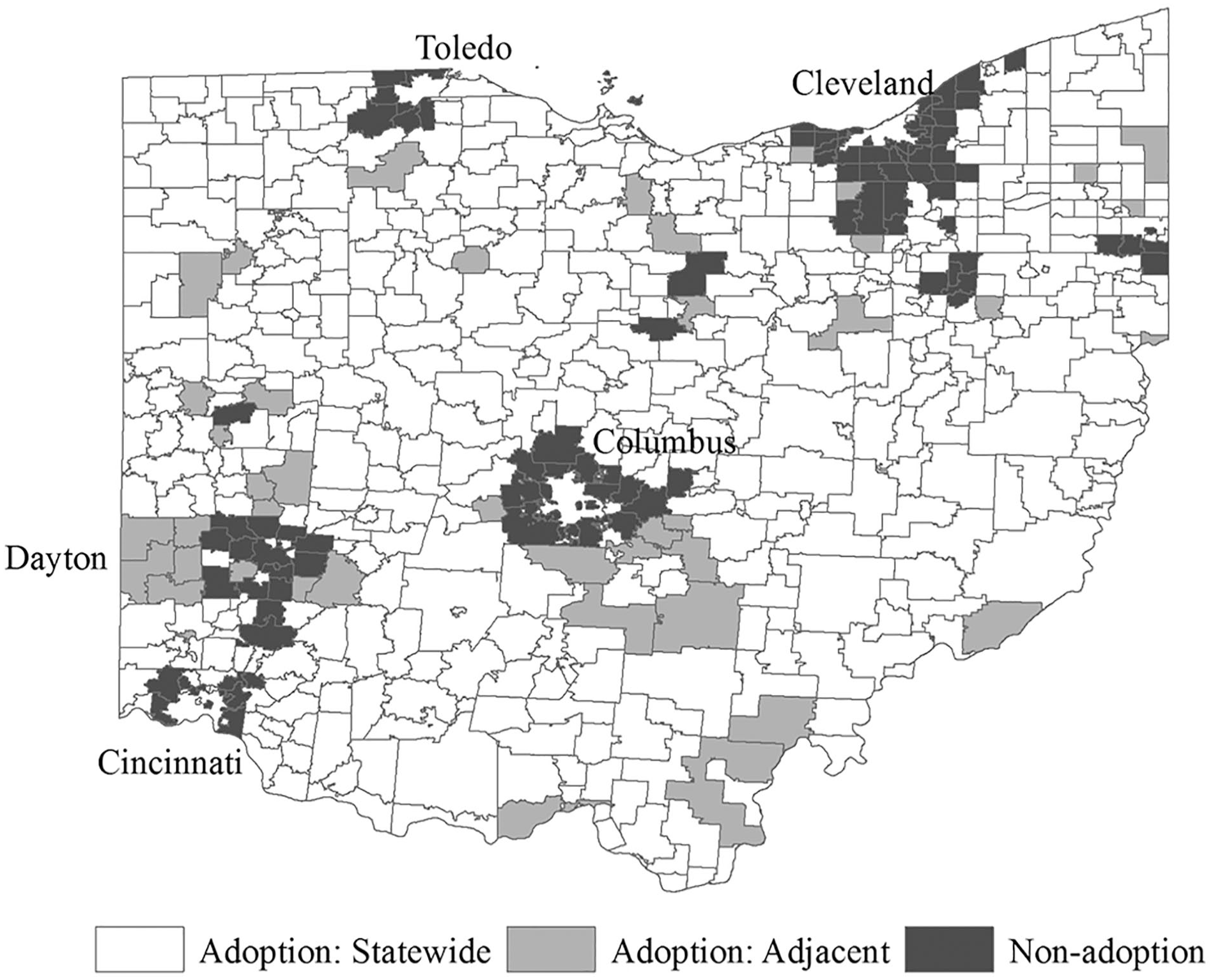
Distribution of Ohio school districts by policy adoption.
Geographic Representations
Localism and neoliberalism have incorporated and taken advantage of geographically embedded power. As Bourdieu also pointed out (Bourdieu, 1986; Bourdieu & Passeron, 1990), physical spaces have portrayed the variation in cultural and social capital owned by individuals in a shared territory. This accumulation through transformation of cultural, social, and symbolic capital as well as possession of economic capital has shaped the provision of public services at the neighborhood according to its residents’ needs and capabilities (Yoon et al., 2018). Such spatial division among neighborhoods reproduces the geographic discontinuity in the distribution of local schools and school districts. Place-based collective power has also contributed to an understanding of geographical unevenness by maintaining or promoting its privileged position in educational markets (Lubienski & Dougherty, 2009; Powell, 2009). Therefore, this study employs a critical geographic framework to shed insight into the dynamic of geographic differentiation across local educational agencies. The geographic information system allows to combine a map positioning schools as points, school bus routes as lines, and school catchment zones as polygons with a variety set of layers conveying contextual information (Cobb, 2003; Nguyen et al., 2017). With the distinctness from traditional tabulations and statistical computations, thematic maps generated through the critical geographic approach can demonstrate whether demographically and socioeconomically constructed communities use their collective power to distinguish and defend themselves from marginalized neighborhoods (Helfenbein & Taylor, 2009; O’Sullivan, 2006; Pini et al., 2017).
Guided by Levin’s framework for evaluating the range of school choice in educational vouchers (Levin, 2002), this research questions if students in the school district that supports the interdistrict open enrollment have de facto access to schools in other school districts. The examination of spatial contiguity and spatial split helps to understand how a local government formulates a response to the neoliberal policy. As a decision on interdistrict student transfer is made at the school district level and the policy becomes in effect for children by local education agency, this study focuses on 49 school districts in the Cleveland metropolitan area and 60 school districts in the Columbus metropolitan region. The selected school districts are physically embedded in the metropolitan areas that contain at least one urbanized area with a high population density. The 109 school districts also satisfy the condition of Queen’s case that neighboring school districts share an edge or a corner of the school district borderlines (Wang, 2006, 2014).
Through the use of a mapping application in QGIS, the black-and-white contrast, which illustrates the pattern of the state school policy adoption in Figure 1, is integrated with three nonspatial but geographically coded indicators. The first two indicators, the proportion of African American children aged under 18 years old and the proportion of residents who are aged over 25 years old and hold a bachelor’s degree or higher, are extracted from the 2011–2015 American Community Survey 5-year estimates at the U.S. Census Bureau. These geographic dividers, which have reinforced the process of gerrymandering, can represent interlocal divergence as a form of territorial discontinuity and spatial inequality. The third indicator, the amount of property tax per pupil, is obtained from the school district profiles of the Ohio Department of Education for the 2015–16 school year and is used to frame the relationship between local educational agencies and their surrounding contexts. As the property tax has served as a primary source of finances for the planning, maintenance, and operation of public services and facilities, incoming students from the nontaxpayers in other districts can lead to a significant and non-negligible gain or loss in local revenue for education.
The selected three indicators across the Cleveland and Columbus metropolitan areas are differentiated by the natural breaks classification based on the Jenks Natural Breaks algorithm (De Smith et al., 2018). The natural breaks classification has been widely used to compare multiple geographic units in a single map built from a specific attribute because the class differences are formed by grouping similar values together. The three indicators classified into five ranges are assigned to varying symbol sizes to visualize the magnitude of a given feature and a difference between polygons. Given that school district boundaries have been instrumental in delineating and reproducing place-based cultural and social capital, an analysis of the geographic representation of the selected indicators at the school district level, in conjunction with Figure 1, allows for an observation of hidden mechanisms to which local power is attached within a designed boundary.
Illustrative Evidence
Local identities articulated by pre-existing political geography can employ unique coping strategies in favor of or against open-market forces and for the reinforcement of a sense of place (Clarke, 2013; Peck & Tickell, 1994; Pratchett, 2004). To defend its place in the global political economy, neoliberalism may also reconcile with local circumstances such as historical legacies, geographical contexts, and political backgrounds (Brenner & Theodore, 2002). In other words, the shift from residence-based assignment in local public schools toward open enrollment in uneven school markets has the potential to conflict with local governance that has been securely preserved through geographical divisions. Along with Figure 1 that demonstrates the spatial variation in voluntary policy adoption, Figures 2 to 4 illustrate the adaptation of localism under neoliberalism through the geographic patterns of the three community features in the Cleveland and Columbus regions.

School district distribution in the selected regions by African American student proportion (top: Cleveland; bottom: Columbus).

School district distribution in the selected regions by proportion of population with bachelor’s degree or higher (top: Cleveland; bottom: Columbus).

School district distribution in the selected regions by total property tax per pupil in dollar (top: Cleveland; bottom: Columbus).
Figure 2 shows the variation in policy adoption linked to the proportion of African American students. A dynamic connection between racial characteristics and policies for interdistrict student transfers is found in urban cores and their peripheries, which are depicted as an open-school district surrounded by closed donut-shaped school district rings. This suggests that families in particular metropolitan areas experience limited student mobility to nearby school districts regardless of policy adoption at the local level. School districts in the western Cleveland and Columbus suburbs specifically are more likely to grant school admission to only local residents. These districts have a proportion of African American students similar to those of remote districts, but their core cities and neighboring districts are comprised of a relatively large proportion of students of color. In general, the closer a school district is to urban cities that are majorly comprised of ethnic minorities, the more likely the district is to lock its boundaries. Most school districts that are far from the cities of Cleveland and Columbus have opened enrollment to students of both neighboring and remote school districts. However, this openness does not necessarily guarantee the free and meaningful transfers of students of color from urban cores to white-majority community schools because of the strong parental preference for proximity (Bell, 2009; Burgess et al., 2011). Given that only a few non-white urban students are able to travel to remote school districts, the voluntary permission of interdistrict enrollment alone hardly undermines local school governance at the fringe of the Cleveland and Columbus metropolitan regions serving a small percentage of African American students. More precisely, the boards of predominantly white rural districts, which have no conflicts of local interest, can appear to construct a supportive environment for equity in open markets while at the same time maintaining segregative school policies and practices. On the contrary, the darkly shaded districts in Figure 2 ensure the relative whiteness of their school districts by refusing student transfers mainly from neighborhoods with a comparatively greater percentage of African American students.
Figure 3 demonstrates how local school boards respond differently to student exchange across district borderlines in conjunction with education level. Overall, school districts in which a greater proportion of the population has undergone tertiary education are more likely to support the traditional enrollment initiatives based on home address. The geography of the policy adoption shown in Figure 3 indicates that the residents who possess a bachelor’s degree or higher may perceive the growing pressure of competition presented by student transfers as a threat to local control over education in their community. A commitment to the status quo displayed by voluntarily opting out of state-driven open-enrollment plans is well represented in such communities, particularly in the eastern Cleveland metropolitan region. In a side-by-side comparison of Figures 2 and 3, it is apparent that school districts without open enrollment in these eastern areas have a similar proportion of African American enrollments compared to the Cleveland Metropolitan School District, but these eastern suburban communities show a greater proportion of the residents with a bachelor’s degree or higher compared to the inner city of Cleveland and their vicinities. As a result, residency requirements for school enrollment become pervasive in cases where districts with more minority students and highly educated adults are situated next to ones with more minority students and less-educated adults. This supports previous findings that white families and families of higher socioeconomic status are more likely to use interdistrict open-enrollment policies and leave disadvantaged school districts for better-performing ones (Brunner et al., 2012; Ganski, 2015; Iarussi & Larwin, 2015; Lavery & Carlson, 2015). When local authorities are aware of the dissimilarities between neighboring school districts, the allowance of nonresident students to cross-over district lines may be seen as a potential source of harm and uncertainty for the local forms of identity and governance. Figures 2 and 3 indicate the likelihood that local education agencies neighboring school districts with mainly minority children and families with lower education levels exercise their collective power to keep their school borders closed. Given that such loss aversion leads some school districts to take action against the rise of market forces like local patriots, the statewide implementation of open educational markets creates a defensive mechanism to avoid in-flows from school districts with a certain population subgroup.
Although blurring lines between in-zone and out-of-zone students demand strong engagement with local authorities and close collaboration with surrounding communities, the collective power to protect the individual rights of local schools and the core identity of a shared area shapes a notable spatial distribution of policies on the basis of dissimilarities between communities. The last figure offers a coherent message about local responses to neoliberal regional policies through an examination of geographic variation with reference to the total property tax per pupil in each school district. Figure 4 illustrates that the awareness of existing differences in property tax capacity between school districts influences a reciprocal commitment that is necessary for student exchanges. School districts hostile to interdistrict student mobility are likely to administer a relatively higher property tax per pupil compared to the two principal cities; therefore, restricting student inflow from neighboring school districts with relatively small tax revenue. This discovery supports the previous research finding that poorer school districts, expecting a benefit from adjacent school districts with higher expenditures per pupil, are more likely to open their boundaries, whereas wealthier ones are not (Ghosh, 2011). While it may seem obvious that affluent communities look unfavorably upon student transfers, the local responses to regional policy presented in Figure 4 do not represent a simple divide between poor city cores and rich suburban rings. Rather, a district’s decision to close or open its boundaries is relevant more with a relative difference between its school funds and those of an adjacent school district. If a school district collects a larger amount of property tax per pupil than other closed districts but is surrounded by communities with similar financial environments, its school board may voluntarily join the open-enrollment plan. This strategic interaction between local authorities may occur because tuition under interdistrict open-enrollment is deducted from a student’s home districts and given to the district in which they have enrolled. Although the state government provides limited financial support for school districts that accept students from other districts with lower expenditures per pupil, local governments must scrutinize all factors of their neighboring districts before making financial decisions (Rincke, 2006a, 2006bb). When voluntary engagement in competition through regional policies causes critical changes in local identities, specifically those that result in more losses than benefits, local education agencies may use their political power over district boundaries to retain the status quo.
When federal and state governments propose voluntary participation in discrediting community borderlines such as interdistrict open enrollment, the pre-existing geographies of unequal opportunities in schooling generate a local variation in policy response that can either maintain or share exclusive access to community services (Holloway et al., 2010; Holloway & Pimlott-Wilson, 2012). The illustrative evidence in Figures 2 to 4 overall concludes that residents in more advantaged school districts that border school districts with less-advantaged populations voluntarily opt out of open enrollment to maintain boundaries and minimize any potential risks or burdens. A justification for the exclusion of school districts from competitive markets is more straightforward, as some local authorities may be concerned about the inflow of new students from less-advantaged districts, while others may pay more attention to a decline of school budgets cause by a loss of students.
Discussion
Communities fractured by demographic and socioeconomic features not only localize school systems in accordance with residents’ needs and preferences but are also reinforced by local politics that support these school systems. Local spaces embracing distinct place-based identities provide differentiated public school experiences for families within the designed boundaries. However, such spatial variations in the U.S. school districts have mirrored the explicitly and implicitly uneven socio-geography distinguished by neighborhood features, and have labeled certain school catchment zones as areas to be avoided or escaped from (Baker, 2018, U.S. Commission on Civil Rights, 2018). As the conventional approach to school assignments by home address becomes instrumental in perpetuating local hierarchies and hindering new entry into education markets, local governance for community schools contributes to inequitable opportunities for education. The discourse surrounding spatial injustice has raised concerns about disparities in local public schools by the demographic and socioeconomic attributes of community members rather than by individual preferences for public schools (Bayer & McMillan, 2012; Soja, 2010).
Under these circumstances, an interdistrict open-enrollment scheme, entwined with neoliberalism, has been widely adopted in the United States to offer marginalized students who are trapped in at-risk communities a chance to leave their community schools. This progressive option of opening school admission to nonresident students questions the foundation for local school systems by decreasing local power over education and weakening geopolitical power forming local governance. Well-established research on mobility and proximity in school access has argued that student transfers across district boundaries could result in significant changes to a sense of location and to school district identities (Cullen et al., 2005; Hanushek et al., 2004). The formation of school policies for the creation of open educational markets challenges the use of strong authority for school enrollment based on a student’s place of residence and the sense of belongingness in local communities. An opportunity to enroll a child in a different school district under the expansion of neoliberalism has been perceived as incompatible with traditional localism resting on spatially defined local identities.
The tension between localism and neoliberalism cannot be simply summarized in a zero-sum proposition, however. Under the decisive influence of local governance, state and federal governments leave substantial leeway for local education agencies in an attempt to minimize possible resistance and prevent the adverse effects of top-down policy initiatives. As described in the case of the Ohio inter-district open-enrollment plan, local school boards make voluntary decisions about how open or close their boundaries are to exchange students. This elective open-enrollment policy re-confirms that strong local autonomy and collective power over traditional school district borders remain undiminished (Ford, 1994; Harvey, 1989). Such wiggle room in the policy adoption provides local authorities with a heads-up for transformation under the influence of localism. Local education agencies are asked to place every aspect of a prospective transfer student’s home district under scrutiny to conform to a wider effort to close the gap between us and them, that is, between minority and majority school populations and at the same time achieve an optimal resolution.
In response to growing external forces, traditional localism remodels itself in two different ways: cooperative localism and defensive localism. Cooperative localism begins with an awareness of the distinction between difference and inequality, and it consumes some efforts to regionalize localized public goods and services (Hinrichs, 2003). From the standpoint of cooperative localism, the provision of public school access to out-of-zone students suggests that local school boards are willing to encounter potential losses that result from student transfers. As such, a high rate of participation in interdistrict open enrollment in Ohio can be seen as representative of a favorable attitude toward competitive market incentives. On the other side, defensive localism, which is strengthened by anxiety toward undesired changes brought about by an increase in population variance in homogeneous communities, has been frequently reported in the process of capitalizing and racializing neighborhoods in intensively segregated metropolitan areas (Feagan, 2016; Winter, 2003). Although defensive localism does not directly deny or resist centralized state policies (Barron & Frug, 2005; Crowson & Goldring, 2009), local authorities that enable a school district to not collaborate on market-driven state policies may maximize the defensive stance of their communities. As illustrated in Figures 2 to 4, the comparable differences between a school district and its neighbors in terms of racial composition, educational attainment, and property tax contribution portray distinct spatial patterns that result from voluntary policy adoption. Local governments surrounded by dissimilar neighborhoods are more likely to exploit local power over decision-making to protect local identities and locational privileges, especially whiteness and white privilege (Barron & Frug, 2005; Swanson & Barrilleaux, 2020; Troutt, 2008).
While this emerging form of localism seems to come into conflict with neoliberal policies that are expected to improve spatial inequity at the federal and state levels, the irreconcilable and seemingly contradictory relationship between defensive localism and neoliberalism shares efforts to maximize individual freedoms. Localism has been widely found in collective attitudes and actions such as the Not in My Back Yard phenomenon and the use of gerrymandering, in which residents perceive the rights to use their land and educate their children as a form of private property (Hankinson, 2018; Scally & Koenig, 2012). Neoliberal movements have attempted to dismantle centralized governments, privatize public services and products, and liberalize individuals and entities through deregulation (Bailey & Pill, 2015; Peck & Tickell, 2002). Taken together, school districts’ defensive reaction toward student transfer, which could conserve community privilege and local identity, echoes the main standpoints of neoliberalism that emphasize exclusive access to community schools as property rights. Indeed, collective individuals have decided to remain isolated from the potential influence from environments that are considered unstable or undesirable even in open competitive markets (Feagan, 2016; Hinrichs, 2003). Conservative and elitist groups on local school boards have similarly misused local governance to protect community identities from external competitors, which in turn would lead to “losses of localization.” (Lareau et al., 2018; Reay & Lucey, 2003).
Here, special attention is given to politics in defensive localism on the grounds of school market hierarchies in uneven geographies. Defensive localism built on the strong bond between public education and community contributes to reinforcing invisible walls between neighborhoods in the same manner that classic localism has worked as a dominant factor in retaining local enrollments and locking students in attendance zones. Extensive literature and empirical evidence have unveiled that competitive market incentives have been also narrowly offered to certain privileged groups and that underserved populations have been increasingly excluded from their prospective advantages (Brenner & Theodore, 2002; Giroux, 2004; Harvey, 2007; Newman, 2013). Therefore, discourse about neoliberalism has been coupled with an examination of geography through suggesting the claim that residences, school locations, and workplaces are becoming commodified as a property that delivers social and cultural capitals (Lipman, 2011; Means, 2008; Pedroni, 2011; Sheppard, 2015). As a sign of “accumulation by dispossession” (Harvey, 2004), some community leaders have exploited market mechanisms to obtain more desirable access outside of their community boundaries by adopting aggressive neoliberal policies and gentrifying neighborhoods (Cucchiara et al., 2011; Hankins, 2005; Reay & Lucey, 2003). In addition, neoliberal reforms that justify the capitalization of locations and the reproduction of privileges have been criticized for causing demographic and socioeconomic segregation in local schools. In circumstances where localism is compatible in practice with neoliberalism, neoliberal policies can safeguard community interests by developing a deep engagement with the exchange of resources across borders in regional market environments.
Conclusion
Since the expansion of marketization and the commodification of public schooling encouraged families to opt out of neighboring schools that are assigned to them by their home school districts, a large volume of research on open enrollment has examined individual motivations and behaviors in competitive education markets by investigating the characteristics of school districts that lose or gain students as a consequence of competition (Dillon, 2008; McClure-Hartman, 2012). This study focuses on the potential benefits or detriments of neoliberal changes in local governance through an investigation of Ohio’s voluntary interdistrict open-enrollment plan. The descriptive patterns in this research illustrate that proximity and homogeneity between a given school board and its surroundings account for the adoption of interdistrict enrollment policies. In specific, local education authorities are likely to keep their attendance zones closed when they are neighbored by districts with relatively fewer minority students, more highly educated adults, and higher local property tax contributions. School districts with such characteristics are typically committed to upholding the status quo, and they are likely to defensively use local power to protect local identities and privileges (Barron & Frug, 2005; Finnigan & Holme, 2018; Schragger, 2001; Troutt, 2008).
With strong local governance under localism, school attendance boundaries have reproduced information about a locality’s demographics, economic environments, and political inclinations. Localized public school systems have offered adequate learning experiences to in-zone residents, but geographic disparities between in-zone and out-of-zone populations have led to unequal educational opportunities for students who cross their district borderlines. The recent expansion of market metaphors in the public policy arena has encouraged U.S. states to equalize local communities by weakening territorial school district borders. Neoliberalists have also defined themselves as potential crusaders for equal opportunity of education in schools and school districts in lessening place-based inequalities (Lubienski, 2017). Still, as suggested by Ohio’s voluntary interdistrict open enrollment, a state policy that is implemented to provide better access to education for all students may instead deny such access to students of color in disenfranchised communities on the basis of the right to local governance. When the collective power to protect the stratified hierarchy of access to education dovetails with neoliberalism with the intensification of parental rights for schooling as private goods, the roles and responsibilities of local education authorities are reshaped for the status quo (Jacobs & Manzi, 2013; Ledwith & Reilly, 2013; Weir, 1994). Given that new initiatives to cultivate open school markets can be compromised and manipulated by strong local engagement, local responses to elective school reform policies under neoliberalism, as outlined in this study, show that the emerging forms of new localism require further research into the micro-processes of decision-making by individual local school districts.
