




Abstract
Current levels of youth unemployment need to be understood in the context of increased labor market flexibility, an expansion of higher education, youth migration, and family legacies of long-term unemployment. Compared with previous recessions, European-wide policies and investments have significantly increased with attempts to support national policies. By mapping these developments and debates, we illustrate the different factors shaping the future of European labor markets. We argue that understanding youth unemployment requires a holistic approach that combines an analysis of changes in the economic sphere around labor market flexibility, skills attainment, and employer demand, as well as understanding the impact of family legacies affecting increasingly polarized trajectories for young people today. The success of EU policy initiatives and investments will be shaped by the ability of national actors to implement these effectively.
Keywords
Introduction
What Distinguishes the Current Phase of Youth Unemployment?
Although the impact of the recent economic crisis on young people has been considerable, its effects vary enormously across Europe. Countries most affected by the financial crisis have particularly high rates of youth unemployment (International Labour Organization [ILO], 2012a, O’Higgins, 2012). We know that the “scarring” effects of long-term youth joblessness leaves a legacy that reduces lifetime earnings, increases the risk of future periods of unemployment, augments the likelihood of precarious employment, and results in poorer health, well-being, and reduced job satisfaction more than 20 years later (Bell & Blanchflower, 2011). According to John Martin (2012), former director for Employment, Labour and Social Affairs at the Organisation for Economic Co-Operation and Development (OECD), what distinguishes youth unemployment today from that of the 1980s is the evidence of a growth in long-term unemployment for certain categories of youth, especially among those whose parents had experienced unemployment in previous recessions; this “inheritance” perpetuates and exacerbates pockets of generational disadvantage for some young people.
Based on an extensive review of the research and debates on definitions of youth unemployment, we suggest there are five core characteristics distinguishing the current period. First, the pervasiveness of labor market flexibility makes it more difficult for young people to secure stable employment trajectories. Second, debates about skills and qualification mismatches illustrate how the expansion of education has been poorly aligned to the changing structure of skills required by employers. Third, youth migration within the EU has been more extensive, selective, and diversified than in previous recessions. Fourth, family work history legacies create new forms of polarization for younger generations. And fifth, the EU has significantly expanded its role in promoting and investing in policies to support national and EU initiatives. On the basis of these distinctive characteristics, we argue that the range of “solutions” policy makers develop for different groups of young people will be affected not only by how the problem of youth unemployment is conceptualized in different institutional settings but also by how policy legacies from previous periods aimed at addressing youth unemployment in different societal contexts interact with recent EU initiatives.
The Extent of the Problem
Considerable debate exists around definitions of what constitutes youth unemployment and by implication the kinds of policy it requires. The OECD (2010) identifies “poorly integrated new entrants,” who, although qualified, experience persistent difficulties in accessing stable employment. They are caught in a series of precarious jobs interspersed by relatively short periods of unemployment or economic inactivity. This group accounts for about 20% to 30% on average of all youth in the OECD countries, and these experiences are particularly prevalent in southern Europe (Scarpetta, Sonnet, & Manfredi, 2010). With the expansion of tertiary education, an increase in part-time and temporary work in student labor markets (Purcell, 2010), and the high share of graduates ending up unemployed or in non-standard employment, the transitions between education and employment are becoming increasingly blurred and diversified (Knijn, 2012), illustrative of the experiences of poorly integrated youth.
In contrast the “youth left behind” face multiple disadvantages: They are more likely to have no qualifications, to come from an immigrant/minority background, and/or to live in disadvantaged, rural, or remote areas (Eurofound, 2012b). The share of those not in employment, education, or training (NEETs) aged 15 to 24 in the EU-28 increased from 10.8% in 2008 to 13.0% in 2013 (Table 1; Eurostat, 2014). Country variations in the share of NEETs range from around 5% to 10% in Luxembourg, the Netherlands, Denmark, Germany, Austria, Sweden, Czech Republic, Slovenia, and Finland to more than 20% in Greece, Bulgaria, and Italy. Increases of more than five percentage points during the last 4 years were observed in Greece, Ireland, Cyprus, and Italy. Young adults (25-29 years), particularly women, display very high NEET rates, and in many cases higher than those of young people between 15 and 24 years (European Trade Union Confederation [ETUC]/European Trade Union Institute [ETUI], 2014). The distinction between “poorly integrated new entrants” and the buildup of those “left behind” captures some of the diversity among young people looking for work (Crul, Schneider, & Lelie, 2012; Furlong, 2006; Roberts & MacDonald, 2013; Trades Union Congress [TUC], 2012).
Youth Unemployment Rates, Ratios, and NEET Rates 2013 (Aged 15-24; Ranked by Ratios).
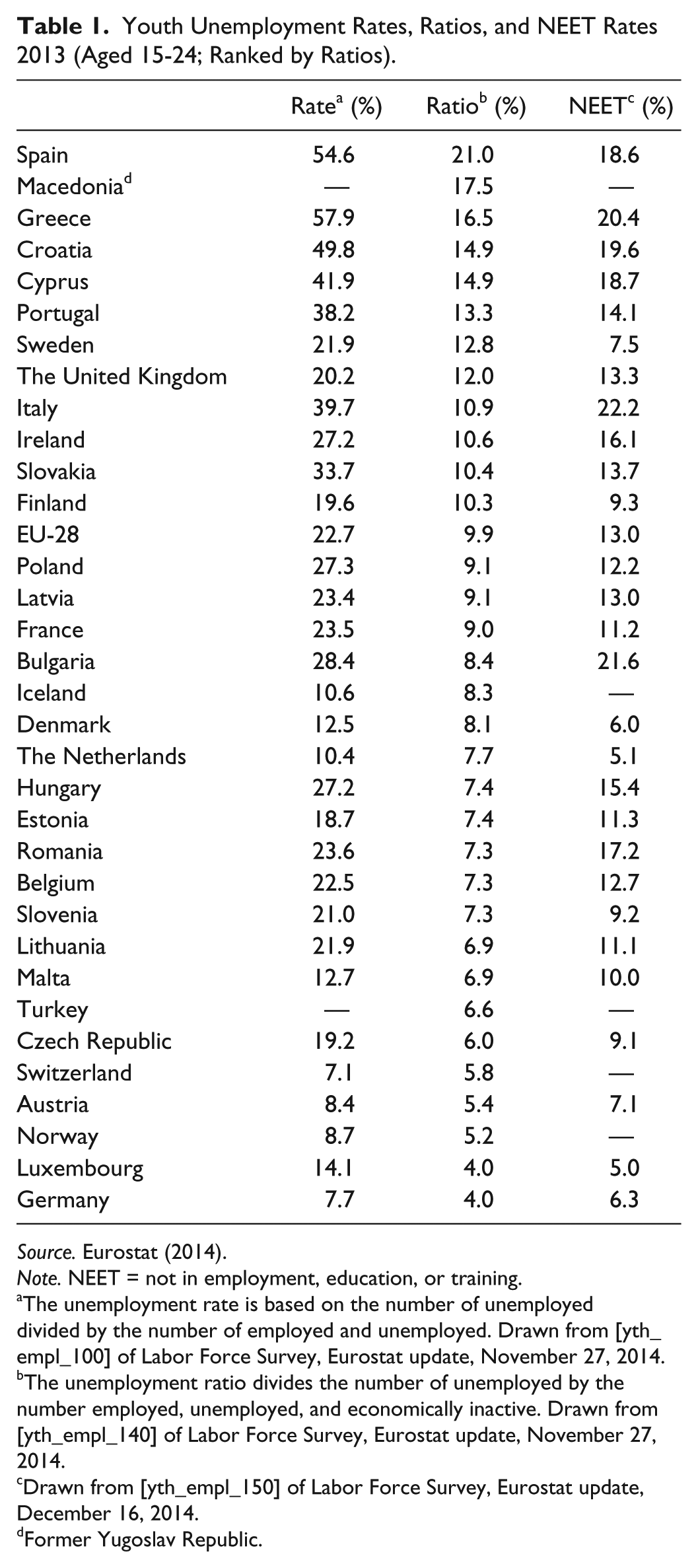
Source. Eurostat (2014).
Note. NEET = not in employment, education, or training.
The unemployment rate is based on the number of unemployed divided by the number of employed and unemployed. Drawn from [yth_empl_100] of Labor Force Survey, Eurostat update, November 27, 2014.
The unemployment ratio divides the number of unemployed by the number employed, unemployed, and economically inactive. Drawn from [yth_empl_140] of Labor Force Survey, Eurostat update, November 27, 2014.
Drawn from [yth_empl_150] of Labor Force Survey, Eurostat update, December 16, 2014.
Former Yugoslav Republic.
There has been an increasing use of the distinction between rates and ratios to discuss this problem (Hadjivassiliou et al., 2015). 1 Rates are higher than ratios because this measure is based on the number of unemployed youth divided by the total number of youth in the labor force (employed and unemployed). The unemployment ratio is lower because the denominator is the total population of young people (including those in education and training). Hill (2012) argues that ratios provide a more accurate measure in European debates because those not looking for full-time work, that is, full-time students, are included in the denominator; this provides a more correct estimate of those who are really looking for full-time work as a proportion of the total youth population.
The ratio measure reduces levels of youth unemployment to about half. This does not change the significance of the problem for countries facing the highest rates (Table 1). But, it does draw attention to some countries where the rates of youth unemployment are relatively low and where their ratios are much higher than the EU average, for example, in Sweden and the United Kingdom. The inverse is true, for example, in Poland, Bulgaria, and Hungary, where the rates are higher than the EU-28 average, but the ratios are relatively low, that is, below 10%. This would suggest that in these latter countries, a higher proportion of non-employed young people in the calculation of the denominator are either in education or are NEETs. These groups of young people require very different policy responses.
Understanding the significance of this definitional issue is illustrated by looking at the British case. At its peak in 1984, 1.2 million young people (16-24) were unemployed in the United Kingdom compared with 1.04 million in 2011 (Table 2). This measure would suggest that the situation was worse in the 1980s. By excluding students, in 2011, 731,000 (i.e., 10% of the youth population) were unemployed. “This compares with 832,000 (12 per cent) in 1993 and 1.1 million (14 per cent) in 1984” (Office of National Statistics [ONS], 2012, p. 2). Levels in 2011 were not as high as in the 1980s or 1990s, but when we compare the proportions/ratios of unemployed youth in the final quarter of 2011, excluding full-time students, these are “the highest since records began” (ONS, 2012, p. 2; Table 2).
Youth Unemployment in the United Kingdom.

Source. ONS Labor Force Survey (seasonally adjusted).
Note. ONS = Office of National Statistics.
These measurement debates are both political and academic: They are academic in terms of how we should accurately measure and interpret this phenomenon, and they are political in terms of appreciating its significance and the policies required to address it. Based on an extensive review of existing evidence, we argue that five distinctive characteristics differentiate the current phase of youth unemployment from earlier periods. These dimensions allow us to understand how different explanations and potential policy solutions have been developed to account for this phenomenon. Here we examine debates on labor market flexibility, skills mismatch, migration, family legacies, and the EU initiatives.
Increased Labor Market Flexibility
In the early 1990s, the conventional understanding of the poor job creation capacity of the European economy rested almost entirely on labor market rigidities; the suggested recommendation went in the direction of deregulating the labor market to make it more flexible (Simonazzi & Villa, 1999). Where flexibility has increased, this has often happened on the margins and has frequently been seen at the cost of security to employees (Boeri, 2011; Eamets, Philips, Alloja, & Krillo, 2008; Heyes, 2011). This process has been referred to as “partial and targeted deregulation” (Esping-Andersen & Regini, 2000), “two-tier reforms,” and reforms “at the margin” (European Commission, 2010a). It has created segmented labor markets where the burden of flexibility falls on workers with “atypical” contracts—with youth being considerably more likely to have fixed-term or temporary contracts compared with prime-age workers (Eichhorst et al., 2014).
Youth employment is characterized by high shares of temporary and part-time work (European Commission, 2014a). Of those below 25 years, 42% are on temporary contracts compared with 10% of those aged 25 to 64 (Eurofound, 2014b). Countries with the highest rates of young people working in temporary jobs are Slovenia, Poland, Germany, Spain, Portugal, Sweden, France, the Netherlands, and Italy. The percentage of young people in temporary work ranged from 66.6% in Slovenia to 44.4% in Italy in 2012; the lowest levels were in Romania, Lithuania, Estonia, Bulgaria, Latvia, Malta, Cyprus, the United Kingdom, and Slovakia, where less than 13% of youth employment was in temporary jobs (Eurofound, 2014b). On average for the EU-27, 36.7% of young people were in temporary employment “involuntarily” (Eurofound, 2014b). Part-time work is also an important feature of youth employment in some countries: While less than 5% of employed youth, 1 year after leaving school, were working part-time in Hungary, the Czech Republic, and Slovakia, the shares exceeded 30% in Denmark, the Netherlands, and Sweden.
The underlying assumption that flexibility improves economic performance is contested (Freeman, 2005; Kahn, 2010; Solow, 1998). Temporary contracts can ease the entry of first-time job seekers into stable employment where employers use them as screening devices to test skills and productivity. However, temporary contracts are known to pay less, offer less on-the-job training, be less satisfying than standard contracts, and also result in incomplete contributions to pensions and unemployment benefits (Eurofound, 2014b). They are often used as cheaper alternatives to offering permanent jobs (Guell & Petrolongo, 2007; Kahn, 2010). Chung, Bekker, and Houwing (2012) argue that low and decreasing transition rates from temporary work into permanent employment suggest that temporary work creates a cohort rather than an age effect: Younger generations may, in contrast to previous generations, be facing long-term labor market risks and scarring processes (Van Lancker, 2012).
Young people’s insecurity in employment and income not only impairs access to credit and residential independence and inhibits long-term commitments like family formation, it can also lead to subjective insecurities (Chung et al., 2012). There is a strong correlation between subjective insecurity (Burchell, 2002; de Witte & Naswall, 2003) and one’s employment contract (Erlinghagen, 2008). Paugam and Zhou (2007) show how the strength of this relationship varies across countries: The contrast in subjective insecurity between permanent and temporary workers is particularly stark in France and weakest in Denmark, indicating that institutional factors mediate this experience. Subjective insecurity is influenced not only by individual and occupational characteristics such as sex, age, family responsibilities, occupation, public- versus private-sector employment, and the size of organization (Clark & Postel-Vinay, 2009) but also by wider economic factors such as the unemployment levels (Green, 2009). Chung and van Oorschot (2011) and Erlinghagen (2008) suggest that while institutional factors such as employment protection levels and social security spending were correlated with levels of subjective insecurity, these factors were less important than individual/job characteristics and economic conditions.
Policy initiatives to limit the successive use of fixed-term contracts and to reduce divisions between temporary and permanent workers are captured in some of the debates on flexicurity. This policy concept encapsulates initiatives that both enhance labor market flexibility and employment and income security (Wilthagen & Tros, 2004). Policy makers, especially at the EU level, have been interested in identifying which elements of the best performing countries are responsible for their success and if, or how, these best practices could be transferred to other countries (European Commission, 2007). 2
However, critical evaluations of the effectiveness of these initiatives point to the fact that there is no universally agreed-upon definition of what these mean in different institutional contexts (Heyes, 2011; Jorgensen & Madsen, 2007; Tangian, 2011; Viebrock & Clasen, 2009). National and European trade unions have been particularly concerned about the consequences of the shift in emphasis from job security to employment security (Bekker, 2011; Council of the European Union, 2012). And many unanswered questions remain about the resilience of these systems during the recent economic crisis, and the consequences this has on youth transitions, subjective feelings of insecurity, and the effectiveness of policy reform (Leschke, 2012). Notwithstanding criticism, the concept remains an important component of the Europe 2020 strategy (European Commission, 2010a).
Our first characteristic of the pervasive growth of labor market flexibility since the 1980s and its impact on youth employment opportunities is illustrated by these debates. The changing structure of the youth labor market and the associated difficulty in accessing entry-level jobs poses a major challenge for young people looking for work. Moreover, the progressive polarization and hollowing out of the labor market have resulted in fewer jobs for the low- and mid-qualified. The reduction of intermediate-level jobs results in fewer opportunities for progression beyond entry-level jobs. Changing employers’ expectations that young people should be “job-ready” has emphasized the need for education systems to teach “employability” skills. In attempts to obtain these skills, we have witnessed an expansion of internships (Lain et al., 2014), many of which are unpaid or very poorly paid. Some employers have been criticized for using these to avoid employing young people with properly paid probation periods. New forms of labor market flexibility, alongside the expansion of education and skills, are reshaping the consequences associated with different youth transition trajectories.
Expansion of Education, Skill, and Qualifications Mismatch
Changes in the structure of employment and employers’ skill expectations since the 1980s have gone alongside a significant expansion of education systems (Berman, Bound, & Machin, 1998; Casner-Lotto & Barrington, 2006; Piketty, 2014; U.K. Commission’s Employer Skills Survey [UKCES], 2012). This has generated considerable research interest in the issue of skills and qualification mismatch (European Commission, 2012b; McGuinness, 2003). Worker mismatch generally describes the situation whereby the skill levels or education of the individual are to some degree misaligned with the productivity requirements of the firm, that is, there is an imbalance between labor supply and labor demand. While the overall concept of mismatch seems quite straightforward, the measurement of mismatch is somewhat more complicated and will be largely dependent upon both data availability and whether the concept is being explored from the perspective of the worker or the firm. Most studies have focused on mismatch from the point of view of the worker, and the bulk of the literature, to date, has used over-education as the key measure of mismatch (Quintini, 2011).
Over-education refers to the situation whereby workers hold more qualifications than are required for their current job. Within the over-education literature, educational attainment is taken as a proxy for worker human capital (labor supply), while job entry requirements are taken as a proxy measure of job productivity requirements (labor demand). Nevertheless, the over-education measure has been criticized by a number of authors (Mavromaras, McGuinness, & King Fok, 2009; McGuinness & Wooden, 2009) on the basis that educational attainment will under-estimate an individual’s total human capital as it ignores skills acquired in the workplace. Furthermore, job entry requirements are often a poor measure of job productivity as a consequence of qualifications inflation.
More recently studies have focused on over-skilling as the key measure of mismatch, on the grounds that it more accurately measures the imbalance between the demand and supply of labor (Allen & van der Velden, 2001; Green & McIntosh, 2007; Mavromaras et al., 2009). Over-skilling requires the worker to directly compare all their acquired skills with actual job requirements and, as such, they will take account of both formal and informal learning as well as actual job content. It is argued that the over-skilling measure gets over many of the weaknesses associated with an over-education indicator. In practice, however, the measure adopted is generally dictated by the nature of the data available.
Over-education and over-skilling describe situations where the worker has too much education or too many skills for the current job. Conversely, under-education and under-skilling describes the situation whereby workers report having insufficient levels of education or skills for their current employment. Generally, workers who are under-educated or under-skilled have been found to earn a pay premium relative to their counterparts who are well matched. The lack of any obvious negative impacts associated with under-education and under-skilling from the perspective of the employee is the most probable explanation for the lack of research activity in the area.
Over-education and over-skilling are associated with substantial wage penalties and lower levels of job satisfaction. Nevertheless, it cannot be assumed that over-education and over-skilling are interchangeable. In general, studies have found that relatively low proportions of workers reporting over-education also describe themselves as being over-skilled and vice versa (Allen & van der Velden, 2001; Green & McIntosh, 2007; Mavromaras et al., 2009). Furthermore, wage penalties appear higher for over-educated workers while over-skilled workers tend to be less satisfied with their jobs (McGuinness & Sloane, 2011). Individuals who are mismatched experience lower rates of career progression, with the evidence suggesting that both over-education and over-skilling tend to have a long-term impact. Despite having higher rates of job separation and mobility, mismatched workers are more likely to move from one state of over-education/over-skilling to another (Dolton & Siles, 2003; McGuinness & Wooden, 2009). In addition to lower levels of earnings, job satisfaction, and career progression, mismatch is also associated with cognitive decline, particularly with regard to immediate and delayed recall abilities, cognitive flexibility, and verbal fluency (de Grip, Bosma, Willems, & van Boxtel, 2008).
Studies of over-education or over-skilling with specific reference to young people are relatively rare. Extant literature shows that being mismatched in their first employment tends to permanently constrain substantial proportions of graduates to low-level occupations (Dolton & Siles, 2003; McGuinness & Sloane, 2011). Similarly, Böhlmark (2003) finds that 61% of Swedish 18- to 29-year-olds who were over-educated in 1981 were still so after 10 years. However, there is a distinct lack of work focusing on the youth labor market despite the fact that existing evidence suggests that an unsuccessful match at the point of labor market entry is the most crucial determinant of mismatch in later life (Cedefop, 2010).
Furthermore, we know little of the determinants of mismatch within countries, for example, the extent to which it relates to the nature of educational provision, job-search behavior, inadequate levels of labor market demand, or the role of institutions. To a large extent, the paucity of knowledge on the determinants of mismatch relates to data constraints and an over-reliance of country-specific micro-level data that does not allow researchers to disentangle such effects. Finally, there has been little work on the impact of business cycle effects and, more specifically, the degree to which the incidence and impacts of mismatch within the youth labor market have worsened as a consequence of recent recessions in many European countries.
Gender differences are also likely to prove important as it has been argued that females, particularly those that are married, are more likely to be restricted to local geographical areas in terms of their labor market search activities, which may, in turn, expose them to a higher probability of mismatch or unemployment (Frank, 1978). While some limited research has been carried out with regard to gender differences in rates of over-education (Buchel & Battu, 2003; Buchel & van Ham, 2002; McGoldrick & Robst, 1996), no work has been carried out with regard to the youth labor market or in terms of more recent concepts of mismatch such as over-skilling.
The focus on country-specific micro data sets in the literature implies that studies tend to focus on a specific outcome or determinant of mismatch, which has led to a situation whereby knowledge of the topic has expanded in a rather piecemeal fashion without any real advancement of the understanding of the causes of mismatch. It is only through the exploitation of cross-country data sets with a time varying component that the relative importance of factors such as the expansion of educational supply, the structure of labor market demand, institutions in determining levels of mismatch, among both adults and young people, will be properly understood (McGuinness et al., 2015).
Our second characteristic of the expansion of education and skills mismatch is interwoven with the extent of structural labor market changes over recent decades, and the consequences this has for differently qualified young people looking for work (European Commission, 2012c). One consequence has been evidenced in new patterns of youth mobility, as both highly educated young people and those with fewer qualifications move across the EU to find work.
Youth Migration
Intra-EU labor mobility has been promoted as an adjustment mechanism to ensure more efficient labor allocation across the EU by contributing to better labor market matching and reducing regional disparities in unemployment (European Commission, 2010c; Kahanec & Zimmermann, 2010, forthcoming). EU enlargement in 2004 and 2007 witnessed an unexpected level of intra-EU migration from Central–Eastern Europe to Western Europe, although this varied between countries ( OECD, 2014). Post-accession East–West migration has been composed of a high share of youth migrants with tertiary education (Favell, 2008; Kaczmarczyk & Okólski, 2008; Kureková, 2011a, 2011b). Despite high levels of qualifications, a majority found employment in low-skilled jobs with limited degrees of upward job mobility and low earnings (Johnston, Khattab, & Manley, 2014; Voitchovsky, 2014).
High rates of youth mobility can be explained by a complex set of push and pull factors. These include the economic situation in the sending and receiving country; policy measures inciting or preventing migration (the so-called transitional measures); geographic, language, and cultural proximity; as well as the differential distribution of migrant networks across Europe (Kahanec & Zimmermann, 2010). Youth mobility from East to West has also been discussed as a “choice” to “exit” native labor markets experiencing difficult economic conditions or as a “brain overflow,” where younger cohorts have benefited from increased access to tertiary education, but these qualifications do not fit well with the structure of the labor demand in their own countries (Galgóczi, Leschke, & Watt, 2012; Kaczmarczyk & Okólski, 2008; Kahanec & Fabo, 2013; Kahanec & Mýtna Kureková, forthcoming; Kureková, 2011b, 2013; OECD, 2012a).
The recent global economic crisis further reshuffled the distribution of intra-EU migration. It temporarily slowed down the rates of outward migration from some of the Central–Eastern Europe countries or led to onward migration from those countries where it was becoming more difficult to find work. In some cases, return migration occurred to countries that were less affected by the crisis such as Poland and Slovakia, or countries experiencing a faster recovery, such as Estonia (Galgóczi et al., 2012; OECD, 2012a; Zaiceva & Zimmermann, 2014). Since the 2008 financial crisis, South–North emigration has re-emerged as young people from Spain, Greece, Italy, Portugal, and Ireland move to find work in parts of northern Europe or outside the EU altogether.
Intra-EU mobility might contribute to better macro-level outcomes in terms of lower unemployment rates across the EU and increasing the options and experiences for young Europeans (Galgóczi, Leschke, & Watt, 2009; OECD, 2012b). However, this mobility might come at the cost of some young migrant workers employed on very short-term flexible contracts and accepting jobs beneath their qualifications that employers find difficult to recognize (Eurostat, 2014; Kahanec & Zimmermann, 2015).
The ultimate effects of youth labor mobility and return migration will depend on whether the migrants and returnees will have accumulated, or depleted, their human, financial, and social capital during their migration experience. To date, relatively little is known about selectivity of West–East return mobility, their occupational trajectories, and labor market outcomes (Anacka & Fihel, 2012; Radu & Martin, 2010; Zaiceva & Zimmermann, 2014). However, the benefits of labor mobility may well be limited, if those returning are going back to areas with difficult economic circumstances (Barcevičius, Iglicka, Repečkaitė, & Žvalionytė, 2012; Radu & Martin, 2010).
Policies affecting mobility and migration provided by welfare and social security (and their transferability within the EU) have become particularly political issues (Bruzelius, Chase, & Seeleib-Kaiser, 2014). On one hand, critiques of the principles of “free movement” of labor within the EU have been voiced by a variety of Eurosceptics wanting to curtail immigration flows. On the other hand, a less vociferous debate on policies to facilitate mobility has discussed the potential transferability of welfare and social security entitlements through the development of a European social insurance fund (Vandenbroucke, 2014), in which policy reform is part of a “social investment state” (Knijn, 2012; Morel, Palier, & Palme, 2012).
A further range of policies has sought to improve job matching and information through various EU employment packages and the extension of the Erasmus mobility scheme to include young apprentices as well as its traditional base of university graduates. These exist alongside other labor market intermediaries such as recruitment agencies or temporary employment agencies, whose role in shaping labor mobility and influencing the character of employment contracts, wages, and working conditions of youth migrant workers frequently divides opinion on the negative and beneficial effects for both the host communities and migrants (Coe, Jones, & Ward, 2010; OECD, 2014).
More recently, attention has started to be focused on what happens to migrants and their children who settle abroad and establish families. Recent OECD (2014) research shows that the proportion of 15-year-olds with two foreign-born parents has doubled in the past decade. For second-generation children whose parents have low levels of education issues of integration are becoming more important in affecting their own labor market entrance. According to Castagnone, Nazio, Bartolini, and Schoumaker (2014), non-EU migrants experience a dramatic downgrading and slow occupational recovery during their first decade working in Europe. Reducing the educational–occupational mismatch requires obtaining (further) qualifications in the destination countries that employers find easier to recognize. For second-generation youth, that is, the children of earlier waves of migration, the impact of ethnic penalties in attaining skills, qualifications, and occupational status varies by the ethnic status of their parents (Zuccotti, 2014). Clearly parents always matter, and with increasing levels of migration, our third characteristic, where their parents come from, will matter even more, both for those who move and those who establish new families in foreign countries.
The Family Legacy
For some young people, unemployment is a frictional experience; for others, long-term exposure is part of a generational legacy (Martin, 2012). This legacy is a result of demographic changes, the expansion of higher education, and structural economic adjustment in the late 1970s and 1980s, resulting in the large-scale displacement of traditional manufacturing sector employment.
The experience of the parents of today’s children shapes their opportunities through the transmission of resources and cultural capital (Warmuth, Kittel, Steiber, & Mühlböck, 2014). We know from earlier research that parental unemployment can become an “unintended” legacy for their own children, depending on where they live and how the economy around them has changed in recent decades (Ekhaugen, 2009; Headey & Verick, 2006; MacDonald, Shildrick, & Furlong, 2013; Macmillan, 2014).
The “culture of poverty” approach attributed inter-generational unemployment to factors such as poor role models and the transmission of attitudes toward employment and welfare dependency (Mead, 1986; Wilson, 1987). This explanation is also prominent in the popular media (MacDonald, Shildrick, & Furlong, 2013). Such cultural accounts have been criticized for failing to adequately acknowledge the role of structural economic inequalities (Bynner, 2005), lack of evidence on distinct attitudes among the unemployed (Gallie, 1994), and exaggerated claims about the pervasiveness and persistence of joblessness in households and communities (MacDonald et al., 2014). Family heterogeneity, such as parental education, household income, and nationality, was found to account for almost half of the inter-generational correlation in employment in Norwegian families while unobserved family fixed effects (i.e., other factors that are not explained by the above mentioned characteristics) “accounted” for the remaining differences (Ekhaugen, 2009). Hadjivassiliou et al. (2015) also found that parental education had an effect on youth labour market transitions, this effect is increasing over time and contributing to growing levels of inequalities amongst young people. In the United Kingdom, Macmillan (2014) highlights the role of high unemployment in the local labor markets in accounting for shared risks of parents and children. Some of this debate has been polarized between identifying different explanations for the same phenomenon: Is the persistence of inter-generational legacies of unemployment due to (a) attitudinal differences, (b) regional disparities in available jobs, or (c) the effects of the benefits system if young people are to take up paid work, while still living at home with their parents who may be reliant on benefits? Disentangling these factors is a research priority.
Such processes mean that youth unemployment today is likely to be affected by the polarization of work-poor and work-rich households since the 1980s. The concentration of joblessness within households also has implications for the level of poverty experience by unemployed youth (de Graaf-Zijl & Nolan, 2011). Opportunities to find work are linked not to some inherited attitudes on dependency, but on the regions in which they live. Gregg and Wadsworth (2000) draw attention to this development in the early 1990s by identifying households where no one was working (i.e., work-poor) compared with households where two or more people were in employment (work-rich). The importance of this gap varied between countries with Ireland, the United Kingdom, and Spain having the highest proportions of work-poor households (Anxo & O’Reilly, 2001). A range of policies in the 1990s reduced the proportion of workless households; however, since the economic crisis of 2007/2008, the proportions of work-poor households are beginning to rise again and are expected to increase even further (Gregg, Scutella, & Wadsworth, 2010).
Alongside the impact of parental work legacies, the patterns of leaving home have become more diverse, not always reflecting a simple step toward economic independence. Young people leave, for different reasons, and are increasingly, intermittently, coming back. Newman (2012) refers to this emerging phenomenon as the “boomerang generation” creating “accordion families” that shrink and expand in relation to these generational movements. Newman argues that this phenomenon is present across a number of highly developed countries. In Japan, where the economic crisis came much earlier in the 1990s, and persists, a growing number of young people, in their late 20s or early 30s, still living at home, are derogatively referred to as “parasite singles.” Genda (2005) and Brinton (2011) both argue that this popularized stigma fails to recognize how the segmented structure of Japanese firms places insurmountable barriers for young men to achieve the characteristic career of “salary men.” In Italian media, a similar invective against “bamboccioni” labels such young men as “grown-up babies.” But Saraceno (2012) argues that these individualized experiences need to be contextualized: Young Italians have the lowest salary levels, the highest degrees of precariousness in Europe, and scant if no access to unemployment benefits. Even in Germany, Geserick (2011) shows that the term “Nesthocker” at “Hotel Mama” is becoming a visible trend. But negative connotations depend on whether this is seen as a long- or short-term trajectory, and should also be linked to the economic status of the families who are able to continue supporting their adult children.
When jobs are scarce, parents and other networks can become important factors in getting a job (Berloffa, Modena, & Villa, 2011; Granovetter, 1973). But in prosperous economic times when jobs are available, youth unemployment can also be high because of the gap between expectations, aspirations, and the realities of low wages and poor working conditions on offer (Giraldo & Trivellato, 2006). The distinction between young people who can afford to wait for better opportunities, compared with those who have to take what is on offer, is shaped by their family situation and specific societal conditions (Bukodi & Goldthorpe, 2011).
Parents not only influence employment outcomes but also often provide direct financial transfers and practical help to their adult children during the process of transition to adulthood (Heath & Calvert, 2013; Lye, 1996). According to Swartz, Kim, Uno, Mortimer, and O’Brien (2011), parental support can be temporary support that contributes to human capital accumulation or other major goals of social status attainment, such as college finance (Henretta, Wolf, van Voorhis, & Soldo, 2012; Kalenkoski & Pabilonia, 2010), or purchasing housing (Kurz & Blossfeld, 2004). Both economic theories on altruistic transfers (Cox, 1987) and sociological theories about contingent transfers (Wightman, Schoeni, & Robinson, 2012) imply that parents will be inclined to help adult children in need, where they can. There are a variety of ways in which parental support affects youth labor market transitions. These can include sharing resources in the form of co-residence, financial resources, housing, time, emotional support, services, supporting separate households by inter-generational private financial transfers, or inheritance. These forms of support differ by gender, social status, and countries (Ayllón, 2014; Blossfeld, 2005; Nazio, 2008).
Our fourth characteristic is that family legacies affect the routes and resources young people can avail of, or are penalized by, in relation to transitions into economically independent adulthood. These are becoming increasingly polarized both within and across European societies along a variety of dimensions that cannot simply be read off in terms of ethnicity, class, gender, or the original nationality of their parents. Understanding the long-term implications of the impact of these social divisions will be a central focus in knowing which kinds of policy interventions might be most effective in addressing current levels of youth unemployment.
The European Dimension
The fifth characteristic that distinguishes the current period of youth unemployment has been the more extensive financial investment in policy programs by the EU. 3 Knijn and Smith (2012) examine policy initiatives for youth prior to the financial crisis in relation to different policy paradigms linked to the social investment state (Morel et al., 2012), transitional labor markets (Schmid, 2012, 2015), and an individual life-course paradigm (Bovenberg, 2007; Brückner & Mayer, 2005). Knijn and Smith argue that policies encompassed by these different paradigms can be distinguished between those emphasizing investing in, facilitating, and individualizing new social risks. Policies include a broad spectrum. These cover educational social investments to facilitate secure transitions; policies that encourage individualized responsibility and investment in their own human capital, entrepreneurial activities, or private saving schemes to protect against social risks (Knijn, 2012). In Knijn and Smith’s comprehensive review of youth policies before the crisis, they argue that EU approach tends to overlap especially between the first and second paradigms; they share a similar language but policy implementation has not been guided by a comprehensive new paradigm (Hall, 1993). Since Knijn and Smith’s review, a range of new policies has been introduced to address youth unemployment as a result of the economic crisis and its impact on youth (Table 3). We outline these policies before discussing the problems of policy evaluation.
Summary of European Policy Initiatives.

Note. YOI = Youth Opportunities Initiative; ESF = European Social Fund; YEP = Youth Employment Package; YEI = Youth Employment Initiative; NEET = not in employment, education, or training; EAfA = European Alliance for apprenticeships.
http://www.slideshare.net/EESCsocsection/youth-employment-package and http://ec.europa.eu/social/main.jsp?langId=en&catId=1036&newsId=1731&furtherNews=yes
The Europe 2020 Strategy
The Europe 2020 strategy was based around flagship initiatives to promote economic growth. The Youth on the Move flagship aims to enhance the performance and quality of the education and training systems, promote youth mobility, both for learning and work purposes, ensure a smooth and speedy labor market transition of young people, and reinforce the international attractiveness of Europe’s higher education (European Commission, 2010c).
The Agenda for New Skills and Jobs flagship seeks to achieve a better skills match through dialogue in the design of qualifications and training provision between education/training providers, social partners, and employers (European Commission, 2012b). It emphasizes the importance of geographical mobility throughout the EU to ensure that skills supply is matched with labor market need. The Europe 2020 initiative also plans to build on the success of the pilot Erasmus program for young entrepreneurs by establishing a permanent program encouraging exchange of individuals and expertise between new entrepreneurs and host enterprises.
The third flagship, the European Platform Against Poverty, promotes social inclusion and cohesion through the design of innovative programs aimed at providing education, employment, and training opportunities for the most vulnerable. It includes (a) a communication proposing policies to combat early school leaving, (b) the launch in 2012 of an initiative to encourage more effective intervention at all stages of education to tackle disadvantage, and (c) a recommendation in 2012 on child poverty (Council of the European Union, 2011).
EU efforts are mainly focused on promoting mobility through the provision of information, for example, through a European Labor Market Monitor to disseminate data on vacancies and job seekers across the EU, a multilingual dictionary of occupations and skills to improve understanding of vacancy information and a “Match and Map” system which both matches user profiles to jobs and geographically maps the location of jobs, addressing the third characteristic identified here around youth mobility. The 2010 Council conclusions on “New Skills for New Jobs: The Way Forward” also stress the need to improve the transition from education to work through the links between providers and employers, in recognizing the significance of skills mismatch related to the second characteristic we have discussed here (Council of the European Union, 2010).
The Youth Opportunities Initiative (YOI)
This initiative introduced in 2011 was part of a set of measures to support the Youth on the Move flagship. It called on Member States, with the help and support of the EU, to work on preventing early school leaving and to support graduates get work experience, illustrating how policy is directed at the different communities of youth between the “poorly integrated” and those “left behind.” The actions, proposed by the Commission and financed by EU funds (European Commission, 2011, 2012a), covered a range of policies. These included supporting “Youth Guarantee” schemes, European Social Fund (ESF) to support the setting up of apprenticeships, ESF Technical Assistance to young business starters, gearing funds toward placements in enterprises, financial assistance to Your First EURES Job search initiative, providing at least 10,000 volunteering opportunities, and a framework for high-quality traineeships. The Commission also urged Member States to make better use of the ESF, which still had €30 billion of funding uncommitted to projects in 2013.
The YOI called on social partners, where appropriate, with the help of the relevant Member States’ authorities, to explore how they could promote these goals. The European Social Partners’ Framework Agreement on Inclusive Labour Markets (ETUC/Confédération Européenne des Syndicats [CES], 2012) outlines how they see the action of the social partners to include “awareness-raising” and dissemination; cooperation with the “third sector”; cooperation with vocational education and training (VET) providers to “ease transitions”; implementing effective recruitment, induction programs, and competence development plans for young people; facilitating geographical and occupational mobility through the recognition and transferability of qualifications; and promoting more and better apprenticeship contracts.
By April 2012, and in response to the prolonged economic crisis, an employment package “Towards a Job-Rich Recovery” 4 was adopted to address skills and geographical mismatch. This policy communication included incentives to encourage hiring of some disadvantaged groups. However, the main focus was on the supply side. Proposals included reducing taxes on labor or supporting business start-ups, and promoting cross-border job mobility. It also identified the areas with the biggest job potential for the future, including the green economy, health services, and information and communications technologies (ICTs). The policy communication underlined the need for a stronger employment and social dimension to EU governance and lays down ways to involve employers’ and workers’ representatives more in setting EU priorities. However, given the structural weakness of unions in the majority of European countries since the 1980s, their role today is more likely to be one of consultation and advice about implementation in this policy process.
The Youth Employment Package (YEP) and the Youth Employment Initiative (YEI)
By December 2012, further initiatives under the YEP included four key actions. It recommended that Member States introduce the “youth guarantee” ensuring that all young people up to age 25 received a quality offer of a job, continued education, an apprenticeship, or a traineeship within 4 months of leaving formal education or becoming unemployed.
Following on from this, in March 2013, the “Grand Coalition for Digital Jobs” 5 was launched outlining measures to increase job mobility, and rationalize training and certification in the sector to match skills to vacancies. In the same month, the Commission announced the YEI, which reinforced the measures outlined in the YEP. In particular, the YEI and its €6 billion budget aims to support NEETs in regions with a youth unemployment rate above 25% (European Commission, 2013b). The YEI’s funds comprise €3 billion from the ESF and €3 billion from a new budget line dedicated specifically to youth unemployment; Greece, Spain, and Italy will receive the largest share of the YEI, €3.4 billion. An estimated 7.5 million young Europeans aged 15 to 24 are currently classified as NEETs; the YEI’s implementation is front-loaded so that funding is committed in 2014 and 2015 rather than over the 7-year period of the 2014-2020 Multiannual Financial Framework (MFF).
The Youth Guarantee (YG)
The YEI’s funds are channeled to the design and implementation of the YG based on its success in Nordic countries and Austria. The Finnish YG resulted in a significant reduction in youth unemployment through either direct employment assistance or further training leading to a job (European Commission, 2014b). In an evaluation of the Swedish YG conducted in 2011, unemployed young people aged 24 who participated in the program in 2008 were able to find a job faster than a control group of participants in other Public Employment Service (PES) measures (Eurofound, 2012a, 2012c). As a result, YGs feature prominently both in the YEI and in the Commission’s Communication Working Together for Europe’s Young People—A Call to Action on Youth Unemployment, launched on June 19, 2013, aimed at accelerating the implementation of the YG more widely across Europe (European Commission, 2013a).
The YG concept implies an entitlement to a job, training, or education of a defined group of young people and an obligation for the PES or another public authority to provide the services and/or implement the programs within a given period of time (ILO, 2012b). The debate around an EU YG at the European level started in 2005 when the Council agreed that every young unemployed is offered a new start within 6 months of unemployment. However, despite several calls for YGs over the years, in particular from the European Council, the European Parliament, and the European Commission, their take-up and implementation have historically been very limited and concentrated to a few Nordic countries and Austria. Following European Commission’s YG proposal in December 2012, the Council of the European Union adopted a recommendation to establish a YG in April 22, 2013.
Guidelines inform the design and implementation of YGs in Member States encompass six key areas: (a) building up partnership-based approaches, (b) early intervention and activation, (c) supportive measures enabling labor market integration (including enhancing skills and labor market–related measures), (d) use of EU funds, (e) assessment and continuous improvement of the scheme, and (f) (prompt) implementation of YG schemes.
Following the above Recommendation and its endorsement by the European Council in June 2013, Member States with regions experiencing youth unemployment rates above 25% were asked to develop and submit a National Youth Guarantee Implementation Plan (NYGIP) by the end of 2013, with the remaining seven Member States having to submit one by March 2014. Despite this need for urgent implementation of the YG, progress to date has been patchy. 6
Despite the positive experience with YGs in the Nordic and a few other countries, there is rather limited evidence on their long-term impact, which suggests that performance monitoring and impact evaluation systems need to be enhanced substantially. Indeed, the need for more robust evaluation and impact assessment of YEI-related measures, notably the YG, has also been recognized by the Commission that considers the requirement for two YEI impact evaluations during a period of 9 years as a minimum requirement. To this end, in March 2013, it put forward a list of relevant YEI and NEET-related indicators (immediate and longer term result indicators broken down by gender) that must be used to assess the take-up and effectiveness of interventions such as the YG and be included in the annual implementation reports.
Evidence suggests that the success rate of YG interventions is higher for new labor market entrants than for long-term unemployed (Eurofound, 2012a, 2012b). This is of particular relevance to addressing the needs of disadvantaged groups of young people who may also face structural problems. Indeed, as regards NEETs, existing evidence indicates that YG schemes are more suitable for those who are closer to the labor market, while those who face multiple barriers could not be engaged as effectively (Eurofound, 2012a, 2012b). Current YGs are available only to young people registered with the PES; they do not support unregistered jobless youth. Given the significant share of young people who fall out of the reach of employment services in many countries, it would seem important to extend participation of these young people, including through flexible design and outreach strategies.
The available funding can also be an issue because the effective implementation of YGs is resource intensive and requires substantial public- or private-sector investment. The EU funds earmarked for the EU YG (e.g., the ESF itself and the YEI’s €6 billion) are seen as inadequate for its successful implementation. For example, the ILO estimates that the EU requires an injection of €21 billion which represents around 0.45% of Eurozone government spending (and 0.22% of GDP). As the 2012 Eurofound’s ground-breaking study has shown, this should be seen against an estimated annual cost of NEETs of about €153 billion (representing 1.21% of EU’s GDP; Eurofound, 2012b; ILO, 2012b, 2012c).
Moreover, PES must be able to ensure individual young people receive appropriate advice on job, education, and training opportunities most relevant to their own situation. The effectiveness of YGs is linked to the capacity of PES to effectively administer labor market measures and the capacity to establish cooperative arrangements with other stakeholders, including youth organizations. Yet, the quality, capacity, and reach of PES vary considerably between countries and even regions within the same country. Indeed, in many countries, the successful implementation of the YG will require structural reforms such as the restructuring and revamping of PES which must have the necessary capacity and professional staffing levels to ensure individual young people receive appropriate advice on job, education, and training opportunities most relevant to their own needs.
Traineeships and Apprenticeships
Further policy initiatives in 2014 included the Council of Ministers’ adoption of the Quality Framework For Traineeships, based on several years of consultation (Council of the European Union, 2014). This is aimed at helping trainees acquire high-quality work experience under safe and fair conditions and to increase their chances of finding a good quality job. This was in response to the level of critique directed at the quality of many employer-provided internships/traineeships (Lain et al., 2014). The YEP also announced the European Alliance for Apprenticeships (EAfA), the aim of which is to improve the quality and supply of apprenticeships available by spreading successful apprenticeship schemes across the EU and by bringing together all relevant stakeholders. Finally, the YEP stressed the importance of EU-wide mobility for young people, for example, through the “Your First EURES Job” initiative and the Erasmus program. 7 The YEP recognized the important role that EU funds, notably the ESF, can play in supporting its youth employment measures. Specifically, the Commission’s proposed ESF Regulation for the next programming period 2014-2020 included a dedicated ESF investment priority targeting the sustainable labor market integration of young NEETs.
The extent to which these new initiatives can significantly change the institutional trajectory of countries is currently in a process of evaluation. But a notable difference, compared with the 1980s, is that current levels of support are drawing on significantly higher level of EU-wide structural investment (Allen, 2010; Lindley, 1996; Rodríguez-Pose & Fratesi, 2004). Although this level of EU-wide-funded initiatives has been criticized for not being large enough, for example, by the European Youth Forum, it also illustrates our fifth characteristic of how the issue of youth unemployment today differs from that of the 1980s in terms of the higher priority and investment this issue receives at EU level.
Discussion: Policy Initiatives and Performance—What Works?
Making general statements about the likely effectiveness of particular programs on youth unemployment is difficult given the variation of program design, national framework conditions, and target groups (Kluve et al., 2006). These problems apply to EU initiatives and international comparisons of the effectiveness of different schemes. Also, the scope of evaluation studies varies between programs and countries and the various success indicators being used: These can range from only a reduction of benefit recipients to sustainable integration into employment including the focus on working conditions and wages. Traditionally, the best way to guard against the risks of youth unemployment has been educational attainment and qualifications. Cross-country comparisons show that countries maintaining a substantial dual apprenticeship system, that is, Austria, Denmark, Germany, and Switzerland, exhibit a much smoother transition from school to work, low NEET rates, and low youth unemployment than other countries (Eurofound, 2014a).
But youth labor market transitions only provide partial evidence on the relative performance of the training systems in the respective countries. A causal analysis is impeded by the co-variation of other relevant institutional factors. Further problems arise from the absence of a unified framework for defining the respective training options and collecting data on the costs and benefits experienced by the state, the firms, and trainees (Hoeckel, 2008).
Besides limited data availability impeding the analysis of net benefits of the respective training options, assessing the individual benefit of participation within a country is complicated by several identification issues (Wolter & Ryan, 2011), namely, first, identifying the relevant counterfactual situations in the presence of occupation-specific labor markets; second, non-random selection into the training options based on unobservable characteristics; third, heterogeneous outcomes by field of training; and fourth, general equilibrium effects.
Evidence on the relative performance of vocational versus general upper secondary and tertiary education is summarized by Ryan (2001) for France, the United Kingdom, and the United States, and Russell and O’Connell (2001) for nine European countries. These studies point to an increased employment probability of participants in occupation-specific training. However, evidence on wage differentials is mixed: In some cases for those with occupational-specific training, there are wage penalties; they receive similar wages or they even benefit from wage bonuses compared with those with general skills or educational qualifications (Malamoud & Pop-Eleches, 2010; van de Werfhorst, 2011).
Most recently, Hanushek, Woessmann, and Zhang (2011) adopt a life cycle approach to analyzing employment differences of general and vocational schooling over the course of individuals’ working life. In line with previous findings, their descriptive evidence points at a faster initial integration into the labor market of vocational education participants, but a faster decreasing labor market participation toward the end of their working life. This suggests that occupational-specific knowledge dates faster and leads to lower employment opportunities later in life. But this of course depends on the types of occupations and the changing demand for these skills in the labor market. More reliable evidence on the perceived trade-off remains to be produced, as the causal interpretation of these findings is impeded by occupation-specific segregation of the labor market and the limited availability of long-term panel data.
Given the available evidence of evaluation studies (Card, Kluve, & Weber, 2010; Martin & Grubb, 2001), it seems fair to conclude in general:
Job search assistance and sanctioning have positive short-run effects on the termination of unemployment.
Publicly sponsored training has positive medium run effects, particularly if delivered in high quality and tailored to the labor market needs of firms’ skill demands, which can be achieved by mobilizing employers and local communities.
Targeted and temporary hiring subsidies to employers are effective, but costly, and they tend to have significant side effects so that net employment gains are less clear-cut.
Direct public job creation is most problematic in promoting transition to full-time permanent employment.
Start-up support has proven to be a quite effective instrument at least for higher educated and motivated youth.
According to the meta-analysis by Card et al. (2010), most Active Labor Market Policies schemes (ALMPs) targeted toward young people seem less effective than schemes targeting the unemployed in general. However, evidence highlights the important role of early intervention in changing outcomes for those young people most at risk, both with respect to activation at an early stage of unemployment (Martin & Grubb, 2001) and, most importantly, early in life (Heckman, 2000).
In many countries, participation in activation policies has been made compulsory after an initial period of receipt of social security along the principle of “mutual obligations” either stressing swift integration into work (“work first”) or demanding participation in training (“train first”), such as a the “YG.” Integration into work via “work first’ tends to bring about short-run gains but is less effective than participation in training in the medium and long run (Card et al., 2010). Training measures and comprehensive programs with a strong training element are most prominent in youth ALMPs.
According to a recent Eurofound (2012a) study, successful policies to address youth unemployment specify target and hard to reach groups; the young people involved consider the program to have a good reputation, and relevant community groups are involved in the delivery of these programs. The effectiveness of these policies is based on the understanding of the range of minor and complex needs affecting labor market readiness of young people, as well as well-trained support staff providing comprehensive holistic guidance with personalized advice to help them achieve long-term sustainable pathways into work, “rather than low-quality quick fixes” (Eurofound, 2012a). Flexible responses adapted to the economic cycle together with inter-agency collaboration, the buy-in of employers, and their representatives can provide “cost-effective ways to implement policies” (Eurofound, 2012a). But these measures require systematic and robust monitoring and evaluation if we are to know what really works and why.
Conclusion
Youth transitions to economic independence and adulthood are becoming increasingly more difficult and protracted. We have argued that the distinguishing characteristics of contemporary youth labor markets reflect structural changes in employment and increased demands for labor flexibility and changing skill requirements, new patterns of migration, polarization created by family legacies, and increased policy intervention and investment by the EU. The nexus of transitions between skill attainment, labor market integration, and economic independence for young people over future decades will be critical on a number of dimensions.
First, the lack of engagement in regular paid employment can result in a vicious downward circle in terms of subjective senses of recognition, value, and well-being. In economic terms, it affects long-term material accumulation and the opportunities this creates, either to live independently or to start a family. Second, the consequences of differentiated trajectories are socially divisive. Within countries as well as across the EU, this creates elements of a polity that are highly skeptical of those who govern it to meet their needs; this experience impacts on their values, aspirations, and attitudes. And third, at a very individual level, the consequences of the barriers encountered by attempting to make the transition to independent adulthood, through employment, housing, and family formation, will have an aggregate effect in relation to demographic and fertility trends. For these three reasons, the consequences of youth unemployment today will leave a long-term legacy, and possibly a scar, for the future identity and opportunity for young Europeans, in different parts of Europe, and how they value the “European Project” and those who are managing it.
Footnotes
Declaration of Conflicting Interests
The author(s) declared no potential conflicts of interest with respect to the research, authorship, and/or publication of this article.
Funding
The author(s) disclosed receipt of the following financial support for the research and/or authorship of this article: The research for this article has received funding from the European Union’s Seventh Framework Programme for research, technological development and demonstration under grant agreement no. 613256 ( ).
).
Notes
Author Biographies
).
).
).
).
).
).
).
).
).
).