




Abstract
Market-orientation (MO) is not a very untouched research area, yet its application in universities is quite a recent phenomenon to execute marketing concept for a better value proposition. Various popular instruments including MARKOR and MKTOR have been used to assess MO in a variety of enterprise setups, but those measures turned out to be invalid in higher education context due to different goals and objectives of universities. Hence, the aim of this article is to validate a relatively more context-specific scale “UNIVERSITY MARKOR” in the developing countries like Pakistan that was initially developed and tested as relatively a better measure of university MO in some developed countries. Survey method was used in this study through the target population constituted by the university teachers and administrators. The proportionate systematic random sampling method was used to form a total sample of 476 respondents. For data analysis, the partial least squares (PLS) path modeling was utilized. The confirmatory factor analysis (CFA) for this study established three dimensions of “UNIVERSITY-MARKOR” construct. The examination of internal consistency reliability, convergent validity, and discriminant validity confirmed adequate psychometric properties for the UNIVERSITY-MARKOR construct. The results of this study are also consistent to the previous studies conducted in different contexts. Additional value may be complemented to this study if the pertinent future research may replicate it either in the private-sector universities. This study is therefore a source of support in developing countries to assist researchers and higher education authorities for better decision making.
Introduction
Purpose of this study is to validate UNIVERSIITY-MARKOR (Niculescu, Xu, Hampton, & Peterson, 2016), which is a relatively newfangled and a more context-specific tool to measure market-orientation (MO) particularly in Higher Education Institutions (HEIs). The UNIVERSIITY-MARKOR is composed of the items that are highly pertinent to the student’s related activities the university teaches (Niculescu, Xu, Hampton, & Peterson, 2013). This study has a specific focus on public-sector universities of developing countries (like Pakistan), where the adoption and application of MO is highly desirable to bring the public-sector universities at par with the international standards (Khuwaja, Shaari, & Bakar, 2017). The changing role of universities, from mere knowledge producers at their own ends to the knowledge synchronizers into the economic system, has placed increasing demands on the contemporary universities (Mainardes, Raposo, & Alves, 2014). Hence the adoption of modern market-based strategic approaches would augment universities to capitalize on such socioeconomic challenges more vigilantly (Casidy, 2014a).
Education serves as the backbone for any nation because all the socioeconomic and moral ethos of a nation are determined by its education system (Khuwaja et al., 2017). While the changing scenario of higher education world over has forced universities to be more competitive for the competent students, staff as well as other resources (Mainardes et al., 2014; Rutter, Lettice, & Nadeau, 2017) by adopting some sort of market-based approaches for university (performance) excellence (Algarni & Talib, 2014; Hashim & Rahim, 2011; Zebal & Goodwin, 2012) by capitalizing on the organization’s intellectual capabilities such as MO (Casidy, 2014a; Niculescu et al., 2013; Pucciarelli & Kaplan, 2016). This notion is particularly consistent with the theory of resource-based view (Barney, 1991; Day, 1994; Hoskisson, Gambeta, Green, & Li, 2018; Wernerfelt, 1984) as well as the organizational learning theory (Aragón-Correa, García-Morales, & Cordón-Pozo, 2007; Crossan, Lane, & White, 1999).
Although a large array of literature has highlighted the effectiveness of MO for improved organizational performance particularly in the enterprise context (Agarwal, Erramilli, & Dev, 2003; Cripps, Ewing, & McMahon, 2004; Glaveli & Geormas, 2018; Jaworski & Kohli, 1993; Kohli, 2017; Morgan, Vorhies, & Mason, 2009; Narver & Slater, 1990), yet the context of higher education has relatively become more topical in recent years to adopt MO (Asaad, Melewar, & Cohen, 2015; Casidy, 2014a; Mainardes et al., 2014).
While a majority of previous studies have been accommodating the traditional enterprise-based measures of MO (Niculescu et al., 2016; Hampton, Wolf, Albinsson, & McQuitty, 2009; Khuwaja et al., 2017) that were typically taken as one or another form of either MARKOR (Jaworski & Kohli, 1993) or MAKTOR (Slater & Narver, 1994), but these measures appeared quite inappropriate in the context of higher education due to different organizational goals as well as knowledge-based structure of universities (Niculescu et al., 2013).
Hence this gap was initially well tried to be filled by Niculescu et al. (2016) in the form of formulating and validating a relatively better measure of MO in universities, which was labeled as UNIVERSITY-MARKOR. This tool was further validated in the scenario of developed world (Niculescu et al., 2013), yet the nature of developing countries is quite unsimilar (Umrani & Mahmood, 2015), so the gap for validating UNIVERSITY-MARKOR still remained unfilled in the developing world. This study therefore aims at bridging that gap.
This study is particularly important for the higher education of developed countries (specially Pakistan) where universities are faced with a plenty of common challenges like lower university rankings, unemployable graduates, inefficient curriculum, mismatched research with ground realities, lack of support for scholars/academicians (Aziz, Akhtar, & Rauf, 2014; Khuwaja et al., 2017). Hence the usefulness of this study may further be enhanced if the findings of this study may be further generalized to the other developing countries and to the private sector universities of Pakistan.
Literature Review
The pertinent literature appears to fall-short of providing any universally accepted conceptualization of MO (Khuwaja et al., 2017; Kirca, Jayachandran, & Bearden, 2005) and its applications to the higher education institutions.
In the early 1990s, the concept of MO and its’ organizational application became more popular while Kohli, Jaworski, and Kumar (1993) narrated it as a corporate philosophy which aims at engaging all departments at all levels of the organization; and more profitably serving customer needs by means of optimum level of generating, disseminating, and responding to market intelligence. Since its origin, the concept of MO has been overwhelmingly viewed as an employee-perceived phenomenon (Yu, Yen, Barnes, & Huang, 2017). In contrast, the concept of MO as a customer-perceived phenomenon has secured relatively a petite attention in the pertinent literature particularly in the small- and medium-sized enterprise(SME)-sector, nonprofit sector, or in higher education sector (Hashim & Rahim, 2011; O’Dwyer & Gilmore, 2018).
A few researchers have tried to encompass some internal organizational phenomenon like behaviors and attitudes into MO (Avlonitis & Gounaris, 1999; Boukis, Gounaris, & Lings, 2017), while the others count into MO, some external environmental factors such as competitors and distributors as well (Javanmard & Hasani, 2017; Lado, Maydeu-Olivares, & Rivera, 1998). Sharp (2001) argues that MO must take into account the customer satisfaction as well as the product development phenomenon, whereas, Hult, Cravens, and Sheth (2001) consider MO as consisting value chain components that cover “culture–behaviors–processes–actions–performance.” Similarly, Matsuno, Mentzer, and Rentz (2005) emphasize that MO accounts for the macroeconomic factors affecting the organizational performance. Nevertheless, the most commonly accepted conceptualization of MO turns out to be an offshoot and application of “the marketing concept” (Jaworski & Kohli, 2017; Narver & Slater, 1990; Niculescu et al., 2013), which is a foundation stone of the marketing discipline (Pantouvakis, 2014), considering the customers as a pivotal element of any organization (Harker, Brennan, Kotler, & Armstrong, 2015; Kotler & Armstrong, 2013).
Hence based on MO considerations originally taken into account by Kohli and Jaworski (1990) as well as Narver and Slater (1990), MO has been defined as a cultural process of any organization for a consistent creation of superior customer value–based on market intelligence (Niculescu et al., 2013, p. 75). While based on the overall review, the comprehensive definition of MO may appear as the following: The generation of appropriate market intelligence pertaining to current and future customer needs and the relative abilities of competitive entities to satisfy these needs; the integration and dissemination of such intelligence across departments; and the co-ordinated design and execution of the organization’s strategic response to market opportunities.
Significance of MO for the Nonprofit Organizations
Kolsaker (2008) recommends that managerial modes of the for-profit sector can be beneficially applied to nonprofit sector including academia. The importance of MO in the public/nonprofit organizations is quite evident from a series of previous studies that have been reporting with supporting results regarding a significantly positive impact of MO on organizational performance (Casidy, 2014b; C. H. Chin, Lo, & Ramayah, 2013; Dwairi, Akour, & Sayyer, 2012; Glaveli & Geormas, 2018; Hashim & Rahim, 2011; Khuwaja et al., 2017; Latif, Abdullah, Jan, & Thaheer, 2016; Mainardes et al., 2014; Modi, 2012).
Modi (2012) and Glaveli and Geormas (2018) express that the concept of MO is significantly applicable in the nonprofit sector, despite being derived from profit-oriented organizations. Cripps et al. (2004) express that, as the part of the organizational restructuring process, the governments even in developed countries now place additional attention on MO and seek superior levels of customer-satisfaction. Even for the government, the citizens are supposed to be the customers in public-sector organizations, thus adoption of MO in public sector organizations is very viable to get closer to citizens for satisfying their needs more effectively (Dwairi et al., 2012; Pollanen, Abdel-Maksoud, Elbanna, & Mahama, 2017). Cervera, Mollá, and Sanchez (2001) further state that the MO helps overcoming internal and external barriers even for public organizations by transforming their political and administrative structure through directing the responsibilities and delegation of power.
Contribution of MO to Universities
Higher education literature affirms MO with enough rationale to be adopted by universities for better performance and competitive advantage (Algarni & Talib, 2014; Duque-Zuluaga & Schneider, 2008; Guilbault, 2016; Hashim & Rahim, 2011; Niculescu et al., 2013; Tapia-Fonllem, Fraijo-Sing, Corral-Verdugo, & Ortiz-Valdez, 2017; Zebal & Goodwin, 2012). Although education marketing research is gaining more attention (Gibbs, 2017; Oplatka & Hemsley-Brown, 2007), whereby universities today growingly acknowledge MO as an indispensable tool to be carried-out with an ability to effectively handle the contemporary higher education challenges (Asaad et al., 2015; Camelia & Marius, 2013; Flavián & Lozano, 2007). However, instead of so many lucrative benefits (as discussed below), the MO is still not able to win enough attention of universities (Casidy, 2014a; Hammond, Webster, & Harmon, 2006) where the level of management emphasis on MO is at alarmingly low lever (Camelia & Dorel, 2013).
The corporationalization of modern competitive universities requires them to adopt marketing theories and concepts as used effectively in the business enterprise world, for the sake of increasing overall university performance and gaining a competitive advantage (Hemsley-Brown & Oplatka, 2006; Ng, 2016). MO has been reported to be highly effective means for universities to develop the student–university relationship (Clark, Fine, & Scheuer, 2017; Flavián & Lozano, 2006; Schuck, Gordon, & Buchanan, 2008) due to the higher ability of university to fulfill (customers’) students’ needs including first the students’ skills to enter effectively into job market and second the necessary insights, perceptions, motivations, philosophies, and other mental capabilities which might be useful throughout their career (Walkenhorst, 2008). Similarly, the higher the degree of MO by a university, the higher is the institution’s ability to obtain nontradional/nongovernment funding (Mainardes et al., 2014).
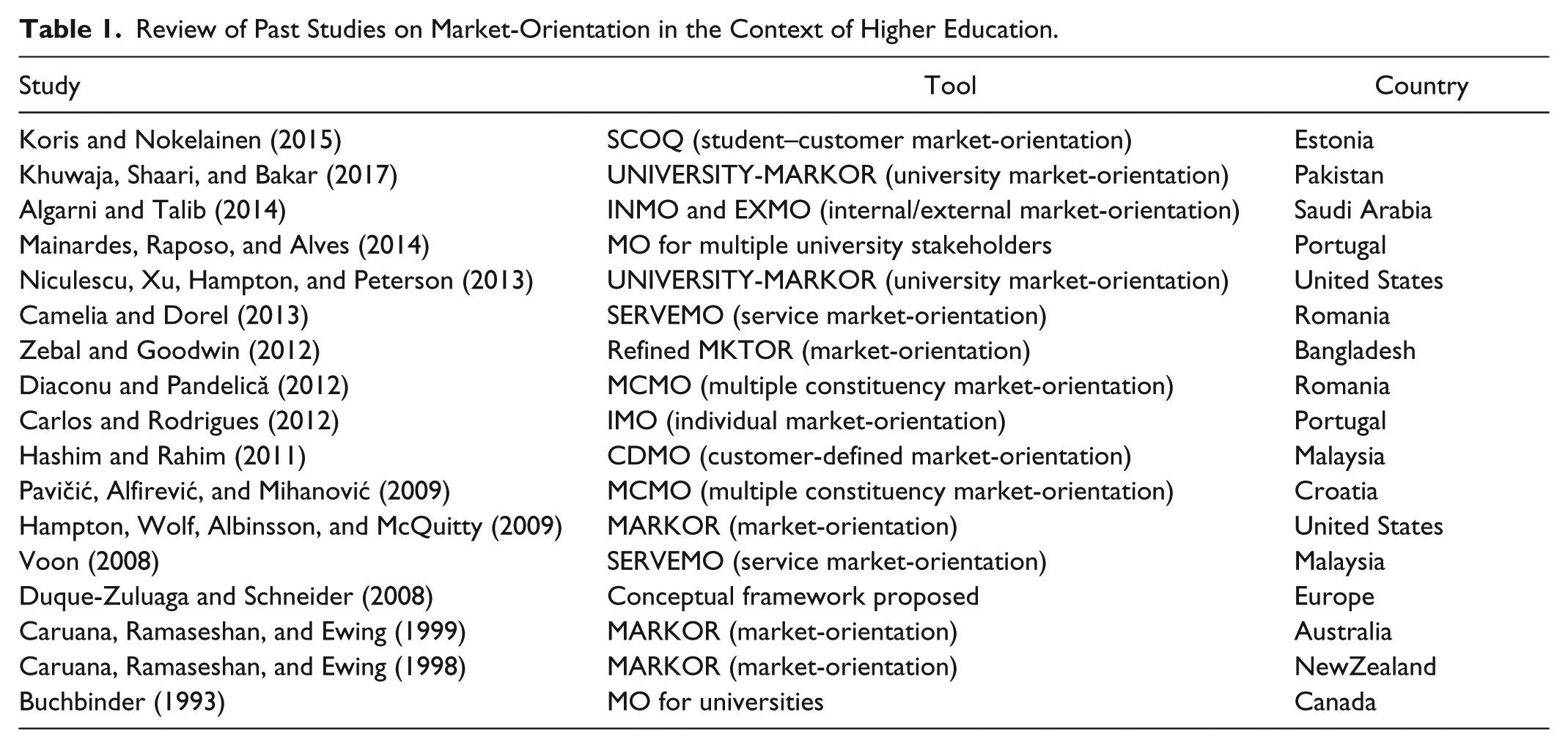
A number of other crucial benefits of MO for universities are also reported in literature such as, a potential boost in the enrollment rate, growth in the students’ retention rate, more future involvement from the alumni and business community (Santini, Ladeira, Sampaio, & da Silva Costa, 2017; Webster, Hammond, & Rothwell, 2014). Flavián and Lozano (2007) recognize the association of MO with a very positive impact on research and teaching process in universities. A better focus of universities on MO can even improve quality perception, satisfaction, and loyalty of students (Guilbault, 2016; Voon, 2008). MO has been able to seek the attention of researchers in great length, particularly in the context of higher education as Table 1 depicts below.
Review of Past Studies on Market-Orientation in the Context of Higher Education.
Measurement of Market-Orientation
The reasoning that literature provides on how to best measure MO is diverse. For an effective application of MO in universities, it is imperative to have an appropriate tool that could effectively measure MO in universities. But unluckily the tools used for that purpose are normally adopted from business environment which is unlike the university environment due to different goals and the knowledge-based structure of universities (Khuwaja et al., 2017). The traditionally used popular tools like MARKOR (Jaworski & Kohli, 1993; Kohli & Jaworski, 1990) or MAKTOR (Narver & Slater, 1990; Slater & Narver, 1994) along with a number of their extensions (Devece, Llopis, Albert, Palacios, & Marqués, 2017; Matsuno et al., 2005) appear to be improper to measure MO in universities (Niculescu et al., 2013).
There are miscellaneous viewpoints regarding measurement of MO, as well as regarding the appropriateness of each scale. The traditional measures of MO have been criticized in multiple studies (Turnes, Idoeta, & Julien, 2017) Some researchers on one hand, such as Siguaw and Diamantopoulos (1995) have criticized the authenticity of MKTOR that the original items of MKTOR were just partly related to its given dimensions, and found that the MKTOR couldn’t fit the data sound. While on the contrary, some other research studies such as Chakrabarty and Roge (2003) as well as Han, Kim, and Srivastava (1998) have favored the MKTOR scale by arguing that the given dimensions of MKTOR fit the data well. Moreover, during their cross-culture and cross-industry studies for comparing the reliability of both the MARKOR and the MKTOR scales, Mavondo and Farrell (2000) found MKTOR scale to be superior than MARKOR scale. But in contrast to that another comparative study regarding MKTOR and MARKOR scales discovered MARKOR to be relatively a more reliable and valid scale (Soehadi, Hart, & Tagg, 2001).
Literature has however emphasized on using more context-specific measure of MO (Turnes et al., 2017) particularly in universities (Niculescu et al., 2016; Khuwaja et al., 2017; Niculescu et al., 2013) because unlike the traditional business setups the universities work on formulating useful information rather than traditional “factors of production” (O’Neill & Palmer, 2004).
Hence after a detailed literature review and a careful scrutiny, Niculescu et al. (2016) developed a more context-specific three-dimensional UNIVERSITY-MARKOR scale to measure MO in higher education institutions. This scale was primarily rooted in previous studies including MO scales (Kohli et al., 1993; Caruana, Ramaseshan, & Ewing, 1998, 1999) as well as customer-orientation scale (Brady & Cornin, 2001; Saxe & Weitz, 1982). This scale focused more on the student-related activities of university teachers and hence provided a paradigm shift from top management perspective to the teachers’ perspective of MO (Niculescu et al., 2016; Khuwaja et al., 2017). Some later studies assessed in universities the relative reliability and validity of the three scales, that is, “MARKOR, MKTOR, and UNIVERSITY-MARKOR” (Niculescu et al., 2013) and recognized that the UNIVERSITY-MARKOR scale outperformed in the university setup.
Although UNIVERSITY-MARKOR scale had been reassessed to be relatively more reliable and more valid with a different sample of university teachers (Niculescu et al., 2016; Niculescu et al., 2013), yet these studies were conducted only in the developed countries, which creates and leaves behind the concern of cultural differences of less developed or developing countries. Hence there is potential need to address this issue by further validating how the psychometric properties of UNIVERSITY-MARKOR scale score in the higher education institutions of developing nations. Thus, for this issue to be addressed, the present study aims to revalidate the UNIVERSITY-MARKOR scale in the higher education sector of Pakistan. This study will potentially fill the knowledge gap in the existing body of literature by examining the psychometric properties of UNIVERSITY-MARKOR scale in Pakistani context.
Research Method
Choice of an appropriate research design is critical for the effectiveness of any research (Turnes et al., 2017). The survey design appears to be the most widely used approach for business/organizational research, which is termed as the best method to study and describe large populations swiftly and more economically (Leedy & Ormrod, 2005). Respondent’s background confidentiality is also ensured while collecting data through survey (Umrani & Mahmood, 2015). The survey method also ensures to facilitate researchers not only for data collection, but also for performing statistical analysis, as well as conducting the reliability and validity tests effectively on the instrument. Therefore, a cross-sectional quantitative survey method is used for the underlying study.
Sampling and Population
Based on concrete support from previous studies regarding the assessment of MO and university-performance relationship through university teachers (Flavián & Lozano, 2007; Niculescu et al., 2016; Hampton et al., 2009; Hemsley-Brown & Oplatka, 2010; Liefner, 2003; Mokoena & Dhurup, 2016; Niculescu et al., 2013; Zebal & Goodwin, 2012), the target population for this study was also constituted by the university teachers (and teachers-cum-administrators), including lecturers, assistant professors, associate professors, and the professors from five oldest and the largest public-sector universities of Sindh province, Pakistan, with maximum number of students accommodated as shown in Table 2 (HEC, 2015). These target universities accommodate 2,906 full-time faculty members who constitute more than 50% of total number of 5,600 full-time faculty members from the target area.
Details About Five Largest Public-Sector Universities in Sindh, Pakistan.

Source. Higher Education Commission, Pakistan, official webpage, retrieved on 2nd June, 2016.
Sindh province contains the largest number of higher education institutions in Pakistan as compared with the other provinces as shown in Table 3 (HEC, 2015). Moreover, Sindh province has been a center of attraction for a very huge mix of population dwelling there because it offers relatively better economic and trade opportunities.
Number of Public and Private Sector Universities/DAI by Region, 2015.

Source. Higher Education Commission Pakistan, Official Webpage, retrieved on 2nd June, 2015.
DAI = Degree Awarding Institutes.
Furthermore, based on the nature of public-sector departments, they are normally characterized by homogeneous conditions. They follow the same constitution under the same governing body known as Higher Education Commission (HEC) of Pakistan (HEC, 2014). Hence, the results of this study can be generalized in public-sector organizations throughout the country (Flynn, 2007).
For sampling purpose, the proportionate systematic random sampling method was used for this study (Sekaran & Bougie, 2013). Based on the guidelines of Krejcie and Morgan (1970), a total sample of 476 respondents was determined from the total population of 2,906 constituted by the target universities. Hence, a total of 476 questionnaires were distributed to the teachers/faculty members (with a regular follow-up to ensure better response) into five largest and oldest public sector general universities located in Sindh province of Pakistan (HEC, 2015).
For present study, the data were collected proportionally from target universities (Sekaran & Bougie, 2013) using a list of teachers from the given universities, whereby (after discarding 12 questionnaires due to either being incomplete or with frivolous responses), a total of 333 usable responses were collected, thus making the response rate up to 69.95 % (see Table 4).
Response Rate.

Demographic Profile
The majority population for the underlying study was comprised of male respondents (63%). The proportion of participants that constituted the mainstream responses were the teachers-only (84.3%), while the remaining cohort of participants was composed of teachers and administrators. Furthermore, the widely held respondents (52.4%) were postgraduate degree holders, followed by PhDs (39.2%) and undergraduate degree holders (8.4%). Similarly, 52.4% of participants had less than 3 years of work experience, whereas 26.5% had 11 to 20 years of experience, while 12.7% had 21 to 30 years of experience. The remaining 8.2% had the work experience of above 30 years.
The Instrument
The present study employed UNIVERSITY-MARKOR scale of MO (Niculescu et al., 2016) for its investigation in the context of public universities of Pakistan. UNIVERSITY-MARKOR scale is rooted in previous literature (refer Brady & Cornin, 2001; Kohli et al., 1993; Saxe & Weitz, 1982). The given scale has three dimensions including administration leadership (06 items), students’ advising and mentoring (05 items), and intelligence generation and responsiveness (10 items). A 5-point Likert-type scale was employed (Matell & Jacoby, 1971), denominating 1 as strongly disagree and 5 as strongly agree.
Analysis and Results
For data analysis, the partial least squares (PLS) path modeling was utilized. PLS is a variance-based structural equation modeling technique which is relatively more suitable to structural measurement models, where even if the sample size is small, the research is exploratory in nature with the objective of testing and validating models (Ahmed, Umrani, Qureshi, & Samad, 2018; Hair, Ringle, & Sarstedt, 2011; Hair, Sarstedt, Ringle, & Mena, 2012; Sabiu, Kura, Mei, Joarder, & Umrani, 2019; Umrani, Mahmood, & Ahmed, 2016; Umrani, Kura, & Ahmed, 2018). A soft-modeling approach is more suitable for exploratory sort of research (Wold, 1975). Hence PLS path modeling would be more apposite in this context. For ascertaining the construct validity of UNIVERSITY-MARKOR scale in higher education context in Pakistan, the confirmatory factor analysis (CFA) has been used in Smart PLS 2.0 M3 (Ringle, Wende, & Will, 2005). The PLS Algorithm was calculated for ascertaining the internal consistency reliability, convergent validity, and discriminant validity (Henseler, Ringle, & Sinkovics, 2009). Refer Table 5 for further details.
Confirmatory Factor Analysis Outcomes for UNIVERSITY-MARKOR Scale.
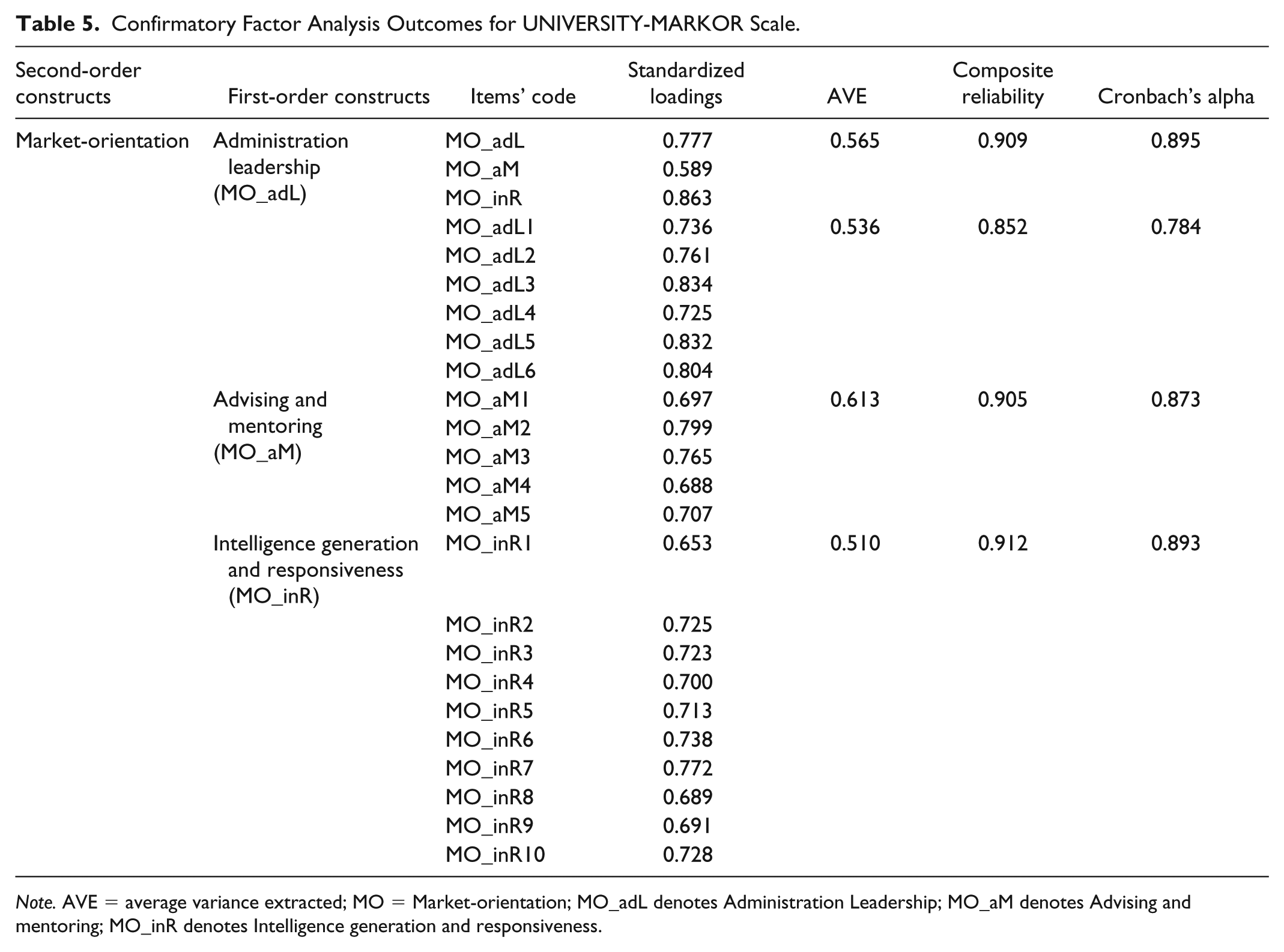
Note. AVE = average variance extracted; MO = Market-orientation; MO_adL denotes Administration Leadership; MO_aM denotes Advising and mentoring; MO_inR denotes Intelligence generation and responsiveness.
The CFA for this study yielded three dimensions of “UNIVERSITY-MARKOR” construct, as Table 5 depicts. Hereby the internal consistency reliability was assessed using composite reliability coefficients. As per the recommendations of Hair et al. (2011), the composite reliability coefficient must be 0.70 or above. It is evident in Table 5 that the composite reliability coefficients range from 0.852 to 0.912, which is quite acceptable (Hair et al., 2011) to depict a passable level of internal consistency reliability for all the components of the construct of interest (first order as well as second order) (Hair, Sarstedt, Hopkins, & Kuppelwieser, 2014). In addition to that the internal consistency reliability was further confirmed in Table 5 by means of Cronbach’s alpha values for all the components of the construct of interest, that range between 0.784 and 0.895, which is also compatible to the threshold of 0.7 and above (Sekaran & Bougie, 2013). Moreover, the convergent validity was also ascertained through average variance extracted (AVE) for each of the latent construct constituting the UNIVERSITY-MARKOR scale (Fornell & Larcker, 1981). W. W. Chin (2010) urges that the AVE should be 0.5 and above. Hence Table 5 confirms the AVE values for each construct to be higher than the recommended threshold of 0.5. Thus, all the dimensions of UNIVERSITY-MARKOR construct fulfill the criterion of convergent validity as well.
Discriminant validity of UNIVERSITY-MARKOR was ascertained as per the recommendations of Fornell and Larcker (1981), by comparing the correlations among the latent variables with square root of their respective AVE values (values in bold face) as shown in Table 6. The square roots of all AVE values were found to be greater than each of their respective correlations among the latent variables (Fornell & Larcker, 1981). Hence all constructs of given scale met the criterion of discriminant validity, suggesting adequate psychometric properties for UNIVERSITY-MARKOR dimensions (Fornell & Larcker, 1981).
Discriminant Validity of Constructs.

Note. Entries in the boldface represent the square root of the average variance extracted. MO_adL denotes Administration Leadership; MO_aM denotes Advising and mentoring; MO_inR denotes Intelligence generation and responsiveness.
Discussion
With its core purpose, this study has well established empirical evidence by validating psychometric properties of UNIVERSITY MARRKO in the context of developing countries to help future researchers measuring MO in the universities with greater confidence.
In line with a number of previous studies, this study too in the given context approves UNIVERSITY-MARKOR carrying the psychometric dynamics of effectively measuring MO in universities (refer Niculescu et al., 2016; Khuwaja et al., 2017; Niculescu et al., 2013), whereby, MO has turns out to be a very highly relevant strategy in the context of contemporary higher education, as the same was confirmed in previous literature (Akonkwa, 2009; Zebal & Goodwin, 2012).
Although, previous literature confirms the findings of this study by providing empirical evidence for measuring MO through some form of traditional measures “MARKOR and MKTOR” (Casidy, 2014a; Glaveli & Geormas, 2018; Hashim & Rahim, 2011; Latif et al., 2016; Modi, 2012), even in the context of universities (refer Table 1), yet the said measures (Jaworski & Kohli, 1993; Slater & Narver, 1994) were basically developed for the corporate/for-profit sector, which seems inappropriate to assess MO for universities/not-for-profit sector, leading to devising and validation of more context-specific tool, “UNIVERSITY-MARKOR” initially in developed countries (Niculescu et al., 2016; Niculescu et al., 2013). Thus, in harmony with Niculescu et al. (2013) as-well-as Niculescu et al. (2016), the given tool has further been validated by this study in developing countries like Pakistan. The recommendations of Khuwaja et al. (2017) also support the findings of this study that to measure the MO even in the developing countries, UNIVERSITY-MARKOR scale is a more appropriate context-specific option for the pertinent researchers.
The conclusion of this study also confirms the findings of previous studies regarding the application of MO in public/nonprofit organizations (including universities) as an effective tool for enhancing organizational performance as well as acquiring sustainable competitive advantage (refer Dwairi et al., 2012; Hashim & Rahim, 2011; Modi, 2012)
This study is also consistent with a number of other studies conducted in different contexts demonstrating the significance of MO and the dynamics to measure it for higher education sector (Algarni & Talib, 2014; Duque-Zuluaga & Schneider, 2008; Hammond et al., 2006; Hampton et al., 2009; Hashim & Rahim, 2011; Khuwaja et al., 2017; Niculescu et al., 2013).
Thus, based on the evidence secured from both the previous literature as well as from the current empirical findings, the authors of this study confidently recommend UNIVERSITY-MARKOR scale as the more generalizable, authentic, and context-specific tool to measure MO in the both private or public higher education institutions irrespective of the country to be contextually developing or developed.
Conclusion
The present study is aimed to validate a newfangled “UNIVERSITY-MARKOR” scale (Niculescu et al., 2016) to measure MO in the context of higher education in the developing countries like Pakistan. The findings offer several useful observations. The CFA suggests “UNIVERSITY-MARKOR” to be a three-dimensional construct. While the internal consistency, reliability, and the discriminant validity for all the components of the construct of interest was also confirmed to be under passable limits. The findings are presented in Table 4 and Table 5 for ready reference. These findings are in line with the previous research studies conducted in developed countries (Niculescu et al., 2016; Niculescu et al., 2013) whereby “UNIVERSITY-MARKOR” scale was theoretically validated. These results of CFA, reliability, and validity tests affirm that the UNIVERSITY-MARKOR construct is relatively a more suitable tool as compared with other popular tools such as MARKOR and MKTOR among others, for measuring MO particularly in the higher education sector of developing countries like Pakistan, besides the developed countries like United States, where the scale was originally formulated and tested.
However, this study was conducted in the public-sector universities only whereby the target population was constituted by the university teachers and teachers-cum-administrators. While the additional value may be complemented to this study if the pertinent future research may replicate it either in the private-sector universities, or it may also be further extended by taking into account the university management as the target population.
Supplemental Material
Authorship_change_req_form – Supplemental material for University Markor: A Context-Specific Scale to Measure Market-Orientation in Universities
Supplemental material, Authorship_change_req_form for University Markor: A Context-Specific Scale to Measure Market-Orientation in Universities by Faiz Muhammad Khuwaja, Waheed Ali Umrani, Sanober Salman Shaikh, Ammar Ahmed and Sanaullah Shar in SAGE Open
Supplemental Material
Authorship_change_req_form_1 – Supplemental material for University Markor: A Context-Specific Scale to Measure Market-Orientation in Universities
Supplemental material, Authorship_change_req_form_1 for University Markor: A Context-Specific Scale to Measure Market-Orientation in Universities by Faiz Muhammad Khuwaja, Waheed Ali Umrani, Sanober Salman Shaikh, Ammar Ahmed and Sanaullah Shar in SAGE Open
Footnotes
Declaration of Conflicting Interests
The author(s) declared no potential conflicts of interest with respect to the research, authorship, and/or publication of this article.
Funding
The author(s) received no financial support for the research, authorship, and/or publication of this article.

Author Biographies
References
Supplementary Material
Please find the following supplemental material available below.
For Open Access articles published under a Creative Commons License, all supplemental material carries the same license as the article it is associated with.
For non-Open Access articles published, all supplemental material carries a non-exclusive license, and permission requests for re-use of supplemental material or any part of supplemental material shall be sent directly to the copyright owner as specified in the copyright notice associated with the article.


