



Abstract
Despite the pivotal function of knowledge sharing for enterprises in today’s highly competitive and ever-changing economic environment, the mechanism about how ethical leadership impacts employees’ knowledge sharing remains a largely unexplored domain in the literature. Drawing on the social exchange theory and social learning theory, this study examines how ethical leadership helps to encourage followers’ knowledge sharing behavior considering the dual-mediating effects of positive reciprocity and moral efficacy. A questionnaire-based survey is used to collect data in China. And structural equation modeling techniques are used to analyze the collected data in order to test the proposed hypothesis. Results show that ethical leadership has positive impact on followers’ knowledge sharing. It is also found that both positive reciprocity and moral efficacy play significant mediating effects, and they are equally important in accounting for the impact of ethical leadership on followers’ knowledge sharing. Based on the analysis results, this paper further discusses theoretical and practical implications.
Introduction
Knowledge, as an important organizational resource, can provide sustainable competitive advantage for enterprises in today’s highly competitive and ever-changing economic environment. Success of knowledge management is closely related to staff’s collective sharing of knowledge, skills and experience, which has been increasingly recognized as a significant relevant in promoting creativity, problem solving, and decision making of individuals, teams and even organizations (Bhatti et al., 2020; Song et al., 2017; Yang & Song, 2016; Yuan et al., 2018; Zhang et al., 2016). What’s more, peer knowledge sharing has been proven to have positive impact on organizational performance (i.e., innovation performance, financial performance, individual job performance) (Lin et al., 2020; Muhammed & Zaim, 2020). Despite the various benefits of knowledge sharing, some employees are frequently reluctant to share their knowledge, because it sometimes turns their valuable information into a public good. Specifically, knowledge acquisition requires a lot of time and effort, whereas knowledge sharing makes knowledge lose its original value or unique privilege once shared with others (Xia & Yang, 2020; Park et al., 2017). Hence, it usually presents a moral dilemma for organizational members to decide whether to share knowledge for the collective welfare or hide knowledge for intensifying personal competitive advantages. However, in the context of knowledge-based enterprises, organizational innovation and productivity requires the members to actively participate in the activities of knowledge sharing. Therefore, it is necessary to explore the antecedents of employees’ knowledge sharing.
Most of previous researches have examined various antecedent variables of knowledge sharing from the perspective of social capital (Hu & Randel, 2014; Rosendaal & Katinka, 2013), individual traits and cultural factors (Liu et al., 2018). These studies have discussed both the contextual factors and organizational cues, but more and more researches highlighted that leadership is a key factor in fostering employees’ knowledge sharing behavior. Studies have found that transformational leadership (Wang et al., 2013), parental leadership (Zhang et al., 2015), authoritative leadership (Tang et al., 2016), and sharing leadership (Yuan et al., 2018) have positive effects on knowledge sharing. However, those studies have failed to examine the impact of the organization’s leadership on employees’ knowledge sharing from the perspective of morality. Kim and Yun (2015) argued that knowledge sharing is regarded as generous or ethical “donating” behaviors especially in workplaces, which can raise other colleagues’ knowledge level and even improve organizational performance. Whereas knowledge hiding may maximize individuals’ personal interests and bargaining capability, it will also damage the operation, resource allocation and even survival of the team and the whole organization (Isaac et al., 2010). Therefore, to a certain extent, knowledge sharing or knowledge hiding contains ethics implication.
Given the ethical nature of knowledge sharing and the significance of organization leadership styles, more and more recent studies have demonstrated that ethical leadership is the most appropriate leadership approach to encourage employees to engage in knowledge sharing (Bavik, et al., 2017; Bhatti et al., 2020; Bhatti et al., 2021; Lu et al., 2019). It has been found in many previous studies that ethical leadership negatively associated with knowledge hiding and a lot of valuable management practices have been explored to discourage employees to hide knowledge (Abdullah et al., 2019; Men et al., 2020; Tang et al., 2015). However, the mechanism about how ethical leadership influences knowledge sharing and about how to encourage employees to actively participate in knowledge sharing remains a largely unexplored domain in the literature (Lu et al., 2019). Thus, it still needs to be further investigated.
In working places, employees’ attitude and behavior are closely related with their comprehensive interaction with their leaders. They may comprehensively analyze and evaluate the information collected from the interpersonal relationship, and adjust their decisions and behaviors accordingly. However, previous researches that explored ethical leadership’s impact on followers’ knowledge sharing mostly focused on the mediating role of affection commitment and positive emotion (Su et al., 2018), psychological engagement (Tang et al., 2015), subjective well-being (Bhatti et al., 2020), prosocial motivation and conscientiousness (Xia & Yang, 2020), and organizational concern (Lu et al., 2019). Whereas those researches have highlighted the mediation of employees’ psychological cognition in the process of ethical leadership’s impact on knowledge sharing, they have neglected the norm of reciprocity in organizations’ leader-membership. Drawing from the principles of social exchange theory, ethical leaders usually express sincere concern and kindness toward their followers and focus on collective interests; they can then create an obligation for their followers to positively reciprocate the benefit they receive by engaging in actions that benefit their leaders or organizations in return (Bhatti et al., 2020). Thus, this paper proposes that the relationship between ethical leadership and knowledge sharing may be explained by the mediating mechanism of positive reciprocity.
Apart from the perceived social exchange of ethical norms within the organization, moral efficacy is also a suitable process induced by ethical leadership (Lemoine et al., 2019). Previous research has suggested that moral efficacy presents a motivational factor that transmits ethical leadership to desirable ethical outcomes (Huang & Paterson, 2017). Erkutlu and Chafra (2020) posit that leader’s integrity can decrease followers’ interpersonal deviance by increasing their moral efficacy in the workplace. Drawing from the principles of social learning theory, organizational members may share their perceptions of their leaders’ ethical behaviors, thereby enhancing their collective beliefs of moral capabilities to act ethically (Kim & Vandenberghe, 2020). Therefore, this paper proposes that followers’ moral efficacy also serves as a mechanism through which ethical leadership affects workplace knowledge sharing.
This study aims to contribute to the literature by exploring how ethical leadership affects followers’ knowledge sharing behaviors. The next sections of this study proceed as follows. First, we hypothesize a universal effect model to explain the relationship among ethical leadership, positive reciprocity, moral efficacy and knowledge sharing. Second, we describe the research method including sampling, measures, and result analysis. We then test our hypotheses. Finally, we discuss in detail the results including implications for management practitioners.
Literature Review and Hypothesis Development
Social Exchange Theory
Social exchange theory posits that parties, with the expectation of some future return, will be involved in and sustain the exchange relationship with others (Blau, 1964). The exchange relationship is characterized as bilateral, interactive, and reciprocal (Emerson, 1976). It assumes that self-interested parties exchange with other parties in order to achieve some outcomes that cannot be achieved by themselves; once the two parties find the exchange is not reciprocal, the exchange relationship would terminate. Followers’ perceptions of being valued and cared about by their leaders will enhance their trust that the organization will recognize or reward desired followers’ attitudes and behavior as the exchange obligations. In this study, knowledge sharing could be treated as a social exchange because followers will perceive social benefits from ethical leaders who demonstrate trust, friendliness, fairness and care to their followers. Therefore, this study utilizes social exchange theory, which has been validated in many context, as the theoretical foundation to understand the mechanism of ethical leaders’ impact on follower’ knowledge sharing through the mediating role of positive reciprocity.
Social Learning Theory
The social learning theory proposed by Bandura (2002) has been widely used to explain a variety of leader-membership studies. This theory argues that individuals can learn new information and behaviors by watching other people. Known as observational learning (or modeling), this type of learning consists of four steps: attention, retention, reproduction, and motivation. In organizations, leaders possess higher status, formal authority, and control of resources, and they are more likely to be role models for followers (Brown et al., 2005; Su et al., 2020). Social learning theory proposes that people will learn various behaviors by paying attention to, observing and imitating role model behaviors, and establish their own cognitive framework (such as psychological structure) to guide them to imitate these behaviors. In the process of learning ethical leadership, employees will establish their own moral psychological state and improve moral efficacy (moral ability), which will make employees more willing to act ethically (Fan & Zhou, 2018). Therefore, social exchange theory is suitable to explain the mechanism of ethical leaders’ impact on follower’ knowledge sharing through the mediating role of moral efficacy.
Ethical Leadership and Employees’ Knowledge Sharing
Knowledge sharing means a series of behaviors in workplaces where employees selectively transfer or contribute to others certain knowledge or professional skills (Yang & Li, 2017). Knowledge sharing is pro-social and moral in nature (Tang et al., 2015) and has been validated in many contexts that it is beneficial to both interpersonal interaction and organizational collective effectiveness. For knowledge providers, acquiring knowledge has consumed them much time and effort. Knowledge, especially the invisible knowledge, may be of great value to individuals. It can help to maintain their resources such as position, power and rewards within the organizations (Su et al., 2018). Hence, knowledge is “sticky” in nature (Szulanski, 2000). Some researches put forward that knowledge sharing is a generous and ethical “donating” actions, especially in workplaces (Wang & Noe, 2010). While knowledge hiding can protect individuals’ personal interests and improve bargaining capability, it will harm organizational innovation, resource allocation and even the survival whole organization (Isaac et al., 2010). In the workplaces, unethical behavior may violate explicit (formal) or implicit (informal) norms and has adverse consequences for stakeholders, despite intentionally or not (Kaptein, 2008). Similar to the negative effects of non-ethical behaviors such as misrepresentation of work performance, anti-production behavior, or workplace ostracism, employees’ knowledge hiding usually resulted from the individual’s concern for their own interests but at the expense of the overall welfare of stakeholder. Therefore, to a certain extent, knowledge sharing contains ethic implication. Therefore, from this perspective, knowledge hiding can also be regarded as a violation of ethics. Yet, organizational innovation and productivity requires employees to share knowledge or information they’ve acquired. Hence, the antecedent of knowledge sharing is a topic that has been paid great attention to by both scholars and managers.
Ethical leadership refers to leaders who demonstrate a morally suitable behavior pattern through mutual communication, reinforcement, and decision-making (Mao et al., 2020). First, through role models and appropriate behaviors, ethical leaders will demonstrate the values and norms abided by their organization (e.g., trust, friendliness, fairness, and care about followers’ needs). Second, ethical leaders also take specific actions to highlight the ethical characteristics of the organizational environment. For example, ethical leaders communicate with followers on ethical issues and allow them to express their thoughts and opinions. Ethical leaders also set ethical standards in their work and reward ethical behaviors. More and more recent studies have found that ethical leaders have positive impacts on followers’ attitudes and behaviors (Jia et al., 2020; Su et al., 2018, 2020; Wei et al., 2019; Yan et al., 2020). When followers perceive the sense of organizational identity and have achieved returns, they are willing to repay their organizations through active efforts, such as sharing knowledge, thereby contributing to the organizational innovations and productivity (Jia et al., 2020).
Leadership has been proven as a key antecedent impacting employees’ interpersonal process of knowledge exchanging within the organizations (Kim & Yun, 2015). Given the ethical nature of knowledge sharing, this paper posits that ethical leadership may predict followers’ knowledge sharing. Ethical leadership has ethically satisfactory characteristics by showing fairness, openness, and trustworthiness toward the followers.
Based on the above analysis, this paper assumes that ethical leadership will promote employees’ knowledge sharing.
The Mediating Role of Positive Reciprocity
Social exchange theory mainly focuses on the study of interpersonal relationship. The theory argues that the relationship and mutual interaction behavior among people requires a process in which different parties exchange valuable resources in relevant activities. According to the positive reciprocity principle of social exchange theory, individuals usually seek to establish social relationships based on positive interpersonal communication as well as reciprocal norms (Miles et al., 2017). When employees obtain economic and social affectional resources from the organization, they will have a sense of responsibility to pay off the organization (Cropanzano & Mitchell, 2005). Eisenberger et al. (2001) is the first to apply the reciprocal norm to the field of organizational behavior. He proposed in their research on the development of organizations that the specific actions shown by the leader will in turn affect employees’ work behaviors. Leaders play an important part in organizational management operations, so it is necessary to analyze in depth the impact of leadership characteristics on employees’ work output. Recently, some scholars also put forward that leaders’ moral virtues and values are the key factors for raising leadership effectiveness (Hassan, 2015; Hassan et al., 2014; Lu & Guy, 2014). Ethical leadership shows the moral traits that employees perceive by observing manager’s behavior. Many scholars believed moral leadership influences employees’ work outcomes through the process of social exchange (Brown et al., 2005; Hassan et al., 2014; Su et al., 2018; Xiao & Zhao, 2017). Subordinates are more likely to believe that they have established social exchanges with leaders because of their fair treatment, care and trust they receive” (Brown & Treviño, 2006). When managers demonstrate ethical leadership behaviors, employees will be more willing to pay off leaders’ supports. That is, ethical leaders usually generate high-quality social relationships with their subordinates, thereby motivating them to pay off their managers with good attitudes and behaviors. Conversely, if employees consider that their leaders are unethical, they may give response with negative attitudes and anti-production behaviors, thus doing harm to the team and the collective interest.
Previous researches have shown that ethical leadership has a significant impact on followers’ affective commitment (Jiang et al., 2018), voice behavior (Li et al., 2018), subjective well-being, and organizational citizenship behavior (Wang, 2017). These findings implicate that managers show high-quality interpersonal relationships with employees by showing ethical behaviors and creating normative guidelines to motivate employees to imitate, thereby promoting beneficial behavior for organizations. Employees’ perception of fairness or care from the leaders reflects “how much the employees think the leader treats himself / herself fairly” and “how much can his or her efforts in the work effort achieve a reasonable return.” If an individual is conscientious in his work and actively shares his knowledge or resources, but does not receive a reasonable return from the organization, then they will be slack at their work with negative emotions, resulting in a dramatic drop in job satisfaction. On the contrary, if the employee dedicates what he or she has learned to their colleagues or superior managers, and their leaders also provide timely supports and recognition, then they will have a more positive evaluation of their organization and work. Of course, he will also be more willing to consider the issue for the sake of the whole organization’s overall situation or to show more extra-role behaviors, such as cooperative behaviors and helping behaviors, to achieve collective achievement. Therefore, employees with higher levels of job satisfaction have a positive impact on their willingness and motivation to integrate and exchange knowledge information, thereby accelerating the full sharing of knowledge information among members at the organization, even though the sharing may not bring direct positive reciprocal benefits to individuals. The overall discussion leads to the following hypothesis:
The Mediating Role of Moral Efficacy
Self-efficacy, which is an important construct in social learning theory, refers to the individual’s perception and judgment of his or her ability to carry out a specific task (Bandura, 1977). Moral efficacy, as a unique sense of self-efficacy, is defined as a state of individual’s confidence in his or her ability to behave ethically This notion has the unique property of reflecting both a motivational mechanism drawn from social learning and an ethical orientation, which makes it a suitable process induced by ethical leadership (Kim & Vandenberghe, 2020). When confronted with moral adversity, people will insist their belief and ability to organize and mobilize their motivation, cognitive resources, methods, and behavioral processes required to achieve moral practice (Hannah et al., 2011). As a state of mind, moral efficacy is malleable and evolving.
According to the Social Learning Theory, subordinate employees will learn from leaders’ behaviors by imitation. And their self-efficacy is a key mediating state in the process of imitation and learning. Brown et al. (2005) argue that ethical leaders demonstrate ethical individual behaviors in their workplaces and interpersonal relationships, which may positively or negatively strengthen their impact on subordinates through mutual communication and management decisions. Here are the two main characteristics of ethical leadership: first, the leader must be a moral person as the role model of their subordinates, and he or she behaves conforming to ethical characteristics and standards; second, the leader is also an ethical manager who actively promotes ethical principles, rewards and punishments through mutual and open communication. In workplaces, ethical leaders’ integrity can improve employees’ moral identity and moral efficacy (Erkutlu & Chafra, 2020). For instance, followers may increase their shared moral efficacy beliefs and abilities by learning from leaders’ ethical practices, such as reinforcing high ethical standards, rewarding appropriate behaviors and punishing those who violate ethical rules in the workplaces. The improvement of moral efficacy will enhance the intention of moral behavior (Hannah et al., 2011). The higher the moral efficacy, the more likely employees are to transmit moral judgment and moral tendency into pro-social behavior (Fan & Zhou, 2018; Huang & Paterson, 2017). Knowledge sharing, as a pro-social behavior, will also be stimulated by individuals’ moral efficacy. That is, people with higher level of moral efficacy will be more willing to share knowledge with their colleagues, and vice versa.
The research model of this study is shown in Figure 1.

Conceptual model of the study.
Data Source and Measures
Online Questionnaire Survey
The study draws on an online questionnaire survey of employees in China with a specific aim to examine how ethical leadership affects followers’ knowledge learning. The research team develops an online questionnaire and conducts a pre-tested to obtain the final questionnaire. The questionnaire was sent to 307 employees randomly selected from companies operating in Fujian Province, a southern city of China. The survey was conducted during July to September 2018. The online survey was distributed to the employees by the human resources departments in charge of their respective companies. Participation in online survey followed the principle of voluntariness to ensure the confidentiality and anonymity of respondents’ answers. At the same time, respondents were also informed of the purpose of the investigation and were told that they could opt out at any time, just in case they decide not to continue and complete the online survey. A total of 307 employees participated in the survey. After cleaning up the data and excluding invalid questionnaires, a total of 256 valid questionnaires were retained and were used for hypotheses testing in our study.
The sample is composed of relatively young respondents, 79.7% of whom are under the age of 40. More than half (56.6%) of the respondents in the sample were female. All of them were employed full-time. About 25.4% of respondents have worked for their current companies for 5 years or less, while 74.6% of respondents have spent over 5 years for their current companies. In terms of education level, all employees graduated from vocational colleges or universities.
Measures
The four main constructs, namely, ethical leadership, positive reciprocity, moral efficacy and knowledge sharing were measured with multiple items which have been validated in previous literature. A comprehensive review of the literature was carried out, followed by item generation and pilot testing. All items in the study were measured using a 5-point Likert-type scale (1= totally disagree; 5=totally agree).
Ethical leadership was measured by seven items adapted from Brown et al. (2005). Examples of items used include “My supervisor can always make fair and just decisions,” “My supervisor can always listen to the opinions of subordinates,” “My supervisor is a trustworthy person.”
Positive reciprocity was measured by six items adapted from Perugini et al. (2003). Examples of items used include “If someone is helpful with me at work, I am pleased to help him or her” and “I am ready to undergo personal costs to help somebody who helped me before.”
Moral efficacy was measured by five items from Hannah and Avolio (2010). Examples of items used include “I can easily see the ethical/moral issues involved in the challenges I face,” “I can fight against people who use unethical behavior to solve problems.”
Knowledge sharing was measured by six items adapted from Connelly et al. (2012). Examples of items used include “In the daily work, I usually proactively shares my work experience with my colleagues,” “I often share the knowledge I’ve learned via various channels (face-to-face, E-mail, phone, WeChat) .
Control variables: Previous studies have shown that demographic variables (i.e., age, gender, educational level and working tenure) may affect employees’ perceptions of different leadership behaviors, which in turn affect employees’ working attitudes and knowledge behaviors (Fong et al., 2018; Jia et al., 2020; Men et al., 2020). According to previous literature review, these four control variables may have confounding effects on the relationship between ethical leadership and knowledge sharing within organizations (Bavik et al., 2017; Jia et al., 2020; Su et al., 2018; Yan et al., 2020).
Data Analysis and Results
The main research method employed in this research is Structural Equation Model technique using the software AMOS 24.0 and SPSS 21.0 because it provide the model fit index and allows to estimate multiple indirect path relationships of the constructs in a particular conceptual mode at the same time. First, we conducted an exploratory factor analysis (EFA) on the measurement model. The results showed that cross-loading of item 1 of the positive reciprocity scale exceeded the standard recommendation value of 0.40. Therefore, we removed this item from the scale. Second, we performed a confirmatory factor analysis (CFA) on all variables. According to the recommendations of Anderson and Gerbing (1988), we excluded the items with standardized factor loading below 0.5 in the variables. After that, we also performed a model fitness test on the variables to examine whether the measurement model matched the survey data. Next, we tested the internal consistent reliability and construct validity of all variables. Finally, the obtained path estimate was used for the hypothesis test of the theoretical model. At the same time, bootstrap resampling technique was employed to test the significance of the two mediating effects and evaluate their confidence intervals.
Reliability and Validity Tests
To test the internal consistent reliability and the construct validity of the key variables of this study, we performed a CFA on all items. We then obtained unstandardized factor loading (Unstd.), standard error (SE), Z-value, and standardized factor loading (Std.) of each item. Based on the above values, we further calculated the square multiple correlations (SMCs), composite reliability (CR) and average variance extracted (AVE). The results of CFA were shown in Table 1.
Confirmatory Factor Analysis Results.

Note. SE = standard error; SMC = square multiple correlation; CR = composite reliability; AVE = variance extracted value.
Strands for p < .001.
Table 1 shows that (a) the standardized factor loading of each variable measurement item is above the ideal level of 0.70 (p < .000); (b) the CR of each variable is above the generally recommended 0.60 standard, indicating that the structure has a good explanatory power for each item (Fornell & Larcker, 1981); and (c) the AVE values for all constructs range from 0.661 to 0.776, which are also above minimum acceptable value of 0.50, indicating the four constructs of the study have a good average explanatory power for their respective items (Fornell & Larcker, 1981). In summary, the variable scales in this study have good internal consistency and high stability and credibility.
Next, the CFA results were used to examine the construct validity of the scale, including convergent validity and discriminant validity. The data in Table 2 show that the square root of AVE of each construct ranges from 0.813 to 0.881, which are above the Pearson correlation coefficient between variables, indicating that the constructs designed have good discriminant validity. In summary, the measurement variables of this study have high construct validity and can accurately measure the true meaning of each variable.
Construct Validity Test Result.

Note. The boldface in the table is the square root of AVE of the latent variable, and the lower triangle is the Pearson correlation coefficient between the latent variables. AVE = variance extracted value.
Structural Model Test Results
In this study, Amos 24.0 software was used to perform model fit test on all variables of the study using covariance structure analysis method, and then verified the research hypothesis one by one. Table 3 lists both the recommended values of the fitting criteria and the model fitting results for this study. The data show that the model fit values of this study are in line with the recommended criteria, indicating that the model and the sample data has a good fitness.
Model Fit of the Variables.

Note. DF = degree of freedom; GFI = goodness-of-fit index; AGFI = adjusted goodness-of-fit index; CFI = comparative fit index; TLI = Tucker–Lewis index; NNFI = non-normed fit index; RMSEA = root mean squared error approximation; SRMR = standardized root mean square residual.
Next, this study examines the relevance and significance of structural models. Figure 2 shows the results of the model path tests (the values in parentheses are unstandardized path coefficients). Figure 2A shows the direct effect of ethical leadership on employees’ knowledge sharing behavior. Figure 2B shows both the direct and indirect effects of ethical leadership on employees’ knowledge sharing behavior. First, ethical leadership has a positive correlation with employees’ positive reciprocity (β = 0.673, p < .001) and moral efficacy (β = 0.576, p < .001). What’s more, employees’ positive reciprocity (β= 0.534, p < .001) and moral efficacy (β = 0.279, p < .001) are positively correlated with employees’ knowledge sharing. In addition, due to the addition of positive reciprocity and moral efficacy, the path between ethical leadership and knowledge sharing becomes irrelevant (β = 0.017, ns), indicating that positive reciprocity and moral efficacy play complete mediating effects in the relation. Thus, hypothesis 1 to 3 are all supported.

Results of model path analysis.
Analysis Results of Mediating Effects Test
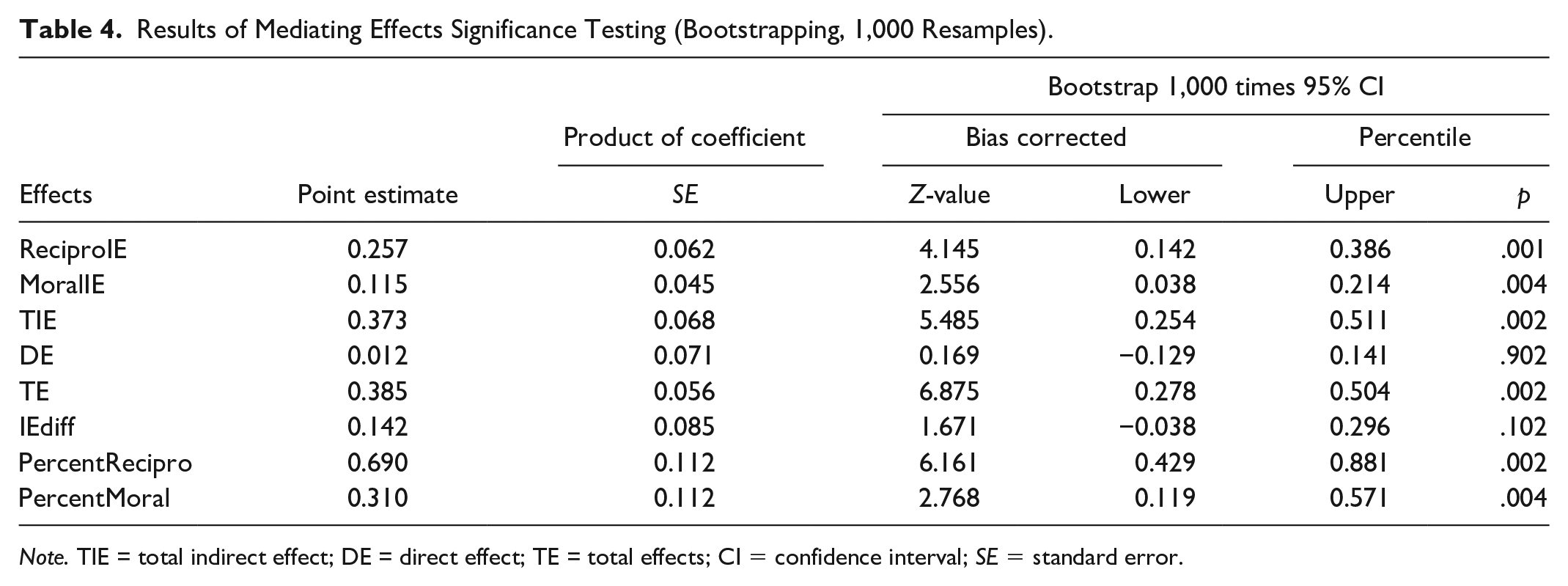
Bootstrap resampling technique was used to test whether the mediating effects of positive reciprocity commitment and moral efficacy are significant. Through 1,000 times of bootstrap resampling analysis, we obtained the unstandardized coefficients, standard coefficients of the direct, indirect and total effect, as well as Z-value, 95% confidence interval and its significance. The testing results are shown in Table 4.
Results of Mediating Effects Significance Testing (Bootstrapping, 1,000 Resamples).
Note. TIE = total indirect effect; DE = direct effect; TE = total effects; CI = confidence interval; SE = standard error.
Table 4 shows that the point estimate of ethical leadership’s direct effect on knowledge sharing behavior is 0.012, and the standard coefficient is 0.071, so the Z-value obtained by dividing the above two is 0.902, of which the absolute value is less than the critical value of 1.96, and 95% confidence interval contains 0 (lower limit -0.129, upper limit of 0.141). Therefore, the results of the two estimation methods show that the direct effect of ethical leadership and knowledge sharing behavior is not significant. At the same time, Table 4 also provides the mediating effects of positive reciprocity and moral efficacy and their comparison results.
The mediating effect’s point estimate of positive reciprocity is 0.257, the standard coefficient is 0.062, and the Z-value obtained by dividing the two is 4.145, which is greater than the critical value of 1.96, and the 95% confidence interval does not contain 0 (lower limit is 0.142, upper limit is 0.386). Therefore, the results of the two estimation methods show that the mediating effect of positive reciprocity is significant.
The mediating effect’s point estimate of moral efficacy is 0.115, the standard coefficient is 0.045, and the Z-value obtained by dividing the two is 2.921, which is greater than the critical value of 1.96, and the 95% confidence interval does not contain 0 (lower limit is 0.038, upper limit is 0.214). Therefore, the results of the two estimation methods show that the mediating effect of moral efficacy is significant.
In addition, positive reciprocity accounts for 69% of the total indirect effect, while the mediating effect of moral efficacy accounts for 31%. In addition, the point estimate of the two indirect effects’ comparison result is 0.142, the standard coefficient is 0.085, the Z-value obtained by dividing the two is 1.671, which is smaller than the critical value of 1.96, and the 95% confidence interval also contains 0 (the lower limit is -0.038, the upper limit is 0.296). It shows that the two mediating effects have no statistically and significantly difference, that is to say, the indirect effect of positive reciprocity is as important as that of moral efficacy.
Discussion
This paper deeply examines the relationship between ethical leadership and knowledge sharing behavior, a
Theoretical Implications
First, our research examines ethical leadership’s positive impact on employees’ knowledge sharing behavior from the perspective of morality in the context of Chinese culture, which is consistent with the findings of existing research literature. At the same time, this discovery also further supports the ethical relevance of knowledge sharing (Bavik et al., 2017). As a moral role model, ethical leaders are usually characterized by sincerity, compassion, integrity. They can influence followers by expressing sincere concern and kindness toward their followers and focus on joint interests. On the one hand, employees’ actively sharing knowledge is a kind of pro-social moral behavior, which can protect the joint interests of the organization (Zhang & Liao, 2017). But on the other hand, such knowledge “donating” behavior also faces higher risks of losing their personal proprietorship of one’s acquired knowledge. Under such circumstance, leaders play a vital role in this ethical dilemma. In the context of Chinese culture, people generally pay attention to complying with leadership authority and organizational collective interests.
Second, the study combined social exchange and social learning theories to examine two theoretically plausible explanations for the mediating effects of ethical leadership on knowledge sharing among employees. Specifically, this study sheds light on the dual-mediating mechanisms by examining that employees participate in knowledge sharing not only because of their desire for future reward from the organization (i.e., positive reciprocity), but also because of their self-construal ethical confidence and abilities (i.e., moral efficacy) by learning form leaders’ moral actions. The finding show that both positive reciprocity and moral efficacy play mediating roles in the relationship between ethical leadership and knowledge sharing. What’s more, the conceptual model established in this study is more comprehensive than the existing researches, which describes an ethical leader who not only actively reinforces external regulation but also help employees’ self-concept building that manifests their moral beliefs and confidence (Bavik et al., 2017).
Finally, the study also finds that positive reciprocity and moral efficacy are equally important for ethical leaders’ motivating followers’ knowledge sharing. We use the bootstrap resampling method to test the mediating effects, which improves the credibility and reliability of the research results. The result is consistent with the view of Ryan and Deci’s (2002) that extrinsic objectives are not necessarily inferior to internal driving forces that promote individuals’ behavior. In short, the results prove that the dual mechanisms that ethical leadership’s internal and external influence on worker’ prosocial motivation and moral identity are both effective (Bavik et al., 2017).
Managerial Implications
This research provides valuable theoretical support for organizations to better promote knowledge-sharing behavior that transcends employees’ personal interests. First, a platform for high-level ethical managers is very important. This study finds that ethical leadership can not only directly improve employees’ knowledge sharing behavior, but also indirectly influence that behavior through the mediating effects of positive reciprocity and moral efficacy. Therefore, in the work practice, enterprises should pay attention to the selection and cultivation of high-level ethical managers. In the practice of human resources management such as recruitment and promotion, high-level ethical leaders should be provided more platforms and opportunities.
Second, in order to increase knowledge sharing behavior at work, managers should be good at promoting ethical behaviors through reasonable rewards and punishment programs, and practicing moral role model to motivate employees’ knowledge sharing. Organizations should emphasize the importance of ethical principles by providing training programs to managers, and require managers to regulate their own words and deeds in their daily behavior and management practices to foster ethical leadership.
Third, enterprises should also pay attention to the indirect effects of employees’ positive reciprocity and moral efficacy on knowledge sharing behaviors. Organizations should transmit the ethical leadership style to employees in an effective and mutually beneficial form. The theory of social exchange proposes that individuals’ behaviors are the result of social exchange activities based on the principle of reciprocity. What’s more, the results of this study show that ethical leadership can enhance employees’ moral efficacy, thereby motivating them to be more willing to engage in knowledge sharing behavior. So, companies should encourage employees to follow the ethical behaviors of leaders.
Research Limitations and Future Prospects
Although this study has obtained some meaningful conclusions, due to some subjective factors, there are still some limitations. First, this study only analyzes the mediating effects of positive reciprocity and moral efficacy, but in actual business management practice, employees’ willingness to share knowledge may also be affected by organizational culture and the actual organizational performance. Future researches can explore the influence of moderating variables on this model, such as organizational ethical climate, organizational performance, and so on. The introduction of different variables will provide more comprehensive guidance for business management practices. Second, the data in this study come from the same employee’s self-reporting. So, the evaluation process is inevitably affected by individual subjective factors. Future researches should be done with dyad survey for more scientific results. For example, ethical leadership can be evaluated by subordinate employees, and employees’ organizational knowledge sharing behavior can be evaluated by colleagues.
Concluding Remarks
In today’s knowledge economy era, employees’ knowledge sharing behavior plays an extremely important role in business development. Given the ethical relevance of knowledge sharing and the importance of leadership style, it is important to understand how ethical leaders influence subordinates’ knowledge sharing behavior. This study shows that ethical leadership affects employees’ positive reciprocity and moral efficacy, and thus acts on their knowledge sharing behavior. Future researches should focus on other mediating paths and boundary conditions of ethical leadership affecting the performance of subordinates.
Footnotes
Declaration of Conflicting Interests
The author(s) declared no potential conflicts of interest with respect to the research, authorship, and/or publication of this article.
Funding
The author(s) disclosed receipt of the following financial support for the research, authorship, and/or publication of this article: This paper is supported by Project of Yongchun Ecological Civilization Research Institute “Research on the Mobilization Mechanism of Rural Social Organizations in Yongchun County from the Perspective of Localization” (No. 2019001), the first batch of cooperative education project of industry university cooperation of the Ministry of education in 2020 (Grant 202002168035), the 2020 annual project of the 13th five-year plan of educational science of Fujian (Grant FJJKCG20-244), and the general project of undergraduate education and teaching reform of FAFU in 2020 (Grant YB2020035)
