




Abstract
Employment of idioms is essential to reach higher English expressive levels, especially for English as Foreign Language (EFL) learners. However, English idioms are challenging for both instructors and learners because the complex content of idioms depends on understanding their cultural context. Most mobile language applications are for vocabulary acquisition. Therefore, the purpose of this study was to develop an animation/video-based application, “My English Idiom Learning Assistant” (MEILA), to explore the different idiom learning behaviors, as well as the relationships of their learning behaviors to MEILA. To explore the relationship between the learning outcomes and the learning behaviors, the researcher used logs from the MEILA database. The participants consisted of 59 freshmen from two English conversation classes in one private university in central Taiwan. Students experienced the learning activities over 3 weeks. The researcher adopted idiomatic understanding pre- and posttests for the study as well as in-depth interviews. The results revealed that MEILA significantly enhanced idiomatic learning outcomes. The sequential analysis used provides language instructors an example of monitoring learning behaviors to improve teaching materials and methods. The findings may stimulate more mobile-assist language learning (MALL) researchers, English instructors, and app designers to create innovative mobile environments for English idiomatic learning.
Introduction
Idioms are frequently used in daily English conversation because they enrich the content of the communication and enable the speakers to express themselves clearly (Thyab, 2016). Employment of idioms is vital to reach the higher English expressive levels (Xie, 2017), especially for English as Foreign Language (EFL) learners who endeavor to achieve fluency comparable with what native speakers need for conversation and daily interaction (Cooper, 1999).
English courses in Taiwan, however, mostly focus on vocabulary and grammar acquisition because it is considered to be time-consuming to teach students the complex content of “the cultural, often figurative, indirect, multiple-word nature of idioms and their rigid structure” (Asl, 2013; Liontas, 2017) and because non-native speakers of English may not be confident of understanding idioms well enough to explain them. Moreover, the higher education system in Taiwan often employs a conservative English learning environment which is mostly teacher-centered and test-driven. To overcome this, it is necessary to stimulate Taiwanese students to learn English idioms as well as elevate their accuracy of English expression in an effective way, such as by providing interesting materials and innovative learning tools (Kuo & Su, 2016).
Mobile-assist language learning (MALL) has been widely applied as an effective teaching method because it has affordances that address the problems and limitations of language learning via conventional instruction (Burston, 2015; L. Hsu, 2013). MALL technology that can be adapted to language learning includes podcasting, social networking, course management systems (CMS), and automatic speech recognition (ASR) (Kim & Kwon, 2012), which are all able to enhance the functionality of language learning (Godwin-Jones, 2011). With the affordances of MALL, English learning is no longer limited in classrooms because of the enthusiasm of the students for the technology (Foti & Mendez, 2014; Godwin-Jones, 2017). Learners can gain abundant information and knowledge at ease in an appealing way (Chun et al., 2016).
Scholarly investigation has often ignored the instruction and learning of idiomatic expression (Chen Hsieh et al., 2017). Therefore, it is essential to go beyond vocabulary and grammar and to create a dynamic learning method with technology in modern educational environment. However, research on MALL in higher education has mainly focused on designing m-learning applications and system development instead of analyzing the outcomes of the MALL designs (Krull & Duart, 2017). Furthermore, most of the mobile applications designed for English learning are based on vocabulary or grammar and they are usually test-oriented (Chen Hsieh et al., 2017; Kukulska-Hulme, 2013), which can fail to engage and stimulate students.
Therefore, this study developed an interactive student-centered mobile application for learning English idioms. The mobile application, named “My English Idiom Learning Assistant” (MEILA), not only contained multiple learning materials related to idiom learning but also included animations and videos designed to be helpful for language skills comprehension, understanding of context, cultural background, and conversational usage. Moreover, the current research analyzed the learning behavioral patterns of MEILA users to explore the effectiveness of idiomatic acquisitions via smartphones.
Accordingly, the following two quantitative and one qualitative research questions guided this study:
This study is significant because it developed an English animation-based smartphone application, containing audio and video presentations for Taiwanese EFL learners that were designed to be interesting and engaging to students. In addition to a basic look at changes in idiomatic competence and the users’ attitudes about MEILA, the study also analyzed their behavior patterns while using MEILA. The results of the study can help researchers understand the relationship between learning achievement and behavioral patterns, which can be beneficial to educators who want to be effective in improving the English idiomatic acquisition of their students.
Literature Review
Learning Idioms for Elevated Proficiency
Idioms are groups of words that are expressed with a new or metaphorical meaning. Müller et al. (2018) found that a large number of idioms exist in English fiction, social media, publications, songs, movies, and TV shows. With English as a lingua franca (ELF), and people around the world learning English as a second or foreign language (ESL/EFL), English learners encounter English idioms frequently. Because of the “multidimensionality” of English idioms, they play an essential role and have received great attention recently, especially in EFL research (Qureshi et al., 2018). However, non-native speakers usually have difficulty understanding idioms, even though they may have a large vocabulary, because the meaning of English idioms goes beyond literal meanings (Liontas, 2003; Xie, 2017), so that the meaning of idioms often can’t be decoded by interpreting the individual words (Khonbi & Sadeghi, 2017).
Moreover, English instructors who teach idioms also need to concern themselves with syntactic, semantic, and pragmatic knowledge of English idioms. Chen Hsieh et al. (2017) first instructed students to analyze the syntactic structure of the idiom and asked them to analyze the grammatical usages. Next, they gave learners some example sentences to read after analyzing the semantic meaning or telling its cultural perspectives. In their study, they did not provide students with additional idiomatic usage practice. Creswell (2011) showed the students who applied the etymological elaboration in practicing idioms and daily expressions presented an effective learning strategy. However, Chen Hsieh et al. (2017) found that knowing the context may require too much time for learners to acquire English idioms, especially for Chinese students. Learners need more time and effort for understanding the origin or for assembling the complete contextual clues to understand the whole conversation (Mäntylä, 2004). In other words, the idioms with unpredictable meanings pose additional challenges for both teachers and learners (Grant & Bauer, 2004). Therefore, the rich content of English idioms and the relationships among languages, communication, and culture are drawing much more attention in academic research (Guest, 2002; Scarino, 2010; Yuen, 2011).
Benefits of Multimedia Learning
Multimedia materials have been employed to facilitate English learning for many years (Chun & Plass, 1996) and many educators embrace visualization for instructional applications (Niknejad & Rahbar, 2015). Multimedia learning is defined as learning from words and pictures, which includes “book-based environments consisting of text and illustrations, computer-based environments consisting of narration and animation, and virtual game environments consisting of interactive speech and animated microworlds” (Mayer, 2002, p. 85). Students acquire new knowledge straightforwardly and efficiently through multimedia learning.
The numerous media resources for language learning that are available today not only provide innovative learning opportunities but also create a dynamic learning environment for students (Egbert, 1989; Lin & Tseng, 2012; Shih, 2010). Materials presented with pictures, diagrams, films, animations, demonstrations, and incidental content appeal to visual learners who may not respond as well to lecture or written explanations (Felder & Henriques, 1995). Moreover, multimedia content can stimulate the memory and associations of language learners (Hongtao, 2015). Providing students multiple sensory inputs, especially an infusion of visual materials, is a good way to achieve better learning outcomes.
Videos, in particular, are useful tools for learning because they can fill the gap between real life and school life by providing visual examples to help learners understand their lessons (Bal-Gezegin, 2014). The orthographical visual features of videos for language learning assist non-native speakers with the specific conversational context. Learners usually require visual clues such as facial expression, gestures, and details of the environment to support their interpretation of language (Cakir, 2006; Richards, 2015). In this situation, the use of video is a solution for language learning, and especially for idiom learning, because video effectively infuses the class with context, conversation, atmosphere, and culture (Danan, 2004; Herron & Hanley, 1992).
Moreover, Niknejad and Rahbar (2015) found that increasing the use of animated video provides audiences enhanced memory of the content, especially for abstract ideas. Animation is considered to be helpful for drawing the students’ attention because animation can present a complex concept in an interesting and accessible form, and eventually provide more learning opportunities (Shreesha & Tyagi, 2016).
However, the performance of learners is also related to their learning styles, the adaptability of multimedia learning, and their learning behaviors (Niknejad & Rahbar, 2015). It is essential for instructors to identify the learning styles of their students and make effective instructional plans for them. (Lin & Yu, 2017) pointed out that there are two channels in the human information-processing system: the auditory/verbal channel and the visual/pictorial channel, both of which influence behavior in dealing with information. Some students learn by reading texts or listening to words whereas some prefer seeing pictures or watching videos, while others prefer hands-on learning (Aisami, 2015). According to Keskin and Metcalf (2011), students can have more than one learning style, such as visual-verbal, visual-nonverbal, and so on, and benefit from multiple instructional styles. Students are often more appreciative of learning with digital materials, especially a film with a story, compared with a lesson in the textbook (Guan et al., 2018). Moreover, Baylor and Ryu (2003) indicated that learning with animation is more engaging and credible than static pictures. In summary, instructors should help students employ different multimedia and cultivate multiple learning strategies to achieve their learning goals.
MALL
MALL is a learning/teaching technique that assists or enhances language learning through the use of smartphones and other personal mobile electronic devices (Kacetl & Klímová, 2019). Because the mobile devices are autonomous, portable, and ubiquitous, they can support learners with more learning materials, functions, and activities (Hwang & Fu, 2019). Mobile devices can provide authentic contextual learning so that L2 learners can better apply what they have learned (Chen & Chang, 2011). With the numerous mobile applications now available, research in MALL teaching and learning has exploded in recent years. Learners can be encouraged to build a collaborative learning environment through the social communication features of mobile devices while they learn a language at anytime, anywhere (Chang et al., 2012).
Most studies discussing MALL have probed the outcomes of learner performance after using technology, or the affordances of the technology, but analysis of learning behavioral patterns is rare in the MALL literature (C. K. Hsu, 2015; Lai & Hwang, 2015). However, the analysis of the learning behavioral patterns is very important because it shows the relationships between the learners’ experiences and attitudes while using the MALL technology (K. E. Chang et al., 2014).
Method
Participants
The participants were 59 freshmen from two English conversation courses in one private university in central Taiwan. They were between the ages of 19 and 20 years, and most of them had a similar background, having learned English in primary and junior high schools, because of the 12-year compulsory English education requirement in Taiwan. The average score of their Test of English for International Communication ( TOEIC) was 450 to 550, which means that they were in the B1 level of Common European Framework of Reference for Languages (CEFR). They had their own mobile devices and wireless access so they would have difficulties neither with hardware nor software while using MEILA.
Interventional Design
Figure 1 presents the instructional design of this study. In the first week, the teacher introduced the functions of MEILA and the importance of learning English idioms as part of English communication courses. After the introduction and the detailed explanation (Q&A), the participants completed a 25-min pretest about their understanding of English idioms.

The instructional design of the study.
Then, in the following 3 weeks, all participants performed self-learning with MEILA outside of class. In the fourth week, the participants completed the posttest, which had a similar structure and length to the pretests. Finally, the researcher asked eight volunteers for interviews after school. Each interview lasted 30 to 40 min.
MEILA Design
The 50 idioms employed in MEILA were drawn from several reliable resources. According to Oxford Dictionary of Idioms, there are over 6,000 idioms in the English-speaking world. After referring to school textbooks, online idiom dictionaries, and online resources, the researcher selected 100 frequently-used idioms as the preliminary content of MEILA for students from Taiwan. To increase the difficulty level gradually, the study began with three experts selecting 50 of the idioms, chosen because they had characteristics allowing the easy visual association to make them easily accepted by the beginners.
The app was designed based on the theory of Associative Fluency (Dansky & Silverman, 1975), that is, fostering the ability of learners to make multiple associations for a given “trigger” term or idea. The researchers, therefore, wanted students to be able to make multiple associations stemming from their learning experiences with the idioms in MEILA. To accomplish this, the functions of MEILA were tailored to the learning needs of the users and their habits of app utilization, incorporating audio-visual learning materials (functions) such as videos, animations, and conversation listening (Figure 2). The text presentation included dialogue reading, bilingual subtitles, and word banks. Other functions allowed the practice of idiom use, such as sentence recording, sentence making, and peer evaluation. MEILA provided the definitions of idioms, Chinese translations, the use of idioms, example dialogue, keywords, cultural background of idioms, and other user tasks such as the reviews of user sentence making and recording. The content reflected not only the English idiom itself but also other aspects needed by the MEILA users. Supplements from the word bank and example sentences extended the users’ vocabulary and knowledge of grammar. After watching the animations, students were able to imagine their own scenes and conversations in which they could apply the idioms they had learned. Videos, recorded by the instructors and researchers, provided learners with cultural and utilization tips for the idioms.

The structure and the design of MEILA in this study.
MEILA was designed to have a clear interface and to be easy to operate. On the category page, users could choose any of the 50 animation items they wished to watch (Figure 3).

The interfaces of MEILA for “start learning.”
When they watched an animation or a video, they could stop or replay it, if needed to follow the story of the conversation (Figure 4). After watching the animations, learners could continue watching the videos which were created by the researchers and instructor. The videos showed the cultural aspects and utilization tips for the English idioms (Figure 4).

The interfaces of MEILA for watching animation, video, and reading sentences.
No animations or videos were longer than 20 s, due to considerations of user attention span and mobile device storage. With audio-visual input, students could read the dialogue, recite the words, and listen to the example sentences related to the idioms within MEILA (Figure 5). One of the researchers is an American professor. He helped develop the examples and scripts for the animated videos and checked them for accuracy. The audio for the animations was recorded by his American students, who were native speakers trained in voice performance, to provide learners with exemplary American accents and pronunciation role models. Moreover, MEILA was designed to create a friendly interactive environment for enhancing the users’ output. The function of sentence making allowed students to upload their application of the idioms in 200 word paragraphs (Figure 5). Learners could practice their oral skills by performing the recording tasks (Figure 5). Every assignment could be accessed by every user on MEILA. Students could give the points to the good assignments on the system and record their process of improvement on the idiomatic acquisition (Figure 5). If users were not satisfied with their performance on any of these assignments, they could prepare again for the task and redo it.

The interfaces of MEILA for listening and recording sentences.
Finally, MEILA was designed to compile logs of user actions and task durations. To observe the learning process and sequence of the users, the database recorded the date and time that students used MEILA, their actions on MEILA, and their tasks performed, such as sentence making and recording. The app provided a “dashboard” to allow the teacher/researchers to monitor the learning progress of the students. This allowed the teacher to intervene with students who were behind.
Research Design
Three data collection sources were used to answer the research questions (Figure 6). They included pre- and posttests of understanding of idioms, user logs compiled by the MEILA app, and a qualitative interview.

Issues explored and instruments be used in this study.
To answer Research Question 1, about the extent to which the use of MEILA improved the comprehension of English idioms among users, the participants completed pre- and posttests to determine the level of knowledge of English idioms. A modified version of an instrument by Chwo et al. (2016) measured the understanding of idioms by the participants. The tests included 39 questions drawn from the 50 idioms the researchers chose to include in MEILA, including idiom matching (nine items for Chinese translation into English and nine items for English translation into Chinese, two points for each question), fill-in-the-blank (five items, four points for each question), conversation choice (12 items, two points for each question), and sentence making (four items). Students were required to make four sentences associated with the idioms. The examples had been provided (1 point: It’s time to hit the books. 3 points: It is very important for high school students to hit the books. 5 points: To learn English, she not only hits the books but also listens to CNN every day.) The pre- and posttest of idiom comprehension were designed by the researcher and her instructor based on the content in MEILA. The researchers used paired samples t-tests to determine whether there was a significant difference between the pre- and posttest performance of the participants.
To answer Research Question 2, about the behavioral learning patterns of participants, the researchers used the MEILA log of learning tasks performed and durations to code seven main actions of learning in MEILA and analyze the users’ behavioral patterns (Table 1). The raw data of the learning patterns were transformed into the format suitable for the Generalized Sequential Querier, which is a useful and powerful program for sequential analysis. To explore participant behaviors, the researchers used a three-stage coding process. In the first stage, defining the actions, the researchers identified the seven most common behaviors of learning in MEILA. Second, the researchers coded the actions recorded on animation and video, based on the coding scheme. Third, three experts examined the suitability of the codes and the definitions (Table 1).
The Coding Scheme for the Learning Behaviors of Using MEILA.

Note. MEILA = My English Idiom Learning Assistant.
The researchers analyzed the data in terms of low, medium, and high achievers, as determined by the answers to Research Question 1. After the researchers analyzed the sequence of use of the various MEILA functions for adjusted residuals, they portrayed the results in behavioral transition diagram figures for the three proficiency groups.
To answer Research Question 3, about the perceptions of the participants about using MEILA, including their usage and self-evaluations, the researchers developed a qualitative interview for semi-structured interviews. The interviews consisted of two sections. In the first section, the interviewees briefly demonstrated how they used their smartphones to learn English idioms with MEILA. Second, the interviewees answered seven questions related to their learning experience with MEILA based on their performance of the idiomatic understanding post-test.
The recordings of interviews were stored as both recording files and text transcriptions. The text files included transcripts and notations of key points from the interview. The interviewer was not directly involved in the learning procedure of the participants and therefore served as an objective third party. The researchers used an analytical process described by Creswell (2011), by which data collection and analysis is an iterative process. Researchers go back and forth among data sources repeatedly to understand the data, in this case the qualitative interview records and transcripts. The analysis first structured the data in preliminary open categories, according Creswell’s methodology, and then refined the categories to achieve a focus and specific representative quotes which answered the research question.
Findings
Research Question 1: To What Extent Did MEILA Improve Student Comprehension of English Idioms?
The pre- and posttests of idiom comprehension were designed by the researcher to answer Research Question 1, based on the content in MEILA. Table 2 presents a paired samples t-test showing whether there were significant differences between the initial idiomatic understanding and the learning outcomes after using MEILA. The mean score on the posttest (M = 65.41, SD = 20.95) was higher than that of the pretest (M = 37.27, SD = 16.42). In a paired samples t-test, the difference between the pre- and posttest scores, M = 28.136, was significant, indicating that after using MEILA, the English idiomatic understanding of participants had improved significantly.
Descriptive Data and Paired Samples Statistics of the English Idiomatic Understanding Pre- and Posttest Results.

p< .001.
The answer to Research Question 1, therefore, is that use of MEILA did result in improving the student’s comprehension of English Idioms, at a significant level, across all student participants in the study. The outcomes for participants of different proficiency levels will be reported in the next section.
Research Question 2: What Were the Different Behavioral Patterns Among Different Proficiency Levels of Students While Using MEILA?
To answer Research Question 2, the researchers used the answers to Research Question 1 to group the participants based on their improvements of English idiomatic tests. The students whose improvement scored in the top 27% on the posttest were categorized as high achievers and those whose improvements scoring in the bottom 27% designated as the low achievers. The remaining 46% were tagged as the medium achievers. The mean scores of English idiomatic understandings test of low achievers was M = 49.5 (SD = 18.02), of medium achievers was M = 66.4 (SD = 19.54), and of high achievers was M = 79.56 (SD=14.95).
The 59 participants yielded a total of 9,429 behavioral codes. After analyzing the behavioral characteristics, the researchers conducted a sequential analysis of the use of the seven behavioral codes by the three different proficiency groups to determine the learning behavioral patterns for each group (Hou, 2015). An individual learning sequence was defined as reaching a significant level if the adjusted residuals z-value was greater than +1.96.
Table 3 shows the frequency and percentage of use of each function. The “watch videos” function was the highest use in all three of the proficiency groups. For the lowest achievers, the “watch video” function had only one-sixth as many individual uses as among the high achievers, because the low achievers had only 8% of the total interactions in the study. The least-used function was recording sentences, not used at all by the low and medium proficiency groups, and serving as only 2% of the function uses of the high achievers.
The Learning Behavior Frequency of the Students.

Tables 4 to 6 show these adjusted residuals tables from different proficiency groups of achievers.
Adjusted Residuals Table of Low Achievers.

p < .05.
Adjusted Residuals Table of Medium Achievers.
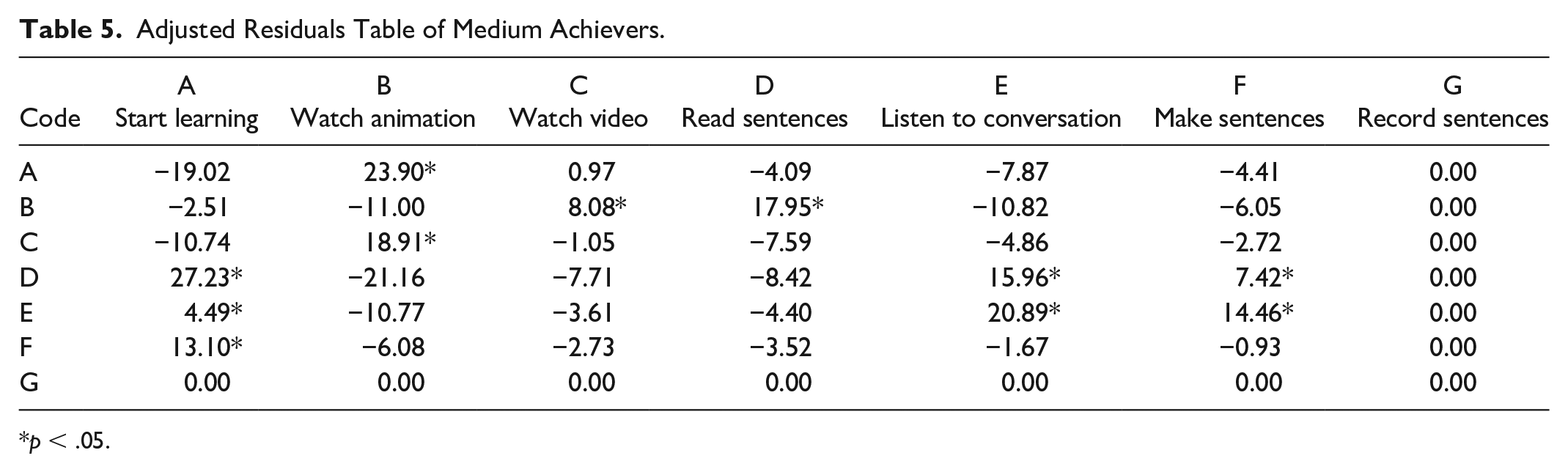
p < .05.
Adjusted Residuals Table of High Achievers.

p < .05.
The researcher conducted a sequential analysis of the seven learning action behavior codes and frequencies to investigate the relationship among the use of the seven functions of MEILA and the resulting behaviors. The analysis resulted in behavioral transition diagram figures for the three proficiency groups.
The sequential patterns for low achievers (Figure 7) show only eight lines in total. It shows no significant links to or from F (Make the sentences) or G (Record the sentences), which means that low achievers seldom used the functions of sentence making and sentence recording. The strongest sequences were moderate links from A → B (Start learning to Watch the animation, z = 15.25) and D → A (Read the sentences to Start learning, z = 13.13). Weak sequential links existed between B → C (Watch the animation to Watch the video, z = 6.91), C → B (Watch the video to Watch the animation, z = 5.09), B → D (Watch the animation to Read the sentences, z = 7.08), D → E (Read the sentences to Listen to the conversation, z = 8.82), E → E (Listen to the conversation and repeated, z = 3.53), and E → A (Listen to the conversation to Start learning, z = 5.12).

The behavioral transition diagram of the low achievers.
Medium achievers (Figure 8), had eleven links, including strong links from A → B (Start learning to Watch the Animation, z = 23.90) and D → A (Read the sentences to Start learning, z = 27.23). These paths constituted the same pathways as the strongest links for low achievers, but with higher z-scores. In addition, the medium achievers had multiple sequential links to and from F (Make the sentences), which low achievers did not use at the significant level.

The behavioral transition diagram of the medium achievers.
The medium achievers had moderate sequence links from C → B (Watch the videos to Watch the animation, z = 18.91), B → D (Watch the animation to Read the sentences, z = 17.95), D → E (Read the sentences to Listen to the conversation, z = 15.96), E → F (Listen to the conversation to Make the sentences, z = 14.46), F → A (Make the sentences to Start learning, z = 13.10), E → E (Repeated Listening to conversations, z = 20.89), and E → A (Listen to the conversation to Start learning, z = 4.49). Weak but significant links were found from B → C (Watch the animation to Watch the video, z = 8.08), D → F (Read the sentences to Make the sentences, z = 7.42), and E → A (Listen to the conversations to Start learning, z = 4.49).
Figure 9 shows that compared with low achievers and medium achievers, there were even more sequential links in the group of high achievers, with 14 significant sequential links, compared with 11 and eight for the medium and low achievers, respectively. Especially they used pathways and functions not used by the other groups, including function G (Recording sentences, 2%) and pathways D → G (Read the sentences to Record the sentences, z = 3.45) and E → G (Listen to the conversations to Record the sentences, z = 16.79). Moreover, the bidirectional B ↔ C interaction (Watching the animation, 30%, and Watching the video, 9%) was significant (B → C, z = 21.47; C → B, z = 26.30), suggesting that high achievers tended to make particularly good use of the audio-visual functions in MEILA.

The behavioral transition diagram of the high achievers.
High achievers had strong sequences from A → B (Start learning to Watch the animation, z = 26.93), B → C (Watch the animation to Watch the video, z = 21.47), C → B (Watch the video to Watch the animation, z = 26.30), D → A (Read the sentence to Start learning, z = 28.23), and E → E (Repeated Listening to conversations, z = 24.84). Moderate sequences for high achievers were B → D (Watch the animations to Read the sentences, z = 19.30), D → E (Read the sentence to Listen to the conversation, z = 19.44), D → F (Listen to the conversation to Make the sentence, z = 12.20), E → G (Listen to the conversation to Record the sentence, z = 16.79), F → A (Record the sentence to Start learning, z = 11.80), and G → A (Record the sentence to start learning, z=13.87). Weak but significant sequences for high achievers were A → D (Start learning to Watch the video, z = 9.93), D → G (Read the sentence to Record the sentence, z = 3.45), and E → A (Listen to the conversation to Start learning, z = 7.21).
The percentages of the overall behaviors in the groups of low achievers were also the lowest among the groups (755 times, 8%) and the high achievers reached the highest percentage (4,929 times, 52%). The results may illustrate that low achievers less frequently adjusted their idiomatic learning in MEILA, compared with the other groups.
The answer to Research Question 2, therefore, was that participants of different proficiency levels used MEILA in different ways. Lower achievers, as defined in this study, used MEILA least, and used the fewest sequential pathways. High achievers used MEILA more often and had the most diversity in pathways, while medium achievers were in the middle in both measures. All three groups had a preference for watching animations after they started learning. All three groups listened to more than one conversation sequentially. For all three groups, reading the sentences tended to cause them to return to Start learning. Making sentences and recording sentences were used the least.
Research Question 3: What Are the Perceptions of Students After Using MEILA?
To answer Research Question 3, the researchers conducted focus group interviews and performed theme analysis on the resulting interview transcripts. Three themes arose from the data: outcomes of idiomatic learning, learning experience, and perceptions and preferences concerning MEILA.
Outcomes of idiomatic learning
Most of the interviewees were satisfied with their learning procedures in MEILA because it made them feel relaxed and pleased. “The animations in MEILA really enhanced my memory of idioms. They were so fun! I could easily remember the content and know how to use them by watching the animations one or two times” (Student E).
The students were also aware of the importance of English idioms for practical communication skills and they were more willing to learn them after this learning activity. Student F mentioned that he was very happy when he later encountered the idioms in some of his favorite movies because he understood not only the meaning of the idioms themselves but also the punch lines in the conversation. Another student (B) concluded that English idioms are very important, saying, “If we can acquire idioms then we can understand the meaning of the sentences. It is also very interesting to learn the cultural background of the idioms.”
The results show that idioms can enrich the content as well as the context of a conversation, especially for some movies or songs that attempt to convey meaning to the audience efficiently. Students liked the cultural background knowledge of the idioms because they perceived them as being like stories. Moreover, students also realized that English idioms are important for communication or interaction with English speakers. This theme indicated that knowing the meaning of English idioms can enhance confidence of communicating with native English speakers.
Learning experience of MEILA
The interview asked the participants how often they had used MEILA, and for how long each time. Table 7 shows that it was the perception of the participants that they used MEILA for relatively brief durations, most commonly 5 to 10 min per use. The students told the interviewer that they tended to use MEILA at times such as when waiting for a bus or before they went to bed.
The MEILA Using Frequency of the Interviewees.

Note. MEILA = My English Idiom Learning Assistant.
They said that the new learning experience of using mobile devises for learning idioms impressed them and it resulted in them having higher motivation for studying English idioms. Four interviewees specifically said they liked the animations, example sentences, and listening on MEILA, and their average test improvement scores were high.
Several of the interviewees were specifically impressed by the animation used by MEILA, to reinforce the memorization of idioms, and the video instruction on the usage of idiom. “The animations really helped with my idiomatic memory. Some of them are funny and I think either pictures or the videos are more interesting than text” (Student B); “I like the animations and it helped me a lot because it released my pressure when I was studying” (Student D); “I like the video and listening functions on MEILA because videos contain the Chinese explanation of the idioms and listening helped me with the memorization” (Student C).
Most of the students did not prefer using the MEILA functions of recording and making sentences. They said this was because of their accustomed use of their mobile devices, which they preferred to use for social networking or mobile games. They thought the tasks of sentence making or recording were more serious or troublesome to them than the games. Otherwise, the students showed positive attitudes about their experiences with MEILA.
Perceptions and preferences
The results showed that the Taiwanese students in this study liked to learn these English idioms and other knowledge through self-learning with MEILA. The rich content and dynamic functions of the mobile applications created an interesting learning environment for learners. “I think that these apps are very convenient and I can get a lot of resources through a smartphone. MEILA is different from these vocabulary apps since it contains lots of videos and recording, which is useful to me” (Student C).
Furthermore, the interviewees gave the researcher some suggestions based on their experience of English learning, learning behaviors, and their expectations for MEILA for the future development. For example, Student C said, “Although MEILA has the sentence recording function, it didn’t provide us suggestions for our pronunciation or grammar. I want to correct my mistakes—something like a formal oral exam that helps with our speaking.”
The answer to Research Question 3, therefore, is that the participants were satisfied with their experience of using MEILA for idiom learning, because it was not a high-pressure learning environment. They used the app for relatively brief periods of time, most commonly 5 to 10 min per use, at times such as when waiting for a bus or before they went to bed. They were impressed by the animation and video in MEILA, but did not prefer the recording and making sentences functions in MEILA.
Discussion
The most important finding of this study was that participants of different proficiency levels used MEILA differently. Those who were lower achievers on the pretest were the most limited in both the frequency of their use and in the number of sequential pathways they used. High achievers had the most diversity in pathways, and medium achievers were in the middle. All three groups had a preference for watching animations after they started learning. All three groups listened to more than one conversation sequentially. For all three groups, reading the sentences tended to cause them to return to Start learning. Making sentences and recording sentences were used the least.
After the initial Start learning step, the function used most often, both overall and in each individual group, was watching animation. Students may have considered this to be an easy step, but it is also not surprising, given today’s overall social media and internet environment, the popularity of animation among Asian young people, and the short duration of each animation segment. This correlates well with the student’s focus group comments about when and where they used MEILA. It also resonates with past research that has indicated that students tend to use their smartphones for brief periods of time, such as when waiting for a bus, meaning that learning designed for smartphones and other portable electronic devices is best structured as short segments that can be returned to later, as opposed to longer activities requiring deeper engagement (Chwo et al., 2016).
Reading sentences also tended to trigger returning to the Start learning step, with the z-scores of this path increasing in correlation with higher achievement levels. This suggests that reading sentences was often a culmination of a perceived cycle of learning, leading to a fresh start. It is important to note that the low, medium, and high achievement levels were defined in this study by the level of improvement between the pre- and posttests of selected English idioms and may not precisely match overall general proficiency in English. Nevertheless, better posttest knowledge of the idioms correlated with use of more diverse sequential pathways. This may be because the high achieving students felt more engaged and self-confident with the subject matter, separate from their comfort level with MEILA itself. Confidence with the subject matter has been shown to correlate with motivation, and over time with improved ability (Wu et al., 2011). Thus, we can say that students who engaged with MEILA improved more, but we can also conclude that students who were more willing and able to improve adopted a strategy of using more MEILA pathways.
As a result, the high achievers tended to perform additional learning behaviors after reading an example sentence, such as listening to the conversation, making sentences, and recording sentences. Medium achievers in this study seldom took the additional steps of recording sentences. Low achievers only listened to the conversation after reading the example sentences, that is, expended the minimum effort.
The results of the students’ learning motivation corresponded to the view stated by Baylor and Ryu (2003) and Sanaeifar (2017), who considered animations and videos as active learning materials that can trigger learner motivation. Moreover, Dai (2009) indicated that a successful English learning approach depends upon high learner motivation, and the good feedback from the learning experience makes students more engaged in the learning process with sufficient motivation. Future research could try different means of feedback to the students, both from within the app and from the teacher.
This study has shown that MEILA was an effective tool for assisting Taiwanese college students to improve their idiomatic understanding. Instructional designers wishing to make use of the lessons learned in this study should consider of the following recommendations, especially to benefit learners who have low English ability or learning motivation:
Students should be accountable for how many times they use the app, and for what duration. If use of the app is, in effect, optional, lower-proficiency students will be less likely to use it, even though they need it most. As a result, using the app should be part of the graded curriculum, beyond simply the scores assigned to the post-tests.
The tasks embedded within the app learning functions (videos, animations, reading and writing activities) should de designed for short periods of use, which can then be paused and returned to later (Chwo et al., 2016).
The app should be “scalable” with different features for different levels of proficiency. For example, settings could allow users to watch animations with English subtitles, bilingual subtitles, or no subtitles, depending on the users’ learning requirements (Aisami, 2015). App developers could also allow users to set their own listening speed to that more advanced learners could listen at normal speed, possibly without textual annotations, while others would be allowed to listen to the slower speed recordings or with the textual contents (Chang et al., 2011; Liang, 2013).
Developers should consider gamification components, to allow users to compete with themselves or with others in a class to make using the app more interesting and help with their memories of the idioms they had learned.
Developers should also strive for functionality to allow MEILA to be used without an internet connection. Certainly, all videos and animation cannot be stored on every device, but a system allowing users to download new lessons periodically, replacing those that have been completed, could make the app more convenient for users.
Conclusion
This study found that after using MEILA, the English learning motivation of participants improved because of the interesting animation and useful functions. The compared results of low, medium, and high achievers indicated that English idiomatic understanding correlated with time spent using MEILA to practice idioms. The results of the sequential analysis showed that the bidirectional sequential links between “watching animations” and “watching videos” were the features of the MEILA learning procedure that revealed the most about how the participants conducted their idiomatic learning.
This study not only provides recommendations for app designers wishing to emphasize the learning of idioms but also provides language instructors a role model for monitoring the learning behaviors of individual learners for the purpose of teaching reflection and improved pedagogy. The findings may stimulate more MALL researchers, English instructors, and app designers to design innovative mobile learning environments.
Footnotes
Declaration of Conflicting Interests
The author(s) declared no potential conflicts of interest with respect to the research, authorship, and/or publication of this article.
Funding
The author(s) received no financial support for the research, authorship, and/or publication of this article.
