




Abstract
Vocabulary, as important as it is, is largely relegated to the domain of memorization in the English as a foreign language (EFL) situations in the Kingdom of Saudi Arabia (KSA). Assessment and achievement tests have proven time and again that this strategy is not doing any good for the learners’ proficiency. This study was conceived to suggest means of improving critical knowledge application. In pilot studies with intermediate EFL learners at Majmaah University and Qassim University, preliminary findings after using mobile-assisted language learning (MALL) as a tool of collaborative learning indicated improved vocabulary retention. The study employed a mixed-method approach by comparing pre- and posttest results across genders and obtaining direct teacher–learner feedback using questionnaires, with 80 participants from two Universities over a period of 3 months. The questions were centered around seeking their opinion on collaborative learning and using smart devices as study tools on the campuses. Results showed that, the experimental group’s use of mobile devices for collaboration helped them for better retention of vocabulary, postintervention, and group performance was improved drastically with more learners scoring closer to the mean value, while the control group showed no remarkable difference in performance.
Introduction
English as a foreign language (EFL) learners in the Kingdom of Saudi Arabia (KSA) have, over the past decade, moved from being reticent to active participants in the classrooms. Awareness of the changed socioeconomic–political scenario all over the world has brought to them the reality and inevitability of dependence on knowing English if they are to ensure their individual and national development. Consequently, the administration has taken a proactive stance by encouraging research in the field to bring about the most conducive changes to the benefit of the young people and the country. Explicitly stated in the vision of Suadi Arabia 2030 is a clause wholly dedicated to uplifting the educational standards to enable KSA to compete with the world on an equal footing. This study has also been undertaken to integrate new thoughts in language teaching that can place the EFL learner at the center stage of the learning project and, in the long run, empower him to emerge as a global citizen armed with an international language. Technology integration is also a corollary to this endeavor.
Exploring the outcomes of computer-assisted language learning (CALL), C. C. Chang et al. (2018) found that CALL led to significantly lower cognitive load and enhanced comprehension. In another innovative study using mobile-assisted language learning (MALL), classroom, and online discussion, Wong and Looi (2010) found that primary school learners who used the mobile devices had an “authentic seamless learning experience” of English prepositions and Chinese idioms. These are not the only studies that have asserted the great potential of collaborative MALL. It combines the benefits of collaboration and prudent technology use to enhance the learners’ experience. There are also other studies on using MALL for collaborative learning in general and in English in particular, including vocabulary learning (Al-Burston, 2014; Al-Ghamdi et al., 2019; Alnajjar, 2020; C. K. Chang & Hsu, 2011; Li et al., 2017; Lin & Lin, 2019; Liu & Chen, 2015; Magulod, 2018).
Collaborative learning works at three levels: It concretizes what learners have already learned and creates new opportunities for them to practice the learning they have acquired with peer interaction and collaboration. Collaborative learning is particularly useful in keeping the learners’ schematic knowledge alive by encouraging the process of thinking together in their classrooms. It fosters the skills of cooperation, collaboration, and interaction among the learners, skills which are not merely language-oriented but are life skills in the real world of growing internationalism. Technology-integrated classrooms are yet another way of empowering the learners for this world. But before the arrival of technology-enabled teaching/learning tools, much like the rest of the educational world, the chalk and talk method governed EFL classrooms in KSA. This was the exact opposite of what we know as the communicative method. A standard classroom would consist of a teacher as the sole master of the learning process, engaged in lecturing (more often than not, in the mother tongue), and a set of classroom-disconnected learners struggling to grasp how the content they were being fed would improve their English proficiency. Teachers, meanwhile, faced the situation that foreign language teachers often find themselves struggling with two major challenges: First, learners are not sufficiently motivated due to the specialized challenge that foreign language acquisition poses on their cognition, and second, learners are at varied proficiency levels, finding it extremely difficult to adjust with the teacher’s style and leading to the first. This is where collaborative learning based on MALL can play a significant role. It works on the basic premise of free and unlimited opportunity for the learners to participate in the learning process, sans the usual drawbacks of individuals being unable to cope with curricular pressures, peer fear and inhibition owing to an inability to perform in the class, and, most importantly, losing interest as an outcome of poor motivation. Moreover, there is a need to empower students of English in the Arab world, including Saudi Arabia with technologies in language learning (Al-Ahdal, 2013). These issues and exigencies motivated us to explore the potential of MALL in enhancing EFL learners’ vocabulary in KSA.
Literature Review
Theoretical Framework
Given the popularity of mobile phones, it has become impractical to separate young people from their devices. They carry them everywhere and use them for every need that they encounter, whether to translate for communication, to clarify doubts in what they read in the classroom, or to simply “connect” with the world. This makes it pertinent for the teaching community to use these devices as learning companions, because these are the only things that apparently hold the attention of the learners for any substantial period of time. In the KSA context, the introduction of mobile phones is comparatively recent, but the growth in their usage is perhaps among the fastest in any population in the world. Students in universities use their phones for research and academic work. One development that can also be seen is that real-life communication skills have taken a backseat with individual learners preferring their smartphones over their peers as companions in learning. Hence, the current study was meant to explore the possibility of using smartphones among the Saudi EFL learners as a learning aid, a bridge to connect to the outside world, simply because the purpose of training in a language ultimately comes down to dealing efficiently with real people. In short, MALL and collaborative learning were the two focal points around which the study was centered.
Research shows the pedagogical potential of mobile phones in educational institutions. Cheng et al. (2010) used the mobile device and online system, Student Partner, to help students learn English using multimedia and Global Postioning System (GPS) support on campus. This was a 6-month-long experiment that concluded that the experience was found to be enjoyable and effective by students for learning English. In a study of the effectiveness of MALL for language teachers, Tai (2012) concluded that contextualizing MALL improved learners’ language learning experience and also affected their attitudes positively.
Song et al. (2012) offered a mobile-assisted experiential learning experiment, which aimed at measuring the development of primary school learners’ personalized and diversified understanding of science lessons they were taught at school. The experiment indicated that technology-assisted seamless learning facilitated a better understanding of scientific processes by diminishing earlier boundaries between learning, recreation, and home assignments.
In their study of the effectiveness of collaborative filtering on learners’ English vocabulary, Yamada et al. (2014) emphasized that their model enabled learners to read articles and score higher on topical vocabulary tests. This 2-month long study showed that with their collaborative model, learners were able to expand their interests while also learning English vocabulary. They also concluded that learners’ interest in using online learning environments has grown, and this can be an excellent supportive agent to learn a foreign language outside the classroom. As Larabee et al. (2014) quoted Prensky (2001) in aptly calling the learner of our times a “digital native”. That means children who grow up well versed in the language of computers and other digital tools like video games. The study compared standard materials with an equivalent iPad application to study the effects of e-intervention on reading among early learners. However, the results were inconclusive with no clear-cut difference being observed. In almost the same vein, DeWitt et al. (2014) developed a science e-module for secondary school learners based on collaborative learning, asserting that the combination of three computer-mediated communication tools for science instruction was the most effective, for it could cater to the learners’ individual learning preferences. Most of all, group work and collaborative activities contributed the greatest to the learning experience, which was supported by the posttest results.
Shadiev et al. (2015) investigated how using a tablet affected learners’ cognitive load in an environment of foreign language learning (English in this case). The study indicated a positive correlation between e-learning and test performance. The two caused remarkably less cognitive load as compared with traditional textbook learning. Nonetheless, the concept of angle was taught by Crompton (2017) in a study using iPads with fourth graders. Angles are perceived to be one of the more difficult concepts of Geometry. The author reports that whereas previous studies on teaching this concept have even adopted real-life models, what sets the digital technologies apart in education is the possibility and scope for personalization to suit individual needs. Yet, in a recent study, Zou and Xie (2018) developed an e-system for Technique Feature Analysis that promotes effective word learning. Their checklist, an adaptation from Nation and Webb (2011) consisting of five items, leads to the conclusion that the e-learning system is very effective in achieving learning target words.
Defining Collaboration and Exploring Its Scope
Scager et al. (2016) concluded that collaborative learning is especially useful in higher education, for it evokes a sense of positive interdependence. More than the grades, learners engaged in such learning experiences value not only their learning process or their sense of achievement but also the end product of the learning process. Citing the usefulness of collaborative learning, Lane (2016) sounds a note of caution to teachers urging them to be careful in designing tasks for the collaborative classroom. She proceeds to further explain that in such a classroom, learners learn not only from the teacher but also from each other. Another advantage of collaborative learning is stimulating the social and intellectual bonding between the learners. Yazici (2005) significantly found that students are (by nature) collaborative learners. This fosters participation, competition, and team spirit. Apart from a motivating environment and learner grit, a complex combination of internal and external factors is at work deciding the success of a foreign language program. Among internal determinants, one may list learner’s age, language experience, cognitive ability, mother tongue, and learning strategy. Among the external factors, learning environment, curriculum, pedagogy of instruction, and exposure to native speakers of the language are the deciding parameters. While the internal factors may fall in the domain of psycholinguistics, as a study concerned with a novel pedagogy, our concern here is primarily with the external factors. This is mainly because language learning is a fundamentally social process. To put it a bit differently, language learners can only learn in a sustained and meaningful way when they learn together or collaboratively. Collaborative Learner Development (CLD) creates opportunities for learners to develop individual language, while this inevitably leads to the participation and development of other learners: Together they build a context for meaningful language creation. Taken in this sense, CLD holds the view that language learners are producers of language both individually and collectively. Mobile technology, in particular the use of smartphones that ensure minute-to-minute and day-to-day connectivity, overcomes learner isolation and supports 24 × 7 collaborative study. The integration of this real-life technology into the language teaching routine immediately opens the door to many possibilities for language creation.
The essential features of MALL in the context of Collaborative Learning (CL) would be continuity, systematicity, voluntariness, and control. It is, so to speak, communicative language technology at its peak immediately enhancing the scope of the language learning environment. In foreign language classrooms, it must always be kept in mind that the learners are there to learn the language to attain communicative ability as many of them wish to travel to a place where it is the language of communication. Needless to say, they come with the assumption that the class environment and activities are aimed at imparting to them the structure that they would, in reality, encounter in the environment of the foreign language. Furthermore, the aforementioned exposure would enable them to achieve the communicative competence one needs to think in a new way and to think in the new language. Our aim here is to measure the usefulness of MALL in CL to improve learners’ vocabulary. In this regard, McCafferty et al. (2001) suggested, again, two possible models. Learner collaboration with other learners and learner collaboration with the teacher both offer a classroom opportunities for learning. Such partnerships not only foster greater social skills, which are essential for all people no matter what age group, but also offer sound scaffolding when learning motivation reclines.
The Association of Supervision and Curriculum Development, a recognized leader in content and on-site professional learning expertise for more than 70 years, underlines the significance of the learner’s social surrounding in the following words: “What children learn through social interactions with adults and peers forms the basis for more complex thinking and understanding. In short, by interacting with others, children learn not only what to think but how to think.” In its 1999 Yearbook, as Association for Supervision and Curriculum Development states, “The process of learning has passed from simple organisation to collaborative, interpersonal, meaningful involvement, and real-world experience and application.” All these conditions are fulfilled by the use of smartphones with their education-friendly applications, ease of access (as one cannot imagine young learners forgetting to carry their smart devices at any time), and access to online resources to back up lectures. Across the world, device-based learning is catching on as a teaching pedagogy that fosters productivity in a fun way as nothing engages the young learners today more than their smartphones. These are compelling tools in the hands of educators who can think of novel ways to improve efficiency and effectiveness by using them creatively. Finally, smartphones are here to stay with young people practically living with them. After years of reaction among the teachers on the use of smartphones, modern educational research is actually encouraging them. Resistance, as educators, seems to be futile!
Research Objectives and Questions
With massive funding being pumped into English education in KSA, bringing about desirable outcomes has become necessary. English teachers across levels and regions agree that being a foreign language and not being the leading medium of instruction, learning and teaching English is rather a challenge for both teachers and learners alike. One major stumbling block is vocabulary which is not treated as an applied skill. The current study aims to integrate usable and available technology as a basic tool in this direction by encouraging collaborative task management inside and outside the classroom. The following research questions are intended to be answered by the end of the experiment:
Method
Study Setting
The current study was conducted over a 3-month period with two groups of sophomore students at Majmaah University and Qassim University in KSA; both control group (CG) and experimental group (EG) had an equal number of male and female learners (male = 40, female = 40, 20 each from the two Universities). It may be noted here that classrooms are gender-segregated in the University, but for the purpose of this study, they were allowed to collaborate across genders. The study was replicated across the two Universities simultaneously, and all data were compared before and after the intervention. All learners came with a minimum of 8 years of EFL exposure in their school, in addition to 1 year at University entry level. The EFL courses at schools in KSA focus mainly on improving listening and speaking skills, but the curricular content is very limited in the sense that it is neither very in-depth nor very broad in scope. Vocabulary learning is, however, a component taught throughout the period. Of these learners, at least half were taught by each one of the researchers at the entry level at the University. The classes were not streamed, as this is done nowhere in the KSA university systems and the learners were randomly assigned at the time of admission. Several specialized tests are checked for reliability and validity, and that we use to evaluate learners’ grammar, vocabulary, reading, and speaking skills throughout the academic year at the Saudi universities that offer a major in English. In this study, nevertheless, we limited our inquiry to the vocabulary testing battery. This test is based on vocabulary that learners at this stage would be required to know for the major and nonmajor subjects they will be studying through the year. The test has 60% new vocabulary.
All learners were familiar with the syllabi and accustomed to the credit system followed at the University because the administration, the mentors, and student welfare committees keep them constantly updated about what is expected of them. They were all aged between 18 and 20 years, and were rated at intermediate level as they all scored A2 or lower on the standardized Level 1 test used by the teachers at these universities to check learners’ language proficiency.
Many of them (n = 68 out of a total of 160 learners) shared a common aim to score high and maintain their Grade Point Average (GPA) so as to be able to apply for higher education in the country or in the Western world. According to a questionnaire-based survey administered before the start of the research, all of the learners had their own mobile smartphones with easy access to the internet. The survey also indicated that they spent more than 3 hr a day on average in looking up information via their mobile devices. They all expressed keenness to use mobile phones as a vocabulary-enhancing tool. A similar questionnaire was conducted to the teachers (n = 12) to gauge the use of smartphones as teaching tools. Eight teachers across the two Universities stated that it was an effective tool for at-home research on class content and that learners were mostly enthusiastic about using their devices for academic activities. Furthermore, six out of the 12 teachers remarked that learners were more forthcoming to undertake tasks when given the option of collaborating with their peers.
English major classes are held every alternate day at the two Universities and the class duration is 50 min. The course content taught in all the groups remained the same, but we varied the vocabulary activities by incorporating MALL-based vocabulary exercises for the EG. Learners had the freedom to access them on their mobile phones or tablets and laptops, considering each time they had to post their response on the common group. The learners were free to collaborate with others on the group whether online or in-person as the activities were projected as group activities rather than individual assignments. They were advised not to discuss their class projects with their counterparts in the CG and vice versa. The activities were based on the textbook materials that were being used by the CGs as well but were being taught by the conventional methods.
The Study Procedure
The CGs engaged in this study were not subjected to any change in the methodology used by the EFL teacher. A considerable part of class time in the usual EFL settings in KSA is devoted to the lecture method, with students being given some printed materials. In terms of vocabulary, word lists (much like the standard International English Language Testing System and Pearson Test of English) are the norm. Some exercises in the study materials do involve the recall of these word bank items, but it is more an exception than a norm. During the experiment period, the CGs were still engaged in the earlier practice.
At the beginning of the 3-month experiment, the EG learners were oriented on how to use the activities collaboratively. They were informed that they now had the freedom to complete the tasks outside the class time too. The learners were also informed that the vocabulary activities would account for the subject assessment (75% of the total assessment would be based on collaborative problem solving, 25% on individual inputs).
Learners could access the listening activities using the server: They were provided with usernames and passwords for access. Some activities had visuals attached to them. The initial exercises were simpler seeking passive inputs such as selecting the correct answer from the options given, and progressed to more complex ones, such as collaborating with others to complete the dialogues by substituting English definitions with words. In all, there were six types of tasks: (a) choosing the correct word, (b) substituting a statement with a word, (c) substituting a word with its antonym, (d) substituting a word with its synonym, (e) substituting a set of words with an idiom, and (f) substituting a statement with a phrasal. Of these, all except Task 1 involved using new vocabulary introduced to the learners in the class. Once a task was completed, it was downloaded on a PC and stored for assessment. Care was taken to select at least 60% of the words and structures from the textbooks, but with which the learners were yet not familiar. In-class time was duly spent on preparing the learners for the MALL task by discussing new vocabulary in the context.
Some class activities were based on playing short informative videos related to the textbook content and they were allowed to take notes to later help them with the MALL vocabulary activity. Learners had the option of downloading onto their smartphones an HD version of the video or watch it directly by using the link that was provided. Once a week, a reverse activity was planned with a video clip to be watched on the devices by the learners and the follow-up vocabulary activity was in-class for the teacher to assess firsthand their success in collaborating with their classmates.
Data Collection and Analysis
At the end of 3 months, the standardized Level 2 vocabulary test of the university was administered to the groups. As in the case of the pretest, the posttest consisted of 50 scoring items. The data were first analyzed to determine how many learners used the smartphones. Not surprisingly, all of the 80 respondents in the EGs had effectively used their smartphones throughout the 3-month period to complete the vocabulary tasks. However, what is noteworthy is the fact that the average time spent on the devices did not vary much as compared with the pretest average. In the EGs, where the pretest average was 3.12 hr per day with a low standard deviation of 1.3, the posttest average device time came to 3.17 hr per day with a low standard deviation of 1.2. This goes to show that learners spent marginally higher amount of time on their devices as before but in a more focused way, as reflected in the posttest results. This finding allays the fear among the teachers that excessive use of electronic devices would distance and isolate the learners from the classrooms and eventually bring to reality the possibility of the “teacherless” classroom. In the CGs, too, the pre- and posttest average device use time remained more or less the same at 3.13 hr a day with SD at 1.4 in the pretest stage and 3.10 hr a day with SD at 1.2 in the posttest stage.
Test scores in Level 2 Vocabulary improved considerably among the EGs after the MALL-based CL intervention but remained more or less unvaried in the CGs. Tables 1 and 2 illustrate this.
Compared Pretest Scores of CG and EG.

Note. CG = control group; EG = experimental group.
Compared Posttest Scores of CG and EG.

Note. CG = control group; EG = experimental group.
It should be noted that the data across the two Universities have been compared under EG and CG.
Figure 1, which reflects the descriptive statistics for the CG, shows that pre- and posttest results for this group were more or less identical. The only noticeable change is in the group mean which has reduced slightly in the posttest. The other parameters are in the vicinity of the pretest scores. This shows that the conventional method followed for this group did not result in any remarkable change in the learners’ performance on vocabulary count, even at the end of the 3-month period.

Comparative representation of CG pre- and posttest descriptive statistics.
Figure 2 indicates the comparative descriptive statistics for EG. On all descriptors, change has been recorded. The central tendencies for the entire dataset, that is, the mean, median, and mode, have all increased for the group. This rise demonstrates an upward trend in the performance of the group as a whole. In other words, collaborative learning appears to have benefited learning objectives.

Comparative representation of EG pre- and posttest descriptive statistics.
Looking at the analysis of variance (ANOVA) readings for the two groups, the study reports that in the pretest stage, the statistical significance in the mean scores rested at .071, which is higher than .05 and hence demonstrates that the difference in the achievement of the EG and CG is not statistically significant. In other words, all participants across the board scored relatively equally and therefore, it may be stated, are at the same proficiency level in the vocabulary testing battery. However, the posttest ANOVA readings changed drastically with a statistical difference of .01, significantly less than .05, which shows that the performance of the EG and CG are at great variance. This is to be interpreted as positive for the intervention, which led to much better performance by the EG in the posttest.
Results and Discussion
It was observed that peer interaction was intense in the EG during the experiment. Frequently, learners gave the feedback that their classmates’ inputs contributed to keeping the out-of-class learning experience alive. On average, the participants in the EG spent 30 to 50 min on their mobiles, discussing the vocabulary used in the tasks, helping their friends, finding new information relating to the words introduced to them, or, sometimes, even coming up with linguistic jokes by using some of these words. All through the 3 months, learner motivation was high with record attendance in the classes, and there was great cooperation and collaboration toward improved learning helping the peers learn.
It is noteworthy that kurtosis, which was a positive value for both groups in the pretest stage and for the CG in the posttest, remarkably reduced to a negative value for the EG posttest. This shows that the tails of the data are lighter and the peak is flatter. In other words, it means that the data are closer to the mean value and have lesser number of fluctuations above or below the mean. This is also visible in the Scatter Chart Diagram 2, where all the test scores are concentrated above 20 reflecting the trend of the group scores (see Figures 3 and 4).
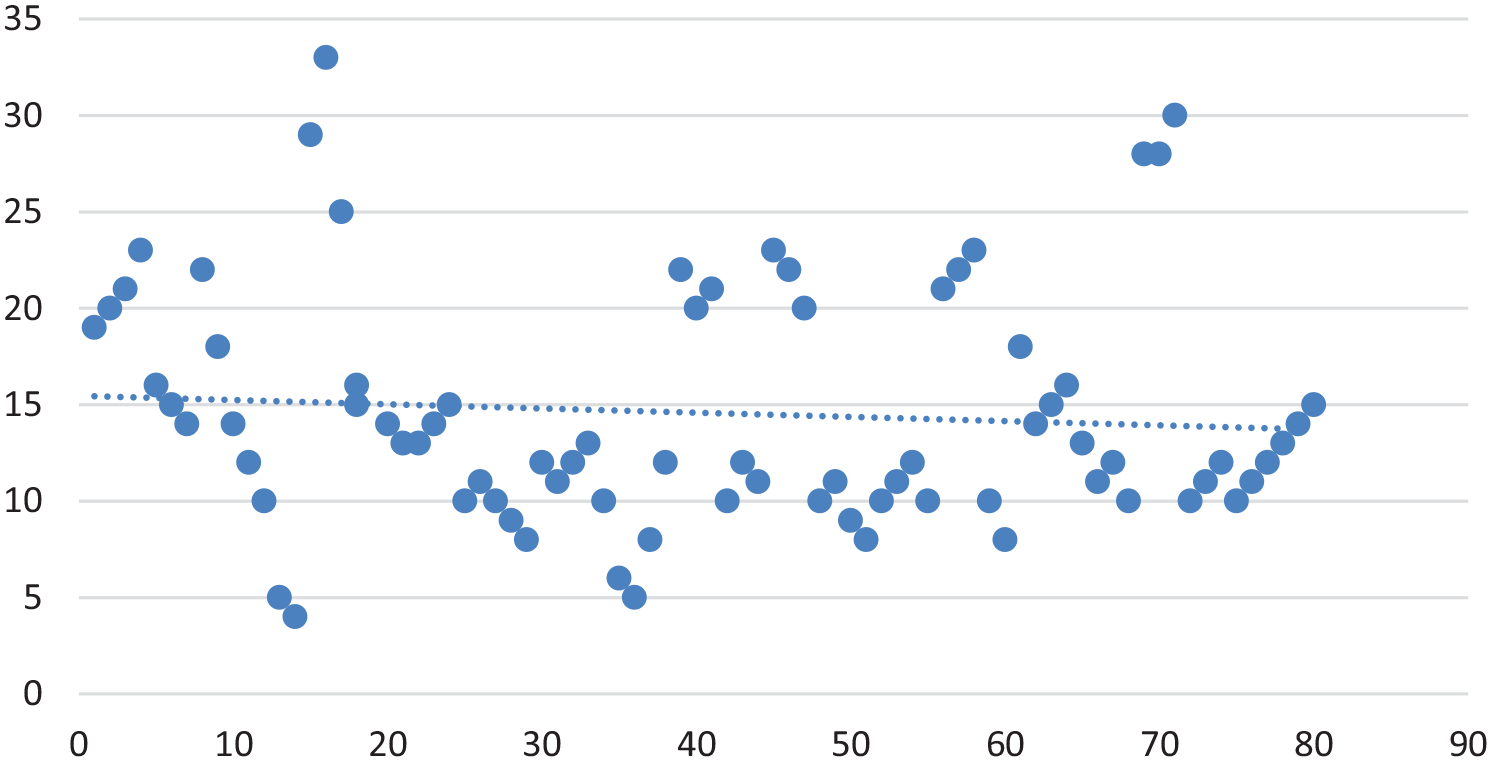
Scatter Chart representation of control group posttest scores.
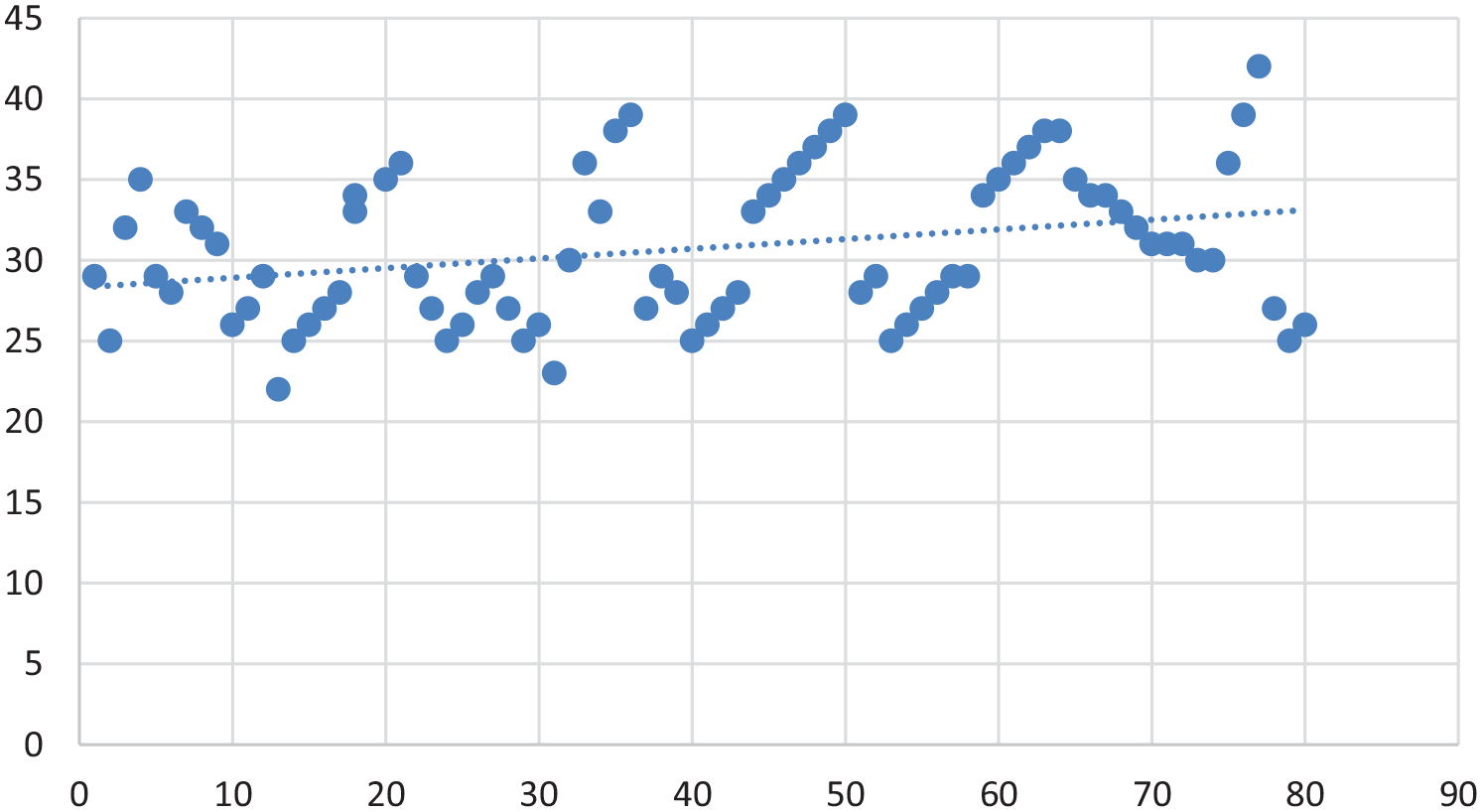
Scatter Chart representation of experimental group posttest scores.
The Scatter Chart representations show a remarkable change in the score dynamics: In the CG, the scores are scattered over a wide range and tend to be concentrated below 20 marks. In the EG, group dynamics show a turnaround with all scores concentrating above 20 marks. Clearly, as a group, these learners have individually and collectively contributed to better scores. After posttest interviews, certain reasons for this drastic improvement could be noted (recorded ahead in this study). The trend line in case of CG shows a downward trend in contrast to the upward trend in case of the EG. This can be taken as a strong indicator for the successful use of MALL-based CL as a successful vocabulary learning strategy.
On being asked to report on their experience at the end of the study period, in the EG, 26 females said that collaborative MALL lessons offered them the much desired flexibility to interact with their peers and the teacher outside the class time; 33 females reported to finding an improved motivation to learn; and 39 females were of the view that MALL-based collaborative learning ought to be adopted for their other subjects too.
On the same questionnaire, 31 male learners confirmed that what they found the most remarkable was the autonomy that MALL-based CL offered them in terms of time and space. Nevertheless, 39 of them reported that, in the previous lesson structure, they found the idea of speaking up before their peers the most confounding and preferred to miss their classes for fear of being laughed at.
Some of the biggest indicators of pedagogical success are learner motivation and test scores. On both these counts, it can be stated with certainty that MALL-based collaborative learning kept the learners motivated as the EG recorded a remarkable 97% attendance through the 3-month period, against 74% recorded by the CG. Test scores too showed noticeable improvement. The study has some very significant contributions to language teaching pedagogy. One, we must make room for more autonomous, student-centered, and technology-driven classrooms because, as the study has made it clear, collaborative learning is preferred by learners. Two, teachers need to be knowledgeable in the latest findings that connect the learner with the content because as teachers, it is our primary concern to ensure and enhance learning. And three, teachers need to find greater ingenuity in thinking up ways in which their subject matter may be presented to the learners using a technological platform to engage the learners more effectively and be ready for pedagogical modifications to suit learner preference.
Conclusion
Active peer involvement in problem solving and collaboration was seen as one of the biggest accomplishments of the experiment. First of all, it was observed that the usually reticent learners benefited greatly, as they found an opportunity to participate in class activities without having to overcome their initial inhibition. Second, learners acted more responsibly by taking the initiative themselves to learn, which contrasts sharply with the previous practice of depending thoroughly on the teacher to complete the syllabus. In fact, the learners found the pedagogy so engaging that some of them sought permission to stay after hours to undertake extra reading. It was also remarkable that the mean device time did not increase significantly, with the implication that learners were using the same amount of time but directing it toward learning.
The study has brought to the fore the immense potential that lies in the use of MALL and collaborative learning, especially in foreign language learning, and learner engagement, suggesting that it may be a useful idea to integrate this in other areas of learning as well. Although mobile devices are not allowed on school campuses in KSA, similar activities can be designed to be undertaken at home for younger learners of EFL. This would ensure better proficiency and motivation for learning, particularly in the domain of higher education. It would be advisable to apply the pedagogy to other skill areas of EFL, such as listening and writing, as that would enhance global proficiency of the learners. Finally, it is recommended that MALL- and collaboration-based activities be embedded in the curriculum, and that teachers be adequately trained so as to make the most of young people’s attachment to technology.
Generalizations to an experiment may be drawn only after verifying its results in large and varied populations. We feel that the current sample of 160 respondents was actually too small for experimenting with a novel method of language exposure. It may be more pertinent to conduct similar studies with varied age groups of learners from different educational backgrounds. A larger number of teachers should also be recruited to highlight teacher-taught aspirations, and the results of such studies should be shared with the educational administrators to bring about a serious pedagogical change.
Footnotes
Authors’ Note
Mohammed Abdullah Alharbi is affiliated with Department of English, College of education, Majmaah university, Majmaah, Saudi Arabia. Email
Declaration of Conflicting Interests
The author(s) declared no potential conflicts of interest with respect to the research, authorship, and/or publication of this article.
Funding
The author(s) received no financial support for the research, authorship, and/or publication of this article.
