




Abstract
Difficult co-workers cause stress and create unpleasant work environments. Yet, the characteristics of difficult co-workers are not thoroughly explored. Following Fritz’s typology of troublesome others at work, this study conceptualized difficult co-workers as those whose traits and behaviors may provoke antipathy. The study also hypothesized that difficult co-workers would trigger negative attitudinal responses. Data were collected from 719 Chinese working adults. Results of structural equation modeling showed that difficult co-workers led to negative employees’ attitudes toward them, and indirectly led to employee intention to leave. Specifically, the study explored the cause of antipathy at work by identifying major unpleasant traits and behaviors of difficult co-workers.
Introduction
Interpersonal relationships in the workplace have been a popular research topic in management and social psychology (Abugre, 2017; Buunk et al., 2010; Methot et al., 2017; Sims & Sun, 2012). Levitt et al. (1996) suggested that more than half of working adults might have troublesome relationships at work. Clinical studies showed that social interaction at work was a major risk factor for stress, depression, and psychiatric disorder (Zlotnick et al., 2000). In the management literature, researchers showed that the perception of a difficult co-worker would have an impact on an employee even when she or he might not need to work with that difficult co-worker (Lutgen-Sandvik et al., 2007; Sims & Sun, 2012). The presence of difficult co-workers leads to cynicism and disloyalty in an organization. An undesirable outcome could be high employee turnover intention (Abugre, 2017). In addition, organizational cynicism and intention to leave almost certainly weaken employee commitment, they adversely affect esprit de corps and inhibit organizational improvements (Abugre, 2017; Çaylak & Altuntas, 2017). Beneath the multitude of interactions among employees are the social-psychological forces that shape organizational climate (Bock et al., 2005; F. X. Yang & Lau, 2019). Despite the significance of clinical interpretations and understanding of the interaction, its footprint is almost absent in the management literature. This research seeks to open up a dialogue between the two disciplines.
The term, difficult co-worker, has been widely covered in mass media (Alaimo, 2015; Clark, 2012) and has sporadically appeared in academic literature (Arnold & Roach, 1992; Elden, 2014; Lazarus, 1995; Rosen, 1998). However, it has yet to be defined clearly literally. As the term suggests, it concerns with the negative aspects of an employee. Fritz (2002, 2006) and Lutgen-Sandvik et al. (2007) characterized a similar concept—troublesome others from a multidimensional perspective. Other studies in the literature used only a few items to measure perceived negative co-worker behaviors, resulting in some oversimplified unidimensional constructs, such as interpersonal conflict (Y. Chen et al., 2010; de Raeve et al., 2009; Spector et al., 1988). As a supplement to Fritz’s (2002, 2006) typology of troublesome others at work including bosses, peers, and subordinates, the study proposes a six-factor scale which covers a wide range of personal traits and behaviors of difficult co-workers. Generally speaking, difficult co-workers are those people whom employees find difficult to work, interact, or just encounter with. Although Fritz (2002) did not use the exact term “difficult co-workers,” she highlighted that people routinely encounter difficult people at work and social settings. Difficult co-workers drive people frustrated. They affect how employees interact and perform tasks. Accordingly, this study focuses on characterizing difficult co-workers. It also investigates employees’ attitudes toward difficult co-workers and explored whether and how difficult co-workers might cause employee intention to leave. The study was guided by the social exchange theory (Blau, 1964). The theory posits that human relationships are formed under a subjective cost-benefit analysis. It proposes that social relationships are grounded on the concept of reciprocity in interactions. The social exchange theory has been widely used to understand employees’ work attitudes, behaviors, and intentions (Herman et al., 2013; Liu et al., 2018; Parzefall & Salin, 2010). Specifically, the theory has been adopted to explain organizational citizenship behaviors, deviant and counterproductive work behaviors, and turnover intentions (Liu et al., 2018; Parzefall & Salin, 2010; Robinson & Bennett, 1995). However, Chiaburu and Harrison (2008) call for a more comprehensive and complex method to investigate co-worker influences in workplace. To that end, this study supplements the literature with possible missing links.
Interpersonal workplace relations are complicated by cultures, in particular, guanxi—the fundamental personal connection—has been the centerpiece of modern studies on Chinese business community (X. P. Chen & Chen, 2004). There is no exception in the workplace. The study of interpersonal workplace relations is imperative and critical among Chinese co-workers (Butt, 2019; Guan & Frenkel, 2019). Thus, the Chinese community was chosen as the context. The study aimed to address two important research questions:
In answering these questions, the study contributes to define difficult co-workers thoroughly and to explore their effects on employees’ general subjective and encountering (interpersonal) attitudes. More specifically, general subjective attitude refers to an individual psychological evaluation of his or her co-worker based on observation of this difficult co-worker’s attitudes and behaviors (Lutgen-Sandvik et al., 2007; Sims & Sun, 2012). Encountering attitude refers to an individual’s personal feelings toward interactions with a co-worker (Snavely, 1981). In addition, the impact of encountering attitude on employees’ intention to leave (i.e., turnover propensity) will be investigated. The findings of the study shed light on how Chinese employees see difficult co-workers and the negative effects of difficult co-workers on employees’ attitudinal responses and intention to leave, the topics that have yet to be explored in the management literature.
Literature Review and Hypothesis Development
Interacting with difficult co-workers is unpleasant (Walker, 2011); this interpersonal unpleasantness has yet to be fully addressed. There have been attempts to investigate such interpersonal encounters; however, most research has focused on interpersonal conflict (P. Y. Chen & Spector, 1991; Ilies et al., 2011; Liu et al., 2015), interpersonal discrimination (King & Ahmad, 2010), and abusive interaction (Akella, 2016; Keashly et al., 1997). Nevertheless, an employee’s perception of a co-worker might have been formed before any actual interpersonal interaction. It is because the employee can observe and discuss how that co-worker behaves, acts, and interacts with others. Paull et al. (2012) and Popp (2017) indicated that workplace bullying affects the victim, and the perpetrator’s negative behavior also affects bystanders or observers. Rayner et al. (2002) reported that 70% of respondents experienced stress as they witnessed bullying incidents and about one quarter of respondents left their jobs due to poor organizational climate associated with bullying. Fritz (2002) explored unpleasant work relationships between boss and associate, between two associates, and between associate and subordinate. She identified several key factors of troublesome others at work. That included unprofessional behavior, incompetence, lording power, sexual harassment, bossy/controlling, and so on. Fritz (2006) replicated her early study, and similar findings were obtained.
Following Fritz’s (2002, 2006) typology of troublesome others at work, this study proposes that difficult co-workers could be characterized by six key factors, namely, busy body, lording power, unprofessional behavior, sexual harassment, incompetence, and bossy. These six factors incorporate a wide range of attributes, from personal traits to interpersonal behaviors. An example of busy body is a person butting in with unsolicited voices and opinions. Examples of lording power and unprofessional behavior include a co-worker trying to promote himself and bad-mouthing people to a third party, respectively. Sexual harassment refers to a co-worker harassing people sexually. Examples of incompetence and bossy include a co-worker not doing his or her job correctly and trying to control fellow co-workers, respectively. Fritz (2002) suggested that busy body might not be very harmful to people. However, with the rising concerns of workplace privacy in present day (Bhave et al., 2020), the invasion is an issue (Samosh, 2019; Stone-Romero et al., 2003), and it is very negative in the Asian culture (Su, 2019).
Difficult Co-Workers and Employees’ Attitudinal Responses
Co-worker behaviors affect employees’ work-related perceptions and attitudes (Morrow et al., 1994). For instance, Rayner et al. (2002) and Sims and Sun (2012) indicated that it does not only affect the target victims but also the event observers; they would experience the associated emotional strain. Sims and Sun (2012) studied employees’ general attitude when these employees witnessed workplace bullying. However, the subject of interests in this present study is broader than workplace bullying and covers a broad range of attitudinal reactions. When an employee is involved in interactions with difficult co-workers, the feelings of frustration, anxiety, and emotional pain are more intense (Ilies et al., 2011; Rosen, 1998). These attitudinal reactions have been well studied in clinical research because physicians frequently face similar situations in interacting with “difficult patients.” Indeed, Hahn et al. (1994) developed the Difficult Doctor–Patient Relationship Questionnaire to characterize doctors’ general subjective attitude and encountering attitude toward interacting with difficult patients. In sum, there are two categories of employees’ attitudinal responses. The first one is employees’ general subjective attitude toward difficult co-workers in which employees develop due to observing difficult co-workers’ behaviors without interacting with them. The second one is employees’ encountering attitude toward working with difficult co-workers. Direct interaction is involved. Following this line of research, this study characterizes employees’ general subjective attitude and encountering attitude toward working with difficult co-workers, including items such as the level of frustration a respondent may have and his or her unwillingness to work with difficult co-workers. Specifically, there are evidences of co-worker influence in the workplace even for a bystander under the social exchange framework (Chiaburu & Harrison, 2008; Parzefall & Salin, 2010; Takeuchi et al., 2011). Thus, the following hypothesis is posited:
Parzefall and Salin (2010) explored how bullying is experienced and the mechanisms through which bullying leads to negative outcomes for both victims and bystanders. Their study revealed that victims’ and bystanders’ perceptions of bullying are different, but related. Being the first person, his expectation from his prior knowledge about the perpetrator are some strong determinants of the experience of being abused (Keashly, 2001). Thus, the following hypothesis is given:
Employees’ general subjective attitude toward difficult co-workers has an influence on their encountering attitude (i.e., attitude toward working with difficult co-workers). It is because once an employee forms an impression of a particular co-worker, it creates a tendency in affection. It will project his or her encounter in a deeper sense; for instance, the observation on the communication style of an employee would affect the observer’s perceptions on trust, credibility, power, and attraction between them (Snavely, 1981). In Kellermann’s (1984) term, it is the negativity effect in the formation of judgments. Disproportionate weight is given to the negative subjective impressions. This phenomenon affects and guides interpersonal interaction from a social exchange perspective (Baillien et al., 2009; Kellermann, 1984). Baillien et al. (2009) indicated that employees’ negative subjective attitude usually led to interpersonal conflict. Thus, the following hypothesis is posited:
Individual Difference and Employees’ Attitudinal Responses
Time and again, similarity is shown to positively impact social and work relationships (Bernerth et al., 2008; Mollenhorst et al., 2008; Sias et al., 2004; Van Swol, & Drury-Grogan, 2017). On the contrary, dissimilarity or individual difference is associated with repulsion (Mollenhorst et al., 2008; Singh et al., 2017; Singh & Ho, 2000; Snavely, 1981). By nature, similarity matters to the perception of liking, and individual difference plays a key role in shaping individuals’ attitude toward each other (Collisson & Howell, 2014). More explicitly, Singh and Ho (2000) and Singh et al. (2017) showed that there exists a similarity–dissimilarity asymmetry in which the dissimilarity-repulsion is stronger than the similarity-attraction. Liao et al. (2008) revealed that perceived deep-level dissimilarity in teams negatively and significantly predicted critical behavioral outcomes, such as individual’s helping. Fritz (2002) indicated that dissimilarity (i.e., individual difference) affects employee perceptions and psychology states significantly. This effect of dissimilar attitudes (i.e., repulsion) is also related to interpersonal distance (Michinov & Monteil, 2002). It is unnoticeable to the employee until he or she has to interact with a dissimilar co-worker (Liao et al., 2008). Thus, individual difference is related to employees’ encountering attitude, but not employees’ general subjective attitude.
Employees’ Encountering Attitude and Intention to Leave
Engendering a social exchange relationship, Herda and Lavelle (2012) showed that burnout was positively related to turnover intention. However, many other researches confirmed that interpersonal relationship was actually the key factor in employee retention (Ferres et al., 2004; Sheridan, 1992). It is suspected that another key element is the effect of employee attitudinal responses. There is a general phenomenon that direct interpersonal conflicts influence turnover intention (Kim & Park, 2014). Moreover, researchers (Fritz, 2002; Kuo et al., 2013; Sherony & Green, 2002) showed that the poor interpersonal relationship perceived by employees induced negative physiological and attitudinal reactions, eventually leading to turnover intention. In the theory of reasoned action, attitude influences behavioral intention (Ajzen & Fishbein, 1980). Thus, employee intention to leave is hypothesized as a consequence of the negative encountering attitude formed due to the interaction with difficult co-workers.
Figure 1 shows how the second-order factors of difficult co-workers and individual difference influence employee attitudinal reactions and intention to leave.

Second-order factor structure of difficult co-worker and the theoretical model.
Method
The study followed the best practices as suggested by Kelley et al. (2003) and Fink (2015) closely. No vulnerable population was involved and no financial or unjust incentive was given, so there was no undue influence. As for the tool, existing and psychometrically tested questionnaires for measurement items were utilized. To ensure comprehension, questions were divided into sections, and headings were included to make the questionnaire easier to follow. The draft questionnaire was tested with a pilot sample of 20 respondents. Participants indicated that they could understand the instructions and questions without difficulties. They were able to complete the questionnaire within 15 min.
Participants and Procedures
Chinese employees working in Macao’s service sector were identified as participants in the study. The study adopted an organization-wide questionnaire survey in which employees were approached formally. The organizations selected for the study included banks, government departments, institutions, and utility companies. The human resources departments of these organizations were contacted. The study’s purpose was explained to managers or directors of human resources, and they were invited to forward invitation emails to their employees. Over a period of 9 months, the survey was administered to participants who agreed to take part with an appointment in their organization. Informed consent was achieved by briefings and clear instructions to participants. In the survey, participants were asked to think of all co-workers with whom they had direct or indirect working relationship and to recall the most difficult co-worker. A difficult co-worker was defined as “the person with whom you had the greatest difficulty in approaching him or her, getting alone or getting a job done together.” After that, they were invited to respond to the questionnaire. Although the survey did not involve bioethical issues, respondents were ensured that their participation would be voluntary and they could withdraw from the survey at any point. Respondents were also ensured the anonymity and confidentiality of the collected data.
In total, 732 completed questionnaires were collected. After discarding 13 invalid questionnaires due to missing data, 719 usable questionnaires were obtained. Out of the 719 usable responses from working adults, 402 were collected from banks and 317 from public organizations. Overall, 75.4% worked in organizations employing more than 200 employees. Most respondents (36.3%) worked in departments of medium size, ranging from 10 to 19 staff. Most respondents (44.6%) identified their role as a supporting staff, 35.2% worked in the front line, 13.9% were assistant managers, and 3.8% were managers. Most respondents (83%) had a post-secondary qualification, and 40% were men. The first 150 and the last 150 returned questionnaires were compared using a series of t tests on all items (Armstrong & Overton, 1977). The t test results indicated that no significant difference was found between these two data sets, implying nonresponse bias was unlikely an issue. This sample size was sufficient for obtaining meaningful parameter estimates with small standard errors using structural equation modeling (Anderson & Gerbing, 1988).
Measures
Difficult Co-Worker Scale
Basically, the study incorporated Fritz’s (2002) work on “troublesome others.” The work-related behaviors of a difficult co-worker include bossy around and incompetence while the personal and interpersonal behaviors of a difficult co-worker include busy body, lording power, unprofessional behavior, and sexual harassment (Fritz, 2002). Table 1 shows the six dimensions of difficult co-worker scale and their measurement items. The difficult co-worker scale was subjected to a comprehensive set of validity tests as described in the next section. These six dimensions cover a wide range of task and relationship behaviors of difficult co-workers. Participants were asked to assess the extent to which the measurement items describe difficult co-workers using a 7-point Likert-type scale from 1 (“very strongly disagree”) to 7 (“very strongly agree”).
Factor Loadings of the Measurement Model.

Employees’ Attitudinal Responses
Two categories of employees’ attitudinal responses were identified according to the conditions of interacting with difficult co-workers. The management and clinical literature provide specific taxonomy of attitudes toward difficult co-workers or people (Hahn et al., 1994; Ilies et al., 2011; Rosen, 1998). Seven items were adapted from the Difficult Doctor–Patient Relationship Questionnaire developed by Hahn et al. (1994). The Difficult Doctor–Patient Relationship Questionnaire was proved to have high internal consistency, and it is popular in the clinical literature for characterizing interpersonal relationships (Hahn, 2001; Hahn et al., 1994). In it, three items are used to characterize employees’ general subjective attitude toward difficult co-workers based on observations. Four items are used to characterize employees’ encountering attitude toward working with difficult co-workers. The items were rated using a 7-point scale from 1 (“not at all”) to 7 (“a great deal”).
Individual Difference
Difference or similarity between individuals affects interactions, communication processes, and attitude toward each other (Fritz, 2002; Liao et al., 2008; Singh et al., 2017). Four items were adapted from Fritz (2002) to measure perceived individual difference of an employee toward difficult co-workers because the scale had been thoroughly tested for different seniority of employees. Respondents were asked to rate perceived individual difference using a 7-point Likert-type scale from 1 (“very strongly disagree”) to 7 (“very strongly agree”).
Intention to Leave
Intention to leave is one of the most immediate and direct predictors of employee turnover. It refers to an employee’s desire to leave the organization in the near future (Carmeli & Weisberg, 2006; Ferres et al., 2004). A three-item scale was adapted from Ferres et al. (2004). Respondents were asked to evaluate each item using a 7-point scale from 1 (“never”) to 7 (“very often”).
Results
First-Order Measurement Model
The measurement items were tested in accordance with Trochim and Donnelly’s (2001) recommendations, and the structural equation modeling was carried out using maximum-likelihood estimation procedure in LISREL 8. Each multiple-item scale was subjected to reliability tests. To ensure discrimination power and high internal consistency, all scale’s items must be greater than the typical threshold of .40 on total-item correlation (Trochim & Donnelly, 2001), and the scale was assessed by Cronbach’s alpha. Table 1 shows that nearly all Cronbach’s alpha values were greater than .70, except that employees’ general subjective attitude had a marginal value of .683. To further assess the scale reliability, confirmatory factor analysis (CFA) was performed using LISREL 8 (Joreskog & Sorbom, 1996). All the 10 latent variables were included in the first-order measurement model. The CFA results showed that the model’s χ2 statistic was 2,297.3 (df = 620, p < .01), whereas the independence model’s χ2 statistic was 42,956.6 (df = 703). The model’s Goodness of Fit Index (GFI) and the Root Mean Square Error of Approximation (RMSEA) were 0.852 and 0.063, respectively. These statistics of the first-order measurement model were comparable with other researches on management (Ho et al., 2011) and indicated an acceptable fit (Browne & Cudeck, 1992). In addition, the non-sample dependent indices including the Comparative Fit Index (CFI), Non-normed Fit Index (NNFI), and Incremental Fit Index (IFI) were 0.960, 0.947, and 0.960, respectively, which were all acceptable for practical reasons (Bentler, 1990). Table 1 also shows measurement items, factor loadings, composite reliabilities, and Average Variance Extracted (AVE) values. Composite reliabilities were all acceptable with values greater than .70.
Because all latent variables were measured by items in the questionnaires completed by the same respondents, we examined common method variance by conducting Harman’s one-factor test (Podsakoff & Organ, 1986). We entered all measurement items and performed a principal component factor analysis. The unrotated factor solution produced nine factors in which the first factor explained 28% of variance. Besides, when all the observable items were included in a one-factor model, the model’s χ2 statistic was 7,895.6 (df = 665, p < .01), and its GFI and RMSEA were 0.571 and 0.142, respectively, implying a much less satisfactory fit. Hence, common method variance was not significant in the study (Podsakoff & Organ, 1986).
Table 1 shows that all measurement items significantly loaded to the prescribed latent variables, supporting convergent validity (Anderson & Gerbing, 1988). To evaluate discriminant validity, the AVE values and inter-construct correlations were computed. Table 2 shows that all root square values of AVEs were greater than the construct’s correlations with all other constructs, confirming discriminant validity (Fornell & Larcker, 1981). Furthermore, we constrained the correlation between each pair of constructs, one at a time, to be equal to 1.0 (Anderson & Gerbing, 1988). All such constrained models had larger Akaike Information Criterion (AIC) values than that of the unconstrained model (i.e., the basic measurement model) and changes in χ2 values were significant (p < .05). These results showed that no two constructs had correlation equal to 1.0, supporting discriminant validity. Hence, the reliability, convergent validity, and discriminant validity of measurement scales were acceptable.
AVE Values and Inter-Construct Correlations From the Measurement Model.

Note. The diagonal numbers in bold correspond to the square root values of AVEs. AVE = Average Variance Extracted.
Second-order factor measurement model
Difficult co-worker is a multidimensional variable consisting of six first-order latent constructs, which are correlated. Thus, a higher-level latent variable called difficult co-worker was added. This type of second-order factor offers a few advantages: It provides a higher level of abstraction that allows researchers to focus on the generic form of difficult co-worker; it also helps control multicollinearity problems in a structural model (Koufteros et al., 2009). To justify this parsimonious model, we tested a second-order CFA model in which additional restrictions were imposed to six first-order factors. On composite reliability, with all the other measures included at their original first-order form, the χ2 statistic of the CFA was 2,550.5 (df = 650, p < .01). A simple χ2 difference test indicated that the second-order factor model was less parsimonious, that was less fit. However, a bare χ2 difference tests suffered many limitations, so we treated these differences as indicators of comparative fit, rather than strict tests of fit. For the fit indices, GFI was 0.832 and the RMSEA was 0.067. The non-sample dependent indices CFI, NNFI, and IFI were 0.955, 0.951, and 0.955, respectively, which were all acceptable. In particular, NNFI performed better, which took into account the number of parameters in the model and measured model fitness with absolute value. In that sense, all indexes indicated that the second-order factor model was of acceptable fit (Bentler, 1990) and they were comparable with similar employee researches (cf. Ho et al., 2011). To take advantage of a higher abstraction for understanding the impact of difficult co-workers on employee attitudinal responses, the second-order factor model was used.
In this second-order factor model, the factor loading on busy body was 0.807, lording power 0.689, unprofessional behavior 0.824, sexual harassment 0.547, incompetence 0.581, and bossy 0.901. All these first-order factors significantly loaded to the second-order structure. The latent variable—bossy—weighted most in difficult co-worker scale suggesting that it was more relevant in defining the scale’s dimensionality. On the other hand, sexual harassment had the least weighting on the scale. The composite reliability and AVE of the second-order factor model of difficult co-worker scale were 0.873 and 0.542, respectively. The item loadings for the rest of the model were very similar to the first-order model as shown in Table 1; for the sake of simplicity, they were not shown here. Again, all measurement items significantly loaded to the prescribed latent variables in the second-order factor, supporting convergent validity (Anderson & Gerbing, 1988). Thus, results indicated that the second-order measurement model was reliable.
To assess discriminant validity, the square root values of AVEs and inter-construct correlations were compared in Table 3 in which the square root values of AVEs were updated accordingly. Again, the square root values of AVEs exceeded the construct’s correlations with all other constructs, supporting the discriminant validity of this second-order model. Conclusively, the reliability, convergent validity, and discriminant validity of measurement scales with this second-order factor were deemed acceptable.
AVE Values and Inter-Construct Correlations From the Second-Order Measurement Model.

Note. The diagonal numbers in bold correspond to the square root values of AVEs. AVE = Average Variance Extracted.
Structural Equation Model for Testing Hypotheses
The hypotheses were tested by computing path coefficients of the second-order factor model. For each path between constructs, t value and the significance of path coefficient were computed. Table 4 shows path coefficients and the corresponding t values. The model’s χ2 statistic was 2,556.9 (df = 654, p < .01), and the RMSEA was 0.067, indicating an acceptable fit (Browne & Cudeck, 1992). The GFI, CFI, NNFI, and IFI were 0.832, 0.955, 0.952, and 0.955 respectively, which were all acceptable in practices.
Standardized Path Coefficients for the Structural Model.

p < .01. **p < .001.
H1 was about the positive and direct relationship between difficult co-worker and employee’s general subjective attitude. The path was significant at the .001 level, and its path coefficient indicated a moderate effect. Similarly, most other hypotheses showed moderate, significant relationships. In comparison, the path coefficient for H5 was weak but still significant; this implied that employee intention to leave was also affected by other factors. Taken together, all hypothesized paths were supported by the empirical findings as shown in Table 4. Finally, the squared multiple correlations for employees’ general subjective attitude, employees’ encountering attitude, and employee intention to leave were .225, .594, and .02, respectively. The result indicated that the variance of encountering attitude was explained by the model up to 59%; this high explanatory power was satisfactory. Figure 2 presents the results of structural equation modeling.
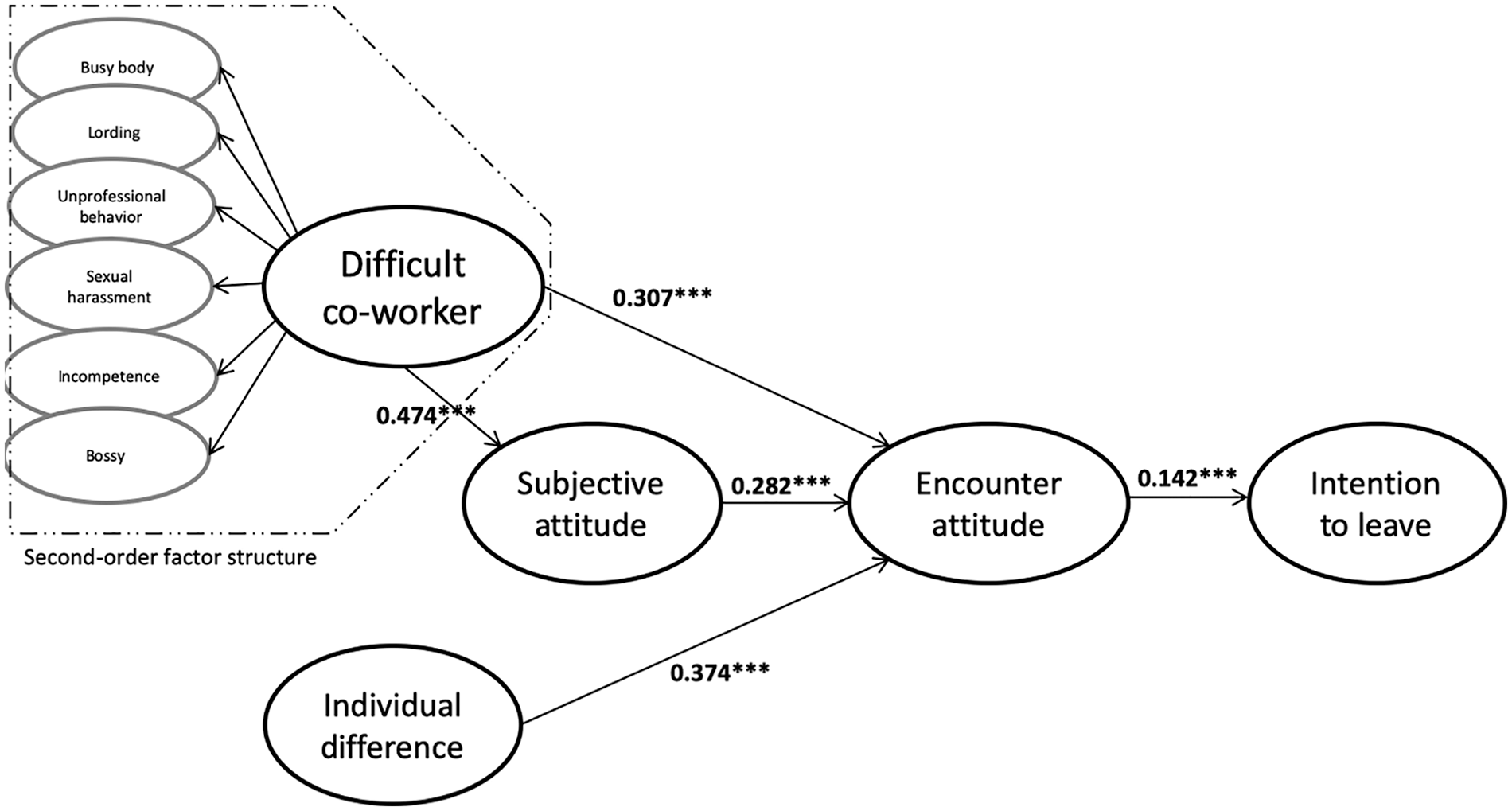
Result on the hypotheses of the model.
The role of employees’ general subjective attitude
In the above structural equation modeling analysis, there was an indirect effect with a standardized coefficient of 0.134 from difficult co-workers to employees’ encountering attitude via employees’ general subjective attitude. It provided preliminary evidence about the indirect effect. To assess it, the direct effect of difficult co-workers on employees’ encountering attitude was compared with the indirect effect through employees’ general subjective attitude by Baron and Kenny’s (1986) procedure (Zhao et al., 2010). To determine if difficult co-workers affect employees’ encountering attitude through employees’ general subjective attitude, the path coefficient of the direct effect (0.307) was compared with that of the indirect effect, which is the product of the two path coefficients involved (0.134). Both paths were significant and of the same sign. It showed evidence for the complementary mediation role of employees’ general subjective attitude between difficult co-workers and employees’ encountering attitude (Zhao et al., 2010).
Discussion
This study examined and validated the second-order nature of difficult co-worker scale. Consistent with the hypotheses, the relationships between difficult co-workers, employee attitudinal responses, and intention to leave were confirmed. The confirmation of difficult co-worker scale and the structural model provided new insights into the impact of difficult co-workers in work settings. Grounded on clinical research (Hahn et al., 1994, 2001), two categories of employee attitudinal responses toward difficult co-workers in the organizational context were established: general subjective attitude and encountering attitude. The model results provided a vibrant conceptualization of these employee attitudinal responses. It was found that difficult co-workers induced employees’ negative attitudes strongly, either with or without interactions. The results confirmed that difficult co-workers affected employees’ attitude toward them considerably and differently. As a post hoc analysis, by summing the contribution of direct and indirect effects, the aggregated effect of difficult co-workers on the negative employees’ encountering attitude was 0.44. While the direct effect of difficult co-workers on the negative employees’ encountering attitude (0.28) was not as strong as what individual difference could make (0.37), the total effect of difficult co-workers (0.44) exceeded that from individual difference. The second contribution of the study was the empirical evidence of the complementary mediating mechanism. Difficult co-workers played dual roles in affecting negative encountering attitude; difficult co-workers affected encountering attitude directly and indirectly through negative general subjective attitude.
Consistent with the extant literature (e.g., Sheridan, 1992), intention to leave was found to be only weakly, though significantly, related to negative employees’ encountering attitude. The finding suggested that the presence of difficult co-workers only weakly led to higher intention to leave. A possible explanation for such a weak relationship was due to other factors such as group process perceptions, goal commitment, compensation, job satisfaction, procedural and distributive justice perceptions, and perceived organizational support (Ferres et al., 2004; Loi et al., 2006; Sheridan, 1992; Whiteoak, 2007). Employees’ intention to leave actually depends on multiple complex factors which shall play a more significant role in the formation of intention to leave. Moreover, ample job opportunities in Macao also played a significant role in employee retention or intention to leave. There were severe competitions in Macao’s labor market (Yu & To, 2013). New openings in the job market prompted employees to seek for alternative opportunities, rather than their work and psychological situations. All these subdued the effect on employee intention to leave.
Specifically, the study contributed to social and interpersonal research in several ways. First, at the time of writing, it was a pioneer study in human resource management and organizational psychology to offer a rigorous conceptualization and operationalization of difficult co-workers as a second-order measurement model. The multidimensional scale describes traits, behaviors, and working attributes of difficult co-workers. It provides preliminary evidence and insight on the effect of difficult co-workers on employee attitudinal responses. As for employee attitudinal responses, they come from the clinical research literature and are new to the organizational literature. The study confirmed their validity as new measures for organizational research.
There were limitations of this study. First, common method bias might posit a potential problem in self-reported measures. To ensure that it was not a significant issue in the study, Harman’s one-factor test was conducted. Results confirmed that common method bias was not an issue. Indeed, the use of self-reported measures is accurate and reliable in regard to the purpose of assessing a person’s perception on his or her co-workers. Second, the second-order factor model of difficult co-workers could only be confirmed but not strong. Nevertheless, in a post-hoc analysis with modification indices, no apparent path modification could be detected. Under other research contexts, there might be additional variables to be studied, the measurement and structural model should be subjected to re-test to assure that other latent constructs are orthogonal to difficult co-worker scale (MacCallum & Austin, 2000). Hitherto, the cross-sectional nature of research design did not provide evidence on the direction of causality on the hypothesized links. Future research based on longitudinal designs may provide deeper understandings of difficult co-workers and their effects on employee attitudinal and behavioral responses.
Implications and Future Research
The study demonstrated that both individual difference and difficult co-workers influenced employee attitudinal responses. The findings suggested that, in total, difficult co-workers have greater effects than individual difference on employee negative attitudinal responses. It could be an implication for managers. Manipulating job assignment is important; it can decouple tasks and workgroups (J. Yang & Mossholder, 2004) to lessen undesirable development of employees’ negative attitude toward difficult co-workers. A more prudent approach is to take pre-emptive action against those undesirable interactions. Human resource management practices can facilitate by identifying and hiring the right employees (Yu & To, 2011). Personality tests and cyber-vetting, such as screening applicants’ social media profiles, can be used as the metrics for employee recruitment. Responding or confronting difficult co-workers when they come into sight is belated and risky. It may lead to workplace litigation. Managers are constrained by the employment law (Johnson & Indvik, 1999) and such actions may not be effective.
The findings helped managers comprehend the difficult co-worker-related matter and drew attention to the important elements of difficult co-workers: bossy, unprofessional behavior, busy body, lording power, incompetence, and sexual harassment in descending importance. Future research would greatly benefit by examining the impact of difficult co-workers on organizational support, job satisfaction, and so on. Individual difference was not a strong factor as anticipated, but it was a good driving factor influencing employee attitudinal responses or work performance.
The study concurred with the findings of Sims and Sun (2012) that barely witnessing workplace bullying could lead to employees’ negative attitude (i.e., general subjective attitude in the study). The study supplemented that difficult co-workers could actually lead to employees’ general subjective attitude and encountering attitude at the same time. Thus, it is important for Chinese managers to ensure work interactions to be well-behaved. Manifestations of difficult co-workers should be kept to minimal. A prudent solution may come from Japanese culture of linguistic politeness in the office setting; it helps avoid unnecessary potential conflict (Matsumoto, 1988). After all, it is always important to maintain the collaborative spirit among employees for organizational performance.
Footnotes
Declaration of Conflicting Interests
The author(s) declared no potential conflicts of interest with respect to the research, authorship, and/or publication of this article.
Funding
The author(s) received no financial support for the research, authorship, and/or publication of this article.
