




Abstract
International students leave their countries to pursue their educational goals in a different country and must adapt to succeed. However, they may face challenges when adapting to and learning a new culture. This study investigates the challenges common to international students in their host countries and summarizes the publishing trends. A literature search of peer-reviewed articles published in Scopus, Taylor & Francis, EBSCO Host, Web of Science, Springer, PubMed, and Wiley Online over 21 years (2002–2022) was done for data collection. After the screening, a total of 175 articles were included in this review and analyzed with content analysis. The findings show that the top four destinations for international students (USA, UK, Australia, and Canada) produced the most articles about international students’ challenges. Additionally, most papers investigated more than one challenge, and sociocultural (82.9%) and academic challenges (82.3%) were the most researched, with language issues as the primary cause. The results also show no changes or improvement in the challenges of international students in 21 years, and areas such as psychological and economic challenges need more research. These challenges and other trends found in the articles are discussed and directions for future research are suggested.
The UNESCO Institute of Statistics defines anyone who crosses a border or territory into another country and enrolls in an educational institution as an international student. International students are sought after globally, and their numbers have increased significantly. There were over 6.3 million international students globally as of 2020 (UNESCO Institute of Statistics [UIS], 2022a). Different countries host these students due to the economic growth, cultural awareness, and diversity they bring to their host countries (Luo & Jamieson-Drake, 2013).
According to Fakunle (2021), international students’ motivations for studying abroad are from educational, aspirational, experiential, and economic dimensions. Many international students’ motivation to study abroad stems from personal ambitions and the desire for better prospects. For others, it is because of their country’s low education quality (Bhandari et al., 2018). In addition, economic, technological, and cultural factors significantly impact international education, making it easier to access for international students (Organization of Economic Cooperation and Development[OECD], 2021). Regardless of what motivates these students to study overseas, they may need help settling in a new country and adapting to academic life due to unforeseen difficulties. These students face challenges at almost every point during the transition from their home country to their destination and post-graduation (Khanal & Gaulee, 2019).
When these challenges are not addressed, international students may experience low life satisfaction and lose interest in their academic pursuits. For instance, a study in Germany reported a higher dropout rate among international students studying for higher education degrees. In the study, international students cited language barriers, financial issues, and the requirements of academic study as reasons for dropping out (Pineda et al., 2022). Therefore, reviewing these challenges to understand them further can improve international students’ education and experience.
Over the years, numerous academic and social researchers have conducted studies to determine international students’ challenges in different regions and countries. However, the generalization of these challenges to all international students globally needs to be clarified. Therefore, examining the existing literature on this topic is important to identify the improvements and trends in these challenges. The specific objectives of this study are (I) to find and analyze the trend changes in the challenges of international students from 2002 to 2022, and (II) to investigate the similarities and differences of these challenges across regions and countries. This research provides insight into understanding, acknowledging, and finding possible solutions to these challenges.
Literature Review
International students worldwide face sociocultural (Baklashova & Kazakov, 2016; H. Ma & Miller, 2021; Wu et al., 2015), academic (Grayson, 2008; Ibragimova & Tarasova, 2018; Perry, 2016), psychological (Dovchin, 2020; Wu et al., 2015) and economic (Robertson et al., 2010; Shah et al., 2019; Vickers & Bekhradnia, 2007; Witherell & Clayton, 2014) challenges. These challenges have been investigated in some countries hosting international students, and findings show they are linked.
Sociocultural Challenges
The first and most common challenge international students encounter in their study countries is sociocultural. These challenges have been linked to increased stress levels among international students (Iorga et al., 2020), especially in the first and second years of arrival in their host country (Kristiana et al., 2022). Homesickness, loneliness, and isolation (Cowley & Hyams–Ssekasi, 2018; Shah et al., 2019), stress (Russell et al., 2010), absence of cultural food (Forbes-Mewett, 2018), social living conditions (Newsome & Cooper, 2016; Sivtceva, 2016), climate and environmental differences (Nieto & Zoller Booth, 2010; Sherry et al., 2010), unequal treatment, and language discrimination (Dovchin, 2020; Lee, 2010) are some common sociocultural challenges international students face. Meanwhile, these challenges are different for domestic students. Compared to their international counterparts, domestic students can quickly adapt to higher education since they usually have a support system. Whereas international students live in a foreign land with different cultures, have little knowledge of the way of life, and barely know people in the new destination (Shah et al., 2019).
Although international students can predict sociocultural challenges such as language and loneliness, they may still face unexpected challenges such as discrimination, racism, and culture shock. For instance, Brown and Jones (2013) investigated racial discrimination against 153 international students, and 49 respondents reported that they had experienced racially motivated verbal and physical assault. Likewise, Ge et al. (2019) found cultural bias and discrimination against Chinese international students in Canada. These students reported being prejudiced based on their identity (language use, skin color, and cultural practices). Such negative labels hinder students’ adaptation and academic success in the long run (Ge et al., 2019). One apparent solution to this issue would be enabling a social relationship between domestic and international students. However, international students find it difficult to form friendships with domestic students in their host countries (Elturki et al., 2019; Jenkins & Galloway, 2009) since they mostly gravitate toward their fellow international students of the same ethnicity.
Apart from discrimination, culture shock is another unexpected sociocultural challenge international students face. This is because most international students are leaving their countries for the first time and are used to a particular way of life. Nevertheless, they must incorporate their host country’s unfamiliar culture. These students are exposed to the radical differences in values, attitudes, habits, and ways of thinking (Poedjiastutie, 2015) in both cultures. For instance, one must immediately open a gift in Western culture and show gratitude; this differs from Eastern and African cultures, where gifts are opened in the absence of the giver (Baklashova & Kazakov, 2016). Such cultural differences may cause awkwardness in social interactions for the parties involved.
Another issue that cuts across all socio-cultural challenges is language. International students prefer to study in countries where English is the native or official language (Ke et al., 2022; Mahmoud et al., 2020), hence why their most popular destinations are English-speaking countries like the US, the UK, and Australia. Choosing such countries not only helps the students integrate easily, but they can also improve their English proficiency. However, students whose first language is not English may need help in those countries (Gatwiri, 2015; Kuo, 2011; Nieto & Zoller Booth, 2010; Sawir, 2005; Sherry et al., 2010).
Several sociocultural issues are linked to language barriers. For instance, research has shown that speaking with an accent and pronouncing words differently than native English speakers can cause international students to face accent stereotyping (Crawford, 2000) and high levels of discrimination (Poyrazli & Lopez, 2007). This discrimination and stereotyping is called linguistic racism. Dovchin (2020) posited that linguistic racism has two main traits—the first is ethnic stereotyping, which involves laughing and joking at ethnically different English speakers. The second is linguistic stereotyping, which Dovchin (2020) defined as unfavorable perceptions enacted on English speakers due to their ethnicity, regardless of their high language proficiency. International students who are non-native speakers face more language barrier issues. Some of these students can read and write but can barely hold conversations in English. This language difficulty may stem from the weakness in students’ prior English language learning experience while schooling in their home country (Sawir, 2005). Language issues affect the adjustment, academic performance, social, and overall experiences of international students.
Despite the availability of several studies on sociocultural challenges and highlighted solutions, international students still need help with these challenges since there have been no significant changes. Recent studies (Calvo et al., 2022; H. Ma & Miller, 2021; Y. Ma & Zhan, 2022) focused on international students’ experiences during the pandemic and found that these students faced more social problems like discrimination and loneliness than domestic students.
Academic Challenges
Regardless of their citizenship status, all students can have academic struggles (Perry, 2016). However, Grayson (2008) and Deuchar (2022) reported that international students face more academic challenges when compared to their domestic counterparts. These challenges emanate from their academic environment and are sometimes visible in their academic performance. Teaching methods, university curriculum, and teachers’ accents are examples of the academic challenges these students may encounter (Alavi & Mansor, 2011). International students struggle more during their first year as they get to know their new learning environment. This is also when the realization of a new life dawns on them. As a result, being in a new country and navigating a new university increases alienation thoughts among international students (Burdett & Crossman, 2012).
Language is also a primary cause of academic struggle among international students, especially non-native speakers of English. Many international students must write and pass an English proficiency examination for admission and visa purposes. However, Burdett and Crossman (2012) found that despite passing these exams before arriving, international students in the USA still needed help to survive academic-related language challenges upon arrival. Much of this struggle is centered on understanding and keeping up with the accent used in the host country. Park et al. (2017) researched 182 English as a second language international students studying in Australia—a native English-speaking country. They found that all these students experience accent-related problems when speaking in an educational setting. International students in such situations avoid class discussions so they do not sound unintelligent (Andrade, 2006; Sherry et al., 2010). Sawir (2005) explained that these language difficulties might be because of weaknesses in students’ previous learning experiences, where they focus less on conversational skills and more on grammar and reading in a teacher-centered classroom. Apart from listening and speaking, reading was also challenging for international students, especially undergraduates (Perry, Weatherford, & Lausch, 2016). Students with reading and writing issues tend to miss assignment deadlines (Zhang & Mi, 2010), affecting their academic performance.
International students studying in non-English-speaking countries have more language difficulties. Ibragimova and Tarasova’s (2018) study on non-English speaking international students in their first year at a Russian university showed that studying in a non-English-speaking country is even more tedious, and students must devote their first year to learning Russian. This phenomenon is common in most European universities, where students must learn the host nation’s language to qualify for tuition-free education. The implication is that these students must learn a new language from scratch to a certain proficiency level within a limited time before starting their academic journey.
Nevertheless, language and the inability to participate in the classroom are not the only academic challenges international students encounter. They also tend not to understand their degree requirements (Pineda et al., 2022). In addition, they have issues with communication and interaction with local students and professors, as well as coping with the stress of schoolwork (Shah et al., 2019). International students also reported more advisor-related problems (Perry, Weatherford, & Lausch, 2016), and some reported discrimination between local and international students by lecturers (Alavi & Mansor, 2011). International students may need more motivation when they perceive the learning environment and requirements as highly challenging. As a result, they may be unable to cope and drop out of school (Pineda et al., 2022), leading to more sociocultural and psychological challenges. However, Vlachoudi et al. (2023) posit that self-evaluation can lead to positive learning outcomes for students, and the results from such evaluation can improve lesson planning and design, which eventually helps the students’ performance. Universities admitting international students can utilize organizational evaluation to combat these academic challenges.
Psychological Challenges
There has been an increase in the number of resources explaining what constitutes mental health issues, how to spot the symptoms, and the available solutions (Busfield, 2012; Forbes-Mewett, 2018). There is also an increase in media reporting regarding mental health, and as a result, there is a surge in mental health issues, prevalence, and interventions (Foulkes & Andrews, 2023). People are aware of mental health problems and how they affect our lives now more than ever. The rise of mental health awareness has dramatically improved the view of international students’ psychological challenges in their host countries.
Researchers are more interested in international students’ mental health because of the psychological, physical, and mental stress associated with migration and university life (Chen et al., 2020; Dovchin, 2020; Forbes-Mewett & Sawyer, 2016). According to some studies (Collishaw et al., 2010; Stallman, 2012; Twenge et al., 2010), the deterioration of the mental health of adolescents and university students is on the rise as more research respondents report symptoms of low mental health and severe psychological problems. Homesickness and loneliness are among the earliest emotional issues international students encounter post-arrival (Shah et al., 2019). These students may find a way to connect with their home country to alleviate their emotional sickness. Forbes-Mewett (2018) noted that culturally appropriate food could comfort international students. However, these students cannot access the home-cooked family meals they are probably used to back home. In addition, food is a crucial element for international students’ adaptation that is often overlooked (Forbes-Mewett, 2018).
There is a significant difference in psychological challenges between domestic and international students. Prior research on international students’ mental health showed that international students have always suffered psychological challenges. For example, Furnham and Trezise (1983) found that international students in the UK had higher psychological disturbance levels than British students. Lu (1990) also noted that international students reported that homesickness was a more stable challenge for international students than other psychological symptoms that tend to fade over time. In addition, Sam and Eide’s (1991) global research on international students found that these students reported anxiety, paranoia, depression, and somatic symptoms while studying in a foreign country. Ryan and Twibell (2000) also reported the same results and added that these symptoms affect international students’ activities. Another study of 900 international students in Australia by Russell et al. (2010) reported that 41% of the respondents experienced elevated stress levels. This research also found that culture shock, homesickness, and perceived discrimination are the leading causes of stress among this demographic. Such stress levels can lead to psychological distress and lower levels of functioning among these students (Hunley, 2010). Recent research also had similar results (Forbes-Mewett & Sawyer, 2016; Nguyen & Balakrishnan, 2020; Sun et al., 2021). However, some studies (Ladum & Burkholder, 2019; LaMontagne et al., 2023) have found no differences in the prevalence of mental health issues between international students and their domestic counterparts.
The causes of mental health problems for international students were grouped into three by Forbes-Mewett and Sawyer (2011). First are the English language challenges, and the sub-factors here are the interaction between teachers and students and the unfamiliar academic environment. According to Dovchin (2020), language discrimination leads to an inferiority complex, social withdrawal, anxiety, and self-esteem issues for international students. Dovchin (2020) also stated that these symptoms may lead to severe depressive mental health symptoms in these students. The second cause is the sudden freedom international students from restrictive backgrounds find and how they take charge of daily activities like cooking, managing relationships, and finances. The third cause is cultural perception, with examples such as not asking for help due to stigma and unwillingness to disclose information. Forbes-Mewett and Sawyer (2011) argued that the third factor is why international students avoid using university counseling services.
Furthermore, social adaptation plays a significant role in preventing psychological challenges for international students. Rosenthal et al. (2006) discovered that Southeast Asian students make fewer connections in their country of study, making them susceptible to psychological problems like anxiety and depression, which may also affect their education. However, Sun et al. (2021) found that Chinese international students with social connectedness to domestic students reported reduced mental health compared to those who only formed connections with people of the same ethnicity.
Gan and Forbes-Mewett’s (2019) study in Australia found that international students rarely seek professional help, and when they do, they hope to be anonymous to disclose their issues more easily. Besides, universities have counseling centers for their students regardless of ethnicity; however, the use of the facility is where the problems lie. Different understandings of mental health, psychological problems, cultural perceptions, and stigma affect help-seeking behaviors (Gan & Forbes-Mewett, 2019). It is easier for international students to acknowledge a physical illness than accept that they have psychological problems (Forbes-Mewett & Sawyer, 2011).
Economic Challenges
Several studies (Adnett, 2010; Andrade, 2006; Baklashova & Kazakov, 2016; Bound et al., 2016; Brown & Jones, 2013; Ortiz et al., 2015; Scott et al., 2015; Shah et al., 2019; Vickers & Bekhradnia, 2007; Witherell & Clayton, 2014) highlighted and emphasized the deliberate part of international students in the development of their host country’s economy. For instance, one of the most popular destinations for international students—the United States of America– reported that international students contributed $45 billion to the economy in 2018 and $41 billion in 2019 (NAFSA, 2019). Although there has been a decline in the enrollment of international students, the US still received a $28.4 billion contribution to the economy in the 2020/2021 academic year from international students (NAFSA, 2021).
These students not only add to the economy, but their contribution also improves the higher education budget in their host countries. An OECD article by Van-Damme (2017) reported that international students contribute immensely to the total expenditure of international students hosting countries on higher education. Countries like Australia and New Zealand receive an income from international students equal to one-quarter of their total expenditure; the United States receives 2.4%, and Canada receives 8.2%. Van-Damme (2017) noted that in Denmark, where higher education is free for domestic students and international students pay, the country receives 13.3% of its higher education budget from international students.
International students offer their host countries numerous economic benefits. However, few studies acknowledge the presence of economic difficulties in the lives of these students. Robertson et al. (2010) and Shah et al. (2019) noted that the primary financial challenge international students face is the tuition fee. In most countries, domestic students pay less than international students. These students still pay when studying in European countries like Denmark, Sweden, and Poland, where education is free for European Union (EU) and European Economic Area (EEA) students. However, countries like Norway, Germany, and Iceland offer free education to everyone who studies in a public institution (Lungu, 2022), while countries like the Czech Republic offer tuition-free education only to international students who want to learn the Czech language (Taylor, 2022).
Nevertheless, there is still a considerable variation in domestic and international tuition fees. Undergraduate international students pay the highest tuition fee, making it seem like they are a source of revenue (Cantwell, 2019). Countries with no higher education tuition fees, like Sweden and Denmark, are known to charge international students. Moreover, international students in countries with subsidized fees for domestic students, like the UK, Australia, Canada, and New Zealand, still pay premium fees (Johnstone & Marcucci, 2010), usually more than double that of what domestic students pay.
Despite all this, the enrollment of international students keeps increasing steadily. Lee et al. (2006) suggested that the potential for economic gain is a common rationale for universities admitting international students. Cantwell (2019) and Van-Damme (2017) also posited that these universities might see international students as “cash cows” instead of an addition to the student body to improve cultural diversity. However, Van-Damme (2017) noted that the high cost of tuition is a way for countries to reduce the influx of international students and only welcome those with financial stability.
Financial support is another economic challenge for international students, with their first year being the toughest. During the first year, they are yet to get familiar with their new environment and may not fully understand the cost of survival. Besides, international students cannot depend on employment in the host country to fuel their education and living costs. Open Doors (2019) reported that about 62% of international students in the US have their primary source of income outside the country. Some have business in their home country or receive assistance from family, friends, and their home country’s universities and government.
Sometimes, this support is insufficient, as they may not fully anticipate living costs in the host country. Shah et al. (2019) reported that international students in Canada face financial challenges because of high rent and low-paying part-time jobs. Newsome and Cooper (2016) also found that international students in the UK reported financial challenges. Some of the respondents in the study complained about high house rents and resorted to living with other students in a small room to counter their financial issues.
International students have always faced one challenge or another in gaining an international education, achieving their dreams, or improving their career prospects. When host universities or countries fail these students, they may use digital activism to communicate their needs and get a solution to better their lives. However, technological habitus and computational self-efficacy, among other factors, may hinder digital activism (Aguayo et al., 2022). Therefore, it is essential to recognize the existence of these challenges and tackle them to improve international education practices.
Method
Search Strategy and Inclusion Criteria
This study focuses on international students’ challenges in various countries, and keywords like “challenges of international students,”“international students; issues,” and “adaptation challenges of international students” were used to search for articles in databases from 2002 until August 2022. The databases searched are Web of Science, Springer, Taylor & Francis, Scopus, EBSCO Host, PubMed, and Wiley Online.
The Preferred Reporting Items for Systematic Reviews and Meta-Analysis (PRISMA) guidelines were followed in the screening and retrieval of articles, as shown in Figure 1. The inclusion criteria were that articles must be focused on the challenges and issues of international students, published in English, peer-reviewed, and have available full texts. Duplicate articles, review articles, and articles that involved domestic participants were excluded, and a total of 175 articles were eligible for inclusion.
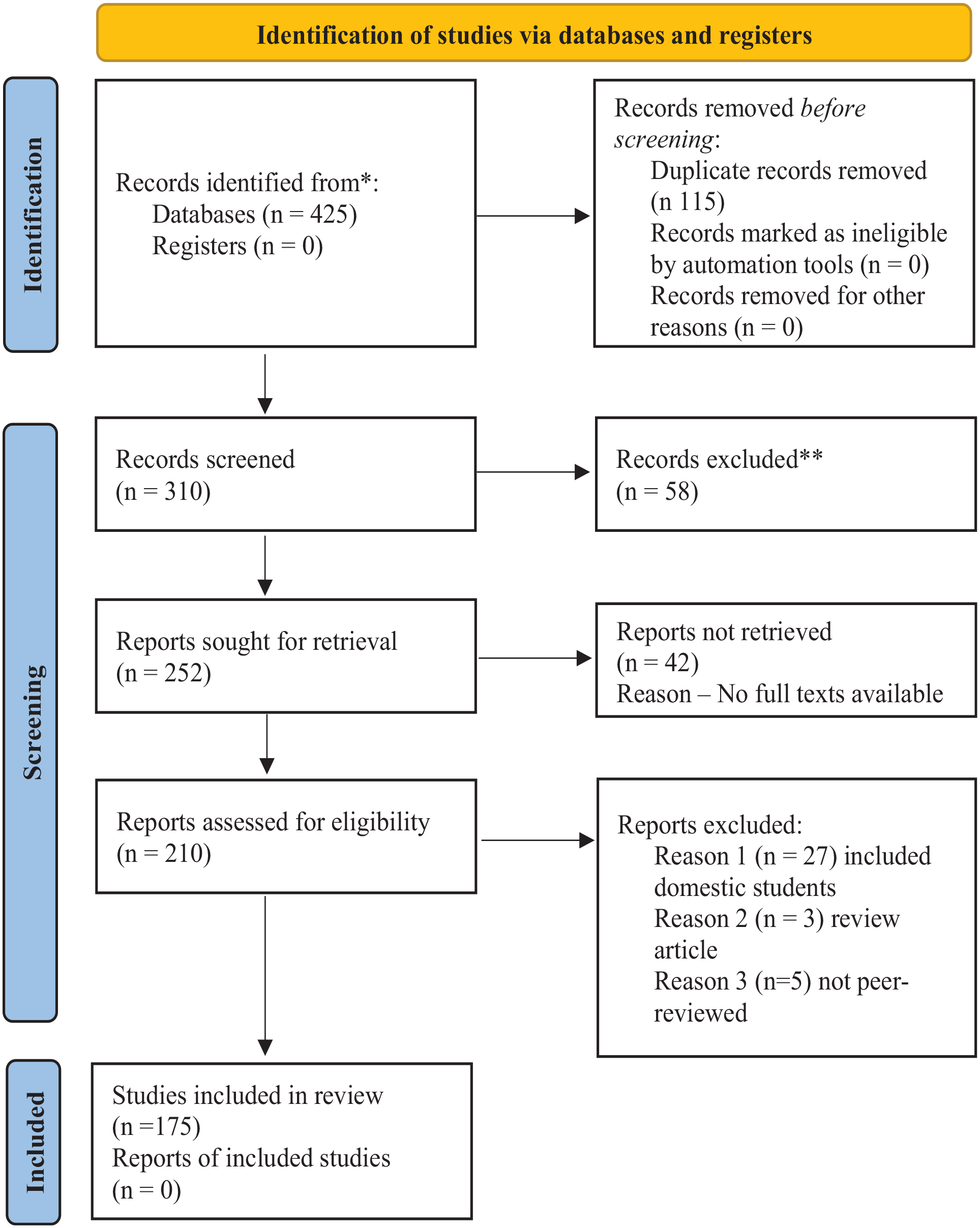
Systematic Review Flowchart.
Quality Assessment
The Joanna Briggs Institute Checklist for Systematic Review and Research Synthesis (Aromataris & Munn, 2020) was used to critically appraise each article. The checklist has 11 questions with options of yes, no, unclear, and not applicable. All authors appraised each article independently and compared the results. Articles with scores higher than six were deemed moderate to high quality and included in the study.
Data Synthesis and Analysis
Different types of articles published in peer-reviewed journals and used qualitative, quantitative, and mixed methods were included in this review. The information extracted from the articles were publication year, author name(s), country (affiliation), article type, citation count, and the challenges investigated. The included studies were heterogeneous in methodology, and since we intended to explore the relationships in their data, a narrative synthesis was used to summarize our findings (Lisy & Porritt, 2016). Content analysis was used to analyze the findings of each article. Content analysis is commonly used to identify and present themes from quantitative and qualitative data (Vaismoradi & Snelgrove, 2019). Inductive coding was used to categorize emerging themes, and the coding was done independently by two authors, with the third author ensuring reliability to a degree of 95%. The emerging themes from the challenges investigated in each study were grouped into four categories, as shown in Table 1.
Coding Categories for Challenges Faced by International Students.

Results and Discussion
This descriptive study intends to inform international students, teachers, advisors, and higher education boards of home and destination countries about the need to identify and comprehend the challenges of international education. Articles related to the “Challenges of International Students” published in different databases over 21 years (2002–2022) were analyzed in this study. A total of 175 research articles with international student participants were identified.
Trends in Article Publication (Year)
All 175 papers analyzed were published in English. The research articles published between 2002 and 2014 were significantly lower. Nevertheless, they recorded more citation counts compared to recent years (see Figure 2). This may indicate that these research articles, although low in number, served as the basis for the literature review of recently published articles.

Citation counts by year of publication.
By 2015, the number of published articles on international students’ challenges increased, and this increment was steady (refer to Figure 3). There were 15 (8.6%) and 16 (9.1%) articles published in 2015 and 2016, respectively. Since the enrollment of international students in 2019 increased to over 6.1 million from 5.7 million in 2018 (UIS, 2022b), it was not surprising that more researchers studied the challenges of these students. However, in 2020, despite the slight increase in enrollment of international students to 6.3 million, only 13 (7.4%) publications addressed international students’ challenges.
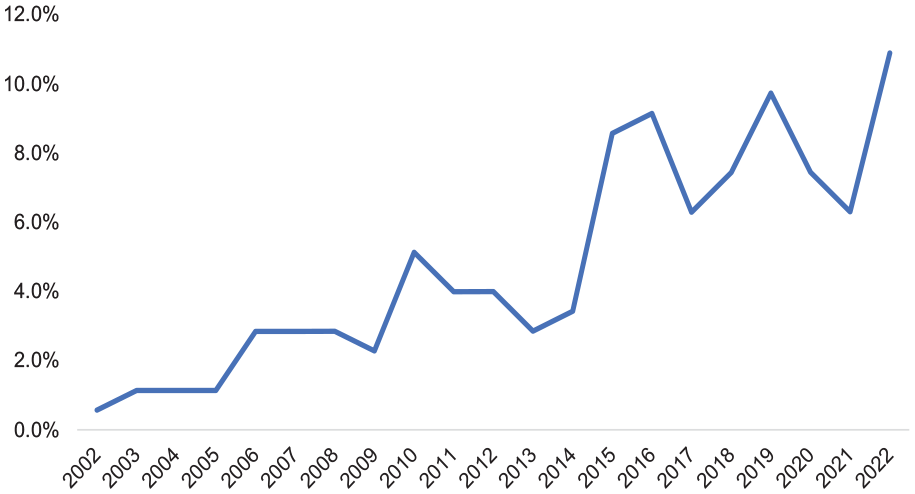
Percentage Distribution of Articles by Year of Publication.
The year 2021 saw a further decrease in publications, with only 11 (6.3%) articles. It should be noted that the pandemic and national lockdowns spread globally in 2020, which may have affected the enrollment of international students and the number of studies published. So far, 19 (10.9%) articles were published in 2022, which is the highest in all the years in this analysis. Most of these articles were about international students’ challenges during the pandemic and its aftereffects.
Trends in Article Publication (Country)
Researchers across 27 countries published all the analyzed articles. Most of the articles were co-authored, with a few authors having multiple articles addressing different challenges of international students. Most of the studies were done in America (44%), followed by Australia with 12%, the UK with 9%, and Canada with 6% (see Figure 4). These four countries are the top destinations for international students (Project Atlas, 2020); therefore, it was unsurprising that they produced the most articles.
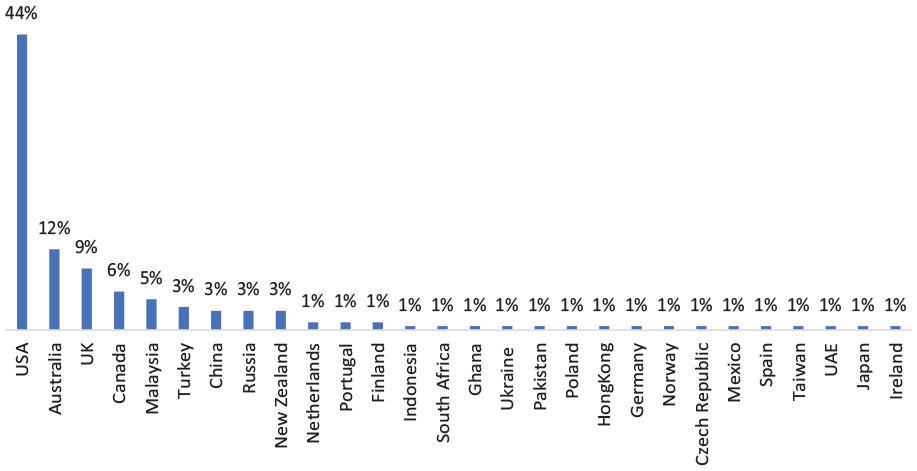
Percentage of Published Articles by Country.
Surprisingly, most European countries recorded little or no research on the challenges of international students. Since Europe is considered a popular non-English-speaking destination for international students, with countries like France, Russia, and Germany topping the list (Project Atlas, 2020), there must be clarification on why there are few published studies. This is the same for other non-European countries like Turkey, China, and Malaysia. For instance, China had over 490,000 international students in 2018 (Statistical Report on International Students in China, 2018). This figure is slightly higher than that of the UK, which was 485,645 (United Kingdom Higher Education Statistics Agency, 2021) in the same year. However, only 3% of the articles analyzed in this research were from China, compared to 9% from the UK.
Nevertheless, this study analyzed the available articles on international students’ challenges from European countries. The analysis of the articles shows that international students face more socio-cultural challenges in these countries. However, we cannot generalize these challenges because the research articles are few and limited in population.
Trends in the Challenges Faced by International Students
All the challenges of international students in the articles were analyzed, and the emerging themes were coded into four categories: academic, sociocultural, psychological, and economic (see Table 2). Only a few articles focused on a single challenge, as most addressed two or more challenges—often academic and socio-cultural.
Percentage of Articles that Addressed Each of the Challenges.

Note. Each challenge identified per article was added to its applicable group. Therefore, an article may be counted more than once depending on the number of challenges identified.
Sociocultural challenges were the most addressed, with 82.9% (145) articles. The most prevalent issues in this group were culture shock, language issues, acculturation, social values and morals, discrimination, housing, homesickness, loneliness, immigration policies, and adaptation issues. According to the articles analyzed, most of these sociocultural challenges are familiar to all international students. However, international students in English-speaking countries have fewer sociocultural challenges than those in non-English-speaking countries. This may be because language barrier issues are less obvious, and these students can easily communicate and understand their environment since they have some knowledge of the English language. However, they may be subject to linguistic racism (Dovchin, 2020).
On the other hand, international students in non-English speaking countries have more significant sociocultural challenges. They live in a country with a different language and find it difficult to communicate outside the classroom (Gebru & Yuksel-Kaptanoglu, 2020). As a result, these students may need help securing accommodation, getting employment, shopping in the market, and making friends with domestic students.
Academic challenges were the next, with 82.3% (144) articles. The most addressed issues were the use of English, procrastination, adaptation to a new academic environment, teacher-student relationships, the role of supervisors and advisors, and academic stress. Our results do not show any significant difference in the academic challenges of international students in English-speaking countries and those in non-English-speaking countries.
Only 63.4% (111) of the articles analyzed addressed international students’ psychological challenges. Many prior articles focused on sociocultural and academic challenges and barely addressed psychological ones. Therefore, most articles on international students’ mental health and psychological challenges were from 2013 until 2022. This may be because of increased global mental health awareness through TV and social media (Foulkes & Andrews, 2023). The most common issues found under psychological challenges were mood disorders, anxiety, depression, stress, low motivation, and some significant psychiatric disorders. We also found that international students face more psychological challenges in their first year due to loneliness and homesickness. However, they may face severe psychological challenges like clinical depression in their subsequent years if their sociocultural, academic, and economic challenges are not addressed. Research on psychological challenges also indicated that international students were less inclined to access the mental health facilities of their universities and find solutions to their psychological challenges (Forbes-Mewett & Sawyer, 2011; Gan & Forbes-Mewett, 2019; Martirosyan et al., 2019; Merry et al., 2021; Onabule & Boes, 2013).
One under-researched issue is the economic challenges faced by international students. Only 33 (19.4%) articles addressed these students’ economic challenges. This may be because host countries expect international students to understand the financial burden of international education and be prepared to bear it. This is apparent in the visa requirements of these countries, where they expect incoming students to show proof of funds to ascertain that they can sustain their education and living expenses without having to work in the country (Khanal & Gaulee, 2019). While these regulations are valid, unforeseen circumstances may happen to these students and cause them to lose their financial dependency.
Sometimes, international students do not expect the high living expenses they encounter in their host countries and can barely cope. Articles that addressed the economic challenges of international students highlighted unemployment, the high cost of living, and massive differences in local and international students’ tuition. For instance, Newsome and Cooper (2016) noted that international students in the UK could barely afford accommodation and lived poorly to the extent that they described their experience as “such a hard life.”
Another under-researched challenge is the environmental challenge—moving from one country to another may also mean moving from one climate to another and interacting with different environmental policies like recycling. Few articles (Khanal & Gaulee, 2019; Shah et al., 2019) mentioned it as an adaptation challenge, relating it to only weather conditions. None of the articles analyzed investigated the perceptions of international students about the environmental practices of their host countries and the differences when compared to their home country.
Despite the differences in these challenges, they all had one issue in common—language. The analysis of each challenge showed that language and its use might be the underlying cause of all the major issues international students encounter. The inability to use English causes significant academic problems for all students, regardless of their host country. Students studying in non-English-speaking countries have sociocultural challenges since they cannot communicate with the citizens of their host country and may have to learn the language. Furthermore, the inability to use the host country’s official language reduced the chances of international students getting part-time jobs, resulting in economic challenges. Additionally, speaking in a foreign accent made it easy for international students in English-speaking countries to be subjected to linguistic racism, leading to psychological challenges like anxiety and low self-esteem (Dovchin, 2020).
Finally, our analysis shows that the challenges were similar for international students regardless of their country of origin or host countries, and there has been no difference or reduction in these challenges between 2002 and 2022. For instance, prior research (Jenkins & Galloway, 2009; Lee, 2010; Nieto & Zoller Booth, 2010; Russell et al., 2010) on the socio-cultural challenges of international students found issues like cultural differences, social living conditions, language barriers, and unequal treatment. Recent studies (Byrne et al., 2019; Elturki et al., 2019; Gebru & Yuksel-Kaptanoglu, 2020; Hui-Spears & Park-Saltzman, 2022; Sung, 2022) have highlighted the same issues. Therefore, there needs to be a critical review and clarification on what host countries, governments, and universities are doing to help international students settle properly during their academic pursuits.
Limitations and Recommendations
This review focuses on the challenges of international students but does not fully address their causes. While it is good to acknowledge the existence of these challenges, one way to solve them is to find out the root causes. Therefore, we recommend that research on the causes of international students’ challenges be carried out. In addition, there are no significant differences in the challenges when compared between past and recent studies. Studies must be done to learn what host countries and universities are doing to help improve international students’ experiences.
The most addressed challenges are academic and socio-cultural; future research may also want to investigate international students’ economic and environmental challenges, as they are widely under-researched. Although boosting the economy with international students’ tuition is not a problem, host countries may consider implementing policies to help international students financially during their stay in the country. Accessible health facilities, subsidized accommodation, scholarships, and job support are a few ways to provide economic support. The absence of such policies corroborates Cantwell’s (2019) and Qureshi and Khawaja’s (2021) description of international students as “cash cows” for destination countries.
Furthermore, future researchers may use this study’s information to elaborate on international students’ psychological and mental health issues. Knowing how to help these students is important since most do not have a family in their host country for emotional and psychological support.
In addition, more studies need to be done on the challenges faced by international students studying in non-English-speaking countries. The research studies on this topic from such countries are too few compared to English-speaking ones. The language barrier may be the problem here, as researchers may have published the articles in the host country’s official language. However, it is well known that the mode of instruction used for international students is English. Therefore, articles relating to international students challenges in such countries should be published in English and the country’s language.
Finally, the trends in this study can serve as a core for impending research on international students. Meta-analyses should be done on the challenges of international students to gain an in-depth understanding of the issues and their causes. These challenges can affect international students’ mental health, adaptation, and academic performance. Therefore, shedding light on these issues and providing lasting solutions can help international students adapt quickly and better to their host countries, which in turn helps them achieve their educational goals and excel.
Conclusion
This review article analyzed 175 research studies on the challenges of international students published between 2002 and 2022 using content analysis. The results revealed that the US is the biggest producer of research articles, followed by Australia, the UK, and Canada. According to the analysis, socio-cultural and academic challenges were the most addressed for international students. The results also show that the highest number of articles were published in 2022 and the least in 2002, although the increase in publication can be noticed from 2015. In addition, the findings noted an increase in mental health awareness as more articles were published on psychological challenges from 2013 upwards compared to previous years. It also shows that international students face the same challenges globally, but they may manifest differently depending on the host country. Recommendations were made, and we suggested that future research should address the causes of these challenges and make suggestions for improvement. Government bodies and universities in host countries also need to regulate their practices and policies to improve international education.
Footnotes
Declaration of Conflicting Interests
The author(s) declared no potential conflicts of interest with respect to the research, authorship, and/or publication of this article.
Funding
The author(s) received no financial support for the research, authorship, and/or publication of this article.

Data Availability Statement
Data sharing is not applicable to this article as no datasets were generated or analyzed during the current study.