




Abstract
Work-related injury insurance (WII) has undergone a long period of rapid growth in China. Therefore, its sustainability, funding, and system of payments deserve serious attention. By analyzing the changes of the numbers of insured, the number of compensated, and the cumulative balance of WII Fund, this article systematically reviews and summarizes the various stages of the development of WII in China. The relationship between the WII Fund’s revenue and expenditure between 1997 and 2018 is analyzed using statistical methods, including the augmented Dickey–Fuller (ADF) unit root test, the cointegration test, the Granger causality test and an error correction model. Since 1996, China’s WII has been repeatedly adjusted and constantly growing. Our empirical evidence shows that there is a long-term equilibrium and cointegration relationship between the WII Fund’s revenue and expenditure. Revenue is the Granger cause of expenditure, but it does not conform to the fund-raising principle. WII Fund has a large accumulated balance over the years, which violates the principles of fund management and has caused considerable controversy. China’s WII has undergone several regulatory upgrades and management mode adjustments to better ensure its sustainable development. The fund has maintained a basic balance of revenue and expenditure. Nevertheless, at present, China’s WII Fund is facing the pressure of declining fund balance and, as such, medium- and long-term development risks deserve careful attention. As there is no sufficient literature on WII Fund management, this study is a valuable contribution to the existing body of knowledge.
Introduction
Although more and more countries in some way guarantee compensation for occupational injuries and diseases, for political, economic, and historical reasons, different countries have adopted a variety of approaches to establishing work-related injury insurance (WII) systems. Overall, the WII funds are coordinated and managed by national governments in majority of the countries; only few countries have developed WII funds managed by commercial organizations. For instance, Germany and Japan have adopted the former management mode, while the United States adopts the latter mode (Shin et al., 2011). These are reflected in the significant differences in insurance institutions, funding sources, and compensation standard.
The current WII system in China was established on a nationwide basis in 1996 and can be described as a kind of government-led and employer-sponsored social insurance. In the early years of its existence, the enterprises which participated in WII were mainly state owned and large scale. Small and medium-sized enterprises which had relatively poor safety conditions at work, and especially collective ownership enterprises, private enterprises, and enterprises which involve greater safety risks to employees, were less likely to participate in such noncompulsory insurance at that stage. Eight years later, the policy orientation of WII has changed (Deng & Liu, 2008). Since 2004, the Chinese government has focused on promoting occupational injury insurance in industries with a high risk of occupational injury (mines, construction, as well as industries involving hazardous chemicals, fireworks and firecrackers, the production of civil explosive materials, etc.). At this time, the government explicitly required that migrant workers be included in occupational injury insurance (Tang & Chen, 2006; Yang, 2011). This is significant because, in China, most of the workers in jobs with higher occupational injury risk are migrant workers. The number of people participating in WII in China has continued to increase. By the end of 2018, the total number had reached 238,684,458, demonstrating significant growth momentum (Figure 1). The statistical data cited by the article stem from China Statistical Yearbook 1997 to 2018 and China Human Resources and Social Insurance Development Statistics Bulletin (2018).

Number of WII covered workers, 1997 to 2018.
Over the past 20 years, there have been four major changes in WII regulations in China which have had a significant impact on the fund’s revenue and expenditure. As such, the development of WII can be roughly divided into four stages:
In the first stage, from 1993 to 1996, China’s State Administration decided to carry out a trial operation of WII in different regions. Only some employees of few enterprises in the pilot areas participated in the insurance. During this period, the scale of revenue and expenditure was small, showing a relatively stable growth trend.
The second stage was from 1997 to 2003. At the beginning, revenue and expenditure both underwent a small decline, but then began to grow steadily. Its background to these changes is that, in 1996, the Work-Related Injury Insurance Trial Measures for Enterprise Employees pushed WII to expand gradually from pilot areas to more areas.
In the third stage, from 2004 to 2009, the revenue and expenditure of the WII Fund increased significantly faster than before. Notably, the rise in revenue far outstripped the increase in expenditure. These changes were due to the Work-Related Injury Insurance Regulations promulgated in 2003, which represent important legislation in the construction of China’s WII system. The original Trial Measures were upgraded from being a departmental rule to an administrative regulation of the State Council, and its authority and legal power were thereby greatly increased.
The fourth stage, beginning in 2010 and continuing to the present day, is characterized by a large increase in insured workers; the revenue and expenditure of WII Fund have increased correspondingly. These changes are due to the promulgation of the Social Insurance Law in 2010, which clearly stipulates that employees must participate in WII. The law expands the scope of the WII system and has initiated the rapid expansion of WII in China. In 2015, the State Council requested a substantial reduction in the premium rate of WII throughout the country to alleviate the burden on enterprises caused by excessive social insurance premiums. The number of workers who have been compensated for occupational injuries has also increased rapidly, reaching its highest level in 2015 and declining in the following 2 years due to the improvement of safety management (Figure 2).
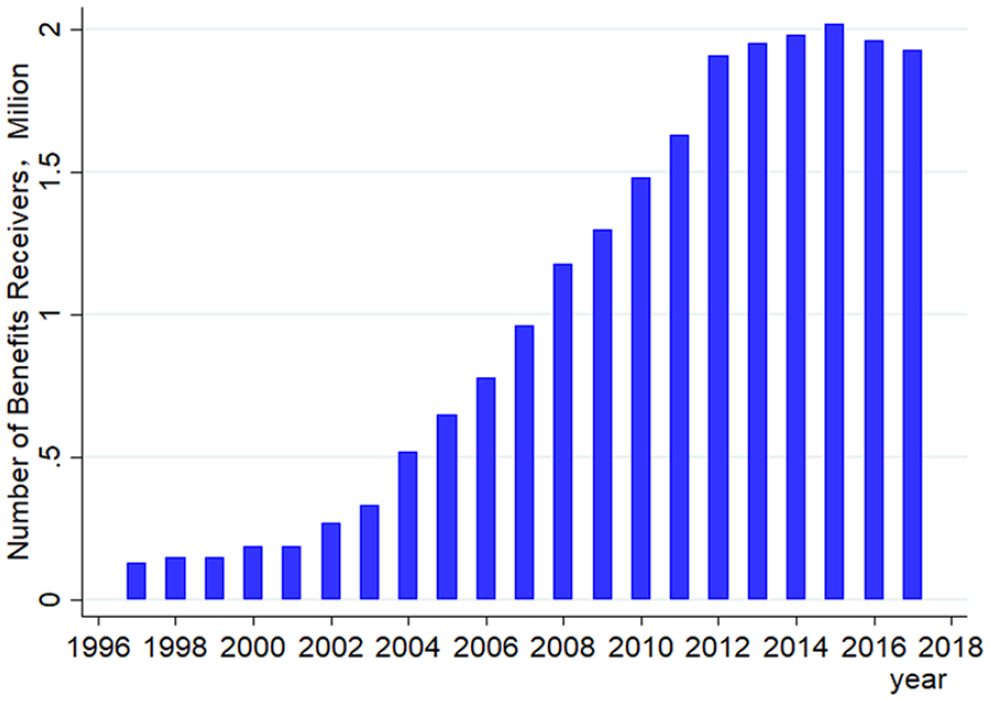
Number of recipients of WII benefits, 1997 to 2017.
At the same time, it is worth noting that the cumulative balance of WII Fund has increased year-on-year, reaching its highest value in 2016, before declining slightly. The WII Fund still maintained a balance of 177.16 billion CNY in 2018 (Figure 3). This huge balance has caused great controversy among Chinese scholars and policymakers as it runs contrary to the core principle of the WII Fund. This core principle is the so-called principle of determining fund revenue according to expenditure. It requires that revenue shall be determined on the basis of expenditure. Its revenue and expenditure should be basically balanced with a small amount of savings. However, because the amount of WII has gone through a rapid expansion in recent years, the practice of WII Fund management does not accord with this principle, which eventually results in a large amount of fund balance.
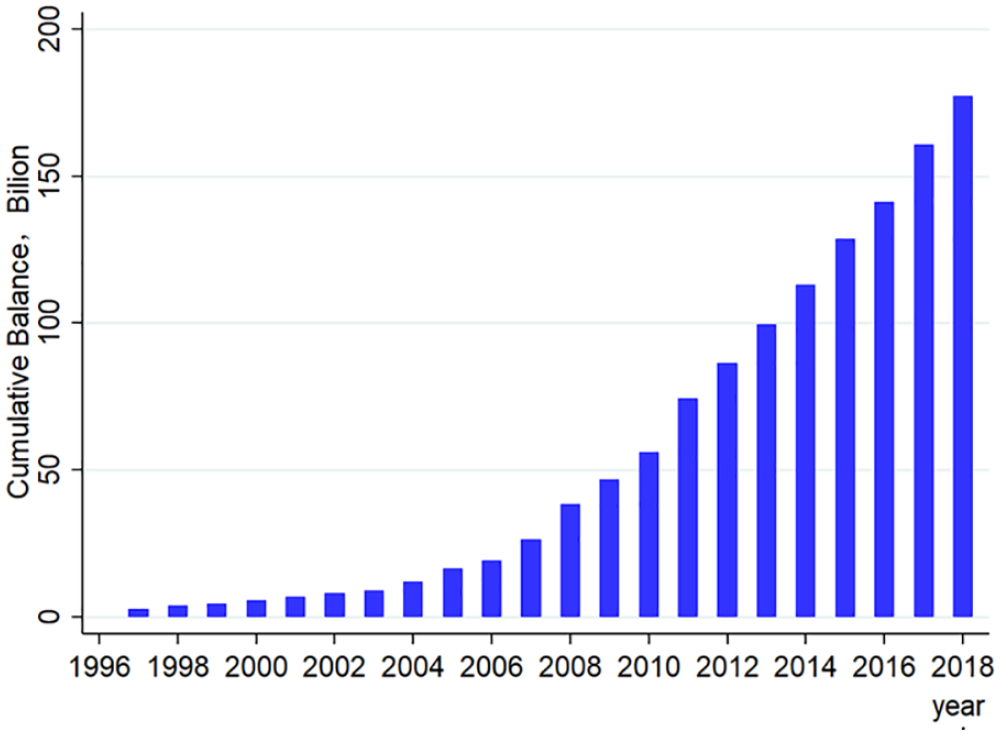
Cumulative balance of WII Fund of China, 1997 to 2018.
Critics contend that this large quantity of balance is not conducive to the healthy development of the WII system in China. In light of this, the purpose of this study is to undertake a thorough analysis of the revenue and expenditure of WII Fund over the past 20 years to establish a sound and factual basis from which decisions can be made that will ensure its sustainable development.
To improve the sustainability and systematic management of WII in China, this study discusses the cointegration of the fund balance of WII. The academic contributions of this article are as follows: First, this article provides a comprehensive review and analysis of the development of China’s WII by focusing on the sustainable development of the WII Fund. Second, this article analyses the long-term equilibrium and cointegration relationship between the revenue and expenditure of WII Fund in China. It investigates the effects of implementing the management principle of the WII Fund, before providing evidence-based recommendations for the improvement of WII management.
Literature Review
WII has developed over a long period of time in various countries. To improve the sustainability of WIIF, researchers are constantly exploring measures to improve and optimize the WII management. According to Chang and Sung (2015), a WII system must be developed within the framework of sustainable social insurance. To compensate the loss after the injuries, it is necessary to have a systematic occupational risk management system. Also, the work-related injury compensation regulations should protect insurance companies, employers, and employees by setting an acceptable compensation rate (Ying, 2013; W. J. Zhang & Wang, 2015).
Some researchers are concerned about the adequacy of compensation provided to victims of work-related injuries (Bađun, 2017; Danzon, 1993; Seabury et al., 2015; Saral et al., 2019), while others believe that it is more important to assess the funds needed to compensate and ensure that sufficient funds are available for payment (Foley & Silverstein, 2015; Thepaksorn & Pongpanich, 2014). Therefore, the issue of the WII Fund’s revenue and expenditure deserves particular attention. Clark et al. (2018) studied the impact of changes in the Labor Compensation Law in United States from 2003 to 2011 on the performance of insurance companies. The regulations have brought about some improvements, the most significant of which is the changes to limits on temporary total indemnity and penalties for workers who do not comply with rehabilitation efforts. Garcia and Cortegano (2018) analyzed the determinants of the price of Portuguese workers’ compensation insurance. The results show that salaries and employee numbers are both related to the price of workers’ compensation insurance. In addition, the authors demonstrated that the accident incidence, region, type of economic activities, and scale of enterprises have a positive and significant impact on premiums. Australia has established worker compensation (WC) systems in various states to provide income support, health care, and rehabilitation for injured and sick workers, covering about 90% of the workforce. The government continuously monitors and improves the performance of the WC system through legislative amendments, including the claim rate, cost, and the result of return to work (Collie et al., 2018).
In October 1996, China implemented the Trial Measures for Work-related Injury Insurance for Enterprise Workers. This legislation stipulated the introduction of a pay-as-you-go financing system. The system is based on a relatively short accounting period (usually 1 year), during which the premium rate is determined. In 2003, new regulations further stipulated that WII Fund should be raised in accordance with the principle of determining fund expenditure by revenue (Zhai, 2009). Nevertheless, to avoid frequent rate adjustments and to prevent the significant fluctuations in fund revenue and expenditure that may occur in cases of major industrial accidents, the WII Fund retains a small amount of floating reserve fund, which is characterized as “a fixed revenue and a slight surplus.” Over the past two decades, China’s WII has undergone numerous rate adjustments, a significant expansion of coverage, and various changes in insurance rules (Guan, 2018; J. Zhang, 2018). The WII system is now vast and dynamic, and it therefore remains a vital theoretical and practical challenge to maintain a reasonable balance between revenue and expenditure to ensure the system’s sustainable development.
The WII premium rate is a key issue in WII Fund management (Xiang, 2019). There are three types of premium rate: differential rate, floating rate, and unified rate in the world. China’s WII premium rate is a mixture of three schemes. The regulations specify the insurance premium rate in three aspects: industry division, rate determination, and rate fluctuation. These regulations require that the average premium rate of WII in provinces, autonomous regions, and municipalities should in principle be determined in relation to a specific proportion of employees’ total wages, such as 1.0%. The benchmark rate of various industries in each pooling area is then determined as the different proportion of the total wages of employees in particular enterprises. The specific operation method used to determine the WII premium rate in the pooling areas is calibrated according to the use of WII premium, the incidence of industrial injury, the degree of occupational hazard, and other factors. Based on the above factors, every 1 to 3 years, the management of WII can decide how to float between different premium rates in the industry. To improve the current situation of work-related injury and subsidize the limited payment capacity of the companies, the Chinese government has lowered the premium rate for WII during 2015 to 2019. This policy lowered the production costs of the companies and increased their motivation to protect the workers’ safety (Hu & Tang, 2019).
China regulates WII through administrative regulations or legislation, and at the same time carries out regionalization management of WII Fund. Therefore, domestic experts pay more attention to regional management issues, especially regional revenue and expenditure, in applied research. The effective prevention of fraud, ensuring the safety and integrity of the WII Fund, and promoting the healthy operation and sustainable development of WII have become important issues at the forefront of current analytical work (Leng & Wan, 2016; W. L. Zhang, 2019) In recent years, local WII faces the problems of increasing expenditure caused by policy adjustments and increased fund expenditure caused by excessive medical treatment. Several countermeasures were proposed, namely, enlarging insurance coverage, strengthening management quality, and improving management service. These changes are all designed to improve the integrity and safety of the WII Fund and therefore the ability to pay for legitimate claims (Wang et al., 2014). With the introduction of centralized fund utilization of the WII and the growth of expenditure, controlling expenditure has become a key initiative designed to achieve the sustainable development of WII (X. L. Yu & Wang, 2015). Li and Wu (2015) predicted that in the 2016 to 2020 year, Shanghai WII Fund’s expenditure would exceed its revenue.
Another group of scholars has focused on the theoretical analysis of key issues affecting fund revenue and expenditure in China (M. F. Yu, 2009; D. H. Zhou, 2016). The nominal rate of local WII in China is generally higher than the actual rate, which has caused many problems for policy formulation and implementation. Based on Chinese WII data from 2008 to 2013, as well as the average salary of domestic regional employees, H. W. Zhou and Liu (2016) calculated the actual insurance rate and compared these with the nominal rate in 31 provinces and autonomous regions. They found that the actual rate of most provinces and cities is not higher than 0.75. Du (2010) analyzed the causes of imbalance between revenue and expenditure in the WII Fund in recent years, which has resulted in a huge fund surplus. The pooling level of the WII Fund should be coordinated with the responsibility of government and other liability bearers (Yuan & Qiu, 2016). X. L. Yu and Wang (2015) developed a set of modeling methods and procedures for budgetary decision-making for WII Fund expenditure. This method allows for the effective evaluation of the rationality of WII Fund expenditure based on a prediction method.
In summary, many countries are constantly optimizing the WII system through legislation and managerial improvements. Of the issues involved, the revenue and expenditure of the WII Fund is a central focus of attention. In contrast, Chinese scholars mostly focus on the management practice of WII Fund, lacking quantitative analysis of WII Fund and analyzing the sustainability of WII.
Method
The empirical research method of this article comprises four parts: (a) The augmented Dickey–Fuller (ADF) method is used to test the stationarity of two variables; (b) The Engle-Granger (EG) two-step method is used to test the cointegration relationship between variables; (c) An error correction model (ECM) is established for instances where variables pass the cointegration test; and (d) The Granger causality test is used to test the causality between two variables.
ADF Unit Root Test Model
Unit root test methods usually include a DF test, a Phillips-Perron Test (PP) test, and an ADF test. For theoretical and practical reasons, the ADF test is most commonly used.
The unit root test was first proposed by Dickey and Fuller (1979); they then extended this to create the ADF test. The model of the ADF test is:

where xt is the variable value of t period,
The zero hypothesis of the ADF test is
Cointegration Analysis
In a stationarity test, when both X and Y time series are unit root processes of the same order, the cointegration relationship can be examined through an EG two-step cointegration test, as proposed by EG in 1987.
First, the following equations are estimated using the ordinary least squares (OLS) method:

then


Second, we test the integrity of
ECM
According to Granger’s theorem, if there is a cointegration relationship between dependent and independent variables, the relationship between them can be expressed by ECM. ECM improves the time series model by considering only stationary variables, ignoring the weakness of nonstationary variables, and overcomes the problem of ignoring false regression in the classical econometric model. It combines long-term relationship with short-term dynamic characteristics in a model.
EG Causality Test Model
The Granger causality test can measure two variables and thereby determine which is the cause and which is the result. A bivariate Granger model (Ganger, 1987) is:


Here, Xt and Yt represent two time series, m and n are the largest lag order, and
To test whether the lag value of X has significant predictive ability for the current value of Y, the standard constrained regression combined hypothesis F test is generally used. If
Data and Descriptive Statistics
To investigate empirically the relationship between the revenue and expenditure of China’s WII Fund, this article collected the revenue and expenditure data from 1997 to 2018, which are respectively expressed as re and ex. The data are all derived from the China Statistical Yearbook for each of these years.
First, by dividing the original nominal revenue and expenditure data using the CPI fixed-base index of 1997 as the base period to eliminate the price factors, the actual value of the revenue and expenditure of the WII Fund was obtained.
Second, to eliminate the heteroscedasticity of each time series and reduce the influence of drastic fluctuations in the data, the variables are logarithmized (taking the natural logarithm) and recorded as lnre and lnex, respectively (Table 1). Logarithm has different meanings for different variables. This article takes logarithms for independent and dependent variables to analyze the percentage change of dependent variables for every 1% change of independent variables, so as to measure the elasticity between them.
Descriptive Statistics.

Figure 4 shows that the revenue and expenditure of the WII Fund have maintained a continuous growth trend from 1997 to 2018.

Revenue and expenditure of the WII Fund in China, 1997 to 2018.
Considering the impact of price index on revenue and expenditure, dividing the original data by price index and taking logarithm, the revenue and expenditure show a linear trend (Figure 5), and both show similar growth trends.
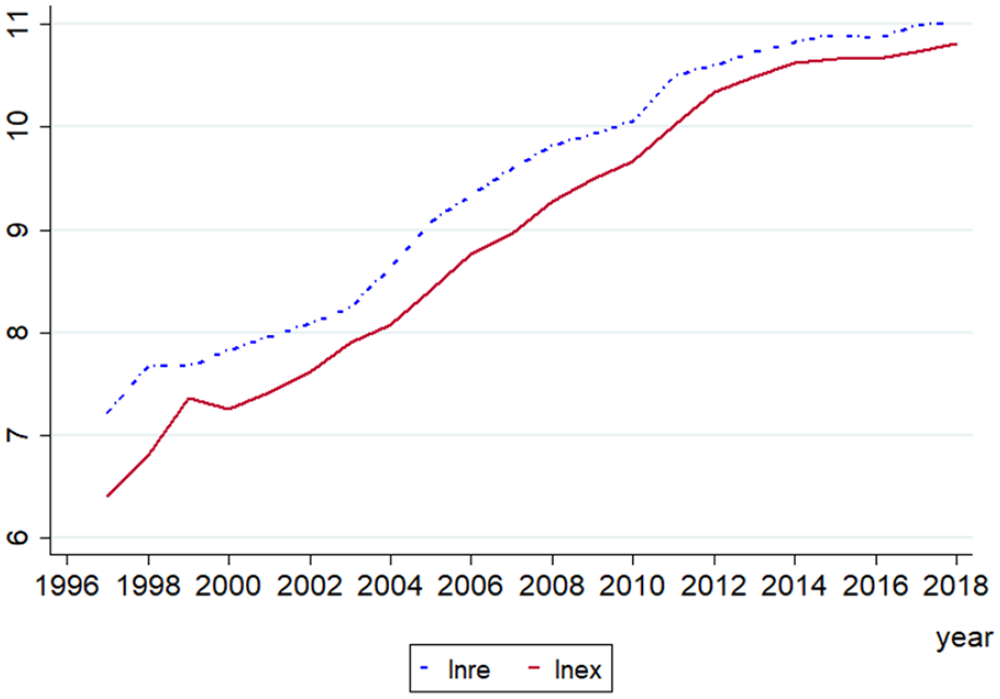
Revenue and expenditure (logarithm) of WII Fund.
However, after taking the first-order difference, both revenue and expenditure show a relatively similar trend of random changes (Figure 6).

First-order difference diagram of revenue and expenditure of WII Fund.
Result
ADF Unit Root Tests
The results of the unit root test using the ADF method are shown in Table 2. The ADF value of the original horizontal sequence of lnre and lnex is larger than the MacKinnon critical value, and the ADF value is less than the MacKinnon 5% critical value after the first-order difference. Therefore, lnre and lnex are nonstationary and I(1).
Results of ADF Test.

Note. Regarding the model specification for each test, “C,” “T,” and “L” denote the “constant,” “linear trend,” and “Lags,” respectively. ADF = augmented Dickey–Fuller.
Cointegration Analysis
First, the cointegration regression of lnre and lnex was carried out, and the cointegration equation was obtained according to the WII Fund’s principle of determining fund revenue according to expenditure.



The regression coefficients of Model (1) are very significant.
Second, the stationarity test of the residual series et of cointegration Model (1) was carried out. The test form is (0, 0, 0), ADF = −3.499684, 1% critical value is −2.679735, so the residual sequence is stable. Therefore, there is a long-term equilibrium and cointegration relationship between the revenue and expenditure of China’s WII Fund.
ECM
Thus, we can establish the long-term equilibrium model as follows:

We can establish the ECM as follows:

The ECM reflects the short-term relationship of variables, whereas the error correction term reflects the long-term relationship of variables. The regression coefficients in Model (3) are significant. The coefficient of error correction term is negative, which conforms to the reverse correction mechanism. It can be understood that when the short-term fluctuation deviates from the long-term equilibrium, the nonequilibrium state will be pulled into equilibrium with an adjustment force of 0.702043. The goodness of fit of the model is acceptable, and there is no autocorrelation.
EG Causality Test
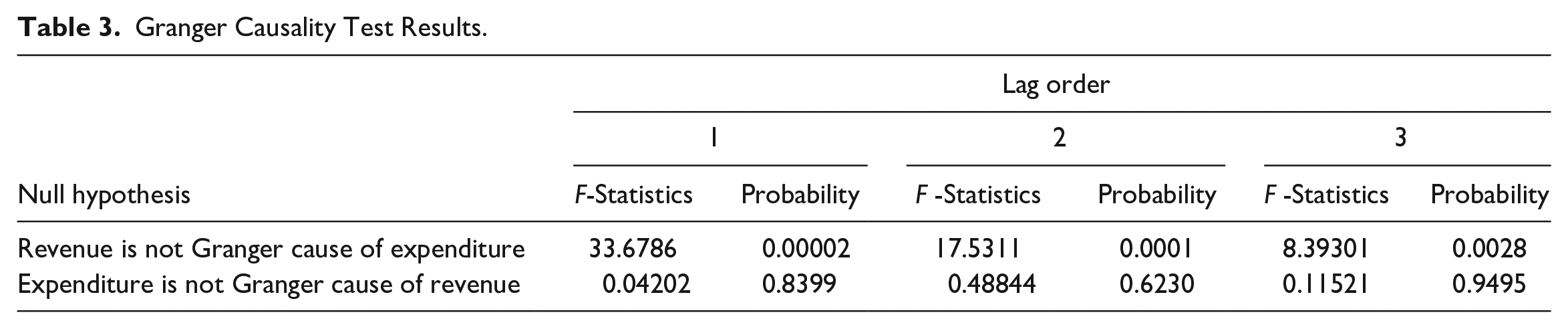
Because both lnre and lnex are I(1) processes and have a cointegration relationship, the Granger causality test can be used to test them. The Granger causality test results (Table 3) show that, in the case of lag order of 1 to 3, the null hypothesis “revenue is not Granger cause of expenditure” passed the Granger causality test on 1‰ significance level, that is to say, the revenue is the Granger cause of the expenditure. The change of the revenue can be used to explain and predict the change in expenditure. However, the null hypothesis “expenditure is not Granger cause of revenue” did not pass the Granger causality test, meaning that expenditure is not Granger cause of revenue.
Granger Causality Test Results.
Discussion
The stability test of time series of WII Fund revenue and expenditure in China from 1997 to 2018 shows that the fund’s revenue and expenditure are nonstationary variables, but have a long-term dynamic equilibrium relationship. On average, if expenditure increases by 1%, revenue would increase by 0.8952%.
The ECM shows that, in the short term, there is a significant positive correlation between the revenue and expenditure of China’s WII Fund. If expenditure increases by 1%, revenue would increase by 0.8397% in the same direction. That is to say, the elasticity of fund revenue to expenditure is 0.8397, that is, less than 1, because the increase of fund expenditure is greater than that of revenue in the short term. The estimated coefficient of the error correction term is −0.7020, which conforms to the reverse correction mechanism. This shows that when the revenue of the WII Fund deviates from the long-term equilibrium level, the nonequilibrium state will be brought back to equilibrium state with a 70.2% adjustment.
The Granger causality test results show that there is a long-term equilibrium relationship between fund revenue and expenditure, that revenue is the Granger cause of expenditure, and that this effect is unilateral. In China, the government’s plan is to raise funds for WII to pay for expenses, which is the principle of income determined by expenditure mentioned earlier. Our analysis actually shows that it is revenue that determines expenditures, not the other way around, which is counterintuitive. This is therefore a problem in the approach taken so far by China (an approach founded on long-term planning and prudent financial management).
Of course, due to it being only quite recently established, and then progressively developed in recent years, China’s WII Fund and the WII system itself lacks stability. Other factors which affect the ability of the WII system to work effectively include high levels of monetary accumulation, a conservative management style, and slow and sometimes incomplete public disclosure. In the future, effective amendments must be made to the system in line with the principle of determining fund expenditure according to revenue. The WII Fund is the fundamental guarantor of the smooth development of the WII system. At present, China’s WII Fund is facing three major changes and challenges, which will have an important impact on its sustainable development and balance of payments. These three changes and challenges must be monitored and engaged with directly in the future.
First, the State Administration has required that the provincial-level coordination of the WII Fund must be fully realized by the end of 2020. At present, only four municipalities and seven provinces have implemented the provincial-level coordination of the WII Fund, whereas most regions have essentially achieved only city-level coordination. Wherever the overall level of management is poor, the size of regional funds is relatively small, and therefore, the ability to withstand uncertain risks is limited. The implementation of provincial-level coordination can effectively expand the scale of the fund, narrow the gap between regional funds, and enhance the ability of the WII Fund to disperse accident risk. The implementation of provincial coordination is also conducive to improving the efficiency of fund use because it will no longer be necessary for each region to establish a separate reserve fund. As such, this is conducive to balancing the level of interregional funds and improving the efficiency of fund use.
Second, as part of its 2015 reform aimed at reducing the burden on enterprises nationwide, the State Council also decided to adjust and reduce the social insurance premium rate, including the WII premium rate. The balance of the WII Fund is required to be kept at a reasonable and appropriate scale. In areas with high accumulative fund balances, measures such as the timely adjustment of specific standards of industry benchmark rates or a reduction in rates should be taken to reduce excessive fund balances. In 2016, the average premium rate of WII in China was 0.7%, showing a reduction from 0.85% in 2015.
Third, from January 1, 2019, the tax authorities at all levels will collect all kinds of social insurance premiums, including for WII, to achieve the “separation of revenue and expenditure” in social insurance. Previously, WII premiums were collected by social insurance institutions, which had limited authority. As a result, certain problems were common, such as unjustly depressed insurance base and incomplete collection. As the authority of the premium collectors is enhanced under the new legislation, the compliance rate of market participants will be greatly increased. This will likely have two results: In some sectors or industries, payments may well increase as they are more efficiently and diligently collected, but at the same time, this increase in revenue may lead to, overall, a further reduction in WII premium rates.
At present, the number of insured workers in China has reached 239 million, and the number of insured workers is increasing every year. The implementation of a higher level of overall management of the WII Fund and the reduction of the premium rate may affect the sustainable development and balance of revenue and expenditure of the WII Fund in China. The long-term security and effectiveness of WII are therefore facing a major new test.
Conclusion
From 1996 to 2018, we witnessed the continuous expansion of China’s WII insurance coverage and the constant adjustment of management methods. Fund revenue and expenditure are also in the process of long-term dynamic growth. The revenue and expenditure data of WII can be seen to be nonstationary variables, and there is a long-term dynamic equilibrium relationship between them. The important finding of this article is that although the financing principle of China’s WII Fund stipulates that “determining income by expenditure,” its expenditure is actually determined by income.
This counterintuitive finding reflects the lack of theoretical analysis and professional management guidance in the operation of China’s WII, as well as a culture of conservative decision-making and overly bureaucratic management. Such problems need to be addressed both in theory and in practice to protect the development and efficacy of WII in contemporary China. By analyzing the practical experience of WII Fund in China, this article suggests that a well-developed fund management system will ensure the sustainable development of WII. Meanwhile, the policy implications of this study are as follows. First, the management objectives of the WII system should be in accordance with “determining income by expenditure” principle. Second, premium rates of WII should match the income level of the WII Fund. Third, an optimized evaluation method will improve the long-term development of the WII Fund.
It can be expected that WII in China will continue to expand for a long time to come. It is worth noting that the current WII reform may profoundly affect the balance of fund revenue and expenditure. At present, the balance is relatively stable, but after the recent three major changes and challenges, the balance has shown a long-term downward trend since 2016. Close attention should be paid to keep track of and forecast the revenue and expenditure of the WII Fund so as to prevent the imbalance of the fund. In short, WII can still maintain healthy development in China, but the pressures in recent years have been relatively high and may lead to inherent systemic risks.
Footnotes
Acknowledgements
The authors acknowledge the National-sponsored Funding Program for Social Sciences of China.
Declaration of Conflicting Interests
The author(s) declared no potential conflicts of interest with respect to the research, authorship, and/or publication of this article.
Funding
The author(s) disclosed receipt of the following financial support for the research and/or authorship of this article: This work was supported by the National-sponsored Funding Program for Social Sciences of China (Grant No. 18BGL198)
